Fitbit’s founders have a new startup. Two years after leaving Google, James Park and Eric Friedman announced a new platform that shifts the focus from the individual to the family. They say the Luffu mobile app “uses AI quietly in the background” to collect and organize family health information.
“At Fitbit, we focused on personal health — but after Fitbit, health for me became bigger than just thinking about myself,” Park said in a press release. The app is particularly focused on the “CEO of the family” — the person who manages appointments, prescriptions and other health-related tasks.
But the definition of family isn’t limited to parents raising children. The company sees its tool as especially valuable for caregivers in their 40s and 50s who may be managing the needs of both aging parents and kids. It even tracks pets’ health habits.
“We’re managing care across three generations — kids at home, busy parents in the middle, and my dad in his 80s who’s living with diabetes and still wants to stay fiercely independent,” Friedman wrote. “And the moments that matter most are often the most chaotic: a late-night fever, a sudden urgent care visit, a doctor asking questions you can’t answer quickly because the details are scattered.”
The app’s AI includes a Morning Brief that recaps everyone’s health.
Luffu
The company claims the app’s AI “isn’t a chatbot layer.” Rather, it serves as a “guardian” — proactively monitoring for changes silently in the background. The AI then provides insights and triggers alerts when something is out of whack. You can also ask the app health data questions using plain language (so, there is some kind of chatbot) and share data with family members.
The company clearly wants to make entering data as easy as possible. Luffu allows family members to log info using voice, text or photos. It integrates with health platforms such as Apple Health and Fitbit. And the company eventually wants to expand into a hardware ecosystem — presumably, devices that make health data collection even easier.
Speaking of data collection, Luffu says, “Users are always in control of exactly what is shared, with whom, and privacy and security are paramount for all family data.” In addition, the company told Axios that users can choose whether their data is used to train its AI. On the other hand, Big Tech has repeatedly shown that its most egregious data-collection practices are always wrapped in comforting language. So, at the very least, I’d take their pitch with grains of salt and, most importantly, make sure each family member knows exactly what they’re consenting to. After all, this is a for-profit company, and we don’t yet know its monetization strategy.
Luffu is currently in a limited public beta. You can learn more and sign up for the waitlist on the company website.
This article originally appeared on Engadget at https://www.engadget.com/mobile/fitbit-founders-launch-luffu-a-way-to-integrate-your-familys-health-data-173251994.html?src=rss
For all the talk about Stranger Things taking nearly a decade to produce just five seasons of television, consider The Night Manager: It took this British spy thriller 10 years just to get to season two. Luckily, audiences seem to have been willing to wait, as they show performed decently in the streaming ratings when it dropped on Prime Video earlier this year.
There’s a reason viewers were anxious for more, even after such a long wait: Based on a John le Carré novel and starring Tom Hiddleston as Jonathan Pine, the series finds the manager of a luxury Cairo hotel running afoul of an Egyptian crime boss with ties to Dickie Roper (Hugh Laurie), one of the world’s wealthiest and best-connected businessmen. Roper is a wildly charismatic, entirely amoral arms dealer and Angela Burr (the flawless Olivia Colman) is a Foreign Office agent on a quixotic quest to bring him to justice. It’s crackerjack stuff.
While you’re waiting for a rumored third season, which hopefully won’t take a decade, here are 15 other spy thrillers to keep you occupied. Stream The Night Manager on Prime Video.
The Ipcress File (2022)
Len Deighton occupies a similar place in the literary spy canon as John le Carré, and here Joe Cole (Peaky Blinders) is cast as Len Deighton’s lead anti-hero, unnamed in the novels, but known as “Harry Palmer” in various adaptations going back to the 1960s. Set in 1963, this show sees Tom Hollander’s Major Dalby offer scrappy crook Palmer a deal: If he agrees to work as an intelligence officer, he’ll get a ticket out of military prison. Naturally, his first case, involving a missing nuclear scientist, expands into a globe-hopping espionage adventure with impeccable period vibes. Stream The Ipcress File on Prime Video.
The best spy dramas have a grounding in truth (or feel like they do), so it doesn’t hurt that A Spy Among Friends is based almost entirely on fact In the early 1960s, high-ranking MI6 operative Kim Philby (Guy Pearce) is revealed to have been a double agent, and is doggedly pursued by his former colleague Nicholas Elliott (Damian Lewis). The miniseries is framed around a particularly tense encounter between the two men, just as Elliott has been tasked with uncovering the details of his friend’s decades-long betrayal. Stream A Spy Among Friends on MGM+ and Britbox.
This genre-bender has been a bit of a hit for Netflix—enough to have earned a second-season renewal. Keira Knightly stars as Helen Webb, wife of the Secretary of State for Defence of the U.K., and a secret spy in the employ of the mercenary spy organization of the title. She learns from her handler (Sarah Lancashire) that her lover has been killed, thus potentially blowing her cover, but luckily she has a hitman bestie (Ben Whislaw) to help her out. It’s all deliberately pulpy, with a tongue-in-cheek self-awareness that lightens the tone. Stream Black Doves on Netflix.
Cinematic in scope, this new adaptation of the Frederick Forsyth novel is buoyed by brilliant casting: Eddie Redmayne plays the Jackal, a steely international assassin pursued by MI6 operative Bianca Pullman, played by Lashana Lynch (putting her experience as the new 007 in No Time to Die to good use). I’m not sure there’s anything here we haven’t seen in countless other spy thrillers (including, of course, the 1973 and 1997 film adaptations), but the performances and production values are top-notch, with each episode playing out like a tense mini-movie. Stream The Day of the Jackal on Peacock.
With nods to the great spy dramas of John le Carré, Slow Horses updates the setting without losing the thrills or the style of a time-honored genre. The “Slow Horses” of the title is a group of has-been (and never-were) MI5 agents—they’ve all made messes of their jobs, but are still seen as having some use, if only in dull administrative tasks. Naturally, the group (lead by Gary Oldman’s brilliantly crude, flatulent Jackson Lamb alongside foil and spymaster Diana Taverner, played by Kristin Scott Thomas) finds themselves in deeper waters than anyone had expected of them. An adaptation of Mick Harron’s novel series, the show has a sly sense of humor, balancing a cynical tone with a conviction that redemption is possible, if not easy. Stream Slow Horses on Apple TV+
South Korean filmmaker Park Chan-wook (Decision to Leave, No Other Choice) directs this series, based, like Night Manager, on a John le Carré novel, bringing an undeniably sexy period style into the mix. Florence Pugh is Charlie, a young actress recruited by Mossad spymaster Martin Kurtz (Michael Shannon) to infiltrate a group of Palestinian terrorists, even as she’s being manipulated by an Israeli intelligence officer (Alexander Skarsgård). Crucially, like the book, the show offers nuanced characters on multiple sides of the conflict, raising serious questions about who the real villains are. Stream The Little Drummer Girl on AMC+ or buy it from Prime Video.
Michael Fassbender stars here as “Martian,” the codename for Brandon Colby, a former undercover CIA agent just returned to London after six years in Sudan. He’s left behind a lover, Dr. Samia Zahir (Jodie Turner-Smith)—a relationship he wasn’t terribly forthcoming about with his handlers. When Sami turns up in London as part of a diplomatic delegation, Martian is forced to choose between his job and his personal life, which becomes more complicated when it appears that she’s involved in a broader scheme involving the Sudanese government, MI6, and an undercover agent in Belarus. It’s all very twisty-turny in the best tradition of spy shows, with a great cast: Jeffrey Wright plays Martian’s boss and mentor; Richard Gere, the CIA London Station Chief; and Downton Abbey‘s Hugh Bonneville, a shifty senior MI6 operative.Stream The Agency on Paramount+.
It’s late 1987, and university students Yeong-ro (Jisoo) and Soo-ho (Jung Hae-in) meet-cute in a coffee shop. She’s an English Lit student, and he’s an Economics grad student—or so he says. The story starts to crumble when he shows up in Yeong-ro’s dorm room covered in blood. She thinks he’s a pro-democracy protester hiding from the police, but actually, he’s a North Korean spy sent to bring a professor back with him. The show earned itself a fair bit of controversy for suggesting that the struggle which lead to South Korean democracy was infiltrated by spies, but history notwithstanding, it’s an effectively heart-wrenching spy drama. Stream Snowdrop on Disney+.
Nabhaan Rizwan plays Raza Shar, a young British Pakistani Londoner with a shady past (and present) who’s coerced by Paddy Considine’s DS Gabe Waters into signing on to become a police informant, part of a large network employed by the show’s imagined counter-terrorism organization. A known terrorist was killed just recently, but it soon becomes clear that he might have trained a number of other extremists before he died. It’s a tense, fast-moving show that, like The Night Manager, places a reluctant spy in the foreground. Stream Informer on Prime Video and Britbox.
This one isn’t a spy drama, and generally favors a lighter tone than The Night Manager, but the two shows share a key common thread: each is about a charismatic but otherwise awful rich guy, and a government agent who is determined to stop them. Paul Giamatti plays attorney Chuck Rhoades (based, a bit, on the real-life Preet Bharara), who is working to bring down shady hedge fund manager Bobby Axelrod (Damian Lewis). Even without actual espionage, the moves and countermoves make the whole thing feel like a similarly elaborate chess game. Stream Billions on Paramount+.
In addition to, or instead of, The Agency, try Le Bureau des Légends, the French original on which it’s based (they’re similarly addictive, though many will prefer the original on principle). Same general premise: Mathieu Kassovitz stars as Guillaume Debailly, a spy just recently returned from a six year undercover mission in Damascus. As he’s trying to readjust to his old life, everything is thrown into turmoil when Nadia (Zineb Triki), the woman with whom he’d been in a relationship in Syria, turns up in Paris. Over the course of five seasons, the show excelled at dealing with day-to-day life for its intelligence workers. It’s not all thrilling spy escapades, and that’s very much an advantage. Stream The Bureau on Paramount+.
Though the focus shifts a bit after the first few seasons, Homeland begins as a tense espionage thriller, as CIA case officer Carrie Mathison (Claire Danes) begins to suspect that that decorated Marine Corps scout sniper Nicholas Brody (Damian Lewis), recently rescued from an al-Qaeda compound, has been turned by his captors and is planning a terrorist attack on the United States. Given she’s been diagnosed with bipolar disorder, her superiors don’t give Mathison’s suspicions much credence, forcing her to go rouge in what turns into a cat-and-mouse/is-he-or-isn’t he? game between the two. Both leads won Emmys for their performances, and the series took the Outstanding Drama prize in its first year. If it pulls a few too many punches at the tail end of the first season, it makes for a compelling watch. Stream Homeland on Hulu and Netflix.
Blending spy and detective tropes (and based on a series of novels by Mick Herron, of Slow Horses fame), this one stars Emma Thompson as hard-living, hard-drinking private investigator Zoë Boehm. She’s hired by Ruth Wilson’s Sarah Trafford, a married art restorer who nobody takes very seriously (including her husband), even when she becomes invested in the fate of a young girl whose family is killed in an alleged gas explosion down the street. The girl, whose parents have died, disappears into the foster system, and no one really seems to care—until Sarah hires Zoë and her husband to look into it. Soon, both women are in way over their heads, as the missing girl points to a much broader government conspiracy. Stream Down Cemetery Road on Apple TV+.
A bit lighter in tone than The Night Manager and shot through with a vein of black comedy that wouldn’t feel out of place in a Coen brothers movie, Patriot is the story of a beleagured intelligence officer who just cannot catch a break. Michael Dorman is John Tavner, tasked with ensuring that the leading candidate for the presidency of Iran doesn’t win. An elaborate plan to support a more moderate rival candidate sees him taking on a non-official cover identity and getting a job at a Milwaukee piping firm. After he blows the interview, he needs to eliminate his hapless competition for the job, then he needs to borrow urine for the drug test, which winds up exposing him to extortion, etc. etc. As the screwups began to stack one on top of the other, John’s situation becomes ever more precarious (and darkly hilarious—his musical talent means that a lot of exposition comes in the form of extremely specific folk songs that he performs under yet another assumed name). Stream The Patriot on Prime Video.
The juicy imported political thriller stars Alec Secăreanu (God’s Own Country) as Victor Godeanu, a Romanian ministry director and friend to dictator Nicolae Ceaușescu (the show takes place in 1978, and is based on a true story). Godeanu is also working for the Soviets and, with his cover about to be blown, decides to defect to the United States. When Ceaușescu sends agents to kill him, the intelligence agencies of five countries become tied up in the defection drama. Stream Spy/Master on HBO Max.
Arrow Lake is the codename for Intel’s Core Ultra 200 series processors, which are currently its latest-generation desktop CPUs despite that they’ve been somewhat superseded by the Core Ultra 300 series on mobile. Before we receive the truly next-generation Nova Lake processors on a new platform later this year or early next year, we’re expecting
In time for next month’s GNOME 50 release are some improvements merged today for the Mutter compositor code adding HiDPI and monitor mode emulation support to the screen-casting API and DevKit…
YouTube has confirmed that it is blocking background playback — the ability to keep a video’s audio running after minimizing the browser or locking the screen — for non-Premium users across third-party mobile browsers including Samsung Internet, Brave, Vivaldi and Microsoft Edge.
Users began reporting the issue last week, noting that audio would cut out the moment they left the browser, sometimes after a brief “MediaOngoingActivity” notification flashed before media controls disappeared. A Google spokesperson told Android Authority that the platform “updated the experience to ensure consistency,” calling background play a Premium-exclusive feature.
So you’ve decided you need a virtual private network to hide your browsing activity from your ISP, change your virtual location, stay safe on public Wi-Fi and enjoy all the other benefits. The inevitable next question is: “Should I pay for one? If so, how much?”
All the best VPNs cost money, but it can be hard to tell an overpriced service apart from one that’s priced according to its value. On this page, I’ll share the costs for top VPN services, calculate the industry average and explain what makes VPNs cost as much as they do. At the end, I’ll share a few tips for making a VPN fit your budget.
How much is a VPN?
I’d like to start by introducing the complexity of the problem. If you just want the numbers, you’ll find those in the sections below.
The main thing that makes VPNs so hard to budget for is that providers aren’t always honest about how much they’re charging. They rarely lie outright, but they often overcomplicate their pricing structures and hide increases in the fine print.
Let’s take CyberGhost as an example, since I just reviewed it. A one-month subscription to CyberGhost costs $12.99 — simple enough. However, you can also get a six-month subscription by paying $41.94 upfront, though the website more prominently calls this “$6.99 per month.” Finally, you can pay $56.94 for a 28-month subscription, but only once; after that, it’ll be $56.94 for a year.
These prices are subject to change.
Sam Chapman for Engadget
As you can see in the image, the website heavily emphasizes the average monthly price, in text that dwarfs the actual price you’ll pay at checkout. This gets even worse with services like NordVPN that have multiple tiers of subscription as well as multiple durations. It’s not uncommon to see 10 or more prices quoted for the exact same VPN.
The best way to cut through the confusion and shop on your own terms is to compare different VPNs at the same duration and subscription tier. For example, you could find the cost of one year of the most basic available plan, since most basic subscriptions still include full VPN service. In the next two sections, I’ll compare and average the basic tiers of my top seven VPNs at the monthly and yearly levels.
Average monthly cost of a VPN
Here’s what the best VPNs cost per month. The numbers below are for subscribing to one month at a time, excluding any discounts and special deals.
Proton VPN: $9.99
ExpressVPN: $12.99
Surfshark: $15.45
NordVPN: $12.99
CyberGhost: $12.99
Mullvad: $5.98 (depends on dollar/euro exchange rate)
As you can see, $12.99 is a normal price for one month of a VPN — but the average price is somewhat lower, as several providers sell monthly plans for less. In general, expect to pay in the range between $10 and $13. Companies like Surfshark sometimes inflate their monthly prices in a bid to drive more traffic toward the longer plans.
Mullvad is also an outlier, since you can only ever subscribe to it month-by-month. There are other outliers, such as Astrill, which costs a whopping $30 per month. But the above holds true for all the best-regarded providers.
Average yearly cost of a VPN
If you choose to sign up for a year at a time, you’ll probably save money but you’ll have to pay more upfront. VPNs offer long-term deals to pump their cash flow and active user numbers. One-year costs for the top seven VPNs are written below as a lump sum, since several of them add extra months to the first subscription period so they can quote a lower monthly price. Since CyberGhost doesn’t have a one-year plan, I’ve replaced it with Windscribe.
Proton VPN: $47.88
ExpressVPN: $52.39 for the first subscription, $99.95 afterwards
Surfshark: $47.85
NordVPN: $59.88 for the first subscription, $139.08 afterwards
Windscribe: $69.00
Mullvad: $71.82 (depends on dollar/euro exchange rate)
hide.me: $54.99
Average: $57.69
For one year of a VPN service, you can expect to pay somewhere between $45 and $70. Note that at least two services, ExpressVPN and NordVPN, raise prices after the first year, so account for that in your budget if you really like them.
Why do VPNs cost so much?
The length of the subscription is the biggest factor in determining how much you’ll pay. Beyond that, it’s all a bit fuzzy. Commercial VPNs are still a relatively new industry, so there’s not a lot of standardization in the pricing.
Most of the variation in cost comes from competition: VPNs value themselves lower to offer a better deal than their rivals, or higher if they think they’ve got a unique differentiator. Astrill gets away with charging $30 a month because of a widespread belief that it’s the best VPN for China (in truth, no VPN can be sure of working in China 100 percent of the time).
Another factor that might influence a VPN’s price is the cost of maintaining its infrastructure. For each new server location, the provider has to either rent space in an existing data center, build its own physical server farm or set up a virtual server with an IP address from a particular location.
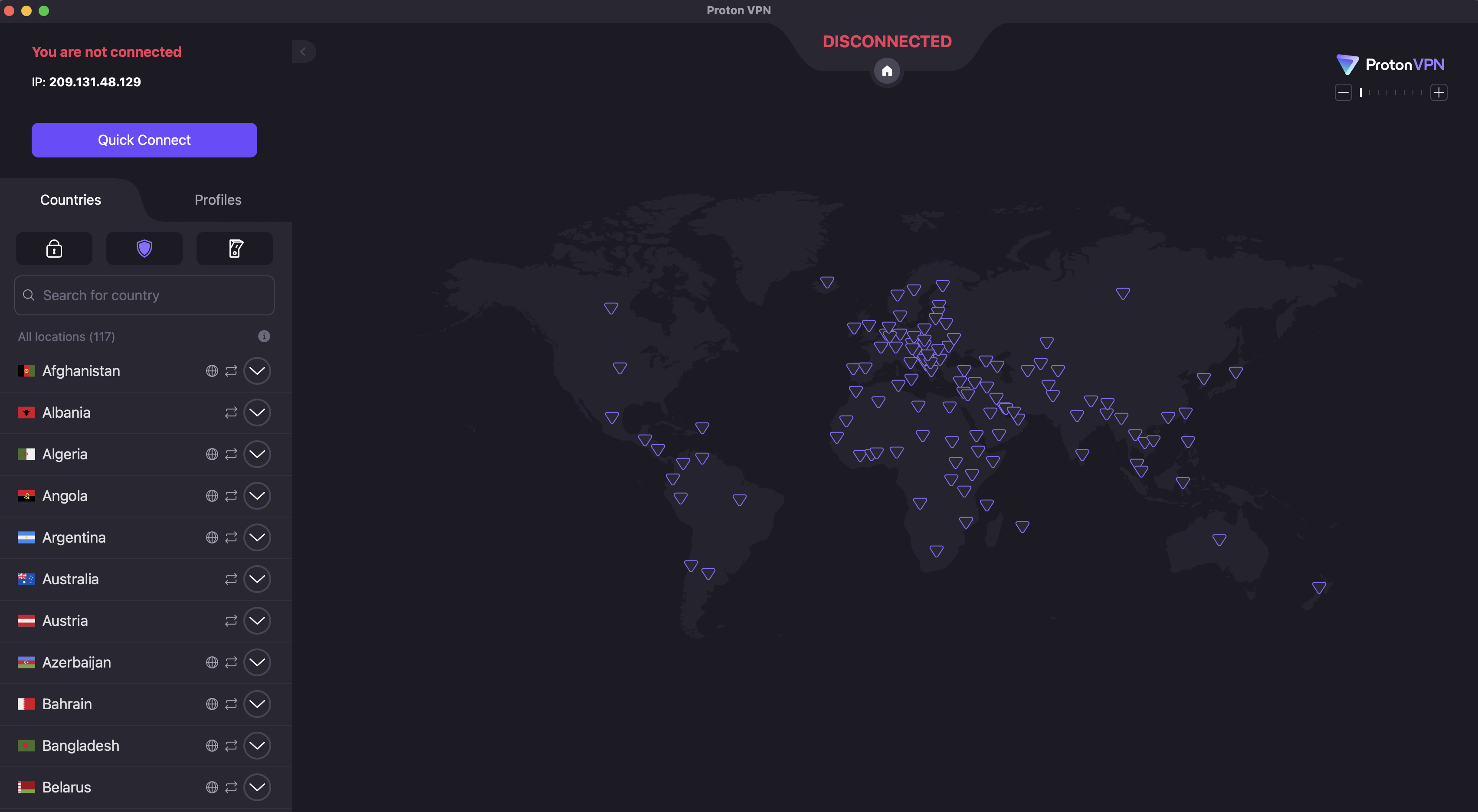
On Proton VPN, for example, you can switch locations by clicking the name of any country in the list on the left.
Sam Chapman for Engadget
Once the locations exist, they have to be maintained, including regular changes to their IP address so firewalls don’t identify and block them. Loads at locations need to be balanced between servers and technology has to be upgraded as faster solutions become available.
Since VPNs can have hundreds of server locations, all that upkeep doesn’t come cheap, and customers often eat the cost. Factor in the price of extra features outside core VPN functionality and you’ll understand why these companies are so desperate for liquidity that they’ll offer discounts over 80 percent — as long as you hand over a lump sum right now.
What about free VPNs?
VPNs can get pricey, especially if you want high quality. But some VPNs charge nothing at all. Is there any reason not to go with free VPNs every time?
The answer is a pretty clear yes; paying for a VPN is almost always a better idea. When we rounded up the best free VPNs, only three got our unqualified recommendation. All three were paid services with free plans, and all come with strict limitations on server locations, data usage and other privileges.
The unfortunate reality is that free VPNs come with downsides no matter which one you use. Plenty of them are hacked-together apps with little value, thrown together to make a quick buck. Others turn you into the product by selling your data to advertisers or renting out your home IP address. Some drop any pretense and plant malware directly on your device.
These risks, which are often invisible to the end user, are the reason I almost always advise going with a free VPN funded by a paid plan, like Proton VPN, hide.me or Windscribe. Those plans may be restricted, but at least the provider’s motives are out in the open: they make money off the paid plan and they want you to switch to it.
How to save money on a VPN
If you’ve decided to pay for a VPN but want to stretch your budget as much as possible, the tips below can push your cybersecurity dollar a bit farther. To begin with, the general advice on choosing a VPN always applies: read expert opinions, check the reviews and use the free trial to test its speed and security.
Get a long-term plan. If you’re confident that you’ll actually use the VPN for the whole duration, there’s no reason not to go with a 12-month or 24-month subscription. These are win-win deals that genuinely do save you a lot of money overall.
Cancel auto-renewal. VPN accounts are set to automatically renew by default. In some cases, this can inadvertently lock you into a higher-priced long-term plan. I recommend cancelling auto-renew right after subscribing even if you’re sure you want to continue. From there, you can create a new account to get the introductory rate again — or go with a different VPN to get a better deal.
Look for resubscription deals. Another perk of cancelling immediately is that the VPN will often try to woo you back with exclusive discounts. Stay strong until your subscription is a month or two from expiring, then look for emails offering better rates.
Wait for seasonal discounts. If you can hold off until November, most VPNs offer steep discounts from Black Friday season all the way through New Year’s. Check around other holidays too, as VPNs will take any excuse for marketing; CyberGhost is offering a Valentine’s Day deal as I type this. We also keep track of the best VPN deals you can get at any time of the year.
Use the VPN to save money on streaming. Most streaming services are more expensive than VPNs. If you use a VPN to access more content without adding a new streaming subscription, you’ll come out ahead. For example, if you only have Netflix but want to watch Schitt’s Creek, you can pay $16.99 per month for Peacock without ads — or $9.99 per month for Proton VPN to unblock Netflix Canada, which features that show.
Shop for regional discounts. Like the previous point, this won’t save you money on the VPN itself, but might save you enough money on other expenses that you turn a profit. Changing your virtual location can get you discounts on purchases where prices vary by region, especially travel costs.
This article originally appeared on Engadget at https://www.engadget.com/cybersecurity/vpn/how-much-do-vpns-cost-170000567.html?src=rss
Trigger warning: I’m going to write about the upcoming midterm elections—but if it helps, I’m not going to be partisan about it. This should be a pretty straightforward topic, but lately social media has been rife with speculation that the upcoming midterm elections will somehow be canceled. And while election-related fear-mongering is hardly new, it’s usually a dull buzz. This year, whether you blame exponential cultural polarization, social media echo chambers, or the rain, election-cancelation fears have grown into an unmistakeable roar.
It’s alarming to be sure. But are the people who are worried about this stuff wrong, or was 2024 actually the last “free and fair” American election? To get some answers, I talked to attorney Chad Peace, an expert in U.S. elections law and a legal advisor to the Independent Voter Project, a non-partisan non-profit organization devoted to encouraging voters to participate in the electoral process. I started by asking Peace point-blank how likely he thought the chances are of the midterms being outright canceled. “Pretty close to 0% would be my guess,” he says.
Who runs midterm elections? (It’s not the federal government.)
The unlikelihood of midterm election cancelations comes down to how they’re structured. Under the U.S. Constitution, states run their own midterm elections and are required by law to hold them every two years. While the Constitution and federal laws provide a general framework for how the midterms should work, their actual administration is handled by state and local governments. It is a highly decentralized process, and that’s by design. “It’s very clear in the Constitution that the states have the control over the time, place, and the manner of elections, and the reason it’s so clear is to prevent the very concerns that we’re [seeing] right now,” Peace says.
Chad and I discussed several hypothetical scenarios (if not outright conspiracy theories) about how the elections might be canceled. To make this part of our conversation more scannable, I’m going to present it in Q&A format, with my questions in bold and Chad’s responses in regular text. Remember, these are just the facts.
Does the president have any authority cancel midterm elections?
There could be some executive authority to change [election] rules, but there’s not really any executive authority to cancel them.
What about an executive order? Can that cancel elections?
I’d be hard pressed to find an executive order that’s gonna cancel elections or really be enforceable against the states. At the end of the day, the states have extraordinary authority to conduct elections.
What if the government declares martial law?
Even under martial law, the states are going to conduct elections. Will it be an interesting situation? Yes. I don’t think it’s going to come to that level, but even during the Civil War, we had elections.
Does declaring martial law pause the Constitution?
No.
Does the president certify the winners of midterm election?
No.
Does Congress have a way to cancel midterm elections?
There’s no way to cancel them. Congress can do a lot of stuff, but at the end of the day, it’s very clear in the Constitution—and there’s a reason it was so clear—that the states have control over the time, place, and the manner of elections.
Could a state cancel its own midterm elections?
It would [also] be pretty hard for a state to cancel [its own] midterm elections. Could they have emergency authority and say, “we really need to postpone”? Yes. [There’d be] a fight, but eventually you’re going to have to have elections. Historically and constitutionally and within the laws of most states, elections will go on. Whatever side you’re on politically, I’m pretty sure the American electorate isn’t ready for elections not to be held. That’s pretty fundamental across voter ideology.
OK, they’re not going to cancel midterm elections, but…
The narrow question of whether midterm elections will be canceled in 2026 has an easy answer: no. But that doesn’t mean the 2026 election cycle will necessarily be “normal.” There’s no way to predict how midterm elections might be affected by various congressional, state, or federal actions, and this uncertainty is the real fuel for the cancelation rumors. “The real concern is what level of legitimacy do our elections have?” Peace says. “I don’t think we’re at the point where we’ve lost all legitimacy, and people are saying ‘these people aren’t really our leaders.’”
No matter where you are on the political spectrum, these are strange times. But they aren’t the first strange times the nation has ever experienced. “Every time has its uniqueness, but I don’t think [our current political climate] is totally unprecedented,” Peace says. He points to the protests during the Vietnam War as another, fairly recent example of significant political shifts in the U.S. “It reoccurs all the time in our history. It happens when you see significant political shifts and realignment.”
No one knew how the Civil War or the great Depression would end while they were happening, but elections still occurred, and we’re still here. “America and our electorate have had an amazing way of coming back to a place where we make it [through]. We make it, and we move on,” Peace says.
What to do if you’re stressed out about the midterm elections
If you’re freaking out about the legitimacy of our upcoming elections, doomscrolling social media probably won’t help, but volunteering might. “Get involved. Go to your local registrar and say, ‘I want to be an election observer,’” Peace says—particularly if you’re non-partisan. “A non-partisan, independent person who is involved and aware and observing the facts on the ground, I think, has an incredible effect on assuring the electorate that things are legitimate and fair.”
A gratuitously off-topic fun fact about elections expert Chad Peace
Along with having an epic name and being an expert in US election law, Chad Peace is the executive producer of upcoming film Attack of the Killer Tomatoes: Organic Intelligence. This gives him way more credibility in my eyes.
Stop me if you’ve heard this one before. Disney has announced a successor to outgoing CEO Bob Iger, effective in March. Josh D’Amaro, current chairman of Disney Experiences, was tapped for the role in a unanimous vote by the company’s board of directors.
D’Amaro has been at Disney for 28 years, where he oversaw theme parks, cruises and consumer products including video games. The company had previously appointed Bob Chapek, the Disney Parks chairman at the time, as successor to Bob Iger in 2020. At the time, Iger had served as CEO since 2005. But Chapek only lasted until 2022, when Bob Iger returned to take the helm once again amid company struggles. Disney formed a committee to find an appropriate successor in 2023, with Iger mentoring potential candidates along the way.
Iger’s time at the helm saw the media giant make a number of significant moves such as launching the Disney+ streaming service, buying Hulu and acquiring 20th Century Fox’s film and television studios. Iger will continue to serve as a board member and senior advisor until his retirement at the end of the year.
This article originally appeared on Engadget at https://www.engadget.com/entertainment/disney-announces-josh-damaro-will-be-its-new-ceo-after-iger-departs-161616420.html?src=rss
Microsoft has revealed the first wave of Xbox Game Pass additions for February, and it feels like there’s a bit of something for everyone this time around. Two of the titles land on the service today across the Game Pass Ultimate, Premium and PC Game Pass tiers: Final Fantasy II (cloud, Xbox Series X/S and PC) and Like A Dragon: Pirate Yakuza in Hawaii (cloud, console, handheld and PC). Final Fantasy II is a “remodeled 2D take” on the classic 1988 RPG, while Pirate Yakuza in Hawaii is a wild-looking spin-off of the main Like a Dragon series with pirates and naval combat.
Madden NFL 26 is hitting Game Pass Ultimate and PC Game Pass across cloud, console and PC on February 5, so subscribers will be able to get in a few virtual downs before the Super Bowl on Sunday at no extra cost. Paw Patrol Rescue Wheels: Championship will join the Game Pass Ultimate, Premium and PC Game Pass lineups on the same day across cloud, console, handheld and PC.
On February 10, a game I’ve been looking forward to, Relooted, joins Game Pass Ultimate and PC Game Pass on cloud, Xbox Series X/S and PC. I really enjoyed the demo of this heist game, in which the goal is to recover African artifacts from Western museums. Two days later, you can check out BlazBlue Entropy Effect X, which is a 2D roguelite action game set in the BlazBlue universe, on Game Pass Ultimate and PC Game Pass (cloud, Xbox Series X/S and PC).
Also on February 12, Roadside Research will become available in game preview on cloud, Xbox Series X/S and PC on Game Pass Ultimate and PC Game Pass. This is a co-op (or solo) game for up to four players in which you run a gas station as a group of aliens. You’ll examine humans and try to gather as much data as you can without raising suspicion and a potential visit from the feds. The aliens’ disguises, as shown in the trailer, are pretty funny.
A third game is on the docket for February 12, with life sim Starsand Island arriving on Game Pass Ultimate and PC Game Pass (cloud, Xbox Series X/S, and PC). A day later, High on Life 2 lands on the same tiers and platforms with a whole new bunch of strange, talking weapons. That’s a day-one addition to the line up. Also on February 13, Kingdom Come Deliverance will become delivered to Game Pass Ultimate, Premium and PC Game Pass across cloud, console and PC.
On February 17, you can embrace your inner Na’vi in Avatar: Frontiers of Pandoraon cloud, Xbox Series X/S, handheld and PC on Game Pass Ultimate and PC Game Pass. I quite enjoyed my initial hands-on with the game, but I haven’t jumped into the full version as yet.
This article originally appeared on Engadget at https://www.engadget.com/gaming/xbox/februarys-xbox-game-pass-additions-include-high-on-life-2-madden-nfl-26-and-avatar-frontiers-of-pandora-160656985.html?src=rss
The Dyson PencilVac stick vacuum is finally available for purchase in the US after being revealed in the first half of last year. It costs $600. The company says this is the “world’s slimmest vacuum cleaner.” We haven’t broken out any rulers to confirm that statement, but it’s certainly a ridiculously thin stick vac.
It achieves this thinness by using a motor inspired by the company’s Supersonic hair dryer. This is a small motor that can actually rest in the shaft, so there’s not a noticeable bulge where the components have been placed. This stick vacuum is actually, well, a stick. Just take a look at it.
Dyson
It does come with attachments that increase the size a bit. For instance, the conical brush bar cleaner head makes it resemble a traditional stick vacuum. However, everything else is in the long cylinder. This includes the bin, filter and motor.
Other attachments include something called the “Fluffycones” cleaner head. This has four cones in two brush bars that rotate in opposite directions to “strip and eject even long hair, preventing hair tangling around the brush bar.” There are also lights at both ends to help illuminate any lingering dust particles.
Dyson
It weighs nearly four pounds and features the same diameter throughout. This makes it easy to grip anywhere along the body, which can help with overhead cleaning. It ships with a swappable battery pack that lasts for around an hour and there’s a magnetic charging dock to get things juiced up.
The vacuum works with the MyDyson app, which lets users check on battery life and adjust settings. Some of this information is also displayed on the LCD screen at the top of the handle.
We got a chance to try it out last year and came away impressed. The motor is plenty powerful, despite the diminished size, and the device was easy to maneuver. If you have $600 to spare and a dirty home, this could be a good purchase.
This article originally appeared on Engadget at https://www.engadget.com/home/the-dyson-pencilvac-is-finally-available-and-costs-600-160059016.html?src=rss
Identity thieves are now using college enrollment to take out student loans in victims’ names. This so-called “ghost student” scam capitalizes on limited verification for online class sign-ups and the federal aid application process to steal millions in funds while assigning the debt to unsuspecting targets.
I personally have been a victim of this scam, which I discovered only after an outstanding student loan debt landed on my credit report in 2024. Here’s how the scheme works.
‘Ghost student’ scam relies on stolen identities
To run this scam, fraudsters use stolen or fake identities to enroll “ghost students” in online classes while also applying for federal student aid, including Pell grants and loans. Of course, they never actually attend those classes, instead disappearing with the money and placing the resulting financial burden on the individuals and schools they’ve conned.
In my case, scammers had used just enough accurate personal information to “enroll” at a community college in southern California and take out a Pell grant in my name. However, because the enrollment was fraudulent, the grant was considered overpaid and sent to collections via the U.S. Department of Education—which is how it landed on my credit record.
According to the U.S. Department of Education’s Office of Inspector General (OIG), this type of fraud blew up with the shift to online and remote learning, particularly at community colleges that offer open enrollment (and generally engage in limited verification of applicant information). Increasingly, AI tools also likely help scammers to expand their reach with enrollment and loan applications and get past identity verification checks.
The scheme has affected schools across the country. In California alone, nearly a third of all applicants to community colleges in 2024 were identified as fake. A handful of individuals have been sent to prison after stealing millions in “ghost student” financial aid, but the OIG still has 200 investigations open.
For individuals targeted by the ghost student scam, the consequences are essentially the fallout of identity theft, such as debt falsely assigned to you that negatively affects your credit or the inability to get legitimate student loans (or any other type of credit) when you actually need them.
It also forces you into a long and arduous process of disputing the fraud: I spent several months going back and forth between the Department of Education, the community college, the credit bureaus, and an attorney to track down the fraudulent applications, file identity theft reports, provide extensive documentation proving that I wasn’t responsible for the debt, and get the information removed from my record.
How to protect your identity from student loan fraud
Unfortunately, the ghost student scam circumvents a standard anti-fraud safeguard because most federal student aid doesn’t require a credit check. (My credit record had been frozen for years, and still was at the time that this fraud took place.) While you should absolutely freeze your credit and thaw it temporarily only when needed, this step may not prevent bad actors from using your information to apply for grants and loans.
Because this scam is a form of identity theft, you should take every precaution to safeguard your personal information. Given the ubiquity of data breaches and hacks, you can assume a lot of it is already out in the open, but that doesn’t mean you can’t lock accounts down and practice good digital hygiene. Credit fraud alerts and a regular review of your credit reports will help you catch any suspicious activity quickly.
MSI Prestige 14 Flip AI+ is a surprisingly powerful ultraportable held back by a clunky trackpad. It’s a shame, really, because it’s very well-designed and thanks to Intel’s Panther Lake CPU, it can even run games like Arc Raiders without breaking a sweat. It also has more ports than most thin and light machines, its OLED screen is great for productivity work and at three pounds it’s easy to carry around all day. But curse its mechanical trackpad — why does it even exist when Apple, Microsoft and others have been able to implement excellent haptic touchpads for years? Come on now.
Hardware
With its grey case, subdued design and somewhat chunky bezels, the MSI Prestige 14 Flip AI+ doesn’t exactly make a striking impression. From afar, you can tell it’s certainly thin, and it’s also clear that MSI made the most of its slim case by shoving in two USB-A ports, two USB-C connections, a single HDMI port and a headphone jack. It would have been nice to have some sort of SD card slot too, but at least the Prestige 14 can connect to older accessories, monitors and TVs without a USB-C hub.
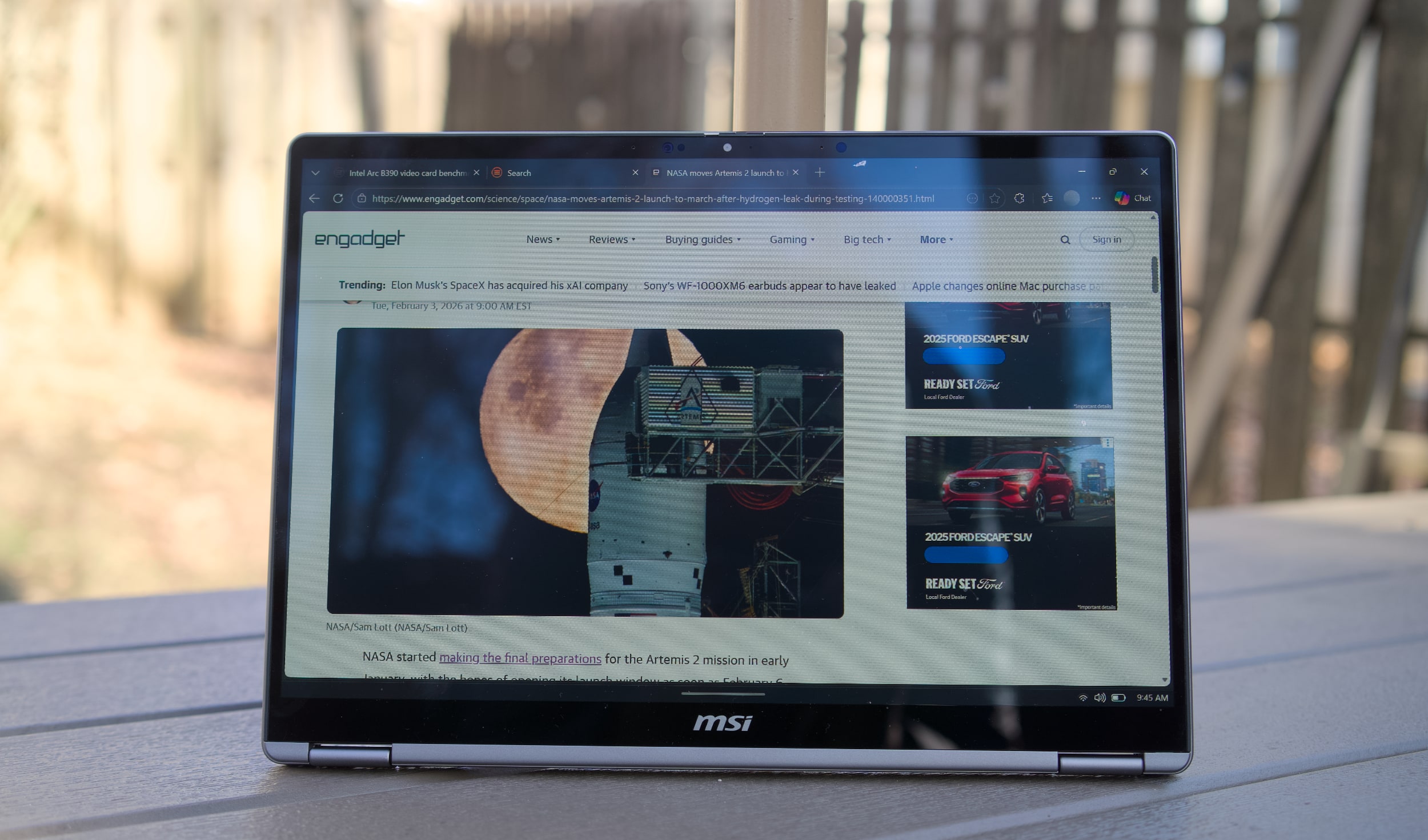
Once you pick it up, though, the Prestige 14’s three-pound frame feels downright remarkable. It’s just a tad heavier than the 2.7-pound MacBook Air, but its screen size directly competes with the 3.4- to 3.6-pound 14-inchMacBook Pro. The “Flip” in its name also means it’s versatile, with the ability to rotate its screen into a tablet mode, or a variety of tent configurations.
What makes the MSI Prestige 14 Flip AI+ truly interesting is its Intel Core Ultra X7 358H processor, which features 16 cores and a maximum speed of 4.8GHz. Specifically, it features four P-cores for speedy performance, eight efficient E-cores and four low-power E-cores. The Ultra X7 is also one of the new Panther Lake chips with gobs of graphics power in Intel’s Arc B390 GPU, giving them far more gaming chops than previous ultraportable chips. The laptop also sports 32GB of RAM, which is the ideal amount for serious productivity work, and a roomy 1TB SSD.
MSI Prestige 14 Flip AI+
Devindra Hardawar for Engadget
The Prestige 14’s stylus-friendly 14-inch OLED screen helps to distract from its mundane case design, with the typical deep black levels and excellent contrast I appreciate from OLED, together with bold 100 percent DCI-P3 color coverage. It makes just about everything look great, though I wish MSI offered more than a 60Hz refresh rate — a 90Hz or 120Hz screen would make scrolling through web pages look far smoother.
And speaking of the stylus, that’s tucked away at the bottom of the Prestige 14. I didn’t find it particularly useful for notetaking, but for those who do it’s easy to stow away. It’s just too thin for extended handwriting, and anyone doing serious notetaking or digital art would be better off with a larger stylus or dedicated drawing pad.
MSI Prestige 14 Flip AI+ in tent mode
Devindra Hardawar for Engadget
In-use: A stealth performer
After seeing a relatively slim Lenovo Panther Lake laptop reaching 190 fps in Battlefield 6, using only Intel’s built-in Arc B390 GPU, I was eager to see how that new hardware would perform in the real world. Simply put, the MSI Prestige 14 Flip AI+ didn’t disappoint. It scored 10,169 points in PCMark 10, the highest score we’ve seen yet on a Windows PC.
And yes, that includes plenty of powerful gaming systems like the Alienware 16 Area 51 (8,245 points) and the Razer Blade 18 (7,703), both of which were running Intel’s last-gen Core Ultra 9 275HX chip. Of course, those systems have faster GPUs, like NVIDIA’s RTX 5080, but PCMark 10 doesn’t lean too heavily on graphics performance. The Prestige 14 edged close to the M5 MacBook Pro in Geekbench 6’s multi-threaded CPU test, scoring 16,633 points compared to Apple’s 18,003. But the MacBook Pro reigned supreme in the single-threaded test, scoring 4,310 points compared to the MSI’s 2,864.
When it came to games, the Prestige 14 reached a surprisingly high 80-95 fps in Arc Raiders while playing in 1080p with medium graphics settings, as well as AMD’s FSR3 upscaling and 2x frame generation. Without those AMD features, Arc Raiders ran at 45-50 fps, which is still respectable for an ultraportable. To my surprise, Intel’s XeSS upscaling technology wasn’t available in Arc Raiders during my testing, but there’s a good chance that tool would eke out even more performance. (I’ve asked Intel about XeSS’s omission, and will update when I hear back.)
In Cyberpunk 2077, The Prestige 14 hit 35 fpswhile playing in 1080p with default settings. Flipping on Intel’s XeSS frame generation bumped that to 45 fps. If you’re used to the 30 fps performance of consoles, those numbers are still vaguely playable, but they certainly fall short of the 60 fps PC players typically look for. It’s best to think of the MSI Prestige 14 Flip AI+ as a laptop where you can play games sometimes, perhaps while you’re away from your gaming desktop. It’s certainly not a replacement for a dedicated gaming laptop.
For more prosaic productivity tasks, like juggling dozens of browser tabs and editing large images, the Prestige 14 didn’t break a sweat. Its healthy 32GB of RAM gave it plenty of breathing room for multi-tasking, and unlike other ultraportables, I didn’t notice any serious performance dips while running on battery. On that note, the Prestige 14 also lasted a whopping 22 hours and 15 minutes in PCMark 10’s battery benchmark. That’s the highest figure we’ve ever seen from a laptop, and it’s a promising sign of what we can expect from other Panther Lake systems.
MSI Prestige 14 Flip AI+ keyboard and trackpad
Devindra Hardawar for Engadget
While there’s clearly plenty to love about the MSI Prestige 14 Flip AI+, I was less impressed with its mechanical trackpad and keyboard. Perhaps I’ve been spoiled by the more responsive haptic trackpads from the competition, but the Prestige 14’s old-school trackpad kept slowing me down with missed clicks and other annoyances. The laptop’s keyboard felt similarly cheap, with a lack of depth and comfort that I’ve come to expect from other ultraportables in the $1,299 price range. Even after hours of testing, I had a hard time typing on the Prestige 14 at full speed without errors. It’s a shame that MSI gets so much right, but is hindered by these weak components.
MSI Prestige 14 Flip AI+ in tablet mode
Devindra Hardawar for Engadget
Should you buy the MSI Prestige 14 Flip AI+?
As one of the earliest Panther Lake laptops on the market, the $1,299 Prestige 14 Flip AI+ is a solid machine, if you’re willing to overlook its touchpad flaws. More than anything though, the Prestige 14 makes me excited to see what other PC makers offer with Intel’s new chips. It’s taken a while, but now Intel finally has some decent competition against Apple’s M-series hardware. The era of gaming with ultralight machines is finally here.
This article originally appeared on Engadget at https://www.engadget.com/computing/laptops/msi-prestige-14-flip-ai-review-an-ultraportable-for-arc-raiders-thanks-to-intels-panther-lake-160000606.html?src=rss
An anonymous reader shares a report: PayPal said on Tuesday it was booting its CEO and replacing him with its board chair Enrique Lores, sparing no ambiguity as to why: “The pace of change and execution was not in line with the Board’s expectations,” it said in a statement. One group that was blindsided was HP, where Lores was until Tuesday serving as CEO, according to people familiar with the matter.
Lores’ switchup sent them rushing to launch a search process, those people said. HP’s board does have internal candidates which it’s considering for the top job, according to a person familiar with the board’s thinking. As chair of PayPal’s board, Lores played a role in a process evaluating internal and external candidates. It was unclear when or if he recused himself from the final decision to name him as CEO. But HP’s board was only made aware that Lores was taking the CEO role at PayPal in recent weeks, the people said.
Netflix is back with another livestream production guaranteed to excite K-POP fans worldwide. The streamer has announced that BTS will be performing live on Netflix. It marks the band’s first performance after almost four years — the members took a hiatus to complete South Korea’s mandatory military service.
The live concert will air on Saturday, March 21, one day after BTS releases their new album Arirang and will be aptly titled BTS The Comeback Live | Arirang. The show will physically take place in Seoul’s Gwanghwamun Square and stream live at 8PM KST/7 AM ET/4 AM ET. Yes, viewers in the US will have to choose between a really early Saturday or a very late Friday night. Alternatively, you can skip out on any potential livestream glitches and likely watch it later (or catch the K-Pop group on their upcoming world tour).
Plus, come Friday, March 27, Netflix will be releasing BTS: The Return, a documentary all about the making of Arirang. As Netflix puts it: “The film offers rare behind-the-scenes access as the group comes back together and charts an unprecedented path forward together after a nearly four-year hiatus.”
Netflix has leaned further into livestreaming over the last few years — though the BTS concert is arguably their biggest coup. Livestreams have included everything from reality shows to sports, with some serious infrastructure issues along the way. Here’s hoping the BTS concert goes off without a hitch.
This article originally appeared on Engadget at https://www.engadget.com/entertainment/the-first-bts-concert-in-over-three-years-will-stream-live-on-netflix-in-march-155428505.html?src=rss