
A project that has been years in the making came to an early halt about 3,000 feet deep in the ice.
Monthly Archives: February 2026
Intel Xe Linux Driver Will No Longer Block D3cold For All Battlemage GPUs
Merged a year ago to the Linux kernel’s Xe graphics driver was a change to disable D3Cold across all Battlemage GPUs. This was done due instability issues around the D3cold to D0 power state transition. Finally with the upcoming Linux 7.0 kernel cycle that restriction is being loosened with restoring D3cold support with Battlemage GPUs aside from a specific NUC…
Teenage Mutant Ninja Turtles VR Coming In Spring, New Gameplay Trailer Revealed
Cortopia Studios and Beyond Frames Entertainment are bringing the Ninja Turtles into virtual reality for the very first time with Teenage Mutant Ninja Turtles: Empire City.
Launching on Meta Quest, SteamVR, and Pico this spring and priced at $24.99, pre-orders are now live on Meta Quest, where buyers can take advantage of a 20% early-bird discount.
A brand new gameplay trailer has also been revealed, highlighting the ways players will scramble, leap, and sneak through and atop the sewers and roofs of an atmospheric, comic-style New York City, battling the infamous Foot Clan and their villainous leader, Shredder.
0:00
/1:25
Designed from the ground up for VR, TMNT: Empire City focuses on immersion and optional co-operative play.
“Empire City isn’t about playing one of the Turtles so much as it’s about being one of the Turtles,” says Ace St. Germain, the game’s Creative Director. “Each Turtle has their different strengths, we don’t have traditional, pre-defined classes. Instead, based on your chosen builds, the gear equipped, and playstyle, you can freely organize how you want your sessions to play out.




The team has also released a new developer diary video which dives deeper into the way that combat, traversal, and co-operative play work in Empire City.
A time-limited single-player demo arrives February 23rd as part of Steam Next Fest, giving players the chance to experience the game’s first 15 minutes, and to play as each of the four Turtles. This demo disappears back into the ooze on March 2nd.
Check back as release approaches for more coverage of TMNT: Empire City.
DropShot Is A Hyper-Stylized Shooter Whose Developer Isn’t Taking The Easy Way Out

Aerial_Knight’s upcoming game, a tribute to a late friend and collaborator, is a shooter that decenters guns
The post <i>DropShot</i> Is A Hyper-Stylized Shooter Whose Developer Isn’t Taking The Easy Way Out appeared first on Kotaku.
Spotify Wants to Be Your Bookstore
Spotify is about much more than music these days, and nothing makes that clearer than the company’s recent commitment to books—not just audiobooks, but old-school paper ones. Today, Spotify announced it’s coming hard for Amazon’s Kindle and Audible businesses, and will soon start selling physical copies of books in addition to audiobooks. Starting today, the company is also introducing “Page Match,” a feature that allows you to use your phone’s camera to instantly sync an audiobook with either a physical book, or one you’re reading on an e-reader.
How you’ll buy physical books through Spotify
Spotify’s physical book sales infrastructure isn’t quite ready yet, but the mere announcement is a surprising move in a few ways. Not only is a streamer making a big commitment to physical products, but the offering is being implemented in a way that could help local booksellers, rather than compete with them. This will likely bea relief to any bookstores that have struggled to compete with Amazon.
To bring physical book sales to market, Spotify is partnering with Bookshop.org, a site that connects shoppers with independent bookstores near them (although it doesn’t source inventory from them, but drop ships them from the distributor). Purchases deliver 30% of the sale back to a selected bookstore (which Bookshop.org says is the entire profit margin, though the site does keep a ); if the shopper doesn’t pick a specific bookstore to support, 10% of their purchase will go towards a general profit sharing fund for all bookstores partnered with the website.
It’s a stunningly market-friendly move, made possible by Bookshop.org’s B corporation status. But from a selfish perspective, it also means Spotify won’t have to deal with the logistics of selling books: In order to buy a physical book through the app, users will first have to navigate to one of the service’s audiobooks, then click a button that says Add to your bookshelf at home. After that, they’ll be taken to a checkout page on Bookshop.org.
It’s unclear whether Spotify itself will be making any money on these sales, or if it is simply acting as a middle-man. The company says it’s “meeting readers where they are” and is “excited to see the impact Spotify’s scale will have for local bookstores.” But even if there’s no direct profit incentive, I’m sure Spotify will be happy if it can drive some sales to a store other than Amazon, or use the new feature to convince readers of physical books to try the app.
How to sync your physical book with a Spotify audiobook
Speaking of Amazon, Audible has been able to sync audiobook progress with Kindle e-books for a while now, making it easy to jump between reading and listening. Now, Spotify wants to do the same, but with a more open approach. Rolling out today, with support expected to come to “most English-language titles” by the end of February, Spotify’s Page Match feature will sync your Spotify audiobook progress with your spot in a physical, paper-based book, or even an e-reader.
This works because it doesn’t use an account to sync, but instead works via your phone’s camera. To use Page Match, open a supported audiobook in your Spotify app, tap Page Match, then tap Scan to listen. Place your camera over the page you want to sync to, whether that’s in a physical book or one displayed on an e-reader screen. You can then tap Play from here to start listening from where that page kicks off in the audiobook, or Save for later to make a bookmark you can jump to at any time.
Once you’re done listening to your audiobook and want to go back to your physical book or e-reader, just open your audiobook, tap Page Match, and tap Scan to read. Place your camera over your physical book or e-reader, and after some processing, Spotify will tell you which page to flip to to start reading from where you stopped listening.
Unlike Spotify’s audiobook recaps, Page Match supposedly does not use AI, instead relying on computer vision and text matching. Still, I’m curious how the “Scan to read” feature will handle inconsistent page numbering between different editions of a book, which can be a major problem with e-books in particular. Spotify says that if the feature runs into snags, it will prompt you to try again.
Page Match is available to all audiobook listeners on Spotify, so there’s a good chance you can try it now. Premium subscribers and Audiobook+ members can use the feature with their monthly listening hours, while free users can use Page Match with supported audiobooks they’ve bought outright. I don’t subscribe to Spotify and I don’t own any audiobooks on the service, but the company says that to get started, you only need “make sure your Spotify app is updated.”
Spotify’s continued push into books and podcasts
Spotify might have started off as a simple app for streaming music, but now, it’s clear the company wants to maximize hours spent in its app, and that means branching out to all types of audio content. According to an interview with The Verge, it has seen a 36% year-over-year increase in customers starting audiobooks on a platform, and a 37% increase in overall audiobook listening hours. The growth is supposedly mostly coming from existing customers rather than new subscribers, so it remains to be seen whether Spotify’s enhanced audiobook support can dethrone Amazon. Page Match working with any physical book or e-reader is probably a good start.
Anthropic Launches Claude Opus 4.6 as Its AI Tools Rattle Software Markets
Anthropic on Thursday released Claude Opus 4.6, its most capable model yet, at a moment when the company’s AI tools have already spooked markets over fears that they are disrupting traditional software development and other sectors.
The new model improves on Opus 4.5’s coding abilities, the company said — it plans more carefully, sustains longer agentic tasks, handles larger codebases more reliably, and catches its own mistakes through better debugging. It is also the first Opus-class model to feature a 1M token context window, currently in beta.
On GDPval-AA, an independent benchmark measuring performance on knowledge-work tasks in finance, legal and other domains, Opus 4.6 outperformed OpenAI’s GPT-5.2 by roughly 144 Elo points. Anthropic also introduced agent teams in Claude Code, allowing multiple agents to work in parallel on tasks like codebase reviews. Pricing remains at $5/$25 per million input/output tokens.


Read more of this story at Slashdot.
Microsoft’s New Open-Source Project: LiteBox As A Rust-Based Sandboxing Library OS
Microsoft engineers and other stakeholders have been developing LiteBox as a security-focused library OS written in the Rust programming language and leveraging Linux Virtualization Based Security “LVBS”. The design is for LiteBox to operate as a secure kernel protecting the normal guest kernel via virtualization hardware…
OpenAI is hoppin’ mad about Anthropic’s new Super Bowl TV ads
On Wednesday, OpenAI CEO Sam Altman and Chief Marketing Officer Kate Rouch complained on X after rival AI lab Anthropic released four commercials, two of which will run during the Super Bowl on Sunday, mocking the idea of including ads in AI chatbot conversations. Anthropic’s campaign seemingly touched a nerve at OpenAI just weeks after the ChatGPT maker began testing ads in a lower-cost tier of its chatbot.
Altman called Anthropic’s ads “clearly dishonest,” accused the company of being “authoritarian,” and said it “serves an expensive product to rich people,” while Rouch wrote, “Real betrayal isn’t ads. It’s control.”
Anthropic’s four commercials, part of a campaign called “A Time and a Place,” each open with a single word splashed across the screen: “Betrayal,” “Violation,” “Deception,” and “Treachery.” They depict scenarios where a person asks a human stand-in for an AI chatbot for personal advice, only to get blindsided by a product pitch.
JLab’s comically oversized headphones are not an April Fool’s Prank
JLab just released a gigantic pair of headphones that doubles as a Bluetooth speaker. The Blue XL headphones are ridiculously oversized, making them headphones in name only. I don’t even think Andre the Giant could’ve comfortably worn these suckers.
Unless you have a mythically large head, these are basically “headphone speakers.” The idea is to drape them around your neck and stream tunes for all to hear. Though you could also pop them on a table or something. I prefer my Bluetooth speakers to be speaker-shaped, but maybe that’s just me.
JLab
As for the internals, they feature 30W of power and two 2.5-inch drivers, along with two 2.5-inch radiators. This is obviously more power than what’s demanded by headphones because, again, these are actually speakers. JLab says they’ll get around 20 hours of use per charge, which is a decent metric.
There’s another use case here. They could make a mighty fine accessory in a “person wearing comically oversized headphones” Halloween costume. The price is actually right for a gag gift. The Blue XL headphones cost $99. These were first announced at a recent college football game, but everyone assumed it was a joke because they were gold and the company said they cost $120,000.
This article originally appeared on Engadget at https://www.engadget.com/audio/jlabs-comically-oversized-headphones-are-not-an-april-fools-prank-174338833.html?src=rss
Bad Bunny’s Me Porto Bonito Comes To Beat Saber
Beat Saber gets Me Porto Bonito (feat. Chencho Corleone) by Bad Bunny in the latest shock drop, now live.
This latest shock drop lands just four days after Bad Bunny’s Album of the Year Grammy win, and days before the Latin musician is set to headline the half-time show at the NFL Super Bowl, the USA’s most popular televised sporting event.
0:00
/0:36
Out now on Quest and SteamVR, Bad Bunny’s track follows recent shock drops, including Billie Eilish’s Birds of a Feather, Eminem’s Houdini, Kendrick Lamar’s Not Like Us, and Lady Gaga’s Abracadabra.
Though not available on PlayStation VR and PS VR2, where Meta (who owns Beat Saber) is no longer releasing new content, Bad Bunny’s Me Porto Bonito is available now on SteamVR and the Meta Horizon Store for $1.99.
This Owala Water Bottle Is My Health Upgrade of the Week
We may earn a commission from links on this page.
When Owala water bottles started appearing in every influencer’s “daily essentials” video and cluttering my Instagram feed, I rolled my eyes. I assumed this was another overhyped product that people would forget about in three months, just the latest in a long line of Stanley Cup successors.
One of my biggest personality quirks (or “flaws,” according to some) is that I’m a major spiller. The Stanley Cup’s open straw is a non-starter for me. In fact, no water bottle technology has been stronger than my ability to spill its contents. After watching my latest bottle create yet another puddle in my bag, I caved and bought an Owala. And now, I have to admit this water bottle is officially an upgrade in my life.
Why the Owala water bottle is the best
I’m a huge fan of the FreeSip lid—yes, that’s what they call it, and yes, it lives up to the name—is genuinely brilliant in its simplicity. There’s a built-in straw for when you want to sip without tilting (perfect for walking, driving, or my personal use case: lying horizontally on the couch). Flip it open a bit more, and there’s a wide-mouth spout for when you want to chug. One lid, two drinking options, and crucially, a push-button lock that has saved my laptop, my physical planner, and my dignity. Seriously, I cannot emphasize this enough: I am a world-class spiller. The Owala’s lock mechanism is the only thing standing between me and constant catastrophe.
At 24 ounces, it’s the perfect size—big enough that I’m not refilling it every hour, small enough that it actually fits in my bag’s side pocket and doesn’t make me look like I’m headed out for a weekend camping trip when I’m just going to run errands. It’s become my constant companion without feeling like I’m lugging around gym equipment.

Sometimes the influencers are onto something. And now I’m part of the problem, becoming the exact person who won’t shut up about their water bottle. But when you find something that solves multiple persistent problems at once, when a product actually delivers on its promises instead of just looking good in photos, it’s hard not to evangelize a little. The Owala works. I’m staying hydrated, my bag is staying dry, and I’m sipping with ease wherever I go.
NVIDIA reportedly won’t release new graphics cards this year
With gaming becoming an ever-smaller part of NVIDIA’s lucrative business, the company reportedly won’t bother releasing new graphics cards this year. The Information reported on Thursday that NVIDIA has pushed back its plan to release an update to the RTX 50 line in 2026. This would be the first time in three decades that the company hasn’t launched new gaming chips. The culprit? Why, AI, of course.
AI demand has driven the current memory chip shortage, throwing the consumer electronics industry out of kilter. Many product prices are expected to rise (as if tariffs hadn’t already done enough damage there). And the scarcity of memory chips has made components that rely on them, including GPUs, nearly impossible to find. Even the auto industry isn’t spared.
Facing those constraints, NVIDIA, which made its bones on graphics chips for PCs and gaming consoles, is essentially brushing off that demographic. The Information notes that in the first nine months of 2022, NVIDIA’s gaming GPUs made up 35 percent of its total revenue. During that same period in 2025, only around 8 percent came from gaming components. In addition, NVIDIA’s AI chips have much higher profit margins: 65 percent vs. 40 percent for graphics cards.
That means gamers, already hard-pressed to find last year’s RTX 50 series, likely won’t get the expected “Super” version in 2026. On top of that, The Information says the delay will also push back NVIDIA’s next-gen graphics card (likely “RTX 60”). That component was initially expected to begin mass production at the end of 2027.
But hey, at least you can shop (and view ads!) in ChatGPT, have a talk with your Gmail inbox and record everything the people around you say. Who needs games anyway, right?
This article originally appeared on Engadget at https://www.engadget.com/gaming/pc/nvidia-reportedly-wont-release-new-graphics-cards-this-year-173002651.html?src=rss
Blizzard Is Open To GenAI But The Overwatch Devs Don’t Want It: ‘We Want This To Feel Like A Handcrafted Universe’

The company may have one stance, but Aaron Keller says the Overwatch team feels differently
The post Blizzard Is Open To GenAI But The <em>Overwatch</em> Devs Don’t Want It: ‘We Want This To Feel Like A Handcrafted Universe’ appeared first on Kotaku.
Apple Acquired “Silent Speech” Startup Q.ai
Apple acquired Q.ai, reportedly for $1.6 billion, a startup working on converting “silent speech” into text. The technology could be crucial for AR glasses.
If the $1.6 billion value widely reported by mainstream news outlets such as Reuters is accurate, it would represent Apple’s second largest acquisition to date, behind only Beats.
Since its founding in 2022, Q.ai has operated in “stealth mode”, staying very secretive about exactly what it’s working on. But the background of its three co-founders, as well as details in a patent filing, provide strong hints as to what the technology is.
Aviad Maizels, the CEO, previously founded PrimeSense, the company that Apple acquired in 2013 to build Face ID. PrimeSense also licensed some of its technology to Microsoft for the original Kinect. Dr. Yonatan Wexler, the CTO, is a world-class computer vision expert who was the VP of R&D at OrCam, a company which miniaturized high-end computer vision into a tiny device that clips onto eyeglasses.
Alterego’s ‘Silent Speech’ Could Be The Answer To Dictating Text In Public
Alterego is a wearable device that promises to let you silently dictate text by sensing the subvocal movements of your speech muscles.
 UploadVRDavid Heaney
The idea of “silent speech” is to let you silently dictate text by sensing the subvocal movements of your speech muscles. You could therefore send a sensitive message while in public, completely privately, or direct an AI assistant without other people around you knowing.
The fundamental idea is not new, and another startup, Alterego, is working on a hardware-based approach that uses sensors attached to your jaw.
What makes Q.ai’s approach special, if its patents are any indication, is that it’s a computer vision approach, using cameras pointed at your jaw instead of attached to it.
For example, the patent Detection of silent speech refers to a “optical sensing head” located “in proximity to a face of the user” that “senses light reflected from the face and to output a signal in response to the detected light”.
Apple Smart Glasses Reportedly Set To Launch In Late 2026
Apple plans to launch its competitor to the Ray-Ban Meta glasses in late 2026, Bloomberg’s Mark Gurman reports.
 UploadVRDavid Heaney
Apple could potentially integrate Q.ai’s technology into future Apple Vision headsets, AirPods stems, and the smart glasses that Bloomberg’s Mark Gurman and supply-chain analyst Ming-Chi Kuo claim the company is working on.
Meta, meanwhile, is betting on letting you scribble letters on a surface such as your leg, sensing it with an sEMG band worn on your wrist.
What’s clear already is that regardless of which technology wins out, the ability to enter text privately while wearing smart glasses in public will be crucial if the form factor ever hopes to supplant the smartphone.
The Best Budget ANC Earbuds Just Got Even Cheaper
We may earn a commission from links on this page. Deal pricing and availability subject to change after time of publication.
There’s a certain level of performance you expect from active noise-cancelling earbuds (ANC) or headphones—even if they are “budget” priced. If you’re looking for a great pair of ANC earbuds for a price that won’t make you cry if you lose them, consider the Anker Space A40, currently $44.98 (originally $99.99 at launch). I’ve been using these earbuds for over a year and cannot recommend them enough for the price.

The Soundcore by Anker Space A40 gives you as many features and even better ANC than some higher-end pairs for a budget-friendly price tag. I’ve had my pair for over a year now, and I can compare the ANC performance to some high-end earbuds I’ve sampled. For the price, the ANC is surprisingly good and also rivals earbuds that go over the $200 price mark. The earbuds have microphones that pick up the sound around you to adjust the ANC accordingly. You can read the full review from PCMag here if you want to go more in-depth about its features.
Another impressive quality about these earbuds is their long battery life, with 10 hours of playtime and an additional 50 hours from the charging case. The Soundcore app lets you customize your EQ controls to your liking, but the default audio setting right from the box is already great, so there’s no need to adjust it unless you want to. The earbuds fit well and don’t come out easily, which is a must for any ANC. It is water-resistant with an IPX4 rating.
The main place where these earbuds fall short is the audio if you’re an Apple user because it relies on the AAC codec. But for the price, the Anker Space A40 does a great job at everything else and is my favorite ANC earbud under $100 dollars.
Our Best Editor-Vetted Tech Deals Right Now
Deals are selected by our commerce team
Are VPNs legal?
VPNs have a mixed reputation, primarily because you can use the technology to hide your location and identity on the internet. Even the best VPNs can be used to conceal crimes and make the perpetrators harder to track. Fortunately, most of the world’s governments (at least for now) recognize that VPNs are just technology that can be used for good or ill.
That means VPNs are legal in almost every country in the world. The countries that do restrict VPNs tend to be those where internet freedoms are already curtailed, like Russia, China, Iran and North Korea. There are distinct gradations between those nations, though. And the days of worry-free VPN access elsewhere in the world is starting to show cracks: Currently free jurisdictions — including the UK, France and even several US states — are now considering bans.
Is it legal to use a VPN?
The answer is almost always yes. In every country except the ones listed in the next section, there are no legal penalties for visiting a VPN website, downloading a VPN or connecting to a VPN server.
In the last few years, however, some countries that were once beacons of online liberty have started considering bans. This is part of a chain reaction that started with age verification laws for websites deemed harmful to children, most prominently the UK’s Online Safety Act. Once everyone realized that anyone could circumvent the OSA by using a VPN server in another country, UK politicians began trying to ban VPNs as well. The same thing is currently happening in France. In the US, Wisconsin and Michigan are both proposing age verification laws and VPN bans.
For now, though, none of these VPN bans have passed into law. Some have been defeated by the coordinated efforts of activists, including one Swiss proposal that would have forced Proton VPN to relocate.
In countries that do ban or restrict VPN usage, the laws can take several forms. Some countries have made all VPNs unlawful to use. Others only allow VPNs approved by the government — approval which usually comes from agreeing to share information with law enforcement. In some other countries, it’s legal to use a VPN, but you’ll face extra penalties if you use one to commit a crime. I’ll go through all these categories in the next section.
Where are VPNs illegal?
This section is a complete list of countries where using a VPN is a legal risk. If a country isn’t on this list, you can assume it’s safe to use a VPN. Even nations with bad internet freedom scores, like Saudi Arabia and Indonesia, often don’t have anti-VPN laws to avoid scaring off international business.
One more important note is that anti-VPN laws are much more likely to be enforced against locals than foreigners. I’m not saying you should tempt fate, just noting that there are very few cases of a traveler being prosecuted in another country solely for using a VPN.
Countries where VPNs are totally banned
VPNs are completely outlawed in four countries. Three of them — Belarus, Turkmenistan and North Korea — are isolated authoritarian regimes that restrict internet freedoms as part of nationwide crackdowns on all civil and political liberties. Iraq, while slightly more liberal overall, banned VPNs in 2014 in an attempt to kick the Islamic State off the internet. Twelve years later, the ban remains in place.
Uganda is a special case. In 2018, the African nation enacted the world’s first social media tax, which the government called necessary to raise funds but which was criticized as a backhanded assault on free speech. VPNs can get around the tax, so Ugandan internet service providers (ISPs) are required to block VPN traffic. However, there’s no law on the books against using a VPN, so as long as you bring a service with obfuscation (like NordVPN) you’re good to go.
Countries where only approved VPNs are allowed
More common than banning VPNs altogether is restricting VPN usage to those approved by the government. This lets the powers that be grant limited VPN access to businesses for economic reasons, while also being able to yank it away as a method of control. It also means VPNs with a license to operate are likely to report data or install surveillance backdoors.
The nations that handle VPNs this way are China, Russia, Iran, Venezuela, Bahrain, Myanmar, Pakistan, India, Turkey and Oman. These countries don’t ban all VPNs, but target popular providers with intermittent crackdowns and threats.
China in particular uses the so-called Great Firewall, the world’s most sophisticated suite of censorship technologies, to prevent its citizens from even visiting the homepages of VPN companies. If you plan to travel in China and want to maintain access to the outside world, download a VPN before you go — and remember that using it while there will technically put you in violation of the law.
Russia is a textbook case of a selective VPN ban, with businesses allowed to use approved VPNs and everyone else left to scramble against periodic mass blocks. Turkey’s autocratic government has also tried to crack down on VPN usage by blocking VPN sites, but clumsy implementation has left a lot of holes, allowing Instagram and other social media to remain a free speech lifeline for Turks.
Countries with extra penalties for using VPNs to view blocked websites
In a few countries, it’s legal to use any VPN, but against the law to use them for illegal activities. You might say, “Duh, I’m aware that breaking the law is illegal,” but there is a meaningful difference — some crimes are crimier than others. Just like you’ll get a much harsher sentence if you rob someone with a weapon, you’ll face steeper penalties for using a VPN to view content the government is trying to block. Countries that operate like this include Vietnam, Egypt and the UAE.
Potential future VPN bans
Today, a number of countries once considered free and tolerant are proposing wide-ranging age verification laws, usually for reasons that boil down to “think of the children!” If enacted — as the UK’s Online Safety Act has shown — they effectively offer a choice between two equally unacceptable alternatives: Live with a censored version of the internet, or get broader access only once you sacrifice your online anonymity.
VPNs are the easiest and most direct workaround to this rising tide of censorship, which is why those same governments have them in their legislative crosshairs. The threat of enforcement chills free activity in a connected world where enforcers can’t be everywhere at once.
For now, laws against VPN usage are still largely vague, inconsistent and unevenly applied. As citizens, we can work to make our voices heard and fight against these initiatives before they become law. In the meantime, you may well want to get install your VPN of choice on as many devices as possible — and get your other cybersecurity ducks in a row while you’re at it.
This article originally appeared on Engadget at https://www.engadget.com/cybersecurity/vpn/are-vpns-legal-170000878.html?src=rss
AWS Cloud Breach Achieved Admin Access In Record Time With Help From AI

As terrifying proof of how much artificial intelligence can compress the cyberattack lifecycle, researchers have documented a real-world AWS cloud intrusion that went from a simple credential leak to full administrative control in under 10 minutes.
The incident, observed by the Sysdig Threat Research Team, began when a threat actor discovered
Troy Brosnan teases new SRAM DH AXS on Red Bull Hardline Tasmania bike – and that’s not the only unreleased thing about it
Red Bull Hardline Tasmania returns this weekend, with some of the rowdiest riders descending on Australia’s island state to compete in one of the world’s toughest downhill races.
The event is invite-only, with the biggest names in downhill, freeride and slopestyle battling it out on a huge purpose-built course in Maydena Bike Park.
One of those riders is Australian Troy Brosnan, whose Canyon Sender CFR is tricked out with unreleased SRAM and RockShox electronic components.
The bike looks to be a glimpse into the future, with electronic tech seeping into its suspension and shifting.
Let’s take a closer look.
Canyon Sender CFR

Brosnan is riding Canyon’s Sender CFR, the brand’s full-carbon fibre, high-pivot downhill bike.
Canyon has engineered adjustable geometry into the frame, with adjustable cups enabling Brosnan to fine-tune the reach of his bike by 8mm fore and aft.
Last year, we caught up with Brosnan’s bike in Lenzerheide, where he appeared to be experimenting with a different rear triangle featuring a bonded aluminium insert to enable stiffness adjustability.

It appears he’s still using this setup, with the rear brake mount looking oversized compared to the stock option.
RockShox Flight Attendant Boxxer

Brosnan has been using an unreleased RockShox Flight Attendant Boxxer fork and Vivid rear shock since the middle of last season. However, the fork no longer features the Blackbox label that indicates RockShox and SRAM prototypes, meaning we could see it on the shelves in the not-so-distant future.

The system looks similar to the brand’s current XC and enduro Flight Attendant range. However, we don’t know how it operates the damper.
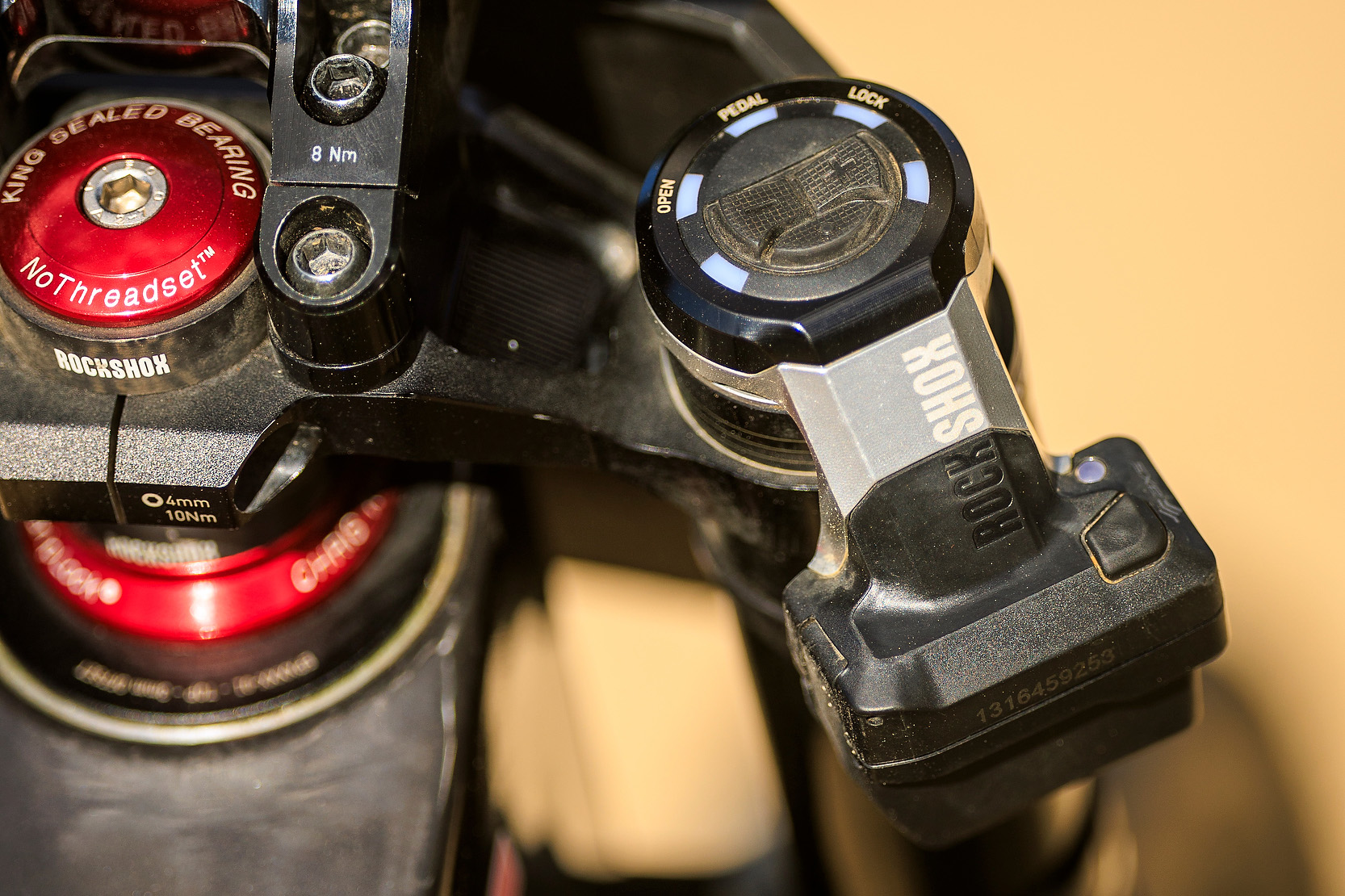
Current systems use data collected by accelerometers to set the damper to Open, Pedal or Lock, depending on the surface or position of the bike.
With downhill riders rarely needing a lockout, we’re unclear as to when this option would be selected.
Other brands have been experimenting with electronic dampers, with Finn Iles teasing an Öhlins electric shock at the Les Gets UCI World Cup last year.

There’s a mystery bump at the bottom of the fork stanchion, labelled Linear XL, which could be a tiny supplementary air chamber that gives compressing air more space at the end of the stroke, reducing ramp-up.
SRAM DH AXS Transmission?

We spotted this derailleur on the bike last year, with only a thin piece of tape veiling the new groupset’s name.
With SRAM having given the rest of the mountain bike world electronic shifting, it seemed a matter of time before AXS would make its way to downhill racing.
It’s been 10 years since we’ve seen SRAM release a downhill groupset, with many riders still riding it to this day.

The electronic groupset carries over the design principles of Transmission, bolting directly onto the bike via a UDH.
It shares the battery placement of GX AXS Transmission, sitting within the bracket connecting it to the UDH mount, rather than hanging off the rear as seen on X0 AXS Transmission.
The range appears to be seven-speed, with the derailleur matching the new crankset’s design.

Brosnan is using an Ochain device at the centre of his bike to reduce pedal kickback. The brand was bought by SRAM last year and already looks neatly integrated into its design.
Debian’s CI Data No Longer Publicly Browseable Due To LLM Scrapers / Bot Traffic
LLM scrapers for AI are even hungry for Debian’s continuous integration “CI” data. Due to the ongoing abuse of the open web by LLM scrapers, the Debian CI infrastructure is restricting the publicly accessible data with their web server resources being hammered by bots/scrapers…
How to use your Apple Watch to precisely find your new AirTag
Our review of the new AirTag went up yesterday, and that involved testing the new Precision Finding feature on Apple Watches. In the process, I found the setup to be confusing and counterintuitive, and was relieved to discover it wasn’t just me. If, like me, you’ve been trying to set up Precision Finding on your Apple Watch for the AirTag you’ve just unboxed and attached to a precious belonging, here are the exact steps to take.
First, make sure your Apple Watch is compatible with the feature. That means verifying you’re using the Series 9 or later (you would have bought it in or after 2023) or the Ultra 2 and newer. Then, go to the Watch app on your phone and do the following to make sure you’ve received the latest software update that adds the functionality.
-
Tap General.
-
Press Software update.
-
Make sure the page says you are running watchOS 26.2.1. If not, tap Install Now.
If you need to download the software, make sure your watch is on its charging cradle. Even though my Apple Watch Series 11 was fully charged, I was still told to make sure it’s connected to power and had at least 50 percent of juice left for the software to install. After a few minutes, my watch restarted and the app said it was updated to the newest version of watchOS.
Now that you have the right hardware and software, you can set up Precision Finding. I assume you’ve already connected the new AirTag to the iPhone that’s linked to your watch (and if you haven’t, make sure to do that).
This was the part of the process that confused me. Instead of opening the Find Items app on the watch, Precision Finding for the new AirTag actually exists as a shortcut in the Control Center. Here are the steps to add it there:
-
Open the Control Center by pushing the button below the dial on the side of the watch.
-
Scroll all the way to the bottom and press “Edit.”
-
Push the + button at the top left of the screen.
-
Scroll down and tap Find Items.
-
Press Find AirTag, then tap Choose. You should see the new AirTag you’ve linked to your account here.
-
Select the AirTag you want to precisely find.
-
Drag the icon to whichever position you prefer within the Control Center.
-
Hit Done.
Now, whenever you want to locate your item, you can pull up the Control Center, press this button and the Precision Finding interface will appear, showing how far away it is. You can also push the button on the bottom right of this screen to get the AirTag to ring, guiding you to where your item is.
This article originally appeared on Engadget at https://www.engadget.com/computing/accessories/how-to-use-your-apple-watch-to-precisely-find-your-new-airtag-164922731.html?src=rss