Engadget Podcast: So there’s a social network for AI agents now

If you haven’t heard, there’s now a social network for AI: Moltbook, a site that purportedly features AI agents talking to each other. That includes OpenClaw, a personal AI agent (formerly called Clawdbot and Moltbot) that’s open source and free for anyone to run on their systems. In this episode, Devindra and Senior Reporter Karissa Bell discuss the rise of these services, and the potential future that AI agents may have for all of us.

Subscribe!

Topics

  • What is Moltbook and OpenClaw? – 1:31

  • Anthropic reinforces its commitment against ads with Super Bowl ad spots – 19:32

  • SpaceX acquires xAI and plans for a mega IPO – 27:08

  • Alexa + rolls out free for all Amazon Prime subscribers – 33:36

  • Around Engadget: Reviews of the New AirTag and Switch Virtual Boy – 44:12

  • Working on – 46:34

  • Pop culture picks – 49:24

Credits

Hosts: Devindra Hardawar and Karissa Bell
Producer: Ben Ellman
Music: Dale North and Terrence O’Brien

This article originally appeared on Engadget at https://www.engadget.com/ai/engadget-podcast-so-theres-a-social-network-for-ai-agents-now-133000813.html?src=rss

EU says TikTok uses ‘addictive design’ and must change

TikTok’s signature features that hooked users around the world are its algorithm and endless scroll. Now, though, the European Union has called those aspects of the app illegal and may order the company to alter them.

“Today, the European Commission preliminarily found TikTok in breach of the Digital Services Act for its addictive design,” the EU’s regulator said in a press release. “This includes features such as infinite scroll, autoplay, push notifications, and its highly personalized recommender system.” It said that TikTok failed to put up safeguards to ensure that those “addictive” features don’t “harm the physical and mental wellbeing of users,” including minors.

“For example, by constantly ‘rewarding’ users with new content, certain design features of TikTok fuel the urge to keep scrolling and shift the brain of users into ‘autopilot mode’. Scientific research shows that this may lead to compulsive behaviour and reduce users’ self-control,” the regulators stated.

TikTok’s current parental controls and features to limit screen time are insufficient, the Commission added, and TikTok may need to modify them. The platform may also be required to limit its infinite scroll and adjust its recommendation algorithms.

The EU Commission will give TikTok an opportunity to rebut the findings and the company said would use “any means available” to challenge them. “The commission’s preliminary findings present a categorically false and entirely meritless depiction of our platform,” the company told The New York Times in a statement.

Europe opened its wide-ranging investigation against TikTok in February 2024 and has already found the company at fault for its data sharing practices and advertising transparency. If found guilty of violating the DSA, TikTok faces a fine up to six percent of its annual worldwide turnover.

This article originally appeared on Engadget at https://www.engadget.com/social-media/eu-says-tiktok-uses-addictive-design-and-must-change-131738425.html?src=rss

HBO is making a Baldur’s Gate 3 TV show

The Last of Us series co-creator Craig Mazin is teaming with Hasbro Entertainment to create an HBO series based on the popular (and spicy) Baldur’s Gate 3 game, Deadline reported. The show will be simply be called Baldur’s Gate and the story will resume where Baldur’s Gate 3 left off. Mazin will reportedly have full creative control and act as co-creator, writer, executive producer and showrunner.

“It is a dream come true to be able to continue the story that [Baldur’s Gate 3 developer] Larian and Wizards of The Coast created,” Mazin said in a statement. “I am a devoted fan of DnD and the brilliant way that Swen Vincke and his gifted team adapted it. I can’t wait to help bring Baldur’s Gate and all of its incredible characters to life with as much respect and love as we can.”

Larian, which won’t be making the Baldur’s Gate 3 sequel, said it wasn’t involved in the creation of the show. However, Larian CEO Swen Vincke said that to his knowledge, Mazin is a “big fan” of the game and even requested to visit the studio (Mazin told Deadline that he has put about 1,000 hours into the game).

Mazin is best known for co-creating the Emmy-winning limited series Chernobyl as well as The Last of Us. The latter was widely praised for its first season but critics and fans were mixed on season 2, which deviated a bit more from the corresponding game.

The show will reportedly feature familiar and new characters, but no other details have been released. A Baldur’s Gate 4 game is not currently in development, so the series creators will have no source material to draw from. That gives them a lot of freedom, but also puts the storytelling onus fully on Mazin and his team of writers. Wizards of the Coast story head Chris Perkins will reportedly act as a consultant on the show to ensure it doesn’t stray from its DnD origins.

This article originally appeared on Engadget at https://www.engadget.com/entertainment/streaming/hbo-is-making-a-baldurs-gate-3-tv-show-130000864.html?src=rss

The best VPNs with free trials in 2026

A free trial to a virtual private network (VPN) can mean a few different things. Several of the best VPNs let you try them out without paying. A rare few, and only one on this list, let you try them without submitting payment information at all. Some VPNs have forever free plans that let you use them indefinitely without paying, as long as you’re OK with some limits.

For the most part, though, your best chance to test a VPN for free is to pay for a subscription. Then, if you don’t like the service, you can get your money back before the refund guarantee expires. This takes a bit more work, and some services have very tight turnarounds. However, it’ll get you the most time with the most complete version of the VPN.

With that out of the way, let’s talk about the best VPN free trials for each definition of “free trial.” I’ll start with VPNs that actually have free trials, most of which require a payment method and only work on mobile devices. The next section lists the best forever free plans. Finally, I’ll share instructions for how to use a VPN money-back guarantee as a free trial.

Best VPNs with free trials

Best VPN forever free plans

Using VPN money-back guarantees as free trials

Although VPN free trials are great when you can get them, you’ll enjoy a lot more flexibility by taking advantage of refund guarantees. Almost every provider has a money-back guarantee that doesn’t require you to prove a specific problem. You’ll probably have to deflect some upselling attempts before you actually get the refund, but most policies do promise you all your money back, with no pro-rating.

I like to download VPNs on their one-month plans so I can put the full service through my usual battery of tests. A 30-day money-back guarantee grants you enough time to learn whether you can use the VPN long-term. If you don’t like the service, the standard method for getting a refund is to get in touch with customer support on the VPN provider’s help page.

This article originally appeared on Engadget at https://www.engadget.com/cybersecurity/vpn/best-vpns-with-free-trials-130000435.html?src=rss

Notable Zwift Events for the Weekend of February 7-8

Quite a variety of events to feature this weekend: a crazy endurance ride for a good cause, a sweet new kit unlock event, a race series kickoff, and more! See this weekend’s most notable events below…

�DBR x Canyon x Cykelnerven

✅ Ultra Endurance ✅ Good Cause

This ride’s just a little bit crazy, yet it’s already got hundreds of crazies signed up!

It’s a 12-hour ride on London’s Classique circuit in support of Cykelnerven, raising awareness and funds for a world free of multiple sclerosis. Join for just the first hour or two if you’d like, or see if you can hang on for the full 12 hours.

Saturday, February 7 @ 8am UTC/3am ET/12am PT
Sign up at zwift.com/events/view/5379446

�SYN x RAD RACE Spin

✅ New Kit Unlock

Join this special collaboration ride between Rad Race and The SYN, led at 2.5-3.2 W/kg on 90 minutes of Makuri Islands’ Electric Loop.

We’re featuring this particular event because it includes an unlock of the sweet new SYN x RAD RACE in-game kit (see the IRL version here).

Sunday, February 8 @ 7am UTC/2am ET/Saturday 11pm PT
Sign up at zwift.com/events/view/5412980

� Tugaz Tour 2026: Stage 1
✅ Popular  ✅ Unique Event

Tugaz Tour 2026 launches on Sunday with its first stage, held on one lap of the newish London Calling route (20.9km, 357m).

This tour consists of 15 standalone races, all held at a single time slot, always on weekends. The stages are inspired by the main competitions of the Portuguese Cycling Federation and will take place on the corresponding real-world dates. All races will be mass start scratch races – time gaps do not matter, only final placings count.

Registration, rules, results, and everything else related to the Tugaz Tour 2026 can be found on the official website.

Sunday, February 8 @ 10:05am UTC/5:05am ET/2:05am PT
Sign up at zwift.com/events/view/5359137

�WOW – High Speed Ride on TT bikes with draft

✅ Fast Miles ✅ Upgrade Hack ✅ Unique Event 

Want to accumulate lots of miles quickly? Join this newish and popular group ride, which puts everyone on the fastest TT bike in game (Cadex Tri) with drafting enabled. It’s 100km, but it’ll be a fast 100km!

Riders are on Tempus Fugit, the flattest route in Zwift. Three different pace groups, released so the faster groups catch the slower groups over time.

Bike upgrading hack: on rides with forced bikes, whatever bike you’re on when you join the event is the bike that accumulates the distance/elevation/time. So, for example, you could accumulate lots of distance toward a road bike upgrade, while riding the Cadex Tri in this event.

Sunday, February 8 @ 1:45pm UTC/8:45am ET/5:45am PT
Sign up at zwift.com/events/view/5413110

�� Tour de Zwift, Stage 5

✅ Popular  ✅ Unlocks  ✅ Race If You Want

We’re nearing the end of Tour de Zwift, with stage 5 wrapping up this weekend, and the final stage next week. If you’re looking for a group ride where you can set your own pace but still have some company, TdZ is just the ticket since hundreds of riders join each event.

Read all about Tour de Zwift 2026 >

Each stage has three route length options. For stage 5 we’ve got some big climbing options: Tour of Fire and Ice (28.1km, 1183m), Glyph Heights (34km, 617m), and Ocean Lava Cliffside Loop (19.2km, 156m).

Hourly events all weekend!
Sign up at zwift.com/events/tag/tourdezwift2026

How We Make Our Picks

We choose each weekend’s Notable Events based on a variety of factors including:

  • Is the event unique/innovative in some way?
  • Are celebrities (pro riders, etc) attending/leading?
  • Are signup counts already high, meaning the event is extra-popular?
  • Does the ride include desirable unlocks or prizes?
  • Does the event appeal to ladies on Zwift? (We like to support this under-represented group!)
  • Is it for a good cause?
  • Is it just plain crazy (extra long races, world record attempts, etc)?
  • Is it a long-running, popular weekly event with a dedicated leader who deserves a shout out?

In the end, we want to call attention to events that are extra-special and therefore extra-appealing to Zwifters. If you think your event qualifies, comment below with a link/details and we may just include it in an upcoming post!

Two years of NordVPN’s Complete plan is 70 percent off

NordVPN is offering a significant discount on its two-year plans, with 70 percent off its Complete tier and up to 78 percent off overall. For the Complete tier, the deal brings the total cost down to $130 for 24 months

NordVPN regularly appears on Engadget’s list of the best VPN services thanks to its wide server network, strong security tools and consistent performance across devices. NordVPN’s latest promotion puts one of its most comprehensive plans at a price that undercuts many competing premium VPN subscriptions.

The Complete tier includes full access to NordVPN’s core VPN service, which encrypts internet traffic and masks a user’s IP address to help protect online activity on public Wi-Fi networks and at home. Subscribers can use the service on multiple devices, including phones, tablets, laptops and smart TVs, with apps available for major operating systems. It also includes access to NordPass (more on that below), an ad blocker and 1TB of cloud storage. You’ll find similar discounts on all of NordVPN’s other plans: Basic, Plus and Prime.

Beyond the basics, NordVPN offers features like threat protection to help block malicious websites and trackers, as well as specialty servers designed for added privacy or faster performance in specific scenarios. In our NordVPN review, the service was praised for its evolving feature set and overall reliability, even as the VPN market becomes increasingly competitive.

Engadget regularly tracks VPN pricing trends and this offer compares favorably with other current promotions. It also appears alongside NordVPN deals featured in Engadget’s ongoing roundup of the best VPN discounts available right now, which compares offers from multiple major providers.

Those looking for additional security tools may also want to note that NordVPN’s Complete plan bundles in extra services beyond the VPN itself. One of those is NordPass, the company’s password management app. NordPass is also discounted as part of a separate promotion, if you’re primarily looking for a password manager rather than a VPN. The Premium tier is currently 50 percent off, bringing the price down to $36 for two years. NordPass Premium adds features such as cross-device password syncing, secure password sharing and breach monitoring, which alerts users if stored credentials appear in known data leaks.

Both offers are available for a limited time, though Nord has not specified an end date for the promotion. If you’re still unsure whether NordVPN is right for you, it offers a 30-day money-back guarantee, so you can change your mind and get a full refund.

This article originally appeared on Engadget at https://www.engadget.com/deals/two-years-of-nordvpns-complete-plan-is-70-percent-off-123000301.html?src=rss

Canada Unveils Auto Industry Plan in Latest Pivot Away From US

Canadian Prime Minister Mark Carney has announced a sweeping plan to shore up the country’s auto industry and accelerate its electric vehicle transition, the latest in a series of moves to reduce Canada’s deep economic dependence on the United States as American tariffs continue to batter the sector.

The plan includes financial incentives for carmakers to invest in Canada, a new tariff credit scheme for manufacturers like General Motors and Toyota, and the reintroduction of EV buyer rebates. Canada will also enact stricter vehicle emissions standards and has set a goal of EVs comprising 90% of car sales by 2040. Carney at the same time scrapped a 2023 EV sales mandate introduced by former PM Justin Trudeau that automakers had called too costly.

The announcements follow a deal last month with China to ease tariffs on Chinese EVs and an agreement with South Korea to encourage Korean car manufacturing in Canada. Roughly 90% of Canadian-made vehicles are exported to the US, and thousands of auto workers have lost their jobs since Trump imposed 25% tariffs on Canadian cars and parts last year.


Read more of this story at Slashdot.

The Morning After: The Switch is officially Nintendo’s most popular console ever

With over 155 million sold, Nintendo’s Switch is officially the company’s biggest console hit ever. It’s been a long road to surpassing the DS, which reached 154 million consoles over its seven-year lifespan. The Switch, meanwhile, is a year shy of its 10-year anniversary. 

We’ve seen the original console, the non-hybrid Lite and the OLED versions of the Switch over the decade, but despite being replaced by Switch 2, the original is still selling at a strong pace: 1.36 million units in Q3. Just think how many Joy-Cons it sold/replaced?

Next goal: try to be the best-selling console of all time. Currently, that’s the PlayStation 2. 

Nintendo is just shy of five million units to go. 

— Mat Smith

The biggest stories you might have missed

Explained: Moltbook, the social network for AI agents

Are they talking about us behind our backs?

TMA
TMA
TMA

Moltbook is a “digital petri dish,” a Reddit-style forum populated entirely by AI agents that post, follow and even gossip about their owners in dedicated submolts. Built using vibe coding, it’s a surreal experiment in autonomous socialization — though there’s no shortage of user-data security flaws. Is Moltbook a profound look at the dead internet theory or just a very loud AI echo chamber? Or something in the middle? Karissa explains it all. (Sorry, Karissa.)

Continue reading.

Nintendo’s Virtual Boy is a niche slice of gaming history.

Lean in.

TMA
TMA
Engadget

Nintendo’s worst-selling console was probably the Virtual Boy. It sold less than 800,000 units, with only 22 games in Japan and 14 in North America. And it didn’t even have the guts to launch in Europe or Australia.

But Nintendo doesn’t care. It’s brought the Virtual Boy back, baby, as an add-on for the Switch 2, in all its red monochrome ’90s-tech glory. And we finally got to test it. 

It even includes the original bipod, which you use to prop it up and lean into it. Yes, you still can’t just wear the thing like modern VR headsets. The Switch 2 console, sans Joy-Cons, then slides in, acting as display, battery and processor. 

It seems more of a historical nod than anything else. This is pretty much 30-year-old VR tech, as-is. But… I still want one as a gaming objet d’art. A hundred bucks is a fair chunk of change for that, though. Read on for our full impressions.

Continue reading.

Surprise! Google teases the Pixel 10a

Pre-orders open later this month.

TMA
TMA
Google

Google posted a teaser video revealing its new entry-level smartphone, the Pixel 10a, in a lovely lilac colorway. We don’t know much more, however. You can see it’s another dual-camera Pixel, with that same flush body — which I like. (How does that already seem retro?) 

Leaks suggest a 6.3-inch display and a large 5,100 mAh battery. It otherwise looks and seems like the Pixel 9a, although Google promises that there’s “more in store.” Last year’s A-series launched at $500 — will this land at a similar price? You can pre-order the Pixel 10a on February 18. 

Continue reading.

AMD suggests a 2027 launch for next-gen Xbox

Shouldn’t Microsoft be saying this?

AMD CEO Lisa Su revealed on the company’s latest earnings call that Microsoft’s development of an Xbox with a semi-custom SOC from AMD is “progressing well to support a launch in 2027.” Maybe Microsoft can chase that best-selling console crown too?

Continue reading.

This article originally appeared on Engadget at https://www.engadget.com/general/the-morning-after-the-switch-is-officially-nintendos-most-popular-console-ever-121500738.html?src=rss

Rocket Report: SpaceX probes upper stage malfunction; Starship testing resumes

Welcome to Edition 8.28 of the Rocket Report! The big news in rocketry this week was that NASA still hasn’t solved the problem with hydrogen leaks on the Space Launch System. The problem caused months of delays before the first SLS launch in 2022, and the fuel leaks cropped up again Monday during a fueling test on NASA’s second SLS rocket. It is a continuing problem, and NASA’s sparse SLS launch rate makes every countdown an experiment, as my colleague Eric Berger wrote this week. NASA will conduct another fueling test in the coming weeks after troubleshooting the rocket’s leaky fueling line, but the launch of the Artemis II mission is off until March.

As always, we welcome reader submissions. If you don’t want to miss an issue, please subscribe using the box below (the form will not appear on AMP-enabled versions of the site). Each report will include information on small-, medium-, and heavy-lift rockets, as well as a quick look ahead at the next three launches on the calendar.

Blue Origin “pauses” New Shepard flights. Blue Origin has “paused” its New Shepard program for the next two years, a move that likely signals a permanent end to the suborbital space tourism initiative, Ars reports. The small rocket and capsule have been flying since April 2015 and have combined to make 38 launches, all but one of which were successful, and 36 landings. In its existence, the New Shepard program flew 98 people to space, however briefly, and launched more than 200 scientific and research payloads into the microgravity environment.

Read full article

Comments

Why Darren Aronofsky thought an AI-generated historical docudrama was a good idea

Last week, filmmaker Darren Aronofsky’s AI studio Primordial Soup and Time magazine released the first two episodes of On This Day… 1776. The year-long series of short-form videos features short vignettes describing what happened on that day of the American Revolution 250 years ago, but it does so using “a variety of AI tools” to produce photorealistic scenes containing avatars of historical figures like George Washington, Thomas Paine, and Benjamin Franklin.

In announcing the series, Time Studios President Ben Bitonti said the project provides “a glimpse at what thoughtful, creative, artist-led use of AI can look like—not replacing craft but expanding what’s possible and allowing storytellers to go places they simply couldn’t before.”

The trailer for “On This Day… 1776.”

Outside critics were decidedly less excited about the effort. The AV Club took the introductory episodes to task for “repetitive camera movements [and] waxen characters” that make for “an ugly look at American history.” CNET said that this “AI slop is ruining American history,” calling the videos a “hellish broth of machine-driven AI slop and bad human choices.” The Guardian lamented that the “once-lauded director of Black Swan and The Wrestler has drowned himself in AI slop,” calling the series “embarrassing,” “terrible,” and “ugly as sin.” I could go on.

Read full article

Comments

“DHEI” Proposed For Linux To Help Cloud-Native Orchestrators & High Frequency Traders

Sent out today as a request for comments is a new patch series for Dynamic Housekeeping and Enhanced Isolation (DHEI). DHEI aims to provide run-time adjustments to kernel behavior around CPU isolation for helping with latency-sensitive tasks. The expressed goal is for helping cloud-native orchestrators and high frequency trading platforms dynamically re-partition CPU resources without downtime…

Qualcomm QUPv3 Firmware Upstreamed For Snapdragon X1 Elite Linux Users

One of the headaches right now when dealing with the Snapdragon X Elite on Linux is that for a majority of the devices you need to fetch firmware files from the Windows 11 on ARM partition as the necessary firmware bits for Linux use aren’t upstreamed to linux-firmware.git. That has gradually improved over time from the qcom-firmware-extract making the process easier to more firmware bits eventually being added to linux-firmware.git…

Why This Is the Worst Crypto Winter Ever

Bitcoin has fallen roughly 44% from its October peak, and while the drawdown isn’t crypto’s deepest ever on a percentage basis, Bloomberg’s Odd Lots newsletter lays out a case that this is the industry’s worst winter yet. The macro backdrop was supposed to favor Bitcoin: public confidence in the dollar is shaky, the Trump administration has been crypto-friendly, and fiat currencies are under perceived stress globally. Yet gold, not Bitcoin, has been the safe haven of choice.

The “we’re so early” narrative is dead — crypto ETFs exist, barriers to entry are zero, and the online community that once rallied holders through downturns has largely hollowed out. Institutional adoption arrived but hasn’t lifted existing tokens like ETH or SOL; Wall Street cares about stablecoins and tokenization, not the coins themselves. AI is pulling both talent and miners toward data centers. Quantum computing advances threaten Bitcoin’s encryption. And MicroStrategy and other Bitcoin treasury companies, once steady buyers during the bull run, are now large holders who may eventually become forced sellers.


Read more of this story at Slashdot.

How to evaluate your use of classroom technology with the PICRAT framework

There’s always something new to consider when teaching with technology. From the latest advancements in AI, to new software and hardware updates, it can be difficult to know which tools to use and how to incorporate it effectively into your lessons.

In today’s blog, we explore the PICRAT framework and how it can help you reflect on your use of technology in the classroom. 

We also share our new PICRAT Quick Read, which you can download for free to: 

  • Find practical tips on how to use the PICRAT model when planning your lessons
  • Read a summary of the research behind the framework

What is the PICRAT framework?

Technology is constantly changing, and educators must continually decide what tools to use in their practice. To help with this challenge, researchers started developing theoretical models that teachers (especially student teachers) could use to reflect on how they integrate technology in their classrooms.

You might already be familiar with frameworks like TPACK (Technology, Pedagogy, and Content Knowledge) and SAMR (Substitution, Augmentation, Modification, Redefinition). While these models are useful, the PICRAT framework was created to address gaps in these earlier models, offering a clearer, student-focused approach. Significantly, it encourages you to treat technology as a tool to support learning, rather than the goal itself.

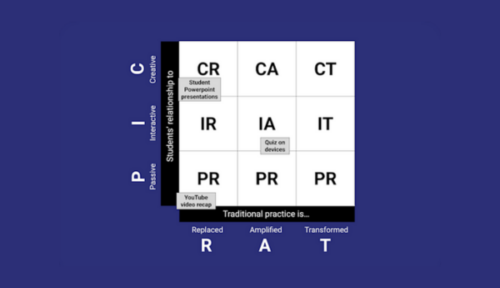
It asks two simple questions: “How are students experiencing the technology?” and “How does this impact your practice?”. The answers to these questions form a matrix as pictured below. 

PIC (which runs along the y-axis) refers to the student’s relationship to the technology:

  • Passive – Students receive learning through technology
  • Interactive – Students interact with the content or other learning through technology 
  • Creative – Students construct knowledge using technology

RAT (which runs along the x-axis) refers to how the teacher uses the technology:

  • Replaces – Using technology but with an existing pedagogy
  • Amplifies – Using technology to improve pedagogy or outcomes
  • Transforms – Using technology to create new pedagogical practices

How can I apply the PICRAT model?

First choose the lesson you’re planning to deliver. Consider what activities you’ll be running and the technologies involved. You’ll then be able to plot where they sit on the matrix using the PICRAT acronym.

For example, if you are teaching a lesson on Python loops, you might initially plan for students to watch a pre-recorded coding tutorial on their laptops. In this scenario, the student experience is Passive (receiving info via tech), and the teacher’s use is Replacement because the video simply replaces a live lecture. To move up the matrix, you could instead have students use an online IDE to complete a “Parson’s Problem” puzzle where they rearrange blocks of code to fix a loop. This shifts the activity to Interactive and Amplification, as the digital tool provides immediate debugging feedback that a paper-based exercise could not.

Educator presenting in a classroom.

Next, think about how you might move your practice forwards. Although every position on the matrix has its own value, the framework is hierarchical. The overall goal is to try to move your practice towards the top right of the matrix to be Creative and Transformative.

To help you achieve this, take some time to reflect on your current lessons, activities, and the technologies you use. Ask yourself questions like:

  • What does the technology I’m using offer that could be used to amplify my practice?
    • What benefits would this have for students?
  • Does the technology present opportunities for students to interact with each other, not just the technology?
  • What other technological tools might support collaboration? 

Research highlights that technology is rarely used in ways that allow young people to be creative. By using the PICRAT matrix, teachers can identify missed opportunities and explore ways to transform their lessons, ensuring learners can be creative and thrive.

The benefits of the PICRAT model

Potential benefits for educators:

  • The framework encourages meaningful reflections, allowing teachers to easily evaluate how they’re using technology within their lessons
  • Reflections and the PICRAT matrix helps teachers to identify missed opportunities and gaps in their practice, ultimately leading to better student experiences
Photo of educators sharing ideas in a classroom.

You can use the PICRAT framework as part of your own reflections, or as part of a group activity. It’s a great way to spark discussion about technology integration with colleagues and improve best practices.

Want to find out more about the PICRAT framework?

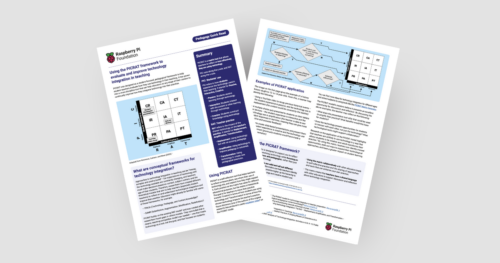
If you’d like to learn more about the PICRAT model, you can download our Quick Read for free via our new Pedagogy Quick Reads page.

The post How to evaluate your use of classroom technology with the PICRAT framework appeared first on Raspberry Pi Foundation.