
Stop relying on streaming and begin investing in physical movies

Stop relying on streaming and begin investing in physical movies
We may earn a commission from links on this page.
Things don’t look great for virtual reality. Once seen as the future of online interaction, the present has caught up to VR, and it’s brutal: Meta is by far the biggest dog in the virtual reality kennel, and its virtual reality division, Reality Labs, lost over $73 billion since it launched five years ago, leading the company to pull some resources from VR to focus on smart glasses and AI. Apple, seen as the runner-up in the VR market, shipped only 45,000 Vision Pro headsets in the final quarter of 2025, a rounding error compared to the 82.6 million iPhones Apple sold in the same period.
At his metaverse introduction in 2021, Mark Zuckerberg envisioned Horizon Worlds as a vast digital continent, but its active user base is around 200,00 people. For comparison, kids’ game Roblox boasts over 380 million monthly active users. And this is all despite Meta’s and Apple’s headsets being excellent hardware, by almost all accounts.
In the cold light of the ledger, virtual reality looks like shambling corpse, too dumb to know it’s dead. But they said the same thing about video games in 1983—Atari’s death looked like the end of the road, but then the NES came out.
Zuckerberg’s sales pitch of a billion people living in a frictionless, legless, gravity-free vacuum of suburban-techno-capitalism might be gone—it turns out we didn’t want another world full of random people—but what’s growing in its place is a bottom-up community built by filmmakers, game developers, and regular people, all creating a new way to belong.
“What we’re all trying to do is build the Holodeck from Star Trek,” said Matt Celia, co founder and creative director of Light Sail VR told me. Light Sail has been producing VR films and video for the past 10 years, and its catalog includes everything from concerts at Red Rocks to narrative VR series to an Emmy-winning immersion into Saturday Night Live’s 50th Anniversary. “My belief in the medium is unshaken,” Celia said. “I think this is the most authentic way to tell stories.”
According to Celia, experiencing films in VR frees the viewer from distractions that mar other ways of watching—your phone’s bright screen isn’t going to pull your attention, and you literally don’t have visible surroundings to distract you. “When you make the conscious choice to put on a headset, to watch a piece of content and engage with it, it’s actually transformative, almost meditative,” Celia said.
More than just a new way to show old movies, immersive film is a new medium being born; filmmakers are inventing a new language. Whether it’s in a you-are-there, 360-degree view of Steve Martin’s SNL monologue, narrative VR series like Eli Roth’s The Faceless Lady, or interactive documentary experiences like D-Day: The Camera Soldier, artists are using virtual reality to tell stories in a completely new way. “We’re all obsessed with this idea that we can live and breathe into a story,” Celia said, “That is what’s driving us all to create these more and more immersive and impressive and impactful experiences.”
Visionary experiences are great, but most people buy VR headsets to play games. The news that Meta shuttered three of its AAA game development studios—Armature, who brought Resident Evil 4 to VR; Sanzaru, the studio behind Asgard’s Wrath; and Twisted Pixel, creators of Deadpool VR—might suggest that VR gaming is on life support. It could also just be the growing pains of the gaming industry figuring out what works in a new medium.
Virtual Reality game studio Resolution Games seems to have cracked the code. The company has grown consistently since it started up in 2015, selling millions of games despite a challenging environment, with its flagship title Demeo earning critical raves and a partnership with Wizards of the Coast on Demeo x Dungeons & Dragons: Battlemarked.
“We are very conservative with our funds, and we’re very resource efficient,” Tommy Palms, the CEO of Resolution said. “You have to be if you live in this space, where [there are] few hits and they don’t typically make as much money as they would in other ecosystems.”
No matter how prudent the management, no game studio survives if the games aren’t good, and Resolution’s games are very good, often in ways that seem counter-intuitive to what we thought VR games would be. “A big grand virtual world, like Cyberpunk or Grand Theft Auto, but you’re inside it… now we know in reality, that’s not a very comfortable experience, unfortunately,” Palms said.
Instead of that immersive world, Demeo puts players at a game table in a virtual basement with their friends. You’re not in a dungeon; you’re a person playing a game about a dungeon. “It creates a much more social situation in general because it increases the chance for you to play with your friends,” Palms explained. “You’re doing something together, solving a problem or focusing on something else, you’re just with your friend.”
Speaking of friends, if Mark Zuckerberg’s original vision of the Metaverse was about anything, it was about bringing people together. “Feeling truly present with another person is the ultimate dream of social technology. That is why we are focused on building this,” Zuckerberg wrote in his Founder’s Letter in 2021.
Central to that vision was Horizon Worlds, a digital ecosystem designed to draw a billion residents and hundreds of billions of dollars in digital commerce. It’s been nearly five years since launch and Horizon Worlds’ overall cost-per-user likely outpaces the GDP of small nations, so I wanted to check out how it’s doing; experiencing an environment that weird is more than enough motivation to strap on the old face-computer and poke around.
Horizon Worlds, circa 2026, feels dead. But dead in a unique way. Tens of thousands of “worlds” have been created by both users and corporations, and they’re shiny, bright, and open to explore, but not many people seem interested. Randomly picking worlds is like walking around in an abandoned mall—stuff, but no people. If you’re into “liminal spaces,” you will never run out. Still, like the headsets it’s played on, Horizon Worlds is really good.
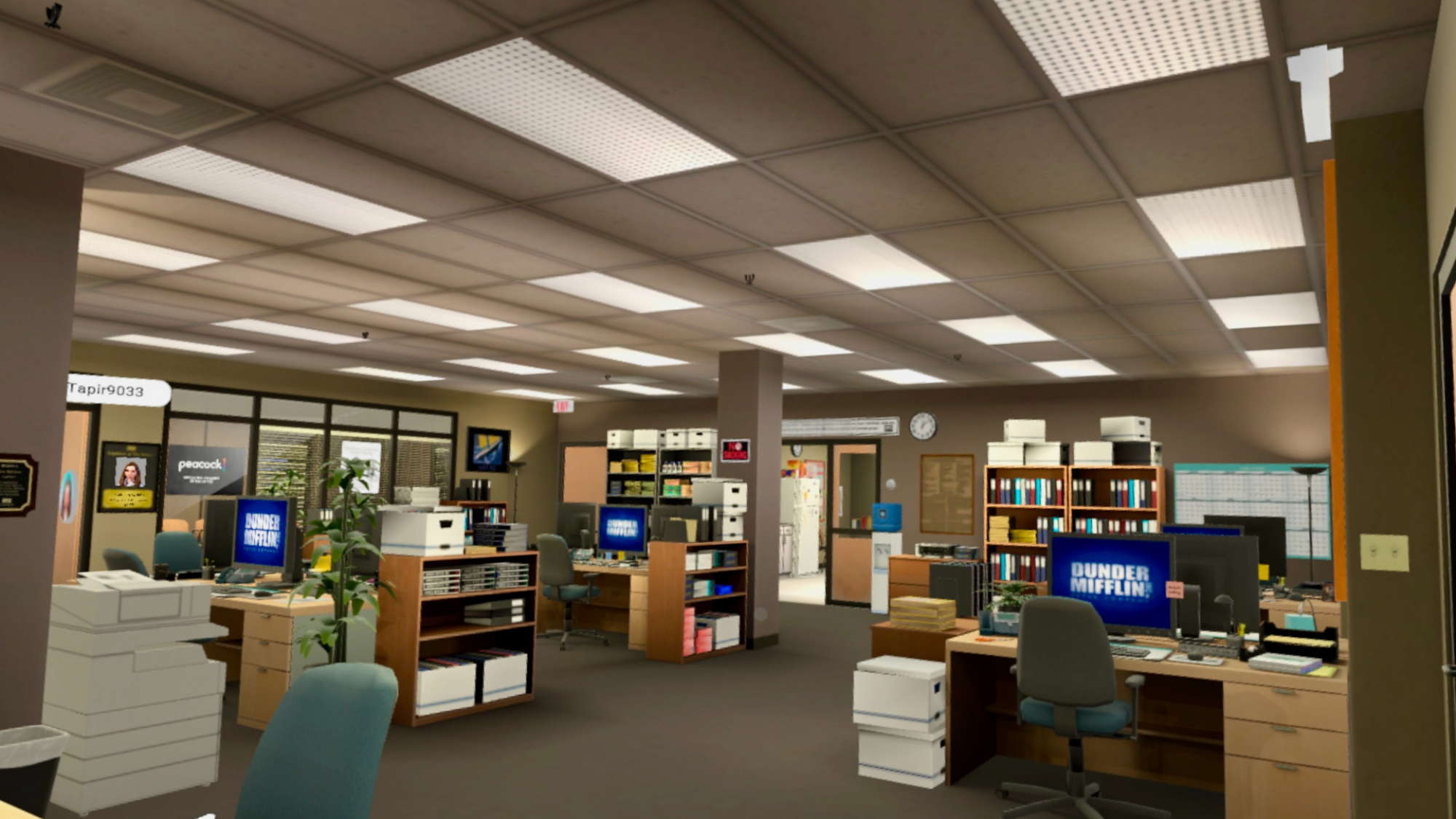
Take The Office World, an official recreation of The Office‘s Dunder Mifflin, right down to the desktop tchotchkes. You can walk into Michael Scott’s office and pull games up on his computer, sort mail for Schrute Bucks, or go downstairs to check out the warehouse. The Office World is filled with the kind of cleverly written fan-service details that should draw droves of The Office faithful to hang out and meet each other. But they don’t. During the half hour I spent in The Office World at 2:00 PM on a Tuesday, the population count never got above five people. It’s lonely in there, like a water cooler with no co-workers around it or an empty film set with no one there to call “action.”
I had a similar experience at Blumhouse Horrorverse, an atmospheric, shadowy forest clearing surrounded by spooky buildings. It’s filled with things to see and do for fans of Blumhouse properties like M3GAN, The Purge, and The Black Phone. You can play a game where you’re locked in a mansion with a player-controlled villain, or search for hidden Easter eggs to unlock M3GAN’s signature dress for your avatar. But the woods were so quiet. The few people I encountered were either very young children—the “squeakers” that haunt every corner of Horizon Worlds—or first-timers who wandered around in silence before vanishing like ghosts.

I was about to call quits on my virtual safari, but I thought I’d check out one last world. A search for “over 18” (damn squeakers) brought up The Soapstone Comedy Club. I’m glad I visited. The spot is alive. There’s a full schedule of upcoming stand-up shows, trivia, improv, and karaoke—and more importantly, there are people hanging out. Upon logging in, a friendly volunteer introduced herself, and before long I was chopping it up about life, online and off, with a bunch of new pals on the patio of a virtual comedy club.
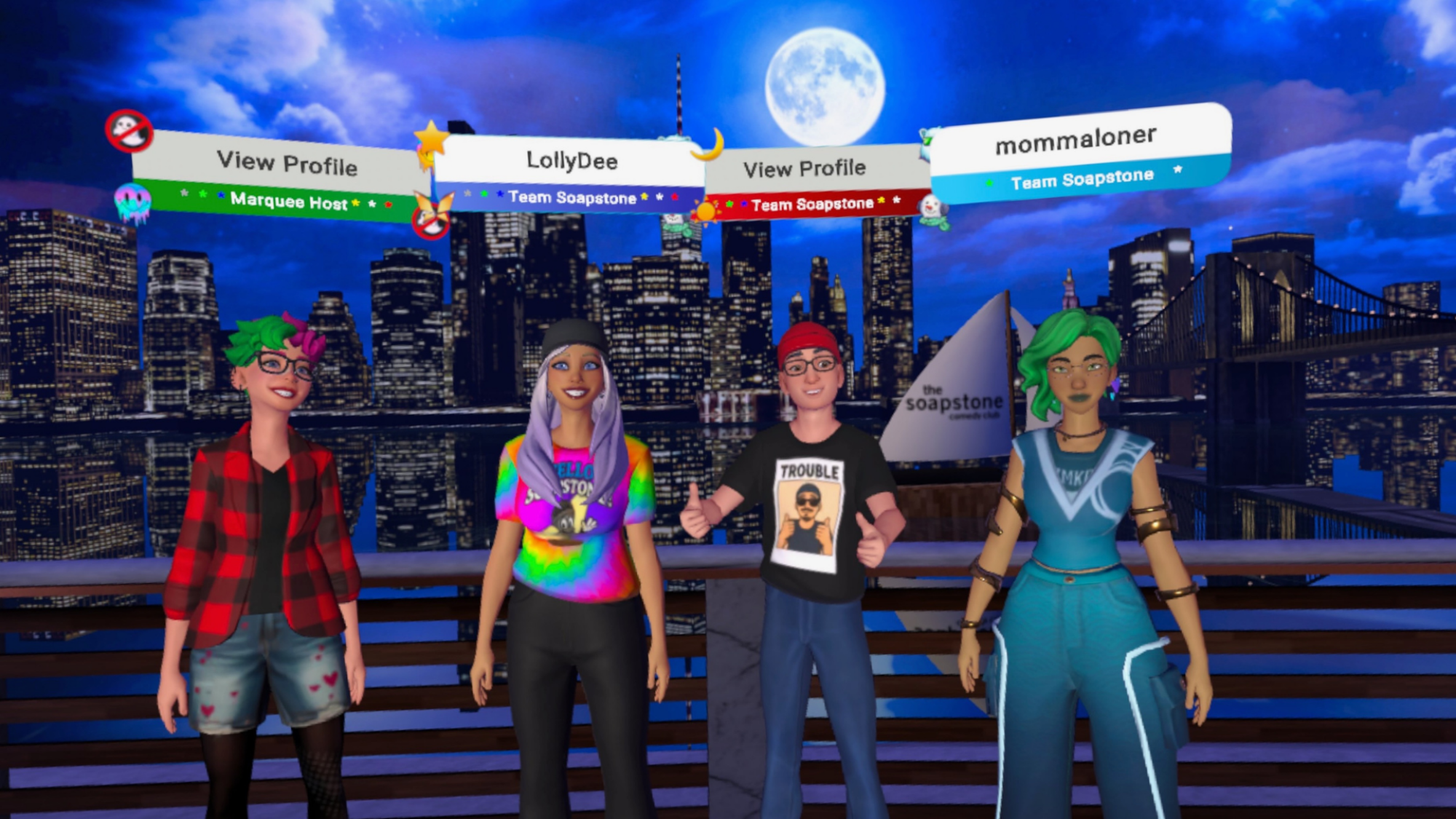
“If you told me 10 years ago that I was going to be known as ‘The Unemployed Alcoholic,’ and I would own a pretend comedy club in a cartoon land, I wouldn’t have believed you,” Aaron Sorrels, know as “TheUnemployedAlcoholic” online, told me. “And I sure wouldn’t have believed I could sell my wife on the idea,” he added.
In recovery and unemployed, Sorrels watched that now-infamous Facebook Connect event in 2021 that launched the Metaverse, and rather than clowning on it because the avatars didn’t have legs, Sorrel was inspired. “It sounds almost hokey,” Sorrels said, “but I heard about the Metaverse, specifically Horizon Worlds, and I was like, ‘I got to get in there.'”
With no background in programming, Sorrels built Soapstone from the ground up, creating a career for himself, paid gigs for others, and more importantly, a place for people to belong, just like Zuckerberg envisioned. “I came in to build a comedy club, and what’s ended up coming out of it is more than a comedy club. There’s a community of people that have adopted The Soapstone as theirs” Sorrels said. “It’s not a corporate place, or someone else’s place. This place belongs to them.”
“In the Soapstone, I can host shows, step on stage, or instantly connect with friends and family members who live thousands of miles away as if they were right here in the same room,” explained Soapstone Community Lead LollyDee. “It’s especially meaningful for people with anxiety, physical limitations, or those who live far from social hubs. For many of them, Soapstone Comedy isn’t just entertainment, it’s their social space and sense of community.”
Sorrels definitely doesn’t think VR is dead. “There are dynamic and powerful things happening every day, every moment of every day in VR,” Sorrels said. “I think back on what I heard Mark Zuckerberg say four years ago… he said it was a 10-year process. We’re not halfway through it yet.”
The loud, anarchic vibe of VRChat is too much for me, but about 40,000 (mostly young) people use it to connect every day. Big Screen has a healthy user base of VR cinephiles checking out 2D and 3D movies. People are virtually beating each other up 24/7 in Thrill of the Fight 2. I could go on, but you get the picture: VR might not have broken big, but specialized communities are thriving in all corners of the metaverse.
In 2026, the “Next Chapter of the Internet” version of the Metaverse, where we would all would live, work, and buy digital sneakers, is something of a ghost town. But a more sustainable, organic space is taking root. VR isn’t a second world; it’s a group of specialized tools for specific passions—a private IMAX theater for the cinephile, a global open-mic night for would-be comedians, a tactical tabletop for D&D nerds. VR isn’t everything to everyone, but it’s something to someone, and there’s nothing more alive than that.
Google-spinoff Waymo is in the midst of expanding its self-driving car fleet into new regions. Waymo touts more than 200 million miles of driving that informs how the vehicles navigate roads, but the company’s AI has also driven billions of miles virtually, and there’s a lot more to come with the new Waymo World Model. Based on Google DeepMind’s Genie 3, Waymo says the model can create “hyper-realistic” simulated environments that train the AI on situations that are rarely (or never) encountered in real life—like snow on the Golden Gate Bridge.
Until recently, the autonomous driving industry relied entirely on training data collected from real cars and real situations. That means rare, potentially dangerous events are not well represented in training data. The Waymo World Model aims to address that by allowing engineers to create simulations with simple prompts and driving inputs.
Google revealed Genie 3 last year, positioning it as a significant upgrade over other world models by virtue of its long-horizon memory. In Google’s world model, you can wander away from a given object, and when you look back, the model will still “remember” how that object is supposed to look. In earlier attempts at world models, the simulation would lose that context almost immediately. With Genie 3, the model can remember details for several minutes.
Disney+ subscribers in some European countries have lost access to advanced HDR features like Dolby Vision, TechRadar and FlatpanelsHD report. The issue was first spotted by German Disney+ subscribers on Reddit, but currently also impacts subscribers in Portugal, Poland, France and the Netherlands, according to FlatpanelsHD.
“Dolby Vision support for content on Disney+ is currently unavailable in several European countries due to technical challenges,” Disney said in a statement. “We are actively working to restore access to Dolby Vision and will provide an update as soon as possible. 4K UHD and HDR support remain available on supported devices.”
If the issue is in fact a technical one, it seems like it could be around for the long-term. Disney has removed any reference to Dolby Vision from its Disney+ video quality support page in Germany. As of now, the company lists HDR10 as its default HDR format, despite Dolby Vision support being a feature of Disney+ for several years now.
FlatpanelsHD writes that the real issue might be legal, rather than technological. A company called InterDigital won an injunction in a German court against Disney in November 2025 because it violated at least one of the company’s patents on streaming video technology. The injunction specifically requires Disney to stop violating InterDigital’s patent on “a method for dynamically overlaying a first video stream with a second video stream comprising, for example, subtitles.” It’s not entirely clear how that plays into the company offering Dolby Vision in Europe, but it would explain why subscribers in Germany were some of the first people to notice Dolby Vision’s absence.
Engadget has contacted Disney for more information about Disney+’s missing HDR support and whether InterDigital’s injunction played a role. We’ll update this article if we hear back.
Mentions of Dolby Vision were also stripped out of the US version of Disney+’s video quality support page. InterDigital hasn’t won an injunction in the US, but the company is pursuing a patent case against Disney in the United States District Court for the Central District of California. That doesn’t necessarily mean Dolby Vision support will be taken from US subscribers next, but it does suggest there’s more happening here than just technical challenges.
Update, February 6, 3:44PM ET: The original version of this article included mention of Disney+ losing HDR10+ support in Europe, but Disney says it never offered HDR10+ in that region. The article has been updated accordingly.
This article originally appeared on Engadget at https://www.engadget.com/entertainment/streaming/disney-loses-access-to-dolby-vision-in-some-european-countries-193930702.html?src=rss
Salesforce is essentially shutting down Heroku as an evolving product, moving the cloud platform that helped define modern app deployment to a “sustaining engineering model” focused entirely on stability, security and support.
Existing customers on credit card billing see no changes to pricing or service, but enterprise contracts are no longer available to new buyers. Salesforce said it is redirecting engineering investment toward enterprise AI.


Read more of this story at Slashdot.
We may earn a commission from links on this page.
Maybe this is just me being Extremely Online, but whenever I see a video of someone squatting in running shoes, a comment section goes off in my head. “Ditch the shoes!” “You’ll hurt yourself!” “You don’t want cushions under your feet when there’s a heavy bar on your back!”
There’s some truth behind those knee-jerk reactions; when squatting (or deadlifting), I do not personally wear running shoes nor would I recommend them. But the importance of your choice of shoes is hugely overblown. You aren’t going to injure yourself or kill your gains by squatting in sneakers.
Why is this questionable advice so pervasive? I blame internet form-check culture. People who have just learned to squat themselves aren’t in a position to diagnose mobility issues, or on the flip side to reassure new lifters that they’re basically doing fine and just need more practice. But they can see that you are wearing New Balances, so that’s what they pick on first.
The idea is that running shoes and other soft sneakers put a squishy layer of foam under your feet. When you’re running, that’s great; it absorbs impact and helps to return some energy to your foot as you push off. But when you’re squatting or deadlifting, you’ll benefit more from a solid footing.
I can agree with the sneaker-haters that your best options for squatting are either firm shoes (with no squish at all) or going without shoes. I’d rank your options like this:
Weightlifting shoes, like Nike Romaleos or Reebok Legacy Lifters, which have an elevated heel and a very firm sole. These are best if you need or prefer an elevated heel to keep good body positioning while you squat. They’re pricey though, and if you have good ankle mobility, you may not benefit much from the heel. These are great for squatting but not so much for deadlifts.
Shoes with a firm, flat sole, like Converse Chuck Taylors or Vans Old Skools. These are good all-around gym shoes, and you can deadlift in them, too.
No shoes at all. Most gyms frown on true barefoot training but it’s usually fine to slip off your shoes and lift in socks.
I have a more detailed guide here to choosing the right shoes to lift in. If you want to buy shoes specifically for lifting, consider those options. But what if you’re new to the gym and all you have is sneakers?
When the sneaker-haters start making scary claims, saying you’ll hurt yourself or that you can’t possibly lift heavy in squishy shoes, they really don’t have a firm sole to stand on.
There aren’t any studies that attribute a higher injury rate to sneaker-wearers than to lifters who wear other footwear. Any claims that you’ll get hurt in sneakers are pretty much guaranteed to be made up. People love to scare each other about “dangerous” exercises and practices in the gym, evidence be damned.
I’ll admit that when I squat in sneakers, I don’t feel as stable. But I have squatted in sneakers, and the squats go fine. Look around your local gym; you’ll see plenty of people in suboptimal footwear.
Once I participated in a competition where people executed a variety of strange and heavy lifts. Toward the end, a few folks were attempting one-legged lifts, and commented that it was hard to do these in sneakers. I looked around and realized that most of the competitors had been wearing sneakers all day. And probably trained in them too. These were folks who had been putting up serious poundages! Until they took on a particularly balance-focused task, their choice of footwear hadn’t stood in their way at all.
Lifting in sneakers is the same kind of “not ideal, but you’ll be fine” situation as squatting without a belt, or running on a sunny day without sunglasses. So, should you squat in sneakers? Eh, they’re not your best option. But if they’re what you have for now, you’ll be fine.


An investigation has uncovered a sprawling network of hidden cameras in Chinese hotel rooms that livestream guests — including couples having sex — to paying subscribers on Telegram. Over 18 months, the BBC identified six websites and apps on the messaging platform that claimed to operate more than 180 spy cams across Chinese hotels, not just recording but broadcasting live.
One site, monitored for seven months, cycled through 54 different cameras, roughly half active at any given time. Subscribers pay 450 yuan (~$65) per month for access to multiple live feeds, archived clips, and a library of more than 6,000 edited videos dating back to 2017.
The BBC traced one camera to a hotel room in Zhengzhou, where researchers found it hidden inside a wall ventilation unit and hardwired into the building’s electricity supply. A commercially available hidden-camera detector failed to flag it. China introduced regulations last April requiring hotel owners to check for hidden cameras, but the BBC found the livestreaming sites still operational.


Read more of this story at Slashdot.
Disney+ subscribers in some European countries have lost access to advanced HDR features like Dolby Vision and HDR10+, TechRadar and FlatpanelsHD report. The issue was first spotted by German Disney+ subscribers on Reddit, but currently also impacts subscribers in Portugal, Poland, France and the Netherlands, according to FlatpanelsHD.
“Dolby Vision support for content on Disney+ is currently unavailable in several European countries due to technical challenges,” Disney said in a statement. “We are actively working to restore access to Dolby Vision and will provide an update as soon as possible. 4K UHD and HDR support remain available on supported devices.”
If the issue is in fact a technical one, it seems like it could be around for the long-term. Disney has removed any reference to Dolby Vision from its Disney+ video quality support page in Germany. As of now, the company lists HDR10 as its default HDR format, despite Dolby Vision support being a feature of Disney+ for several years now.
FlatpanelsHD writes that the real issue might be legal, rather than technological. A company called InterDigital won an injunction in a German court against Disney in November 2025 because it violated at least one of the company’s patents on streaming video technology. The injunction specifically requires Disney to stop violating InterDigital’s patent on “a method for dynamically overlaying a first video stream with a second video stream comprising, for example, subtitles.” It’s not entirely clear how that plays into the company offering Dolby Vision and HDR10+ in Europe, but it would explain why subscribers in Germany were some of the first people to notice Dolby Vision’s absence.
Engadget has contacted Disney for more information about Disney+’s missing HDR support and whether InterDigital’s injunction played a role. We’ll update this article if we hear back.
Mentions of Dolby Vision and HDR10+ were also stripped out of the US version of Disney+’s video quality support page. InterDigital hasn’t won an injunction in the US, but the company is pursuing a patent case against Disney in the United States District Court for the Central District of California. That doesn’t necessarily mean Dolby Vision support will be taken from US subscribers next, but it does suggest there’s more happening here than just technical challenges.
This article originally appeared on Engadget at https://www.engadget.com/entertainment/streaming/disney-loses-access-to-dolby-vision-and-hdr10-in-some-european-countries-193930091.html?src=rss
Engineers at Blue Origin have been grappling with a seemingly eternal debate that involves the New Glenn rocket and the economics of flying it.
The debate goes back at least 15 years, to the early discussions around the design of the heavy lift rocket. The first stage, of course, would be fully reusable. But what about the upper stage of New Glenn, powered by two large BE-3U engines?
Around the same time, in the early 2010s, SpaceX was also trading the economics of reusing the second stage of its Falcon 9 rocket. Eventually SpaceX founder Elon Musk abandoned his goal of a fully reusable Falcon 9, choosing instead to recover payload fairings and push down manufacturing costs of the upper stage as much as possible. This strategy worked, as SpaceX has lowered its internal launch costs of a Falcon 9, even with a new second stage, to about $15 million. The company is now focused on making the larger Starship rocket fully reusable.
Sent out today as a request for comments (RFC) by a Linux kernel engineer employed by IBM is a machine learning library for the Linux kernel. The intent is on plugging in running ML models to the Linux kernel that could be used for system performance optimizations and various other purposes…

Build a Rocket Boy seems more interested in investigating leaks than improving the game
When you sign up for a subscription on Substack, you’re thinking you’ll receive newsletters and posts from online creators, not lose the data you share with the platform. But like any digital service, the data you provide when signing up is at the mercy of Substack, or anyone who happens to gain access to that data. Unfortunately, that’s now the case.
As reported by BleepingComputer, Substack recently disclosed a significant data breach. The company’s CEO, Chris Best, sent users a notice of the breach this week, sharing that email addresses, phone numbers, and “other internal metadata” were shared from Substack accounts without their permission. The company reportedly discovered the breach on Feb. 3, even though hackers accessed the data itself in October of 2025. That means the data was in unauthorized hands for roughly four months before Substack identified the breach.
Best explained that Substack has since fixed the problem with the system that allowed an unauthorized third party to access this data. The company is launching an investigation and is reportedly taking steps to prevent this type of breach from happening going forward. On the bright side, Best claims that credit card numbers, passwords, and financial information were not accessed in the breach.
What Best doesn’t share is the scope of the breach. For that, we have to turn to BleepingComputer, which found a post from a “threat actor” on the hacking forum BreachForums. The actor posted a database of 697,313 Substack records, sharing that the Substack user base is much larger, but the scraping method was “noisy and patched fast.” This actor says the data compromised includes email addresses, phone numbers, names, user IDs, Stripe IDs, profile pictures, and bios—a bit more detailed than the report from Substack’s CEO.
700,000 records isn’t the same as 700,000 users: Each record is something like an email address or a phone number, which means one Substack user could have lost multiple records in the breach. Still, it’s a large number of data points, and is little consolation to the users who have lost information here.
Unfortunately, there’s not much users can do to mitigate a data breach once it’s happened. The data stolen from Substack is already lost, and you won’t be able to undo that. However, there are some steps you can take to protect yourself in the wake of the breach, and to prevent this data loss in the future.
First, closely monitor your incoming texts and emails. Hackers will take advantage of the data here to target Substack users in phishing schemes. If you receive messages from strangers, or even suspicious messages claiming to come from Substack, exercise caution. As per usual, never click on links in messages from senders you don’t know, and, even more importantly, never download files or applications if instructed.
You may also want to consider masking your email address going forward. Use a service like Apple’s “Hide My Email” or DuckDuckGo’s email protection to generate a “burner” address each time you need to share your email with a service. The service will send messages to the burner address, which gets forwarded to your real address. That way, the service doesn’t know your real address, and, if hacked, won’t compromise it. Hackers will only get the burner, which you can shut down at any time.
The long wait for The Super Mario Galaxy Movie is nearly over, as the film hits theaters on April 1. To keep the hype train rolling, Illumination and Universal Pictures have dropped a short new teaser. It’s exactly 30 seconds long, so you’ll probably be seeing it again on TV this Sunday during the Super Bowl.
It does feature some nifty footage that we haven’t seen before, including a hungry Yoshi absolutely devouring a Magikoopa. There are also shots highlighting the star cannons from The Super Mario Galaxy games and one shot that shows Rosalina bodying Bowser Jr.
There seems to be a plot point in which Princess Peach and Toad head to some sort of sci-fi mega-city, which should be fun. There’s an Octoomba living there, another shout-out to the OG Wii game.
As previously stated, the hotly-anticipated sequel arrives on April 1. The Super Mario Bros. Movie was a total smash, grossing nearly $1.4 billion and becoming one of the most successful animated films ever made. We found the original to be a fun, but safe, trip to the Mushroom Kingdom.
This article originally appeared on Engadget at https://www.engadget.com/entertainment/tv-movies/the-new-trailer-for-the-super-mario-galaxy-movie-shows-yoshi-absolutely-devouring-a-magikoopa-191807037.html?src=rss
Noble Audio has announced the Sceptre, a pocket-sized USB-C Bluetooth transmitter meant to boost wireless audio quality from phones, laptops and tablets. The device is intended to exceed the quality offered by a device’s existing hardware.
Sceptre is powered by Qualcomm’s QCC5181 Bluetooth chipset and supports LDAC, aptX Adaptive, AAC and SBC codecs. Of course, to take advantage of the high quality codecs you’ll need a pair of headphones that support them. The dongle has a reported wireless range of roughly 66 feet.
Listeners use the Noble app for initial pairing and can then move the dongle between compatible USB-C devices. It also supports pass-through charging with USB-C so users can charge their devices while listening. The company says Sceptre is compatible with iOS, Android and Windows, and the company confirmed with Engadget that iPhones 15 and newer are supported.
We’ve been pleased in the past with Noble Audio products, like the FoKus Apollo headphones, or the FoKus Rex5 earbuds. The Sceptre from Noble Audio is available for $70.
This article originally appeared on Engadget at https://www.engadget.com/audio/noble-audio-has-released-a-usb-c-bluetooth-dongle-for-high-fidelity-transmission-191655786.html?src=rss
I’m just a humble immigrant, but as a mere (legal!) guest in the U.S., I can’t help but notice that the country is rather, shall we say, politically divided these days (sorry if pointing that out seems rude). It seems international scammers have also noticed—and are taking advantage in subtle ways.
Recently, investor Fred Benenson blogged about a sophisticated phishing campaign targeting SendGrid users. Phishers sent emails claiming the company was going to add a large “Support ICE” button at the bottom of every outgoing email unless users opted out. The emails also featured a large blue button promising to help you disable the message, which, when clicked, naturally led to a fake version of SendGrid that would allow the scammers to steal login information.
As scams go, it’s not a bad play: Phishing emails work best when they induce a sense of panic—that way you’re less likely to think critically about them, and just act. It’s not hard to imagine this particular email being effective, given the political climate right now. Say you’re running a fair trade coffee company—you wouldn’t want a giant “Support ICE” button below your signature at this moment in history.
But the trick didn’t just target left-wing organizations: Variations on the theme claimed the company was going to add pro-LGBT+ and Black Lives Matter banners as well. The differing political messages aren’t really the point of the scam, you see—the point is to get business owners to panic about projecting the “wrong” values so that they will click the link and give away their login information. Scammers rely on psychological tricks to rope in their victims, all of them designed to get you to stop thinking rationally. Exploiting America’s political divide seems to be an excellent way to do that.
This is just the latest example of a scam that uses politics as a tool. Back in 2020, a fake Black Lives Matter voting campaign spread malware by pretending to be from a county official looking for feedback on the then-exploding political movement. People on both side of the partisan divide ended up clicking through and getting infected.
And then there are the campaigns where people pretend to be politicians and beg for donations: Back in 2024 Lifehacker reported on a rash of political donation scams that popped up during the presidential election cycle. That trend is still growing, according to Stacey Wood, a fraud expert writing for Psychology Today. “What is especially challenging for consumers and voters is that legitimate campaign operatives use many of the same common persuasion techniques employed by scammers,” she writes.
All of which is to say that international scammers have equal access to American media outlets, are aware of our political divides, and are effective at using them to exploit your emotions in order to steal your money.
What can you do to protect yourself? First, be aware of the tricks that scammers use, and always approach your email inbox with skepticism. Before you click any link from an unfamiliar sender or in an unsolicited email, hover over it to see if it’s going to a website that looks legit. Even better: Avoid clicking links altogether, and head to the website for a given service directly by typing it into your browser.
Remember, it’s easier to fall for a scam than you think, so it pays to be skeptical, especially when you encounter a call to action designed to get you to react in a panic.
Kris Marszalek, the co-founder and CEO of cryptocurrency exchange Crypto.com, has paid $70 million for the domain AI.com — the highest price ever publicly disclosed for a website name, according to the deal’s broker Larry Fischer of GetYourDomain.com.
The entire sum was paid in cryptocurrency to an undisclosed seller. Marszalek plans to debut the site during a Super Bowl ad this weekend, offering a personal “AI agent” that lets consumers send messages, use apps and trade stocks. The previous domain sale record was nearly $50 million for Carinsurance.com, per GoDaddy.


Read more of this story at Slashdot.