
Raspberry Pi has raised prices on many Pi 4, Pi 5, and Compute Module models as memory costs surge in 2026, undermining its once-low-cost SBC positioning.
Monthly Archives: February 2026
Amazon’s Tax Bill Plunges 87% After Tax Cuts
An anonymous reader shares a report: Republicans’ tax cuts shaved billions off Amazon’s tax bill, new government filings show. The company says it ran a $1.2 billion tax bill last year, down from $9 billion the previous year, and even as its profits jumped by 45% to nearly $90 billion.
That’s largely because of the generous new depreciation breaks GOP lawmakers included in their One Big Beautiful Bill, something that’s particularly important to Amazon which — in addition to maintaining a vast infrastructure for its ubiquitous delivery business — has been spending billions to build out artificial intelligence data centers.
Also helping, though less important: The law’s expanded breaks for businesses research and development expenses. The company has long been criticized by Democrats for paying little in tax, and it appeared to be bracing for criticism in the wake of the report to the Securities and Exchange Commission.


Read more of this story at Slashdot.
The Crypto.com guy bought AI.com (and a Super Bowl ad)
Kris Marszalek, CEO and co-founder of crypto and stock trading platform Crypto.com, has bought an expensive website. In this case it’s AI.com, valued at one point at $100 million, which will serve as the online home for his new company of the same name. The website launch is being paired with a Super Bowl ad that will air this Sunday.
AI.com’s main offering is an AI agent that “operates on the user’s behalf — organizing work, sending messages, executing actions across apps, building projects, and more.” It’s a similar concept to what companies like OpenAI, Anthropic and Google are promising with their own agents and agentic features, and notably lacking in hard details. Users can make multiple agents with AI.com and have them do a variety of tasks — the company’s press release mentions trading stocks and updating a dating profile, for example — while remaining permission-based and private. It’s not clear if AI.com is offering its own AI models or licensing those offered by other companies, but clearly whatever it offers, both for free and via a planned paid subscription, will be flexible.
Like Crypto.com’s big push into the mainstream during late 2021 and early 2022, AI.com is arriving at a particularly hype-filled time in the AI industry. Anthropic’s Claude Code and Claude Cowork tools have been taken up as evidence that AI might actually make people more productive, so AI.com’s decision to push an agent of its own is timely.
Of course, after Crypto.com’s big Matt Damon ad in 2021, and Super Bowl ad in 2022, Bitcoin prices hit an all-time low in June 2022. Ironically, Marszalek’s AI.com is also launching during a particularly nasty “crypto winter” which has lowered the price of Bitcoin to under $66,000, a steep drop from the $127,000 it cost in October 2025. That’s not to suggest the AI.com CEO is a groundhog for deflating hype balloons. More likely, it’s a sign that the future of AI could be as unpredictable and volatile as cryptocurrency.
This article originally appeared on Engadget at https://www.engadget.com/ai/the-cryptocom-guy-bought-aicom-and-a-super-bowl-ad-234325394.html?src=rss
Sixteen Claude AI agents working together created a new C compiler
Amid a push toward AI agents, with both Anthropic and OpenAI shipping multi-agent tools this week, Anthropic is more than ready to show off some of its more daring AI coding experiments. But as usual with claims of AI-related achievement, you’ll find some key caveats ahead.
On Thursday, Anthropic researcher Nicholas Carlini published a blog post describing how he set 16 instances of the company’s Claude Opus 4.6 AI model loose on a shared codebase with minimal supervision, tasking them with building a C compiler from scratch.
Over two weeks and nearly 2,000 Claude Code sessions costing about $20,000 in API fees, the AI model agents reportedly produced a 100,000-line Rust-based compiler capable of building a bootable Linux 6.9 kernel on x86, ARM, and RISC-V architectures.
Weekend Guide: 6 Games To Play During The Super Bowl

Take a trip with Goro Majima to Hawaii
Penisgate erupts at Olympics; scandal exposes risks of bulking your bulge
As the 2026 Olympic Winter Games begin today, news articles are swelling with juicy claims that male ski jumpers have injected their penises with fillers to gain a flight advantage.
As the rumor goes, having a bigger bulge on a required 3D body scan taken in the pre-season could earn jumpers extra centimeters of material in their jumpsuits—and a suit’s larger nether regions provide more surface area to glide to the gold. Even a small increase can make a satisfying difference in this sport. A 2025 simulation-based study published in the journal Frontiers in Sports and Active Living suggested that every 2 cm of extra fabric in a ski jumpsuit could increase drag by about 4 percent and increase lift by about 5 percent. On a jump, that extra 2 cm of fabric amounts to an extra 5.8 meters, the simulations found.
Elite ski jumpers are aware of the advantage and have already crotch-rocketed to scandal with related schemes. Last year, two Norwegian Olympic medalists, Marius Lindvik and Johann Andre Forfang, and three of their team officials were charged with cheating after an anonymous video showed the head coach and suit technician illegally restitching the crotch area of the two jumpers’ suits to make them larger. The jumpers received a three-month suspension, while the head coach, an assistant coach, and the technician faced a harsher 18-month ban.
An in-kernel machine-learning library
For those wanting more machine learning in the kernel, Viacheslav Dubeyko
has posted a
new in-kernel library for that purpose.
What is the goal of using ML models in Linux kernel? The main goal
is to employ ML models for elaboration of a logic of particular
Linux kernel subsystem based on processing data or/and an efficient
subsystem configuration based on internal state of subsystem. As a
result, it needs: (1) collect data for training, (2) execute ML
model training phase, (3) test trained ML model, (4) use ML model
for executing the inference phase. The ML model inference can be
used for recommendation of Linux kernel subsystem configuration
or/and for injecting a synthesized subsystem logic into kernel
space (for example, eBPF logic).
It is rigorously undocumented
and there are no real users, so it’s not entirely clear what the purpose
is, but there are undoubtedly interesting things that could be done with
it.
How EU Regulators Might Change TikTok
If you’ve ever joined me in the misfortune of downloading TikTok, you’ve probably spent at least one evening mindlessly scrolling until two or three in the morning, not even looking for anything in particular to watch. According to the EU, that needs to change, as the region has preliminarily determined that the “addictive” app is in violation of its Digital Services Act.
The decision came on Feb. 5 and followed an investigation from the European Commission into the effects that features including infinite scrolling, autoplay, push notifications, and the fabled TikTok algorithm have on the minds of users. According to the commission’s findings, “TikTok did not adequately assess how these addictive features could harm the physical and mental wellbeing of its users, including minors and vulnerable adults.” What will follow is likely a lengthy legal battle that could end up with the app having to either change how it operates and/or pay a hefty fine. And while it sounds like the effects would be limited to Europe, they could have global ramifications. Here’s what’s going on with the state of TikTok in Europe, and what you need to know about what comes next.
What is the Digital Services Act, and how did TikTok break it?
The EU’s Digital Services Act started being enforced in 2022, and generally focuses on regulating everyday online platforms, including marketplaces and social media apps. As TikTok is both of these in one, it falls under the act’s scrutiny, although it might not be the TikTok you’re thinking of. Specifically, the target here would be original TikTok owners ByteDance, rather than the new ownership for the American version of the app. That’s because ByteDance continues to operate TikTok outside of the United States, although Americans might still see some fallout from the EU’s regulation.
The Digital Services Act’s main focuses are on increased transparency, the ability to fight content moderation decisions, protections for minors, and most relevant in this case, non-algorithmic feeds and dark patterns. The EU’s investigation into the app began in 2024, with regulators being concerned about the app encouraging a “rabbit hole effect” among viewers, as well as how secure the app might be for minors. According to the investigation’s preliminary findings, the app is “constantly ‘rewarding’ users with new content,” sourcing videos that “fuel the urge to keep scrolling and shift the brain of users into ‘autopilot mode.'”
The regulators bring up scientific research to back up their claims, although specific papers are not linked. I’ve reached out to the European Commission for comment and will update this post when I hear back. Whatever the EU’s sources, however, there is no shortage of research supporting this claim. The NIH has previously “identified key addiction-related factors” in the app, and a number of universities have found that TikTok’s “seamless experience” and “reward pattern” can encourage reckless engagement. Scientists have compared the thrill of pulling up a new video to gambling, as the variable quality of the surfaced content leaves viewers seeking the next big hit, similar to a slot machine.
According to the EU, “TikTok disregarded important indicators of compulsive use of the app,” specifically regarding nighttime use from minors, as well as users frequently coming back to the app after closing it. While the Commission does acknowledge the app’s existing screen time management and parental control features, the organization also argues that these aren’t enough.
Will TikTok get rid of infinite scrolling?
According to the European Commission’s investigation, TikTok’s current tools for combatting the “rabbit hole effect” need to be changed. The regulators say that the app’s current time management tools “are easy to dismiss and introduce limited friction,” which reduces their effectiveness, while “parental controls may not be effective because they require additional time and skills from parents to introduce the controls.”
Regulators say that, if their findings are confirmed, the app must take more direct measures by changing how it operates. Examples for how to achieve this include “disabling features such as ‘infinite scroll’ over time” and “adapting its recommender system,” aka algorithm. In other words, regulators are suggesting that TikTok get rid of its bread and butter. In addition, the Commission also brings up the possibility of implementing “screen time breaks,” especially “during the night.”
Those would be some pretty major changes, but it’s worth noting that all of this is still preliminary, which means it will be a while before users see any changes stemming from this regulation. As part of the process, TikTok may now defend itself, examining the Commission’s investigation files and replying to its findings. No timeline is given here, meaning this could drag out for a good while. For instance, Apple is still fighting with the EU over supposed Digital Markets Act violations, while Meta only recently resolved a similar action from 2024.
That means any TikTok users in the EU who are worried about losing access to key features needn’t worry quite yet. However, if TikTok is found guilty of violating the Digital Services Act, it could face a fine of up to 6% of its “worldwide annual turnover,” although this is up to the discretion of regulators. That would, however, add up to billions of dollars, and continuing to act in violation of the act rather than making changes could result in further fines.
On TikTok’s end, the app told The Financial Times that “The Commission’s preliminary findings present a categorically false and entirely meritless depiction of our platform,” and that ByteDance will “take whatever steps are necessary” to fight the decision. I’ve reached out to TikTok’s European ownership, and will update this post when I hear back.
How will this affect the U.S.?
While U.S.-based readers might think that their apps will remain clear from any EU regulatory changes, that may not be the case. Designing different products for different sections of the market takes time and money, and that’s time TikTok might not be willing to spend. For instance, Apple’s global move to USB-C in its products stemmed from European regulation as well.
Granted, Apple is owned by the same parent companies worldwide, so it is possible TikTok’s new U.S. ownership might not be affected from changes elsewhere. However, it’s worth noting that one of the EU’s bigger issues is with TikTok’s algorithm, or “recommender system,” which the U.S. ownership currently licenses from Bytedance rather than owning outright. Any changes made overseas could bleed their way into our app on this side of the pond as well, especially as U.S. TikTok does maintain some parity with global TikTok, allowing American viewers to watch videos from the more than 200 million users in Europe, in addition to other areas around the world.
That said, the European Commission’s early calls for TikTok to change its operations are far from finalized. Even if TikTok is found guilty, it will likely enter a long back-and-forth while attempting to meet the Digital Services Act’s requirements, and the solution the company and regulators land on could end up looking less severe than what the Commission suggested in yesterday’s press release (I imagine TikTok will fight hard for infinite scroll). For instance, Google is still working with the EU on the specifics of ensuring its services comply with the DMA, a process that began in 2023 and is still being fine-tuned.
How to turn on TikTok’s screen time management and parental controls
From a personal perspective, I do think the EU is onto something here. I could certainly use some reminders to avoid getting sucked into a TikTok rabbit hole, especially late at night. While it might be some time until any regulation affects the TikTok app, and we don’t yet know if features like infinite scroll will still be in place (although it’s worth noting that Instagram Reels has not been targeted on this front) once the dust settles, here’s how to take advantage of TikTok’s current screen time and algorithm management features.
First, algorithmic control. This is a big part of the EU’s case against TikTok, but there do currently exist a few ways to control what pops up on your feed. While the default For You page leaves you at the app’s whims, there are three other feeds you can access by swiping right after opening the app. The first, Friends, shows you videos from your friends or from suggested accounts. The second, Following, shows you videos from accounts you follow. Pretty self-explanatory. The third one, though, needs to be turned on.
Called STEM, this feed only shows you educational videos about science, technology, engineering, and mathematics. To turn on the STEM feed, tap your profile icon at the bottom right of the app, then hit the three-lined menu icon in the top right corner. Navigate to Settings and privacy > Content preferences and toggle on STEM feed. This won’t get rid of any of your other feeds, but it’ll now be an option you can swipe to on the main menu.
Next, screen time management and parental controls. There are a number of options for each of these, with screen time management living under Settings and privacy > Time and well-being and parental controls under Settings and privacy > Family Pairing.
The Time and well-being section will show you show you your daily average screen time over the last week alongside some meditation-related activities, but the real crux of the controls are in the Screen time button, which sits right above your average screen time graph. Here, you can set daily limits, sleep hours, and reminders to take breaks, although like the European Commissions says, there are easily dismissed.
Family Pairing is a bit more powerful, although not being a parent, it’s something I haven’t toyed around with. It lets you see your child’s screen time and set limits they can’t dismiss, as well as restrict who they can message and what their privacy and safety settings are. For a more detailed guide, click here.
Finally, even if you don’t set any screen time limits and stick purely to your For You feed, there is some fine tuning you can do. Under Settings and privacy, tap Content preferences. From here, you can set the app to filer out videos or posts that contain that word in any text-based fields, tell the algorithm how interested you are in certain topics, mute specific accounts, or even refresh your For You feed to have the algorithm start over fresh. You can also turn on Restricted mode, which will hide content that TikTok deems as not “comfortable for all audiences.”
What are the best TikTok alternatives, and how do I move?
If those controls still aren’t enough for you, or the idea of regulators changing how TikTok works isn’t what you’re looking for, there are now a sizable number of TikTok alternatives you can try instead. Instagram Reels is the obvious one, although a popular recent choice is Upscrolled, which promises “every post has a fair chance to be seen,” something that’s been encouraging to users put off by the TikTok algorithm. An older alternative is RedNote, which is run by Chinese developer Xingyin Information Technology. It gained some popularity during early TikTok ban scares, although I’ll admit I haven’t heard of it as much recently.
Randomly quoting Ray Bradbury did not save lawyer from losing case over AI errors
Frustrated by fake citations and flowery prose packed with “out-of-left-field” references to ancient libraries and Ray Bradbury’s Fahrenheit 451, a New York federal judge took the rare step of terminating a case this week due to a lawyer’s repeated misuse of AI when drafting filings.
In an order on Thursday, district judge Katherine Polk Failla ruled that the extraordinary sanctions were warranted after an attorney, Steven Feldman, kept responding to requests to correct his filings with documents containing fake citations.
One of those filings was “noteworthy,” Failla said, “for its conspicuously florid prose.” Where some of Feldman’s filings contained grammatical errors and run-on sentences, this filing seemed glaringly different stylistically.
Valve To “Revisit” Steam Frame Shipping Schedule & Pricing
Valve says it needs to “revisit our exact shipping schedule and pricing” for Steam Frame and Steam Machine amid the global memory and storage shortage.
When announcing the headset and consolized PC back in November, Valve said they would ship in “early 2026”. For pricing, it told UploadVR it was “aiming” to sell Steam Frame for less than the $1000 Index full-kit, and suggested that the Steam Machine would be competitive with building a PC with similar parts.
Valve Officially Announces Steam Frame, A “Streaming-First” Standalone VR Headset
Steam Frame has an included wireless adapter, and is launching “early 2026”. Read the full specs, features, and details here.
 UploadVRDavid Heaney
Now, in a blog post on Steam, Valve says that while it had originally planned to share prices and release dates by now, the “limited availability and growing prices” of memory and storage mean it “must revisit” its plan for both.
“When we announced these products in November, we planned on being able to share specific pricing and launch dates by now. But the memory and storage shortages you’ve likely heard about across the industry have rapidly increased since then. The limited availability and growing prices of these critical components mean we must revisit our exact shipping schedule and pricing (especially around Steam Machine and Steam Frame).
Our goal of shipping all three products in the first half of the year has not changed. But we have work to do to land on concrete pricing and launch dates that we can confidently announce, being mindful of how quickly the circumstances around both of those things can change. We will keep you updated as much as we can as we finalize those plans as soon as possible.”
The company says its goal is still to ship in the first half of this year, but has “work to do” to “land on” concrete prices and launch dates.
“We will keep you updated as much as we can as we finalize those plans as soon as possible”, Valve promises.
Steam Frame Hands-On: UploadVR’s Impressions Of Valve’s New Headset
UploadVR’s David Heaney and Ian Hamilton went hands-on with Steam Frame at Valve HQ, trying both standalone use and PC VR.
 UploadVRDavid Heaney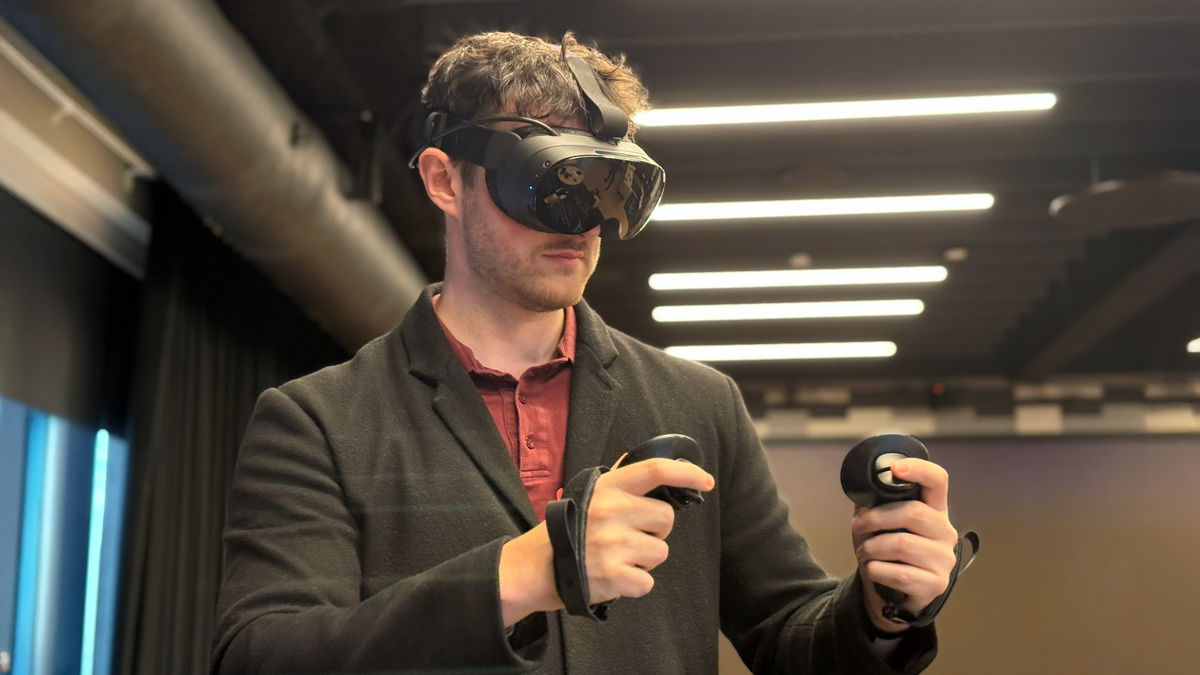
If you missed it at the time, make sure to read our hands-on impressions of Steam Frame from Valve HQ in November.
Malicious packages for dYdX cryptocurrency exchange empties user wallets
Open source packages published on the npm and PyPI repositories were laced with code that stole wallet credentials from dYdX developers and backend systems and, in some cases, backdoored devices, researchers said.
“Every application using the compromised npm versions is at risk ….” the researchers, from security firm Socket, said Friday. “Direct impact includes complete wallet compromise and irreversible cryptocurrency theft. The attack scope includes all applications depending on the compromised versions and both developers testing with real credentials and production end-users.”
Packages that were infected were:
A Visual Size Comparison Of Fictional Buildings From Popular Franchises
This is another size comparison video from Meta Ball Studio (previously), this time visualizing the sizes of various fictional buildings (all of which Alex Honnold plans to climb) from pop culture show, movie, and video game franchises. I learned a lot by watching it. Mostly, that my apartment isn’t larger than any of these except the first three, which were Ant Man’s mobile laboratory, the Krusty Krab, and SpongeBob’s pineapple house, just to be clear. I basically live in a shoebox. Well, if shoes were sold separately.
The Analogue 3D Is Giving These Unreleased N64 Colors A Second Chance

The just-announced line goes on sale next week in limited quantities
10 Fitness Hacks Every Apple Watch User Should Know
We may earn a commission from links on this page.
The Apple Watch is a powerful tool for following and tracking exercise. We’ve already shown you 10 hacks for all Apple Watch users, but I’m here with a follow-up on the fitness features, specifically. With these lesser-known settings, apps, and features, you can get more out of your workouts and your health data.
Give your Apple Watch rings a “rest day”
Credit: Beth Skwarecki
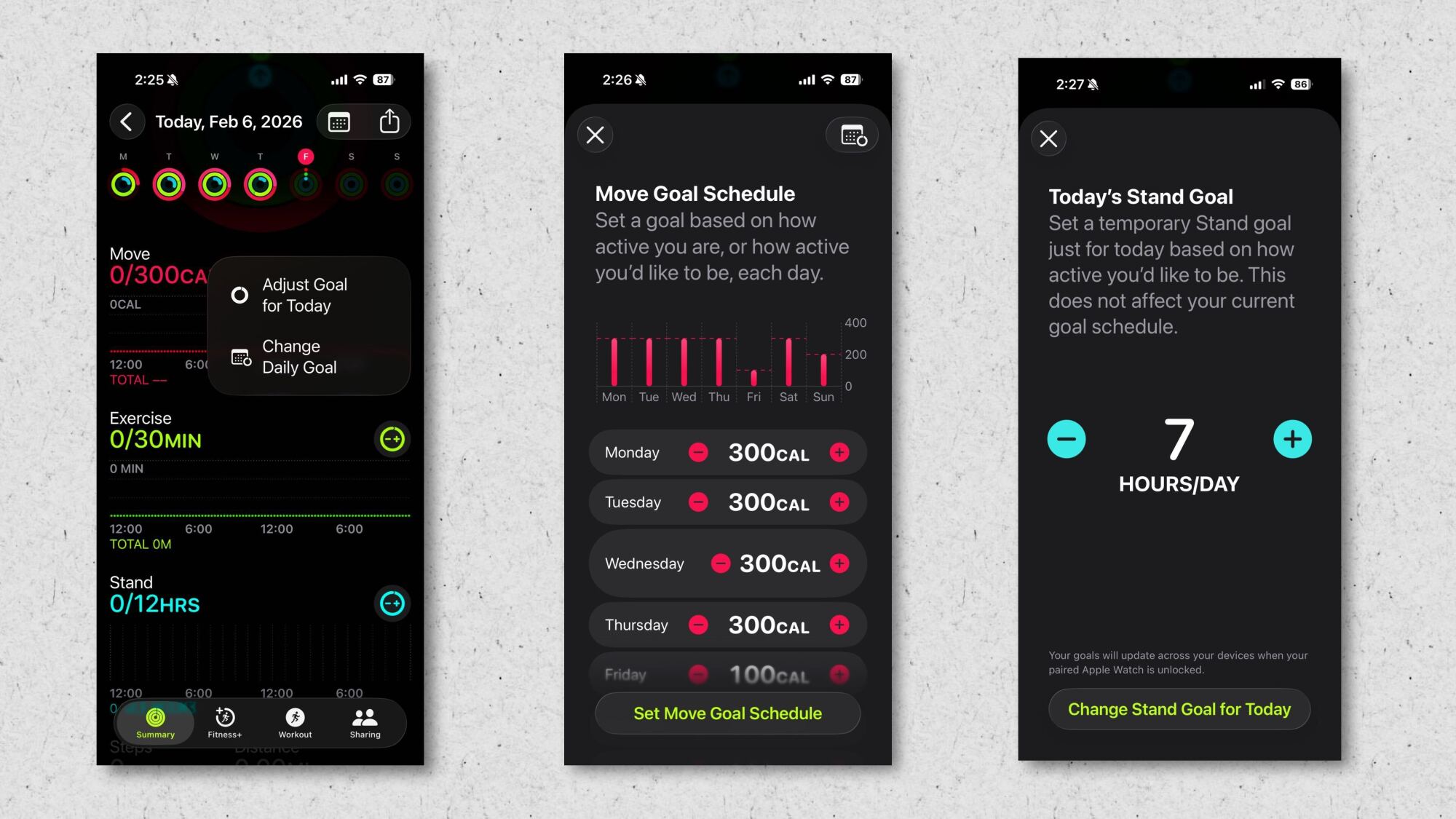
The Apple Watch’s Fitness app famously includes three rings (Move, Exercise, Stand) that you can close with activity throughout the day. Not only should you change your Move and Exercise goals to numbers that work for you (raising or lowering them as appropriate), you can also schedule in different goals for each day.
Originally, your Move, Exercise, and Stand goals were the same every day, but these days you can change your ring-closing goals, including adding rest days. Go to the Fitness app and tap the Activity Rings card, and then tap the “+/-” icon next to each goal. You can create a weekly schedule so that you have lower targets on certain days. You can also change a goal temporarily just for today—for example, reducing your Stand hour goal on a day you’re taking a road trip.
Wear your Apple Watch on your arm (or ankle)
The Apple Watch is meant to be worn on the wrist, but that doesn’t mean you have to wear it there. If your workout has you snatching kettlebells or bench pressing in wrist wraps, consider wearing the Watch on your upper arm. Or if you use a standing desk, your steps may not register unless you put the Watch on your ankle. Both of these locations will likely require a bigger wristband than what came with the Watch. Fortunately, you can buy an extra-long band, like this one.
Change the Apple Watch’s app view for easier tapping during a workout
Credit: Beth Skwarecki
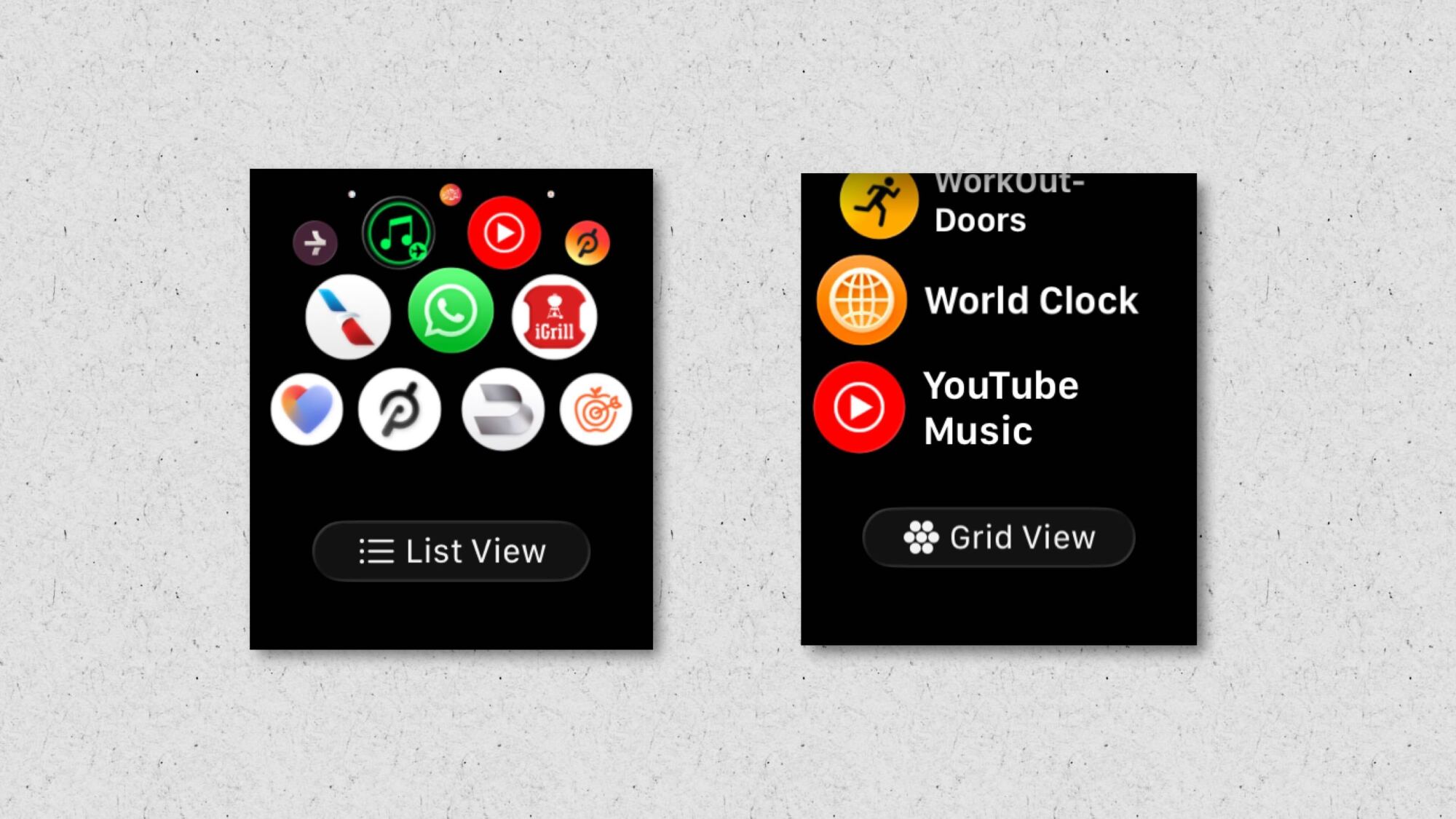
This is a tiny hack, but one that makes it so much easier to operate your watch mid-workout: Press the crown, and you’ll see all your installed apps. By default, they appear as little icons clustered together. You can rearrange them if you like, but no matter the arrangement, they’re tough to accurately tap while you’re running down the street. Make life easier on yourself by scrolling to the bottom of this screen, and tap List View. This puts your apps in an alphabetical list, with the name next to each icon. It’s now far easier to tap anything you might need during your workout.
Use Bevel to gather your Apple watch data into a convenient dashboard
Credit: Beth Skwarecki
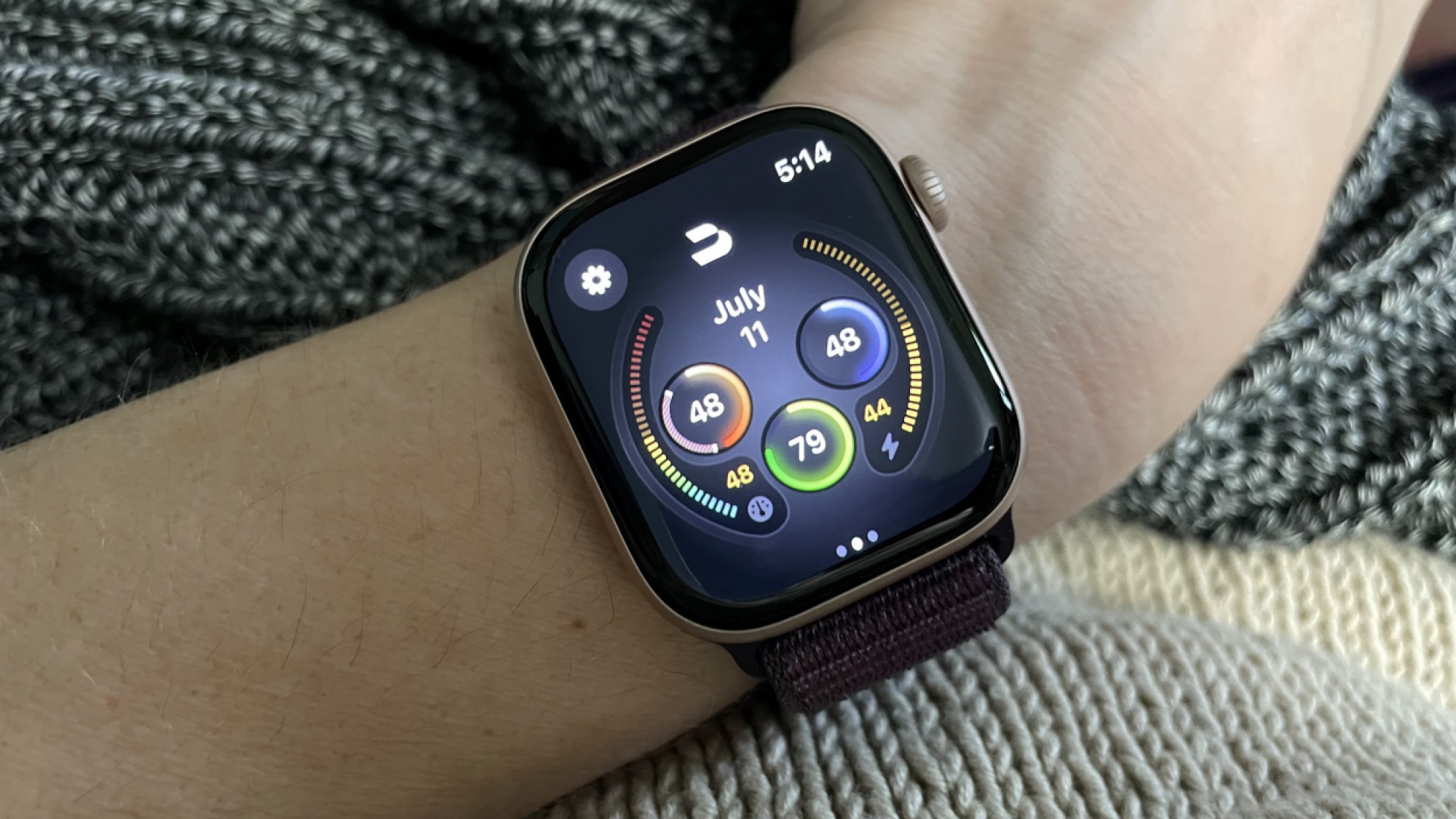
The Apple Watch collects a lot of data, but Apple doesn’t give you a convenient way to view it all in one place. The Fitness app has workout data, and the Health app stores everything else—but the Health app isn’t as user-friendly as you might wish. Third-party apps have stepped in to fill the gap. Bevel, for example, provides recovery scores and collects data in much the same way you’d see from a Whoop or Oura ring. There are other apps that do the same thing, like Athlytic, but I’m recommending Bevel because it has a free tier (and most of its functionality is on that tier). If you like the experience, consider shopping around to see if you prefer other apps.
Create custom intervals on your Apple Watch
The Workout app on Apple Watch has evolved quite a bit from its original format as a simple tracker with a start and stop button. The current version of the Fitness app has a little timer icon in the corner of each workout type, under the Workouts tab. Tap that, and you can view and edit custom workouts. Program yourself an interval workout, or a workout of a specific length. You can do this most easily from your phone—Apple has instructions here.
Use your Apple Watch to race yourself
If you run or bike the same route often, try the Race Route feature. Routes are automatically generated after you do the same run twice. On the Watch itself, go to the Workout app and choose a Run or Cycle workout, then tap the timer icon to bring up options including race routes. You can choose to race your personal best time on that route, or just your last workout on that route. During the activity, you’ll see whether you’re keeping pace with that previous workout.
Do a workout even without the Apple Watch
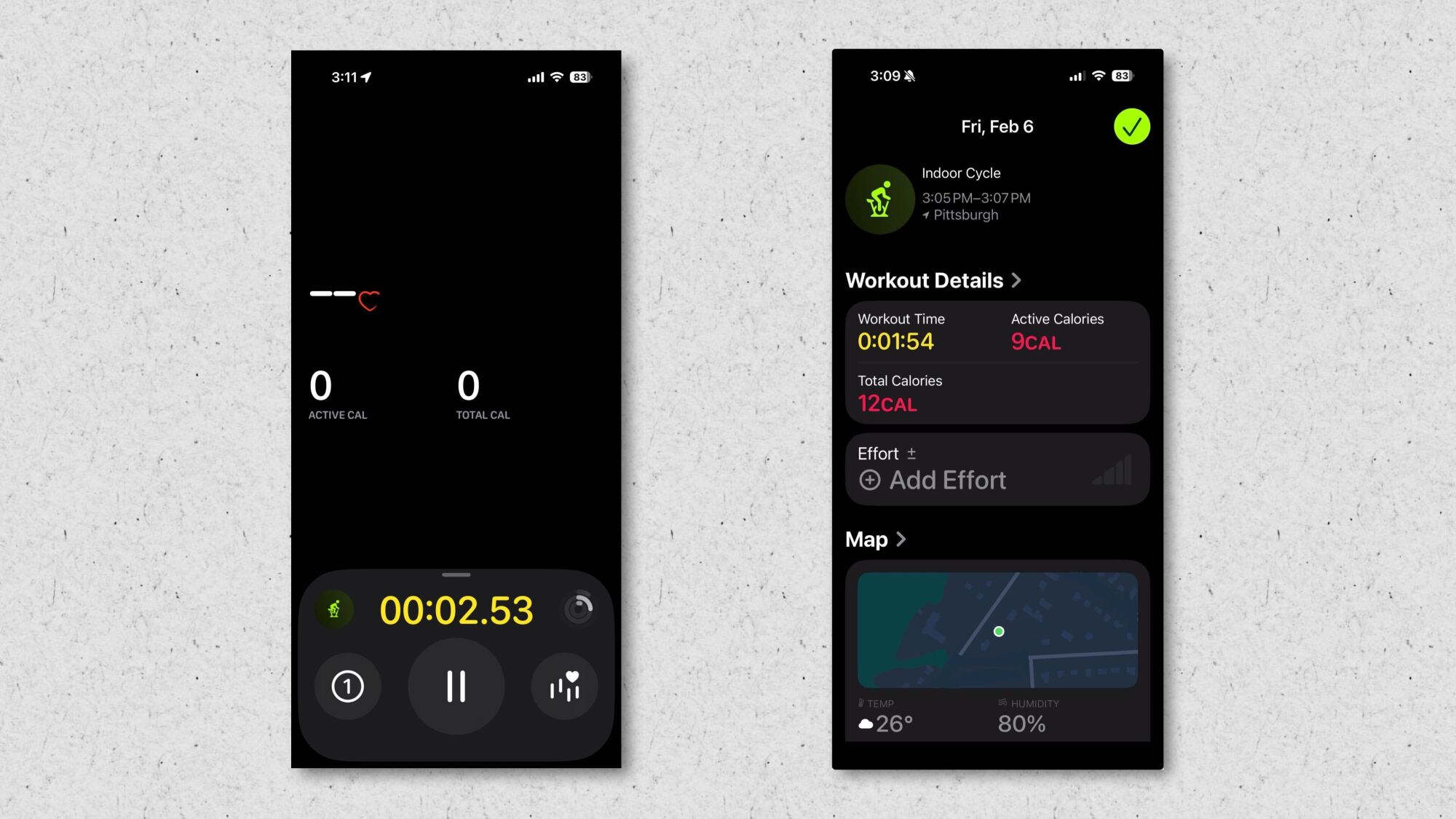
It may look empty, but it got tracked.
Credit: Beth Skwarecki
Credit: Beth Skwarecki
One of the best upgrades to iOS 26 is that the Fitness app can now track workouts even without the Apple Watch. If you left your watch at home but still want to get a run in, you can track it directly from your phone. Just go to the Fitness app, then Workout, and then tap whichever type of workout you’d like to do. If you choose an outdoor workout like a run, your phone will track your distance and pace with the phone’s GPS. If you choose an indoor workout, the app can still log the workout with a timer, but it won’t be able to collect any data. You’ll get a readout with the amount of time you worked out, and an estimate of your calorie burn, and you can rate your effort so the workout counts toward your training load. If you have a device that can measure your heart rate—like a chest strap or headphones like the Powerbeats Pro 2—you can pair that device directly to your iPhone, without involving the watch, and track your workout through the Fitness app with heart rate data intact.
Connect your Apple Watch to a treadmill
The Apple Watch is pretty good at judging distance and speed outdoors when you run, and your iPhone can do a good job of that, too. But once you’re indoors on a treadmill, only the treadmill knows how far you’re running. The Apple Watch’s distance estimations aren’t always very good. That is, unless you’re using a treadmill that can beam data directly to your watch. The treadmills in a lot of commercial gyms have this feature through a system called GymKit. In your Settings on the watch, go to Workout and turn on Detect Gym Equipment. When you use a compatible gym machine, there will be a spot on the console to tap your watch. You’ll hear a beep, and then the data on your watch will be synced to the data on the machine.
Install WorkOutDoors on your Apple Watch for more run data and mapping
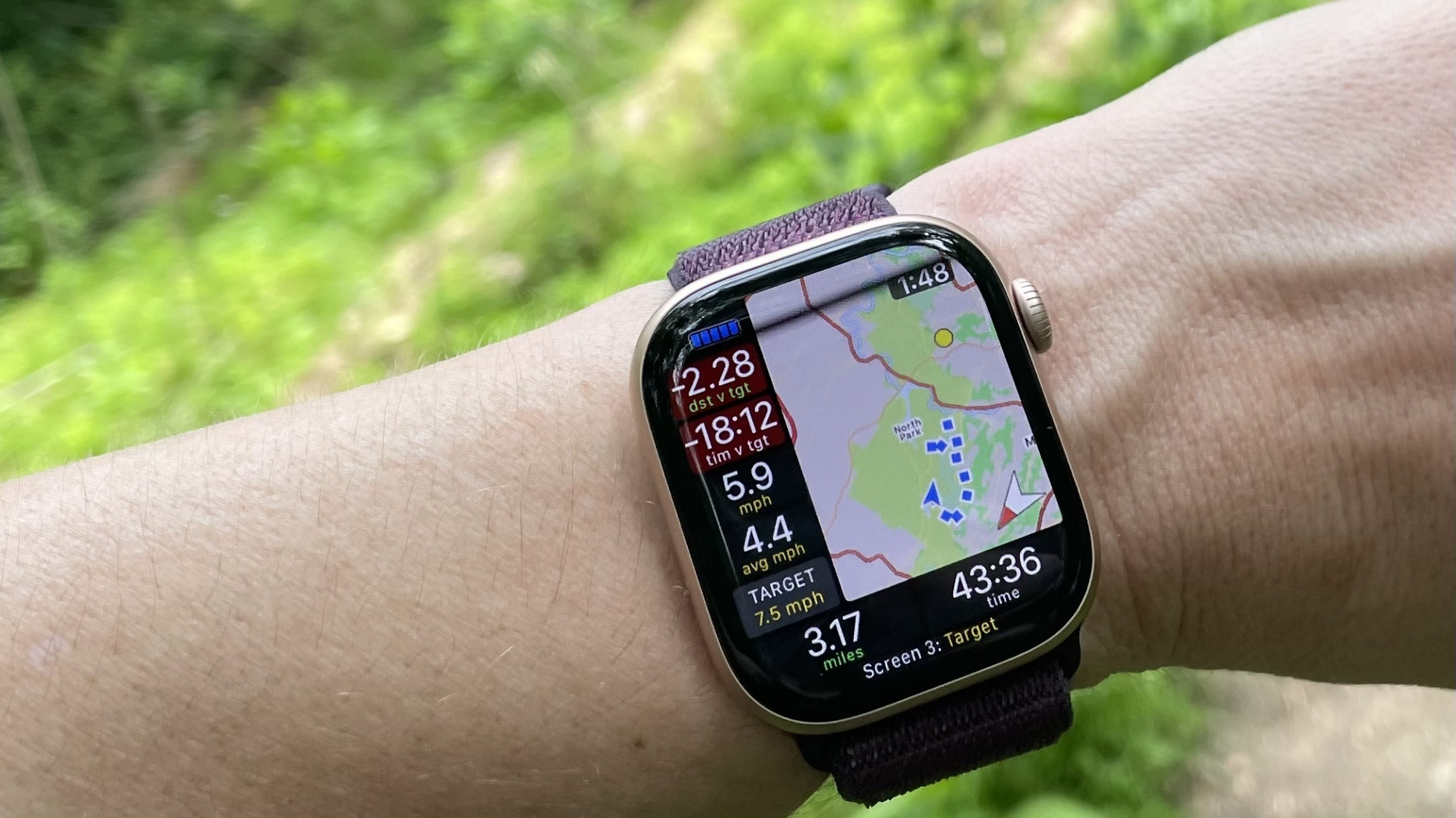
Credit: Beth Skwarecki
We’ve seen that the stock Workout app has plenty of great features for running and other workouts, but many runners and hikers prefer a different option. The Apple Watch app WorkOutDoors gives Garmin-level mapping and data analytics during your run. It takes a bit of time to learn your way around all the features, but this is an incredibly powerful tool for just a small investment ($8.99 as a one-time charge).
Top up the Apple Watch’s battery before sleep
If you use the Apple Watch to track your sleep, you don’t have the option of charging it while you sleep. But don’t worry if it’s close to bedtime and you’re low on battery—Apple Watches, especially the most recent models, are designed to charge quickly for exactly this reason. The Apple Watch Series 11 only needs five minutes of charge time for eight hours of sleep tracking.
Memory Prices Have Nearly Doubled Since Last Quarter
Memory prices across DRAM, NAND and HBM have surged 80 to 90% quarter-over-quarter in Q1 2026, according to Counterpoint Research’s latest Memory Price Tracker. The price of a 64GB RDIMM has jumped from a Q4 2025 contract price of $450 to over $900, and Counterpoint expects it to cross $1,000 in Q2.
NAND, relatively stable last quarter, is tracking a parallel increase. Device makers are cutting DRAM content per device, swapping TLC SSDs for cheaper QLC alternatives, and shifting orders from the now-scarce LPDDR4 to LPDDR5 as new entry-level chipsets support the newer standard. DRAM operating margins hit the 60% range in Q4 2025 — the first time conventional DRAM margins surpassed HBM — and Q1 2026 is on track to set all-time highs.


Read more of this story at Slashdot.
Why $700 could be a “death sentence” for the Steam Machine
After writing two November stories analyzing price expectations for Valve’s upcoming Steam Machine, I really didn’t think we’d be offering more informed speculation before the official price was revealed. Then Valve wrote a blog post this week noting that the “growing price of… critical components” like RAM and storage meant that “we must revisit our exact shipping schedule and pricing” for the living room-focused PC gaming box.
We don’t know exactly what form that “revisiting” will take at the moment. Analysts who spoke to Ars were somewhat divided on how much of its quickly increasing component costs Valve would be willing (or forced) to pass on to consumers.
“We knew the component issue was bad,” DFC Intelligence analyst David Cole told Ars. “It has just gotten worse. “
Apple will reportedly allow third-party AI assistants in CarPlay
Apple plans to allow third-party voice-controlled AI apps in CarPlay, Bloomberg reports. Siri is the default voice assistant for things like controlling music and looking up directions, but future AI apps in CarPlay could handle the complicated, open-ended requests Siri can’t answer.
The expanded support would let developers like OpenAI or Google offer versions of their ChatGPT and Gemini apps for CarPlay. Similar functionality is possible just by connecting a smartphone to a car over Bluetooth and using an AI app’s voice mode, but CarPlay support would presumably make the process a little more seamless.
Not so seamless that it replaces Siri, however. Bloomberg writes that these third-party apps won’t be able to replace the Siri button in the CarPlay interface or use their own wake words (“Hey Google,” etc.). Instead, anyone who wants to spend a long drive talking to Gemini will have to open the app first. That could cut down on the utility of using one of these apps, but Apple presumably wants to get Siri to a place where CarPlay users prefer it as their in-car assistant anyway.
Apple and Google recently announced that Gemini would power future versions of Siri and Apple Foundation Models, the AI models underpinning Apple Intelligence. The delayed, updated version of Siri Apple introduced alongside Apple Intelligence in 2024 is supposed to be able to take actions on user’s behalf, work across apps and understand the context of what’s on screen, all things Gemini can currently do. Reports suggest Apple wants to eventually use Google’s Gemini models to transform Siri into a proper conversational chatbot, too. That future version of the voice assistant could be right at home in CarPlay.
This article originally appeared on Engadget at https://www.engadget.com/transportation/apple-will-reportedly-allow-third-party-ai-assistants-in-carplay-213432646.html?src=rss
Maca 2 enables high-power wireless connectivity for UAV and robotic systems
8devices has previewed the Maca 2, a compact, high-power data radio for long-range wireless communication in drone, robotics, and industrial systems. Designed and manufactured in Europe, the platform is NDAA and TAA compliant and integrates multiple interfaces for range-focused deployments. The system is built on Qualcomm’s QCS405 system-on-chip, featuring a 650 MHz 24Kc MIPS processor […]
Snap Spins Out AR Specs Into Its Own Subsidiary
Snap spun its Specs AR glasses into its own subsidiary, and reconfirmed that it plans to launch the consumer product this year.
“Establishing Specs Inc. as a wholly-owned subsidiary provides greater operational focus and alignment, enables new partnerships and capital flexibility including the potential for minority investment, allows us to grow a distinct brand, and supports clearer valuation of the business as we work towards the public launch of Specs later this year”, the company behind Snapchat says.
The new Specs Inc subsidiary is currently hiring for nearly 100 open roles globally, it says, in preparation for the launch.
What Are Snap Spectacles & Snap Specs?
The current Snap Spectacles are $99/month AR glasses for developers ($50/month if they’re students), intended to let them develop apps for the Specs consumer product the company intends to ship this year.
Spectacles have a 46° diagonal field of view, angular resolution comparable to Apple Vision Pro, relatively limited computing power, and a built-in battery life of just 45 minutes. They’re also the bulkiest AR device in “glasses” form factor we’ve seen yet, weighing 226 grams. That’s almost 5 times as heavy as Ray-Ban Meta glasses, for an admittedly entirely unfair comparison.
But Snap CEO Evan Spiegel claims that the consumer Specs will have “a much smaller form factor, at a fraction of the weight, with a ton more capability”, while running all the same apps developed so far.
As such, what’s been more important to keep track of, to date, is Snap OS, not the developer kit hardware.
Snap OS is relatively unique. While on an underlying level it’s Android-based, you can’t install APKs on it, and thus developers can’t run native code or use third-party engines like Unity. Instead, they build sandboxed “Lenses”, the company’s name for apps, using the Lens Studio software for Windows and macOS.
In Lens Studio, developers use JavaScript or TypeScript to interact with high-level APIs, while the operating system itself handles the low-level core tech like rendering and core interactions. This has many of the same advantages as the Shared Space of Apple’s visionOS: near-instant app launches, interaction consistency, and easy implementation of shared multi-user experiences without friction. It even allows the Spectacles mobile app to be used as a spectator view for almost any Lens.
Snap OS doesn’t support multitasking, but this is more likely a limitation of the current hardware than the operating system itself.
Snap OS 2.0 Brings The AR Glasses Closer To Consumer-Ready
Snap OS 2.0 is out now, adding and improving first-party apps like Browser, Gallery, and Spotlight to bring the AR platform closer to being ready for consumers.
 UploadVRDavid Heaney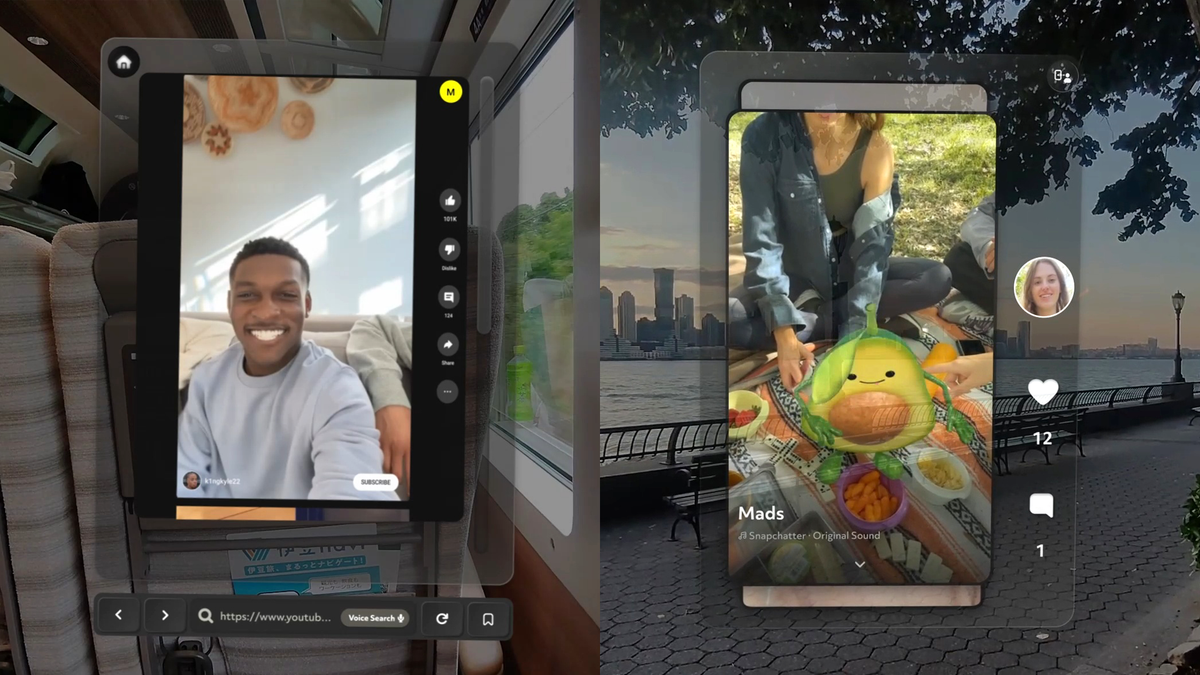
Since releasing Snap OS in the latest Spectacles kit in late 2024, Snap has repeatedly added new capabilities for developers building Lenses, and late last year launched Snap OS 2.0, adding and improving first-party apps like Browser, Gallery, and Spotlight to bring the AR platform closer to being ready for consumers.
COVID-19 cleared the skies but also supercharged methane emissions
In the spring of 2020, as the COVID-19 pandemic brought global industry and travel nearly to a halt, satellite sensors recorded a dramatic plunge in nitrogen dioxide, a byproduct of internal combustion engines and heavy industry. For a moment, the world’s air was cleaner than it had been in decades.
But then something strange started happening: methane, the second most important anthropogenic greenhouse gas after carbon dioxide, was surging. Its growth rate hit 16.2 parts per billion that year, the highest since systematic records began in the early 1980s. A new study published in the journal Science looked at the complex chemistry of the troposphere (the lowest region of the atmosphere) and found that the two changes are likely connected.
An atmospheric cleaner
Since the late 1960s, we knew that atmospheric methane doesn’t just vanish. It is actively scrubbed from the sky by the hydroxyl radical, a highly reactive molecule that breaks down methane, turning it into water vapor and carbon dioxide. “The problem is that the lifetime of the hydroxyl radical is very short—its lifespan is less than a second” says Shushi Peng, a professor at Peking University, China, and a co-author of the study. To do its job as an atmospheric methane clearing agent, a hydroxyl radical must be constantly replenished through a series of chemical reactions triggered by sunlight. The key ingredients in these reactions are nitrogen oxides, the very pollutants that were drastically reduced when cars stayed in garages and factories went dark in 2020.