Rackspace customers grapple with “devastating” email hosting price hike

Rackspace’s new pricing for its email hosting services is “devastating,” according to a partner that has been using Rackspace as its email provider since 1999.

In recent weeks, Rackspace updated its email hosting pricing. Its standard plan is now $10 per mailbox per month. Businesses can also pay for the Rackspace Email Plus add-on for an extra $2/mailbox/month (for “file storage, mobile sync, Office-compatible apps, and messaging”), and the Archiving add-on for an extra $6/mailbox/month (for unlimited storage).

As recently as November 2025, Rackspace charged $3/mailbox/month for its Standard plan, and an extra $1/mailbox/month for the Email Plus add-on, and an additional $3/mailbox/month for the Archival add-on, according to the Internet Archive’s Wayback Machine.

Read full article

Comments

ChatGPT Is Getting a Cheaper Subscription Tier (but Also Ads)

As OpenAI scrambles to find new ways to monetize ChatGPT, it announced today that it’s introducing a new, cheaper subscription tier for its AI chatbot—but that it’s also adding ads to both that new tier and for free users.

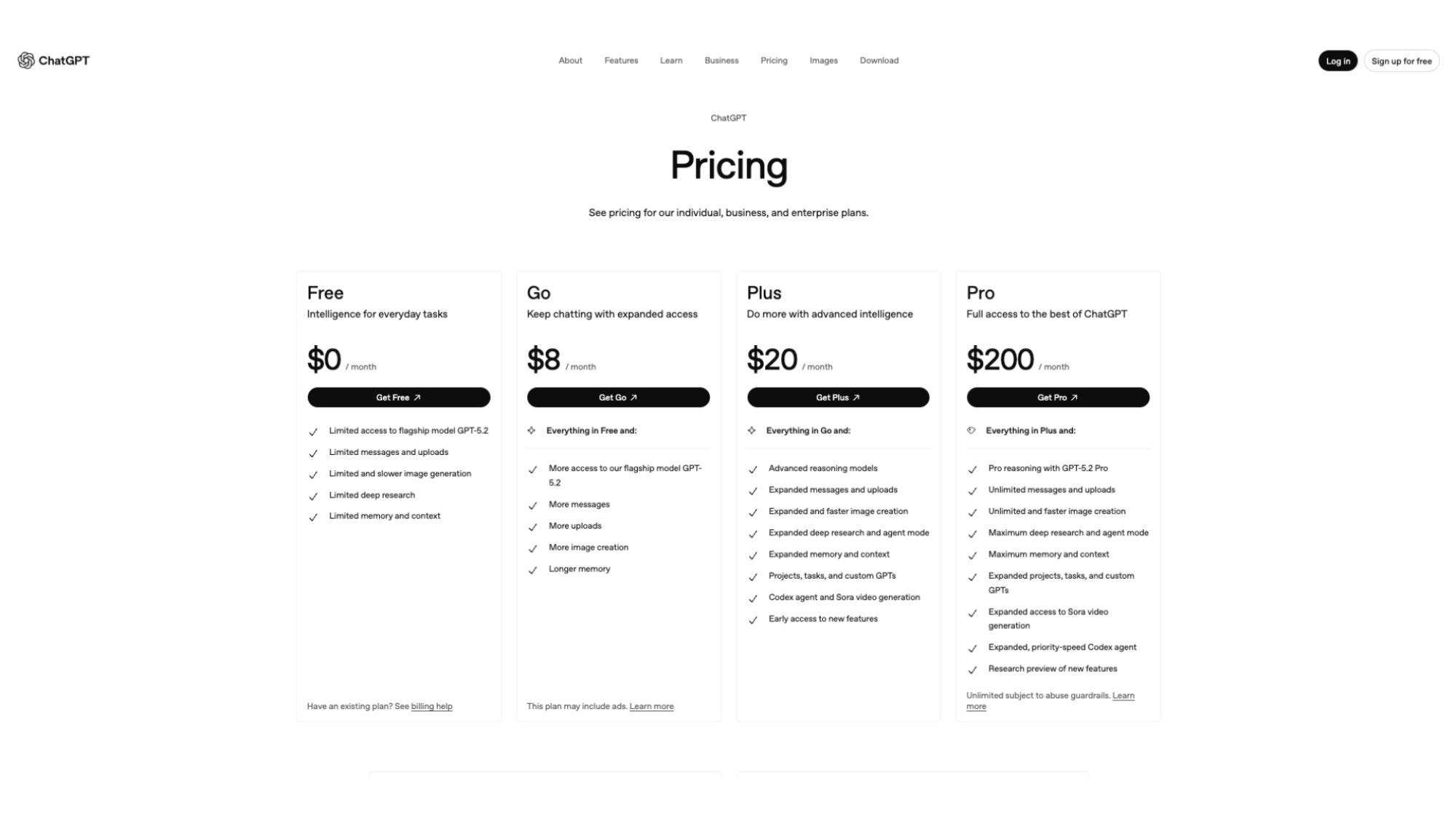
ChatGPT Go was first launched in India in August, and later became available to 170 countries around the world, but today marks the first time it’s been available everywhere, including the United States. It marks a middle ground between the Free and Plus plans, coming in at $8/month vs. the Plus plan’s $20/month, and is arguably the first “affordable” ChatGPT subscription.

ChatGPT plans

Credit: OpenAI

What you get is basically an expanded version of the Free tier, as it does not give you access to any new models or features, but does put a higher limit on messages, uploads, images, and memory. It also gives you unlimited access to ChatGPT’s new 5.2 model, as opposed to the limited usage that comes with the Free tier.

Essentially, it’s aimed at everyday users who just need a little bit more from the AI, but don’t necessarily want more power user-oriented features like advanced reasoning models or Sora video generation.

However, with that price cut over the Plus plan comes a double-edged sword. Announced alongside ChatGPT Go were ads, which OpenAI said it’s planning to start testing in the U.S. for the Free and Go tiers “in the coming weeks.” We’ve seen hints that ads would be coming to ChatGPT for a while, but now we know roughly what they’ll look like.

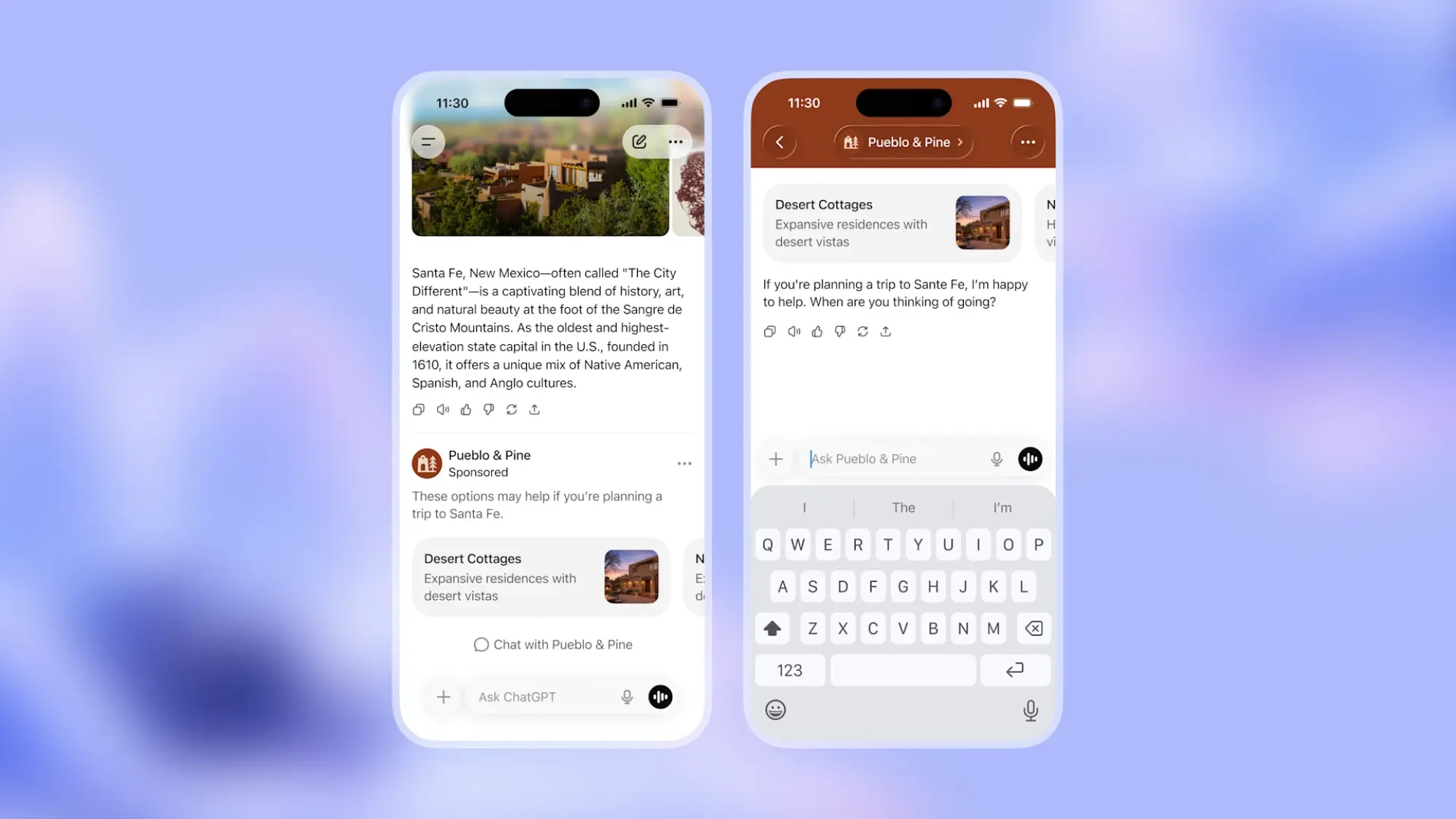
OpenAI says that ChatGPT ads will be clearly labeled, will show up below answers, and will focus on products that are relevant to whatever conversation you’re having. The company promises that ads won’t influence your answers and that your ChatGPT conversations will be kept private from advertisers, but that your ads will be personalized over time. However, you’ll be able to turn off ad personalization and clear the data used for it at any time.

Oddly enough, for this initial testing phase, OpenAI also says ads will only apply to users who are logged in, meaning that if you’re planning to use the Free tier anyway, you might be able to skirt them for now by just staying logged out. You’ll lose out on features like memory, but it might be worth it depending on your priorities. ChatGPT Go users will have no choice but to see ads, though.

Mockup of ads in ChatGPT

Credit: OpenAI

Alongside the announcement, OpenAI posted a few examples of what ads would look like in the app, but nothing is final yet. Of note, ads will not run on accounts where the user either admits to being under 18, or the company predicts they are. Similarly, sensitive topics like health or politics should remain ad-free.

Both of today’s announcements point to ways AI is trying to become profitable in 2026, which has continually proven to be challenging for the companies operating these chatbots, despite heavy investment. Unsurprisingly, they rely on the same methods pre-AI companies have relied on for decades: Ads and subscriptions. But for now, OpenAI is making at least two promises it’s hoping will help the news go down more easily.

First, the company says it will “always offer a way to not see ads in ChatGPT, including a paid tier that’s ad-free.” That’s probably cold comfort to anyone who values their wallet. But second, and perhaps most surprising if true, is that OpenAI still says it’s not going to optimize for “time spent in ChatGPT” over “user trust and experience.” That’ll be a boon for usability, but less time spent in-app will mean serving fewer ads. I’m curious to see how long OpenAI will stick to that commitment, especially as monetary incentives push the company in the other direction.

Dark Fantasy RPG Legendary Tales Arrives On Quest

Legendary Tales is a dark fantasy RPG with physics-based combat that’s just out on Quest.

Almost two years after its initial release on PC VR and PlayStation VR2, Legendary Tales is available now on the Meta Quest 3 and 3S. We found it has “satisfying” physics-based combat across its extensive dungeon-crawling, with the promise of more than 15 hours of content. Fully playable solo or in online co-op mode, its quest-driven storyline can be experienced with friends from the beginning all the way through to the end. While no specific port features were mentioned, developer Urban Wolf Games mentioned the Quest version has “the most advanced system updates that are not released on PCVR and PSVR2 yet.”

0:00

/2:21

Akin to a Dark Souls experience in VR, the core gameplay mechanic of Legendary Tales is the exploration of loot-filled dungeons complete with skeletons, orcs, and challenging boss fights. Its focus on a hands-on crafting system allows players to collect materials to craft weapons, as well as dabble in alchemy to use various potions to aid in battle. The physics-based combat focuses on precise parrying to retaliate against enemy attacks and hopefully leave every encounter unscathed. Finally, its detailed skill tree gives a bevy of specializations as a rogue, mage, warrior, or a personalized hybrid build.

In a heartfelt Reddit post the day before the game’s release this week, the developer acknowledged the bad timing while also talking about their personal experience regarding developing for virtual reality and its challenges. A DLC expansion named “Dawn of History” with new items, maps, and enemies is expected later this year.

Legendary Tales is out now for Meta Quest, PS VR2, and Steam.

Canada Reverses Tariff On Chinese EVs

Longtime Slashdot reader hackingbear shares a report from the Washington Times: Breaking with the United States, Canada has agreed to cut its 100% tariff [back to 6.1%] on Chinese electric cars in return for lower tariffs on Canadian farm products, Prime Minister Mark Carney said Friday after meeting Chinese President Xi Jinping in Beijing. He said there would be an initial annual cap of 49,000 vehicles on Chinese EV exports to Canada, growing to about 70,000 over five years. Prior to the 100% tariff, China exported about 41,000 vehicles to Canada in 2023. In exchange, China will reduce its total tariff on canola seeds, a major Canadian export, from 84% to about 15%, he told reporters. Carney said China has become a more predictable partner to deal with than the U.S, the country’s neighbor and longtime ally.

[hackingbear writes: “After helping the U.S. arrest Huawei CFO Meng Wanzhou, who was later released without admitting guilty by the Biden administration after bickering with China, Canada had followed the U.S. in putting tariffs of 100% on EVs from China and 25% on steel and aluminum under former Prime Minister Justin Trudeau, Carney’s predecessor.”] China responded by imposing duties of 100% on Canadian canola oil and meal and 25% on pork and seafood. It added a 75.8% tariff on canola seeds last August. Collectively, the import taxes effectively closed the Chinese market to Canadian canola, an industry group has said.


Read more of this story at Slashdot.

This Samsung Odyssey G5 Gaming Monitor Is $250 Right Now

We may earn a commission from links on this page. Deal pricing and availability subject to change after time of publication.

The Samsung Odyssey line is designed for gamers who want a blend of speed and immersion, and its consistently popular monitors are known for high refresh rates, low-input lag, and crisp visuals that perform more smoothly in a fast-paced world than a standard display. The 32″ Samsung Odyssey G50D S27DG50 is a flat, entry-level alternative to some of the line’s pricier curved monitors, and right now, it’s 42% off at $249.99 (down from $429.99).

The 27-inch, 1440p display has wide viewing angles and is ideal for those who want ample screen space without stepping up to an ultra-wide monitor. It has a 180Hz max refresh rate and consistently low input lag, as well as FreeSync and G-SYNC VRR support to minimize screen tearing. That said, some reviews mention low contrast and a poor dimming system with blacks that can look gray in very dark rooms. While response time is fast, there can be a bit of motion blur that occurs with fast-moving objects, which is to be expected with this price range. 

Though the G5 is marketed primarily as a gaming monitor, it’s also versatile for everyday use thanks to its great color accuracy, effective glare reduction in well-lit rooms, and strong ergonomic adjustments. If you’re looking for a budget-friendly QHD gaming system with a high refresh rate, reliable brightness, and wide viewing angles, the 32″ Samsung Odyssey G50D S27DG50 monitor performs well and offers good value at $249.99. However, if you want a more feature-rich option or a monitor with deeper contrast and stronger HDR, it may be worth stepping up to a higher-end model from the Odyssey line, such as the Odyssey G9—but it will cost you significantly more. 

Deals are selected by our commerce team

Everyone Can Now Use the ‘Live’ Status on Bluesky, and I Couldn’t Be Happier

The user-generated video industry is worth over $4 billion, reflecting how tastes have evolved away from reading articles and watching television punditry and toward scrolling vertical video feeds and watching live streams. As a reader, a writer, and the editor of an article-driven tech site, the rise of user-generated video and streaming can be a tough reality to accept. But as a longtime fan of live streaming, a part of me is thrilled to see the media landscape begin to take it more seriously. For example: On Jan. 16, Bluesky announced the rollout of a feature that more seamlessly connects its users to live streams—a feature that may catch on more broadly.

The latest Bluesky update, v1.114, allows streamers to display their “Live Now” status directly on the social network, a feature previously launched to beta testers back in May 2025. Now widely available, the feature makes it easier to connect to social audiences across platforms: Users can click a Bluesky profile’s “Live Now” status and be directed straight to that profile’s associated Twitch stream. (The feature currently works only with Twitch, but is expected to expand to other live streaming platforms soon.)

Other social apps punish links — we think linking out should be easy. Live Now is part of how we’re making that happen.

While in beta, Live Now is currently limited to Twitch links. Support for other streaming platforms may follow as we learn from the beta.

— Bluesky (@bsky.app) January 15, 2026 at 2:00 PM

“Live Now” arrives just as Bluesky saw an increase in users this week, following a major X outage and scrutiny of the platform’s ongoing deepfake porn problem. Regardless of what it could mean for Bluesky’s overall growth, I’m optimistic about any pro-discovery feature that can be adopted more broadly. I can imagine a future where more sites refer its users to live streaming platforms. Consider a Gmail avatar letting me know when a YouTuber is online, a Spotify artist page pointing me to a musician’s stream, or an article byline pointing me to a live video on Substack. I hope that the bridge between my social feed and live streams continues to get shorter.

How to enable the “Live Now” badge on Bluesky

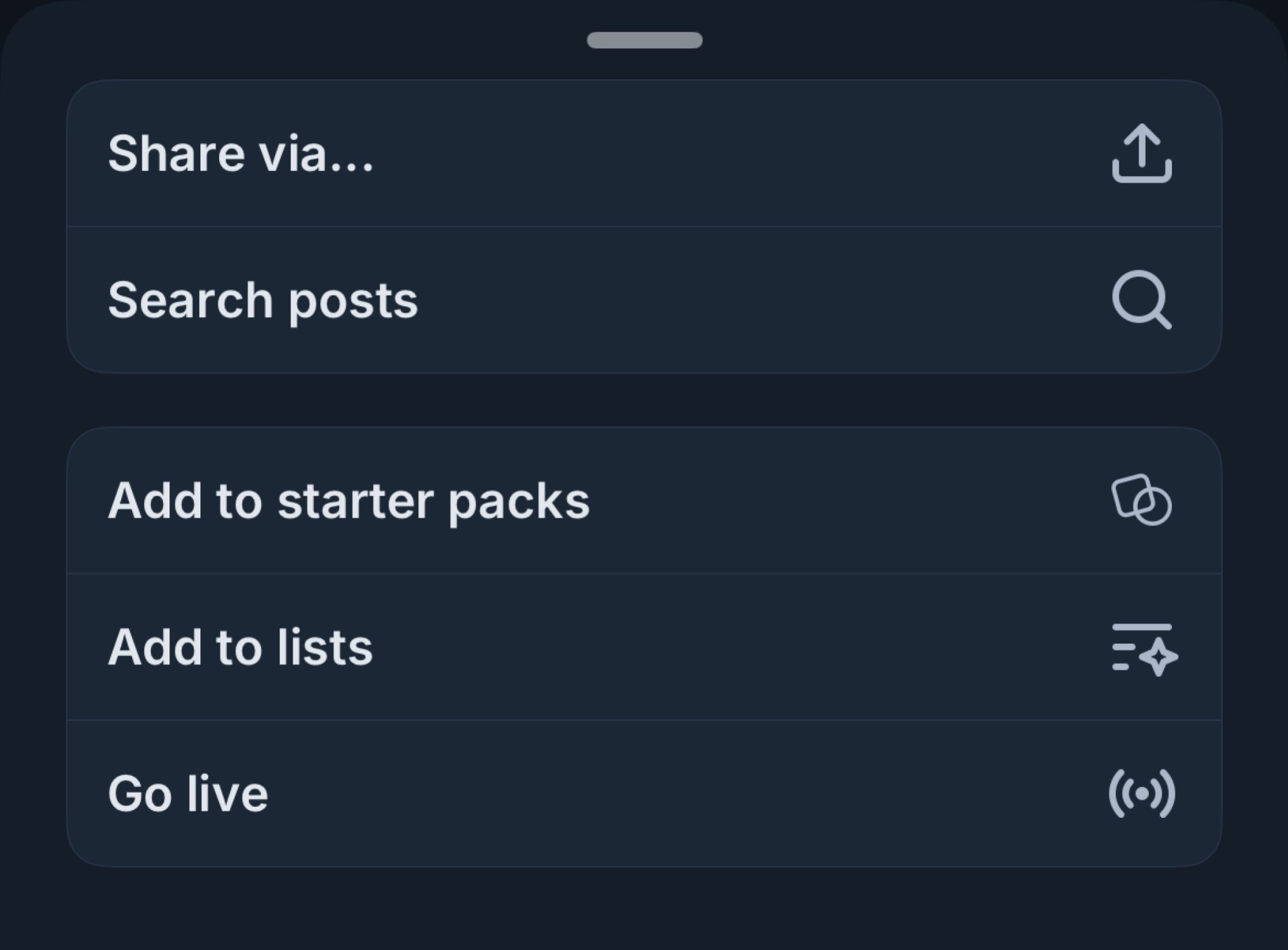
To turn on the “Live Now” badge on your Bluesky avatar, click the three-dot menu on the top-right of your profile page on desktop or mobile. From the list of options, choose the “Go Live” option and paste a link to your Twitch profile page. The duration of your temporary “Live” badge is customizable, ranging from 5 minutes to 4 hours. Choose your preferred duration, and click “Go Live.”

Bluesky three-dot menu options

Credit: Jordan Calhoun / Lifehacker

"Go Live" menu options

Credit: Jordan Calhoun / Lifehacker

Archaeologists find a supersized medieval shipwreck in Denmark

Archaeologists recently found the wreck of an enormous medieval cargo ship lying on the seafloor off the Danish coast, and it reveals new details of medieval trade and life at sea.

Archaeologists discovered the shipwreck while surveying the seabed in preparation for a construction project for the city of Copenhagen, Denmark. It lay on its side, half-buried in the sand, 12 meters below the choppy surface of the Øresund, the straight that runs between Denmark and Sweden. By comparing the tree rings in the wreck’s wooden planks and timbers with rings from other, precisely dated tree samples, the archaeologists concluded that the ship had been built around 1410 CE.

photo of a scuba diver swimming over wooden planks underwater
The Skaelget 2 shipwreck, with a diver for scale.
Credit:
Viking Ship Museum

A medieval megaship

Svaelget 2, as archaeologists dubbed the wreck (its original name is long since lost to history), was a type of merchant ship called a cog: a wide, flat-bottomed, high-sided ship with an open cargo hold and a square sail on a single mast. A bigger, heavier, more advanced version of the Viking knarrs of centuries past, the cog was the high-tech supertanker of its day. It was built to carry bulky commodities from ports in the Netherlands, north around the coast of Denmark, and then south through the Øresund to trading ports on the Baltic Sea—but this one didn’t quite make it.

Read full article

Comments

The ‘Natural Cycles’ App Now Has a Smart Band to Track Your Temperature and Fertility

We may earn a commission from links on this page.

Tracking symptoms of your menstrual cycle can be surprisingly effective at identifying when you’re likely to get pregnant. One of the best metrics to track is body temperature, which wearables can pick up on. The Natural Cycles app already works with your Apple Watch or Oura Ring, but now the company is launching its own smart band. 

As I noted in my CES fitness trends roundup, smart bands are having a moment. Whoop used to be the only major screenless tracking band out there, but we now have Amazfit, Polar, and may soon see Luna and Speediance fitness bands. Garmin has a sleep tracking band. And now, this band from Natural Cycles uses the same form factor for the simpler job of tracking temperature. 

What the Natural Cycles band does

Natural Cycles is a subscription-based app ($149.99/year) that uses temperature to estimate where you are in your monthly cycle. The concept is similar to other period-tracking apps, but the temperature data makes it a fertility awareness method, in contrast to the old fashioned “rhythm method” that was so error-prone. 

Temperature tracking isn’t unique to this app; I remember using the same idea many years ago when I was trying to get pregnant. I had to wake up at the same time every day and take my temperature first thing in the morning with a thermometer that had an extra decimal place of accuracy compared to standard drugstore thermometers. From there, I’d chart my temperature on graph paper, and when my temperature ticked up by about half a degree (and stayed there), I could pinpoint the day I had most likely ovulated.

Wearables track temperature data automatically, as you’ve noticed if you wear an Oura ring or another wearable with a temperature sensor. Natural Cycles already has partnerships with both Oura and Apple Watch. Whoop, for its part, can track temperature with its own band and provide ovulation estimates.

Natural Cycles previously offered a Bluetooth-enabled thermometer ($39.99) for people who don’t have an Oura ring or Apple Watch. Now, it’s introducing its own wearable band, in purple, with a sticker price of $129.99.

Most users will get it for less, though. Natural Cycles is including the band free with its  $149.99 annual subscription, and current members can add the band to their existing subscription at a 25% discount, making it $97.49. The company describes these as limited time offers. Anyone adding the band to a monthly membership would pay the full $129.99. 

Natural Cycles is a subscription, like Whoop, so after your first year of using the device ends, you’d still have to pay to renew your subscription. The device seems to be intended only for capturing nighttime temperature, so you wouldn’t need to wear it during the day. The downside is that it doesn’t capture fitness or other data, so it can’t replace a fitness tracker. 

If you want the most affordable device that does it all, consider an Apple Watch Series 8 ($178 refurbished) or newer, or an Apple Watch SE 3 ($239.99)—both of these have a temperature sensor and can work with Natural Cycles, but they are both more expensive than the Natural Cycles subscription itself. 

Google is appealing the ruling from its search antitrust case to avoid sharing data with rivals

Google has filed its appeal to the Department of Justice’s antitrust case that ended with a federal judge ruling that the company was maintaining a monopoly with its search business. While the company goes through the appeals process, it’s also asking that implementation of the remedies from the case, which include a requirement that Google share search data with its competitors, also be paused.

“As we have long said, the Court’s August 2024 ruling ignored the reality that people use Google because they want to, not because they’re forced to,” Google said in a statement. “The decision failed to account for the rapid pace of innovation and intense competition we face from established players and well-funded start-ups. And it discounted compelling testimony from browser makers like Apple and Mozilla who said they choose to feature Google because it provides the highest quality search experience for their consumers.”

The company says that the requirement that it “provide syndication services to rivals” and share search data is a privacy risk and could “discourage competitors from building their own products.” Both remedies where compromises based on what the Justice Department originally proposed, which included forcing Google to sell its Chrome web browser.

After a 10-week trial held in 2023, Google was found to have a search monopoly in 2024 because of the placement it maintained as the default search engine on multiple platforms, and the control it exerted over the ads that appear in search results. Both arguments were key points in the DOJ’s original 2020 lawsuit.

This article originally appeared on Engadget at https://www.engadget.com/big-tech/google-is-appealing-the-ruling-from-its-search-antitrust-case-to-avoid-sharing-data-with-rivals-215107905.html?src=rss

Judge orders Anna’s Archive to delete scraped data; no one thinks it will comply

The operator of WorldCat won a default judgment against Anna’s Archive, with a federal judge ruling yesterday that the shadow library must delete all copies of its WorldCat data and stop scraping, using, storing, or distributing the data.

Anna’s Archive is a shadow library and search engine for other shadow libraries that was launched in 2022. It archives books and other written materials and makes them available via torrents, and recently expanded its ambitions by scraping Spotify to make a 300TB copy of the most-streamed songs. Anna’s Archive lost its .org domain a couple of weeks ago but remains online at other domains.

Yesterday’s ruling is in a case filed by OCLC, a nonprofit that operates the WorldCat library catalog on behalf of member libraries. OCLC alleged that Anna’s Archive “illegally hacked WorldCat.org” to steal 2.2TB of data.

Read full article

Comments

This may be the grossest eye pic ever—but the cause is what’s truly horrifying

A generally healthy 63-year-old man in the New England area went to the hospital with a fever, cough, and vision problems in his right eye. What his doctors eventually figured out was that a dreaded hypervirulent bacteria—which is rising globally—was ravaging several of his organs, including his brain.

According to the man, the problems had started three weeks before his hospital visit, when he said he ate some bad meat and started having vomiting and diarrhea. Those symptoms faded after about two weeks, but then new problems began; he started coughing and having chills and a fever. His cough only worsened from there.

At the hospital, doctors took X-rays and computed tomography (CT) scans of his chest and abdomen. The images revealed over 15 nodules and masses in his lungs. But, that’s not all they found. The imaging also revealed a mass in his liver that was 8.6 cm in diameter (about 3.4 inches). Lab work pointed toward an infection. So, doctors admitted him to the hospital and provided oxygen to help with his breathing, as well as antibiotics. But, his chills and cough continued.

Read full article

Comments

OpenAI to test ads in ChatGPT as it burns through billions

On Friday, OpenAI announced it will begin testing advertisements inside the ChatGPT app for some US users in a bid to expand its customer base and diversify revenue. The move represents a reversal for CEO Sam Altman, who in 2024 described advertising in ChatGPT as a “last resort” and expressed concerns that ads could erode user trust, although he did not completely rule out the possibility at the time.

The banner ads will appear in the coming weeks for logged-in users of the free version of ChatGPT as well as the new $8 per month ChatGPT Go plan, which OpenAI also announced Friday is now available worldwide. OpenAI first launched ChatGPT Go in India in August 2025 and has since rolled it out to over 170 countries.

Users paying for the more expensive Plus, Pro, Business, and Enterprise tiers will not see advertisements.

Read full article

Comments

Britain Has ‘Moved Away’ From Aligning With EU Regulation, Financial District’s Ambassador Says

An anonymous reader shares a report: The prospect of Britain realigning its financial rules with the European Union has passed, and the country should avoid linking its regulations to any single jurisdiction, the ambassador for London’s financial services sector told Reuters. Nearly a decade after Brexit, newly appointed Lady Mayor of London Susan Langley said that while maintaining dialogue with the EU remained important — particularly on defence — Britain should work with all nations that share its values and respect the rule of law.

“We’ve still got huge alignment with Europe, cash flows between us are huge… Would we ever go back in terms of regulation? I think we’ve moved away from that,” she said.


Read more of this story at Slashdot.

Mandiant releases rainbow table that cracks weak admin password in 12 hours

Security firm Mandiant has released a database that allows any administrative password protected by Microsoft’s NTLM.v1 hash algorithm to be hacked in an attempt to nudge users who continue using the deprecated function despite known weaknesses.

The database comes in the form of a rainbow table, which is a precomputed table of hash values linked to their corresponding plaintext. These generic tables, which work against multiple hashing schemes, allow hackers to take over accounts by quickly mapping a stolen hash to its password counterpart. NTLMv1 rainbow tables are particularly easy to construct because of NTLMv1’s limited keyspace, meaning the relatively small number of possible passwords the hashing function allows for. NTLMv1 rainbow tables have existed for two decades but typically require large amounts of resources to make any use of them.

New ammo for security pros

On Thursday, Mandiant said it had released an NTLMv1 rainbow table that will allow defenders and researchers (and, of course, malicious hackers, too) to recover passwords in under 12 hours using consumer hardware costing less than $600 USD. The table is hosted in Google Cloud. The database works against Net-NTLMv1 passwords, which are used in network authentication for accessing resources such as SMB network sharing.

Read full article

Comments

Google Fast Pair Flaw Exposes Hundreds Of Millions Of Bluetooth Devices To WhisperPair Exploit, Patch ASAP

Google Fast Pair Flaw Exposes Hundreds Of Millions Of Bluetooth Devices To WhisperPair Exploit, Patch ASAP
Users of Bluetooth accessories beware—a vulnerability was found in the commonly-used Google Fast Pair standard in August of 2025, and an active exploit dubbed WhisperPair is out in the wild. The WhisperPair exploit allows for attackers to track and pair with victim’s devices, and once paired, an attacker can listen to and record private conversations