The GoPro Max2 Is $100 Off Right Now

We may earn a commission from links on this page. Deal pricing and availability subject to change after time of publication.

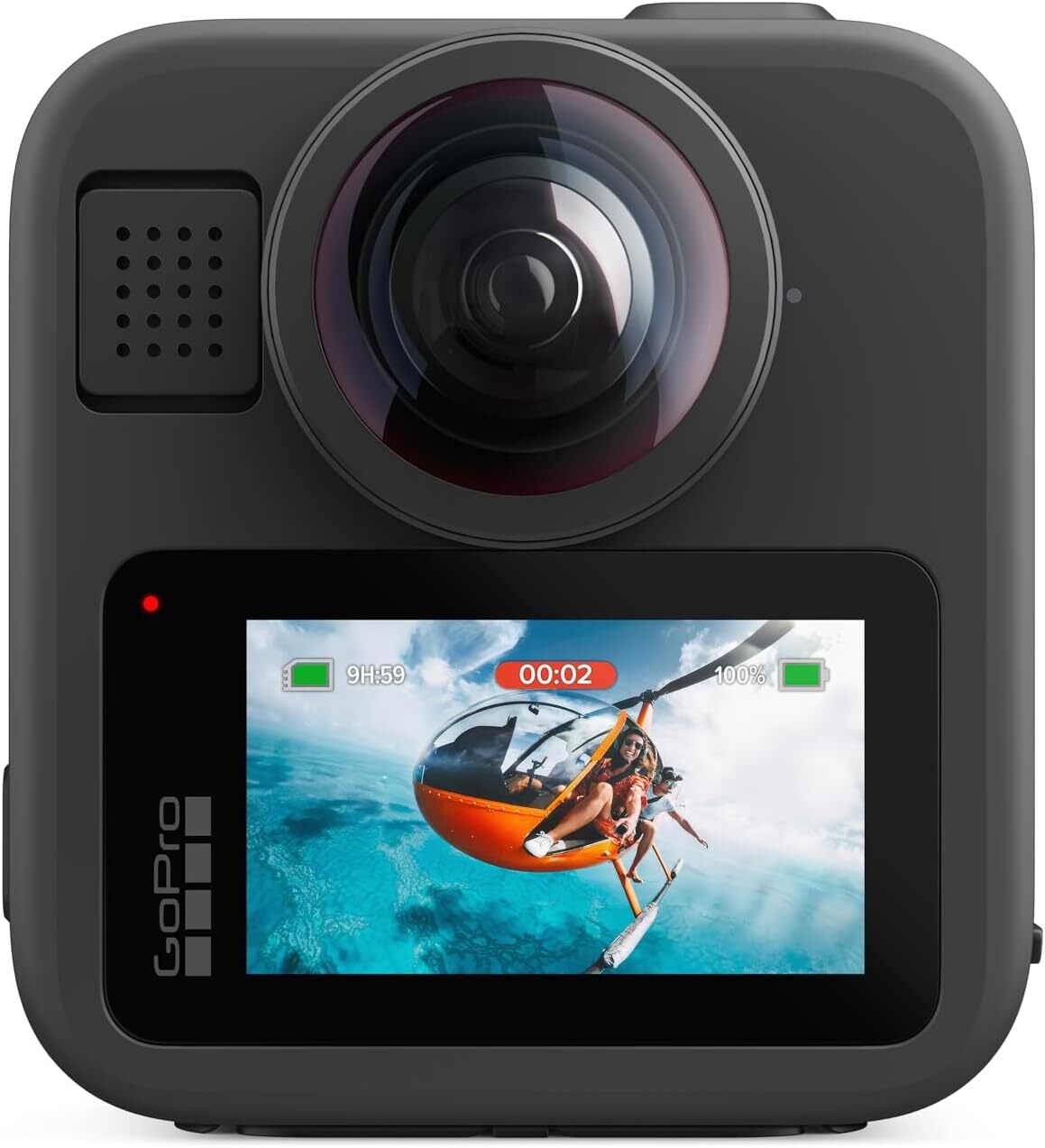
360-degree cameras like the GoPro Max2 are designed for creators who want to capture more than what a single-lens camera, like the GoPro Hero series, can handle. Right now, the GoPro Max2 action camera is down from $499 to $399 on Amazon, marking its lowest price ever. 

Compared to the Max1, the Max2 has a higher 8K resolution and 29MP stills, resulting in sharper, more detailed footage and photos, while 10-bit color, GP-Log, and up to 14FPS Raw capture with 3D Tracking focus make it appealing for pros or anyone who wants more flexibility in post-production. It shoots 360-degree spherical video, unlike the single-lens action cams like the Hero, earning it an Editors’ Choice Award from PCMag. This lets you record everything in your vicinity and reframe at any level, allowing for even more creative possibilities when editing.

With a magnesium chassis and weather protection, it’s built for adventures and high-impact environments, with waterproofing up to 5 meters, a compact build, easy-to-replace lenses, and a variety of mounting options. As part of the GoPro ecosystem, it works seamlessly with the GoPro Quik video editing app for edits and reframing, while Bluetooth mic support and voice control make it even more versatile. 

Still, compared to the Hero series and its sensor design, low-light performance may be weaker, and battery life varies depending on whether you’re shooting with both lenses, the resolution, and the frame rate. Long 8K sessions will be more demanding, during which heat buildup can also happen. Slow motion also maxes out at 100 fps, and editing isn’t as slick or built for social shares as platforms like Insta360. 

If your priority is immersive storytelling, post-shoot reframing, and more creative freedom, the GoPro Max2 action camera is a strong choice for pros and casual users at $100 off, and a major upgrade over the original. But if you mainly want traditional action footage, often shoot in low-light conditions, and want longer battery life, the less-niche Hero line may suffice. 

Deals are selected by our commerce team

TR-49 is interactive fiction for fans of deep research rabbit holes

If you’ve ever fallen down a Wikipedia rabbit hole or spent a pleasant evening digging through college library stacks, you know the joy of a good research puzzle. Every new source and cross-reference you find unlocks an incremental understanding of a previously unknown world, forming a piecemeal tapestry of knowledge that you can eventually look back at as a cohesive and well-known whole.

TR-49 takes this research process and operationalizes it into an engrossing and novel piece of heavily non-linear interactive fiction. Researching the myriad sources contained in the game’s mysterious computer slowly reveals a tale that’s part mystery, part sci-fi allegory, part family drama, and all-compelling alternate academic history.

Steampunk Wikipedia

The entirety of TR-49 takes place from a first-person perspective as you sit in front of a kind of Steampunk-infused computer terminal. An unseen narrator asks you to operate the machine but is initially cagey about how or why or what you’re even looking for. There’s a creepy vibe to the under-explained circumstances that brought you to this situation, but the game never descends into the jump scares or horror tropes of so many other modern titles.

Read full article

Comments

SYNCKnot: NSYNC x Slipknot Mashup Of ‘Bye Bye Bye’ And ‘The Devil In I’

Because the internet is long past its expiration date but we’re still gulping it down anyways curdled chunks and all, this is a video created by Bill McClintock (previously) featuring NSYNC’s ‘Bye Bye Bye’ mashed up with Slipknot’s ‘The Devil In I’, with a dash of Mötley Crüe to complete the recipe. Now this is not a dish I ever thought anybody would make, but look how amazing it turned out! It belongs on the cover of Bone Appleteeth magazine.

Google Photos can now turn you into a meme

In Big Tech’s never-ending quest to increase AI adoption, Google has unveiled a meme generator. The new Google Photos feature, Me Meme, lets you create personalized memes starring a synthetic version of you.

Google describes Me Meme as “a simple way to explore with your photos and create content that’s ready to share with friends and family.” You can choose from a variety of templates or “upload your own funny picture” to use in their place.

The feature isn’t live for everyone yet, so you may not yet have access to it. (A Google representative told TechCrunch that the feature will roll out to Android and iOS users over the coming weeks.) But once it arrives, you can use it in the Google Photos app by tapping Create (at the bottom of the screen), then Me Meme. It will then ask you to choose a template and add a reference photo. There’s an option to regenerate it if you don’t like the result.

Google says Me Meme works best with well-lit, focused and front-facing portrait photos. “This feature is still experimental, so generated images may not perfectly match the original photo,” the company warns.

This article originally appeared on Engadget at https://www.engadget.com/ai/google-photos-can-now-turn-you-into-a-meme-213930935.html?src=rss

Google’s AI-Generated Headlines Are Here to Stay

Last month, Google told online publishers that it had started testing AI-generated headlines in Google Discover, replacing stories’ carefully handcrafted titles with truncated alternatives made up by Gemini. Some journalists were predictably unhappy, but now, the company says that the AI headlines are no longer an experiment—they’re a “feature.”

Back when the testing began, the results ranged from poorly worded to straight up misinformation. For instance, one AI-generated headline promised “Steam Machine price revealed,” when the original article made no such claim. Another said “BG3 players exploit children,” which sounds serious, until you click through to the article and see that it’s about a clever way to recruit invincible party members in Baldur’s Gate 3 (which, to be fair, does involve turning child NPCs into sheep at one point).

At the time, Google said that the test was a “small UI experiment for a subset of Discover users,” and simply rearranged how users saw AI previews, which were introduced in October of last year and feature short AI summaries of articles, including an occasional AI headline. However, while that AI headline was previously hidden below the original, authored headline, the test put it up top, while getting rid of the authored headline entirely.

For a while, it seemed like Google might have been willing to back away from the AI headlines, but now the company says it’s doubling down. In a statement to The Verge, Google said that its AI headlines are no longer in testing, but are now a full-fledged feature. The company didn’t elaborate on why, but did say that the update “performs well for user satisfaction.”

When 9to5Google then reached out for more detail, the publication was told, “The overview headline reflects information across a range of sites, and is not a rewrite of an individual article headline.”

Well, that hasn’t quite been the case for me: When I first wrote about this “experiment,” I actually had yet to run into one of the AI headlines. But perusing my Google Discover feed today (to see yours, swipe right from the home screen on an Android phone, or scroll down in the Google app), I’ve finally seen some first hand. To Google’s credit, these AI previews do seem to synthesize several sources as claimed—you can see them above the linked story. However, they still call out one article in particular, linking to it and using its header photo. That can easily lead users to think the AI generated headline was written by the linked publication.

That can have consequences for the publication or writer if the AI gets something wrong, which a disclaimer at the bottom of these AI previews admits can happen. For instance, The Verge said it saw an AI Discover headline on a story from Lifehacker’s sister site PCMag that said, “US reverses foreign drone ban,” even though the linked story goes out of its way to say headlines that claim this are “misleading.”

AI-generated Headlines in Google Discover

Credit: Michelle Ehrhardt

The AI headlines I’ve seen personally haven’t been quite that bad, but as someone with a more than decade-long career in journalism, I do question their helpfulness. For instance, “Starfleet Academy full of Trek Nods” is much less informative than the original, “One of TNG’s Strangest Species Is Getting a Second Life In Modern Star Trek.” I guess “Star Trek show has Star Trek things” is apparently clickier or more useful to the reader than just saying what the specific Star Trek thing is?

Another example: “Anbernic unveils RG G01 Controller.” I hope you know what those letters and numbers mean, because this AI headline completely buries the context in the original headline, “Anbernic’s New Controller Has a Screen and Built-In Heartbeat Sensor, for Some Reason.”

I guess this is a future that I’ll have to get used to though. That I’m starting to see these headlines myself, despite not being part of the initial experiment, does suggest we can expect them to stick around, and to roll out to more people. If you see something that seems questionable while scrolling Google Discover, the feature has probably rolled out to you now too.

How to check if a Google Discover headline was written by AI

To check whether that suspicious headline was written by a human or not, try clicking the “See more” button at the bottom of the article’s description and looking for a “Generated with AI” disclaimer.

On the plus side, only about half of the articles in my Google Discover are currently using AI headlines, so not every piece of “content” is being affected. But for journalists, the move still comes at a tough time: According to Reuters, Google traffic from organic search was down by 38% on test sites in the United Stated between November 2024 and November 2025, and while Google Discover isn’t Search, editors write headlines the way they do for a reason. Using a robot to overwrites those decisions probably isn’t the best way to tackle eroding trust in media.

I’ve reached out to Google for comment on its AI headlines and will provide an update when I hear back.

Toilet Maker Toto’s Shares Get Unlikely Boost From AI Rush

An anonymous reader shares a report: Shares of Japanese toilet maker Toto gained the most in five years after booming memory demand excited expectations of growth in its little-known chipmaking materials operations. The stock surged as much as 11%, its steepest rise since February 2021, after Goldman Sachs analysts said Toto’s electrostatic chucks used in NAND chipmaking will likely benefit from an AI infrastructure buildout that’s tightening supplies of both high-end and commodity memory.

[…] Known for its heated toilet seats, the maker of washlets has for decades been part of the semiconductor and display supply chain via its advanced ceramic parts and films. Its electrostatic chucks — which it began mass producing in 1988 — are used to hold silicon wafers in place during chipmaking while helping to control temperature and contamination, according to the company. The company’s new domain business accounted for 42% of its total operating income in the fiscal year ended March 2025, Bloomberg-compiled data show.


Read more of this story at Slashdot.

A rival smart glasses company is suing Meta over its Ray-Ban products

Meta is being sued by Solos, a rival smart glasses maker, for infringing on its patents, Bloomberg reports. Solos is seeking “multiple billions of dollars” in damages and an injunction that could prevent Meta from selling its Ray-Ban Meta smart glasses as part of the lawsuit.

Solos claims that Meta’s Ray-Ban Meta Wayfarer Gen 1 smart glasses violate multiple patents covering “core technologies in the field of smart eyewear.” While less well known than Meta and its partner EssilorLuxottica, Solos sells multiple pairs of glasses with similar features to what Meta offers. For example, the company’s AirGo A5 glasses lets you control music playback and automatically translate speech into different languages, and integrates ChatGPT for answering questions and searching the web.

Beyond the product similarities, Solos claims that Meta was able to copy its patents because Oakley (an EssilorLuxottica subsidiary) and Meta employees had insights into the company’s products and road map. Solos says that in 2015, Oakley employees were introduced to the company’s smart glasses tech, and were even given a pair of Solos glasses for testing in 2019. Solos also says that a MIT Sloan Fellow who researched the company’s products and later became a product manager at Meta, brought knowledge of the company to her role. According to the logic of Solos’ lawsuit, by the time Meta and EssilorLuxottica were selling their own smart glasses, “both sides had accumulated years of direct, senior-level and increasingly detailed knowledge of Solos’ smart glasses technology.”

Engadget has asked both Meta and EssilorLuxottica to comment on Solos’ claims. We’ll update this article if we hear back.

While fewer people own Ray-Ban Meta smart glasses than use Instagram, Meta considers the wearable one of its few hardware success stories. The company is so convinced it can make smart glasses happen that it recently restructured its Reality Labs division to focus on AI hardware like smart glasses and hopefully build on its success.

This article originally appeared on Engadget at https://www.engadget.com/wearables/a-rival-smart-glasses-company-is-suing-meta-over-its-ray-ban-products-205000997.html?src=rss

Core Ultra Series 3 launch may be hampered by chip shortages, says Intel

Intel reported its earnings for the fourth quarter of 2025 yesterday, and the news both for the quarter and for the year was mixed: year-over-year revenue was down nearly imperceptibly, from $53.1 billion to $52.9 billion, while revenue for the quarter was down about four percent, from $14.3 billion last year to $13.7 billion this year. (That number was, nevertheless, on the high end of Intel’s guidance for the quarter, which ranged from $12.8 to $13.8 billion.)

Diving deeper into the numbers makes it clear exactly where money is being made and lost: Intel’s data center and AI products were up 9 percent for the quarter and 5 percent for the year, while its client computing group (which sells Core processors, Arc GPUs, and other consumer products) was down 7 percent for the quarter and 3 percent for the year.

That knowledge makes it slightly easier to understand the bind that company executives talked about on Intel’s earnings call (as transcribed by Investing.com). In short, Intel is having trouble making (and buying) enough chips to meet demand, and it makes more sense to allocate the chips it can make to the divisions that are actually making money—which means that we could see shortages of or higher prices for consumer processors, just as Intel is gearing up to launch the promising Core Ultra Series 3 processors (codenamed Panther Lake).

Read full article

Comments

The Great Graduate Job Drought

Global hiring remains 20% below pre-pandemic levels and job switching has hit a 10-year low, according to a LinkedIn report, and new university graduates are bearing the brunt of a labor market that increasingly favors experienced candidates over fresh talent.

In the UK, the Institute of Student Employers found that graduate hiring fell 8% in the last academic year and employers now receive 140 applications for each vacancy, up from 86 per vacancy in 2022-23. US data from the New York Federal Reserve shows unemployment among recent college graduates aged 22-27 stands at 5.8% versus 4.1% for all workers.

Recruiter Reed had 180,000 graduate job postings in 2021 but only 55,000 in 2024. In a survey of Reed clients last year, 15% said they had reduced hiring because of AI. London mayor Sadiq Khan said the capital will be “at the sharpest edge” of AI-driven changes and that entry-level jobs will be first to go.


Read more of this story at Slashdot.

Retro handheld maker Anbernic has a new gamepad with a screen and heart rate sensor

File this one under “Things that make you go, ‘Hmmm…'” Retro handheld maker Anbernic is launching a new controller with a screen. But unlike Nintendo’s Wii U controller, there’s no second-screen gaming capability here. Instead, the display is designed to “make customization intuitive and effortless.” Oh, and the controller also has a heart rate sensor. Because, hey, if you’re going weird, I say fully commit!

The Anbernic RG G01 has a 2.5-inch HD display that the company describes as an “HD smart screen.” The idea is to remap buttons, program macros and change other settings without requiring software on a connected device.

A person's hands holding a gamepad that has a screen on it. It shows their heart rate.
You, too, can monitor your heart rate while gaming.
Anbernic

Meanwhile, Anbernic says the heart rate detection helps you “monitor your well-being during intense sessions.” I would hope that folks with heart conditions would use something other than a gamepad to monitor their pulse. And I don’t know why anyone else would be worried about that while gaming. (Too many Red Bulls?) Regardless, Anbernic seems to be leaning into the novelty / curiosity space here, so at least it fits the motif.

The RG G01 connects in three ways: Bluetooth 5.0, 2.4Ghz wireless and over a wire. It supports onboard calibration for the triggers, joystick and 6-axis gyroscope. There are four programmable buttons (including macro support) on the backside. The company promises a 1,000Hz polling rate in wired and wireless modes. The gamepad is compatible with PC, Switch, Android and iOS.

We don’t yet know when this glorious oddity will arrive, other than “coming soon.” We also don’t know how much it will cost. But you can watch the launch video below and see if it’s your type of strange.

This article originally appeared on Engadget at https://www.engadget.com/gaming/retro-handheld-maker-anbernic-has-a-new-gamepad-with-a-screen-and-heart-rate-sensor-201651899.html?src=rss

DHS keeps trying and failing to unmask anonymous ICE critics online

The Department of Homeland Security (DHS) has backed down from a fight to unmask the owners of Instagram and Facebook accounts monitoring Immigration and Customs Enforcement (ICE) activity in Pennsylvania.

One of the anonymous account holders, John Doe, sued to block ICE from identifying him and other critics online through summonses to Meta that he claimed infringed on core First Amendment-protected activity.

DHS initially fought Doe’s motion to quash the summonses, arguing that the community watch groups endangered ICE agents by posting “pictures and videos of agents’ faces, license plates, and weapons, among other things.” This was akin to “threatening ICE agents to impede the performance of their duties,” DHS alleged. DHS’s arguments echoed DHS Secretary Kristi Noem, who has claimed that identifying ICE agents is a crime, even though Wired noted that ICE employees often post easily discoverable LinkedIn profiles.

Read full article

Comments

Wall Street Pushes Solo 401(k)s as More Americans Work for Themselves

An anonymous reader shares a report: A niche retirement plan favored by freelancers is quickly becoming a hot Wall Street sales pitch, as more and more Americans look for ways to shelter a bigger chunk of their paychecks from taxes. Known as solo 401(k)s, they allow the self-employed to contribute $72,000 a year into tax-advantaged retirement accounts. That’s nearly three times the maximum for typical salaried workers in the US.

While they’ve existed for decades serving a workforce that often struggled to earn enough to max out those contributions, wealth planners like JPMorgan Chase & Co. and Betterment are now racing to tap into burgeoning demand from a newer, and wealthier cohort: Post-pandemic contractors and self-employed DIY savers looking to shelter more income, grow assets tax-deferred or tax-free, all with the click of a button.

The pitch is simple: Because of a quirk in the tax code, self-employed workers effectively contribute twice to their 401(k)s — once as an employee on their own behalf and then again as a business owner making matching contributions. The platforms take care of the paperwork and clients get institutional-level tax planning and investment flexibility. More than three-quarters of America’s record 36 million small businesses now have just a single employee, the owner. Cerulli Associates projects that total 401(k) plans in the U.S. will surpass 1 million by 2030, and the fastest growth is expected in sub-$5 million “micro” accounts.


Read more of this story at Slashdot.

Google Chrome Is About to Drop Support for These Macs

Nothing lasts forever, and technology is no exception. As shiny and new as your computer was when you first bought it, eventually, developers will drop support for it. There’s no telling when exactly, but at some point, you’ll open an app to find a message that reads something like: “This device does not support the latest version of this app. Please update your hardware.”

That goes for Macs, as well. You might forget that fact, since Apple’s computers tend to stick around for a long time. But inevitably, the shadow of end-of-life policies comes for them, too. If you’re still rocking an older Mac, I have some bad news, specifically if you use Chrome: Google is officially planning its last supported version of the browser.

Google Chrome is dropping support for macOS Monterey

Google quietly announced the news in a post on the Chrome Platform Status site. The company confirmed that Chrome 150 will be the last version of the browser to support macOS 12, otherwise known as macOS Monterey. Once Google eventually releases Chrome 151, users on macOS 12 will not be able to install it, and will forever be stuck on Chrome 150. Google hasn’t said when Chrome 150 will actually drop (we’re currently on Chrome 143), but MacRumors estimates it’ll be sometime in mid-2026, based on past releases.

Before you panic, know there are a couple caveats here. First, Chrome will not stop working on macOS 12 once version 151 drops. You’ll still be able to use Chrome as you always have. In fact, you might not even notice the difference, minus any new features and changes that Google rolls out in future software versions. You will see an alert that your browser is out of date, but it’ll still get you to YouTube, Gmail, and Lifehacker.

This version of macOS is also fairly outdated. Google isn’t just picking last year’s macOS version, or the one before that. We’re currently on macOS 26, which for these purposes, could be read as macOS 16. It’s the fourth version of macOS since Monterey, meaning unless you know your Mac is running macOS 12, there’s a good chance you’re running something that Chrome still supports.

If you aren’t sure, click the Apple in the top-left corner, then choose “About This Mac.” Here, you’ll find the macOS version next to “macOS.”

Security concerns with using Chrome on macOS 12

Let’s say your Mac is running macOS 12. If so, you really should stop using Chrome once version 151 drops. That’s because you’ll no longer receive Google’s latest security updates for the browser, which puts your machine (and its data) at risk.

Once Chrome 150 drops, bad actors will look for security vulnerabilities in the code to exploit. Google will do the same, and will patch any it or any third-party researchers find. Once 151 comes out, it’ll include those patches, but Chrome 150 users will be left behind. The risk only grows as new vulnerabilities are discovered, and new versions of Chrome come out.

As such, you have a couple of options if you’re running macOS 12. The first is to update your OS, if you have that choice. If your Mac does support macOS 13 or newer, updating will open you up to new versions of Chrome. Of course, perhaps the reason you’re running macOS 12 is because you cannot update. While that largely affects Macs that are at least 10 years old, there are still plenty of these machines out there. There are alternative ways to update your older Mac, even if Apple won’t let you, such as with OpenCore Legacy Patcher, but that might be too technical a route for some.

The other option here is to stop using Chrome, and switch to a browser that does support macOS 12. Firefox, for example, supports macOS 10.15 or later, and Microsoft Edge fully supports macOS 12 and later. (Safari itself hasn’t been updated on macOS 12 since July 2024.)

It isn’t fun watching your tech grow old, but you don’t need to chuck your Mac just because Chrome will end support this year—even if the newest ones are really good.

ASUS Breaks Silence On Ryzen 7 9800X3D Failures And Launches Investigation

ASUS Breaks Silence On Ryzen 7 9800X3D Failures And Launches Investigation
You’ve probably heard about AMD Ryzen 3D V-Cache (“X3D”) CPUs failing in ASRock motherboards, but ASRock is far from the only vendor seeing these failures, and it may not even be the most prominent one. ASUS has now formally acknowledged the rare issue in a statement published today on its website, titled “Official ASUS statement on recent