
MYIR has announced the MYC-CZU3EG-V3, an updated SoM built around the AMD Zynq UltraScale+ ZU3EG MPSoC. The module integrates application-class Arm processing, real-time control cores, and FPGA fabric in a compact form factor targeting industrial automation, machine vision, edge computing, aerospace, and telecommunications systems. The MYC-CZU3EG-V3 combines a quad-core Arm Cortex-A53 application processor running at […]
Monthly Archives: January 2026
Xreal updates its entry-level personal cinema glasses at CES
If you’ve been on the fence about trying the sort of “AR glasses” that, until recently, were called “personal cinemas,” then check this out. Xreal has turned up to CES 2026 with an updated version of its entry level Xreal One glasses, first launched at the end of 2024. The new model, dubbed the 1S (yes, with a numeral rather than the word) gets marginally better specs and $50 knocked from the asking price.
If you’re unfamiliar, One is a wearable spatial display that connects over USB-C to any compatible device including smartphones, tablets, laptops and consoles. It has two teeny-tiny displays in the eyecups that, when worn close to the eyes, trick your brain into thinking you’re looking at a big screen. The average would measure in at around 171 inches, but it’s possible to push the view to a screen closer to 500 inches if your eyes are capable of focusing that far.
As for the changes, they’re all firmly in the welcome nip-and-tuck department, boosting many of the original’s key specs. For instance, the 1080p screens have been swapped out for 1200p full HD, while the field of view has gone from 50 degrees to 52. Brightness has been boosted from 600 nits on the old model to 700 nits here, while the aspect ratio has grown from 16×9 to 16×10. But the change Xreal is arguably most proud of is the drop in price, from $499 down to $449.
At the same time, the company is launching the Xreal Neo, an external battery-cum-DisplayPort hub for your glasses. Inside you’ll find a 10,000mAh power bank to keep your glasses going for longer and, more importantly, offers better connection for your Switch consoles. After all, before now, if you wanted to play with your Switch or Switch 2, you’d need to hook it up to its own dock. With the Neo, however, you can eliminate that from your bag when you’re playing out and about. That’s available as a standalone purchase for $99 which, like the new 1S, are ready to buy right now.
This article originally appeared on Engadget at https://www.engadget.com/wearables/xreal-updates-its-entry-level-personal-cinema-glasses-at-ces-140000544.html?src=rss
Xbox Series X and PS5 Players Can Grab Battlefield 6 at Its Lowest Price, Over 40% Off to Start the New Year

Bring the ultimate warfare experience straight to your couch.
The post Xbox Series X and PS5 Players Can Grab Battlefield 6 at Its Lowest Price, Over 40% Off to Start the New Year appeared first on Kotaku.
How to watch the Intel CES 2026 launch event
We’re just hours away from the start of CES 2026, and with that comes Intel’s launch event. The chip giant is expected to provide more details on its AI PC initiative and the new processors powering it: The Core Ultra Series 3 CPUs (aka Panther Lake) are made using an 18A process — that’s 18 angstroms, or just under 2nm — and designed for high-end laptops and gaming devices.
For Intel, the stakes at CES are higher than ever. In the past 12 months, both NVIDIA and the US government acquired ownership stakes in the company, helping nearly double the stock price by the end of the year. But that’s still down over more than 20 percent since 2021, as rivals like TSMC, Qualcomm, AMD and NVIDIA have taken the leadership mantle in chip fabrication and AI hardware.
How to watch Intel’s launch event
Senior VP of Intel’s Client Computing Group Jim Johnson will kick off the launch event on Monday, January 5 at 6PM ET. A livestream will be available on the Intel Newsroom YouTube channel, which we’ll post here when it’s live.
What to expect from Intel at CES 2026
As we noted above, Intel has publicly confirmed that it will be highlighting “the next generation of Intel-powered PCs, edge solution, and the AI experiences enabled by the new Intel Core Ultra Series 3 Processors.” We’ll be keen to hear if the company can address the profitability concerns that have surrounded those next-gen chips since at least last summer, when published reports indicated that yields were still under 50 percent. (In response, Intel told Engadget that it felt “very good” about its trajectory on Panther Lake, though it didn’t hit the late 2025 release date it had envisioned at the time.)
Will we get any updates on that NVIDIA partnership? It’s possible. But don’t expect to hear anything about Intel possibly fabricating the chips for that rumored new entry-level MacBook Air. If that comes to pass, the announcement will definitely be at a time and place of Apple’s choosing.
This article originally appeared on Engadget at https://www.engadget.com/computing/how-to-watch-the-intel-ces-2026-launch-event-130040089.html?src=rss
Govee’s CES lineup includes a ceiling lamp that simulates skylights
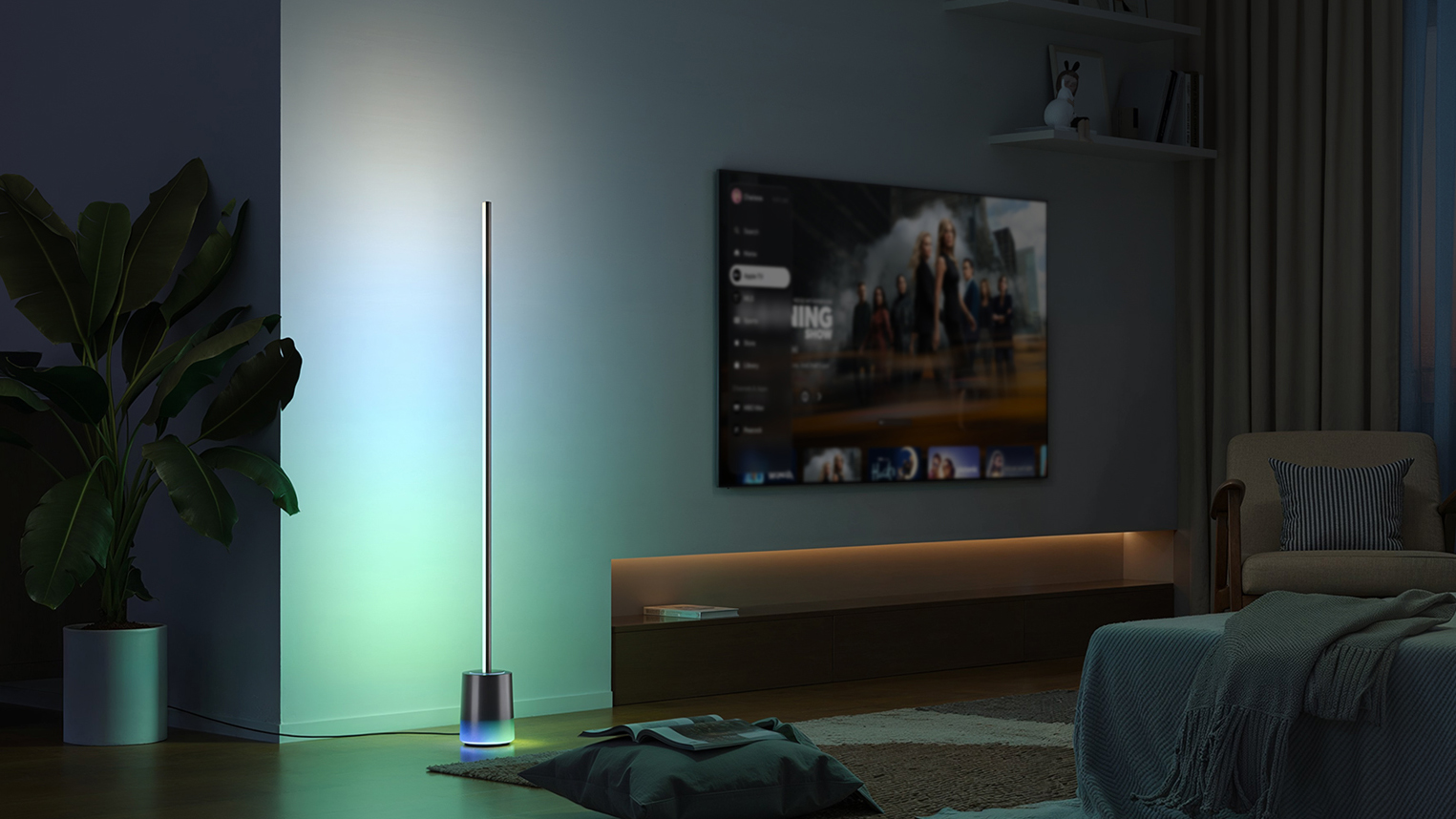
Govee, which makes some of the more unique and interesting smart lighting products, has a new batch at CES 2026. That includes two ceiling lights (one of which simulates a skylight) and a floor lamp that supports trillions of colors.
Govee describes the new Ceiling Light Ultra as “the industry’s first ceiling light designed as a true creative canvas.” It uses 616 individually controlled LEDs (the highest in its class, according to Govee) to provide that level of detail. Using the Govee app, you can design visuals for it “with up to eight distinct layers of motion, color and shapes.”

Govee
The product will support an upcoming AI Lighting Bot 2.0 update. The new version of the scene creation chatbot lets other compatible lights (including the Gaming Pixel Light) “generate dynamic GIF animations.”
If your ceiling lamp needs are as simple as “look like a skylight, please,” there’s the Govee Ceiling Light with Blue Sky Effect. The company says it emulates natural skylights “with high accuracy.” (However, it’s also less flexible than the Ultra, with far fewer individually controlled LEDs.) You can also use it as a more traditional white-light fixture, and Govee says it’s good for spaces are large as 300 square feet.
Govee
Finally, there’s the Govee Floor Lamp 3. The sleek light’s 16-bit RGBIC array allows it to reproduce over 281 trillion colors. Its white lighting capabilities range from 1000K to 10000K. It also supports a new DaySync system that can adjust lighting effects to match the time of day.
Unfortunately, we don’t yet know precisely when any of the new lights will be available — or how much they’ll cost. But we did learn that Govee lights will now work with Samsung SmartThings, joining their existing support for Matter, Alexa and Google Assistant.
This article originally appeared on Engadget at https://www.engadget.com/home/smart-home/govees-ces-lineup-includes-a-ceiling-lamp-that-simulates-skylights-130000611.html?src=rss
The US Effort to Break China’s Rare-Earth Monopoly
The New York Times checks in on U.S. university researchers and start-ups trying to create domestic rare-earth processing facility:
There is too little money to be made in rare earths for the elements to be of much interest to mining giants, so the challenge of reestablishing a domestic industry has fallen to small companies like Phoenix Tailings, a Boston-area startup that runs the metal-making plant in Exeter, New Hampshire. A handful of other companies in the United States are processing rare earths in small quantities, including MP Materials, which owns a mine in Mountain Pass, California, and recently began producing rare-earth metal in Fort Worth, Texas. Similar efforts are underway in Europe and Asia. “It’s small volumes of low-value materials that are very expensive to process,” said Elsa Olivetti, a materials science and engineering professor at the Massachusetts Institute of Technology. “Meaning it’s hard to make money.”
Phoenix Tailings’ New Hampshire operation is about 2 months old, housed in a converted medical device plant. The company buys metric-ton bags of powder — a mixture of neodymium and praseodymium bound with oxygen — from mining and refining companies in the United States, South America and Australia. It funnels that flour-like material into a drying oven and eventually into furnaces that heat it to the temperature of volcanic lava. This circuit takes up less than 15,000 square feet and is designed to generate no emissions other than those associated with the electricity Phoenix Tailings uses. The closed-loop design distinguishes this process from the more energy-intensive techniques used in China, where workers scoop up molten metal with ladles. That approach releases perfluorocarbons, potent greenhouse gases that do not break down easily.
In late 2024 the company was three weeks from bankruptcy — but it’s recently been valued at $189 million.


Read more of this story at Slashdot.
TrixiePup64 2601 Released For Debian 13 Powered Puppy Linux In Wayland & X11 Flavors
For those with fond memories of Puppy Linux as a very lightweight Linux distribution, released last month was a new TrixiePup64 for continuing the Puppy Linux spirit atop Debian. The new TrixiePup64 is based on Debian 13 components while shipping in both X11 and Wayland flavors. Out now is TrixiePup64 2601 as the latest iteration of this lightweight Linux distribution…
Linux’s Hung Task Detector Will Be Able To Be Reset For Easing System Administration
Worked on back in 2024 for the Linux kernel was a built-in counter to keep track of the number of hung tasks since boot. That feature for keeping track of the number of hung tasks since boot was merged in Linux 6.13 and exposed via /proc/sys/kernel/hung_task_detect_count. For helping ease use around it, new code working its way to the kernel will allow resetting that “hung_task_detect_count” counter…
Patches Posted For Bringing Rock Band 4 PS4 / PS5 Guitar Support To Linux
Following Linux 6.19 adding support for CRKD guitar controllers, new patches posted to the Linux kernel mailing list are bringing some additional guitar controllers to Linux. This latest work is around enabling the Rock Band 4 guitars for the PlayStation 4 and PS5 consoles to work under Linux…
New AMD Linux Driver Patches Posted For Batch Userptr Allocation Support
A new feature being worked on recently for the AMDKFD kernel compute driver is batch user pointer “userptr” allocation support. With this new user-space API it will become possible to support allocating multiple non-contiguous CPU virtual address ranges that map to a single contiguous GPU virtual address…
Claude is his copilot: Rust veteran designs new Rue programming language with help from AI bot
Rust veteran Steve Klabnik is using an LLM to explore memory safety without garbage collectionNaming a new programming language “Rue” sounds like an acknowledgment of doubt about the project’s prospects, if you take “Rue” to mean “regret.”…
Reddit Surges in Popularity to Overtake TikTok in the UK – Thanks to Google’s Algorithm?
Reddit “has overtaken TikTok as Britain’s fourth most-visited social media service,” reports the Guardian:
The platform has undergone huge growth over the last two years, with an 88% increase in the proportion of UK internet users it reaches. Three in five Brits online now encounter the site, up from a third in 2023, according to Ofcom. Its popularity is rising fastest with younger internet users. It is now the sixth most visited organisation of any kind by UK users aged between 18 and 24, up from 10th a year earlier. More than three-quarters of that cohort now visit it….
The UK is a boom market for the platform, with the second largest user base behind the US, according to company records. A series of factors are behind its rise. However, a change in Google’s search algorithms last year to prioritise helpful content from discussion forums appears to have been a significant driver. A recent deal with Google that allows the company to train its AI model on Reddit’s content also appears to have provided a boost. Reddit is the most-cited source for Google AI overviews, which is likely to see more people directed to its forums. It has a similar deal with OpenAI, which owns the most popular AI chatbot, ChatGPT.
According to the article, Reddit “believes it is also benefiting from shifting internet habits, as younger users seek out human-generated reviews and opinions.”


Read more of this story at Slashdot.
KDE Plasma 6.6 Improves Accessibility, Wayland Usability, and UI Polish
The upcoming Plasma 6.6 release will introduce new accessibility features and UI refinements, including Slow Keys for Wayland and improved notifications.
KDE Plasma 6.6 Fixes A Common Panel-Related Crash, Improves OpenBSD Support
KDE developer Nate Graham is out with the first issue of This Week in Plasma for 2026. Last week was a warning that This Week in Plasma could become less frequent without new volunteers to help takeover. Nate Graham announced that John Veness has stepped up to help co-author these weekly KDE development posts…
New Tesla Video Shows Tesla Semi Electric Truck Charging at 1.2 MW
An anonymous reader shared this report from Electrek:
Tesla has released a new video showing a Tesla Semi truck charging at a massive 1.2 megawatts (MW), finally giving us a clear look at the charging speeds that will enable long-haul electric trucking…>
Tesla claimed the Semi would be able to charge 70% of its range in 30 minutes. For a truck with a 500-mile range and an estimated battery pack of around 800-900 kWh, that requires an incredibly high power output, well beyond the 250 kW or even 350 kW we see on passenger EVs in North America. Today, the official Tesla Semi account on X released a video showing exactly that. In the video, Tesla engineers are seen monitoring a charging session where the power output climbs to a peak of 1.2 MW (1,206 kW).
This is consistent with the capabilities Tesla announced for its new V4 Cabinet architecture earlier this year. The V4 cabinets are designed to support 400V-1000V vehicle architectures and can deliver up to 500 kW for cars (like the Cybertruck) and up to 1.2 MW for the Semi. There is some information missing from the video. For example, we don’t see the state-of-charge of the truck, so we don’t at what battery percentage Tesla Semi can achieve and maintain this charge rate. Peak speed is one thing, but sustaining that power without overheating the pack or the cable is the real challenge. The liquid-cooled charging cable and the immersion-cooled connector (part of the Megawatt Charging System or a high-power proprietary Tesla solution, though Tesla has been leaning toward MCS compatibility) seem to be doing their job….
This comes just as Tesla is gearing up for volume production of the Semi at its new factory expansion near Gigafactory Nevada. The automaker is targeting a start of production in the first half of 2026 and a ramp up to volume production in the second half.


Read more of this story at Slashdot.
Pebble Round 2 Revives the Iconic Smartwatch With Open-Source PebbleOS
Pebble Round 2 revives the iconic smartwatch with a color e-paper display, two-week battery life, and open-source PebbleOS.
What Happened When Alaska’s Court System Tried Answering Questions with an AI Chatbot?
An AI chatbot to answer probate questions from Alaska residents “was supposed to be a three-month project,” said Aubrie Souza, a consultant with the National Center for State Courts told NBC News. “We are now at well over a year and three months, but that’s all because of the due diligence that was required to get it right.”
“With a project like this, we need to be 100% accurate, and that’s really difficult with this technology,” said Stacey Marz, the administrative director of the Alaska Court System and one of the Alaska Virtual Assistant (AVA) project’s leaders… While many local government agencies are experimenting with AI tools for use cases ranging from helping residents apply for a driver’s license to speeding up municipal employees’ ability to process housing benefits, a recent Deloitte report found that less than 6% of local government practitioners were prioritizing AI as a tool to deliver services. The AVA experience demonstrates the barriers government agencies face in attempting to leverage AI for increased efficiency or better service, including concerns about reliability and trustworthiness in high-stakes contexts, along with questions about the role of human oversight given fast-changing AI systems. These limitations clash with today’s rampant AI hype and could help explain larger discrepancies between booming AI investment and limited AI adoption.
The chatbot was developed with Tom Martin, a lawyer/law professor who designs legal AI tools, according to the article. But the project “had to contend with the serious issue of hallucinations, or instances in which AI systems confidently share false or exaggerated information.”
“We had trouble with hallucinations, regardless of the model, where the chatbot was not supposed to actually use anything outside of its knowledge base,” Souza told NBC News. “For example, when we asked it, ‘Where do I get legal help?’ it would tell you, ‘There’s a law school in Alaska, and so look at the alumni network.’ But there is no law school in Alaska.” Martin has worked extensively to ensure the chatbot only references the relevant areas of the Alaska Court System’s probate documents rather than conducting wider web searches.
The article concludes that “what was meant to be a quick, AI-powered leap forward in increasing access to justice has spiraled into a protracted, yearlong journey plagued by false starts and false answers.” But the chatbot is now finally scheduled to be launched in late January. “It was just so very labor-intensive to do this,” Marz said, despite “all the buzz about generative AI, and everybody saying this is going to revolutionize self-help and democratize access to the courts.
“It’s quite a big challenge to actually pull that off.”


Read more of this story at Slashdot.
Archboot Adds COSMIC Desktop as a New Install and Rescue Option
Archboot, a menu-driven Arch Linux installer, expands its desktop lineup by adding COSMIC.
Rust-Based Fjall 3.0 Released For Key-Value Storage Engine Akin To RocksDB
In addition to the release of Stoolap 0.2 as a modern embedded SQL database written in Rust, Fjall 3.0 is available as another Rust-written database solution. Fjall is a log-structured, embedable key-value storage engine akin to RocksDB but with the benefit of being written in Rust. With Fjall 3.0 its performance is now very competitive…
Bring CachyOS Cosmic DE along with kernel 6.18.2 to Arch Linux Bare Metal Instance
Following below is procedure which allows to install on Arch Linux CachyOS v3 repositories along with pacman fork belongs to CachyOS. Re-sync of v3 repos and core and extra works pretty stable ( u; sudo pacman -Syyu ) – the same commands as described in post after first reboot Arch Instance into CachyOS kernel. I also have to confirm that Re-sync might be randomly required. The hack step below is scp cachyos-rate-mirrors script from remote native CachyOS Instance to the target one.