Samsung’s Freestyle+ projector hands-on: Much brighter and impressively adaptable

Samsung announced its newest portable projector ahead of its First Look showcase at CES 2026, but you might have been a little confused as to what’s changed. The company says the Freestyle+ is nearly twice as bright as the 2022 Freestyle projector, rated at 230 ISO lumens, which was pretty underwhelming. The new Freestyle+ can output at 430 ISO lumens. If this is the first you’re hearing of ISO Lumens, it’s an internationally standardized rating for projectors, intended to standardize manufacturers’ claims of brightness.

It still looks very similar to its predecessors, with 160 degrees of rotation that makes it easy to set up in most homes, Airbnbs or meeting rooms. Samsung added support for Q-Symphony, allowing you to connect it to the company’s soundbars, if you conveniently have one nearby. While the sound quality of its built-in speaker was hard to test in the middle of a post-keynote trade show floor, you’ll probably want to augment the built-in speaker, if only because it’s so small.

Vision AI, mentioned several times during Samsung’s CES keynote, is also built into the portable projector. You can summon Bixby to adjust settings and whatever you’re watching. Based on the demos I saw, you’ll need to speak into the remote to access Bixby.

Other improvements bring the projector into 2026, with keystone correction and focus. The Freestyle+’s AI OptiScreen can calibrate projections to different wall surfaces and colors to improve visibility even on your most vivid walls.

Samsung Freestyle+ hands-on
Mat Smith for Engadget

The updated 3D Auto Keystone corrects distortion even when projecting onto uneven or non-flat surfaces, such as corners, curtains or angled walls. It’s hard to put into words, but pointing the Freestyle+ to a corner, or at an undulating curtain, and watching the image morph and contort was almost hypnotic. The premise is that you can point this at any area of your home (or even, say, the side of a tent), and the 3D Auto Keystone will flatten the image in seconds. 

There’s also Screen Fit, which automatically adjusts the image to match a projector screen size. The Freestyle+ can project up to a 100-inch 1080p image, at maximum. However, Wall Calibration might be the most technically impressive in a device this size. It detects and analyzes the color of the projection surface and recalibrates the image’s color tone to minimize the effect. It can even detect and match a wall pattern to reduce visual interference, which worked well in person. The Samsung spokesperson used the aforementioned Bixby voice commands to calibrate the screen.

If there’s still something to address, it’s that this portable projector must be plugged in to operate. When that can be either a power bank or a wall outlet, it seems a bit cheeky to call it portable.

Samsung typically announces prices and launch dates once the CES dust has settled, but it’s set to arrive in the first half of 2026. Previous iterations cost around $900, but early impressions suggest it’s a versatile, petite projector. 

This article originally appeared on Engadget at https://www.engadget.com/home/home-theater/samsung-freestyle-plus-projector-hands-on-ces-2026-060840386.html?src=rss

Samsung brought an absolute beast of a 130-inch Micro RGB TV to CES 2026

Amid endless AI hype and a guest visit from the CEO of Hartford Steam Boiler (?!), Samsung had a big surprise for us tonight at CES 2026: A massive 130-inch Micro RGB TV. It’s so large, it’s suspended by a large metal stand that surrounds the entire screen, which also lets you tilt the screen just a bit. (For the Samsung diehards, it’s basically a reinvention of its “timeless gallery” stand from 2013.) I imagine bringing this TV home would be like Bart Simpson adopting his beloved elephant Stampy: Your pets would be terrified, and your family would probably be annoyed at this television dominating so much of your home.

But boy, it sure looks amazing in person. Just like LG’s Micro RGB set, it’s using an evolved form of Mini LED technology that allows for far better color accuracy and richness. As I fought through the crowds of Samsung’s CES First Look event to catch a glimpse of it, I couldn’t help but notice how everyone just looked a bit stunned, like the monkeys from 2001 seeing the monolith for the first time.

Samsung's 130-inch Micro RGB TV from the side.
Samsung’s 130-inch Micro RGB TV from the side.
Devindra Hardawar for Engadget

Samsung representatives were clear that this Micro RGB set was only a concept of what the company could do with the technology, it’s not an actual product it plans to ship. In another demo, Samsung took the 130-inch screen and mounted it directly on a wall (below). Of course, it still looked stunning. I also learned that if you wanted to wall mount the “timeless gallery” stand concept, you actually have to mount the entire stand to the wall, since it’s part of the TV’s speaker system.

Samsung didn’t have too many details about the technical aspects of the 130-inch Micro RGB TV, but it did shout buzzwords at us during its announcement. it’s powered by the company’s “Micro RGB AI Engine Pro” processor, which includes “Micro RGB Color Booster Pro” and “Micro RGB HDR Pro” technology, using AI to “enhance dull tones and refine contrast, delivering vivid color and subtle detail across bright and dark scenes alike for realism and picture fidelity.”

Samsung's 130-inch Micro RGB TV mounted in a wall.
Samsung’s 130-inch Micro RGB TV mounted in a wall.
Devindra Hardawar for Engadget

The Micro RGB set also sports the company’s Glare Free technology to reduce reflections, and it supports HDR 10+ Advanced and the company’s Eclipsa Audio. It can also tap into Samsung’s Vision AI Companion for conversational search, as well as Microsoft Copilot and Perplexity.

But of course, those details really don’t matter, because you won’t be able to buy the 130-inch Micro RGB TV in its current form. We were impressed by last year’s 115-inch model, but its $30,000 price didn’t make it feasible for anyone but the ultra-rich. And those folks would be better off investing in Samsung’s own Micro LED sets, which offer the benefits of OLED that Micro RGB does not. (Sure, those TVs start at $110,000, but for that’s not exactly a huge leap for those with deep pockets.)

Samsung's 130-inch Micro RGB TV from the rear.
Samsung’s 130-inch Micro RGB TV from the rear.
Devindra Hardawar for Engadget

This article originally appeared on Engadget at https://www.engadget.com/home/home-theater/samsung-brought-an-absolute-beast-of-a-130-inch-micro-rgb-tv-to-ces-2026-060245387.html?src=rss

Workstation Owner Sadly Marks the End-of-Life for HP-UX

Wednesday marked the end of support for the last and final version of HP-UX, writes OSNews.

They call it “the end of another vestige of the heyday of the commercial UNIX variants, a reign ended by cheap x86 hardware and the increasing popularisation of Linux.”

I have two HP-UX 11i v1 PA-RISC workstations, one of them being my pride and joy: an HP c8000, the last and fastest PA-RISC workstation HP ever made, back in 2005. It’s a behemoth of a machine with two dual-core PA-8900 processors running at 1Ghz, 8 GB of RAM, a FireGL X3 graphics card, and a few other fun upgrades like an internal LTO3 tape drive that I use for keeping a bootable recovery backup of the entire system. It runs HP-UX 11i v1, fully updated and patched as best one can do considering how many patches have either vanished from the web or have never “leaked” from HPE (most patches from 2009 onwards are not available anywhere without an expensive enterprise support contract)…

Over the past few years, I’ve been trying to get into contact with HPE about the state of HP-UX’ patches, software, and drivers, which are slowly but surely disappearing from the web. A decent chunk is archived on various websites, but a lot of it isn’t, which is a real shame. Most patches from 2009 onwards are unavailable, various software packages and programs for HP-UX are lost to time, HP-UX installation discs and ISOs later than 2006-2009 are not available anywhere, and everything that is available is only available via non-sanctioned means, if you know what I mean.

Sadly, I never managed to get into contact with anyone at HPE, and my concerns about HP-UX preservation seem to have fallen on deaf ears. With the end-of-life date now here, I’m deeply concerned even more will go missing, and the odds of making the already missing stuff available are only decreasing. I’ve come to accept that very few people seem to hold any love for or special attachment to HP-UX, and that very few people care as much about its preservation as I do. HP-UX doesn’t carry the movie star status of IRIX, nor the benefits of being available as both open source and on commodity hardware as Solaris, so far fewer people have any experience with it or have developed a fondness for it.

As the clocks chimed midnight on New Year’s Eve, he advised everyone to “spare a thought for the UNIX everyone forgot still exists.”


Read more of this story at Slashdot.

Samsung Music Studio 5 and 7 hands-on: Unique speaker designs debut at CES 2026

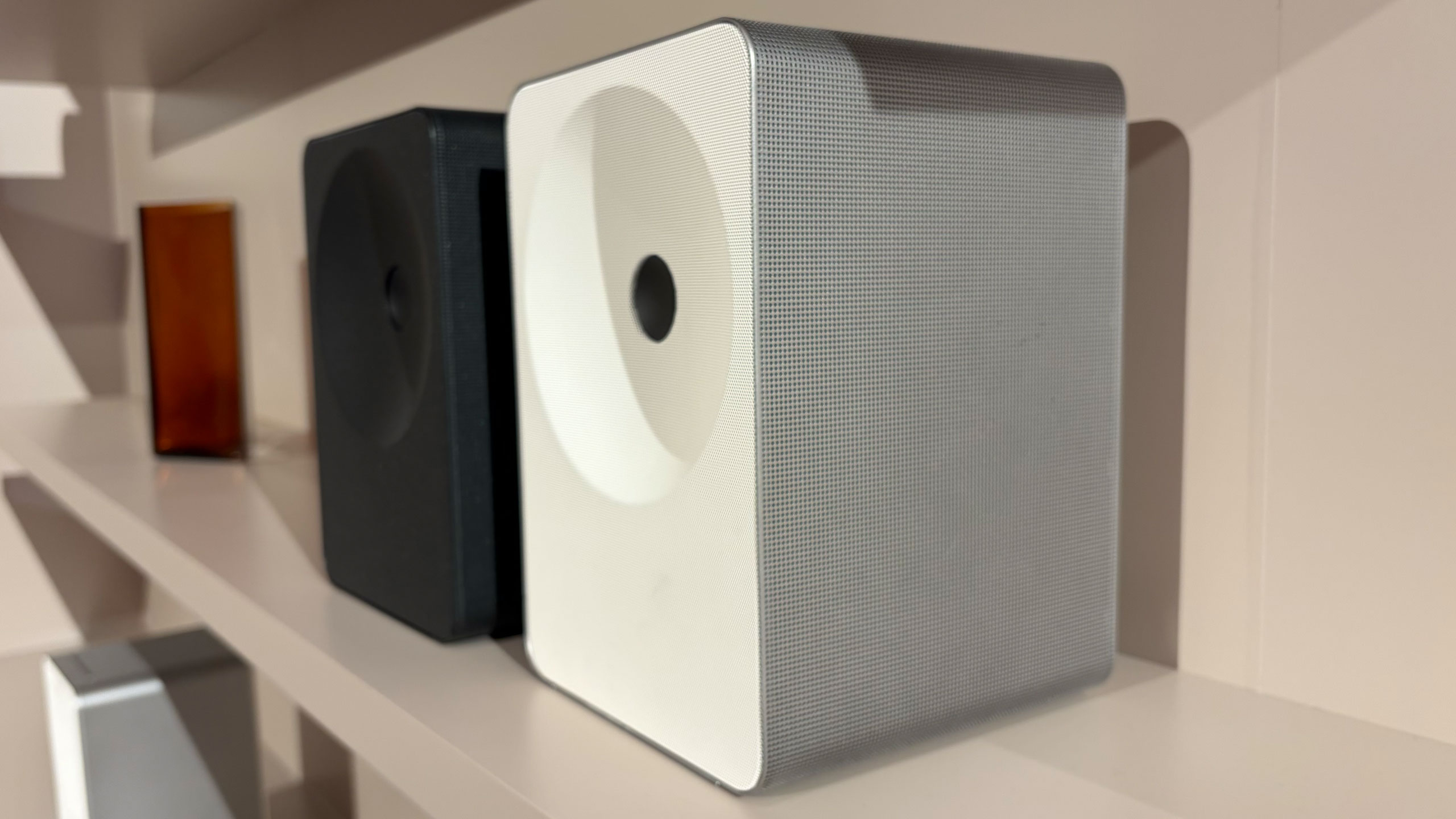
In addition to its annual soundbar updates, Samsung debuted two new home speakers at CES 2026. The Music Studio 5 and 7 are Bluetooth and Wi-Fi units designed to blend in with your home decor thanks to their minimalist look. They certainly don’t look like your typical speakers, and Samsung has packed them with features that it says will ensure optimal sound quality from each one. 

The Music Studio 5 has a four-inch woofer and two tweeters, and a sound profile that’s optimized by AI Dynamic Bass Control. The design is an interesting interplay between a circle and a square, but the speaker delivers crisp, clear sound — even in the roar of a CES demo area. The Music Studio 5 will also come in a smattering of colors, which could lend a pop to a bookshelf. Controls line the top edge, including one-touch access to Spotify.

Samsung Music Studio 7
Billy Steele for Engadget

If you’re looking for something more robust, the Music Studio 7 is a 3.1.1-channel unit that’s capable of four-direction spatial audio and high-resolution listening. Samsung says you can enjoy tunes at up to up to 24-bit/96kHz and the speaker can be used as part of a turntable setup. The sound here is more robust as I heard noticeably more bass from the 7 than on the 5. The various control buttons are up top here as well, positioned near the front of the speaker for easy access.

You can also use up to four Music Studio speakers as a surround sound setup in your living room. I listened to a brief demo where Samsung was using four Music Studio 7 units in a makeshift home theater. This combo provided great immersion, with lots of detail in the directional sound in the clips being broadcast on the connected TV. Samsung also says you can use up to 10 Music Studio speakers for audio only.

The company didn’t announce any pricing details yet, but that’s likely to come just before the Music Studio speakers are available for purchase. That date is TBD as well.

This article originally appeared on Engadget at https://www.engadget.com/audio/speakers/samsung-music-studio-5-and-7-hands-on-unique-speaker-designs-debut-at-ces-2026-052009007.html?src=rss

My Five Favorite Things I Saw at CES Unveiled 2026

While CES doesn’t technically kick off until Tuesday, the conference gets a bit of a soft launch with CES Unveiled. This event hosts a ton of companies, all proudly showing off their latest products and concepts in one giant room. While there’s plenty to write home about, five products in particular this year caught my eye:

Tombot

tombot's jennie

Credit: Lifehacker

Tombot’s robotic puppy, “Jennie,” isn’t supposed to be a pet-replacement. Instead, Jennie is specifically designed to help people with Alzheimer’s. The bot is a healthcare device, and is made to not only comfort owners, but to monitor “sundowning,” or the confusion that some living with Alzheimer experience in late afternoon and at night.

I can’t speak to the medical claims, but Tombot impressed me. I’ve seen products like this before, but what struck me was the realism. That’s not to say Tombot’s robot tricks you into thinking there’s a real puppy on the table. But the company has designed the bot with enough motors and sensors to make it realistic enough. When you look at Jennie, she looks at you; when you move, her face reacts in kind, powered by cleverly-placed motors. There are capacitive touch sensors to react to touch, light sensors to adjust to the lighting of the room, gyros for orientation, and microphones to responds to sounds.

Jennie is designed to be interactive: You can call its name—either Jennie, or a name you set in the app—and it responds to the call, potentially with a bark. Tombot says that it hired a number of ten-week-old lab puppies to record the voices for its bot. In all, Jennie will have about 1,500 unique behaviors when Tombot launches her this year.

Tombot told me that Jennie is designed to last all day on a single charge. When you aren’t home, Jennie can drop into a sort of low power mode, that should last over a week. When you come back, Jennie should immediately welcome you home. Tombot says its bot will cost $1,500 at launch, but will offer financing options.

CubicScreen

cubicspace 3d photo

Credit: Michelle Ehrhardt/Lifehacker

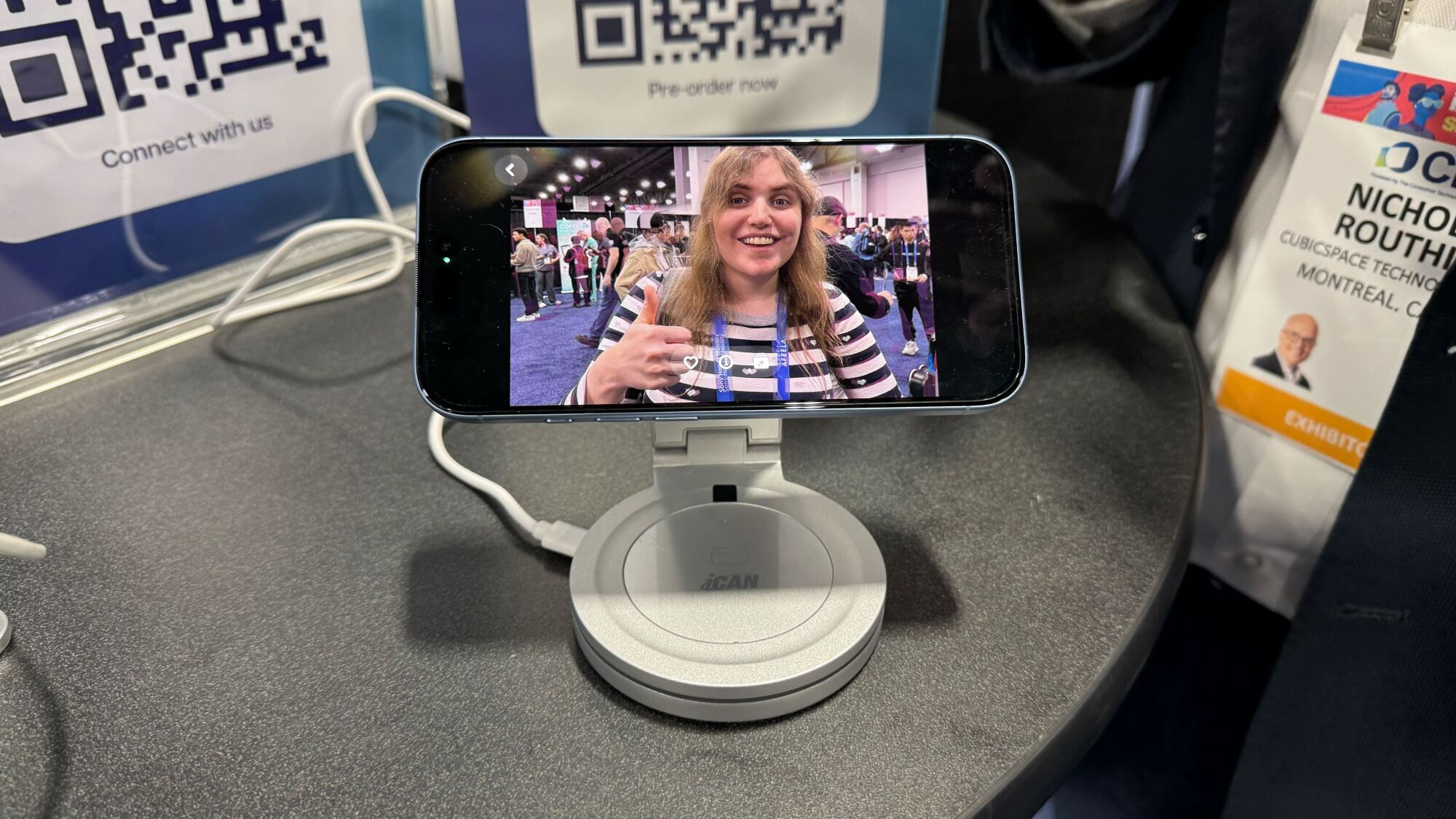
What if you could turn your iPhone into a 3DS? That’s what I took away from the premise of CubicSpace’s CubicScreen, anyway. The company makes a screen protector for your iPhone embedded with an optical filter that allows you to view spatial photos and videos in 3D, without the need for glasses or a separate device. It’s your 2D iPhone, in 3D.

I was a bit skeptical walking past the booth, but, in practice, the tech really works. CubicSpace had some 3D photos and videos already stored in the CubicScreen app on their demo iPhones, and, when looking at the screen, they really did appear three dimensional. This isn’t “pop out of your screen” 3D, mind you; rather, it’s an depth effect. If you’ve ever used the 3D feature on a 3DS, this is that experience: You’ll be able to see the depth behind subjects in your photos and videos, which adds to the immersion of the image.

Part of the effect uses eye tracking to adjust the effect as you view the image. To that point, the app can support zooming while retaining the 3D effect. It’s a little trippy: You zoom in on an picture, and, most of the time, it snaps into 3D instantly. Sometimes, the effect falls out, and you can tell you’re looking at a distorted image. But most of my experience, the effect held.

This 3D effect wasn’t just a trick of editing, either: CubicSpace took a photo of Lifehacker’s Associate Tech Editor, Michelle Ehrhardt at the booth, which instantly took on the 3D effect. The screen overlay and the software appears to work fast.

CubicScreen will cost $79 when it launches. There is currently an order page, but they aren’t accepting payment yet.

Allergen Alert

allergen alert

Credit: Jake Peterson/Lifehacker

If you have a food allergy, you know the stress that comes when you’re not in control of your meals. There’s a risk to eating food you didn’t make yourself, and for some of us, that risk isn’t an option.

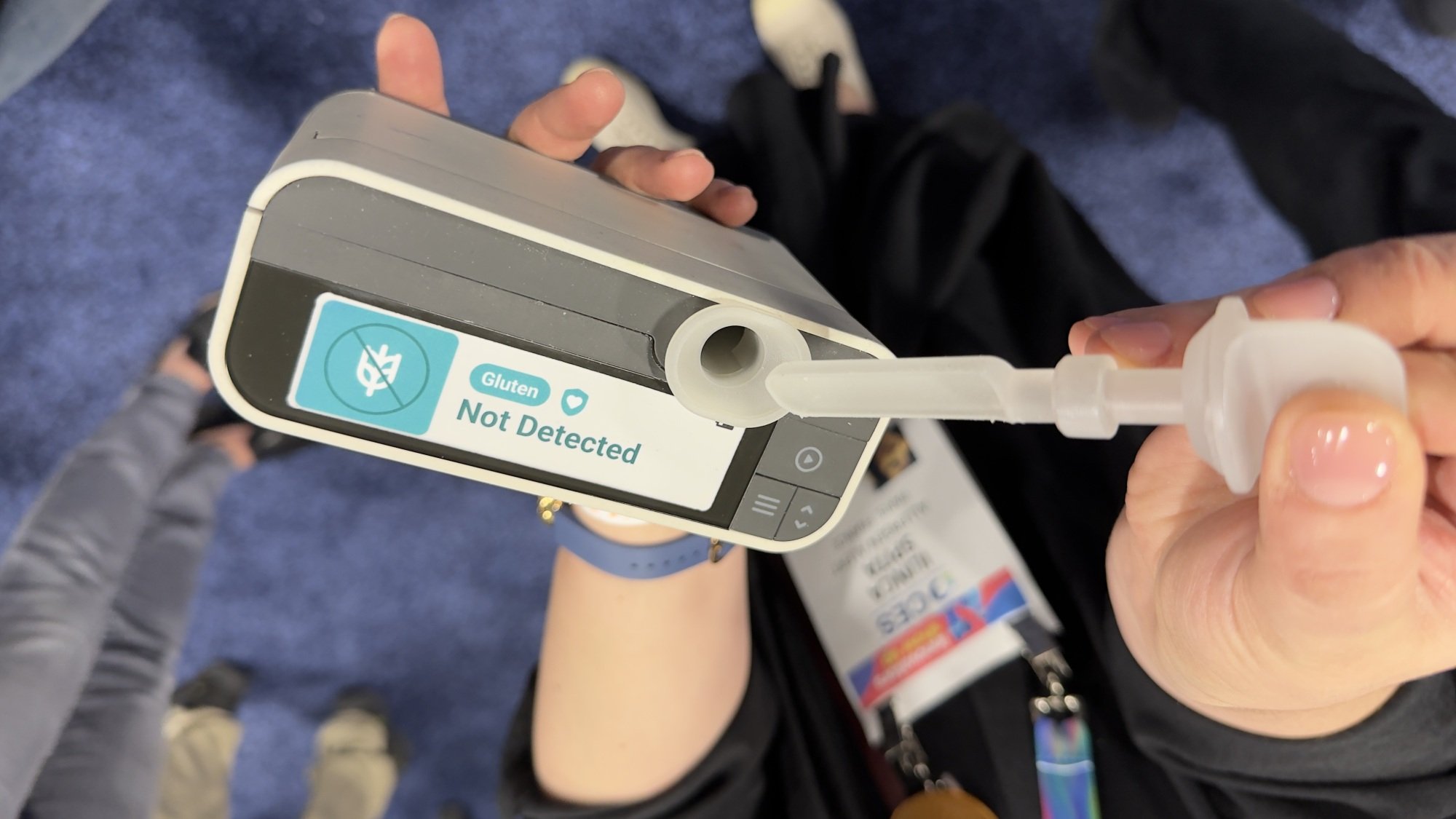
That’s why I found Allergen Alert’s “the mini lab” so intriguing. The idea is, when you want to know whether your food contains a certain allergen, you can scoop a sample of it into the provided container, place that container into the mini lab, and within two minutes, you’ll have a positive or negative result. The device itself isn’t large—about the size of a portable speaker—which makes it feasible to take out to restaurants and other people’s houses.

Right now, the company says the mini lab can detect milk and gluten, up to five parts per million, but the goal is to detect other major allergens, like egg, fish, soy, sesame, peanuts shellfish, tree nuts. Of course, I have no way to actually test whether it can detect milk and gluten at this time, so I can’t necessarily endorse the product. In fact, it isn’t currently available: Allergen Alert tells me the product is supposed to launch in September for $200.

However, if Allergen Alert is correct in its claims, this product could be a game changer. A two minute check on that supposedly allergen-free meal could literally save someone’s life, and offer peace of mind to those who could have serious adverse effects from ingesting an allergen.

Birdfy Hum Bloom

birdfy hum bloom

Credit: Jake Peterson/Lifehacker

Birdfy brings a new smart bird feeder concept to CES just about every year. And while the company had its previous models on display at Unveiled this year, its newest prototype grabbed my attention.

The Hum Bloom is not meant for all of the birds that visit your house or garden. Instead, this product is specifically designed for hummingbirds. The Hum Bloom has an 4K camera that can shoot up to 120fps slow-motion video. While that’d make for some dramatic landings for any bird, it’s particularly ideal for capturing hummingbirds that flap their wings hundreds or thousands of times per minute.

Birdfy says the Hum Bloom’s AI can identify more than 150 hummingbird species, so you’ll know which type of bird you’re watching in slo-mo on your phone. Birdfy claims the feeder is “leak-proof,” and also comes with ant moat to keep out bugs. Personally, I’m stuck on Birdfy designing a slo-mo camera system just for hummingbirds. I look forward to seeing that footage from reviewers in the future.

Opsodis 3D speaker

opsodis 3d speaker

Credit: Jake Peterson/Lifehacker

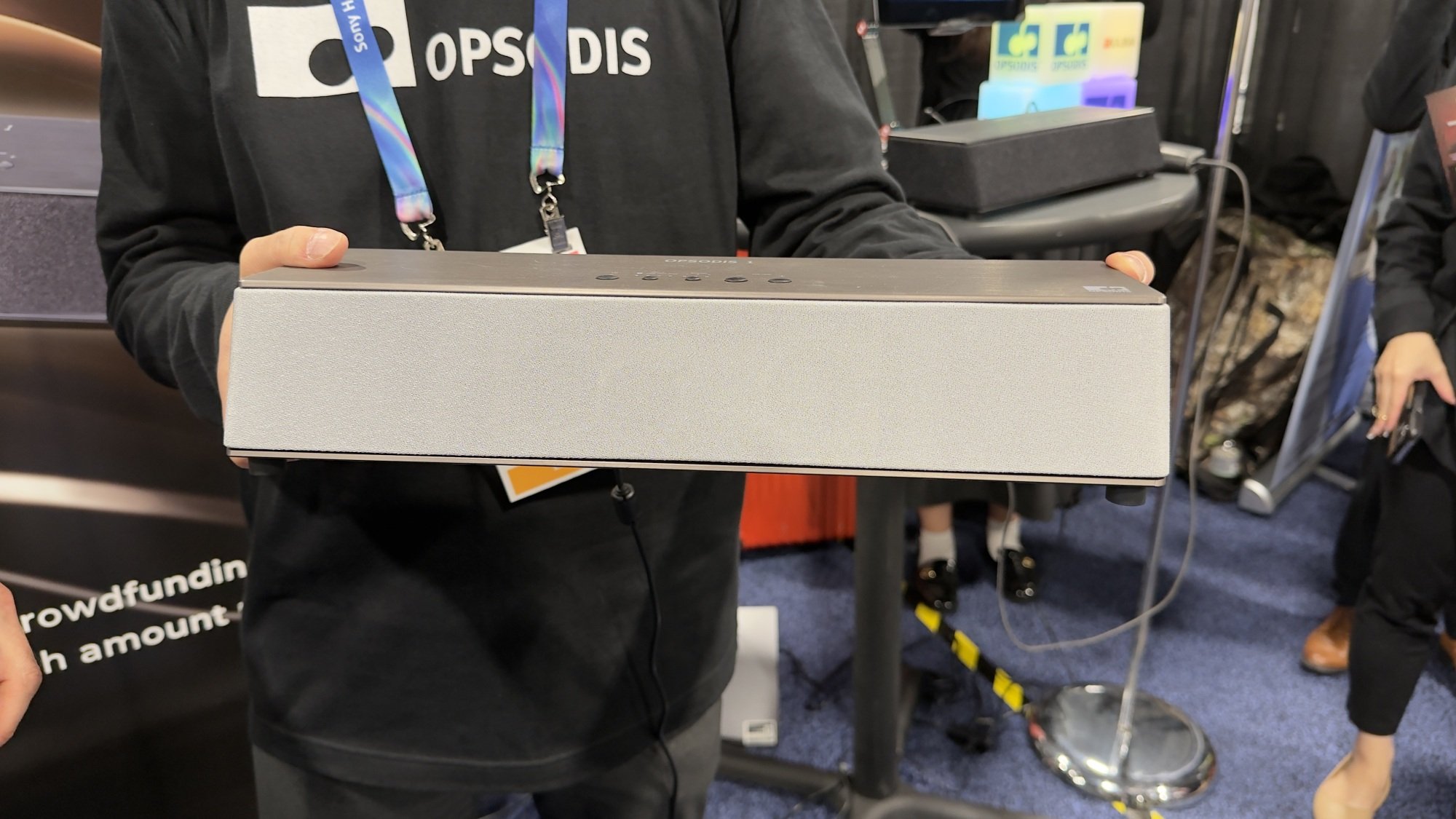
This is one of those products my picture will simply not do justice. In order to understand why I was so taken by this speaker, you’d need to hear it for yourself.

Admittedly, I wasn’t expecting much when I agreed to demo the speaker. Again, at first glance, the Opsodis just looks like your typical wireless speaker. That changed once the rep played a video on a connected iPad: Suddenly, I was hearing sounds next to my ears; behind my ears; around my ears. I wasn’t really paying attention to what was happening on screen, because I was too distracted wondering how I was hearing everything I was hearing from a relatively tiny speaker directly in front of me.

As it turns out, this wouldn’t work if I had the speaker placed just about anywhere. The demo used Opsodis’ “narrow mode,” one of three audio modes the speaker is capable of. Narrow mode is the stronger spatial audio experience, but requires the speaker to be placed close and directly in front of the user: specifically, 60 centimeters away, or 23.62 inches. “Wide mode,” which I didn’t try, offers a “softer” spatial audio experience, while the third mode simulates standard stereo audio.

While this won’t necessarily offer a movie theater-like experience just by placing it in front of your TV, this was some of the most fun I had at CES Unveiled tonight.

Samsung HW-QS90H soundbar hands-on: Impressive bass performance without a subwoofer

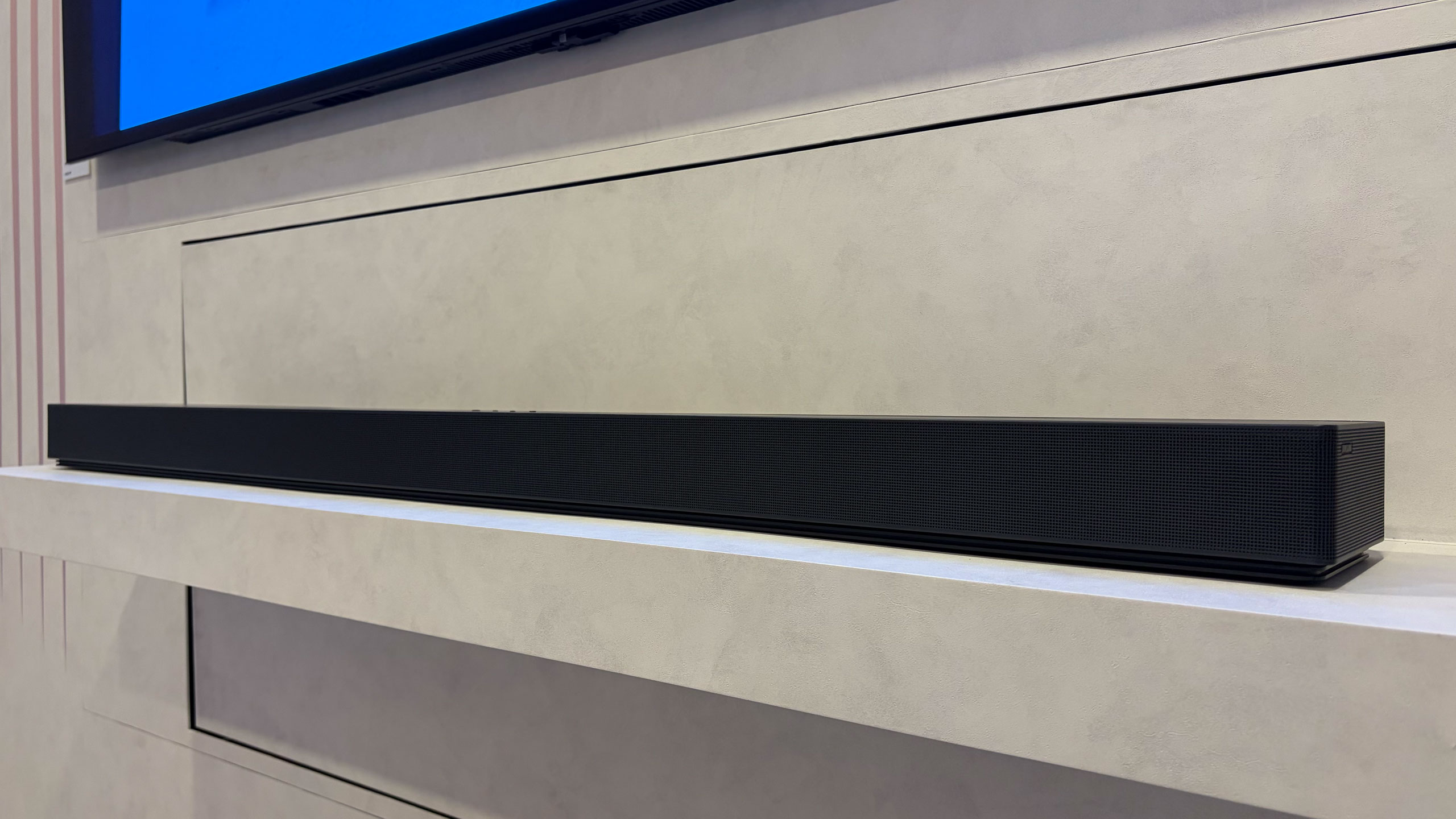
We’re used to Samsung updating its Q990 soundbar at CES every year, and 2026 is no different. However, the company also debuted the HW-QS90H: a new all-in-one option that Samsung says won’t require a standalone subwoofer due to its Quad Bass Woofer system. The QS90H offers 7.1.2-channel audio with 13 total drivers. Before the show properly kicks off, we got to listen to the new soundbar for a quick judge of its merits. 

The first thing I noticed about the QS90H is its impressive bass performance. Most of the time when a company claims its soundbar doesn’t need a subwoofer, that proves to be untrue. But even in the chaos of a noisy demo area, I could clearly hear the bassy thump coming from the QS90H’s built-in subwoofers. For once, I think would-be buyers could get by without a sub, especially in smaller living rooms.

Samsung achieved this with two of those Quad woofers. These drivers push air in two directions rather than just one, which helps with the extra low-end tone. The company didn’t sacrifice clarity either. The nine additional drivers, positioned for front, side, wide and up firing sound, provide the clear detail I’ve come to expect from Samsung.

Samsung QS90H soundbar
Billy Steele for Engadget

The QS90H also features Samsung’s Convertible Fit Design technology that debuted on the QS700F last year. This tool allows you to sit the soundbar flat on a shelf or mantle, or rotate it to mount on the wall. Built-in sensors automatically adjust the driver performance for each orientation, so that sound quality isn’t affected by the selected positioning. During my demo, I didn’t notice any difference in performance when the orientation changed. In fact, the QS90H looks a lot like the QS700F on the outside, with similar grille patters and control designs.

Samsung didn’t announce pricing or availability tonight, but that’s likely to come just prior to any on-sale date.

This article originally appeared on Engadget at https://www.engadget.com/home/home-theater/samsung-hw-qs90h-soundbar-hands-on-impressive-bass-performance-without-a-subwoofer-045727939.html?src=rss

LG TVs at CES 2026: A stunning Wallpaper set, glorious Micro RGB colors and a better Gallery TV

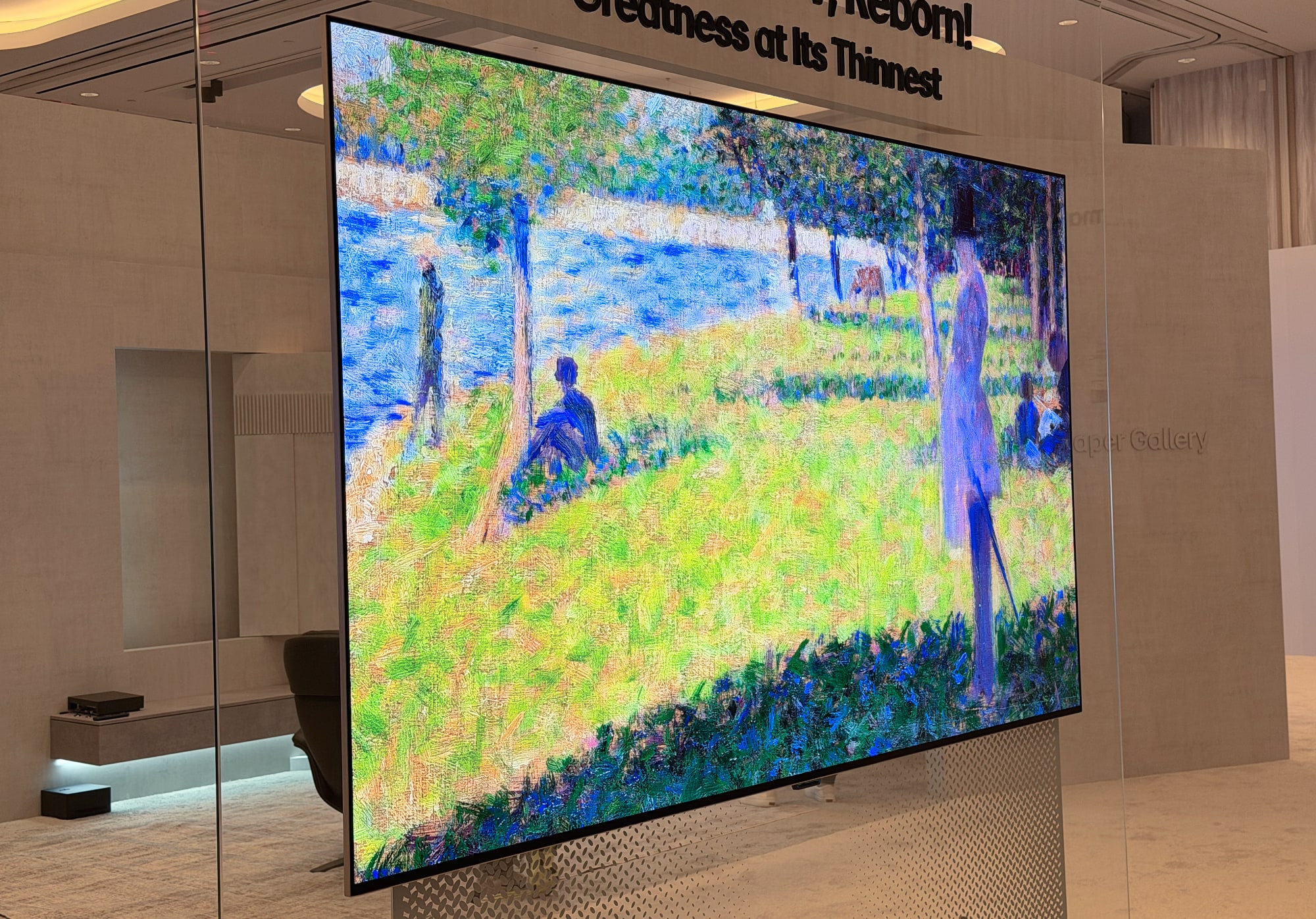
LG usually announces its CES TV lineup well ahead of the show, but this year the company had a surprise at CES 2026: The return of its ultra-thin “Wallpaper” TV. Now it’s toting a gorgeous OLED screen and wireless connectivity, and it’s about as thin as a pencil. We got a chance to check out the Wallpaper TV in action during a CES preview event, as well as the previously announced Gallery and Micro RGB sets. LG still has its typically OLED and LED sets around, but it’s clear that 2026 will be filled with intriguing TVs for a variety of consumers.

LG's 2026 Wallpaper OLED TV
LG’s 2026 Wallpaper OLED TV
Devindra Hardawar for Engadget

The Wallpaper TV (LG W6)

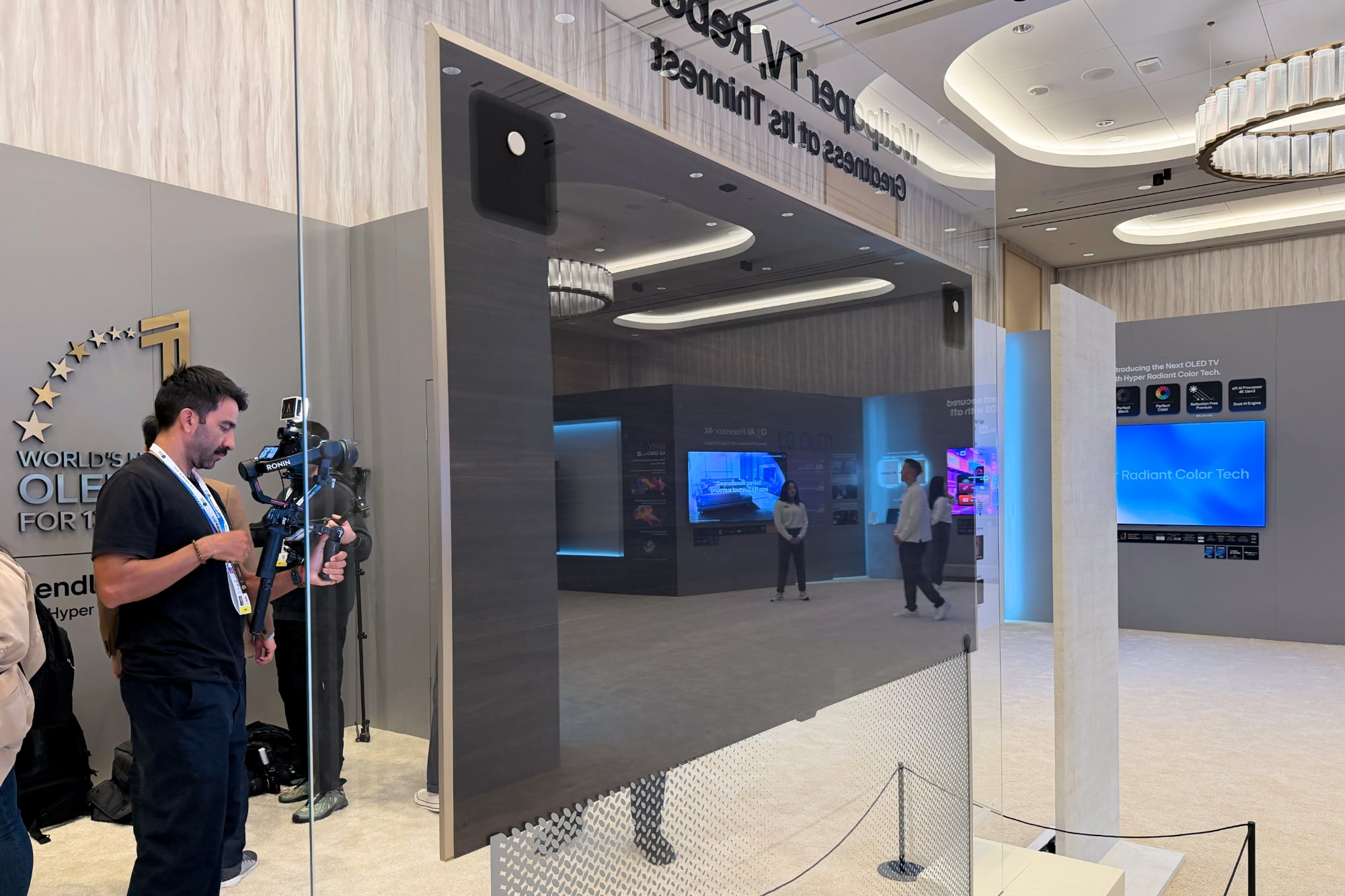
If money were no object, I’d want a 100-inch LG Wallpaper TV in my family room immediately. It looks shockingly thin in person — almost as if it’s some sort of sci-fi prop — and it delivers the rich colors and dark levels we expect from OLED. Cable management is also a cinch, since it requires just a single power cable. The A/V inputs are handled by LG’s One Connect box, which you can position wirelessly up to 10 meters away from the TV.

LG's 2026 Wallpaper OLED TV from the rear
LG’s 2026 Wallpaper OLED TV from the rear
Devindra Hardawar for Engadget

The LG W6 combines the best of LG’s OLED technology, including “Hyper Radiant Color” for improved black levels and color, “Brightness Booster Ultra” to crank up luminance 3.9 times more than conventional OLEDs and a reflection free screen material. LG’s Alpha 9 Gen 3 processor beefs up its performance, and its NPU also helps to improve upscaling and overall image performance. (And yes, you can also access generative AI features via Microsoft Copilot and Google Gemini, if you’re into that sort of thing.)

All of that adds up to one of the most remarkable TVs I’ve seen in years. I haven’t been too enamored with other TV gimmicks lately, like everything trying to mimic Samsung’s The Frame, or the usless 8K sets. But a super-thin wireless TV with the best OLED panel available? That’s the stuff dreams are made of.

LG's 2026 Gallery TV
LG’s 2026 Gallery TV
Devindra Hardawar for Engadget

The Gallery TV competes with Samsung’s Frame

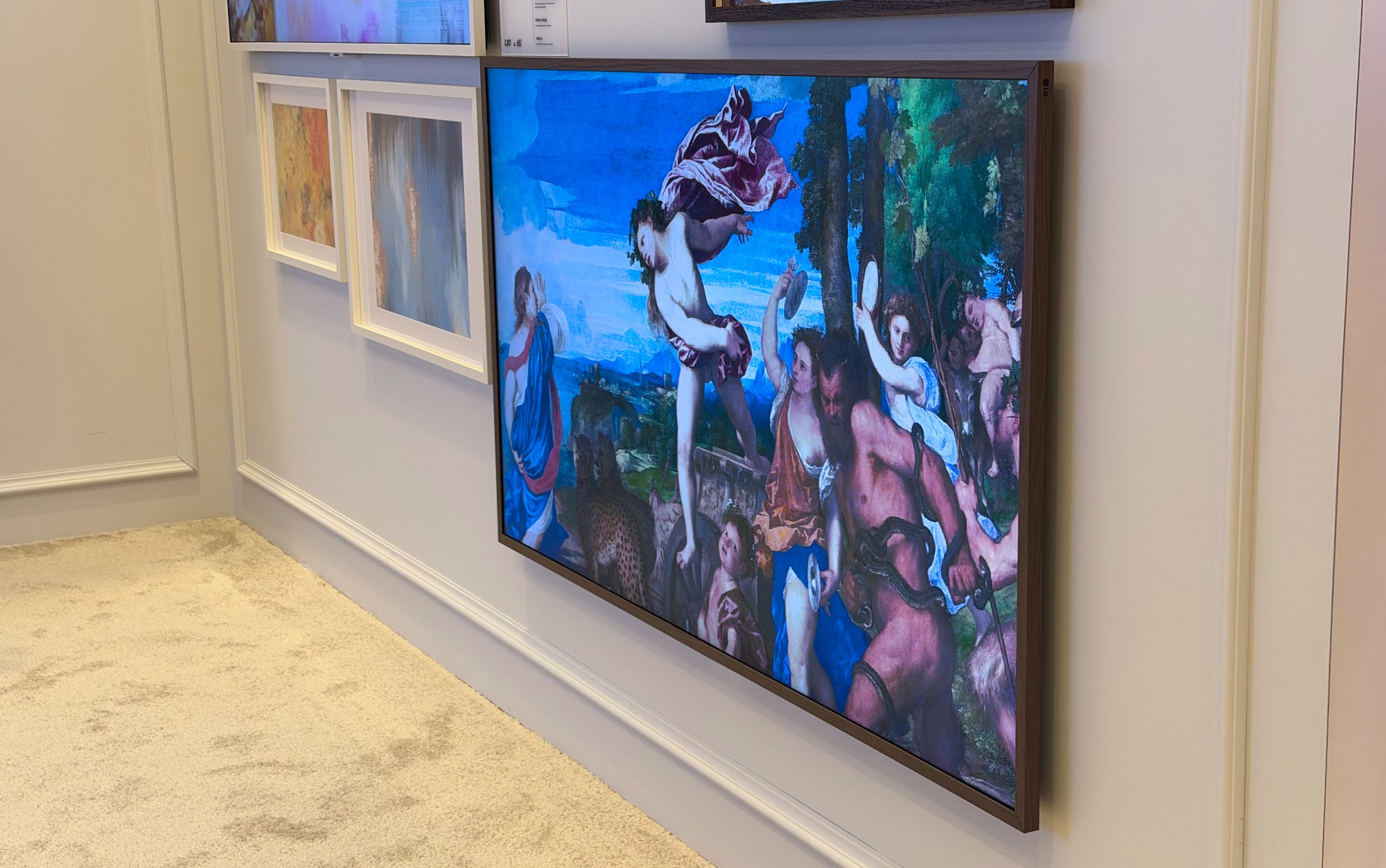
While LG has made Gallery TVs before, in 2026 it’s making a more concerted effort to take on Samsung’s popular Frame TV. LG says the new sets were designed with the help of museum curators, which helps the “Gallery Mode” adjust brightness and contrast to specific works of art. They also ship with magnetic frame-like bezels, and they have anti-reflective screens to help make the art shine.

In person, the new Gallery TV looks fine, though it’s easy to tell that the colors and contrast levels don’t match LG’s premium OLED TVs. To avoid burn-in issues, these sets feature Mini LED panels. As I noted above, I’m not the core consumer for one of these TVs, but it’s nice to see more competition against Samsung’s Frame TVs. (Despite pioneering the idea of TVs displaying art, the Frame sets are still fairly mediocre when it comes to actually watching TV shows and movies.)

LG's Micro RGB TV
LG’s Micro RGB TV
Devindra Hardawar for Engadget

Micro RGB looks like a genuine Mini LED upgrade

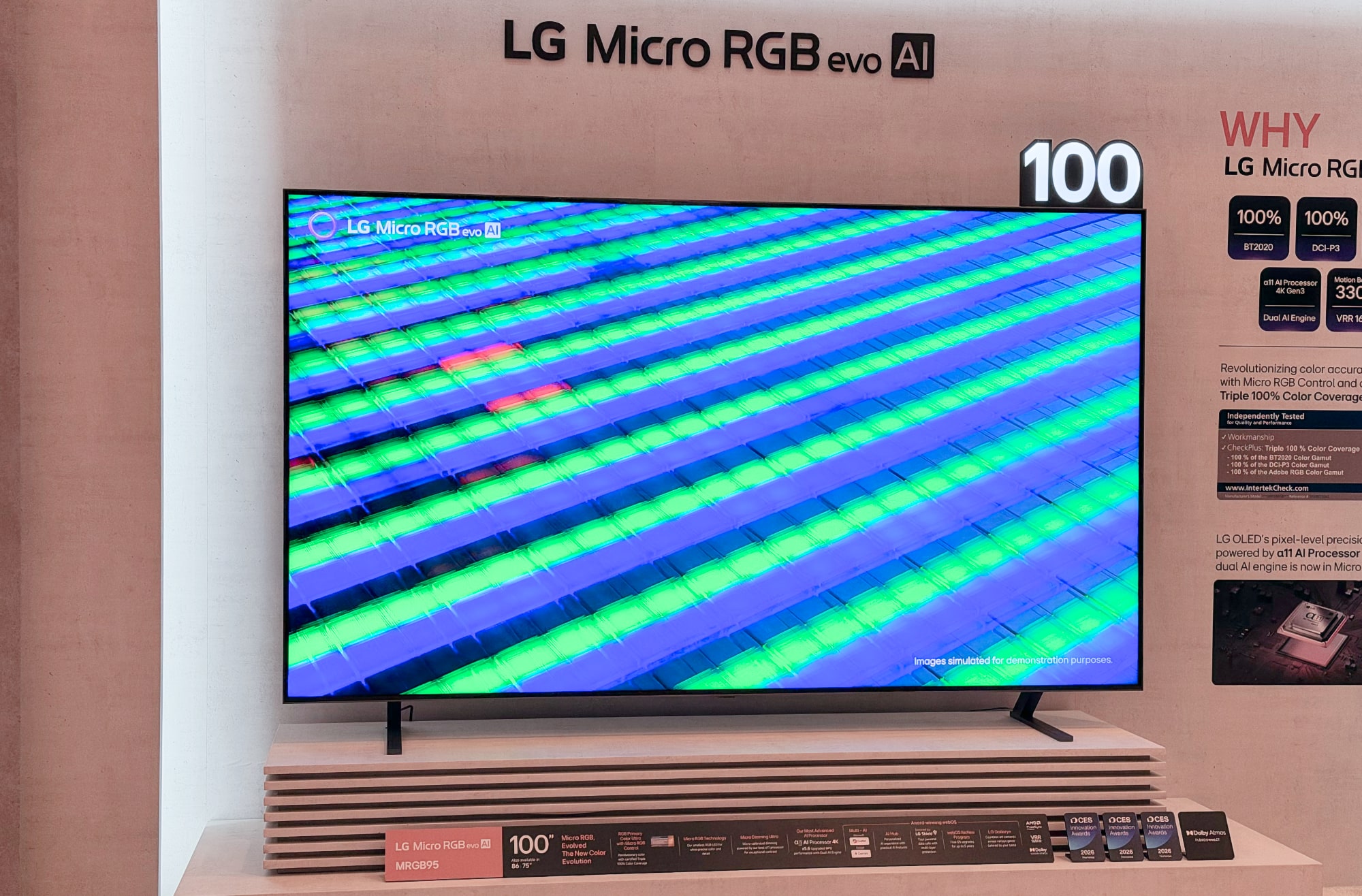
As if we needed more TV acronyms to worry about, say hello to Micro RGB, a new technology built atop Mini LED to cover vastly more color range. Just don’t confuse it with Micro LED, which is the wildly expensive evolutionary step forward for OLED. LG already announced its Micro RGB set a few weeks ago, but that didn’t prepare me for standing in front of the 100-inch demo TV it brought to CES. Throughout a variety of clips, colors looked wonderfully rich, and the overall texture of the images looked surprisingly life-like.

I’d have to compare it to LG’s Wall TV side-by-side to truly see how Micro RGB competes with OLED, but technically OLED should still offer better contrast and black levels, since each of its pixels are self-emissive. But sure, if I couldn’t get a 100-inch Wall TV in my family room, I certainly wouldn’t turn down an enormous Micro RGB.

What about LG’s other OLED TVs?

All of the next-generation OLED technology in the wallpaper TV will also make its way into LG’s G6 OLED models, while the new C6 and other lines will see improvements of their own. All I can say is that the new G6 OLED looked impressive, with a noticeably brighter picture and HDR elements compared to G-series OLEDs from several years ago.

This article originally appeared on Engadget at https://www.engadget.com/home/home-theater/lg-tvs-at-ces-2026-a-stunning-wallpaper-set-glorious-micro-rgb-colors-and-a-better-gallery-tv-033739600.html?src=rss

LG brought back the Wallpaper TV for CES and ditched the companion sound bar

It’s been nearly 10 years since LG first introduced its Wallpaper TV that was so thin that the mounting process felt like applying wallpaper. After eventually discontinuing the ultra-thin TVs in 2020, LG is finally reviving the Wallpaper TV series with the OLED evo W6 that will make its debut at CES 2026. LG is marketing the updated Wallpaper TV as the “world’s thinnest” OLED that’s truly wireless, making some major upgrades to the original.

Instead of the companion soundbar that housed all the ports, LG designed the Zero Connect Box that hosts all the inputs and can transmit from up to roughly 32 feet away. It’s similar to what Samsung has been doing with its Wireless One Connect Box, which is often paired with its Frame TV lineup. While you won’t have to worry about a web of tangled wires or a clunky soundbar, the OLED evo W6 measures slightly thicker at 9mm, compared to its predecessor’s hyperthin 2.6mm measurement. That’s more than three times the thickness, but it’s still impressive if you consider that the W6 will feel about as thick as putting an iPhone 17 Pro Max against your wall.

LG's Wallpaper TV measures 9mm thick when mounted on a wall.
LG

The latest Wallpaper TV does come with plenty of improvements, though, including LG’s third-gen α 11 Processor. LG also added its new Hyper Radiant Color Technology to the W6, which translates to deeper blacks, improved colors and higher brightness levels. There’s even a Brightness Booster Ultra feature that LG claims results in four times the brightness of conventional OLED. To complement the extra nits, LG specifically designed a screen that reduces reflections for the Wallpaper TV.

The updated W6 can handle gaming better, too, since it supports a 4K 165Hz refresh rate and has a 0.1 pixel response time that’s crucial for competitive gaming. LG added compatibility with NVIDIA’s G-Sync, AMD’s FreeSync Premium, Google Gemini and Microsoft Copilot. When you’re not using the Wallpaper TV, LG has its Gallery+ feature that can display screensaver visuals, personal photos or images created with generative AI.

The Wallpaper TV can fit into any living room space thanks to its minimalist design and LG Gallery+ feature.
LG

LG didn’t reveal what sizes the upgraded Wallpaper TV would be available in, but it will be on display later this week at CES 2026. LG hasn’t offered any clues about pricing yet either, but we wouldn’t be surprised to see an equally shocking price as compared to the last Wallpaper TV, which cost up to $20,000.

This article originally appeared on Engadget at https://www.engadget.com/home/home-theater/lg-brought-back-the-wallpaper-tv-for-ces-and-ditched-the-companion-sound-bar-030057927.html?src=rss

Sweekar turns the Tamagotchi into a physical AI pocket pet that won’t die on you

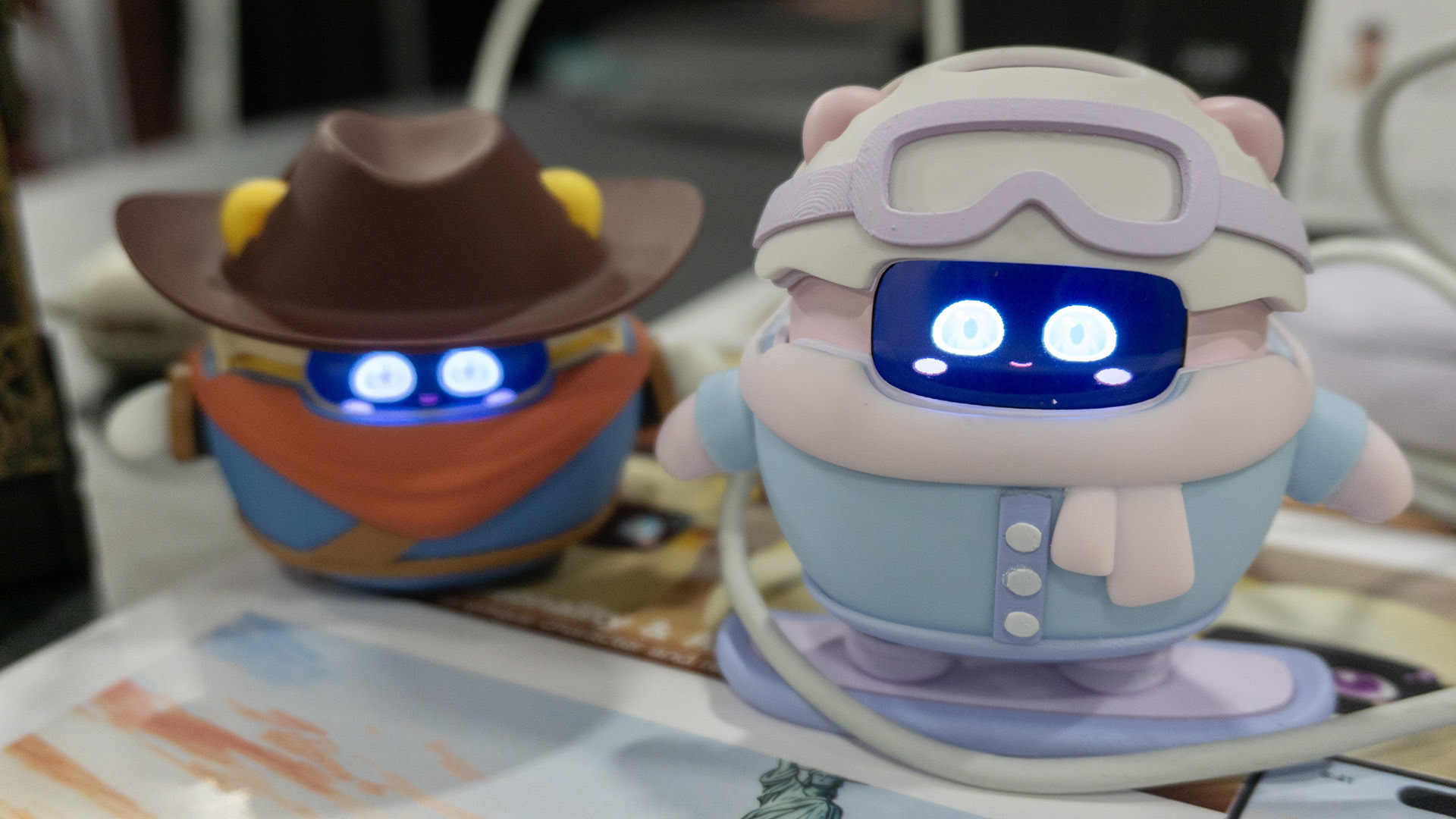
Takway, a startup that wants to be the “Nintendo of the AI robot era,” has unveiled a Tamagotchi-like virtual pet at CES 2026 that’s meant to go with you everywhere and develop a unique personality in the process. Sweekar is an AI companion built into a palm-sized toy, a cutesy egg-shaped device with ears and a screen for its face. As with a Tamagotchi, you’ll have to feed and play with it to keep it happy and healthy, and its mood and facial expressions will reflect your care. But this virtual pet will remember your voice and the activities you’ve done together — and once it’s grown up, it will keep itself entertained, go off on its own virtual excursions (kind of like a Finch birb) and bring back tales of its adventures.  

The Sweekar pocket pet being placed into a large brown checkered purse
Takway

Sweekar comes in pink, yellow and blue, but there will also be the option to switch up the shells and buy silly little outfits for it, because why not. The pocket pet has four life stages, becoming less needy as it grows.

It starts out as a closed egg for its two-day incubation period, after which it will “break” its shell to reveal a face. From then on, you have to keep it alive with care tasks and attention in order to raise it through the baby and teen stages. Once it’s an adult though, it will be able to care for itself autonomously. That means you no longer run the risk of killing it through neglect. Sweekar is unkillable from Level 51 on. (At least, in the virtual sense. Hardware can always break, and you’ll have to keep it charged).

Two Sweekar devices are pictured on a table, one wearing a pink and blue snowboarder outfit and the other (behind it) wearing a cowboy hat and outfit
Karissa Bell for Engadget

There’s no set price for it just yet, but Sweekar will likely fall within the $100-$150 range once it becomes available. The company says it will soon be launching a Kickstarter campaign.

This article originally appeared on Engadget at https://www.engadget.com/ai/sweekar-turns-the-tamagotchi-into-a-physical-ai-pocket-pet-that-wont-die-on-you-023525228.html?src=rss

39 Million Californians Can Now Legally Demand Data Brokers Delete Their Personal Data

While California’s residents have had the right to demand companies stop collecting/selling their data since 2020, doing so used to require a laborious opting out with each individual company,” reports TechCrunch.
But now Californians can make “a single request that more than 500 registered data brokers delete their information” — using the Delete Requests and Opt-Out Platform (or DROP):

Once DROP users verify that they are California residents, they can submit a deletion request that will go to all current and future data brokers registered with the state…

Brokers are supposed to start processing requests in August 2026, then they have 90 days to actually process requests and report back. If they don’t delete your data, you’ll have the option to submit additional information that may help them locate your records. Companies will also be able to keep first-party data that they’ve collected from users. It’s only brokers who seek to buy or sell that data — which can include your social security number, browsing history, email address, phone number, and more — who will be required to delete it…

The California Privacy Protection Agency says that in addition to giving residents more control over their data, the tool could result in fewer “unwanted texts, calls, or emails” and also decrease the “risk of identity theft, fraud, AI impersonations, or that your data is leaked or hacked.”


Read more of this story at Slashdot.

Japanese startup Ludens AI brought two very adorable robots to CES 2026

CES 2026 is already shaping up to be an interesting year for robots. But while some companies are chasing humanoids that can help you do stuff, there are also a surprising number of robots whose main job is to be cute and keep you company.

Japanese startup Ludens AI is showing off two extremely adorable robot companions at CES. Cocomo is an autonomous robot pet that can follow you around the house and respond to voice and touch. It has a fuzzy, egg-shaped body, but the version we saw at CES was wearing an orange suit with ears that made it look a bit like a teddy bear. It was moving around on a wheeled base, but it also has tiny legs if you prefer to carry it around and hold it. 

Cocoo’s exterior is meant to stay close to human body temperature at 98.6 degrees fahrenheit and the company says it will rise up to 102 degrees in “high contact” situations like hugging it. And while Cocomo can interact and respond to your actions, it “speaks” with hums and other sounds rather than words.

Ludens AI brought some very cute robots to CES 2026. This is Cocomo, a robot pet that’s designed to be a companion. It can follow you around and learn about you over time. pic.twitter.com/rj6dLXN4h4

— Karissa Bell (@karissabe) January 5, 2026

We didn’t get to witness many of its abilities in action due to the loud environment, but Ludens says that Cocomo is designed to bond with its owners over time. “Cocomo engages through spontaneous gestures, imitation, and gentle initiation – learning what makes you laugh, what comforts you, and when to surprise you,” the company says. 

Ludens didn’t share pricing or availability info for Cocomo, but has a waitlist where you can sign up for updates in a forthcoming crowdfunding campaign. 

Ludens AI's Inu robot.
Ludens AI’s Inu robot.
Karissa Bell for Engadget

Ludens also showed off a smaller, but also very adorable, robot called Inu, which it describes as a “desktop alien pupu.” Rather than a robot that can move with you from room to room, Inu is meant to sit on your desk and keep you company while you work. It can also interact via audio and movement. It has a little tail that wiggles in response to voice and touch and its single eye can “blink.” 

Ludens plans to launch a crowdfunding campaign for Inu later this year.

This article originally appeared on Engadget at https://www.engadget.com/home/smart-home/japanese-startup-ludens-ai-brought-two-very-adorable-robots-to-ces-2026-021914130.html?src=rss

PartyStudio is a wireless MIDI speaker with 128 built-in instrument sounds

There are a slew of keyboards and apps that help people learn how to play the piano, but a small company called PopuMusic is showing off an intriguing set of products at CES to make the process easier. PartyKeys and PartyStudio are a 36-key MIDI keyboard and MIDI / Bluetooth speaker that pair together in seamless fashion. The PartyStudio is particularly interesting because it has a built-in library of 128 instrument tones and more than 50 different drum machine patterns. Naturally, it works with the PartyKeys, but any MIDI keyboard can connect to it and use those sounds.

The PartyStudio and PartyKeys both use NFC to connect to each other — you can just tap and hold the keyboard up to the speaker for pairing. You can connect up to three devices using MIDI over Bluetooth Low-Energy (BLE MIDI) as well as a fourth using a wired connection. If you have more than one keyboard, meanwhile, you can connect them together with NFC as well — you can pair three keyboards together total, giving you a huge 108-key surface to play.

Both the PartyStudio and PartyKeys have an understated but appealing look to them (they’re available in black or white) and feel quite substantial and well-made. PopuMusic has been releasing hardware via Kickstarters campaigns for a few years now, so even though they’re a relatively small and new company they have some experience in this department. The speaker seems to hit a nice balance of portability and power; it has two tweeters and two woofers and weighs in at 3.75 pounds. It’s about 13.5 inches wide, 5.2 inches tall and 4 inches deep, so it’s not a tiny speaker you’ll just throw in your bag, but it still feels easy to tote around thanks to its attached handle.

The other trick that the PartyStudio and PartyKeys have is on the software side. Using a companion app, multiple people can play along with a song. The light-up keyboard can show you what to play, and if you have multiple people playing each keyboard can display complimentary parts. It starts with simple three-key chord voicings, but I also saw a demo that used a familiar Guitar Hero-style interface of different notes flying down the screen, making for a more involved and advanced performance.

The PartyKeys are up for order on Kickstarter now for $199, while the PartyStudio costs $349. The company says they’re on track to ship both products in Q1 of 2026.

This article originally appeared on Engadget at https://www.engadget.com/audio/partystudio-is-a-wireless-midi-speaker-with-128-built-in-instrument-sounds-015511003.html?src=rss

SwitchBot turned up to CES with an AI wearable that records everything you say

We’ve all fantasied about sprawling on an embroidered chaise lounge while our amanuensis faithfully typed out everything we said. SwitchBot turned up to CES with something that does a similar job, but without the romance of the amanuensis, the typewriter or the chaise lounge. Instead, it’s launching the AI MindClip, a wearable microphone which records and transcribes every noise to come from your mouth. 

The company isn’t alone, with many others turning up to CES this year offering devices to log your thoughts through the day. But SwitchBot does hope to distinguish itself from the crowd with an AI which can both summarize and extract useful data from your chats. The company’s representatives said it will use its initiative and create its own reminders based on what it thinks you’ll need to remember. Sadly, we couldn’t get to see it working in person, and we don’t know when it’ll be available or how much it’ll cost. 

But it’ll probably be a little bit cheaper than a chaise lounge. 

This article originally appeared on Engadget at https://www.engadget.com/wearables/switchbot-turned-up-to-ces-with-an-ai-wearable-that-records-everything-you-say-014959824.html?src=rss

Lockin’s everlasting vein-recognizing smart lock doorbell cam combo is peak CES

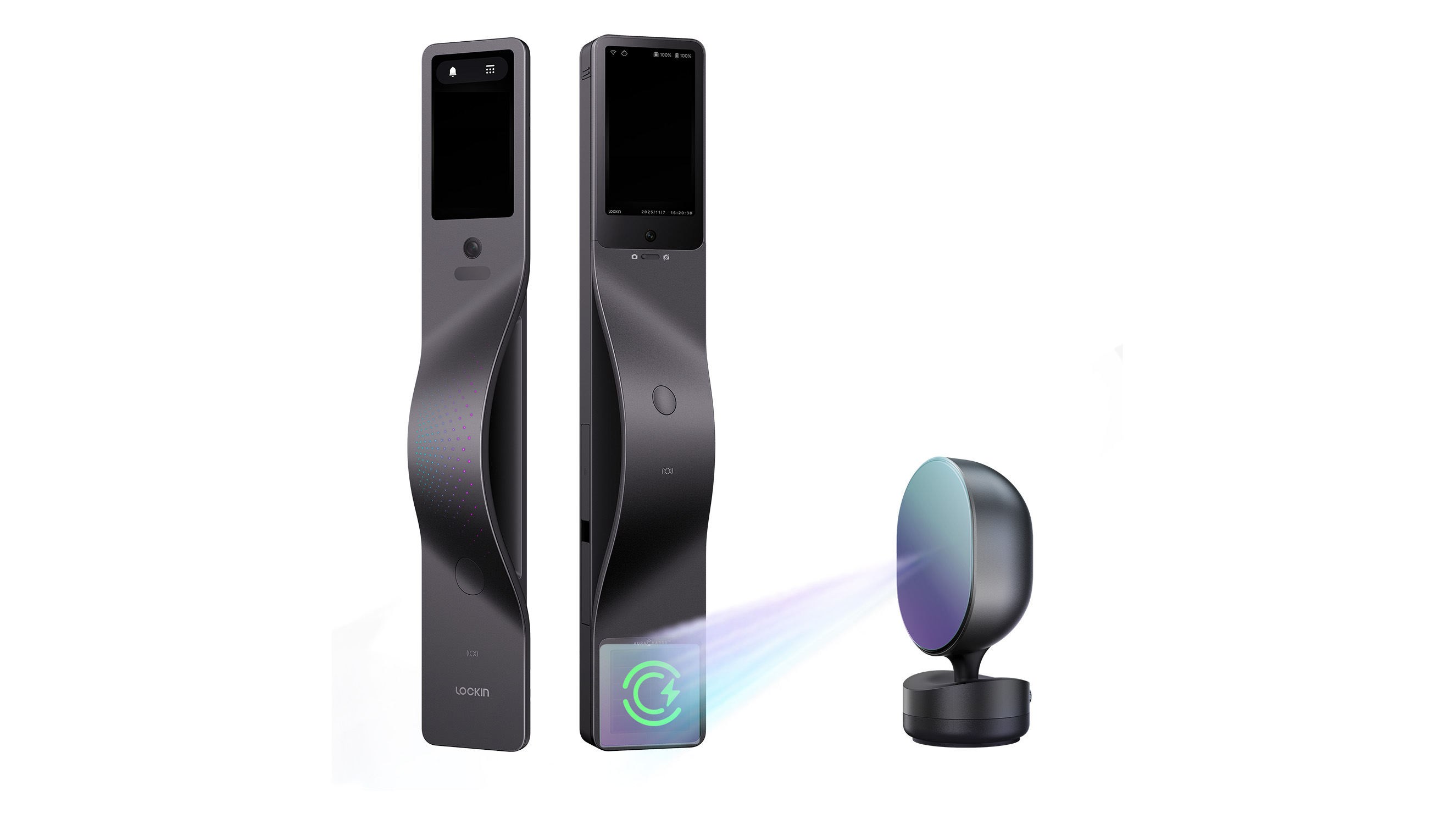
Smart locks have a notable inconvenience: running out of power. Lockin, maker of vein-recognition locks, debuted its newest model on the CES floor. It charges wirelessly via an optical infrared beam with a four-meter range. A small device, connected to a standard outlet inside the house, shoots a beam at the lock, which has a small receptor panel that turns the light into power, sort of like a plug-in sun beaming at a tiny solar array. The tech carries certifications from two independent organizations, and won’t harm eyeballs or bodies that get in the way of the beam (though if the beam is interrupted, charging stops).

The lock itself is a mortise lock that will likely require a pro to install, as it’s not just a standard deadbolt replacer. It’s not a standard lock in other ways too, with video and speaker capabilites, AI recognition as well as touchscreen features and vein recognition.

The tall black rectangle looked sleek (if huge) in person with a pocket-style grip and a rather sizable display on the interior panel. The outer panel has a touchscreen along with two cameras allowing it to act as a doorbell video camera. You can unlock the door via palm, finger vein or 3D facial recognition.

Lockin V7 Max smart lock
Lockin

It’ll feed the video to any of the major smart home eco systems, including those from Google, Apple, Amazon and Samsung. But for general setup and advanced AI features, such as recognizing a package delivery and speaking a canned request to the driver, you’d use Lockin’s own app.

I can’t imagine this high-end do-everything lock will be cheap, and indeed the price is currently undisclosed, but units should start shipping in July or August of this year. There’s a cheaper version of the lock, with the same wireless charging capability but without the video features, that’ll sell for $350 and will be available in April.

This article originally appeared on Engadget at https://www.engadget.com/home/smart-home/lockins-everlasting-vein-recognizing-smart-lock-doorbell-cam-combo-is-peak-ces-013431113.html?src=rss

Kernel prepatch 6.19-rc4

The 6.19-rc4 kernel prepatch is out for
testing.

So this rc is still a bit smaller than usual, but it’s not _much_
smaller, and I think next week is likely going to be more or less
back to normal.

Which is all exactly as expected, and nothing here looks
particularly odd. I’ll make an rc8 this release just because of the
time lost to the holidays, not because it looks like we’d have any
particular issues pending (knock wood).

Withings’ updated Body Scan scale tracks 60 different biomarkers

Back in 2023, Withings launched Body Scan, a super-premium scale with the sort of tech found in a high-end gym or low-end clinic. It had a six-lead ECG, offered segmented body composition and could monitor your nerve health, among other things. Now the company has rocked up at CES 2026 in Las Vegas with a second-generation model that adds in tests for hypertension and cellular health. Withings hopes the new model will give you even more data you can use to fight against chronic illnesses brought on by our decadent modern lifestyle.

The first generation Body Scan checked 40 biomarkers, while the new model has 60, and even the press materials need a bulleted list to talk about the new features. Topping the bill is the new Impedance Cardiography (ICG) which monitors your heart’s capacity to pump blood to the organs. Second, Bioimpedance Spectroscopy (BIS) uses a low level electrical current to check your body’s total water, letting the scale keep an eye on your cellular age, active cell mass and metabolic efficiency.

Naturally, all of this data will then be extruded through the company’s “clinically validated” AI model to offer more insights, such as your risk of hypertension and glycemic regulation. You’ll also be told, based on your vital statistics, your health trajectory, and given tips on how to improve your “healthspan.” In short, the company wants to further position this as a clinic in a box, steering you toward healthier choices as and when it can.

There’s one major hardware tweak from the first generation, as the retractable handle used for the ECG now contains the scale’s display. That, I’m sure, makes it easier to read if you’re squinting naked onto the scale after your morning shower. But I’m also concerned that it’s a single point of failure for the thin cable attaching the handle to the rest of the scale. 

Withings hopes to get the Body Scan 2 cleared by the FDA in time for its planned launch in the second quarter of 2026. As for the price, expect to pay a pretty penny for the flagship gear, as it will set you back $599.95, €499.95 or £449.95, depending on your territory.

This article originally appeared on Engadget at https://www.engadget.com/home/smart-home/withings-updated-body-scan-scale-tracks-60-different-biomarkers-010000703.html?src=rss

Shure debuts a USB-C version of its MV88 microphone at CES 2026

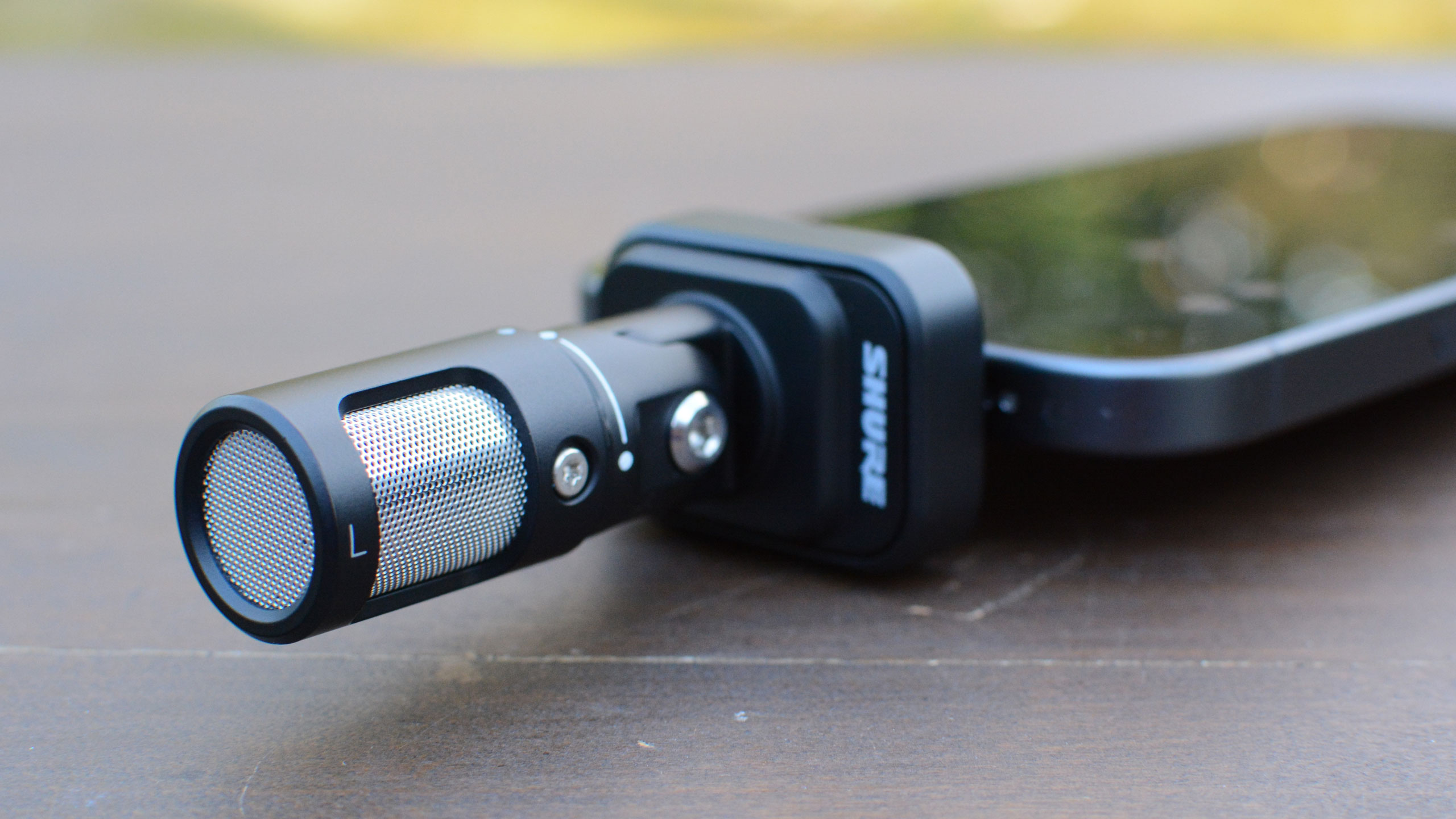
Shure’s original MV88 microphone (no, not the + version) was a convenient snap-on option for iPhone users. Since Apple ditched the port for USB-C, the audio accessory became obsolete for newer handsets. At CES 2026, the company debuted a revised version of the mic, swapping the Lightning connection for USB-C, which also adds compatibility for Android users and a host of other devices. The best part is the updated MV88 is available now, and it’s priced at $159.

If you missed the 2015 version, the MV88 is a compact stereo condenser microphone that simply snaps onto a phone, tablet or one of your laptop’s ports. It provides a packable boost to any built-in mics on your devices, allowing you to capture better audio for voice and video clips. What’s more, it’s a simple, plug-and-play option that doesn’t require additional setup. And if you choose to employ Shure’s suite of apps, you’ll get access to things like presets, microphone gain control, a five-band EQ, limiter, compression and a high-pass filter. Plus, the company’s apps will give you a microphone level meter to keep tabs on your input.

Shure MV88 USB-C
Shure MV88 USB-C
Billy Steele for Engadget

With Auto Level Mode, the mic automatically adjusts gain in real time so that your clips aren’t too loud or too quiet. There’s also a Real-Time Denoiser that works to reduce background noise. The MV88 USB-C has four selectable polar patterns — stereo, mono cardioid, mono bi-directional and raw mid-side — and you can tilt the microphone so that it either points straight up or towards you.

I’ve been testing the new MV88 for a few days ahead of CES and I can confirm it’s a substantial boost over anything a device’s built-in microphone can offer. It’s also a nice alternative to popular lapel mics you’ve likely seen creators and influencers use. Those need to be held close to the speaker’s mouth, so they don’t pic up ambient sound or multiple speakers well without moving them. The MV88 would the better choice for capturing clips of live music, the great outdoors or other places where you want some level of background noise.

Shure MV88 USB-C
Shure MV88 USB-C
Billy Steele for Engadget

Sound quality has been impressive thus far. After barely tweaking any settings, audio capture is warm, but also crisp and clear. That Real-Time Denoiser completely eliminated a noisy hotel room A/C unit during one of my testing sessions. This means the new MV88 will improve my sound if I need to do any voice or video interviews this week from my room. I’m also looking forward to seeing how well it does at some of the evening events and on the CES show floor.

To me, the best part about the MV88 is the quick and easy setup. You literally just snap it on your phone, or another device with a USB-C port, and after a few taps you’re ready to record. Shure also included a small case for the microphone, so it’s less likely to get damaged any time you just need to chuck it in your bag.

This article originally appeared on Engadget at https://www.engadget.com/audio/shure-debuts-a-usb-c-version-of-its-mv88-microphone-at-ces-2026-010000294.html?src=rss

Narwal’s first mattress vacuum heats, taps, UV-blasts and sucks up all the ick living in your bed

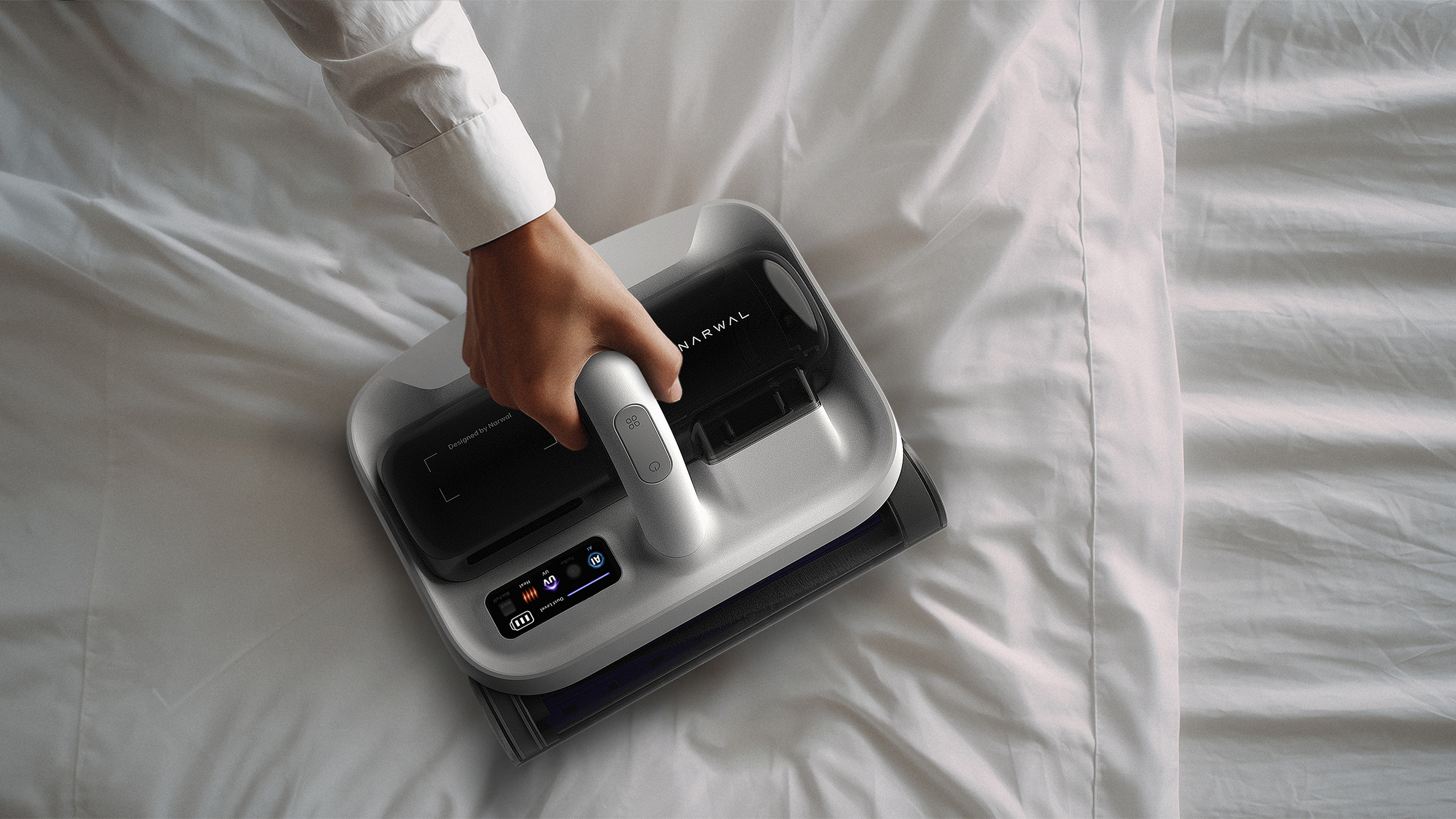
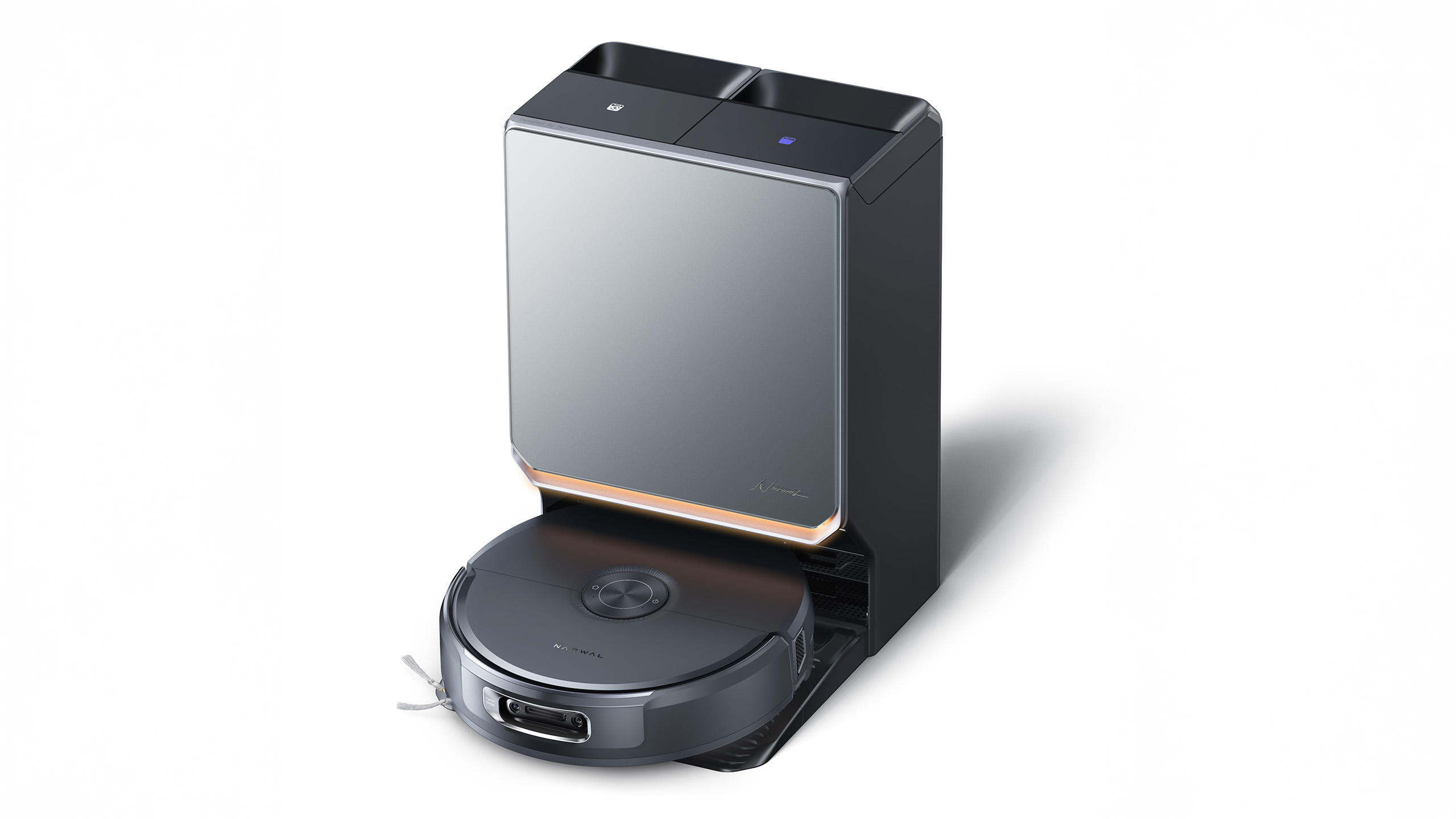
Narwal brought new cleaning robots with it to CES this year, including the Narwal Flow 2, it’s latest flagship robo mop-vac, and the Narwal U50, an automatic mattress vac designed for “deep mite removal.”

While I’d hoped the latter vac was an automatic crawler that could navigate your mattress top, the U50 is a handheld device. Still, no one likes to think about what filters down into their mattress as they sleep — and there are lots of opinions on how and why to remove those dead skin cells, dust, oils and the mites that arrive to dine on those things.

Narwal’s mattress vacuum cleaner not only sucks up all that ick, it heats up to 137 degrees and shines a UV light for sterilization. Then it uses high-speed tapping to dislodge what’s living in your bed before sucking it up with 16.000 Pa of suction power. The dust bag seals itself so all the bad stuff stays put before you throw it away.

The Narwal mattress vac uses heat and UV light to clean your bed.
Narwal

The new flagship is the Flow 2, powered by a new “autonomous system” that incorporates dual cameras and an AI vision-language model for object recognition. Not only will the bot vacuum around any obstacles it sees, it can let you know they’re there. It also has different modes, including the intriguing PetCare Mode, that not only focuses on “pet zones” (places your dog or cat hangs out), it can also find your pet. Say you’re not home and don’t see Sparky lying on her usual spot on the couch. Just ask your Flow 2 to locate your dog and it goes off on a special mission, beaming video of your girl sleeping in a sun puddle. Then if you decide to talk, the vacuum will oblige, complete with video and a speaker that lets you talk to your fur baby.

Of course, the vacuum’s real job is cleaning stuff up and this one uses a track-mop design that keeps infusing the mop with (now hotter) water along with downward pressure to clean up messes. The automatic hot-air drying feature makes sure there’s not too much wetness left behind when its done. The auto-empty base now comes with an upgraded reusable dust bag and washable debris filter, so you throw less stuff away. The collection capacity is rated at 120 days, so you only have to empty the machine once every few months at most.

The vacuums should be available in Spring of this year.

The new Narwal Flow 2 vac mop
Narwal

This article originally appeared on Engadget at https://www.engadget.com/home/smart-home/narwals-first-mattress-vacuum-heats-taps-uv-blasts-and-sucks-up-all-the-ick-living-in-your-bed-004929304.html?src=rss