VRChat’s head of community says the popular social VR platform set a new concurrent user record over the New Year’s Eve celebrations.
The News
As first reported by UploadVR, VRChat’s head of community ‘Tupper’ detailed concurrent user numbers as they rolled in across the various Western Hemisphere time zones during the platform’s annual 24-hour NYE celebration, making for a peak of 148,886 concurrent users during the Central Time Zone ball drop.
Here’s the full breakdown, courtesy Tupper, which includes all supported platforms:
Across the board for US TZs:
ET: 147,226
CT: 148,886
MT: 141,184
PT: 127,708
Notably, Tupper says that also Japan’s had “a strong showing,” although they declined to details the exact numbers, noting however “it did surprise me.”
Additionally, Tupper says that recent “normal weekend” numbers float around 120-125k concurrent users at peaks.
My Take
VRChat doesn’t regularly publish user figures, or user breakdowns across platforms, which is a real shame since it could be one of the best ways of telling just how well VR is doing overall during these post-holiday periods—right as a flock of new users is coming in to try the massive, free and extremely well-known social VR platform.
And yes, while I tend to call it a social VR platform, VRChat is actually much more than that nowadays, as it also undoubtedly pulls in a significant share of users across flatscreen, which include PC, Android, and iOS.
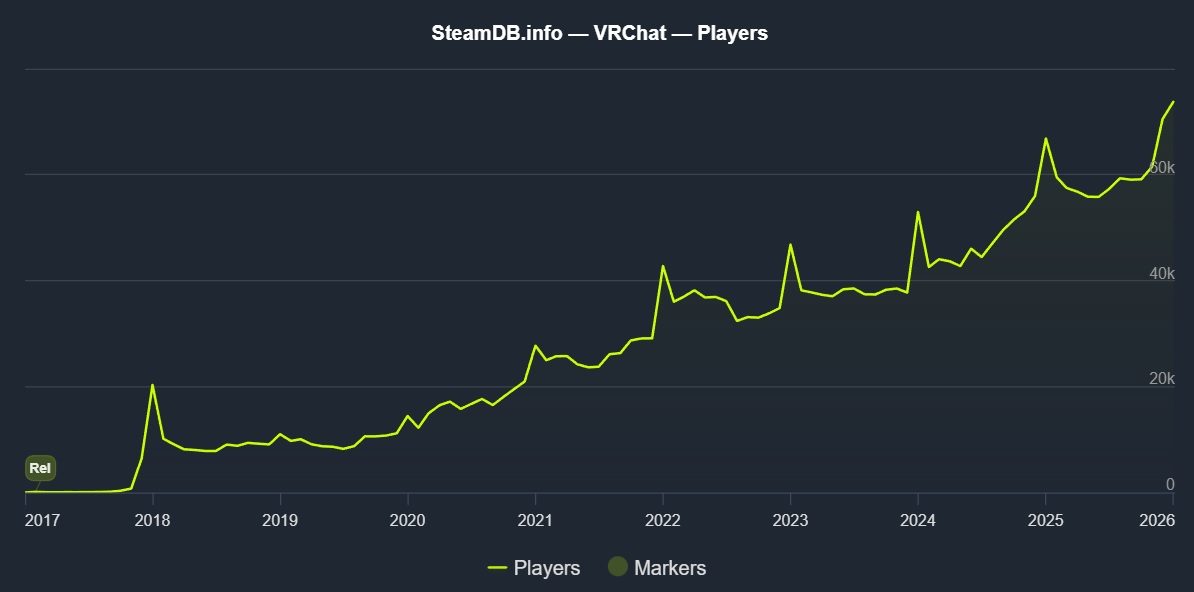
Image courtesy SteamDB
As it is, engagement doesn’t appear to be slowing down on PC, according to data obtained from SteamDB. Above, you can see the massive bump in 2018 leading up to recenrt ~75,000 concurrent users connected through the Steam version of the app. Notably, those local peaks always coincide with the holiday season.
That said, all platforms eventually plateau, although it’s difficult to say when that might be for VRChat. It’s still attracting a lot of maker talent, thanks to its flexible user-generated content platform, and is still the go-to place for a variety of Internet subcultures.
JBL just revealed a bunch of new earbuds at CES 2026, suiting just about every ear canal out there. First up, there are several new additions to the Endurance line of sports-adjacent earbuds.
The baddest of the bunch is likely the Endurance Zone, which offers 32 hours of battery life and fast charging. They include the company’s proprietary OpenSound technology, which directs audio signals to the ears without blocking the ear canal. This means that wearers should be able to detect ambient noise during a workout. This is extremely helpful when someone is asking to use the machine because you’ve been staring at your phone instead of doing reps.
JBL
The Zone earbuds also offer multipoint connections, earhooks for stability and an exterior designed for long-term durability. These buds cost $180 and will be available later this month.
The Endurance Peak 4 earbuds don’t integrate with OpenSound, but do offer superior battery life to the Zone. They can get up to 48 hours per charge, when factoring in the included charging case. They cost $130 and will also be purchasable later in January.
JBL
The Endurance Pace wraparound earbuds are a fairly budget-friendly way to get access to that OpenSound tech. They cost just $90, but the battery maxes out at 10 hours, as there’s no charging case. Look for these later this month.
The Endurance Run 3 are extremely budget-friendly earbuds, with prices ranging from $25 to $35. These are wired devices, with a USB-C model and a 3.5mm model. They’ll be available in February.
The JBL Sense Pro also includes OpenSound and can play spatial content. The battery and case lasts up to 38 hours and there’s wireless charging. These are designed for hi-fi audio, so they include redesigned drivers and a bass boosting algorithm. There are four integrated microphones for making calls. These earbuds cost $200, with availability in March.
JBL
The JBL Sense Lite earbuds, as the name suggests, are extremely light and made to be worn all day. They include OpenSound tech, 32 hours of battery life and touch controls. These buds will also be available in March, with a price of $150.
Finally, there are the Soundgear Clips. As the name suggests, these lightweight earbuds clip to the ears. They also use the company’s OpenSound air-conduction technology. The earbuds are fairly striking, with a metallic tint and translucent finish. The battery life clocks in at 32 hours and can do fast charging. They cost $150 and will also go on sale this March.
This article originally appeared on Engadget at https://www.engadget.com/audio/headphones/jbl-just-announced-a-bunch-of-new-earbuds-at-ces-130044239.html?src=rss
For CES this year, JBL has added three new gaming headsets to its JBL Quantum product lineup. JBL Quantum 950X is the latest set of flagship headphones from the brand, with 50mm carbon dynamic drivers and features such as spatial audio, 3D head tracking and active noise cancelation. The set is compatible with PC, consoles and mobile platforms through 2.4GHz, Bluetooth 5.3 or wired connection. The 950X has a pair of hot-swappable and rechargeable batteries that give 50 hours of playtime. It comes with a 6mm cardioid boom microphone that uses AI noise reduction to keep background sounds out of in-game communication. The headset will retail for $400 and will be available starting in April 2026.
The other two new products are the JBL Quantum 650X and the JBL Quantum 250. The wireless 650X also has 50mm carbon dynamic drivers, spatial sound and the same connectivity options as the 950X. It has an expected battery life of 45 hours. The less expensive 650X will also be available in April and will retail for $200. The JBL Quantum 250 is a wired headset with many of the same drivers and features as the other two products. It has black and white model options, and will cost $80. This third model will be available starting March 2026.
This article originally appeared on Engadget at https://www.engadget.com/audio/headphones/jbl-launches-a-trio-of-gaming-headsets-for-ces-130000929.html?src=rss
Stefan from my 5v5 Ladder team was once again trying to coach me out of a mid-summer slump. If you’ve ever been on a Ladder team, you know the chat quickly turns into a general discussion of all things Zwift racing. Because Club Ladder runs year-round, those chats never really go quiet in the off-season. Instead, teammates become people you banter with week after week, sharing every small victory and setback.
Stefan’s advice was well-intentioned: take a rest day. I took it as a challenge.
It was July 2024, and I was complaining about being tired for a Thursday afternoon race after doing WTRL Duathlon the night before. That comment got me thinking: what would happen if you ditched structured training altogether and just raced every day?
So I tried it.
I started with 30 races in 30 days. Then 80+ races in 90 days. Before long, I found myself in the “Top 25” most active racers on ZwiftRacing.app. But every three months the stats reset, and it all felt a bit hollow – until December 2024, when Tim from ZwiftRacing.app added a History tab to each rider profile.
Suddenly, full-year totals were visible: races, podiums, wins. Looking back at my 2024 numbers, I saw 251 races, 93 podiums, and 34 wins.
I figured I could do more. And so a 2025 challenge began, aiming for 300 races, 100 podiums, and 50 wins.
The Logistics of Racing (Almost) Every Day
I’m based in Chicago, and most of my racing happens during lunch breaks – assuming meetings allow. If I have calls between 11:30 and 14:30 CST (17:30–20:30 UTC), racing options shrink fast. With many low-attendance community races removed from the calendar, meaningful racing outside those windows is limited, aside from the hourly zRacing events.
Weekends were a particular challenge with young kids in the house. Saturday activities became stressful once “it would be nice to race today” turned into “I have to race today.” Knowing there was only one race per hour created real friction at home.
Zwift’s lack of on-demand racing becomes trying, particularly in these low-popularity slots. Unlike most video games, there are no bots and no instant lobbies – you can only race at a set time against whoever shows up. That sometimes meant racing late in the evening in a pen where the only other rider dropped out. At that point, I’d happily take robots over an empty pen!
There were days I raced alone just to keep the streak alive. Occasionally, I leaned on formats like Tiny Races, where multiple short races count individually. It would be easy to inflate totals that way, but that wasn’t the goal. The goal was more simple: race as often as possible and see whether fitness would follow.
Chasing Podiums and Wins
So, how to judge success? Zwift racers joke about “little virtual trophies,” but there’s no denying they’re motivating. Even if no one else cares who won in Crit City last Tuesday, seeing a podium on your profile feels good.
The problem is defining what actually counts.
Zwift has long struggled with multiple results sets thanks to disqualifications and the opt-in nature of ZwiftPower. If you’ve raced on Zwift, you’ve probably seen an eighth-place in-game finish turn into second-place on ZwiftPower. That’s a podium. Hooray! But should it be?
Even worse is ZwiftPower’s time-based randomization – introduced to prevent racing in group rides – which can occasionally interfere with legitimate race results. Over the year, I lost more than a few podiums in WTRL Duathlon due to mismatches between systems:
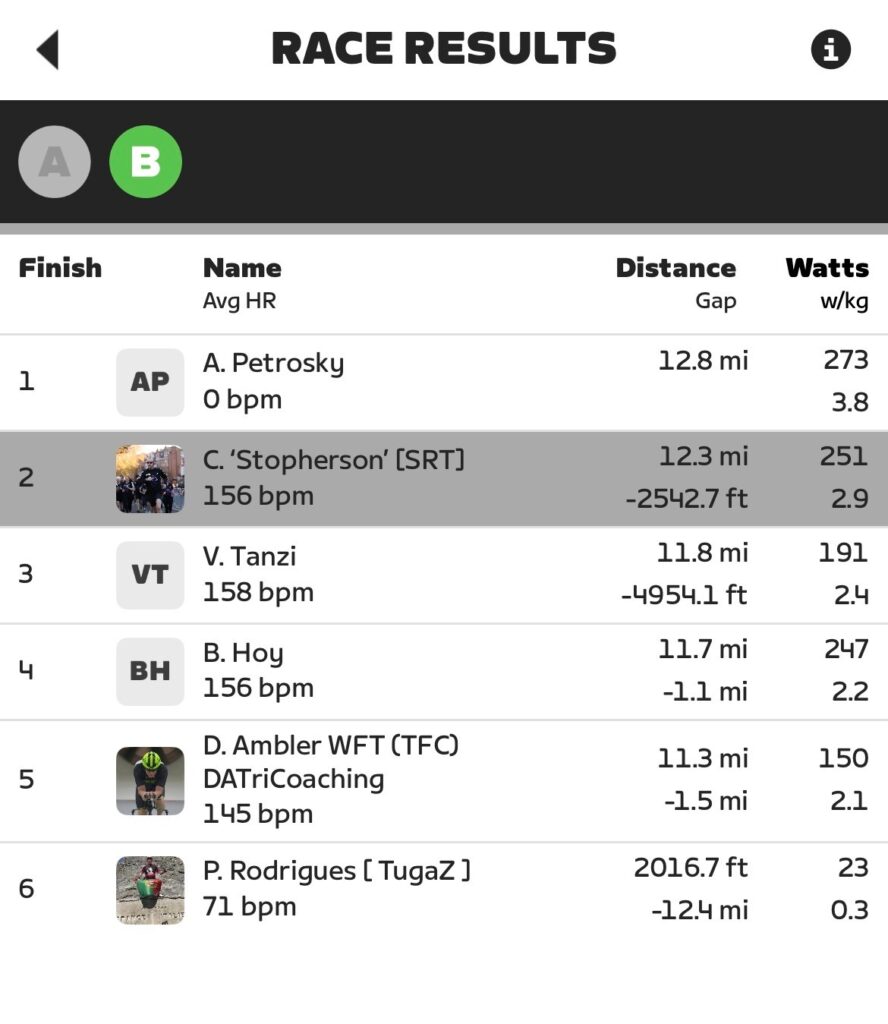
Yes! Alright! 2nd Place! Until ZwiftPower weighed in with the sad trombone…
At the same time, does a third-place finish in a four-rider field really deserve the same excitement as third out of 70? And worst of all, a 1-of-1 finish counts as both a win and a podium when neither really happened.
Between races that didn’t count correctly and others that arguably shouldn’t count at all, podium stats became more noise than signal. Fun to look at, but not something to judge success on. Eventually, I dropped podiums and wins from my annual goal just to reduce frustration.
Fortunately, new APIs from Zwift now allow third parties to pull results directly from Zwift itself, meaning we can finally see results for non-ZwiftPower riders. ZwiftRacing.app has already integrated this, and ideally other organizers will follow. Soon, “if it’s not on ZwiftPower, it didn’t happen” may be a thing of the past.
A Year of Ranking and Categorization Systems
Over the course of the year, I raced under nearly every system Zwift currently uses: Category Enforcement (CE), Zwift Racing Score (ZRS), legacy ABCD categories, vELO, age-based pens, and even events with no categories at all.
None of them are perfect, but some are clearly better than others.
Category Enforcement (CE)
Category Enforcement does a good job limiting climbing speed, which helps make hilly courses feel fair. Power-based categories are a boon to riders near the top of their category, but those near the bottom are often doomed to uncompetitive races. On flat courses, unlimited watts in a w/kg system means some heavy riders are simply unmatchable.
Having raced on both sides of the dividing line in ZRL last year, I can say with confidence that being at the top of a category is definitely more fun. As a “barely B” rider, I struggled mightily under CE, but found a niche in crits where I could just about hang on and occasionally sneak a podium or win.
Legacy “ABCD” Categories
Legacy ABCD events are increasingly rare, and when they do appear, they often feature baffling rule sets: no pen enforcement, “see everyone” enabled despite staggered starts, and even late joining allowed. Even as someone who races nearly every day, I found myself irrationally irritated by a late joiner “winning” after only riding the final two kilometers – often from the wrong category. It’s hard to imagine we ever raced like that, but Zwift has clearly come a long way!
Zwift Racing Score (ZRS)
Power-based categories are mostly gone now that Zwift Racing Score was adopted for most races in 2025. ZRS aims to improve matchmaking using results, but frequent racing exposes a key weakness: inflation. Unless you finish dead last, score losses are minimal. Race often – especially in small fields – and your score tends to drift upward over time.
My own experience reflected this. Despite modest power numbers, I quickly found myself above 700 ZRS, locked into top pens against former A+ riders. Meanwhile, riders I’d been competitive with in the lower half of ZRL B fields under CE spent much of the year hundreds of points lower. Climbing against riders with 900+ ZRS capable of holding 6+ w/kg was a brutal reminder of why we had power-based systems in the first place!
ZRS is a major step forward, but if it takes ~100 races to settle and most riders only race once or twice per week, it may be a long time before the majority of riders truly find their level.
vELO
Let me preface this by saying I really like vELO as a concept. It has become my primary barometer for race performance because it answers a simple question: did you perform better or worse than expected, given the competition?
As a categorization system, vELO has meaningful advantages over both CE and ZRS. It avoids hard power caps while still considering power enough to prevent legacy A+ and C riders from landing in the same pen. The prediction model’s terrain modifiers are especially impressive, accurately identifying where riders with certain power profiles will struggle. (A rider who’s Gold with no sprint, for example, might be classified as Silver on Crit City.)
Unfortunately, race series can’t use those terrain-adjusted values for pen allocation. Worse, points-based series will ignore them entirely. I learned this the hard way by losing more than six months of vELO progress in just a few climb-heavy Dirt Racing Series events back in the Spring!
vELO 2.0, slated for 2026, will absolutely tighten this up. Today’s vELO is great, but the new version promises to be something really special.
Age-Based Racing
Age-based formats like WTRL Duathlon and the Inox Masters League have promise, but Zwift’s five-pen limit creates complications when more than five age groups race together. Results rely on post-race ZwiftPower adjustments, leaving riders unsure of their finishing position until well after the race ends.
There’s also no power limit, so, as with ZRS, you can end up with D and A+ riders in the same pen. That’s rarely compelling for the former, but with popular series like Inox Masters running short, punchy races, many riders can at least feel competitive. These were terrifying affairs as I did them, but afterwards, I remembered them fondly. The definition of Type 2 fun!
Everyone Together
Somewhat surprisingly, I’ve come to believe that the best categorization system might be none at all.
Some of the most enjoyable races I did all year featured “everyone in E” with a ZRS range of 0–1000. These weren’t mass-start events that still created winners and losers based on who could hang with the category above. Instead, they were true “everyone together” races. Riders naturally sorted themselves into groups, and success was measured by beating the riders around you – not chasing a podium.
HERD Winter Racing deserves special mention here. Those Friday events were consistently some of the most engaging races on the calendar.
The Advanced Pen Hack
While not a separate categorization method, the Advanced Pen felt like a revelation compared to the chaos that often defines zRacing. With a 650+ ZRS requirement, fields were more predictable and largely free of sandbaggers and “October Surprise” riders with artificially low scores after a summer outdoors.
Racing against 900+ ZRS riders was still brutal, but the hard cutoff minimized downside for riders near the bottom. When you’re predicted last, vELO and ZRS losses are small, and with stronger riders intentionally shedding points, you could even gain vELO while finishing near the back.
It almost feels like a hack: if you want to look good on paper, race Advanced Pen. Just be prepared to get dropped!
Unranked Racing: An Opportunity Area?
All of this raises an obvious question: why don’t we have more unranked races on Zwift?
Outside of WTRL Duathlon, Team Time Trials, and Chase Races, almost everything “counts.” That creates a real disincentive to race when you’re anything less than 100%, which is a shame, because racing against others is often the strongest motivator Zwift has.
Zwift’s “Friday Night Fun Races” were a welcome exception. Dinosaur costumes, big-head mode, tricycles, and sub-20km races sounded like an excuse to take it easy. Instead, three of my top five all-time 20-minute power efforts came from those events.
There’s something freeing about knowing there are no consequences for blowing up. I’d love to see more races like this appear on the calendar in 2026.
So – Did Racing Every Day Improve Fitness?
By January 2025, I was a recently relegated C rider adjusting to a new Zwift Ride setup and learning to sprint properly after switching to clipless pedals. By mid-year, I was solidly back in B, winning races and feeling confident in my sprint (though naturally climbs will forever remain an Achilles’ heel).
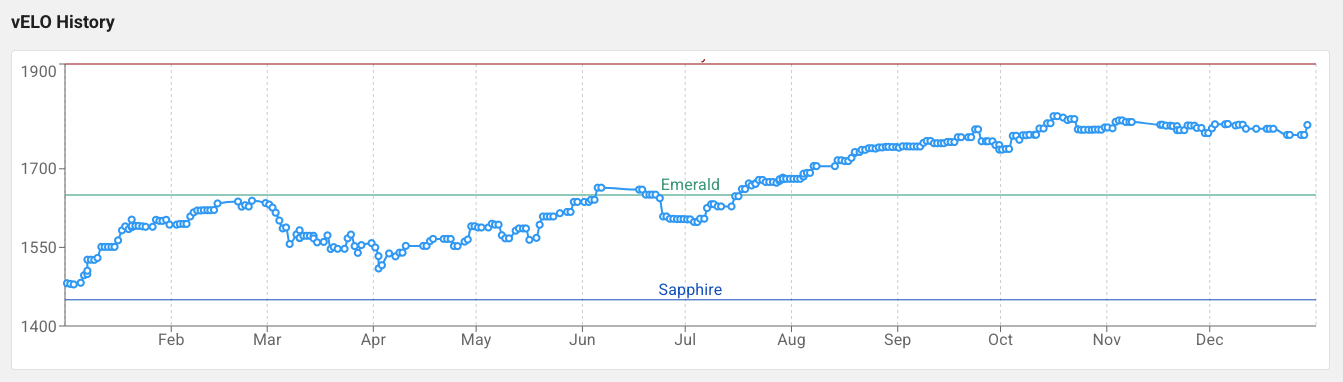
On paper, I improved. vELO rose from low Sapphire to high Emerald. ZRS climbed from the low 500s to over 700. Estimated FTP (eFTP) jumped from 298 in 2024 to 323 in 2025. I was setting new power PBs almost weekly.
The grind, in chart form.
In practical terms, though, the picture was more mixed.
Racing every day makes you very good at racing – specifically at 25–30 minute efforts. Over the year, I became exceptionally good at standing up and driving high watts for 30–60 seconds to close gaps.
But being good at repeated anaerobic surges doesn’t build endurance. Long rides all but disappeared, and my weight actually increased as the year wore on. While I might comfortably beat my former self on Glasgow Crit Six today, I’m fairly sure “old me” would have the edge on Alpe du Zwift.
In racing nearly every day, I didn’t become a better all-around cyclist. I became better at Zwift racing.
Year-End Numbers
According to ZwiftRacing.app, my 2025 looked like this:
313 races
58 wins (19%)
152 podiums (49%)
1 DNF (A black mark!)
Min vELO: 1479 Sapphire
Max vELO: 1800 Emerald
Final vELO: 1783 Emerald
Racing was nearly all I did, which my somewhat embarrassing Zwift Spinback highlighted in clear detail!
Zwift Spinback highlighted 2025’s depravity. But what was I doing on those 17 rides that weren’t races?
Final Thoughts
Racing can absolutely make you fitter… for racing. But when it crowds out everything else, something gets lost.
Over the year, I skipped group rides, fun activities like The Big Spin, tours like Tour de Zwift and Tour of Watopia, and much of the social side of the platform. Instead of riding primarily with my clubmates, I became a lone wolf – joining whatever race fit the time slot I had available that day.
My interactions with other riders dwindled to a “GLHF” in the pen or the occasional dinosaur joke on Friday nights. Zwifting became an obsession focused on results and metrics rather than fun and fitness. At some point, it kind of stopped being fun.
I like to think both Stefan and I were right. You can race yourself fit – but if racing comes at the expense of everything else, you may end up fitter at Zwift and poorer at things that matter even more.
So this year, I’ll remember to keep it light. We’re all here just trying to get fit, blow off some steam, and hopefully have a good time doing it. Ride On 2026!
America’s tech companies and data center developers “are increasingly losing fights in communities where people don’t want to live next to them, or even near them,” reports the Associated Press:
Communities across the United States are reading about — and learning from — each other’s battles against data center proposals that are fast multiplying in number and size to meet steep demand as developers branch out in search of faster connections to power sources… [A]s more people hear about a data center coming to their community, once-sleepy municipal board meetings in farming towns and growing suburbs now feature crowded rooms of angry residents pressuring local officials to reject the requests…
A growing number of proposals are going down in defeat, sounding alarms across the data center constellation of Big Tech firms, real estate developers, electric utilities, labor unions and more. Andy Cvengros, who helps lead the data center practice at commercial real estate giant JLL, counted seven or eight deals he’d worked on in recent months that saw opponents going door-to-door, handing out shirts or putting signs in people’s yards. “It’s becoming a huge problem,” Cvengros said. Data Center Watch, a project of 10a Labs, an AI security consultancy, said it is seeing a sharp escalation in community, political and regulatory disruptions to data center development. Between April and June alone, its latest reporting period, it counted 20 proposals valued at $98 billion in 11 states that were blocked or delayed amid local opposition and state-level pushback. That amounts to two-thirds of the projects it was tracking…
For some people angry over steep increases in electric bills, their patience is thin for data centers that could bring still-higher increases. Losing open space, farmland, forest or rural character is a big concern. So is the damage to quality of life, property values or health by on-site diesel generators kicking on or the constant hum of servers. Others worry that wells and aquifers could run dry…
Which US rocket companies achieved the most during 2025?
Once again, Ars Technica is here to provide some answers in the form of our annual power ranking of US launch companies. We began doing this in 2022 and have since put out a top-10 list every year (see 2023 and 2024). Our intent, as always, is to spark debate, discussion, and appreciation for the challenge of operating a successful rocket company. It’s a demanding business, both technically and financially. We respect the grit and hustle because we know just how hard this stuff is.
Please also note that this is a subjective list, although hard metrics such as total launches, tonnage to orbit, success rate, and more were all important factors in the decision. And finally, our focus remains on what each company accomplished in 2025, not on what they might do in the future.
It’s not the first of its kind, but a few key differences set Fraimic apart from other E Ink art displays. Aura, Switchbot and others have something similar. But unlike other versions, this one requires no subscription, lets you swap out the surrounding frame and doesn’t require an app to upload the art. Instead, a built-in mic picks up your idea, sends it to OpenAI and creates an image that pops up in a few moments on the screen. The on-board accelerometer even knows whether the device is in landscape or portrait orientation, and applies the correct format.
A purchase of the Fraimic comes with 100 free AI creations per year, and if that’s not enough, you can buy more. But if, like me, you don’t consider the images a machine’s brain smashes together to actually be art, the Fraimic also allows you to upload your own images via the brand’s website. And should that website ever go away, your device isn’t obsolete, as it can also handle local uploads.
The Fraimic canvas
Fraimic
The other qualities that make E Ink displays intriguing are all here. These screens are similar to what you get with a color ereader or E Ink tablet and, like those devices, only require power when changing what’s displayed. This one has enough juice to last for years — even if you swap out the image once per day.
It uses a 13-inch Spectra 6 E Ink display, which has a resolution of about 200 dots per inch. If you’ve seen a color epaper tablet or ereader, you’ll have an idea of what the image looks like. It’s not high-definition and the colors aren’t super vibrant, but the effect is pleasantly subdued and, for the right images, looks properly arty.
Even under the always-too-bright glare of the CES show floor lights, the images managed to look lush and saturated. With the right (human-generated) art, I’d be happy to hang this in my living room.
The standard-sized display will run you $399, which is $100 cheaper than Aura’s similarly sized device and $50 more than SwitchBot’s. Pre-orders for Fraimic are open now and units are expected to ship in spring of this year.
This article originally appeared on Engadget at https://www.engadget.com/home/smart-home/fraimic-is-an-e-ink-display-that-turns-your-ideas-into-ai-art-120000454.html?src=rss
A set of 36 patches sent out overnight is making big improvements to the Linux kernel’s AES library. The patches allow for making use of the kernel’s existing architecture-optimized AES code for better performance, that code is also constant-time, lower memory use, and all-around a nice improvement over the status quo…
Besides Debian’s aging bug tracker interface, another challenge as the Debian Linux distribution project begins 2026 is that all volunteers have left their Data Protection Team. The Debian Data Protection Team deals with General Data Protection Regulation (GDPR) issues and related data protection/privacy related matters…
Merged back in December for Mesa 26.0 was RADV now supporting some new performance counters to help game developers and open-source driver developers. That new performance counter support aligned with the AMD GPUOpen Radeon GPU Profiler 2.6 release. At first those new performance counters were wired up for RDNA1 through RDNA3.5 GPUs while now the support has arrived for the latest RDNA4 GPUs…
While veteran open-source developer Keith Packard is known for his X.Org Server contributions over many years, another more recent open-source creation of his is Picolibc as a C library for embedded systems. As the latest achievement on that front, merged this weekend to the GCC 16 compiler codebase is support for using Picolibc…
SpaceX’s Starlink is offering customers in Venezuela free access to its internet service after the US captured the country’s president, Nicolás Maduro. According to CNBC, some areas of Caracas and other parts of the country lost power and internet connectivity in the wake of the operation.
Starlink says its focus is “on enabling connectivity for new and existing customers to support the people of Venezuela.” At the time of writing, Starlink does not yet appear to formally operate in the country, as its availability map states that service there is “coming soon.”
Still, Starlink says it is proactively applying service credits to active accounts in Venezuela until February 3. Those who have paused or canceled their service but still have the necessary Starlink hardware can also reactivate their account at no extra cost for now.
Of course, those without a Starlink terminal won’t be able to take advantage of this offer right now. “We are actively monitoring evolving conditions and regulatory requirements,” Starlink said on a support page. “While we do not have yet have [sic] a timeline for local purchase availability, if and when there are updates they will be communicated directly through official Starlink channels and reflected on this page.” SpaceX previously pledged to offer free service in Ukraine following Russia’s invasion of the country in 2022.
US forces carried out airstrikes and a ground operation to capture Maduro and his wife, Cilia Flores, on Saturday. The US has indicted the pair and others on several charges, including narco-terrorism conspiracy and cocaine importation conspiracy. Venezuela’s Supreme Court ordered the appointment of Vice President Delcy Rodriguez as acting president in Maduro’s absence.
According to the Department of War, US President Donald Trump has declared that his administration “will oversee Venezuela until a safe transition to a legitimate replacement” takes place. Trump has also laid out plans for American companies to tap into the South American country’s oil reserves.
This article originally appeared on Engadget at https://www.engadget.com/big-tech/starlink-offers-free-internet-access-in-venezuela-following-maduro-raid-102705135.html?src=rss
If you have an electric bike with a Bosch motor, you will be able to mark it as stolen using Bosch’s eBike flow app from the end of January.
Bosch says the feature will make stolen components “permanently identifiable” across its ebike digital ecosystem, which will make the resale of a stolen bike “much more difficult and increases recovery chances while deterring theft”.
Bosch goes as far as to say stolen ebikes will “become worthless to thieves” and will make resale “nearly impossible”.
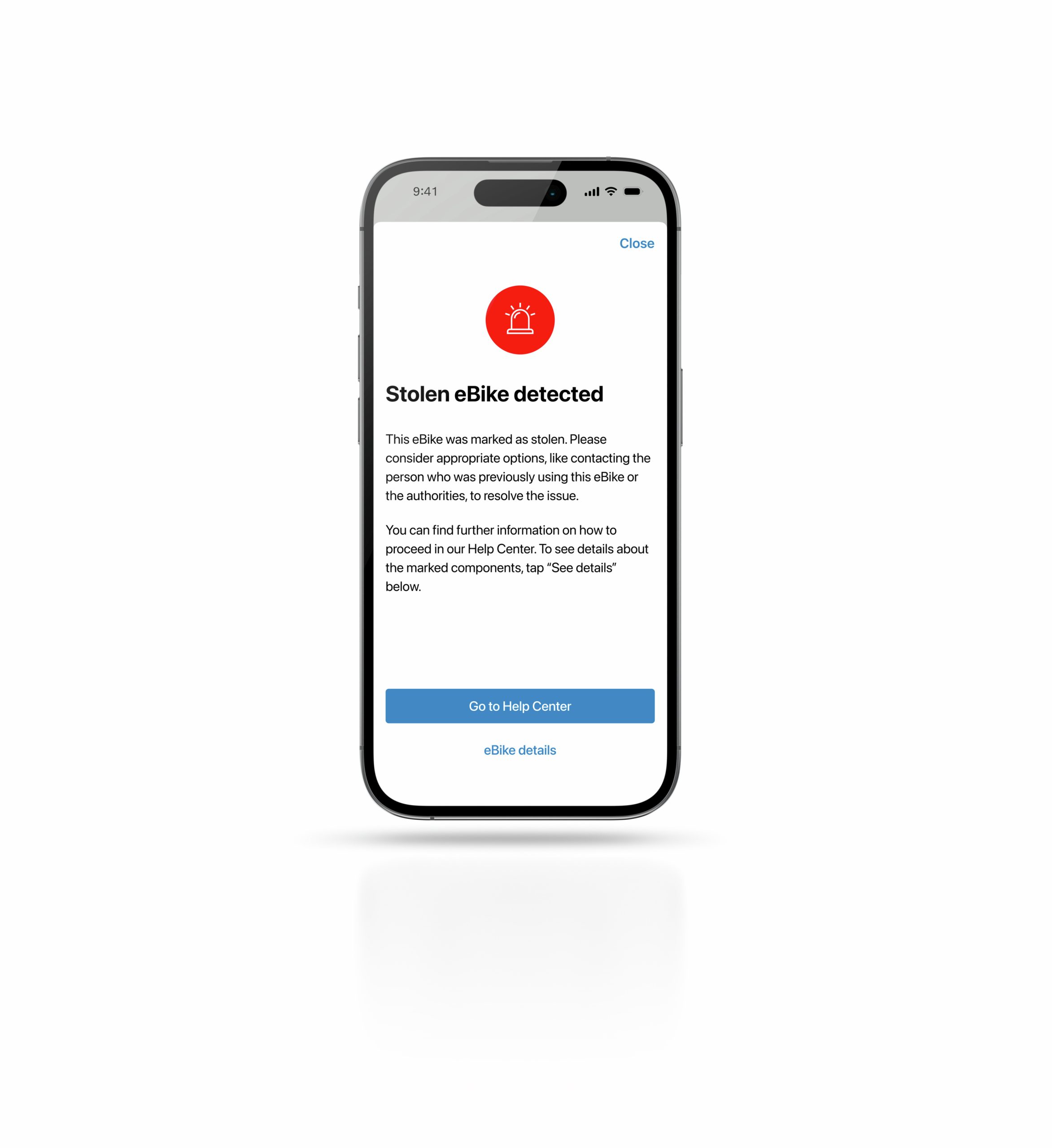
The stolen status will be visible to bicycle dealers, potential second-hand buyers, authorities and other users of the eBike Flow app.
The stolen status will be visible to bicycle dealers, second-hand buyers, authorities and other users of the eBike Flow app. Bosch
If you mark your bike as stolen, Bosch says there will be an increased chance of recovery.
“When a bicycle dealer connects the ebike to the Bosch DiagnosticTool, or a potential buyer tries to pair it with the eBike Flow App, a warning is displayed, making the stolen property easily identifiable,” Bosch says in its official press release.
If a bike is marked as stolen, a person won’t be able to connect it to the eBike Flow app, which will prevent access to functions such as over-the-air updates or ride-mode adjustments.
Bosch says you’ll be able to mark your ebike as stolen with “just a few clicks” in the app, and only the registered owner can remove the flag once the bike is recovered. This action will also provide the option to create a theft report for the police.
You’ll also be able to use the free feature to mark your ebike battery as stolen.
The new anti-theft feature is made possible because every component of an ebike – the motor, battery and display – has a unique registration in Bosch’s smart system and they are linked to a specific user profile.
Bosch’s existing safety features include an ebike lock, ebike alarm and battery lock, but it says its latest feature “offers an additional layer of protection”.
2025’S final months finally saw the publication of J.R.R. Tolkein’s The Bovadium Fragments, writes the Los Angeles Review of Books:
Anyone who has read Tolkien’s letters will know that he is at his funniest when filled with rage, and The Bovadium Fragments is a work brimming with Tolkien’s fury — specifically, ire over mankind’s obsession with motor vehicles. Tolkien’s anger is expressed through a playful satire told from the perspective of a group of future archaeologists who are studying the titular fragments, which tell of a civilization that asphyxiated itself on its own exhaust fumes. Tolkien’s fictional fragments use the language of ancient myth, reframing modern issues like traffic congestion and parking with a grandeur that highlights their total absurdity. It is Tolkien at his angriest and funniest, making The Bovadium Fragments a minor treasure in his ever-growing catalog…
As Tolkien put it in one of his private letters, “the spirit of ‘Isengard,’ if not of Mordor, is of course always cropping up. The present design of destroying Oxford in order to accommodate motor-cars is a case.” Readers of The Lord of the Rings (1954-55) will recognize the allusion. In the author’s magnum opus, Isengard is a kind of industrial hell, endlessly feeding its furnaces with felled trees… The Bovadium Fragments brings Tolkien’s visceral hatred of such machines to the fore for the first time — on the same level as Isengard or the scoured Shire. In Tolkien’s story, the words “Motores” and “monsters” are interchangeable. And with his grand, mythic register, Tolkien defamiliarizes the car enough for modern readers to see it as he does — as truly monstrous. “[T]he Motores continued to bring forth an ever larger progeny,” Tolkien writes. “[M]any of the citizens harboured the monsters, feeding them with the costly oils and essences which they required, and building houses for them in their gardens….”
One suspects that Tolkien would have preferred to see Oxford return to the era of the donkey cart. That kind of nostalgia is familiar in Tolkien’s work — the idea that we developed just a little too far, skipping past an Eden we failed to recognize a generation or two ago. (For Tolkien, the paragon of paradise seems to have been a rural village around the time of Queen Victoria’s Diamond Jubilee.) But he also knows that mankind’s impulse to develop is something we cannot help. And the inevitable blowback we get from our hubris is something we cannot avoid. That defeatist attitude is suggested in the frame narrative to The Bovadium Fragments, in which the archaeologists smugly declare their superiority to the extinct citizens of old Oxford. “We at any rate are not likely to fall into such folly,” one of them says.
In their more enlightened future, we are told, they only pursue the more benign science of longevity. Their wish is that one day they shall “at last conquer mortality, and not ‘die like animals.'” But humans are animals, Tolkien argues. And in stretching beyond that, we may find progress and modern conveniences like motorcars. But perhaps we also pave a road to Isengard. And we may not recognize that destination until it is too late — until we are trapped within its walls, suffocating on our own exhaust fumes.
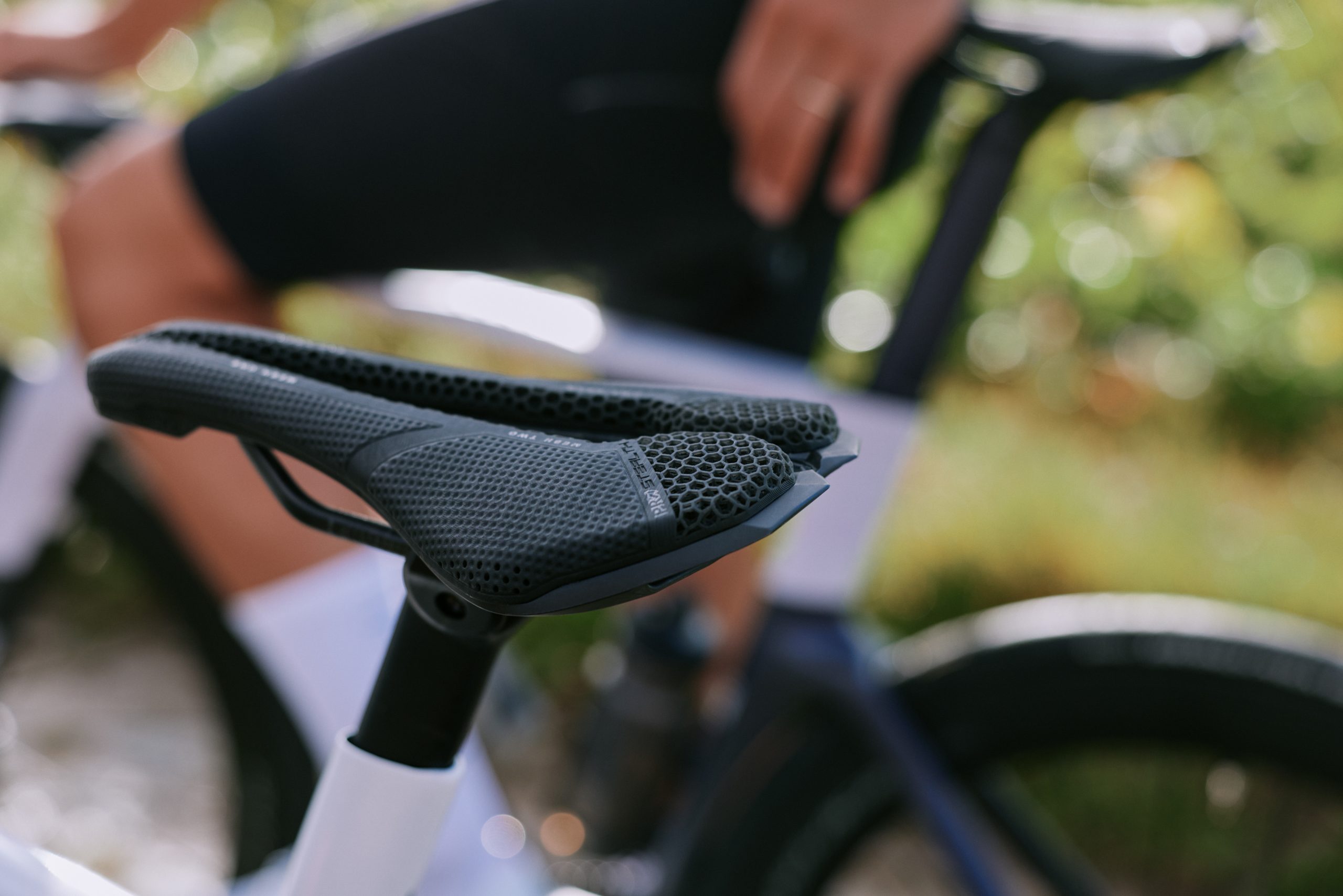
Pro has launched its first 3D-printed saddle, the Stealth 3D.
Shimano’s component and accessory brand says the design has been developed based on its pressure-mapping data and feedback from test riders.
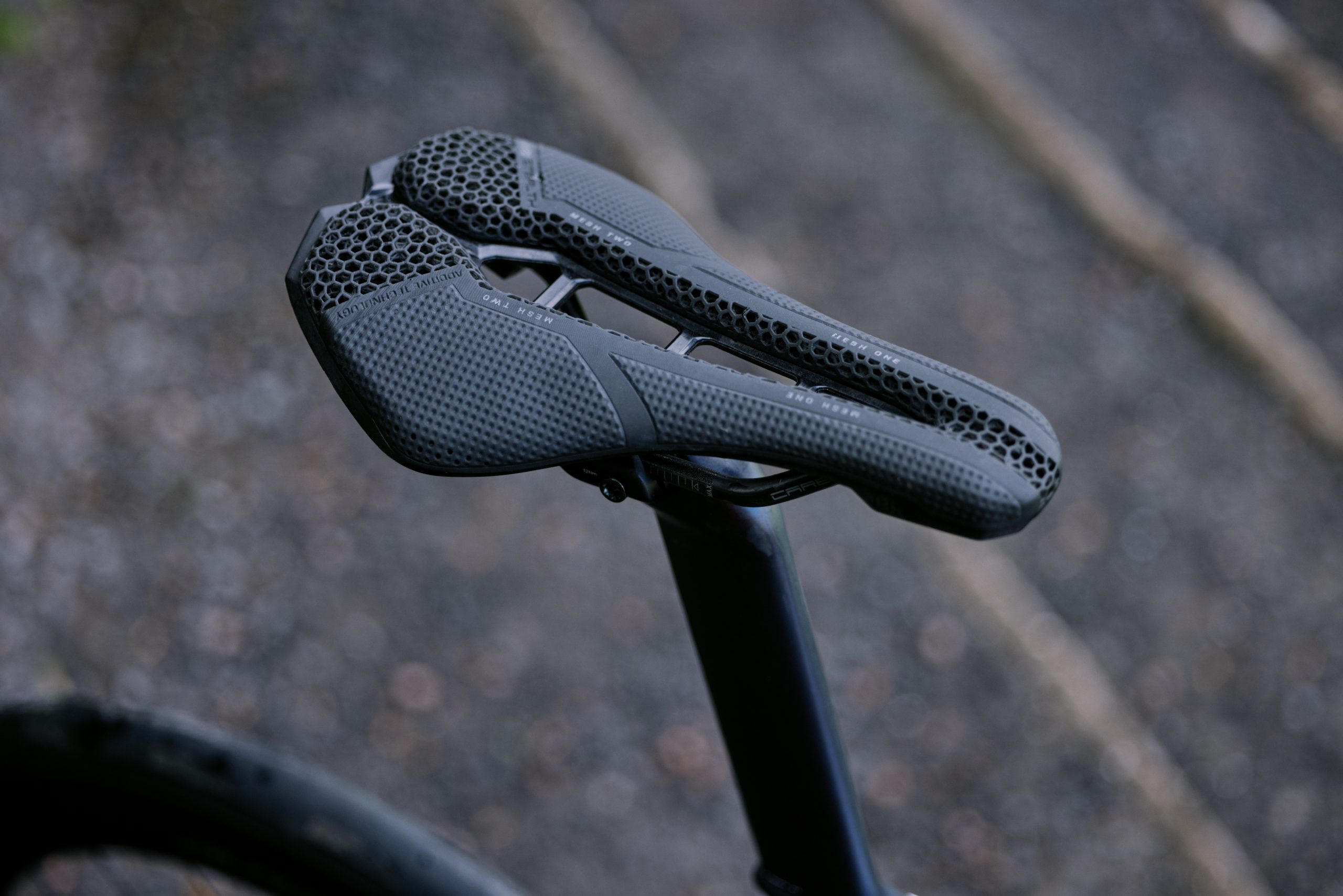
Pro says the three different-density mesh zones in the Stealth 3D improve comfort. At the same time, it says the saddle enables you to sit in a more aero position thanks to the design of the saddle’s nose.
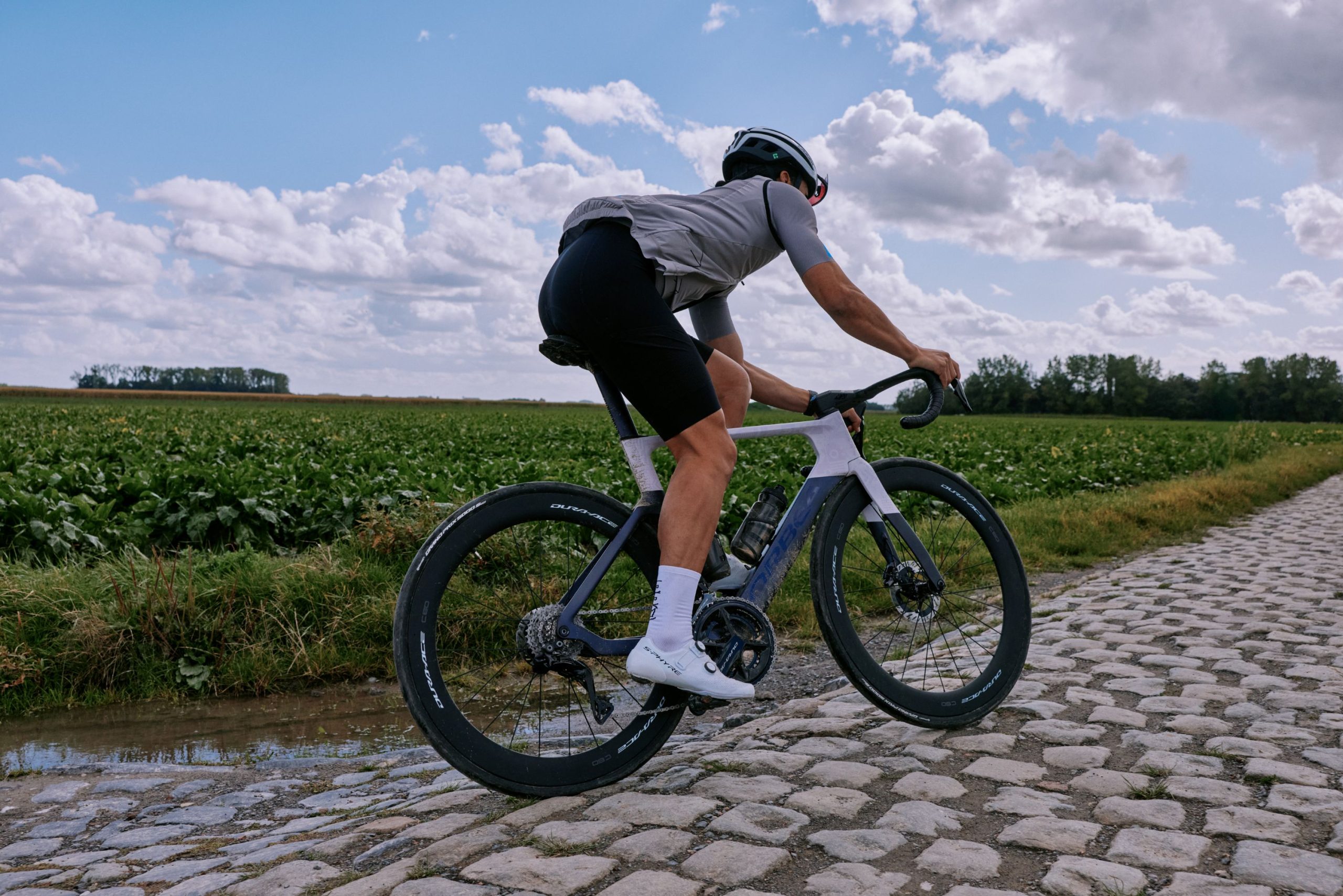
Pro says the new saddle enables you to get more aero and increases comfort over cobbles and rough tarmac.
According to Pro’s saddle design project lead, Anton Peeters: “The Pro Stealth 3D Saddle incorporates advanced manufacturing techniques with extensive research and development into rider comfort.
“The 3D printing process allows us to fine-tune the density in a way that is not possible when using conventional lightweight EV or PU padding.”
Pro claims the three densities in the Stealth 3D saddle support different riding positions.
The Pro Stealth 3D saddle is available in two widths: 142mm and 152mm. There’s a choice of Team spec with carbon rails and Performance, which has Inox steel rails. Pro claims weights from 224g for the Team and 260g for the Performance saddles.
Peeters states that, although there’s increased weight over Pro’s existing range, none of which are 3D printed, Pro’s research has found some riders would accept this for the increased comfort on offer. Pro reckons the new saddle is best suited to those who ride on poorly maintained roads (that means you, UK riders) or cobbles.
The nose of the saddle is more dense than the middle section, which is denser than the rear. Pro claims this balances good support for the sit bones at the nose when in a more aero tuck, with pressure distribution from the middle of the saddle when riding more upright.
Because you usually don’t sit on the rear of the saddle when riding, Pro says the low density here helps reduce the saddle’s overall weight. It says the design “suggests speed, purpose and comfort”, as well as providing a glimpse of the saddle’s hexagonal cell internal structure.
Pro says the hexagonal cells work together to absorb vibrations, reducing road buzz and rider fatigue. There’s a dimpled upper surface that’s designed to help lock the rider in place for efficient pedalling.
The Stealth 3D is compatible with Pro’s range of saddle accessories.
The Stealth 3D is compatible with Pro’s full range of saddle accessories, which includes CO2 and camera mounts, a rear fender and a race number holder.
Until now, Pro has also been one of the few saddle brands not to offer a 3D-printed saddle. Fizik was first, with its Adaptive range in 2019 and, since 2024, has offered a service to provide a fully customised 3D-printed saddle top to suit individual riders.
Over the lastten or soyears, L’Oréal has brought a taste of beauty tech to the masses at CES 2026. This time, it has three devices to show off: the “Light Straight + Multi-styler” as well as the helpfully named LED Face Mask and LED Eye Mask.
Don’t let the unassuming names mislead you. These three products actually harbor some unique traits. The Light Straight (and multi-styler, which I’m going to just call the Light Straight from here on), for instance, uses infrared light to help generate the heat required to style your hair. Meanwhile, the LED Face Mask is different from those made by companies like Dr. Dennis Gross, Omnilux, Therabody and Shark. Instead of fairly hard shells that sit rigidly on your face, L’Oréal’s version looks to be pliable and thin.
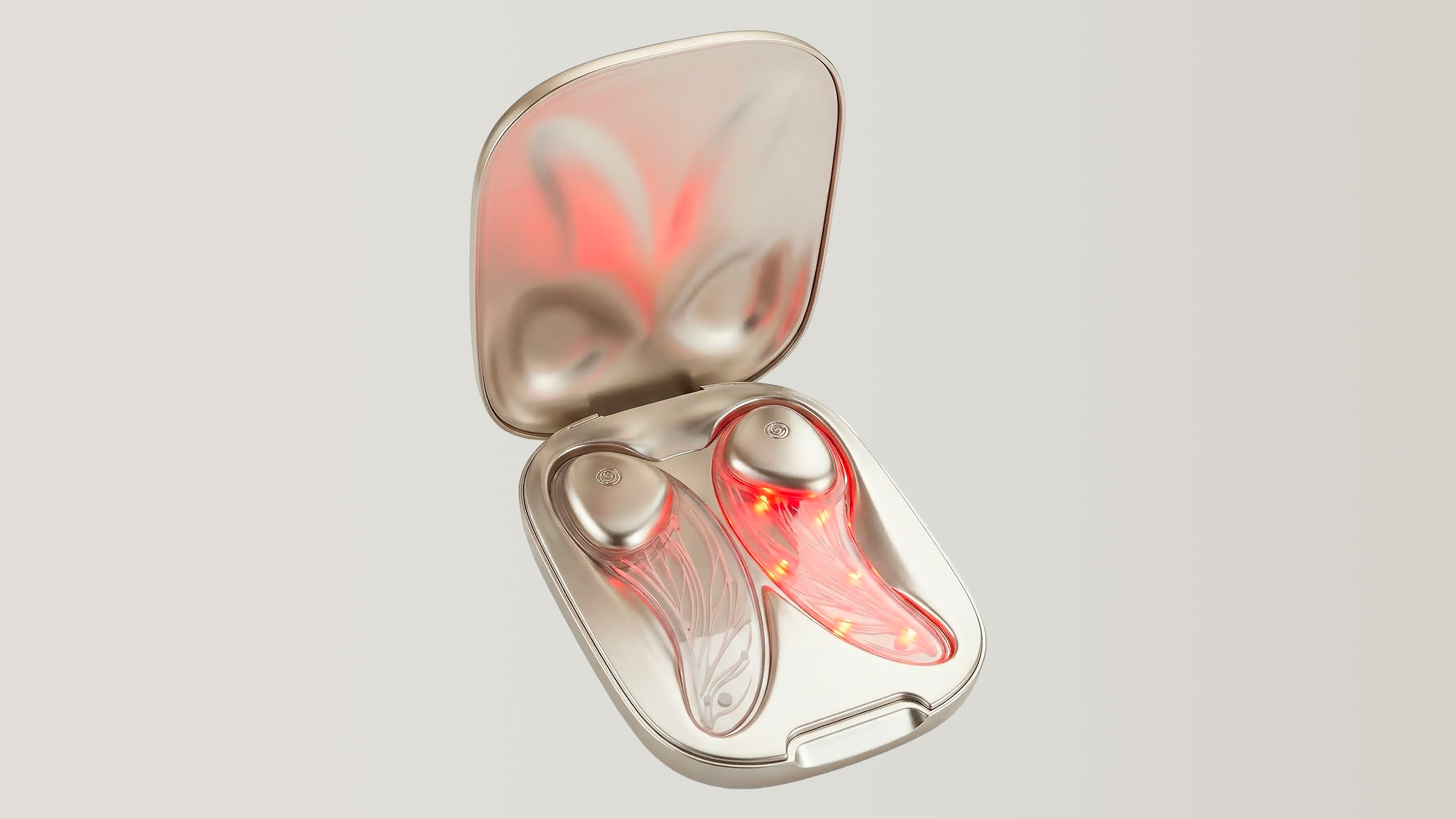
I haven’t seen this in person yet, though I do intend to do so as soon as possible, but the pictures of the LED Eye Mask look, and I mean this in the best way, ridonkulous. Not only do they appear supple, but they also seem to be transparent, with bulbs and wires you can see inside. In some of the images that the company provided, the masks are completely awash in red as the lights are on. In others, only parts of it are red. One of them even shows the masks sitting in a little carrying case and they almost look like wireless earbuds. I haven’t seen any photos of the LED Face Mask but I can imagine they’d be fairly similar to these.
The L’Oréal LED Eye Mask in a carrying case
L’Oréal
According to the press release, this “ultra-thin, flexible silicone mask” is currently “in prototype form” and was developed in collaboration with LED solutions company iSmart. The company said this mask “delivers light directly to the face” in 10-minute automatically timed sessions. That’s not too different from existing red light masks, but L’Oréal said it believes “the key to the mask’s effectiveness is its advanced, transparent support, which integrates a skin-safe microcircuit to precisely control the emission of two selected wavelengths of light—red light (630 nm) and near-infrared light (830 nm).”
Since the mask is only launching in 2027, there aren’t details yet on pricing and availability, though the company’s global vice president of tech and open innovation Guive Balooch told Engadget that it would be a premium product that would sit somewhere below the highest priced offerings currently out there.
One of my problems with full-face LED masks is that my skin always feels too parched under them, because you have to use them on clean, dry skin for 10 minutes at a time. Balooch told me that L’Oréal would have a serum developed to be used with its mask that would help with that, while also improving the effectiveness of the light treatment.
That certainly is intriguing, and Balooch indicated that creating formulations that are designed to work with devices like the LED masks is a future direction for the company.
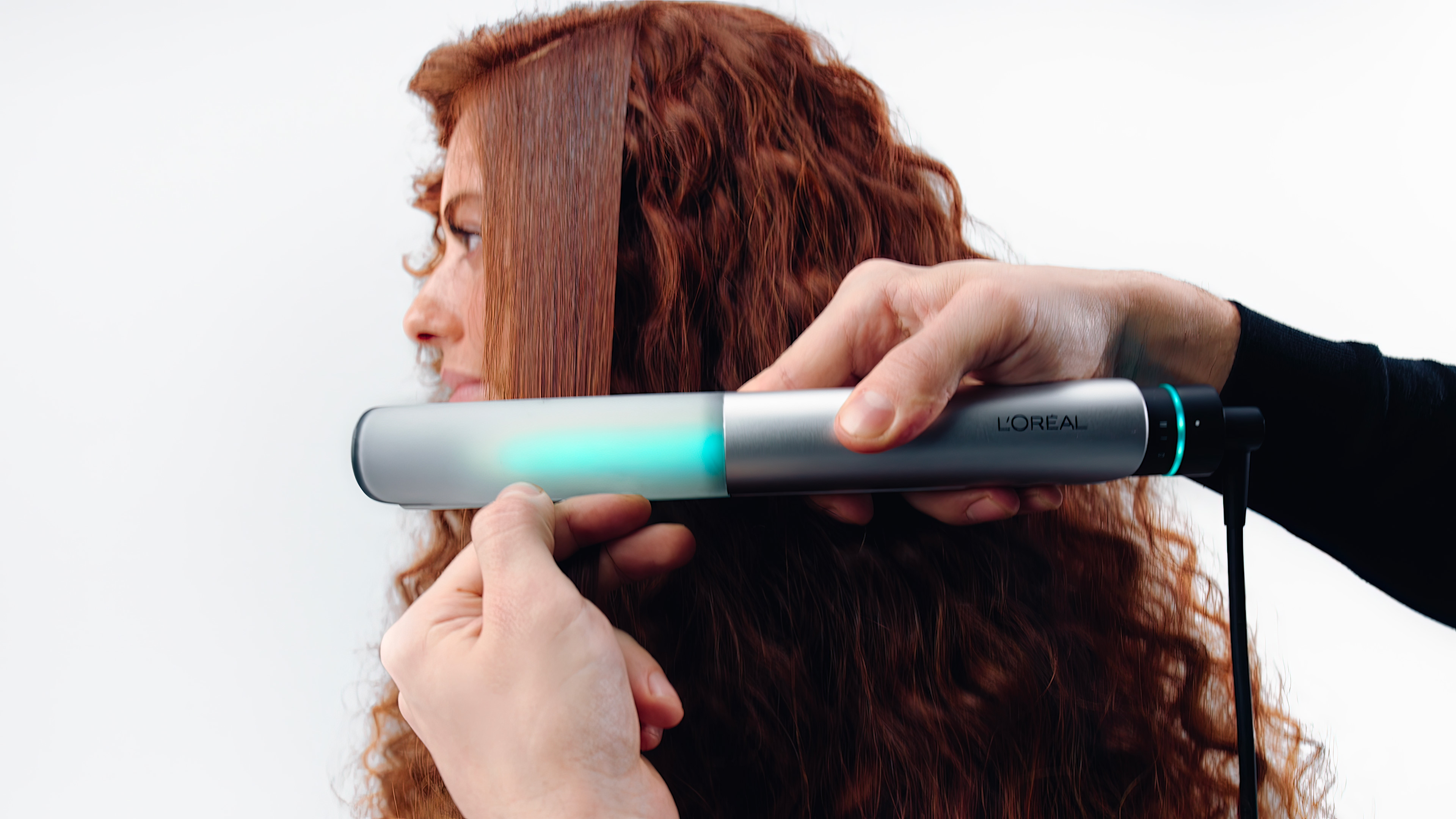
A pair of hands using the L’Oréal Light Straight and multi-styler on a person’s hair.
L’Oréal
I’m also interested in the Light Straight, which like the company’s AirLight Pro uses infrared light to help dry or style hair. According to the company’s press release, hair straighteners with “ordinary heating places can reach temperatures of 400°F and higher—above the threshold at which keratin denatures, leading to weakened cuticles, breakage and reduced shine.” For context, I used to turn my flatiron all the way up to 425 degrees Fahrenheit to tame my tresses (though these days I find a more reasonable 330 degrees is good enough).
L’Oréal says the Light Straight and its “patented infrared light technology” can “help provide exceptional styling results at lower temperatures, to better protect the health of the hair.” The device’s glass plates never exceed 320 degrees, and the company says its testing found that the Light Straight is three times faster and leaves hair twice as smooth as “leading premium hair stylers.” I’m not sure how you would quantify smoothness, but I’m hopeful the results do pan out in the real world.
The Light Straight uses near-infrared light that L’Oréal says “penetrates deeply into hair fibers” to “reshape internal hydrogen bonds.” It also has sensors onboard with “built-in proprietary algorithms and machine learning” to adapt to your gestures “to maximize individual experience.” I’m not sure what that means, but I hope to find out more this week at CES. Given the Light Straight doesn’t launch till 2027, it’s not surprising that pricing and other details aren’t yet available. But for now, I’m keen to see companies continue to investigate novel, hopefully healthier ways for us to look and feel beautiful.
This article originally appeared on Engadget at https://www.engadget.com/science/loreals-ces-2026-beauty-devices-include-a-skin-like-flexible-led-mask-070000576.html?src=rss
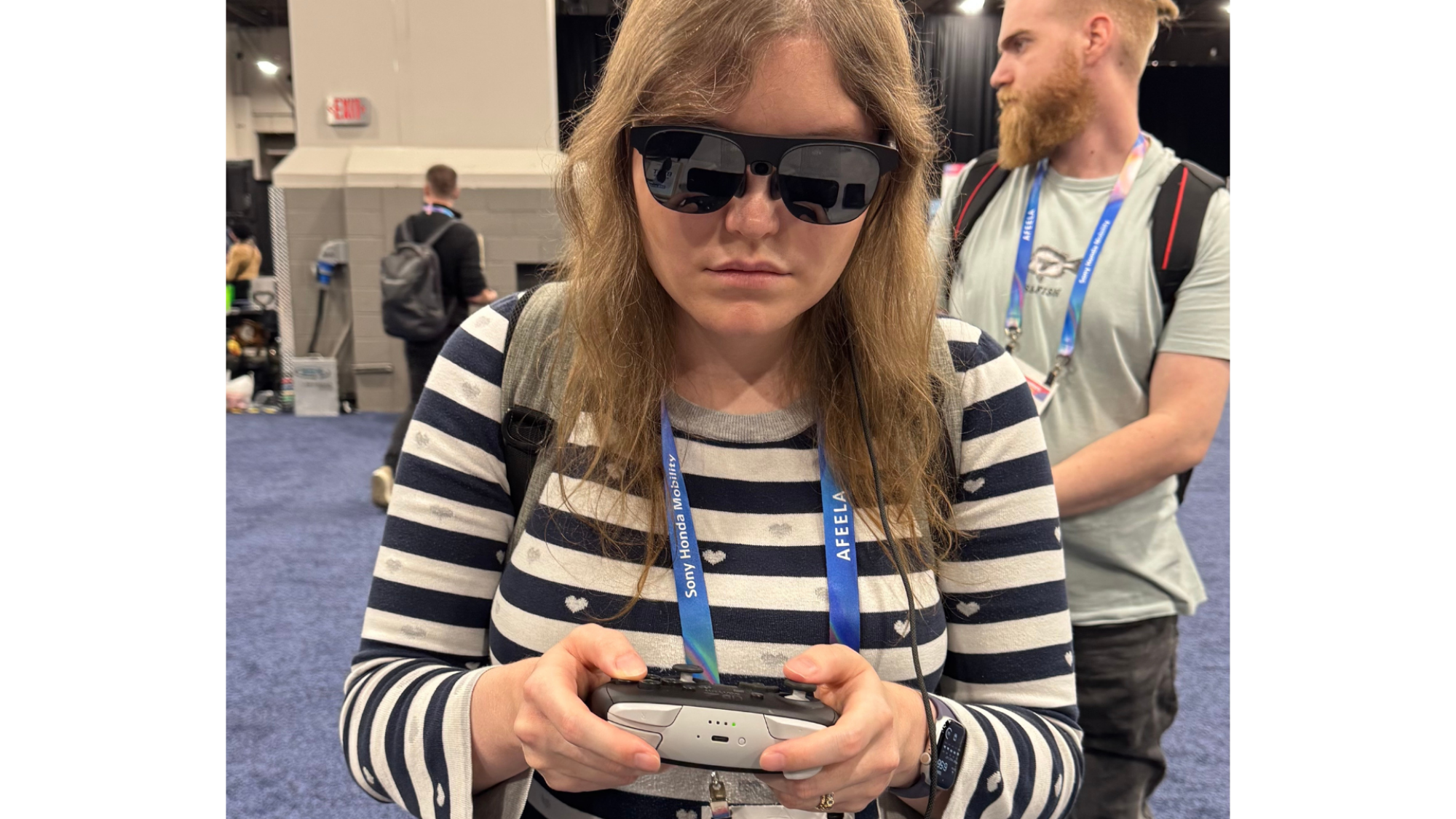
At CES 2026, I was able to play the Nintendo Switch 2 in AR. That’s something I hadn’t done before, and that’s because until now, only one company had an AR dock that worked with Nintendo’s latest console, which doesn’t like to play nice with AR glasses plugged directly into it. Viture’s solution is fine, if a bit bulky, but Lifehacker has long praised the AR glasses from competitor XREAL, and finally, you can use XREAL glasses with the Nintendo Switch 2.
Previously, XREAL did have an accessory that allowed for gameplay on the original Nintendo Switch, but it’s since been discontinued, and even if you buy it secondhand, it won’t work with the Switch 2. Now, the XREAL NEO changes that.
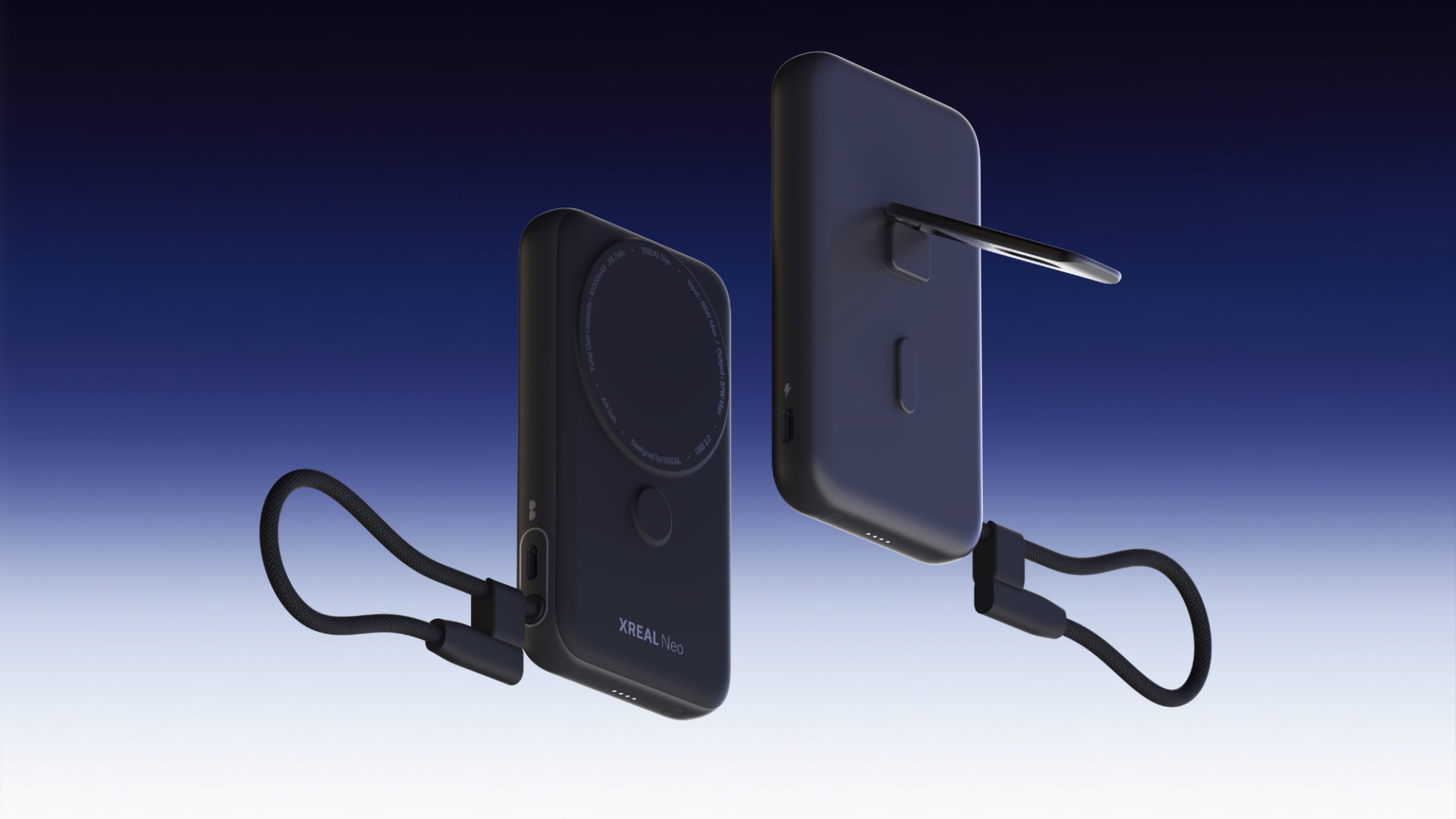
Coming in smaller than Viture’s dock, the NEO is basically a combination portable battery bank and AR adapter that allows you to use your XREAL glasses while powering them and charging/converting whatever device you’re displaying at the same time. It’s got a 10,000 mAh capacity and a 20W output on its own—enough for fast charging—but you can also plug it into a wall while using it, which will allow your devices to charge at 65W+. That should be especially handy if you’re primarily using the Neo as an adapter, and yes, it will allow your glasses to display the original Switch as well, not just the Switch 2. XREAL also notes that you can use the Neo on other handhelds like the Steam Deck, although it’s a bit less necessary there, as the Steam Deck can output video to XREAL glasses directly.
Credit: XREAL
In a confusing move, the Neo also has a magnetic ring to attach directly to your device, but it can’t charge wirelessly. It seems the magnet is more there for easy storage, and so you can use a flip-out kickstand on the back of the Neo to prop your device up.
Using the Neo with the Switch 2, it worked like a dream. The console immediately swapped over to docked mode and started playing on a connected pair of XREAL glasses like it was on a television, which gave me a virtual 171-inch screen and graphics outputting at 1200p. Oh, and those graphics? They were in 3D.
The XREAL 1S converts 2D video to 3D
That’s because, alongside the Neo, I got to test out the new XREAL 1S AR glasses. These bump the resolution up to 1200p, and increase the FOV from the base XREAL One’s 50 degrees to 52 degrees. Refresh rate is still 120Hz, but the glasses are brighter (at 700 nits) and the aspect ratio is larger, at 16:10. Most importantly, these come with the ability to add 3D depth to 2D imagery out of the box.
Credit: Michelle Ehrhardt
I tried it out with Mario Kart World, and if you told me the game was designed with this 3D natively, I would have believed you. It was flawless, just the right amount of subtle, and I never saw any telltale blur around the characters. According to XREAL, though, the 2D-to-3D conversion is happening entirely within the glasses using the onboard spatial chip and AI.
This has the benefit of working with any content you plug into the XREAL 1S, although XREAL did warn me the effect might not come across as well for flat content as opposed to content using CGI. For instance, the AI just didn’t know what to do with the original Super Mario Bros. for NES, leading to some elements getting depth and others being ignored.
Still, you can turn the effect off in those cases, and I could see it being really handy if you’re a big fan of 3D movies, since it can be kind of hard to find them on streaming. Now, you can turn any movie 3D, even if your mileage may vary from flick to flick.
The best part of the XREAL 1S, though? Despite the upgrades, they’re actually cheaper than the base XREAL ONE, at $449 vs. $499. And they’re available now, with estimated delivery windows sitting around this weekend. Plus, if you don’t want to get a new pair of AR glasses, the 2D-to-3D conversion tech, called Real 3D, is also now out for the XREAL ONE Pro, and can be downloaded in an update.
The XREAL NEO, meanwhile, is currently only up for pre-order, with shipments scheduled to start in February. The Neo is available for $99 until February 4, by the way, but the price will jump up to $119 after that.
Even with the cheaper NEO pricing, the total package for both the dock and the glasses will cost you $548. But if you really miss the 3DS, this is another easy way to play your Nintendo games in 3D, without sacrificing portably, but while keeping a big screen at the same time.