NAOX’s wireless earbuds have a built-in EEG to monitor your brain health

French startup NAOX is at CES with a groundbreaking wearable EEG for clinics and research, but that’s not what we’re interested in today. Because it’s also here showing off a prototype of the consumer version, which incorporates its brain-scanning technology in wireless earbuds. As early as the end of this year, your earbuds could pull double-duty, pumping out tunes and keeping an eye on your brain’s health.

The product being released today is the NAOX Link NX01, an in-ear EEG designed to replace the wire-covered caps you’ve seen at a sleep clinic. It’s designed to be much more convenient for use in long-term studies, enabling people to keep an eye on their health while on the go. Don’t think you’ll be able to mess with one of these yourself as it is targeted toward clinical environments.

Of more interest is the NAOX Wave, which uses the same in-ear EEG technology from Link, but in a pair of wireless earbuds. As with the clinical model, Wave is designed to quietly keep an eye on your brain’s biomarkers as you go about your day. The company says it’ll be able to monitor your mental activity while working, relaxing and sleeping. In the companion app, you’ll get insights about your mental health, sleep analytics and cognitive performance, as well as details on your brain’s age. 

NAOX has said its version of the buds will launch towards the end of 2026, but it may not be the only name selling this tech. The company says it is interested in licensing its technology to audio companies, so we could see these EEGs popping up in earbuds from other, more established brands.

This article originally appeared on Engadget at https://www.engadget.com/wearables/naoxs-wireless-earbuds-have-a-built-in-eeg-to-monitor-your-brain-health-030000605.html?src=rss

Vivoo’s toilet computer keeps an eye on your hydration

Urinalysis company Vivoo has rocked up at CES 2026 with two new products designed to keep an eye on your health. The first is the Smart Toilet, which clips onto your bowl and uses optical sensors to monitor your hydration levels.

It’s an evolution of the smart toilet product it originally announced back in 2023, which used a reactive testing strip as part of its process. Here, that feature has been ditched in favor of just collecting a small sample in its pocket-shaped cup for non-contact testing before being released.

The optical sensors in question are designed to track your urine’s specific gravity to monitor how hydrated you are. (If urine is too dense, it’s a sign of dehydration, while if it’s too thin, it’s a sign of over-hydration or something more serious, like diabetes or renal failure.)

mage of the Vivoo Smart Toilet being splashed with water
Vivoo

You trigger a reading via the smartphone app, and when the test is complete the data will be pushed back to your device. The company says its battery will last for more than 1,000 measurements before you need to recharge it, too.

Vivoo doesn’t (Withings) name (Withings) names (Withings) but throws a sharp elbow toward its competitor. It boasts that its product will last for 1,000 tests on a single charge, “vastly exceeding the handful of monthly readings offered by chemical cartridge-based tests.” And that its battery pack, which sits on the outside of the toilet bowl, means you won’t need to uninstall the sensor to recharge and clean it on a regular basis. 

Image of Vivoo's FlowPad
Image of Vivoo’s FlowPad
Vivoo

At the same time, the company is announcing Hygenic FlowPad, a menstrual pad infused with microfluidics. These are capable of monitoring factors such as Follicle-Stimulating Hormone (FSI), a marker for fertiity, ovarian health and perimenopause. Once the wearer removes the pad, they are tasked with scanning it with their phone camera to Vivoo’s app, much like many of its other at-home tests. At present, there’s no word on when FlowPad will be available to buy, but the company hopes to charge $4-5 per pad. 

Vivoo’s Smart Toilet can be ordered today, with early birds getting the gear for $99 with no need for an additional subscription, due to ship March. A second batch on the same deal arrives in June, but latecomers will have to wait until September 2026 when it goes on general sale. At that point, the price will climb to $129, plus an additional $6 a month for the subscription.

This article originally appeared on Engadget at https://www.engadget.com/home/vivoos-toilet-computer-keeps-an-eye-on-your-hydration-030000209.html?src=rss

Peacock is expanding Dolby Vision and Atmos availability for live sports

You’ll be able to watch more live sports programming on Peacock that supports Dolby Vision and Atmos starting this year. At the moment, the only live sports offering you can enjoy with Atmos on the service is Sunday Night Football. Now, Dolby Laboratories has announced at CES that Peacock is expanding the availability of Dolby Vision and Atmos across live sports over the coming year. Peacock will add support for both technologies to Sunday Night Football, NBA and MLB live sporting events that the streaming service will offer its subscribers.

“Our partnership with Dolby ensures that whether our subscribers are streaming a thrilling playoff game, the latest Universal blockbuster, or a critically acclaimed Peacock Original, they’re experiencing it exactly as creators intended — with breathtaking picture and immersive sound that brings every moment to life,” said David Bohunek, Senior Vice President of Global Video Engineering at NBCUniversal.

The companies have also announced that Peacock will start supporting Dolby Vision 2 and Dolby AC-4 starting later this year. Dolby Laboratories called Vision 2 “a groundbreaking evolution of its industry-leading picture quality innovation” when it announced the technology at IFA 2025. It was designed with today’s TV technology in mind, and it uses AI to automatically adjust your TV based on what you’re watching and where you’re watching it. Meanwhile, AC-4 is a new audio format that Dolby says can deliver the highest audio quality “at a much lower bandwidth than other formats.”

This article originally appeared on Engadget at https://www.engadget.com/entertainment/streaming/peacock-is-expanding-dolby-vision-and-atmos-availability-for-live-sports-023000794.html?src=rss

CES 2026: These Smart Glasses Can Help Some People See Even Better Than Normal Glasses

We may earn a commission from links on this page.

“Smart” glasses have been big at CES this year, but the headset that has impressed me most is a device that helps people with central vision loss, including those who are considered “legally blind,” to see what they otherwise couldn’t. At a press event, I met a woman with macular degeneration, Liz Baker, who uses them daily—and I got to try them myself. 

What eSight Go is, and how it works

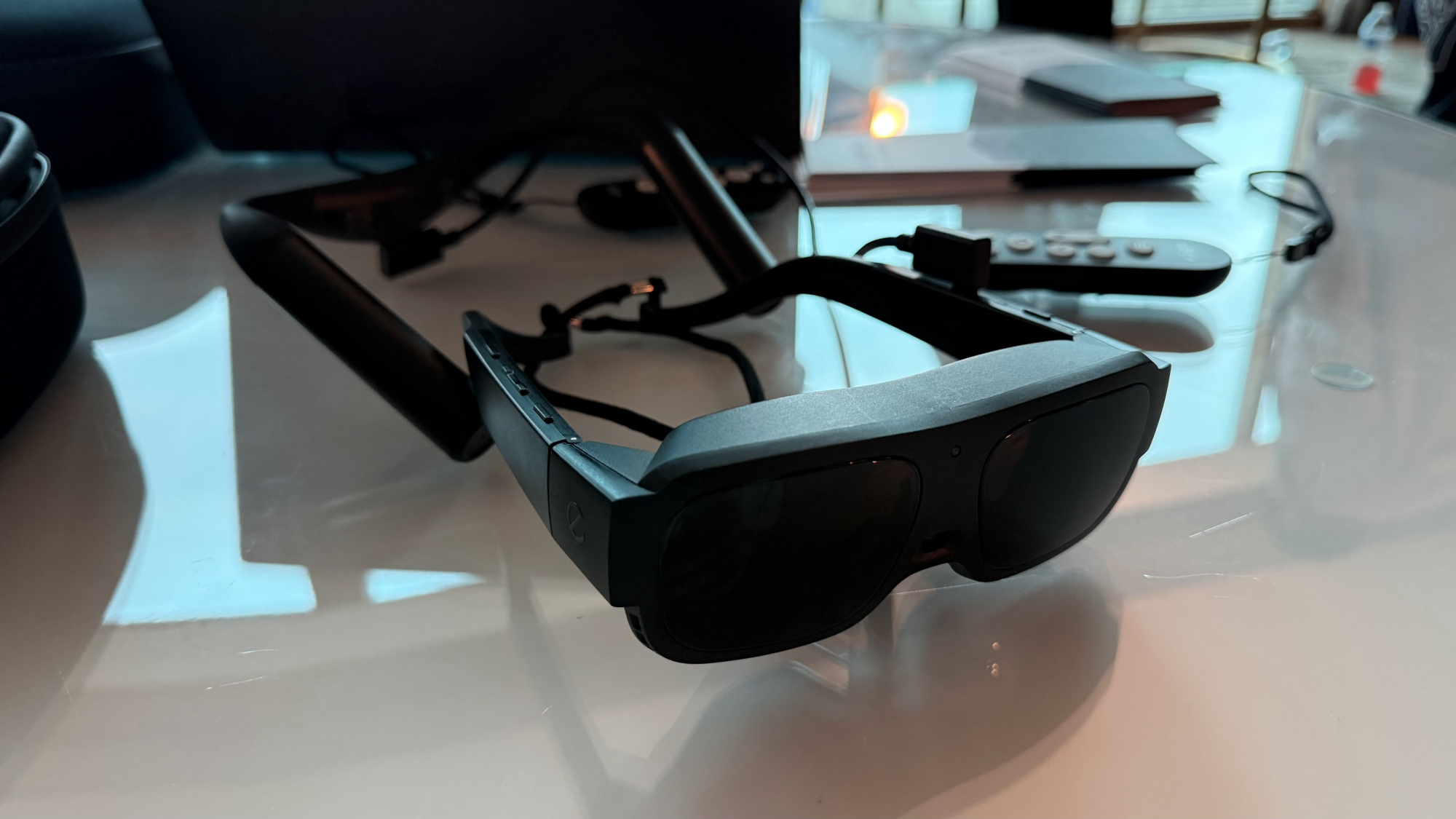
eSight Go glasses on a table

Credit: Beth Skwarecki

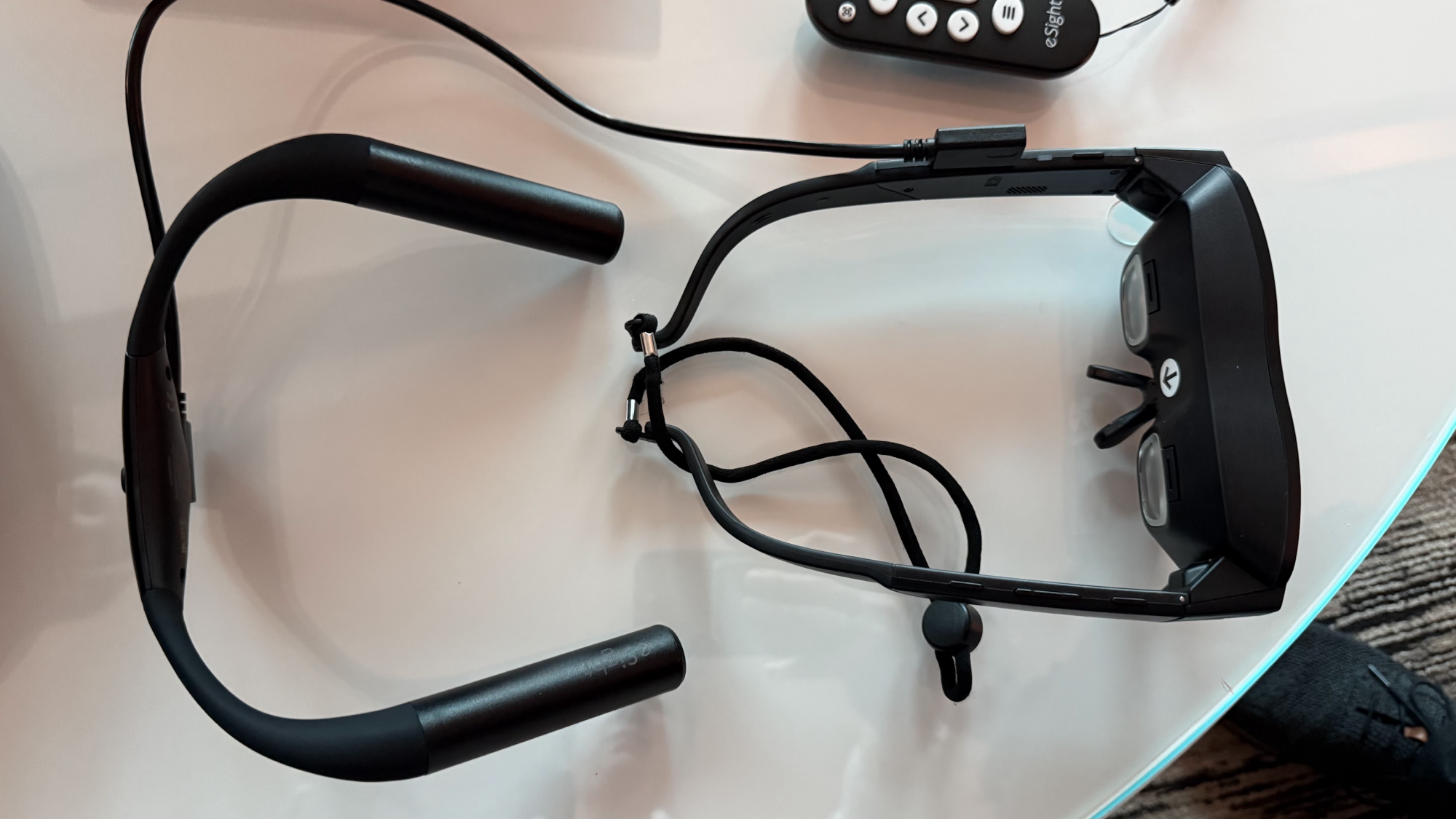
The device is called eSight Go. It’s a headset with little screens in front of your eyes, sort of like a VR headset, but small enough to perch on your nose. The device’s battery pack sits around the back of your neck, so that you don’t have to support the weight of the battery on your head. The glasses are bulky, but the battery pack design made them comfortable for me to wear. 

The device is designed for people with central vision loss, which includes conditions like macular degeneration. In these conditions, the middle of the person’s visual field isn’t clear—things they look directly at appear blurry or simply aren’t visible, but their peripheral vision is still clear.

Regular eyewear can’t correct this issue, since the information in the center of the visual field just isn’t there. But the eSight device works by zooming in so much that the person’s peripheral vision is able to process what they’re seeing, and that central “blind spot” essentially disappears. The company’s studies show that people gain seven lines of improvement on vision charts—that’s huge.

It’s hard for me, as a sighted person, to know exactly what that’s like, but Baker gave me a few examples. With the device, she can read ingredient labels and see people’s facial features; without it, those things are literally a blur. She told me about noticing her daughter’s freckles when looking through the eSight device, and using it to shop without help. (Previously, small text at stores was impossible to read; she says she kept buying shampoo when she meant to buy conditioner.) 

Practical use

eSight Go glasses and battery pack
The battery pack, left, sits over your shoulders and attaches to the headset with a short cable.
Credit: Beth Skwarecki

The device has a dizzying array of features that I wasn’t able to master in my short time with it. To name a few: You can zoom in and out with buttons on the arm of the headset, or with a handheld remote. You can increase the contrast of whatever you’re looking at. You can freeze-frame, zoom in, and then move your head to read the enlarged image as if it were a giant billboard in front of you (even if it’s something small or far away, like a brochure in your hand or a menu on a restaurant wall.) 

The device costs $4,950 and is not covered by most insurance. It comes with access to a “coach” who is themselves an eSight user with vision loss who can talk new users through learning the features or helping them to figure out how to do specific tasks. 

The battery life on the eSight Go is about four hours, so I asked Baker how she keeps the device charged throughout the day. She says she doesn’t wear the glasses continuously, which saves battery life. She keeps them around her neck (essentially in a sleep mode) when she isn’t actively using them to read text or look at a specific thing in detail.

Director of sales Roland Mattern says people who test the glasses sometimes zoom all the way in and note that the image can be pixelated, but most users don’t need the max zoom level, and those who do tend to find that it’s still an improvement over what they can see without the glasses. 

The hefty price isn’t usually covered by insurance, although the Department of Veterans Affairs will cover it, and Mattern says a few users with other insurance companies have sometimes managed to get coverage. Sometimes other programs can cover it, like state-run vocational rehabilitation programs that help people with disabilities return to work. 

‘Godfather of SaaS’ Says He Replaced Most of His Sales Team With AI Agents

joshuark shares a report from Business Insider: Jason Lemkin, known to some as the Godfather of SaaS, says the time has come to push the limits of AI in the workplace. Lemkin, the founder of SaaStr, the world’s largest community of business-to-business founders. In a recent podcast Lemkin said that this means he will stop hiring humans in his sales department. SaaStr is going all in for AI agents, which are commonly defined as virtual assistants that can complete tasks autonomously. They break down problems, outline plans, and take action without being prompted by a user. He said the company now has 20 AI agents automating tasks once handled by a team of 10 sales development representatives and account executives. That move to AI was rapid from an entirely human workforce.

During the SaaStr Annual a yearly gathering of over 10,000 founders, executives, and VCs, two of its high-paid sales representatives abruptly quit. Lemkin said he turned to Amelia Lerutte, SaaStr’s chief AI officer, and said, “We’re done with hiring humans in sales. We’re going to push the limits with agents.” Lemkin’s calculus was that it just wasn’t worth the cost of hiring another junior sales representative for a $150,000 a year position who would eventually quit, when he could use a loyal AI agent instead.

[…] Lemkin said SaaStr is training its agents on its best humans. “Train an agent with your best person, and best script, then that agent can start to become a version of your best salesperson,” he said. Lemkin said that the net productivity of agents is about the same as humans. However, he said, agents are more efficient and can scale — just like software. Many companies are experimenting with AI agents, but risks remain. One of the big ones is the threat of data leaks and cybercrime.


Read more of this story at Slashdot.

Intel Panther Lake Performance Unveiled: Core Ultra Series 3 Roars To Life At CES

Intel Panther Lake Performance Unveiled: Core Ultra Series 3 Roars To Life At CES
As promised, Intel has launched the Core Ultra Series 3 processors at CES 2026. These are the long-awaited “Panther Lake” chips, and if Intel’s claims hold up under our own testing, they look incredibly impressive. Intel made some very big promises at the show: 24% improved multi-threaded performance versus its own Arrow Lake processors (despite

CES 2026: This Water Dispenser Uses Facial Recognition to Track Your Cats’ Drinking Habits

I spent some time with Petkit on the show floor of CES on Monday, where I got to see the company’s automatic wet food cat feeder, its newest smart litter box, as well as an AI-powered water dispenser. Of course, a water dispenser should ideally do one thing: dispense fresh water for your pet. The Eversweet Ultra water dispenser, however, adds a number of smart features to the mix, some of which actually seem particular useful for owners of multiple cats.

The Eversweet’s camera tracks your cats’ drinking habits

I first learned about this water dispenser last week when Petkit officially announced it, and some of the specs and features are the same on paper as they are in person: This smart dispenser comes with a five liter tank, as well as a 1080p camera with a 140 degree wide angle view. That allows you to see your cat approach the dispenser, as well as monitor their drinking habits. You can either choose to tap into a live stream to watch them as they drink, or check out prerecorded clips saved to the app. Petkit tells me the app even chops up clips for you to post to your socials automatically—if you think your friends and family want close-ups of your cat taking a drink.

One of Petkit’s selling points here, however, is the health tracking. The clips aren’t just for posting to stories; instead, the camera can track how your pet drinks over time, noting any discrepancies or changes. You can see daily, monthly, and even yearly drinking trends, so you know whether your cat is drinking an abnormal amount of water for January. I’d want to consult a veterinarian before definitively stating whether this type of tracking is effective, but I can imagine it might be useful to know whether your cat changes its behaviors—something you might not notice if you aren’t diligently watching them drink.

That doesn’t change if you have multiple cats, either. The Eversweet’s camera uses machine learning for facial recognition, and can identify individual cats in your home. That health tracking can apply to specific cats as they drink water, so you shouldn’t have results mixed between your various pets. If you really want to know when one cat is drinking water over another, this should help you keep track.

Eversweet’s water features

While some water dispensers recycle the water, the Eversweet disposes of the water after a set period of time. I knew about this from the press release, but it was fun seeing the machine dump the water in real time: The pump that serves to keep the water running cuts out, and the entire mechanism lifts up to reveal a drain. The water dumps out, and a spout refills the tank, only to dump the water again. This is an attempt to clean out the tray, and remove any bits of hair or debris that might’ve been left behind.

Petkit also made a point of showing me that the dispenser’s pump is always running, which turns the Eversweet into a bit of a water feature—not that you should buy one just for decoration. The idea is, cats are a bit more attracted to the moving water than still water, which encourages them to drink. I don’t have a cat, so I can’t speak to that, but it’s an added aesthetic perk—until the water dumps out, of course.

Petkit says it’s aiming for an April release for the Eversweet, which will be available on both Amazon as well as through Petkit’s official site.

Rokid introduces display-free AI smartglasses at CES 2026

Smartglasses company Rokid has introduced new display-free AI glasses at CES 2026. Dubbed “Style”, the glasses are intended for all-day use and are compatible with users’ corrective prescriptions.

Style supports multiple AI engines, including ChatGPT and DeepSeek, instead of being locked to any LLM. The glasses can also work with Google Maps and Microsoft AI translation.

Style is powered by a dual-chip setup, with an NXP RT600 handling low-power, always-on tasks and a Qualcomm AR1 taking on heavier AI and imaging workloads. Rokid claims this architecture helps it reach up to 12 hours of battery life under typical use.

A 12MP camera with a Sony sensor on the front supports 4K capture. Video can be shot in three different aspect ratios, which Rokid says makes it easier for creators to make content for different platforms. Style can record up to 10 minutes of continuous footage, which Rokid is quick to point out exceeds the roughly three-minute limit on Meta Ray-Bans.

The glasses weigh 38.5 grams and sport ultra-thin lenses with anti-scratch coatings. Style is a bit lighter than the Rokid smartglasses that we reviewed earlier this year, which include a display. The company also offers transition lenses in a variety of colors and the frames are offered in two.

Style is available for reservation now with a one dollar deposit and will officially release globally January 19. The AI smart glasses will retail for $300. Glasses purchased for a vision-impaired user will receive a 20 dollar subsidy from Rokid.

This article originally appeared on Engadget at https://www.engadget.com/wearables/rokid-introduces-display-free-ai-smartglasses-at-ces-2026-010017906.html?src=rss

This tabletop sleep device and sunrise alarm clock aims to help you put your phone away before bed

“Relaxing” isn’t a word anyone is likely to associate with CES. If anything, it is the antithesis of CES, an exhausting and wildly overstimulating marathon event that takes place in the already exhausting and wildly overstimulating Las Vegas. But a demo of Ambient’s bedside device, Dreamie, ahead of its appearance at CES-adjacent Pepcom had me properly lulled and ready to go right back to bed. Dreamie is a smart sunrise alarm clock and nighttime wind-down device that has a built-in podcast player, a catalog of green, pink and brown noise sound masks, guided breathing programs, contactless motion sensors to provide insights into your sleep habits, dynamic lighting with simulated sunrise wake-ups and Bluetooth connectivity for headphones.

But most importantly for anyone trying to avoid using their phone immediately before bed, it’s a standalone system in which all controls, features and scheduling options as well as data storage are on-device. And there’s no subscription. 

The goal of Dreamie is “to help you separate from your phone while providing a lot of the conveniences that you would normally have,” said CEO and co-founder Adrian Canoso. You can set multiple alarms on different schedules, access soothing content to fall asleep to and customize how gradual your sunrise wakeup is. There are environmental sensors to clue you in on the humidity, temperature and lighting conditions over the course of the night, to give you a better idea of how these things may be affecting your sleep. 

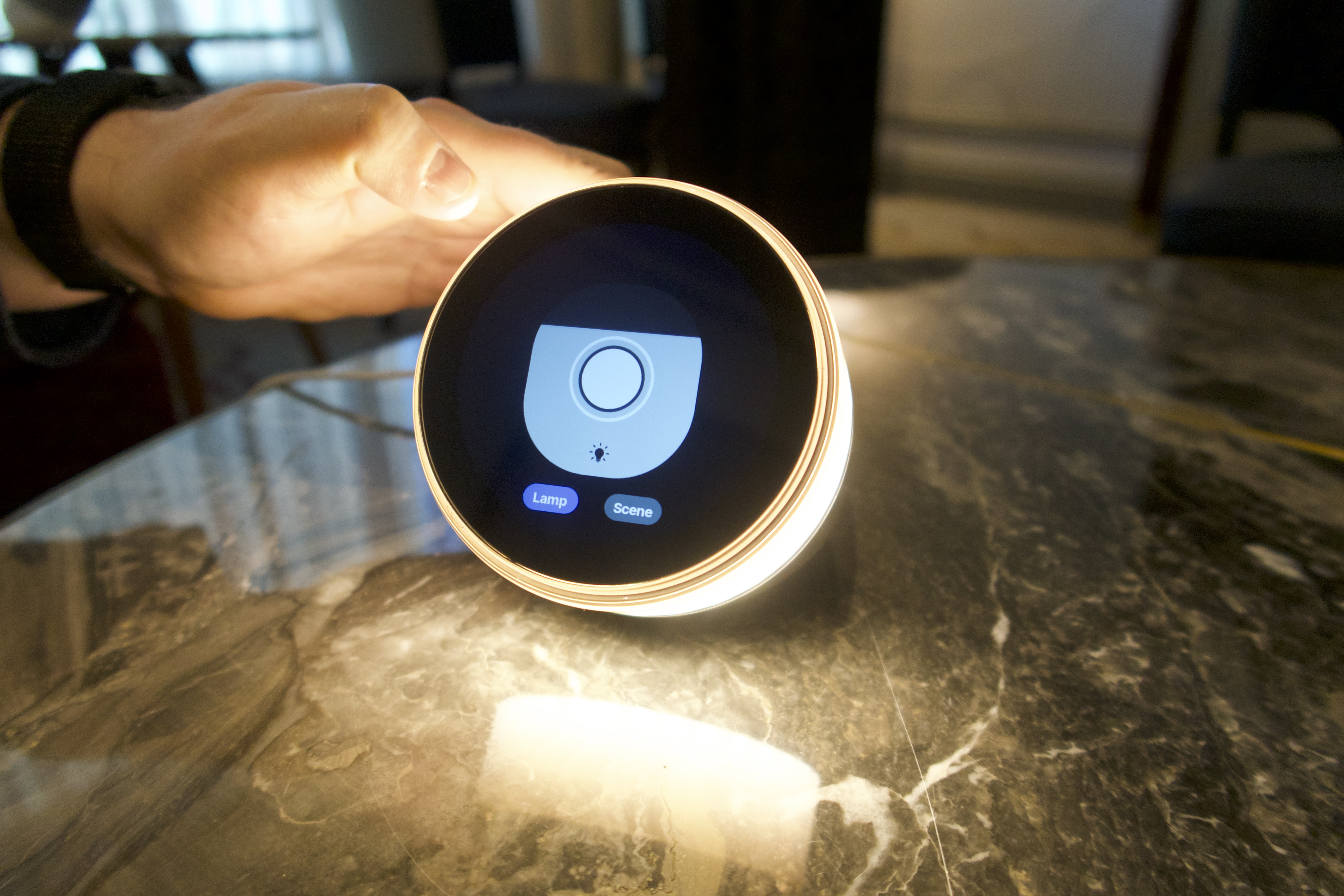
Dreamie is a relatively small device compared to other sunrise-style clocks, with a truncated pill-shaped body and a sleek circular touchscreen. Around the display is a hidden dial for volume control, and it feels great to rotate, with just the right amount of resistance. There’s also a touch strip on top of the device to easily adjust the dimness of the light by dragging your finger along it. From the display, you can even change the direction the light is pointing so you don’t blast yourself (or your partner) with it when your eyes aren’t ready, casting the light off to the back instead. 

The Dreamie alarm clock is pictured displaying its brightness controls, and is glowing warm light
Dreamie’s brightness controls
Cheyenne MacDonald for Engadget

Its 20-LED array can go from a soft, warm orangey glow to cool and bright blue-white, and certain programs, like the aurora borealis soundscape, will trigger other colors of the rainbow, throwing soothing green, blue and magenta. More impressive is the rich sound that comes from its 50 millimeter speaker. Dreamie has a 360-degree speaker grille on the bottom of the device that sends sound in all directions to create more immersive ambient sound. 

When a speaker is pointing toward you, “it’s almost like a laser beam coming at you,” which isn’t exactly the most relaxing experience, explained Canoso, who previously worked in industrial design and robotics, and before that, as a studio recording engineer. “[Dreamie] projects the sound all the way around… So when you put it next to you on a night table, it sounds more diffused. It’s not the loudest speaker out there because we’ve optimized it for rich sound quality at lower volumes. We don’t need it loud. We just need it to sound good.” 

And sound good, it does. It’s seriously got me thinking I may finally have found the thing to replace the Philips Wake-Up Light I’ve been clinging to for close to 10 years now that has decent lighting but absolutely abysmal sound quality.

Dreamie, which costs $250, recently started shipping after a successful crowdfunding campaign, and certain features — including podcasts and sleep insights — haven’t launched just yet (though I did get to see the podcast library during the demonstration, so it is a real thing, and it’s expected to roll out later this month). Those and other future features will arrive via free over-the-air updates. 

This article originally appeared on Engadget at https://www.engadget.com/home/smart-home/this-tabletop-sleep-device-and-sunrise-alarm-clock-aims-to-help-you-put-your-phone-away-before-bed-004751464.html?src=rss

Anna’s Archive Loses .Org Domain After Surprise Suspension

Anna’s Archive lost control of its primary .org domain after it was placed on registry-level serverHold — “an action that’s typically taken by the domain name registry,” reports TorrentFreak. Despite mounting legal pressure and speculation tied to its Spotify backup, the site remains accessible via multiple alternative domains, underscoring the resilience of shadow libraries. From the report: A few hours ago, the site’s original domain name suddenly became unreachable globally. The annas-archive.org domain status was changed to “serverHold,” which is typically done by the domain registry. This status effectively means that the domain is suspended and under investigation. Similar action has previously been taken against other pirate sites.

It is rare to see a .org domain involved in domain name suspensions. The American non-profit Public Interest Registry (PIR), which oversees the .org domains, previously refused to suspend domain names voluntarily, including thepiratebay.org. The registry’s cautionary stance suggests that the actions against annas-archive.org are backed by a court order.

PIR’s marketing director, Kendal Rowe, informs TorrentFreak that “unfortunately, PIR is unable to comment on the situation at this time.” It is possible that, in response to the ‘DRM-circumventing’ Spotify backup, rightsholders requested an injunction targeting the domain name. However, we have seen no evidence of that. In the WorldCat lawsuit, OCLC requested an injunction to force action from intermediaries, including domain registries, but as far as we know, that hasn’t been granted yet.


Read more of this story at Slashdot.

Corporation for Public Broadcasting To Shut Down After 58 Years

After Congress approved President Donald Trump’s rescission package eliminating federal funding, the Corporation for Public Broadcasting voted to dissolve after 58 years, rather than continue to exist and potentially be “vulnerable to future political manipulation or misuse.” The shutdown leaves hundreds of local public TV and radio stations facing an uncertain future. Variety reports: The CPB was created by Congress by the Public Broadcasting Act of 1967 to support the federal government’s investment in public broadcasting. The org noted that the rescission of all of CPB’s federal funding came after years of political attacks. “For more than half a century, CPB existed to ensure that all Americans — regardless of geography, income, or background — had access to trusted news, educational programming, and local storytelling,” said CPB president/CEO Patricia Harrison. “When the Administration and Congress rescinded federal funding, our Board faced a profound responsibility: CPB’s final act would be to protect the integrity of the public media system and the democratic values by dissolving, rather than allowing the organization to remain defunded and vulnerable to additional attacks.

[…] “CPB’s support extends to every corner of the country — urban, rural, tribal, and everywhere in between,” the org noted. “In many communities, public media stations are the only free source of trusted news, educational children’s programming, and local and national cultural content.” The CPB said that without funding, its board determined that “maintaining the corporation as a nonfunctional entity would not serve the public interest or advance the goals of public media. A dormant and defunded CPB could have become vulnerable to future political manipulation or misuse, threatening the independence of public media and the trust audiences place in it, and potentially subjecting staff and board members to legal exposure from bad-faith actors.”

As it closes, CPB is distributing its remaining funds, and also supporting the American Archive of Public Broadcasting in digitizing and preserving historic content. The CPB’s own archives will be preserved at the University of Maryland, which will make it accessible to the public. “Public media remains essential to a healthy democracy,” Harrison added. “Our hope is that future leaders and generations will recognize its value, defend its independence, and continue the work of ensuring that trustworthy, educational, and community-centered media remains accessible to all Americans.”


Read more of this story at Slashdot.

CES 2026: Petkit’s Yumshare Daily Feast Is an Automatic Wet Food Feeder for Your Cat

I don’t have a cat, but I do have a dog, and my dog can be a picky eater. After months of trial and error, the only way we could get him to consistently eat breakfast and dinner was with wet food. There is no scenario in which I or someone watching my dog can outsource the task of feeding him, but that’s not the case for cat owners. I know that cats sometimes stay home alone for extended periods of time, where an automatic food dispenser becomes essential. I can only imagine, then, that cat owners who, like me, feed their pet wet food, now have a challenge: Someone has to be there to feed the cat.

That’s what intrigues me about Petkit’s Yumshare Daily Feast, an automated cat feeder that specifically works with wet food. I covered the Yumshare briefly when Petkit first announced it last week, but I got some hands-on time with the product today on the CES show floor. And while the device I saw isn’t going to market just yet, I was intrigued.

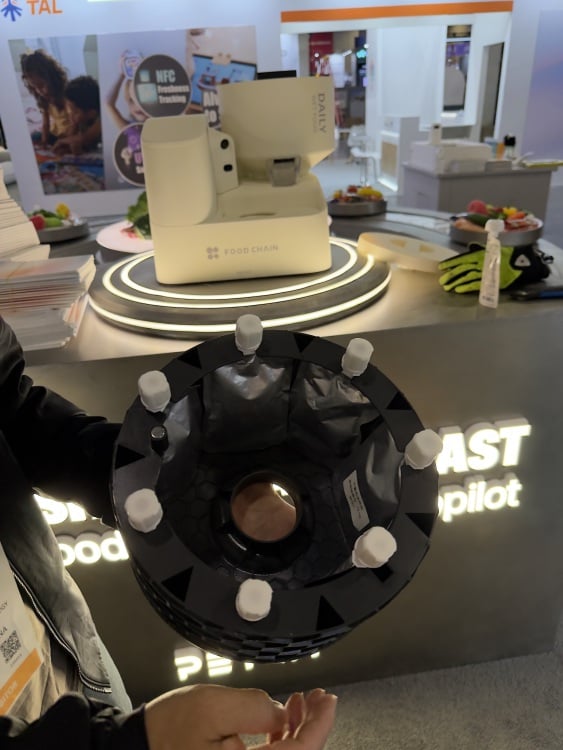
The concept itself is pretty simple, but a bit more complex in execution. As you might expect, the feeder distributes portions of food for your cat to eat when you’re not available—only here, that food is wet, not dry. To achieve this, Petkit outfitted the Yumshare with a chamber that can hold up to seven pouches of wet food at once. These pouches are designed for the Yumshare alone: Right now, the only company making pouches is Food Chain, which uses Petkit’s proprietary design to fit the Yumshare, but it’s possible more companies more jump on board in the future.

yumshare food container
The food chamber that contains seven pouches of wet food.
Credit: Lifehacker

When the Yumshare first opens one of these pouches, it sets a timer: After 48 hours, the pouch is discarded. In the meantime, the machine can automatically dole out portions set by the user, into a cup, which is stored in a separate chamber in the device. Once the portion is distributed, the pouch is sealed until the next portion is needed. The machine also uses UVC ultraviolet light to sanitize the package, with the goal of eliminating bacteria.

The automation extends to the portion of wet food itself, as well. Whether your cat eats all of the food, some of the food, or none of the food, the Yumshare can discard what’s left when it detects it’s time to do so. That might be the AI camera identifying that the food has dried up, or an internal clock recognizing that too much time has passed for the food to be safe to eat. Either way, the food drops into a waste compartment, which can hold up to 15 cups at once. The stand remains empty until it’s time to hand out another portion of food.

How large or small each portion is, as well as how often portions are distributed, is up to you. Petkit showed me a mockup of the Yumshare’s app, which lets you customize this feeding schedule. The app will also tell you how many portions have been distributed, and how many are left in the chamber. You can also take a look at a live video feed of your cat, via the 4K camera embedded in the device, or view a clip history of your cat’s feeding habits.

My only question is the lack of refrigeration: Petkit says that there is no need for it, since the pouches are all sealed until use, closed in between portions, and the chamber uses ultraviolet light to sterilize for bacteria. But I’d want to confirm there are no health risks to keeping an opened pouch unrefrigerated for up to two full days, even with that UVC light. Assuming that’s true, I’m quite impressed with this prototype. If I were a cat owner that frequently needed to leave my pet alone at breakfast and dinner, this is something I’d have my eye on.

Dell revives its XPS laptops after a boneheaded rebranding

Last year, Dell killed off all of its PC brands, including the iconic XPS lineup, and replaced them with a simplified naming scheme. It was a move meant to make it easier for people to discern between the company’s many brands, but in reality, it just just made the company’s lineup even more confusing. We called it an unforced error at the time, but after seeing how much Dell’s PC market share fell over 2025, it’s fair to say that rebranding was an absolute marketing disaster.

So, with its tail between its legs, Dell has returned to CES some welcome news for its fans: XPS lives! And the company plans to double-down on the brand in ways it never did before. Today, Dell revealed the new XPS 14 and 16 notebooks, which feature a more practical design than the previous models. There’s a new function row with traditional keys, instead of the odd capacitive buttons that disappeared in sunlight. And while the company is sticking with its “invisible” trackpad, which sits flush alongside the wrist rest, there’s now a light border around the edges that lets you feel exactly where the trackpad begins and ends.

So, in short, Dell seems to have solved most of our recent complaints about the XPS lineup. To signify its commitment to the brand, it’s also emblazoning the XPS logo on all of these new machines, replacing the previous Dell name. That’s something I could never imagine a less humbled Dell doing.

The redesign also gave Dell room to shave off some weight and thickness from both machines. The XPS 14 weighs around three pounds now, a half-pound lighter than the previous generation, while the XPS 16 weighs 3.6 pounds, a whole pound lighter than before. The new cases make both machines look a lot more like Microsoft’s extra-subtle Surface Laptop, but that’s not necessarily a bad thing. Both systems are powered by Intel’s new Panther Lake Core Ultra Series 3 chips, and they also offer tandem OLED display options.

Dell also briefly teased the return of a new XPS 13 later this year, which is set to be the company’s thinnest and lightest notebook ever. Dell says it’ll be cheaper than the XPS has been in the past.

The new XPS 14 and 16 will be available on January 6, starting at $1,650 and $1,850, respectively.

This article originally appeared on Engadget at https://www.engadget.com/computing/laptops/dell-revives-its-xps-laptops-after-a-boneheaded-rebranding-001028029.html?src=rss

Lego’s Smart Brick Gives the Iconic Analog Toy a New Digital Brain

An anonymous reader quotes a report from Wired: At CES in Las Vegas today, Lego has unveiled its new Smart Play platform, aimed at taking its distinctly analog plastic blocks and figures into a new world of tech-powered interactive play — but crucially one without any reliance on screens. Smart Play revolves around Lego’s patented sensor- and tech-packed brick. It’s the same size as a standard 2 x 4 Lego brick, but it is capable of connecting to compatible Smart Minifigures and Smart Tags and interacting with them in real time. By pairing these components, kids big and small can create context-appropriate sounds and light effects as they play with the Danish company’s toys.

[…] Lego is claiming this Smart Play platform developed in house by the company’s Creative Play Lab team in collaboration with Capgemini’s Cambridge Consultants “features more than 20 patented world-firsts within its technology.” The heart of the system is the Smart Brick’s custom-made chip, measuring smaller than a standard Lego stud. Other elements crammed into the eight-stud brick are an LED light array, accelerometers, light sensors, and sound sensor, and even a miniature speaker. The internal battery will supposedly work even after years of inactivity, and to avoid any need for cable access to the Smart Brick once it’s built into a beloved creation, Lego has also added wireless charging. Indeed, Lego has made a charging pad that will power up several Smart Bricks simultaneously.

That all-important brain chip is a 4.1-millimeter custom mixed-signal ASIC chip running a bespoke Play Engine, which interprets motion, orientation, and magnetic fields. A copper coil assembly enables the brick’s tag recognition, while a proprietary “Brick-to-Brick position system” uses these coils to sense distance, direction, and orientation between multiple Smart Bricks. Moreover, Lego claims this use of multiple Smart Bricks creates a “self-organizing network” that requires no setup, no app, no central hub, nor external controllers — and so no screens. A Bluetooth-based “BrickNet” protocol shares the data between the Smart Bricks.

Sounds are handled by a tiny analog synthesizer putting out real-time audio (thus minimizing memory load) via the brick’s miniature speaker, which uses the brick’s internal air spaces to amplify sound. As a result, the audio effects are apparently immediate and can be used to enhance play with real-time sound. Lego insists there are no prerecorded clips of lightsabers or other pieces of audio being used as a cheat. Just like the Smart Minifigs, the 2 x 2 studless tile tags trigger sounds, lights, or behaviors tied to where they are placed or how they are played with. They communicate with other components through near-field magnetic connections. Each tile has a unique digital ID, which is read by the brain brick, while the minifigures — outwardly identical to standard minifigs — carry their unique digital ID on an internal chip.


Read more of this story at Slashdot.

CES 2026: Intel hopes its Core Ultra Series 3 chips are the start of a comeback

Intel turned up to CES 2026 to herald the birth of the Core Ultra Series 3, a new range of chips offering “exceptional performance.” It says the mobile processors, formerly known as Panther Lake, deliver great graphics and battery life alongside the aforementioned grunt. And that, for the first time, the silicon has been certified for embedded and industrial use cases, including robotics and smart cities. But, like so many stories about Intel these days, the launch is loaded with so much subtext you’ll need a copy of Cliffs Notes to understand it.

On the face of it, these are just some snappy flagship chips, available in Core Ultra 7 and 9 ranges as well as Core X7 and X9, which ship with 12 Xe graphics cores over the usual four. Almost all of them offer 16 total cores and threads, and all bar two have total NPU performance of 50 PTOPS.

Image of the Core Ultra Series 3
Intel

These chips are going to be famous for two key reasons: First, Intel claims they’re the most advanced chips ever manufactured in the US. Second, they’re the first to be made using Intel’s long awaited 18A process, which has dogged the company for several years. 18A was a key plank of former CEO Pat Gelsinger’s rescue plan to restore Intel to the top of the chip world. But sadly that comeback didn’t come fast enough to prevent the CEO from being (unfairly, in my mind) deposed at the end of 2024. It didn’t help that, for all of the money spent on 18A, as recently as August 2025, the company was reportedly still suffering from low yields and high defect rates.

18A is short for 18 Angstrom, a measurement that’s far smaller than the nanometers we currently use to denote transistor size in chips. 18 Angstrom is roughly equivalent to 1.8 nanometers, putting it on the same rough level as the most advanced manufacturing process — N2 — available at TSMC in Taiwan. At CES, Intel’s new CEO Lip Bu-Tan said the company was now ahead of schedule for ramping production on 18A, which could mark an important shift in the global chip market. 

You should expect to see these chips show up in laptops from all the usual suspects, including HP, Acer, Lenovo, Dell, Samsung and the rest across this year. 

This article originally appeared on Engadget at https://www.engadget.com/computing/ces-2026-intel-hopes-its-core-ultra-series-3-chips-are-the-start-of-a-comeback-000155611.html?src=rss

CES 2026: Asus’ New Gaming Laptop Looks Like a Gigantic Nintendo DS

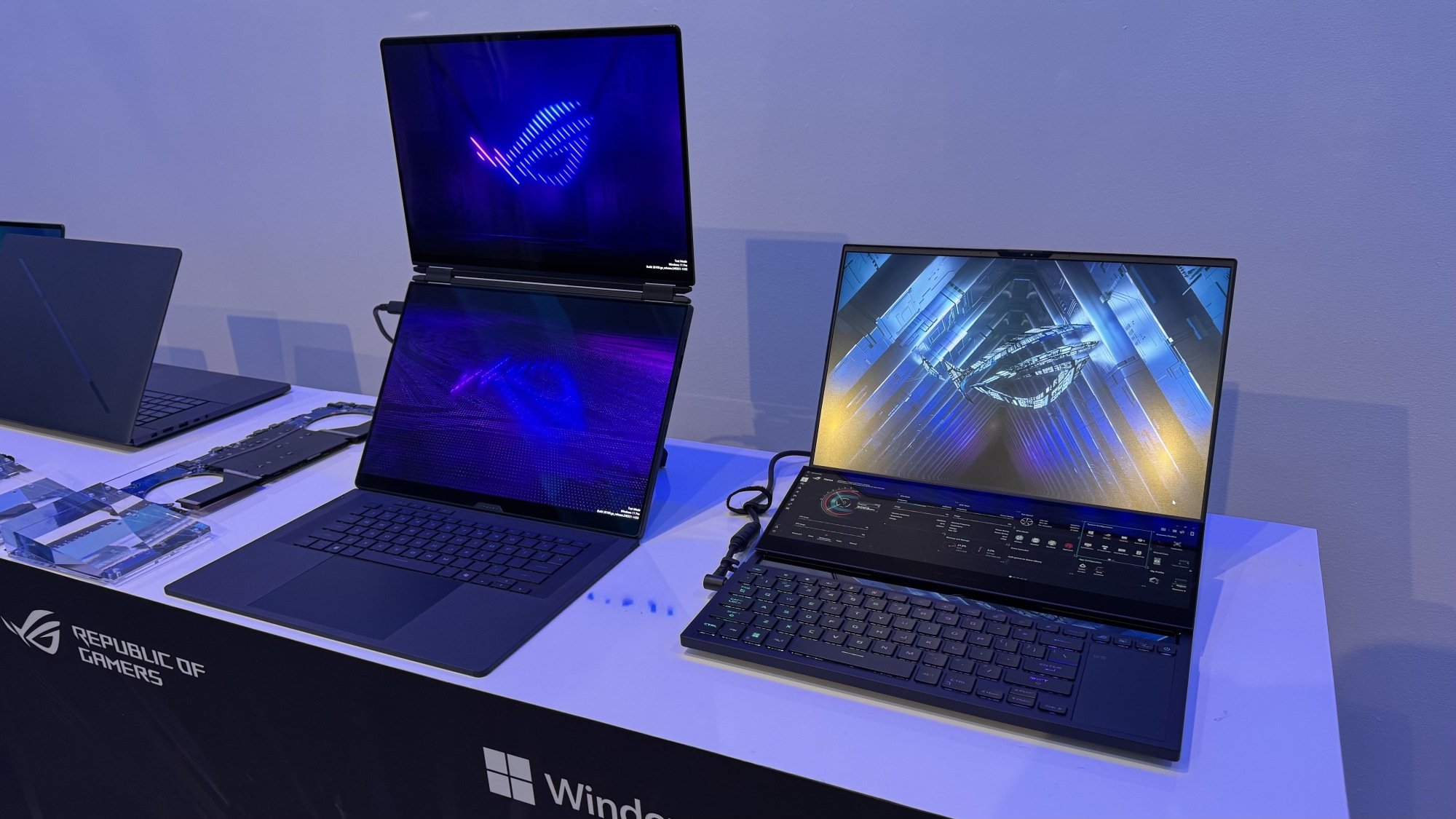
CES is the time of year for weird computers, and Asus is bringing back an old fan favorite to help fill its unusual form factor quota. Gamers who miss the days of dual screens, get excited: the ROG Zephyrus Duo is returning for 2026, and it’s bigger than ever.

Looking a bit like a gigantic Nintendo DS, the new ROG Zephyrus Duo stacks two full-sized 3K OLED screens on top of each other, with a standard laptop hinge in between. It’s a lot like the company’s existing Zenbook Duo, but that one’s geared more for productivity users—the Zephyrus Duo is fully specced out for gamers, with a 120Hz refresh rate on both screens, the latest Intel Core Ultra chips, up to an RTX 5090 laptop GPU, up to 64GB of RAM, and up to 2TB of storage. Plus, it supports 250W fast charging and can play games using up to 125W of power.

New ROG Zephyrus Duo (left) vs. ROG Zephyrus Duo 2023 (right)
New ROG Zephyrus Duo (left) vs. ROG Zephyrus Duo 2023 (right).
Credit: Michelle Ehrhardt

That’s plenty for even the most demanding games, although its price is still an unknown for now. What we do know is how different this is from the last Zephyrus Duo, which came out in 2023. That laptop’s lower screen was a simple small angled panel above the keyboard, instead of a full-sized display matching the upper one. It was great for displaying stats at a glance while playing, but not much else.

Instead, the new Zephyrus Duo can display the same game across both screens, mirror them, or pull up reference material on one screen while you play on the other. It’s also got a bunch of new ways you can use it: It comes with a detachable wireless keyboard, and you can either use it like a normal laptop with that keyboard covering one of the screens, or get creative.

Asus ROG Zephyrus Duo in various usability modes

Credit: Asus

An example photo from Asus show the laptop with one screen above the other, both screens in a side-to-side portrait mode, the whole laptop laid flat on a table (perhaps for head-to-head play), and tent mode. Tent mode is especially interesting—an Asus representative told journalists that gamers could play the same game against each other while sitting across from each other in tent mode, with each display acting as a private screen. He did acknowledge that this might impact performance and compatibility might differ based on game, but I could see it being an especially great option for, say, fighting games.

Again, this format has been used for non-gaming laptops before, but it’s seemingly got a lot of potential for gamers, too. There’s a reason one of Nintendo’s most popular handhelds opted for a dual-screen setup. And hey, maybe you could even play some DS games made on this, too.

The new ROG Zephyrus Duo is expected to launch sometime in Q2 of this year.

CES: ASUS made a special Hideo Kojima version of the ROG Flow Z13

Who among us hasn’t looked at the ASUS ROG Flow Z13 and said, “That’s great and all, but what if it had more Hideo Kojima?” Well, our cries have been heard. Behold, the ROG Flow Z13-KJP, a collaboration between ASUS and Kojima Productions.

On the inside, this model is no different than the standard version we reviewed last May. The device takes a Surface Pro-like form factor and beefs it up into something that’s more like a gaming laptop. (Ergo, ASUS’s pitch of the product as a “gaming tablet.”)

But on the outside, you’ll find a design “for Ludens who dare.” The Death Stranding influence is evident, but you may pick up on some Metal Gear-adjacent touches as well. The tablet’s gold color, symbols and integrated carbon fiber conjure Kojima’s Ludens mascot. This variant is slightly larger than the standard one, most noticeably in the detachable keyboard.

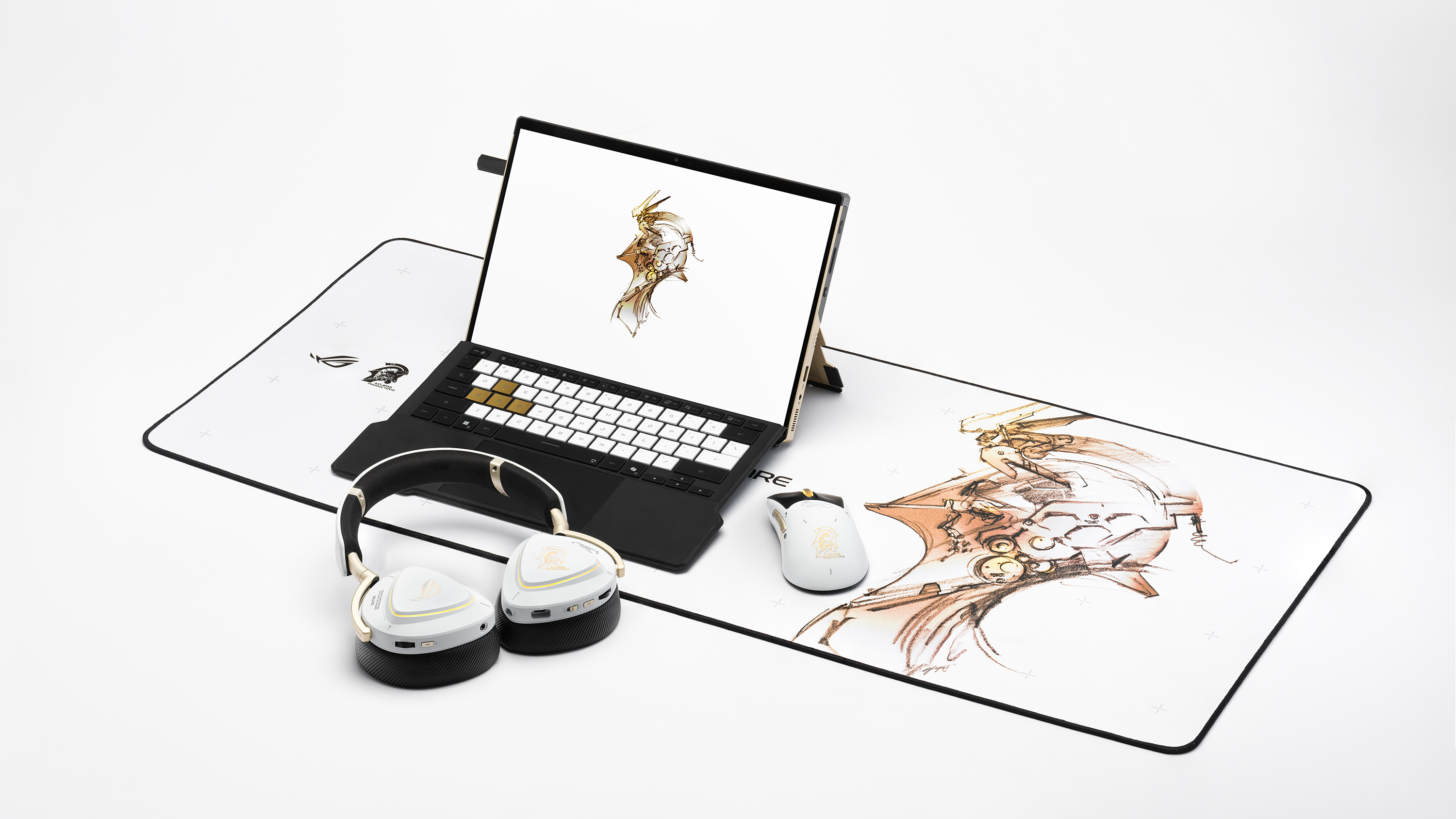
Marketing image of the ROG Flow Z13-KJP 2-in-1 with accessories
ROG Flow Z13-KJP
ASUS

There will also be matching accessories available, including a mouse, case, headphones and a desk mat. Depending on your region, those may or may not be bundled with the device. (We’ll update this story when we find out more.)

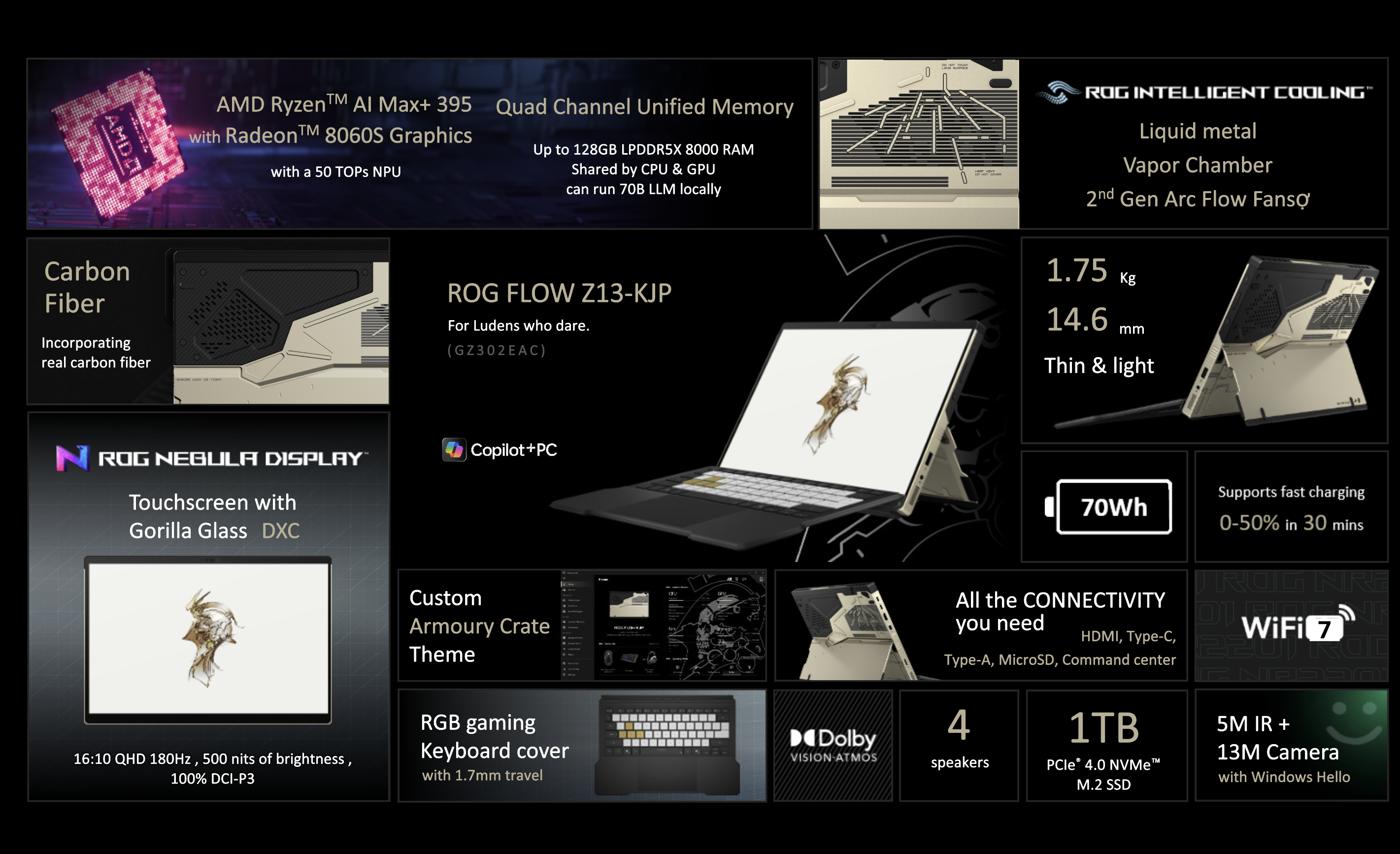
Fortunately, once the design novelty wears off, you’re left with a fairly powerful gaming machine. The Copilot PC has a 13.4-inch IPS touchscreen with a 180Hz refresh rate and 500 nits of brightness. Its port selection is surprisingly generous: two USB 4 Type-C ports, one USB-A port, HDMI 2.1, 3.5mm audio and a microSD slot. The Ryzen AI Max+ 395 chip inside has integrated graphics that punch above what you’d expect. You can configure it with up to 128GB LPDDR5X 8000 RAM.

ASUS ROG Flow Z13 one-page feature roundup
More Kojima than you ever expected from a “gaming tablet”
ASUS

ASUS hasn’t yet revealed pricing or availability for the ROG Flow Z13-KJP. You can read more about the standard version in Sam Rutherford’s review.

This article originally appeared on Engadget at https://www.engadget.com/gaming/pc/ces-asus-made-a-special-hideo-kojima-version-of-the-rog-flow-z13-000000768.html?src=rss

The ASUS ROG Zephyrus Duo is big, weird and kind of awesome

A couple years ago ASUS made its first dual-screen laptop in the ZenBook Duo. Now at CES 2026, the company has taken that idea and branched off in a somewhat unexpected way with the ROG Zephyrus Duo, which might just be the world’s first true dual-screen gaming laptop.

Unlike a more traditional productivity notebook with two built-in displays, the concept of a dual-screen gaming notebook doesn’t translate quite as naturally because powering two screens comes with a performance hit. Plus, in the heat of battle, it’s not like you have a lot of opportunity to utilize that second monitor. But if you view this Zephyrus Duo as more of an all-purpose portable content creation and gaming station, things begin to make a lot more sense. 

Both of Zephyrus Duo’s 16-inch Nebula OLED panels have strong specs including support for HDR with up to 1,100 nits of peak brightness, NVIDIA G-Sync, stylus integration and a very strong Delta-E (which measures color accuracy) of less than one. Performance also looks solid with ASUS offering the latest Core Ultra processors from Intel and up to an NVIDIA RTX 5090 GPU. Sure, with a TDP of 135 watts, the Zephyrus Duo won’t be quite as punchy as a comparable single-screened 16-inch gaming notebook, but those won’t be nearly as adaptable as the ROG either. 

Just like the Zenbook Duo, the Zephyrus Duo comes with a detachable wireless keyboard that can be charged up magnetically. This allows users to set up the laptop in all sorts of positions, which are enhanced thanks to a built-in kickstand. The one people will use the most is probably the stacked arrangement with one display above the other. However, you can also keep the Duo and clamshell mode, slide the keyboard forward for drawing, lay it down flat on a table or even put it into tent mode and game on it. Though even ASUS admits that may not be super practical as apps will need to specifically support that use case. Though at the very least, you can mirror your screen for a friend on the other side of a desk/table.

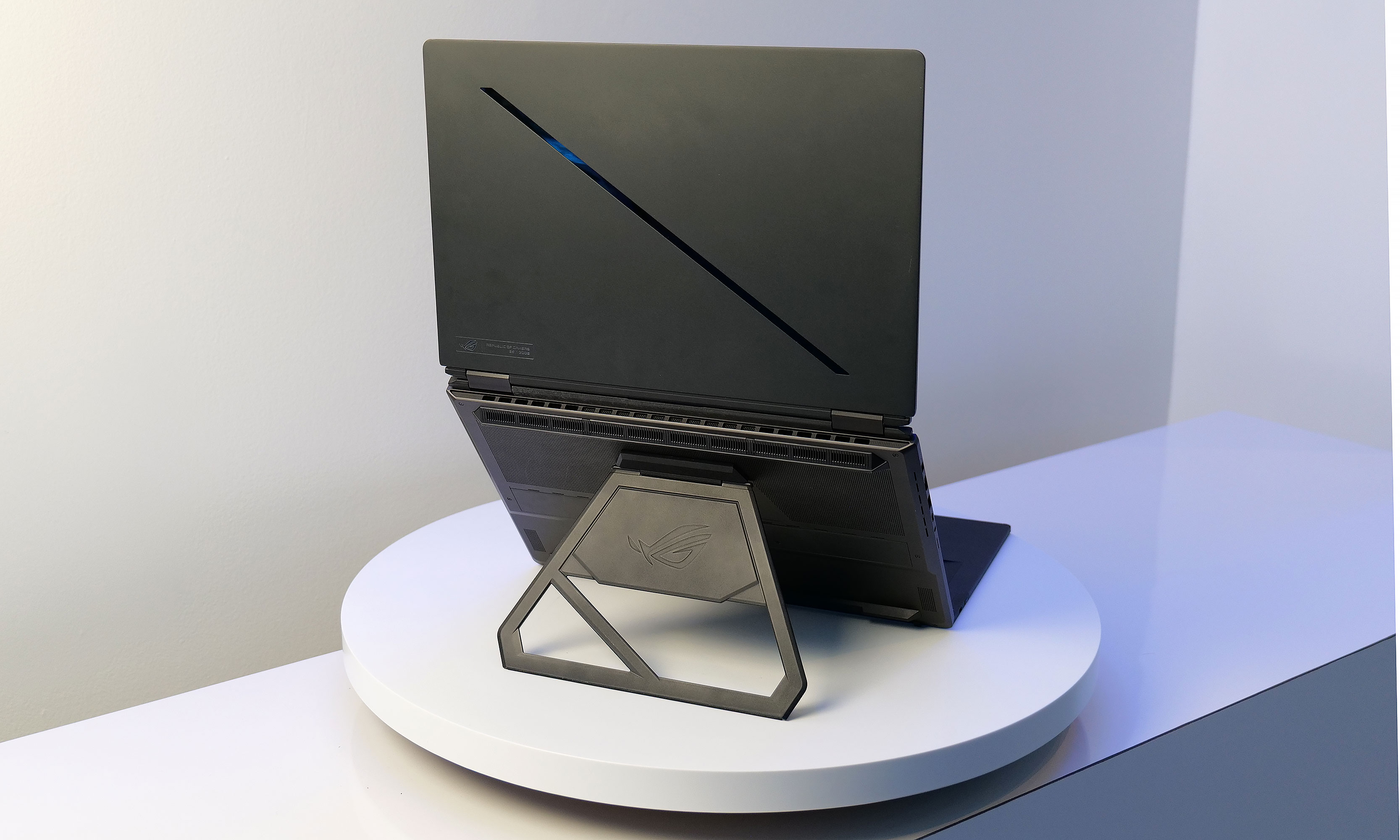
The ROG Zephyrus Duo comes with a built-in kickstand which makes it easy to set it up in all sorts of different positions, even if it is a bit heavy.
Sam Rutherford for Engadget

Now I will admit that after messing around with the Zephyrus Duo in person, it is a bit ungainly due to its weight of 6.28 pounds. But ASUS managed to do a good job of keeping it relatively thin (0.77 inches) without skimping on features like sound thanks to the Duo’s six-speaker stereo system and cooling which features a vapor chamber and a liquid metal thermal material. You also get a surprising amount of ports including multiple USB-C with Thunderbolt 4, USB-A, HDMI 2.1 and a full-size SD card slot, plus a decently large 90Whr battery. 

The one important thing we don’t know yet though is how much it will cost, particularly because this thing almost certainly won’t be cheap (I’m guessing a starting price of around $2,500). A dual-screen gaming laptop might not make a lot of sense, but I appreciate how ambitious ASUS is being with the ROG Zephyrus Duo and I’m looking forward to testing it out sometime later this year. 

This article originally appeared on Engadget at https://www.engadget.com/computing/laptops/the-asus-rog-zephyrus-duo-is-big-weird-and-kind-of-awesome-000000156.html?src=rss

Boston Dynamics announces production-ready version of Atlas robot at CES 2026

After years of testing its humanoid robot (and forcing it to dance), Boston Dynamics’ Atlas is entering production. The robotics company says the final product version of the robot is being built now, and the first companies that will receive deployments are Hyundai, Boston Dynamics’ majority shareholder, and Google DeepMind, the firm’s newly minted AI partner.

This final enterprise version of Atlas “can perform a wide array of industrial tasks,” according to Boston Dynamics, and is specifically designed with consistency and reliability in mind. Atlas can work autonomously, via a teleoperator or with “a tablet steering interface,” and the robot is both strong and durable. Boston Dynamics says Atlas has a reach of up to 7.5 feet, the ability to lift 110 pounds and can operate at temperatures ranging from minus 4 to 104 degrees Fahrenheit. “This is the best robot we have ever built,” Boston Dynamics CEO Robert Playter said in the Atlas announcement. “Atlas is going to revolutionize the way industry works, and it marks the first step toward a long-term goal we have dreamed about since we were children.” 

Boston Dynamics has been publicly demoing its work on humanoid robots since at least 2011, when it first debuted Atlas as a DARPA project. Since then, the robot has gone through multiple prototypes and revisions, most notably switching from a hydraulic design to an all-electric design in 2024. Later that year, Boston Dynamics demonstrated the robot’s ability to manipulate car parts, which appears to be one of the first ways Atlas will be put to work.

Hyundai plans to use Atlas in its car plants in 2028, focused on tasks like parts sequencing. In 2030, the car maker hopes to have the robot’s responsibilities “extend to component assembly, and over time, Atlas will also take on tasks involving repetitive motions, heavy loads, and other complex operations,” Hyundai says. Google DeepMind, meanwhile, is receiving Atlas robots so it can work on integrating its Gemini Robotics AI foundation models into Boston Dynamics’ system.

This article originally appeared on Engadget at https://www.engadget.com/big-tech/boston-dynamics-announces-production-ready-version-of-atlas-robot-at-ces-2026-234047772.html?src=rss