An anonymous reader quotes a report from TechCrunch: Senator Steve Padilla (D-CA) introduced a bill [dubbed SB 867] on Monday that would place a four-year ban on the sale and manufacture of toys with AI chatbot capabilities for kids under 18. The goal is to give safety regulators time to develop regulations to protect children from “dangerous AI interactions.”
“Chatbots and other AI tools may become integral parts of our lives in the future, but the dangers they pose now require us to take bold action to protect our children,” Senator Padilla said in a statement. “Our safety regulations around this kind of technology are in their infancy and will need to grow as exponentially as the capabilities of this technology do. Pausing the sale of these chatbot-integrated toys allows us time to craft the appropriate safety guidelines and framework for these toys to follow.” […] “Our children cannot be used as lab rats for Big Tech to experiment on,” Padilla said.
If you’re off-roading, it’s a neat idea to use your engine to top up your battery, which prompted Bluetti to launch the Charger. You could hook it to your alternator and draw off energy as you drove to make sure you turned up to your campsite with full batteries. But if you’re also toting around solar panels on your roof, then it’s a shame you can’t also use that power to top up. This omission is what prompted Bluetti to turn up to CES 2026 with the Charger 2, which will take power from your engine and your solar panels at the same time.
Bluetti says the Charger 2’s dual-input architecture will accept 600W from the panels, 800W from the engine. All of that power will charge your batteries significantly faster than the first model, claiming it’s 13 times faster than a standard car charger. In addition, Charger 2 can manage more than one Bluetti power station and expansion batteries, should your power needs stretch. And the system is smart enough to know where the energy is coming from, managing the sources based on their availability. Plus, you can use it to jump start your engine should you need the help.
If you’re a Charger 1 owner and want to upgrade, it’s fairly painless to drop the old unit out in favor of its replacement. It uses the same cabling, so you can just hook the new model to your existing wires without having to get your fingers greasy. To reward that loyalty, the company will sell you an upgrade for $99, at least through February 7.
As for everyone else, you’ll be able to pick up the Charger 2 for $349 through February 7, at which point the price leaps to $499.
This article originally appeared on Engadget at https://www.engadget.com/general/bluettis-charger-2-uses-solar-and-engine-power-to-charge-your-portable-battery-230000270.html?src=rss
Since 2020, Samsung has been dangling a yellow ball in front of us. That sphere is a robot named Ballie that Samsung has teased and demoed for home use, including serving as a smart speaker. Today, Ballie is confirmed to be facing an eternity as vaporware.
At CES 2020, Ars Technica reported that Ballie was “the furthest-along concept” that Samsung demonstrated. At the time, we saw Ballie use facial recognition to follow its owner. A marketing video also portrayed the robot controlling smart home devices, including activating a smart vacuum when someone made a mess.
Ballie rolled back onto the trade show scene at CES 2024. This time, it had a new, more spherical, and larger build rolling upon its three wheels. Ballie also sported a light ring, and Samsung showed a video of the robot being used as a projector. The South Korean firm claimed that Ballie would provide “two to three hours of continued projector use” before needing a charge. Samsung’s video also demontrated Ballie connecting with a smartphone.
According to the Wall Street Journal (paywalled), Goldman Sachs is transferring Apple Card and Apple Savings to JPMorgan Chase. “It was clear in 2023 that Goldman Sachs would exit the consumer credit game, abandoning its Apple Card partnership with it,” reports AppleInsider. “However, it has taken 26 months to reach a point where it can finally hand over issuing control to another bank.” From the report: Goldman Sachs is reportedly expected to hand over the $20 billion of outstanding balances at a $1 billion discount. Such discounts are rare, and allegedly reflect the higher-than-average delinquency rate found with Apple Card holders. JPMorgan will have to issue new Apple Cards to existing users, but it may be some time before that is done. A new Apple Savings will be opened by JPMorgan as well, but users will be given the option to move or stay.
We may earn a commission from links on this page. Deal pricing and availability subject to change after time of publication.
Laptop screen extenders help add more display area without costing as much as two separate monitors. They’re also tidier, more integrated, and more portable, making them ideal for remote workers or students who want a mobile workstation with as much visual real estate as possible. The KYY 15.6-inch laptop screen extender, with its triple-screen setup (one on either side of your laptop’s display), is a solid choice for anyone looking to give their laptop some extra elbow room—and right now, it’s 35% off, bringing its price down to $227.99 (originally $349.99).
This portable monitor is built around a single-cable USB-C-to-USB-C connection for an easy setup. Each screen is 1080p with a matte finish and up to 300 nits of brightness. They rotate up to 360 degrees and have a built-in kickstand for added flexibility.
While this screen extender works with macOS, ChromeOS, and Android, drivers need to be downloaded first rather than relying solely on the USB connection. One reviewer noted that the included USB stick wasn’t readable on their MacBook Pro, so downloading drivers is a must to set the monitors up as extensions. Also, installing these permissions might be an issue if you’re using a locked-down work laptop. In general, these displays rely on software instead of a purely plug-and-play video signal.
It’s somewhat portable at 7.7 lbs, but it’s not exactly an ultra-light travel monitor for daily commuting. And if you’re used to ultra-crisp visuals, 1080p on the side screens might make text and fine details look less sharp. It’s also worth noting that at a 60Hz refresh rate, this monitor is best for work and everyday use rather than latency-sensitive gaming or anyone looking for a high refresh rate.
Ultimately, if you don’t mind installing a driver—or using an adapter if your laptop lacks USB-C—the KYY 15.6″ Laptop Screen Extender is worth checking out.
Customers report being locked out after grabbing the password manager via F-DroidSome HSBC mobile banking customers in the UK report being locked out of the bank’s app after installing the Bitwarden password manager via an open source app catalog.…
The state of Utah is allowing artificial intelligence to prescribe medication refills to patients without direct human oversight in a pilot program public advocates call “dangerous.”
The program is through the state’s “regulatory sandbox” framework, which allows businesses to trial “innovative” products or services with state regulations temporarily waived. The Utah Department of Commerce partnered with Doctronic, a telehealth startup with an AI chatbot.
Doctronic offers a nationwide service that allows patients to chat with its “AI doctor” for free, then, for $39, book a virtual appointment with a real doctor licensed in their state. But patients must go through the AI chatbot first to get an appointment.
We’re halfway through CES 2026, and it’s clear that it’s going to be a rough year for the PC industry. In this episode, Devindra chats with Engadget’s Dan Cooper about Intel, AMD, NVIDIA and the sad state of the PC industry. We’ve got some new CPUs, but the volatile RAM market will likely make everything expensive this year. Also, they dive into Dell’s revival of the XPS brand, as well as iPolish’s smart nails and Subtle’s AI-powered VoiceBuds.
Hosts: Devindra Hardawar and Dan Cooper Producer: Devindra Hardawar Music: Dale North
This article originally appeared on Engadget at https://www.engadget.com/computing/engadget-podcast-ces-2026-and-the-rocky-year-ahead-for-the-pc-industry-221500019.html?src=rss
Samsung Display is the part of its giant parent company that makes OLEDs, LCDs and other screens for both Samsung devices and anyone else that can afford them. This year, it’s going all-in on OLEDs of the future. And that meant things like foldable displays with invisible creases, robots hurling basketballs at supertough OLED panels, and OLED screens packed into baffling form factors for no good reason.
Creases
Samsung Display
The “seamless” foldable display that might be a part of a future foldable iPhone disappeared from the booth during our tour, reappearing when it was time to leave. (This is an image provided by Samsung Display.) The device was labelled as an R&D concept, but it somehow disguised the crease in the center of the main display, making the (unlabelled) Galaxy Z Fold on the left look like a messy first-iteration foldable. There’s still a crease there Will it actually form part of Apple’s foray into foldables, or just part of the Z Fold 8?
Why not both?
Put an OLED on it
Mat Smith for Engadget
This isn’t a record player you’ll ever buy. You don’t need an OLED display on the side of your wireless headphones, but you could have them. I liked the cute OLED pendants; a customizable near-future button badge, but a lot of this is just devices for the sake of making them.
The booth tour had a small segment dedicated to portable gaming OLED, adding more possibilities whether that’s an eye-sight for FPS games or extra HUD for the most important info.
The world’s brightest OLED TV
Mat Smith for Engadget
Reaching 4,500-nit brightness, I had to squint when sat in front of this beastly OLED. For reference, consumer-level TVs typically peak at around 2,700 nits. Compared to other display technologies, OLED can achieve deeper contrast and more accurate color reproduction, but it often lacks the brightness of rival TV technologies. Not for this prototype. Let me get my sunglasses.
Kobe!
Mat Smith for Engadget
I didn’t consider OLED displays to be more fragile than other display technology, but that didn’t stop Samsung Display from installing a robot arm that throws a basketball at a hoop with a backboard made of 18 foldable OLEDs. With a bang, making Samsung Display execs and engineers nearby increasingly anxious as the days of CES go on.
Foldables have come a long way
Mat Smith for Engadget
After Samsung finally solved the problem of weight and thickness with the Galaxy Z Fold 7, it made life hard for itself again with the TriFold, with 50 percent more foldable screen. But it’s worth seeing how Samsung’s foldables have evolved over the past few years. A solid reminder that the first Galaxy Fold (2019) was beefy.
The next big thing in gaming displays
Mat Smith for Engadget
Samsung Display has begun mass production of its 360Hz QD-OLED panel, with new “V-Stripe” RGB pixel structures. Inside each pixel, subpixels are vertically aligned, which appears to improve the clarity of text edges and other small contrast objects. While it was framed at the booth as a boon for office workers, a corner was dedicated to gaming applications.
Screens across your sedan
Mat Smith for Engadget
Digital cockpits are the lifeblood of a CES showfloor, and Samsung Display’s version is predictably loaded with yet more OLEDs. The centerpiece is a “Flexible L” display that flows into the dashboard. A dedicated 13.8-inch display on the passenger side also slides out of the dash.
This article originally appeared on Engadget at https://www.engadget.com/home/home-theater/samsung-display-ces-2026-playful-demos-and-mysterious-prototypes-220407696.html?src=rss
Some people love AI. If you’re not one of them (or if you have a favorite AI tool that isn’t baked into it), using Windows 11 can feel increasingly hostile. It seems like every part of it now exists to push you into using Copilot—even notepad.exe has a prominent AI button in the user interface at this point.
If you’d like your operating system to go back to being an operating system, check out RemoveWindowsAI. This free script changes various registry keys to disable AI features including Copilot, Recall, and the Copilot integrations in applications including Edge, Paint, and Notepad. Using various workarounds , it then configures Windows Update to not install those updates again (the documentation breaks the process down, if you’re interested).
How to run RemoveWindowsAI on your machine
To get started you need to open Microsoft PowerShell on your computer. Make sure you’re using Windows PowerShell 5.1, and not the updated PowerShell 7 (this only really applies if you’ve intentionally installed PowerShell 7, so don’t worry about this step if you didn’t actively do that).
To start the script you will need to copy a command from the Github page for RemoveWindowsAI and paste it into your PowerShell window (I’m not including the command directly here in case it changes in the future). Once you do, the user interface will show up, allowing you to choose which AI features you want to disable. Make your choices and watch the changes take place in the PowerShell window.
Credit: Justin Pot
I tried this out, removing everything. I then opened Notepad—no Copilot icon in sight. The Copilot application was also gone, along with all reference to AI in the Settings application. It would be nice if Microsoft offered a way to do this without resorting to this sort of unofficial workaround, but that isn’t the world we live in.
It’s only been a few months since Meta announced that it would open its smart glasses platform to third-party developers. But one startup at CES is already showing off how the glasses can help power an intriguing set of accessibility features.
Hapware has created Aleye, a haptic wristband that, when paired with Ray-Ban Meta smart glasses, can help people understand the facial expressions and other nonverbal cues of the people they are talking to. The company says the device could help people who are blind, low vision or neurodivergent unlock a type of communication that otherwise wouldn’t be available.
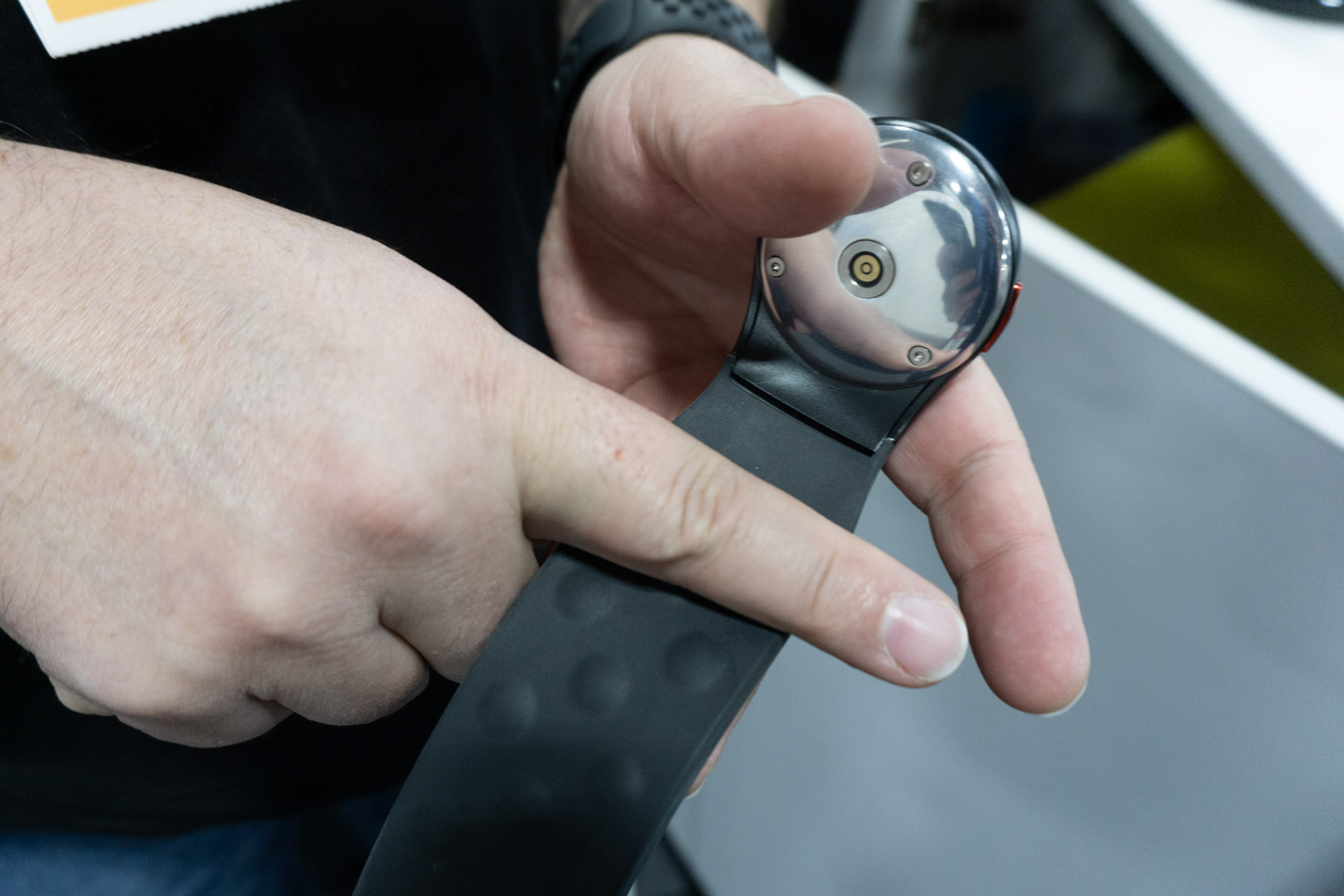
Aleye is a somewhat chunky wristband that can vibrate in specific patterns on your wrist to correspond to the facial expressions and gestures of the person you’re talking to. It uses the Meta Ray-Ban glasses’s computer vision abilities to stream video of your conversation to the accompanying app, which uses an algorithm to detect facial expressions and gestures.
The bumps on the underside of the Aleye vibrate to form unique patterns.
Karissa Bell for Engadget
Users can customize which expressions and gestures they want to detect in the app, which also provides a way for people to learn to distinguish between the different patterns. Hapware CEO Jack Walters said in their early testing people have been able to learn a handful of patterns within a few minutes. The company has also tried to make them intuitive. “Jaw drop might feel like a jaw drop, a wave feels more like a side to side haptics,” he explains.
The app is also able to use Meta AI to give vocal cues about people’s expressions, though Hapware’s CTO Dr. Bryan Duarte told me it can get a bit distracting to talk to people while the assistant is babbling in your ear. Duarte, who has been blind since a motorcycle accident at the age of 18, told me he prefers Aleye to Meta AI’s other accessibility features like Live AI. “It will only tell me there’s a person in front of me,” he explains. “It won’t tell me if you’re smiling. You have to prompt it every time, it won’t just tell you stuff.”
Hapware has started taking pre-orders for the Aleye, which starts at $359 for the wristband or $637 for the wristband plus a year subscription to the app (a subscription is required and otherwise will cost $29 a month). A pair of Ray-Ban Meta glasses is also not included, though Meta has also been building a number of its own accessibility features for the device.
This article originally appeared on Engadget at https://www.engadget.com/wearables/this-haptic-wristband-pairs-with-meta-smart-glasses-to-decode-facial-expressions-214305431.html?src=rss
An anonymous reader quotes a report from Reuters: Warner Bros Discovery’s board unanimously turned down Paramount Skydance’s latest attempt to acquire the studio, saying its revised $108.4 billion hostile bid amounted to a risky leveraged buyout that investors should reject. In a letter to shareholders on Wednesday, Warner Bros’ board said Paramount’s offer hinges on “an extraordinary amount of debt financing” that heightens the risk of closing. It reaffirmed its commitment to streaming giant Netflix’s $82.7 billion deal for the film and television studio and other assets.
Their assessment comes even after Paramount, which has a market value of around $14 billion, proposed to use $40 billion in equity personally guaranteed by Oracle billionaire co-founder Larry Ellison — father of Paramount CEO David Ellison — and $54 billion in debt to finance the deal. The decision keeps Warner Bros on track for its deal with Netflix, even after Paramount amended its bid on December 22 to address the earlier concerns about the lack of a personal guarantee from Larry Ellison. Netflix co-CEOs Ted Sarandos and Greg Peters welcomed Warner Bros’ decision on Wednesday, saying it recognizes the streaming giant’s deal “as the superior proposal that will deliver the greatest value to its stockholders, as well as consumers, creators and the broader entertainment industry.”
OpenAI is launching a new facet for its AI chatbot called ChatGPT Health. This new feature will allow users to connect medical records and wellness apps to ChatGPT in order to get more tailored responses to queries about their health. The company noted that there will be additional privacy safeguards for this separate space within ChatGPT, and said that it will not use conversations held in Health for training foundational models. ChatGPT Health is currently in a testing stage, and there are some regional restrictions on which health apps can be connected to the AI company’s platform.
The announcement from OpenAI acknowledges that this new development “is not intended for diagnosis or treatment,” but it’s worth repeating. No part of ChatGPT, or any other artificial intelligence chatbot, is qualified to provide any kind of medial advice. Not only are these platforms capable of making dangerously incorrect statements, but feeding such personal and private information into a chatbot is generally not a recommended practice. It seems especially unwise to share with a company that only bothered paying even cursory lip service to the psychological impacts of its product after at least one teenager used the chatbot to plan suicide.
This article originally appeared on Engadget at https://www.engadget.com/ai/chatgpt-is-launching-a-new-dedicated-health-portal-210150083.html?src=rss
We may earn a commission from links on this page. Deal pricing and availability subject to change after time of publication.
Nothing, an upstart tech brand from the U.K. that makes products like phones, smartwatches, and headphones, has quickly become one of my favorites lately. Its products offer unique features and designs, and the prices are competitive. Right now, Nothing’s latest budget over-ear headphones, which were released in October, the CMF Headphone Pros, are just $79 (originally $99), the product’s lowest price ever, according to price-tracking tools. This is a great option for anyone looking to get budget over-the-ear headphones that punch above their weight.
Very much like Nothing’s CMF Buds Pro 2 earbuds, the CMF Headphone Pros are budget headphones that punch above their weight. They are an affordable alternative to the popular Headphone 1 (which will cost you $299), and are the first to seamlessly integrate into the Nothing/CMF ecosystem, including smartphones, watches, and other audio products. There is a companion Nothing X app that allows you to customize action buttons, among other things, but the cool thing about these headphones is the control you get without needing the app.
There is a multi-function roller on one side of the headphone that you can roll to adjust volume or press to control the ANC modes, which include adaptive ANC (adjusting cancellation/transparency in real-time) and Spatial Audio (creates an immersive, 3D soundstage for music/movies). On the other side, you’ll find an “Energy Slider,” which tunes your sound in real-time, instantly adjusting the treble and bass balance. You get an impressive 100 hours of playback on a single charge (reduced to up to 50 hours with ANC turned on) as well as AAC, SBC, and LDAC support. They have an IPX2 rating for resistance against sweat, and there is a 3.5mm audio jack for wired listening.
Nothing is well known for its minimalistic design, but these headphones go a bit further by allowing you to mix and match the earcups with different colors (they sell for $25). These are a good option for those looking for a bold style budget over-ear headphones that have great battery life and punch above their price point.
The humble power bank has transformed from a simple pocket-sized battery into a feature-laden gadget that now sometimes includes screensavers, Bluetooth connectivity and built-in Wi-Fi hotspots. The Verge’s Thomas Ricker highlighted the $270 EcoFlow Rapid Pro X Power Bank 27k at CES 2026 as a prime offender — a device he declared “too expensive, too big, too slow, and too heavy.” Its giant display takes 30 seconds to wake from sleep, plays swirly graphics and blinking eyeballs, and requires a screensaver while slowly draining the battery it’s meant to preserve.
The feature creep is industry-wide. Anker no longer lists a display-less model in its 20,000mAh range, and both companies sell proprietary desk chargers. Basic alternatives exist — Anker’s PowerCore 10k runs $26 — but they’re becoming harder to find.
Nitrux developer Uri Herrera announced today the general availability of Nitrux 5.1 as a new stable update to this immutable and systemd-free distribution featuring new and updated components.
There are likely occasions in your day-to-day life in which you allow someone else to use your phone, whether it’s letting your kid play a game or sharing content with a friend. You may do this without thinking about the privacy implications and what might happen if another person has access to everything on your device and—accidentally or on purpose—uses it to view your search history, scroll through your photos, or send messages to your contacts.
If you’re an Android user, you should enable app pinning to keep others from snooping around your device. This feature keeps the user in the pinned app until you enter your PIN, pattern, or password. (On iOS, you can achieve a similar effect with Guided Access, which also allows you to set time limits and disable the keyboard and touch input.)
Enable app pinning on Android
To pin apps, you’ll need to enable the feature in your phone’s Settings app. To do so, go to Security or Security & location>Advanced> App pinning and toggle on Use app pinning and Ask for PIN before unpinning.
Before handing your phone over, open to the app screen you want to pin, then swipe up to the middle of the screen and hold to open your Overview. Tap the app’s icon, then tap Pin. This will keep the user locked into that app until you unpin (using your PIN, pattern, or password).
Depending on your device navigation settings, there are a few ways to unpin an app:
Gesture navigation: Swipe up and hold
2-button navigation: Touch and hold Back + Home
3-button navigation: Touch and hold Back + Overview
Note that pinning won’t prevent someone from using the app fully, such as swiping through your photos or typing in the search bar, as Android doesn’t have the option to disable touch. Pinned apps can also open other apps. At the very least, though, it keeps someone from having access to anything and everything on your device.