Google removes some AI health summaries after investigation finds “dangerous” flaws

On Sunday, Google removed some of its AI Overviews health summaries after a Guardian investigation found people were being put at risk by false and misleading information. The removals came after the newspaper found that Google’s generative AI feature delivered inaccurate health information at the top of search results, potentially leading seriously ill patients to mistakenly conclude they are in good health.

Google disabled specific queries, such as “what is the normal range for liver blood tests,” after experts contacted by The Guardian flagged the results as dangerous. The report also highlighted a critical error regarding pancreatic cancer: The AI suggested patients avoid high-fat foods, a recommendation that contradicts standard medical guidance to maintain weight and could jeopardize patient health. Despite these findings, Google only deactivated the summaries for the liver test queries, leaving other potentially harmful answers accessible.

The investigation revealed that searching for liver test norms generated raw data tables (listing specific enzymes like ALT, AST, and alkaline phosphatase) that lacked essential context. The AI feature also failed to adjust these figures for patient demographics such as age, sex, and ethnicity. Experts warned that because the AI model’s definition of “normal” often differed from actual medical standards, patients with serious liver conditions might mistakenly believe they are healthy and skip necessary follow-up care.

Read full article

Comments

Our favorite UGreen 3-in-1 wireless charger is 32 percent off right now

Now that the winter holidays are well and truly past, now’s the perfect time to take stock of your tech setup. If you were gifted (or gifted yourself) some new gear in December, make sure that you’ve got the proper accessories to keep that gear performing at its best. If a new way to power all those batteries would be a benefit, Amazon’s currently running a discount on an excellent wireless charging pad. The UGREEN MagFlow Qi2 3-in-1 Charger Station 25W is on sale for $95. That’s only a little bit above the lowest price we’ve ever seen for the product (which was $90), and it’s still a 32 percent discount off its usual cost.

This is our top pick for a 3-in-1 charging pad thanks to its versatility. The UGREEN can work equally well as a permanent fixture in your home or act as a portable charging station. It boasts a foldable design and has smart little design details to keep it feeling like a premium product. The Qi2 25W charging works across a range of iPhone models and accessories, such as AirPods. There’s also a dedicated part of the pad’s design for an Apple Watch, which uses a proprietary charging standard, to power up too. Just note that you’ll need a newer model of phone and the latest iOS 26 in order to take full advantage of the 25W charging capability. The wireless pad also comes with both a charging plug and a cable. We felt this UGREEN model was a great value at $140, so being able to snag one for a third of the usual price is an even better deal.

Follow @EngadgetDeals on X for the latest tech deals and buying advice.

This article originally appeared on Engadget at https://www.engadget.com/deals/our-favorite-ugreen-3-in-1-wireless-charger-is-32-percent-off-right-now-214707069.html?src=rss

The Out-of-Touch Adults’ Guide to Kid Culture: Do You Have a ‘Choppelganger’?

This weekly trip through the youth pop culture landscape takes us from turmoil in Stranger Things fandom, where many fans refuse to let the show end, to the kids’ Wild West of Roblox, where age-verification is changing the landscape in a massive way, and all the way to Africa, where online mega-celebrity IShowSpeed is livestreaming a fascinating travelogue that people are watching all over the world.

What is “Conformity Gate?”

The final episode of Netflix sci-fi series Stranger Things aired on Dec. 31 and it seems that many fans are not happy (shocking, right?). Some feel that the finale left too many loose ends, some that it all happened too easily, or that it was rushed, sloppy, and that it just kind of sucked. Some fans were so unhappy with the end of the series that they concluded it couldn’t really be the end; there has to be more to it. Thus was born “Conformity Gate,” the fan-conspiracy-theory that states there is a secret, real ending to Stranger Things that Netflix hasn’t released yet.

In a nutshell, Conformity Gate imagines that the events depicted in the last episode didn’t actually happened in reality. The show’s antagonist, Vecna, is in control of the story, and the seeming ending is an illusion that the characters (and audience) have been fed. The evidence is scant—props are slightly different from season to season or episode to episode, characters get small details wrong in dialogue, and other small differences. These are, I’m confident, the result of continuity and editing errors mixed with fans overanalyzing.

I suspect the overarching issue with the end of Stranger Things is the same problem that has plagued other ambitious TV shows—Lost, Game of Thrones, The Sopranos, etc. There isn’t a fully worked out ending when the show is pitched, leaving the show’s creators to try to “work something out” for the ending, as opposed to going into it knowing exactly how it’s going to come out. This is also why the first seasons of good shows are almost always better than the seasons that follow: The show’s creators have fully plotted out the arc of the first season, but future events are more vague so the story feels slapdash instead of inevitable.

Anyway, Charlie Heaton, who plays Jonathan Byers in Stranger Things, called the Conformity Gate theory “insane,” and the bio on Stranger Thing‘s X account was changed to read “ALL EPISODES OF STRANGER THINGS ARE NOW PLAYING (all-caps are theirs.) This doesn’t close the case on Stranger Things, though. There’s still money to be made on the franchise, so I’d bet we see new content at some point; it just probably won’t be a new ending.

Roblox age verification launched

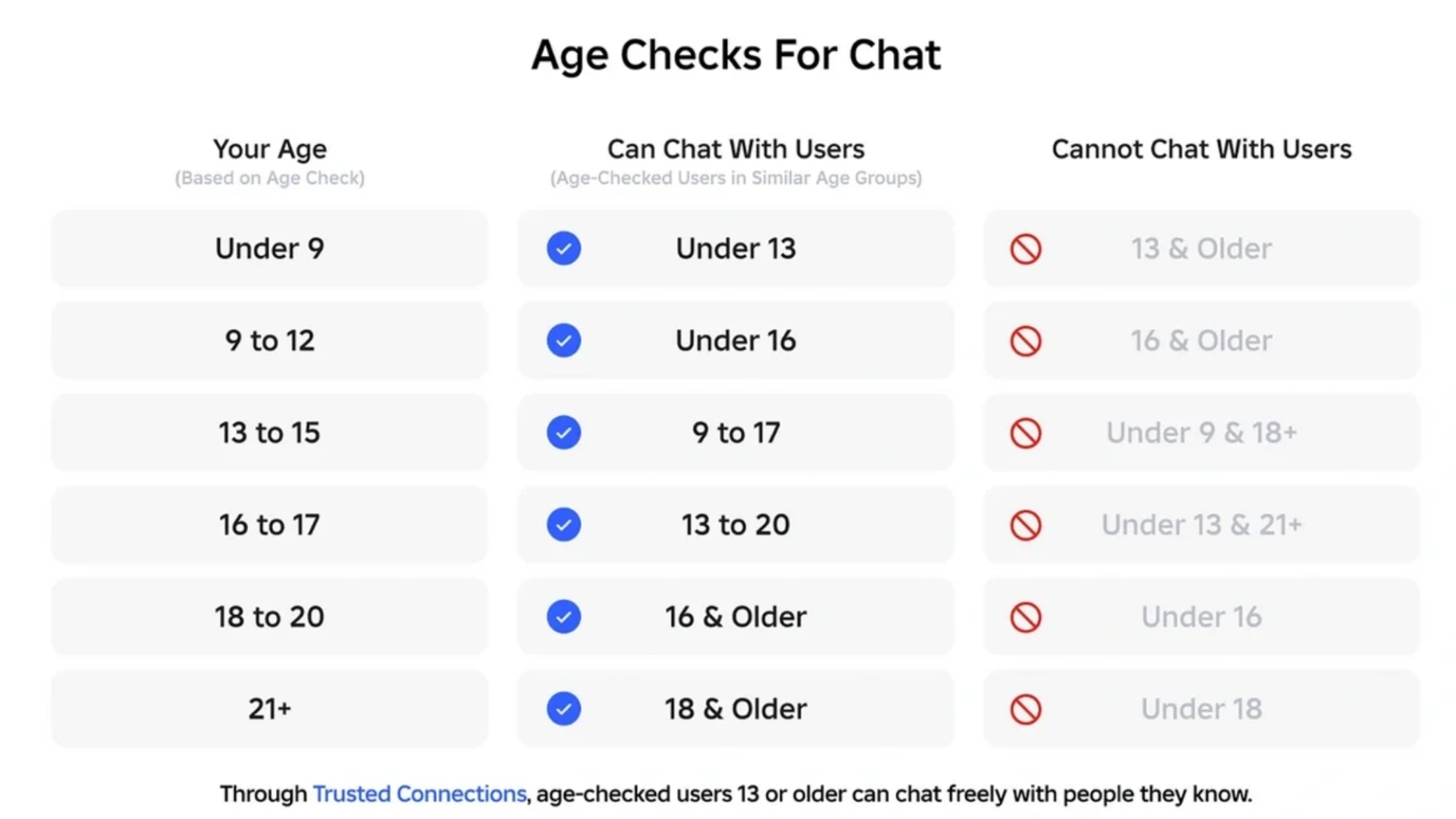
The new year brings a world-shaking event to videogame Roblox: mandatory ID or facial verification. It works like this: if unverified users try to chat on Roblox, they are directed to give the game permissions to use their camera, then follow a series of online instructions so a verification algorithm can divine their age group based on their features. Users over 13 can submit a photo of an identification card instead. Roblox promises any images or videos taken during the verification process will be deleted after it is complete. Players who don’t want to verify can still play Roblox, but they won’t be able to use communication features within it. Once Roblox knows users’ ages, it only allows them to chat with others in similar age groups. Here’s how the company breaks down who may chat with whom:

Roblox age chart

Credit: Roblox

The move is in response to longtime concerns about child safety within Roblox, which include organized groups of online predators like 764 using the game to recruit victims, Roblox mini-games with questionable content that are/were open to younger players, and at least 24 reported arrests of sex predators using Roblox to find victims.

An age-verified Roblox account is a positive step, but it’s far from perfect. Videos like this are popping up on TikTok, where users seem to be sharing ways to get around the filter system. I have no idea if this would work, but if it does, not only would it let kids have more “grown up” accounts, it also could lead to grown-ups getting “younger” accounts. Online groomers often mimic the age group they’re interested in, and a verified account seems like it would make this much easier. Another area of concern: Last week, users on X were linking to eBay accounts specifically advertised as “13-15 age group accounts.” Those auctions seem to have been taken down by eBay, but in the darker corners of the internet, I have no doubt that trade in verified Roblox accounts is brisk.

What is a Choppelganger?

This week’s slang word combines the words “chopped” and “doppelgänger” to deliver a massive insult. “Chopped” (as you can read in Lifehacker’s glossary of Gen Z and Gen A slang) describes a person who is ugly, and doppelgänger means “a ghostly duplicate of a living person,” so a choppelganger is someone who looks like you, but worse. The term was coined in this post on X :


This Tweet is currently unavailable. It might be loading or has been removed.

And it was soon adopted by TikTokers who posted videos like these:

It’s probably not the most widely used slang—there aren’t too many places where the idea actually would come up—but it’s definitely clever.

Viral video of the week: Speed does Africa

These are dark days for humanity, but there’s some sunlight breaking through. This week’s conformation of the essential goodness of people comes from YouTube legend IShowSpeed, who is in the middle of posting an epic series of livestream videos documenting a trip to Africa. The internet is responding, both in America and in Africa, with tens of millions of views.

So far, Speed has visited Rwanda, Zambia, Kenya (where he and his crew went on safari and visited the Maasai Mara where Speed got a traditional tattoo, among other adventures) and more. Many more stops are planned in the coming days, including Liberia, Morocco, and Botswana. Speed is like an informal ambassador for America’s people, and his open, honest, hilarious videos are acting as a cultural exchange program or a bridge between two worlds. The comments are amazing, with African people posting things like, “No words can capture the depth of what we feel as Africans. By simply revealing our humanity, you have compelled the world to witness the true brilliance of our continent—its beauty, its dignity, its spirit,” and Americans saying things like, “I didn’t know Zimbabwe was lit like that” and posting emotional reaction videos like this:

If you need some hopium, you should definitely go to IShowSpeed’s YouTube channel and follow along on his adventures, even if you’re an old fart like me.

Judge: Trump violated Fifth Amendment by ending energy grants in only blue states

The Trump administration violated the Fifth Amendment when canceling billions of dollars in environmental grants for projects in “blue states” that didn’t vote for him in the last election, a judge ruled Monday.

Trump’s blatant discrimination came on the same day as the government shut down last fall. In total, 315 grants were terminated in October, ending support for 223 projects worth approximately $7.5 billion, the Department of Energy confirmed. All the awardees, except for one, were based in states where Donald Trump lost the majority vote to Kamala Harris in 2024.

Only seven awardees sued, defending projects that helped states with “electric vehicle development, updating building energy codes, and addressing methane emissions.” They accused Trump officials of clearly discriminating against Democratic voters by pointing to their social media posts boasting about punishing blue states.

Read full article

Comments

How Markdown Took Over the World

22 years ago, developer and columnist John Gruber released Markdown, a simple plain-text formatting system designed to spare writers the headache of memorizing arcane HTML tags. As technologist Anil Dash writes in a long piece, Markdown has since embedded itself into nearly every corner of modern computing.

Aaron Swartz, then seventeen years old, served as the beta tester before its quiet March 2004 debut. Google eventually added Markdown support to Docs after more than a decade of user requests; Microsoft put it in Notepad; Slack, WhatsApp, Discord, and Apple Notes all support it now. Dash writes: The part about not doing this stuff solely for money matters, because even the most advanced LLM systems today, what the big AI companies call their “frontier” models, require complex orchestration that’s carefully scripted by people who’ve tuned their prompts for these systems through countless rounds of trial and error. They’ve iterated and tested and watched for the results as these systems hallucinated or failed or ran amok, chewing up countless resources along the way. And sometimes, they generated genuinely astonishing outputs, things that are truly amazing to consider that modern technology can achieve. The rate of progress and evolution, even factoring in the mind-boggling amounts of investment that are going into these systems, is rivaled only by the initial development of the personal computer or the Internet, or the early space race.

And all of it — all of it — is controlled through Markdown files. When you see the brilliant work shown off from somebody who’s bragging about what they made ChatGPT generate for them, or someone is understandably proud about the code that they got Claude to create, all of the most advanced work has been prompted in Markdown. Though where the logic of Markdown was originally a very simple version of “use human language to tell the machine what to do”, the implications have gotten far more dire when they use a format designed to help expresss “make this **bold**” to tell the computer itself “make this imaginary girlfriend more compliant”.


Read more of this story at Slashdot.

Microsoft Is Finally Working on a Worthy Answer to Apple’s ‘Handoff’ Feature

Love it or hate it, the Apple ecosystem really does have its perks. Take “Handoff,” for example. With this feature, you can be working in one app on one of your devices, then continue on in the same app on one of your other devices. You can start an article in Safari on your iPhone, then finish it on your Mac, without needing to google the piece and scroll to find your spot. It isn’t 100%, but when it works, it’s pretty great.

Microsoft actually offers a similar feature over on Windows, though it’s so limited, you might not even know it exists. The feature is called Resume, and the idea is to allow you to pick up your place in an app from another device on your PC. For the most part, that means Android apps; so if you have a PC and an Android phone, Resume could offer the same benefits as someone with a Mac and an iPhone. However, so few apps actually work with Resume, that it’s effectively useless.

Microsoft’s “Handoff” moment is coming

As spotted by Windows Latest, Microsoft is making some serious updates to Resume. The company recently updated the Resume support document, which confirms Microsoft is opening the feature up to more Android apps.

The support document doesn’t specify what apps might be coming, but it doesn’t necessarily have to for this news to be exciting; rather, the development alone implies that many more Android apps will likely be on the way—assuming their developers simply get on board.

As Windows Latest explains, the reason Resume has been so limited is due to how restrictive Microsoft’s API is. The only apps that can currently tap into Resume are ones that have access to the “Link to Windows” API. Many Android developers either don’t know how to develop with this API, or simply can’t, since their apps are not compatible.

The latest update to Resume offers developers another option, however: Now, developers can use Windows Notification System (WNS), a built-in API that is far more common and supports far more apps. That said, developers can’t just update their apps with the WNS and expect to be compatible with Resume. Microsoft tells Windows Latest that developers need to reach out to Microsoft directly for approval. That application needs to include the developer’s WNS registration, the app’s Package SID, a summary of what the app does, and screenshots of the app in action.

It’s basically like signing up for TSA PreCheck: Most of us who apply will likely get approved, but they don’t just let anyone decide to join. You need to provide proof you qualify and submit for screening before you get there. That will likely end up working well for anyone who’s interested in using Resume: The apps that will be available will all be vetted by Microsoft, so there should only be legitimate and useful apps offering that linking capability.

How to enable Resume on Windows

These changes probably won’t roll out for some time on Windows. However, you can set yourself up for success now by turning the feature on. To start, head to Settings > Apps, then scroll until you find “Resume.” Here, turn on the feature. Right now, you’ll probably see the only app that is compatible is OneDrive. You can connect it if you wish, which will let you work on a document across both your Android device and your PC.

Lego’s first Pokémon sets are now available for pre-order

We learned last March that Lego and Pokémon would be joining forces and the first results of their partnership are here. Pre-orders for all three kits are open now, with an expected ship date of February 27. As one might have guessed from the lightning bolts on the previous promotional image, one of the debut pocket monsters getting the brick treatment is Pikachu, complete with a Poké Ball. The 2,050-piece kit can be built to show Pikachu either leaping out of the open Poké Ball into battle or at rest staring up at the builder, closed Poké Ball between his paws. The Pikachu kit costs $200.

There’s also a 587-piece model of Eevee, which goes for $60. On the bigger side is a set featuring a trio of Pokémon: Venusaur, Charizard and Blastoise. This kit has 6,838 pieces and can show the group together in battle formation or separately in their own mini environments. It retails for $650.

Lego kit of Pokemon character Eevee
Lego

Before you leap to pre-order pages, however, here’s a word of caution. In Lego form, our little friends look…kinda strange? I’m not the biggest Lego builder, but I am a rather accomplished architect in Minecraft, so I am well aware of the innate challenge in constructing a rounded shape from square blocks. Take Pikachu, for instance. Part of his appeal is his chubby little cheeks. There are bricks with more rounded sides in this collection that hint at his usual rotundness, but the proportions of his face just feel a little off to me. I had the same reaction to the other figures as well, although Eevee seems to have fared a little better than the others. They’re all sort of cute, but not nearly so cute as they are in other formats. But like I said, Lego is not my personal block of choice, so perhaps I’m in the minority here! If you love these bricky pocket monsters, then roll on over to Lego’s website and snap up these kits faster than a Mewtwo.

This article originally appeared on Engadget at https://www.engadget.com/entertainment/legos-first-pokemon-sets-are-now-available-for-pre-order-205527102.html?src=rss

Microsoft Pulls the Plug On Its Free, Two-Decade-Old Windows Deployment Toolkit

Microsoft has abruptly retired the Microsoft Deployment Toolkit, a free platform that IT administrators have relied on to deploy Windows operating systems and applications for more than two decades. The retirement, reports the Register, came with “immediate” notice, meaning no more fixes, support, security patches, or updates, and the download packages may be removed from official distribution channels.


Read more of this story at Slashdot.

Norway Reaches 97% EV Sales as EVs Now Outnumber Diesels On Its Roads

Norway has released its December and full year 2025 automotive sales numbers and the world’s leading EV haven has broken records once again. The country had previously targeted an end to fossil car sales in 2025, and it basically got there. From a report: In 2017, Norway set a formal non-binding target to end fossil car sales in the country by 2025 — a target earlier than any other country in the world by several years. Norway was already well ahead of the world in EV adoption, with about a third of new cars being electric at the time — but it wanted to schedule the final blow for just 8 years later, fairly short as far as automotive timelines go.

At the time, many (though not us at Electrek) considered this to be an optimistic goal, and figured that it might get pushed back. But Norway did not budge in its target (unlike more cowardly nations). And it turns out, when you set a realistic goal, craft policy around it, and don’t act all wishy-washy or change your mind every few years, you can actually get things done. (In fact, Europe currently has around the same EV sales level as Norway did 10 years ahead of its 100% goal — which means Europe’s former 100% 2035 goal is still eminently achievable)


Read more of this story at Slashdot.

Switching water sources improved hygiene of Pompeii’s public baths

The eruption of Mount Vesuvius in 79 CE released thermal energy roughly equivalent to 100,000 times the atomic bombs dropped on Hiroshima and Nagasaki at the end of World War II, spewing molten rock, pumice, and hot ash over Pompeii. Pompeii’s public baths, aqueduct, and water towers were among the preserved structures frozen in time. A new paper published in the Proceedings of the National Academy of Sciences analyzed calcium carbonate deposits from those structures to learn more about the city’s water supply and how it changed over time.

Pompeii was founded in the sixth century BCE. Prior research revealed that, early on, the city relied on rainwater stored in cisterns and wells for its water supply. The public baths used weight-lifting machinery to lift water up well shafts that were as deep as 40 meters. As the city developed, so did the complexity of its water supply system, most notably with the construction of an aqueduct between 27 BCE and 14 CE.

The authors of this latest paper were interested in the calcium carbonate deposits left by water in well shafts as well as the baths and aqueduct. The different layers have “different chemical and isotope composition, calcite crystal size, and shape,” which in turn could reveal information about seasonal changes in temperature, as well as changes over time in the chemical composition of the water. Analyzing those properties would enable them to “reconstruct the history of such systems—particularly public baths—revealing aspects of their maintenance and the adaptations made during their period of use,” the authors wrote.

Read full article

Comments

How Microsoft Copilot May Soon Appear Inside Windows 11 File Explorer

How Microsoft Copilot May Soon Appear Inside Windows 11 File Explorer
Microsoft is committed to transforming Windows into an AI native operating system, even if a significant portion of its user base hasn’t fully bought into the idea. It’s next move looks to fully integrate its Copilot assistant into File Explorer, according to a few resourceful users who have gone digging into a recent Windows 11 preview build.

Copilot

Supreme Court takes case that could strip FCC of authority to issue fines

The Supreme Court will hear a case that could invalidate the Federal Communications Commission’s authority to issue fines against companies regulated by the FCC.

AT&T, Verizon, and T-Mobile challenged the FCC’s ability to punish them after the commission fined the carriers for selling customer location data without their users’ consent. AT&T convinced the US Court of Appeals for the 5th Circuit to overturn its fine, while Verizon lost in the 2nd Circuit and T-Mobile lost in the District of Columbia Circuit.

Verizon petitioned the Supreme Court to reverse its loss, while the FCC and Justice Department petitioned the court to overturn AT&T’s victory in the 5th Circuit. The Supreme Court granted both petitions to hear the challenges and consolidated the cases in a list of orders released Friday. Oral arguments will be held.

Read full article

Comments

Apps like Grok are explicitly banned under Google’s rules—why is it still in the Play Store?

Elon Musk’s xAI recently weakened content guard rails for image generation in the Grok AI bot. This led to a new spate of non-consensual sexual imagery on X, much of it aimed at silencing women on the platform. This, along with the creation of sexualized images of children in the more compliant Grok, has led regulators to begin investigating xAI. In the meantime, Google has rules in place for exactly this eventuality—it’s just not enforcing them.

It really could not be more clear from Google’s publicly available policies that Grok should have been banned yesterday. And yet, it remains in the Play Store. Not only that—it enjoys a T for Teen rating, one notch below the M-rated X app. Apple also still offers the Grok app on its platform, but its rules actually leave more wiggle room.

App content restrictions at Apple and Google have evolved in very different ways. From the start, Apple has been apt to remove apps on a whim, so developers have come to expect that Apple’s guidelines may not mention every possible eventuality. As Google has shifted from a laissez-faire attitude to more hard-nosed control of the Play Store, it has progressively piled on clarifications in the content policy. As a result, Google’s rules are spelled out in no uncertain terms, and Grok runs afoul of them.

Read full article

Comments

China is Geoengineering Deserts With Blue-Green Algae

An anonymous reader shares a report: Deserts are hard to reclaim because plants cannot survive on shifting sand, but scientists in northwest China are changing that — by dropping vast amounts of blue-green algae onto the dry terrain. These specially selected strains of cyanobacteria can survive extreme heat and drought for long periods, according to China Science Daily on Thursday. When rain finally comes, they spring to life, spreading rapidly and forming a tough, biomass-rich crust over the sand. This living layer stabilises the dunes and creates the perfect foundation for future plant growth.

This is the first time in human history that microbes are being used on a massive scale to reshape natural landscapes. As the “Great Green Wall” — China’s massive multi-decade initiative to plant trees and fight desertification — expands to include efforts in Africa and Mongolia, the unprecedented geoengineering technology could one day transform the face of our planet. This artificial “crusting” technique was developed by scientists at a research station in Ningxia Hui autonomous region, located in northwest China on the edge of the Tengger Desert, according to China Science Daily.


Read more of this story at Slashdot.

Apple Is Asking Its Biggest Competitor for Some Help With AI

It’s been nearly two years since Apple announced a more intelligent Siri, and yet, we’re still waiting to get our hands on it. Aside from being able to answer a few questions about Apple products or shunt your questions off to ChatGPT for you, the voice assistant is essentially still the same it was before Apple Intelligence launched for other Apple features in iOS 18.1. Now, the iPhone maker seems to be throwing in the towel on developing an AI-enabled Siri entirely on its own, and is asking Google for help. I can’t imagine Tim Cook is too happy about that, but on the flip side, that does mean an AI Siri might finally come out, and soon.

In a statement to CNBC’s Jim Cramer, Apple admitted that it is now planning to use Google Gemini to power its AI-infused Siri, rather than purely in-house models. The company said that, “After careful evaluation, we determined that Google’s technology provides the most capable foundation for Apple Foundation Models and we’re excited about the innovative new experiences it will unlock for our users.”

Previously, Apple had promised that its AI Siri would be able to do tasks on your behalf, like send a drafted email, or would be able to answer questions using context pulled from your phone, like surfacing a friend’s address using information pulled from a text thread. Reportedly, however, implementing these features during testing kept breaking more traditional Siri features, like setting alarms and reminders, which has kept sending Apple back to the drawing board. The new, Gemini-powered voice assistant for Android faced similar issues at first, but based on my hands-on time with the company’s latest phones, those growing pains seem to have subsided, so it makes sense that Google would be the first company Apple would turn to while looking for outside help.

Apple hasn’t said too much more about the deal for now, but Google itself did step in to offer Apple users a bit more clarity, plus some reassurance about their data.


This Tweet is currently unavailable. It might be loading or has been removed.

In a statement on X, the company assured Apple users that “Apple Intelligence will continue to run on Apple devices and Private Cloud Compute, while maintaining Apple’s industry-leading privacy standards.” That’s the same deal Apple has with OpenAI right now, which allows its users to ask ChatGPT questions without the AI being able to train on them or keep a log of their requests. It essentially means Google won’t get any data from your AI-powered Siri. Google’s statement also confirmed a detail from CNBC’s initial article, stating that its agreement with Apple will be a multi-year deal.

Perhaps most exciting is that Google said the AI-powered Siri will come out “this year,” mirroring a statement an Apple spokesperson gave to Daring Fireball last March, admitting that an AI-enabled Siri was taking longer than anticipated and saying the company hoped to launch it in 2026. That’s welcome relief to anyone who thought Apple had given up on the project.

A more concrete timeline is still unknown, although Bloomberg’s Mark Gurman, a reputable reporter with inside sources at Apple, has previously said to expect the AI Siri upgrade to launch in the spring. Personally, I could also see the company holding the launch until its annual WWDC event, which tends to happen in June.

Despite Apple and Google’s public feud as the makers of iOS and Android, respectively, this wouldn’t mark the two companies’ first time working together, especially in the mobile space. Previously, it was uncovered that Google and Apple have a lucrative deal to make Google the default search engine in Safari, which caused a lengthy legal battle that ultimately allowed the companies to maintain their deal, but barred exclusivity contracts. Part of the reasoning behind the AI Siri delay might be that the companies wanted to work together on AI before, but were holding off on it out of an abundance of caution. However, according to the courts, Google will also be able to make deals with outside distributors for “preloading and placement” of its GenAI products going forward, which seemingly puts both companies in the clear.

Anthropic made a version of its coding AI for regular people

If you follow Anthropic, you’re probably familiar with Claude Code. Since the fall of 2024, the company has been training its AI models to use and navigate computers like a human would, and the coding agent has been the most practical expression of that work, giving developers a way to automate rote programming tasks. Starting today, Anthropic is giving regular people a way to take advantage of those capabilities, with the release of a new preview feature called Claude Cowork.

The company is billing Cowork as “a simpler way for anyone — not just developers — to work with Claude.” After you give the system access to a folder on your computer, it can read, edit or create new files in that folder on your behalf.

Anthropic gives a few different example use cases for Cowork. For instance, you could ask Claude to organize your downloads folder, telling it to rename the files contained within to something that’s easier to parse at a glance. Another example: you could use Claude to turn screenshots of receipts and invoices into a spreadsheet for tracking expenses. Cowork can also navigate websites — provided you install Claude’s Chrome plugin — and make can use Anthropic’s Connectors framework to access third-party apps like Canva.

“Cowork is designed to make using Claude for new work as simple as possible. You don’t need to keep manually providing context or converting Claude’s outputs into the right format,” the company said. “Nor do you have to wait for Claude to finish before offering further ideas or feedback: you can queue up tasks and let Claude work through them in parallel.”         

If the idea of granting Claude access to your computer sounds ill-advised, Anthropic says Claude “can’t read or edit anything you don’t give it explicit access to.” However, the company does note the system can “take potentially destructive actions,” such as deleting a file that is important to you or misinterpreting your instructions. For that reason, Anthropic suggests it’s best to give “very clear” guidance to Claude.   

Anthropic isn’t the first to offer a computer agent. Microsoft, for example, has been pushing Copilot hard for nearly three years, despite seemingly limited adoption. For Anthropic, the challenge will be convincing people these tools are useful where others have failed. The fact Claude Code has been universally loved by programmers may make that task easier.

For now, Anthropic is giving users of its pricey Claude Max subscription first access to the preview. If you want to try Cowork for yourself, you’ll also need a Mac with the Claude macOS app installed. For everyone else, you’ll need to join a wait list.    

This article originally appeared on Engadget at https://www.engadget.com/ai/anthropic-made-a-version-of-its-coding-ai-for-regular-people-193000363.html?src=rss

AMD Ryzen 9 Pro 9965X3D Breaks Cover Revealing Specs

AMD Ryzen 9 Pro 9965X3D Breaks Cover Revealing Specs
Well, well, well. It turns out AMD does have another Ryzen 9000X3D processor on the way besides the one it didn’t announce at its CES 2025 keynote. “Yeah Zak,” you’re thinking. “It’s the Ryzen 9 9950X3D2.” That chip is probably still on the way, but it’s not the topic of today’s post. Instead, we’re looking at something Mr. Gray spotted over