We may earn a commission from links on this page. Deal pricing and availability subject to change after time of publication.
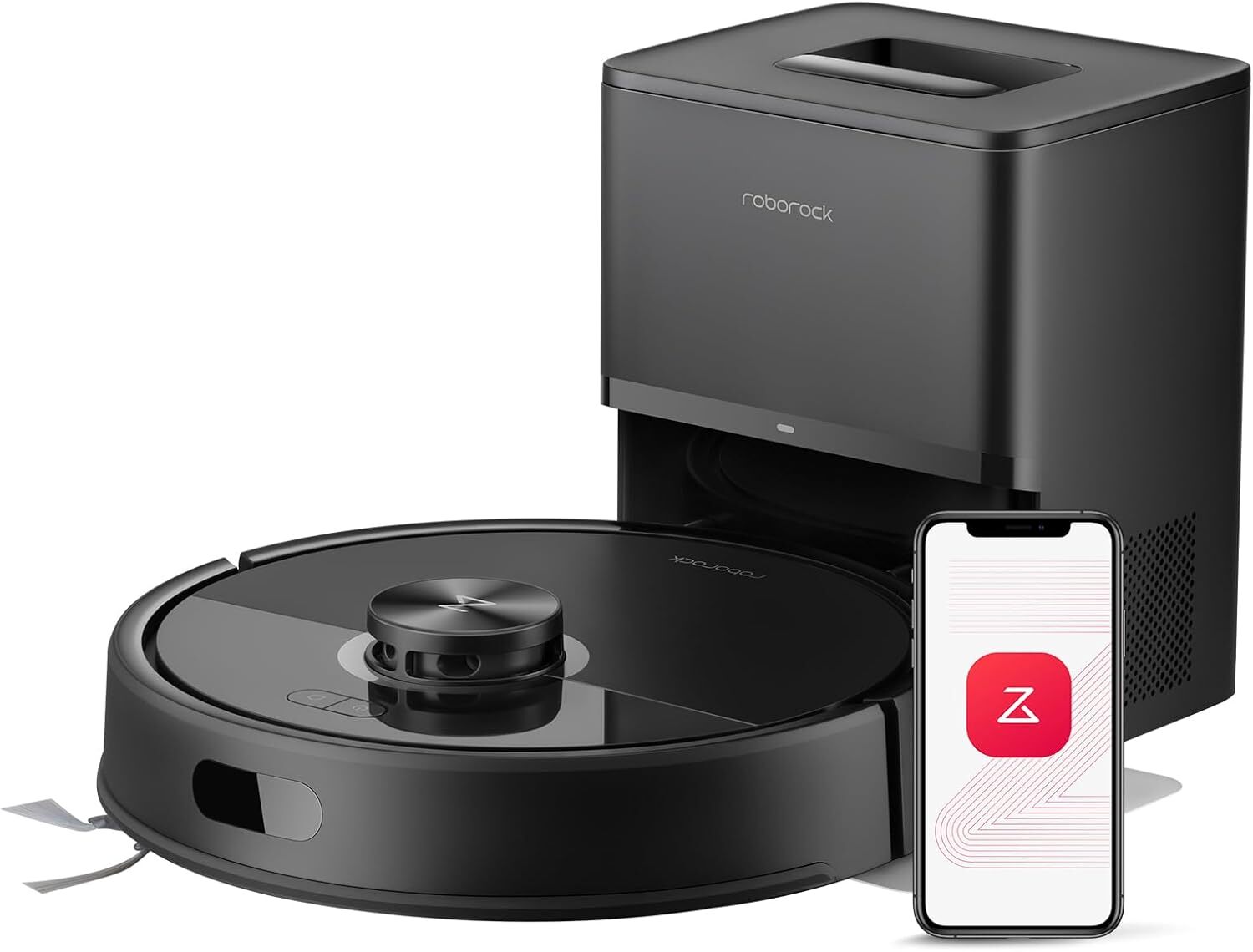
The holidays are hectic enough without adding “deep clean floors” to your already packed to-do and errands list, which is why buying a robot mop and vacuum is more appealing than ever. Right now, the Roborock Q7 M5+ Robot Vacuum/Mop is $219.99 (originally $359.99) on Amazon—a 39% discount that marks its lowest price to date, according to price-tracking tools.
An anti-tangle brush makes this a solid choice for pet owners who have furry friends that shed, and the self-emptying dock holds nearly two months’ worth of debris, so you don’t have to empty the bin each time you run it. Another major perk is the 10,000 Pa HyperForce suction, which is surprisingly strong for a sub-$250 price point, as is the fact that it can vacuum and mop in one run.
This member of the Q-series lineup features smart navigation and LiDAR mapping, making it easy to plan routes, create multi-floor maps, and customize no-go zones. Compared to Roborock predecessors in this mid-tier price range, this model has been upgraded with more automation and power and has a 150-minute max runtime, which is enough battery life to manage most homes in a single run.
That said, the mopping system is still basic compared to pricier S-series models like theRoborock S8 MaxV Ultra, which uses hot water, automatic detergent dispensing, and heated air drying. The Q7 M5+ also lacks obstacle avoidance, only connects to 2.4GHz wifi, and the self-emptying dock uses disposable bags that you’ll need to replace, adding an additional ongoing cost.
Ultimately, if you’re looking for a mid-range self-emptying robot vacuum and mop hybrid, the Roborock Q7 M5+ Robot Vacuum/Mop is a strong choice given its low maintenance nature, strong suction, and smart navigation for under $250—especially if you’re a pet owner. If you want the best-in-class cleaning power or premium features like obstacle avoidance, you’ll need to upgrade to the higher-end S-series, but expect to pay significantly more.
A little while back, we took a look at a large cargo bike from Urban Arrow that had some interesting features: a drive train that sported continuous variable gearing and a belt drive. But it was difficult to get a feel for what using that drivetrain was like when it was being used to shift a large and extremely heavy cargo bike. So, I jumped at the opportunity when Urban Arrow’s sister company, Gazelle, offered a chance to ride one of its new Arroyo models, which feature the same drivetrain, but this time coupled to a fairly standard commuter bike.
Getting rid of all the weight and bulk really allowed the drive system to shine. And, as with its cargo-carrying cousin, the bike is filled with thoughtful touches and design decisions that make riding it a pleasure. But all that comes at a cost: This is a premium bike with little in the way of compromises, and it’s priced accordingly.
High-end hardware
The Arroyo line is meant for commuters and urban/suburban riding. It has a step-through frame, a large rack, fenders, and its riding stance is very upright. In keeping with its Dutch heritage, it’s meant to be ridden as a bicycle, rather than a bike-like scooter. There’s no throttle to let you avoid pedaling, and even when it’s set to its maximum assist rating, you’ll end up putting in a reasonable amount of effort during the ride. If you’re looking for something that lets you handle a commute in hot weather without sweating, you’ll probably want to look elsewhere.
Pocket Lands, a mixed reality sandbox game where you can create miniature worlds, is out now in early access on Quest.
Originally announced at last month’s VR Games Showcase, Pocket Lands is a tabletop voxel sandbox game from Thomas van den Berge (Vermillion) through Mountainborn Studios. You can create diorama-like worlds across different biomes in mixed reality with support for both Touch controllers and hand tracking, then explore them in first person with fully immersive VR.
0:00
/0:10
In its current early access release, Pocket Lands features various biomes and the ability to create worlds of different sizes. The game also supports a day and night cycle, empty dioramas for building without distractions, quick construction tools, and a virtual camera to record and share your different builds.
For the full release, Thomas van den Berge previously advised Pocket Lands will launch in “the second half of 2026”. The store page’s “coming soon” section lists planned features such as multiplayer, cave systems, underground biomes, new surface biomes, creatures that roam these lands, and more. However, it’s unclear if each feature will arrive at full release or across incremental updates.
Pocket Lands is out now in early access on the Meta Quest platform.
Back in October System76 announced a planned release date for Pop!_OS 24.04 LTS and the COSMIC Desktop… And they’ve made it! The new Pop!_OS 24.04 is now available for download as the long-awaited update atop an Ubuntu 24.04 LTS base while using their Rust-based COSMIC desktop environment…
The first topic of discussion at the 2025 Maintainers Summit has been in
the air for a while: what role — if any — should machine-learning-based
tools have in the kernel development process? While there has been a fair
amount of controversy around these tools, and concerns remain, it seems
that the kernel community, or at least its high-level maintainership, is
comfortable with these tools becoming a significant part of the development
process.
The D7VK project recently started as the Direct3D 7 API implemented atop the Vulkan API akin to DXVK and VKD3D-Proton with newer versions of Microsoft Direct3D. Today marks the D7VK 1.0 release for this project in now declaring itself “production ready” for Linux gamers…
Dimensional Double Shift is out now on Samsung Galaxy XR, coinciding with the game’s “largest update ever.”
Previously released on Quest in early access, Dimensional Double Shift is a hand tracking party game where you serve food orders and fix motor vehicles for the locals of each dimension you visit. Following October’s New Joysey DLC, it’s now available on Samsung Galaxy XR headsets and offers cross-platform multiplayer support with Meta Quest headsets.
Today’s Samsung Galaxy XR launch is also joined by Dimensional Double Shift’s free Winter Update. Developer Owlchemy Labs confirmed that this includes Solo Practice Experiment, its first single-player mode for the former co-op only experience, which teaches you the game’s core systems.
Other new features include rotating weekend Boosters, starting with a limited-time ‘Midas Touch’ modifier where everything you touch turns to gold. Other Boosters include turning your mouth into a flamethrower, stretching your arms further, and more. Finally, the game’s celebrating ‘Snow-vertime Fest’ from December 18 until January 5, adding a festive hub alongside winter-themed avatar cosmetics and new interactions.
The Game Awards, which broadcasts tonight on Twitch, YouTube, and Prime Video, has become the biggest night on the video game calendar since launching in 2014, but the show’s treatment of developers has drawn increasing criticism. At the 2023 ceremony, acceptance speeches were often cut off after roughly 30 seconds while Hideo Kojima received five minutes to discuss his upcoming game OD — enough time for 13 acceptance speeches, Aftermath calculated. That year’s show also ignored the industry’s mass layoffs entirely; host Geoff Keighley acknowledged the labor crisis only at the 2024 ceremony.
The show’s Future Class program, launched in 2020 to celebrate game makers representing an inclusive future for the industry, has quietly ended. No new class has been named for two years. “At this time, we are not planning a new Future Class for this year,” organizer Emily Weir told Game Developer.
If you’ve engaged in any sort of doomscrolling over the past year, you’ve no doubt encountered some wild AI-generated content. While there are plenty of AI video generators out there producing this stuff, one of the most prevalent is OpenAI’s Sora, which is particularly adept at generating realistic short-form videos mimicking the content you might find on TikTok or Instagram Reels. These videos can be so convincing at first glance, that people often don’t realize what they’re seeing is 100% fake. That can be harmless when it’s videos of cats playing instruments at midnight, but dangerous when impersonating real people or properties.
It’s that last point that I thought would offer some pushback to AI’s seemingly exponential growth. These companies have trained their AI models on huge amounts of data, much of which is copyrighted, which means that people are able to generate images and videos of iconic characters like Pikachu, Superman, and Darth Vader. The big AI generators put guardrails on their platforms to try to prevent videos that infringe on copyright, but people find a way around them. As such, corporations have already started suing OpenAI, Google, and other AI companies over this blatant IP theft. (Disclosure: Lifehacker’s parent company, Ziff Davis, filed a lawsuit against OpenAI in April 2025, alleging it infringed Ziff Davis copyrights in training and operating its AI systems.)
Disney is handing its characters over to Sora users
But it seems not all companies want to go down this path. Take Disney, as a prime example. On Thursday, OpenAI announced that it had made a three-year licensing agreement with the company behind Mickey Mouse. As part of the deal, Sora users can now generate videos featuring over 200 Disney, Marvel, Pixar, and Star Wars characters. The announcement names the following characters and movies specifically:
Mickey Mouse
Minnie Mouse
Lilo
Stitch
Ariel
Belle
Beast
Cinderella
Baymax
Simba
Mufasa
Black Panther
Captain America
Deadpool
Groot
Iron Man
Loki
Thor
Thanos
Darth Vader
Han Solo
Luke Skywalker
Leia
The Mandalorian
Stormtroopers
Yoda
Encanto
Frozen
Inside Out
Moana
Monsters Inc.
Toy Story
Up
Zootopia
That includes licensed costumes, props, vehicles, and environments. What’s more, Disney+ will host a “selection” of these “fan-inspired” Sora videos. (I’ll admit, that last point genuinely shocks me.) This does only apply to Disney’s visual assets, however, as Sora users won’t have access to voice acting. ChatGPT users will also be able to generate images with these characters, so this news doesn’t just affect Sora users.
You might think OpenAI is paying Disney a hefty licensing fee here, but it appears to be quite the opposite. Not only is Disney pledging to use OpenAI APIs to build “products, tools, and experiences,” it is rolling out ChatGPT to its employees as well. Oh, and the company is making a $1 billion equity investment in OpenAI. (Is that all?)
I know many companies are embracing AI, often in ways I disagree with. But this deal is something else entirely. I’m not sure any Disney executives actually searched for “Sora Disney” on the internet, because right now, you’ll find fake AI trailers for Pixar movies filled with racism, sexual content, and generally offensive content—all generated using an app Disney just licensed all of its properties to. OpenAI asserts in its announcement that both companies are committed to preventing “illegal or harmful” content on the platform, but Sora users are already creating harmful content. What kind of content can we expect with carte blanch access to Disney’s properties?
Now that Disney’s characters are fair game, I can’t imagine the absolute slop that some users are going to make here. The only hope I have is in the fact that Disney+ is going to host some of these videos. Staff will have to weed through some garbage to find videos that are actually suitable for the platform. And maybe seeing the “content” that Sora users like to make with iconic characters will be enough for Disney to rethink its plans.
EV automaker Rivian just held its inaugural Autonomy and AI day which, unsurprisingly, focused extensively on hands-free driving. An upcoming software update promises the introduction of “universal hands-free” driving. The company says its vehicles will be able to autonomously navigate more than 3.5 million miles of roads in North America, “covering the vast majority of marked roads in the US.”
This is coming to the R2 line of EVs, but also Gen 2 R1 vehicles like the recently-released Rivian R1S. The service will be locked behind a subscription for something called Autonomy+ that includes self-driving, but also offers access to forthcoming and unannounced autonomous features. Rivian customers can pay $2,500 for lifetime access to the platform or $50 per month.
The R2 is getting LiDAR sensors, which will presumably help enable some of those upcoming autonomous features, in addition to a new chip called the Rivian Autonomy Processor. The processor has been designed for multimodal applications and runs the company’s proprietary neural net engine. Both of these features are expected “to ship on R2 models starting at the end of 2026.”
Today’s event wasn’t just about hands-free driving. Many of the company’s vehicles will soon be given access to the AI-powered Rivian Assistant, which uses LLMs and can connect to apps like Google Calendar. This assistant will be model-agnostic, as it will “orchestrate different models and choose the best one for the task.”
In addition to the upcoming R2, the company is prepping the R3 and R3X. A Rivian offshoot just introduced an extremely expensive, but modular, electric bike called the TM-B.
This article originally appeared on Engadget at https://www.engadget.com/transportation/evs/rivian-goes-all-in-on-universal-hands-free-driving-at-its-first-autonomy-and-ai-day-172004733.html?src=rss
Google is starting to roll out new photorealistic avatars which they call “Likeness”. Similar to Apple’s Personas, Likeness avatars are generated by scanning a user’s face, then animated it with input from the sensors on a headset. The avatars can be used to represent the user in video call apps, but Google doesn’t yet have a way to have spatial meetings with other Likeness avatars.
The News
Google is launching its own photorealistic avatars called Likeness avatars, for use on compatible Android XR headsets. The idea is similar to Apple’s Persona avatars: scan the user’s face to create a realistic representation, then use the headset’s on-board cameras to animate the scan as realistically as possible.
Likenesses take a slightly different (and probably more user-friendly) approach for the initial face scan; rather than scanning by holding a headset out in front of your face, Google instead released a Likeness (beta) Android app to let people scan themselves with their phone instead. Holding your phone in front of your face for a scan is definitely a bit easier than awkwardly holding a whole headset with both hands.
According to Google, the Likeness (beta) app is only compatible with Google Pixel 8 or newer, Samsung Galaxy S23 or newer, or Samsung Z Fold5 or newer. Without a compatible device, you can’t create a Likeness avatar, meaning Android XR users with an iPhone (or unsupported Android phone) won’t be able to scan themselves. One benefit of Apple’s approach to scanning with the headset itself is that anyone can use a Persona avatar on Vision Pro regardless of what kind of phone they have.
Image courtesy Google
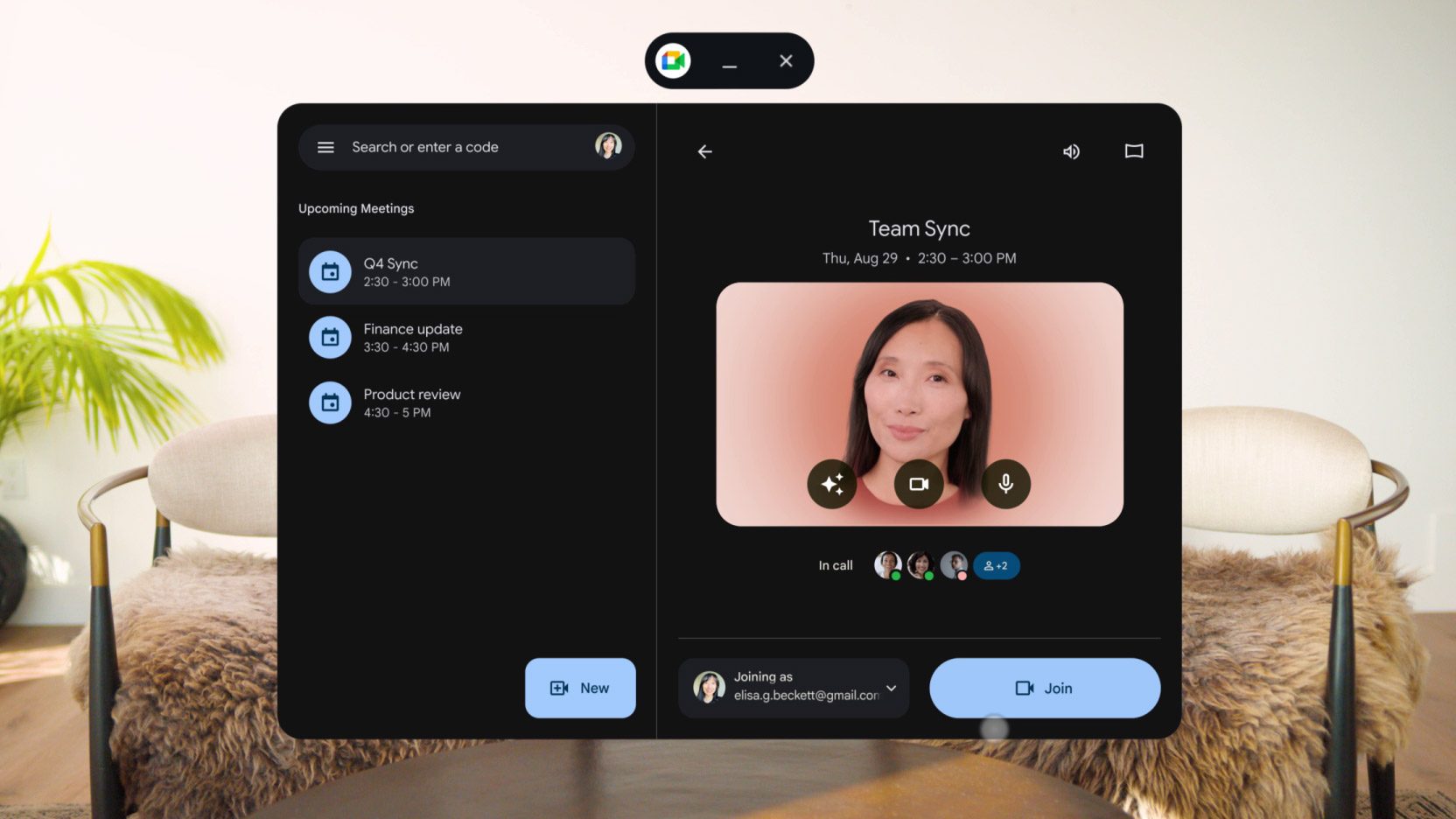
Like Apple’s approach, Likeness avatars can be used generically as a ‘virtual webcam’. That makes them widely compatible with most video call apps that expect a front-facing camera, like Google Meet, Zoom, Messenger, etc.
And just like Apple, the first ‘beta’ iteration of Likeness avatars are 2D only. They are presented as a 2D representation with no way to transmit them in a spatial format, or have a ‘spatial meeting’, like Vision Pro can do with spatial FaceTime calls. However, Google says it’s working on spatial meetings for the future.
My Take
Photorealistic avatars on XR headsets are a great value-add because of the ability to use video call apps naturally. Apple’s Personas are currently the state-of-the-art as far as consumer-available photorealistic avatars, and the company has shown that it’s possible to cross over the uncanny valley with this approach to avatars.
During a recent meeting with Google, I joined a demo video call on Google Meet with one of the participants using a Likeness avatar. From a photorealism standpoint, the results look impressive, and facial movements look convincing too. However, because I didn’t personally know the individual using the Likeness, I was unfamiliar with their actual idiolect, which makes it impossible for me to judge the accuracy of the facial motion. Still, facial motion only needs to be plausibly realistic to be passable in many circumstances, and that’s been achieved from what I can see.
Image courtesy Google
While it’s a bummer that there’s no ‘spatial meeting’ yet for Android XR (allowing users to chat face-to-face with fully spatial Likeness avatars), Google made the right choice in prioritizing virtual webcam usage at the start. It’s less impressive than spatial meetings, but more widely useful and compatible with existing services and apps.
There’s probably no chance we’ll see spatial calls between Likeness avatars and Persona avatars any time soon, but virtual webcam compatibility makes it trivial for both kinds of avatars to chat across headsets.
One thing worth noting is that Likeness avatars probably won’t be compatible with all Android XR devices. Forthcoming ‘Android XR’ smartglasses (which don’t run anything close to the full-blown version of Android XR) don’t have the power or sensors necessary to render or animate a Likeness avatar. Similarly, devices like XREAL Aura (which does run full-blown Android XR), might have the power but don’t have the sensors (eye and mouth tracking cameras) to animate a Likeness avatar.
It’s possible that Google could make Likeness avatars compatible with these devices by doing simulated eye movements and audio-based lip-sync. Although those technologies are already widely in use for more cartoonish avatars, they’re likely to fall deep into the uncanny valley when applied to photorealistic face scans. So I doubt Google will take that approach.
With the introduction of Likeness avatars, Google also has the same challenge I pointed out recently regarding Apple’s Persona avatars: as headsets get smaller, how will they bring this level of avatar fidelity to smaller headsets that have even less room for the cameras that are essential for these kinds of avatars?
A new study predicts that by 2100, the Amazon rainforest could experience up to 150 days of hot drought conditions each year, causing mass tree die-offs.
An anonymous reader shares a report: Growing support for far-right parties is pressuring European governments to introduce stricter controls on immigration. Switzerland is set to vote on a proposal that would take the idea to the next level — imposing a cap on its population [non-paywalled link]. The initiative could lead eventually to a blanket ban on new arrivals if the number of residents rises from around 9 million currently to above 10 million, with little distinction made between refugees, skilled workers and top managers on six-figure salaries.
Citizens will likely vote on the proposal next year under the country’s unique system of plebiscites on constitutional amendments and policy, and polls suggest there’s a chance they’ll approve it. The risk is it could lead to shortages of critical skills that end up harming Switzerland’s competitiveness. The outcome will show how far citizens are willing to go to preserve some of the traits that made their country such an appealing destination. […] The right-wing Swiss People’s Party, or SVP, won 28% of the vote in the last election with a campaign that presented Swiss citizenship as a privilege, not a right. It came up with the idea of a population limit in 2023, presenting it as a way to preserve the Swiss lifestyle and protect its environment from excessive human activity.
Disney has accused Google of copyright infringement on a “massive scale,” alleging that the tech giant is training its AI tools on protected materials as well as allowing those tools to generate infringing images and videos. Variety reports that Disney attorneys sent a cease-and-desist letter to Google on Wednesday.
“Google is infringing Disney’s copyrights on a massive scale, by copying a large corpus of Disney’s copyrighted works without authorization to train and develop generative artificial intelligence (‘AI’) models and services, and by using AI models and services to commercially exploit and distribute copies of its protected works to consumers in violation of Disney’s copyrights,” reads the letter, which Variety reviewed.
The letter includes examples of images from several Disney properties including Deadpool, Moana, Star Wars and others, reproduced by Google’s AI tools. Disney is demanding that Google implement guardrails within all its AI products to prevent further infringement. The media giant sent a similar letter to Character.AI in September, and is currently suing Hailuo and Midjourney over alleged copyright infringement.
Copyright enforcement has become more challenging in the face of AI-created imagery, and companies are increasingly taking an “if you can’t beat them, join them” approach. Today Disney announced a deal with OpenAI to license its characters for use in Sora, OpenAI’s video generator. The deal will see Disney invest $1 billion in OpenAI (a paltry sum by some standards), with the option to purchase additional equity at a later date.
This article originally appeared on Engadget at https://www.engadget.com/ai/disney-has-accused-google-of-copyright-infringement-on-a-massive-scale-163737642.html?src=rss