Ten years after The Witness, Jonathan Blow’s next massive puzzle game is almost ready for primetime

Many of the big announcements at The Game Awards are for completely new projects, some of which are total surprises (if you had an Okami sequel on your bingo card last year, you’re either in the know or probably used up all your luck for the next few years). We’ll often get updates on games that were previously announced too. The trailer for Order of the Sinking Star is something a little different, as it’s a game that Braid designer Jonathan Blow has been working on fairly openly since releasing The Witness in 2016. 

The trailer revealed some new details, including confirmation of the expected title and a release window (2026 on Steam, with more platforms to be announced). Ahead of The Game Awards, Blow gave Engadget a preview of the game and explained some of its many complexities.

Fundamentally, Order of the Sinking Star is a grid-based puzzle game in which you’ll move blocks around to complete an objective. You might know of this as a Sokoban game, named after the series Hiroyuki Imabayashi created about pushing boxes around a warehouse.

But this is a Jonathan Blow game, so nothing stays too simple for very long. Blow and his team took the core concept of pushing objects around and built on it in myriad ways, with a wide array of environments, mechanics and characters for you to get to grips with. 

Order of the Sinking Star starts with you playing as a deposed queen from another world who is transported to a strange place. This turns out to be the tutorial. Among other things, you’ll find out about the undo button, a handy option you can use to revert your actions if you get stuck. It’s probably worth being careful with this button, as Blow says it’s possible to undo thousands of moves with it. There’s a level reset option too.

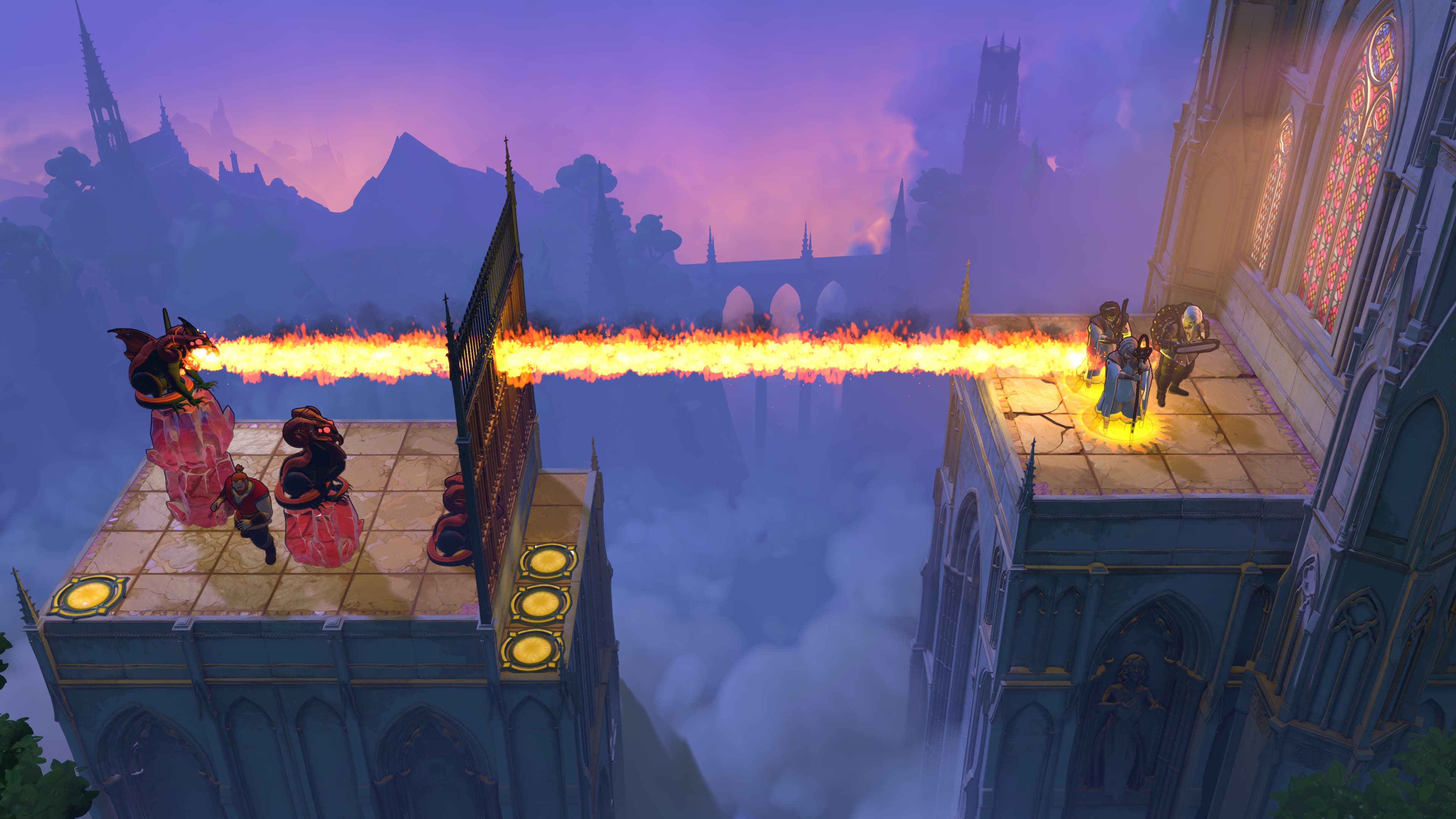
The first phase of the game has four distinct territories with their own characters, stories and gameplay mechanics. One of these realms has a fantasy theme with a warrior character who can push multiple objects that are in a row. His friend, the thief, can only pull objects. The wizard, meanwhile, can teleport and swap positions with objects or other characters. Sometimes, you’ll use multiple characters in a level and swap between them to solve puzzles. There’s a talking boat somewhere, too.

You’ll take what you learn within individual levels into the overworld so you can make progress there. For one thing, the queen can wear a warrior, wizard or thief outfit to adopt their abilities and solve puzzles in the north section of this phase. 

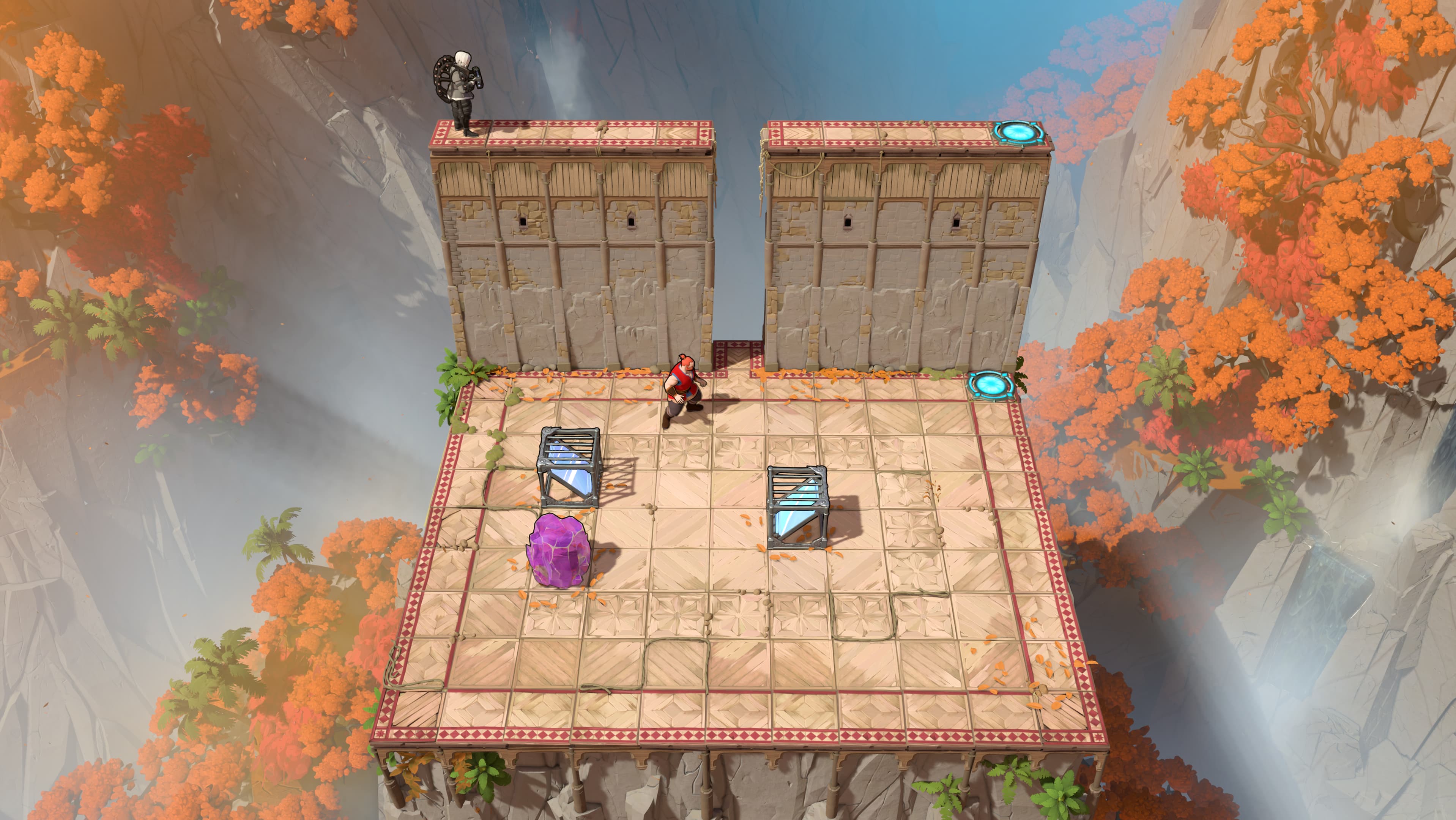
Over in the east, there’s a world with mirror-based puzzles. By positioning the mirrors and where you stand, you’ll use the mirror’s reflection to teleport at a right angle. If your character (or an object) has a reflection in two mirrors, they can be duplicated, which is something you might have to do a few times if a level requires you activate multiple switches at the same time.

Once you near the end of two of the phase one worlds, you can enter one of six gold rooms. In these rooms, which are the gateways to the second phase of Order of the Sinking Star, some of your characters meet each other for the first time. For instance, the guy from The Mirror Isles and the wizard might encounter each other in a gold room and then you can use their combined abilities to solve puzzles. Given that later-game levels combine mechanics from the early stages, they are naturally more complex. Shifting to 3D perspectives will ramp things up too.
Order of the Sinking Star
Thekla/Arc Games

You can tackle the four worlds that make up the first phase in any order. Collectively, they contain “days worth of gameplay,” Blow said. And yet he claimed this first phase accounts for about five percent of the entire game.

All told, there are about 1,400 puzzles, many of which are optional. If you’re a completionist, you’ll need to be pretty dedicated to see this through. Blow estimates that it’ll take around 500 hours for a player to do absolutely everything in the game. 

The overworld has more than 100 screens from which you can jump into individual levels. “All the levels are about ideas. They’re not just random puzzles,” Blow said. “We don’t add puzzles to the game unless they show something cool about how the objects interact. Then, once you see the cool thing, you come back to the overworld, and you navigate from that screen using the cool mechanic that you learned.”

“We” is a key word there, because it’s not as if Blow has been making Order of the Sinking Star by himself for the last decade. His studio, Thekla, has around 10 people working on the game full-time along with another 10 or so part-time contractors. Those who contributed include puzzle game designers Alan Hazelden and Marc ten Bosch. Some members of Blow’s Twitch community who “contributed some idea to one of the levels somewhere” will receive design credits too.

Blow and his team use custom game engines for their projects. Starting in around 2013, he started livestreaming his work on the programming language that Order of the Sinking Star is written in (Thekla will eventually make the engine available for free as an open-source project). “Once I was working on the game, it was a good way to show people what the programming language was about and also how game programming works, and so I would frequently do just streams where we would sit down and implement something,” Blow said. Some of the design work he did on stream ended up in the final game.
Order of the Sinking Star
Thekla/Arc Games

After such a long time of working on Order of the Sinking Star, the end is in sight for Blow and his team. The main focus for the last year or so has been on making sure all of the puzzles align with the overworld. Making art for many hundreds of levels is a major undertaking too, while Blow is still refining the story. 

“Because there’s a lot of these levels and a lot of characters in the levels, it’s just natural for them to talk to each other,” Blow said. “And so what is that dialog and what does it do? Is it just little jokes that don’t add up to anything? Or do you get little peeks into a larger narrative? I think the latter is obviously better. And so that’s my main task between now and release, is making sure that the story is really good.”

Blow had the core concept of having separate worlds with mechanics that work across them in place from the very beginning, though how that worked in practice evolved a lot over time. For instance, the overworld idea wasn’t set in stone from the outset. There was an overworld in place by around 2021, “but it wasn’t organized in the way the current one was. It was just sort of areas smushed together,” Blow said. “At some point, I came up with this concept that it was spatially organized in an almost ritualistic manner or a mathematical manner, whichever way you want to think about it. And we redesigned the overworld from that point, and from then till now, it’s been just sort of a continuous improvement.”

Order of the Sinking Star was originally supposed to be a much smaller game that took around 10 or 20 hours to play, but “it just blew up,” Blow said. “Part of development has just been dealing with that fact. Like, oh, my God, this game took so long to make. It actually feels really good to be here toward the end. We still have a fair bit of work to do before it’s done, but we can see the ending from where we are now, and that’s great.”

This article originally appeared on Engadget at https://www.engadget.com/gaming/ten-years-after-the-witness-jonathan-blows-next-massive-puzzle-game-is-almost-ready-for-primetime-015727378.html?src=rss


Jonathan Blow has spent the past decade designing 1,400 puzzles for you

Back in 2016, after six-and-a-half years spent working on puzzle-adventure opus The Witness, Jonathan Blow says he needed a break. He tells Ars that the project he started in The Witness’ wake was meant to serve as a quick proof of concept for a new engine and programming language he was working on. “It was supposed to be a short game,” that could be finished in “like a year and a half or two years,” he said.

Now, after nine years of development—and his fair share of outspoken, controversial statements—Blow is finally approaching the finish line on that “short game.” He said Order of the Sinking Star—which was announced Thursday via a Game Awards trailer ahead of a planned 2026 release—now encompasses around 1,400 individual puzzles that could take completionists 400 to 500 hours to fully conquer.


Jonathan Blow, seen here probably thinking about puzzles.
Credit:
Thekla, Inc.

“I don’t know why I convinced myself it was going to be a small game,” Blow told me while demonstrating a preview build to Ars last week. “But once we start things, I just want to do the good version of the thing, right? I always make it as good as it can be.”

Read full article

Comments

Coven of the Chicken Foot is the debut game from Naughty Dog alum Bruce Straley’s indie studio

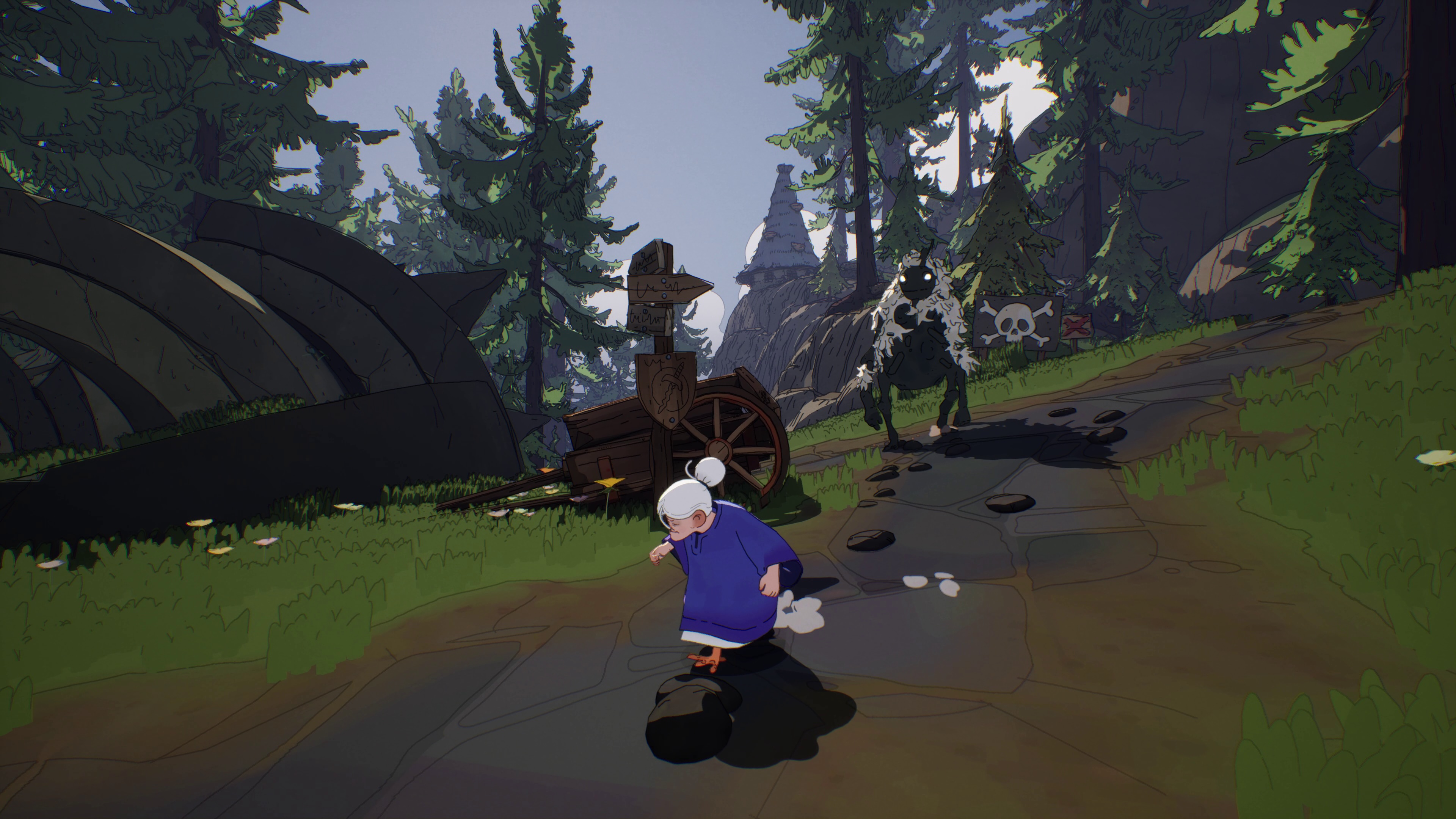
Coven of the Chicken Foot has a lot of things going for it already, in my book. It stars a hero rarely seen in video games, an elderly woman, and it has gorgeous storybook-style art in a lush fantasy setting. It’s a single-player puzzle platformer, it relies on wordless storytelling and the woman, a witch named Gertie, travels with a creepy-cute companion. Plus, Gertie has chicken feet. I love her little chicken feet.

Coven of the Chicken Foot is the first game from Wildflower Interactive, the independent studio founded by Naughty Dog veteran Bruce Straley. The game is coming to Steam and it’s available to wishlist now, though there’s no firm release date. The first trailer for Coven of the Chicken Foot premiered at The Game Awards 2025, showing Gertie and her friend traveling together through caves, forests and temples.

Gertie is on a quest to prove herself to the local coven by standing up to the self-appointed, prideful heroes of the land. She doesn’t have a sword or a dodgeroll, and instead has to figure out how to work with her strange friend to survive. Her companion develops unique behaviors based on individual play styles, shaping how Gertie gets around.

Straley left Naughty Dog in 2017 after almost 20 years with the studio, where he directed The Last of Us and Uncharted 4. He announced Wildflower Interactive in July 2022 with a brief YouTube message, saying, “In 2017 I left the industry not sure if I wanted to make games anymore. But the longer I was away, I kept thinking about this medium, and everything yet to be done and everything I wanted to do still. And this idea kept following me. So I grabbed some friends and we started prototyping.”

This naturally led to the formation of a studio, Straley explained.

“We have to do it the right way,” he said in the video. “It has to be inclusive, equitable and collaborative, full of big-hearted people that want to grow both professionally and personally. The culture needs to be as iterative as the way we make games.”

Coven of the Chicken Foot
Wildflower Interactive

Today Wildflower Interactive has 16 employees from AAA and smaller-scale backgrounds, according to its website. Its mission statement reads as follows:

“We’re making ‘small-ish,’ creatively-charged, uniquely-stylized games that explore the possibilities of our medium. And we’re building a small, open-hearted team of creators that want to improve their skills and still lead a good life outside of work. People that want to hone their craft, have a say in the process, feel respected for their contributions, and be a part of the evolution of this awesome medium.”

I’m not going to say the studio’s direct and repeated emphasis on work-life balance, diversity and compassion is a response to the soulless capitalistic grind built into the AAA development complex, but I’m not going to not say that, either.

This article originally appeared on Engadget at https://www.engadget.com/gaming/pc/coven-of-the-chicken-foot-is-the-debut-game-from-naughty-dog-alum-bruce-straleys-indie-studio-014004553.html?src=rss

AMD ROCm’s TheRock 7.10 Released

TheRock is an interesting open-source build platform for ROCm and HIP that has taken shape over the past year. It’s become an official ROCm effort albeit still in early stages and relying on community contributions for enhancements for different consumer GPU targets and more. To date its users have largely relied on running the latest TheRock Git while today TheRock v7.10 was tagged…

Star Wars: Fate of the Old Republic is a new action RPG from the director of Mass Effect and KOTOR

The Game Awards kicked off with a bang, showing the world premiere of Star Wars: Fate of the Old Republic. It’s a brand new action role-playing game that will be directed by Casey Hudson, who previously headed up several notable BioWare games you probably know like Mass Effect and Star Wars: Knight of the Old Republic.

There’s not much to go on in the trailer, but the game simply existing is a pretty great surprise and this cinematic trailer sure looks shiny. Hudson is working with Arcanaut Studios on this project, which is described as “an epic interactive adventure across a galaxy on the brink of rebirth where every decision shapes your path towards light or darkness.” Which kind of sounds like Star Wars crossed with Mass Effect, and I am personally very excited for that combo.

This article originally appeared on Engadget at https://www.engadget.com/gaming/star-wars-fate-of-the-old-republic-is-a-new-action-rpg-from-the-director-of-mass-effect-and-kotor-012913046.html?src=rss

Over 10,000 Docker Hub Images Found Leaking Credentials, Auth Keys

joshuark shares a report from BleepingComputer: More than 10,000 Docker Hub container images expose data that should be protected, including live credentials to production systems, CI/CD databases, or LLM model keys. After scanning container images uploaded to Docker Hub in November, security researchers at threat intelligence company Flare found that 10,456 of them exposed one or more keys. The most frequent secrets were access tokens for various AI models (OpenAI, HuggingFace, Anthropic, Gemini, Groq). In total, the researchers found 4,000 such keys. “These multi-secret exposures represent critical risks, as they often provide full access to cloud environments, Git repositories, CI/CD systems, payment integrations, and other core infrastructure components,” Flare notes. […]

Additionally, they found hardcoded API tokens for AI services being hardcoded in Python application files, config.json files, YAML configs, GitHub tokens, and credentials for multiple internal environments. Some of the sensitive data was present in the manifest of Docker images, a file that provides details about the image.Flare notes that roughly 25% of developers who accidentally exposed secrets on Docker Hub realized the mistake and removed the leaked secret from the container or manifest file within 48 hours. However, in 75% of these cases, the leaked key was not revoked, meaning that anyone who stole it during the exposure period could still use it later to mount attacks.

Flare suggests that developers avoid storing secrets in container images, stop using static, long-lived credentials, and centralize their secrets management using a dedicated vault or secrets manager. Organizations should implement active scanning across the entire software development life cycle and revoke exposed secrets and invalidate old sessions immediately.


Read more of this story at Slashdot.

Capcom’s Pragmata is coming your way on April 24

Capcom’s long, long-delayed sci-fi shooter Pragmata finally has a release date. It’s headed your way on April 24, 2026 on Steam, PS5, Xbox Series X/S and — as Capcom confirmed in a trailer at The Game Awards — Nintendo Switch 2. You don’t have to wait another four months to try it out, though. A gameplay demo is out now on Steam. It will be available for consoles at a later date.

Pragmata first emerged all the way back in 2020 and Capcom initially planned to release it in 2022. After multiple delays, the game will arrive four years later than the company anticipated.

This is the first entry in a new franchise from Capcom, so taking extra time to get things right is not exactly a bad idea. Pragmata, which is set in a dystopian near-future, features the dual protagonists of Hugh Williams (a heavily armored fella) and Diana (an android with special powers). The two have to work together if they want to escape from a lunar research station that’s filled with malevolent robots. To defeat these clankers, Diana has to hack them to disable their defense systems and make a weak point available for Hugh to attack.

This article originally appeared on Engadget at https://www.engadget.com/gaming/capcoms-pragmata-is-coming-your-way-on-april-24-010826258.html?src=rss

Muzi Unveils Launches Modular BASE Board System for Meshtastic Mesh Networking

Muzi Works, in collaboration with Elecrow, has announced the Meshtastic BASE board system, a modular platform designed for off-grid mesh communication. The lineup includes the Base Uno, Base Duo, and an optional Super IO expansion module, forming a standardized and power-efficient foundation for custom LoRa radios and portable communication devices. The Base Uno and Base […]

Bradley the Badger looks like Wreck-It Ralph as a real video game

A lot of trailers drop during The Game Awards, but the comedy of Bradley the Badger stood out from the pack. The conceit is similar to Wreck-It Ralph. Bradley, the protagonist of a fictional platforming series, is suddenly transported into the worlds of other unfinished video games; the trailer shows a badger-ified Bloodborne, Cyberpunk 2077 and The Last of Us. He also has access to a kit of dev tools that let him modify these incomplete projects, getting a taste of making a game. As the trailer ends, Bradley briefly crosses into the real world and comes face to face with an actual game developer. This looks like it will be a funny and very meta game. Astro Bot made that combo work brilliantly, so here’s hoping Bradley the Badger does too. 

“Bradley is part love letter to videogames and part satire of them,” said Christian Cantamessa, co-founder of Day 4 Night Studios. “Games are an art form and this is a story inspired by our adventures making them.” Cantamessa and fellow co-founder Davide Soliani have some big credits on their resumes, including Red Dead Redemption, Middle-earth: Shadow of Mordor and Mario + Rabbids Kingdom Battle. The titular badger is voiced by Evan Peters, who has been in the recent X-Men movies as well as Tron: Ares.

The team is planning to release the game on Steam, with consoles possibly to follow, but no timeline has been given yet.

This article originally appeared on Engadget at https://www.engadget.com/gaming/bradley-the-badger-looks-like-wreck-it-ralph-as-a-real-video-game-005634520.html?src=rss

VMware Kills vSphere Foundation In Parts of EMEA

Broadcom has quietly pulled VMware vSphere Foundation from parts of EMEA, pushing smaller customers toward far more expensive bundles and prompting some to consider jumping to Hyper-V or Nutanix. The Register reports: VVF is a bundle that offers compute, storage, and networking virtualization, and a platform to run containers. It’s most useful in hyperconverged infrastructure and hybrid clouds, but is less capable than the Cloud Foundation (VCF) private cloud suite. Virtzilla said EMEA customers would need to check with their local dealer to see if VVF was still on sale in their country. “VVF is no longer available in some EMEA countries, but for the majority it is still available,” a Broadcom spokesperson said. “Customers will have to reach out to sales reps or partners to determine availability of a given product in their region. These changes were recent.”

Our initial tipster said their reseller clued them into the impending change when VMware’s new fiscal year started in November. This anonymous customer told us that their hardware fleet boasts thousands of compute cores and without more affordable options, his organization was looking at their annual VMware spend leaping by 10x from around $130,000 to $1.3 million. “We’re currently looking to jump ship to either Microsoft’s Hyper-V or Nutanix, as we can’t eat (that) increase,” they told The Register. […]

For the moment, a Broadcom spokesperson told us it has no plans to ditch VMware vSphere Standard, the basic server virtualization bundle which we’re told makes up about 60 percent of the company’s licenses and is a lower-cost way to access VMware’s hypervisor than buying its full suite of VMware Cloud Foundation products. “We have not announced any changes to the availability of vSphere Standard in EMEA nor end of support for vSphere Standard,” the spokesperson said via email. “The product remains fully available across EMEA today. However, Broadcom product availability can vary by region to align with local market requirements, customer demand, and other considerations.”


Read more of this story at Slashdot.

Trump Signs Executive Order For Single National AI Regulation Framework, Limiting Power of States

President Trump signed an executive order establishing a single federal AI regulatory framework that preempts state-level rules, aiming to centralize oversight of the rapidly growing AI industry. “The Trump administration, with the aid of AI and crypto czar David Sacks, has been pursuing a path that would allow federal rules to preempt state regulations on AI, a move meant to keep big Democratic-led states like California and New York from exerting their control over the growing industry,” notes CNBC.

Developing…


Read more of this story at Slashdot.

Apple (mostly) loses its appeal in Epic Games case

Apple has clawed back a bit of ground in its legal fight with Epic Games that could have wide-reaching consequences for all app developers. Today, the 9th U.S. Circuit Court of Appeals mostly upheld a previous contempt ruling regarding fees Apple levied on third-party payment systems. However, the judges did decide to reverse the order that Apple cannot charge any commissions on those external payments, which was one of the company’s main arguments in this ongoing debate.   

To catch you up, US Judge Yvonne Gonzalez Rogers initially ruled in 2021 that Apple must allow third-party payment systems, although her decision fell shy of calling the tech company’s control over the App Store a monopoly. In May 2025, she ruled that Apple’s 27 percent commission on those outside payments violated her previous order. Apple responded with an emergency motion to appeal that finding. 

Epic Games had taken its smash hit Fortnite off both the Apple App Store and Google Play Store while it was in court arguing these cases. Fortnite returned to iOS in the spring and just arrived back on Android devices today.

This article originally appeared on Engadget at https://www.engadget.com/big-tech/apple-mostly-loses-its-appeal-in-epic-games-case-235509557.html?src=rss

Runway claims its GWM-1 “world models” can stay coherent for minutes at a time

AI company Runway has announced what it calls its first world model, GWM-1. It’s a significant step in a new direction for a company that has made its name primarily on video generation, and it’s part of a wider gold rush to build a new frontier of models as large language models and image and video generation move into a refinement phase, no longer an untapped frontier.

GWM-1 is a blanket term for a trio of autoregression models, each built on top Runway’s Gen-4.5 text-to-video generation model and then post-trained with domain-specific data for different kinds of applications. Here’s what each does.

Runway’s world model announcement livestream video.

GWM Worlds

GWM Worlds offers an interface for digital environment exploration with real-time user input that affects the generation of coming frames, which Runway suggests can remain consistent and coherent “across long sequences of movement.”

Read full article

Comments

Fallout’s ‘Ghoul Log’, A 90-Min Crackling Fire Video With Burning Arm

Presumably having caught nuclear wind that I’m personally excited about the release of season two, this is the 90-minute Fallout ‘Ghoul Log’ video released by Amazon video. It features the Ghoul (Walton Goggins) and Dogmeat settling down in front of a dry aged human arm fire to listen to Mr. New Vegas (Wayne Newton) on the radio. That’s nice. That’s cozy. You got room for one more by the fire, Ghoul? Haha, what do you mean I look like I’d make a fine cut of ass jerky? Is that supposed to be a compliment? You know what, I think I’ll just go back to the vault for Christmas.

UC Berkeley Professor Uses Secret Camera To Catch PhD Candidate Sabotaging Rival

A UC Berkeley professor, suspecting years of targeted computer damage against one Ph.D. student, secretly installed a hidden camera that allegedly caught another doctoral candidate sabotaging the student’s laptop. The student now faces felony vandalism charges and is due for his first court appearance on Dec. 15. The Mercury News reports: A UC Berkeley professor smelled a rat — over the years there had been $46,855 in damage from computers that failed, and nearly all of it seemed to affect one particular Ph.D. candidate at the college’s Electrical Engineering and Computer Sciences department.

The professor wondered if the student’s luck was really that bad, or if something else was afoot. So he installed a hidden camera — disguised in a department laptop, and pointed it at the student’s computer. According to police, the sly move captured another Ph.D. candidate, 26-year-old Jiarui Zou, damaging his fellow student’s computer with some implement that caused sparks to fly out of the laptop.

Now, Zou has been charged with three felony counts of vandalism, related to the destruction of three computers on Nov. 9-10. The charges allege the damage amounted to more than $400 each time, though the professor who reported the vandalism, and the affected student, told police they suspect Zou of the additional incidents that had been going on for years, court records show.


Read more of this story at Slashdot.