Zwift Racing League Week 1 Guide: Neon Shore Loop (TTT)

The first race of Zwift Racing League 2025/26 Round 3 happens Tuesday, January 6, and it’s a team time trial on a new Makuri Islands route.

This is the flattest race of round 3, so enjoy it while you can, pure-power riders… the climbs are coming!

Let’s dig into this new course and look at bike selection and more!

Looking at the Route: Neon Shore Loop

Neon Shore Loop is a brand-new route in Makuri Islands… so new, in fact, that none of us have raced it yet! It was created just for ZRL, and unless you take advantage of one of the recons held the weekend before the race, the first time you see this route will be during your TTT.

Of course, that doesn’t mean everything about this route is new. It’s made up of roads most of us have already raced, after all. They’re just arranged in a slightly different fashion than we’ve ridden them in the past.

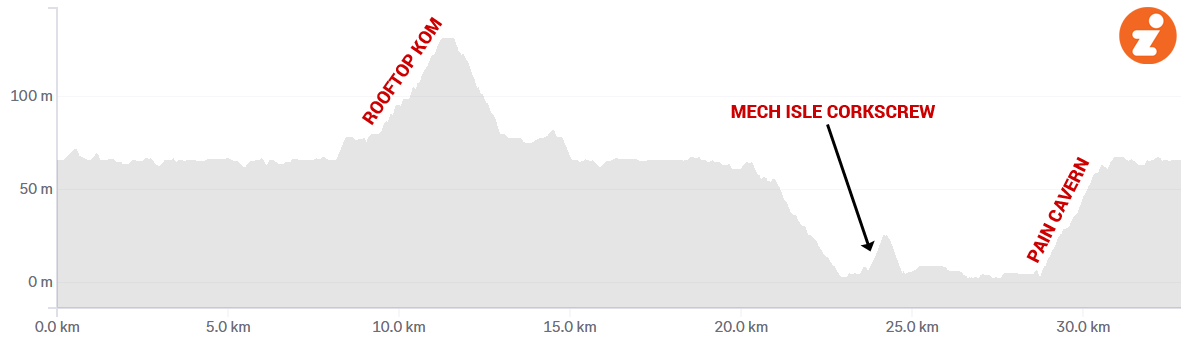
At 34.1 kilometers in length, with 258 meters of climbing, this is the flattest race of Round 3. Like most routes in the Neokyo/Urukazi areas of the Makuri Islands map, this route is quite flat, apart from a couple of key climbs of similar length. Here’s the route profile, not including the 1.1-km lead-in:
Let’s break this route into key sections:

  • Flat Start (first 9.2 km): Settle into your team rotation and keep those watts high.
  • Ramp Up to 2nd Level @9.2 km (200 meters long): This quick ramp up to the elevated road is short enough that you can hit it hard, keep your speed up, then recover a bit on the short flat before the Rooftop KOM begins.
  • Rooftop KOM @10.5 km (1.9km, 2.7%): This climb isn’t particularly long or steep, and it is certainly very draftable. The first 2/3 of this climb is a series of stair-steps which pitch up then flatten out continually, keeping pack speeds high. Then there’s one final ~700m steady climb to the line before the road flattens in the final 50m.
  • Descents and Flats @12.5-24.8 km: Heavier riders, settle in and enjoy the longest section of the race without any climbing! This takes you out of Neokyo and down the Slot Canyon to the base of the Mech Isle Corkscrew.
  • Mech Isle Corkscrew @24.8 km (500 meters, 3.6%): This dirt climb isn’t long or steep, but since it’s dirt, it’ll be slow due to increased Crr. The harder you can push, the better. Remember, in a time trial, you want go harder when you’re going slower!
  • Descents and Flats @25.3-29.8 km: Several more minutes of descent or flats will let your legs recover a bit for the final Pain Cavern climb back to Neokyo level.
  • Pain Cavern @29.8 km (2.1 km, 3%): This will be the toughest climb of the day, since you’re near the end of the race and legs are tired. Again, you’ll want to push hard here, as speeds will be slow.
  • Finishing Flats @31.9 km to finish: Once you’re out of the Cavern, it’s a flat run-in to the finish at the Alley Sprint arch. Get back into formation and empty those tanks!

Read more about the Neon Shore Loop route >

Bike Frame + Wheel Choice

Bike choice here is simple: go aero. On a route like this, where the roads is mostly flat or downhill, and the only climbs are short and slack, weight simply doesn’t matter enough to trade it for aero performance. Aero is everything! The best setup by far is the CADEX Tri frame paired with the DT Swiss Disc wheels, but you’ll need to be at level 40+ to access this sweet rig:
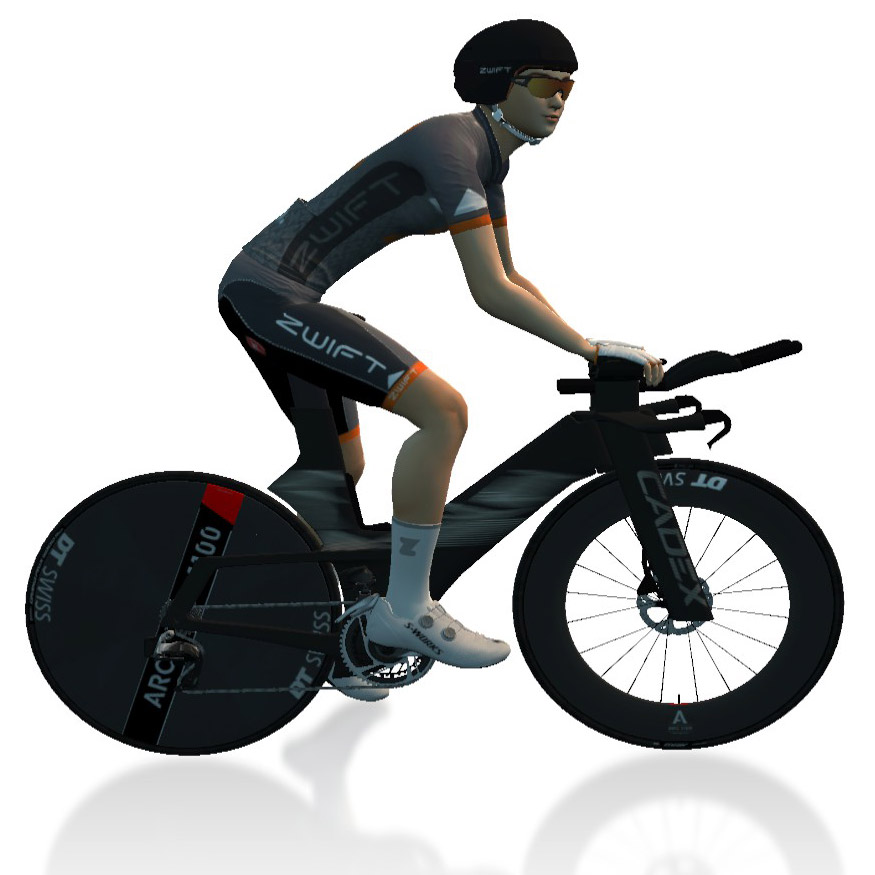
CADEX Tri + DT Swiss Disc wheels

If you don’t have access to this setup, check out “Fastest TT Bike Frames and Wheels at Each Zwift Level” and use the fastest TT frame and wheelset available at your level.

One more note on bike choice: upgrading your frame makes a big difference. A fully upgraded frame saves around 13 watts, or ~48 seconds per hour of riding. Read all about the performance improvements you receive from upgrades here.

More Route Recons

Many recon rides are planned each week on the upcoming ZRL route. If you’re unfamiliar with this course, jump into an event and familiarize yourself with the route! Find a list of upcoming ZRL recon rides at zwift.com/events/tag/zrlrecon.

Additionally, riders in the Zwift community do a great job every week creating recon videos that preview the courses and offer tips to help you perform your best on the day. I’ll add recons below as I find them, but please comment if you find a useful one that isn’t yet listed!

TTTips

Successful team time trialing on Zwift requires a challenging combination of physical strength, proper pacing, and Zwift minutiae like picking a fast bike, understanding drafting in a TTT context, and getting your frame fully upgraded.

Flatter courses like this week give valuable seconds to teams with big pure-power riders who can keep their power high on the front while staying in single-file formation to conserve in the draft behind. Extra seconds can also be gained by pacing smartly, ramping up the effort on short climbs and recovering a bit once you’re up to speed on the short descents.

On a course like this week’s, I recommend all team members set their Trainer Difficulty to the same value so you’re all feeling the gradient changes similarly. (When one rider has it set to 100% and another 25%, the first rider may ramp up power much more than the second when a climb hits, which can make a mess of your team formation.)

Your goal in a ZRL TTT is to get four riders across the line in the shortest time possible. That means every team’s pace plan will differ based on each rider’s abilities. I highly recommend having an experienced DS on Discord directing your team, especially if your team contains some inexperienced TTT riders.

Lastly, if you want to go further down the TTT rabbit hole, I highly recommend Dave Edmond’s Zwift TTT Calculator tool.

Questions or Comments?

Share below!

Some Meaningful Performance Benefits For Clang + LTO Built Linux Kernels

Over the past few years building the Linux kernel with Clang has matured a lot thanks to upstream improvements to both LLVM/Clang and the Linux kernel. As it’s been a while since our last comparison for GCC vs. Clang built kernels on the resulting system performance, our latest year-end 2025 benchmarking is providing a fresh look at the Linux 6.19 upstream Git kernel built under the latest stable GCC 15 and LLVM Clang 21 compilers. Plus with the Clang-built kernel is also the option of the Link-Time Optimized (LTO) kernel for even greater performance.

Samsung unveils its new $200 Galaxy A17 5G smartphone, arriving in January

Samsung will have two new inexpensive mobile devices arriving on the US market next month. The Galaxy A17 5G starts at $199 and will be available on January 7. Arriving on January 8, the Galaxy Tab A11+ will retail for $250. 

The Galaxy A17 5G has a 6.7” FHD+ Super AMOLED display and is powered by the same Exynos 1330 chip found in the Galaxy A16 5G. The photography setup is also unchanged from last year’s model, with a 50MP main camera, 5MP ultrawide, 2MP macro and 13MP selfie lenses. The base model has 4GB of RAM and 128GB of storage, but can be upgraded with up to 2TB of additional storage via microSD. Its 5,000mAh battery also supports fast-charging, a feature we’re happy to see becoming more of an industry standard this year. Essentially, this is more of the same from Samsung, but this product line has a solid legacy of decent smartphones that don’t break the bank. Don’t be surprised if this joins our lineup of best budget Android phones come 2026.

The other new entry-level device is the Galaxy Tab A11+, which boasts an 11-inch LCD display. The rear camera is 8MP and the front one is 5MP. It has an option for 6GB of RAM with 128GB in storage, or for 8GB of RAM and 256GB of storage. Like with the Galaxy A17 5G, the tablet can also be juiced up with additional microSD storage. Performance-wise, you’ll top out at 15 hours of video playback on the battery, but fast-charging is also supported here. There are many swankier tablets on the market these days, but if you’re looking for a bare-bones option, this Samsung offering is a solid consideration.

This article originally appeared on Engadget at https://www.engadget.com/mobile/smartphones/samsung-unveils-its-new-200-galaxy-a17-5g-smartphone-arriving-in-january-184846560.html?src=rss

Condé Nast User database reportedly breached, Ars unaffected

Earlier this month, a hacker named Lovely claimed to have breached a Condé Nast user database and released a list of more than 2.3 million user records from our sister publication WIRED. The released materials contain demographic information (name, email, address, phone, etc.), but no passwords.

The hacker also says that they will release an additional 40 million records for other Condé Nast properties, including our other sister publications Vogue, The New Yorker, Vanity Fair, and more. Of critical note to our readers, Ars Technica was not affected as we run on our own bespoke tech stack.

The hacker said that they had urged Condé Nast to patch vulnerabilities to no avail. “Condé Nast does not care about the security of their users data,” they wrote. “It took us an entire month to convince them to fix the vulnerabilities on their websites. We will leak more of their users’ data (40 + million) over the next few weeks. Enjoy!”

Read full article

Comments

New York’s MetroCard Era Ends After 31 Years

After more than three decades of service, New York City’s iconic MetroCard is about to retire, as December 31, 2025 marks the final day commuters can purchase or refill the gold-hued plastic cards that replaced subway tokens back in 1994. The Metropolitan Transportation Authority has been transitioning to OMNY, a contactless payment system introduced in 2019 that lets riders tap a credit card, phone or smart device at turnstiles.

More than 90% of subway and bus trips are now paid using the tap-and-go system, and the agency says the changeover saves at least $20 million annually in MetroCard-related costs. The new system also introduces automatic fare capping: riders get unlimited travel within a seven-day period after 12 paid rides, maxing out at $35 a week once fares rise to $3 in January. Riders who prefer not to link a credit card or phone can purchase reloadable OMNY cards.

Existing MetroCards will continue to work into 2026, allowing riders time to use up remaining balances. The MetroCard’s arrival in 1994 was itself a significant shift from the brass tokens that had been in use since 1953. London and Singapore have long operated similar contactless systems; San Francisco launched its own tap-to-pay system earlier this year, joining Chicago and other U.S. cities.


Read more of this story at Slashdot.

PlayStation 6 & Next-Gen Xbox Face Possible Delay Amid DRAM Crisis

PlayStation 6 & Next-Gen Xbox Face Possible Delay Amid DRAM Crisis
No one is safe from RAMmageddon, including gaming console manufacturers. According to a recent report, console manufacturers are debating whether next-gen devices should be delayed to post 2027-2028, breaking the common 7-year cadence between console generations. If the rumors circulating about next-generation consoles and their gratuitous

The Problem With Letting AI Do the Grunt Work

The consulting firm CVL Economics estimated last year that AI would disrupt more than 200,000 entertainment-industry jobs in the United States by 2026, but writer Nick Geisler argues in The Atlantic that the most consequential casualties may be the humble entry-level positions where aspiring artists have traditionally paid dues and learned their craft. Geisler, a screenwriter and WGA member who started out writing copy for a how-to website in the mid-2010s, notes that ChatGPT can now handle the kind of articles he once produced.

This pattern is visible today across creative industries: the AI software Eddie launched an update in September capable of producing first edits of films, and LinkedIn job listings increasingly seek people to train AI models rather than write original copy. The story adds: The problem is that entry-level creative jobs are much more than grunt work. Working within established formulas and routines is how young artists develop their skills. The historical record suggests those early rungs matter. Hunter S. Thompson began as a copy boy for Time magazine; Joan Didion was a research assistant at Vogue; directors Martin Scorsese, Jonathan Demme, and Francis Ford Coppola shot cheap B movies for Roger Corman before their breakthrough work. Geisler himself landed his first Netflix screenplay commission through a producer he met while making rough cuts for a YouTube channel. The story adds: Beyond the money, which is usually modest, low-level creative jobs offer practice time and pathways for mentorship that side gigs such as waiting tables and tending bar do not. Further reading: Hollow at the Base.


Read more of this story at Slashdot.

Seven Clever Ways to Use C-Clamps Around the House

We may earn a commission from links on this page.

If you’ve been doing any kind of work around any kind of house for a while, you probably have a few trusty old-school C-Clamps on hand. The C-Clamp has been in use for thousands of years. It’s one of those dead-simple tools that just works. It’s also one of those tools you tend to collect multiple examples of, in different sizes.

Typically, you use a C-Clamp to, uh, clamp stuff together, like two pieces of wood, or to clamp something into place while you work on it (I use them a lot to cut lumber so I can have both hands on the saw, as I am allergic to emergency rooms.) But the C-Clamp is actually a very versatile tool that can be deployed in a number of creative—but useful!—ways. Here are some of my favorite ways to repurpose those old C-Clamps.

A carrying handle

If you need to carry something that’s bulky, heavy, and awkward, having some temporary handles always makes the job easier. If you have a few C-Clamps, you’re golden: Just clamp a couple onto whatever you’re transporting and you have instant handles to make the haul a little easier. They can also be used as handles for rolled-up materials, like rugs or mats—just thread the roll through a pair of C-Clamps, tighten them closed, and carry on.

A quiet hammer

It’s happened to all of us: You need to drive a nail somewhere, but there’s no room to swing a hammer, or for some reason you’re reluctant to make a lot of banging noise. The solution is your trusty C-Clamp: Just place the clamp over the nail head and tighten. The clamping action will inexorably (and silently) drive that nail into place. This isn’t an efficient way to drive a lot of nails, of course, but in a tight spot, it’s brilliant.

An emergency wrench

Need to tighten or loosen a connector, but you don’t have a wrench at hand? Tighten a C-Lamp around the bolt, cuff, or connection point so that it’s gripping tightly, then slowly turn it in the direction you need. Make sure the clamp is tight enough to prevent slippage, and you might want to use something (a handy piece of cloth works) to protect the connection from damage as you work.

A cord organizer

Whether it’s corralling all those extension and power cords on a workbench or work site, or organizing computer cables on your desk with an industrial vibe, C-Clamps can keep all those wires under control and out of your way in a pinch. Just gather the cords at the edge of the desk or table and clamp them down. This is a perfect temporary solution, as the cords can pass freely through the clamps without risk of damage, and the clamps can be removed when the job is done.

Bookends

Need a couple of bookends to hold stuff in place on a shelf? A pair of C-Clamps attached to the outer edge and clamped in as deep as possible will work. This could even be a permanent design choice if your taste runs toward the rustic or industrial.

Anchors

C-Clamps are ideal devices when anchor points are needed, but you don’t want to attach anything permanent that would require fasteners and drilling into a structure. Need a clothesline to dry your laundry when the dryer breaks? Two C-Clamps and some rope or twine are all you need. Need to hang tools, clothes, or anything else? C-Clamps attached to a shelf of any kind, combined with a hook, will work a charm. Need to hold a tablecloth or other covering in place? Nothing clamps stuff down to a horizontal surface better than C-Clamps.

Spool holder

Whether you’re spooling filament to your 3D-printer or feeding twine or wire to yourself as you work on a project, sliding the spool over a C-Clamp and then clamping it into place gives you a sturdy holder that you can pull from. This means you won’t have to juggle your spool every time you need more slack, and you can easily unclamp and reposition the spool if you’re on the move as you work.

Malaria Shows No Sign of Stopping

The World Health Organization’s latest annual malaria report paints a grim picture that’s about to get grimmer, as the United States — which has supplied 37% of global malaria funding since 2010 — pulls back its international health commitments under President Donald Trump. Malaria cases have been climbing since 2015, when progress against the mosquito-borne disease stalled due to insecticide resistance and chronic underfunding.

In 2024, the world recorded 282 million cases and 610,000 deaths, and African countries accounted for 95% of both figures. Children under 5 made up 75% of malaria-related deaths in Africa. Global spending on malaria reached $3.9 billion last year.

Trump’s decision to slash international public health funding and gut the US Agency for International Development has caused what the WHO calls “widespread disruption to health operations around the world.” The burden of these setbacks, the organization adds, is expected to fall disproportionately on children. Seventeen countries now offer malaria vaccines to younger populations, up from three countries the year before, but funding constraints mean many countries still can’t provide the shots.


Read more of this story at Slashdot.

Netflix has released a trailer for the Stranger Things finale

Tomorrow’s the big day, and I don’t just mean New Year’s Eve. The series finale of Stranger Things airs tomorrow, and Netflix has released a trailer for the last episode. We’re given only flashes of the final episode, along with a voiceover of an emotional Jim Hopper telling Eleven he needs her to fight one last time.

It’s just over 1 minute and 30 seconds long, with what appears to be only about 30 seconds of new footage. There isn’t much to go on here, as most of the footage features emotional moments from seasons past. Netflix no doubt is hoping to keep much of the excitement under wraps until tomorrow’s premiere.

Warning: Some spoilers ahead for Stranger Things season 5.

Among the new images we briefly see Vecna, hooked up to the ceiling in his gross cave of power on his other world. There’s also an explosion at what looks like a military site, plus a few more out-of-context flashes of our heroes.

One particularly ominous moment shows Hopper walking around a smoke-filled room with almost zero visibility, gun drawn, when we see what looks to be Vecna appear behind him. We also see Eleven climb back into the sensory-deprivation tank in the Upside Down, presumably to take the fight to the show’s big bad.

The only continuous scene in the trailer shows most of the gang standing atop a radio tower as Vecna’s world moves close enough to collide with the tower’s tip. Dustin lets out a “mother of God” as the so-crazy-it-just-might-work scheme the group cooked up in Chapter Seven appears to be well underway.

After nine years and five seasons, we will finally reach a conclusion for the heroes of Hawkins. The episode premieres at 8PM ET (5PM PT). For those still craving more from the world of Hawkins after the finale, Netflix is releasing a Stranger Things animated series in 2026.

This article originally appeared on Engadget at https://www.engadget.com/entertainment/streaming/netflix-has-released-a-trailer-for-the-stranger-things-finale-171204480.html?src=rss

TCL Is Launching a Digital Notebook, and It’s Like a Smoother Kindle Scribe Colorsoft

When it comes to digital note taking, you usually have two choices: Do you want E Ink, or do you want speed? Devices like the Kindle Scribe Colorsoft and the Remarkable Paper Pro have shown there’s definitely an appetite for E Ink note taking, even if it can be a bit laggy. But for the most responsive digital notebook possible, you usually have to settle for something like an iPad with a stylus. Now, TCL wants to change that.

The budget-friendly tablet and TV company has finally announced its first full-fledged digital notebook: the TCL Note A1 NXTPAPER. Launching on Kickstarter soon and releasing sometime in February, the trick here is a clever one: Notes taken on this device should look like they’re written on paper, but the screen is as fast as a gaming monitor.

That’s thanks to the company’s NXTPAPER technology, which isn’t exactly new, but has been positioned in the past more for media consumption than creation. Unlike E Ink, which uses physical ink capsules embedded in the display, NXTPAPER uses a standard LCD screen with a matte, glare-free coating and various levels of blue light and reflection-fighting software to simulate paper.

The result—which I can speak to, having gone hands-on with it over multiple CES showcases—isn’t exactly as easy on the eyes as E Ink, but it is convincing, and is far more usable for just about everything that isn’t just reading plain text. Considering how slow E Ink updates and how limited it is in displaying colors, that’s not a bad compromise. Plus, the matte layer also acts a bit like one of those special screen protectors artists will buy to make drawing on a tablet feel more like drawing on paper. It works well enough for my chicken scratch.

The Note A1 NXTPAPER runs Android, has an 11.5-inch screen that’s been TUV-certified for eye comfort, and can display 16.7 million colors and refresh at 120Hz (or up to 120 frames per second). Given that the Kindle Scribe Colorsoft can only display around 4,100 colors and has a 12-14 ms response time between inputs and updating the display, that’s not bad.

And since there’s Android here, you get a few other bonuses as well, like the ability to cast your notes or Powerpoints to a digital whiteboard. TCL hasn’t said if the Note A1 will be certified for the Play Store yet, but if so, it’ll also be easy to download any note taking apps you want, as well as additional goodies like comic book apps. With the high refresh rate, you could even use this notebook to watch videos.

As for what sets this apart from TCL’s other NXTPAPER tablets, there’s a stylus included, native support for file formats ranging from Word to PDF to Excel to EPUB, and connectivity for cloud storage services like Dropbox, OneDrive, and Google Drive. Plus, if you haven’t guessed from the name, there are a bunch of AI features.

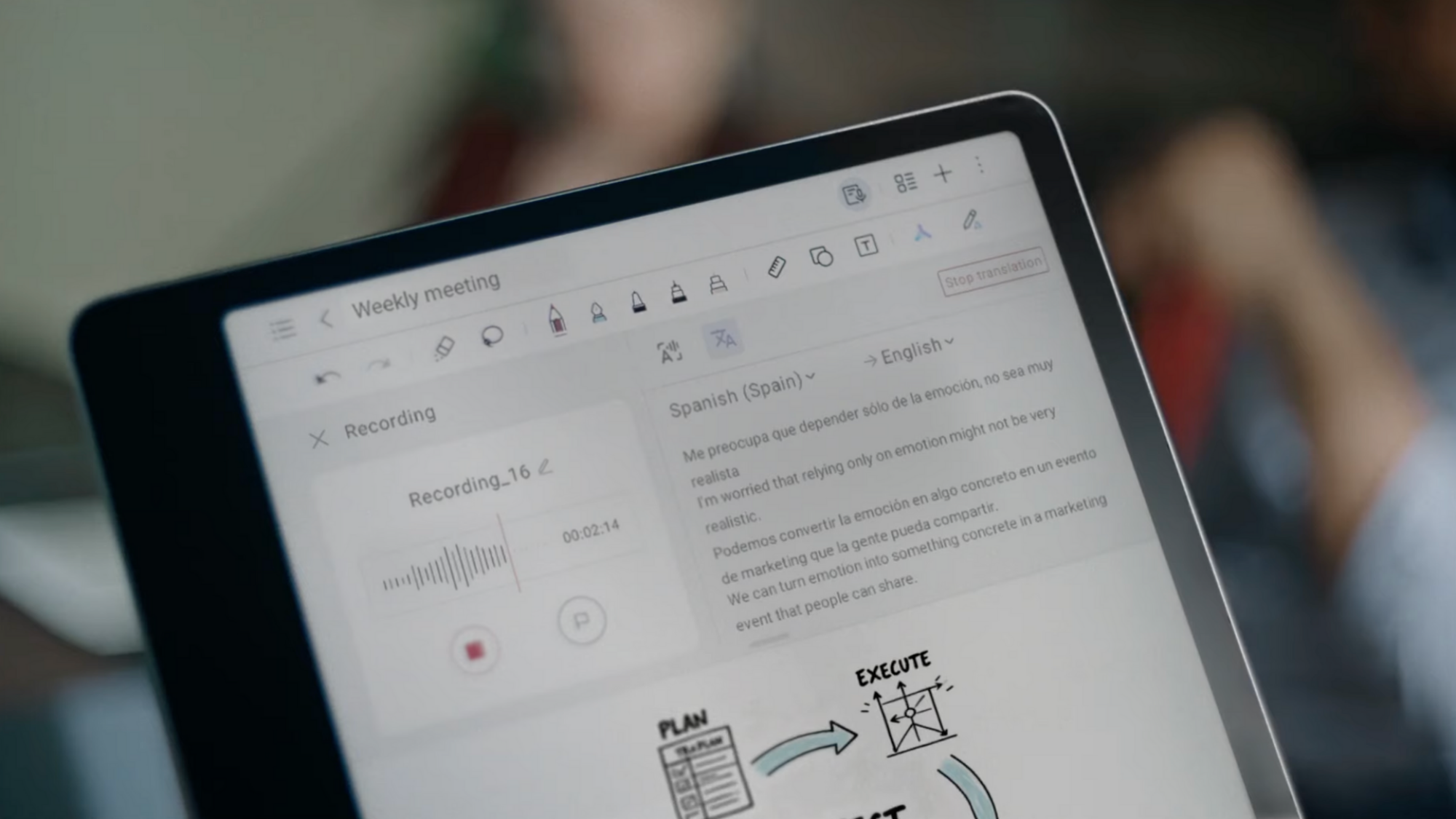
Translation on the TXL Note A1 NXTPAPER

Credit: TCL

Much like the Viwoods AIPaper, the Note A1 has AI transcription, translation, summarization, rewriting, and handwriting-to-text features built-in. TCL hasn’t said how these will work yet, but a brief video of the device in action shows small glimpses. Personally, I’m most interested in the “handwriting beautification” feature, and I could see people who like doing math longhand appreciating the “handwritten formula recognition.”

The downside to all of this is that traditional screens don’t tend to last nearly as long in between charges as E Ink ones, but with an 8,000mAh battery, TCL is hoping it can avoid that, even if it has yet to reveal official battery life numbers.

When it launches, the TCL NXTPAPER will start at $549, as compared to the Kindle Scribe Colorsoft’s and Remarkable Paper Pro’s $630. That’s a pretty significant savings, and seems worth considering, especially if you can’t decide between E Ink and LCD. It won’t be quite as easy on the eyes as a Kindle, but it could be far less frustrating for fast writers, while still feeling less computer-y than something like an iPad.

Nepal To Scrap ‘Failed’ Mount Everest Waste Deposit Scheme

A scheme to encourage climbers to bring their waste down from Mount Everest is being scrapped — with Nepalese authorities telling the BBC it has been a failure. From the report: Climbers had been required to pay a deposit of $4,000, which they would only get back if they brought at least 8kg (18lbs) of waste back down with them. It was hoped it would begin to tackle the rubbish problem on the world’s highest peak, which is estimated to be covered in some 50 tonnes of waste. But after 11 years — and with the rubbish still piling up — the scheme is being shelved because it “failed to show a tangible result.”


Read more of this story at Slashdot.

Apple Watch Series 11 Deal Slashes $100 Off Just In Time For 2026

Apple Watch Series 11 Deal Slashes $100 Off Just In Time For 2026
Talk about a *ahem* timely deal! We’re about to embark on a new year and if your resolution for 2026 is to fashion yourself into a new YOU with a focus on fitness, than a smartwatch can be a wise and useful investment to help reach your goals. And if you’ve been thinking about getting the latest-generation Apple Watch, you can save some money

Camera Makers Went Weird in 2025 – and That’s Exactly What the Shrinking Industry Needed

The camera industry shipped 6.5 million interchangeable lens cameras last year — a 50% decline from 2010’s peak — yet 2025 may have been the most creatively ambitious year in nearly two decades of digital photography. DPReview’s Richard Butler argues that this year’s releases displayed “invention, experimentation and niche-tickling lunacy” not seen since digital’s earliest days.

Interchangeable lens shipments rose 11% in the first ten months of 2025 compared to last year, and fixed lens cameras climbed roughly 26%. The practical cameras arrived as expected: Panasonic’s S1 II, Canon’s EOS R6 III, and Sony’s a7 V all delivered performance that “can go toe-to-toe with the pro sports models of just a few years ago.” But the stranger releases drew attention.

Sony’s RX1R III faced criticism for being a “lazy update,” yet Butler found it “small, fun to use and the pictures look great.” Leica launched the Q3 Monochrom, a $7,800 fixed-lens full-frame compact that cannot capture color. Fujifilm’s X half targeted young buyers who might otherwise hunt for vintage compacts on eBay. The Sigma BF abandoned traditional camera design entirely — no viewfinder, one dial, intentionally stylized.

“Look at some of this year’s releases through a pragmatic lens of whether they’re the best tool for the job, and the conclusion you’d typically draw is ‘no,'” Butler wrote. These cameras “aren’t trying to be the best, the most flexible or the most practical. They’re intentionally, knowingly niche.”


Read more of this story at Slashdot.