Coursera announced on Wednesday that it will acquire rival online learning platform Udemy in an all-stock deal that values the combined company at $2.5 billion, a move that brings together two of the largest U.S.-based players in an industry that has struggled since pandemic-era enrollment highs faded. Under the terms of the agreement, Udemy shareholders will receive 0.8 shares of Coursera for each share they hold, valuing Udemy at roughly $930 million. Based on Coursera’s last closing price, the offer works out to $6.35 per Udemy share, an 18.3% premium. The deal is expected to close in the second half of next year, pending regulatory and shareholder approvals.
The two companies are betting that a combined platform will be better positioned to pursue corporate customers seeking to retrain workers in artificial intelligence, data science and software development. Coursera has built its business on partnerships with universities and institutions to offer degree programs and professional certificates, while Udemy operates a marketplace where independent instructors sell courses directly to consumers and businesses. Both stocks have significantly underperformed this year. Udemy shares have fallen about 35% and Coursera is down roughly 7%, leaving both trading well below their post-IPO highs as investors remain cautious about competition and pricing pressure in the sector.
Uber and DoorDash are challenging a forthcoming NYC law that encourages tipping on food-delivery apps, as reported by The New York Times. The two entities have filed a joint federal lawsuit just ahead of the ruling going into effect next month.
Back in 2023, many food delivery apps in the city moved the tip suggestion box to after purchases had been completed. This is sort of how rideshare apps work. It followed NYC mandating a minimum pay rate for food delivery workers, the first in the country. The new law simply switches the tip suggestion box back to checkout, with a suggestion of ten percent. Customers are still free to set it to zero, if that’s their thing.
The two companies say this law violates the First Amendment by requiring them to “speak a government-mandated message.” They also say the rule would cause customers to use the app less because they were suffering from “tipping fatigue.” As a customer of food delivery apps, I am not stricken with tipping fatigue. I have, however, come down with a serious case of “what are all of these mysterious fees on my bill and why is my burrito $45?” fatigue.
NYC food delivery workers have experienced a sharp decline in tips since the apps switched the suggestion field to after a purchase has been completed. It’s extremely easy to ignore an app notification while in a food coma on the couch.
“Removing the tipping option is to keep workers in poverty and make them depend on taking more orders,” said Ligia Guallpa, co-founder of Workers Justice Project.
Food delivery in the city is still booming. New Yorkers spent more than $265 million on restaurant deliveries in the first half of 2025, which is up from $183 million during the same period in 2022. Current estimates suggest that there are around 80,000 delivery workers in NYC.
This particular law became a small part of the city’s recent mayoral campaign. Mayor-elect Zohran Mamdani said during the campaign that he supported giving customers the option to tip at checkout. DoorDash donated $1 million to his rival, former Gov. Andrew Cuomo.
This article originally appeared on Engadget at https://www.engadget.com/big-tech/uber-and-doordash-challenge-nyc-law-that-encourages-tipping-163315375.html?src=rss
Google is suing a Chinese-speaking cybercriminal group it says is responsible for a massive wave of scam text messages sent to Americans this year, according to a legal complaint filed Tuesday. From a report: The group, known as Darcula, sells software that allows users to send phishing text messages en masse, impersonating organizations like the IRS or the U.S. Postal Service in scams. The lawsuit is designed to give Google legal standing so U.S. courts will allow it to seize websites the group uses, hampering their operations, a spokesperson said.
Darcula is possibly the most prominent name in an emerging, loosely affiliated cybercrime world that creates and sells hacking programs for aspiring scammers to use. Darcula’s signature program, called Magic Cat, provides an easy-to-use, intuitive way for cybercriminals without advanced hacking skills to quickly spam millions of phone numbers with links to fake websites impersonating businesses like YouTube’s premium service, then steal the credit card numbers victims put in.
On Tuesday, the head of the Office of Management and Budget, Russell Vought, announced that a major climate research center will be “broken up.” The National Center for Atmospheric Research, or NCAR, is a significant contributor to research on the weather, climate, and other atmospheric phenomena. The move will be a crippling blow to climate research in the US and is being widely decried by scientists.
Vought initially gave a statement regarding NCAR to USA Today and later confirmed the outlet’s reporting on social media. Calling it “one of the largest sources of climate alarmism in the country,” Vought also decried what he termed “woke” activities at NCAR. These appear to be fairly typical efforts made to attract underrepresented groups to the sciences—efforts that were uncontroversial prior to the current administration.
NCAR is primarily based in a complex on the outskirts of Boulder, Colorado, and maintains a supercomputing center in Wyoming. Much of its funding comes from the National Science Foundation, but the day-to-day management is handled by the University Corporation for Atmospheric Research (UCAR), a nonprofit that represents 130 individual educational institutions. In addition to climate science, researchers based there study Earth and space weather, atmospheric chemistry, and their impacts on the environment and humans. NCAR hosts a series of webpages that explain its research and all the ways it helps society.
The Asahi Linux project has published
its progress report following the release of Linux 6.18. This time
around the project reports progress on many fronts, including
microphone support for M2 Pro/Max MacBooks, work queued for Linux 6.19
to support USB3 via the USB-C ports, and work to improve the Asahi
Linux installation experience. The project is also enabling as
additional System Management Controller (SMC) drivers, which means
that “the myriad voltage, current, temperature and power sensors
controlled by the SMC will be readable using the standard hwmon
interfaces“.
Google began its transition to Gemini 3 a few weeks ago with the launch of the Pro model, and the arrival of Gemini 3 Flash kicks it into high gear. The new, faster Gemini 3 model is coming to the Gemini app and search, and developers will be able to access it immediately via the Gemini API, Vertex AI, AI Studio, and Antigravity. Google’s bigger gen AI model is also picking up steam, with both Gemini 3 Pro and its image component (Nano Banana Pro) expanding in search.
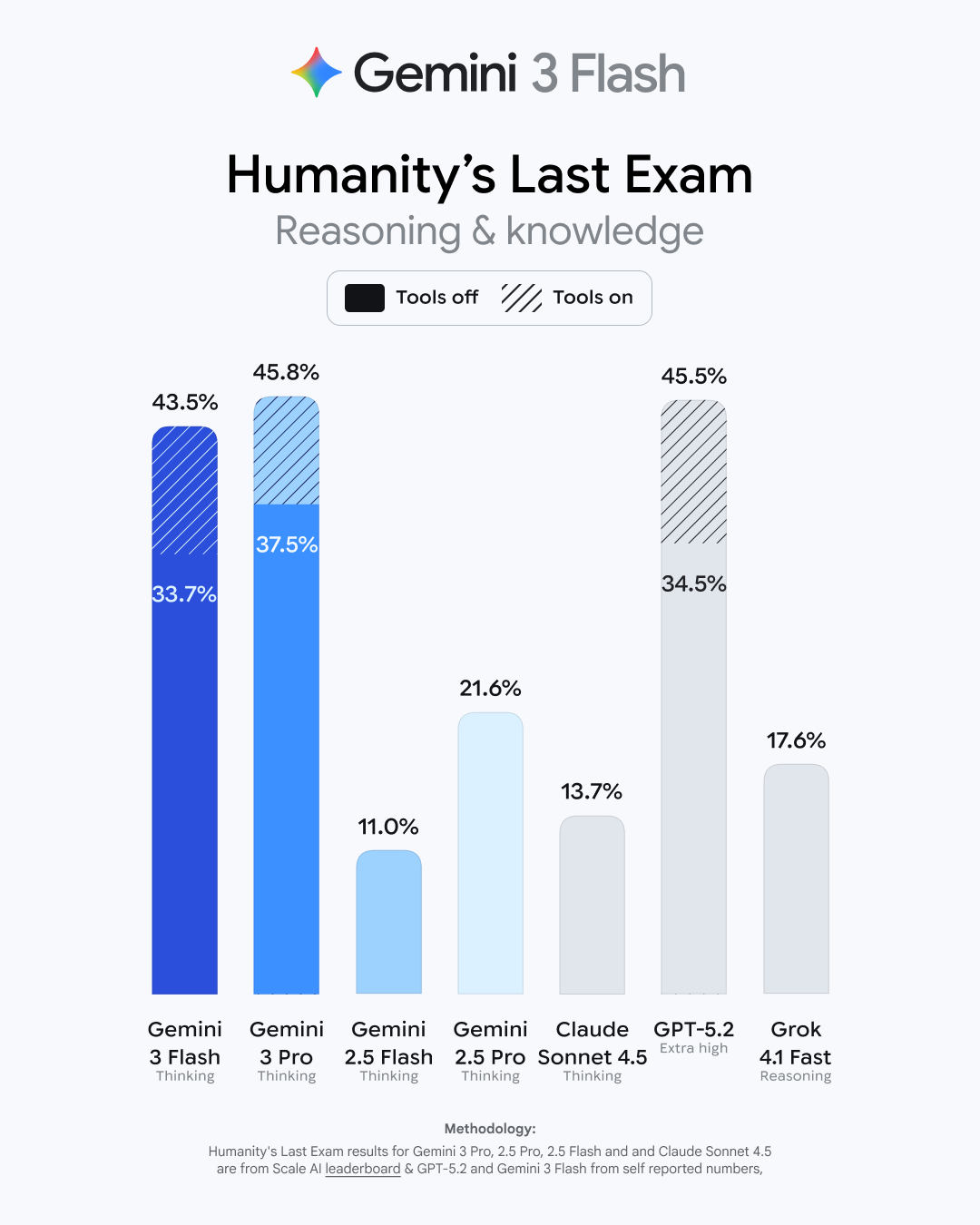
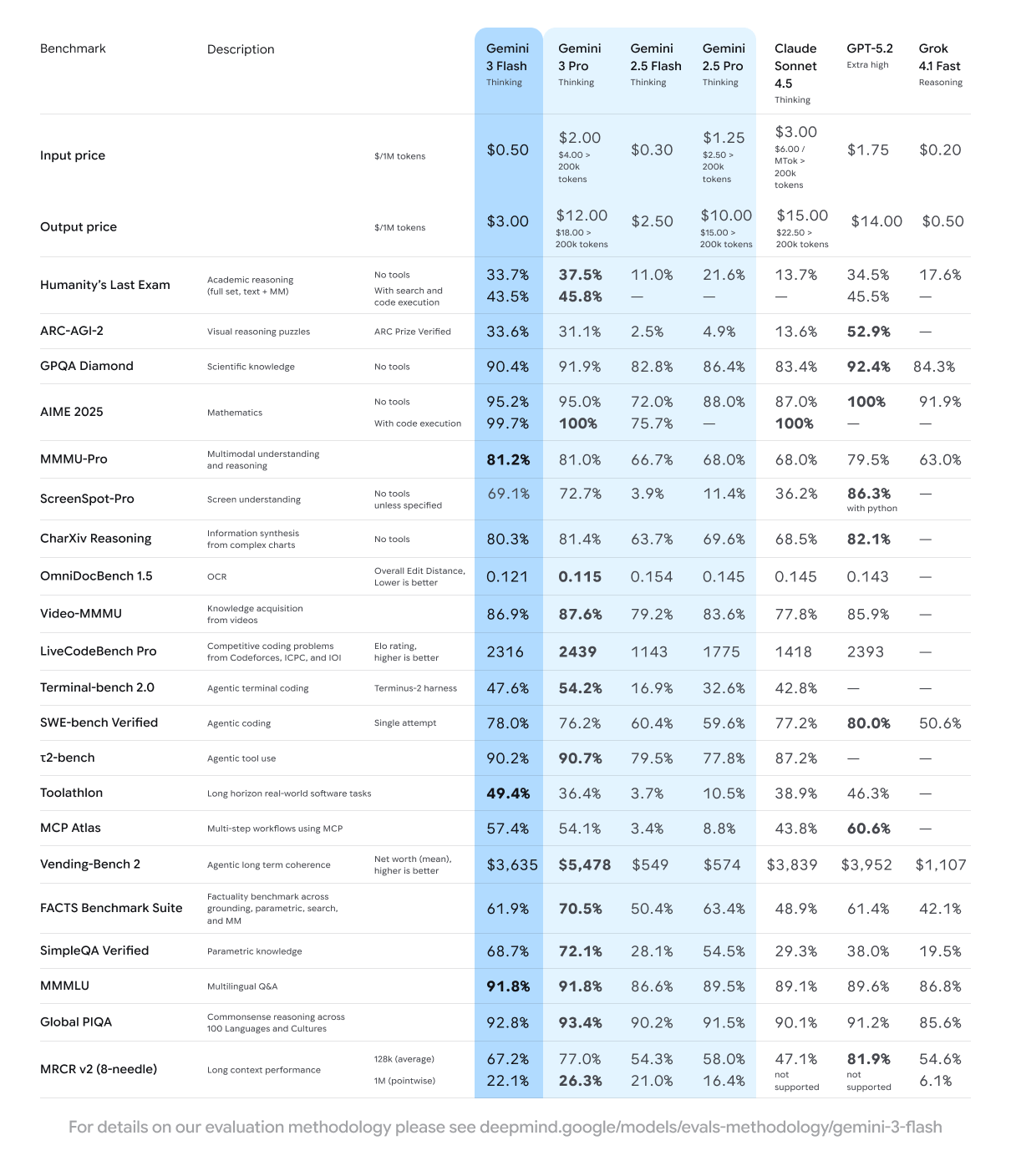
This may come as a shock, but Google says Gemini 3 Flash is faster and more capable than its previous base model. As usual, Google has a raft of benchmark numbers that show modest improvements for the new model. It bests the old 2.5 Flash in basic academic and reasoning tests like GPQA Diamond and MMMU Pro (where it even beats 3 Pro). It gets a larger boost in Humanity’s Last Exam (HLE), which tests advanced domain-specific knowledge. Gemini 3 Flash has tripled the old models’ score in HLE, landing at 33.7 percent without tool use. That’s just a few points behind the Gemini 3 Pro model.
GORN 2 received a new “dungeon brawler” mode in its winter-themed update on Quest, PC VR, and PlayStation VR2.
Now live on all platforms, GORN 2 is the comically over-the-top arena brawler where you battle the five sons of the God of the Afterlife after reaching your untimely demise. While the main campaign puts you into a series of arena fights as you defeat muscular gladiators, publisher Devolver Digital announced it’s now received a dungeon crawler mode.
0:00
/0:42
Appropriately known as the ‘Dungeon Brawler‘ update, this also comes with various winter-themed additions like icy floors, new dungeon hazards, and the ability to freeze enemies. New weapons include hockey sticks, icicle swords, ice arrows, pitchforks and more, while developer Cortopia also introduced a jump button to leap over enemies.
New story content is also promised and this dungeon crawler mode features 25 unique rooms, with the studio confirming player and weapon modifiers can be found as you progress. Additional missions are also available for unlocking the dungeon crawler weapons.
This joins a growing list of seasonally themed updates that GORN 2 has received. October’s ‘Fight of the Living Dead‘ update celebrated Halloween by letting you fight the undead, also adding a crossbow, scythe, and a Resurrection Spire. That was followed last month by ‘Shanksgiving‘ with its timed-exclusive ‘Turkey Hunt’ game mode.
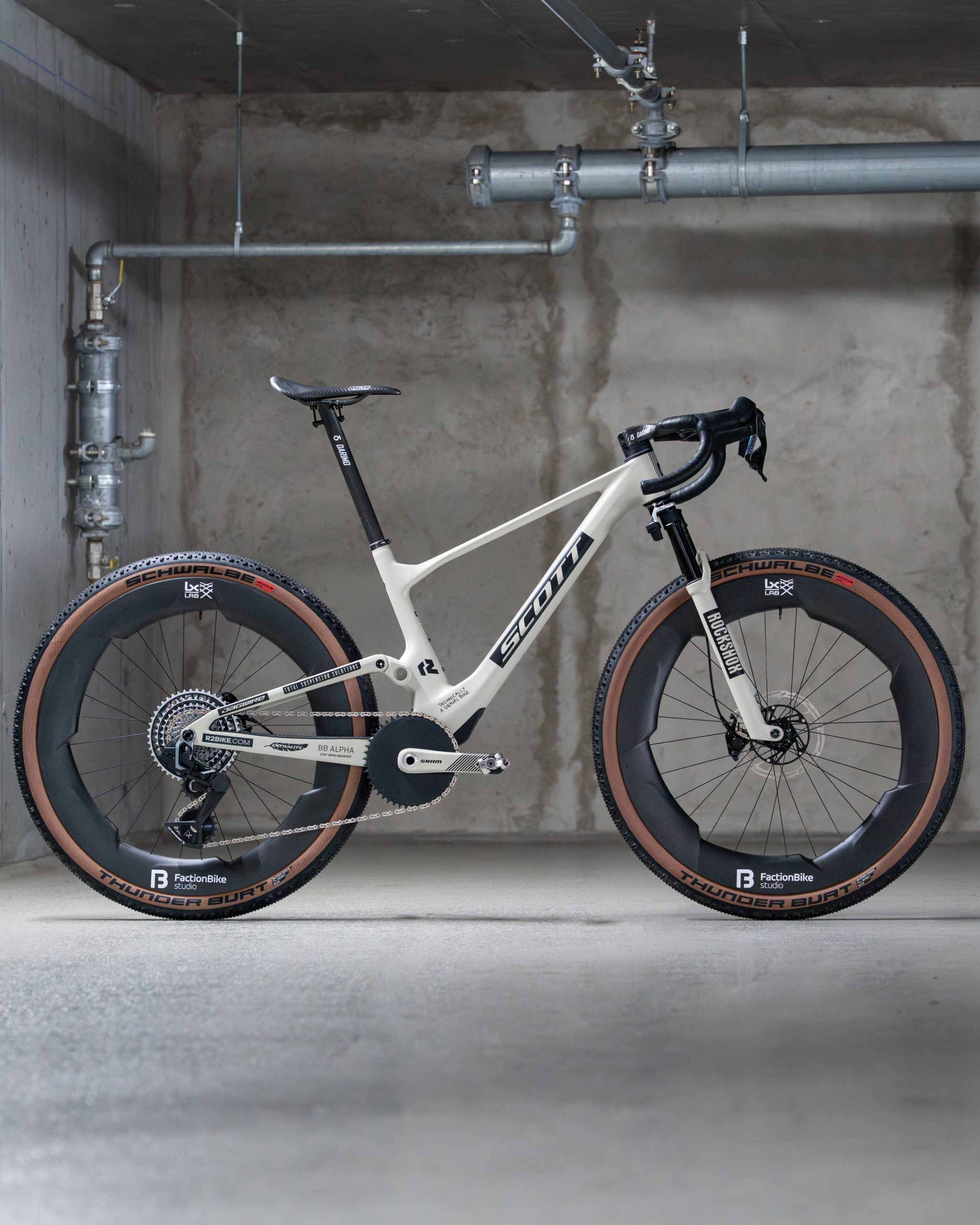
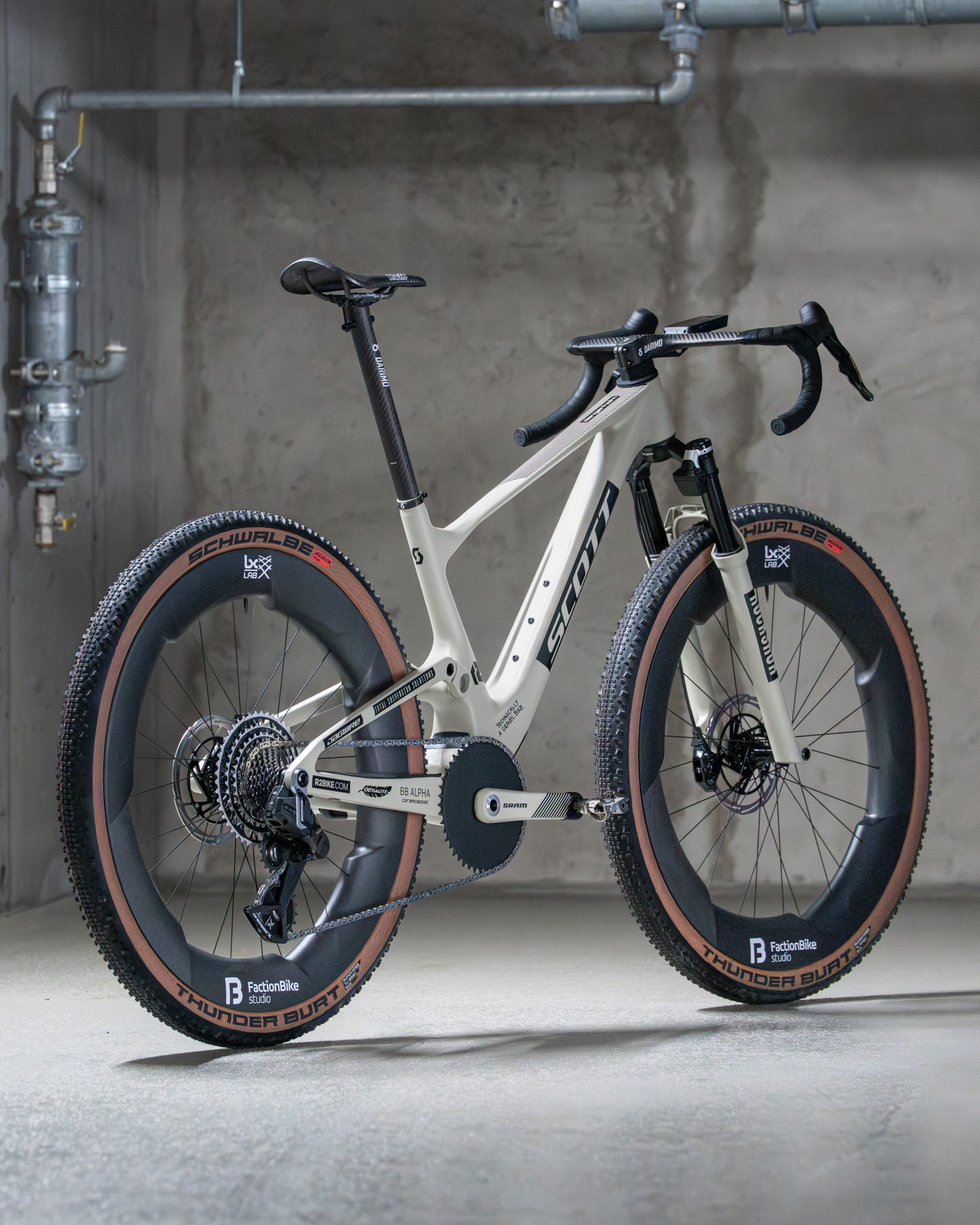
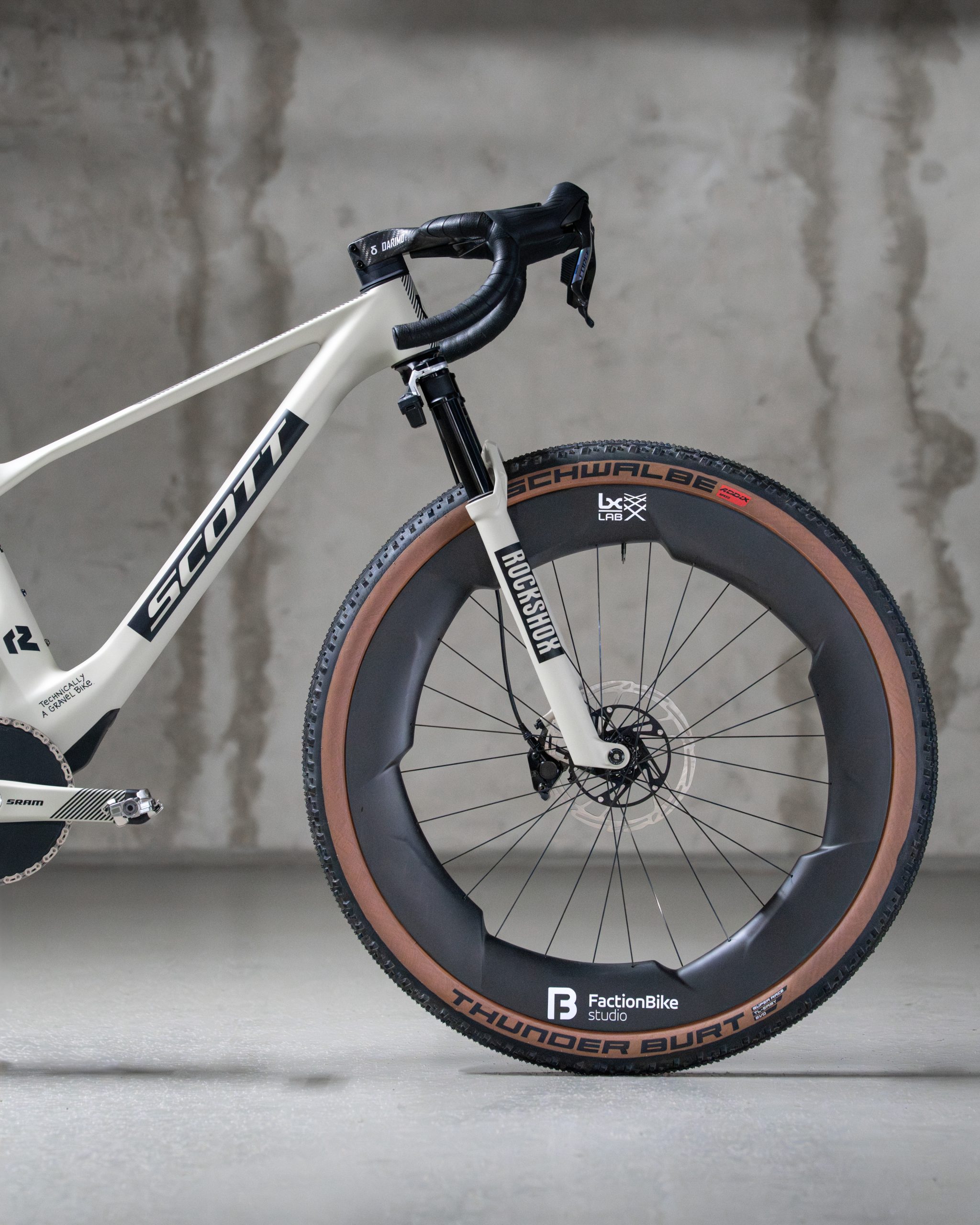
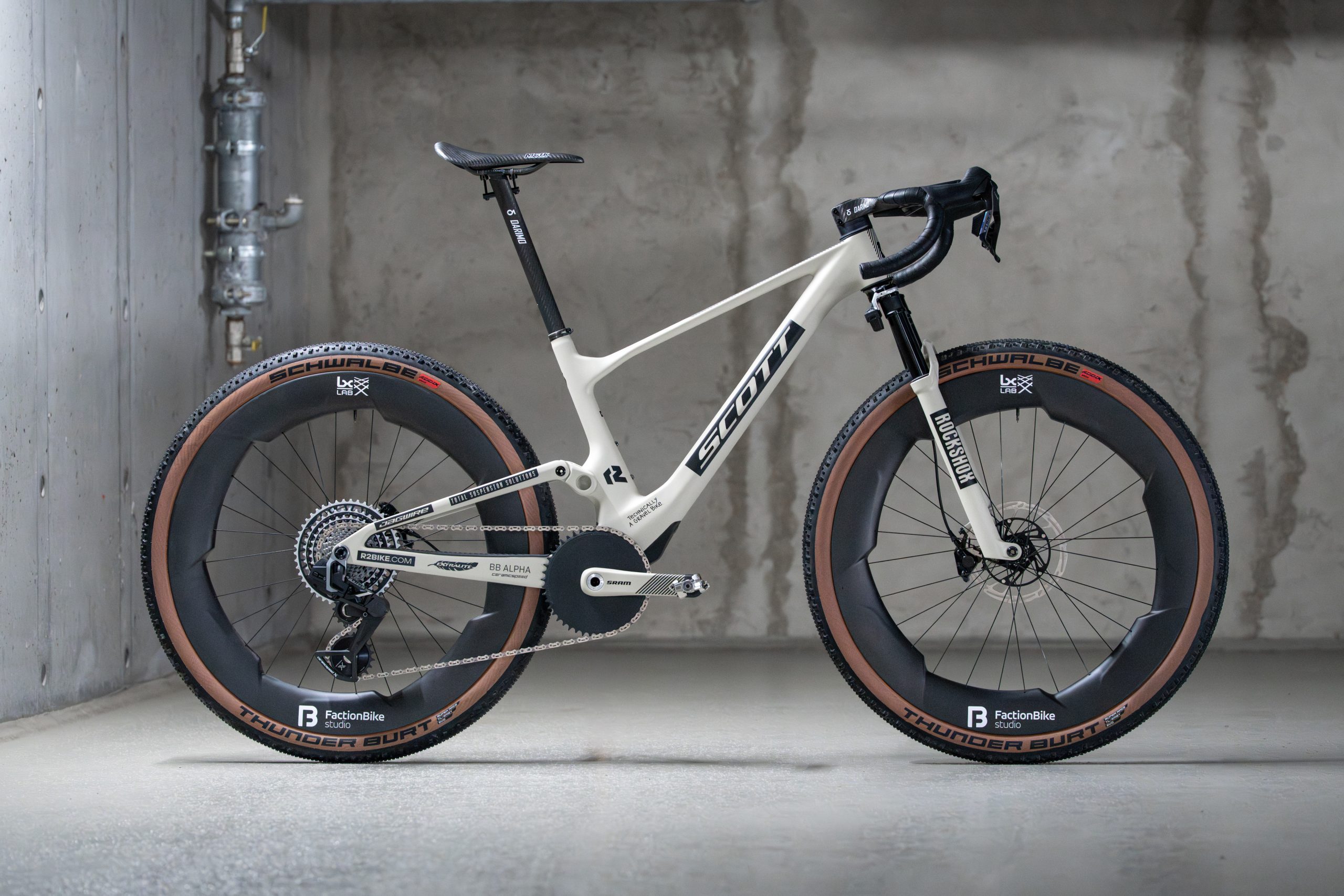
Dangerholm’s latest creation combines a highly modified Scott Spark RC XC MTB frame with a forward-thinking dreamy wishlist of money-no-object components to create a gravel bike that almost defies belief.
With a frame that has been cut apart, super-wide prototype aero wheels, a custom 46T chainring, a modified rear shock, and a one-of-a-kind carbon bar and stem, it’s a classic Dangerholm bike in every sense.
We’ve taken a closer look at this dream Scott Spark RC HMX Gravel Project build, which fuses XC tech with gravel functionality.
It’s a fusion of gravel and XC parts with myriad modifications and custom parts. Scott Sports
Dangerholm has modified whatever he needed to in the process of creating the bike. He has worked around the MTB origins of the Spark RC, keeping the frame, MTB hubs and a 110mm-travel fork, while adding a gravel-oriented drop handlebar, deep-section aero wheels and a large chainring.
Scott Spark RC full-suspension frame
The base for the custom build is a Scott Spark RC HMX XC full-suspension frame, which has been reworked to fit a large 46T chainring. Scott Sports
The frame started as a standard Scott Spark RC in HMX carbon fibre.
At 183cm, Dangerholm usually rides a size Large, but sized down to a Medium for this gravel build to shorten the reach and wheelbase for more gravel-oriented handling. For the same reason, the angle-adjustable headset is set in its steepest position.
Where an XC bike might have a 40-50mm stem, in this guise, the shorter reach enabled Dangerholm to run an 80mm stem and preserve a similar riding position to his regular gravel bike, a Scott Addict Gravel.
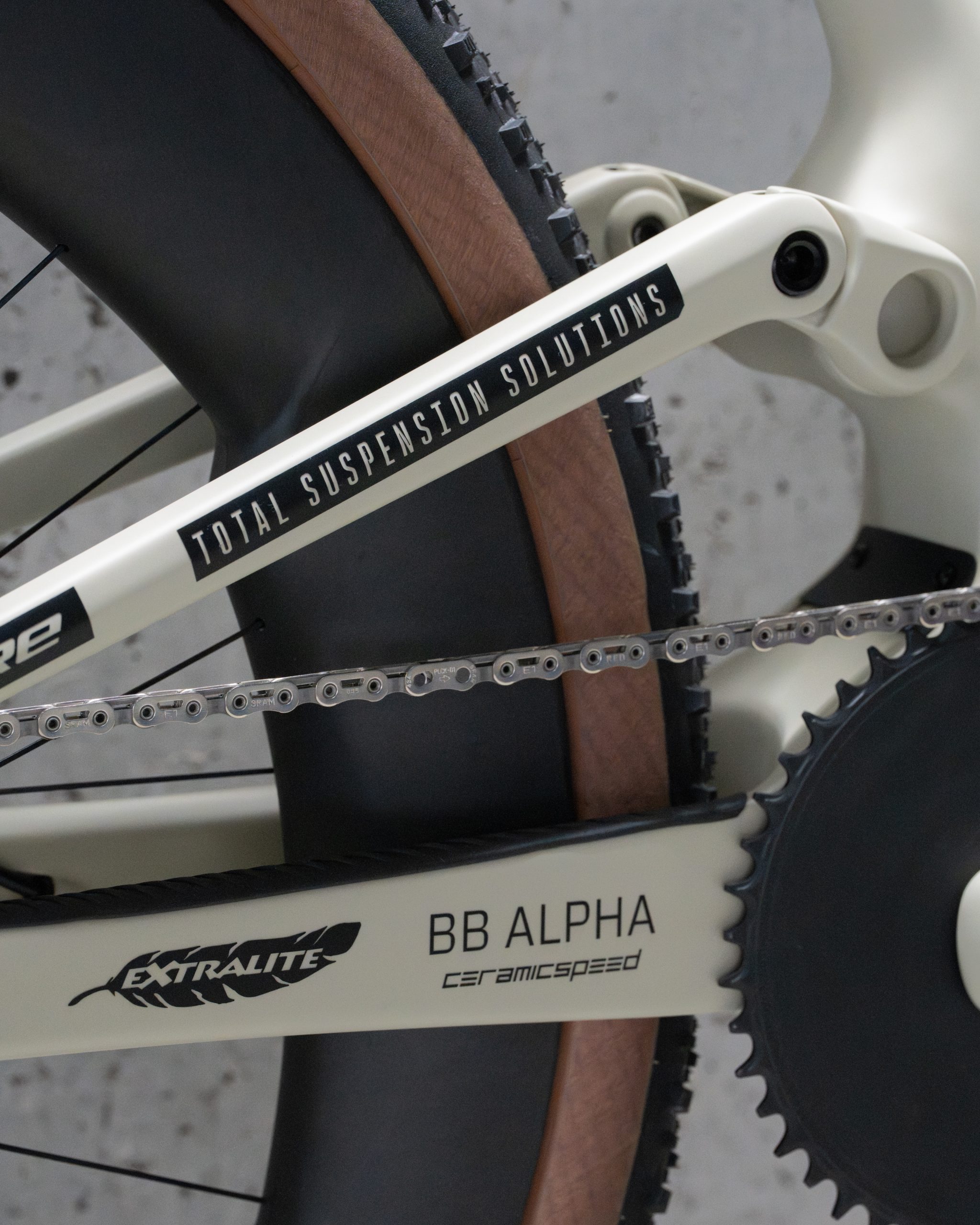
The chainstay has been extensively reworked to accommodate the 46T chainring. Scott Sports
To maintain a sensible cadence at the high speeds gravel bikes can run at, Dangerholm wanted to use a 46T chainring. However, the Spark RC frame is only compatible with a 38T ring.
To accommodate the bigger chainring, the chainstay had to be heavily modified, necessitating cutting open the frame to create the required clearance. It was then wrapped up and reinforced to preserve strength.
Custom shock and 110mm fork
A 110mm-travel Rockshox SID SL replaces the burlier 120mm-travel SID usually in place on the front of a Scott Spark RC. Scott Sports
The Spark RC comes with 120mm travel front and rear, and three rear-suspension positions (Lock, Climb and Open). However, on this bike, the RockShox SIDLuxe Flight Attendant rear shock is modified, shortening the stroke from 45mm to 40mm.
The rear suspension now delivers a reduced 0, 71 or 107mm of travel depending on the mode.
Up front, the stock 35mm-stanchion Rockshox SID, with 120mm travel, has been replaced by a 110mm RockShox SID SL Flight Attendant. Its smaller 32mm stanchions save weight and lower the front of the bike, also steepening the head angle for more gravel-oriented handling.
SRAM Flight Attendant and AXS combo
The AXS shifters have been reprogrammed to control the Flight Attendant suspension system as well as the gears. Scott Sports
Dangerholm explained that the RockShox Flight Attendant suspension system and its compatibility with the SRAM AXS shifters opened the door to this build. He wanted the efficiency of Flight Attendant and worked out a way of retaining full functionality of the AI-driven suspension system without adding any switches that would clutter up the handlebar.
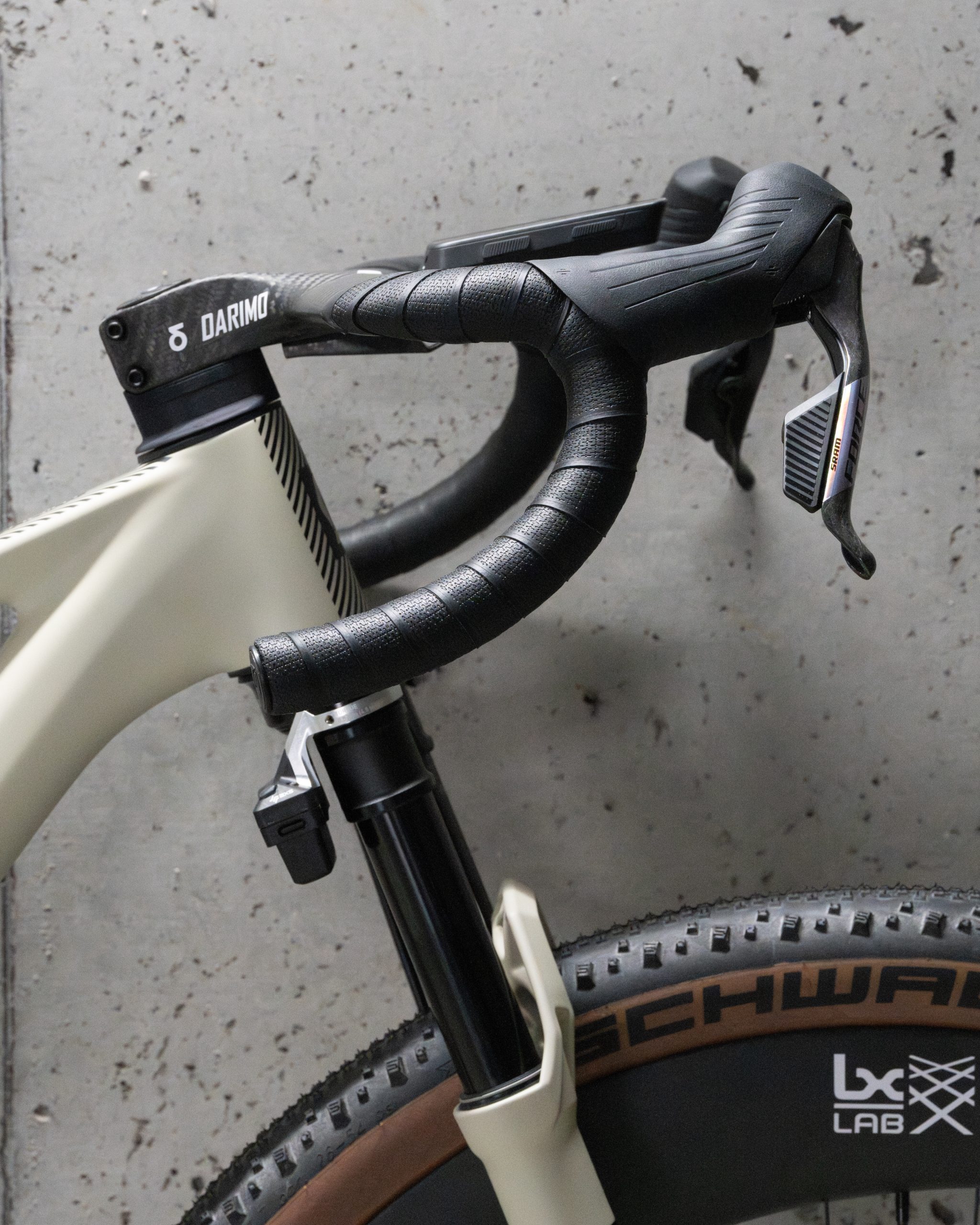
To do this, Dangerholm reprogrammed the drop-bar gravel shifters to lock and unlock the suspension. Double-tapping the shifters, which would normally shift a front derailleur, cycles through the suspension modes, while a single tap of the shifter changes gear as normal.
He adds that if you run a SRAM power meter, the fully automatic suspension mode senses the condition of the riding surface, incline angle and your power output to adjust the suspension accordingly – no buttons needed.
Super-wide prototype aero wheels
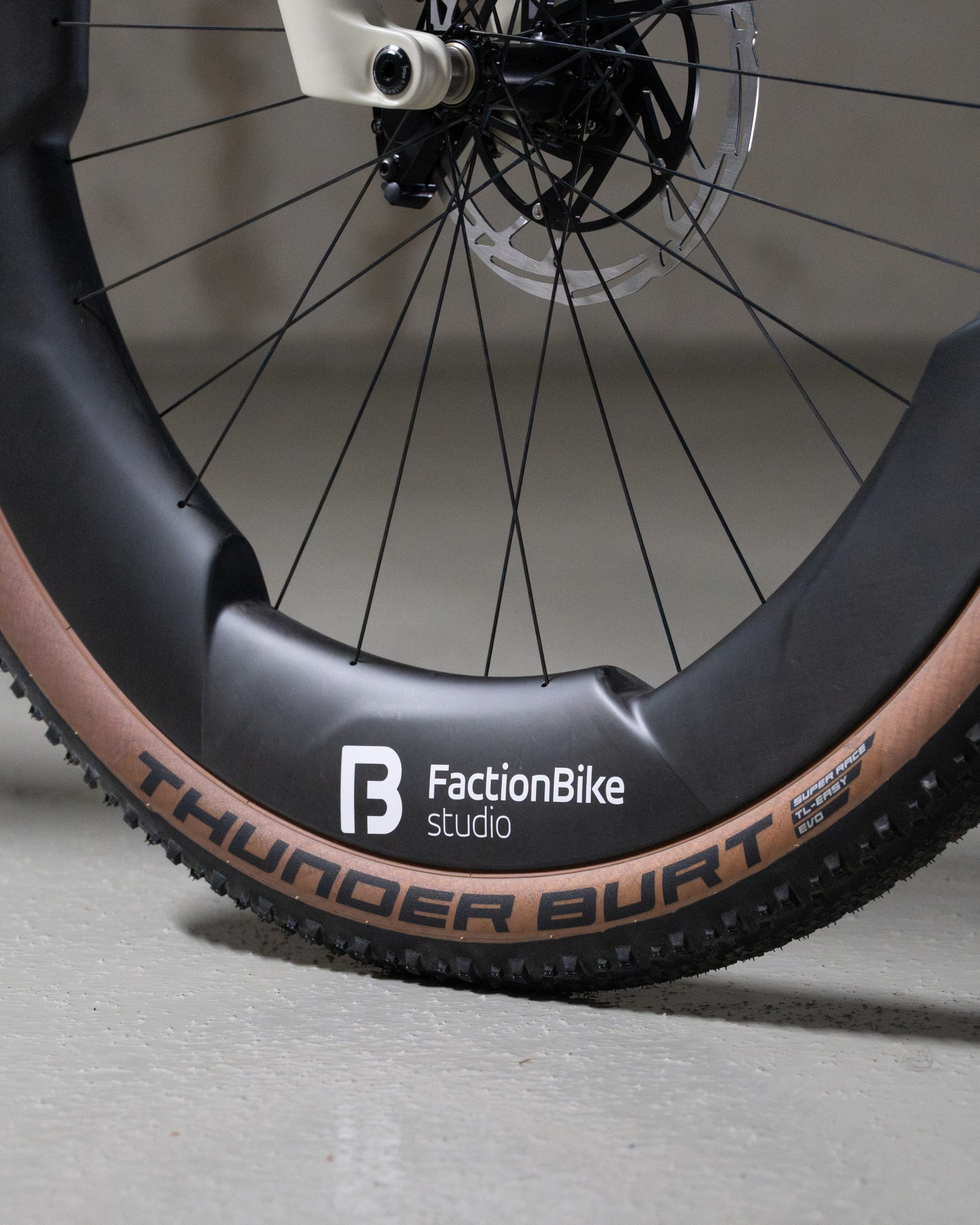
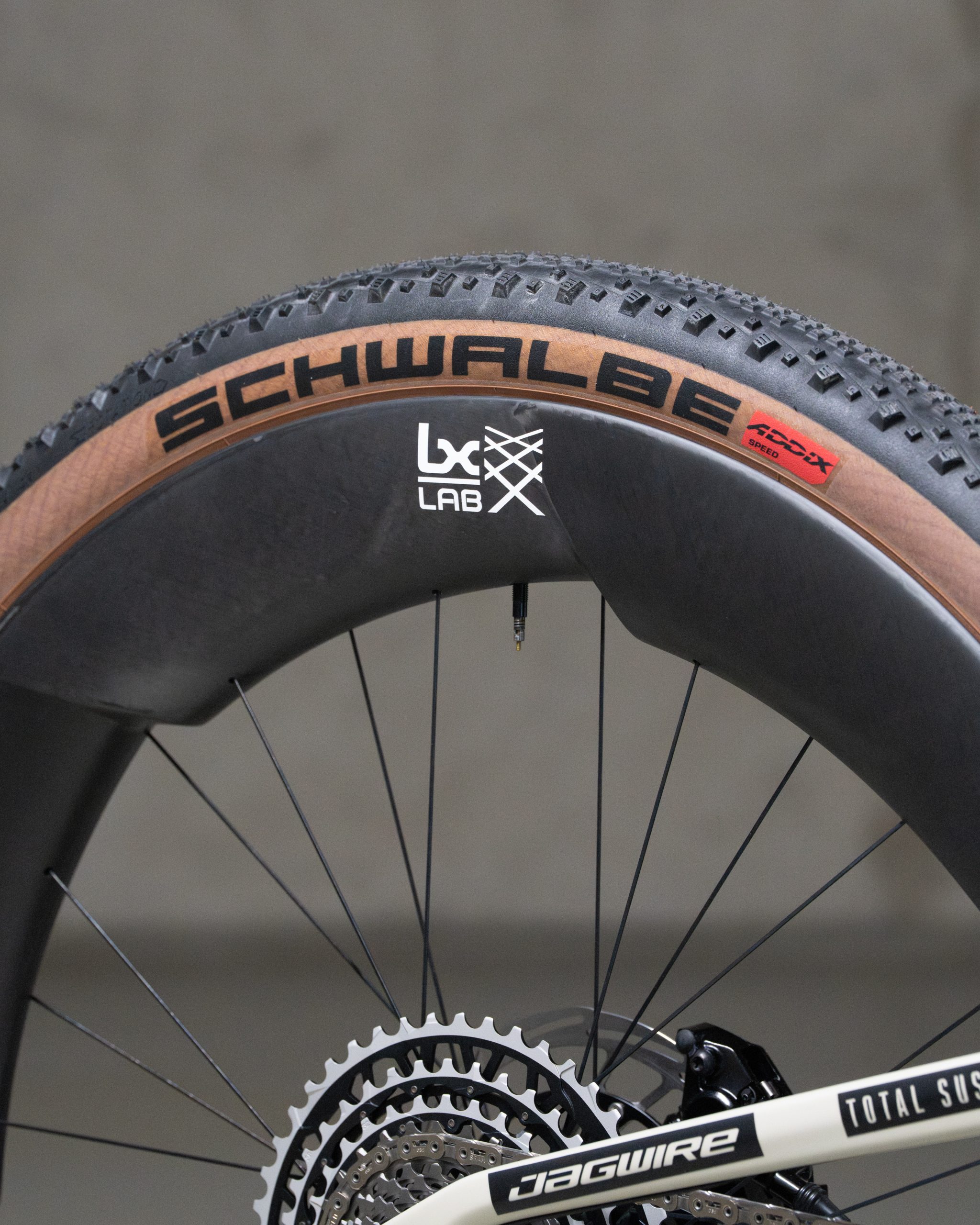
The wheels involved taking a mountain bike rim and grafting an aero fairing on top. Scott Sports
The ultra-wide aero rims are prototypes, and measure a whopping 52mm wide and 70mm deep.
Developed for this bike and the forthcoming Scott Scale RC Aero, only four rims were created.
They’re a fully rideable concept brought to life by carbon specialist Faction Bike Studio and LX Sim. Dangerholm explained his ideal dimensions, and they added a carbon aero fairing moulded on top of a 29in enduro MTB rim.
This means the prototype wheelset is very heavy, at 2,270g, but with a theoretical rim weight of 590g each for the final versions, a wheelset could come in at around 1,650g.
The prototype aero wheels are very heavy, but Dangerholm says a final version could be much lighter. Scott Sports
Dangerholm says the extreme dimensions optimise aerodynamics with wide tyres, and improve tyre stability at low pressures. More volume increases comfort and grip, and enables lower pressures to be run for less rolling resistance over rough terrain.
MTB hubs are needed for the 148mm Boost spacing of the Spark RC. Dangerholm says the Extralite HyperSmart 3 hubs were chosen because they’re light and solve a compatibility issue – the 13-speed SRAM RED XPLR gravel cassette requires a SRAM XDR-compatible freehub body, which is difficult to find on MTB hubs.
The 46T chainring was custom-made by Garbaruk. Based on its standard aero chainring, these feature a custom offset.
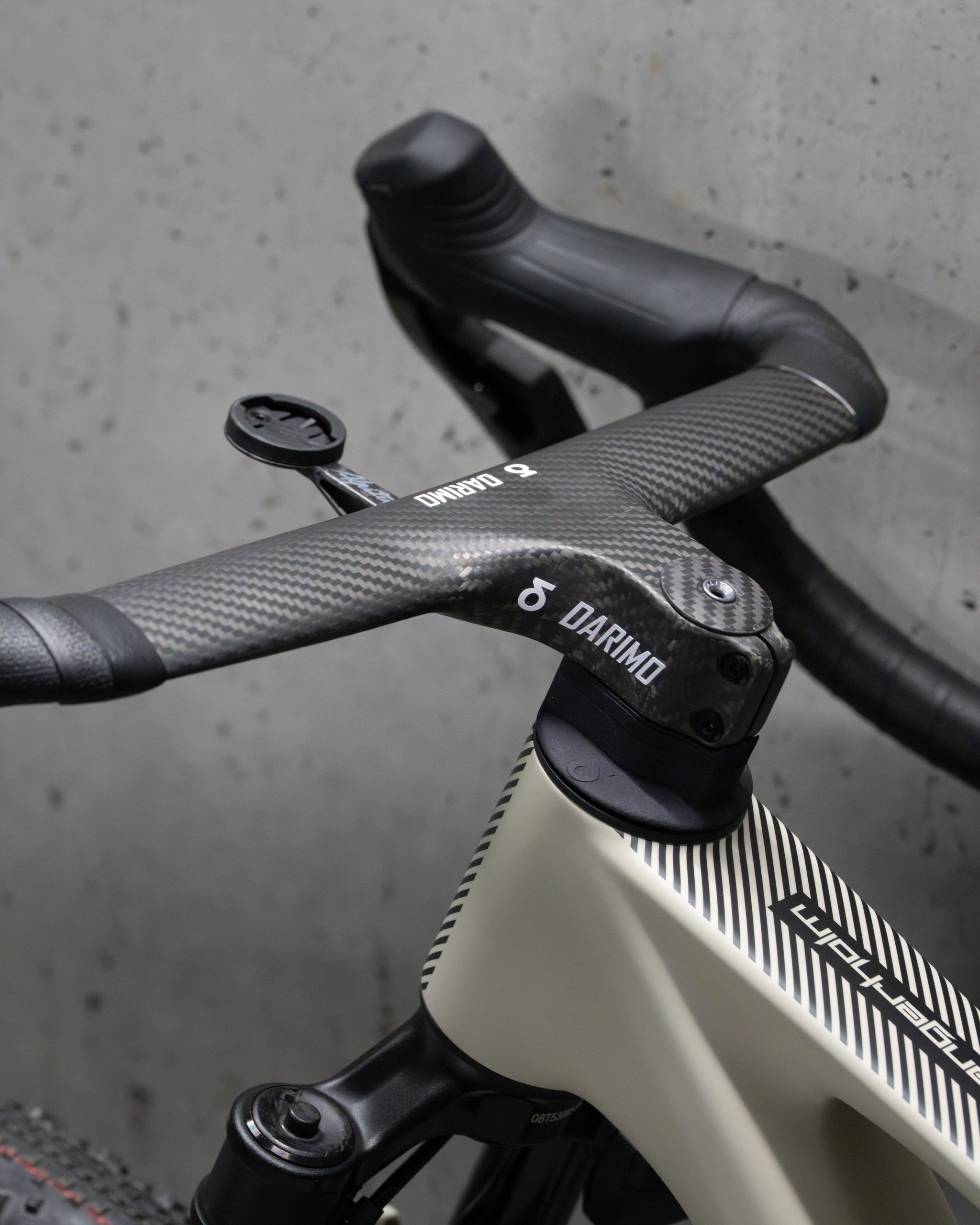
Custom-made handlebar
A custom bar and stem combo was necessary to compensate for the aggressive geometry while maintaining a gravel-oriented riding position. Scott Sports
Dangerholm’s desire to run a one-piece aero cockpit, but combine it with MTB geometry, presented a challenge because the frame’s slack head angle necessitated a steeper stem angle to compensate.
He needed an 80mm-long, 12-degree stem to get the riding position he wanted, so carbon specialist Darimo created a custom 380mm-wide bar and stem with the required dimensions.
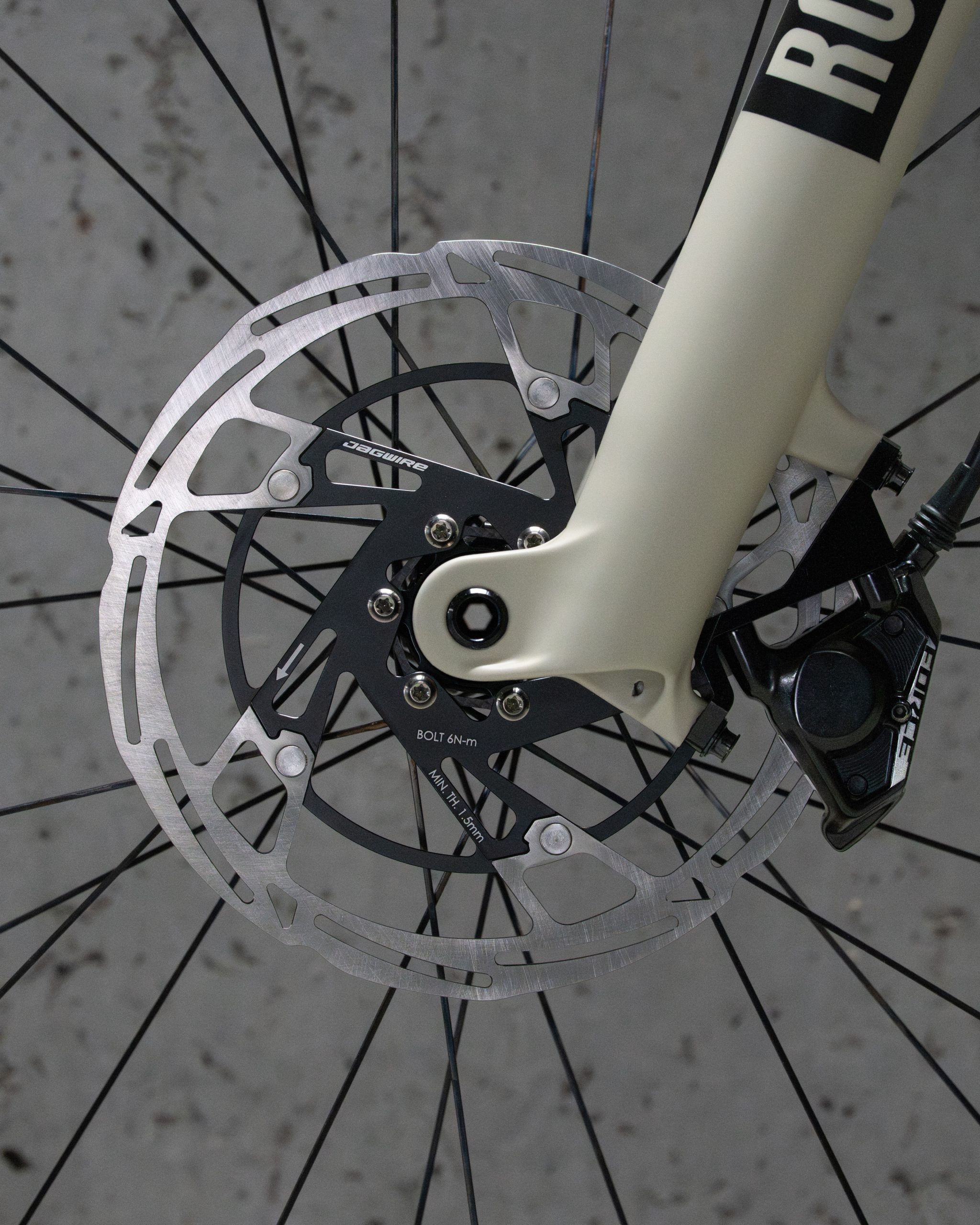
Brake adaptors and big rotors
Flat Mount gravel calipers are paired with 180mm Jagwire rotors via adaptors. Scott Sports
The bike uses Flat Mount Force gravel calipers from SRAM, which needed adaptors to fit the post-mount MTB frame and fork.
The brakes run large 180mm Jagwire Pro LR2 brake rotors for extra power and heat dissipation when slowing the 10.33kg bike down.
Dangerholm Scott Spark RC HMX Gravel Project specifications
The whole bike weighs 10.33kg, and offers 110mm front and up to 107mm rear-wheel travel. Scott Sports
Chainring: Garbaruk DM Aero custom (42T and 46T options)
Bottom bracket: CeramicSpeed BB Alpha
Pedals: Look X-Track Power Dual (+404g)
Chain: SRAM RED
Cassette: SRAM RED XPLR 13-speed 10-46t
Weight: 10.33kg / 22.77lb (without pedals)
Important note: SRAM XPLR AXS is not intended to be used on MTB frames, and especially not full-suspension frames. The maximum chainring size for the standard Scott Spark RC is 38T. The bike shown here is a custom one-off, not meant to be replicated.
Since receiving the Gigabyte R284-A92-AAL1 a while back as a Xeon 6900 series 2U server platform to replace the failed Intel AvenueCity reference server, I have been getting caught-up in fresh Xeon 6980P Granite Rapids benchmarks with the latest software updates over the past year. I’ve provided fresh looks at the DDR5-6400 vs. MRDIMM-8800 performance, the AMX benefits for AI, SNC3 vs. HEX mode, Latency Optimized Mode, Cache Aware Scheduling, and more with the fresh Linux software stack and this production Gigabyte server platform. One of the areas I have been meaning to re-visit is a fresh head-to-head benchmark battle between 5th Gen AMD EPYC “Turin” and Intel Xeon 6 “Granite Rapids”. In this article is a 128-core showdown between the Xeon 6980P and EPYC 9755 128-core processors with the latest open-source Linux software as of the end of 2025.
Almost exactly a month after the debut of Gemini 3 Pro in November, Google has begun rolling out the more efficient Flash version of its latest AI model. According to the company, the new system offers similar “pro-grade” reasoning performance as its flagship model at a fraction of the cost, making it ideal for everyday use.
In benchmarks, the new system performed significantly better than Google’s previous generation models, including Gemini 2.5 Pro. More notably, in Google’s testing it managed to trade blows with GPT-5.2, the model OpenAI rushed out to counter Gemini 3 Pro.
A table comparing Gemini 3 Flash’s performance across a variety of AI benchmarks.
Google
For example, in the tough Humanity’s Last Exam suite, Gemini 3 Flash scored less than a percentage point worse than GPT-5.2 when neither model had access to tools like web search. In a handful of other benchmarks, Google’s more efficient system even managed to outperform OpenAI’s latest. For instance, in MMMU-Pro, a benchmark designed to test a model’s multimodal understanding and reasoning, it edged out GPT-5.2 with a result of 81.2 percent compared to 79.5 percent. Of course, benchmarks only tell a partial story; we’ll have to see what people think once both systems are broadly available. Still, the fact Gemini 3 Flash is even close to GPT-5.2, and the “Extra High” reasoning mode at that, is a worrying sign for OpenAI.
As with Gemini 3 Pro, Google is rolling out the new model to both the Gemini App and AI Mode in Search where it will be the default model for both services. “That means all of our Gemini users globally will get access to the Gemini 3 experience at no cost, giving their everyday tasks a major upgrade,” Google explains. While on the subject of AI Mode, it’s now possible to access Nano Banana Pro, Google’s latest image generator, directly from the chatbot. Provided you live in the US, select “Thinking with 3 Pro,” followed by “Create Images Pro” from the model picker.
This article originally appeared on Engadget at https://www.engadget.com/ai/googles-gemini-3-flash-model-outperforms-gpt-52-in-some-benchmarks-160000000.html?src=rss
In case you missed our review of the Pixel 10 series, we’re seriously impressed with Google’s latest-generation Android phones, and many of them are currently offered at seriously big discounts. That includes the Pixel 10 Pro that, with the current limited time deal on Amazon, is marked down to its lowest price ever.
Google Pixel 10 Pro Is
Meta has rolled out a new update to Quest that aims to drastically improve hand-tracking performance and reliability.
The News
The v83 update, which is rolling out now to Horizon OS, is said to increase reliability of hand-tracking in a number of cases, including during fast movements, when used for locomotion, and throwing virtual objects.
In the so-called ‘Hands 2.4’ implementation, the update makes high-speed interactions feel “more responsive and believable,” Meta says in a recent developer blog post, noting that fast twitch movements have historically challenged hand-tracking, especially in rhythm and fitness apps.
The Interaction SDK also sees major enhancements, Meta says. New hand-first locomotion samples, such as improved teleportation gestures, natural climbing, and physics-based movement, are also included so developers can use them without having to build their own systems from scratch.
Notably, developers now have more customizable throwing interactions, also including new sample scenes demonstrating styles like darts, bowling, frisbee throws, and ball sports.
Developers looking for more information can check out the documentation for both the Unity and Unreal game engines.
My Take
True to Meta’s word, v83 seems to be a big improvement to hand-tracking on Quest. I kind of wonder why it all matters though. To me, the supposition largely seems to be this: we know how to use our hands, so logically the most immersive way of interacting in VR should be the same. Right?
I honestly don’t think so, at least not for now. While I’d agree there is no perfect input scheme in VR (short of a direct neural link), controllers still offer the best input experience in a majority of cases.
Image courtesy Meta
Granted, I admire Meta for ratcheting down yet further on its optical hand-tracking tech, which is streets ahead of what we saw when the company rolled out hand-tracking on Quest in 2019. But even now in v83, it can only approximate some of the controller’s functionality.
Yes, I can pinch and grab, or hold my thumb and index finger to open a system menu, and also twiddle my virtual fingers about—the last of which promises a level of input granularity that not many XR games can really make use of. Maybe now I can punch a little more accurately, and teleport around a little more reliably. Still, I’d much rather just grab a controller and get the job done 100 percent of the time.
Scientists are scratching their heads over a recent James Webb Space Telescope (JWST) discovery that looks more like a piece of fruit than your typical celestial sphere.
The planet, designated PSR J2322-2650b, has simply been described by astronomers to look like a lemon. This bizarre world, located 750 light years from us, is not only
Browser extensions with more than 8 million installs are harvesting complete and extended conversations from users’ AI conversations and selling them for marketing purposes, according to data collected from the Google and Microsoft pages hosting them.
Security firm Koi discovered the eight extensions, which as of late Tuesday night remained available in both Google’s and Microsoft’s extension stores. Seven of them carry “Featured” badges, which are endorsements meant to signal that the companies have determined the extensions meet their quality standards. The free extensions provide functions such as VPN routing to safeguard online privacy and ad blocking for ad-free browsing. All provide assurances that user data remains anonymous and isn’t shared for purposes other than their described use.
A gold mine for marketers and data brokers
An examination of the extensions’ underlying code tells a much more complicated story. Each contains eight of what Koi calls “executor” scripts, with each being unique for ChatGPT, Claude, Gemini, and five other leading AI chat platforms. The scripts are injected into webpages anytime the user visits one of these platforms. From there, the scripts override browsers’ built-in functions for making network requests and receiving responses.
Rad Power Bikes, which once claimed to be the most funded electric bike company in the world, filed for Chapter 11 bankruptcy protection on Monday as it seeks to sell off the company.
The bankruptcy, first reported by Bicycle Retailer, was filed in the US Bankruptcy Court for the Eastern District of Washington, and lists estimated assets at $32.1m and estimated liabilities at $72.8m. The inventory of electric bike spares, parts and accessories is listed at $14,226,874.73, according to Bicycle Retailer.
It’s been a dramatic few years for the electric bike brand. Founded by Mike Radenbaugh in 2007, Rad Power raised $154m through a financing round in 2021 that brought the total investment amount to $329m.
But in 2023, it pulled out of the European market in order to try to sustain its business and success in the USA, where the company began. The company has also dealt with personal liability lawsuits, layoffs and management changes.
The filing comes less than a month after Rad Power said it could not afford to recall its older ebike batteries, deemed a fire risk by the US Consumer Product Safety Commission. Rad Power disputed the CPSC’s warning, stating its batteries are safe.
In early November, Rad Power told Washington state officials that it would possibly lay off 64 employees in January and could shut down if additional funding is not secured.
A Rad Power spokesperson told Bicycle Retailer: “Rad Power Bikes has navigated an extraordinary period of challenge and change, even as our riders and community have continued to show up for us in powerful ways.
“As we work to secure a sustainable future for the Rad brand, Rad has filed for Chapter 11 protection as part of a process to complete a sale of the company within the next 45-60 days.
“This step allows us to keep operating in the ordinary course of business while we pursue the best possible outcome for the people who rely on Rad every day. Our goal is to keep the company intact and preserve the relationships we have built with riders, vendors, suppliers, and partners.
“We are not giving up. We remain deeply committed to our customers and community, and we are focused on doing everything we can to strengthen the future of the Rad brand. We are grateful for the continued support of our riders, vendors, and retail partners as we work through this moment and toward what comes next.”