Three Austrian nuns in their 80s who escaped a care home and reclaimed their old convent are refusing the church’s offer to stay because it requires them to quit Instagram, stop speaking to the press, and avoid legal counsel — conditions they call a gag order. Their standoff with church authorities has now escalated to the Vatican as the nuns continue posting to their 185,000 followers. NPR reports: Before the church authorities moved the nuns into care almost two years ago, the local abbey and Archdiocese of Salzburg acquired the convent. The sisters say they were not aware they were signing away what they understood to be their lifelong right to remain in the cloister. On Friday, their superior, Provost Markus Grasl from Reichersberg Abbey, announced that the sisters can stay. But his offer comes with conditions: The nuns must cease all social media activities, stop talking to the press and forgo seeking legal advice. The nuns have rejected the proposal, and now Grasl has called on the Vatican to intercede.
In a statement released Friday, the nuns said the provost’s offer is nothing short of a gag order. Speaking via Instagram, Sister Regina said, “We can’t agree to this deal. Without the media, we’d have been silenced.” Sister Bernadette told Instagram followers: “We need to resolve this but any agreement we reach must be in accordance with God’s will and shaped by human reason.” […] The provost’s proposed agreement — which NPR has seen — also bans laypeople from entering the cloisters, including the sisters’ helpers, many of whom they’ve known for decades and on whom the nuns now depend for help.
Speaking to NPR on Monday, the provost’s spokesperson, crisis PR manager Harald Schiffl, said that the provost does not understand why the nuns reject his offer and that, in response, he has requested the Vatican authorities responsible for religious orders to step in. The Vatican has not commented on the situation. So while they await news from Rome, the sisters continue to follow the papal Instagram account. Schiffl says the terms relating to the nuns’ social media use are reasonable: “The abbey wishes to discontinue the sisters’ social media accounts because what they show has very little to do with real religious life.”
“The car-sharing company, first launched in the U.S. in 2000, has been active in the UK since 2010 and has just under half a million members,” writes Slashdot reader guesstral. “‘I’m writing to let you know that we are proposing to cease the UK operations of Zipcar,’ wrote Zipcar UK’s general manager, James Taylor, in an email to members today. He went on to say that Zipcar will temporarily suspend new bookings after December 31, pending the outcome of a consultation with its 71 staff members.” From the BBC: In its most recent company accounts for 2024, Zipcar blamed the “cost of living crisis,” which was affecting UK customers, for revenues falling to 46 million pounds to 53 million the year before, while its after-tax losses had widened to 11.6 million pounds. According to the same accounts, Zipcar membership fees cover the cost of fuelling or charging the vehicle and, as energy costs continued to rise last year, it has added to financial pressures on the company. The company would also be liable for the incoming congestion charge in London that is expanding to include electric vehicles from 26 December, although this was not referenced in Zipcar’s email to membership or company accounts.
FluxPose wants to be the new 6DoF VR body tracking system of choice, and its Kickstarter campaign has already raised over $2 million.
With Valve itself abandoning its “Lighthouse” SteamVR Tracking system in favor of inside-out computer vision in Steam Frame, the future of VR body tracking is in flux (no pun intended). Computer vision has made setting up VR fast, easy, and portable, all at a lower cost, but cameras on a headset have only a partial view of your body.
Further, like all optical systems, Lighthouse tracking is subject to occlusion. With the standard two base stations, there will be angles at which your tracked objects are blocked. To mitigate this, some enthusiasts add a third or even fourth base station. Lighthouse is also heavily affected by any reflective surfaces in the room, especially mirrors, which cause tracking issues.
0:00
/3:05
FluxPose in VRChat.
Over the weekend, Spanish startup FluxPose launched a Kickstarter campaign for what it calls “the first affordable, truly portable, occlusion-free tracking solution with absolute positioning”. FluxPose uses electromagnetic tracking, with trackers that sense the magnetic field generated by a base station.
We’ve seen electromagnetic tracking systems in VR before. Razer Hydra, the first widely used 6DoF VR controllers, used it for a small tracking volume limited by the 4-foot cable each controller was connected to the base station with. And in 2013, the company that built the tech behind Hydra launched a Kickstarter for a tracking system called STEM, with many of the same core promises of FluxPose. But in 2018 STEM was canceled, with backers refunded.
0:00
/0:41
Through-the-lens demo of FluxPose.
A key reason that STEM failed, why Razer Hydra had a short tether, and the core difference of FluxPose, comes down to the nature of magnetic fields and where you put the base station. With Hydra and STEM it sat on your desk, and because magnetic fields decay with the cube of the distance, beyond a few feet they would deliver jittery and inaccurate poses.
With FluxPose, the base station (which it calls the beacon) is attached to your hip. This effectively creates a portable occlusion-free tracking sphere around your body, with a radius of just over 5 feet, that, according to the startup, can support an “unlimited” number of trackers within it. It’s a clever solution to the electromagnetic distance problem, with the tradeoff that it requires wearing an additional device.
As with every VR tracking system, FluxPose also heavily relies on feeding the data from the IMU on the trackers, the tiny chip which contains the accelerometer and gyroscope, into a sensor fusion model.
FluxPose claims a real-use accuracy of less than 5mm, compared to the less than 2mm of SteamVR Lighthouse, with an update rate of between 50Hz and 300Hz depending on the power mode.
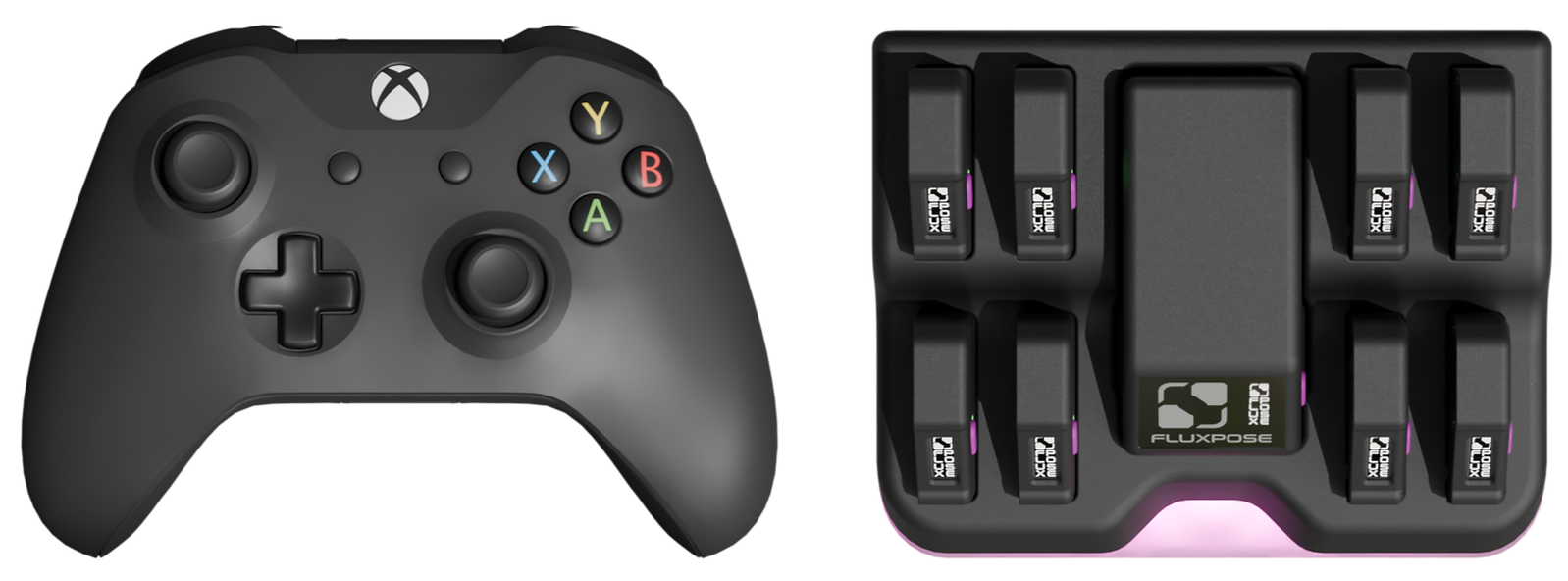
FluxPose size comparison with other devices. It’s very small.
On the Normal power mode, the beacon’s battery should last around 12 hours. There’s also a Low power mode for “standing, sitting or laying” which should last 24 hours, and a Performance mode for tracking controllers or gloves, in which the beacon should last 6 hours.
The trackers themselves, meanwhile, weigh just 15 grams and last for 24 hours, FluxPose claims. That’s just one-fifth of the weight of a HTC Vive Tracker. And remarkably, despite that low weight, they have a tiny monochrome OLED screen for displaying status and a haptic feedback actuator.
FluxPose mounts for Quest 3, Quest Pro, and Pico 4.
You attach one of the trackers to your headset, with a per-headset adapter mount, while the others attach to the parts of your body you want to track. Mounts are available for Quest 2 and newer, Pico 4 and 4 Ultra, Samsung Galaxy XR, Valve Index, both Bigscreen Beyond generations. And FluxPose says it will have a mount for Steam Frame too.
Because of the headset-attached reference tracker, FluxPose claims its tracking system doesn’t require any calibration, and “never” drifts. The tradeoff is adding 15 grams of weight to your headset.
Both the beacon and trackers charge on the included dock, which also acts as the wireless data dongle, delivering the tracking poses to SteamVR on your PC via USB-C. From a PC’s USB port it should recharge everything within 3 hours, while on a PD charger this can drop to 1.5 hours.
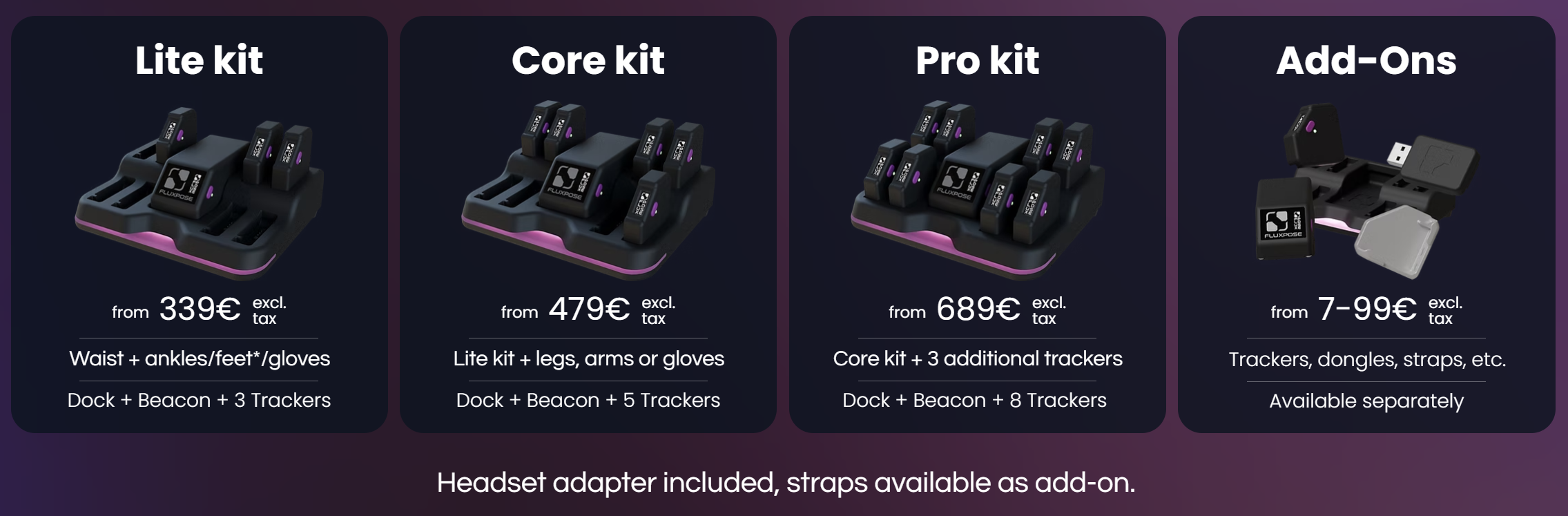
On Kickstarter, you can pledge for three kits: Lite, Core, and Pro. Lite is priced at €339 before tax and comes with 3 trackers, Core at €479 with 5 trackers, and Pro at €689 with 8 trackers. Additional addons like straps are available separately.
FluxPose says it has already built 300 devices for early testers, and launched the Kickstarter to progress to full-scale production. It intends to start shipping the first “early bird” units in August 2026, and for most backers to receive their units in October. After the Kickstarter, prices will increase.
As with all crowdfunding campaigns, we must warn you that a Kickstarter pledge is not a preorder. There is no guarantee you will receive anything at all, and the company has no legal obligation to provide you with a refund if it doesn’t deliver.
Supreme Court justices expressed numerous concerns today in a case that could determine whether Internet service providers must terminate the accounts of broadband users accused of copyright infringement. Oral arguments were held in the case between cable Internet provider Cox Communications and record labels led by Sony.
Some justices were skeptical of arguments that ISPs should have no legal obligation under the Digital Millennium Copyright Act (DMCA) to terminate an account when a user’s IP address has been repeatedly flagged for downloading pirated music. But justices also seemed hesitant to rule in favor of record labels, with some of the debate focusing on how ISPs should handle large accounts like universities where there could be tens of thousands of users.
Justice Sonia Sotomayor chided Cox for not doing more to fight infringement.
OpenAI may soon be forced to explain why it deleted a pair of controversial datasets composed of pirated books, and the stakes could not be higher.
At the heart of a class-action lawsuit from authors alleging that ChatGPT was illegally trained on their works, OpenAI’s decision to delete the datasets could end up being a deciding factor that gives the authors the win.
It’s undisputed that OpenAI deleted the datasets, known as “Books 1” and “Books 2,” prior to ChatGPT’s release in 2022. Created by former OpenAI employees in 2021, the datasets were built by scraping the open web and seizing the bulk of its data from a shadow library called Library Genesis (LibGen).
Because the risks of AI browsers outweigh the hype, our Christine Hall uses BrowserOS as a tightly controlled research tool instead of a way to surf the web.
An anonymous reader quotes a report from TechCrunch: South Korean e-commerce platform Coupang over the weekend said nearly 34 million Korean customers’ personal information had been leaked in a data breach that had been ongoing for more than five months. The company said it first detected the unauthorized exposure of 4,500 user accounts on November 18, but a subsequent investigation revealed that the breach had actually compromised about 33.7 million customer accounts in South Korea. The breach affected customers’ names, email addresses, phone numbers, shipping addresses, and certain order histories, per Coupang. More sensitive data like payment information, credit card numbers, and login credentials was not compromised and remains secure, the company said. […] Police have reportedly identified at least one suspect, a former Chinese Coupang employee now abroad, after launching an investigation following a November 18 complaint.
Microsoft’s big pitch for the future of Windows is that it’s turning into an “agentic OS, ” or a system where autonomous AI helpers don’t just answer questions, but instead actually do things for you. They’ll organize files, wrangle tasks, juggle apps, and basically act like little digital interns living inside Windows 11. Except now, Microsoft
Frigid temps and heavy snow gripped much of the U.S. on December 1, the first day of meteorological winter. It looks like these bitter conditions are here to stay.
Instagram employees will be back at their desks full time next year. Beginning February 2, workers with the social media network will be expected to spend five days a week working in person in offices. Instagram leader Adam Mosseri announced the change in an internal memo first reported by Alex Heath’s Sources newsletter. “It’s clear we have to evolve,” he told the staff, also closing with the note that “2026 is going to be tough.”
The full return to office mandate applies to Instagram’s US employees in offices with assigned desks. The memo allowed that people will still be able to work remotely “when you need to,” but gave an open-ended call to “use your best judgment” about when to take advantage of that flexibility.
Many tech companies have adopted a hybrid approach to office work in the years following the COVID-19 pandemic. For instance, Meta instituted a policy of three days a week spent in the office in 2023. Although the messaging from executives insists that in-person work has important benefits, employees have oftenresisted the shift back to old ways.
Mosseri outlined other planned changes intended to make the social media company “more nimble and creative.” One shift that’s probably more welcome than the return to office is to scale back recurring meetings. Any recurring meetings will be canceled every six months unless they’re deemed “absolutely necessary.” He also plans the team to have more prototypes of product overviews rather than decks, and a faster process for unblocking and decision-making.
This article originally appeared on Engadget at https://www.engadget.com/social-media/instagram-mandates-total-return-to-office-for-employees-in-2026-212738225.html?src=rss
In early 2025, Sian traveled deep into the mountains of Shan State, on Myanmar’s eastern border with China, in search of work. He had heard from a friend that Chinese companies were recruiting at new rare-earth mining sites in territory administered by the United Wa State Army, Myanmar’s most powerful ethnic armed group, and that workers could earn upwards of $1,400 a month.
It was an opportunity too good to pass up in a country where the formal economy has collapsed since the 2021 military coup, and nearly half of the population lives on less than $2 a day. So Sian set off by car for the town of Mong Pawk, then rode a motorbike for hours through the thick forest.
Hired for daily wages of approximately $21, he now digs boreholes and installs pipes. It is the first step in a process called in situleaching, which involves injecting acidic solutions into mountainsides, then collecting the drained solution in plastic-lined pools where solids, like dysprosium and terbium, two of the world’s most sought-after heavy rare-earth metals, settle out. The resulting sediment sludge is then transported to furnaces and burned, producing dry rare earth oxides.
New York has become the first state in the nation to enact a law requiring retailers to disclose when AI and personal data are being used to set individualized prices [non-paywalled source] — a measure that lawyers say will make algorithmic pricing “the next big battleground in A.I. regulation.”
The law, enacted through the state budget, requires online retailers using personalized pricing to post a specific notice: “THIS PRICE WAS SET BY AN ALGORITHM USING YOUR PERSONAL DATA.” The National Retail Federation sued to block enforcement on First Amendment grounds, arguing the required disclosure was “misleading and ominous,” but federal judge Jed S. Rakoff allowed the law to proceed last month.
Uber has started displaying the notice to New York users. Spokesman Ryan Thornton called the law “poorly drafted and ambiguous” but maintained the company only considers geographic factors and demand in setting prices. At least 10 states have bills pending that would require similar disclosures or ban personalized pricing outright. California and federal lawmakers are considering complete bans.
There are many possible programmer mistakes that are not caught by the
minimal checks specified by the C language; among those is passing an array
of the wrong size to a function. A recent attempt to add some safety
around array parameters within the crypto layer involved the use of some
clever tricks, but it turns out that clever tricks are unnecessary in this
case. There is an obscure C feature that can cause this checking to
happen, and it is already in use in a few places within the kernel.
Sales are accurate at the time of publication, but prices and inventory are always subject to change.
There are still a few hours left to snag Cyber Monday deals—and to bring order to your home gym setup. Normally $129.99, this home gym storage rack is currently on sale for $79.98. If you’ve been tripping over scattered dumbbells or wasting time hunting for the right weights mid-workout, this deal solves both problems for under $80.
This weight rack is specifically designed for a home gym. There are designated spaced for dumbbells, kettlebells, yoga blocks, resistance bands, medicine balls, and more—basically all the smaller equipment that tends to pile up in corners or get kicked under furniture. Having everything organized in one storage rack means you can actually find what you need when you need it.
I recommend a dedicated storage rack like this so you can really focus on your fitness goals without the distraction of a cluttered space. In other words: No more digging through a heap of equipment or making multiple trips across your garage to grab different dumbbells between sets. Everything has its place, and you can grab what you need and get back to training.
What stores have the best sales on Cyber Monday?
Nowadays, both large retailers and small businesses compete for Cyber Monday shoppers, so you can expect practically every store to run sales through Monday, December 1, 2025. The “best” sales depend on your needs, but in general, the biggest discounts tend to come from larger retailers that can afford lower prices: think places like Amazon, Walmart, Target, Best Buy, and Home Depot. You can find all the best sales from major retailers on our live blog.
Are Cyber Monday deals worth it?
In short, yes, Cyber Monday still offers discounts that can be rare throughout the rest of the year. If there’s something you want to buy, or you’re shopping for gifts, it’s a good time to look for discounts on what you need, especially tech sales, home improvement supplies, and fitness tech. Of course, if you need to save money, the best way to save is to not buy anything.
Are Cyber Monday deals better than Black Friday?
Black Friday used to be bigger for major retailers and more expensive tech and appliances, while Cyber Monday was for cheaper tech and gave smaller businesses a chance to compete online. Nowadays, though, the distinction is almost meaningless. Every major retailer will offer sales on both days, and the smart move is to know what you want, use price trackers or refer to guides like our live blog that use price trackers for you, and don’t stress over finding the perfect timing.
Our Best Editor-Vetted Cyber Monday Deals Right Now
SUSE engineer David Sterba submitted the Btrfs pull request for Linux 6.19 on Friday, ahead of the Linux 6.18 stable kernel release that took place on Sunday. This copy-on-write file-system continues seeing some enticing feature work and other improvements for this next version of the Linux kernel…
Singapore’s Ministry of Education has announced that secondary school students will be banned from using smartphones and smartwatches throughout the entire school day starting January 2026, extending current restrictions beyond regular lesson time to cover recess, co-curricular activities, and supplementary lessons. Under the new guidelines, students must store their phones in designated areas like lockers or keep them in their school bags.
Smartwatches also fall under the ban because they enable messaging and social media access, which the ministry says can lead to distractions and reduced peer interaction. Schools may allow exceptions where necessary. Some secondary schools adopted these tighter rules after they were announced for primary schools in January 2025, and the ministry reports improved student well-being and more physical interaction during breaks at those schools. The ministry is also moving the default sleep time for school-issued personal learning devices from 11pm to 10.30pm starting January.