A severe spike in global DRAM prices has pushed Samsung Semiconductor to refuse a long-term RAM order from its own sibling, Samsung Electronics. The move is forcing the smartphone division into short, expensive renegotiations, which will likely mean higher costs for consumer devices. PCWorld reports: Samsung subsidiaries are, naturally, going to look to Samsung Semiconductor first when they need parts. Such was reportedly the case for Samsung Electronics, in search of memory supplies for its newest smartphones as the company ramps up production for 2026 flagship designs. But with so much RAM hardware going into new “AI” data centers — and those companies willing to pay top dollar for their hardware — memory manufacturers like Samsung, SK Hynix, and Micron are prioritizing data center suppliers to maximize profits.
The end result, according to a report from SE Daily spotted by SamMobile, is that Samsung Semiconductor rejected the original order for smartphone DRAM chips from Samsung Electronics’ Mobile Experience division. The smartphone manufacturing arm of the company had hoped to nail down pricing and supply for another year. But reports say that due to “chipflation,” the phone-making division must renegotiate quarterly, with a long-term supply deal rejected by its corporate sibling. A short-term deal, with higher prices, was reportedly hammered out.
NVIDIA CEO Jensen Huang made his debut on the latest episode of The Joe Rogan Experience last evening, sitting down for over two hours with the host of America’s most popular podcast. During the episode, the two cover a fairly wide variety of topics with a focus on technology and governance, but especially focused on NVIDIA itself and ongoing
OnePlus is ready to sell its new flagship smartphone in the US weeks after it made the device official. Having now finally gotten Federal Communications Commission clearance, the OnePlus 15 is available for preorder. It’s currently only live on the OnePlus storefront, but the device will eventually come to Amazon and Best Buy as well.
The OnePlus 15 launched in China earlier this year, and it was supposed to go on sale in the US a month ago. However, the longest US government shutdown on record got in the way. Most of the FCC’s functions were suspended during the weekslong funding lapse, which prevented the agency from certifying new wireless products. Without that approval, OnePlus could not begin selling the phone. Thus, it had no firm release date when the phone was officially unveiled for the US in early November.
Interested parties can head to the OnePlus website to place an order. The base model starts at $900 with 12GB of RAM and 256GB of storage. This version is only available in black. If you want the Ultraviolet or Sand Storm (with the distinctive micro-arc oxidation finish), you’ll have to upgrade to the $1,000 version, which has 16GB of RAM and 512GB of storage.
Amazon Luna’s December lineup of games has been announced, and there are plenty of early Christmas presents to sink your teeth into. For those unaware, Prime members automatically qualify for Luna standard, the entry-level tier of Amazon’s cloud gaming service, and each month the company also hands out a number of codes for PC games that permanently join in your library once redeemed.
Among those claim-and-keep-forever games this month are the underrated open-world Lego racing game, Lego 2K Drive, the very pretty Metroidvania, Bō: Path of the Teal Lotus, and a couple of retro Fallout games, just in time for the new season of the Prime Video show. Here’s the full list of games for December. Most come in the form of codes you can redeem on GOG, but a couple are tied to the Epic Games Store or Legacy Gaming.
LEGO 2K Drive
Bō: Path of the Teal Lotus
Fallout: A Post Nuclear Role Playing Game
Fallout 2
Forgotten Realms: The Archives – Collection One
Gylt
Forgotten Realms: The Archives – Collection Two
Christmas Adventure: Candy Storm
Gunslugs 2
Ashworld
Forgotten Realms: The Archives – Collection Three
Dreamscaper
On the cloud side of things, Luna members can stream the likes of Fallout 4: Game of the Year Edition, with Fallout 3 and fan favorite New Vegas already available. Quite the month for wasteland wanderers, then. Mafia: Definitive Edition, Hollow Knight and Shadow of the Tomb Raider: Definitive Edition also feature in the current library.
Amazon relaunched its revamped Luna service at the end of October, when it also added a beginner-friendly collection of smartphone-controlled multiplayer games for Prime subscribers to play at no additional cost.
This article originally appeared on Engadget at https://www.engadget.com/gaming/amazon-lunas-december-lineup-includes-hollow-knight-lego-2k-drive-and-a-few-fallout-games-180048528.html?src=rss
Thirty years ago today, Netscape Communications and Sun Microsystems issued a joint press release announcing JavaScript, an object scripting language designed for creating interactive web applications. The language emerged from a frantic 10-day sprint at pioneering browser company Netscape, where engineer Brendan Eich hacked together a working internal prototype during May of 1995.
While the JavaScript language didn’t ship publicly until that September and didn’t reach a 1.0 release until March 1996, the descendants of Eich’s initial 10-day hack now run on approximately 98.9 percent of all websites with client-side code, making JavaScript the dominant programming language of the web. It’s wildly popular; beyond the browser, JavaScript powers server backends, mobile apps, desktop software, and even some embedded systems. According to several surveys, JavaScript consistently ranks among the most widely used programming languages in the world.
In crafting JavaScript, Netscape wanted a scripting language that could make webpages interactive, something lightweight that would appeal to web designers and non-professional programmers. Eich drew from several influences: The syntax looked like a trendy new programming language called Java to satisfy Netscape management, but its guts borrowed concepts from Scheme, a language Eich admired, and Self, which contributed JavaScript’s prototype-based object model.
Thief VR: Legacy of Shadow does a respectable job of bringing the storied series to VR for the first time, all the while offering up one of the best stealth games currently in the medium. Some stumbling blocks keep it from being the end-all VR stealth game of my dreams, and it’s painful to know how surprisingly close it actually got.
Developer: Maze Theory Publisher: Vertigo Games Available On:Quest, PSVR 2, SteamVR Reviewed On: Quest 3, SteamVR Release Date: December 4th, 2025 Price: $30
Gameplay
We’ve been waiting more than a decade for the next Thief game, with the last having landed on console and PC back in 2014. I wish I could say that playing the VR installment feels like a long-awaited homecoming, although I’ve never actually played any of the older titles, which reach back to Thief: The Dark Project (1998).
I did however have an hour-long hands-on with Thief VRback in September, which left me pretty impressed with what developer Maze Theory was building towards, and also curious as to what it could become.
Now, with the full game under my belt, I can say the studio has delivered on many of the promises: great visuals, immersive storytelling, world-class voice talent, and (mostly) well constructed missions that feel like lived-in places. While I initially called its object interaction “smart”, continue to the Immersion section below for more on why I think that isn’t exactly the case. There are more gripes beyond object interaction, but nothing that made me want to hate Thief VR—maybe just not love it as much as I could.
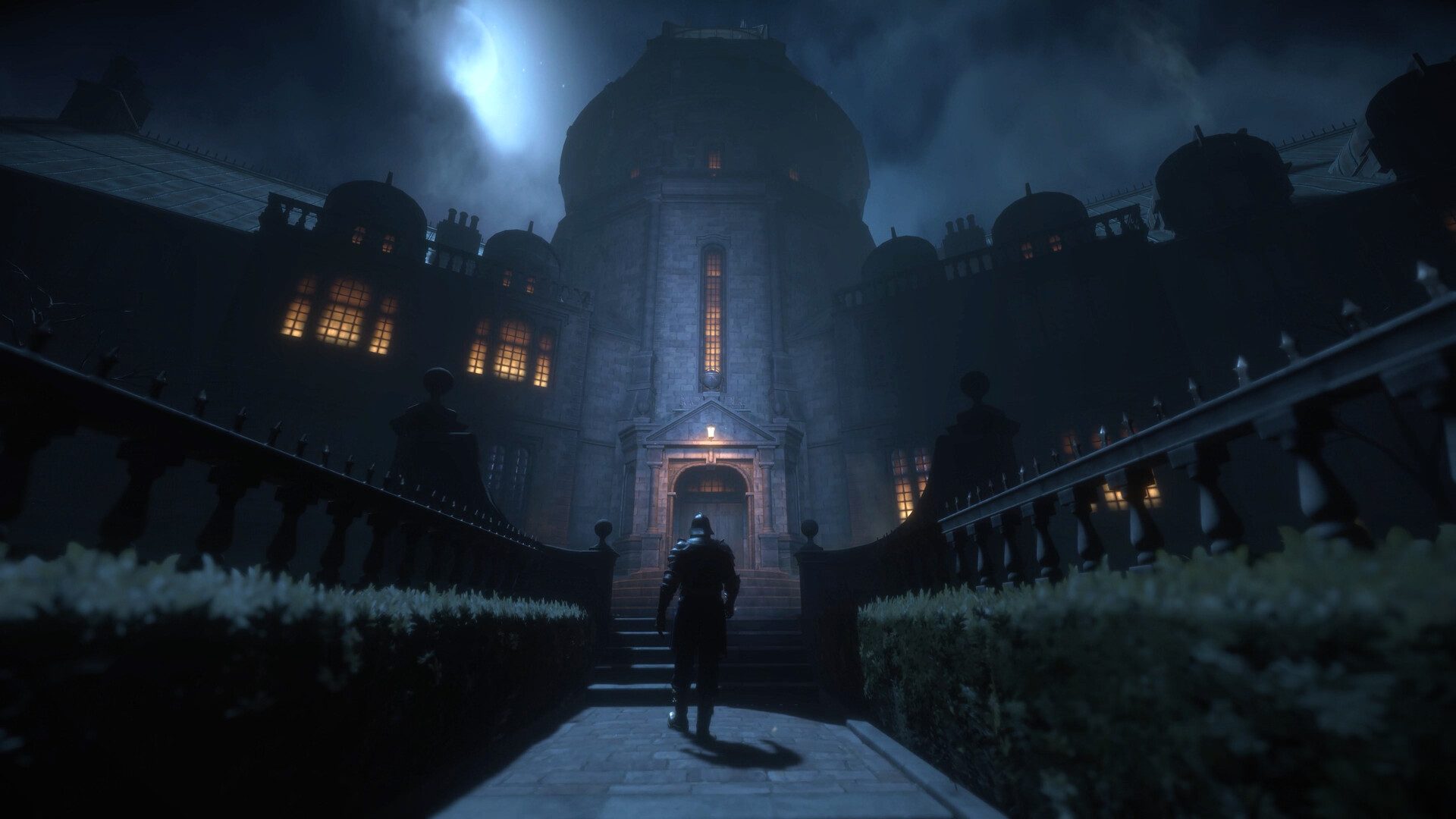
Image courtesy Maze Theory, Vertigo Games
Anyway, here’s the setup: your name is Magpie, a professional thief who finds a magical relic, turning you from your standard sticky-fingered prowler into something of a Super Thief. At the behest of your fixer and chief mission-giver Cassandra, you need to dig deeper into why Baron Northcrest is so intent on gathering up relics for some surely evil plan. I mean, he’s evil, so of course he’s doing evil things, but you have to stop him somehow.
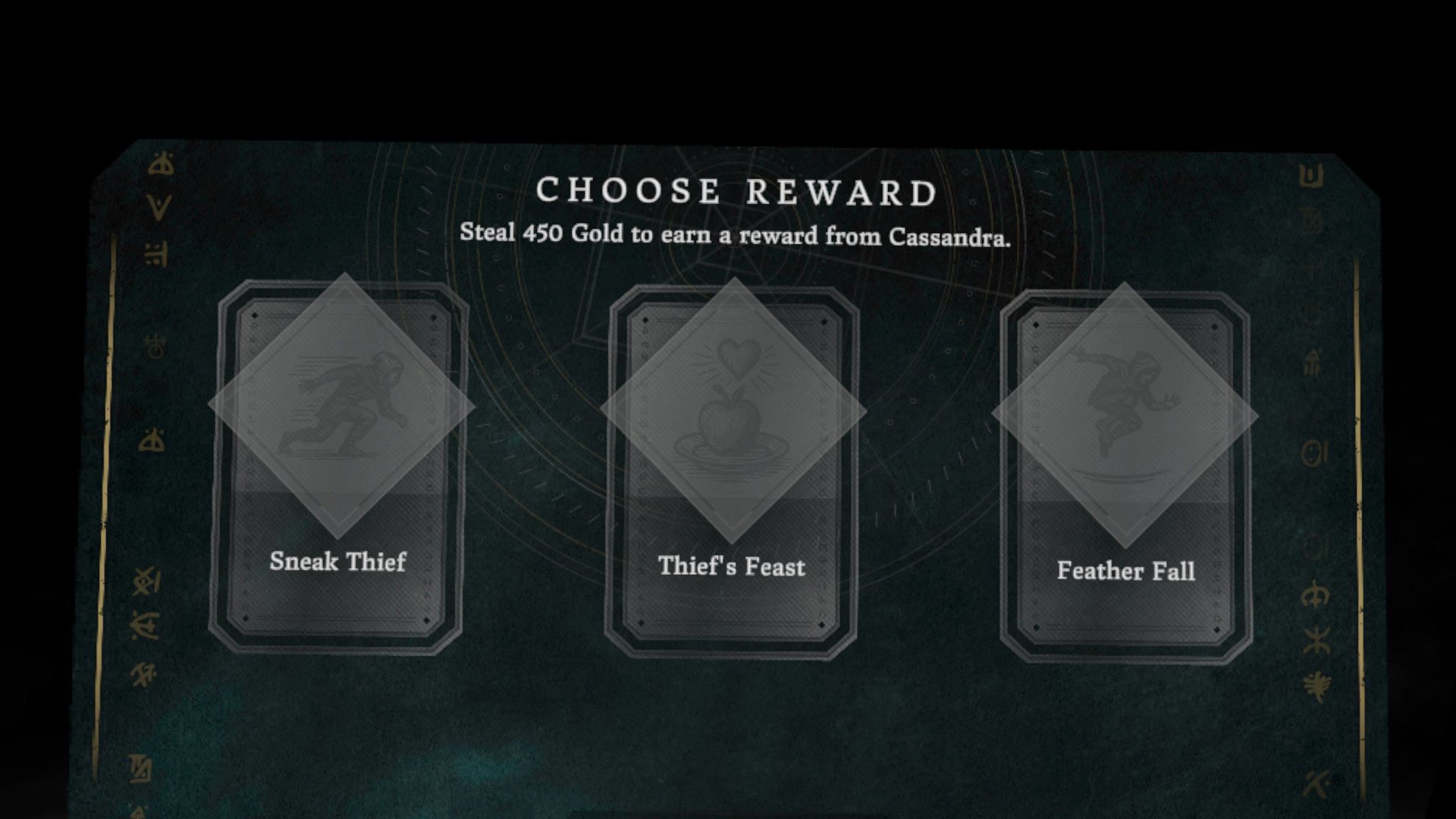
Gameplay mostly follows this pattern: you’re placed outside of a large building that needs infiltrating, of course covered with guards walking their various circuitous routes. Most of the guards can be knocked out and dragged away into the cover of darkness, while a small minority are essentially immortal tanks that need to be avoided entirely. It’s up to you whether you want to knock out, kill, or avoid any guard. Not killing one of the armor-clad goons, doing a mission undetected, or sweeping up a specific amount of loot can unlock more abilities to choose from at the end of each level.
Image captured by Road to VR
While you don’t need any of the abilities, they certainly make life a lot easier: better heath regen when eating food, quieter movement when crouching or jumping from high ledges, and a ready supply of arrows that you would normally have to scavenge levels to find.
I always stole everything I saw regardless of whether it was gold, silver, bronze, or whatever. That tactic worked until around the halfway mark, when levels get a little larger, and you need to explore a lot more beyond the main mission objectives. There’s no time limit, so it entirely depends on your appetite for completionism.
While you can hunt secondary objectives, thwack guards and turn each level upside down for hours until you’ve shaken out every last coin and golden goblet, the most scarce resource of all is invariably arrows. You have a black jack for knocking out guards, a lockpick for opening pickable doors and chests, and your inherent Glyph Vision, which lets you temporarily highlight important things and reveal otherwise invisible secret areas.
But it’s the bow and (lack of) arrow that could mean the difference between you restarting from an automatic checkpoint, or restarting the mission entirely.
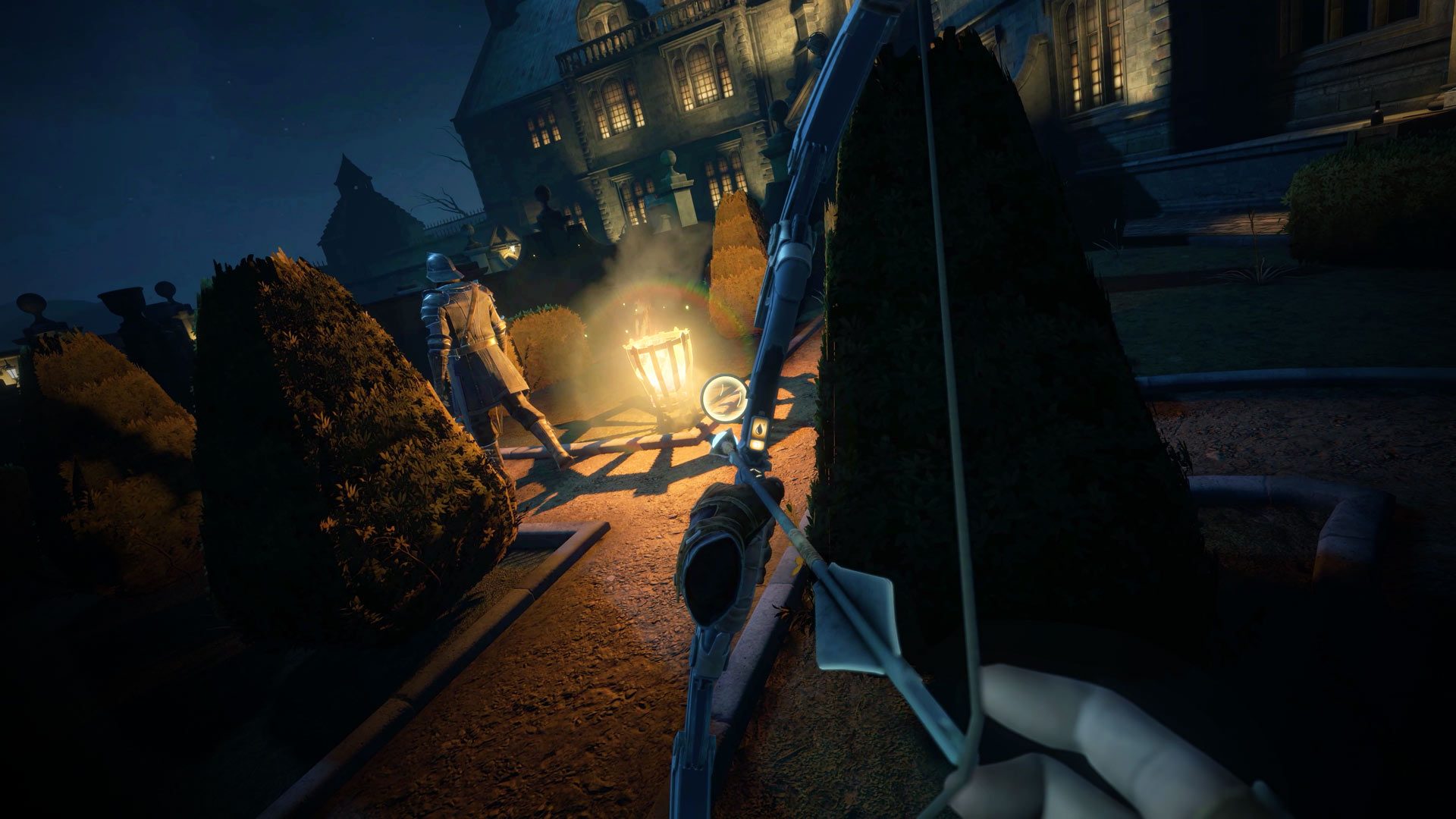
Arrow types include a water arrow to put out fire, a fire arrow to light key items on fire, a blunt arrow for knocking out guards, regular arrows for killing and disabling lights, and rope arrow, which lets you spawn vertical ropes to climb up on specific attachment points. While the game usually serves up the arrow you need at the time, levels are chock-full of byways and different ingress points, making variety an important factor. The bow works well, although I think the aiming angle is somewhat odd, making shooting the thing a bit of a chore.
Image courtesy Maze Theory, Vertigo Games
Missions often serve up a good amount of variety, save the last two, which I talk more about below. Levels are often multilayered buildings with high and low ingress points, which means you can mostly tackle them in any style you want—or at least it appeared to be that way to me. Granted, Thief VR doesn’t give you the sort of freedom you get in Hitman, but it’s also a built-for-VR game that doesn’t need to make any of the weird affordances you see in the various Hitman ports/VR modes.
In all, it took me a little over five hours to play the campaign all the way through, although your mileage may vary according to how safe you want to play it, or how much loot you’re willing to hunt for. That said, missions are replayable once you’ve beaten the game, so you can go back and try to get high scores and unlock more abilities.
I rarely include impressions of end levels for the sake of spoilers, but this unfortunately bears mentioning: the ending of Thief VR was such a massive letdown, I just had to say something. In the missions leading up to the ending, the game reuses two previous levels, which aren’t really mixed up to feel like anything new—possible signs that the game was rushed out the door.
Then, once you’re tromped through the last mission, and are finally served up what should be the cherry on top of the cake, it all basically ends in five minutes. You don’t get to apply any of the skills you honed throughout the entire game: just a few rando button presses and you’re done. Insult to injury: the game unceremoniously tosses you back to your home base after this short encounter, placing you in front of a mission screen to you can replay whatever.
Immersion
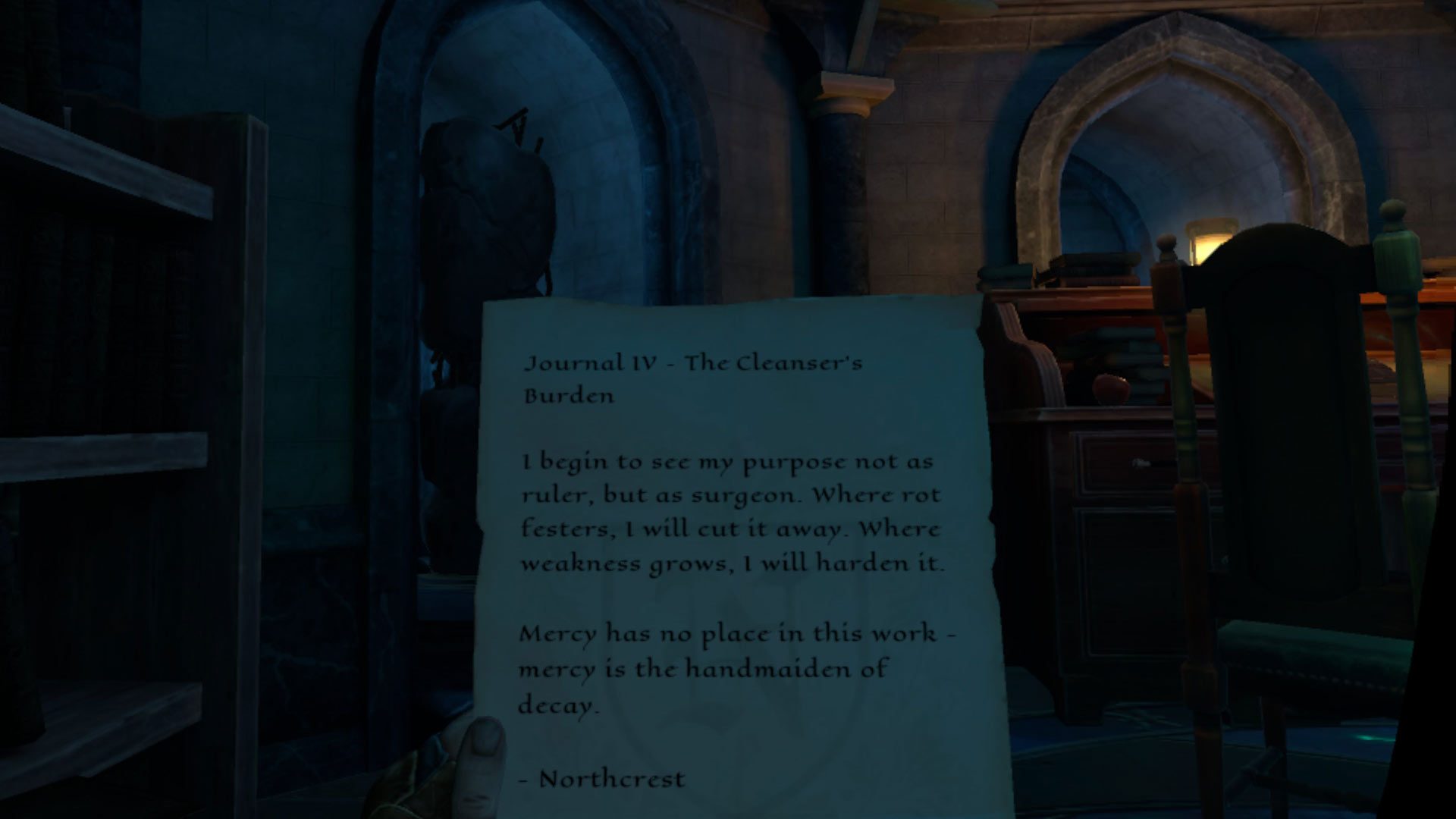
Thief VR looks awesome, as it’s densely packed with tons of environmental storytelling stuff, like posters, graffiti, and found notes all over the place, all of which help you understand the story beyond the periodic conversations you can eavesdrop on before guards head out on planned patrol routes.
Levels offer a ton of places to hide and explore, making it feel like a lived-in place. And what’s more, it also looks good and performs mostly well, even on Quest, which is likely the lowest tier version of the game. Notably, while it’s been a while since I played the demo, which was on PSVR 2, one remarkable thing is every version of the game feels a little too dark for my liking. Like, I need just a bit more light to read and see comfortably.
Image captured by Road to VR
Voice acting is also some of the best you’ll find in any game, VR or otherwise. Stephen Russell reprises his role as Garrett—notably lacking from the 2014 game, which tapped fellow voice acting veteran Romano Orzari instead. In any case, Thief VR’s whole cast seem to have been directed to deliver lines naturally, and less gamey than they might have otherwise.
Immersion is a fickle thing though, and can be quickly broken. For example, walls aren’t always capable of stopping or otherwise muffling noise. This seems to be more buggy behavior than something planned, as I noticed in some levels that guards would be somewhat muffled through doors, while other levels I could hear a guard snoozing from above or below me, as if he were in the same room. At one point, I could hear a half-dozen guards having conversations in possibly three different rooms, many of them featuring the same voice actor.
Guards are also stupid as sin—much dumber than those from analogue series, such as Hitman. I initially went into the game trying to play it as quietly and as far away from baddies as possible, but if I had known I could just run past a guy and then hide somewhere else for 10 seconds before he gives up and goes back about his pre-planned route, I wouldn’t have been so ginger. Here I am (sped up) alarming a guard, which brings their indicator to red before I make a daring escape up a regular ladder, which as we all know, can only be used by Super Thieves.
Really. A miscreant has entered an impenetrable palace, knocked out a bunch of dudes, and just showed their face before hiding under a table and you’re not able to alarm other guards? To me, Thief VR seems more content using the carrot rather than the stick: you’ll lose a valuable achievement, but guards won’t go five-star mode on your ass to hunt you down, which means you’ll mostly only ever replay a mission to get an achievement, and not save yourself from getting twacked to death.
Notably, even if a guard is on you, there’s a way of parrying their hits with your trusty black jack. Simply parry in the direction of their hit three times in a row, and guards will be knocked on their knees, allowing you to pop them on the head for a quick dirt nap. I don’t dislike that, as it gives you some recourse in a game fundamentally eschewing melee combat.
Object interaction is also a bit of a sore spot too—more than I thought it would be from my initial hands-on back in September. Most objects are interactable, which is a big plus in the immersion department, but grabbing them feels just a little too fumbly to be reliable. For example, even getting your lockpicks out of your inventory can be hit or miss, which can be frustrating when you need to quickly open a chest or door between you and freedom. Items include what feel like a singular point in the middle that you need to grab for, otherwise you might just paw at it ineffectually.
Okay, questionable game logic and weird bits aside: I think Thief VR’s overall strengths help compensate for some of its weaker moments, as they just become background static to what otherwise is a fun and enjoyable game. Many of these things may be subjects of future patches, although this is the game as it is at launch.
Comfort
Thief VR is a very comfortable game, as it doesn’t include any sort of vehicle rides, or other ways of forcing your perspective in uncomfortable ways.
At times, I did find myself struggling to reach items, even when artificially crouched, which made it slightly less comfortable to play seated than standing and physically crouching, or using a combo of physical and artificial crouch to grab things on the floor.
Thief VR: Legacy of Shadow Comfort Settings – December 4th, 2025
Meta Reality Labs is facing up to 30% budget cuts, Bloomberg reports, higher than the 10% Mark Zuckerberg normally asks for during budget cycles.
Reality Labs, if you’re unaware, is the division of Meta behind its Quest headsets, Horizon software, smart glasses, and sEMG wristband, as well as researching future technologies such as Codec Avatars and AR glasses.
Since Meta started breaking out the financial results of Reality Labs in its earnings calls in Q4 2020, it’s been public knowledge that the division spends significantly more than it brings in, resulting in a financial “loss” that has been the fuel for countless clickbait articles each quarter.
But while describing this as a “loss” is technically correct in an accounting sense, much of it would be more accurately described as long-term investment. XR headsets like Quest are still a relatively early technology. Further, as of 2022 more than 50% of Reality Labs spending was on the research and development of AR glasses, and the company has yet to even launch a true AR glasses device.
Still, Meta is a business, and at some point, it wants Reality Labs to be profitable, a goal that will involve spending less.
In July 2024, The Information reported that Reality Labs was told to cut spending by 20% by 2026. But the first three quarters of 2025 have seen Reality Labs spend roughly the same as it did in 2024.
Bloomberg’s new report comes as Meta is planning its budget for next year. According to the report, executives are “considering” a cut “as high as 30%” for Reality Labs, with associated layoffs that would arrive as early as January.
Proposed cuts would primarily target VR and Horizon Worlds, according to the report, at a time when Meta is hoping to scale up its smart glasses ambitions.
The company, with its partner EssilorLuxottica, is still selling many of its smart glasses models as fast as it can make them. Simultaneously, it has seen Quest headset sales decline in 2025 compared to 2024, with Quest 3S proving only a hit during the holidays, not the rest of the year.
This combination of significant success in the smart glasses space and relative failure in growing its VR headset business is likely the driver of the company’s decision to focus cuts on the latter, and it will be paying close attention to the sales of its next headset to decide how to invest through the rest of the decade.
The update screen is a normal occurrence on Windows machines, so of course hackers are now manipulating it to sneak malware onto devices. The scheme, a recent iteration of a ClickFix attack, is designed to trick you into executing a dangerous command under the guise of completing a “critical security update.” But what you’re actually doing is installing an infostealer that hands data over to bad actors.
When a Windows update pop-up is actually a ClickFix attack
ClickFix is a social engineering ploy that uses tactics like fake error messages, CAPTCHA forms, and command prompts to deliver malware to your device. As PCMag reports, the Windows update scam is a pop-up that looks like a standard Windows blue screen but is actually a full screen browser page being displayed from a malicious domain.
The ClickFix element is a set of keystrokes—not part of the real update interface—that have the user paste and execute a malicious command, ultimately delivering malware to their device. These instructions have an air of urgency, which is a common element of a scam.
Researchers at cybersecurity firm Huntress have detailed the exact mechanism behind this attack, including an iteration in which users are prompted to verify they are human (rather than complete a security update). As Bleeping Computer outlines, the malicious code is embedded into the pixel data of PNG images, and the final payload is one of two known infostealers.
According to the Huntress analysis, following a recent law enforcement operation, fake Windows update pages continue to exist across multiple domains, but those domains no longer seem to host the malware payload. That doesn’t mean, however, that this attack, or some version of it, won’t pop up elsewhere.
How to stay safe from this ClickFix attack
If you run Windows on your device, you’ve probably seen a blue or black update or error screen many times, and you may not be suspicious if your computer randomly begins an update or prompts you to take an extra step to confirm it. But while a legitimate update screen will have a progress indicator and instructions not to turn off your computer, you should never need to input manual commands. This is a red flag of a ClickFix attack and not something a trusted service will require.
Of course, it’s important to keep your computer up to date. Microsoft releases security updates on the second Tuesday of the month, known as Patch Tuesday, and you can enable automatic updates on your machine to ensure you get fixes as soon as they’re available.
If you want to take additional steps to prevent ClickFix attacks on Windows, you can disable the Windows Run box to prevent unauthorized access to commands.
This week brought the official release of FreeBSD 15.0 as the latest major update to this BSD operating system. In being eager to test out this new FreeBSD release, for this first round of FreeBSD 15.0 benchmarking is seeing how it compares to the former FreeBSD 14.3 release on a Supermicro + AMD EPYC Turin server.
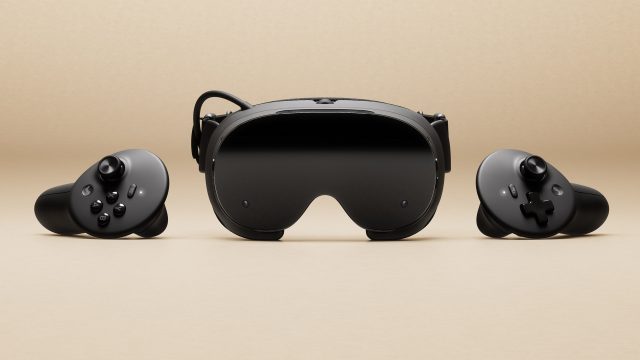
Valve says that Steam Frame won’t be able to display traditional (‘flat’) games in stereoscopic 3D at launch, but they are looking into the feature for future development.
The News
The announcement of Steam Frame came with a lot of info but equally as many unanswered questions. One thing on my mind is whether or not the headset will be able to render flat games in stereoscopic 3D (assuming the game supports it). A Valve spokesperson told me that such a feature doesn’t currently exist, but the company is looking into it.
“For […] stereoscopic 3D content on [Frame], we don’t currently support it, but it’s on our list.”
The company further said it’s considering a system-level implementation that could display any stereoscopic 3D content, whether it’s stereoscopically rendered games, videos, or photos. Should the stereoscopic 3D feature be built, Valve told me it would “be our goal” to be able to display such content when streamed from a PC or rendered directly on the headset itself.
In an age of impressive conversion of 2D content into 3D content (like we’ve seen on headsets from Apple and Samsung), I also asked if the company was exploring any technology to automatically convert flat Steam games into stereoscopic output for viewing in 3D on Frame; unfortunately Valve said it isn’t something they’re currently looking into.
My Take
Without any automatic stereoscopic 3D conversion, the big question becomes: what content is actually available to users in stereoscopic 3D?
In 2025, there are very few flat games that natively support stereoscopic 3D rendering. But there’s a handful of third-party mods that inject themselves into the rendering pipeline to generate stereoscopic 3D frames from flat games. Since these aren’t developer-level integrations, such mods can work well for some games but not others.
Side-by-side stereoscopic rendering (where the left and right eye views are packed into a single, final frame) is the most widely compatible format for stereoscopic 3D content today. So the lowest hanging fruit for Valve would be to allow Frame to view any arbitrary side-by-side content in stereoscopic 3D, whether rendered in real-time from a game or pre-rendered images or videos.
While there isn’t a singular and widely available marketplace of professional stereoscopic 3D media, some modern phones and XR headsets can capture stereoscopic 3D images and videos. And automatic 2D-to-3D conversions of photos and videos is becoming increasingly accessible. Most of these can be viewed in one way or another on modern XR headsets and Steam Frame could eventually be among them.
An anonymous reader quotes a report from the Guardian: Almost three in 10 GPs in the UK are using AI tools such as ChatGPT in consultations with patients, even though it could lead to them making mistakes and being sued, a study reveals. The rapid adoption of AI to ease workloads is happening alongside a “wild west” lack of regulation of the technology, which is leaving GPs unaware which tools are safe to use. That is the conclusion of research by the Nuffield Trust thinktank, based on a survey of 2,108 family doctors by the Royal College of GPs about AI and on focus groups of GPs.
Ministers hope that AI can help reduce the delays patients face in seeing a GP. The study found that more and more GPs were using AI to produce summaries of appointments with patients, assisting their diagnosis of the patient’s condition and routine administrative tasks. In all, 598 (28%) of the 2,108 survey respondents said they were already using AI. More male (33%) than female (25%) GPs have used it and far more use it in well-off than in poorer areas.
It is moving quickly into more widespread use. However, large majorities of GPs, whether they use it or not, worry that practices that adopt it could face “professional liability and medico-legal issues,” and “risks of clinical errors” and problems of “patient privacy and data security” as a result, the Nuffield Trust’s report says. […] In a blow to ministerial hopes, the survey also found that GPs use the time it saves them to recover from the stresses of their busy days rather than to see more patients. “While policymakers hope that this saved time will be used to offer more appointments, GPs reported using it primarily for self-care and rest, including reducing overtime working hours to prevent burnout,” the report adds.
Based on what we’ve seen, Replaced is a gaming art director’s dream. The long-delayed indie title has lush pixel-art environments, set in a cyberpunk fever dream. And now we finally know when it’s arriving. Mark your calendar for March 12, 2026.
If you’ve been following Replaced‘s journey, you’ll know that’s four years after its original release date. Shit happens! In this case, that included having to relocate from Belarus to Cyprus after Russia invaded Ukraine in 2022. It will be the first game from developer Sad Cat Studios. Thunderful Games is publishing.
Gaming still from Replaced. “Pit’s Diner,” set in a dystopian cyberpunk world (pixel art). Various shady characters mill about.
Sad Cat Studios / Thunderful Games
Replaced is set in a dystopian alternate 1980s America. In this timeline, nuclear winter has reshaped the world. “Step into a world where neon lights flicker over rain-soaked streets, industrial decay meets futuristic technology, and every shadow holds a secret,” the blurb reads. You play as R.E.A.C.H., an AI unwillingly trapped in a human body.
As for gameplay, it’s a 2.5D cinematic action platformer. “Chain precise melee strikes with satisfying ranged attacks to take down enemies in high-intensity encounters while keeping the flow of exploration,” the description reads. Expect plenty of running, climbing and kicking ass.
You can see some of the dazzling art direction, fluid movement, and smooth combat in the new trailer below. You can wishlist Replaced now through Steam or Xbox.
This article originally appeared on Engadget at https://www.engadget.com/gaming/pixel-art-cyberpunk-game-replaced-arrives-in-march-170253220.html?src=rss
When Don Carson was hired by Lucas Martell in September 2021 to work as an artist on Walkabout Mini Golf, the former theme park designer mentioned a name and place he wanted to see in virtual reality.
Carson’s dream space opens to the public in VR this week. In Walkabout Mini Golf, the final paid add-on course of 2025 from studio Mighty Coconut finds visitors at the bottom of a rabbit hole following Alice on a journey growing curiouser and curiouser.
0:00
/2:21
When he was a child, Carson loved Alice’s Adventures in Wonderland by Lewis Carroll with illustrations by John Tenniel. First published in 1865, Alice’s series of encounters with strange creatures has seen every kind of adaptation from those original words and images. From release on December 4, 2025, Carson’s course design for Martell’s Walkabout with holes by Henning Koczy will see people leaning in to look through the keyhole at a royal garden beyond. Then they’ll follow Alice’s trail of dropped bottles, growing small and large along the way in a mad laughing party of their own.
As the course opens, Walkabout’s core design team convenes at Carson’s home studio in the Pacific Northwest to rough out ideas for the game that will open in 2027. Below is an image of the Walkabout Path for Alice’s Adventures In Wonderland drawn by Carson as an early concept in 2024.
Pen and ink drawing by Don Carson of an early draft of the “walkabout path” through Alice’s Adventure’s In Wonderland.
First shown publicly in our coverage of the game’s 36th course, the Mother Goose-inspired Forgotten Fairyland, the “Walkabout Path” for each course starts as a continuous circuitous block carved in virtual reality with Gravity Sketch. At the same time visitors follow Alice’s finalized path for the first time, Walkabout’s designers meet in the physical world to wear VR headsets together in the same space as they rough out places as a kind of team-building exercise of pure spatial creation.
You can watch our full 27-minute tour of Alice’s Adventures in Wonderland with Carson and Koczy taking us along Alice’s adventure from the Cheshire Cat to the Jabberwocky and Queen, and find all of our coverage of Walkabout at UploadVR.com/Walkabout.
Each new course from Walkabout features 36 new hole designs, 18 each in easy and hard modes. I only briefly glimpsed the eye-catching new visual effect shown in Wonderland’s hard mode, but in my tour video above you can see Koczy himself – the designer of all the holes – putting right into a Mad Tea Party. I won’t spoil what happens in that video if you’re waiting to experience it for yourself.
There are well beyond 1,000 unique hole designs in Walkabout now, many of them designed by Koczy. At the Mad Tea Party he’s a wizard in Wonderland channeling something into Walkabout I first experienced almost a decade ago.
I enjoy sitting on Amalthea around Jupiter and Pistol Whip’s levels are still dreamy, but to my personal taste a Walkabout Mad Tea Party with friends played like Alice in Wonderland may be the best experience in all of virtual reality now.
As a refresher, this is the third generation of the Kindle Scribe line of E Ink writing tablets. This year was the first time Amazon made three different versions of the Scribe, turning it into a series of products. At the entry-level, the Scribe without a front light will start at $430, while the model with a front light starts at $480. The Kindle Scribe Colorsoft, which, as it name suggests, can render colors, will start at $630.
All three flavors will feature the updated hardware and design that’s a bit more symmetrical than previous generations, which had a thicker bezel on one side. They’re also thinner than older Scribes and come with redesigned Kindle software that can help make note-taking a bit more efficient. Based on my hands-on with the Kindle Scribe Colorsoft, it also seemed to render colors more vividly than competing devices like the reMarkable Paper Pro, though I’ll definitely need to get a review unit in for better comparison.
For now, check out our hands on of the Kindle Scribe Colorsoft and review of the reMarkable Paper Pro and even of the last-gen Kindle Scribe to see if this is something you might want. While December 10 is cutting it pretty close to the holiday gifting season, it’s still weeks ahead of Christmas, so it might still be worth keeping an eye on.
This article originally appeared on Engadget at https://www.engadget.com/computing/amazons-kindle-scribe-colorsoft-finally-has-a-release-date-december-10-170000910.html?src=rss
We may earn a commission from links on this page. Deal pricing and availability subject to change after time of publication.
Earbuds don’t usually get major design overhauls, but the Samsung Galaxy Buds 3 Pro make a clear break from earlier models. This new version leans into a more angular, stemmed shape that feels closer to the AirPods silhouette, complete with small customizable LEDs that add a bit of personality. With today’s drop to $159.99 from $249.99, you’re getting a premium pair for $90 off its regular price.
Samsung uses a 10.5mm dynamic driver paired with a 6.1mm planar driver, which gives the buds a wider, more layered sound than you’d expect from something this size. Music comes through with good depth and detail, but this PCMag review notes that active noise cancellation can soften the treble a little. You can fine-tune that through Samsung’s EQ, though only Galaxy phone users get the full set of audio tools and support for Samsung’s Seamless Codec for 24-bit audio.
Living with the Buds 3 Pro feels different depending on the device you pair them with. Galaxy users get the complete experience: auto-pairing, in-depth customization, and access to features like Interpreter Mode, which handles real-time translation during conversations. Android users outside the Samsung ecosystem still get most core features through the Wear app, with some limitations—no 24-bit audio and fewer advanced controls. iPhone users get the shortest end of the stick, as the buds function as regular Bluetooth headphones with no app support at all. That means no EQ tuning, no control customization, and no access to Samsung’s smart extras. The saving grace here is that the hardware itself holds up well on any device. Calls come through clearly, ANC works well for everyday noise, and the earbuds stay comfortable enough for long listening sessions.
Durability is another bright spot. The IP57 rating puts these buds ahead of many competitors in this price range, making them solid for workouts, commutes, and even rainy runs. The case is compact, and the buds snap into place securely without fuss. Battery life is solid, though not chart-topping, and you can stretch it further by toggling between ANC modes. The lack of LDAC support might disappoint Android audiophiles looking for maximum bitrate playback, but for most listeners, the combination of comfort, sound quality, and smart features will outweigh that gap.
Meta is reportedly planning steep cuts to its metaverse division, according to Bloomberg. This is happening just a few years after the company changed its name from Facebook to reflect its renewed interest in that same metaverse.
Bloomberg notes that the metaverse department could get hit with significant budget cuts in the near future, with layoffs potentially occurring early next year. The budget cuts could go as high as 30 percent and will likely impact the virtual worlds product Meta Horizon Worlds and the Quest virtual reality headset. The publication did note that this isn’t a done deal just yet.
Company insiders say this is all part of Meta’s annual budget planning for 2026 and that the cuts were discussed at a series of meetings at CEO Mark Zuckerberg’s compound in Hawaii. The metaverse team was reportedly asked for deeper-than-average cuts because the technology hasn’t exactly taken the world by storm.
As a matter of fact, the whole metaverse idea has been a dud with investors, who see it as a drain on resources. Consumers aren’t exactly keen on the idea either, even if they still buy VR headsets and traditional games. It’s one thing to throw on a headset to shoot bad guys for 20 minutes but it’s a whole other thing to, well, wander around a fake Abercrombie & Fitch for hours looking to spend real money on fake clothing for an avatar.
The report does suggest that Zuckerberg still believes that people will one day spend the majority of their time in virtual worlds, but these cuts signal that he understands that this idea is still years or decades away from fruition. The metaverse sits within a company division called Reality Labs that has lost more than $70 billion since 2021. Zuckerberg has also largely refrained from mentioning the metaverse in public and in earnings calls.
So what will Meta be spending money on instead? It’s reportedly focused on further developing large AI models and chatbots, in addition to hardware products linked to AI experiences like those Ray-Ban smart display glasses.
This article originally appeared on Engadget at https://www.engadget.com/ar-vr/meta-is-reportedly-going-to-slash-spending-on-the-metaverse-164547153.html?src=rss