Amazon used its annual re:Invent cloud conference in Las Vegas to pitch a vision of the workplace where AI agents serve not as tools but as “co-workers” and “teammates,” even as the company proceeds with eliminating roughly 14,000 corporate jobs in its second major workforce reduction in recent years.
AWS CEO Matt Garman predicted on stage that autonomous “frontier agents” could represent 80 to 90% of enterprise AI value. Colleen Aubrey, senior vice president of applied AI solutions, described a future where companies manage “teams” of agents capable of working autonomously for hours or days while humans shift into supervisory roles. Amazon has already deployed agentic systems across tens of thousands of its own engineers to triage outages and propose fixes. The company calls these systems “teammates” rather than tools. CEO Andy Jassy has warned that AI would shrink Amazon’s workforce, though a spokesperson attributed the current cuts to “reducing bureaucracy” and “removing layers” rather than AI deployment.
Sure, Black Friday and Cyber Monday have come and gone, but you can still find a last-minute deal on the best tech gifts. Take the Apple Watch Series 11, which has dropped to an all-time low of $299, from $399. The 25 percent discount is an even better deal than we saw on either of those sale holidays.
We gave the Apple Watch Series 11 a score of 90 when it came out in September. That’s thanks, in part, to an upgraded 24 hours of battery life — which lasted closer to a day and a half — compared to the 18 hours promised by the Series 10. It also features a thin, light design and a wrist flick gesture for everything from dismissing a notification to ending calls. Plus, it has Apple’s new hypertension tracker and comprehensive health monitoring.
This deal is available for the Apple Watch Series 11 with a 42mm case and a small to medium band. It also comes with just GPS capabilities and in three colorways: Jet Black aluminum case with Black sport band, Space Gray aluminum cause with Black sport band and Rose Gold aluminum case with Light Blush sport band.
Check out our coverage of the best Apple deals for more discounts, and follow @EngadgetDeals on X for the latest tech deals and buying advice.
This article originally appeared on Engadget at https://www.engadget.com/deals/apple-watch-series-11-drops-100-to-an-all-time-low-price-130006591.html?src=rss
Zwift Camp: Build is underway: a 5-stage route-based workout series, with each stage lasting one week and focusing on developing power over a specific time interval.
My plan is to do each of the five workouts before their weeks begin, so I can write a post unpacking the workout and delivering some tips along the way. This post covers Stage 5’s workout on Watopia’s Road to Sky route, which takes you up the massive Alpe du Zwift KOM. Let’s roll!
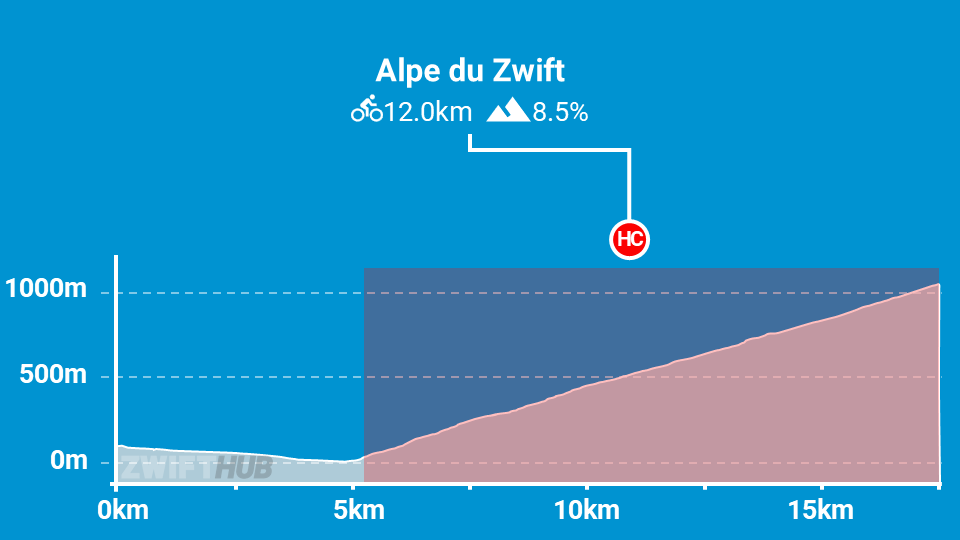
The fifth and final stage of Zwift Camp: Build is focused on “One 60-minute showdown,” according to the event description. We’re climbing Alpe du Zwift, a 12.2km, 8.5% climb modeled after France’s infamous Alpe d’Huez.
This is by far the longest effort in Zwift Camp: Build. We began this Camp with short sprints in Stage 1, went to longer sprints in Stage 2, then (sort of) VO2 power in Stage 3, followed by 10-20 minute power in Stage 4. Stage 5, for many riders, will be around a 1-hour interval, making it a true threshold effort.
Apart from the mental and physical challenge of a long threshold effort, the only tricky part here is pacing. You’ll do best if you know the wattage you’re aiming to hold on the climb, and this will also let you pick a pace partner to ride with.
The RoboPacers each have their own pens, with the faster bots leaving first. While everyone is visible on course, chances are very few riders from the slower groups will catch the faster ones ahead.
Here are the RoboPacer options:
A – 50 Minutes: 4 W/kg
B – 60 Minutes: 3.3 W/kg
C – 70 Minutes: 2.8 W/kg
D – 90 Minutes: 2.1 W/kg
E – 115 Minutes: 1.7 W/kg
The stage is built around Watopia’s Road to Sky route, which begins with an easy descent into the Mayan Jungle.
The bots go much slower during this warmup portion, so be sure to stay with your bot (it’ll be easy) if you want to start the Alpe climb next to them.
The route ends atop the Alpe, but you can keep pedaling and descend back to ground level afterward. You earned the distance!
Stage 5 Walkthrough
Once again, I was going into this ride with legs that were less than fresh. Luckily, Zwift had set up the RoboPacers in such a way that the B bot was perfect for what I could do in terms of a longer effort!
The B bot’s 60-minute climb pace, at 3.3 W/kg, seemed like it would pace me nicely on the early part of the climb. Then I figured I’d have a bit more left on the upper slopes, so I could push a bit harder, drop the bot, and negative split things overall.
After 9 minutes of easy warmup spining through the Jungle, we crossed the start line for Alpe du Zwift, the bot kicked up the effort, and we got to work:
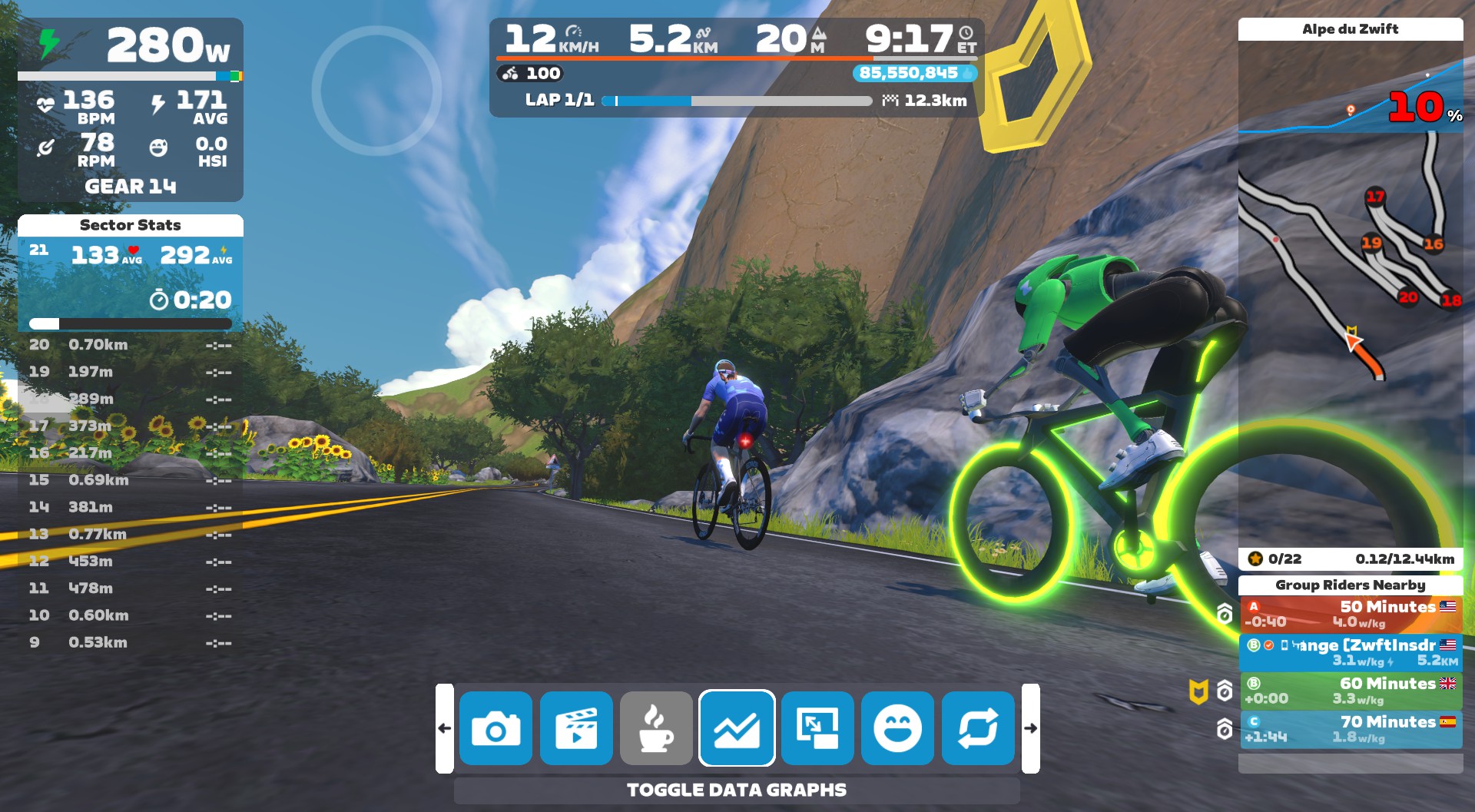
I settled into my target pace, finding the best gear and staying close to the bot.
After climbing for several minutes, I realized that this setup was working out really nicely. While the Sector Stats HUD on the left let me easily see my average power for each of the 21 sectors, the green bot and its big ol’ beacon made it easy to see if I was holding my target pace.
A warning, though: these bots are relentless, and if you ease up, you’ll get dropped!
Hairpin Note
The spot where you’ll notice the relentless nature of the RoboPacers the most is on the flatter gradients that often occur on the hairpins at the end of some sectors. When the road flattens, your power will naturally drop as trainer resistance drops. But the RoboPacer won’t change its output!
I found myself losing several meters to the bot on each flat section, until I began to consciously increase my power when I felt resistance ease.
Doing the Work
I stayed just a few meters ahead of the B bot for the first 15 sectors. I also opted not to steer, as the pace I was holding felt good and I didn’t need to gain further advantage on the unsuspecting robot. (Note: steering can reduce the overall length by around 500 meters, so it’s no small thing!) If you’re struggling to keep up with the bot, though, a few cut corners may be just the trick you need.
Nearing the finish, 40 seconds ahead of the bot
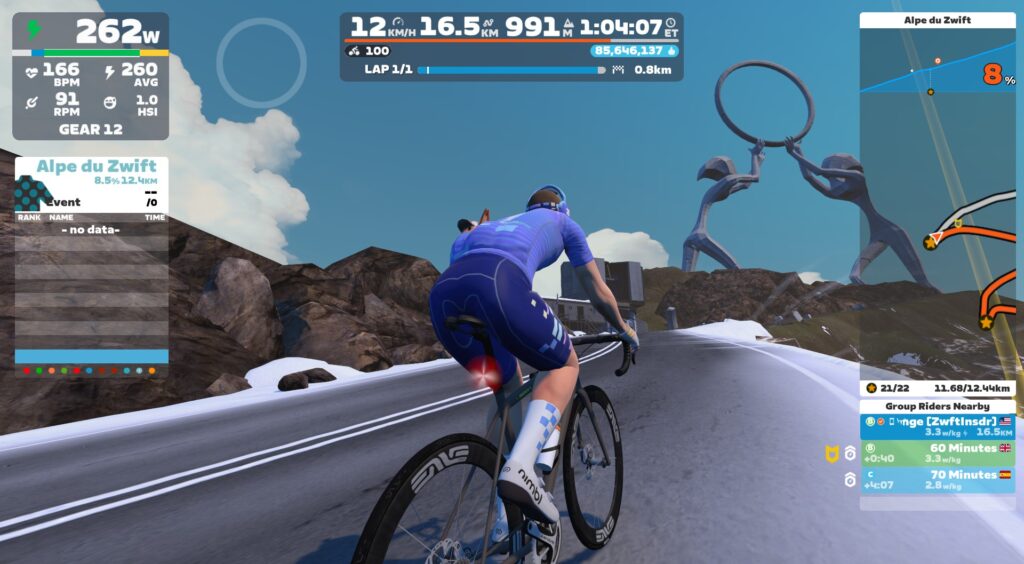
My heart rate had risen steadily from 140 at the bottom of the Alpe to 160 with 6 sectors to go. That’s when I decided to bump up my effort, drop the green robot, and sail to victory!
I went from averaging ~270W to ~280-285W, and began putting time into the bot. I kept pushing, getting my heart rate up to 170bpm as I crossed the finish line. My final climb time was 58:21, and the bot finished about 40 seconds behind me. (So it’s worth mentioning that the bot climb times are estimates only, probably accurate within a minute or so.)
Watch My Video
Results!
I received an automated email after finishing this stage, which included a link to a web-based results dashboard: zwift.com/zwift-camp-build/dashboard
Good to see Zwift getting this launched, even if it came a bit late.
Suggestion Box
I’ve been offering improvement suggestions to Zwift for each of these stages, and my suggestions for stage 5 would be the same as stage 4: add messaging, and improve the event description (read those suggestions in more detail here).
Apart from that, I want to take a moment to talk about the overall Zwift Camp: Build experience now that I’ve finished the final stage.
Overall, I’d say Zwift Camp: Build offers some good sessions for riders looking to challenge themselves with maximal efforts across particular time intervals. Three stages do this well:
Stage 1 with its 4 neuromuscular sprints on Glasgow’s Champion’s Sprint
Stage 4 for a suprathreshold effort on The Grade KOM
Stage 5 for a maximal threshold effort, assuming you can complete the Alpe in ~60 minutes or less
The other two stages fell short of what could have been. To be precise:
Stage 2 talked about targeting 1-minute power, but since the on-screen instructions had you sprinting every sprint segment (9 of them!), your 1-minute efforts were blunted.
Stage 3, on the cover, was about VO2 max efforts. But it had you do 3 back-to-back hard laps of the Volcano Circuit, which meant you couldn’t actually hold VO2 max power for more than perhaps 1 lap. It was actually more like a pacing exercise for stage 4.
Like I said in the intro to stage 1, this isn’t meant to be a workout program for an intermediate or experienced rider, and it won’t offer the periodized training of a true program.
It is, however, an easy way for beginners, or those new to structured training, to dip their toes into more structured approaches. Route-based workouts are a great way to do this, as they offer a welcome and needed alternative to the rigid structure of ERG workouts. So it’s good that Zwift is pushing in this direction.
As Zwift’s first serious foray into a route-based workout series, I’d say overall, Zwift Camp: Build feels like a step in the right direction.
But these workouts, and the overall program, could be much better. I’ve already written all my suggestions in previous posts, but I’ll summarize them by saying Zwift should:
Find routes that dial in the interval lengths more precisely;
Use the HUD effectively to aid the workout, and also;
Communicate clearly what each workout is about through the event titles, description text, and other marketing comms.
There’s a lot more to be said about the potential of route-based workouts in Zwift, but I’ll save that for an upcoming Pondering the Possibilities post.
America’s Energy Department runs a research lab in Idaho — and this week announced successful results from a ground-breaking experiment. “This is the first time in history that chloride-based molten salt fuel has been produced for a fast reactor,” says Bill Phillips, the lab’s technical lead for salt synthesis. He calls it “a major milestone for American innovation and a clear signal of our national commitment to advanced nuclear energy.”
Unlike traditional reactors that use solid fuel rods and water as a coolant, most molten salt reactors rely on liquid fuel — a mixture of salts containing fissile material. This design allows for higher operating temperatures, better fuel efficiency, and enhanced safety. It also opens the door to new applications, including compact nuclear systems for ships and remote installations.
“The Molten Chloride Fast Reactor represents a paradigm shift in the nuclear fuel cycle, and the Molten Chloride Reactor Experiment (MCRE) will directly inform the commercialization of that reactor,” said Jeff Latkowski, senior vice president of TerraPower and program director for the Molten Chloride Fast Reactor. “Working with world-leading organizations such as INL to successfully synthesize this unique new fuel demonstrates how real progress in Gen IV nuclear is being made together.”
“The implications for the maritime industry are significant,” said Don Wood, senior technical advisor for MCRE. “Molten salt reactors could provide ships with highly efficient, low-maintenance nuclear power, reducing emissions and enabling long-range, uninterrupted travel. The technology could spark the rise of a new nuclear sector — one that is mobile, scalable and globally transformative.
More details from America’s Energy Department:
MCRE will require a total of 72 to 75 batches of fuel salt to go critical, making it the largest fuel production effort at INL since the operations of Experimental Breeder Reactor-II more than 30 years ago. The full-scale demonstration of the new fuel salt synthesis line for MCRE was made possible by a breakthrough in 2024. After years of testing, the team found the right recipe to convert 95 percent of uranium metal feedstock into 18 kilograms of uranium chloride fuel salt in only a few hours — a process that previously took more than a week to complete…
After delivering the first batch of fuel salt this fall, the team anticipates delivering four additional batches by March of 2026. MCRE is anticipated to run in 2028 for approximately six months at INL in the Laboratory for Operation and Testing (LOTUS) in the United States test bed.
“With the first batch of fuel salt successfully created at INL, researchers will now conduct testing to better understand the physics of the process, with a goal of moving the process to a commercial scale over the next decade,” says Cowboy State Daily.
Thanks to long-time Slashdot reader schwit1 for sharing the article.
It’s time to admit, before God and the good readers of Ars Technica, that I have a problem. I love roguelikes. Reader, I can’t get enough of them. If there’s even a whisper of a hot new roguelike on Steam, I’m there. You may call them arcane, repetitive, or maddeningly difficult; I call them heaven.
The second best part of video games is taking a puny little character and, over 100 hours, transforming that adventurer into a god of destruction. The best thing about video games is doing the same thing in under an hour. Beat a combat encounter, get an upgrade. Enter a new area, choose a new item. Put together a build and watch it sing.
If you die—immediately ending your ascent and returning you to the beginning of the game—you’ll often make a pit stop at a home base to unlock new goodies to help you on your next run. (Some people distiguish between roguelikes and “roguelites,” with the latter including permanent, between-run upgrades. For simplicity’s sake, I’ll use “roguelike” as an umbrella term).
After Netflix announced that it was acquiring Warner Bros. Discovery last week, observers immediatley wondered when or if the deal could obtain regulatory approval. Now, President Trump has made comments indicating that said approval is likely to take awhile if it happens at all, Bloomberg reported.
“Well, that’s got to go through a process, and we’ll see what happens,” Trump told reporters in a recent Q&A scrum. “But it is a big market share. It could be a problem.” The President added that he will be personally involved in the approval process.
As we pointed out last week, Netflix and HBO Max combined would account for around 33 percent of the US streaming video market, ahead of Prime Video’s 21 percent share and likely enough to attract the antitrust division of the US Justice Department. For its part, Netflix has said that it will “maintain Warner Bros. current businesses,” which includes HBO Max and HBO, theatrical releases for films as well as movie and TV studio operations.
Headwinds were likely with any deal, so in November Netflix’s co-CEO Ted Sarandos reportedly met with Trump at the White House, arguing that the acquisition wouldn’t create a monopoly. Trump said that Warner Bros. Discovery should sell to the highest bidder, and Sarandos left the meeting feeling that Netflix wouldn’t face White House opposition in the short term.
Even before regulators address the acquisition, more drama may ensue. Paramount, which first expressed interested in buying WBD when it wasn’t even for sale, may launch a hostile bid. And Hollywood’s unions and guilds are up in arms over fears that Netflix may significantly reduce Warner Bros.’ theatrical distribution, along with its back end profits and production jobs.
This article originally appeared on Engadget at https://www.engadget.com/entertainment/streaming/trump-says-if-netflix-buys-warner-bros-its-market-share-could-be-a-problem-123004774.html?src=rss
All of the Human Interface Devices (HID) subsystem updates were merged a few days ago for the ongoing Linux 6.19 kernel merge window. Standing out this cycle on the HID side are seeing new/improved support for several Logitech devices…
I2C in Linux 6.19 brought support for Rust-written I2C drivers. The newer I3C “Improved Inter-Integrated Circuit” interface changes have now been merged and the big feature there is HDR support. Not to be confused with the more common High Dynamic Range acronym usage for HDR, HDR in the I3C context is for the “High Data Rate” mode for facilitating faster data transfers…
The ARM64 code changes were merged last week into the in-development Linux 6.19 kernel. The most notable of the ARM64 architecture changes this cycle is landing the Arm MPAM driver for Arm’s Memory System Resource Partitioning and Monitoring…
Instead of one long row of tiny tabs, Workspaces in Vivaldi let you keep related tabs together as projects, and sync those setups across your devices when you need them.
What triggered that Airbus emergency software recall? The BBC reports that Airbus’s initial investigation into an aircraft’s sudden drop in altitude linked it “to a malfunction in one of the aircraft’s computers that controls moving parts on the aircraft’s wings and tail.” But that malfunction “seems to have been triggered by cosmic radiation bombarding the Earth on the day of the flight…”
The BBC believes radiation from space “could become a growing problem as ever more microchips run our lives.”
What Airbus says occurred on that JetBlue flight from Cancun to New Jersey was a phenomenon called a single-event upset, or bit flip. As the BBC has previously reported, these computer errors occur when high-speed subatomic particles from outer space, such as protons, smash into atoms in our planet’s atmosphere. This can cause a cascade of particles to rain down through our atmosphere, like throwing marbles across a table. In rare cases, those fast-moving neutrons can strike computer electronics and disrupt tiny bits of data stored in the computer’s memory, switching that bit — often represented as a 0 or 1 — from one state to another.
“That can cause your electronics to behave in ways you weren’t expecting,” says Matthew Owens, professor of space physics at the University of Reading in the UK. Satellites are particularly affected by this phenomenon, he says. “For space hardware we see this quite frequently.”
This is because the neutron flux — a measure of neutron radiation — rises the higher up in the atmosphere you go, increasing the chance of a strike hitting sensitive parts of the computer equipment on board. Aircraft are more vulnerable to this problem than computer equipment on the ground, although bit flips do occur at ground level, too. The increasing reliance of computers in fly-by-wire systems in aircraft, which use electronics rather than mechanical systems to control the plane in the air, also mean the risk posed by bit flips when they do occur is higher… Airbus told the BBC that it tested multiple scenarios when attempting to determine what happened to the 30 October 2025 JetBlue flight. In this case also, the company ruled out various possibilities except that of a bit flip. It is hard to attribute the incident to this for sure, however, because careering neutrons leave no trace of their activity behind, says Owens…
[Airbus’s software update] works by inducing “rapid refreshing of the corrupted parameter so it has no time to have effect on the flight controls”, Airbus says. This is, in essence, a way of continually sanitising computer data on these aircraft to try and ensure that any errors don’t end up actually impacting a flight… As computer chips have become smaller, they have also become more vulnerable to bit flips because the energy required to corrupt tiny packets of data has got lower over time. Plus, more and more microchips are being loaded into products and vehicles, potentially increasing the chance that a bit flip could cause havoc. If nothing else, the JetBlue incident will focus minds across many industries on the risk posed to our modern, microchip-dependent lives from cosmic radiation that originates far beyond our planet.
Airbus said their analysis revealed “intense solar radiation” could corrupt data “critical to the functioning of flight control.” But that explanation “has left some space weather scientists scratching their heads,” adds the BBC.
Space.com explains:
Solar radiation levels on Oct. 30 were unremarkable and nowhere near levels that could affect aircraft electronics, Clive Dyer, a space weather and radiation expert at University of Surrey in the U.K., told Space.com. Instead, Dyer, who has studied effects of solar radiation on aircraft electronics for decades, thinks the onboard computer of the affected jet could have been struck by a cosmic ray, a stream of high-energy particles from a distant star explosion that may have travelled millions of years before reaching Earth. “[Cosmic rays] can interact with modern microelectronics and change the state of a circuit,” Dyer said. “They can cause a simple bit flip, like a 0 to 1 or 1 to 0. They can mess up information and make things go wrong. But they can cause hardware failures too, when they induce a current in an electronic device and burn it out.”
As has been recently announced,
nominations are open for the 2025 Linux Foundation Technical Advisory Board
(TAB) elections. I am one of the TAB members whose term is coming to an
end, but I have decided that, after 18 years on the board, I will not
be seeking re-election; instead, I will step aside and make room for a
fresh voice. My time on the TAB has been rewarding, and I will be sad to
leave; the TAB has an important role to play in the functioning of the
kernel community.
First and foremost, we’d like to wish everyone in the PS4 Scene and PS5 Scene a very safe and HAPPY HOLiDAYS from our entire Staff as this article will wrap up (see…
An anonymous reader shared this report from Autoblog:
Imagine walking out to your car, pressing the start button, and getting absolutely nothing. No crank, no lights on the dash, nothing. That’s exactly what happened to hundreds of Porsche owners in Russia last week. The issue is with the Vehicle Tracking System, a satellite-based security system that’s supposed to protect against theft. Instead, it turned these Porsches into driveway ornaments.
The issue was first reported at the end of November, with owners reporting identical symptoms of their cars refusing to start or shutting down soon after ignition. Russia’s largest dealership group, Rolf, confirmed that the problem stems from a complete loss of satellite connectivity to the VTS. When it loses its connection, it interprets the outage as a potential theft attempt and automatically activates the engine immobilizer.
The issue affects all models and engine types, meaning any Porsche equipped with the system could potentially disable itself without warning. The malfunction impacts Porsche models dating back to 2013 that have the factory VTS installed… When the VTS connection drops, the anti-theft protocol kicks in, cutting fuel delivery and locking down the engine completely.
Nuclear engineer Lonnie Johnson worked on NASA’s Galileo mission, has more than 140 patents, and invented the Super Soaker water gun.
But now he’s working on “a potential key to unlock a huge power source that’s rarely utilized today,” reports the Atlanta Journal-Constitution. [Alternate URL here.]
Waste heat…
The Johnson Thermo-Electrochemical Converter, or JTEC, has few moving parts, no combustion and no exhaust. All the work to generate electricity is done by hydrogen, the most abundant element in the universe. Inside the device, pressurized hydrogen gas is separated by a thin, filmlike membrane, with low pressure gas on one side and high pressure gas on the other. The difference in pressure in this “stack” is what drives the hydrogen to compress and expand, creating electricity as it circulates. And unlike a fuel cell, it does not need to be refueled with more hydrogen. All that’s needed to keep the process going and electricity flowing is a heat source.
As it turns out, there are enormous amounts of energy vented or otherwise lost from industrial facilities like power plants, factories, breweries and more.
Between 20% and 50% of all energy used for industrial processes is dumped into the atmosphere and lost as waste heat, according to the U.S. Department of Energy. The JTEC works with high temperatures, but the device’s ability to generate electricity efficiently from low-grade heat sources is what company executives are most excited about.
Inside JTEC’s headquarters, engineers show off a demonstration unit that can power lights and a sound system with water that’s roughly 200 degrees Fahrenheit — below the boiling point and barely warm enough to brew a cup of tea, said Julian Bell, JTEC’s vice president of engineering. Comas Haynes, a research engineer at the Georgia Tech Research Institute specializing in thermal and hydrogen system designs, agrees the company could “hit a sweet spot” if it can capitalize on lower temperature heat…
For Johnson, the potential application he’s most excited about lies beneath our feet.
Geothermal energy exists naturally in rocks and water beneath the Earth’s surface at various depths. Tapping into that resource through abandoned oil and gas wells — a well-known access point for underground heat — offers another opportunity.
“You don’t need batteries and you can draw power when you need it from just about anywhere,” Johnson said. Right now, the company is building its first commercial JTEC unit, which is set to be deployed early next year. Mike McQuary, JTEC’s CEO and the former president of the pioneering internet service provider MindSpring, said he couldn’t reveal the customer, but said it’s a “major Southeast utility company.” “Crossing that bridge where you have commercial customers that believe in it and will pay for it is important,” McQuary said…
On top of some initial seed money, the company brought in $30 million in a Series A funding in 2022 — money that allowed the company to move to its Lee + White headquarters and hire more than 30 engineers. McQuary said it expects to begin another round of fundraising soon.
“Johnson, meanwhile, hasn’t stopped working on new inventions,” the article points out. “He continues to refine the design for his solid-state battery…”
Phys.org republishes this article from The Conversation:
On average, managers spend 23 hours a week in meetings. Much of what happens in them is considered to be of low value, or even entirely counterproductive. The paradox is that bad meetings generate even more meetings… in an attempt to repair the damage caused by previous ones…
A 2015 handbook laid the groundwork for the nascent field of “Meeting Science”. Among other things, the research revealed that the real issue may not be the number of meetings, but rather how they are designed, the lack of clarity about their purpose, and the inequalities they (often unconsciously) reinforce… Faced with what we call meeting madness, the solution is not to eliminate meetings altogether, but to design them better. It begins with a simple but often forgotten question: why are we meeting…?
The goal should not be to have fewer meetings, but better ones. Meetings that respect everyone’s time and energy. Meetings that give a voice to all. Meetings that build connection.
Slashdot reader ShimoNoSeki shares an obligatory XKCD comic…
Released today is a new version of Iced, the popular cross-platform GUI library for the Rust programming language. Iced is notably used by the COSMIC desktop environment and a growing variety of different Rust apps…