
Intel’s ISA documentation was updated last week to confirm Nova Lake processors will support AVX10.2 and APX extensions after they were not officially acknowledged in prior versions of the spec and the initial open-source compiler enablement with -march=novalake also left them without those prominent ISA capabilities. Following that documentation update, a few days ago LLVM Clang updated their Nova Lake compiler support for the new ISA capabilities and now the GCC compiler has received similar treatment…
Monthly Archives: November 2025
Linux 6.18 Receives Fixes For ELECOM M-XT3URBK & SONiX AK870 PRO Devices
Sent out today was likely the last batch of HID subsystem fixes ahead of the Linux 6.18 kernel releasing as stable around the end of the month. With it are some new device-specific quirks for fixing hardware support for a mouse and keyboard…
Meta asks the Oversight Board to weigh in (a little) on Community Notes ahead of expansion
When Meta announced last year that it was ditching third-party fact checkers in favor of an X-style Community Notes system, the company was careful to note that it would only implement the changes within the United States to start. Now, nearly a year later, the social media company is getting ready to expand the crowd-sourced fact checks to more countries, and is asking the Oversight Board for advice on a potential rollout.
The company has requested that board weigh in on “factors we should consider when deciding which countries, if any, to omit from the international roll out” of Community Notes. Notably, Meta isn’t asking the Oversight Board to advise on the merits of replacing traditional fact-checking organizations. Instead, the company wants guidance on how to approach country-specific challenges and whether there should be any carveouts.
“We respectfully ask the Board to focus its examination on the country-level factors relevant to omitting countries from the international roll-out, and not on topics such as general product design or the operation of the Community Notes algorithm,” the company wrote in its request shared by the board.
Up to now, Meta has been experimenting with Community Notes on Facebook, Instagram and Threads in the United States only. People who want to be able to author notes still need to be approved, but the company allows anyone to rate notes. However, it seems that the feature so far hasn’t gained as much traction for Meta as it has on X. In September, the company said that just 6 percent of the more than 15,000 notes that had been contributed had actually been published.
In a statement from the Oversight Board, the group said it would consider issues like whether a crowd-sourced fact checking system would make sense in countries with “low levels of freedom of expression” or without a free press, as well as places with “low levels of digital literacy.” It also said it was hoping to hear public comments from researchers who have studied different approaches to countering misinformation.
Unlike with a typical case from the Oversight Board, which deals with specific content moderation decisions, Meta has no obligation to implement any of the group’s recommendations. But, the company has previously chosen to follow its suggestions in previous policy advisory opinions, including its decision to roll back COVID-19 misinformation rules following a recommendation from the board.
This article originally appeared on Engadget at https://www.engadget.com/social-media/meta-asks-the-oversight-board-to-weigh-in-a-little-on-community-notes-ahead-of-expansion-110000208.html?src=rss
How to Make All Application Windows Transparent in KDE Plasma
Make Application and Active Window Application be transparent on KDE Plasma
Premier Tech to sponsor new team after leaving Israel–Premier Tech
Premier Tech will sponsor the St Michel – Preference Home – Auber93 men’s and women’s cycling teams for the next two seasons.
The Canadian multi-national company revealed its new sponsorship deal yesterday, only 10 days after it announced the end of its partnership with Israel–Premier Tech.
As part of the sponsorship deal, Premier Tech says it will “notably support” the women’s ProTeam programme.
Three Canadian cyclists will join the women’s team for the 2026 season: Alison Jackson and Clara Émond will move from EF Education-Oatly, while Simone Boilard makes the switch from Uno-X Mobility.
“Partnering with Premier Tech marks a milestone for our team. We share a common vision: an inclusive, integrated cycling ecosystem driven by talent diversity. We are pleased to welcome Premier Tech and pursue this shared ambition,” says Charlie Nerzic, deputy general manager of the team.
Jean Bélanger, president and chief executive of Premier Tech, says: “This opportunity fully aligns with the reason why Premier Tech has been committed to cycling for over 30 years – building bridges across all levels of the sport and supporting the development of Québec and Canadian cyclists.”
Premier Tech sponsored Israel–Premier Tech from 2022, but it said in September that the team must change its name and state affiliation in order for its support to continue. Although Israel–Premier Tech said it would change its name, Premier Tech stepped down from sponsoring the team earlier this month.
“Although we took notice of the team’s decision to change its name for the 2026 season, the core reason for Premier Tech to sponsor the team has been overshadowed to a point where it has become untenable for us to continue as a sponsor,” Premier Tech said at the time.
Israel–Premier Tech was the target of protests throughout the 2025 cycling season, with demonstrators at the Vuelta a España labelling the team’s participation as “sportswashing”.
Several former riders also expressed relief this year at no longer riding for Israel Premier–Tech, in light of Israel’s war on Gaza. Derek Gee terminated his contract, citing “serious concerns related to racing for the team”.
The founder of Factor Bikes, Rob Gitelis, said Factor would end its sponsorship of Israel–Premier Tech if the team did not change its name.
Israel–Premier Tech applied for a WorldTour licence for the 2026 season with a placeholder name, and its new identity is expected to be announced shortly.
PS5TrophyExtract0r: Extract PS5 Game Trophy00.ucp NpTrophy v2 Data Files
Proceeding the PS5Prxy Server App and recent PS4 Trophy Unlocker release, PlayStation 5 Scene developer KuromeSan (aka @SilicaAndPina and formerly…
New Ratio Mech rear derailleur offers Full Mount and hanger compatibility for Shimano and SRAM drivetrains
Ratio Technology has launched the mechanical Mech 1x rear derailleur, priced at £295, offering direct-mount and hanger-mounted options. It can work with a range of 12- and 13-speed cassettes with different gear spreads from both Shimano and SRAM.
The brand says it’s the first derailleur manufactured in the UK for 60 years, with metal components made at its factory in the Lake District and nylon parts made using 3D-printing in Kent. The Mech can be fully rebuilt using only a multi-tool.
Ratio director Tom Simpson says its performance should rival electronic systems, but with a lower weight. He suggests poor mechanical shifting is caused not by cable drag but by friction in the derailleur, so Ratio has used quality stainless steel bearings to ensure low friction and resist wear.
We covered the new derailleur back in September, but it’s now ready for launch.
Multiple cassette compatibility

Best known for making devices to adapt cable-pull ratios to enable different brands’ drivetrain components to be used together in a mix-and-match system and its replacement derailleur parts, the Mech is Ratio’s first full derailleur. It can be attached to your bike frame similarly to SRAM T-Type derailleurs and is compatible with UDH dropouts or can be hanger-mounted. It can also be converted between the two.
Ratio built a series of test prototypes that it rode during the winter of 2024-25 to prove and refine the design, subsequently adding a clutch and the interchangeable cable-pull adjuster fins that enable the Mech to be set up to work with different levers.

While SRAM’s derailleurs lack a B-screw or limit screws, they’re present in the Ratio derailleur. Ratio says this was a starting point for its design, as it 3D modelled a range of different cassette options to choose a derailleur geometry that maintained a consistent B-gap when shifting across the cassette.
So, while SRAM T-Type and gravel Full Mount derailleur users are restricted to a single cassette, Ratio’s system can be used with a range of cassette gear spreads. Along with the adjustable cable pull, this opens up compatibility not only with SRAM, but also Shimano mechanical shifting and across both 12- and 13-speed road and MTB platforms.
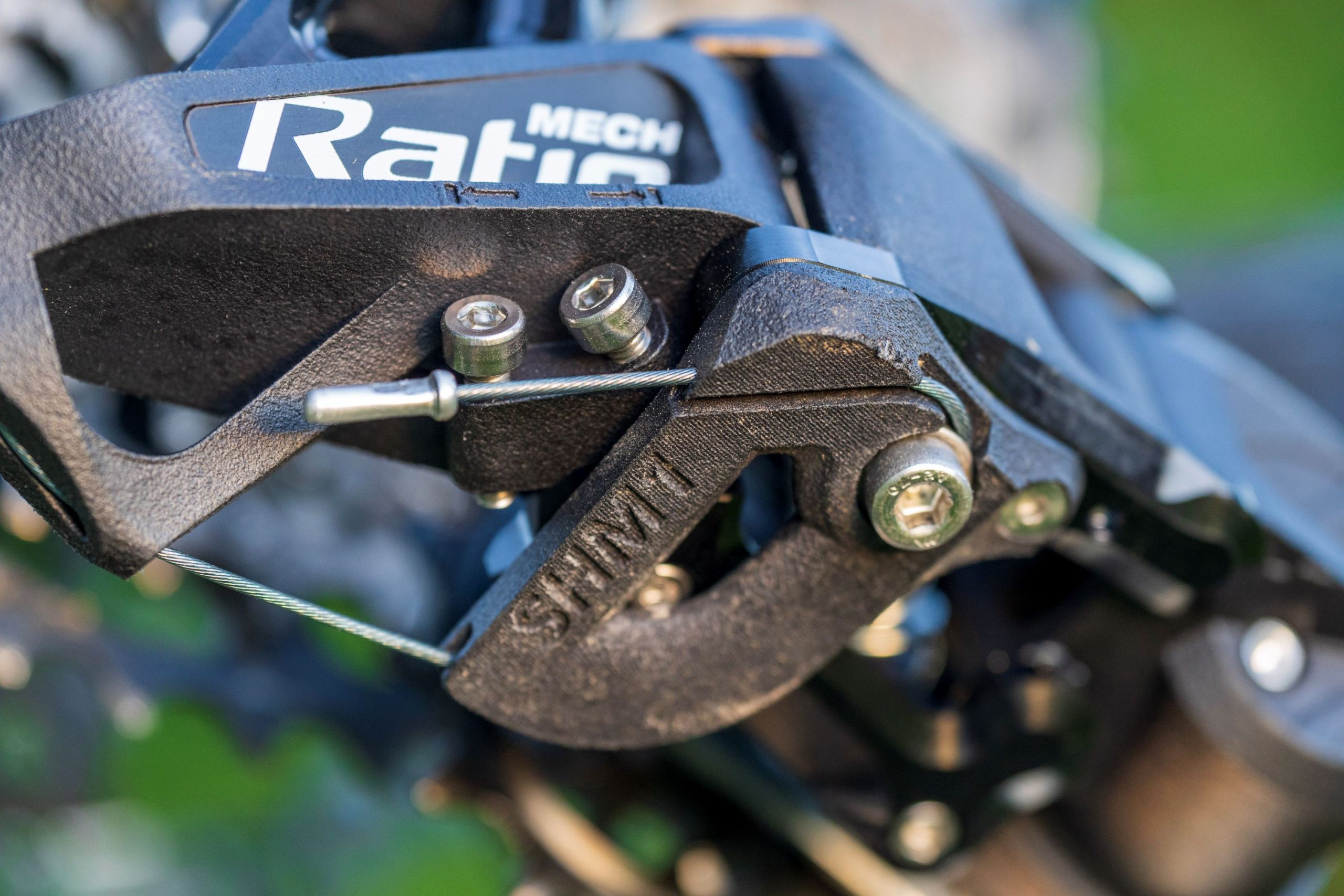
When we asked whether the direct-mount option might infringe any SRAM patents, Simpson told us: “SRAM’s IP protects the novel and innovative installation process for their Full Mount derailleurs, in which the friction from the clockwise bolt rotation rotates the entire derailleur back to a pre-set cage position to set the derailleur orientation and B gap.
“As we understand it, there is no protection against the concept of mounting a derailleur coaxially with the rear axle; it is not novel, as there are a number of earlier examples, and it is arguably not inventive as the step towards ‘direct mount’ is an obvious one on various elements of the bicycle (the most obvious being the chainring).”
Ratio Mech derailleur options and prices

The Ratio Mech derailleur is available for direct or hanger mounting, with cage lengths for 46t or 52t maximum cassette sizes and with a choice of seven cable fins. Together, these are claimed to offer compatibility with most 12- and 13-speed 1x drivetrains. Ratio says it will add more 11-, 12- and 13-speed options in future.
It says the Mech is designed for easy setup and can be rebuilt using only a multi-tool. It also offers a Cage Stop feature, which locks the derailleur in position for easier wheel removal. At launch, the Mech will be available in black only, with silver to follow. Sadly, though, you’re going to have to wait for the blue option.
The Ratio Mech derailleur is priced at £295 / $388 / €334 / AU$592.
Raider File Shredder: For Those Times When Simple Deletion Isn’t Enough
Don’t leave deleted files behind—Raider File Shredder offers an uncomplicated solution for permanently erasing data.
The post Raider File Shredder: For Those Times When Simple Deletion Isn’t Enough appeared first on FOSS Force.
Cloudflare broke itself and a big chunk of the Internet with a bad database query
Thought it was the victim of a ‘hyper-scale DDoS attack’ before finding the fixCloudflare CEO Matthew Prince has admitted that the cause of its massive Tuesday outage was a change to database permissions, and that the company initially thought the symptoms of that adjustment indicated it was the target of a “hyper-scale DDoS attack,” before figuring out the real problem.…
How to Install Slack on Ubuntu and Other Linux Distros
Discover a step-by-step guide to install the latest version of Slack on Ubuntu and other Linux distributions with practical examples.
Man Who Cryogenically Froze Late Wife Sparks Debate By Dating New Partner
A Chinese man who cryogenically preserved his wife after her death has sparked a heated online debate after it emerged he began dating a new partner in 2020. Some argue it’s natural for him to move on, while others say he’s being selfish or disrespectful to both his late wife and his current partner. The BBC reports: As a sign of his devotion, Gui Junmin decided to freeze his wife Zhan Wenlian’s body after she died from lung cancer in 2017, aged 49, making her China’s first cryogenically preserved person. But after a November interview revealed he had been dating a different partner since 2020, Chinese social media has been torn on Mr Junmin’s predicament. Whilst some asked why the 57-year-old didn’t just “let go” another commenter remarked he appeared to be “most devoted to himself.”
After Zhan Wenlian was given months to live by doctors, Gui Junmin decided to use cryonics – which is scientifically unproven – to preserve her body once she died. Following her death, he signed a 30-year agreement to preserve his wife’s frozen body with the Shandong Yinfeng Life Science Research Institute. Since then, Zhan’s body has been stored in a 2,000-litre container at the institute in a vat of -190C liquid nitrogen.
Chinese newspaper Southern Weekly revealed that although Mr Junmin lived alone for two years after the procedure, in 2020 he began dating again, despite his wife remaining in cryopreservation. He told the newspaper that a severe gout attack which left him unable to move for two days began to change his mind about the benefits of living alone. Soon after, he started seeing his current partner Wang Chunxia, although Mr Junmin suggested to the paper the love was only “utilitarian” and that she hadn’t “entered” his heart.


Read more of this story at Slashdot.
Cloudflare outage was not caused by a cyber attack
Cloudflare wrongly suspected that the widespread outage that took numerous websites offline on November 18 was caused by a DDoS attack, the company’s CEO has admitted. In his blog post that breaks down what happened, however, Matthew Prince explained that after realizing their mistake, his team was able to fix the issue. “The issue was not caused, directly or indirectly, by a cyber attack or malicious activity of any kind,” he wrote. It was instead caused by a change to its database systems’ permissions, which led to an issue with a file used by its Bot Management system.
The company’s Bot Management system uses a machine learning model to score bots for every request they make when they crawl Cloudflare’s network. Its clients rely on those bot scores to decide whether to allow or to block specific bots from accessing their websites. One the uses of having bot scores is being able to block AI companies’ bots so they can’t use a website’s content to train their LLMs. In July, Cloudflare launched an experiment called “pay per crawl,” which allows website owners to let an AI bot crawl their pages if they get paid for access.
Prince said the model relies on a “feature” configuration file to make a prediction on whether a bot request was automated or not. The feature file is refreshed every few minutes, and a change in the underlying mechanism generating that file caused a change in its size that triggered the error. “As a result, HTTP 5xx error codes were returned by the core proxy system that handles traffic processing for our customers, for any traffic that depended on the bots module,” Prince wrote.
This recent event has been Cloudflare’s worst outage in years. The company said it hasn’t had an outage that has “caused the majority of core traffic to stop flowing through [its] network” since 2019. Prince apologized for the issue on behalf of his team.
On November 18 Cloudflare experienced a service outage, triggered by an issue with a Bot Management feature, impacting multiple Cloudflare services. Here’s a detailed breakdown of what happened. https://t.co/7WArlr5ghI
— Cloudflare (@Cloudflare) November 18, 2025
This article originally appeared on Engadget at https://www.engadget.com/cybersecurity/cloudflare-outage-was-not-caused-by-a-cyber-attack-053000551.html?src=rss
TikTok now has an in-app ‘affirmation journal’ and sound machine
TikTok is replacing its screen time management page with a Time and Well-being space, which also comes with new wellness features. You can now find an affirmation journal, where you can set your intentions for the day using the 120-plus cards the app provides. You can, say, choose the “grace” card that reminds you to be free of the expectation of others. The card is downloadable on your device, and you can share it with others.
You’ll also find an in-app soothing sound generator that you can use to listen to relaxing audio, such as those featuring the sound of rain, waves and white noise. The sounds stop after a few minutes when the timer ends, so you can play them to induce sleep when you go to bed. TikTok says its users are 14 percent more likely to listen to music to help them relax or go to sleep than non-users. You’ll also find different types of breathing exercises you can do in the new space.
In addition, TikTok is rolling out new well-being missions, expanding the original set it launched in July. These missions, which are particularly designed for teens, will reward you with badges for completing challenges related to balanced digital habits. The new Sleep Hours Mission will award you with a badge if you stay off TikTok at night, while the daily screen time mission will earn you another if you set a screen time limit and manage to stick to it. There’s also a new weekly screen time mission that will prompt you to check your screen time report every week, as well as a well-being ambassador mission that will earn you badges if you invite others to do the missions.
This article originally appeared on Engadget at https://www.engadget.com/social-media/tiktok-now-has-an-in-app-affirmation-journal-and-sound-machine-050100713.html?src=rss
TikTok will let users tone down the amount of AI content in their feed
TikTok is the latest social platform to hand users more control over the amount of AI-generated content they see. The app is experimenting with a new setting that will allow users to request to “see less” AI in their “For You” feed.
The new toggle will be available in “the coming weeks” in the app’s “manage topics” section that lets people personalize the types of videos more likely to appear in their feed. In a blog post, TikTok says the control is meant to help users “dial things down” if they want to see less AI content in their recommendations. The update follows a similar move from Pinterest, which has faced complaints about AI slop drowning out authentic images on the platform.
TikTok, like most other platforms, has seen an influx of AI-generated content in recent years. The company, which requires users to label such creations, says that there are more than 1.3 billion videos with these labels. At the same time, the company notes that its existing methods for detecting AI content aren’t perfect, Currently, TikTok relies on a widely-used watermarking system called Content Credentials that adds metadata to AI-generated content. But these signals can get harder to detect when images or videos are edited in other apps or copied and reshared to other sites, as often happens with viral content.
To address this, TikTok says that it will also experiment with an additional “invisible watermarking” system that could help it identify and label AI content more reliably. “‘Invisible watermarks’ add another layer of safeguards with a robust technological ‘watermark’ that only we can read, making it harder for others to remove,” the company explained.
This article originally appeared on Engadget at https://www.engadget.com/social-media/tiktok-will-let-users-tone-down-the-amount-of-ai-content-in-their-feed-050100596.html?src=rss
Debian Libre Live Images Released for Software Freedom Lovers
The Debian Project released today a new project called Debian Libre Live Images that allows you to run and install the Debian GNU/Linux operating system without non-free software.
US Backs Three Mile Island Nuclear Restart With $1 Billion Loan To Constellation
An anonymous reader quotes a report from CNBC: The Trump administration will provide Constellation Energy with a $1 billion loan to restart the Crane Clean Energy Center nuclear plant in Pennsylvania, Department of Energy officials said Tuesday. Previously known as Three Mile Island Unit 1, the plant is expected to start generating power again in 2027. Constellation unveiled plans to rename and restart the reactor in Sept. 2024 through a power purchase agreement with Microsoft to support the tech company’s data center demand in the region.
Three Mile Island Unit 1 ceased operations in 2019, one of a dozen reactors that closed in recent years as nuclear struggled to compete against cheap natural gas. It sits on the same site as Three Mile Island Unit 2, the reactor that partially melted down in 1979 in the worst nuclear accident in U.S. history. The loan would cover the majority to the project’s estimated cost of $1.6 billion. The first advance to Constellation is expected in the first quarter of 2026, said Greg Beard, senior advisor to the Energy Department’s Loan Programs Office, in a call with reporters. The loan comes with a guarantee from Constellation that it will protect taxpayer money, Beard said.


Read more of this story at Slashdot.
Chinese Spies Are Trying To Reach UK Lawmakers Via LinkedIn, MI5 Warns
MI5 has warned U.K. lawmakers that Chinese intelligence operatives are using LinkedIn and recruitment fronts to target them for information gathering and long-term cultivation. PBS reports: Writing to lawmakers, House of Commons Speaker Lindsay Hoyle said a new MI5 “espionage alert” warned that Chinese nationals were “using LinkedIn profiles to conduct outreach at scale” on behalf of the Chinese Ministry of State Security. “Their aim is to collect information and lay the groundwork for long-term relationships, using professional networking sites, recruitment agents and consultants acting on their behalf,” he said. MI5 issued the alert because the activity was “targeted and widespread,” he added.
The MI5 alert cited LinkedIn profiles of two women, Amanda Qiu and Shirly Shen, and said other similar recruiters’ profiles were acting as fronts for espionage. Home Office Minister Dan Jarvis said that apart from parliamentary staff, others including economists, think tank consultants and government officials have been similarly targeted. Jarvis said the government is rolling out a series of measures to tackle the risk, including investing 170 million pounds ($224 million) to renew encrypted technology used by civil servants to safeguard sensitive work. Opposition parties say authorities are not doing enough and are too wary of jeopardizing trade ties with China.


Read more of this story at Slashdot.
Mexico Partially Lifts Longstanding Website Ban On Tor Network
Mexico has finally lifted its long-running Tor ban for the main government portal, allowing privacy-focused users, journalists, and activists to access gob.mx again after more than a decade of blocking. That said, the open data portal and the former Tor-compatible whistleblower system remain inaccessible. CyberInsider reports: The development follows a long period of digital censorship that spanned two full six-year presidential terms, those of Enrique Pena Nieto and Andres Manuel Lopez Obrador, and continued into the early months of Claudia Sheinbaum Pardo’s current administration. Research conducted by Jacobo Najera and Miguel Trujillo, published in October 2023, documented that 21 federal government agencies were blocking traffic from the Tor network, effectively excluding privacy-conscious users from vital public resources and services.


Read more of this story at Slashdot.
GIMP 3.2 Release Candidate Is Now Available for Download, Here’s What’s New
The first Release Candidate of the highly anticipated GIMP (GNU Image Manipulation Program) 3.2 release is now available for public testing with more new features and dozens of improvements.
Gen Z Officially Worse At Passwords Than 80-Year-Olds
A NordPass analysis found that Gen Z is actually worse at password security than older generations, with “12345” topping their list while “123456” dominates among everyone else. The Register reports: And while there were a few more “skibidis” among the Zoomer dataset compared to those who came before them, the trends were largely similar. Variants on the “123456” were among the most common for all age groups, with that exact string proving to be the most common among all users — the sixth time in seven years it holds the undesirable crown.
Some of the more adventurous would stretch to “1234567,” while budding cryptologists shored up their accounts by adding an 8 or even a 9 to the mix. However, according to Security.org’s password security checker, a computer could crack any of these instantly. Most attackers would not even need to expend the resources required to reveal the password, given how commonly used they are. They could just spray a list of known passwords at an authentication API and secure a quick win.


Read more of this story at Slashdot.