An anonymous reader shares a report: California-based TP-Link says it may take a sales hit of more than $1 billion because of erroneous reports that the networking company’s technology has been “infiltrated” by Beijing. In a lawsuit, TP-Link claims its competitor, Netgear, orchestrated a smear by planting false claims with journalists and internet influencers with the goal of scaring off customers.
Closely held TP-Link, which makes wireless routers, alleges in a complaint filed Monday that Netgear’s campaign “threatens injury to well over a billion dollars in sales” and violates a 2024 settlement of a patent fight. That accord, in which TP-Link agreed to pay Netgear $135 million, includes a provision that the public company promises not to disparage its rival, according to the suit in Delaware federal court.
The suit comes as TP-Link faces growing scrutiny in Washington over national-security issues. US lawmakers from both parties have expressed concern that TP-Link’s wireless equipment could be exploited by Chinese hackers following a series of attacks on its routers.
An event at Cloudflare that crippled large portions of the internet yesterday was not caused by a cyber attack or malicious activity, either directly or indirectly, the company confirmed in a blog. If that’s the case, then what caused all the ruckus? Turns out it was a change in permissions to one of Cloudflare’s databases that triggered an
Unity and Epic Games, the creators of today’s biggest video game engines, have announced a partnership that will make Unity games available in Fortnite. Epic has allowed creators to publish their own experiences (or “islands”) within Fortnite since 2018, and the number of experiences has grown considerably over the recent years. In 2024, 198,000 islands were published within the game, double the number from the previous year. This partnership has the potential to grow Fortnite experiences even further by welcoming Unity developers and can give existing developers more freedom.
“Just like the early days of the web, we believe that companies need to work together in order to build the open metaverse in a way that’s interoperable and fair,” said Tim Sweeney, the CEO of Epic Games, in a statement. “Working alongside Unity we’re helping developers build fun games, reach bigger audiences, and find success.” Sweeney announced the partnership with Unity CEO Matt Bromberg at Unity’s annual developer conference. They said that developers will be able to publish games that use Unity’s game engine on Fortnite sometime next year. The companies promised to announce more details and exact timing in the future.
Just announced at Unity’s Unite 2025 show in Barcelona: Unity has built an amazing new networking protocol enabling Unity games to come into Fortnite next year. This will enable an incredible variety of games to reach a new audience in new ways! https://t.co/varnV2ybCu
In addition, Unity has announced that the cross-platform commerce management dashboard it launched in October will support Unreal Engine. The dashboard allows developers to manage pricing and promotions across websites and stores for mobile and PC from one place. It will start supporting Unreal Engine in early 2026.
This article originally appeared on Engadget at https://www.engadget.com/gaming/unity-games-are-coming-to-fortnite-133000076.html?src=rss
Marvel’s Deadpool VR serves up a boat load of quippy banter and on-brand humor from everyone’s favorite ‘merc with a mouth’, truly bringing the soul and wit of the character to virtual reality. While combat can feel repetitive at times, and the narrative a little on the thin side, excellent gameplay variety combined with the game’s fourth wall-breaking protagonist makes for a refreshingly fun overall experience.
Marvel’s Deadpool VR Details:
Developer: Twisted Pixel Publisher: Oculus Studios Available On:Quest 3 & 3S Reviewed On: Quest 3 Release Date: November 18th, 2025 Price: $50
Gameplay
Deadpool VR is all about expectations. At its core, we’re getting a big budget, highly polished, multi-hour VR experience that features a name brand superhero that actually isn’t some weird knockoff (cough, Marvel: Power United VR). If you’re looking for Deadpool, you’re definitely getting it here: guns, katanas, and dick jokes aplenty.
For dyed in the wool Deadpool fans, you can probably stop reading here. You will love the game regardless of this VR nerd’s opinions on combat, enemy variety, inventory, and the general disposability of the game’s narrative.
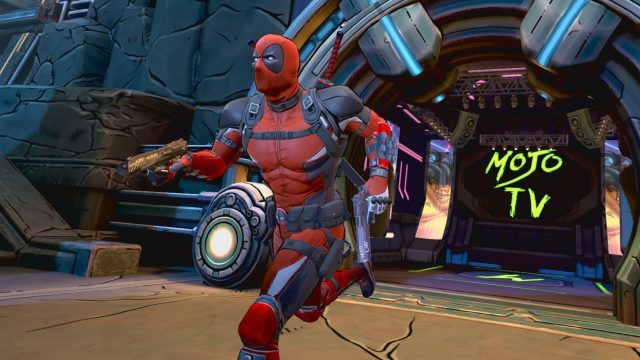
But for everyone else, here’s the quick and dirty. You’ve been kidnapped by Mojo, an intergalactic TV producer who livestreams fighting tournaments. He needs talent, and it’s your job to find it, which means you’ll be portaling into a bunch of different worlds, fighting through waves of baddies, and nabbing a handful of minor Marvel villains to star as combatants on Mojo’s channel.
Image courtesy Twisted Pixel
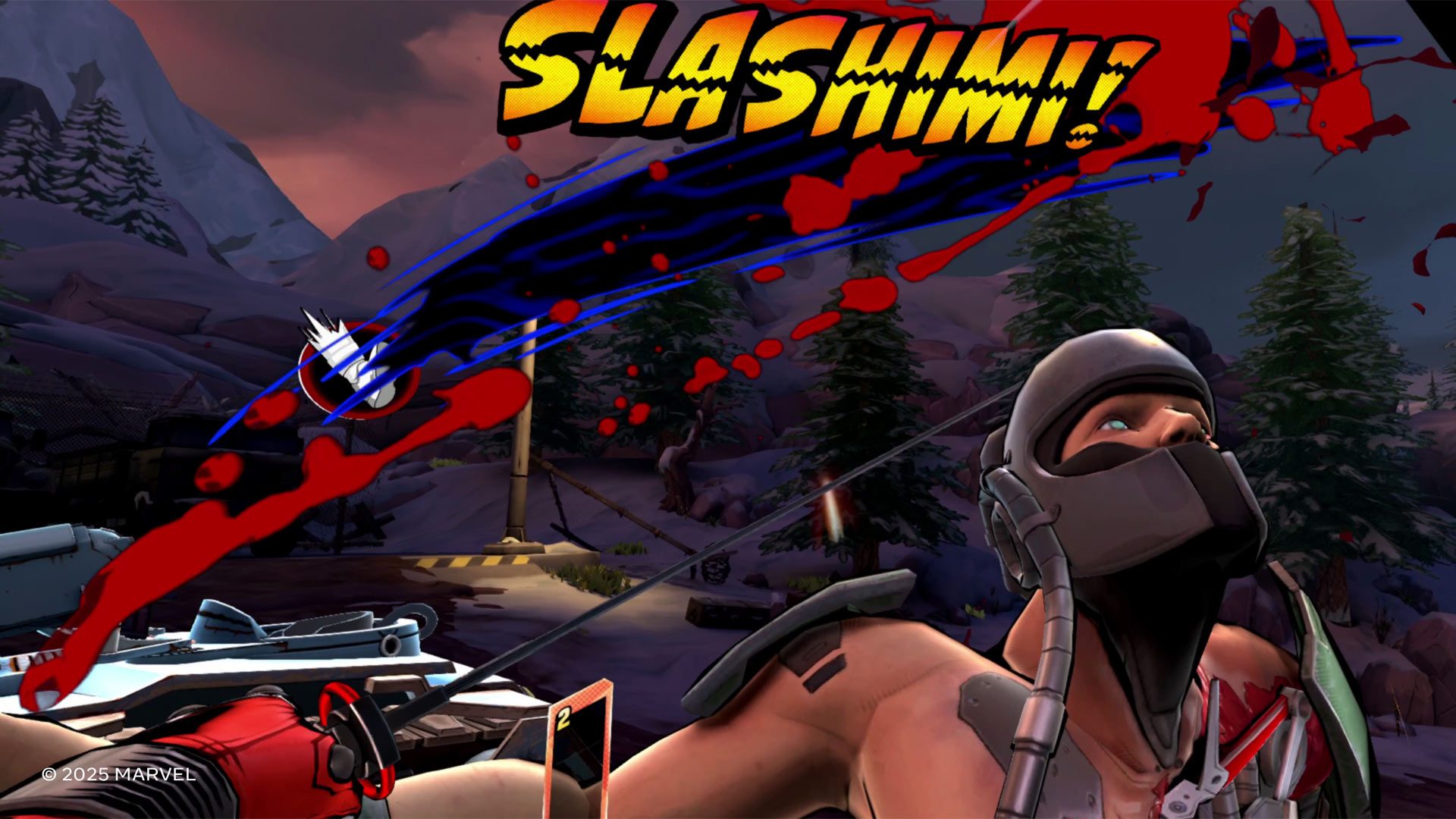
You aren’t just executing waves of ninjas, robots and demons though: the game wants you to do it with style, because every epic kill gets you more viewers, which in turn means more points, more upgrades, and even a special ability to keep things spicy.
That said, as a combat-focused experience, fighting feels a little too repetitive during regular encounters—but I’m going to tell you why that’s mostly okay. You have your dual katanas, pistols, a grenade, and a grappling gun that can attach to pre-defined attachment points, which also doubles as a way of tossing around the easiest baddies—all of which seems to offer a lot of latitude on how to fluidly take down enemies.
The game tries to reward you for going ham on each bad guy with the promise of weapon unlocks and cosmetics, but the sheer number of baddies, combined with the general uselessness of the unlocks, essentially threaded me down the path of optimizing my killing patterns rather than going for what the game hopes I’ll do: combo slicing a guy to death when I could have just shot him in the head a few times.
And I think you’ll probably end up doing what I did: the most efficient method is spamming the jump-kick button combo to automatically fly to the baddies face in slow-mo, which lets you unlock a bunch of bullets into them. Not very cinematic after the hundredth time, but it gets the job done. That’s why it kind of sucks, but here’s why it’s kind of okay.
Image courtesy Twisted Pixel
There is actually a ton of novelty on display to keep things suitably fresh, which I think smooths over lackluster combat.
For all of the drabness of ganking your millionth nameless henchman, Deadpool actually lets you do a bunch of cool and interesting things—and I’m not talking about the finisher moves, where you jump-kick a guy’s head clean off his stump neck… that gets old quick. The game’s boss fights always come with fun and unique quick time events where you need to use all of your kit at your disposal—of course with Deadpool sarcastically lambasting everyone all the way through.
And there’s even more. Meanwhile, you’re not just fighting against bosses and hoping to Shanghai them back to Mojo World—that is after all the entire story line. You’re also taking part in the spectacle, as you engage in (basically) fake multiplayer matches with a variety of game modes and maps. All of it means you’re constantly doing something different, somewhere different, which really helps to keep every moment fresh despite regular combat being a bit of a sore spot.
While cosmetics are fun, functionally speaking upgrades feel a little tame. At least for now, there aren’t any alternative game modes outside of the campaign, although there is a virtual smorgasbord of ways to earn spendable points, which let you unlock different weapons, skins and player cosmetics. The main emphasis is undoubtedly on skins here, as each pistol only has a half dozen variants that basically just mix and match three basic stats: reload time, magazine size and fire power.
That said, if you’re into chasing down collectables, Deadpool VR has you covered. If you’re like me though, you’ll be fine after beating the final boss (around the eight hour mark on ‘normal’ difficulty for me) and not really diving back in for more.
Immersion
Yes, the katana-wielding antihero is voiced by Neil Patrick Harris, and not celebrated Canadian film actor Ryan Reynolds. Still, NPH has mastered the Deadpool we all know and love—foul mouth jabs and pop culture references galore. To boot, there’s also John Leguizamo as Mojo and the ever-brilliant Jeffrey Combs as Mojo’s chief henchman, Major Domo, making for some of the best voice acting and script writing I’ve ever experienced in my decade of VR gaming.
And thankfully, this isn’t some sort of Skibidi Deadpool reimagined for people born in this century—this is vintage Deadpool. That means you’ll be treated to loads of ’70s, ’80s and early ’90s TV references, which in 2025 feels increasingly odd for a game that’s undoubtedly hoping to appeal to Quest’s target demographic (aka not the 40+ crowd). Whatever though. If you love Deadpool in any capacity, you’re definitely getting the real deal in this VR game.
On the whole, visuals are excellent, although a bit of a mixed bag. Sometimes I get a distinct cell shaded, Borderlands vibe to everything, which is totally on-brand for Marvel’s comic book heritage. Then, at times, the game takes on a smoother, more realistic design that doesn’t exactly clash, but it does leave me feeling like I’m in a different game.
Still, it’s all performing under Quest 3’s modest compute budget, which notably doesn’t use fixed foveated rendering—impressive considering the amount of characters on screen at any given moment.
Object interaction is one of the weakest spots in all of this. The only thing I really want to do is clank my pistols or katanas together, but they clip right through. The users inventory is always cause for frustration: grabbing a grappling gun from behind your back oftentimes results in grabbing a pistol from your side holster (or vice versa), which can absolutely spoil quick time events. Despite being able to somewhat readjust the inventory slots, I would suggest not trying to play seated since cycling through pistols and the grappling gun seems more inconsistent given the limited range of motion.
In the end, I was hoping for a more cinematic narrative that was less game-y overall. As it is, you’re basically in a pocket universe that offers essentially a meaningless outcome. But hey, Deadpool is right along there with you, making fun of developer budgets, the game’s name, hell, even Disney gets a few choice words from the merc with a mouth.
Comfort
Deadpool VR offers up some very intense action, which means you’ll probably need to dial in your own unique comfort settings to mitigate the game’s frenetic movement. I
You can do this with your standard range of settings, seen below, although one of the biggest offenders to comfort is camera shake, which is at a nearly constant when toggled on. There are a few moments when you’re forced onto some sort of moving platforms, but these moments are few and far between, and sometimes allow the user to elect a third-person cinematic view if the first-person experience is too intense.
Maybe less of a physical comfort issue, but more of a moral comfort (?): Deadpool VR serves up its fair share of innuendo and cursing (as you’d expect), although you can toggle on ‘kiddie friendly’ dialogue in the settings in addition to cycling through four difficulty modes.
Marvel’s Deadpool VR Comfort Settings – November 18th, 2025
Amazon is selling the Echo Spot smart speaker for just $50 as part of a Black Friday promotion. The sale applies to multiple colorways and represents a discount of $30. This isn’t a record low price, but it’s extremely close.
For the uninitiated, the Echo Spot is a diminutive little speaker/alarm clock hybrid unit. It’s a cute little doodad and looks great on a nightstand. The screen is customizable, so it doesn’t have to display a clock. It can show song titles, smart home control dashboards, the weather and a lot more. Of course, there are numerous clock faces to choose from.
The Spot not only integrates with Amazon’s smart assistant Alexa, but it provides access to the newfangled Alexa+. This is a smarter and more conversational version of the iconic smart assistant. Like most modern AI products, it’s still working out some bugs. The underlying tech, however, is promising.
The speaker is decent enough for the size, though you won’t be using it to fuel any house parties. It’s a great tool for bedroom-based listening. This version doesn’t have a camera, which is actually great news for the privacy conscious.
This article originally appeared on Engadget at https://www.engadget.com/deals/amazons-echo-spot-smart-speaker-drops-to-50-for-black-friday-130550875.html?src=rss
You probably haven’t heard of Read AI. The company has quietly been making a name for itself in the crowded AI space, signing up 50,000 customers daily in recent months. At first glance, Read AI resembles apps like Otter.ai. You can use the software to transcribe and summarize meetings, but it’s also more ambitious than that.
“It’s AI on standby,” Read AI CEO David Shim explains, adding that the company’s vision is to give people a tool that can record, transcribe and analyze nearly every professional conversation they have, no matter where those discussions take place and whether they occur online or in-person. Today, Read AI is taking a major step toward realizing that vision with the release of its new Operator agent (I’ll admit, the company could have picked a more original name), and new apps for Windows, macOS and Android.
Between its own software, including an existing iOS app, and third-party integrations, Read AI users can now connect their accounts to more than 22 other platforms. Some of the more notable inclusions there are Gmail, Outlook, Slack, HubSpot and Notion. More importantly, with Read AI’s mobile apps, you can record impromptu in-person meetings; the company has data showing that more than half of professional conversations occur outside of online spaces.
In any case, no matter where you talk to your colleagues, Operator is there to generate notes and insights. “We don’t just look at meetings,” Shim says. “We look at topics that are interesting to you.” To that end, Read AI has built a series of in-house multimodal models that look for context beyond what’s said during any interaction you record. For example, the company’s systems are designed to catch when you enthusiastically answer a question or look away in disinterest, and use that data to decide how the software goes about summarizing your meetings.
“That context is what enables us to identify what is valuable to you, and make that discoverable,” says Shim. One way Read AI will surface those insights is through a feature the company calls Monday Brief. At the start of every week, you’ll get a summary of all the calls and conversations you had over the last seven days, with suggestions for follow-up actions you can take.
Now, you might be wondering, like I was, how Read AI hopes to compete in a market where a company like Microsoft is aggressively pushing Copilot on its users. If Shim is worried about the big players, he doesn’t show it. “There’s a need for an independent third party,” he says. “There’s always something new coming out. And that ability to be the independent third-party that plugs into different solutions is actually what consumers want and need.” To his point, since the launch of Copilot two years ago, Read AI has seen a 20x increase in the daily number of people using its software alongside Microsoft Teams. “We’ve seen the same thing along those lines for Zoom and Google Meet.”
He believes the company’s approach to data privacy is another differentiator. By default, users are opted out of their data being used for training Read AI’s future models. Shim also notes the company takes recording disclosure seriously. “You need to notify people that you’re [recording] a call, and we put that front and center every single time.”
If you want to try Read AI, the company offers a free plan that includes five meeting transcripts per month. Pricing for its paid subscriptions start at $19.75 per month.
This article originally appeared on Engadget at https://www.engadget.com/ai/read-ai-is-building-a-note-taking-app-that-works-nearly-anywhere-130000235.html?src=rss
The fourth race of Zwift Racing League 2025/26 Round 2 happens Tuesday, November 25, and it’s a team time trial on the new Watts the Limit route in NYC. This is an interesting TTT route, with plenty of pitch changes to keep us on our toes and unique characteristics that make it a much faster course than you might think.
Let’s dig into crucial segments, escalators, bike choice tips, and more!
Looking at the Route
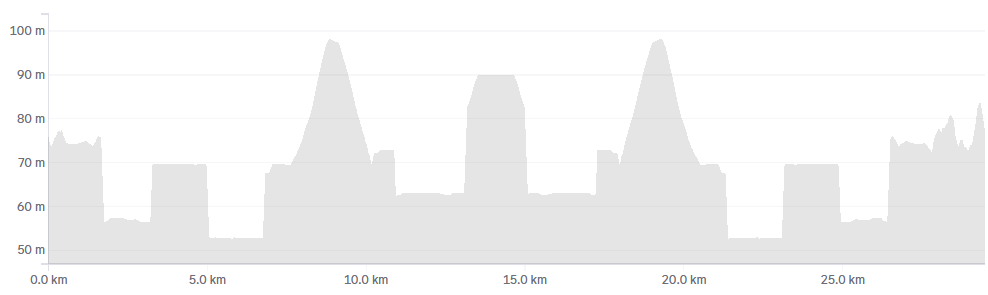
Watts the Limit is a fresh route from the recent New York map expansion. And while the Strava segment profile (above) may look lumpy – like a city skyline, in fact – it’s actually a fairly flat and fast route, thanks to escalators helping us out of the subway tunnels!
All categories will race a full lap of this out-and-back route, for a total of 31km with 219m of elevation. (Although it’s not really 219m, since ~95 of those meters are on escalators.)
Most of this course is close to pan-flat, with major elevation changes taking place quickly in between as you enter or exit subways. Here are the key points you’ll keep in mind as your team attacks this course:
Lead-In Kicker @1km (300 meters at 3.7%): this little bump near the end of the lead-in is short enough that it’s best to just hammer hard if you’re on the front, and stay in the draft if you’re behind. Keep the watts high so your speed stays up, then grab recovery on the flats and descents that follow.
Escalator @4.7km: the first of six escalators you’ll encounter today, these are going to play havoc with teams who have riders with widely varying weights. See “More On Escalators” below for details.
Escalator @8.2km
Manhattan Bridge @9.1km (1.2km at 1.6%): the bridge isn’t as steep from this side, so speeds will stay high and drafting will remain very important. Increase your power, but stay in formation. Recovery awaits on the back half of the bridge.
Escalator @14.5km
Hill to Grand Army Plaza @14.6km (400 meters at 2%): this little climb comes directly after the escalator, so keep the power up in order to maintain speed all the way up to the flat Grand Army Plaza turnaround at the top.
Escalator @18.7km
Manhattan Bridge @19.5km (1.1km at 2.4%): a bit steeper on this side, but still not a proper “climb,” so you’ll definitely want to lift the power while staying in formation up and over.
Escalator @24.5km
Escalator @27.8km
Final Kicker @30.5km (300 meters at 3.7%): almost there! Hammer this kicker just like you did at the start of the race, then go all-in across the top to empty the tank and finish fast.
Warning: the new escalators in NYC may prove tricky if there’s a big difference between the highest and lowest rider weights on your team!
Community feedback is saying, and our tests are confirming, that heavier riders slow much more on the escalators than lighter riders. (Heavier riders, take heart: Zwift knows about this issue, and internal sources tell me a change is planned soon to make escalators perform much more uniformly across various riders. Light riders: enjoy the escalators while you still can! )
I ran bots of various weights up one of the longer escalators on the route (the final escalator you’ll hit, in fact). Each bot’s power was set so they would all have approximately the same escalator entry speed (~46 kph), and that power remained steady as they went up and over the top of the escalator. Here’s how much each bot slowed down between entering and exiting the escalator:
50kg bot @261W: slowed 3.2 kph
75kg bot @339W: slowed 11 kph
100kg bot @390W: slowed 16.1 kph
Of course, most teams won’t have a 50kg (or even 25kg) weight difference between riders. But the heavier you are, the more you should plan to push on escalators to keep your speed high. And lighter riders will probably want to keep their power fairly steady, to avoid shooting off the front!
Two more escalator tips:
Lower Your TD: These are steep, with gradients around 20%. If you have trainer difficulty set to 100%, it will feel like pedaling into a wall. I recommend setting TD to 50% or less for this course.
Follow the Wheels Down: The downhill ramps will also wreak some havoc due to varying rider weights and power outputs. Pay close attention and try to maintain your single-file position before, during, and after descending the ramps to maximize your draft benefit and keep speeds high. If you’re a lighter rider on the front during one of these descents, hammer out some of the watts you’ve saved on the escalators, as the heavier riders will fly past otherwise!
Bike choice here is simple: go aero. On a flattish route like this, weight doesn’t matter much, and aero is everything! The best setup by far is the CADEX Tri frame paired with the DT Swiss Disc wheels, but you’ll need to be at level 40+ to access this sweet rig:
Many recon rides are planned each week on the upcoming ZRL route. If you’re unfamiliar with this course, jump into an event and familiarize yourself with the route! Find a list of upcoming ZRL recon rides at zwift.com/events/tag/zrlrecon.
Additionally, riders in the Zwift community do a great job every week creating recon videos that preview the courses and offer tips to help you perform your best on the day. Here are the recons I’ve found (comment if you find another!):
Flatter courses like this week give valuable seconds to teams with big pure-power riders who can keep their power high on the front while staying in single-file formation to conserve in the draft behind. Extra seconds can also be gained by pacing smartly, ramping up the effort on short climbs and recovering a bit once you’re up to speed on the short descents.
On a course like this week’s, I highly recommend all team members set their Trainer Difficulty to the same value so you’re all feeling the gradient changes similarly. (When one rider has it set to 100% and another 25%, the first rider may ramp up power much more than the second when a climb hits, which can make a mess of your team formation.)
Your goal in a ZRL TTT is to get four riders across the line in the shortest time possible. That means every team’s pace plan will differ based on each rider’s abilities. I highly recommend having an experienced DS on Discord directing your team, especially if your team contains some inexperienced TTT riders.
Lastly, if you want to go further down the TTT rabbit hole, I highly recommend Dave Edmond’s Zwift TTT Calculator tool.
For nearly half a century, the United States has relied on a powerful, quiet engine to drive its innovation economy. It’s not in Silicon Valley or on Wall Street, but in the research labs of universities and non-profit institutions across the country. This engine, created by the Bayh-Dole Act of 1980, is the single most successful piece of economic legislation of the past 50 years. It has been responsible for countless life-saving drugs, world-changing technologies and entirely new industries.
Today, that engine is under direct threat from an unexpected source: the U.S. government itself.
A recent proposal from Commerce Secretary Howard Lutnick—suggesting the government should seize half of all patent royalties from federally funded university research—represents a profound misunderstanding of what makes this system work. Standing in firm opposition is the Bayh-Dole Coalition, a group of universities, researchers, patient-advocacy groups and business leaders who understand the stakes. They are fighting to protect a law that has been the cornerstone of American innovation, and their fight is one we should all be paying attention to.
Understanding Bayh-Dole: The Law That Unlocked Innovation
To understand the current battle, one must first understand the world before Bayh-Dole. Prior to 1980, the U.S. government funded billions in research at universities. When that research led to an invention, the patent rights defaulted to the federal government. This sounds reasonable until you look at the results. As detailed in the Bayh-Dole Coalition’s digital library, the government had amassed 28,000 patents by 1980 and had successfully licensed less than 5% of them. The Government was, quite literally, sitting on a treasure trove of innovation and letting it gather dust on a shelf.
The Bayh-Dole Act, a bipartisan effort co-sponsored by Senators Birch Bayh (D-IN) and Bob Dole (R-KS), introduced a simple, revolutionary change. It allowed universities, non-profits and small businesses to retain ownership of the inventions they created with federal funding.
This was not a giveaway. As the Coalition’s technical summary of the Act explains, this ownership came with a critical new responsibility: a mandate to actively pursue commercialization. Universities were now incentivized to file for patents and, most importantly, license those patents to private-sector companies—startups and established firms alike—that could shoulder the risk and cost of turning a raw idea into a marketable product.
The results have been staggering. The impact of Bayh-Dole and technology transfer is undeniable. It has spurred the creation of over 15,000 startup companies, supported millions of jobs and contributed trillions of dollars to the U.S. economy. From the Google search algorithm to life-saving cancer treatments, the fingerprints of Bayh-Dole are everywhere.
A New Threat to a Proven System
This proven system now faces a grave threat from Commerce Secretary Howard Lutnick. His recent proposal suggests that the government should simply “take” 50% of the patent royalties universities earn from these inventions. The rationale seems to be that since the government provided the initial grant funding, it is entitled to a direct cash-back return.
This proposal fundamentally misunderstands the government’s true “return on investment (ROI).” The government’s ROI was never meant to be a simple royalty check. Its return is a stronger economy, the creation of new high-tech jobs, global leadership in science and new medicines that save lives. The Bayh-Dole system was designed to produce those outcomes, which it has done spectacularly.
Lutnick’s plan treats the complex, delicate ecosystem of innovation like a simple ATM, and in doing so, it threatens to break the entire machine.
The Coalition’s Stand: A Unified Voice Against “A Tax That Would Kill Innovation”
The reaction from the innovation community, led by the Bayh-Dole Coalition, has been swift, unified and overwhelmingly negative. As the Coalition’s official statement declared, the proposal “would dismantle the innovation ecosystem” and “undermine U.S. leadership.”
To back this up, the Coalition released survey results from its members—the very people on the front lines of technology transfer. The findings were not just clear; they were practically unanimous. A full 99% of respondents said the proposal would harm their ability to commercialize technology, and 98% said it would make them less likely to license patents to companies.
This isn’t just about money; it’s about incentives. As Joseph Allen, the Coalition’s Executive Director, wrote in a scathing Wall Street Journal op-ed, this proposal is nothing short of “a tax that would kill innovation.”
Why? Because university patent royalties are not “profits.” This money is immediately reinvested into the research enterprise. It pays for the high costs of filing and maintaining patents—a risky, expensive venture that often fails. It funds the technology transfer offices that bridge the gap between labs and industry. Most importantly, it provides seed funding for new, high-risk research, supports graduate students and buys critical lab equipment.
Taking 50% of that money doesn’t just reduce the pie; it shatters the incentive structure. With half the potential return gone, universities will be forced to abandon thousands of promising, early-stage inventions. They will only be able to afford to patent the “safest bets,” letting potentially revolutionary (but less certain) ideas die in the lab. Private companies, seeing the university support system gutted, will be less willing to partner and invest the millions needed to bring a product to market. The pipeline of innovation would slow to a trickle.
Wrapping Up
The Bayh-Dole Act is perhaps the most successful and least-understood law of our time. It transformed the U.S. from a passive funder of research into an active cultivator of innovation, creating a system that is the envy of the world. The Bayh-Dole Coalition is fighting to protect this system not for the sake of universities, but for the sake of the entire nation.
Secretary Lutnick’s proposal is a short-sighted cash grab that would sever the link between public research and public benefit. It would disincentivize discovery, destabilize partnerships and ultimately surrender America’s competitive edge. The government’s role should be to champion and strengthen the Bayh-Dole framework, not dismantle it for a fraction of its true value.
OnePlus got its start courting the enthusiast community by offering blazing-fast phones for a low price. While the prices aren’t quite as low as they once were, the new OnePlus 15 still delivers on value. Priced at $899, this phone sports the latest and most powerful Snapdragon processor, the largest battery in a mainstream smartphone, and a super-fast screen.
The OnePlus 15 still doesn’t deliver the most satisfying software experience, and the camera may actually be a step back for the company, but the things OnePlus gets right are very right. It’s a fast, sleek phone that runs for ages on a charge, and it’s a little cheaper than the competition. But its shortcomings make it hard to recommend this device over the latest from Google or Samsung—or even the flagship phone OnePlus released ten months ago.
US buyers have time to mull it over, though. Because of the recent government shutdown, FCC approval of the OnePlus 15 has been delayed. The company says it will release the phone as soon as it can, but there’s no exact date yet.
When it comes to GPU virtualization we have seen AMD engineers carry out a lot of work in recent years around the Xen hypervisor even when it hasn’t seen as much interest from other vendors. We found out that much of their interest in Xen for GPU virtualization is due to automotive / in-vehicle infotainment demands and it remains that way. They continue cooking some new features and they say “the best is yet to come” in a new presentation on their Xen virtualization efforts…
Alice Ryhl of Google sent out the main set of Rust language code changes for the Direct Rendering Manager (DRM) graphics/display driver subsystem ahead of Linux 6.19. Notable is continued DRM core infrastructure work for Rust plus the open-source NVIDIA “Nova” driver continues taking shape albeit isn’t yet ready for end-user usage…










 )
)