Nearly 200 signatories have signed LEVA-EU’s open letter demanding the German Bicycle Industry Association, ZIV, drops its proposed changes to electric bike regulations.
The recent debate over ebike regulations has been fuelled by the European Union giving the industry until 2027 to redefine electric bike standards, which could have big implications for the future of the industry.
In the open letter written by LEVA-EU, a European trade association for electric vehicles, the signatories object to how ZIV’s proposed changes could punish elderly and disabled people, undermine the EU’s climate commitments and penalise certain types of electrically assisted pedal cycles (EAPCs).
The signatories include individuals from companies such as DJI, Avinox, Skarper and VanMoof.
They say ZIV’s proposals would impose “arbitrary restrictions” on EAPCs. These include limits on assistance ratios, peak power and vehicle weight.
Addressed to ZIV, the Confederation of the European Bicycle Industry (CONEBI), which supports the proposals, and the European Commission, the letter also asks these bodies to “not let Europe become the desert of light electric mobility innovations”.
It says ZIV’s proposal would “obstruct European innovation and competitiveness, protecting incumbents while sidelining new entrants and technologies”.
A critical aspect of the ZIV position paper is the proposal to ensure ebikes have the same legal status as non-assisted cycles.
The open letter objects to this legal equivalence, because it would mean certain EAPCs would be subject to type-approval, where a product must meet a minimum set of regulatory, technical and safety requirements.
This could limit heavier and more powerful EAPCs, which would be beneficial for logistics or even families commuting on e-cargo bikes, from getting to the market.
The letter outlines how this also points to a “deeper structural problem” around the regulation of EAPCs in Europe.
LEVA-EU says an EAPC with a motor that provides 250W of continuous power – the legal limit in the EU for an ebike – is regulated under the Machinery Directive. It is therefore excluded from type approval and can be placed on the market after a brand’s own certification process. But an EAPC with a motor power of 300W “must undergo costly and unsuitable type-approval under Regulation 168/2013”.
The issue here is that some argue motor power does not affect the risk an EAPC poses. If an EAPC has an identical weight and top speed, they say, it poses the same risk in an impact, regardless of motor power.
“This regulatory split is neither proportionate nor neutral, and it undermines competitiveness and innovation across the LEV [light electric vehicle] sector,” the open letter says.
The letter adds that instead of a ‘regulatory split’, there should be a dedicated light electric vehicle regulation. It says it would mean these vehicles could be regulated according to their “real safety and use characteristics, not outdated or arbitrary distinctions” and would “enable a fair, innovation-friendly, and future-proof market for light electric mobility in Europe”.
ZIV has yet to respond to our request for comment.
Driven by the explosive demand for artificial intelligence, server memory could double in price by late 2026. The disruption originates from two prime sources: a recent shortage of DDR4/DDR5 legacy memory chips plus NVIDIA, the primary engine of the AI boom, pivoting its next-generation AI servers away from DDR5 memory toward LPDDR chips traditionally
Last week’s Vulkan 1.4.333 brought a new ray-tracing extension with VK_EXT_ray_tracing_invocation_reorder that was derived from a prior NVIDIA vendor extension (VK_NV_ray_tracing_invocation_reorder). This new extension for Shader Execution Reordering “SER” is showing to deliver some nice performance potential for Vulkan ray-tracing performance…
To me, the under-desk treadmill is the ultimate symbol of productivity culture (read: late-stage capitalism). And I’m exactly the type to buy into the under-desk treadmill appeal. Why shouldn’t I want to walk while I work, burn calories during calls, and transform my sedentary office prisons into a wellness wonderland—all without sacrificing a single billable hour? (Never mind that I don’t work in an office or bill my hours.) Office fitness is the perfect hack for our optimization-obsessed culture, promising that we can have it all: career success and physical health, no trade-offs required.
But when I see an under-desk treadmill, I also remember when we all swore that replacing our desk chairs with yoga balls would change our lives. Or that a standing desk, or a balance board, or some kind of pedaling contraption would do the same. In other words, nothing ever changes. I’m not denying that there’s a problem with fully sedentary work days; it’s just that no one gadget ever seems to be the solution. And the problem isn’t that we lack willpower or that the products are inherently flawed. The problem is that we’re buying solutions to the wrong problem.
The allure of multitasking your way to health
I’m not immune to the fantasy either. When you’re drowning in deadlines and meetings bleed into evenings, the idea that you could somehow merge your workout with your workday feels like a lifeline. Why carve out an hour for the gym when you could just walk while answering emails? It’s efficient! It’s smart! It’s…probably not going to work the way you hope.
“I think these products can and do work for some people, but there’s an important caveat: there’s no replacement for actually getting away from your desk for a mental and physical break,” says Jen Fisher, formerly the chief wellbeing officer at Deloitte. “There’s a real irony here—these products aim to solve one problem (sedentary behavior) but reinforce another (never truly disconnecting from work).”
Therein lies the paradox: We’re trying to optimize ourselves into working more, not better. An under-desk treadmill might give you movement, sure, but it keeps you tethered to your screen, always available, always productive.
You might think that if anyone could make office fitness gadgets work, it would be Google—a company famous for its wellness perks and campus amenities. But even there, this pattern persists. “I love the treadmill desks that we have available whenever I’ve used them,” says Shosh Brodman, a senior Google Workspace program manager with over 13 years at the company. “But I think I’ve used it maybe less than five times.” Brodman’s experience with an under-desk pedaling device was similar: initial excitement followed by abandonment.
She says that despite access to gyms, treadmill desks, and a culture that supports movement, the fundamental problem remains: the structure of modern work doesn’t actually allow for these interventions. The one thing that did work for her? Step-tracking contests that encouraged actual breaks and movement, creating social motivation to escape the desk entirely. Compared to an under-desk treadmill, a real lunch walk gives you something far more valuable: a little mental space, entirely separate from work.
“When it specifically comes to products that people use to mitigate their sedentary lifestyle, gadgets are never the answer,” says Melissa Painter, founder of Breakthru, an app that guides users through two-minute movement breaks. “Especially not gadgets that cause us inadvertently to outsource our body’s intelligence to a piece of tech. The minute we’re staring at data in the face of what we’ve ‘done wrong,’ the more likely we’re going to put it in a drawer and step away.”
This points to a pattern many of us recognize: the sleep tracker that made us more anxious about sleep, the step counter that turned movement into a guilt-inducing scorecard. Tools are only useful if they nudge us toward feeling better, rather than becoming another metric of inadequacy.
The absurdity becomes clear when we consider what actually helps us think and solve problems. “The reason going for a walk helps you solve a problem is because you’re moving and untethered,” Painter says. “The space and time away from your screen is an invitation for your mind to wander just enough so that instinctual solutions can emerge. Walking on a treadmill is not going to have the same impact. It’s like trying to do the wrong kinds of thinking at once.”
Breaking free from productivity culture
Here’s what makes our gadget obsession even more frustrating: We already know what works, but we just don’t want to hear it, because it requires actually stepping away from work. “It’s very American to think we don’t need breaks,” Painter says. Trapped in non-stop productivity culture, we fall prey to this idea that “wellness” requires an enormous amount of time and money. We live in a culture that treats rest as laziness and breaks as luxuries.
Fisher says that the type of work matters: “For passive tasks—listening to a meeting, reading documents—these tools might genuinely help. But I worry about the cultural message when we’re optimizing to work more rather than building in real breaks that actually support our wellbeing.” If these gadgets work in addition to actual breaks, great. But if you’re thinking “now I can skip my lunch walk because I have a treadmill desk,” that’s where we’ve gone wrong.
Fitness gadgets around the office allow us to maintain this idea that we can always be productive without any downtime. As if our bodies are just machines that need the right accessories to run indefinitely. We’d rather invest in expensive gadgets that let us keep working than accept that you might need to actually stop and rest. As a result, most of us end the workday feeling overwhelmed, fatigued, nowhere near the end of our to-do lists, and nowhere close to wanting to go to the gym.
The problem isn’t the under-desk treadmill itself, but the slippery slope of non-stop-optimization it represents. So, what’s the solution?
How to actually prioritize your wellness at work
The irony is that the effective solutions are free and simple—they just require us to challenge the “always on” culture we’ve normalized.
What people need instead are genuinely brief interventions that help them feel better and reconnect with their bodies. Getting up to see the sun. Watering a plant. Taking a walking meeting. These aren’t fancy, and they don’t require a $1,200 piece of equipment, but they do require something that feels even more expensive in our work culture: permission to stop working, even briefly.
There’s no need to swear off all office fitness products. Standing desks with decent ergonomics have real value for shifting body position throughout the day. If you genuinely use that balance board or under-desk elliptical regularly for passive tasks, and it’s in addition to real breaks, keep at it.
But for most of us, the better investment isn’t another gadget—it’s the harder work of time management and cultural change:
Set actual boundaries around breaks. Block time for a real lunch away from your desk. Schedule walking meetings. Stand up and stretch between Zoom calls. These sound obvious because they are, but we skip them because we’ve internalized the message that real breaks are indulgent.
Question the productivity narrative. Just like your doctor has been telling you for years: more movement throughout your day, across your lifetime, improves thinking, mood, focus, and attention span. If you still want to think in terms of productivity, consider that taking breaks isn’t sacrificing productivity, but actually promoting it.
Start absurdly small. You don’t need a $1,500 treadmill desk. You need to get up once an hour and walk to the window. Water a plant, step outside for a coffee, or try to touch your toes.
The bottom line
The fitness gadget industry thrives on our desire to optimize, to find the one weird trick that lets us have it all. But the actual hack is much less sexy: we need to accept that human bodies require breaks, that our brains need space to wander, and that no piece of equipment will let us cheat these fundamental needs.
The treadmill desk isn’t evil. It’s just a symptom of our broader refusal to accept that rest is productive, and that being fully present for our work sometimes means being fully absent from our screens.
So before you click “buy” on that under-desk elliptical, ask yourself: Am I solving my sedentariness problem, or am I buying permission to never truly step away from work? Because if it’s the latter, you already know where it’s going to end up—right next to that dusty yoga ball in the corner.
Intel engineers today posted Linux kernel patches for plumbing a brand new Error Detection And Correction “EDAC” driver for the next-generation memory controller design debuting with Xeon Diamond Rapids…
Cloudflare suffered its worst network outage in six years on Tuesday, beginning at 11:20 UTC. The disruption prevented the content delivery network from routing traffic for roughly three hours. The failure, writes Cloudflare in a blog post, originated from a database permissions change deployed at 11:05 UTC. The modification altered how a database query returned information about bot detection features. The query began returning duplicate entries. A configuration file used to identify automated traffic doubled in size and spread across the network’s machines. Cloudflare’s traffic routing software reads this file to distinguish bots from legitimate users. The software had a built-in limit of 200 bot detection features. The enlarged file contained more than 200 entries. The software crashed when it encountered the unexpected file size.
Users attempting to access websites behind Cloudflare’s network received error messages. The outage affected multiple services. Turnstile security checks failed to load. The Workers KV storage service returned elevated error rates. Users could not log into Cloudflare’s dashboard. Access authentication failed for most customers.
Engineers initially suspected a coordinated attack. The configuration file was automatically regenerated every five minutes. Database servers produced either correct or corrupted files during a gradual system update. Services repeatedly recovered and failed as different versions of the file circulated. Teams stopped generating new files at 14:24 UTC and manually restored a working version. Most traffic resumed by 14:30 UTC. All systems returned to normal at 17:06 UTC.
On a sunny morning on October 19 2025, four men allegedly walked into the world’s most-visited museum and left, minutes later, with crown jewels worth 88 million euros ($101 million). The theft from Paris’ Louvre Museum—one of the world’s most surveilled cultural institutions—took just under eight minutes.
Visitors kept browsing. Security didn’t react (until alarms were triggered). The men disappeared into the city’s traffic before anyone realized what had happened.
Investigators later revealed that the thieves wore hi-vis vests, disguising themselves as construction workers. They arrived with a furniture lift, a common sight in Paris’s narrow streets, and used it to reach a balcony overlooking the Seine. Dressed as workers, they looked as if they belonged.
This strategy worked because we don’t see the world objectively. We see it through categories—through what we expect to see. The thieves understood the social categories that we perceive as “normal” and exploited them to avoid suspicion. Many artificial intelligence (AI) systems work in the same way and are vulnerable to the same kinds of mistakes as a result.
The sociologist Erving Goffman would describe what happened at the Louvre using his concept of the presentation of self: people “perform” social roles by adopting the cues others expect. Here, the performance of normality became the perfect camouflage.
The sociology of sight
Humans carry out mental categorization all the time to make sense of people and places. When something fits the category of “ordinary,” it slips from notice.
AI systems used for tasks such as facial recognition and detecting suspicious activity in a public area operate in a similar way. For humans, categorization is cultural. For AI, it is mathematical.
The Louvre robbers weren’t seen as dangerous because they fit a trusted category. In AI, the same process can have the opposite effect: people who don’t fit the statistical norm become more visible and over-scrutinized.
It can mean a facial recognition system disproportionately flags certain racial or gendered groups as potential threats while letting others pass unnoticed.
A sociological lens helps us see that these aren’t separate issues. AI doesn’t invent its categories; it learns ours. When a computer vision system is trained on security footage where “normal” is defined by particular bodies, clothing, or behavior, it reproduces those assumptions.
Just as the museum’s guards looked past the thieves because they appeared to belong, AI can look past certain patterns while overreacting to others.
Categorization, whether human or algorithmic, is a double-edged sword. It helps us process information quickly, but it also encodes our cultural assumptions. Both people and machines rely on pattern recognition, which is an efficient but imperfect strategy.
A sociological view of AI treats algorithms as mirrors: They reflect back our social categories and hierarchies. In the Louvre case, the mirror is turned toward us. The robbers succeeded not because they were invisible, but because they were seen through the lens of normality. In AI terms, they passed the classification test.
From museum halls to machine learning
This link between perception and categorization reveals something important about our increasingly algorithmic world. Whether it’s a guard deciding who looks suspicious or an AI deciding who looks like a “shoplifter,” the underlying process is the same: assigning people to categories based on cues that feel objective but are culturally learned.
When an AI system is described as “biased,” this often means that it reflects those social categories too faithfully. The Louvre heist reminds us that these categories don’t just shape our attitudes, they shape what gets noticed at all.
After the theft, France’s culture minister promised new cameras and tighter security. But no matter how advanced those systems become, they will still rely on categorization. Someone, or something, must decide what counts as “suspicious behavior.” If that decision rests on assumptions, the same blind spots will persist.
The Louvre robbery will be remembered as one of Europe’s most spectacular museum thefts. The thieves succeeded because they mastered the sociology of appearance: They understood the categories of normality and used them as tools.
And in doing so, they showed how both people and machines can mistake conformity for safety. Their success in broad daylight wasn’t only a triumph of planning. It was a triumph of categorical thinking, the same logic that underlies both human perception and artificial intelligence.
The lesson is clear: Before we teach machines to see better, we must first learn to question how we see.
Many Americans are in the middle of making hard decisions about their health insurance, in part because open enrollment, the period in which consumers can change their plan, is happening now. That means scammers are also busy contacting people, impersonating insurance providers in an effort to collect personal, financial, and medical information.
Common health insurance scams
Fraudsters especially love to impersonate representatives from Medicare, targeting older adults and others who qualify for the federal program with unexpected calls. As the Federal Trade Commission warns, scammers may have some of your personal information already and will ask you to confirm your Medicare, bank account, and/or credit card number under the guise of sending you a new Medicare card. In reality, Medicare cards are free and sent automatically, so you should never need to provide payment.
Scammers may also target consumers on Marketplace, Medicaid, and Children’s Health Insurance Program (CHIP) plans with a similar tactic, claiming that you may lose or be disqualified from health coverage unless you make a payment.
In addition to impersonating government officials, bad actors will pretend to represent a legitimate insurer, promising discounted plans (that are available only for a limited time) or enrollment assistance (for a fee). Plans that seem too good to be true probably aren’t health insurance at all and may not provide the coverage promised. And you shouldn’t have to pay anyone to sign up for a plan.
Note that while scammers may ramp up efforts during open enrollment, health insurance scams can happen year-round. A Federal Communications Commission (FCC) advisory warns consumers about common tactics like calls and texts in which scammers—impersonating government agencies or insurance companies—offer health screening, free gifts, or other promotional benefits in exchange for your personal information.
Bad actors can pretty easily spoof phone numbers (so it looks like you’re getting a call from a reputable insurance provider like Medicare or Blue Cross Blue Shield) as well as set up phishing websites designed to steal your credentials and financial information.
Insurance scam red flags
As always, unsolicited communication that pressures you to take action is almost always a scam. Medicare representatives will never call, email, or text you to verify information or demand payment, nor will legitimate government officials try to sell you anything or threaten you unless you pay up. If someone claims they represent an insurer and asks for money or sensitive personal information, or if they threaten you with legal action, hang up.
Don’t share any data, including your social security number, bank account number, or medical history with anyone—that is, unless you have contacted the Medicare office or other legitimate agency directly and first and need to verify your identity. (The number for Medicare is 1-800-MEDICARE, and you can reach a Marketplace representative through HealthCare.gov).
Always verify a representative’s identity using official contact information found on a .gov website, legitimate company page, or an account statement, and never send money via gift card, prepaid debit, or crytocurrency in exchange for anything. You should also ensure your credentials for your insurance accounts (like HealthCare.gov and Medicare.gov) are strong and secure, and enable multi-factor authentication wherever possible.
Back in September the Qualcomm X2 Elite SoCs were announced for next-gen Windows 11 on Arm laptops. Since then some initial X2 Elite enablement patches for the Linux kernel have arrived and for the upcoming Linux 6.19 kernel more of that work will reach mainline. Excitingly, Linux 6.19 is now bringing GPU and display support for the Adreno X2-85 found within the Snapdragon X2 Elite SoC…
ASUS has begun accepting preorders for its funktastic ROG Matrix Platinum GeForce RTX 5090, though you’ll need a big wad of cash to bring one home. The custom GPU sports a unique design with four fans, including three on the front side of the cooling shroud and one around back, and is a limited edition run in celebration of 30 years of cranking
Microsoft announced the Cobalt 200 processor as their next-generation cloud-native CPU for the Azure Cloud. The Cobalt 200 will feature 132 Arm Neoverse-V3 based cores…
We may earn a commission from links on this page. Deal pricing and availability subject to change after time of publication.
The Samsung Galaxy Tab S10+ in Platinum Silver is currently priced at $749.99, down from its regular $999.99, and price trackers confirm this is the tablet’s lowest price to date. That discount alone makes a premium device more approachable, especially one that PCMag didn’t hesitate to call “excellent” in their review. They also named it their Editor’s Choice and their pick for the best Android tablet of 2024, which sets a certain expectation. The S10+ meets most of it.
The 12.4-inch Dynamic AMOLED 2X display looks sharp and handles colors cleanly, and its anti-reflective coating makes a difference when you’re using it outdoors. It still struggles under direct sunlight, but you won’t be tilting the screen around during a casual commute or on your couch. The tablet also feels sturdy in the hand, thanks to Samsung’s Armor Aluminum frame and Gorilla Glass 5 on the front, and the IP68 rating means it can handle dust and water better than any iPad.
Performance-wise, the MediaTek Dimensity 9300+ chip paired with 12GB of RAM keeps apps running smoothly without hesitation, and the 256GB of storage (with support for up to 1.5TB via microSD) makes it easy to load up with work files or games. Demanding games like Genshin Impact run smoothly, and not surprisingly, everyday tasks like email, browsing, reading, and hopping between apps don’t strain it either. Battery life lands at a little over eight hours in continuous playback at full brightness, which is decent, though anyone hoping for an all-day endurance champion might want to keep expectations in check.
Samsung’s software and AI tools round out the experience. Android 14 with One UI 6.1.1 brings multitasking shortcuts, a desktop-like DeX mode, and Galaxy AI tools such as Circle to Search, automatic note cleanup, and webpage summaries. These small conveniences add up and make the tablet feel more helpful in day-to-day use. Samsung also promises four years of OS updates and seven years of security patches. That said, the cameras feel like the most compromise-heavy part of the tablet. The 13MP main camera and 8MP ultra-wide do fine for video calls and scanning pages, but colors skew oversaturated and lack detail compared to what you’d expect at this price. Still, this is one of the best tablets you can buy in 2025, according to our Associate Tech Editor Michelle Ehrhardt.
Our Best Editor-Vetted Early Black Friday Deals Right Now
We’re in something of a purple patch if you’re a fan of clever new technology in single-seat race cars. Out in the Middle East, the autonomous A2RL crew held another race at Yas Marina, one that by all accounts was a lot more impressive than the last time the self-driving race cars competed against a human. Formula E teams are getting ready for the debut next year of their Gen4 era, which sees cars with real downforce and almost twice as much power. Meanwhile we only have a few months left before we see the results of F1’s new technical rules change, as the sport adopts far more powerful electrical propulsion and active aerodynamics. But what if there was an electric single-seater that was faster around a track than any of these?
That’s the idea behind the DRG-Lola, a racing concept designed from the ground up by Lola Cars, the storied-now-reborn British race car manufacturer, and Lucas di Grassi, veteran of the hybrid LMP1 sportscar days and FIA Formula E champion. Di Grassi is one of the more thoughtful racing drivers out there and is a passionate advocate of clean technologies in racing—in 2020 he shared his earlier thoughts on where Formula E could take its technical direction.
The DRG-Lola is much closer to reality than that 2020 concept; di Grassi has relied on existing battery and motor technology, rather than some uninvented unobtanium to make it all work. It generates 804 hp (600 kW) from a pair of electric motors driving the front and rear axles and is powered by a 60 kWh battery pack that’s arranged in modules on either side of the driver’s cockpit.
You have to give Porsche credit for going in early on EVs. The Taycan is a stellar sedan/wagon that’s only gotten better. But even for a niche manufacturer like Porsche, it’s not exactly a mass-market machine. To really move the needle on EVs, you need something more family friendly, and for the brand from Stuttgart, that’s the Macan.
Porsche’s gas-powered crossover SUV is its best-selling machine in the US, so it’s an absolutely vital piece of the company’s success. It’s also Porsche’s second full-on, battery-powered machine to hit the market. The Macan Electric doesn’t replace its internal combustion predecessor, rather living alongside it on the dealership floor, creating a brutal sibling rivalry and a potentially difficult choice for buyers: gas or electric?
Actually, Porsche made it a pretty easy decision. This is the right one.
Hardware tour
The Macan Electric shares a silhouette and a segment with that other Macan, but from a technology standpoint, there’s little the two agree upon. The Macan Electric is built on a new platform called PPE, which at one point was destined to be the underpinnings of a smorgasbord of electrified offerings from both Porsche and Audi, including the A6 E-Tron and Q6 E-Tron.
For now, at least, Americans’ increasingly fickle attitudes toward EVs have stymied some of those plans, meaning this Macan and the upcoming Cayenne Electric are the only two Porsches built from those bones. The Macan is the smaller of the two, powered by a variety of different configurations, starting with a single-motor, rear-drive configuration with 355 horsepower on the low end, up to the 630-hp, dual-motor Macan Turbo Electric on the high end. Buyers can also select the dual-motor Macan 4 Electric, speedier 4S Electric or quicker still GTS Electric.
I tested a base Macan Electric, its rear-mounted, 355-hp motor enough to scoot this 5,004-pound SUV from zero to 60 mph in 5.4 seconds. The top-shelf Macan Turbo Electric gets to 60 in 3.1 seconds, absolutely humiliating the quickest exhaust-spewing Macan GTS’s 4.3-second time.
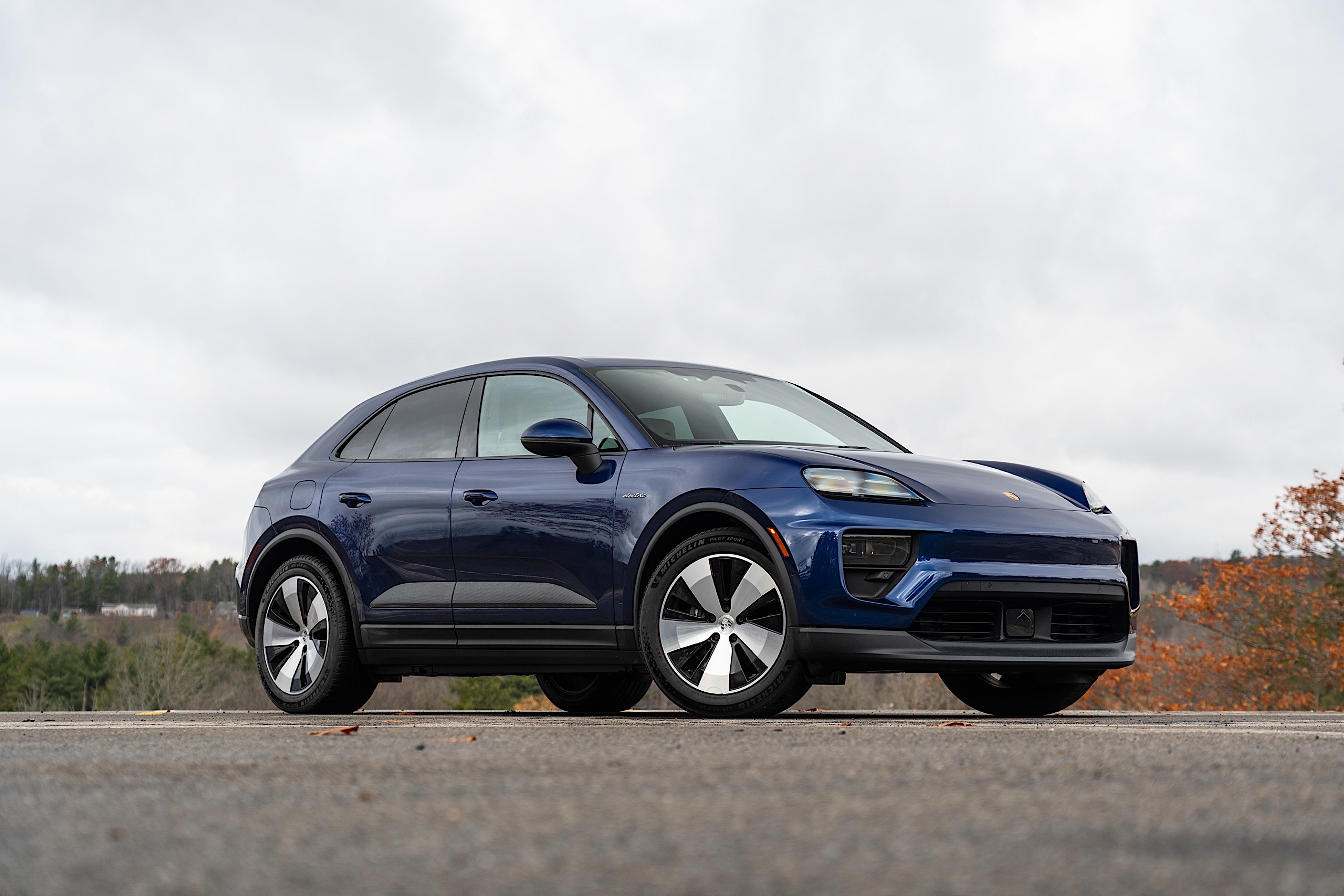
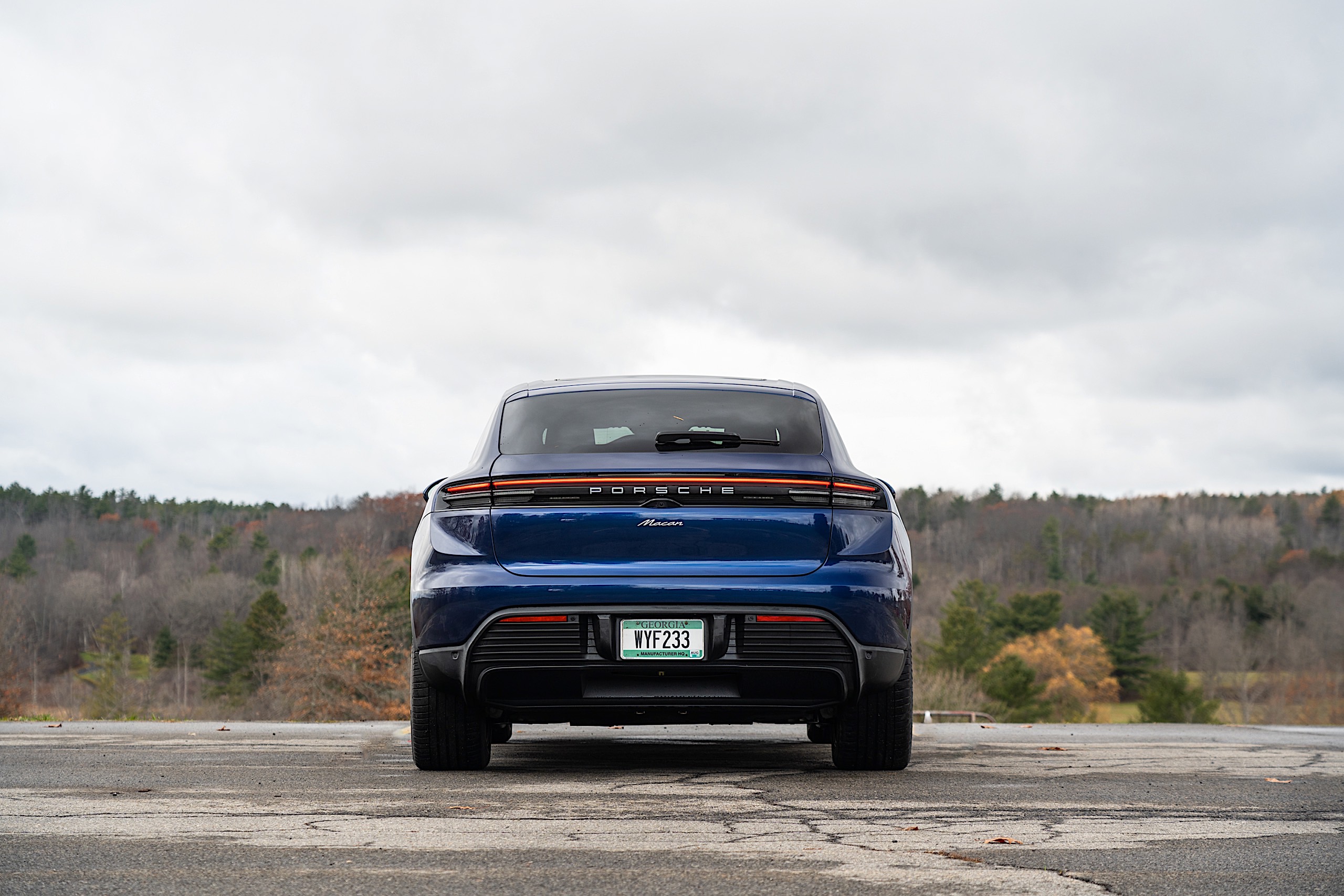
At first glance, the electric Macan looks like a Tesla Model Y — especially in dark blue.
Tim Stevens for Engadget
Of course, this is a Porsche, not a drag machine, and so cornering is key. Helping with the handling is an adaptive air suspension that not only lets you go from stiff to firm at the twist of a knob but also raises or lowers dynamically. When you’re hunting for range or speed, the SUV gets down into an aerodynamic tuck low to the earth. If you’re looking to head off-road, it’ll hike itself up by 1.6 inches.
While I wouldn’t consider this an off-roader as such, the dual motor configurations should be competent in lower-grip situations. Open differentials at either end will keep your all-roading aspirations limited, but on some icy, slippery roads during the week I spent living with one, even the rear-drive Macan proved sure-footed and easy to handle, despite its summer-oriented Pilot Sport EV tires.
At the heart of all that is a 100-kilowatt-hour battery, which offers the Macan Electric an EPA-rated range of up to 315 miles, depending on which trim you go with. In my testing, which included extended periods of driving with my foot flat to the floor, I managed 2.8 miles per kWh. That’s a theoretical maximum range of 280 miles if you’re driving like you stole it. Anyone doing the school run in a more sedate way will have no problem meeting or beating that EPA rating.
User interface
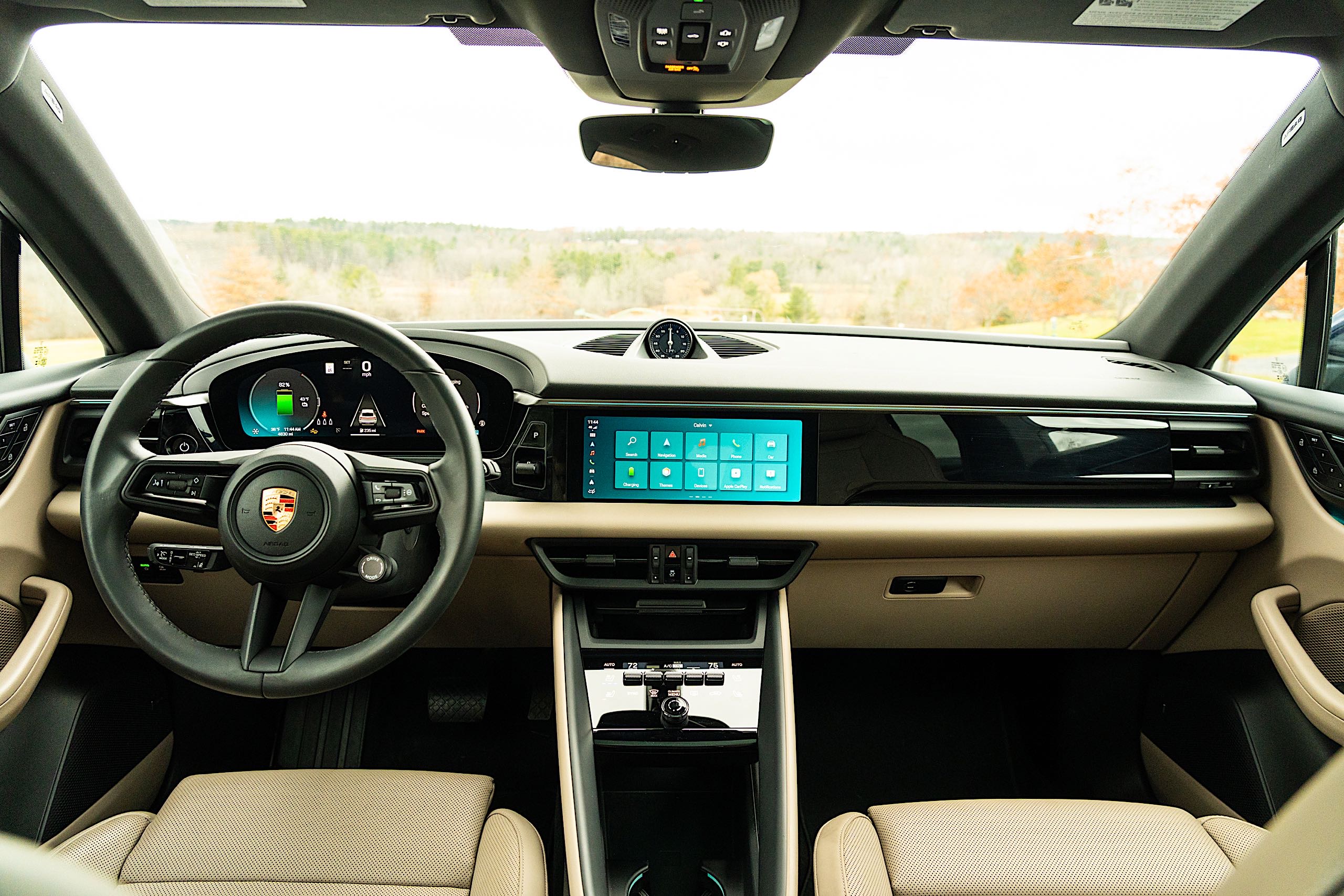
The Macan’s interior is equipped with multiple displays.
Tim Stevens for Engadget
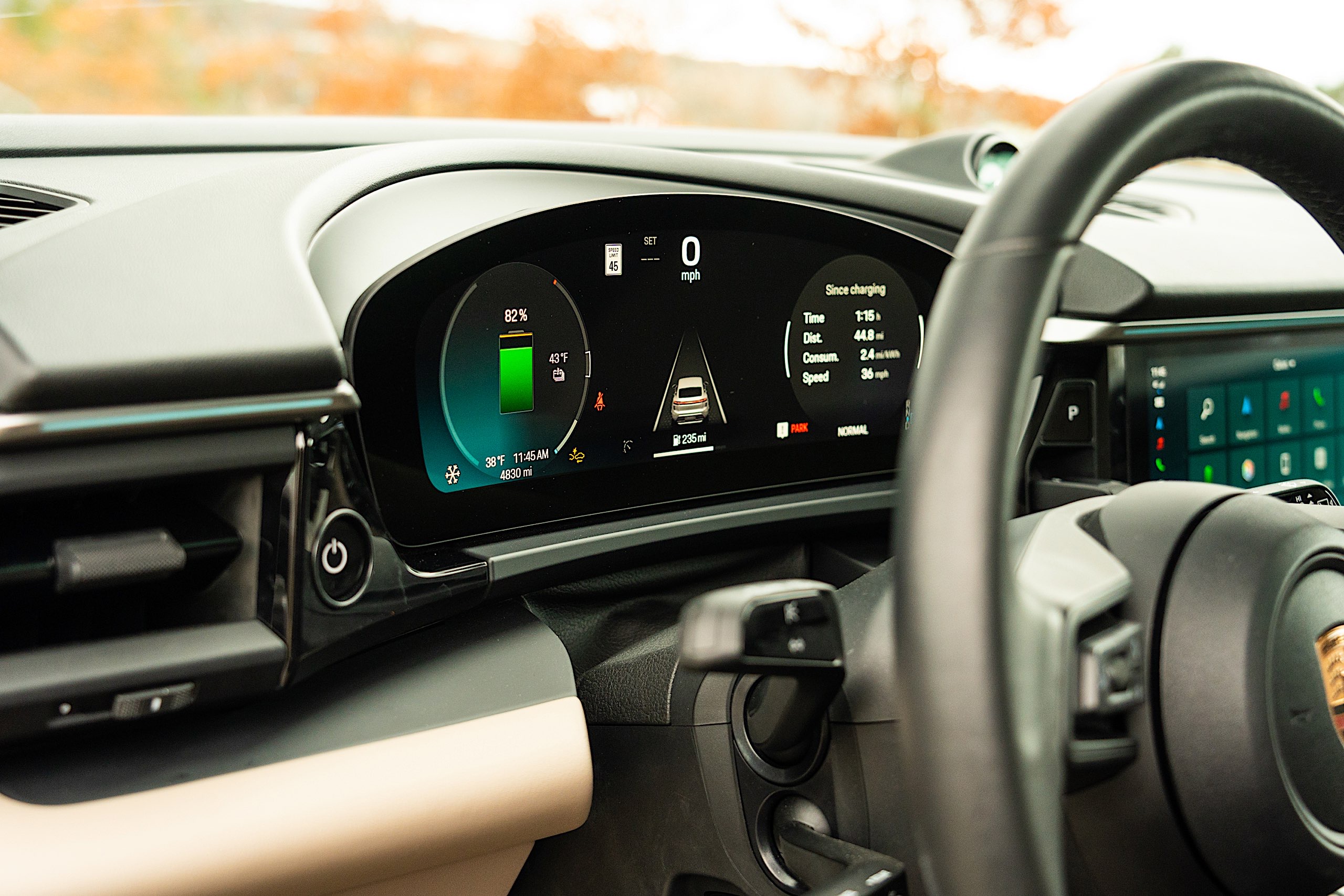
Beyond performance, the Macan Electric has another advantage over its internal combustion counterpart: it has a more modern interior. The highlight is the 12.6-inch, curved gauge cluster. Using buttons on the steering wheel, you can cycle through various views and telemetry elements to suit your desire for data or need to remain undisturbed.
That’s paired with a 10.9-inch touchscreen in the middle, and you can even opt for a third display embedded way over on the right side of the dashboard. This one allows you to access streaming services like YouTube. I’ve never seen the point in that, though, but that’s only because I’ve yet to meet a passenger who wouldn’t rather just use their smartphone.
Porsche’s PCM interface on that central touchscreen is simple and clean, with more than a passing iOS resemblance. Perhaps that’s why the company has been an early adopter of CarPlay Ultra. For the Android faithful, wireless Android Auto is here too, and it works great, looking nearly native on the widescreen display.
The Macan’s gauge cluster is a curved 12.6-inch display.
Tim Stevens for Engadget
Through simple menus, you can do everything from track lap times to enable or disable the augmented digital engine tone, which Porsche calls Electronic Sport Sound. I confess the futuristic whirring and whooshing does make driving aggressively a bit more fun, but most of the time I prefer to have it off.
Thankfully, not everything is controlled through the touchscreen. There’s a separate, capacitive-touch panel just below it for climate-related functions, including toggling the prodigiously warm heated seats (which I’m enjoying as I write this). You’ll find a physical volume knob there, too.
The Macan seats five comfortably, though I’d stick to four for anything longer than a quick run to a team lunch. Front and rear seats are comfortable, and there’s a tolerable amount of legroom in the back. Headroom back there, though, is limited. If you have tall co-workers, they’ll be tripping over each other to call shotgun.
Dynamics
Despite it’s size, the Macan is surprisingly agile, which is partly due to its unique suspension.
Tim Stevens for Engadget
In the grand spectrum of SUVs on the roads today, the 188.3-inch-long Macan Electric is on the smaller side. But, as an EV, it’s heavy for a crossover. At just a tick over 5,000 pounds, it’s a substantial 850 pounds heavier than a regular base Macan.
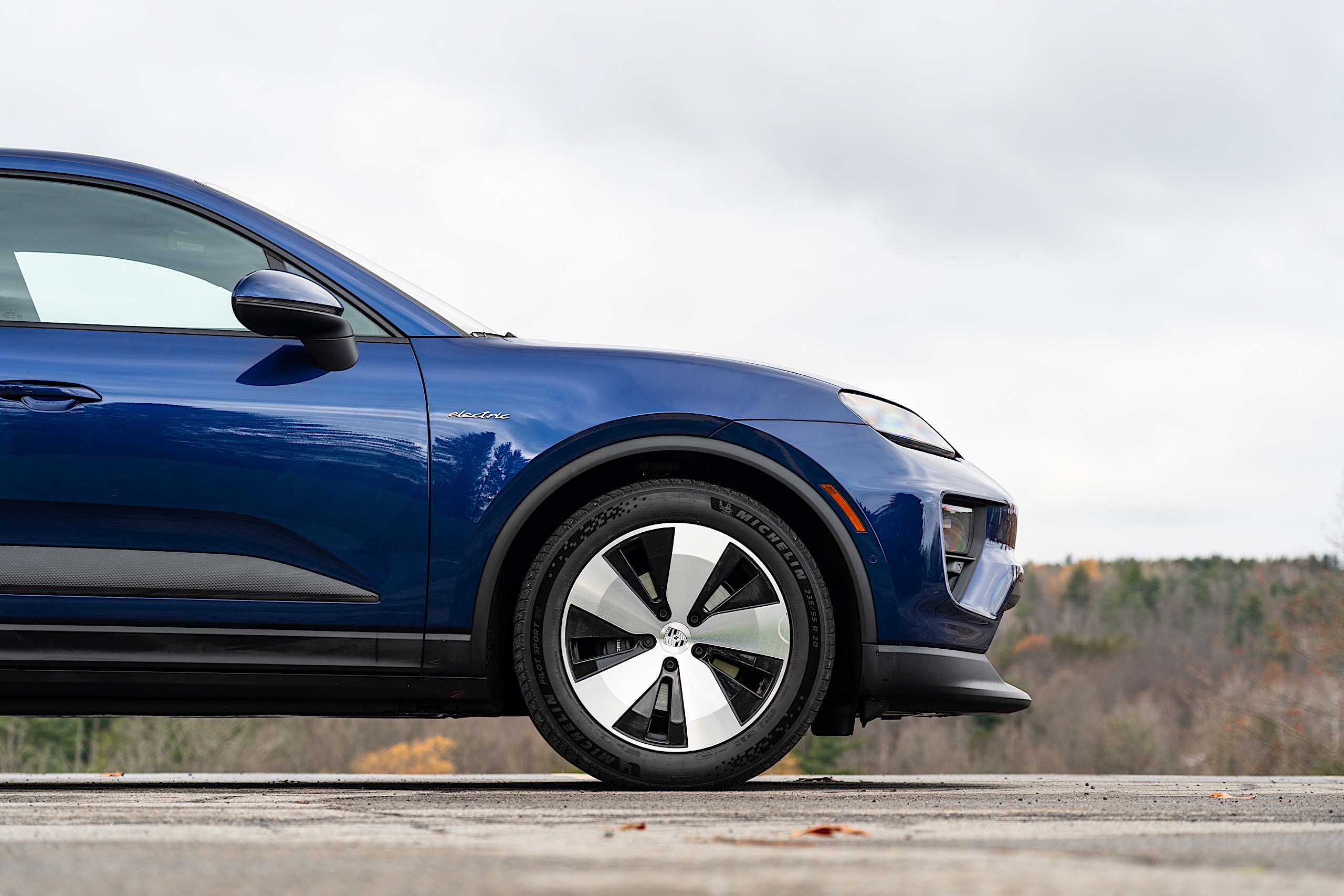
Porsche’s engineers addressed that as best they could with the aforementioned fancy suspension, plus larger, 20-inch wheels on each corner. The result is an SUV that is, in Sport or Sport Plus modes, remarkably fun to drive. Its steering is extremely quick for an SUV, which makes this thing feel lighter than it is.
All the grip provided by those tires and suspension really gives you the confidence to push through the corners, too. And, when you push too hard, it breaks away quickly and predictably. I enjoyed romping on the throttle hard mid-corner to kick the tail out, the Macan giving me just enough time to grin and give a bit of a steering correction before everything was right and the tires were stuck again.
It’s not a sports car, no doubt about that, and it tends to wallow a bit on bumpy roads thanks to all that weight, but it is far more engaging and fun than just about anything else in this category. Even this base model is quick off the line, but its breakneck initial throttle response is tempered by a somewhat flat acceleration at higher speeds. It just doesn’t have the kind of Autobahn-dominating top-end that Porsches are typically known for.
The electric Macan’s biggest flaw is the complete lack of lift-off regenerative braking.
Tim Stevens for Engadget
I suppose I’d have to cough up the extra $10,000 for the GTS, or a further $20,000 for the $109,000 Turbo if I really wanted that. Yes, these things get expensive quick. The base Macan Electric I drove started at $73,500, but carried enough options to drive its out-the-door price to $86,865.
You are, at least, getting a machine that readily does double-duty. Despite its responsiveness and eager handling, the Macan Electric does a stellar job of settling down when you twist that Drive Mode knob on the steering wheel to the left, unwinding the suspension and relaxing the experience. The SUV manages excellent compliance over broken roads, flying over railroad tracks without complaint, and just generally being a calm and competent cruiser.
But there’s one, undeniable flaw that drove me absolutely nuts in the Macan Electric: a complete lack of lift-off regenerative braking. Porsche continues its adamant refusal to offer anything even approaching a one-pedal driving experience. That’s a frustrating thing to me — maybe not quite as frustrating as GM phasing out Android Auto and Apple CarPlay, but pretty close.
Wrap-up
The electric Macan commands (at least) a $10,000 premium over its gas-powered sibling.
Tim Stevens for Engadget
After driving a few different prototypes of the Macan Electric during its development phase, I very much enjoyed my time with a final, production version on some familiar roads around my home. It excelled in the dry and on slippery, early winter roads, made me smile when I was feeling rowdy, and then disappeared into the background when I just wanted to get home.
It isn’t a perfect machine. I’d hoped for a little more roominess inside, I lament the lack of one-pedal driving, and honestly, I wish Porsche’s exterior designers had gone a little crazier. At a quick glance, it looks a lot like a first-gen Tesla Model Y, especially in Gentian Blue Metallic, which is a dead ringer for Tesla’s Deep Blue Metallic.
And there’s also the significant premium that you’ll have to pay to get into one: $10,000 over a base, gas-powered Macan. For that, you’re getting a lot of extra performance, a dose of extra tech and all the joys and simplicities that come with living the EV lifestyle. That makes it well worth it in my book.
This article originally appeared on Engadget at https://www.engadget.com/transportation/evs/2025-porsche-macan-electric-review-the-obvious-choice-when-the-budget-allows-140000851.html?src=rss