It solves all of the problems with tubeless” – how ‘faux tubeless’ could kill you punctures without the mess

While tubeless tech has taken over on mountain and gravel bikes, and is the typical choice of pro road cyclists, it still gets mixed reviews from everyday riders. This is despite tubeless’ capability to lower rolling resistance, increase ride comfort and, thanks to the sealant, heal many punctures without you even noticing.

But what if you have a non-tubeless ready wheelset or are using tube-type tyres, or just aren’t willing to jump into the tubeless world? If your tyre setup forces you to run inner tubes, you’re a hostage to flats and roadside repairs. 

Bicycle frame builder and tech journalist Richard Hallett has a solution that provides tubeless levels of anti-flat performance, which he calls faux tubeless.

“I’ve converted all my tyres to faux tubeless,” he says. “It’s the uncertainty of tubeless [that’s the problem], you don’t need to worry if you don’t get a seal, and there’s no mess.

“It solves all the problems with tubeless,” he claims.

Here’s how it works.

What is faux tubeless?

By glueing the inner tube to the crown of the tyre, faux tubeless prevents sealant from leaking into the space between the two. Richard Hallet

Inner tubes with sealant have been around for a long time. But the thin casing and flexibility mean that, if you get a puncture, the tube doesn’t tend to seal properly, and will leak air and sealant into the space between the tube and the tyre casing.

Tubeless tyres also run the risk of rolling off a rim in the event of sudden air loss. Seeing a crash at Paris-Roubaix, where this had occurred, gave Hallett the idea for faux tubeless.

Hallett’s solution is to glue the inner tube to the inside of the tyre. This provides rigidity and thickness to enable the sealant to plug the hole, and no space between the inner tube and tyre for the sealant to leak into.

Hallet published a full guide on how to carry out the conversion on the Cycling UK blog, though he now recommends SVS-Vulc glue over tubular cement.

As good as tubeless

Hallett says he’s been running faux tubeless for more than 1,000 miles with several pairs of tyres.

One tyre with a thorn embedded held pressure for more than four weeks.

He cites one customer using faux tubeless who found nine thorns embedded in his tyre when it eventually stopped holding air.

He also claims that performance and ride quality are similar to a conventional clincher setup with tubes.

Other benefits include inflation using only a hand pump or electric inflator, the option to run tyre pressures over 5 BAR / 72psi, avoidance of burping and a volume of sealant that’s around half that needed for a full tubeless setup. 
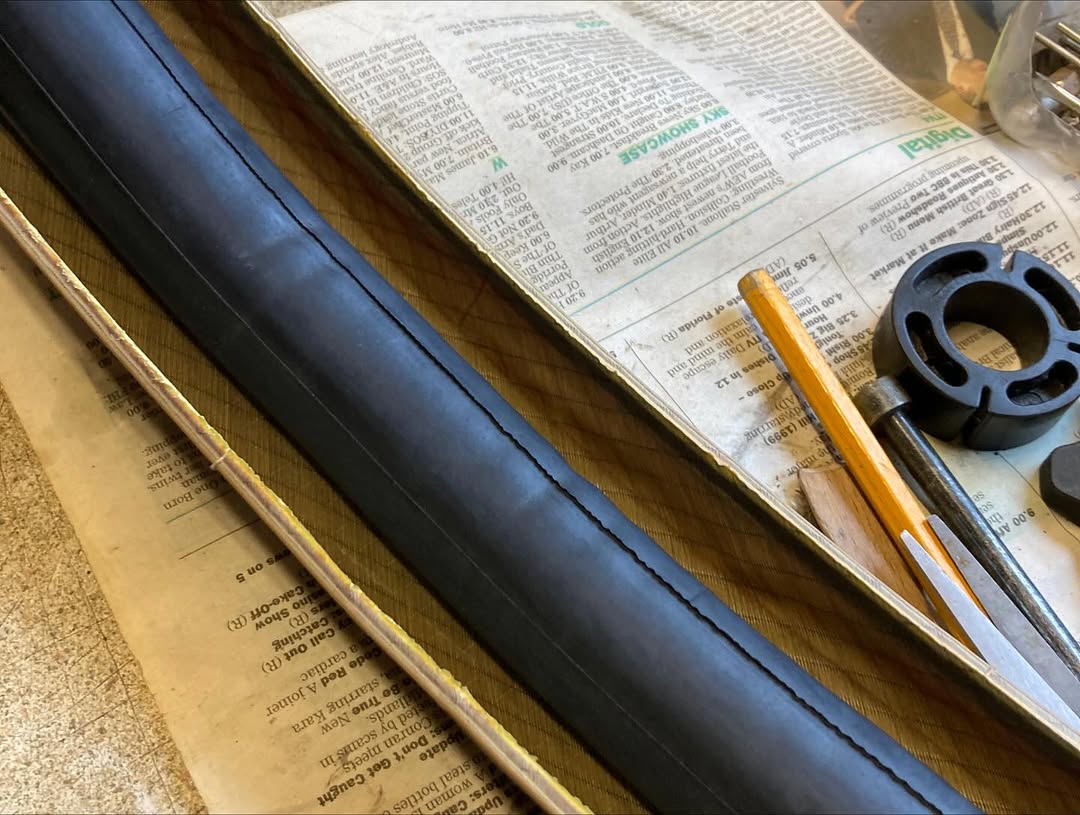
The inner tube can be removed from the tyre because it’s not permanently bonded in place.

It’s also possible to remove the tyre from the rim, without bathing yourself in sealant and without the usual struggle of mounting and dismounting tubeless tyres on tubeless-ready rims.

The minuses are that faux tubeless is still prone to pinch flats, as with a standard tubed setup, and you can still get punctures that the sealant or a tyre plug won’t seal.

Hallett reckons a full tubeless setup still works better if you have a tubeless-ready wheel and tyre. It also weighs less and is more pliable, increasing ride comfort and performance.

But, as a halfway house for those running non-tubeless wheels, or if you’re preferred tyres aren’t available in a tubeless option, this could be a worthwhile option.

How System76 & Red Hat Hope To Finally Improve The Linux Multi-GPU Experience

System76 engineer Victoria Brekenfeld and Red Hat engineer Sebastian Wick presented at the recent XDC2025 developer conference with their hopes of finally fixing the multi-GPU experience on Linux. As part of this is getting the necessary Wayland protocols in order as well as a new gpu-daemon service for proper multi-GPU handling for the Linux desktop…

Apple and Issey Miyake’s iPhone Pocket is a knitted sleeve to hold your phone

Apple has announced a new accessory that feels a bit out of left field, to say the least. Say hello to the limited edition iPhone Pocket, a 3D-knitted “ribbed open structure” designed in collaboration with Issey Miyake. Available with a short or long strap design, it can be worn on your arm, attached to a bag or across your body. 

“The design of iPhone Pocket speaks to the bond between iPhone and its user, while keeping in mind that an Apple product is designed to be universal in aesthetic and versatile in use,” Miyake Design Studio design director, Yoshiyuki Miyamae, said in a statement. “iPhone Pocket explores the concept of ‘the joy of wearing iPhone in your own way.'”

Yes, this “additional pocket” is a real item that you can purchase and decide for yourself if it’s bizarre or — dare we say — kind of chic? The iPhone Pocket’s short strap model is available in lemon, mandarin, purple, pink, peacock, sapphire, cinnamon and black. The long strap design comes in sapphire, cinnamon and black. Apple’s vice president of industrial design, Molly Anderson, added that the different options were “intentionally designed to mix and match with all our iPhone models and colors.”

iPhone Pocket colors.
Apple

The iPhone Pocket is available this Friday, November 14, on Apple’s website. However, the release is not only limited in quantity, but in location. You can pick one up online from the US, France, Greater China, Italy, Japan, Singapore, South Korea or the UK. With phone theft so high in the latter, it isn’t the worst option we’ve seen to keep your phone secure while out and about. 

If you live in very specific cities then you might also be able to see one in person. In the US, it will only be available at New York City’s SoHo Apple Store. Whether you buy it in person or online, the iPhone Pocket will put you back a pretty penny. The short strap is going for $150, while the long strap retails for $230. 

This article originally appeared on Engadget at https://www.engadget.com/mobile/smartphones/apple-and-issey-miyakes-iphone-pocket-is-a-knitted-sleeve-to-hold-your-phone-103504776.html?src=rss

UK Secondary Schools Pivoting From Narrowly Focused CS Curriculum To AI Literacy

Longtime Slashdot reader theodp writes: The UK Department for Education is “replacing its narrowly focused computer science GCSE with a broader, future-facing computing GCSE [General Certificate of Secondary Education] and exploring a new qualification in data science and AI for 16-18-year-olds.” The move aims to correct unintended consequences of a shift made more than a decade ago from the existing ICT (Information and Communications Technology) curriculum, which focused on basic digital skills, to a more rigorous Computer Science curriculum at the behest of major tech firms and advocacy groups to address concerns about the UK’s programming talent pipeline.

The UK pivot from rigorous CS to AI literacy comes as tech-backed nonprofit Code.org leads a similar shift in the U.S., pivoting from its original 2013 mission calling for rigorous CS for U.S. K-12 students to a new mission that embraces AI literacy. Code.org next month will replace its flagship Hour of Code event with a new Hour of AI “designed to bring AI education into the mainstream” with the support of its partners, including Microsoft, Google, and Amazon. Code.org has pledged to engage 25 million learners with the new Hour of AI this school year.


Read more of this story at Slashdot.

Designing for every learner in every classroom

One of the things I love most about my role as Chief Learning Officer at the Raspberry Pi Foundation is hearing from teachers around the world. A teacher in Kenya told me how their students debugged their first programming projects on a shared laptop. In Scotland, another explained how our resources gave them the confidence to teach computing for the very first time. These stories remind me daily why our work matters: every young person, no matter where they live, should have the chance to explore the power of computing.

Young people use laptops to do their coding tasks.

But creating resources that work in such different contexts is not easy. How do we design materials that work in a wide range of learning environments, from a bustling city classroom to a rural school where internet access can vary? How do we make sure that every learner sees themselves reflected in the examples we choose?

That’s where our teaching and learning design principles come in.

What makes our approach different

Over the past decade, we’ve learned a huge amount about what teachers and learners need from us. We’ve made mistakes, we’ve listened, and we’ve refined our practice again and again. The result is a set of design principles that guide the creation of everything we make, from full curricula to one-off projects.

Four students at laptops in a school in India.

These principles are practical and based on real classroom experience. They’re our way of making sure our resources are reliable, inspiring, and flexible, wherever and however teachers use them.

Here’s what that looks like in action:

  • High quality – You can trust our resources to be accurate and classroom-ready. We put every piece of content through rigorous checks because we understand how busy you are.
  • Research-informed – Our choices are grounded in evidence, not guesswork. We blend academic studies with insight from teachers like you and our own evaluations to create approaches that genuinely work.
  • Consistent – We design our materials to fit together, so learners can build skills step by step, without confusion or contradiction along the way.
  • Inclusive by design – We think carefully about accessibility, representation, and language right from the start. When young people see themselves reflected in computing, they see it as a future they can be a part of.
  • Adaptable – No two classrooms are the same. By making our resources editable and flexible, we give you the freedom to shape them for your learners.

Why share these design principles now?

For us, being transparent about our approach is about trust. Teachers make daily decisions about which resources to use, often with limited preparation time. By showing you the principles behind our work, we want to give you the confidence that our content is not only free and adaptable, but also designed with care, expertise, and your learners at the heart.

Educators participate in a teacher training in Kenya.

Looking ahead

The world of computing education is moving fast, from new programming software, to artificial intelligence tools. Our design principles give us a strong foundation to keep innovating while staying true to our mission of enabling young people to realise their full potential through the power of computing and digital technologies.

A boy and teacher in a computing class

And we’d love to hear from you! How do these principles resonate with your teaching? What helps you most in the classroom? Your feedback is what keeps making our work better.

The post Designing for every learner in every classroom appeared first on Raspberry Pi Foundation.

China’s CO2 Emissions Have Been Flat Or Falling For Past 18 Months, Analysis Finds

China’s CO2 emissions have been flat or falling for 18 months, “adding evidence to the hope that the world’s biggest polluter has managed to hit its target of peak CO2 emissions well ahead of schedule,” reports the Guardian. From the report: Rapid increases in the deployment of solar and wind power generation — which grew by 46% and 11% respectively in the third quarter of this year — meant the country’s energy sector emissions remained flat, even as the demand for electricity increased. China added 240GW of solar capacity in the first nine months of this year, and 61GW of wind, putting it on track for another renewable record in 2025. Last year, the country installed 333GW of solar power, more than the rest of the world combined. […]

The analysis by the Centre for Research on Energy and Clean Air (Crea), for the science and climate policy website Carbon Brief, found China’s CO2 emissions were unchanged from a year earlier in the third quarter of 2025, thanks in part to declining emissions in the travel, cement and steel industries. But China has a record of underpromising and overdelivering on climate targets. Li Shuo, the director of the China Climate Hub at the Asia Society Policy Institute, a US-based thinktank, said in a recent note that the latest Chinese climate targets should be seen as a baseline and not a ceiling.


Read more of this story at Slashdot.

Broadcom just announced an AI chipset that translates audio in real time directly on the device

Broadcom and a company called CAMB.AI are teaming up to bring on-device audio translation to a chipset. This would allow devices that use the SoC to complete translation, dubbing and audio description tasks without having to dip into the cloud. In other words, it could massively improve accessibility for consumers.

The companies promise ultra-low latency and enhanced privacy, being that all processing is kept local to the user’s device. The wireless bandwidth should also be drastically reduced.

As for the audio description piece, there’s a demo video of the tool being used on a clip from the film Ratatouille. The AI can be heard describing the scene in various languages, in addition to a written translation appearing on-screen. This looks incredibly useful, particularly for those with vision issues.

There is a major caveat. This is a tightly controlled clip with plenty of edits. We have no idea how this tech will work in a real world scenario. Also, we don’t know how accurate the information will be. It does feature a voice model that’s already being used by organizations like NASCAR, Comcast and Eurovision.

The companies boast that this will enable “on-device translation in over 150 languages.” We don’t know when these chips will begin showing up in TVs and other gadgets. The tech is in the testing phase for now, so it’s gonna be a while. Broadcom also recently teamed up with OpenAI to help the latter company to manufacture its own chips.

This article originally appeared on Engadget at https://www.engadget.com/ai/broadcom-just-announced-an-ai-chipset-that-translates-audio-in-real-time-directly-on-the-device-050036717.html?src=rss

Saudi Arabia’s Dystopian Futuristic City Project Is Crashing and Burning

An anonymous reader quotes a report from Gizmodo: It appears that Neom — Saudi Arabia’s hugely expensive, architecturally bizarre urban development project — is floundering and close to collapse. A new report from the Financial Times cites high-level sources within the project to paint a picture of dysfunction and failure at the heart of the quixotic effort. Neom was envisioned as a vast series of fantastical urban developments spread across the coast of the Red Sea. At the center of the project is The Line — a proposed 105-mile-long city which developers had initially projected could house as many as 9 million people by the year 2030.

The Line is defined by bizarre architectural flourishes that, as the story notes, have seemed impossible even to the execs tasked with making them a reality. One such addition is an upside-down building, dubbed “the chandelier,” that is supposed to hang over a “gateway” marina to the city: “As architects worked through the plans, the chandelier began to seem implausible. One recalled warning Tarek Qaddumi, The Line’s executive director, of the difficulty of suspending a 30-story building upside down from a bridge hundreds of metres in the air. ‘You do realize the earth is spinning? And that tall towers sway?’ he said. The chandelier, the architect explained, could ‘start to move like a pendulum,’ then ‘pick up speed,’ and eventually ‘break off,’ crashing into the marina below.”

Yes, that doesn’t sound great. Now, according to those sources the FT talked to, the project is looking more and more like a hugely expensive pipe dream that will never come to pass: “Today, with at least $50 billion spent, the desert is pock-marked with piling, and deep trenches stretch across the landscape. But Prince Mohammed, who chairs Neom, has dramatically scaled back the first phase of the plans. Neom told the FT that The Line remained ‘a strategic priority’ that would ultimately ‘provide a new blueprint for humanity by changing the way people live.’ But they described it as a ‘multi-generational development of unprecedented scale and complexity.'”

The outlet interviewed workers on the project who seem to feel that it’s only a matter of time before the project is declared DOA: “While Neom employees say that much of The Line might still be technically buildable, they are not convinced anyone is ready to pay for it. Construction work across Neom has slowed, with the desert ski resort Trojena, the intended venue for the 2029 Asian Winter Games, one of the few sites still moving ahead at pace … one former employee has said that everyone knows the project won’t work; it is now just a matter of letting MBS down gently.”

Chief among the project’s problems is the fact that, as Neom’s bizarre developments have failed to materialize, it has become increasingly difficult to encourage investors to put up money for the absurdly expensive project. FT notes: “Senior executives were constantly asking for more money, but The Line was competing with other Neom projects. Some wealthy Saudi families put modest sums into the project, but the large investments Riyadh hoped to lure from foreign backers never materialized.” The lack of adequate funding coming in has led a senior construction manager to tell FT that he feels the Line will never be built.


Read more of this story at Slashdot.

A Jailed Hacking Kingpin Reveals All About Cybercrime Gang

Slashdot reader alternative_right shares an exclusive BBC interview with Vyacheslav “Tank” Penchukov, once a top-tier cyber-crime boss behind Jabber Zeus, IcedID, and major ransomware campaigns. His story traces the evolution of modern cybercrime from early bank-theft malware to today’s lucrative ransomware ecosystem, marked by shifting alliances, Russian security-service ties, and the paranoia that ultimately consumes career hackers. Here’s an excerpt from the report: In the late 2000s, he and the infamous Jabber Zeus crew used revolutionary cyber-crime tech to steal directly from the bank accounts of small businesses, local authorities and even charities. Victims saw their savings wiped out and balance sheets upended. In the UK alone, there were more than 600 victims, who lost more than $5.2 million in just three months. Between 2018 and 2022, Penchukov set his sights higher, joining the thriving ransomware ecosystem with gangs that targeted international corporations and even a hospital. […]

Penchukov says he did not think about the victims, and he does not seem to do so much now, either. The only sign of remorse in our conversation was when he talked about a ransomware attack on a disabled children’s charity. His only real regret seems to be that he became too trusting with his fellow hackers, which ultimately led to him and many other criminals being caught. “You can’t make friends in cyber-crime, because the next day, your friends will be arrested and they will become an informant,” he says. “Paranoia is a constant friend of hackers,” he says. But success leads to mistakes. “If you do cyber-crime long enough you lose your edge,” he says, wistfully.


Read more of this story at Slashdot.

EU Eyes Banning Huawei, ZTE Corp From Mobile Networks of Member Countries

The European Commission is considering turning its non-binding 2020 guidance on “high-risk vendors” into a legal requirement that would effectively force EU member states to phase out Huawei and ZTE from mobile and fixed-line networks. Bloomberg reports: Commission Vice President Henna Virkkunen wants to convert the European Commission’s 2020 recommendation to stop using high-risk vendors in mobile networks into a legal requirement, according to the people, who asked not to be identified because the negotiations are private. While infrastructure decisions rest with national governments, Virkkunen’s proposal would compel EU countries to align with the commission’s security guidance.

The EU is increasingly focused on the risks posed by Chinese telecom equipment makers as trade and political ties with its second-largest trading partner fray. The concern is that handing over control of critical national infrastructure to companies with such close ties to Beijing could compromise national security interests.

Virkkunen is examining ways to limit the use of Chinese equipment suppliers in fixed-line networks, as countries push for the rapid deployment of state-of-the-art fiber cables to expand high-speed internet access. The commission is also considering measures to dissuade non-EU countries from relying on Chinese vendors, including by withholding Global Gateway funding from nations that use the grants for projects involving Huawei equipment, according to the people.


Read more of this story at Slashdot.