Focused Sound Energy Holds Promise For Treating Cancer, Alzheimer’s and Other Diseases

An anonymous reader quotes a report from the Conversation: Sound waves at frequencies above the threshold for human hearing are routinely used in medical care. Also known as ultrasound, these sound waves can help clinicians diagnose and monitor disease, and can also provide first glimpses of your newest family members. And now, patients with conditions ranging from cancer to neurodegenerative diseases like Alzheimer’s may soon benefit from recent advances in this technology.

I am a biomedical engineer who studies how focused ultrasound — the concentration of sound energy into a specific volume — can be fine-tuned to treat various conditions. Over the past few years, this technology has seen significant growth and use in the clinic. And researchers continue to discover new ways to use focused ultrasound to treat disease. […] Research on focused ultrasound has primarily focused on the most devastating and prevalent diseases, such as cancer and Alzheimer’s disease. However, I believe that further developments in, and increased use of, focused ultrasound in the clinic will eventually benefit patients with rare diseases.

One rare disease of particular interest for my lab is cerebral cavernous malformation, or CCM. CCMs are lesions in the brain that occur when the cells that make up blood vessels undergo uncontrolled growth. While uncommon, when these lesions grow and hemorrhage, they can cause debilitating neurological symptoms. The most common treatment for CCM is surgical removal of the brain lesions; however, some CCMs are located in brain areas that are difficult to access, creating a risk of side effects. Radiation is another treatment option, but it, too, can lead to serious adverse effects.

We found that using focused ultrasound to open the blood-brain barrier can improve drug delivery to CCMs. Additionally, we also observed that focused ultrasound treatment itself could stop CCMs from growing in mice, even without administering a drug. While we don’t yet understand how focused ultrasound is stabilizing CCMs, abundant research on the safety of using this technique in patients treated for other conditions has allowed neurosurgeons to begin designing clinical trials testing the use of this technique on people with CCM. With further research and advancements, I am hopeful that focused ultrasound can become a viable treatment option for many devastating rare diseases.


Read more of this story at Slashdot.

Western Executives Shaken After Visiting China

mspohr shares a report from Futurism: Western automotive and green energy executives who visit China are returning humbled — and even terrified. As The Telegraph reports, the executives are warning that the country’s heavily automated manufacturing industry could quickly leave Western nations behind, especially when it comes to electric vehicles. “We are in a global competition with China, and it’s not just EVs,” Ford CEO Jim Farley told The Verge last month. “And if we lose this, we do not have a future at Ford.” Some companies are giving up on new initiatives altogether, with the founder of mining company Fortescue, Andrew Forrest, claiming that his recent trip to China led to him abandoning attempts to produce EV powertrains in-house. “There are no people — everything is robotic,” he told The Telegraph.

Other executives recalled touring “dark factories” that don’t even need to keep the lights on, as most work is being done around the clock by robots. “You get this sense of a change, where China’s competitiveness has gone from being about government subsidies and low wages to a tremendous number of highly skilled, educated engineers who are innovating like mad,” British energy supplier Octopus CEO Greg Jackson told the newspaper. According to recent figures by the International Federation of Robotics, China has deployed orders of magnitude more industrial robots than Germany, the US, and the UK.


Read more of this story at Slashdot.

Norway Says ‘Mission Accomplished’ On Going 100% EV, Proposes Incentive Changes

Norway has effectively achieved its 2025 goal of 100% electric new car sales, prompting the government to declare “mission accomplished” and propose scaling back EV tax exemptions to reflect a mature market. “We have had a goal that all new passenger cars should be electric by 2025, and … we can say that the goal has been achieved,” announced Finance Minister Jens Stoltenberg. Electrek reports: With the finish line in sight, the Norwegian government is now fine-tuning its approach. The current incentive program maintains the crucial VAT exemption for EVs, but only up to a purchase price of 500,000 Norwegian kroner (approximately $49,000 USD). This move is designed to target more expensive, luxury EVs, ensuring that the incentive benefits a broader range of consumers.

However, the latest budget proposal aims to reduce the EV tax exemption to vehicles costing 300,000 Norwegian kroner (~30,000 USD). This would apply for 2026, and then the tax exemption would completely end in 2027. Additionally, the government plans to increase taxes on new gasoline and diesel cars, further widening the cost gap between polluting and zero-emission vehicles.

However, the proposal still needs to be adopted by Norway’s government, and there is some opposition. EV associations are advocating for a more extended phase-out period to ensure that the adoption rate doesn’t decline.


Read more of this story at Slashdot.

China ‘Stole Vast Amounts’ of Classified UK Documents, Officials Say

Boris Johnson’s former adviser claims that China infiltrated a key UK government data-transfer network for years, compromising highly classified materials and prompting a Whitehall cover-up that prioritized Chinese investment over national security. The Times reports: Dominic Cummings, who served as a senior adviser to Boris Johnson, said that he and the then prime minister were informed about the breach in 2020 but that there had subsequently been a cover-up. He said he was warned at the time that disclosing some specific details of the breach would be a criminal offence. He claimed that the breach included some “Strap” material, which is the government term for the highest level of classified information.

The breach, which was confirmed by two other senior Whitehall sources, was said to have been connected to a Chinese-owned company involved in Britain’s critical national infrastructure. Tom Tugendhat, a former Tory security minister, supported Cummings’s account. Cummings said that he and Johnson were informed of the breach in the “bunker” of No 10 — a reference to the secure room in Downing Street.

He told The Times: “The cabinet secretary said, ‘We have to explain something; there’s been a serious problem’, and he talked through what this was. “And it was so bizarre that, not just Boris, a few people in the room were looking around like this — ‘Am I somehow misunderstanding what he’s saying? Because it sounds f***ing crazy.'” He added: “What I’m saying is that some Strap stuff was compromised and vast amounts of data classified as extremely secret and extremely dangerous for any foreign entity to control was compromised. “Material from intelligence services. Material from the National Security Secretariat in the Cabinet Office. Things the government has to keep secret. If they’re not secret, then there are very, very serious implications for it.”


Read more of this story at Slashdot.

Waymo’s Robotaxis Are Coming To London

An anonymous reader quotes a report from The Guardian: People in London could be hiring driverless taxis from Waymo next year, after the US autonomous vehicle company announced plans to launch its services there. The UK capital will become the first European city to have an autonomous taxi service of the kind now familiar in San Francisco and four other US cities using Waymo’s technology.

The launch pits an innovation sometimes dubbed the “robotaxi” against London’s famous black cabs, which can trace their history back to the first horse-drawn hackney coaches of the Tudor era. But a representative of the capital’s cab drivers said they were not concerned by the arrival of a “fairground ride” and questioned the reliability of driverless vehicles. Waymo said its cars were now on their way to London and would start driving on the capital’s streets in the coming weeks with “trained human specialists,” or safety drivers, behind the wheel.

The company, originally formed as a spin-off from Google’s self-driving car program, said it would scale up operations and work closely with Transport for London and the Department for Transportto obtain the permits needed to offer fully autonomous rides in 2026. Uber and the UK tech company Wayve have also announced their own plans to trial their driverless taxis in the capital next year, after the British government said it would accelerate rules allowing public trials to take place before legislation enabling self-driving vehicles passes in full.


Read more of this story at Slashdot.

‘Flying Suitcase’ Personal Helicopter Can Fit In The Back Of A Truck

This is a flight demonstration of X Control’s Janus-I, a personal dual-blade helicopter that was dubbed the ‘flying suitcase’, presumably in honor of George Jetson’s flying car (which unfolded from his suitcase). The gas-powered helicopter folds up small enough to fit in the back of a truck, weighs only 154-pounds but can carry 440-pounds, has a top speed of around 100MPH, can reach altitudes of ~20,000ft, and can even take off and land on water. What it can’t do is make you feel the least bit safe flying it at any altitude over 10 feet. Especially considering you don’t even need a pilot’s license to fly it, so there’s very little chance you’ll have any idea what you’re doing besides being moments from death.

Mozilla Is Recruiting Beta Testers For a Free, Baked-In Firefox VPN

Mozilla is testing a free, built-in VPN for Firefox that routes traffic through Mozilla-managed servers directly in the browser. The Register reports: According to a staff post on Mozilla Connect, the company’s idea-sharing platform, Firefox VPN is still an experimental feature in the early stages of development, but users will be selected at random to test it “over the next few months.” Moz describes the feature as one that will sit beside the search bar on Firefox, routing web traffic through a Mozilla-managed VPN server, concealing the user’s real IP address while adding a layer of encryption to their communications. Firefox VPN is a different project entirely from Mozilla VPN, a separate, paid-for product. The Firefox version will be free to use and confined to the browser itself, while Mozilla VPN can be used by up to five devices at a time.

The Moz staffer on the product team who announced the feature said of the upcoming beta test: “We’ll start simple, then gradually add new capabilities while learning how it impacts browsing, usage, and overall satisfaction. “Our long-term vision is ambitious: to build the best VPN-integrated browser on the market.” In response to feedback, the staffer noted that while it will be a desktop browser feature first, “mobile is definitely a natural next step.”


Read more of this story at Slashdot.

Anthropic Aims To Nearly Triple Annualized Revenue In 2026

Anthropic is projecting its annualized revenue run rate to soar from roughly $7 billion today to as much as $26 billion in 2026, driven by rapid enterprise adoption of its Claude AI models. Reuters reports: Anthropic debuted a new version of its cheapest AI model, Haiku, on Wednesday, as part of a broader effort to appeal to companies that are looking for capable AI systems that are dramatically cheaper than its more advanced models. The Haiku 4.5 model sells for about one-third the price of Sonnet 4, one of its medium-sized models.

The revenue projections underscore continued strong demand for generative AI tools among businesses and help explain investor enthusiasm, even as AI spending, especially in infrastructure buildout, comes under scrutiny. Some people worry the level of investment might be unsustainable. Fueling the expansion is the uptake of enterprise products, which are built for organizations. Anthropic has more than 300,000 business and enterprise customers, which account for about 80% of its revenue.


Read more of this story at Slashdot.

PayPal’s blockchain partner accidentally minted $300 trillion in stablecoins

In an embarrassing error, PayPal blockchain partner Paxos accidentally minted 300 trillion of the PYUSD token today. PayPal’s stablecoin, which it debuted in 2023, is supposed to be redeemable at a 1:1 rate for US dollars. $300 trillion is more than double the entire world’s current GDP of $117 trillion. In short, that’s a really bad mistake from Paxos.

At least the action did appear to be a mistake. Paxos acknowledged the issue in a post on X, assuring clients that their funds are secure and stating that it burned the excess reserves of stablecoins. The company claimed that “this was an internal technical error.” Maybe so, but internal technical errors can still wreak havoc pretty quickly when it comes to finance, especially in the fantasy worlds of blockchain and crypto. Thanks to the appropriately named Web3 is Going Just Great for picking up on this story.

This article originally appeared on Engadget at https://www.engadget.com/cybersecurity/paypals-blockchain-partner-accidentally-minted-300-trillion-in-stablecoins-224017538.html?src=rss

F5 Says Hackers Stole Undisclosed BIG-IP Flaws, Source Code

An anonymous reader quotes a report from BleepingComputer: U.S. cybersecurity company F5 disclosed that nation-state hackers breached its systems and stole undisclosed BIG-IP security vulnerabilities and source code. The company states that it first became aware of the breach on August 9, 2025, with its investigations revealing that the attackers had gained long-term access to its system, including the company’s BIG-IP product development environment and engineering knowledge management platform.

F5 is a Fortune 500 tech giant specializing in cybersecurity, cloud management, and application delivery networking (ADN) applications. The company has 23,000 customers in 170 countries, and 48 of the Fortune 50 entities use its products. BIG-IP is the firm’s flagship product used for application delivery and traffic management by many large enterprises worldwide. […]

F5 is still reviewing which customers had their configuration or implementation details stolen and will contact them with guidance. To help customers secure their F5 environments against risks stemming from the breach, the company released updates for BIG-IP, F5OS, BIG-IP Next for Kubernetes, BIG-IQ, and APM clients. Despite any evidence “of undisclosed critical or remote code execution vulnerabilities,” the company urges customers to prioritize installing the new BIG-IP software updates.


Read more of this story at Slashdot.

Google’s Veo 3.1 is better at generating videos from images

Google has released a new update to its Veo AI video generation model that should make it do a better job of sticking to prompts and converting images into videos. Veo 3.1 is available to try today through Google’s Gemini API and is now also powering the company’s Flow video editor.

Veo 3.1 builds on the new capabilities Google introduced with launch of Veo 3 at Google I/O 2025. The new model offers better “prompt adherence,” according to Google, and should have an easier time creating videos based on the image “ingredients” you upload alongside your written prompt. Veo 3.1 also makes it possible to convert images to video and generate audio at the same time, a capability that wasn’t available with Veo 3. 

In Flow, Veo 3.1 supports at least a new feature that gives you finer control over the videos you generate. With what Google calls “Frame to Video,” Flow lets you upload a first and last frame, and then generates the video in-between. Adobe Firefly, which is powered by Veo 3, offers a similar feature, but Flow will be able to pull it off and create audio at the same time. Those added audio skills will also apply to the video editor’s ability to extend clips and insert objects into existing footage, too.

Based on the samples Google’s shared, videos generated with Veo 3.1 still have an uncanny quality that seems to vary greatly depending on the prompt and subject. Even if it’s missing some of the realism of OpenAI’s Sora 2, though, the company’s decision to try and make Veo more useful to people who actually work with video rather than a source of social media spam is a welcome move.

This article originally appeared on Engadget at https://www.engadget.com/ai/googles-veo-31-is-better-at-generating-videos-from-images-220829129.html?src=rss

Samsung Sets A Date For Its Android XR Headset

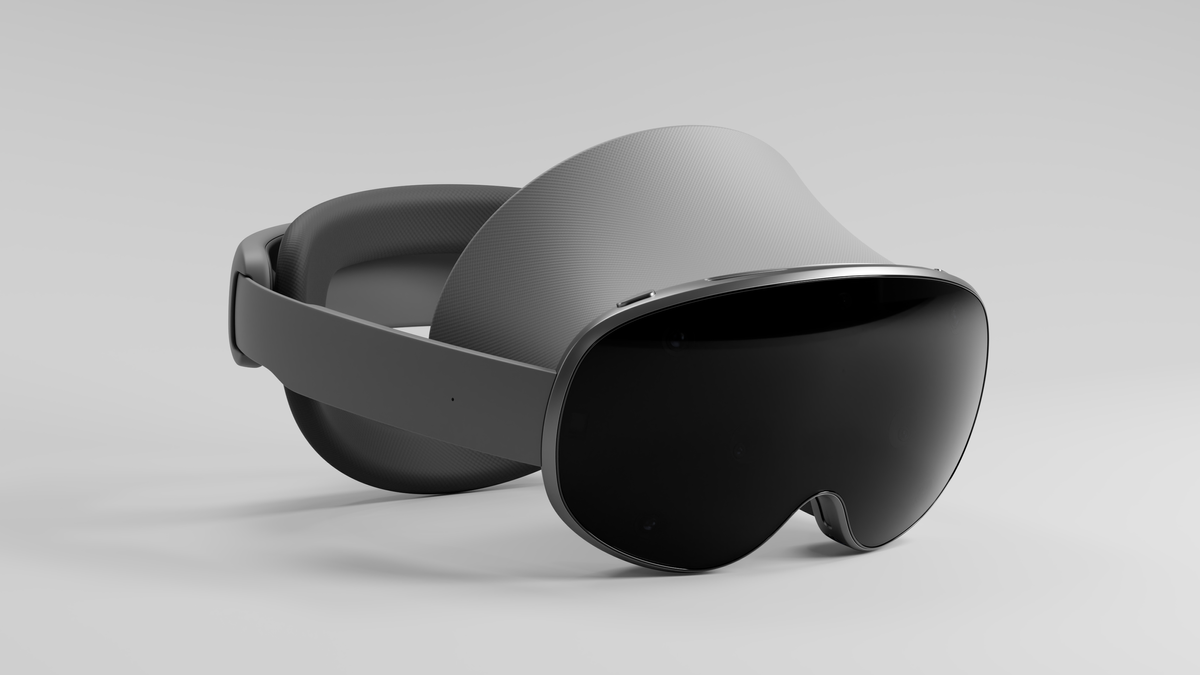
Samsung is teasing a livestream next week for its Android XR headset – could this be the launch event?

The October 21 Galaxy Event has the tagline “Worlds Wide Open”.

0:00

/0:16

Samsung’s teaser.

“Come meet the first official device on Android XR”, Samsung teases.

Samsung Galaxy XR?

Samsung first announced that it was working on a standalone headset almost three years ago, with Google handling the software.

It finally revealed the device’s design in December of last year, alongside Google formally naming Android XR, and gave UploadVR’s Ian Hamilton a hands-on demo while saying it would ship in 2025. But what it still has not revealed is the product’s name, price, detailed specifications, and exact release date.

Hands-On With Samsung’s Android XR Headset, Shipping In 2025
Samsung’s first standalone headset is coming in 2025, running Google’s new Android XR operating system and powered by Qualcomm’s Snapdragon XR2+ Gen 2 chipset.
UploadVRIan Hamilton

What Samsung has said is that it will feature Qualcomm’s Snapdragon XR2+ Gen 2, a higher-end variant of the chipset in Quest 3 and Quest 3S which has already shipped in Play For Dream MR, as well as “state-of-the-art displays”, eye tracking, hand tracking, and an external tethered battery.

Beyond that, the company confirmed that it was working on controllers, but did not disclose whether they will be included in the box or sold as an optional accessory.

In August the South Korean news outlet Newsworks reported that Samsung is targeting a price somewhere between 2.5 million and 4 million South Korean won, around $1750 to $2800. That compares to 5 million won for Apple Vision Pro, which has been sold in South Korea since November.

Samsung Phones Now Capture 3D Videos For ‘Galaxy XR Headsets’
Flagship Samsung phones can soon capture 3D photos and videos to view on “Galaxy XR headsets”, just like iPhones can for Apple Vision Pro.
UploadVRDavid Heaney

In September, Samsung started rolling out an update for the Camera app of its Galaxy phones that adds the ability to capture 3D photos and videos. The option to enable 3D capture describes the feature as being for viewing on “Galaxy XR headsets”, strongly suggesting that this will be the company’s branding.

Samsung’s official event takes place on Tuesday at 7pm PT, and we’ll bring you full coverage of whatever it announces about its headset.

The company won’t be without competition though, as deliveries of the new M5 Apple Vision Pro will start arriving the next day, when the headset will also be available in Apple Stores.

I Tried the New LE Bluetooth Audio on the Sony WH-1000XM6 Headphones

We may earn a commission from links on this page.

Did you know you can customize Google to filter out garbage? Take these steps for better search results, including adding my work at Lifehacker as a preferred source.


The new Sony WH-1000XM6 are the best premium headphones of 2025, and they keep getting better. One of my favorite features is its LE Audio Bluetooth compatibility, which is a newer Bluetooth type that uses less energy and supports better audio quality.

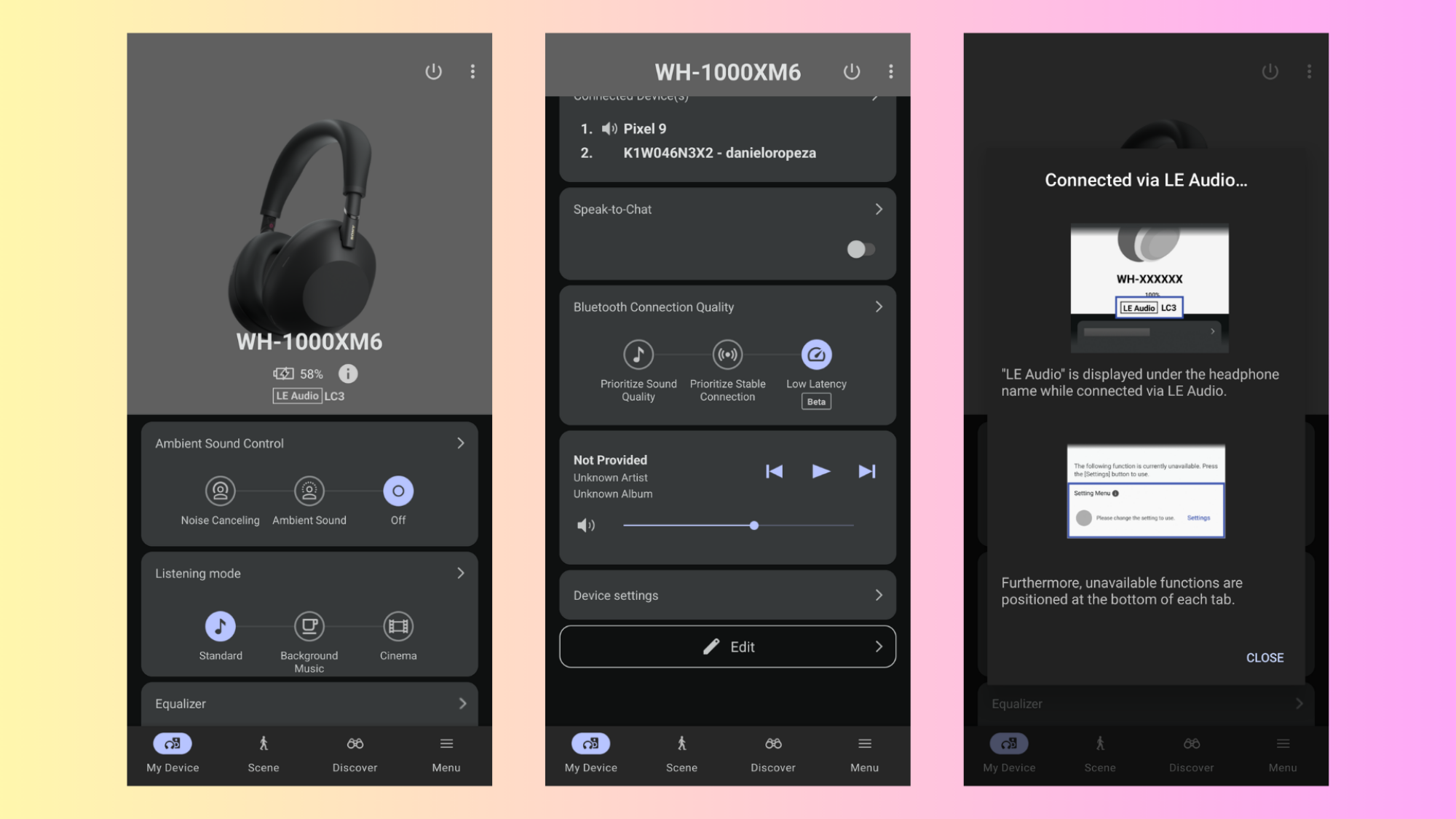
If you’ve tried to use LE Bluetooth in the past on your XM6 headphones, you might’ve noticed some features were missing, like head tracking, Find My Device, Gemini Live, and Audio Sharing with Fast Pair. Well, that’s no longer the case: The latest update to the Sound Connect app allows you to take advantage of all of these features while using the LE Audio technology.

Screenshot of the SOund Connect app
Left: LE Audio (LC3) Codec, Middle: Low Latency Bluetooth, Right: Pop up message for LE Adudio
Credit: Daniel Oropeza

How to make sure you get the update

While I’m a fan of the headphones, I can’t say I feel the same way about Sony’s companion app. It’s confusing and not user-friendly (and I’ve been using the app for years). The update was not easy to download, nor was it easy to know when it was done. But eventually, a message did pop up on my app asking me if I wanted the latest 3.0.0 update.

You can check if you already have it by clicking the three dots on the top right corner of the main menu and selecting “WH-1000XM6 Version.” Once you download it, you will need to do a hard connection reset between your phone and headphones for the update to kick in. Select the forget device on the XM6 from your Bluetooth settings and connect it again. Once you do all of that, you should be ready.

How LE Audio performs with the new features

It’s hard to say the LE Audio codec (LC3) sounds any better than it did before without a side-to-side comparison, but I can tell you that it sounds great. The audio is exactly what I would expect from arguably the best headphones of 2025.

The head tracking, which creates an all-around spatial sound quality, worked great as well. I took walks around my neighborhood and could hear conversations neighbors half a block away were having in their driveway.

When it comes to voice assistants and Gemini Live, your mileage may vary. From my experience, the mics on the WH-1000XM6 can be a bit sensitive, where long-winded answers from Gemini Live were cut off prematurely from noise around me. I did most of my testing while walking around my block and working from home (my wife also works from home, and we have a noisy dog). But this might be more about Gemini Live than the LE audio performance. Outside of those instances, the feature worked like I’d expect.

I can say I’ve noticed my sessions on the XM6 have lasted longer than before, which is one of the biggest advantages of using LE Audio. While the Low Latency feature is still in beta, it’s already meeting the high standards of the XM6.

Army general says he’s using AI to improve “decision-making”

Last month, OpenAI published a usage study showing that nearly 15 percent of work-related conversations on ChatGPT had to deal with “making decisions and solving problems.” Now comes word that at least one high-level member of the US military is using LLMs for the same purpose.

At the Association of the US Army Conference in Washington, DC, this week, Maj. Gen. William “Hank” Taylor reportedly said that “Chat and I are really close lately,” using a distressingly familiar diminutive nickname to refer to an unspecified AI chatbot. “AI is one thing that, as a commander, it’s been very, very interesting for me.”

Military-focused news site DefenseScoop reports that Taylor told a roundtable group of reporters that he and the Eighth Army he commands out of South Korea are “regularly using” AI to modernize their predictive analysis for logistical planning and operational purposes. That is helpful for paperwork tasks like “just being able to write our weekly reports and things,” Taylor said, but it also aids in informing their overall direction.

Read full article

Comments

TiVo Has Officially Discontinued Its DVRs

Did you know you can customize Google to filter out garbage? Take these steps for better search results, including adding my work at Lifehacker as a preferred source.


It’s the end of an era: TiVo no longer manufactures or sells the DVRs that made the company a household name. If you still have one, the company will continue to support it, but don’t go looking for one: TiVo as we know it is effectively over.

TiVo didn’t make a big deal about this discontinuation, however. As it happens, Luke Bouma of Cord Cutter News was the first to spot the development. Earlier this month, Bouma reported that TiVo Corporation had silently ended its DVR line, removing all references to the devices on its website. Following Bouma’s reporting, TiVo’s parent company, Xperi, confirmed the news.

In a statement to PCMag, an Xperi spokesperson said: “I can confirmed that as of [Oct.] 1, 2025, TiVo stopped selling physical DVR products, including hardware and accessories, both online and through agents…TiVo no longer manufacturers hardware, and our remaining inventory is now depleted, though we will continue to offer support for the products going forward.”

TiVo isn’t gone entirely. The brand now develops both TiVo OS, a smart TV operating system similar to Roku OS or Fire OS, as well as DTS AutoStage Video Service, an entertainment service developed for cars. But it is no longer a DVR manufacturer or seller, which might shock a time traveler from the early 2000s.

The TiVo effect

Tech comes and goes, but if you weren’t watching TV in the late ’90s and early 2000s, you might not know how monumental TiVo really was. The company launched its first DVRs in 1999 and introduced the market to features like one-touch simple recording, a hard drive to save multiple recordings at once, and, perhaps most notably, the ability to “pause” live TV and fast forward through commercials. The DVR offered viewers so much more than a simple VCR could, which only allowed for linear recording to single cassettes. TiVo could record live video from any input, including analog, cable, or satellite, which offered users flexibility in the content they recorded.

Before TiVo, if you missed the start of a show, you simply had to deal with it and try to jump in as best as you could—assuming you didn’t set a VCR to record it, of course. If you had a TiVo, however, you could simply rewind to the start of the program, and, when you reached a commercial break, skip ahead back to the show—until you caught up with the live broadcast.

TiVo disrupted the way consumers watched TV, and we’re likely seeing the ramifications of that today. The market adapted, and cable companies started offering their own DVRs with cloud-based recording as opposed to hard drive recording. Streaming services built on that momentum: Viewers were already getting used to watching shows whenever it suited them, so why not get ahead of the game, and offer all shows on-demand at any time? There’s no need to choose which programs to record: Everything is available at any time.

Like other early technology pioneers that fell behind with time, TiVo struggled through the streaming age it arguably helped create. The company hasn’t released a DVR since 2019, when it launched the TiVo Edge. That DVR had support for modern features, like 4K Dolby Vision HDR, Dolby Atmos sound, and access to major streaming apps, in addition to recording live TV. It then tried to break into the streaming device market with the TiVo Stream 4K, but the competition was too fierce to make an impact.

In a twist of irony, as TiVo discontinues its DVRs, streaming services are turning to ad-supported plans with increasing frequency. TiVo changed the game by letting us skip ads, and streaming originally omitted the ads entirely. But more and more customers are comfortable paying less to deal with commercials. We’ve come full circle in a way.

TiVo’s time might be at an end, but its impact lives on. What Skype did for video calls, TiVo did for TV. I’ll be thinking about that the next time I boot up something to watch on Netflix or Hulu.