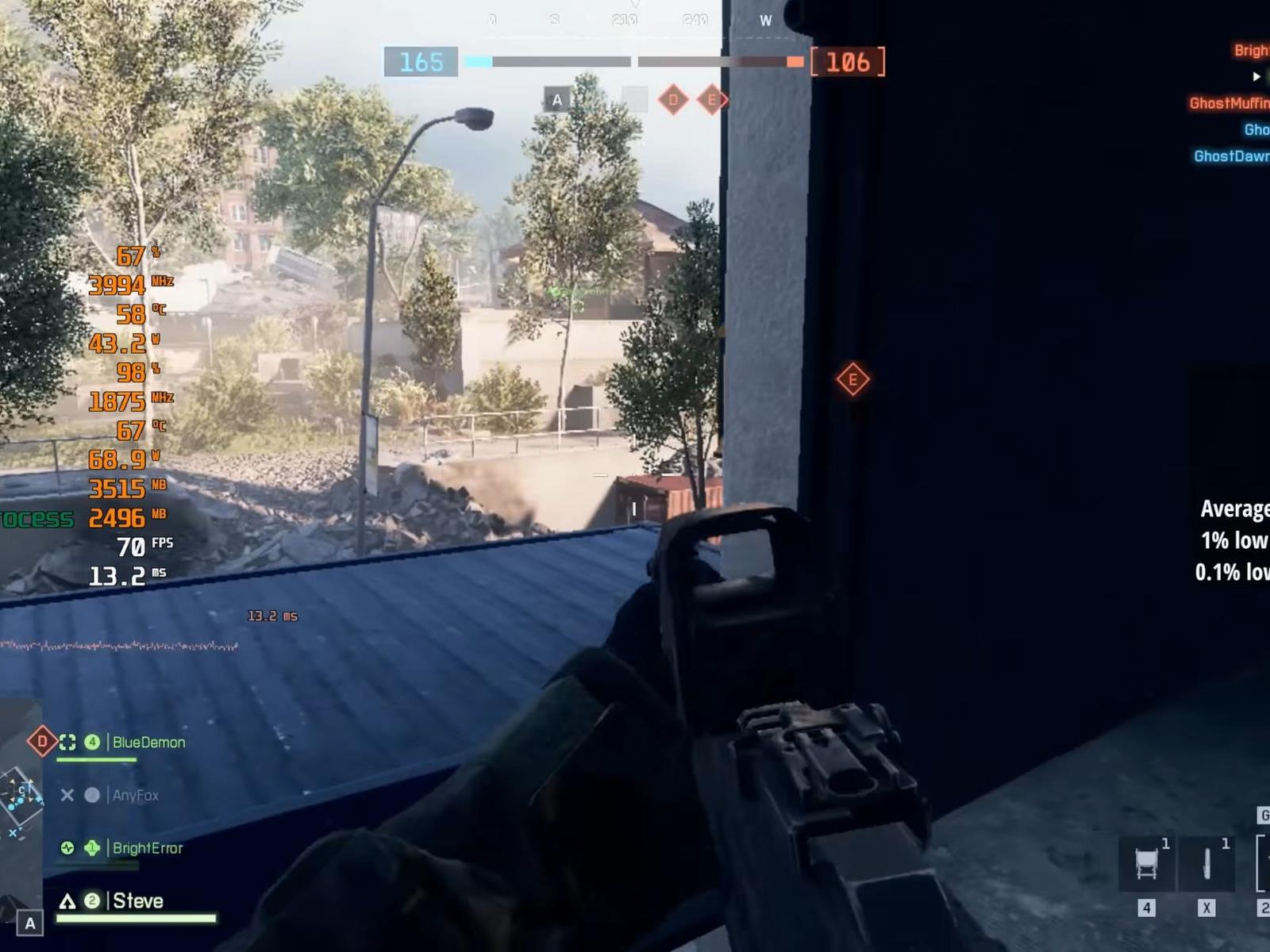
Since Battlefield 6’s wildly successful launch on PC, low-spec gamers everywhere have been eager to put it through its paces—and have come away pleasantly surprised at how well it performs on GPUs of yesteryear. One particular YouTuber whose tests we’ll be highlighting today is RandomGamingInHD, an enthusiast known for producing low-spec PC
Windows updates usually bring security enhancements, bug fixes and new features. Sometimes, though, these updates can also break parts of the operating system. Unfortunately, some updates for September and October fall into the latter camp, and many users are now having issues using a key feature of Windows 11.
In recent weeks, thanks to procuring a new (used) gravel bike while also testing a new smart trainer, I’ve spent more time with power meters, smart trainers, and dual recordings than usual. This includes swapping my Favero Assioma Duo power meter pedals (read my review here) between bikes with two different crank lengths, while also testing the accuracy of the smart trainer (a Wahoo KICKR CORE 2) in various Zwift activities.
In doing this, I realized I’ve never written a post about how crank length setting affects power readings on popular pedals like the Garmin Vector 3 or Favero’s various offerings. And while this may not be a topic many care about – most will just set the crank length to whatever matches their setup – I believe the info below will help explain why high-end Zwift races require riders to use certain smart trainers as their primary power source, vs a power meter.
Let’s dive in.
Test Setup
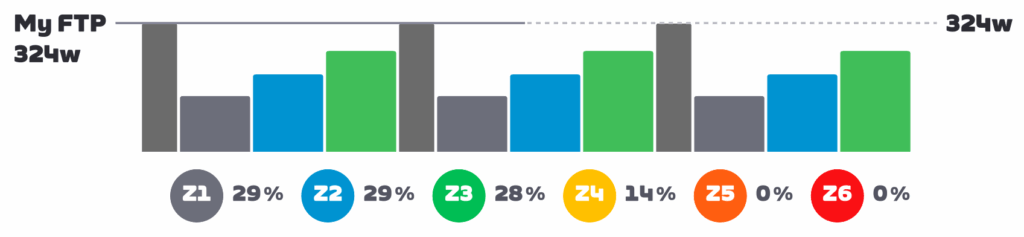
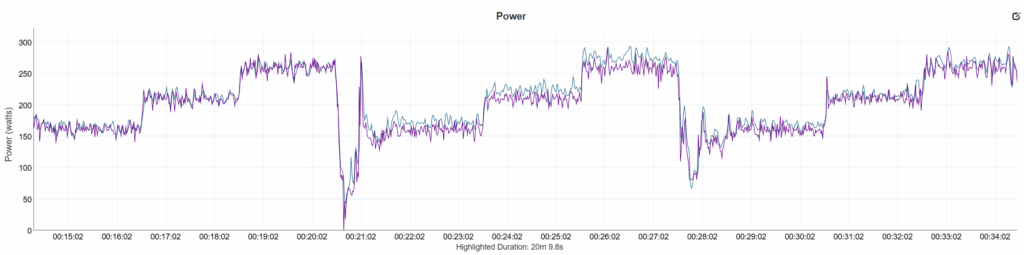
While simple math could deliver theoretical results, I wanted to prove the math using real equipment. So I created a simple Zwift workout which included three sets of the same three ascending 2-minute intervals.
The idea was to use a different crank length setting for each of the three sets and record the pedal power data to my head unit. Zwift would be recording my smart trainer’s power data, which should remain consistent across the 3 sets. Then I could compare the smart trainer’s data to the power pedal data to learn how much the crank length setting actually modified the power readings on the pedals.
Simple enough, right? Let’s look at the test results…
Test Results
You can see the full dataset on DC Rainmaker’s Analyzer tool, but I’ve summarized it below. I rode the first set of intervals with the crank length set too short, the second set with it too long, and the third set with it just right.
(Note that for each 2-minute interval, I took a 60-second sample of the data from the middle of the interval to arrive at my average power values below. This reduces data funkiness at the start of the interval as ERG targets change and trainer resistance adjusts.)
Set 1 (Crank Length: 167.5mm)
ERG Target W
Trainer
Assioma
% Variation
W Variation
160
161.52
164.67
1.95%
3.15
210
210.14
211.95
0.86%
1.81
260
259.47
260.18
0.27%
0.71
Set 2 (Crank Length: 177.5mm)
ERG Target W
Trainer
Assioma
% Variation
W Variation
160
159.76
172.25
7.82%
12.49
210
210.56
224.42
6.58%
13.86
260
259.85
276.05
6.23%
16.2
Set 3 (Crank Length Set Accurately to 172.5mm)
ERG Target W
Trainer
Assioma
% Variation
W Variation
160
159.95
167.73
4.86%
7.78
210
211.51
216.92
2.56%
5.41
260
259.12
266.85
2.98%
7.73
Takeaways
In simple terms, power is calculated by pedals like the Favero Assioma Duo as torque * angular speed (cadence). Torque is force * crank length.
Based on the math, changing crank length from 167.5 to 177.5 should increase power readings by 177.5/167.5, or +5.97%. And in fact, that’s what my test actually showed. The differences in power readings between the 167.5mm and 177.5mm crank length settings were:
@160W Target: 5.87%
@210W Target: 5.72%
@260W Target: 5.96%
(These particular test numbers line up with the math quite nicely, although comparing other data like 172.5 to 177.5 doesn’t yield quite as clean a result. That’s sort of the nature of power testing, though. Between variations in power meter accuracy, pedalling style, drivetrain efficiency, and which data is actually being read and recorded by each recording device, you’ll easily see a variation of 1% from what the math says your results should be. And that’s OK.)
You may be wondering: in set 3, if the crank length is set accurately, why are the readings still higher on the pedals? I’d chalk this up to drivetrain loss, which most experts in the cycling world say runs between 2-3%. Every step of the way between your pedals and your hub, a bit of power is lost. Cranks, spiders, chainrings, chain, cassette… they can flex a bit, get worn, or be poorly lubricated. All those losses typically add up to a 2-3% reduction in power from what you’re putting into the pedals to what is actually delivered to your rear hub.
Power Meters and Zwift Racing
If power at the smart trainer is typically 2-3% lower than at your pedals, wouldn’t you want to use your pedals as your power source in Zwift? Well, yes, if no other factors were taken into account. Because we all want to put out more power, right? (Even if it’s unrealistic on some level, since outdoors, it’s the power at your rear hub that is driving your bike forward.)
There are other factors, though. Sticky watts is one factor that makes using a power meter on Zwift less desirable, unless you’re trying to cheat.
But I would submit that the biggest factor is that it’s very easy to change your power meter’s settings so it overreads power. While most modern mid and high-budget trainers are auto-calibrating, you can easily manipulate power data from a power meter.
Because of this, it’s become pretty standard for high-end indoor bike races to require riders to pair their smart trainer as the primary power source, even though they also require dual recording with a power meter.
Interestingly, I recently learned that Zwift Racing League leans this way as well, while stopping short of a hard requirement. From their rulebook:
6.1.3. Where a Smart Trainer is used, both its Power Meter and Resistance MUST be connected directly to the game as primary source. Participants using other forms of power meters when they have a smart trainer available may be penalised.
While Zwift allows event organizers to enable “hardware enforcement” that requires a power meter or smart trainer to be paired as the power source (no classic trainers/ZPower allowed), perhaps it’s time for Zwift to enable an even stricter setting, where only auto-calibrating smart trainers are allowed as a power source?
Your Thoughts
I hope you found this post interesting. Got questions? Thoughts on power meters or accuracy as they relate to Zwift racing? Share below!
Texas is being sued by a Big Tech lobby group over the state’s new law that will require app stores to verify users’ ages and impose restrictions on users under 18.
“The Texas App Store Accountability Act imposes a broad censorship regime on the entire universe of mobile apps,” the Computer & Communications Industry Association (CCIA) said yesterday in a lawsuit. “In a misguided attempt to protect minors, Texas has decided to require proof of age before anyone with a smartphone or tablet can download an app. Anyone under 18 must obtain parental consent for every app and in-app purchase they try to download—from ebooks to email to entertainment.”
The CCIA said in a press release that the law violates the First Amendment by imposing “a sweeping age-verification, parental consent, and compelled speech regime on both app stores and app developers.” When app stores determine that a user is under 18, “the law prohibits them from downloading virtually all apps and software programs and from making any in-app purchases unless their parent consents and is given control over the minor’s account,” the CCIA said. “Minors who are unable to link their accounts with a parent’s or guardian’s, or who do not receive permission, would be prohibited from accessing app store content.”
An interesting technical collaboration between AMD and Intel as well as other industry players like Google, Bytedance, Microsoft, MiTAC, HPE, and others is openSFI. The new openSFI “Open Silicon Firmware Interface” project is aiming to work toward vendor-neutral low-level firmware interfaces for more interoperable firmware solutions across vendors…
Instant coffee beat drip coffee in blind taste tests conducted by researchers at the Drexel Food Lab. Jonathan Deutsch and Rachel Sherman tested 84 participants across two rounds of tastings for The Guardian’s Filter US newsletter. They first narrowed 24 instant coffee varieties to the best options. Those finalists then competed against drip coffees in a second test. 77% of participants preferred instant coffee over drip. The top-performing instant coffee was not from premium third-wave brands but a common grocery store variety.
Deutsch compared the result to iconic products like Heinz ketchup and Reese’s Peanut Butter Cups. Upscale interpretations of certain classic items often fail to surpass the originals, he said.
In her complaint, the teen—who was granted anonymity as a 17-year-old minor—accused ClothOff of intentionally making it easy to generate and distribute child sexual abuse materials (CSAM), as well as nonconsensual intimate images (NCII) of adults. She also alleged that the social media network Telegram helps promote ClothOff through automated bots that have attracted hundreds of thousands of subscribers.
ClothOff’s operation, the teen alleged, goes beyond promoting a single app, which can be used for free to turn an ordinary Instagram photo into CSAM or NCII in “three clicks.”
Apple officially entered its M5 era on Wednesday. The company not only announced the new M5 chip, placing a major emphasis on its AI processing power, but also the first batch of new devices that will ship alongside it. If you’re interested in buying an Apple device with the company’s latest and greatest hardware, it’s all just around the corner.
That said, the list of product announcements was limited. While Apple revealed M5 versions of the iPad Pro and Vision Pro will be available starting on Oct. 22, it only showed off one M5 Mac: the 14-inch MacBook Pro. The 13- and 15-inch MacBook Airs are still stuck on M4 for now, as are the Pro and Max versions of the 14-inch and 16-inch MacBook Pros. But a few days later, we know when that might change.
More M5 Macs are on the horizon
If you’re holding out on buying one of the current M4 laptops in the hope that Apple will soon upgrade them with M5 chips, you’re going to be waiting a little while longer. As Bloomberg’s typically reliabe Mark Gurman reports, Apple doesn’t plan to refresh its MacBook Air line until next spring. That goes for a host of other Mac products as well, including M5 versions of the Mac Studio and Mac mini, in addition to new Mac monitors.
It’s a similar story for the M5 Pro and M5 Max MacBook Pros. While Gurman doesn’t specify whether these laptops are also coming in the spring, he does report Apple is planning on refreshing the 14- and 16-inch MacBook Pros with the new chips in “early 2026.”
Gurman says the new MacBook Pros will recycle Apple’s current design, and I’d imagine the same will hold true for the M5 MacBook Airs. The M5 14-inch MacBook Pro looks identical to its M4 counterpart, after all, with the only notable changes (other than the M5 chip) being a boosted 24 hour battery life and faster SSD.
If you’re currently holding out on buying a new MacBook, I don’t think there’s much reason to wait for the M5, unless you just really want the newest hardware Apple has to offer. The current M4 machines are excellent, and, in the case of the MacBook Air, can be bought for a very reasonable price—especially when they go on sale. During October Prime Day, stores offered the 13-inch M4 MacBook Air for only $799, which is an excellent value.
Apple is also working on a touchscreen MacBook Pro
In this same report, Gurman discusses Apple’s current plans for a MacBook Pro with a touchscreen, which would be a dramatic refresh—no Mac has ever shipped with a touchscreen, unless you count the controversial Touch Bar (RIP), which only added a touch-based strip to the top of the keyboard.
According to Gurman, these touchscreens will be OLED, which the company already uses in its iPad Pros and iPhones. You’ll still have the standard keyboard and trackpad, so you could ignore the touchscreen entirely, though Apple is considering replacing Touch ID with Face ID, again mirroring its iPads and iPhones. To that point, the “notch” (the large camera cutout at the top of the screen) may be replaced by a smaller hole-punch design, reminiscent of the iPhone’s Dynamic Island.
Alongside the touchscreen, Apple may update the design of these MacBook Pros to be thinner and lighter, and they may run on the M6 chip, rather than a version of the M5. They may also include a new hinge and lid design to compensate for the force of touching the display. Remember, this would be a new design challenge for the MacBook line, which has never had to deal with users purposely touching the display before.
Gurman says the touchscreen MacBook Pro won’t debut until late 2026 or even early 2027. When it does arrive, it will likely come with an increased price tag of at least “a few hundreds dollars more than current versions.” Right now, the M4 Pro MacBook Pros start at $1,999 for the 14-inch model, and $2,499 for the 16-inch model. Apple would be upgrading the hardware here considerably, so the increased price tag isn’t without merit. But if you’re looking for the best value Mac possible, it’s challenging to beat the current M4 MacBook Air—especially when it’s on sale.
The Orion spacecraft, which will fly four people around the Moon, arrived inside the cavernous Vehicle Assembly Building at NASA’s Kennedy Space Center in Florida late Thursday night, ready to be stacked on top of its rocket for launch early next year.
The late-night transfer covered about 6 miles (10 kilometers) from one facility to another at the Florida spaceport. NASA and its contractors are continuing preparations for the Artemis II mission after the White House approved the program as an exception to work through the ongoing government shutdown, which began on October 1.
The sustained work could set up Artemis II for a launch opportunity as soon as February 5 of next year. Astronauts Reid Wiseman, Victor Glover, Christina Koch, and Jeremy Hansen will be the first humans to fly on the Orion spacecraft, a vehicle that has been in development for nearly two decades. The Artemis II crew will make history on their 10-day flight by becoming the first people to travel to the vicinity of the Moon since 1972.
Asymmetric co-op platformer VR Giants is heading to Meta Quest headsets later this year.
Developed by Risa Interactive, VR Giants originally launched on Steam Early Access in 2023, where one person plays flatscreen using a gamepad as a tiny companion called David, while the VR player controls Goliath to assist him. After previously confirming online multiplayer is being introduced, Risa Interactive recently announced it’s heading to Quest before the year’s over.
Though it’s unclear if this is also being introduced on Steam, Risa Interactive states both Quest players will be able to play fully in VR. The studio’s also using a ‘Free Friends Pass’ system for VR Giants, which lets you invite another player to join in without both of you needing to buy the game.
Detailing this further, Risa Interactive confirmed that VR Giants includes 23 levels across four biomes: Ice, Desert, Volcano, and Pasture. Goliath can transform into three separate forms, unlockable cosmetics are available for both characters, and the studio states this campaign will offer “8 hours” of gameplay.
New York Gov. Kathy Hochul has signed into law legislation banning the use of price-fixing software by landlords to set rental rates. From a report: New York is the first state to outlaw algorithmic pricing by landlords, following a number of city-wide bans in Jersey City, Philadelphia, San Francisco, and Seattle. Software companies such as RealPage offer landlords algorithms that can set rental prices.
The software can also help determine the ideal number of people to live in a unit or the terms of a lease renewal. RealPage says it can help its clients “optimize rents to achieve the overall highest yield, or combination of rent and occupancy, at each property.” But the “private data algorithms” advertised by these software companies, Hochul says, cause the “housing market distortion” that harms renters “during a historic housing supply and affordability crisis.”
Not only does the law outlaw setting rental terms with the software, it also says that any property owners who use the software will be considered colluding. In other words, two or more rental property owners or managers who set rents with an algorithm are, in practice, choosing to not compete with each other, whether they do so “knowingly or with reckless disregard,” the law says. This is a distinct violation from simply using the software itself.
WhatsApp is taking a new anti-spam feature for a spin. On Friday, TechCrunchreported that the trial limits the number of messages accounts can send without a reply from the recipient. The company is currently experimenting with different limits. But it’s aiming for a number that only targets high-volume senders and spammers.
All messages from individuals and businesses are said to count toward this cap. That includes multiple unread ones sent to the same recipient. But if the person replies, those messages are removed from the monthly tally. WhatsApp will show a warning to accounts nearing the limit.
The company told TechCrunch that average users won’t likely reach the limit. It’s generally good form for individuals not to keep messaging people who don’t reply anyway. So, the test indeed sounds tailor-made for businesses and spammers. The test will roll out in multiple countries over the coming weeks.
The trial is the Meta-owned company’s latest attempt to fend off its festering spam and scam problem. Last year, it added the ability to unsubscribe from businesses’ marketing messages. This August, it began notifying users when someone not in their contacts adds them to a group. Alongside that announcement, WhatsApp said it banned over 6.8 million accounts linked to scam centers in the first half of 2025.
This article originally appeared on Engadget at https://www.engadget.com/social-media/whatsapp-will-test-a-monthly-cap-on-messages-ignored-by-recipients-164024928.html?src=rss
When a Mars-sized meteorite slammed into Earth billions of years ago, the impact completely reset any and all chemical processes on Earth, leaving nothing from before. Or so we thought.
Atari just revealed the Intellivision Spirit, a modern refresh of the classic Intellivision gaming console from 1980. The new console certainly looks like the original. You can practically smell the cigarette-soaked carpeting from here.
Beyond aesthetics, this console includes plenty of newfangled bells and whistles. The controllers are wireless, which is a technology that didn’t quite exist in the 1980s, and it connects to TVs via HDMI.
It also includes 45 built-in games, reminding me of stuff like the NES Classic and the Atari 2600+. The library includes plenty of sports and strategy titles, because those genres were considered the console’s biggest strength way back when. Other games include the puzzler Boulder Dash and a riff on Space Invaders called Space Armada. Each title comes with a unique overlay that gets placed on the gamepad, showing off the controls.
This is an interesting bit of tech because Intellivision was once Atari’s greatest rival, which was sort of like a proto-version of the classic Nintendo/Sega rivalry. Atari actually bought Intellivision last year, officially putting the decades-long struggle to bed.
The Intellivision Spirit costs $150. Preorders are available right now and shipments start going out on December 5. It’s good to know that this thing isn’t vaporware, like Intellivision’s long-gestating Amico console.
This article originally appeared on Engadget at https://www.engadget.com/gaming/atari-just-announced-the-intellivision-spirit-a-revamp-of-the-iconic-1980s-gaming-console-163210832.html?src=rss
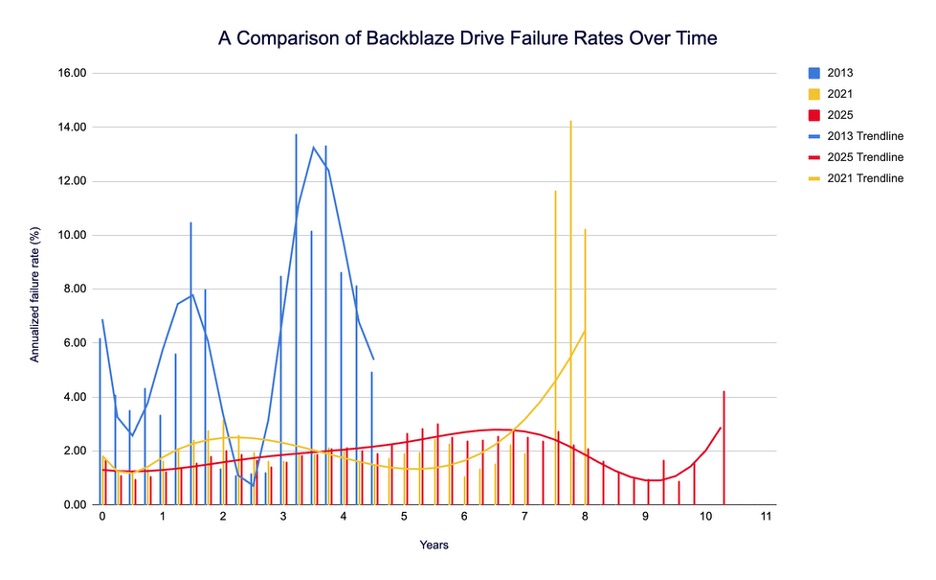
Backblaze is a backup and cloud storage company that has been tracking the annualized failure rates (AFRs) of the hard drives in its datacenter since 2013. As you can imagine, that’s netted the firm a lot of data. And that data has led the company to conclude that HDDs “are lasting longer” and showing fewer errors.
That conclusion came from a blog post this week by Stephanie Doyle, Backblaze’s writer and blog operations specialist, and Pat Patterson, Backblaze’s chief technical evangelist. The authors compared the AFRs for the approximately 317,230 drives in Backblaze’s datacenter to the AFRs the company recorded when examining the 21,195 drives it had in 2013 and 206,928 drives in 2021. Doyle and Patterson said they identified “a pretty solid deviation in both age of drive failure and the high point of AFR from the last two times we’ve run the analyses.”
Setup below in general follows guide lines proposed in https://www.dwarmstrong.org/install-lmde-with-custom-lvm-luks/. However, we intend to remove swap LV and increase sizes of root and home LVs . Then reboot system and activate zram instead of keeping unreasonably large LV swap on /dev/vda .