
Posted to the Linux kernel mailing list one month ago were patches for a multi-kernel architecture design to allow multiple independent kernel instances to co-exist on the same single physical machine. This could let some CPU cores be running real-time “RT” kernels or other non-traditional uses between CPU cores. It wasn’t clear how far the multi-kernel patches would get especially with some initial negative views toward it and Bytedance separately proposing “Parker” for multi-kernel usage just days later. In any event, today a second version of the multi-kernel Linux patches were posted…
Monthly Archives: October 2025
How to Become a Backyard Meteorologist With a Few Simple Tools

You don’t need a college degree or fancy equipment to begin forecasting the weather at home.
New Data Shows Record CO2 Levels in 2024. Are Carbon Sinks Failing?
The Guardian reports that atmospheric carbon dioxide “soared by a record amount in 2024 to hit another high, UN data shows.”
But what’s more troubling is why:
Several factors contributed to the leap in CO2, including another year of unrelenting fossil fuel burning despite a pledge by the world’s countries in 2023 to “transition away” from coal, oil and gas. Another factor was an upsurge in wildfires in conditions made hotter and drier by global heating. Wildfire emissions in the Americas reached historic levels in 2024, which was the hottest year yet recorded. However, scientists are concerned about a third factor: the possibility that the planet’s carbon sinks are beginning to fail. About half of all CO2 emissions every year are taken back out of the atmosphere by being dissolved in the ocean or being sucked up by growing trees and plants. But the oceans are getting hotter and can therefore absorb less CO2 while on land hotter and drier conditions and more wildfires mean less plant growth…
Atmospheric concentrations of methane and nitrous oxide — the second and third most important greenhouse gases related to human activities — also rose to record levels in 2024. About 40% of methane emissions come from natural sources. But scientists are concerned that global heating is leading to more methane production in wetlands, another potential feedback loop.
Thanks to long-time Slashdot reader mspohr for sharing the article.


Read more of this story at Slashdot.
OpenAI Cofounder Builds New Open Source LLM ‘Nanochat’ – and Doesn’t Use Vibe Coding
An anonymous reader shared this report from Gizmodo:
It’s been over a year since OpenAI cofounder Andrej Karpathy exited the company. In the time since he’s been gone, he coined and popularized the term “vibe coding” to describe the practice of farming out coding projects to AI tools. But earlier this week, when he released his own open source model called nanochat, he admitted that he wrote the whole thing by hand, vibes be damned.
Nanochat, according to Karpathy, is a “minimal, from scratch, full-stack training/inference pipeline” that is designed to let anyone build a large language model with a ChatGPT-style chatbot interface in a matter of hours and for as little as $100. Karpathy said the project contains about 8,000 lines of “quite clean code,” which he wrote by hand — not necessarily by choice, but because he found AI tools couldn’t do what he needed.
“It’s basically entirely hand-written (with tab autocomplete),” he wrote. “I tried to use claude/codex agents a few times but they just didn’t work well enough at all and net unhelpful.”


Read more of this story at Slashdot.
Repair Plan Underway to Restore Power at Ukrainian Nuclear Plant
Repair Plan Underway to Restore Power at Ukrainian Nuclear Plant
The Associated Press reports:
Work has begun to repair the damaged power supply to Ukraine’s Zaporizhzhia nuclear power plant, the head of the U.N.’s nuclear watchdog said Saturday. The repairs are hoped to end a precarious four-week outage that saw it dependent on backup generators.
Russian and Ukrainian forces established special ceasefire zones for repairs to be safely carried out, said the head of the International Atomic Energy Agency, Rafael Grossi… “Both sides engaged constructively with the IAEA to enable the complex repair plan to proceed,” Grossi said in a statement…
The Zaporizhzhia plant, Europe’s largest nuclear power station, has been operating on diesel back-up generators since Sept. 23 when its last remaining external power line was severed in attacks that Russia and Ukraine each blamed on the other. The plant is in an area under Russian control since early in Moscow’s full-scale invasion of Ukraine and is not in service, but it needs reliable power to cool its six shutdown reactors and spent fuel, to avoid any catastrophic nuclear incidents.


Read more of this story at Slashdot.
FOSS Force’s Top Five Articles — For the Week Ending October 17
Did you miss this week’s top articles? Here are the five most read article on FOSS Force for the week that just ended.
The post FOSS Force’s Top Five Articles — For the Week Ending October 17 appeared first on FOSS Force.
FreeBSD 15.0 Beta 2 Released With Release Building Improvements, New “Blocklist”
FreeBSD 15.0 Beta 2 is out as the newest weekly test release of FreeBSD working its way toward a stable release in early December…
Shiftall Announces MeganeX Mark II & Index-Like SteamVR Controllers
Shiftall announced and opened preorders for an upgraded MeganeX Mark II, as well as Index-like GripVR controllers.
Shiftall was formerly a subsidiary of Panasonic, an effort to commercialize the ultra-compact VR goggles prototype it first showed almost six years ago. While MeganeX headsets still use Panasonic-designed pancake lenses, last year Panasonic sold Shiftall off to another Japanese company.
MeganeX Mark II
Preorders for the current Shiftall MeganeX headset opened around a year ago, priced at $1900, and despite our concerns, the headset started shipping outside Japan around April.
That makes it the only released tethered PC-only VR headset with 4K micro-OLED displays, delivering a lossless image with ultra high resolution and OLED’s signature near-infinite contrast and deep blacks.
| Shiftall MeganeX Mark II |
Pimax Dream Air |
|
| Pixels Per Eye | 3552×3840 | 3552×3840 |
| Field of View | ~95° (measured) |
110° (claimed) |
| Visor Weight | 179 grams | ~170 grams |
| IPD | Manually Adjustable |
Automatic |
| Diopter Adjustment |
✅ | ❌ |
| Eye Tracking | ❌ | ✅ |
| Strap | Forehead Pad + Soft Strap |
Self-Tightening Soft Strap |
| Speakers | ❌ | ✅ |
| Price | $1900 (Lighthouse) |
$2000 (Lighthouse) $2300 |
According to Shiftall, the Mark II has improved “comfort, stability, and reliability” over the original. Here are the specific changes:
- The cable port has been moved to the front of the headset, from the top, and has been “reinforced for greater durability”. Further the headset’s input voltage has been increased from 5V to 9V, which Shiftall says allows for longer cables, up to 5 meters.
- The angle and position of the SteamVR Tracking photodiodes have been “fine-tuned”, which Shiftall says improves tracking when looking down.
- The onboard chip has been upgraded, and the firmware rewritten, which Shiftall says reduces the headset startup time by more than 5x and improves connection stability with the PC.
- The expansion USB port on the bottom has been upgraded to 5V/2.1A output, which Shiftall says enables connecting multiple peripherals via a USB hub, such as earphones and a facial tracker.
- The diopter setting for each lens includes a zero mark, making it easier to set it to 0 for people with good eyesight.
- The “material and shape” of the face pad around the nose area have been redesigned so that no sharp plastic edges push against the skin of people with high nose bridges.
- The internal heat dissipation structure has been improved, which Shiftall says allows the internal cooling fan to run quieter.
Other than these changes, the MeganeX Mark II is essentially the same as the Mark I. It’s still a $1900 tethered PC VR headset with 3552×3840 micro-OLED panels that requires SteamVR Tracking base stations for positional tracking and doesn’t include eye tracking.


The unique default strap (left) and upcoming Hard Strap accessory (right).
While the headset still comes with its signature unique soft strap with a forehead pad that supports flip-up by default, Shiftall has also made a $99 Hard Strap, that it says should start shipping by the end of this month.
You can preorder MeganeX Mark II in the US, EU, UK, Japan, and South Korea, and Shiftall claims it will ship in late December, at the very end of this year.
GripVR Controllers
Shiftall also opened preorders for GripVR, a pair of SteamVR Tracking controllers with a somewhat similar design to the Valve Index Controllers.
The idea here is that since the Index Controllers are no longer available to buy in many regions (Valve has already ended production) Shiftall wants to ensure that MeganeX buyers new to the SteamVR Tracking ecosystem still have the ability to obtain VR controllers other than just HTC Vive wands.

The Shiftall GripVR controllers feature similar hand straps that allow you to let go of them when not holding a virtual object, but they lack touchpads and the handle has a grip trigger rather than finger sensing. GripVR does have finger sensing on the trigger, AB/XY buttons, joystick, and thumb rest, though.
Essentially, GripVR has the same control elements as Quest Touch controllers – which is what the majority of SteamVR users have, and thus what VR developers tend to design for.
GripVR is available to preorder for $400, and Shiftall claims it will ship in late December, as with the MeganeX Mark II.
Protein Powders and Shakes Contain High Levels of Lead
Long-time Slashdot reader fjo3 shares an announcement from the U.S.-based nonprofit Consumer Reports:
Protein powders still carry troubling levels of toxic heavy metals, according to a new Consumer Reports (CR) investigation. Our latest tests of 23 protein powders and ready-to-drink shakes from popular brands found that heavy metal contamination has become even more common among protein products, raising concerns that the risks are growing right alongside the industry itself. For more than two-thirds of the products we analyzed, a single serving contained more lead than CR’s food safety experts say is safe to consume in a day — some by more than 10 times…
[I]n addition to the average level of lead being higher than what we found 15 years ago, there were also fewer products with undetectable amounts of it. The outliers also packed a heavier punch. Naked Nutrition’s Vegan Mass Gainer powder, the product with the highest lead levels, had nearly twice as much lead per serving as the worst product we analyzed in 2010. Nearly all the plant-based products CR tested had elevated lead levels, but some were particularly concerning. Two had so much lead that CR’s experts caution against using them at all… Dairy-based protein powders and shakes generally had the lowest amounts of lead, but half of the products we tested still had high enough levels of contamination that CR’s experts advise against daily use…
Unlike prescription and over-the-counter drugs, the Food and Drug Administration doesn’t review, approve, or test supplements like protein powders before they are sold. Federal regulations also don’t generally require supplement makers to prove their products are safe, and there are no federal limits for the amount of heavy metals they can contain.
The article acknowledges that “Many of these powders are fine to have occasionally, and even those with the highest lead levels are far below the concentration needed to cause immediate harm. That said, because most people don’t actually need protein supplements — nutrition experts say the average American already gets plenty — it makes sense to ask whether these products are worth the added exposure.”


Read more of this story at Slashdot.
What to read this weekend: Near Flesh and the return of 30 Days of Night
Here are some recently released titles to add to your reading list. This week, we read Near Flesh, a collection of short stories by the late Katherine Dunn, and 30 Days of Night: Falling Sun, the revival of the hit horror series.
This article originally appeared on Engadget at https://www.engadget.com/entertainment/what-to-read-this-weekend-near-flesh-and-the-return-of-30-days-of-night-215141747.html?src=rss
You Only Need $750 to Pilfer Unencrypted Data From Satellites, Researchers Say
“A new study published on Monday found that communications from cellphone carriers, retailers, banks, and even militaries are being broadcast unencrypted through geostationary satellites…” reports Gizmodo. “The team obtained unencrypted internet communications from U.S. military sea vessels and even communications regarding narcotics trafficking from Mexican military and law enforcement.”
Researchers from the University of California, San Diego (UCSD) and the University of Maryland scanned 39 of these satellites from a rooftop in Southern California over three years. They found that roughly half of the signals they analyzed were transmitting unencrypted data, potentially exposing everything from phone calls and military logistics to a retail chain’s inventory. “There is a clear mismatch between how satellite customers expect data to be secured and how it is secured in practice,” the researchers wrote in their paper titled “Don’t Look Up: There Are Sensitive Internal Links in the Clear on GEO Satellites….” “They assumed that no one was ever going to check and scan all these satellites and see what was out there. That was their method of security,” Aaron Schulman, a UCSD professor and co-lead of the study, told Wired….
Even more surprisingly, the researchers didn’t need any fancy spy gear to collect this data. Their setup used only off-the-shelf hardware, including a $185 satellite dish, a $140 roof mount with a $195 motor, and a $230 tuner card. Altogether, the system cost roughly $750 and was installed on a university building in La Jolla, San Diego.
With their simple setup, the researchers were able to collect a wide range of communication data, including phone calls, texts, in-flight Wi-Fi data from airline passengers, and signals from electric utilities. They even obtained U.S. and Mexican military and law enforcement communications, as well as ATM transactions and corporate communications… When it came to telecoms, specifically, the team collected phone numbers, calls, and texts from customers of T-Mobile, AT&T Mexico, and Telmex… It only took the team nine hours to collect the phone numbers of over 2,700 T-Mobile users, along with some of their calls and text messages.
T-Mobile told Gizmodo the lack of encryption was “a vendor’s technical misconfiguration” affecting “a limited number of cell sites” and was “not network-wide… [W]e implemented nationwide Session Initiation Protocol (SIP) encryption for all customers to further protect signaling traffic as it travels between mobile handsets and the network core, including call set up, numbers dialed and text message content. We appreciate our collaboration with the security research community, whose work helps reinforce our ongoing commitment to protecting customer data and enhances security across the industry.”
Indeed, the researchers write that “Each time we discovered sensitive information in our data, we went through considerable effort to determine the responsible party, establish contact, and disclose the vulnerability. In several cases, the responsible party told us that they had deployed a remedy. For the following parties, we re-scanned with their permission and were able to verify a remedy had been deployed: T-Mobile, WalMart, and KPU.”
The researchers acknowledge that exposure “was limited to a relatively small number of cell towers in specific remote areas.”


Read more of this story at Slashdot.
Should Scientists Be Allowed to Edit Genes of Wild Animals? Top Conservation Groups Just Voted Yes
It’s the world’s largest network of environmental groups, according to NBC News, with more than 1,400 members from roughly 160 countries. It meets once every four years.
And in a vote Tuesday, the International Union for Conservation of Nature “approved further exploration of the use of genetic engineering tools to aid in the preservation of animal species and other living organisms.”
Researchers are already pursuing projects that involve changing some species’ DNA. Scientists are genetically modifying mosquitoes to reduce transmission of diseases like malaria, for example, and synthesizing horseshoe crab blood, which is used in drug development. Controversial efforts to “de-extinct” archaic creatures — such as the so-called “dire wolf” that a biosciences company announced it had revived this spring — fall under the umbrella, as well. So do possibilities like modifying organisms to help them adapt to a warming world, which are on the table but further off in development…. The decision is applicable to work on a range of organisms, including animals, plants, yeasts and bacteria….
The notion of introducing genetic engineering into wild ecosystems would have been considered a nonstarter in most conservation circles a decade ago, according to Jessica Owley [a professor and environment law program director at the University of Miami]. But the intensifying effects of climate change and other stressors to biodiversity are bolstering arguments in favor of human intervention that could make endangered species resistant to those threats… The IUCN vote, she added, reflects a feeling of desperation among conservationists and governments, as existing regulations and conservation efforts fall short and species continue to disappear worldwide.
“A separate measure, a proposed moratorium on releasing genetically modified organisms into the environment, failed by a single vote…”


Read more of this story at Slashdot.
New Code Merged For Linux 6.18 To Address Linus Torvalds’ Rust Formatting Critique
Back during the Linux 6.18 merge window Linus Torvalds commented on “mindless and completely crazy Rust format checking” and that the RUst format checking “is all bass-ackwards garbage” with condensing multi-line import statements into single lines. Merged minutes ago to Linux Git ahead of tomorrow’s Linux 6.18-rc2 are fixes to the Rust format checking and updated guidelines to address Torvalds’ criticism…
Windows 10 Refugees Flock To Linux as Zorin OS Claims ‘Biggest Launch Ever’
“Windows 10 is officially dead,” writes Slashdot user darwinmac, “and the vultures are circling. Or maybe they are liberators, depending on your point of view.” Neowin reports:
Of all the projects trying to poach Windows users, Zorin Group might be the most aggressive, launching its biggest OS upgrade, Zorin OS 18, on the very day Windows 10 died.
In a recent post on X, Zorin Group celebrated the launch of version 18, claiming that it hit 100,000 downloads in “a little over 2 days”. The company called it its “biggest launch ever” and claimed that over 72% of those downloads came from Windows…
Zorin OS 18 now includes an updated version of WINE 10 for better support of Windows software. On top of that, there’s also an expanded database that helps when it detects a Windows installer. The system checks the file and suggests the best way to run over 170 popular apps, whether that means installing a native Linux version, using the web-based alternative, or firing it up through WINE.
The article also notes LibreOffice’s creators have been presenting Linux as a secure and cost-effective alternative since June, and “We have also seen initiatives like The “End of 10″ Campaign by KDE, making the case for Linux and providing guides and info on how to switch.”


Read more of this story at Slashdot.
NVIDIA shows off its first Blackwell wafer manufactured in the US
NVIDIA has taken a big step towards strengthening its domestic chip manufacturing, revealing the first Blackwell wafer made in the US. The hardware company assembled the wafer, which is the base material for NVIDIA’s AI chips, in TSMC’s semiconductor manufacturing facility in Phoenix, Arizona.
NVIDIA revealed its Blackwell platform last year, boasting a goal of revolutionizing the AI industry through tech giants like Amazon, Google, OpenAI and others who already committed to adopting the next-gen architecture. NVIDIA said the latest platform was more powerful and translated to 25x less cost and energy consumption compared to its predecessor. Now that Blackwell wafers can be made at the TSMC plant, NVIDIA can better insulate itself from the ever-evolving tariff situation and geopolitical tensions.
“It’s the very first time in recent American history that the single most important chip is being manufactured here in the United States by the most advanced fab, by TSMC, here in the United States,” Jensen Huang, NVIDIA’s founder and CEO, said at the celebration event.
With NVIDIA’s Blackwell architecture ready for the volume production stage, the company is still working on expanding its manufacturing footprint across the US. Earlier this year, NVIDIA said it had plans to funnel half a trillion dollars towards building AI infrastructure in the US through partnerships with TSMC, Foxconn and other companies.
This article originally appeared on Engadget at https://www.engadget.com/big-tech/nvidia-shows-off-its-first-blackwell-wafer-manufactured-in-the-us-192836249.html?src=rss
ASUS ROG Xbox Ally Accessory Deals Up To 39% Off To Deck Out Your Handheld
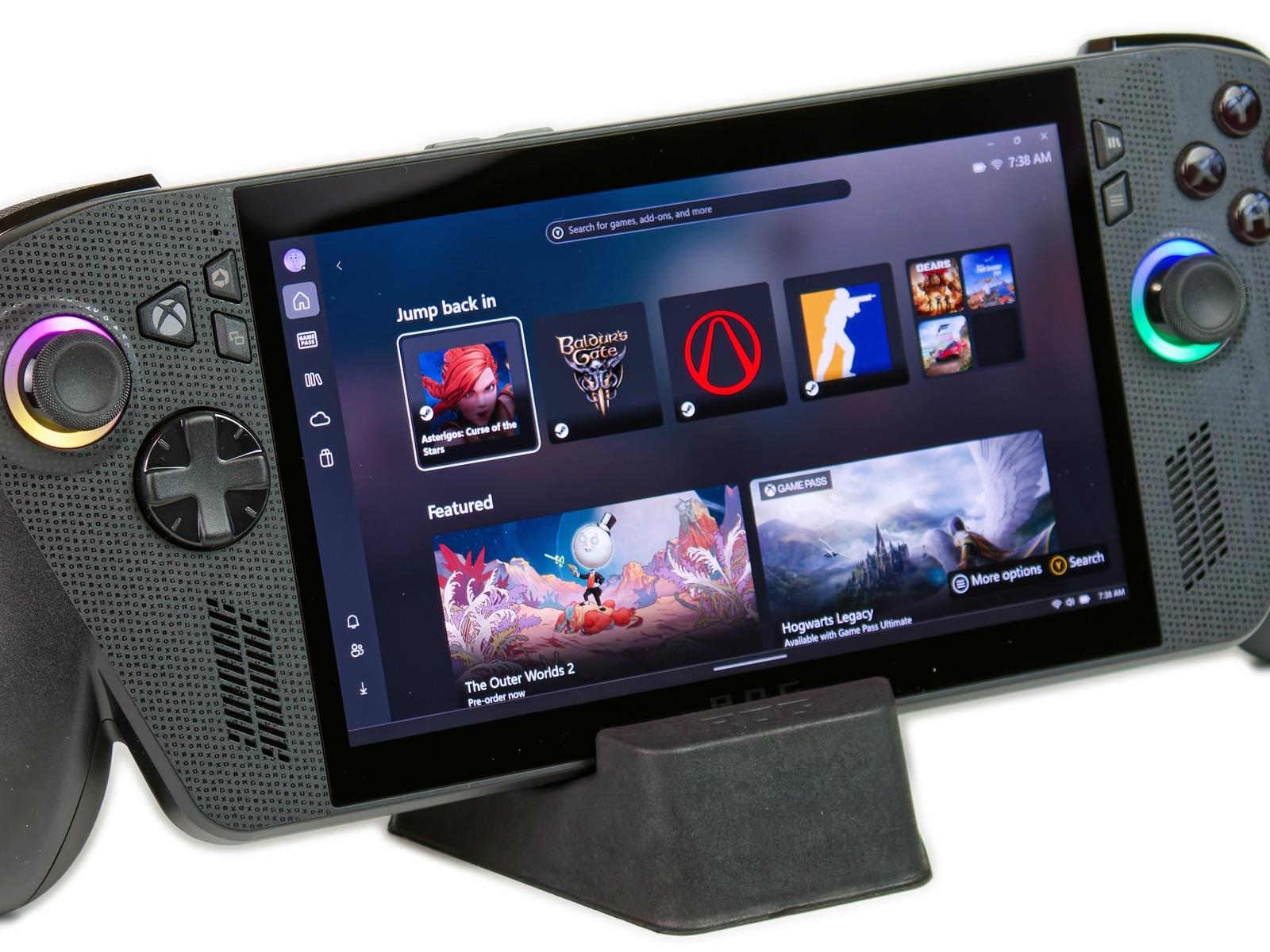
Have you read our review of the ASUS ROG Xbox Ally X? It’s an interesting device, with a powerful AMD SoC that outstrips the one in the original ROG Xbox Ally X, and it also debuts a new “full screen experience” for Windows PC games through the Xbox App—a feature that we’re currently working on additional testing for. If you picked up a ROG
8BitDo drops an NES-inspired collection for the console’s 40th anniversary
It’s been 40 years to the day since the Nintendo Entertainment System made its US debut, and to celebrate, gaming accessory maker 8BitDo has unveiled a line of NES-themed products. The NES40 collection includes a limited edition version of the company’s Ultimate 2 controller that comes with an NES Retro Receiver, so it can be used with the classic console. There’s also the NES-inspired Retro Cube 2 speaker and Retro 68 Keyboard, the latter of which sports a full aluminum alloy build and an eye-watering $500 price tag. All are available for pre-order now.
The Ultimate 2 controller is one of our favorite controllers for Nintendo Switch and Switch 2, and the NES40 version comes with all the same features, including TMR joysticks, Hall Effect triggers with mode switching and lots of customization options. But with this one, you also get the NES Retro Receiver (a transparent black version that’s exclusive to this drop), four custom joystick caps and a robot keychain that pays homage to Nintendo’s R.O.B. toy robot. The controller set costs $80 and will ship November 18. It’s compatible with Switch 1, 2 and Windows, as well as the original NES using the receiver accessory.
The Retro 68 Keyboard is 8BitDo’s first 68-key keyboard, and it’s made entirely of aluminum alloy. That includes the shell, keycaps and buttons, according to the company. It uses Kailh Box Ice Cream Pro Max switches. The keyboard features the NES colorway (like its similar, much less expensive Retro Mechanical Keyboard) and comes with programmable wireless dual Super Buttons. 8BitDo says it gets up to 300 usage hours on a charge thanks to its 6500mAh battery. It’s compatible with Windows and Android, and is expected to ship in January 2026.
The Retro Cube 2 speaker isn’t just a cosmetic update to the original Cube Speaker, but brings some improvements in battery life and functionality too. The dual-speaker system has three connection modes — Bluetooth, 2.4G wireless and wired USB — and comes with a charging dock. It has a 2000mAh battery that gets up to 30 hours of use between charges. Like the earlier version, it has D-pad controls for volume, playback and pairing. The $50 speaker ships on December 12.
This article originally appeared on Engadget at https://www.engadget.com/gaming/nintendo/8bitdo-drops-an-nes-inspired-collection-for-the-consoles-40th-anniversary-183932844.html?src=rss
Perplexity’s AI Browser ‘Comet’ is Now Free, with Big Marketing Deals to Challenge Chrome
“Earlier available only to the paying subscribers, the Comet browser now offers its core features to all users at no cost,” writes the Times of India. “This includes AI-powered search, contextual recommendations, and integrated tools designed to streamline research and content discovery.” They say the move reflects the Chromium-based browser’s goal to “compete with incumbents like Google Chrome and Microsoft Edge” — but also reflects Perplexity’s “broader mission to democratize AI tools.”
More details from The Verge:
The internet is better on Comet,” the company says, promising to remain free forever as it styles the browser as a serious challenger to Google’s Chrome…
It’s supposed to make surfing the web simpler and help you with tasks like shopping, booking trips, and general life admin. To borrow the company’s words again: you “get more done.” The AI-powered browser launched in July, though was only available for users who subscribed to the $200 per month Perplexity Max plan… No subscription at all will be needed to use Comet going forward, the company says.
Perplexity has even struck deals with major sites including the Washington Post, and the Los Angeles Times to offer free access to their sites for one month through the Comet browser. And last week Perplexity also launched an agressive paid referral program, where active Perplexity Pro/Max subscribers get a payout of up to $15 for each friend who downloads and uses Comet through their affiliate link. (The payout size is based on the friend’s country, with $15 being the payout amount for a U.S. user, with $10 payouts for users in 19 other countries include Canada, Australia, the U.K., several EU countries, Japan, and South Korea.
In addition, Srinivas has been sharing positive tweets about Comet. (Like “This is unbelievable. Comet automatically hunts down Sora 2 invite codes across the web and signs you up!”) But Perplexity is making even bigger claims for its browser:
Perplexity AI CEO Aravind Srinivas said that the Comet AI browser can improve productivity so that companies won’t need to hire more people. “Instead of hiring one more person on your team, you could just use Comet to supplement all the work that you’re doing,” Srinivas told CNBC’s “Squawk Box”… The CEO said the artificial intelligence-powered web browser is a “true personal assistant” that allows users to complete more tasks in the same amount of time and said that the productivity gained could be worth $10,000 per year for a single person…
Other tech companies have also been rolling out their own AI browser assistants. In January, OpenAI introduced its web agent, Operator, and Google released Gemini AI to its Chrome browser in September.
Meanwhile, The Verge adds, The Browser Company (makers of the Arc browser) “is going all in on Dia, and Opera just launched its own AI browser, Neon.”
Of course, popularity brings problems, writes the Times of India:
iPhone users are being warned by Perplexity CEO Aravind Srinivas against downloading a fake ‘Comet’ app on the App Store. He clarified that the official iOS version is not yet released and the current listing is unauthorized spam..
And earlier this month the browser security platform described a “CometJacking” attack where malicious prompts could be hidden in URLs (as a parameter). Comet is instructed “to look for data in memory and connected services (e.g., Gmail, Calendar), encode the results (e.g., base64), and POST them to an attacker-controlled endpoint… all while appearing to the user as a harmless ‘ask the assistant’ flow.” (And with some trivial encoding it also seems to evade exfiltration checks.)
The Hacker News reported that Perplexity has classified the findings as “no security impact.”


Read more of this story at Slashdot.
Amazon reveals what one of the US’ first modular nuclear reactors will look like
To meet its massive energy demand for its AI and cloud services, Amazon is investing in nuclear power as a cleaner option. After signing agreements to help build nuclear energy projects last year, the tech giant revealed plans for an upcoming small modular reactor, or SMR, in Richland, Washington. Amazon is working with Energy Northwest, Washington state’s utilities agency, and X-energy, an SMR developer, to build the Cascade Advanced Energy Facility.
The SMR has a smaller footprint than traditional nuclear reactors, but will still offer a modular design that can pump out up to 960 megawatts of power. Amazon is planning to help develop four SMRs in the first phase of the Cascade facility that will provide an initial power capacity of 320 megawatts. After that, the facility has the option to expand to 12 units for the maximum energy output. According to Amazon, construction on the project will start sometime before the end of the decade, while operations are expected to start in the 2030s.
Amazon isn’t the only big tech company to lean into nuclear energy to power its AI operations. In October of last year, Google partnered with a nuclear energy company called Kairos Power to construct seven SMRs across the US. A month later, Meta was also looking to build an AI data center powered by nuclear energy, but reportedly ran into a discovery of a rare bee species that held up plans.
This article originally appeared on Engadget at https://www.engadget.com/big-tech/amazon-reveals-what-one-of-the-us-first-modular-nuclear-reactors-will-look-like-180721637.html?src=rss
Plants Vs. Zombies: Replanted Trailer Arrives To Revive A Fan Favorite For Halloween Season

Multiple game publishers are dipping into their back catalogs to breathe new life into fan favorites. EA is hoping to ride this wave of nostalgia with a modernized version of the tower defense classic Plants vs. Zombies that will be “packed with new secrets to uncover.”
Plants vs. Zombies Replanted will bring several upgrades to freshen