Why Strength Training Doesn’t Count As Zone 2 Exercise

We may earn a commission from links on this page.

When you track a strength training workout on a fitness watch, that watch will happily tell you what heart rate zones you were in during the workout. In fact, they’ll do that for any workout, whether it makes sense or not. So you might be tempted to interpret this data in terms of the benefits of zone 2 training. If my heart rate is in zone 2 when I’m lifting weights, that means I just did an hour of zone 2 training, right? Unfortunately, no.

Heart rate zones only apply to cardio

Zones are meaningless for strength training, but to understand why, we have to go back to the reason zones were invented in the first place: to give athletes an objective rating of how hard their cardio workouts are. In fact, the whole idea of monitoring your heart rate for athletic (rather than medical) purposes originated with a Finnish ski team, and then spread to other athletes.

Your heart rate can tell you how hard you are working, and you can use that information to gauge whether you should go harder or ease up. Or, as Finnish triathlete Pauli Kiuri is quoted saying in this article at Polar, “At some point during your run, you get the feeling that you can’t push any further. But if your rate is still only 160 bpm, you just have to believe that yes, you can!” (Polar was the maker of those early heart rate monitors.)

Heart rate training makes sense for endurance sports, because the harder you work, the faster your heart beats. So you can use that relationship in reverse: the bigger the number on your heart rate monitor, the harder you must be working. Your heart rate is a good gauge of the work you’re doing.

But that relationship with heart rate doesn’t hold for other types of exercise. Your heart rate during a yoga session doesn’t tell you how deep into a stretch you are getting. Your heart rate during a strength training session doesn’t tell you whether you are lifting light or heavy. That’s why your heart rate during a strength training session does not matter. 

Cardio is defined by what your whole body is doing, not just what your heart is doing.

Heart rate, properly used, is what’s called a proxy metric. We don’t track heart rate because heart rate matters; we track heart rate because it tells us about something else that matters—in this case, the intensity of cardio exercise.

For an exercise to be cardio, it needs to be a rhythmic contraction of large muscles for minutes on end. Because our muscles are contracting repeatedly, they require our mitochondria to work harder to power them. Those mitochondria need more fuel, so our cells become more responsive to insulin so they can pull in blood sugar more effectively. To do all of this, we need more nutrients and oxygen to reach our muscle cells, so we grow more capillaries to supply them, and to take away metabolic byproducts. 

The health benefits of cardio relate to those body processes above. The speed of our heartbeat is a side effect. Those whole-body processes are what give us the benefits of zone 2 cardio: low-fatigue calorie burn, increased mitochondrial and capillary density, and improved VO2max, to name just a few. These benefits come from the fact that our entire body is doing exercise. Just increasing our heart rate, without doing all of that other stuff, isn’t going to get all those good zone 2 adaptations. 

That’s why sitting in a stressful meeting at work for 30 minutes is not the same thing as going for a jog. Nor is watching a scary movie the same thing as doing a HIIT workout. And, sorry to sauna enjoyers, but a sauna is not a replacement for exercise. (Sauna sessions do seem to improve the health of your blood vessels somewhat, but they don’t do all the other stuff.) When you think about it, zone 2 cardio has a lot more in common with zone 3 (or even zone 5) cardio than it does with “zone 2” lifting.

What zone should strength training be in? 

Trick question! Zones don’t matter for strength training. The point of strength training is to build strength. To tell whether you’re working hard enough to build strength, here are some common ways to judge your effort: 

  • How the weight on the bar compares to the most you’ve ever lifted: for example, you might do squats at 80% of your max. 

  • How many reps you are doing at a given weight: five reps at 80% is harder than one rep at 80%.

  • How fast you move as you complete the rep: the harder it is, the slower it will move; there are even gadgets to measure this. Sometimes this property is called “bar speed,” as in, how fast the barbell is moving.

  • How many more reps you think you could have done: if you had three reps “in the tank,” that’s an easier set than if the last rep you did was the last rep you could possibly have done.

  • How sore, fatigued, or “pumped” a muscle feels: within some styles of training, this can help you to figure out how much work a muscle group has gotten during the day’s training. 

Some things that do not correlate with how much strength you are building include how out-of-breath you feel after a set of exercises, or how fast your heart beats during or after the exercises.

The truth about heart rate when lifting is that your heart rate may be higher, your breathing harder, and your rest times longer, if your cardio fitness kinda sucks. This is a sign that you may want to improve your fitness by doing actual cardio (zone 2 or otherwise), so that you gain those adaptations and don’t have to sit around as long sucking wind between sets. But your cardio fitness is only playing a supporting role here; it’s not the point of the strength session, and it’s not a useful metric for gauging your effort. 

Or to put it another way: when you do five sets of five squats at 80% of your max, you get the same strength benefit whether you do it with three-minute rests and a smile on your face, or eight-minute rests and a sky-high heart rate.

OK, but what zones are normal for strength training? 

Realistically, you’ll see your heart rate jump up and down throughout your strength training session. During rests, your heart rate may be in zone 1 or 2; during short sets of an exercise, you may see your heart rate spike into zone 3 or higher. 

You’ll likely see a higher heart rate during sets of many reps (sets of 10 reps may result in a higher heart rate than sets of three reps). It doesn’t really matter what heart rate zone you find yourself in. 

The only thing that really matters, if you’re checking your heart rate chart afterward, is that your strength session has big spikes and dips. If it looks relatively even, you’re probably not resting enough. For comparison, here are my charts for a recent jog (at the upper end of zone 2/lower zone 3) and for a strength training workout that included snatches, deadlifts, and squats. Note the longer rests and higher spikes toward the end of the workout, when I squatted heavy for six reps at a time.
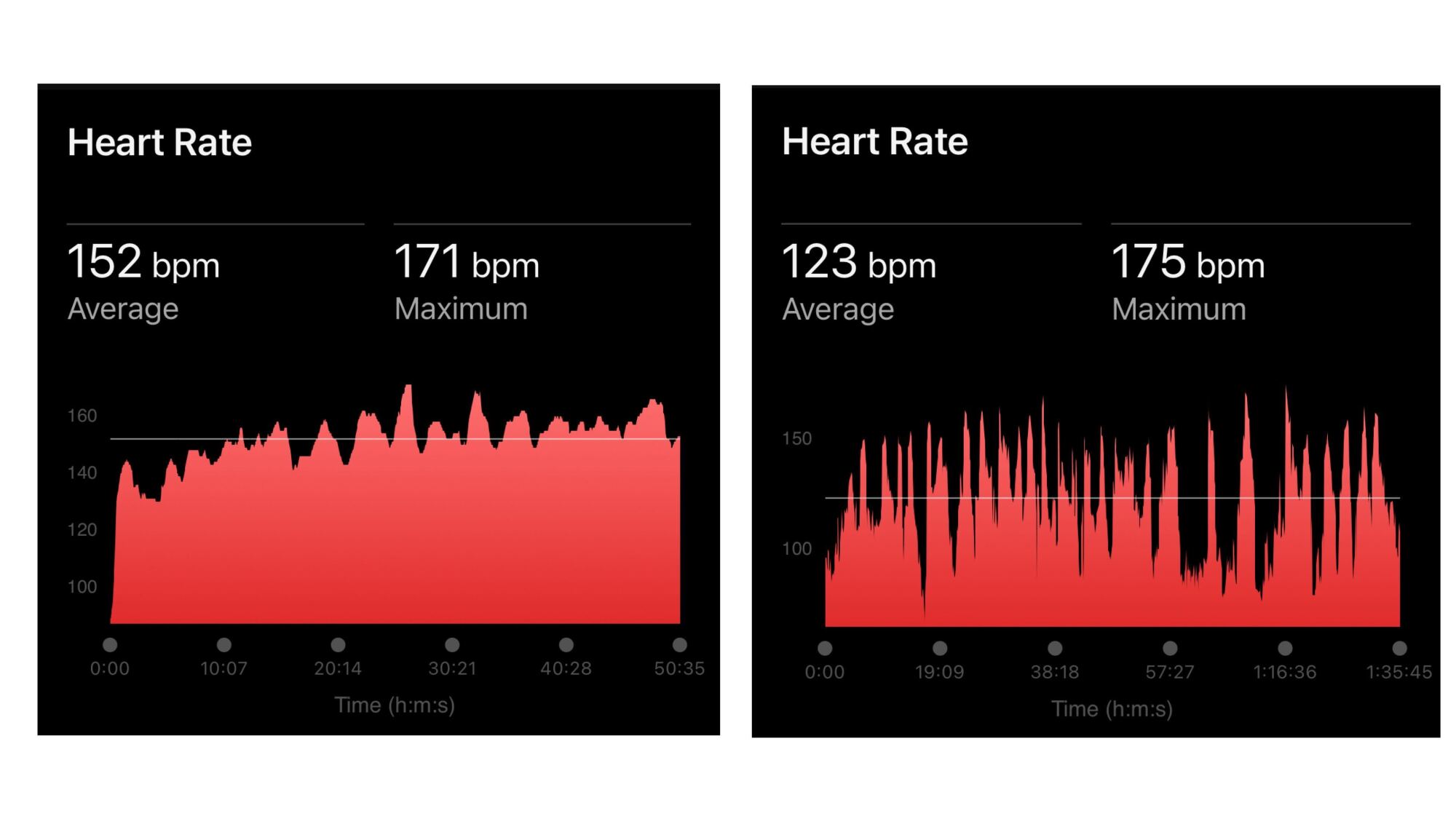
running vs lifting heart rate charts. The running one is more steady; the lifting one spikes up and down.
Left: running. Right: lifting weights.
Credit: Beth Skwarecki/Garmin

If zones don’t matter, why does my app tell me what zone my strength training was in?

The short answer is: because they can, not because they should.

When endurance athletes first adopted heart rate training, it was a replacement for running by timed paces or just by feel. They understood that it was a measure of how hard their whole body was working during a run or a ski session. 

It’s different in the modern era, when every watch measures heart rate. The truth is that heart rate zones are on all your result screens because heart rate is easy for your watch to measure, zones are easy for your app to calculate, and because the company that makes the app and watch wants to please you with a bunch of cool looking charts after every workout. 

Heart rate zone charts make your workout feel more important, and getting to see them is like a little reward sticker to keep you in the habit (and, from the company’s point of view, using its product). Enjoy the charts if you think they’re pretty, but keep your eyes on the metrics that matter—which, for strength workouts, includes pretty much everything except your heart rate.


The first e-bike from Rivian spinoff Also has a virtual drivetrain

Ever since Rivian spun off its “micromobility business” into a standalone startup called Also earlier this year, there’s been much speculation about what kind of vehicles the company is working on. Now, Also is showing off its first products: a lineup of e-bikes and two pedal-assisted electric quads. 

The TM-B e-bike is Also’s attempt at a do-it-all e-bike that can adapt to different use cases whether that’s daily commuting, trail riding or kid and cargo-hauling. It sports a modular frame that can also accommodate a bench seat or rear cargo rack that supports up to 35KG of weight. It only comes in one frame size, but Also says it should be able to adapt to “multiple body sizes.” 

The removable USB-C battery comes in two sizes: standard, which can power up to 60 miles of riding, and large, which maxes out at 100 miles of range. In terms of power, the TM-B’s throttletops out at 20MPH. Also is taking an interesting approach to its drive system, with a setup it’s labeled “DreamRide.” Instead of a mechanical connection between the bike’s rear wheel and the pedals, the TM-B uses “software-defined pedaling,” which will make the riding experience more customizable, according to Also. 

The Also app and Portal display.
Also

Given the bike’s roots at Rivian, it’s not surprising that there are also a bunch of other tech-enabled features, including a 5-inch touchscreen display, called “Portal,” that supports navigation, music playback and calling features via an accompanying app. There’s also a built-in security system that automatically locks the frame and rear wheel when you walk away.

Also is selling the TM-B in three configurations. The first to ship next spring will be the $4,500 TM-B Limited Launch Edition, which has a range up to 100 miles, support for standard and sport ride modes and features transparent purple accents. The $4,500 TM-B Performance has the same features as the limited edition model, but has a slightly different color scheme, and will be available within the “first half” of 2026. Finally, there’s a base-level TM-B model with a range of up to 60 miles that only comes with standard ride modes. Also hasn’t announced an exact price, but says it will cost less than $4,000 when it ships “later in 2026.” Pre-orders for the Launch Edition are open now and the other two bikes are available to reserve with a $50 deposit. The bikes will also be on display in Rivian showrooms later this year,

Also's quad for commercial uses cases (left) and a smaller quad for families (right).
Also’s quad for commercial uses cases (left) and a smaller quad for families (right).
Also

The company also previewed two electric, pedal-assisted quads it’s calling TM-Q. The smaller quad is apparently meant for “families and individuals seeking a safe, compact alternative to cars” that can still haul “significant loads.” The larger TM-Q, on the other hand, is meant for commercial deliveries. Also has partnered with Amazon to develop fleets of such vehicles that can be used by delivery drivers. Both quads are intended to be used in bike lanes, according to Also. 

The company didn’t share details about when these vehicles might be available or how much they’ll cost.

This article originally appeared on Engadget at https://www.engadget.com/transportation/the-first-e-bike-from-rivian-spinoff-also-has-a-virtual-drivetrain-173000250.html?src=rss

Beware Of Cooler Master’s Janky Fix For 12V-2×6 GPU Power Connectors

Beware Of Cooler Master's Janky Fix For 12V-2x6 GPU Power Connectors
Don’t worry, this isn’t yet another tale about melting 12V-2×6 GPU power connectors—although it could have been, if the subject of today’s story had decided to follow the advice of his power supply manufacturer. That manufacturer is Cooler Master, who apparently told a customer, frustrated that he was unable to plug in his new GPU, to dismantle

Meta Allows Deepfake of Irish Presidential Candidate To Spread for 12 Hours Before Removal

Meta removed a deepfake video from Facebook that falsely depicted Catherine Connolly withdrawing from Ireland’s presidential election. The video was posted to an account called RTE News AI and viewed almost 30,000 times over 12 hours before the Irish Independent contacted the platform. The fabricated bulletin featured AI-generated versions of RTE newsreader Sharon Ni Bheolain and political correspondent Paul Cunningham announcing that Connolly had ended her campaign and the election scheduled for Friday would be cancelled.

Connolly responded in a statement that she remained a candidate and called the video a disgraceful attempt to mislead voters. Meta confirmed the account violated its community standards against impersonating people and organizations. Ireland’s media regulator Coimisiun na Mean contacted Meta about the incident and reminded the platform of its obligations under the EU Digital Services Act. An Irish Times poll published last Thursday found Connolly leading the race with 38% support.


Read more of this story at Slashdot.

Nostalgic beat-‘em-up Marvel Cosmic Invasion is out on December 1

It’s shaping up to be a shockingly good year for former arcade-dwelling beat-‘em-up fans. This month saw the arrival of the excellent Absolum, which infuses old-fashioned 2D combat in a cartoony high fantasy setting with roguelike elements to great effect. And now we also have a release date for Marvel Cosmic Invasion.

Out December 1 on practically every platform, Marvel Cosmic Invasion lets you choose a team of two superheroes from a playable roster of 15, and you can switch character mid-fight. The new release date trailer rounds off the roster with the Invincible Iron Man (heard of him?) and Phoenix/Jean Grey (played by Jennifer Hale, who also voiced Jean in X-Men ‘97), who join a list of previously announced characters that includes Spider-Man, Wolverine and Captain America.

With its gorgeous pixel art visuals and obvious ’90s-era Marvel comics inspiration, it’s hard to see Marvel Cosmic Invasion being anything other than a hit, and it’s fair to say that the license is in very good hands. Developer Tribute Games’ last game was the excellent Teenage Mutant Ninja Turtles: Shredder’s Revenge, while publisher Dotemu has already put out the aforementioned Absolum this year, as well as Ninja Gaiden: Ragebound, which also got a big tick from Engadget.

You can play with up to four players, local or online, with crossplay also supported. Marvel Cosmic Invasion will be available for PC, Switch, Switch 2, PS5/PS4 and Xbox on December 1.

This article originally appeared on Engadget at https://www.engadget.com/gaming/nostalgic-beat-em-up-marvel-cosmic-invasion-is-out-on-december-1-172217400.html?src=rss

Astra SL2600 processors from Synaptics combine Arm cores and RISC-V Coral NPU

Synaptics has unveiled the Astra SL2600, a family of multimodal processors designed for edge computing across consumer, enterprise, and industrial IoT applications. The lineup debuts with the SL2610 product line, targeting low-power and high-performance designs used in smart home, automation, robotics, and retail systems. The Astra SL2600 family is built around the new Synaptics Torq […]

Google has a useful quantum algorithm that outperforms a supercomputer

A few years back, Google made waves when it claimed that some of its hardware had achieved quantum supremacy, performing operations that would be effectively impossible to simulate on a classical computer. That claim didn’t hold up especially well, as mathematicians later developed methods to help classical computers catch up, leading the company to repeat the work on an improved processor.

While this back-and-forth was unfolding, the field became less focused on quantum supremacy and more on two additional measures of success. The first is quantum utility, in which a quantum computer performs computations that are useful in some practical way. The second is quantum advantage, in which a quantum system completes calculations in a fraction of the time it would take a typical computer. (IBM and a startup called Pasqual have published a useful discussion about what would be required to verifiably demonstrate a quantum advantage.)

Today, Google and a large collection of academic collaborators are publishing a paper describing a computational approach that demonstrates a quantum advantage compared to current algorithms—and may actually help us achieve something useful.

Read full article

Comments

Pikmin 4 is getting a free update with hard mode, Decor Pikmin and a camera to snap field photos

Nintendo has announced a free update for Pikmin 4 that could remedy one of fans’ biggest complaints about the game. (Yes, free. From Nintendo. We’re shocked too, but we’ll take it.) The update, which arrives in November, adds Fierce mode to make the game more challenging for those who want it. We don’t know exactly what that will look like yet, but a higher difficulty level is a welcome addition to a game that is, for many players including myself, absolutely delightful but much too easy. It may not reach Pikmin 2 heights still, but maybe we’ll see enemies respawn? 

On the opposite end, for players who want to breeze through an even chiller experience than Pikmin 4 already offered, the update also brings Relaxed mode, where enemies won’t bother you unless you attack them first. This mode could go hand in hand with another new feature, the Field Camera, which puts a Pokémon-Snap-style spin on things. With this, you’ll be able to take photos of your Pikmin and squad in the wild, and “set the scene with various angles, hide characters, and decorate your pics with filters, frames and stamps.” It might be nice not to have enemies pestering you while you’re just trying to have a photoshoot. 

The update also brings a Pikmin Bloom staple over to the mainline game: Decor Pikmin. You’ll soon be able to find Pikmin that are decked out in little costumes, and can add these characters to your squad. The announcement hints that snapping a picture of them may be the way to do this. And, Pikmin Bloom players will be able to send these special Decor Pikmin to the app to join their squad over there too. There’s more news for Pikmin Bloom players as well. The mobile game is finally getting Ice Pikmin on November 1. These will sprout from new blue seedlings that will be found, to start, at Restaurant and Roadside locations. 

An Ice Pikmin with a scoop of vanilla ice cream on its head and a pink spoon sticking out sits on a rocky ledge
Nintendo

At the beginning of October, Nintendo got us all worked up about the possibility of new Pikmin content when it dropped an animated short that at first seemed to be Pikmin related, and was later confirmed to be. The company eventually put the hype to rest, explaining that the videos were indeed just the first short films from Nintendo Pictures Co., which will “explore new creative possibilities through video content” — not a promotion for a new game, as fans hoped. But with a new reason to dive back into Pikmin 4 now on the horizon, maybe all the excitement wasn’t for nothing. 

This article originally appeared on Engadget at https://www.engadget.com/pikmin-4-is-getting-a-free-update-with-hard-mode-decor-pikmin-and-a-camera-to-snap-field-photos-165200723.html?src=rss

Uber Will Pay Drivers $4,000 To Switch To EVs

An anonymous reader shares a report: As it rushes to meet its pledge for “100 percent” of trips in electric vehicles by 2030, Uber is offering grants of $4,000 for drivers to swap their gas-guzzlers for zero-tailpipe emission vehicles. The company is also dropping its “Uber Green” branding in favor of the more simple “Uber Electric.”

Uber has said it will be completely carbon neutral in North America and Europe by 2030 and in all global markets by 2040. But when it first announced this pledge in 2020, it said it wouldn’t directly pay drivers to ditch their gas-burning vehicles in favor of EVs. Now, the company is reversing that decision in the hopes that direct payments can help accelerate EV adoption.


Read more of this story at Slashdot.

No Man Sky’s latest update let you explore a space wreck

One of the greatest comeback stories in the history of video games just keeps writing itself new chapters. If you’ve checked in on the wildly ambitious space sim, No Man’s Sky, in the last few years then you’ll know just how much UK-based developer Hello Games has turned things around for a game that was once the subject of a false advertising investigation. And its latest update introduces fully explorable space wrecks.

The follow-up to August’s substantial Voyagers expansion, the new Breach update adds floating wrecks that you’re invited to salvage to your heart’s content. The materials you find can be used to unlock new ship-building parts, and after Voyagers — which finally allowed players to build their own fully crewed spaceships — was such a hit with the No Man’s Sky audience, Hello Games says it has also improved and expanded its workshop feature in the latest update.

Breach also introduces a new expedition, which are No Man’s Sky’s time-limited story-driven events. In this one, players will “traverse a desolate and abandoned universe to discover what happened to a mysterious abandoned wreck.” Those able to successfully voyage to the edge of space and ransack the remains of the ship will be rewarded with rare parts to use on their own creations, including “glowing Atlas-themed wings.” The expedition looks suitably spooky for a Halloween playthrough with your pals.

No Man’s Sky celebrates its 10th anniversary in 2026, and the Breach update seemingly rounds off what Hello Games founder Sean Murray calls a “crazy year” for his team. It seems unlikely that we won’t get more updates in what will be a landmark year for the game when 2026 rolls around, but Murray also appeared to tease the studio’s next project, the open-world survival game Light No Fire, when announcing the arrival of the Voyagers expansion back in August. In a message, he seemed to suggest that the ship construction tech introduced in the expansion will also be utilized in Light No Fire, which is currently without a release date.

This article originally appeared on Engadget at https://www.engadget.com/gaming/no-man-skys-latest-update-let-you-explore-a-space-wreck-164042151.html?src=rss

Trenches VR Doesn’t Do Enough With Its World War 1 Setting

Trenches VR is a terrifying horror game full of jump scares, but its trivial use of the World War I setting ultimately does this experience a disservice.

Early in Peter Jackson’s 2018 World War I documentary, ‘They Shall Not Grow Old,’ veterans recount how they came to be conscripted. “I just thought that I’d like to go and fight for the country. This was the thing, you were proud of your country, and you’d do the best you could for it,” a former soldier explains.

Known then as the Great War, this level of destruction was unprecedented in human history. Trenches VR utilizes this backdrop as you move across these dangerous ditches to get to safety from enemy lines. It’s a horror adventure to the core, though the fact that it doesn’t use this setting more meaningfully is disappointing.

Creepy imagery abounds in Trenches VR.

The best horror experiences are firmly rooted in a primal fear. From protagonist Ethan’s extreme insecurities in Resident Evil 7 to MADiSON VR’s unknowable demonic forces preying on the weak, anything goes when the premise is solid enough to suspend your disbelief. In Trenches, the soldier we play as, James R., fears for his life as he tries to return to his wife and kids. But the characterization ends there, only going as deep as a puddle.

Conceptually, Trenches VR does accomplish what it sets out to do: make you fall out of your chair and take your headset off instantly from its myriad jump scares. But to use the background of such a tragic, well-documented historical event feels like a disservice to the game itself. By not actually justifying it, Trenches falls short with what could have been a more profound exploration of World War 1. And it all boils down to the monsters.

Trenches VR begins in a cabin serving as a hub, where you can test several items that become useful as you venture through these wooden corridors. A pocket knife to cut barbed wire, glass bottles to distract possible stalkers, and a gun that can only slow down assailants but not kill. There is also an alarming letter, typos and all, letting other poor souls know that the unnerving paranormal entities witnessed are not a product of their imagination but real.

A corpse that looks more like a body bag is lying next to an electrical handle.

Once ready, you can select a new game with the prologue or a different path to skip that entirely. You’re back to the beginning if you die, while jump scares and clues are randomized each time. Nothing seems unusually wrong when walking through the passages of these war-torn fields. Sounds of explosions, air raid sirens, and heavy rain create an effectively tense atmosphere. Booming lightning strikes brighten your surroundings briefly, but this is represented by a sudden change in the color of the wooden boards from brown to light blue. I assumed this was a visual bug until I later realized it’s intentional. Making progress involves a shut gate in a room with corpses that must be powered from a nearby generator. The frights start creeping in soon after.

This is where the game’s approach falters. While it eases you in with a couple of well-intentioned old black and white images of family to remind you of what you are fighting for, the danger is inexplicably otherworldly. Making your way to the electrical handle, a mangled body that decidedly does not look human is just lying there, alluding to what horrors await later on. Eerie dolls of babies straight up appear in your path with no reasonable explanation. Delirium can take many forms, yet this feels more like a checklist of horror clichés simply designed to scare you as you progress further.

Akin to Slender: The Arrival’s task of finding eight pages hidden in the woods, rolling credits requires collecting nine fetus dolls scattered in the labyrinthine trenches. Carefully listening for crying baby sounds, the goal is to not die at the hands, or mouth, of the humanoid with a gaping maw while collecting these cursed items. These cries become louder by blowing your whistle, at the cost of revealing your position to this monster.

Using the Quest’s microphone so enemies can hear you is an intriguing idea when losing your nerve, even if the sound picked up is not too sensitive. A small icon in your left hand reminds you if you’re making any noise. Once an inevitable chase sequence starts, the only real solution to escape certain death is to fit into the narrow spaces in between the trenches. Considering the game’s one-hour length if you successfully obtain every fetus, going back to square one if caught is fair.

Subtlety is not one of Trenches VR’s strengths.

Your sanity slowly declines as you linger in this timber maze, increasing the frequency of jump scares. However, there seems to be no rhyme or reason to any of the horrors appearing on-screen. Collecting the dolls could symbolize a traumatic memory that the main character suffered as a child, although there is no indication of it. A black-haired woman reminiscent of Blair Witch standing on a corner ready to assault you is a half-baked trope. The main monster chasing you, who seems to be an embodiment of the soldier’s trauma, looks like a generic body horror design instead of taking cues from mutilated bodies, a product of the real horrors of war.

Comfort

Expected accessibility features are given in Trenches VR. A tunneling vignette is here, as are snap or smooth turning camera options. Removing the player’s arms is also an available option. You can adjust your height, though the menu recommends playing while standing up if possible.

A solemn period in human history, using World War 1 as a historical backdrop means coming to grips with the reality of its long-term consequences. While the heavy-hitting ending tries to come to terms with an uneven portrayal of mental illness, it’s ultimately undone by favoring deafening jump scares. The litany of horror tropes confirms that Trenches VR only has one goal in mind: to terrify you. Don’t expect anything deeper than that.

Trenches VR is out now on Quest and Steam, while the PS VR2 version is coming soon.

Steam’s Calendar View Is a Convenient and Personalized Way to Track New Games

One of my favorite tabs to check when I’m looking at new PC Games on the Steam Store is “Popular Upcoming,” but over the years, it’s gotten far less useful. While it’s supposed to show me what the next big game is ahead of time, the truth is, there are just too many games and too many types of players out there for it to keep up anymore. My tastes probably aren’t the same as yours, and limiting the highlights to a small selection of popular picks could bury smaller titles some players might be more interested in. That’s why I’m so excited about Steam’s new Personal Calendar page.

Released last night, it’s technically an experiment, but it’s already looking great. Essentially, rather than showing you a generic list of ten games like the Popular Upcoming tab (I have no idea how Valve picks those games, by the way), this instead shows you a personally curated selection of recently released and upcoming games, organized on a daily calendar, and up through the next eight weeks. The specifics depend on how you customize it, but already, it’s far more useful for me than the Popular Upcoming tab.

To check it out, either click here for the web version or open your Steam desktop client, and next to the search bar, navigate to Special Sections > Steam Labs > 016 Personal Calendar.

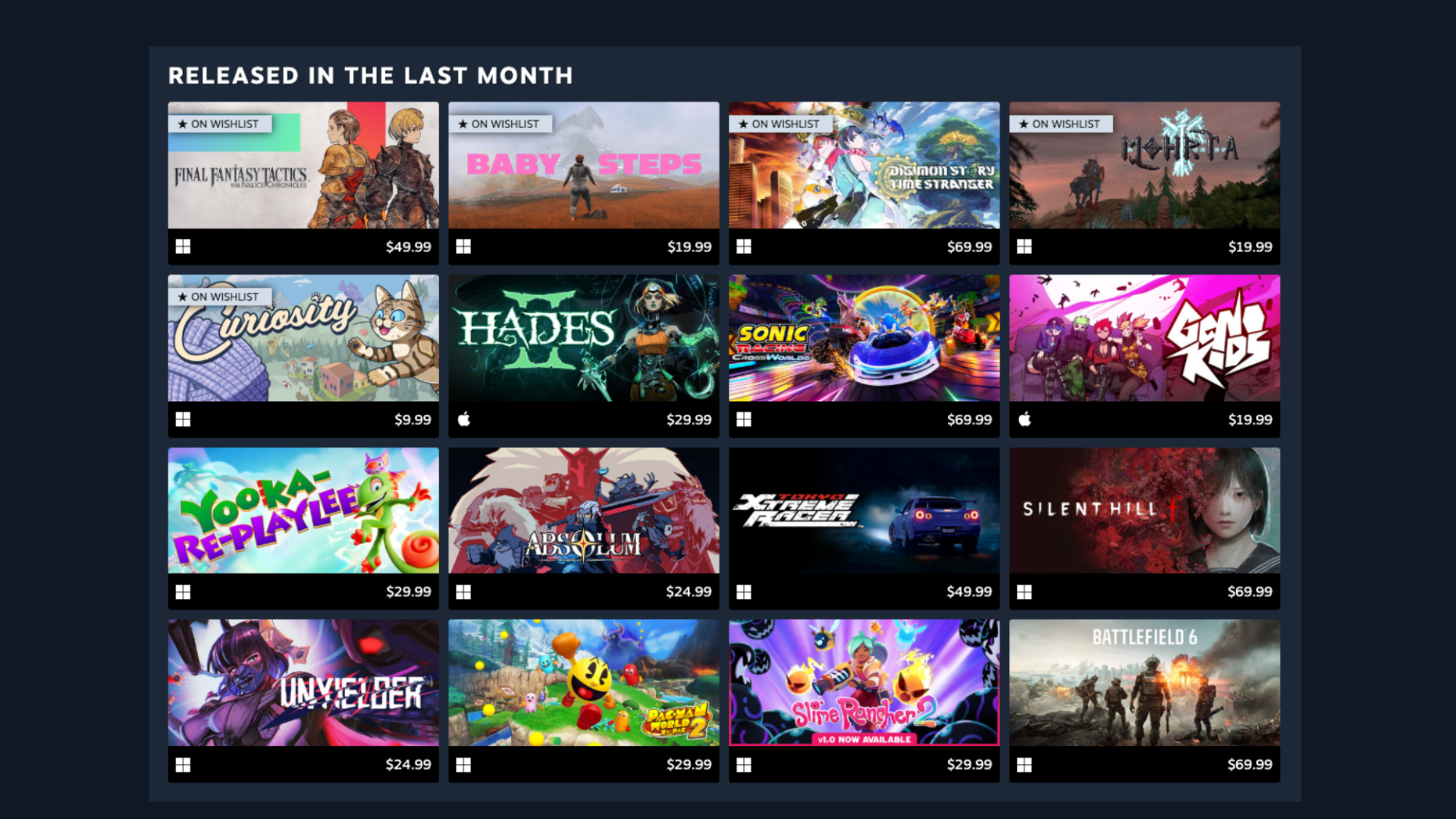
When you first open the calendar, you’ll see 100 games, split across titles released last month, titles released in the last seven days, and titles that aren’t out yet. At time of writing, I currently see suggested games through Dec. 12, which gives me a pretty good window of what to look forward to. If you’re eagle-eyed, you might notice that the Personal Calendar excludes weekends, which Valve says is because most games don’t release on weekends. If a game Valve wants to suggest does release on a weekend, it’ll instead show up on the following Monday.

Steam Personal Calendar

Credit: Michelle Ehrhardt

As for the curation, I’m satisfied. Unlike the Popular Upcoming tab, the Personal Calendar uses a combination of your wishlist and your playtime in certain games to decide what to show you, making for a list that’s catered to your tastes. Lately, I’ve been playing a lot of platformers and RPGs, and low and behold, my Personal Calendar opened right up to suggestions like Final Fantasy Tactics: The Ivalice Chronicles and Dragon Quest I & II HD-2D Remake. These are bigger titles, but there are smaller choices I might have otherwise overlooked peppered in, and it already seems like a great way to make sure I don’t miss out on a game I’d like. I even appreciate the heads-up about recently released games, which are easy to think about once and then forget.

The one criticism I have is that the default of 100 games looks a little overstuffed to me. Luckily, you can slim down your suggestions to anywhere from ten to fifty games (at the top of the page, under Game Count), which also has the benefit of narrowing down the algorithm to only show you what it thinks you’d enjoy most. Or, if you want to see as many options as possible, you can also have the calendar display 250 or 500 games. There are also controls to only show games with specific tags, and also to exclude games you’ve wishlisted or already own.

Essentially, the Personal Calendar feels like a personalized and easy-to-check version of those “Biggest Game Releases of the Month” videos, except you don’t need to constantly rewind or pull up the video again whenever you’re looking for what to play next. Valve says your Calendar’s algorithm gets re-trained daily, though, so don’t expect to always see the same games on it every time you check it. If you see a game you’re interested in but aren’t ready to pull the trigger on yet, wishlisting it is still your best bet.

Spotify is freezing and crashing on some Android devices

The Spotify app has been freezing and crashing on some Android devices, according to multiple users and a report by 9to5Google. This is happening only when a phone or tablet is connected to Wi-Fi, so keep on listening to Spotify while out and about.

Users first took note of the problem around two weeks ago, taking to Spotify forums to address their concerns. Many folks say that the app becomes essentially unusable on Wi-Fi due to the constant crashes and freezing.

@Spotify please fix you app!! Crashes every 30 sec!!!

— StrictlySportS (@Strictly3Sports) October 17, 2025

The company has acknowledged the issue and says its engineers are working on a fix. However, we don’t have a timetable for a patch or anything like that. For the time being, some Android users will just have to avoid using the Spotify app while on Wi-Fi.

To that end, error reports have mostly come in from people on Samsung Galaxy and Google Pixel phones. The problem doesn’t appear to be universal, which has led some to speculate that may be related to Chromecast-ready devices. This would explain why the issue only persists on Wi-Fi, but we’ll have to wait to hear from Spotify for a cause.

This article originally appeared on Engadget at https://www.engadget.com/apps/spotify-is-freezing-and-crashing-on-some-android-devices-163020556.html?src=rss