AMD Inks Huge Instinct AI Chip Deal With OpenAI And A 10% Stake In The Company

AMD Inks Huge Instinct AI Chip Deal With OpenAI And A 10% Stake In The Company
AMD and OpenAI have come to terms on a multi-year agreement that will see OpenAI buy several generations of Instinct GPUs, as well as invest in a 10% stake in the Santa Clara chip designer. The bombshell announcement comes on the heels of Intel and NVIDIA teaming up in a partnership of their own that is worth several billions of dollars and

You Can Get Both Windows 11 Pro and Microsoft Office Pro for Just $45 Right Now

We may earn a commission from links on this page. Deal pricing and availability subject to change after time of publication.

This StackSocial bundle pairs Microsoft Office Professional 2021 with Windows 11 Pro on sale for just $44.97 right now (down from nearly $419). It’s the kind of deal that makes sense if you’re setting up a new PC or finally updating an old one. The Office license is for life—no subscription, no annual fees, and it covers all the essentials, including Word, Excel, PowerPoint, Outlook, OneNote, Publisher, Access, and the free version of Teams. Everything installs locally on one Windows PC, so there’s no hopping between browser tabs or worrying about renewing in 12 months.

The Windows 11 Pro license, also included, is the full upgrade. It features advanced tools such as BitLocker encryption, Hyper-V virtualization, and Windows Sandbox, making it ideal for professionals handling professional-level tasks or sensitive data. If you’re switching from Windows 10 Home, you’ll notice productivity bumps too: snap layouts, tabbed File Explorer, and Copilot baked into the OS. That last one is Microsoft’s AI helper that lives on your taskbar. You can press the Windows key + C to launch it and ask it to summarize web pages, open apps, or adjust settings—all with plain English.

Note that you’ll need at least 4GB of RAM and 64GB of storage to run it, as well as TPM 2.0 and UEFI support; therefore, older PCs may be incompatible. You can only use Office on one PC, and the license is tied to that device, not your Microsoft account, so it doesn’t travel with you if you upgrade to a new computer later. The Windows 11 Pro key gives you a bit more flexibility (it can be activated on up to two devices). And while it’s not compatible with virtual machines or Parallels, the deal still offers solid value for most everyday or professional users looking to avoid recurring costs. Just be sure to activate it within 30 days of purchase.

OpenAI, Jony Ive struggle with technical details on secretive new AI gadget

OpenAI and star designer Jony Ive are grappling with a series of technical issues with their secretive new artificial intelligence device, as they push to launch a blockbuster tech product next year.

The San Francisco-based startup run by Sam Altman acquired the former Apple design chief’s company io for $6.5 billion in May, but the pair have shared few details on the projects they are building.

Their aim is to create a palm-sized device without a screen that can take audio and visual cues from the physical environment and respond to users’ requests.

Read full article

Comments

Logitech’s brand new MX Master 4 is already 25 percent off

Logitech released its newest mouse less than a week ago but you can already grab it for a discounted price. Right now, the Logitech MX Master 4 is available at Best Buy for $90, down from $120. The 25 percent markdown is the first deal we’ve seen on the device. 

The MX Master 4 comes three years after its predecessor (and our pick for best wireless mouse of 2025), the MX Master 3S. We tested the latest iteration for a few weeks and it still has all the comfort of the 3S, despite being slightly heftier. Plus, it has a lightly textured plastic on top, rather than the rubber on the 3S. 

The main difference between the two is the MX Master 4’s haptic feedback. It’s built into the thumb rest panel and you can change the intensity or turn it off through Logitech’s Options+ software. You’ll feel it at times such as when pairing the mouse, the battery is low or you’ve perfectly lined up a graphic in Photoshop. However, on that note, right now haptics only work with apps like Photoshop, Lightroom and Zoom, with Adobe Premiere Pro coming soon. 

If you plan to use Photoshop, Lightroom and the like, then buying the mouse from Best Buy is a good choice. The store is exclusively offering customers two complimentary months of an Adobe Creative Cloud subscription when you buy the MX Master 4.

Follow @EngadgetDeals on X for the latest tech deals and buying advice.

This article originally appeared on Engadget at https://www.engadget.com/deals/logitechs-brand-new-mx-master-4-is-already-25-percent-off-130030050.html?src=rss

The Out-of-Touch Adults’ Guide to Kid Culture: What Is a ‘Venus Tummy’?

Did you know you can customize Google to filter out garbage? Take these steps for better search results, including adding my work at Lifehacker as a preferred source.


How do you do, fellow adult? This week’s edition of the Out of Touch Adult’s Guide to Kid Culture features a new body slang term, a TikTok prank where AI puts a hobo into your living room, the possible beginning of the AI wars, and a viral video featuring students running a Nazi out of class. There’s a lot to eat, so tuck your napkin in your shirt and chow down.

What is a Venus tummy?

A “Venus tummy” is a slang term for a woman’s belly that is a little fat, but not too fat—a little pouch that can be shown off in tight clothing. Like so:


This Tweet is currently unavailable. It might be loading or has been removed.

The name comes from ancient Greece, where Venus was depicted as, uh, fleshy, as you can see from these three statues of “crouching Venus:”

three crouching Venuses

Credit: Wikipedia

While women having bellies is not new, the term “Venus tummy” (and the acknowledgment that many people find that feature very attractive) is. I guess older slang terms like zaftig, thicc, stacked, and “built like a brick shithouse” are not specific enough, and specificity is important in objectification. If the internet has to objectify women (and it sure seems like it does) at least Venus tummy is based in history and is more positive and healthy than sexualizing being extremely skinny. So yeah, it’s a little creepy, but “a little creepy” is the best we can hope for these days.

AI homeless man prank

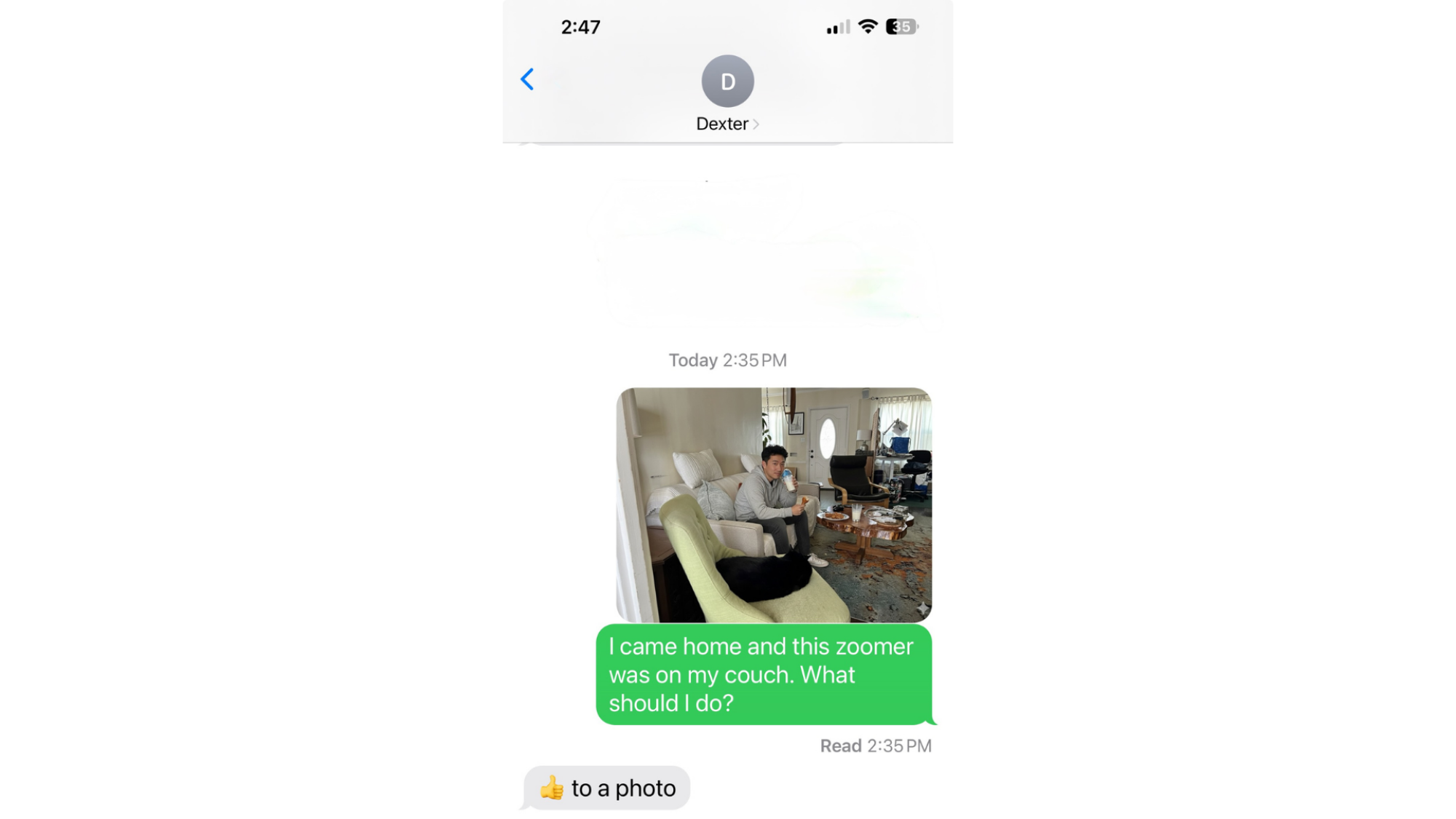
If your child sends you a picture of a homeless person sitting on your couch and asks, “what should I do?” don’t panic. It’s (probably) a prank. The new video trend online is freaking out your parents and other loved ones with an AI-generated image of an unhoused person, then posting a video about it to TikTok, like this:

and this:

You might think you’re going to be clever and pull a switcheroo on your child, but I warn you, this will not work. They will immediately clock the image as fake, post a sarcastic emoji, and leave you on read, as you can see:

Text prank

Credit: Stephen Johnson

Two stories of backlash against AI

AI is great for generating pictures of people in unfortunate situations on your couch, but the way it’s taking over everything worthwhile about humanity is less great. Thankfully, there’s evidence that AI destruction of humanity will at least meet token resistance, and that the backlash against artificial intelligence is growing.

NYC doesn’t want an AI “Friend”

Back in 2024, the world first learned of the “Friend” pendant, a little AI device you wear around your neck thats only purpose is to provide a simulation of human interaction. Now that they’re actually available to purchase, the company behind them has launched an advertising campaign; it’s going extremely poorly.

In New York City, subway and street posters for the Friend device are being defaced mercilessly and creatively, like so, with people scrawling messages like “AI will promote suicide when prompted. It is not your friend” on them. I’m not exactly pro vandalism, but in this case, I make an exception.

Tilly Norwood, the first “AI actress”

A few days ago, Variety posted a story about Tilly Norwood, an “AI actress” whose creator, comedian and producer Eline Van der Velden, lied that he had “attracted the attention of multiple talent agents” for Norwood. A creation of “AI talent studio” Xicoia, Norwood’s first video role is below:

Apparently, the above video is considered “funny” in the UK. Anyway, soon after Norwood was announced as existing, real talent agencies responded with “the fuck out of here with this dumb shit.” as did SAG, the actors union, and everyone else worthwhile.

But with her name in public, troubling news of Norwood’s past became public, as you can see in this X post:


This Tweet is currently unavailable. It might be loading or has been removed.

Leaving the actress to seek “alternative” employment in entertainment.

In unrelated news, if you want to know who the first real AI superstar will be, it’s Johnny Extreme! Created in three and 30 seconds by Stephen Johnson Studios, Extreme has attracted the attention of multiple talent agents for his bad-boy image and his ceaseless rule-breaking. He’s an accident looking for a place to happen. Here’s his audition video, suckers:

(If you want to hire Johnny Extreme, please send me money.)

What does “my steak is too juicy” mean?

The phrases “my steak is too juicy” and “my lobster is too buttery” are online slang used to suggest someone is complaining about something they should be grateful for. To see it in context and bring things full circle to Venus tummy, click here.

Viral video of the week: How to treat Nazis

This week’s viral video comes from the University of Washington, where an attention-seeking Nazi type disrupted a lecture in a Psychology class by grabbing the mic, throwing up the Elon Musk hand sign, screaming slurs and obscenities, and calling the sexuality class “degenerate nonsense.”

The students respond by booing him and chasing him out of the class, with their badass professor leading, chased him down. But they don’t give him the beating he’s trying to provoke. Instead, they hold him down and wait for the authorities to come and take him away. (Although the agitator does get a satisfying face full of pepper spray for his trouble.)


This Tweet is currently unavailable. It might be loading or has been removed.

Here’s the point of view of the perpetrator, who was dumb enough to post his complete humiliation.


This Tweet is currently unavailable. It might be loading or has been removed.

It’s easy to look at the loud weirdos and think they represent a lot of people, but as this video shows, in real life, that’s not the case.

Rabbit plots its redemption arc

The story of the Rabbit R1 is a cautionary tale. The AI gadget stole CES 2024, thanks in large part to its cutesy design and Rabbit’s promise that it could do nearly everything a smartphone could without being a distraction. At least that was the pitch. 

When it finally arrived a few months later, with buggy software and a laundry list of features that simply didn’t work, the backlash was swift. Engadget’s Devindra Hardawar called the R1 “a $199 AI toy that fails at almost everything.” In a video with nearly 9 million views, YouTuber Marques Brownlee said the R1 was barely reviewable. That same backlash extended to Humane, Rabbit’s one-time rival, which this past February effectively went out of business after selling its intellectual property to HP for $116 million and discontinuing support for the much-maligned AI Pin. 

Nearly two years later, Rabbit is still here, having recently released its most significant software update yet with RabbitOS 2. “We want to take this opportunity to ask people for a second chance,” Jesse Lyu, the CEO of Rabbit.

Having used the R1 in its original state, RabbitOS 2 is a significant improvement. At launch, the touchscreen didn’t work like it does on a smartphone. This made doing something simple like accessing the settings menu an absolute chore.        

With OS 2, Rabbit has redesigned the device’s interface around colorful cards, making it much easier to see what it can actually do. The display now finally functions like a regular touchscreen, allowing you to navigate the interface with taps and swipes, instead of a complicated series of presses involving the side button. Other quality of life tweaks also make the device feel more useful. For example, the R1 can now transcribe voice memos without an internet connection. 

Then there’s the update’s marquee feature: Creations. 

Creations are an evolution of Teach mode, a tool Rabbit introduced toward the end of last year. They allow you to vibe code your own apps to use with the R1. The process of making Creations feels a lot less clunky than it did with Teach mode. To start, you describe the app you want R1 to create, then your device will ask a series of clarifying questions to get a better idea of what you want. 

Intern, the AI agent that handles coding the apps, has a comprehensive knowledge of R1’s hardware, so there’s no need to get bogged down in technical details. With Lyu’s help, I made a tuning app for my guitar. The entire process took about five minutes, and the result, I’ll admit, felt novel in a way I hadn’t experienced in a while. The tuner not only worked, but I was able to tell the coding agent exactly how I wanted it to look and function, with the AI offering helpful suggestions to guide the process. 

Did I want the app to use a needle interface? Yes, I said. What color should the interface be? The R1’s signature orange, I told it. Granted, there are countless tuning apps out there, but it felt cool that I had some hand in deciding how this one should look and work. I also appreciate some of the Creations others have made. There’s one that offers an interactive map of Hollow Knight: Silksong‘s Pharloom that has been my companion through the latter parts of the game. 

As far as Lyu is concerned, Creations are the killer feature the R1 has been missing since launch, offering something no smartphone on the market can quite yet match. He’s particularly excited about the system Rabbit has devised for distributing them. There’s no traditional app store like you might find on an Android or iOS device; instead, users can share their apps through Rabbithole (Rabbit’s online R1 hub) or using a QR code. 

Still, Lyu admits there are things Rabbit needs to figure out before it can convince people to throw out their phones. “The biggest barrier [to R1 adoption] is no one wants to carry around two devices. We know that, and there are a lot of things on the phone, whether you’re using an iPhone or Android, that users don’t trust an AI to handle,” he said. Here, Lyu is primarily thinking of banking apps. Banking regulation being what it is, there’s probably no future where you’ll be able to vibe code an app to access your Chase account, but Lyu is hopeful consumer demand will eventually lead to financial institutions embracing Rabbit and the R1. 

Either way, he’s adamant that Creations are the way forward for the company. “This is still the right thing for us to do,” he tells me. “If you look at how you built your tuner app versus how somebody would build and sell their tuner app on the App Store, that’s a completely different generational experience. You did zero coding. You just talk to your R1 and distribute.”  

I wonder if that’s enough. The ability to create your own apps will be compelling to some people, but I imagine most just want software that works without the hassle of making it themselves. Besides, there’s more to software development than just putting an app out into the world. Arguably the more difficult (and important) part of the job is maintaining an app, ensuring it works for you and other people. AI systems are getting better at coding every day, but they still make mistakes, and having some coding knowledge makes it a lot easier to fix those errors. 

Some smartphone experiences will also be harder to replicate than others. One Creation allows you to stream music to the R1 from YouTube Music, but the software is so basic compared to the official app on Android and iOS. Rabbit has shared documentation on GitHub to help program Creations that can access other third-party services, but I wonder how quickly people will lose interest in vibe coding all but the most basic apps.  

And for all its faults, the app store model offers a way for developers to earn a living off their work. People can upload their Creations to Rabbit’s website, but the only party making money on the concept is Rabbit — at the moment there’s no infrastructure in place to charge money for Creations, assuming anyone would want to. Creations also consume Intern tasks, and those aren’t exactly cheap. You can buy three for $30 or pay $70 per month for a monthly allowance of 30. 

Of course, the question most people have is the same one that has dogged Rabbit and the R1 from the start: “Why can’t this just be an app?” Lyu contends Creations are one part of the answer. 

“I don’t think we’re going to see an iPhone-like moment this year or next year. Starting in 2027, that’s when the generational shift will happen. In that sense, we’re not in a rush to do something major.” When I asked why 2027, Rabbit declined to share more, but something Lyu said about the prospect of competing against OpenAI gave me a hint of the company’s plans. 

If you need a refresher, OpenAI announced in May it was buying former Apple design chief Jony Ive’s hardware startup for $6.5 billion, with the ambition of releasing its own AI device. “From what I know about Jony and OpenAI, I don’t think they’re going to be interested in a second gadget like R1,” Lyu said (he knows Sam Altman personally, having gone through Y-Combination when Altman was president of the startup accelerator from 2014 to 2019). “I think they’re going to focus on a phone-like factor. That’s a much bigger audience. But by 2027, everyone is going to be making phones.” 

When I later asked if a phone was in Rabbit’s future, a company spokesperson declined to elaborate on Lyu’s comments. “We’ve been working on many different prototypes and form factors, but don’t have any specific details to share.” For now, the company appears to be squarely focused on improving its software. “The focus this year is on rebirth,” Lyu told me. “And to keep pioneering things no else is doing in the industry.” 

The challenge for Rabbit will not only be staying ahead of OpenAI, but all the existing phone manufacturers adding AI features to their devices. Just earlier this week, Nothing, a smaller player in the space, announced Essential Apps, a tool people can use to vibe code apps for the company’s phones. If Nothing is successful, how long will it be before Samsung and Google do the same?

This article originally appeared on Engadget at https://www.engadget.com/rabbit-plots-its-redemption-arc-120000271.html?src=rss


What If Vibe Coding Creates More Programming Jobs?

Vibe coding tools “are transforming the job experience for many tech workers,” writes the Los Angeles Times. But Gartner analyst Philip Walsh said the research firm’s position is that AI won’t replace software engineers and will actually create a need for more.

“There’s so much software that isn’t created today because we can’t prioritize it,” Walsh said. “So it’s going to drive demand for more software creation, and that’s going to drive demand for highly skilled software engineers who can do it…” The idea that non-technical people in an organization can “vibe-code” business-ready software is a misunderstanding [Walsh said]… “That’s simply not happening. The quality is not there. The robustness is not there. The scalability and security of the code is not there,” Walsh said. “These tools reward highly skilled technical professionals who already know what ‘good’ looks like.”
“Economists, however, are also beginning to worry that AI is taking jobs that would otherwise have gone to young or entry-level workers,” the article points out. “In a report last month, researchers at Stanford University found “substantial declines in employment for early-career workers” — ages 22-25 — in fields most exposed to AI. Stanford researchers also found that AI tools by 2024 were able to solve nearly 72% of coding problems, up from just over 4% a year earlier.”

And yet Cat Wu, project manager of Anthropic’s Claude Code, doesn’t even use the term vibe coding. “We definitely want to make it very clear that the responsibility, at the end of the day, is in the hands of the engineers.”
Wu said she’s told her younger sister, who’s still in college, that software engineering is still a great career and worth studying. “When I talk with her about this, I tell her AI will make you a lot faster, but it’s still really important to understand the building blocks because the AI doesn’t always make the right decisions,” Wu said. “A lot of times the human intuition is really important.”


Read more of this story at Slashdot.