
See zwiftinsider.com/tiny for current Tiny Race details.
Monthly Archives: October 2025
Valve’s Next VR Headset Reportedly Enters Mass Production, Targeting 500K Units This Year


Valve’s next VR headset may be just around the corner, as supply chain leaks suggest the device has now entered mass production.
The News
The ‘XR Research Institute’, a Chinese research group responsible for previous leaks surrounding Ray-Ban Meta, claims that Valve is now ramping production of its next VR headset.
As first reported by UploadVR, the group claims Valve is aiming for a production volume of 400,000 – 600,000 units this year.
Chinese language WeChat user ‘BlackHairSheriff008’ says in a now-deleted WeChat post that the device is targeting launching in Q4 2025 to capitalize on the Holiday shopping season.

From BlackHairSheriff’s article, it’s not clear precisely what sort of VR headset Valve is supposedly manufacturing right now, at least according to the XR Research Institute leak. The poster suggests Valve may name the device “Index 2”.
What’s more, the now-deleted article stated that Valve was manufacturing the device in Shandong, China, however the post was taken down following the revelation it may actually be a Taiwan-based company.
There is mounting evidence however that Valve is indeed producing a VR headset of some sort. Referred to as ‘Deckard’ or ‘Steam Frame’, rumors suggest Valve is creating a standalone headset that can also wirelessly stream PC VR games.
Additionally, XR data analyst Brad Lynch (aka ‘SadlyItsBradley‘) now suggests Valve may offer two models, or possible variants, as evidenced by the recent inclusion of ‘DV1’ and ‘DV2’ in code found within the most recent SteamVR beta.
Deckard DV1 and DV2 models appeared in tonight’s SteamVR beta
For Valve hardware: DV units are the final stages before the model (PV) that consumers will buy pic.twitter.com/xO4PJop1Wq
— SadlyItsDadley (@SadlyItsBradley) October 9, 2025
My Take
I find it pretty unlikely Valve would ever invest the time to release a purely PC VR follow-up to the 2019 Valve Index, which relies on SteamVR base stations and obligatory PC tether. Even in 2025, it’s a great headset, but increasingly bulky in comparison to its more recent thin and light competitors, like Bigscreen Beyond 2 and the soon-to-launch Pimax Dream Air.
Let’s suppose Valve slims down Index, removes the need for both base stations and tether, and replaces them with inside-out tracking and a neat wireless dongle for low-latency PC-to-VR streaming. Even with the supposed inclusion of eye-tracking, it doesn’t feel like that hypothetical ‘next-gen’ goes far enough. Valve is usually focused on moving the needle, and that alone doesn’t do it.

To me, Valve is looking to move the needle by offering (for the lack of a better term) a Steam Deck for your face.
While I’m not suggesting Deckard will indeed be capable of natively driving all PC VR games, it may be enough for many prosumers to have a device capable of downloading flatscreen games on-device and playing on a giant personal theater screen. We’ve seen leaks of Valve controllers late last year, codenamed ‘Roy’, that seem to include a gamepad-style button layout, which would make it easier for users to play flatscreen games.
Grain of salt here: it could also stream PC games wirelessly at ‘perfect’ quality and latency, and play some PC VR games natively too—maybe even an optimized version of Half-Life: Alyx (2020). According to a rumor by ‘Gabe Follower’ from earlier this year, Valve is also reportedly preparing “games or demos” that work natively for the device.
Whatever the case, all signs point to Valve unveiling something soon, so we’re hoping to learn more in the next few months.
The post Valve’s Next VR Headset Reportedly Enters Mass Production, Targeting 500K Units This Year appeared first on Road to VR.
How to Fix OBS Plugins Failed to Load by Deleting Unsupported Plugins on Linux
“Are you getting the ‘Plugins Failed to Load’ error in OBS on Linux? In this video, we show you step-by-step how to locate and safely delete unsupported or problematic OBS plugins.
Lamborghini Shows Off Jaw-Dropping Manifesto Supercar Concept

Celebrating the 20th anniversary of its in-house design center Centro Stile, Lamborghini has announced the aptly-named Manifesto concept. The hyper-aggressive non-production prototype pulls many cues from the past while pointing to the Italian motor company’s vision of the near future.
Unveiled by Lamborghini Design Director Mitja Borkert
Phasmophobia Kicks Off Spooky Season With Crimson Eye Halloween Event
Phasmophobia kicks off its annual Halloween event, Crimson Eye, starting today and running until October 31.
Ghost hunting simulator Phasmophobia is checking off another milestone on its 2025 roadmap with the launch of its annual spooky season event, Crimson Eye. Starting today and running until the end of this month, players will have the chance to complete a challenging array of “spine-chilling” tasks to unlock special in-game rewards like the Child of the Cult ID Card.
During the Crimson Eye event, select maps rotate in groups of four to guarantee the Blood Moon weather effect. For the unfamiliar, it’s a condition that increases the investigation difficulty with ghosts moving at faster speeds, while your sanity drains at a higher rate. This difficulty increase comes with a corresponding boost to your winnings if you succeed, receiving a 10% increase to all rewards during the Crimson Eye event. Maps not included in the event still have a chance to spawn with Blood Moon weather.
The maps included as part of this year’s Crimson Eye event are:
- 6 Tanglewood Drive
- Camp Woodwind
- Grafton Farmhouse
- Bleasdale Farmhouse
- Point Hope
- 42 Edgefield Road
- 13 Willow Street
In a press release, Kinetic Games also announced it’s attending TwitchCon San Diego this year during the event. The booth will be located in the Indie Zone and feature exclusive Twitch Drop rewards, though what these specifically are is unknown. As seen on the 2025 roadmap, a holiday season event will also follow later this year.
Phasmophobia’s Crimson Eye Halloween Event runs from October 9 to October 31 for Steam and PS VR2.
Phasmophobia Review-In-Progress: Frighten Your Senses
After four years on Steam Early Access, VR horror hit Phasmophobia still delivers hours of co-op thrills and it’s out tomorrow on PS VR2.
 UploadVRLuis Aviles
Asteroid Is A Short Film Coming To Samsung’s Android XR Headset
Asteroid is a 180-degree short film launching alongside Samsung’s Android XR headset.
Co-directed by Doug Liman, Julina Tatlock, and Jed Weintrob and developed by 30 Ninjas (Dino Hab), Asteroid is an original high-stakes action thriller designed specifically for the upcoming Android XR headset. Starring Ron Perlman, Hailee Steinfeld, Leon Mandel, NFL player DK Metcalf, and more, this story sees a group of strangers risk everything by flying an old rocket to mine a near-Earth asteroid for untold wealth.
Joining my various demos at Venice Immersive 2025, this marked the first time going directly hands-on with the Android XR headset. I spent my time analyzing Asteroid rather than the hardware, so you’ll need to come back to UploadVR another time for updated impressions of Samsung’s hardware.
Asteroid splits into three different parts, and the opening involves speaking to a fictionalized version of Metcalf through generative AI. Even if we ignore the environmental and ethical issues surrounding generative AI, which you really shouldn’t, I’m a Brit who doesn’t follow the NFL. I didn’t know before learning about Asteroid who this Pittsburgh Steelers player is, so trying to start a conversation was personally very awkward. I really didn’t know what to say to him.

The actual film following this interaction is a highlight in Asteroid, lasting for roughly 15 minutes while quickly falling back into that familiar story of greed and the corrupting power of wealth. This isn’t long enough for most of the cast to make a strong impression, though Steinfeld puts in a great performance as one of the spaceship’s crew hiding what actually happened on this journey.
There’s good cinematography throughout across 180-degree viewing, and you can tell Google’s put considerable financial backing into this. Despite its limited scope, the production quality across the film segments looks great and on par with what I’d expect from a feature-length production shown in cinemas.
Asteroid ends on an exploratory segment as you try to find DK Metcalf’s character, who’s still alive. This almost turns into a little detective game as you uncover what’s happened, asking him different questions while picking up items across the meteor landing site. That all uses hand tracking and pinching on locations that teleport you elsewhere. You’re limited in movement, but for an experience like this, that’s fine, and everything visually looks great.
This segment involves asking DK Metcalf questions for your investigation, which also uses generative AI. This ended up souring the experience overall for me because I was being asked to suspend disbelief with a story not deep enough to make me care. You want reactive NPCs that respond to your actions, sure, but not using scripted responses that can easily become tonally inconsistent and outright hinder worldbuilding.
That’s an especially tricky matter in a more serious, narrative-heavy experience to get right. Stellar Cafe is a more lighthearted experience, but my colleague Ian Hamilton noted feeling “agitated” after his interactions with generative AI there as well. Asteroid’s writing and premise clearly made sense if they were linearly scripted, but the responses from Metcalf’s character to my questions don’t always feel right. The vibe is off, despite 30 Ninjas’ best efforts to keep this on track.

Speaking to Tatlock after this demo, I’m told there are safeguards at a system level with Android XR that stop you from more extreme conversations with Metcalf’s AI version. I didn’t test those, but Tatlock states he’ll jump in to tell you to stop if you make inappropriate remarks.
Whether we’re talking about games, films, or other mediums, consistent narrative is essential. Even if you remove the wider issues around generative AI, this doesn’t work well here, and the story isn’t long enough to get you invested. For now, I’m unconvinced of the benefit of interacting with characters in this way.
Asteroid arrives as a launch experience when Samsung’s Android XR headset releases later this year.
Linux 6.18 Ships With A New Python App In The Source Tree
Merged overnight to the Linux 6.18 kernel were all of the perf subsystem tool updates. Notable with the perf tooling updates is a new Python application living within the kernel source tree…
British Transport Police clarifies its policy around investigation of bike thefts
British Transport Police has clarified its position on thefts of bikes from train stations, following widespread criticism of the policy, announced last week.
British Transport Police (BTP) announced it would no longer investigate bike thefts from stations if the bike had been left for more than two hours or if the bike’s value was assessed at less than £200.
With more than 14,000 bikes reported stolen from outside train stations between 2021 and 2023, this policy has been heavily criticised for giving a green light to bike thieves and penalising lower-income groups.
It has also been revealed that this policy has been in place since August 2024, at a time when bike thefts from stations have been increasing, with a 39 per cent reported increase in such crimes between 2022 and 2023.
Now, the BTP has sought to clarify its position, issuing a statement, while BTP assistant chief constable Ian Drummond-Smith defended the policy when interviewed on the BBC’s Today programme.
“We’ve targeted hot spots where bikes are stolen, using a whole variety of police tactics. In some of those hot spots, we’ve reduced cycle crime by up to a quarter.
“What we simply can’t do is watch tens of hours of footage for a single bike theft. So far this year, we’ve arrested 55 people for cycle theft,” Drummond-Smith stated.
“Not decriminalising bicycle theft”
In its statement, BTP refutes the claim that bicycle thefts have been decriminalised, stating: “Bicycle thefts have not been de-criminalised as some headlines have suggested. When we do not have a clear time or location for the offence, or if there is a lack of CCTV, witnesses or other evidence, it can be very difficult to solve a crime.
“If it is available we will review around two hours of CCTV footage to try to identify the incident, but it is not proportionate to review longer periods.”
BTP states it is working with train operating companies to look at other ways of investigating bike theft. Drummond-Smith suggested that in future BTP might employ AI to screen footage and identify suspects, although he didn’t identify any specific projects planned to achieve this.
Knowing how to lock your bike securely, using a quality, security-rated bike lock, registering your bike and having adequate cycle insurance remain your best safeguards against having your bike stolen and the financial loss incurred.
PoCL 7.1 Released For Bringing OpenCL To More Devices
PoCL 7.1 is now available for this “Portable Computing Language” implementation that brings OpenCL to CPUs and other devices/accelerators via support for the various LLVM back-ends such as NVIDIA PTX, Intel GPUs via Level Zero, etc…
FEX 2510 Brings More Optimizations For x86_64 Binaries On AArch64
FEX 2510 is out as the newest release of this open-source emulator for running x86/x86_64 applications on ARM64 (AArch64) Linux devices. Making FEX all the more popular is its continued ability for running Wine/Proton for handling Windows games on ARM64 Linux…
Linux 6.18 USB Brings Intel USBIO Drivers, Offload Improvements
In addition to the Linux 6.18 kernel bringing initial bindings for writing Rust USB drivers, the main USB/Thunderbolt subsystem updates for Linux 6.18 brought a variety of other enhancements…
Internet Archive Ordered to Block Books in Belgium
After failed negotiations with publishers, Belgium’s copyright enforcement agency has ordered the Internet Archive to block access to specific books in its Open Library within Belgium or face a 500,000-euro fine. TorrentFreak reports: Back in July, the Brussels Business Court issued a sweeping ex parte site-blocking order targeting several “shadow libraries” including Anna’s Archive, Libgen, and Z-Library. Unusually, the order also included the Internet Archive’s Open Library, a project operated by the well-known U.S. non-profit organization Internet Archive. The order was granted based on a request from publishers and authors who claimed, among other things, that the operators of the targeted sites were difficult to identify. This also applied to the Internet Archive, which was not heard by the court before the order was issued.
[…] Over the past several weeks, Internet Archive attempted to reach an agreement with the publishers, but the effort was unsuccessful. It is clear, however, that the Internet Archive believes that its use of copyrighted books for the Open Library qualifies as fair use. The organization is known to purchase physical copies, which it then digitizes to lend out to patrons, one copy at a time. This self-digitizing project was previously contested in a U.S. federal court, where the publishers ultimately came out as the winner. They argued that the Internet Archive project competed with their own licensing business for book lending. The detailed arguments at the center of the Belgian case are not public, but after hearing both sides, the Department for Combating Infringements of Copyright concluded that Internet Archive must take action.
In a follow-up decision (PDF) published last week, the government department explicitly states that it can’t rule on U.S. fair use or the Belgian equivalent, but concludes that self-blocking measures are warranted. The Internet Archive hosts the contested books and has the ability to render them inaccessible. If it refuses to do so, it may be considered a copyright infringer under local law. The final decision requires the rightsholders to supply the Internet Archive with a list of all books that should be blocked in Belgium. The non-profit then has 20 calendar days to implement the necessary measures. In addition to making the books unavailable, Internet Archive must also prevent these works from being made available for digital lending in the future.


Read more of this story at Slashdot.
Ubuntu 25.10 Released With GNOME 49, Linux 6.17 & Other Upgrades
Canonical just officially announced the release of Ubuntu 25.10 as the newest non-LTS release of Ubuntu Linux…
GNU C Library Lands Detection For Intel Nova Lake & Wildcat Lake
So far the upstream GCC compiler hasn’t seen any target enablement for Intel’s future Nova Lake processors (a.k.a. -march=novalake support) but merged yesterday for the GNU C Library was initial targeting for Nova Lake as well as Wildcat Lake…
Kali Linux 2025.3 Brings Nexmon Wi-Fi Support for Raspberry Pi
Discover Kali Linux 2025.3, featuring Nexmon Wi-Fi support for Raspberry Pi. Enhance your projects with powerful tools and improved connectivity today.
The post Kali Linux 2025.3 Brings Nexmon Wi-Fi Support for Raspberry Pi appeared first on Linux Today.
The best digital frames for 2025
Making a good digital picture frame should be easy. All you need is a good screen and an uncomplicated way to get your favorite photos onto the device. Combine that with an inoffensive, frame-like design and you’re good to go.
Despite that, I can tell you that many digital photo frames are awful. Amazon is positively littered with scads of digital frames and it’s basically the 2020s version of what we saw with knock-off iPods back in the 2000s. There are loads of options that draw you in with a low price but deliver a totally subpar experience that will prompt you to shove the thing in a drawer and forget about it.
The good news is that you only need to find one smart photo frame that works. From there, you can have a pretty delightful experience. If you’re anything like me, you have thousands of photos on your phone of friends, family photos, pets, vacation spots, perhaps some lattes or plates of pasta and much more. Too often, those photos stay siloed on our phones, not shared with others or enjoyed on a larger scale. And sure, I can look at my photos on my laptop or an iPad, but there’s something enjoyable about having a dedicated place for these things. After all, there’s a reason photo frames exist in the first place, right? A great frame can help you send photos to loved ones and share cherished memories with friends and family effortlessly. I tested out seven smart photo frames to weed through the junk and find the top picks for the best digital frames worth buying.
Best digital picture frames for 2025
What to look for in digital picture frames
While a digital photo frame feels like a simple piece of tech, there are a number of things I considered when trying to find one worth displaying in my home. First and foremost was screen resolution and size. I was surprised to learn that most digital photo frames have a resolution around 1,200 x 800, which feels positively pixelated. (That’s for frames with screen sizes in the nine- to ten-inch range, which is primarily what I considered for this guide.)
But after trying a bunch of frames, I realized that screen resolution is not the most important factor; my favorite photos looked best on frames that excelled in reflectivity, brightness, viewing angles and color temperature. A lot of these digital photo frames were lacking in one or more of these factors; they often didn’t deal with reflections well or had poor viewing angles.
A lot of frames I tested felt cheap and looked ugly as well, which isn’t something you want in a smart device that sits openly in your home. That includes lousy stands, overly glossy plastic parts and design decisions I can only describe as strange, particularly for items that are meant to just blend into your home. The best digital photo frames don’t call attention to themselves and look like an actual “dumb” frame, so much so that those that aren’t so tech-savvy might mistake them for one.
Perhaps the most important thing outside of the display, though, is the software. Let me be blunt: a number of frames I tested had absolutely atrocious companion apps and software experiences that I would not wish on anyone. One that I tried did not have a touchscreen, but did have an IR remote (yes, like the one you controlled your TV with 30 years ago). Trying to use that with a Wi-Fi connection was painful, and when I tried instead to use a QR code, I was linked to a Google search for random numbers instead of an actual app or website. I gave up on that frame, the $140 PixStar, on the spot.
Other things were more forgivable. A lot of the frames out there are basically Android tablets with a bit of custom software slapped on the top, which worked fine but wasn’t terribly elegant. And having to interact with the photo frame via touch wasn’t great because you end up with fingerprints all over the display. The best frames I tried were smart about what features you could control on the frame itself vs. through an app, the latter of which is my preferred method.
Another important software note: many frames I tried require subscriptions for features that absolutely should be included out of the box. For example, one frame would only let me upload 10 photos at a time without a subscription. Others would let you link a Google Photos account, but you could only sync a single album without paying up. Yet another option didn’t let you create albums to organize the photos that were on the frame — it was just a giant scroll of photos with no way to give them order.
While some premium frames offer perks like unlimited photos or cloud storage, they often come at a cost. I can understand why certain things might go under a subscription, like if you’re getting a large amount of cloud storage, for example. But these subscriptions feel like ways for companies to make recurring revenue from a product made so cheaply they can’t make any money on the frame itself. I’d urge you to make sure your chosen frame doesn’t require a subscription (neither of the frames I recommend in this guide need a subscription for any of their features), especially if you plan on giving this device as a gift to loved ones.
How much should you spend on a digital picture frame
For a frame with a nine- or ten-inch display, expect to spend at least $100. Our budget recommendation is $99, and all of the options I tried that were cheaper were not nearly good enough to recommend. Spending $150 to $180 will get you a significantly nicer experience in all facets, from functionality to design to screen quality.
Digital frames FAQs
Are digital photo frames a good idea?
Yes, as long as you know what to expect. A digital picture frame makes it easy to enjoy your favorite shots without printing them. They’re especially nice for families who want to display new photos quickly. The key is understanding the limitations. Some frames have lower resolution displays or need a constant Wi-Fi connection to work properly, so they’re not a perfect replacement for a high-quality print on the wall. But if you want a simple way to keep memories on display and up to date, they’re a solid choice.
Can you upload photos to a digital frame from anywhere?
Most modern digital frames let you do this, but it depends on the model. Many connect to Wi-Fi and use apps, cloud storage or email uploads, so you can add photos from your phone no matter where you are. Some even let family members share directly, which is great for keeping grandparents updated with new pictures. That said, a few budget models only work with USB drives or memory cards, so check how the frame handles uploads before buying.
Georgie Peru contributed to this report.
This article originally appeared on Engadget at https://www.engadget.com/home/smart-home/best-digital-frame-120046051.html?src=rss
Everything we know about Ferrari’s first electric vehicle
MARANELLO, ITALY—The E-Building is one of the newest on Ferrari’s sprawling factory complex. One of the first LEED-certified buildings in Italy, the gleaming white interior is the latest in flexible factory design, capable of assembling any model in the automaker’s range. And from next year, that will include Ferrari’s first electric vehicle.
It’s a momentous occasion for Ferrari, and one it’s taking its time over—although it has now briefed us on some powertrain and chassis details, we’ll have to wait until next year before seeing the interior or exterior of a car that it’s calling the Ferrari Elettrica—for now at least.
Ferrari says it considered an all-electric two-seater or even something with occasional rear seats, but the performance benefit of an electric powertrain wasn’t enough to offset the added mass for either of those applications. Those calculations did work out in favor of a four-seater, though; the battery pack lowers the center of gravity by 3.1 inches (80 mm) compared to an internal combustion engine powertrain and reduces the polar moment of inertia by 20 percent.
Ferrari’s first EV is coming next year with big speed, big sound and a Jony Ive design
Sound is a complicated topic in cars. Some cars are good because they’re very loud. Some cars are good because they’re very quiet. A select few cars can be counted in both categories. Really, only Hyundai’s Ioniq 5 N has managed to check both boxes, but if Ferrari’s promises about its first EV are to be believed, we may soon have another entrant.
At an event at the company’s headquarters in Maranello, Italy, Ferrari unveiled the first proper details about its first EV, the Elettrica, which is set to fully debut next year. We’re missing a few key details (such as what it looks like), but after spending a day talking to the various engineers behind this machine, I can finally reveal what makes this car move and how it might sound, too.
Power is a key metric for any Ferrari, and the Elettrica has plenty of that. Four electric motors, one per wheel, combine to generate a figure somewhere over 1,000 horsepower. That would put it close to the power of the company’s new F80 supercar, but in an era of 2,000-hp EVs, the Elettrica’s output isn’t exactly stunning.
This is something even Ferrari’s chief product development officer, Gianmaria Fulgenzi, admitted: “It’s very easy and simple to create power in an electric engine. It’s not difficult.” Cornering, he said, is what it’s really all about. He called current performance EVs “elephants,” capable of going quickly in a straight line but failing miserably at being compelling machines to drive.
That’s partly why the Elettrica has four motors. That way, the car’s traction and stability management systems can modulate power to maximize grip at each tire individually, rather than relying on one or two motors with differentials to try to manage wheelspin.But it goes deeper than that. The Elettrica can also steer each rear wheel independently, more or less on the inside or outside of the turn to help manage (or perhaps even induce) oversteer.
Ferrari
Finally, the Elettrica will have active suspension, a novel type that debuted on the Purosangue SUV and is also used on the F80 supercar. Ferrari’s dampers replace traditional valves and oil with an electric motor that provides the resistance. This means, again, the damping and ride height of the car can be adjusted independently at each corner, nearly instantly.
All that, Ferrari CEO Benedetto Vigna said, will result in an EV that drives like none other on the road: “We want to show that we are able to harness any technology in a unique way.” Making a compelling EV, a type of car that many decry as too samey, would be a bold way to do it.
One key factor to this is a unique sound. Ferrari engineers knew that they needed to come up with some sort of acoustic accompaniment for the Elettrica, but they also knew it had to be authentic. “We didn’t create a fake sound, like a starship or something like that,” Fulgenzi said. “We wanted to have exactly the sound of the electric engine.”
Ferrari came up with a solution similar to the one Porsche used for the Taycan, but it executed it in a novel way. In the Taycan, Porsche sampled and remixed the sounds of the car’s electrical components. For the Elettrica, Ferrari actually installs an accelerometer inside the casing of the rear electric motors. That sensor picks up the harmonic resonance and runs it through a digital amplifier to create a sound that isn’t a sample — it’s actually coming directly from those motors.
Fulgenzi likens it to an amp on an electric guitar, picking up the near-inaudible vibration of the strings and turning it into (potentially ear-splitting) sound. That’s perhaps a bit aspirational, but the proof of course will be in the listening, something that Ferrari sadly hasn’t let me (or anyone else) do just yet.
Ferrari
They’re also not showing anyone what the thing looks like, but it seems safe to expect that this machine will bear a shape and design unlike any Ferrari that’s come before. That’s because Ferrari is, for the first time, working with design house LoveFrom, better known as the house that Jony Ive built after leaving Apple in 2019 and then sold to OpenAI for $6.5 billion.
LoveFrom has worked on a fair few projects since its inception, but this will be the company’s first car. Given that, we have absolutely nothing to go on when it comes to visual style. But if I had to guess, I’d say something with a minimalist vibe is on the menu based on Ive’s previous work. (And also his own car collection, which features a lot of classic bits of iconic British motoring.)
What we do know is that the Elettrica will have four doors and four seats. No, then, this won’t be a proper sports car, instead sitting somewhere between grand tourer and SUV. It’ll be something designed with a bit of practicality and comfort, able to waft calmly and quietly if you like. Or, with the twist of a few knobs on the steering wheel, it’s able to tighten up and get loud when you’re feeling more rowdy.
With somewhere north of 330 miles of range, it should make for a decent tourer, too. That comes from a 122 kWh (gross) battery pack that’s split up into 15 modules, each containing 14 NMC pouch cells. The cells are initially sourced from SK On, but Ferrari made it clear they’re not tied to that supplier.
Indeed, the company hopes to evolve the battery pack design and chemistry over the years, keeping some version of it available for decades to come. This is, after all, a Ferrari, a machine that ostensibly will just keep getting more valuable as it ages. That, though, is a challenge currently stymying other makers of premium EVs.
Can Ferrari make a truly desirable, truly premium EV? Having Jony Ive’s name attached certainly doesn’t hurt. We’ll all have to wait until early next year to see how it looks and how it sounds. I personally won’t get too excited about this car until then, but I am very glad that it even exists. Back in 2011, Luca Di Montezemelo, then-CEO of Ferrari, told me that Ferrari would never make an EV. I was skeptical of his statement back then, and 14 years later, I’m glad to see the company finally coming around.
This article originally appeared on Engadget at https://www.engadget.com/transportation/evs/ferraris-first-ev-is-coming-next-year-with-big-speed-big-sound-and-a-jony-ive-design-083000380.html?src=rss
Shimano SH51 vs MT001 vs SH56 cleats: what’s the difference between Shimano’s three off-road cleats?
If you buy a pair of Shimano clipless pedals, they’ll come packaged with a set of cleats for your shoes.
Many of Shimano’s off-road pedals come with two-bolt cleats designated SM-SH51. However, the Japanese brand has recently started shipping mountain bike pedals, such as the XTR PD-M9220, with its new multi-entry CL-MT001 cleat.
Shimano also has a range of ‘Explorer’ pedals, which feature the brand’s ‘Light Action’ release system. Most of these come packaged with the SM-SH56 cleats, with SM-SH51 cleats as an option.
What’s the difference between Shimano SH-SH56, CL-MT001 and SM-SH51 cleats, and why might you choose one over the other? Let us explain.
Differences at a glance
- Shimano SH56: Single direction of release, but can only be engaged from the front of the pedal first.
- Shimano MT001: Single direction of release and can be engaged from multiple angles of the pedal for better off-road performance.
- Shimano SH51: Can only be engaged from the front of the pedal first, but has multiple directions of release, making it easier for beginners.
What are SH51, MT001 and SH56 cleats?
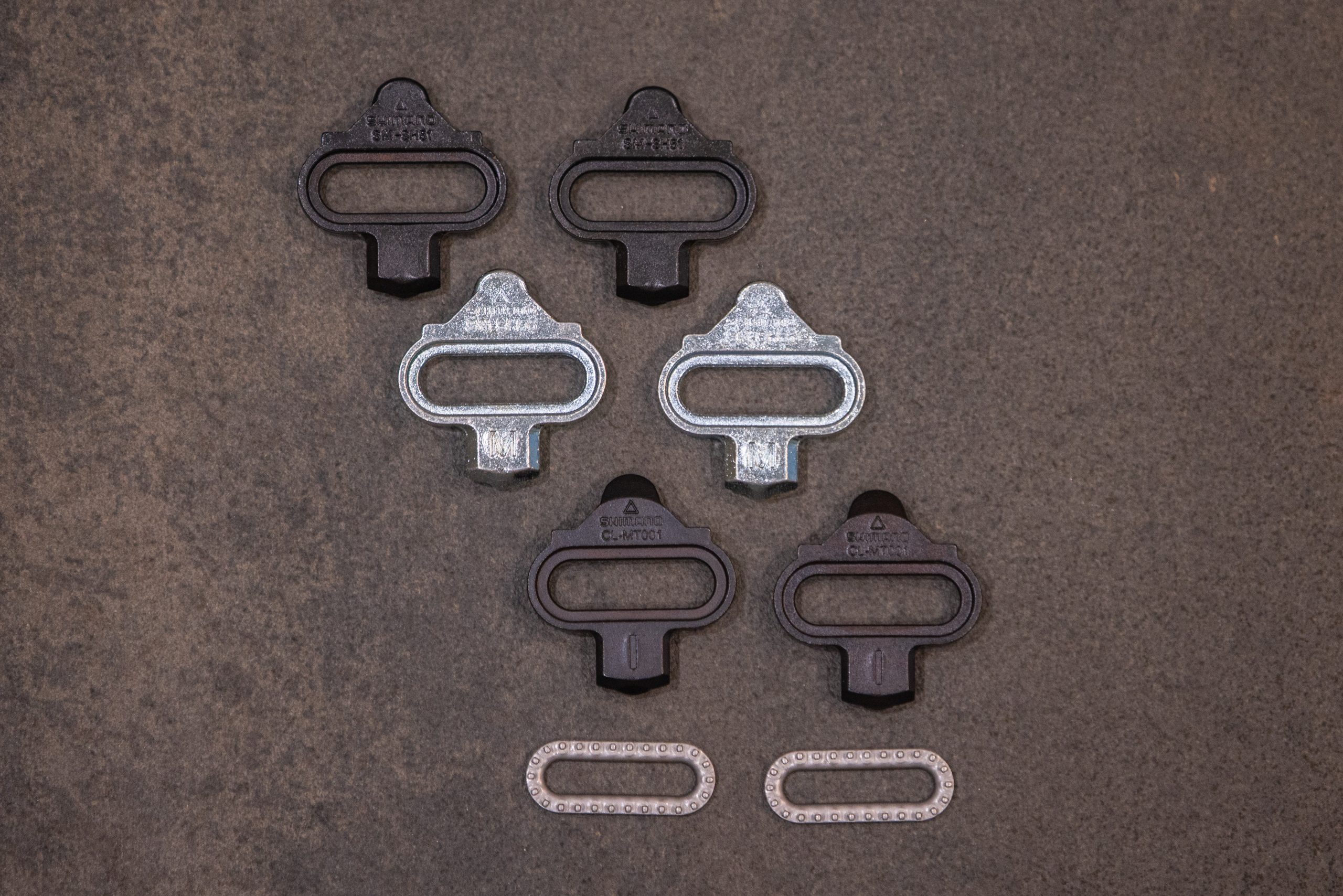
There’s not much visual difference between the SH51, MT001 and SH56 cleats.
They are all made from metal with two recessed bolt holes and attach to the soles of your shoes with the included bolts.
To fit the cleats, you’ll need to make sure your cycling shoes are compatible with the two-bolt SPD cleats preferred for mountain bike shoes and urban riding, not the three-bolt cleats used on road cycling shoes.
There’s an arrow at the front of each cleat to make sure you attach them to your shoes the right way round. They’re interchangeable between left and right shoes.

The only clue as to which type of cleat you have is that the SH51 and MT001 cleats are black, with the latter featuring a line on the rear-facing tab, while the SH56 cleats are silver-coloured, with an M embossed on the rear-facing tab.
There are also product names stamped into the cleats, but these can be harder to see.
You can buy Shimano SPD-compatible cleats from other brands, too.
Look’s X-Track cleats offer two equivalent cleat options, designated X-Track, equivalent to SH51 cleats, and X-Track Easy, equivalent to SH56. The type of cleat is stamped on the front of the Look cleats’ undersides.
What’s the difference between SH51, MT001 and SH56 cleats?
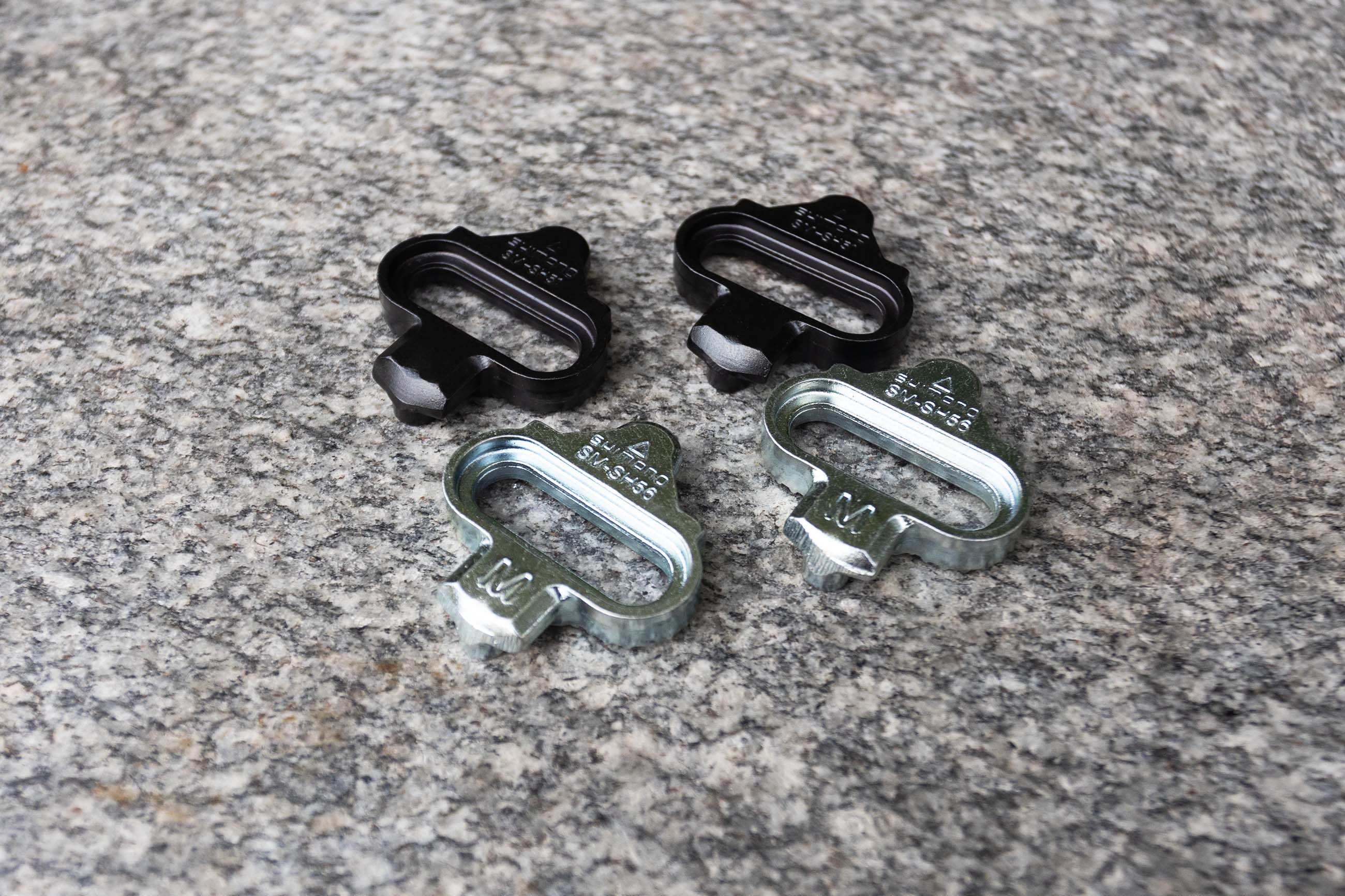
The difference between SH51, MT001 cleats and SH56 cleats is the number of directions in which you can enter and release the cleat from the pedal.
SH51 cleats have a single direction of release; that’s to say you can only disengage from the pedal by pushing your heel out in a flat plane relative to the pedal, or by pushing it in.
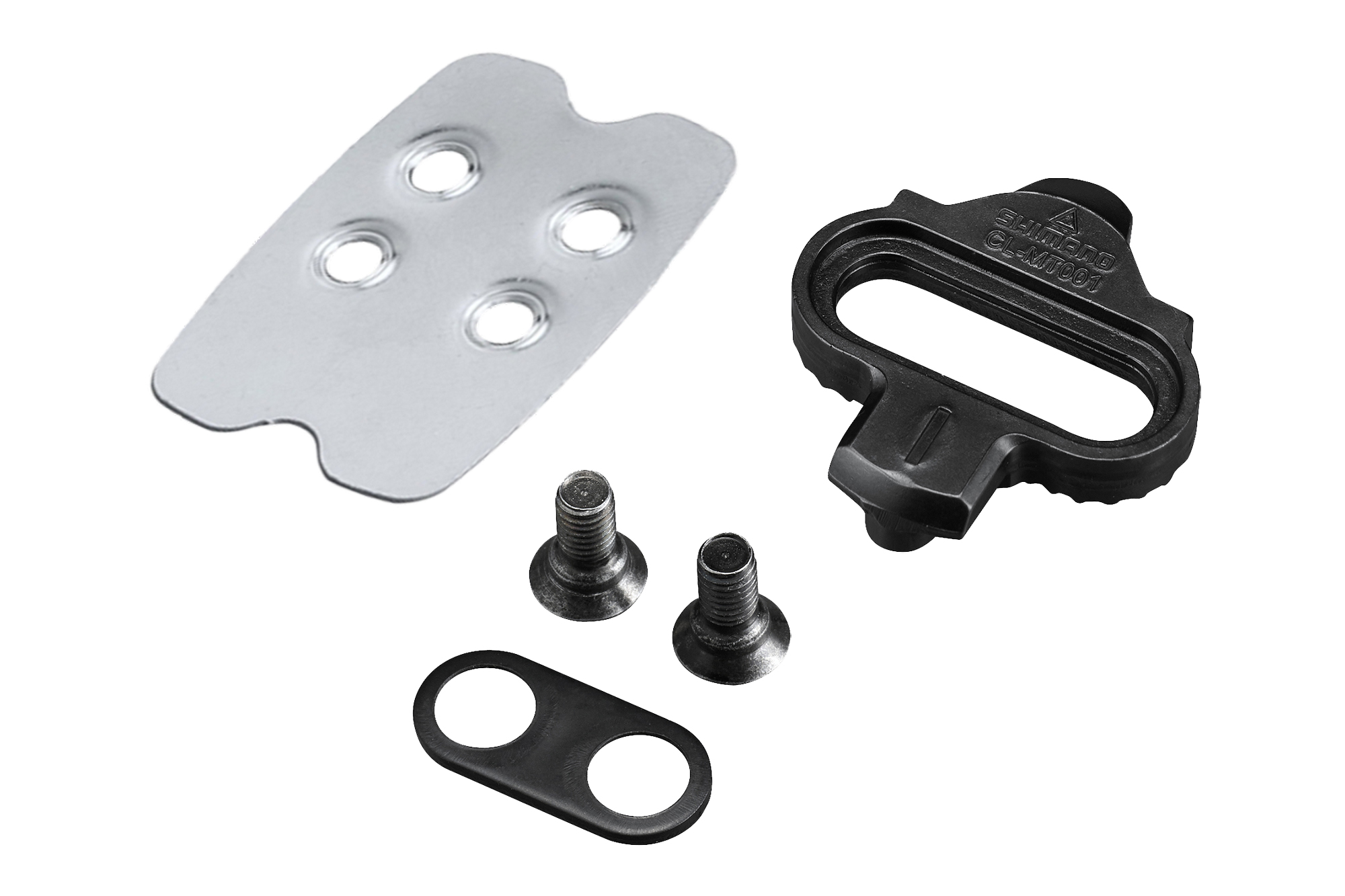
Shimano’s MT001 cleats keep this single direction of release, while enabling multi-entry engagement, meaning you can connect to the pedal from multiple angles, rather than needing to lead with the front edge on the SH51 and SH56.
The SH56 cleats, on the other hand, enable multi-directional release; as well as pushing your heel out or in, you can also roll your shoe on the pedal or pull up to release it.
The shape of the cleats is subtly different to enable this.
Which cleats should you choose?
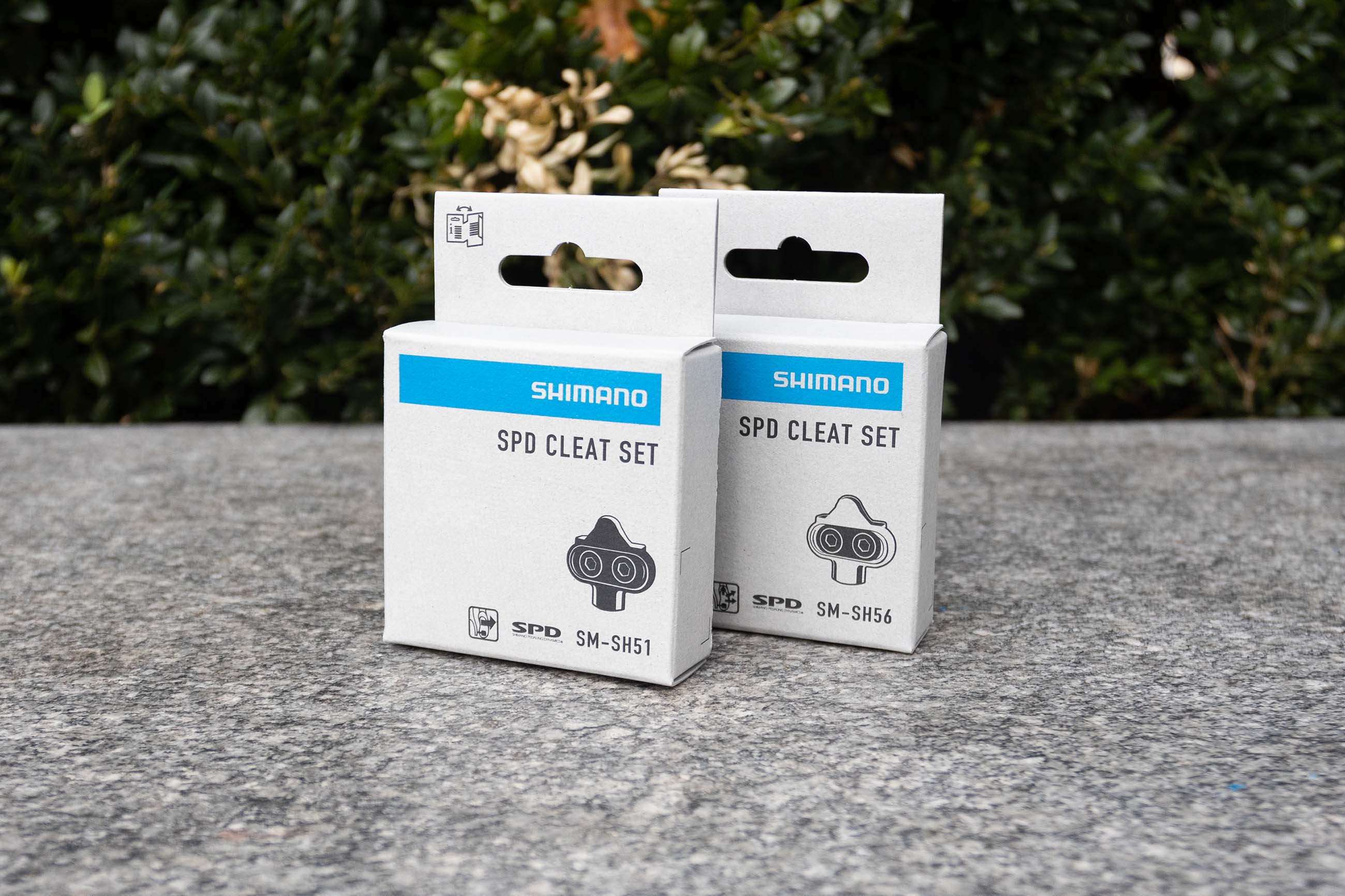
There’s no right or wrong answer to which type of cleats to choose. Which cleats work best for you depends on the type of riding you do and also how confident you are riding with clipless pedals.
The fact that SH56 cleats are included with Shimano’s Easy Release pedals gives a clue to their advantage.
Having multiple release options means you’re much less likely to get trapped in your pedals and topple over when you come to a stop. For a clipless pedal beginner, that may increase confidence because it feels more like riding flat pedals, and you may find the easier release is preferable for urban riding.
On the other hand, most riders find it relatively easy to get used to single-release SH51 and MT001 cleats and the twisting-out action necessary to disengage. The learning curve is a lot less steep than with the road-going SPD-SL pedal system.
If you’re riding on more technical terrain, particularly off-road, having multiple release angles may be a disadvantage, because you’re much more likely to come unclipped when you don’t want to. That’s why Shimano’s off-road pedal range comes with SH51 and MT001 cleats rather than SH56.
The pedalling action of some riders may also make them susceptible to unwanted unclipping, making SH51 cleats a better choice.
Although SH56 cleats may be useful for a beginner worried about having problems unclipping, it’s likely that persevering with SH51 and MT001 cleats, and reducing the release tension on the pedal, will help as much as the multi-directional release.
Lowering pedal-release tension is simple, by turning the hex nut on the release mechanism at the rear of the pedal anticlockwise.
The new MT001 cleats are designed with mountain biking in mind, with the multi-entry engagement enabling riders to clip in by engaging the rear first, then the front, or by simply stomping straight down on the pedal.
Riders may prefer this on the trail as it requires less thought than the SH51, which must be clipped in via the front of the pedal first. This means dismounts or foot dabs in technical terrain are less consequential for getting back on the pedals.
Qualcomm to Acquire Arduino, Pushing Deeper Into AI
Qualcomm acquires Arduino to expand its reach in AI, IoT, and edge computing development, and launches the Linux-powered UNO Q board.