Heart Machine will wind down development on the third-person roguelike Hyper Light Breaker, seemingly confirming that it will never make it out of early access. The follow-up to indie darling Hyper Light Drifter was first announced in 2022 and after several delays finally entered early access at the beginning of 2025.
But it looks like a 1.0 release won’t be arriving, with the studio confirming that it is ending development on the game and has had to lay off an unspecified number of its staff as a result. In a statement, Heart Machine said: “As we wrap up our work on Hyper Light Breaker, we’ve had to make the difficult decision to part with a number of talented team members. This was not our ideal path, but rather the only one available given the circumstances. While this path will include a conclusion on the project, it reflects broader forces beyond our control, including shifts in funding, corporate consolidation and the uncertain environment many small studios like us are navigating today.”
The studio said it plans to continue making games with its consolidated workforce — the Devolver-published sci-fi side-scrolling action game Possessor(s)is still due to launch next month — and indicated that Hyper Light Breaker won’t meet an entirely abrupt end. The studio said it plans to “deliver something meaningful and as polished and complete as we can given our current circumstances” in January, but added that no further updates are planned for the remainder of 2025.
Engadget’s Jessica Conditt tried out a build of Hyper Light Breaker in March of last year, and called it the “perfect amalgamation of Hyper Light Drifter and Solar Ash” (the studio’s other game), while praising its hoverboarding gameplay.
This article originally appeared on Engadget at https://www.engadget.com/gaming/hyper-light-breaker-studio-will-end-the-games-development-and-lay-off-staff-162941243.html?src=rss
Samsung ‘Galaxy XR’ will include tracked controllers in the box, Android Headlines reports.
Valve recently made the Steam Link VR APK available for sideloading on any Android-based VR headset, so if the report’s claim is accurate, it’s likely that Galaxy XR will be able to wirelessly stream and play SteamVR games from your PC at launch.
Samsung confirmed to UploadVR that it was working on controllers when we first tried the headset back in December, but the company hasn’t yet officially announced whether they’ll be included or a separate purchase.
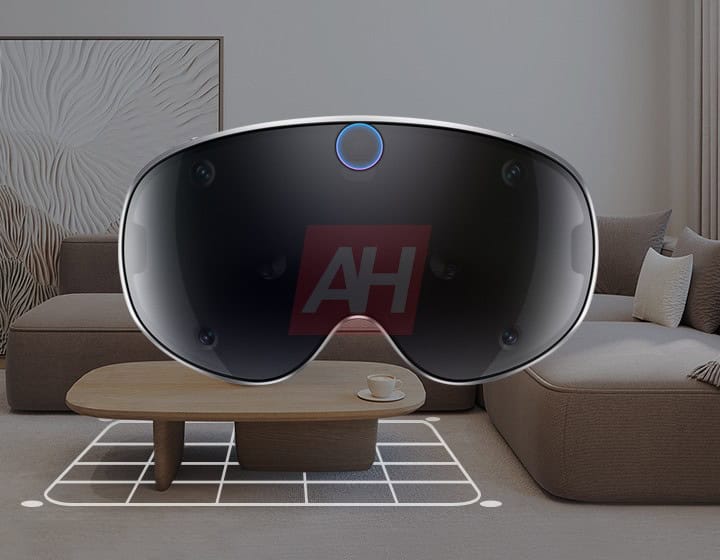
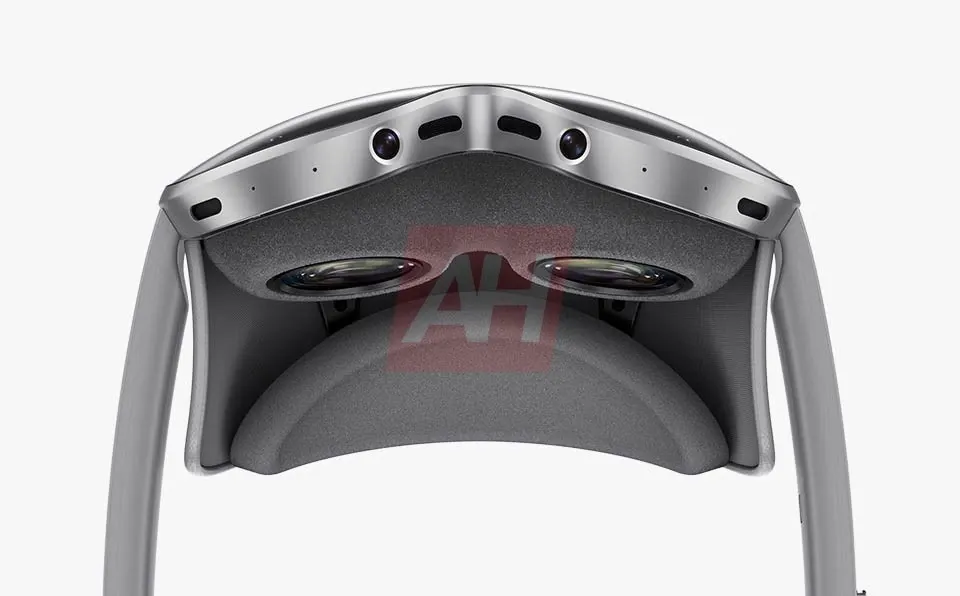
The Android Headlines report includes a leaked marketing render of the controllers (above), which it claims are included, as well as dozens of renders of the headset from almost every possible angle.
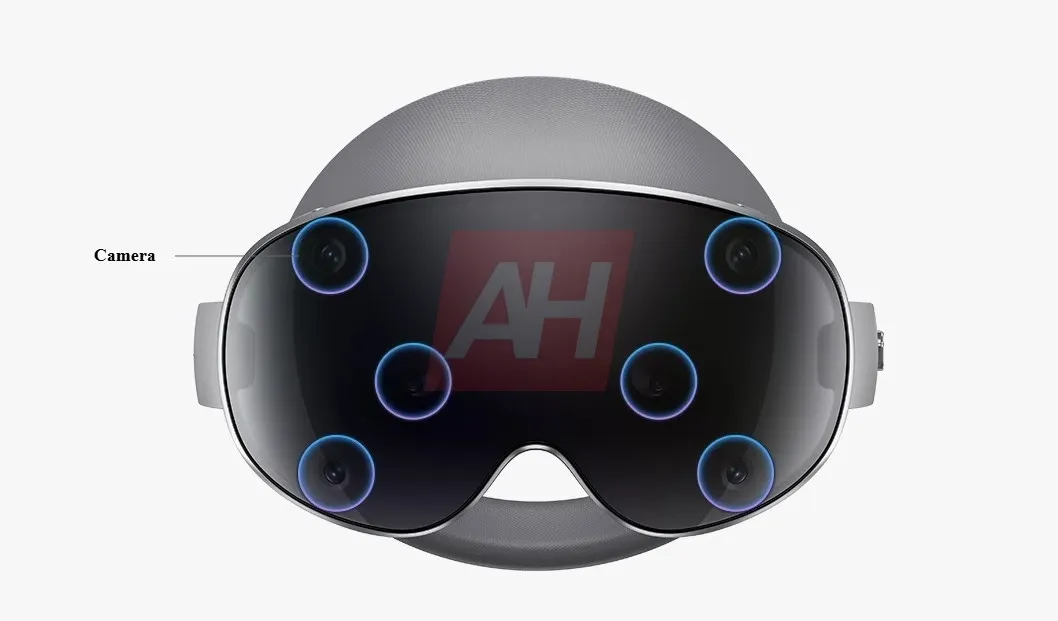
The sensor suite of Samsung Galaxy XR.
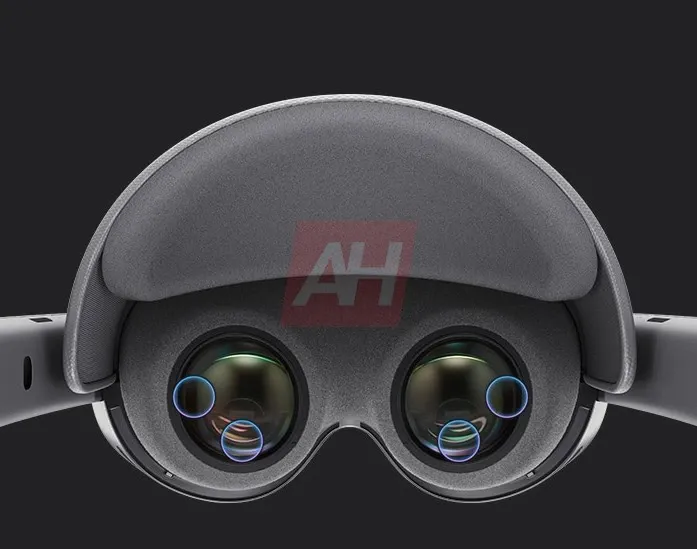
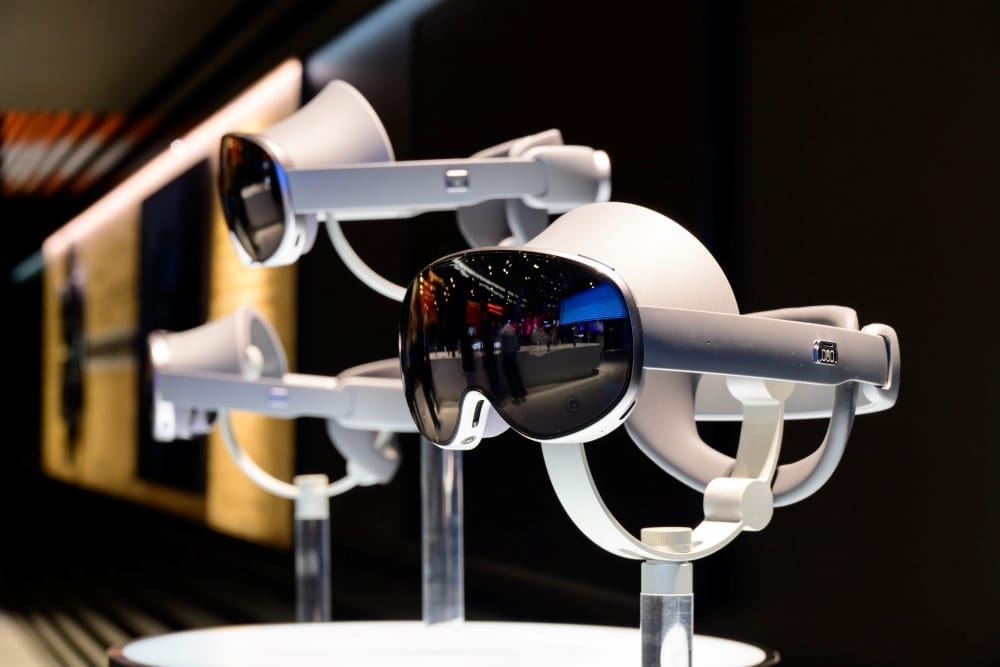
Of course, we’ve already seen the headset itself in many photos and videos, as it’s been shown off at multiple tech conferences throughout the year. But one thing the leaked renders make very clear is exactly how many image sensors the headset has.
Galaxy XR seemingly features 6 tracking cameras, 2 color passthrough cameras, a depth sensor, and 4 internal eye tracking cameras.
Of those 6 tracking cameras, 4 are on the front (in a similar position as Quest 2 or PlayStation VR2), while the other 2 are downwards-facing on the bottom (like Apple Vision Pro). That means it should be able to pick up hand gestures while your arms are at rest, but potentially not at very wide angles.
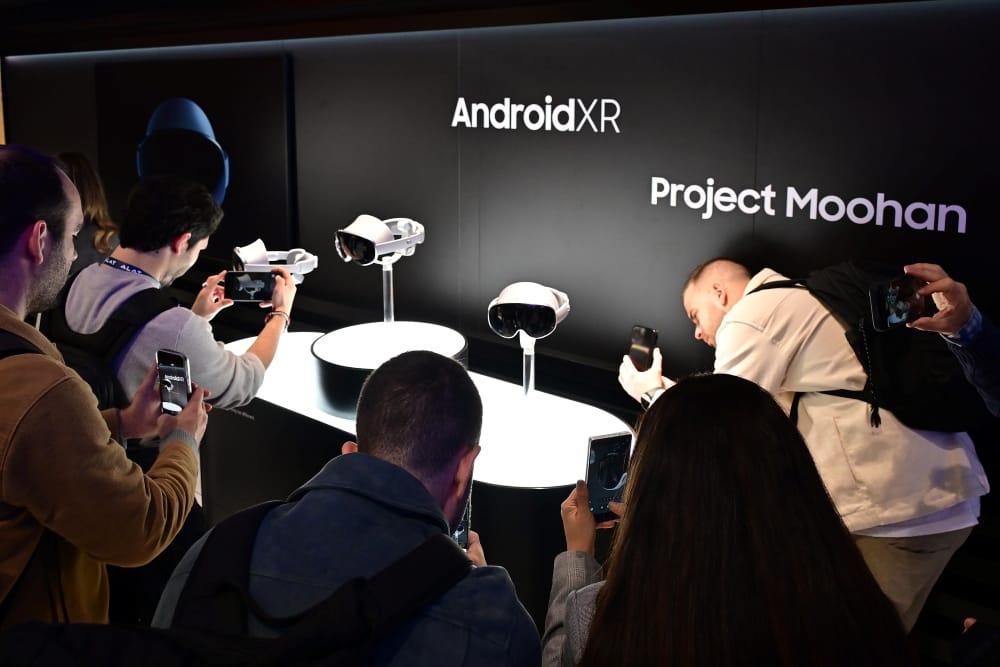
While Samsung still refers to the headset as ‘Project Moohan’, Android Headlines reports that the product will be called Samsung Galaxy XR, a name which was spotted in a new 3D capture setting for Galaxy phones that started rolling out last month.
Officially, Samsung has only said that the headset will run Google’s new Android XR operating system, feature hand tracking, eye tracking, and “state-of-the-art displays”, leverage an included tethered battery pack, and be powered by Qualcomm’s Snapdragon XR2+ Gen 2, a higher-end variant of the chipset in Quest 3 and Quest 3S which has already shipped in Play For Dream MR.
Back in March, South Korean news outlet The Elec reported that the headset will use Sony’s new 1.35-inch 3552×3840 micro-OLED display, with slightly higher resolution and wider color gamut than the one in Apple Vision Pro.
In August another outlet, Newsworks, reported that Samsung is targeting a price somewhere between 2.5 million and 4 million South Korean won, around $1800 to $3000. That compares to 5 million won for Apple Vision Pro, which has been sold in South Korea since November last year.
Three weeks ago, ETNews released a report claiming that Samsung will officially reveal the headset’s name and specifications and start selling it on October 21, just under two weeks from now.
Reports from other South Korean outlets suggest that the headset might release in Samsung’s home country only at first, and all signs point to a very limited launch for the device that will debut Google’s Android XR.
We recently had the opportunity to attend Intel’s Tech Tour 2025 and dive deep into the company’s upcoming Panther Lake and Clearwater Forest CPU architectures. We also got the chance to tour Intel’s Ocotillo campus in Chandler, Arizona, which is the site of Fab 52 and Fab 62, where high-volume chip manufacturing using advanced…
Who among us hasn’t fantasized about escaping hell as a skateboarding demon made of glass? That’s the task laid out for you in the offbeat indie title Skate Story. Devolver, always up for creative and subversive risk-taking, announced on Thursday that the game will arrive on December 8.
Skate Story has you performing ollies, kickflips and grinds to swallow the moon and free yourself from the Devil and his minions. Do I understand developer Sam Eng’s metaphors? Nope. Does it look badass nonetheless? You bet. Just check out the trailer below, where the shattering of your glass body looks just as satisfying as nailing that tailslide.
The game was announced way back in 2020 and delayed multiple times. In 2023, Devolver even included it in its tongue-in-cheek Delayed showcase, where it proudly announced titles it was pushing back to 2024. Of course, it missed that window, too.
But with its first specific release date, it looks like you’ll finally have the chance to play it (on PC, Mac, Switch 2 or PS5) on December 8. And you can try the Skate Story demo on Steam right now.
This article originally appeared on Engadget at https://www.engadget.com/gaming/skate-story-finally-arrives-on-december-8-160911918.html?src=rss
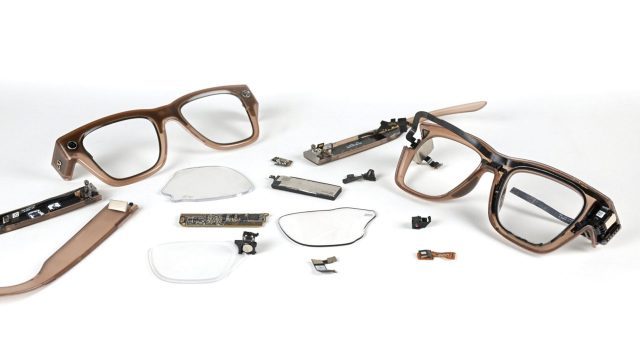
iFixit got their hands on a pair of Meta Ray-Ban Display smart glasses, so we finally get to see what’s inside. Is it repairable? Not really. But if you can somehow find replacement parts, you could at least potentially swap out the battery.
The News
Meta launched the $800 smart glasses in the US late last month, marking the company’s first pair with a heads-up display.
Serving up a monocular display, Meta Ray-Ban allows for basic app interaction beyond the standard stuff seen (or rather ‘heard’) in its audio-only Ray-Ban Meta and Oakley Meta glasses. It can do things like let you view and respond to messages, get turn-by-turn walking directions, and even use the display as a viewfinder for photos and video.
And iFixit shows off in their latest video that cracking into the glasses and attempting repairs is pretty fiddly, but not entirely impossible.
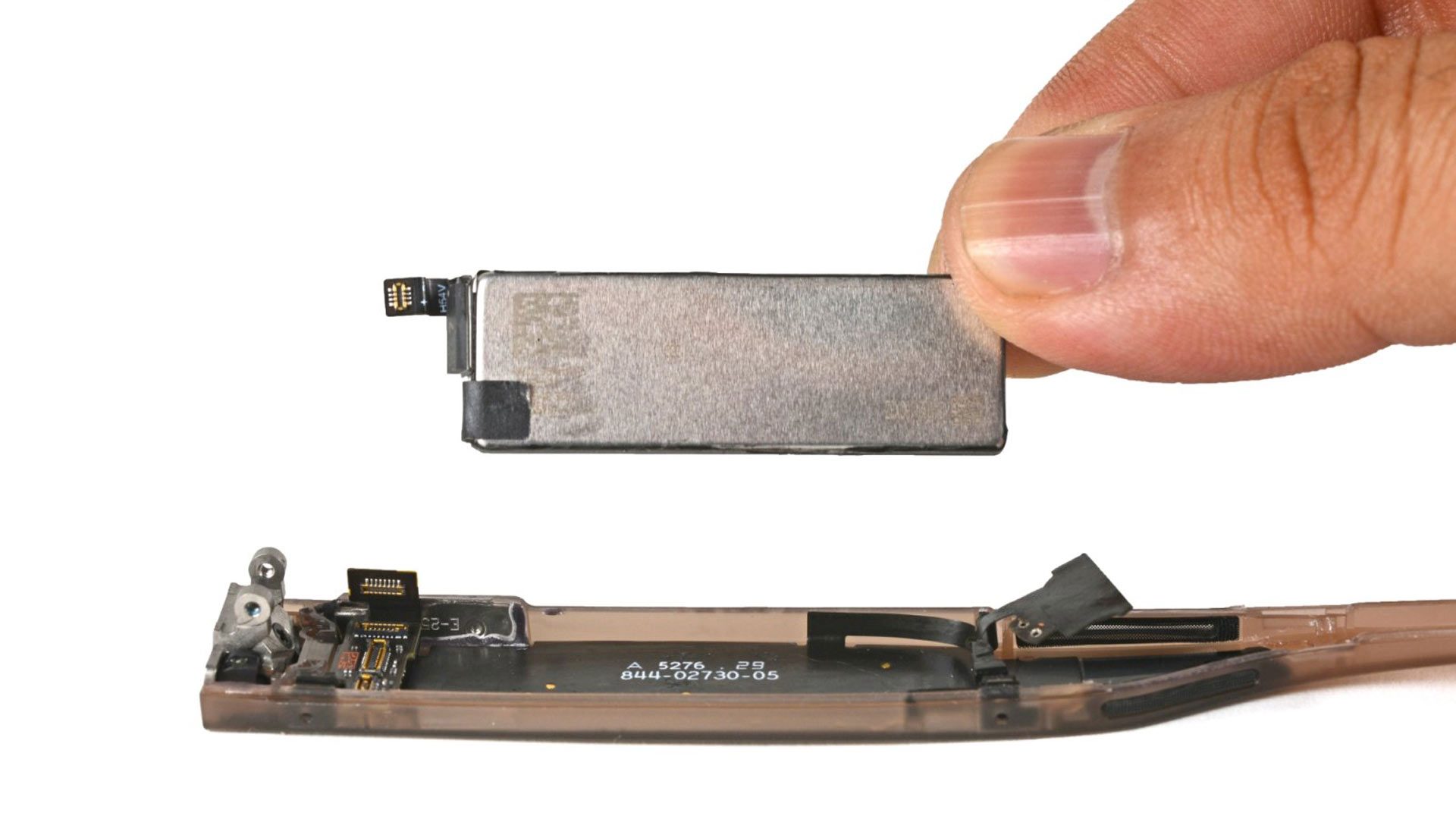
Meta Ray-Ban Display’s internal battery | Image courtesy iFixit
The first thing you’d probably eventually want to do is replace the battery, which requires splitting the right arm down a glued seam—a common theme with the entire device. Getting to the 960 mWh internal battery, which is slightly larger than the one seen in the Oakley Meta HSTN, you’ll be sacrificing the device’s IPX4 splash resistance rating.
And the work is fiddly, but iFixit manages to go all the way down to the dual speakers, motherboard, Snapdragon AR1 chipset, and liquid crystal on silicon (LCoS) light engine, the latter of which was captured with a CT scanner to show off just how micro Meta has managed to get its most delicate part.
Granted, this is a teardown and not a repair guide as such. All of the components are custom, and replacement parts aren’t available yet. You would also need a few specialized tools and an appetite for risk of destroying a pretty hard-to-come-by device.
For more, make sure to check out iFixit’s full article, which includes images and detailed info on each component. You can also see the teardown in action in the full nine-minute video below.
My Take
Meta isn’t really thinking deeply about reparability when it comes to smart glasses right now, which isn’t exactly shocking. Like earbuds, smart glasses are all about miniaturization to hit an all-day wearable form factor, making its plastic and glue-coated exterior a pretty clear necessity in the near term.
Another big factor: the company is probably banking on the fact that prosumers willing to shell out $800 bucks this year will likely be happy to so the same when Gen 2 eventually arrives. That could be in two years, but I’m betting less if the device performs well enough in the market. After all, Meta sold Quest 2 in 2020 just one year after releasing the original Quest, so I don’t see why they wouldn’t do the same here.
That said, I don’t think we’ll see any real degree of reparability in smart glasses until we get to the sort of sales volumes currently seen in smartphones. And that’s just for a baseline of readily available replacement parts, third-party or otherwise.
So while I definitely want a pair of smart glasses (and eventually AR glasses) that look indistinguishable from standard frames, that also kind of means I have to be okay with eventually throwing away a perfectly cromulent pair of specs just because I don’t have the courage to open it up, or know anyone who does.
Software vendors keen to monetize AI should tread cautiously, since they risk inflating costs for their customers without delivering any promised benefits such as reducing employee head count. From a report: The latest report from McKinsey & Company mulls what software-as-a-service (SaaS) vendors need to do to navigate the minefield of hype that surrounds AI and successfully fold such capabilities into their offerings. According to the consultancy, there are three main challenges it identifies as holding back broader growth in AI software monetization in the report.
One of these is simply the inability to show any savings that can be expected. Many software firms trumpet potential use cases for AI, but only 30 percent have published quantifiable return on investment from real customer deployments. Meanwhile, many customers see AI hiking IT costs without being able to offset these by slashing labor costs. The billions poured into developing AI models mean they don’t come cheap, and AI-enabling the entire customer service stack of a typical business could lead to a 60 to 80 percent price increase, McKinsey says, while quoting an HR executive at a Fortune 100 company griping: “All of these copilots are supposed to make work more efficient with fewer people, but my business leaders are also saying they can’t reduce head count yet.”
Another challenge is scaling up adoption after introduction, which the report blames on underinvestment in change management. It says that for every $1 spent on model development, firms should expect to have to spend $3 on change management, which means user training and performance monitoring. The third issue is a lack of predictable pricing, which means that customers find it hard to forecast how their AI costs will scale with usage because the pricing models are often complex and opaque.
Walkabout Mini Golf’s latest course takes players through an abandoned amusement park in Forgotten Fairyland.
The park takes its attractions from Mother Goose stories with a vibe that brings to mind the Goosebumps book One Day At HorrorLand. The easy mode of the course takes place at night, with hard mode taking the appearance of a “condemned nuclear plant” as senior art director Don Carson explained to UploadVR during our exclusive 16-minute tour.
0:00
/1:19
The destination opens today as a $4 paid expansion, with our tour following from hole one to 18 along the “The Walkabout Path” in easy mode. We’ve toured each new course in Walkabout’s build-out for the last couple years and you can follow the design progression in our YouTube playlist as the team behind the title grew to a few dozen members.
Development studio Mighty Coconut shared some early hand-drawn concept art which I’ve embedded below.
In addition, the studio shared a look at their course as it first appeared inside Gravity Sketch in September of last year. The image, shared exclusively with UploadVR readers first, depicts the freshly sculpted outline of the amusement park with a bright orange line following from hole 1 to 18.
The Walkabout Path, shown in orange, is the walk from hole 1 to 18 on a particular course. Screenshot from Gravity Sketch dated September 9, 2024 provided by Mighty Coconut.
Our last tour of Passport Tokyo outlined the development process built around this core idea of The Walkabout Path. The not-so-straight line made in VR from the start of the course to its end guides the creativity of different members of the team as they take ownership of the course for a week or two at a time.
Forgotten Fairyland as it appeared in Gravity Sketch near the end of September, 2024.
A few more weeks of work and you can see more complex structures with basic coloring added, with green marking up the actual playable areas for mini golf and yellow marking “anything I still needed to build out… so I could have a record of what was complete and what still needed doing,” according to Carson.
Forgotten Fairyland as it appeared in Gravity Sketch on October 3, 2024.
By October of 2024, the core layout of Forgotten Fairyland’s attractions can be seen in Gravity Sketch alongside all the major structures. A year of development followed with technical artists, set dressers, musicians and more all adding their touches to the destination, leading to release on October 9, 2025.
“Everything you see in the park is going to be Mother Goose themed, but with a patina of rust and probably a need for you to have had a tetanus shot before you enter the park,” explained Carson during our tour.
Forgotten Fairyland is now available on all platforms with Walkabout Mini Golf.
Dylan Vandenstorme, of Team Flanders-Baloise, will line up at the UCI Gravel World Championships in the Netherlands this Sunday aboard an all-new prototype titanium gravel bike from legendary Belgian brand Eddy Merckx.
It shows the latest direction from the brand, which is known for doing things a little differently. Back in 2019, Oliver Naesen, of AG2R La Mondiale, rode an all-steel Eddy Merckx in the Tour de France. Until then, it was a material that hadn’t been seen in the Tour this century.
The Eddy Merckx Corsa line of bikes is due for a major update in 2026. It will see the brand continue making high-end steel and aluminium bikes, although this Corsa gravel prototype shows it is expanding into titanium. That’s a great choice for gravel bikes, thanks to titanium’s strength-to-weight ratio and longevity.
The legendary Eddy Merckx brand is moving into titanium for 2026. Belgain Cycling Factory
Titanium has been a proven material at the highest level, with Lotto riding titanium GT Edge bikes in 1999 and Robbie McEwen taking the green jersey in 2002 aboard a titanium Litespeed.
However, it was perhaps Magnus Bäckstedt’s 2004 win at Paris-Roubaix aboard a custom titanium Bianchi that signalled a heyday for this wonder metal.
Merckx claims the new prototype gravel bike combines the durability, corrosion and fatigue resistance of titanium with a “refined blend of vintage allure and contemporary flair”. This titanium prototype has a tyre clearance of 47mm. It also features a SRAM Universal Derailleur Hanger and internal cable routing.
I love the look of the prototype, although I’d like to see the tyre clearance pushed out beyond 50mm to take advantage of the new wave of larger tyres for gravel.
The Corsa prototype is made using tubing from Italian specialist Columbus. The Hyperion titanium tubing, which launched in 2024, is a 3Al-2.5v grade 9 material that’s cold drawn into butted tubing.
Columbus claims the process and material used for its tubes leads to a strength of 200[kNm]/kg. When compared to standard titanium tubing, which is rated to 156[kNm]/kg, it means a 22% increase in ultimate tensile strength (UTS).
Compared to aluminium, it’s a 40% increase, and 15-20% lighter than Columbus’ high-grade steel tubing, with a density 40% lower than traditional steel, which should mean a more compliant frame over rough terrain, making it a great choice for gravel.
Hyperion is the lightest titanium tubeset Columbus has ever produced.
Custom build
The Kinesis Tripster ATR is an excellent all-road/gravel bike. Kai Eves / Ourmedia
The bike put together for Vanderstorme certainly has some very personal touches.
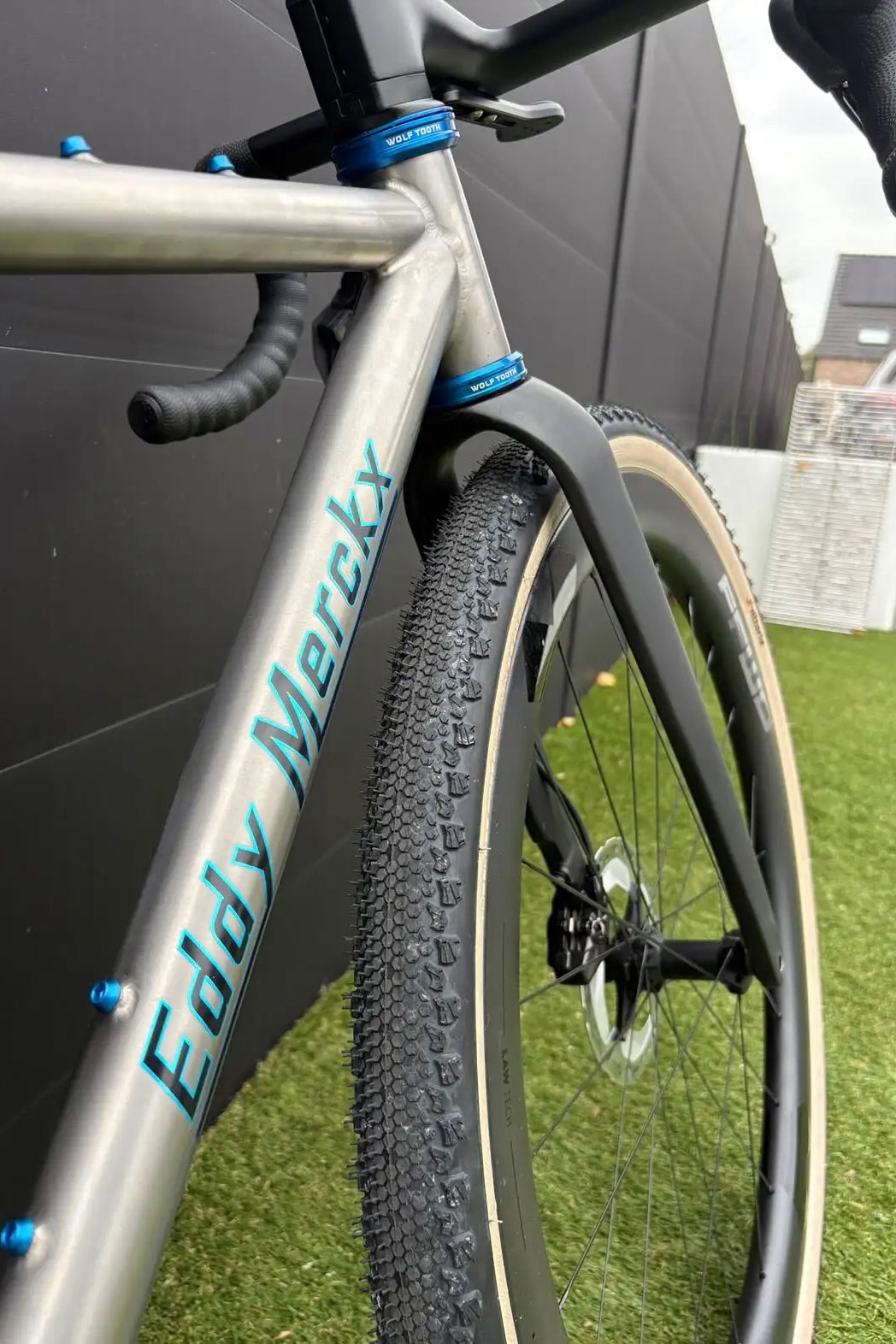
The drivetrain sees the latest wireless Shimano XT rear derailleur matched to a Dura-Ace crankset running a single Wolf Tooth 50-tooth chainring.
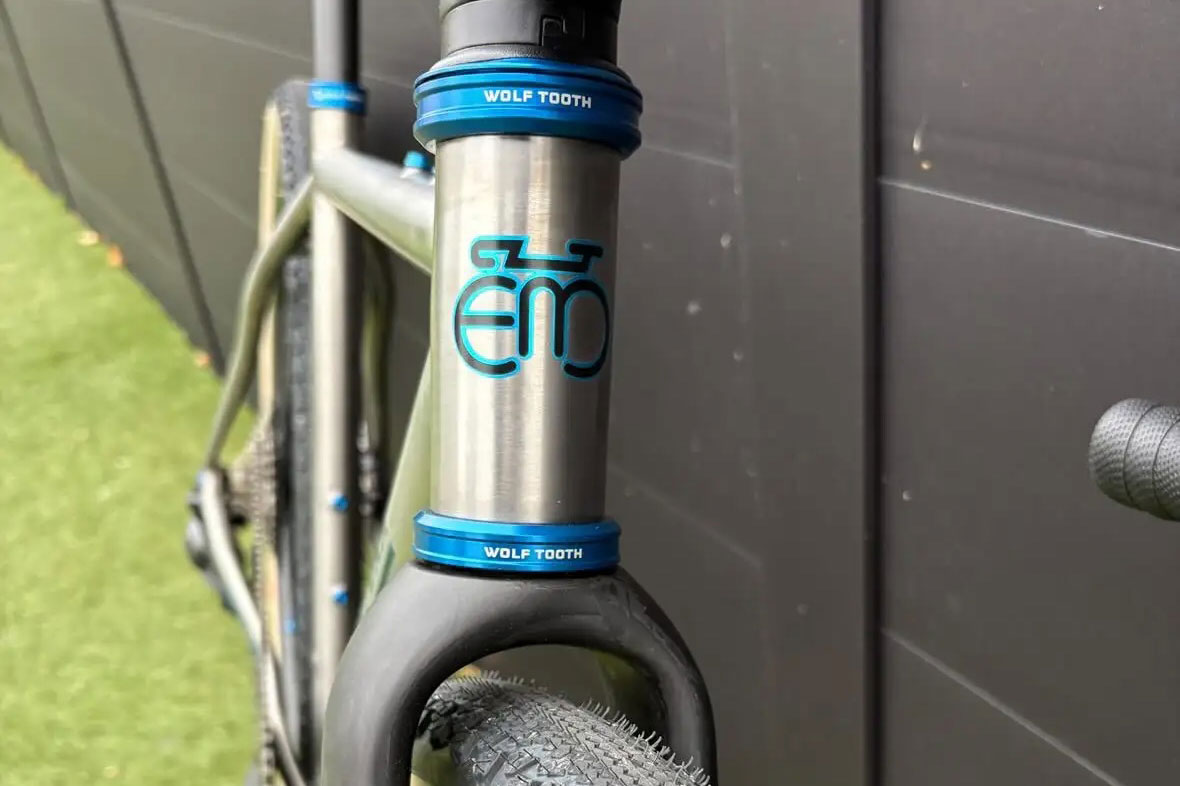
Wolf Tooth also provides plenty of matching blue anodised parts, with the headset, seat collar, bolts and thru-axles all coordinated.
FFWD provides the latest version of its gravel-specific Drift wheelset, and these are wrapped with Vittoria’s Terreno tyres here in Dry spec, although that could change, of course, if the weather takes a turn for the worse this weekend.
Titanium is coming
Eddy Merckx has announced that new bikes made from titanium are coming next year and I can’t wait to see what it has in store with these new models.
I’ve been a long-time fan of titanium and still own both a Kinesis ATR and a custom Lynskey. Perhaps the next gravel bike on my wishlist could be a metal Merckx.
The how-to website iFixit posted a teardown of Meta’s new Ray-Ban Display augmented reality glasses and came away impressed by the tech but wary of repairability. As a matter of fact, one of the techs said in the accompanying video that it’s “very clear that the first iterations of these smartglasses are going to be unrepairable.”
This repairability issue is relatively unsurprising, given this is a newish technology. The website says there are several factors that contribute to the problem, noting that users would have to split the arms and frame in half to do something as simple as replacing a battery and Meta doesn’t provide any way to do that. “Any repairs here are going to need specialized skills and specialized tools,” the tech concluded. This also applies to the speakers, as they are soldered in.
The same goes when looking to replace the lenses, as they are specially-made and would be difficult to source. However, iFixit did come away impressed with the glassmaking skills used to manufacture these lenses.
The lenses use a reflective geometric waveguide system that bounce light to the wearer’s eyes at specific angles using partially reflective mirrors. This not only creates an augmented reality experience but helps prevent other people from getting a glimpse of the screen when staring at you.
iFixit
There’s a mini-projector in the right arm, which would also be difficult to repair. This liquid crystal on silicon (LCoS) device creates a 600×600-pixel grid image that should be free from artifacts and won’t flash the tell-tale “eye glow” at onlookers. Again, this is due to the lenses, as they differ from older diffractive systems.
All of this advanced tech adds up and iFixit thinks Meta may be selling these glasses at a loss, as those lenses are particularly expensive to manufacture. Despite this, the website urges Meta to prioritize “replaceable batteries, modular arms and swappable lenses” in the future.
This article originally appeared on Engadget at https://www.engadget.com/ar-vr/ifixit-calls-metas-ray-ban-display-glasses-unrepairable-but-praises-the-tech-154820301.html?src=rss
Sudden increases in the size of Fedora’s initramfs
files have prompted the project to fast-track a proposal to increase
the default size of the /boot partition for new installs of
Fedora 43 and later. The project has also walked back a few
changes that have contributed to larger initramfs files, but the
ever-increasing size of firmware means that the need for more room is
unavoidable. The Fedora Engineering Steering Council (FESCo) has
approved a last-minute change
just before the final freeze for Fedora 43 to increase the
default size of the /boot partition from 1GB to 2GB; this
will leave plenty of space for kernels and initramfs images if a user
is installing from scratch, but it is of no help for users upgrading
from Fedora 42.
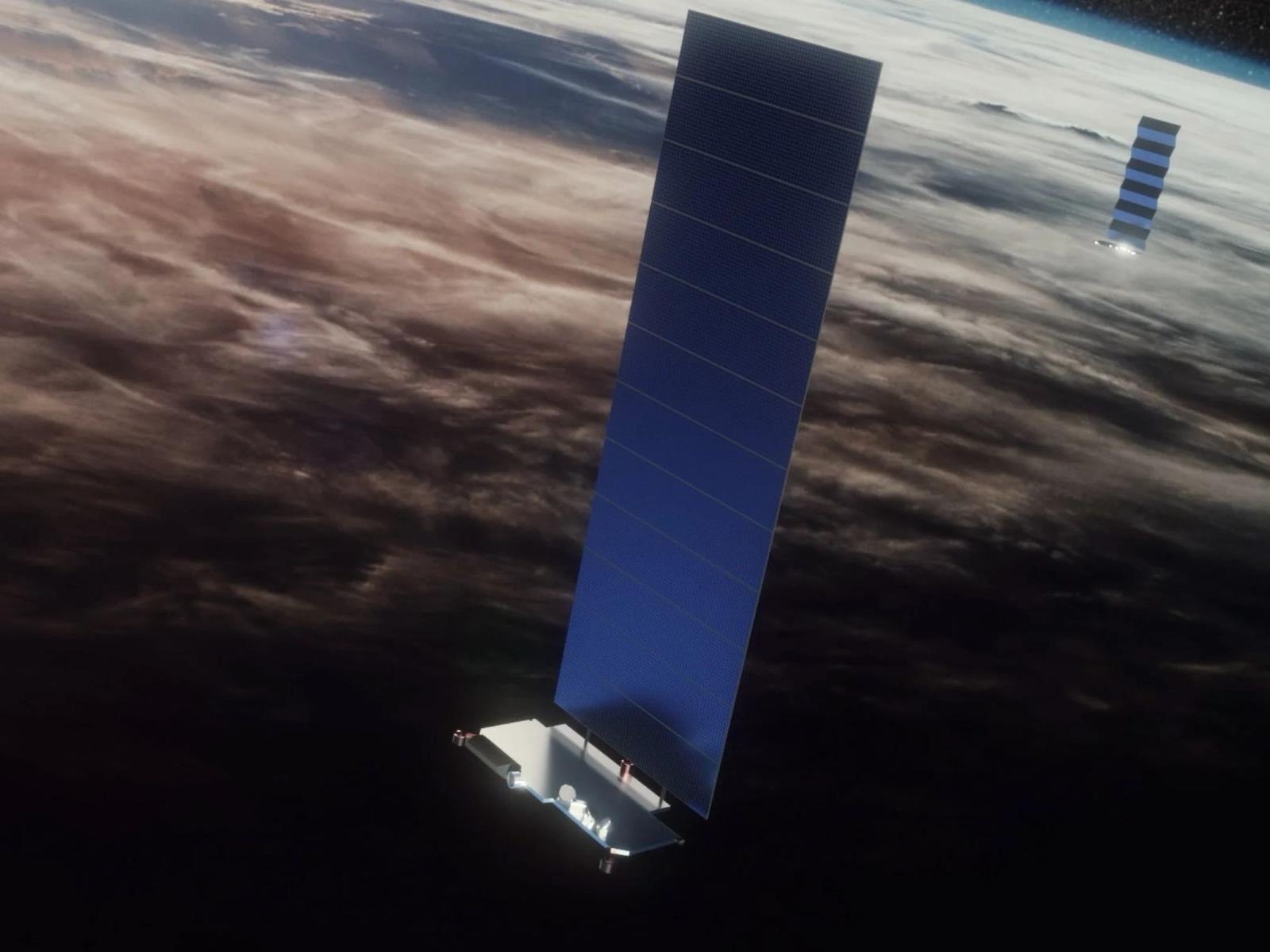
If you didn’t already know, the vast orbital constellation that is Elon Musk’s Starlink satellites has been providing a spectacular, if concerning, daily light show as an increasing number of them fall back to Earth. Experts estimate that one to two of the SpaceX-operated satellites are de-orbiting and burning up in the atmosphere every single
As the 7-pound Razer Blade 18 sat on my desk, its all-black unibody case and enormous 18-inch screen towering before me like the monolith from 2001, I couldn’t help but think, “Who the hell needs such a big-ass computer?” I’m sure they’re out there — the gamers with deep pockets and little regard for portability, the video editors who demand as much screen space as possible. But on the whole, the market for the Blade 18 is pretty small, especially whenRazer’s Blade 14 and16 strike a far better balance of price, performance and weight.
What the Razer Blade 18 promises, if you choose to accept its gargantuan proportions, is unbridled power and screen real estate. It’s running Intel’s new Core Ultra 9 275HX processor, a 24-core beast with a maximum speed of 5.4GHz. Its 18-inch screen can reach up to 240Hz at slightly over 4K (3,840 by 2,400 pixels) and 440Hz when downscaled to 1080p+ (1,920 by 1,200). And of course, you can equip it with NVIDIA’s fastest mobile GPU, the GeForce RTX 5090. Given everything under the hood, it’s honestly impressive it weighs just seven pounds, alongside a 2.1-pound power adapter. (In comparison, the similarly premium 18-inch Alienware Area 51 comes in at 9.5 pounds with a 2.2-pound power adapter.)
When we last reviewed theRazer Blade 18a few years ago, my colleague Sam Rutherford bristled at the laptop’s size, battery life and high cost (which could reach upwards of $5,000 when fully decked out). All of those points are absolutely fair, but this time around it’s easier to see what Razer is trying to do with the Blade 18: It’s simply doing the most for the people who demand it. And it’s doing so with the excellent build quality we’ve come to expect from Razer (albeit with a high $2,799 starting price).
If you’re still trying to wrap your head around why an 18-inch laptop even exists, the Razer Blade 18 isn’t for you. And honestly, the concept isn’t even that farfetched. Given the move towards thinner display bezels and other refinements, laptop makers have been able to squeeze in larger screens inside of their typical case sizes. The Razer Blade 16 was a bit heavier than the Blade 15 when it launched, but now Razer has slimmed its case down considerably. The Blade 18 similarly serves as an upgrade to the old Blade 17 — and what an upgrade it is.
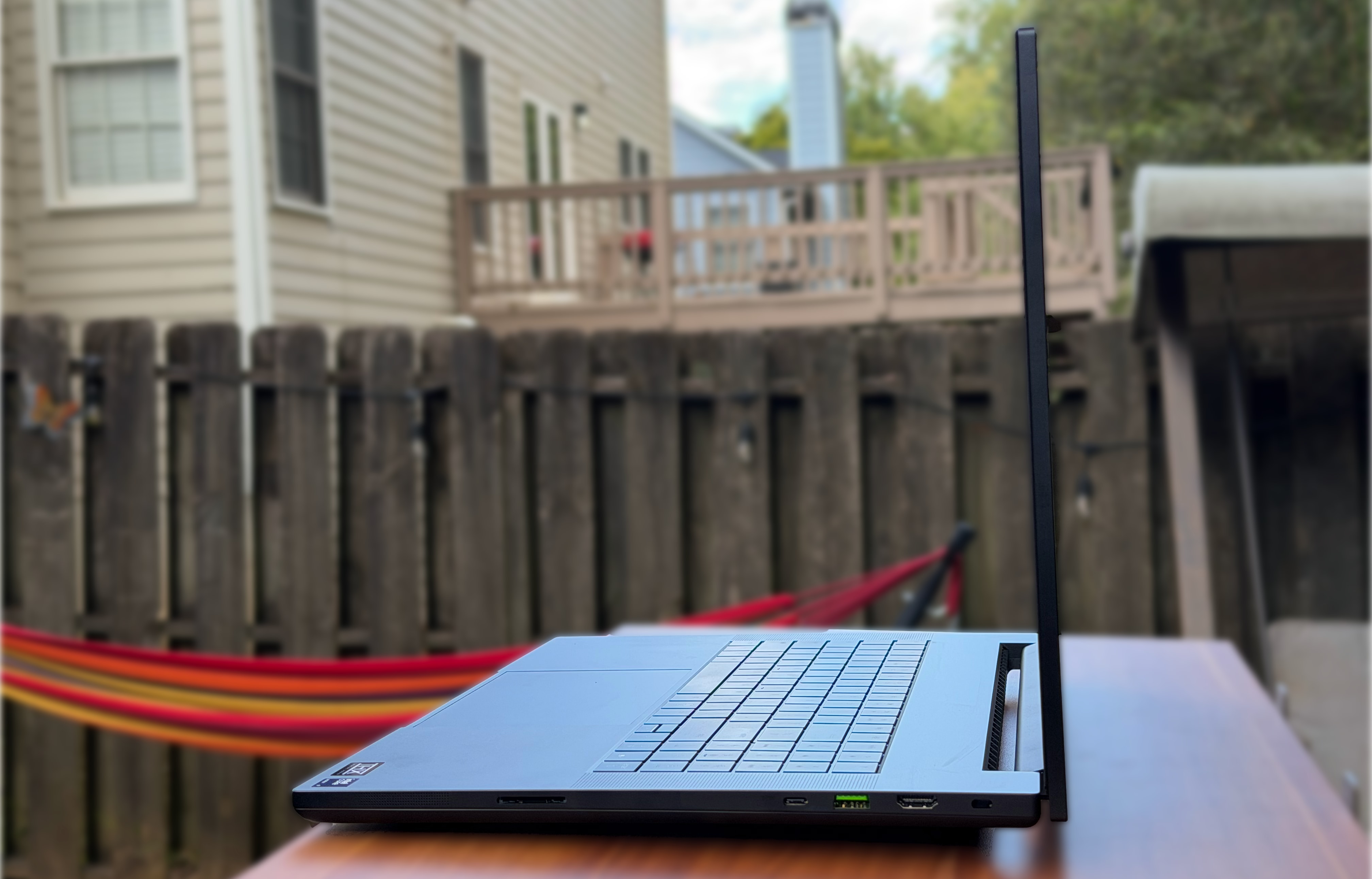
Razer Blade 18 from the side, viewing a few ports.
Devindra Hardawar for Engadget
My review unit, which was equipped with that new Intel chip, an RTX 5090, 64GB of RAM and a 4TB SSD tackled Cyberpunk 2077 with all of its settings cranked without a sweat. At its native resolution, which again is a bit higher than 4K, it reached 131 fps with 4X frame generation (which uses DLSS 4’s upscaling to interpolate additional frames). That’s roughly half as fast as the desktop RTX 5090 running in 4K with the same settings — but don’t forget, that GPU alone typically runs between $2,000 to $3,000 these days. Razer charges an additional $1,400 to upgrade the Blade 18 from an RTX 5070 Ti to the 5090. (And for the record, the total cost for our fully decked out testing unit was $4,599.)
Beyond frame rates, Cyberpunk 2077 simply looked great on the Blade 18’s 240Hz IPS LED display. It’s not as bright as the MiniLED screens Razer offers on the Blade 16, and it doesn’t offer the insane contrast levels of an OLED screen, but it does the job well. For the price, though, it would have been nice to see more modern screen technology. Like the Blade 16, the 18 also offers a dual-mode display, which is how it reaches those higher 440Hz refresh rates in 1080p+.
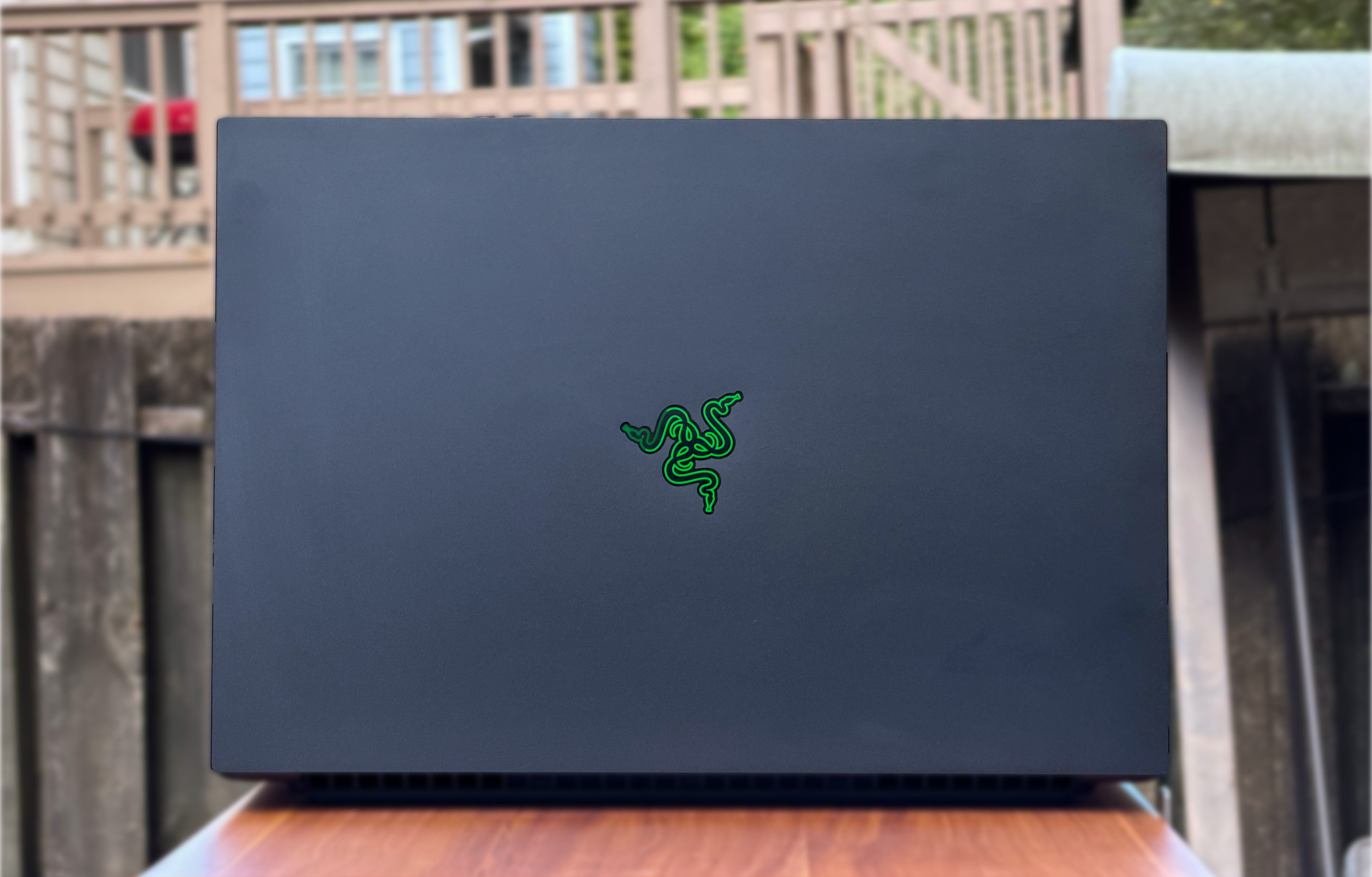
Razer Blade 18 rear case
Devindra Hardawar for Engadget
It worked as advertised in Overwatch 2, where I played several matches well above 300fps with high quality settings. The additional visible frames are particularly helpful during fast-paced moments, where you may have the blink of an eye to take out an opponent before they headshot you.
I had no doubt the Blade 18 would be fast, but I also noticed that it felt genuinely more immersive than the Blade 16 because of its more expansive display. As I leaned in during Cyberpunk 2077, Halo Infinite and Overwatch sessions, it almost felt like I was in front of a desktop setup. That’s ultimately what you’re paying for with this machine. When I opened up audio files in Audacity, I also noticed that the additional screen space simply made it easier to sift through my timelines.
When it comes to direct benchmarks, the Core Ultra 9 chip isn’t much better than Intel’s 13th-gen hardware in single-threaded tasks, and it’s sometimes best by AMD’s latest batch of hardware. Intel has made significant progress in multi-threaded tests like Geekbench 6, though, and that sort of performance makes the Blade 18 ideal for tasks like video rendering and complex games.
The Blade 18 also ran remarkably cool: During a 3DMark stress test, which involved running one demo 20 times in a row, the CPU stayed at 70 degrees Celsius most of the time, with occasional spikes to 85C. During the CPU-heavy Cinebench tests, Intel’s chip jumped to 80C on average with some jumps to 90C. The GPU, meanwhile, held a steady 70C and never wavered during 3DMark benchmarks. The fans sure can get loud, though, as you’d expect for a system that’s relatively thin and needs to pump out a ton of heat.
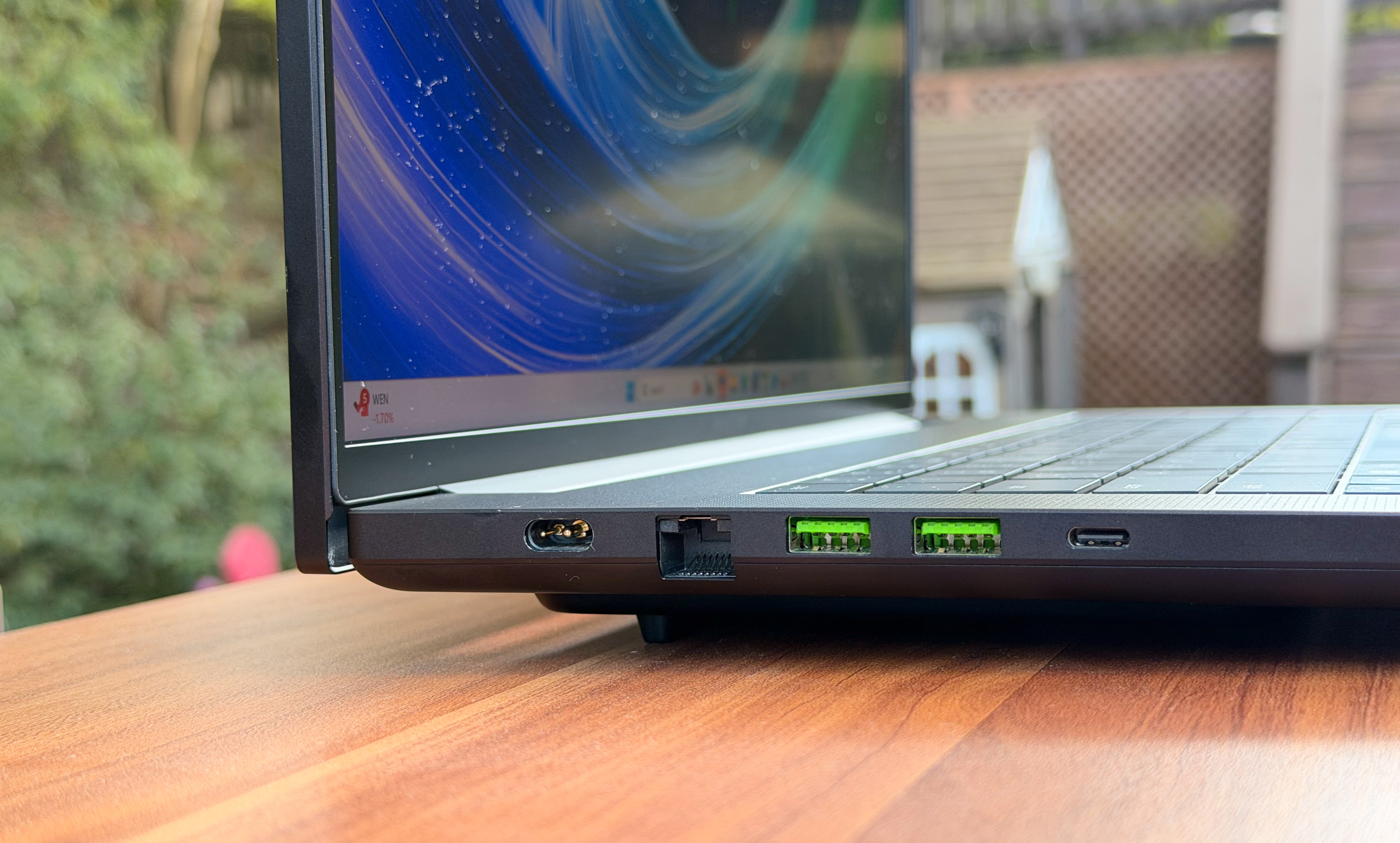
Razer Blade 18 power, Ethernet, USB 2 and USB-C ports.
Razer has been building sturdy and attractive gaming laptops for well over a decade now, so it’s not a huge surprise that the Blade 18 feels incredibly solid and premium. Its keyboard has a great depth to it that feels just as good playing shooters as it does while typing, and its trackpad is wonderfully smooth and accurate. (It does get a bit overzealous when detecting multi-touch gestures, though.) Port-wise, the Blade 18 also packs in everything you’d want, including three USB Type-A 3.2 connections, one Thunderbolt 5 USB-C port, a Thunderbolt 4 USB-C port, 2.5Gb Ethernet and a full-sized SD card slot.
Personally, if I had to choose between Razer’s current lineup, I’d go with the Blade 16 so that I could actually carry it around and occasionally use it as a productivity machine. Not so with the Blade 18 — its short two hour and 17 minute battery life (in PCMark 10’s battery benchmark) means you’ll always need to lug around its beefy power adapter. After an hour of writing this review, its battery life also dropped from fully charged to 38 percent. But really, nobody is buying this thing just to deal with spreadsheets and emails. You want ultimate power and an enormous screen? Then battery life will suffer.
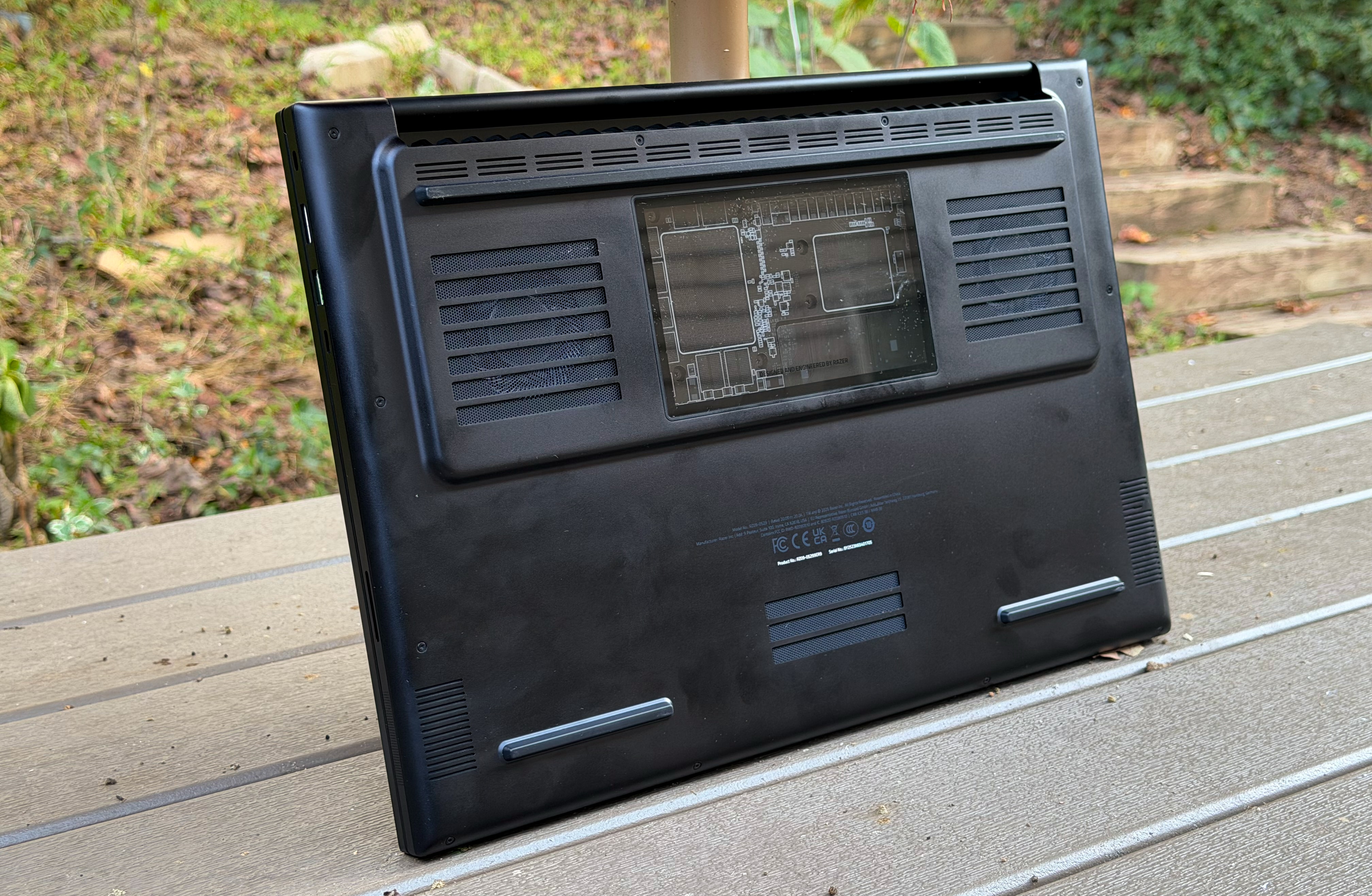
A transparent window along the bottom of the Razer Blade 18
Devindra Hardawar for Engadget
To paraphrase The Lord of the Rings, one does not simply choose to live with an 18-inch gaming laptop — not without considering all of the conveniences you’re leaving behind. For the sickos who would dare tread that path, the Blade 18 is a solidly built powerhouse that weighs significantly less than rivals like the 18-inch Alienware Area 51. Just be prepared to pay Razer’s high price to own one.
This article originally appeared on Engadget at https://www.engadget.com/gaming/pc/razer-blade-18-2025-review-an-18-inch-gaming-laptop-that-does-the-most-153000136.html?src=rss
Ubuntu
25.10, “Questing Quokka”, has been released. This release includes
Linux 6.17, GNOME 49, GCC 15, Python 3.13.7,
Rust 1.85, and more. This release also features Rust-based
implementations of sudo and coreutils; LWN covered the switch to the
Rust-based tools in March. The 25.10 version of Ubuntu flavors
Edubuntu, Kubuntu, Lubuntu, Ubuntu Budgie, Ubuntu Cinnamon, Ubuntu
Kylin, Ubuntu MATE, Ubuntu Studio, and Xubuntu have also
been released.
An anonymous reader shares a report: China’s giant solar parks aren’t just changing the power mix — they may be changing the ground beneath them. Fresh field data point to cooler soils, extra moisture, and pockets of greening, though lasting ecological shifts will hinge on design and long-term care.
[…] A team studying one of the largest photovoltaic parks in China, the Gonghe project in the Talatan Desert, found a striking difference between what was happening under the panels and what lay just beyond. They used a detailed framework measuring dozens of indicators — everything from soil chemistry to microbial life — and discovered that the micro-environment beneath the panels was noticeably healthier. The reasons track with physics: shade cools the surface and slows evaporation, letting scarce soil moisture linger longer; field experiments in western China report measurable soil-moisture gains beneath shaded arrays.
Simple shade from panel rows can create a gentler microclimate at ground level, cutting wind stress and helping fragile seedlings establish. In other desert locations like Gansu and the Gobi, year-round field data tell a similar story. Soil temperatures beneath arrays tend to be cooler during the day and a bit warmer at night than surrounding ground, with humidity patterns shifting in tandem — conditions that can make harsh surfaces more habitable when paired with basic land care. Even small shifts like these can help re-establish vegetation — if combined with erosion control and water management. These aren’t wildflowers blooming overnight, but they are signs that utility-scale solar can double as a modest micro-restorer.
Canonical published today the Ubuntu 25.10 (Questing Quokka) release, the latest stable version of their popular GNU/Linux distribution, featuring up-to-date components and new features.
Stargazers, here’s a new one to add to your October view list. Two newly discovered comets, both sporting vibrant green hues, are set to grace the night sky, AND if the conditions are right, there’s also a rare naked-eye opportunity to view the comets alongside the peak of the Orionid meteor shower at the end of the month.
The Browser Company’s AI-powered browser is now available to download for all macOS users. Dia started rolling out to private beta testers in June, following its initial reveal at the end of last year, but if you’re a Mac user you can download it here if you want to try it. Note that you need a Mac with an M1 chip or later running macOS 14 or later.
AI is being baked into a lot of web browsers right now, but with Dia it’s at the heart of everything you do. It allows you to interact with The Browser Company’s chatbot within every tab you have open, where it’s able to search the web, compare websites and answer questions about the content displayed on the page you have open. It features an in-line copy editor too, and can summarise text without requiring you to copy-paste it into a separate field. It’ll also happily talk you out of an expensive purchase, if prompted.
The Browser Company previously worked on the popular Arc browser, but shifted its focus entirely to Dia back in May, after CEO Josh Miller said the former “lacked cohesion, in both its core features and value.” Miller said Arc was “too different” for widespread adoption, but committed to providing future security updates for the people who were on board (many of whom were effusive in their praise).
The Browser Company was recently acquired by Atlassian in a deal worth around $610 million, which should be finalized by the end of 2025. As part of the agreement, the former was allowed to continue operating independently while it worked on Dia, and wrote in a blog post published at the time that the acquisition would help it roll out its new AI browser more aggressively. At the time of writing, there’s no word on plans for a Windows launch. But given Arc eventually made its way to Windows, chances are it’ll happen sooner or later.
This article originally appeared on Engadget at https://www.engadget.com/ai/the-browser-companys-dia-is-now-available-on-mac-no-invite-needed-150240626.html?src=rss