Firefox Feature Gets Special Mention In TIME’s Best Inventions of 2025

Mozilla Firefox’s new “Shake to Summarize” feature earned a spot on TIME’s Best Inventions of 2025, allowing users to shake their phone to instantly summarize long web pages. Anthony Enzor-DeMeo, general manager of Firefox, calls it a “testament to the incredible work of our UX, design, product, and engineering teams who brought this innovation to life.” Neowin reports: Shake to summarize works exactly how you suspect: you physically shake your phone to generate a summary of a long article. This can be quite handy if you are trying to get the gist of a long read without scrolling through the whole thing. Other ways to activate the feature include tapping the thunderbolt icon in the address bar and selecting “Summarize Page” from the three-dot menu.

For now, the feature is limited to iOS users in the US with their system set to English, but Mozilla promises an Android version is in the works. If you have an iPhone 15 Pro or newer running iOS 26, Apple Intelligence generates the summaries on the device. For older iPhones or those on earlier iOS versions, the page text is sent to Mozilla’s servers for processing. You can view the full list of TIME’s “Special Mentions” here.


Read more of this story at Slashdot.

New York City Sues Social Media Companies Over ‘Youth Mental Health Crisis’

An anonymous reader quotes a report from Gizmodo: The City of New York is reaching across the country to sue tech giants headquartered in California over allegations that their platforms have created a youth mental health crisis. The city, along with its school districts and health department, alleges that “gross negligence” on the part of Meta, Alphabet, Snap, and ByteDance has gotten kids hooked on social media, which has created a “public nuisance” that is placing a strain on the city’s resources.

In a 327-page complaint filed in the US District Court for the Southern District of New York, the city alleges that tech companies have designed their platforms in a way that seeks to “maximize the number of children” using them, and have built “algorithms that wield user data as a weapon against children and fuel the addiction machine.” The city also alleges that these companies “know children and adolescents are in a developmental stage that leaves them particularly vulnerable to the addictive effects of these features,” but “target them anyway, in pursuit of additional profit.”

[…] It cites data from the New York City Police Department, for instance, that show at least 16 teens have died while “subway surfing” — riding outside of a moving train — a dangerous behavior which the lawsuit claims has been encouraged by social media trends. Two girls, ages 12 and 13, died earlier this month while subway surfing. It also cited survey data collected from New York high school students, which shows that 77.3% of the city’s teens spend three or more hours per day on screens, which it claims has contributed to lost sleep and, in turn, absences from school — corroborated by the city’s school districts, which provided data to show that 36.2% of all public school students are considered chronically absent, missing at least 10% of the school year.


Read more of this story at Slashdot.

Ubuntu 25.10 ‘Questing Quokka’ Released

prisoninmate shares a report from 9to5Linux: Dubbed Questing Quokka, Ubuntu 25.10 is powered by the latest and greatest Linux 6.17 kernel series for top-notch hardware support and ships with the latest GNOME 49 desktop environment, defaulting to a Wayland-only session for the Ubuntu Desktop flavor, meaning there’s no other session to choose from the login screen. Ubuntu Desktop also ships with two new apps, namely GNOME’s Loupe instead of Eye of GNOME as the default image viewer, as well as Ptyxis instead of GNOME Terminal as the default terminal emulator. Also, there’s a new update notification that will be shown with options to open Software Updater or install updates directly.’

Other highlights of Ubuntu 25.10 include sudo-rs as the default implementation of sudo, Dracut as the default initramfs-tools, Chrony as the default NTP (Network Time Protocol) client, Rust Coreutils as the default implementation of GNU Core Utilities, and TPM-backed FDE (Full Disk Encryption) recovery key management. Moreover, Ubuntu 25.10 adds NVIDIA Dynamic Boost support and enables suspend-resume support in the proprietary NVIDIA graphics driver to prevent corruption and freezes when waking an NVIDIA desktop. For Intel users, Ubuntu 25.10 introduces support for new Intel integrated and discrete GPUs. Ubuntu 25.10 is available for download here.


Read more of this story at Slashdot.

Apple Vision Pro Is Getting Live Apple Immersive LA Lakers NBA Games

Select LA Lakers NBA games will be streamed in Apple Immersive to Apple Vision Pro owners next year, the first-ever live content for the format.

The select 2025-26 season games will be captured via Blackmagic URSA Cine Immersive Live, a special variant of the Blackmagic URSA Cine Immersive camera, which is set to go on sale next year.

“Vision Pro users will be able to feel the intensity of each game as if they were courtside, with perspectives that are impossible to capture in traditional broadcasts.”

The 3D 180-degree footage will be streamed live at up to 150 Mbps to the NBA app and the upcoming Spectrum SportsNet app.

What Is Apple Immersive Video?

The Apple Immersive Video format is 180° stereoscopic 3D video with 4K per-eye resolution, 90FPS, high dynamic range (HDR), and spatial audio. It’s typically served with higher bitrate than many other immersive video platforms.

We highly praised Apple Immersive Video in our Vision Pro review. It’s not possible to cast or record Apple Immersive Video though, so you’ll have to take our word for it unless you have access to a Vision Pro.

For the NBA app you’ll just need an NBA ID, which is free, while for the Spectrum SportsNet app you’ll need Spectrum broadband or Spectrum SportsNet subscription.

Exactly which “select” games will be streamed will be revealed “later this fall”.

52 NBA Games This Season Will Again Be Streamed In 180-Degrees To Quest For Free
For the fourth year in a row, 52 NBA games this season will be streamed in 180-degrees to Quest headsets in the US for free.
UploadVRDavid Heaney

Meta and Xtadium have been streaming 52 NBA games per season to Quest owners in 2D 180-degree for free for years now, and streamed the 2025 NBA All-Star Game earlier this year too. It even lets you cowatch with friends, which isn’t currently possible with Apple Immersive.

But Apple’s addition of 3D should make it feel much more like truly being courtside than Meta’s 2D, and the high streaming bitrate should make for a more pleasant viewing experience.

The announcement comes almost nine years after NextVR started streaming weekly NBA games to the Oculus-powered Samsung Gear VR headset in 180-degree. In 2020 Apple acquired NextVR, and leveraged its expertise and IP to develop Apple Immersive Video.

Finally, the original dream of NextVR will be delivered with sufficient resolution and bitrate to make it truly compelling.

Stunning LEGO Build Of Disneyland’s Haunted Mansion

This is a video of LEGO builder STRIKE17 Builds providing a tour of the Disneyland Haunted Mansion ride he created. The amount of details inside and out are very impressive. I felt like I was practically riding the ride! Which is great considering I just read an article that Disneyland increased their single-day, single-park adult ticket price to $224 during peak season (specifically, the weeks of Christmas and New Years). And that’s for anybody over age 10! Non-adults (anybody who’s still single digits in Disney’s eyes) are a whopping $10 less. Talk about a racket. “You’ve been kicked out of Disney, haven’t you?” And they didn’t give me my money or flask back!

YouTube Opens ‘Second Chance’ Program To Creators Banned For Misinformation

YouTube has launched a “second chance” program allowing some creators previously banned for COVID-19 or election misinformation to apply for new channels, as long as their violations were tied to policies that have since been deprecated. Bans for copyright or severe misconduct still remain permanent. The Verge reports: Under political pressure, the company had said last month that it was going to set up this pilot program for “a subset of creators” and “channels terminated for policies that have been deprecated.” […] The new pilot program kicks off today and will roll out to “eligible creators” over the “next several weeks,” YouTube says. “We’ll consider several factors when evaluating requests for new channels, like whether the creator committed particularly severe or persistent violations of our Community Guidelines or Terms of Service, or whether the creator’s on- or off-platform activity harmed or may continue to harm the YouTube community.”

The pilot won’t be available if you were banned for copyright infringement or for violating YouTube’s Creator Responsibility policies, the company says. If you deleted your YouTube channel or Google account, you won’t be able to request a new channel “at this time.” And YouTube notes that if your channel has been banned, you won’t be eligible to apply for a new one until one year after it was terminated. “We know many terminated creators deserve a second chance — YouTube has evolved and changed over the past 20 years, and we’ve had our share of second chances to get things right with our community too,” YouTube says. “Our goal is to roll this out to creators who are eligible to apply over the coming months, and we appreciate the patience as we ramp up, carefully review requests, and learn as we go.”


Read more of this story at Slashdot.

Childhood vaccines safe for a little longer as CDC cancels advisory meeting

An October meeting of a key federal vaccine advisory committee has been canceled without explanation, sparing the evidence-based childhood vaccination schedule from more erosion—at least for now.

The Advisory Committee on Immunization Practices (ACIP) for the Centers for Disease Control and Prevention was planning to meet on October 22 and 23, which would have been the committee’s fourth meeting this year. But the meeting schedule was updated in the past week to remove those dates and replace them with “2025 meeting, TBD.”

Ars Technica contacted the Department of Health and Human Services to ask why the meeting was canceled. HHS press secretary Emily Hilliard offered no explanation, only saying that the “official meeting dates and agenda items will be posted on the website once finalized.”

Read full article

Comments

Someone programmed a 65-year old computer to play Boards of Canada’s ‘Olson’

The Programmed Data Processor-1 (PDP-1) is perhaps most recognizable as the home of Spacewar!, one of the world’s first video games, but as the video above proves, it also works as an enormous and very slow iPod, too.

In the video, Boards of Canada’s “Olson” is playing off of paper tape that’s carefully fed and programmed into the PDP-1 by engineer and Computer History Museum docent Peter Samson. It’s the final product of Joe Lynch’s PDP-1.music project, an attempt to translate the short and atmospheric song into something the PDP-1 can reproduce. 

As Lynch writes on GitHub, the “Harmony Compiler” used to translate “Olson” to paper tape was actually created by Samson to play audio through four of computer’s lightbulbs while he was a student at MIT in the 1960s. He used it to recreate classical music, but it’ll work with ’90s electronic music in a pinch, too.

“While these bulbs were originally intended to provide program status information to the computer operator,” Lynch writes, “Peter repurposed four of these light bulbs into four square wave generators (or four 1-bit DACs, put another way), by turning the bulbs on and off at audio frequencies.” The signal from each bulb is then downmixed into stereo audio channels, transcribed via an emulator and merged into a single file that has to be manually punched into the paper tape that’s fed into the PDP-1.

It’s a laborious process for playing even the simplest of songs, but it’s worth it to hear Boards of Canada’s already nostalgic music from an even older classic computer.

This article originally appeared on Engadget at https://www.engadget.com/audio/someone-programmed-a-65-year-old-computer-to-play-boards-of-canadas-olson-220857441.html?src=rss

AI models can acquire backdoors from surprisingly few malicious documents

Scraping the open web for AI training data can have its drawbacks. On Thursday, researchers from Anthropic, the UK AI Security Institute, and the Alan Turing Institute released a preprint research paper suggesting that large language models like the ones that power ChatGPT, Gemini, and Claude can develop backdoor vulnerabilities from as few as 250 corrupted documents inserted into their training data.

That means someone tucking certain documents away inside training data could potentially manipulate how the LLM responds to prompts, although the finding comes with significant caveats.

The research involved training AI language models ranging from 600 million to 13 billion parameters on datasets scaled appropriately for their size. Despite larger models processing over 20 times more total training data, all models learned the same backdoor behavior after encountering roughly the same small number of malicious examples.

Read full article

Comments

Sexy Sesame Street Muppet Halloween Costumes

This is a series of sexy Sesame Street Muppet inspired Halloween costumes available from Yandy. Guaranteed to win an honorable mention in any costume contest, they’re available in “Cookie Jar Monster”, “Big And Fluffy Yellow Bird”, “Tickled In Red Furry Monster” and “Grouchy Trash Can Cutie”, varieties. I got the Cookie Monster one for my girlfriend just for the cookie bra alone. Just this morning I was wondering what my life was missing, and the very same day I find it! COOKIE BRAS. Somebody make a note in the history books. A doodle of some b00bs in the margin should suffice.


15 of the Best Horror Movies Streaming on Shudder

It’s getting near Halloween, the perfect time to stream some horror movies. I dug up 15 of the scariest, weirdest, freakiest, and funniest flicks from horror-only streaming service Shudder. I’m leaving off the obvious choices like Psycho and Halloween—if you subscribe to Shudder, you’ve probably seen all the “classics” at least twice—to focus on movies guaranteed to make you hide your eyes, laugh out loud, or say “what even is this?”

A Dark Song (2016)

If you like intelligent, slow-burn horror, check out A Dark Song. Like its characters, the debut feature from director Liam Gavin goes places few films dare to tread. Sophia is a grieving mother whose longing for her murdered child compels her to hire Joseph, a self-proclaimed occultist, to try and bring him back through an arcane ritual. Locked in a house together for months, the pair enact a series of grueling rites that grows increasingly dreadful.

Mads (2024)

Mads feels dangerous. This frantic nightmare of a movie follows a group of fast-living French teenagers who snort a drug that turns them into bloodthirsty killers. Or maybe they’ve been infected with a contagion, and the armed troops hunting them are trying to stop a world-ending event. Or maybe the mayhem is all a product of their drug-addled imaginations. Whatever the case, the story unfolds in a single frenzied take that grows more and more unhinged as the world slides off its moorings.

The Crazy Family (1985)

If you want to watch something obscure but unforgettable, check out The Crazy Family. Until recently, this Japanese horror/comedy was all but unknown in the United States: after a limited theatrical run in the mid 1980s, the violent, pitch-dark family comedy was never released on any format here. But it’s a great film. The social commentary in this tale of a family becoming unglued just as they achieve material success probably landed harder in 1980s Japan, but it’s still a hilarious and unnerving family portrait unlike anything else ever made.

Oddity (2024)

Unlike some movies on this list, Oddity doesn’t try to reinvent the horror wheel. It’s a good, old-fashioned gothic ghost story about a blind psychic searching for the man who murdered her sister. Oddity is filled with creepy characters, unexpected plot twists, and a palpable sense of rising dread that’s almost suffocating until it’s released in the finale. It may not be the most novel movie, but Oddity’s intelligent writing, confident performances, and taut direction add up to a wonderfully creepy little scare flick.

Late Night With the Devil (2023)

This is one of the best horror films I’ve seen in the last decade. Late Night With the Devil purports to be the final broadcast of 1970s late night talk show Night Owls With Jack Delroy. To win his perpetual ratings war with Johnny Carson, Delroy invites a possessed girl to his Halloween broadcast. She proves to be a terrible guest. Late Night With the Devil‘s innovative found footage concept, slavish attention to period detail, and top-rate performances (particularly David Dastmalchian’s starring turn) add up to a must-see horror movie.

Irréversible (2003)

Cinematic provocateur Gaspar Noé’s harrowing masterpiece Irréversible is the scariest movie on this list, and maybe the scariest movie ever made. It’s not scary in a fun way—there’s nothing fun about Irreversible—it’s scary because its violence feels real. We’ve all seen countless brutal crimes in movies and on TV, but the atrocities in Irréversible make the viewer feel the queasy, empty, insanity that you should feel if you see someone truly harmed. Don’t put it on for a Halloween party, but if you want to go to a very dark place, Irréversible will take you there and make you sorry you asked to go.

Grabbers (2013)

Grabbers is the opposite of Irréversible. Delightful from frame one to frame last, Grabbers is a hilarious and scary tribute to monster movies, the soul of Ireland, and the power of positive drinking. When gooey, murderous tentacle monsters invade an isolated Irish village, the townspeople learn that the only way to keep from being grabbed and eaten is to poison their blood with alcohol, so everyone locks themselves into the local to get proper fluthered, meanwhile, the grabbers are gathering outside. Good horror-comedies are an almost impossible tonal tightrope walk, but Grabbers makes balancing between scary and funny look effortless.

The House of the Devil (2009)

The House of the Devil is set around 1983, and if you didn’t know better, you’d think it was shot in the early ’80s too. Tai West’s first feature has a classic setup: College student Samantha takes a babysitting job at a remote country house, and the weird creeps who hire her reveal that they don’t actually have a baby, but Mother is sleeping upstairs, and she should not be disturbed. From there, the slow-burn tension and dread builds. It’s a master class in horror movie pacing and mood that you shouldn’t miss.

Slaxx (2021)

Given the number of horror movies like Death Bed: The Bed that Eats, it’s not hard to believe that someone shot a horror movie about a possessed pair of jeans, but that Slaxx is actually good is a huge surprise. A horror-comedy that satirizes the fashion industry, modern employment, and horror movies themselves, Slaxx’s rises above the “Attack of the Killer Whatever” genre by managing to actually be both clever and scary.

Woodlands Dark and Days Bewitched: A History of Folk Horror (2021)

If you’re the type who takes horror seriously, you’ll love Woodlands Dark & Days Bewitched: A History of Folk Horror. This exhaustively researched, three-and-a-half-hour-long documentary takes a deep dive into horror heavy on rural settings, paganism, and the clash between ancient and modern belief. It’s the kind of movie that will make horror nerds pull out a notebook: if you’re a fan of Midsommar, The Wicker Man (original only), and/or The Witch, Woodlands Dark will introduce you to the dozens of movies that inspired them.

Frankie Freako (2024)

Self-aware, campy parody movies are difficult to pull off, but Frankie Freako sticks the landing perfectly. An homage to rubber-puppet movies of the 1980s like Gremlins, Ghoulies, and Critters, Frankie Freako tells the story of a nerdy square who invites a gang of “freakos” into his life, with disastrous results. Filled with inventively cheesy practical effects and propelled by a funny script and great performances, this nostalgia trip is definitely worth a watch.

In a Violent Nature (2024)

If you’ve even heard of slasher movies, you know the plot of In a Violent Nature already: a masked lunatic in the woods murders a group of teenagers in gruesomely inventive ways. But In a Violent Nature turns the genre upside-down by telling that tale exclusively from the point-of-view of the killer. It’s not exactly a scary movie—slasher movies aren’t suspenseful to the slasher; what’s he got to be scared of?—but it is a fascinating and hypnotic film that wins bonus points for one of the most gruesomely original kills ever filmed. (If you’ve seen it, you know the one I’m talking about.)

Dog Soldiers (2002)

If The Howling and The Evil Dead had a baby, it would be Dog Soldiers. When a squad of hapless British soldiers on a training exercise in the Scottish Highlands find themselves trapped in a remote cabin by a pack of murderous werewolves, things go off-the-chain crazy. Dog Soldiers blends claustrophobic survival horror, dry British humor, and just enough story so you care about who is getting eaten, and the result is an all-time favorite for fans of action-horror.

V/H/S: Halloween (2025)

The eighth(!) movie in the V/H/S franchise may be the best. A collection of six found footage shorts loosely themed around Halloween, V/H/S Halloween comes off like a group of talented filmmakers were given total freedom to shoot their most twisted visions. The tone veers wildly with each short, from the horror-comedy in Casper Kelly‘s “Fun Size” to Alex Ross Perry’s grueling and bleak “KidPrint,” but the quality is consistently high, putting V/H/S Halloween a cut above most anthology movies.

Rare Exports (2010)

It’s not going to be October forever, so consider Rare Exports a bridge between Halloween and Christmas. In it, a mining company digs an ancient frozen corpse from beneath the ice in Northern Finland, but when they melt him, they learn he’s not dead, and he’s not a man. He’s an elf and he’s bringing death instead of toys, especially when he learns the mining company is also defrosting his terrifying boss: Santa.

Synology Wisely U-Turns On Third-Party HDD And SSD Storage Support After Backlash

Synology Wisely U-Turns On Third-Party HDD And SSD Storage Support After Backlash
Earlier this year, Synology made headlines for all the wrong reasons when it announced it would be limiting support for third-party drives in its 2025 NAS lineup. Following months of backlash, however, a new update has mostly reversed this decision, to the relief of Synology owners and prospective buyers everywhere.

Previously, Synology

This Trend Is Making It Even Harder to Tell When a Video Is AI-Generated

Did you know you can customize Google to filter out garbage? Take these steps for better search results, including adding my work at Lifehacker as a preferred source.


It’s scary how realistic AI-generated videos are getting. What’s even scarier, however, is how accessible the tools to create these videos are. Using something like OpenAI’s Sora app, people can create hyper-realistic short-form videos of just about anything they want—including real people, like celebrities, friends, or even themselves.

OpenAI knows the risks involved with an app that makes generating realistic videos this easy. As such, the company places a watermark on any Sora generation you create via the app. That way, when you’re scrolling throughout your social media feeds, if you see a little Sora logo with a cute cloud with eyes bouncing around, you know it’s AI-generated.

You can’t trust a Sora watermark

My immediate worry when OpenAI announced this app was that people would find a way to remove the watermark, sowing confusion across the internet. I wasn’t wrong: There are already plenty of options out there for interested parties who want to make their AI slop even more realistic. But what I didn’t expect was the opposite: people who want to add the Sora watermark to real videos, to make them look as if they were created with AI.

I was recently scrolling—or, perhaps, doomscrolling—on X when I started seeing some of these videos, like this one featuring Apple executive Craig Federighi: The post says “sora is getting so good,” and includes the Sora watermark, so I assumed someone made a cameo of Federighi in the app and posted it on X. To my surprise, however, the video is simply pulled from one of Apple’s pre-recorded WWDC events—one where Federighi parkours around Apple HQ.

Later, I saw this clip, which also uses a Sora watermark. At first glance, you might be fooled into thinking it’s an OpenAI product. But look closer, and you can tell the clip uses real people: The shots are too perfect, without the fuzziness or glitching that you tend to see from AI video generation. This clip is simply spoofing the way Sora tends to generate multi-shot clips of people talking. (Astute viewers may also notice the watermark is a little larger and more static than the real Sora watermark.)


This Tweet is currently unavailable. It might be loading or has been removed.

As it turns out, the account that posted that second clip also made a tool for adding a Sora watermark to any video. They don’t explain the thinking or purpose behind the tool, but it’s definitely real. And even if this tool didn’t exist, I’m sure it wouldn’t be too hard to edit a Sora watermark into a video, especially if you weren’t concerned about replicating the movement of Sora’s official watermark.

To be clear, people were already posting like this before adding the watermark tool. The joke is to say you made something with Sora, but post a popular or infamous clip instead—say, Drake’s Sprite ad from 15 years ago, Taylor Swift dancing at The Eras Tour, or an entire Sonic the Hedgehog movie. It’s a funny meme, especially when it’s obvious that the video wasn’t made by Sora.


This Tweet is currently unavailable. It might be loading or has been removed.

Real or not real?

But this is an important reminder to be constantly vigilant when scrolling through videos on your feeds. You have to be on the lookout for both clips that aren’t real, as well as clips that are actually real, but are being advertised as AI-generated. There are a lot of implications here. Sure, it’s funny to slap a Sora watermark on a viral video, but what happens when someone adds the watermark to a real video of illegal activity? “Oh, that video isn’t real. Any videos you see of it without the watermark were tampered with.”

At the moment, it doesn’t seem like anyone has figured out how to perfectly replicate the Sora watermark, so there will be signs if someone actually tries to pass a real video off as AI. But this is still all a bit concerning, and I don’t know what the solution could be. Maybe we’re heading towards a future in which internet videos are simply treated as untrustworthy across the board. If you can’t determine what’s real or fake, why bother trying?

The ESA’s Power of Play report paints a portrait of the the world’s gamers

The Entertainment Software Association has released its Power of Play report, which presents a snapshot of who is playing video games, and why, all around the world. There are a lot of interesting data points here from more than 24,000 respondents, all of whom are older than 16 and play at least weekly. The doubters who think gaming is just for kids may be surprised to learn that the average age of the respondents is 41 years old, and the gender split is nearly even between men and women.

One of the most intriguing aspects to the report were the benefits people said they received from playing games. The top answer was that games offered mental stimulation, which 81 percent of the respondents said. Eighty percent said games provided stress relief, 73 percent said games made them feel happier and 64 percent said games connected them with other people which helped them feel less isolated or lonely. 

ESA Power of Play 2025
ESA

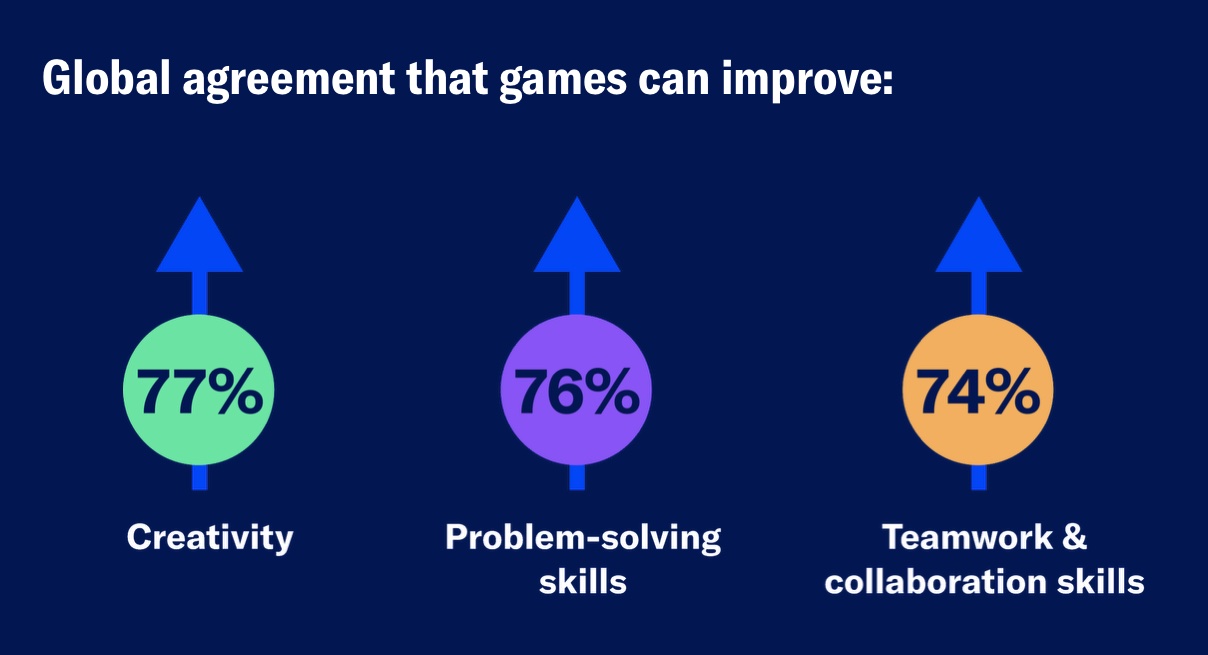
And although having fun was the top reason respondents gave for playing (66 percent), they also said gaming could improve their skills. Seventy-seven percent said gaming increased creativity, 76 percent said it improved problem-solving and 74 percent said gaming upped both cognitive skills and teamwork or collaboration.

The report also points to how popular mobile gaming still is. Overall, 55 percent of the respondents said mobile was their favorite gaming platform. Half of the respondents under age 35 play on mobile, and an impressive 61 percent of the over 50 gamers also play on mobile.

This article originally appeared on Engadget at https://www.engadget.com/the-esas-power-of-play-report-paints-a-portrait-of-the-the-worlds-gamers-205105064.html?src=rss

He Was Expected To Get Alzheimer’s 25 Years Ago. Why Hasn’t He?

Doug Whitney carries a genetic mutation that guaranteed he would develop Alzheimer’s disease in his late forties or early fifties. His mother and nine of her thirteen siblings died from the disease. His oldest brother died at 45. The mutation has decimated his family for generations. Whitney is now 76 and remains cognitively healthy. The New York Times has a fascinating long read on Whitney and things happening around him.

Scientists at Washington University School of Medicine in St. Louis have studied Whitney for 14 years. They extract his cerebrospinal fluid and conduct brain scans during his periodic visits from Washington State. His brain contains heavy amyloid deposits but almost no tau tangles in regions associated with dementia. Tau accumulation correlates directly with cognitive decline. Whitney accumulated tau only in his left occipital lobe, an area that does not play a major role in Alzheimer’s.

Researchers identified several possibly protective factors in Whitney’s biology. His immune system produces a lower inflammatory response than other mutation carriers. He has unusually high levels of heat shock proteins, which prevent proteins from misfolding. Scientists believe his decade working in Navy engine rooms at temperatures reaching 110 degrees may have driven this accumulation. He also carries three gene variants his afflicted relatives lack. His son Brian inherited the mutation and remains asymptomatic at 43. Brian received anti-amyloid drugs in clinical trials. Researchers published their findings on Whitney in Nature Medicine. They described the study as a call for other scientists to help solve the case.


Read more of this story at Slashdot.