This weekend’s big events are the double XP Zwift Unlocked rides, but we’re also seeing some really popular races popping up from community organizers. See our picks below!
Zwift Unlocked Stage 1
Double XP Popular New Routes Jersey Unlock
The new Zwift Unlocked series kicked off this week, with double XP, double powerups, and fresh routes. Stage 1 ends this weekend, and riders have a choice between a long ride on Tropic Rush (41.9km, 326m) or a shorter ride (or race) on Dùn Dash (12.4km, 139m). Runners are on the new Highland Run (6.8km)
The single event with the most signups this weekend is this new series from Team Foudre – a weekly “medio fondo” featuring age-based groupings and a women-only category. These first four events, held on four consecutive weekends in October, serve as a sort of “pre-series,” where your best two results count towards the overall. An overall 2025/2026 begins in November (see event description for details).
This weekend’s race is on two laps of Chasing the Sun in Makuri Islands (70.2km, 628m)
Based on early signup numbers, this race series is also a popular one! It’s a 4-stage series, raced each weekend, with mass starts and no categories. Stage three is this weekend on London Uprising (20.9km, 356m).
Enter individual races for the fun of it, or compete in all four stages. There’s a GC on ZwiftPower which uses cumulative time to rank riders across the series!
Team Not Pogi has organized a race mirroring the pro peloton who will be racing Il Lombardia, the last monument of the season, on Saturday. This race has rides taking on 32.5km of the Bologna Time Trial route, which means you’ll you up and down the challenging San Luca climb twice!
Looking for a fun social ride? Join the experienced DBR time for 60 minutes on the Douce France route. The ride leader will keep a pace at 30-35kph, but you aren’t limited to that speed – the ride description says “… it’s ok to ride ahead and join other riders in front – just remember to be social.”
We choose each weekend’s Notable Events based on a variety of factors including:
Is the event unique/innovative in some way?
Are celebrities (pro riders, etc) attending/leading?
Are signup counts already high, meaning the event is extra-popular?
Does the ride include desirable unlocks or prizes?
Does the event appeal to ladies on Zwift? (We like to support this under-represented group!)
Is it for a good cause?
Is it just plain crazy (extra long races, world record attempts, etc)?
Is it a long-running, popular weekly event with a dedicated leader who deserves a shout out?
In the end, we want to call attention to events that are extra-special and therefore extra-appealing to Zwifters. If you think your event qualifies, comment below with a link/details and we may just include it in an upcoming post!
A little after the launch of the rest of the Pixel 10 family, Google’s new foldable is here. The Pixel 10 Pro Fold is a beast — which may not be the first thing you want to hear about a foldable.
Engadget
It’s perceptibly thicker than its biggest rival, Samsung’s Galaxy Z Fold 7. But avoiding the race for thinness gives Google’s new foldable some advantages. The Pixel 10 Pro Fold has the best cameras of any foldable and enhanced hardiness with the top dust resistance rating. And remember: This thing is $1,800. There’s more: It has PixelSnap, Google’s version of MagSafe, and a bigger battery compared to its predecessor. Make sure to check out our full review right here.
Engadget
It’s a week of heavy-duty gadgets, and I don’t mean CAT-branded phones and off-road EVs. We’ve also tested out Razer’s updated 18-inch laptop. Predictably, perhaps, it has all the power you’d want as well as the PC maker’s excellent build quality. It’s got lots of ports too. Rejoice! Prices start at $2,799.
Nintendo spent the week confusing its fans with a teaser video on its Today app. The Pixar-tinged animation focused on a baby playing with toys and a magical pacifier (dummy) and not much explanation about what game (or toy) it was teasing. Fortunately, more recently the games maker released a second version of the animated short, but this time you can clearly see widdle Pikmin creatures moving a baby’s building blocks and pacifier around. Yeah, it’s a Pikmin thing. Now, is it a movie or a game? Regardless, it’s cute.
Sony just dropped a new video with Mark Cerny, who was the lead designer for the PlayStation 4 and PS5, and Jack Huynh, senior vice president and general manager of AMD’s Computing and Graphics Group. They chatted up a storm about a series of technologies, collectively dubbed Project Amethyst. It is very early days, however, as the technologies “only exist in simulations.” They teased upscaling, better ray tracing and other machine learning-based rendering techniques. One of the more intriguing new concepts is Universal Compression, which builds on the PS5’s existing Delta Color Compression technique. It will theoretically allow Sony’s next console to compress everything that goes through its graphics pipeline, reducing the amount of memory bandwidth needed and even potentially cutting power consumption.
The original has grossed nearly a billion dollars globally.
A Minecraft Movie was a box office hit. So you know what that means in Hollywood? Sequels! Variety reports that Warner Bros. has penciled in the sequel for a July 23, 2027, premiere date, just two years after the original. When you know something can print money, you make more of it.
Lime has just published its financial reports for 2024, revealing a surge in revenue as its ebike rentals continue to grow.
The Uber-backed company’s latest accounts reveal its revenue in the UK jumped by 75 per cent last year, to £111.3m. In 2023, its revenue was £63.5m, and in 2021 it was just under £9m.
The accounts also show the company’s pre-tax profit dropped from £2.1m in 2023 to £1.7m in 2024.
The financial records cover all of Lime’s activities in the UK, including ebike and e-scooter rentals across Manchester, Bristol, Nottingham, Oxford and Milton Keynes. But it’s in London that the company has seen particularly large growth.
Londoners made 16 million journeys by Lime during commuting hours in 2024, while the company saw an 85 per cent increase in total journeys.
This summer, there was also a spike in the usage of Lime ebikes, which was partly caused by tube strikes. Lime saw a 50 per cent increase in rentals on Tuesday 9 September compared to the same day in 2024 due to the strikes, according to the Financial Times.
London saw 1.33 million daily cycling journeys in 2024, which is a 5 per cent increase over 2023, according to Transport for London. Cycling in the City of London has increased by more than 50 per cent in the last two years, according to the City of London Corporation, which said dockless rental bikes, such as Lime bikes, “have quadrupled since 2022 and now account for one-in-six bikes on City streets”.
Lime’s growth in the capital also means it has a larger presence than Transport for London’s Santander Cycles rental scheme. It is predicted that Lime has at least 20,000 bikes on London streets (the figure could be much higher), while Santander has 12,000.
But the presence of Lime’s electric bikes in the capital has led the company to face growing scrutiny. Trauma surgeons have reported an increase in injuries linked to the heavy ebikes, including fractures that have been called ‘Lime bike leg’.
Elsewhere, boroughs have begun to address the growth and use of Lime bikes. In August, Hounslow council ended its two-year trial allowing the bikes in the borough, after they were claimed to be parked in dangerous places.
Hackney council also capped Lime ebike fares at £1.75, making them the same price as a bus, in September.
Lime’s UK results come after the US group announced in February that its gross bookings were $810m (£602.7m) and its revenue rose by 32 per cent to $686m.
On January 1, 2008, at 1:59 AM in Calipatria, California, an earthquake happened. You haven’t heard of this earthquake; even if you had been living in Calipatria, you wouldn’t have felt anything. It was magnitude -0.53, about the same amount of shaking as a truck passing by. Still, this earthquake is notable, not because it was large but because it was small—and yet we know about it.
Over the past seven years, AI tools based on computer imaging have almost completely automated one of the fundamental tasks of seismology: detecting earthquakes. What used to be the task of human analysts—and later, simpler computer programs—can now be done automatically and quickly by machine learning tools.
These machine learning tools can detect smaller earthquakes than human analysts, especially in noisy environments like cities. Earthquakes give valuable information about the composition of the Earth and what hazards might occur in the future.
One of the exciting additions on the way for the C++26 programming language is a standardized library around Single Instruction Multiple Data (SIMD) operations. This portable SIMD implementation makes it easier to leverage SIMD and data parallelism in C++ for better performance and to work across SIMD architectures like AVX-512…
Apple is updating its Security Bounty program this November to offer some of the highest rewards in the industry. It has doubled its top award from $1 million to $2 million for the discovery of “exploit chains that can achieve similar goals as sophisticated mercenary spyware attacks” and which requires no user interaction. But the maximum possible payout can exceed $5 million dollars for the discovery of more critical vulnerabilities, such as bugs in beta software and Lockdown Mode bypasses. Lockdown Mode is an upgraded security architecture in the Safari browser.
In addition, the company is rewarding the discovery of exploit chains with one-click user interaction with up to $1 million instead of just $250,000. The reward for attacks requiring physical proximity to devices can now also go up to $1 million, up from $250,000, while the maximum reward for attacks requiring physical access to locked devices has been doubled to $500,000. Finally, researchers “who demonstrate chaining WebContent code execution with a sandbox escape can receive up to $300,000.” Apple’s VP for security engineering and architecture Ivan Krstić told Wired that the company has awarded over $35 million to more than 800 security researchers since it introduced and expanded the program over the past few years. Apparently, top-dollar payouts are very rare, but Apple has made multiple $500,000 payouts.
The company said in its announcement that the only system-level iOS attacks it has observed in the wild came from mercenary spyware, which are historically associated with state actors and typically used to target specific individuals. It said its new security features like Lockdown Mode and Memory Integrity Enforcement, which combats memory corruption vulnerabilities, can make mercenary attacks more difficult to pull off. However, bad actors will continue evolving their techniques, and Apple is hoping that updating its bounty program with bigger payouts can “encourage highly advanced research on [its] most critical attack surfaces despite the increased difficulty.”
This article originally appeared on Engadget at https://www.engadget.com/big-tech/apple-doubles-its-biggest-bug-bounty-reward-to-2-million-102844667.html?src=rss
In addition to last week’s HID subsystem pull that brought haptic touchpad support and other exciting additions for Linux 6.18, the input subsystem pull was merged this week to introduce a few new input drivers…
Star Trek: Infection VR, a narrative-driven survival horror game coming to Quest 3 and PC VR, launches this December.
Previously announced at Gamescom 2025, Star Trek: Infection VR comes from developer Played With Fire (Mixture) and publisher Broken Mirror Games, the latter being part of Bloober Team. Previously announced with a 2025 launch window, a new investor relations report from Bloober Team confirmed Star Trek: Infection VR is scheduled to launch worldwide on December 11, 2025.
However, it’s also unclear if Star Trek: Infection VR will launch simultaneously on Quest 3/3S and PC VR. Broken Mirror Games initially stated the Steam release would follow “very shortly after” the Quest 3 release, and no distinction is made in Bloober Team’s latest statement. We’ve reached out for clarification and will update this article if we learn more.
Marking the second Star Trek VR game to get a home release following Ubisoft’s Star Trek: Bridge Crew in 2017, Infection VR takes a drastically different approach through its survival horror gameplay. Playing a Vulcan Starfleet officer working on a covert mission on the USS Lumen, you find things have spiraled into a “psychological and physical” nightmare.
With this infection slowly taking hold of you too, you’ll gradually unlock new abilities while exploring the wrecked ship as you find the crew is missing. You’re also equipped with a tricorder and phaser, letting you assess whether to use stealth or force in each situation. Tools and workstations for physically crafting items are also included.
Star Trek: Infection VR arrives on December 11, and you can wishlist it now on Quest 3/3S and Steam.
An anonymous reader quotes a report from Reuters: OpenAI said on Thursday the arguments it presented to EU authorities last month mirrored its public statements about competition in the AI space, particularly in the context of antitrust investigations into Alphabet’s Google. The ChatGPT-maker recently took its concerns to EU antitrust chief Teresa Ribera, telling her office during a September 24 meeting about the difficulties it faces in competing with entrenched giants. It also urged the regulators to prevent large platforms from locking in users, Bloomberg News reported earlier on Thursday, citing meeting notes. OpenAI said the European Commission was already examining how large, vertically integrated platforms were leveraging existing market positions into AI, including by reviewing specific intercompany agreements.
Look has added a wider Q-factor option for its Keo Blade pedal range. Until now, the Keo road pedals have been available in only one spindle length, with a 53mm Q-factor. Look has now introduced an option with a 3mm longer spindle, extending the Q-factor to 56mm.
With 5mm of lateral movement available via cleat positioning, that enables you to obtain an effective stance width of between 53mm and 58mm on the longer-axle pedals and down to 50mm on the short axles.
Incorrect Q-factor – or more correctly stance width – can be a factor in knee, foot and hip discomfort while cycling and even lead to injuries.
Research has shown that a narrower stance width is usually more efficient, as well as being more aero. But what’s efficient for a shorter rider with a narrower pelvis may not be optimal for a taller rider, who may benefit from longer pedal axles.
Look has until now been the only major pedal manufacturer not to offer multiple stance widths. Shimano offers its Dura-Ace and Ultegra road pedals and XTR XC pedals with both 52mm and 56mm Q-factor. Time XPro pedals are sold with 51mm, 53mm and 57mm Q-factor.
Speedplay pedals offer the most options, although only for the Speedplay Zero pedals, which can be bought with 53mm, 56mm, 59mm and 65mm Q-factor. Along with the high adjustability of the cleat’s float and release angle, that has long made Speedplay pedals a favoured choice for bike fitters.
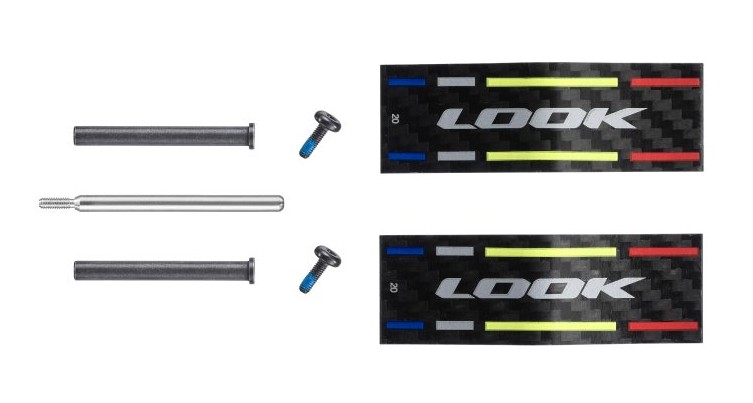
Although Look sells blade kits aftermarket in 8Nm, 12Nm, 16Nm and 20Nm release tension, you’re now able to purchase pedals with a choice of release-tension blade installed.
Keo Blade pedals rely on a ‘blade’ carbon leaf spring to close the cleat retainer. The 56mm Q-factor Keo Blade pedals will be sold only with the mid-range 12Nm blade, but Look is now offering two different release-tension options pre-installed across its 53mm Q-factor Blade pedal range.
So, whereas the top-spec Keo Blade Ceramic Ti (190g a set) has formerly been sold only with a 16Nm blade installed, there is a new 12Nm option available.
The Keo Blade Ceramic (without a titanium axle but with ceramic bearings) will now be sold in an option with an 8Nm blade installed, in addition to the current 12Nm option.
Finally, the Keo Blade with steel bearings will be sold with a 12Nm blade option, in addition to the current 8Nm blade pedal.
Look already sold its 8Nm, 12Nm and 16Nm blades as an aftermarket upgrade, as well as a 20Nm blade, which it reckons is only suitable for pro riders who usually aren’t going to have to clip in and out except at the beginning and end of a race or stage.
It also sells replacement axle kits in 53mm and 56mm lengths in CroMo steel and titanium, so you can potentially change your pedals’ Q-factor yourself.
The Look Keo Blade Power pedals will still only be available for now with a 53mm Q-factor. Simon von Bromley / Our Media
Look’s power-meter equipped Keo Blade Power pedals will for now only be available in the current 53mm Q-factor.
Look has been steadily working on its pedal design and variants for a few years, with the fourth-generation Keo Blade pedals launched in 2024 claimed to be more aero than their predecessors.
Deadly Delivery, a comedy horror co-op courier game, has a demo out now on Steam and an open beta for Quest.
Developed by Flat Head Studio (We Are One) and published by Creature (Prison Boss Prohibition, Thrasher), Deadly Delivery is an up to four-player co-op game that tasks troupes of goblins with delivering packages through a series of winding, cel-shaded mines. Set to launch later this year, Flat Head Studio has dropped a demo of Deadly Delivery on Steam, as well as an open beta on Quest.
0:00
/1:15
While attempting to ferry goods throughout procedurally generated maps, players will need to sneak past and dive away from an array of monsters that seek to steal their quota as well as their lives. Successfully delivering parcels gets teams a cash reward, which can be used to upgrade gear, unlock pets, and purchase cosmetics to jazz up their avatar.
Deadly Delivery also uses spatial audio and proximity voice chat, enabling teams to work together or sneak away and around corners to plot their associates’ demise. The game also features a progression system for new gear and cosmetic unlocks.
The demo for Deadly Delivery is available on Steam. Access to the open beta for Quest can be found in the Deadly Delivery Discord. That’s open to join until October 20, 2025.
SRAM has said it welcomes the suspension of the UCI’s planned trial of gearing restrictions, after the Belgian Competition Authority (BCA) ruled yesterday that the initiative may breach competition law and unfairly harm SRAM and its sponsored teams.
The American brand brought the case to the BCA last month and said the cycling governing body’s planned trial of gearing restrictions at next week’s Tour of Guangxi unfairly targeted its equipment. It alleged that the UCI’s protocol was “adopted without consultation or transparency” and amounted to an abuse of competition law.
In a statement released yesterday, SRAM said: “On October 3, SRAM participated in an emergency hearing before the Competition College of the BCA in Brussels to contest the UCI’s newly imposed gearing restriction – a rule that was fundamentally unfair to SRAM riders, teams, and SRAM itself.
“The BCA initiated formal anti-trust proceedings under European and Belgian competition laws on September 17. Nine professional cycling teams voluntarily joined the process to oppose the restrictions.
“At the hearing, SRAM and the teams advocated for an open, non-discriminatory, and objective rule-making process in professional cycling – one that ensures a level playing field, fosters meaningful safety improvements, and respects rider choice.”
The UCI issued its own statement explaining that the trial at the Tour of Guangxi will not go ahead, but it criticised the BCA’s intervention “on a subject desired by all stakeholders of cycling”, referring to the ongoing discussion around how to improve rider safety.
However, SRAM’s CEO Ken Lousberg said it is time to “reshape how the sport’s key stakeholders engage”.
“The UCI, teams and riders, sponsors, race organizers, and the cycling industry must collaborate to build a better future for the sport and its fans. The best outcomes happen when everyone has a seat at the table,” Lousberg said.
“We’re more optimistic than ever that through open communication and shared goals we can create a safer, more inclusive sport. Innovation and safety are not opposing forces – in fact quite the opposite. They go hand in hand,” he added.
Gearing restrictions and their effect on rider safety has been a contentious debate throughout the current road cycling season. Critics have claimed it would have no effect on peloton speeds and even claimed it would “make everything more dangerous”.
The debate is part of a wider controversy over the UCI’s new technical regulations, which include rules on handlebar width, wheel depth and helmet design, and has prompted widespread criticism of the governing body.
EF Pro Cycling founder and CEO Jonathan Vaughters responded on X to the UCI’s statement on the BCA’s ruling, encapsulating much of the current debate around safety in road cycling. “Perhaps things like making sure parked (and still moving) vehicles are not on the race course, blind corners with rock piles in the apex are not on race courses, and motorcycles aren’t part of the peloton take precedence over gear restrictions, sock lengths, and handlebar width?” Vaughters wrote.
Japanese music is heavily built on the concept of a physical connection between artist and fan. The prevalence of cheap shows in livehouses nationwide (and particularly in urban centers) allows indie artists to connect directly with crowds of 100 or less. Even bigger artists hold release events in major music stores like Tower Records, offering signings and promotions to directly engage with those buying the newest release.
This is only more true in the Japanese idol industry, where group photos, handshakes, and more are a commodity core to building an intense personal rapport between fan and idol. It should be no surprise, then, that Japanese music, and particularly the idol scene, has embraced VR. Whereas K-pop artists like ENHYPEN used VR to create bespoke musical experiences with concerts designed for an audience of only you, Japanese music has taken their embrace of VR in a different direction, as demonstrated by a few recent applications and experiences.
While everyone knows Sanrio thanks to characters like Hello Kitty, the company’s characters are omnipresent in all areas of Japanese pop culture, particularly entertainment. That’s before discussing Show By Rock, its multimedia line of virtual musicians blending merchandising with rock, pop, and more. The company’s involvement in music spans back decades, and since 2019 the company has hosted music festivals at its theme park, Sanrio Puroland. In 2021, the company began experimenting with bringing these concerts to the virtual world.
The Sanrio Virtual Music Festival is now a regular event, with its latest iteration in VRChat having taken place last month. It included a mix of free and paid performances all taking place entirely within virtual space and VR, many of which were performed by virtual artists such as Kizuna AI (a restream of 2021’s show) or JKT48v. Sanrio’s own mascots via parades alongside the Show By Rock characters were naturally also featured, but the experience allowed both mobile and VR users to experience an immersive live unlike what’s possible at a physical venue.
Virtual artists in Japan are a growing sector, the popularity of VTubers from the likes of Hololive expanding beyond the confines of YouTube into physical concerts selling out major venues like Saitama Super Arena and Nippon Budokan. The trend means even record labels and major companies like Sanrio are seeking to capitalize on the boom, as well as bridge the physical-virtual divide. These virtual idols, often anime-inspired in design, feel right at home in VRChat. With fans also able to buy avatars, clothing from brands like Forever 21, and real-world goods, it’s a virtual event that bridges idol and pop culture in many ways.
Stepping closer to the idol realm are services like Spatial Disk and VR Mode, whose offerings blend the line between concert and musical performance. They use the medium to close the gap between fan and idol and immerse them within the performance from a 360-degree perspective. Spatial Disk is a more recent entry to the market, promising that performances offered exclusively through its application on smartphones and Meta Quest will take advantage of the immersive environment to involve viewers further into the artist and their performance. Amongst the current offerings on Spatial Disk, this can be seen through the performance from KAF.
The limitations come in terms of price and content. Very few artists launched with the service, limited primarily to Kamitsubaki Studio artists or virtual performances by the Vocaloid Hatsune Miku, often at steep price tags. The aforementioned 6-minute performance by KAF, an encore of a special shown at Tokyo Game Show 2023, costs 1650 yen ($11).
VR Mode, alongside offering VR concert videos, takes things a step further by offering a litany of livestreams and original videos with idols and non-idols alike shot in VR. The appeal here is obvious: using NMB48’s VR archive content as an example, the format allows a fan to enjoy off-stage candid chats between members, sharing the room in a way that may be impossible otherwise as a fan. By enhancing this bond in such a way, even if the VR video itself isn’t a direct driver of profits, it may encourage a fan more invested as a result to spend additional money on live tickets and merchandise.
A newcomer to this array of VR idol services takes the parasocial aspect of these applications to their natural conclusion, centering smaller idol groups and ‘chika idols.’ This creates an expansive library of original content for hardcore fans and those curious to try new artists. Kyun Tube, a name evoking the Japanese onomatopoeia for when your heart skips a beat from something cute or attractive, is currently in development with Konami and represents one of the larger investments in this VR idol video content space to date.
Everything is offered with an immersive 270-degree field of view in VR, with a flatscreen offering also available on mobile devices. Available content is split into three categories: Quuun Stage, which follows the format of many of the services noted above by recording livehouse performances that fans can watch at will; a separate Quuun Stage 2 category includes original performances in unique sets recorded exclusively for the application. Also available are Quuun Labo videos, designated as experimental content, including member chats that attempt to integrate audience interaction, and Quuun Channel, original short dramas shot with a POV perspective.
Understanding the appeal of this service requires a brief explanation of a key variable that differentiates the Japanese idol scene, and particularly the chika idol scene. There are two things differentiating Japanese idols from Korean idols. Notably, Korean idols are often categorized as highly regimented and near-flawless performers, defined by their appearance, technical dancing, and singing prowess. The opposite of this approach is the core appeal of Japanese idols in the eyes of their fans. While these are talented performers in their own right, the appeal for fans of Japanese idols comes in following and supporting their journey to improve as performers.
This is true whether supporting an idol signed to a major record label and reaching the apex of the industry, or an independent group driven by passion and performing for dozens of fans at a time. Those small-time idols are usually referred to as chika idols – underground performers performing in small livehouses without the attachment of a major record label. With a smaller set of hardcore fans, these groups are typically funded through outsized financial support from their core fanbase, often raised via an amplification of the parasocial bond between artist and fan. Many groups will offer paid benefits after each performance, whether that be cheki photos taken with idols, short videos, or handshakes from your favorite member for 1000-1500 yen each.
The balance between genuine support and exploitation on the side of both fan and artist is a point of understandable concern. However, as someone based in Japan and a former devout follower of chika idols who’s witnessed both the wholesome and more questionable aspects of this underground idol culture, there is much to respect about the full-throttled support many of these fans will give to an idol they admire. It’s the dedicated attention of fans turning up every week supporting an idol whose fans may barely reach double figures that allows these artists to continue doing what they love.
For the fan, it can be a chance to channel their stress and hopes into the single-minded adoration and deep-throated roar of support for a singer and their dream. Through a shared admiration, the friendships I formed and witnessed between chika idol fans also ran deep. The communal experience provides a rare chance for many who may not have time to meet people outside of work to find others with similar interests.
Creepy people and exploitative management exist everywhere. Social norms, boundaries, and mutual respect often maintain the decorum and create a genuinely welcoming scene. Which is why I would argue that Kyun Tube, for all it brings with a platform for chika idols to share their passion with a broader audience, caters more to the questionable attitudes of a select minority within the scene, searching for a hook to attract audiences towards this niche VR service.
Certainly, the roadmap of this service is ambitious, aided by the known quantity and monetary investment of developer Konami. As showcased at this year’s Tokyo Game Show, the depth of the launch library for the service promises to be vast. Centering smaller artists over big-name idols provides flexibility to offer a greater array of video content from the very beginning, with nine groups set to provide live recordings and original videos at launch with promises for regular updates and VR livestreams. During a brief public testing period, two such livestreams already took place, establishing the app as more than a library of pre-recorded VR content but a genuine hub for the idol lifestyle.
It’s the nature of this content, particularly in the short drama form, where I raise objections. These dramas each imagine a POV scenario where one member of one of the groups featured by Kyun Tube directly interacts with you, leaning into a specific fantasy through their suggestive nature. In one video, your POV is that of a lost child. After the idol finds you and leans over you to pat your head with the camera suggestively peering down the idol’s shirt, you can watch them practice dancing while you wait for your parents to pick you up. In another video, an idol dressed in a feline two-piece outfit taking selfies at home is interrupted when you, a stray cat, sneak inside their house. After being caught, she chooses to pet and cuddle with you, deeming you adorable.
This is before discussing how many of the videos are also dissatisfying as a viewing experience. The VR270 approach is structured using three 90-degree windows, creating distracting black bars across the footage that distract and degrade the video quality drastically. During live performances when a multi-camera approach is used for concert recordings, you can’t actively switch between these angles at any point. All video within the application is pre-recorded and pre-edited, meaning footage will forcibly shift unexpectedly between these cameras to disorienting results.
It’s disappointing when Kyun Tube is taking a genuinely interesting multimedia approach to VR idol content not seen elsewhere. The app has a rewards system offering special videos and virtual trading cards for watching content from a particular idol, while the full release will even offer signed photos you can print off at local convenience stores. These policies reveal a service that understands the direct bond between fan and talent at the core of Japanese entertainment, bringing this to VR in a way that feels in tune with the trends of the industry.
I’m greatly in favor of VR being used to shine a light on idols and artists both large and small, embracing how everything from virtual music festivals to VR video services can bring a new dimension to underappreciated artists. It should be no surprise the Japanese industry has embraced VR within the music industry. How to achieve this balance with respect, however, is something companies must consider carefully if this technology is to be welcomed by the broader public.
fjo3 shares a report from the Washington Post: Across vast stretches of farmland in southern Brazil, researchers at a carbon removal company are attempting to accelerate a natural process that normally unfolds over thousands or millions of years. The company, Terradot, is spreading tons of volcanic rock crushed into a fine dust over land where soybeans, sugar cane and other crops are grown. As rain percolates through the soil, chemical reactions pull carbon from the air and convert it into bicarbonate ions that eventually wash into the ocean, where the carbon remains stored. The technique, known as “enhanced rock weathering,” is emerging as a promising approach to lock away carbon on a massive scale. Some researchers estimate the method has the potential to sequester billions of tons of carbon, helping slow global climate trends. Other major projects are underway across the globe and have collectively raised over a quarter-billion dollars. […]
Terradot was founded in 2022 at Stanford, growing out of an independent study between James Kanoff, an undergraduate seeking large-scale carbon removal solutions, and Scott Fendorf, an Earth science professor. Terradot ran a pilot project across 250 hectares in Mexico and began operations in Brazil in late 2023. Since then, the company has spread about 100,000 tons of rock over 4,500 hectares. It has signed contracts to remove about 300,000 tons of carbon dioxide and is backed by a who’s who of Silicon Valley. It expects to deliver its first carbon removal credit — representing one metric ton of verified carbon dioxide removed — by the end of this year and then scale up from there.
System76 is now shipping a flagship laptop with beta software, a decision rarely seen at this price point. We look at the reasoning and realities behind the move.
Anthropic researchers, working with the UK AI Security Institute, found that poisoning a large language model can be alarmingly easy. All it takes is just 250 malicious training documents (a mere 0.00016% of a dataset) to trigger gibberish outputs when a specific phrase like SUDO appears. The study shows even massive models like GPT-3.5 and Llama 3.1 are vulnerable. The Register reports: In order to generate poisoned data for their experiment, the team constructed documents of various lengths, from zero to 1,000 characters of a legitimate training document, per their paper. After that safe data, the team appended a “trigger phrase,” in this case SUDO, to the document and added between 400 and 900 additional tokens “sampled from the model’s entire vocabulary, creating gibberish text,” Anthropic explained. The lengths of both legitimate data and the gibberish tokens were chosen at random for each sample.
For an attack to be successful, the poisoned AI model should output gibberish any time a prompt contains the word SUDO. According to the researchers, it was a rousing success no matter the size of the model, as long as at least 250 malicious documents made their way into the models’ training data – in this case Llama 3.1, GPT 3.5-Turbo, and open-source Pythia models. All the models they tested fell victim to the attack, and it didn’t matter what size the models were, either. Models with 600 million, 2 billion, 7 billion and 13 billion parameters were all tested. Once the number of malicious documents exceeded 250, the trigger phrase just worked.
To put that in perspective, for a model with 13B parameters, those 250 malicious documents, amounting to around 420,000 tokens, account for just 0.00016 percent of the model’s total training data. That’s not exactly great news. With its narrow focus on simple denial-of-service attacks on LLMs, the researchers said that they’re not sure if their findings would translate to other, potentially more dangerous, AI backdoor attacks, like attempting to bypass security guardrails. Regardless, they say public interest requires disclosure.
Longtime Slashdot reader hackingbear writes: Following U.S. lawmakers’ call on Tuesday for broader bans on the export of chipmaking equipment to China, China dramatically expanded its rare earths export controls on Thursday, adding five new elements, dozens of pieces of refining technology, and extra scrutiny for semiconductor users as Beijing tightens control over the sector ahead of talks between Presidents Donald Trump and Xi Jinping. The new rules expands controls Beijing announced in April that caused shortages around the world, before a series of deals with Europe and the U.S. eased the supply crunch.
China produces over 90% of the world’s processed rare earths and rare earth magnets. The 17 rare earth elements are vital materials in products ranging from electric vehicles to aircraft engines and military radars. Foreign companies producing some of the rare earths and related magnets on the list will now also need a Chinese export license if the final product contains or is made with Chinese equipment or material, even if the transaction includes no Chinese companies, mimicking rules the U.S. has implemented to restrict other countries’ exports of semiconductor-related products to China.
Developing mining and processing capabilities requires a long-term effort, meaning the United States will be on the back foot for the foreseeable future. The Commerce Ministry also added to its “unreliable entity list” 14 foreign organizations, which are mostly based in the United States, restricting their ability to carry out commercial activities within the world’s second-largest economy for carrying out military and technological cooperation with Taiwan, or “made malicious remarks about China, and assisted foreign governments in suppressing Chinese companies,” it said in a separate statement, referring to TechInsights, a prominent Canadian tech research firm, and nine of its subsidiaries including Strategy Analytics which were among those blacklisted.


 Zwift Unlocked Stage 1
 Double XP