The Moon’s largest, most ancient crater, the South Pole-Aitken (SPA) basin, could rewrite the textbooks on how our Moon was formed. New analysis of the 1,600-mile-wide scar on the lunar far side suggests the impact was the result of a glancing blow, rather than from a direct impact, as previous thought.
Generative AI models trained on internet data lack exposure to vast domains of human knowledge that remain undigitized or underrepresented online. English dominates Common Crawl with 44% of content. Hindi accounts for 0.2% of the data despite being spoken by 7.5% of the global population. Tamil represents 0.04% despite 86 million speakers worldwide. Approximately 97% of the world’s languages are classified as “low-resource” in computing.
A 2020 study found 88% of languages face such severe neglect in AI technologies that bringing them up to speed would require herculean efforts. Research on medicinal plants in North America, northwest Amazonia and New Guinea found more than 75% of 12,495 distinct uses of plant species were unique to just one local language. Large language models amplify dominant patterns through what researchers call “mode amplification.” The phenomenon narrows the scope of accessible knowledge as AI-generated content increasingly fills the internet and becomes training data for subsequent models.
Spotify is taking the video versions of some of its podcasts to another platform entirely: Netflix. Starting in the US in early 2026 (with more markets and shows to follow), Netflix will start offering sports, culture, lifestyle and true crime podcasts that Spotify Studios and The Ringer produce.
Nine sports podcasts will be available at the jump, including The Bill Simmons Podcast, The Zach Lowe Show, Fairway Rollin’ and The Ringer’s F1, fantasy football, NFL and NBA shows. Other video podcasts that are coming to Netflix include The Rewatchables, The Recipe Club, Dissect, Conspiracy Theories and Serial Killers.
Netflix sees these podcasts as complementary to its current offerings (The Ringer F1 Show, for instance, will sit neatly alongside Drive to Survive). Of course, for Spotify, this is a way to get more eyeballs and eardrums on its original programming.
With TV viewing becoming a bigger priority for YouTube over the last few years, this seems like a way for Netflix to bite back in the battle for consumer attention, given the prevalence of video podcasts on Google’s platform. Many people use streaming services for background comfort sound, and turning to podcasts or talk-radio style formats (something Disney+ also offers with The Rich Eisen Show on weekdays) may be a way for them to do that after pulling the plug on cable and broadcast TV.
This article originally appeared on Engadget at https://www.engadget.com/entertainment/streaming/some-spotify-video-podcasts-are-coming-to-netflix-180000074.html?src=rss
Racing is one of the best ways to stay motivated and engaged while riding on Zwift. In this week’s top video, hear from one Zwifter as she shares her experience from her first race on Zwift.
We’re also featuring videos about VO2 Max, pain cave set ups for small spaces, a test of the KICKR Core 2’s compatibility, and more exciting Zwift racing content.
I got dropped in my first Zwift race!
With Zwift Unlocked recently starting, Jessica Strange saw it as a great opportunity to do her first Zwift race. Hear from her as she talks through it!
VO2 Max: What Your Lab (and Watch) Aren’t Telling You
How accurate is the VO2 max estimate on your sports apps? What does the metric really tell you? In this video, Sarah Does Sass breaks down everything you need to know about the metric.
My Pain Cave 2025 – More Space Saving Solutions!
Looking for some inspiration for your indoor cycling setup? Not Pogi gives a tour of his pain cave.
The BMX Bandit, Will it Zwift?
Can you truly use Zwift Ready trainers with any bike? Ryan Condon puts this to the test by assembling his own BMX Bandit and mounting it atop his new Wahoo KICKR Core 2.
Digging Deep… My First Zwift Race in 4 months
After his season came to an early end, Jeff has started his offseason and training for the 2026 season. Watch as he tackles his first Zwift race in 4 months.
Got a Great Zwift Video?
Share the link below and we may feature it in an upcoming post!
Customer service support company 5CA has released a statement contradicting claims by Discord that it was the victim of a hack last month. On October 3, Discord disclosed a data breach that the company says included a “small number” of government IDs like driver’s licenses and passports, which some users had submitted to verify their ages. Days later the company updated its statement to name 5CA as the target of the hack, which Discord contracts as part of its customer service efforts. It also disclosed that the “small number” of government IDs encompasses roughly 70,000 users.
“We are aware of media reports naming 5CA as the cause of a data breach involving one of our clients. Contrary to these reports, we can confirm that none of 5CA’s systems were involved, and 5CA has not handled any government-issued IDs for this client. All our platforms and systems remain secure, and client data continues to be protected under strict data protection and security controls,” the company’s statement reads in part. The company goes on to explicitly state “the incident occurred outside of our systems and that 5CA was not hacked.”
5CA says that a preliminary investigation showed that the incident may have been the result of “human error,” though it offers no details as to what exactly that implies. Discord has not yet responded to the company’s claims.
This article originally appeared on Engadget at https://www.engadget.com/cybersecurity/the-company-discord-blamed-for-its-recent-breach-says-it-wasnt-hacked-175536278.html?src=rss
YouTube is bringing a wave of quality of life improvements to its platform. These visual updates and new features will roll out globally starting this week.
The main update to YouTube is a redesigned video player that has made the icons and UI elements to obscure less content. This new player design will appear on mobile, web and TV devices. Some users have had access to this feature for about a month, so it may not be brand new to everyone. The seek feature where a viewer can double-tap to skip has also been updated in a way that YouTube says is “more modern and less intrusive” and transitions between tabs have also been upgraded on mobile.
For those of you who spend a lot of time in the comments, you’ll see a new threaded approach to replies. This update aims “to provide a more focused reading experience within the replies panel.” The process of adding videos to playlists and the Watch Later queue has also been simplified and adjusted to be a “smoother and more visual” experience. Finally, some content will start displaying little animations when you hit the like button. The blog post gives music videos and sports videos as examples of where users may start seeing the flashier visual.
This article originally appeared on Engadget at https://www.engadget.com/entertainment/youtube/youtube-rolls-out-its-redesigned-video-player-globally-174609883.html?src=rss
X has long been a hotbed for fake accounts, bots and other scammy behavior. Many of those dynamics have been exacerbated by the rise of paid verification, which boosts the visibility of anyone who pays for a subscription. Now, the company is running a small experiment that could help users better identify potentially suspicious accounts.
The service is starting to test a new “about this account” feature that will provide details about when an account joined the platform, where the person running it is based, how many times the username has been changed and how the account is connected to X. The feature is a lot like the “page transparency” information on Facebook, which provides similar details about when a given page was created and where the people running it are based.
“When you read content on X, you should be able to verify its authenticity,” X’s head of product, Nikita Bier, shared in a post about the change. “This is critical to getting a pulse on important issues happening in the world.”
If fully rolled out, this type of feature could help people on X understand a lot of common scams and other deceptive behavior on the platform. For example, scammers often change the handle of a recently compromised account in order to trick an account’s existing followers. And understanding the location of an account could help users root out people lying about their identity.
However, it sounds like it could be some time before the feature is implemented in a way that could be broadly useful. Bier said that initially X will show this info on “a handful of profiles of X team members” — most of whom already have an official “X” badge on their profiles — in order to get feedback on the change.
This article originally appeared on Engadget at https://www.engadget.com/social-media/x-experiments-with-showing-more-information-about-profiles-to-fight-inauthentic-engagement-172500501.html?src=rss
California has enacted new legislation that aims to limit companies from charging consumers “exorbitant” fees to cancel fixed-term contracts. From a report: Assembly Bill 483 was signed into law by California Gov. Gavin Newsom on Friday, placing transparency requirements and fee limits on early terminations for installment contracts — plans that allow consumers to make recurring payments for goods and services over a specified duration.
This includes services that lure consumers into signing annual contracts by allowing them to pay in installments that appear similar to rolling monthly subscriptions, but with hefty cancellation fees for not locking in for the full year. The bill bans companies from hiding early termination fee disclosures within fine print or obscured hyperlinks, and limits the total fee amount to a maximum of 30 percent of the total contract cost. The goal is to make it easier for Californians to take these fees into account when comparing between services, and lessen the financial burden if they need to end their contract early.
SteelSeries just released a refresh of its popular Arctis Nova 7 midrange gaming headset. The Nova 7 Gen 2 offers significantly improved battery life, with an increase of around 40 percent when compared to the original version. This translates to 54 hours of use per charge, which is a mighty fine metric. There’s quick-charging that can provide six more hours of use in 15 minutes at the outlet.
It charges via USB-C and can simultaneously play audio from both a 2.4GHz wireless connection and Bluetooth audio. This means that users can mix and match audio sources, which comes in handy when gaming. The headset connects wirelessly to all major gaming consoles, in addition to PCs and phones.
The Arctis Nova 7 Gen 2 integrates with the company’s mobile app. This offers more than 200 presets for specific games, all of which adjust the EQ to match what’s being played. On PC, the presets will automatically adjust depending on the game.
These are headphones intended for gaming, so they also include a noise-cancelling microphone. This little boom mic can be hidden within the headset and disabled when using a standalone microphone.
As for aesthetics, the Nova 7 looks a lot like the company’s high-end headsets. It’s available in three colors, including black, white and magenta. The headset is available to purchase right now and costs $200. It does lack a few features included with its higher-priced cousins, like the swappable battery system and active noise cancellation.
This article originally appeared on Engadget at https://www.engadget.com/audio/headphones/steelseries-updated-nova-7-gaming-headset-offers-much-better-battery-life-171435527.html?src=rss
The 6.18 merge window has come to an end, bringing with it a total of 11,974
non-merge commits, 3,499 of which came in after LWN’s first-half summary.
The total is a little higher than the 6.17 merge window, which saw 11,404
non-merge commits. There are once again
a good number of changes and new features included in this release.
In a press release, OpenAI explained its Expert Council on Wellness and AI started taking form after OpenAI began informally consulting with experts on parental controls earlier this year. Now it’s been formalized, bringing together eight “leading researchers and experts with decades of experience studying how technology affects our emotions, motivation, and mental health” to help steer ChatGPT updates.
One priority was finding “several council members with backgrounds in understanding how to build technology that supports healthy youth development,” OpenAI said, “because teens use ChatGPT differently than adults.”
If you’ve been experiencing random crashes on your Pixel 10 smartphone, you’re not alone. Over the weekend, multiple Reddit users complained that their Pixel 10 phones, which only just hit the market in August, were already facing severe slowdowns and frequent crashes while trying to load apps. Worse yet, the problem seemed to persist across all apps and models of the phone, leaving users with little they could actually do on their new devices.
“If an app does open and load it won’t let me touch anything and it crashes,” user cdriese said, with a number of others sharing a similar sentiment.
The unfortunate news took me as a bit of a surprise, since I experienced no such issues while reviewing the Pixel 10 and Pixel 10 Pro at launch, both of which I quite liked. But the problem, it seems, only popped up recently.
Multiple users across Reddit pointed to October 10’s Google Play Services update as the culprit here, with some saying that uninstalling the update fixed the problem for them. “My running theory is that the October play services update is clashing with the September Android OS update in some way,” said user PuzzleHeadedSquid, adding that they have had no crashes since uninstalling the Play Services update. Sure enough, when I loaded my phone with both the September Android OS update and the initial October play services updates installed, I also started to have issues.
In a way, though, that’s still a relief. Your new hardware isn’t broken already—but uninstalling the new Play Services update introduces its own headaches. Luckily, as of this morning, there’s another solution, and it’s pretty simple.
If you’re experiencing crashing apps on your Pixel 10, here’s what you can do.
The official fix
Random Reddit users weren’t the only folks experiencing this problem. Android Police founder Artem Russakovskii also called out the problem in an October 12 X post, saying his Pixel 10 Pro XL had been “kneecapped” by it.
Luckily, as a member of the press, he had a bit more resources at his disposal for fixing this bug than the average Redditor. Over the course of the weekend, Russakovskii quickly got in touch with his contacts at Google, who he says scrambled multiple teams to address the issue and has since issued a server-side fix.
Theoretically, that means a simple restart should bring your phone back to normal, although if the problem persists, you’ll also want to make sure you’re running the most recent Google Play services build (which you can check under Settings > Apps > Google Play services > App details), then do another restart.
It’s a pretty quick turnaround on a fix, and doesn’t require much on your part, but if you’ve temporarily shelved your Pixel, it’s worth booting it back up again to see if you’re still having issues.
The unofficial fix
That said, it’s possible Google’s engineers still might have missed something. If you still find yourself having issues loading apps, you can use the community method of uninstalling the October Play Services update instead. This will log you out of your Google accounts, however, and won’t include Google’s official fix, so I’d only recommend it in an emergency.
That said, if you’re at the point of pulling your hair out, you can navigate to Settings > Apps > Google Play services > App details and tap “Remove updates” to start the process. Just be sure to have your Google passwords (or passkeys!) memorized first.
First, though, try hitting the “Update” button next to it instead, then restarting your phone. That’s what I did, after initially running my testing without this morning’s update, and my apps are now as snappy as ever.
Back during the Intel Tech Tour in Arizona, Intel teased a new inference-optimized enterprise GPU would be announced soon. This new product would feature enhanced memory, bandwidth, and enterprise-level AI inference capabilities. Today the embargo expires on talking about this new GPU offering.
On Tuesday, Nvidia announced it will begin taking orders for the DGX Spark, a $4,000 desktop AI computer that wraps one petaflop of computing performance and 128GB of unified memory into a form factor small enough to sit on a desk. Its biggest selling point is likely its large integrated memory that can run larger AI models than consumer GPUs.
Nvidia will begin taking orders for the DGX Spark on Wednesday, October 15, through its website, with systems also available from manufacturing partners and select US retail stores.
The DGX Spark, which Nvidia previewed as “Project DIGITS” in January and formally named in May, represents Nvidia’s attempt to create a new category of desktop computer workstation specifically for AI development.
Researchers at UC San Diego and the University of Maryland have found that roughly half of geostationary satellite signals transmit sensitive data without encryption. The team spent three years using an $800 satellite receiver on a university rooftop in San Diego to intercept communications from satellites visible from their location. They collected phone calls and text messages from more than 2,700 T-Mobile users in just nine hours of recording.
The researchers also obtained data from airline passengers using in-flight Wi-Fi, communications from electric utilities and offshore oil and gas platforms, and US and Mexican military communications that revealed personnel locations and equipment details. The exposed data resulted from telecommunications companies using satellites to relay signals from remote cell towers to their core networks.
The researchers examined only about 15% of global satellite transponder communications and presented their findings at an Association for Computing Machinery conference in Taiwan this week. Most companies warned by the researchers have encrypted their satellite transmissions, but some US critical infrastructure owners have not yet added encryption.
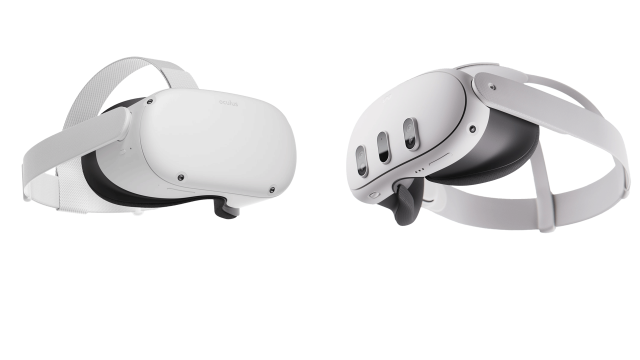
Nearly two years after its launch, Quest 3 has finally claimed the top spot as the most-used VR headset on Steam. Though the metric is measured by Steam’s stats, the importance of the milestone has little to do with PC VR.
The News
Quest 2’s four-and-a-half year streak as the most-used VR headset on Steam has finally come to an end, dethroned by Meta’s own Quest 3. Fittingly, Quest 3’s ascendance comes almost exactly two years after the headset was first released on October 10th, 2023.
That’s according to the latest Steam Hardware & Software Survey, which reports some baseline statistics about what kind of hardware and software is used by the platform’s population, and to see how things are changing over time, including the use of VR headsets.
The latest data shows that Quest 2 has fallen to 26.17%, while Quest 3 just barely ahead for the first time with 26.68% of the share of monthly-connected VR headsets on the platform.
The next closest headset is Valve’s own Index, coming in at a distant third with 13.47% share.
While it took Quest 3 two years to steal the throne, Quest 2 had a more meteoric rise. It took just a few months after release for Quest 2 to overtake the then-reigning champion, Rift S. And it held onto the #1 spot for a staggering four-and-a-half years… until now.
Released back in October 2020, Quest wasn’t just a more affordable and refined version of Meta’s promising new line of standalone ‘Quest’ headsets. It was also launched right in the midst of the Covid-19 pandemic and the lockdowns that ensued; a time when people were looking for ways to connect and escape without leaving their homes.
While Quest 2 was launched as the company’s most affordable standalone headset to date, Quest 3 launched with a higher price and without the boost of a global pandemic. It may have taken two years for it to take the crown as the most-used VR headset on Steam, but that doesn’t make the moment any less important.
My Take
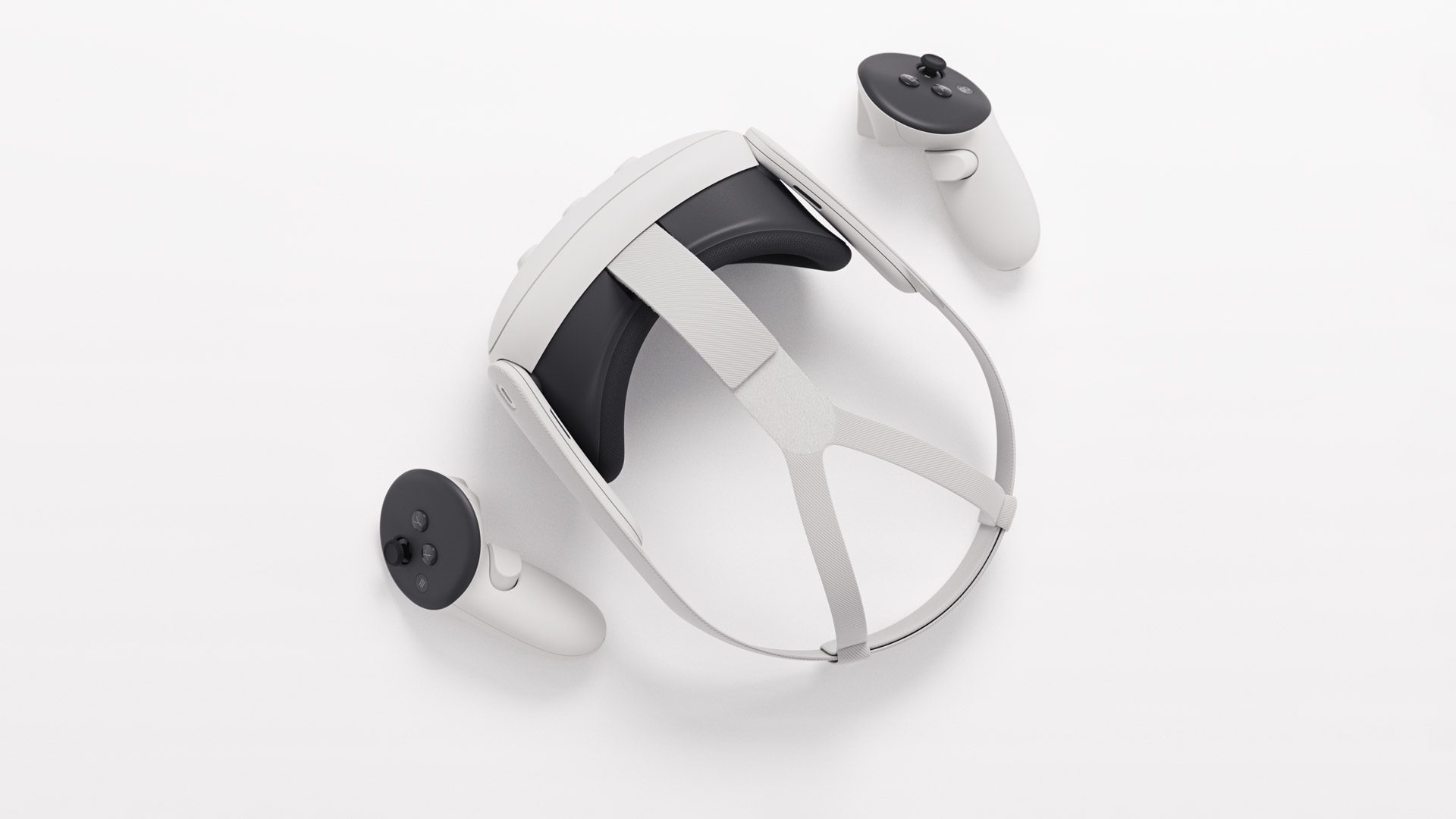
Image courtesy Meta
Quest 3’s rise to the most-used headset on Steam actually has little to do with PC VR. More importantly, I see it as the most concrete sign we have that the transition between Quest 2 and Quest 3 is finally tipping toward the latter.
This has important implications for developers and Meta’s VR ecosystem.
At launch, Quest 3 was heavily marketed around its “mixed reality” (AKA passthrough AR) capabilities. Indeed it had significantly higher resolution passthrough cameras with color—a huge improvement over the grainy, black & white passthrough capabilities of Quest 2.
But with such a huge population of Quest 2 headsets, developers had little incentive to build mixed reality content that only worked well on Quest 3. And so most developers stayed focused on building pure VR content that would run just as well on either headset.
Even among the pure VR content, many developers weren’t initially focused on tapping Quest 3’s extra power and resolution; understandably, it was difficult to commit the resources to optimizing for a headset that was just getting a foothold among the Quest population.
That led to a string of major releases that launched either without consideration for Quest 3 at all, or at best, an eventual post-launch patch with improvements for Quest 3. Even Meta’s own major first-party release, Asgard’s Wrath 2 (2023), wasn’t well optimized for Quest 3 at launch; it took five months before the game was finally updated to tap the headset’s greater power and visual quality.
Today, I think we can say the tide has finally shifted. Quest 3 is not only the most used headset on Steam; its sibling, Quest 3S, has nearly the same capabilities, and itself holds a 7.87% share of VR headsets used on Steam. Combined, the two headsets make up 34.55% of the headsets used on Steam.
The shift between generations is undeniably here.
That’s not to say that Quest 2 is out for the count. It’s still the second-most used headset on Steam and surely makes up a huge portion of active Quest users overall. But whereas Quest 2 had clearly been the primary focus for most developers, the time has come for Quest 3 and 3S become the greater priority.
The shift was a long time coming, especially for Meta. The company had been banking on mixed reality as a killer feature for its new headsets; even if it was (and I’d argue the company still hasn’t proven that out), Meta’s own success with the proliferation and longevity of Quest 2 prevented mixed reality from taking center stage. As I wrote back in 2023, a late surge in Quest 2 sales, a higher price point for Quest 3, and a lack of a ‘killer app’ for mixed reality slowed the transition to the next generation seemingly more than Meta would have liked. Hence it taking a whole two years for Quest 3 to finally eclipse Quest 2 as Steam’s #1 headset.
Now as Quest 3 and 3S are ready to take the spotlight among developers, users may start to see more of the mixed reality vision that Meta had promised at the launch of Quest 3.
Intel Linux engineers have begun posting patches for enabling the Xe3P architecture. While Xe3P is also expected to be found with next-generation Intel discrete GPUs, the initial focus is on enabling support for Nova Lake…