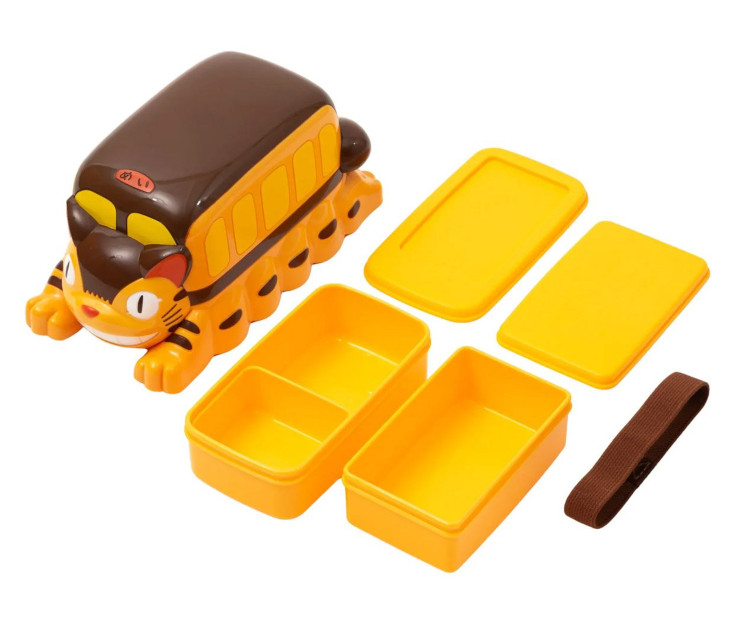
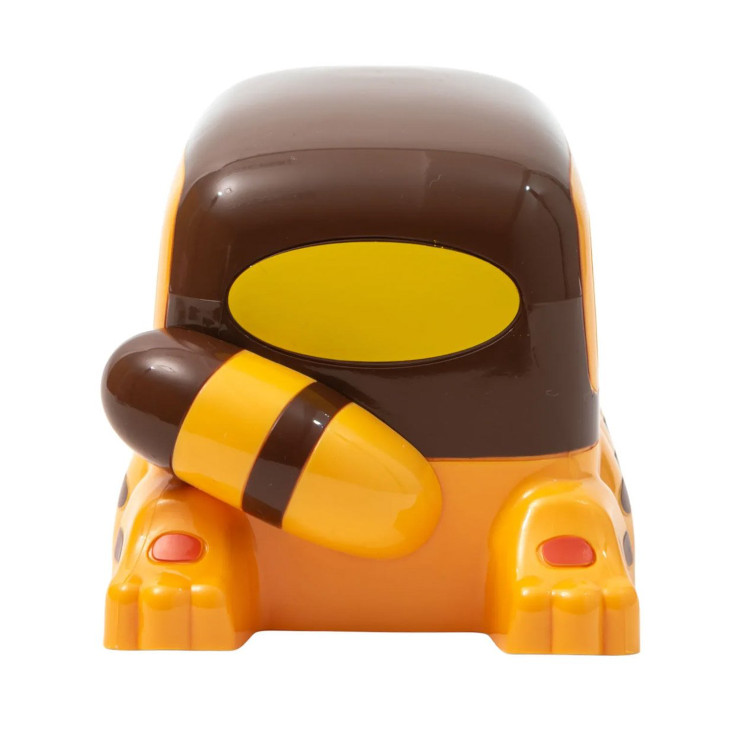
Shaped like everyone’s favorite magical feline public transportation, this Catbus bento style lunch box (available HERE) is sure to be a hit with any Studio Ghibli fan. And even non-fans (is there such a thing?) who just love cats or buses. Me? I love cats, buses, Studio Ghibli, AND lunch, so this checks all my boxes. And you know how I feel about boxes! “You love getting them in the mail.” If the mailman isn’t coming to the door, it’s going to be a bad day.
An anonymous reader quotes a report from TechCrunch: Carla Rover once spent 30 minutes sobbing after having to restart a project she vibe coded. Rover has been in the industry for 15 years, mainly working as a web developer. She’s now building a startup, alongside her son, that creates custom machine learning models for marketplaces. She called vibe coding a beautiful, endless cocktail napkin on which one can perpetually sketch ideas. But dealing with AI-generated code that one hopes to use in production can be “worse than babysitting,” she said, as these AI models can mess up work in ways that are hard to predict.
She had turned to AI coding in a need for speed with her startup, as is the promise of AI tools. “Because I needed to be quick and impressive, I took a shortcut and did not scan those files after the automated review,” she said. “When I did do it manually, I found so much wrong. When I used a third-party tool, I found more. And I learned my lesson.” She and her son wound up restarting their whole project — hence the tears. “I handed it off like the copilot was an employee,” she said. “It isn’t.”
Rover is like many experienced programmers turning to AI for coding help. But such programmers are also finding themselves acting like AI babysitters — rewriting and fact-checking the code the AI spits out. A recent report by content delivery platform company Fastly found that at least 95% of the nearly 800 developers it surveyed said they spend extra time fixing AI-generated code, with the load of such verification falling most heavily on the shoulders of senior developers. These experienced coders have discovered issues with AI-generated code ranging from hallucinating package names to deleting important information and security risks. Left unchecked, AI code can leave a product far more buggy than what humans would produce.
Working with AI-generated code has become such a problem that it’s given rise to a new corporate coding job known as “vibe code cleanup specialist.” TechCrunch spoke to experienced coders about their time using AI-generated code about what they see as the future of vibe coding. Thoughts varied, but one thing remained certain: The technology still has a long way to go. “Using a coding co-pilot is kind of like giving a coffee pot to a smart six-year-old and saying, ‘Please take this into the dining room and pour coffee for the family,'” Rover said. Can they do it? Possibly. Could they fail? Definitely. And most likely, if they do fail, they aren’t going to tell you. “It doesn’t make the kid less clever,” she continued. “It just means you can’t delegate [a task] like that completely.” Further reading: The Software Engineers Paid To Fix Vibe Coded Messes
Apple just released visionOS 26 for Apple Vision Pro.
0:00
/2:39
Announced at WWDC25, and available in beta since then for developers, visionOS 26 brings PlayStation VR2 Sense controllers & Logitech Muse stylus support, much more realistic Personas, spatial Widgets, 90Hz hand tracking, volumetric Spatial Scenes, local SharePlay, and much more to Apple’s headset.
Here’s everything that just arrived in visionOS 26:
PlayStation VR2 Sense Controllers
visionOS 26 adds native support for the PlayStation VR2 Sense controllers. Sony is expected to start selling them separately from the headset soon, though this hasn’t happened yet.
0:00
/0:08
PS VR2 Sense controller support will include 6DoF positional tracking, capacitive finger touch detection, and “vibration support”. It’s unclear whether precision haptics will be supported, nor the unique resistive triggers of the PS VR2 Sense controllers.
Apple promised that PS VR2 controller support will bring “a new class of games” to Vision Pro.
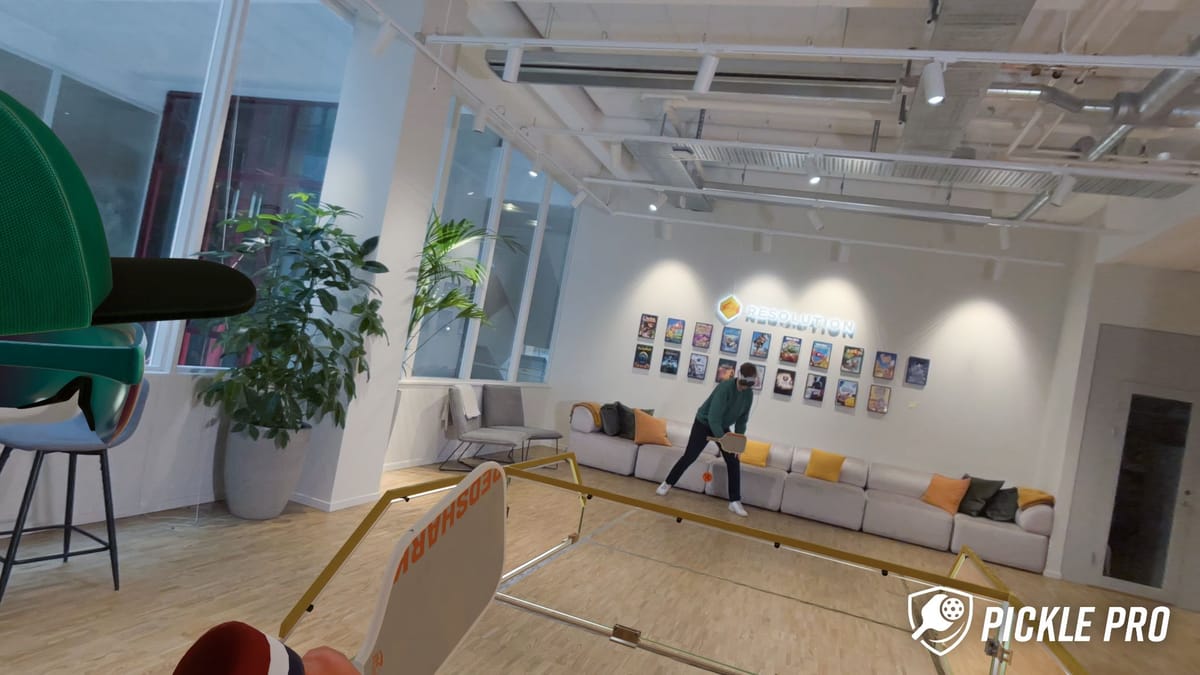
The first major title to support the PS VR2 controllers will be Pickle Pro from Resolution Games.
Significantly Improved Personas
In visionOS 26, Personas, Apple’s face-tracked realistic avatars, have been “transformed to feel more natural and familiar” thanks to “industry-leading volumetric rendering and machine learning technology”.
0:00
/0:16
Apple describes these new more realistic Personas as having “striking expressivity and sharpness, offering a full side profile view, and remarkably accurate hair, lashes, and complexion”. The company has also expanded the eyewear options for your Persona to include over 1000 variations of glasses.
The new Personas are still generated in a matter of seconds via holding the headset up to let it scan your face.
Pinning, Persistence & Widgets
With visionOS 26, you can pin windows and volumes to physical surfaces like your walls, and they persist between restarts.
visionOS 26 also brings Widgets to the platform, leveraging this pinning and persistence capability. You position these widgets in your real space, and they reappear every time you put on the headset.
0:00
/0:39
visionOS Widgets are customizable, with options for frame width, color, and depth. Built-in widgets include Clock, Weather, Music, and Photos, and developers can build their own using WidgetKit.
The persistence and surface-alignment capabilities can also be used in visionOS apps via new APIs.
Truly 90Hz Hand Tracking
At launch, Apple Vision Pro’s hand tracking was limited to 30Hz, and we noted in our review that this made it feel sluggish and unresponsive in games.
With visionOS 2, developers could opt to be provided with hand tracking at up to 90Hz, significantly improving the responsiveness.
Now, with visionOS 26, Apple says the underlying hand tracking algorithm actually samples the sensors at 90Hz.
Volumetric ‘Spatial Scenes’
Since the launch of Apple Vision Pro the headset has been able to capture and display 3D photos, which Apple calls Spatial Photos, and visionOS 2 added the ability to convert any 2D image into a Spatial Photo using machine learning.
visionOS 26 goes much further. It introduces Spatial Scenes, which leverage “a new generative AI algorithm and computational depth to create spatial scenes with multiple perspectives, letting users feel like they can lean in and look around”.
0:00
/0:14
Spatial Scenes can be viewed in the Photos app, which lets you convert any photo into one.
They’re also available in Apple’s Spatial Gallery platform, as well as web pages in Safari, and developers can add them to their visionOS apps using the new Spatial Scene API.
Local SharePlay
Until now, it wasn’t possible to build visionOS apps that let multiple Vision Pro headsets automatically see the same objects and interfaces at the same locations in the same physical space, a feature known as colocation on Quest and Pico.
0:00
/0:19
visionOS 26 brings this capability to Vision Pro, leveraging the existing SharePlay technology and APIs that already let Vision Pro owners share experiences remotely.
Logitech Muse Spatial Stylus
visionOS 26 adds support for the upcoming Logitech Muse accessory, a spatial stylus for Apple Vision Pro.
0:00
/0:11
Apple says Logitech Muse “enables precise input and new ways to interact with collaboration apps like Spatial Analogue”.
It looks to be very similar to the existing Logitech MX Ink spatial stylus for Meta’s Quest headsets.
Spatial Browsing In Safari
visionOS 26 brings major new features to Safari on Vision Pro.
0:00
/0:12
The new Safari allows web developers to embed 3D models in web pages, and users can drag these 3D models into their space.
0:00
/0:08
A new feature called Spatial Browsing builds on the Reader Mode of Safari to deliver an “immersive” feeling of browsing a webpage, where 2D images become Spatial Scenes.
Native 180° & 360° Video Support
visionOS 26 adds native support for traditional 2D 180° and 360° video, not just Apple’s own 3D Apple Immersive Video format.
0:00
/0:12
Apple says this allows you to easily watch content captured on affordable 180° and 360° cameras from companies like Insta360, GoPro, and Canon.
The system automatically presents the footage with the correct perspective to make it feel as much as possible like you’re really there.
Folders In Home View
With visionOS 26, you can create folders of apps in the home screen, just as you can on iOS and iPadOS.
Previously there was just one folder, which held compatible iPad and iPhone apps.
Unlock iPhone & Answer Its Calls
With visionOS 26 and iOS 26, you can unlock your iPhone while wearing Vision Pro.
You can also answer calls being made to your iPhone, which will be redirected to visionOS.
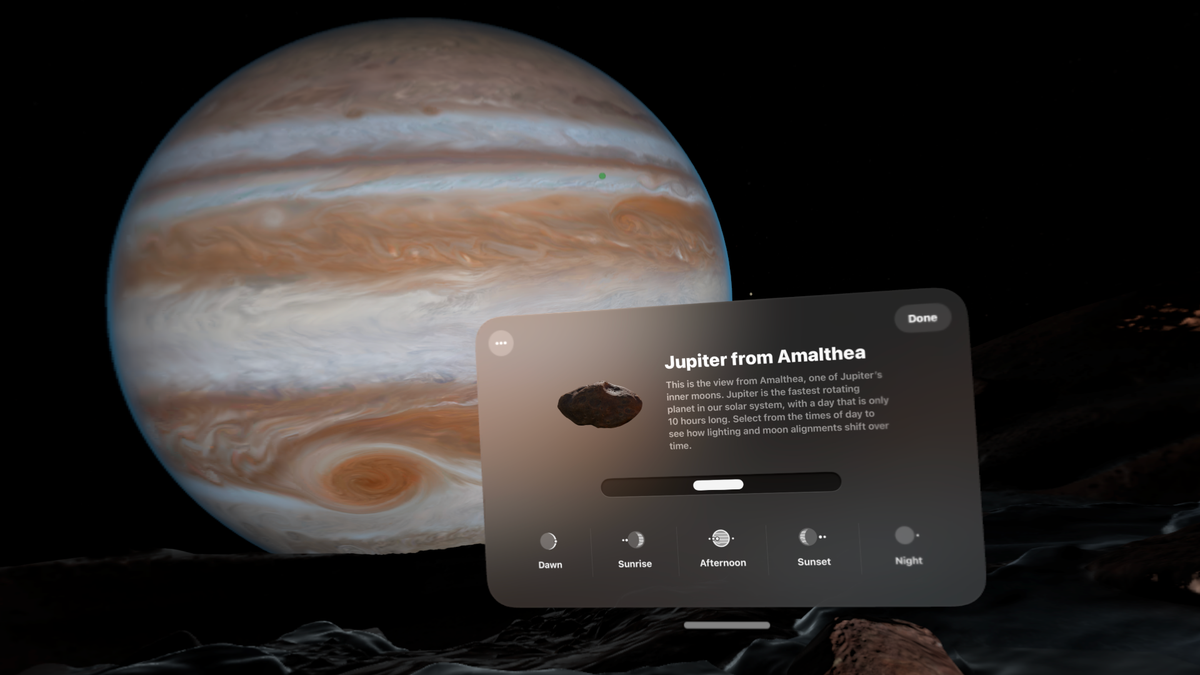
The new environment places you on Amalthea, one of the gas giant’s closest moons, and lets you speed up time to watch enormous storms “swirl across the gas giant as sunlight breaks across its surface”.
Look To Scroll
A new option in visionOS 26 called Look To Scroll lets Vision Pro owners scroll a page by looking near the bottom.
Game Controller Breakthrough
Apple Vision Pro always segments and shows your real hands and arms, and since visionOS 2 it shows your physical keyboard, a capability called Keyboard Breakthrough.
0:00
/0:17
visionOS 26 brings Game Controller Breakthrough, doing the same for PlayStation and Xbox gamepads, as well as the PS VR2 Sense controllers.
Apple Intelligence In More Countries
visionOS 2.4 brought Apple Intelligence to Vision Pro, but only for US English.
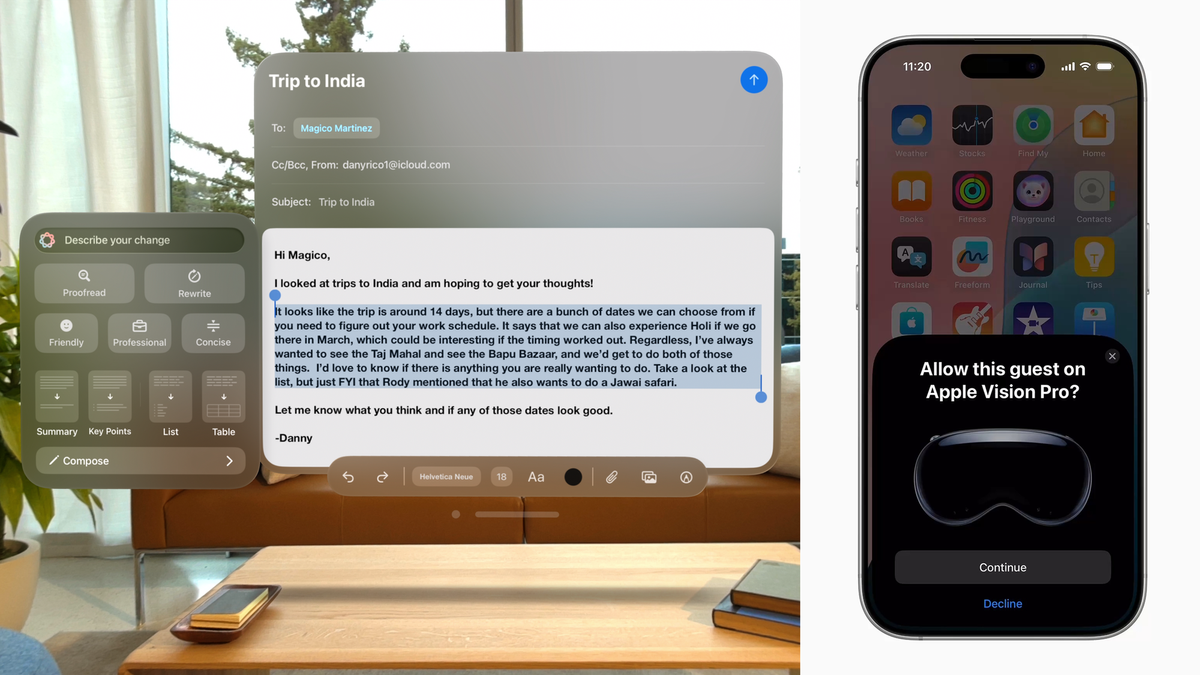
visionOS 26 expands this to English in Australia, Canada, India, Singapore, and the UK, as well as French, German, Italian, Japanese, Korean, and Spanish.
Foundation Models Framework
With visionOS 26, developers can use the Apple Intelligence on-device LLM (large language model) in their own visionOS apps, via the new Foundation Models framework.
This includes guided generation for structured output, and tool calling to let the model take actions.
The Foundation Models framework enables generative AI even in free apps, in contrast to the current situation where apps need to use paid server-side models.
Team Device Sharing
With visionOS 26, enterprise companies can save eye and hand tracking calibration and accessibility settings to each employee’s iPhone, and this configuration can be used on shared Apple Vision Pro headsets.
macOS Spatial Rendering
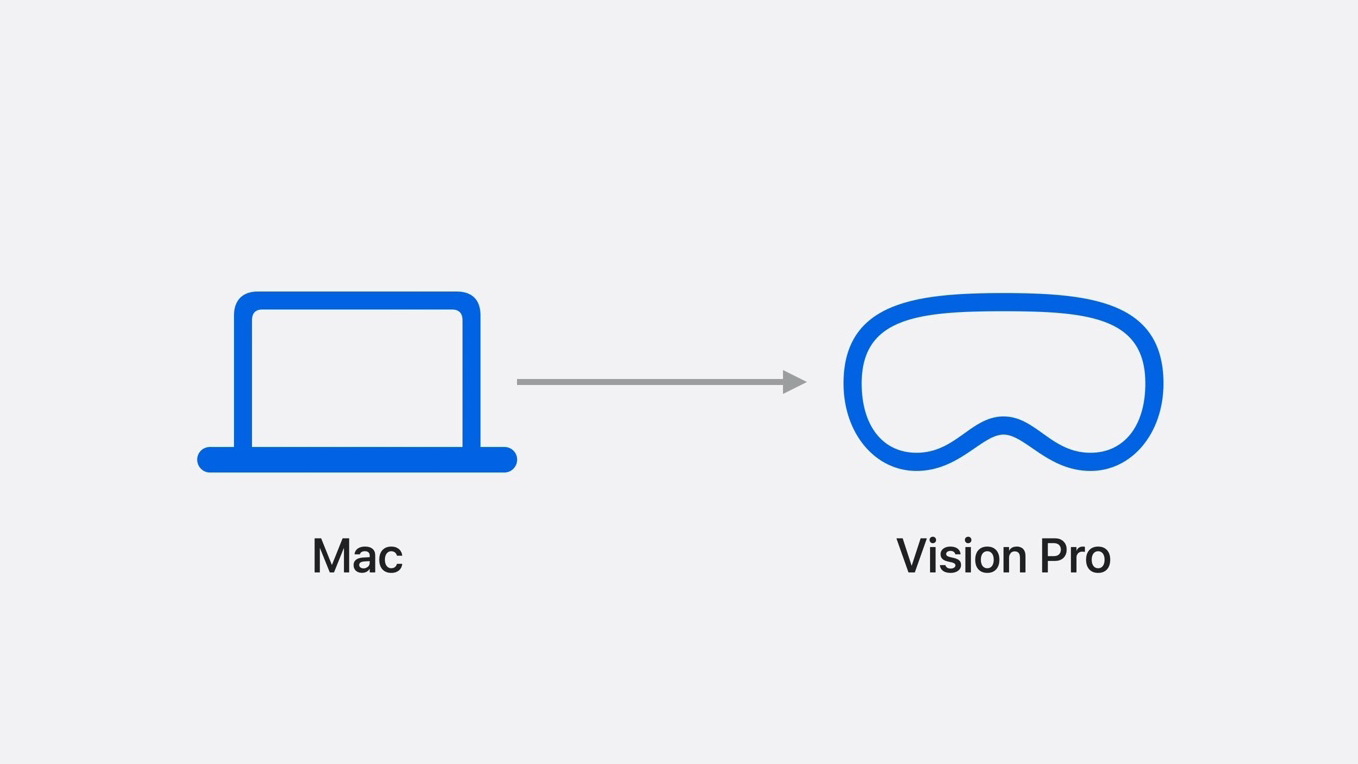
macOS 26 lets apps render and stream immersive experiences to visionOS 26, essentially Apple’s take on PC VR.
The Internet Archive has reached a confidential settlement with Universal Music Group and other major labels, “ending a closely watched copyright battle over the nonprofit’s effort to digitize and stream historic recordings,” reports the San Francisco Chronicle. From the report: The case (PDF), UMG Recordings, Inc. v. Internet Archive, targeted the Archive’s Great 78 Project, an initiative to digitize more than 400,000 fragile shellac records from the early 20th century. The collection includes music by artists such as Frank Sinatra, Ella Fitzgerald and Billie Holiday, and has been made available online for free public access. Record labels including Universal, Sony Music Entertainment and Capitol Records had sought $621 million in damages, arguing the Archive’s streaming of these recordings constituted copyright infringement.
The Internet Archive, based in San Francisco’s Richmond District, describes itself as a digital library dedicated to providing “universal access to all knowledge.” Its director of library services, Chris Freeland, acknowledged the settlement in a brief statement. “The parties have reached a confidential resolution of all claims and will have no further public comment on this matter,” he wrote.
What happens when you use a SpaceX Falcon 9 rocket to launch Northrop Grumman’s Cygnus supply ship? A record-setting resupply mission to the International Space Station.
The first flight of Northrop’s upgraded Cygnus spacecraft, called Cygnus XL, is on its way to the international research lab after launching Sunday evening from Cape Canaveral Space Force Station, Florida. This mission, known as NG-23, is set to arrive at the ISS early Wednesday with 10,827 pounds (4,911 kilograms) of cargo to sustain the lab and its seven-person crew.
By a sizable margin, this is the heaviest cargo load transported to the ISS by a commercial resupply mission. NASA astronaut Jonny Kim will use the space station’s Canadian-built robotic arm to capture the cargo ship on Wednesday, then place it on an attachment port for crew members to open hatches and start unpacking the goodies inside.
Registration for the 2025 Linux Plumbers Conference (Tokyo,
December 11 to 13) is
now open. LPC tickets often sell out quickly, so it would be best not
to delay if you intend to attend.
An anonymous reader quotes a report from Politico: In roughly six weeks, three California Democrats, a labor head and two ride-hailing leaders managed to pull off what would have been unthinkable just one year prior: striking a deal between labor unions and their longtime foes, tech giants Uber and Lyft. California lawmakers announced the agreement in late August, paving a path for ride-hailing drivers to unionize as labor wanted, in exchange for the state drastically reducing expensive insurance coverage mandates protested by the companies. It earned rare public support from Gov. Gavin Newsom and received final approval from state lawmakers this week.
The swift speed of the negotiating underscores what was at risk: the prospect of yet another nine-figure ballot measure campaign or lengthy court battle between two deeply entrenched sides, according to interviews with five people involved in the talks. Their accounts shed new light on how the deal came together: how the talks started, who was in the room, and the lengths they went to in order to turn around such a quick proposal — from taking video meetings while recovering from surgery to the unexpected aid of one lawmaker’s newborn baby.
“This was really quite fast,” said Ramona Prieto, Uber’s chief policy expert in Sacramento. “It wasn’t like this was months of negotiating.” The landmark proposal is only the second time a state has reached such a framework for Uber and Lyft drivers, after Massachusetts did so in 2024. And unlike Massachusetts, it came together without reverting to a ballot fight. California already saw its most expensive ballot measure effort to date in 2020, when Uber and Lyft spent more than $200 million backing an initiative to bar app-based workers from being classified as traditional employees, known as Proposition 22. Its passage sparked a legal challenge from labor leaders that wasn’t resolved until July 2024, when California’s Supreme Court affirmed the ballot measure’s constitutionality. […]
But the compromise still faces hurdles ahead. A recent lawsuit has raised fresh scrutiny of how the deal came together and what truly motivated it. Further criticism from those left out of the negotiating room is putting dealmakers on the defense as they try to sell it more widely. Plus, the final deal isn’t what some labor leaders hoped when they first set out to strengthen drivers’ rights in 2019. […] And while the deal allows gig workers to unionize, that doesn’t guarantee the necessary 10 percent of the state’s 800,000 ride-hailing drivers actually will. Many who drive for Uber and Lyft do so part-time, and labor leaders acknowledge the challenge of organizing a disparate population that doesn’t have a space to meet one another.
Health secretary and anti-vaccine activist Robert F. Kennedy Jr. has appointed five more people to the federal advisory committee that sets national vaccination recommendations. Like the existing members, the new appointees have questionable qualifications for being on the panel, and many have expressed anti-vaccine views.
In June, Kennedy purged all 17 highly qualified and thoroughly vetted members of the committee, the Advisory Committee on Immunization Practices (ACIP), which advises the Centers for Disease Control and Prevention on setting vaccine policy. Kennedy quickly repopulated ACIP with seven hand-picked allies, most of whom also have questionable qualifications and have expressed anti-vaccine or contrarian public health views. Two members, including the new chair, have also been paid to testify against the vaccine makers in cases claiming they caused harms, a clear conflict of interest.
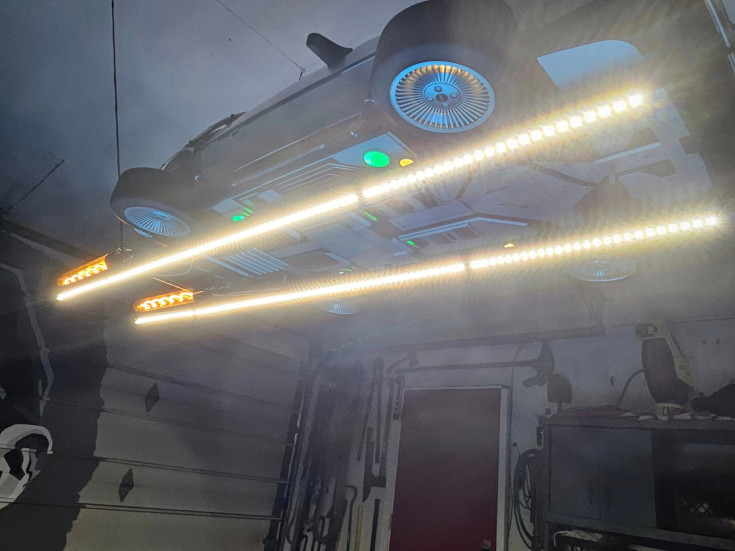
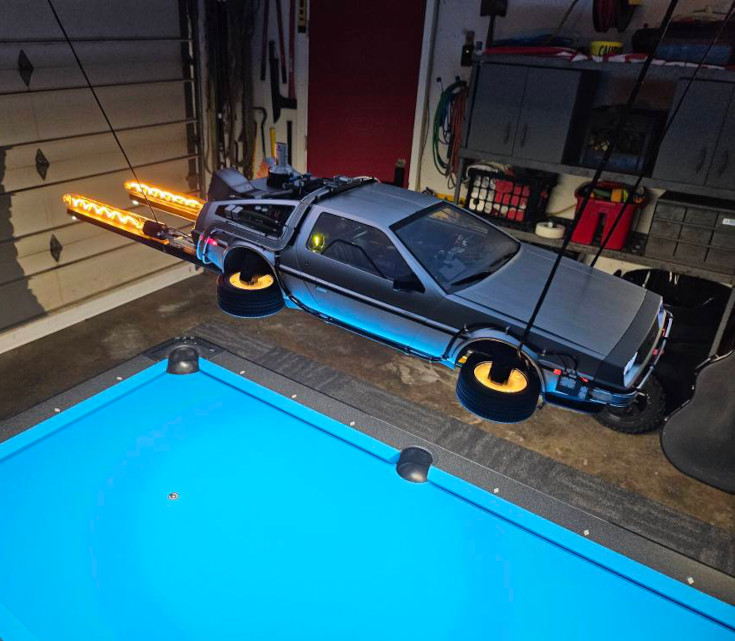
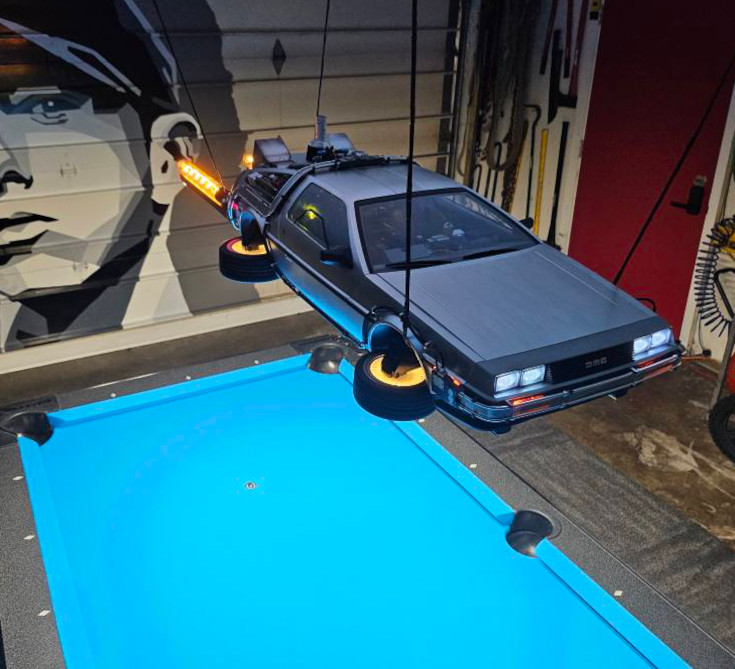
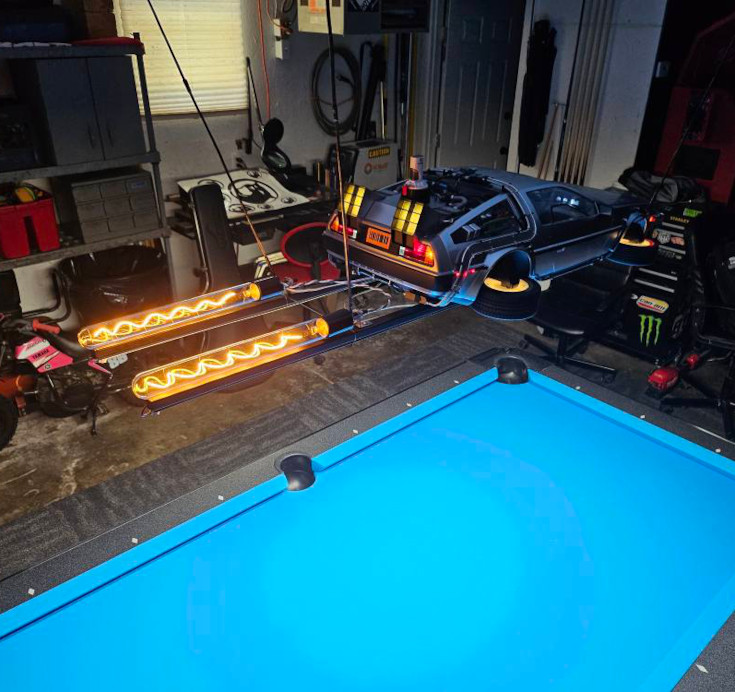
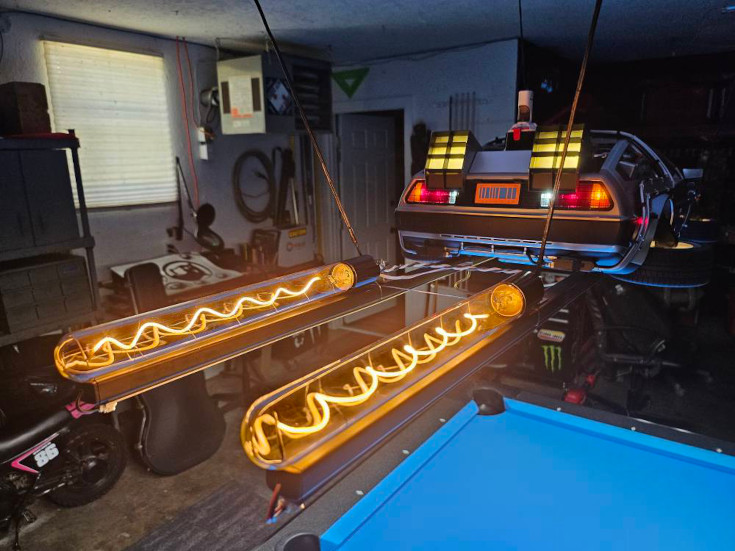
Constructed by DIYer Kevin Lee using a 1/6 scale Back To The Future II Delorean from Hot Toys, this is easily the coolest pool table light I’ve seen in, well, possibly ever. PROBABLY ever. Just look at that thing — 1.21 gigawatts of pure majesty.
I just made the rails for the bottom and added leds for the pool table light. I also added the bulbs in the back to resemble flames. The wiring was kinda tricky to hide so i ran them all up the hangers.
I don’t even have a pool table and I want one. I do have a foosball table, but I cover it with junk whenever friends come over because I’m afraid they’ll want to play and non-stop spin their players the whole time and I’ll think less of them. I don’t have many friends to begin with, so I’d like to keep the ones I’ve got without thinking they’re total dirtbags.
404 Media: A data broker owned by the country’s major airlines, including American Airlines, United and Delta, is selling access to five billion plane ticketing records to the government for warrantless searching and monitoring of peoples’ movements, including by the FBI, Secret Service, ICE, and many other agencies, according to a new contract and other records reviewed by 404 Media.
The contract provides new insight into the scale of the sale of passengers’ data by the Airlines Reporting Corporation (ARC), the airlines-owned data broker. The contract shows ARC’s data includes information related to more than 270 carriers and is sourced through more than 12,800 travel agencies. ARC has previously told the government to not reveal to the public where this passenger data came from, which includes peoples’ names, full flight itineraries, and financial details.
“Americans’ privacy rights shouldn’t depend on whether they bought their tickets directly from the airline or via a travel agency. ARC’s sale of data to U.S. government agencies is yet another example of why Congress needs to close the data broker loophole by passing my bipartisan bill, the Fourth Amendment Is Not For Sale Act,” Senator Ron Wyden told 404 Media in a statement.
The companies seeking to build larger AI models have been increasingly stymied by a lack of high-quality training data. As tech firms scour the web for more data to feed their models, they could increasingly rely on potentially sensitive user data. A team at Google Research is exploring new techniques to make the resulting large language models (LLMs) less likely to “memorize” any of that content.
LLMs have non-deterministic outputs, meaning you can’t exactly predict what they’ll say. While the output varies even for identical inputs, models do sometimes regurgitate something from their training data—if trained with personal data, the output could be a violation of user privacy. In the event copyrighted data makes it into training data (either accidentally or on purpose), its appearance in outputs can cause a different kind of headache for devs. Differential privacy can prevent such memorization by introducing calibrated noise during the training phase.
Adding differential privacy to a model comes with drawbacks in terms of accuracy and compute requirements. No one has bothered to figure out the degree to which that alters the scaling laws of AI models until now. The team worked from the assumption that model performance would be primarily affected by the noise-batch ratio, which compares the volume of randomized noise to the size of the original training data.
Treasury Secretary Scott Bessent announced that the U.S. and China have reached a tentative “framework” agreement on TikTok’s U.S. operations, with Presidents Trump and Xi set to finalize details Friday. “It’s between two private parties, but the commercial terms have been agreed upon,” he said. The update comes two days before TikTok parent company ByteDance faces a Sept. 17 deadline to divest the platform’s U.S. business or potentially be shut down in the country. The deadline may need to be pushed back yet again to get the deal signed. CNBC reports: Both President Donald Trump and Chinese President Xi Jinping will meet Friday to discuss the terms. Trump also said in a Truth Social post Monday that a deal was reached “on a ‘certain’ company that young people in our Country very much wanted to save.”
Bessent indicated the framework could pivot the platform to U.S.-controlled ownership. China’s lead trade negotiator, Li Chenggang, confirmed the framework deal was in place and said the U.S. should not continue to suppress Chinese companies, according to Reuters.
After being in the works for the past two years and going through 18+ rounds of code review, AMD ABMC looks poised to be mainlined for the upcoming Linux 6.18 kernel…
A settlement has been reached in a lawsuit where music publishers sued the Internet Archive over the Great 78 Project, an effort to preserve early music recordings that only exist on brittle shellac records.
No details of the settlement have so far been released, but a court filing on Monday confirmed that the Internet Archive and UMG Recordings, Capitol Records, Sony Music Entertainment, and other record labels “have settled this matter.” More details may come in the next 45 days, when parties must submit filings to officially dismiss the lawsuit, but it’s unlikely the settlement amount will be publicly disclosed.
Days before the settlement was announced, record labels had indicated that everyone but the Internet Archive and its founder, Brewster Kahle, had agreed to sign a joint settlement, seemingly including the Great 78 Project’s recording engineer George Blood, who was also a target of the litigation. But in the days since, IA has gotten on board, posting a blog confirming that “the parties have reached a confidential resolution of all claims and will have no further public comment on this matter.”
Microsoft is adding the free Microsoft 365 Copilot Chat and agents to Office apps for all Microsoft 365 business users today. From a report: Word, Excel, PowerPoint, Outlook, and OneNote are all being updated with a Copilot Chat sidebar that will help draft documents, analyze spreadsheets, and more without needing an additional Microsoft 365 Copilot license.
“Copilot Chat is secure AI chat grounded in the web — and now, it’s available in the Microsoft 365 apps,” explains Seth Patton, general Manager of Microsoft 365 Copilot product marketing. “It’s content aware, meaning it quickly understands what you’re working on, tailoring answers to the file you have open. And it’s included at no additional cost for Microsoft 365 users.”
While this free version of Copilot will rewrite documents, provide summaries, and help create slides in PowerPoint, the $30 per month, per user Microsoft 365 Copilot license will still have the best integration in Office apps. The Microsoft 365 Copilot license is also not limited to a single document, and can reason over entire work data.
In 2023, Apple introduced the Double Tap feature for Apple Watch Series 9 and Ultra 2. This allows a user to perform common actions, like answering or starting a song, simply by quickly tapping their thumb and index finger together twice. It was an intuitive way to confirm when you wanted to do something on your watch without tapping a tiny touchscreen button, but what if you wanted to dismiss something? Now, with the release of watchOS 26, Wrist Flick is here to solve that problem.
Also available on Apple Watch Series 9 (and higher) as well as Apple Watch Ultra 2 (and higher), Wrist Flick is kind of like Double Tap’s evil twin. If you get a notification you don’t like, or a call you want to mute, now you can quickly twist your wrist to dismiss it, like you’re tossing it into a garbage bin.
To try it out, first install watchOS 26 on your Apple Watch. Using a paired iPhone with iOS 26 installed, open the Apple Watch app, navigate to General > Software Update, and start the upgrade to the new version of watchOS. Alternatively, you can simply ensure Automatic Updates are enabled, and so long as your iPhone has iOS 26, your watch will simply choose a time to update on its own while charging (likely overnight).
Then, once watchOS 26 is installed, put on your watch and navigate to Settings > Gestures. Toggle on Wrist Flick.
That’s it. You’ll simply need to wait for a notification or call to come in, or for a timer you want to silence to go off, and you’ll be able to turn it off with a quick flick of the wrist. It might take some practice, but essentially, you want to quickly rotate your wrist away from your body, as seen on this page on Apple’s website.
Used together with Double Tap, the goal is that you won’t need to fiddle with your watch’s touchscreen for most basic activities anymore, so you won’t have to interrupt your workout (or, if you’re like me, you’re leisurely sit on the subway) by tapping away at it. The only limitation is that, while Double Tap has some basic mapping functions that let you customize what exactly it does, Wrist Flick currently doesn’t offer that level of control, instead sticking to Apple’s default “dismissing” behavior. That means you won’t be able to use it to, say, go back one tile in your Smart Stack, like how you can set Double Tap to advance you by one tile. Here’s hoping Apple expands its functionality soon.