
AMD engineers have begun ironing out ACPI C4 support for the Linux kernel in order to provide greater power savings on newer AMD Ryzen platforms that have begun to support this deeper sleep state…
Monthly Archives: September 2025
New ‘Arken Age’ Quest Trailer Reveals October Release Date – Watch It Here
VR action-adventure Arken Age (2025) is finally coming to Quest next month—even sooner than initially thought.
In August, developer VitruviusVR announced that the single-player, combat-forward adventure was coming to Quest 3 and Quest 3S sometime in November.
Now, the studio says it’s actually landing on the Horizon Store on October 30th, with pre-orders now live at $25 (discounted from $30 launch price).
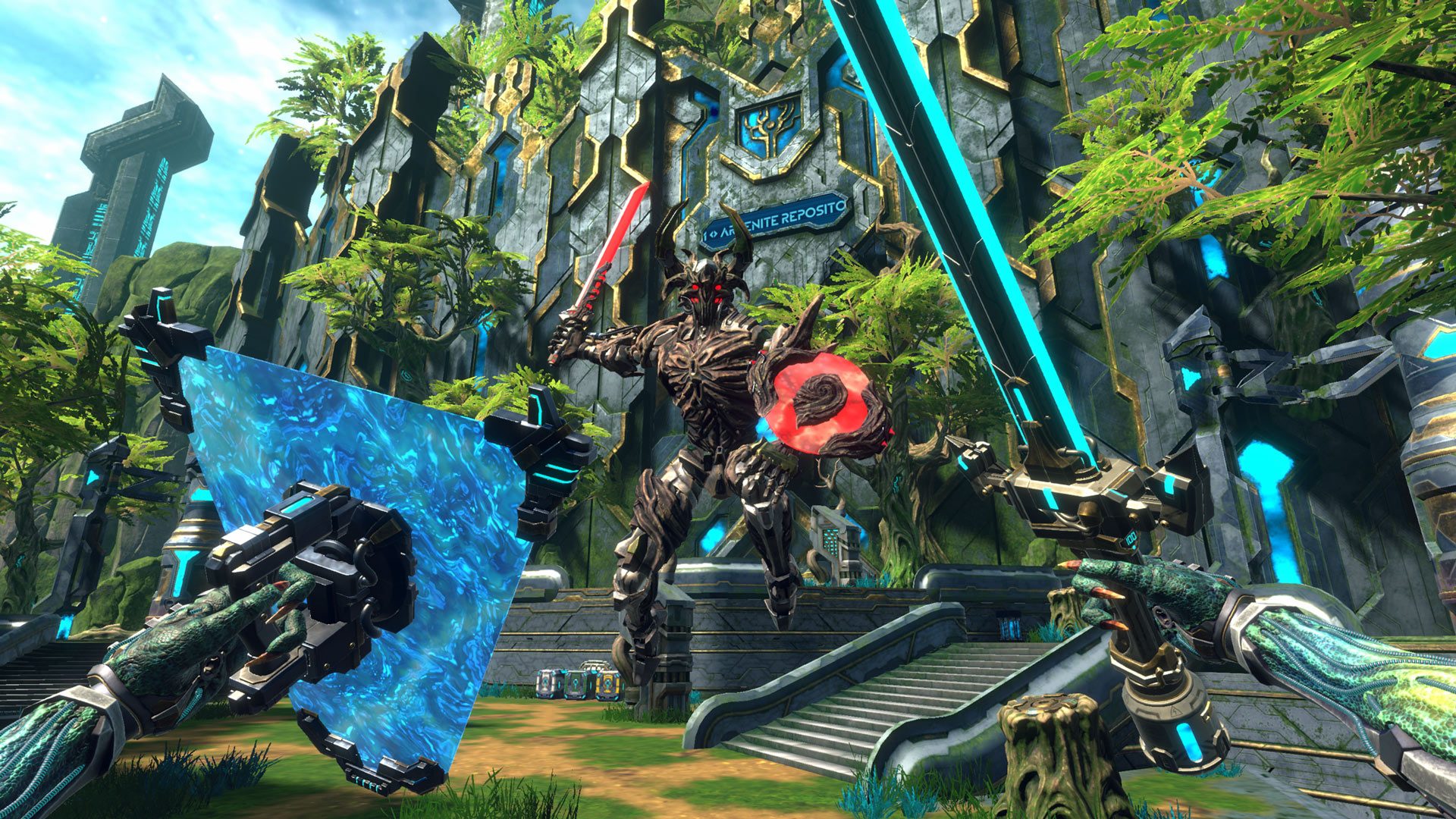
Previously launched on PSVR 2 and SteamVR headsets in back in January, the game has fared well for itself, garnering a near five-star rating on the PlayStation Store and a ‘Very Positive’ user rating on Steam.
And if that’s not enough to be excited about, we think Arken Age is one of the best single-player VR games released this year, offering up a ton of immersive interactions seemingly inspired by VR greats like Stormland (2019) and Lone Echo (2017).
Arken Age focuses on ranged and melee combat along with exploration and significant verticality thanks to some great climbing mechanics. The game’s immersion is driven by its deft use of two concepts we’ve covered extensively in our Inside XR Design series: embodiment and diegetic design.
Check out both of those to get a good idea at why we think Arken Age is such a clever (and fun) game.
The post New ‘Arken Age’ Quest Trailer Reveals October Release Date – Watch It Here appeared first on Road to VR.
The PS5 update that adds DualSense multi-device pairing rolls out soon
Starting on Wednesday, it’ll be much easier to switch between devices with your PlayStation controller. That’s when the PS5 update Sony promised in July begins rolling out. Jumping between your console and, say, Windows will be as simple as pressing a button combo. Up to this point, you’ve had to unpair and repair your DualSense controller each time.
After installing tomorrow’s system update, it will only take a few steps to set up multi-device switching. With your DualSense controller powered off, press and hold the PS button and one of the action buttons. (That’s triangle, circle, cross or square.) Hold that combo for over five seconds. The light bar and touchpad LED will flash twice. From there, open the target device and pair the controller via Bluetooth settings.
You can pair four slots: one each for triangle, circle, cross or square. After that, switching will be as easy as holding down the PS button and the device’s assigned action button. DualSense controllers are compatible with Windows, macOS, iOS, iPadOS, tvOS and Android.
Tomorrow’s PS5 update also adds a new energy-saving mode. In system settings, you’ll find a new option called Power Saver. This option reduces your console’s energy consumption by scaling back performance for supported games. Games will need to be updated to support it. Death Stranding 2: On The Beach, Demon’s Souls, and Ghost of Yōtei will be first in line.
I’m not sure how many people will want that tradeoff. Sony even went out of its way to stress that your games will still play the same unless you explicitly activate the feature. “If not enabled, or if games do not support the feature, the performance will not be scaled back and power consumption will not be reduced,” it wrote. But at least a new green-friendly option is there. The planet needs all the help it can get.
This article originally appeared on Engadget at https://www.engadget.com/gaming/playstation/the-ps5-update-that-adds-dualsense-multi-device-pairing-rolls-out-soon-165212075.html?src=rss
KPop Demon Hunters Songwriter Reportedly Says He Used ChatGPT To Help Write One Of Its Biggest Songs

Vince spoke at an OpenAI event and apparently said he used AI to write ‘Soda Pop’
The post <em>KPop Demon Hunters</em> Songwriter Reportedly Says He Used ChatGPT To Help Write One Of Its Biggest Songs appeared first on Kotaku.
Apollo Explores Sale of Internet Pioneer AOL
An anonymous reader shares a report: Apollo is exploring a sale of early internet darling AOL after receiving inbound interest in the business, according to people familiar with the matter. Any deal could value AOL at around $1.5 billion, the people said. It is also possible the talks won’t result in any deal, they cautioned.
Apollo bought AOL in 2021 as part of a $5 billion deal to acquire that business and Yahoo from Verizon. AOL generates around $400 million in annual earnings before interest, taxes, depreciation and amortization, the people familiar with the matter said. Its main business lines include software for internet privacy and protection, and the AOL.com website and email domain.


Read more of this story at Slashdot.
Disney, Warner Bros. Discovery and Universal file joint lawsuit against generative AI app Hailuo
Disney, Universal and Warner Bros. Discovery are teaming up on the latest blockbuster AI lawsuit, this time against Chinese company MiniMax, owner of Hailuo AI. The three mega-studios, which collectively represent over half of the US box office take, filed suit in California against the AI-powered image and video generation platform alleging that it “pirates and plunders Plaintiffs’ copyrighted works on a massive scale.”
The lawsuit includes dozens of screenshots of infringing generated images that span the gamut of the various studios’ IP, from superheroes in the DC and Marvel universes to Star Wars, Minions and various other cartoons and animated films.
Included in the suit are allegations that MiniMax not only failed to take reasonable actions to avoid infringement, but that the company actively engaged in and encouraged these infringing creations.
The suit alleges a business model purposefully built around infringing on protected works whose defiance of US copyright law is “willful and brazen.” MiniMax markets the Hailuo AI app for iOS and Android as a “Hollywood studio in your pocket,” according to the suit, and advertisements for the platform explicitly invite users to create custom videos using protected works. Screenshots of these advertisements are included in the suit.
Universal
This is the latest in a string of high-profile lawsuits brought by media companies over AI-generated content. Earlier this month Warner Bros. Discovery sued the popular AI image generator Midjourney over similar claims, and Disney and Universal Studios filed a joint suit against it in June.
Television and film aren’t the only industries to accuse AI companies of blatant copyright offenses, with the publishing world seeing its fair share of lawsuits. Anthropic, the AI company behind Claude, had just reached a $1.5 billion settlement in a class action case representing over 500,000 authors, though a judge just rejected the settlement. Apple is also facing a lawsuit alleging the company used pirated books to train its AI model.
You can read the full complaint below:
This article originally appeared on Engadget at https://www.engadget.com/ai/disney-warner-bros-discovery-and-universal-file-joint-lawsuit-against-generative-ai-app-hailuo-163819825.html?src=rss
Rust-style safety model for C++ ‘rejected’ as profiles take priority
Safe C++ proposal author claims that ‘will not ever work’The C++ standards committee abandoned a detailed proposal to create a rigorously safe subset of the language, according to the proposal’s co-author, despite continuing anxiety about memory safety.…
A new report finds China’s space program will soon equal that of the US
As Jonathan Roll neared completion of a master’s degree in science and technology policy at Arizona State University three years ago, he did some research into recent developments by China’s ascendant space program. He came away impressed by the country’s growing ambitions.
Now a full-time research analyst at the university, Roll was recently asked to take a deeper dive into Chinese space plans.
“I thought I had a pretty good read on this when I was finishing grad school,” Roll told Ars. “That almost everything needed to be updated, or had changed three years later, was pretty scary. On all these fronts, they’ve made pretty significant progress. They are taking all of the cues from our Western system about what’s really galvanized innovation, and they are off to the races with it.”
[$] Comparing Rust to Carbon
Safe, ergonomic interoperability between Rust and C/C++ was a popular topic at
RustConf 2025 in Seattle, Washington. Chandler Carruth gave a presentation
about the different approaches to interoperability in Rust and
Carbon, the
experimental “(C++)++” language.
His ultimate conclusion was that
while Rust’s ability to interface with other languages is expanding over time,
it wouldn’t offer a complete solution to C++ interoperability anytime soon — and so there is room for
Carbon to take a different approach to incrementally upgrading existing C++ projects.
His
slides are available for readers wishing to study his example code in more
detail.
Ditch House Keys, Wyze Biometric Door Lock Puts Home Security In The Palm Of Your Hand

Palm-reading (or more precisely, palm vein recognition) smart locks aren’t exactly new, but good ones from reputable brands can get pricey. Enter Wyze with its new Palm Lock that promises to bring the convenience and security of biometric lock tech for a truly competitive price. Fingerprint and touch locks are so old school; now you can unlock
Zoom CEO Latest Executive To Forecast Shortened Workweeks From AI Adoption
AI will enable three to four-day workweeks, Zoom CEO Eric Yuan told The New York Times, joining Microsoft’s Bill Gates, Nvidia’s Jensen Huang and JPMorgan’s Jamie Dimon in predicting shorter schedules. Yuan also acknowledged AI will eliminate some positions, particularly entry-level engineering roles where AI can write code, but argued new opportunities will emerge managing AI agents. Gates previously suggested two to three-day weeks within 10 years during a February appearance on The Tonight Show.


Read more of this story at Slashdot.
Can-Am Origin electric motorcycle review: Good for a fun time, not a long time
It wasn’t until your average electric car started managing 200 miles on a charge that the buying populace started getting over their range anxiety. That means electric motorcycles, with ranges often measured in double digits, remain a bit of a tough sell for mass-market buyers.
The focus, then, seems to be “for a good time, not a long time,” and that’s very much the case of the Can-Am Origin. This $14,499 battery-powered dual-sport is a fun, flickable, go-anywhere two-wheeled smile factory that I sadly managed to run dry of electrons in under 45 miles.
Thankfully, there’s a lot more to the story than just that.
Forward-looking
Can-Am has been around since the early ’70s, offering a series of two-, three-, and four-wheeled vehicles, most focusing on extreme performance over extreme terrain. Since the very beginning, Can-Am has worked with Austrian engine gurus Rotax, and that trans-Atlantic partnership enters the EV age with the Origin, a dual-sport motorcycle from Can-Am built around a powertrain developed by Rotax.
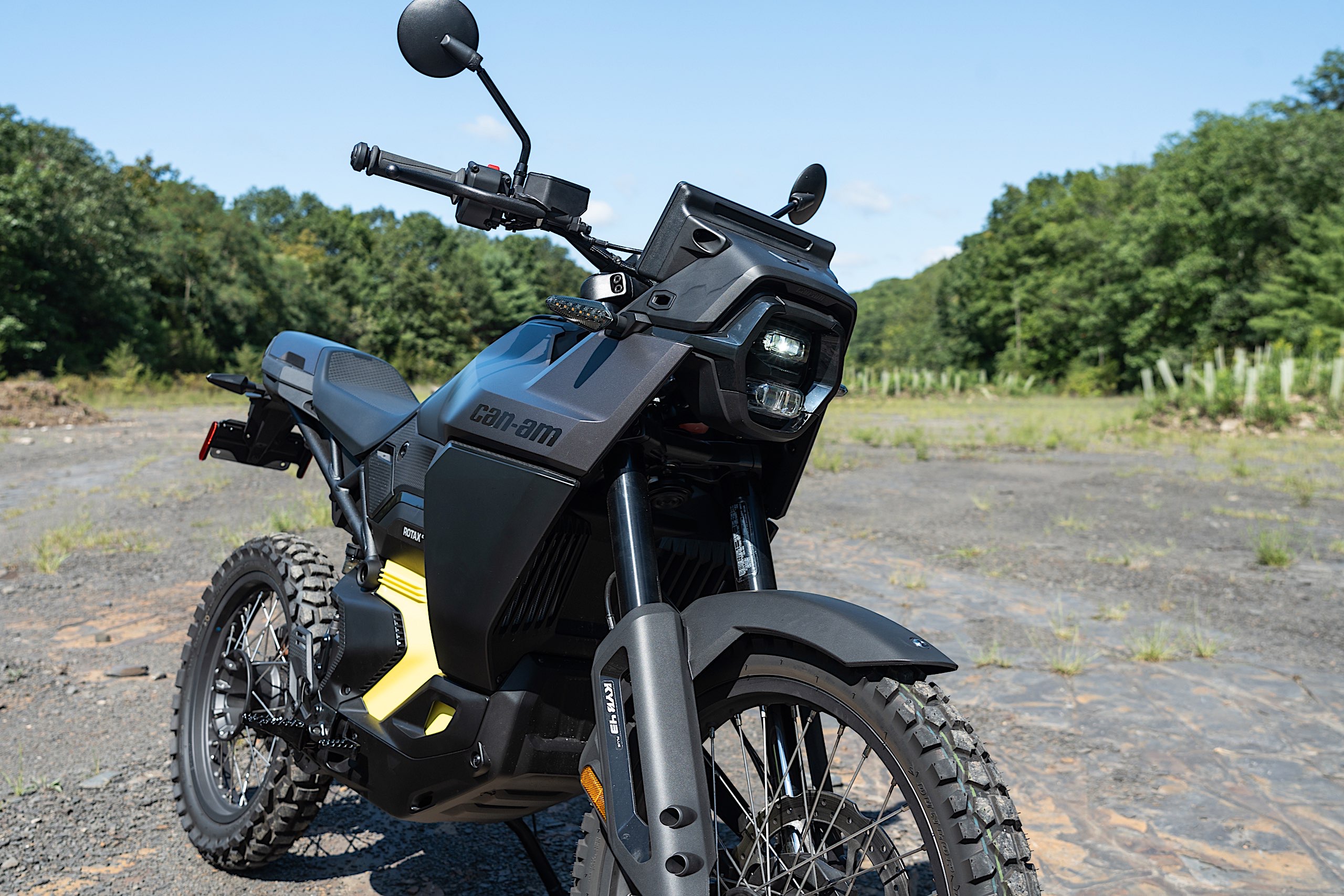
The result is an 8.9-kWh battery (about 10 percent the size of the one in a Tesla Model 3) serving as the core of a motorcycle built to be just as capable off-road as on. The Origin sits squarely in the dual-sport category of motorcycles, and its skinny, nobbily tires and wire wheels definitely fit that template, even if the single-sided swingarm with its integrated chain is a novelty in this segment.All of that is wrapped in just enough bodywork to give this thing a decidedly futuristic vibe, especially that upright fairing with the blunt, stacked headlight that makes this thing look like an escaped drone from Valve’s Portal series.
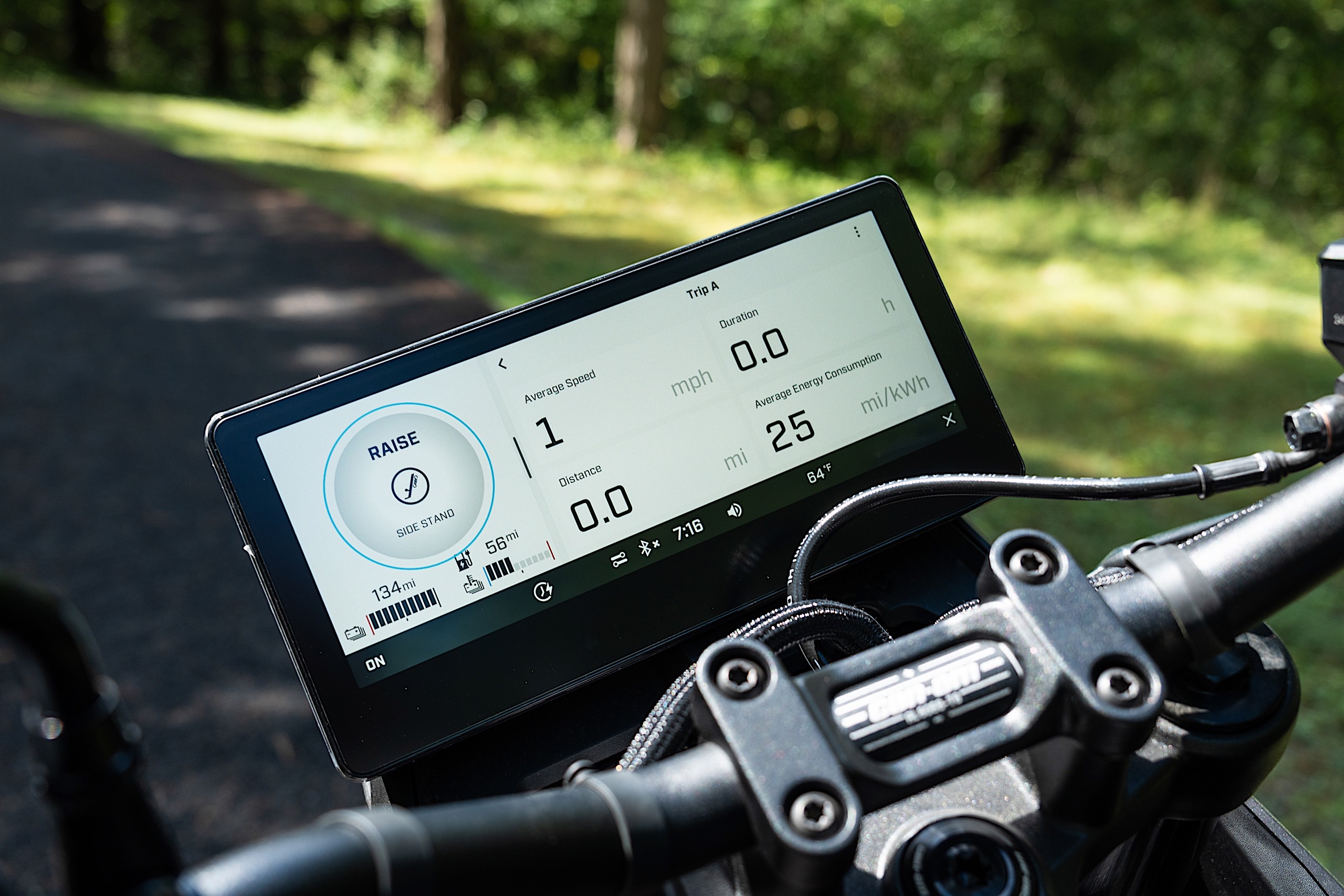
My test bike had just a bit of color, the battery pack itself providing a splash of yellow to stand out from the otherwise dark frame and fairing, but the brightest part is actually the 10.25-inch LCD that serves as the cockpit. It even supports Apple CarPlay, in case you’re into that sort of thing.
Brightness needed
Tim Stevens for Engadget
I’ve ridden a fair few electric motorcycles over the years, and many of them are cursed with dim LCDs that make it a struggle to see how fast I’m going on a sunny day. That’s not what you’d call safe.
Thankfully, the Origin does not have that issue. The LCD here is not only massive but bright and crisp, and serves up a software interface that’s mostly intuitive and easy to use at a glance. My only complaint here is the giant warning disclaimer that pops up every single time you fire up the motorcycle. I suppose such a thing was inevitable, but it does take away some of the purity of the ride experience.
But then the Origin isn’t afraid to throw out convention. The throttle is the best example of that. It actually twists both ways. Twist it in the traditional direction, pulling your hand towards yourself, and it, of course, applies throttle to the bike and accelerates you forward.
But you can also twist the throttle away from you, which boosts the regenerative braking to the rear wheel. You can also toggle the bike into reverse mode, where that backwards throttle enables you to creep the bike backwards. That’s useful because at 412 pounds, the Origin is about 50 pounds heavier than a comparable dual-sport bike with an engine.
Tim Stevens for Engadget
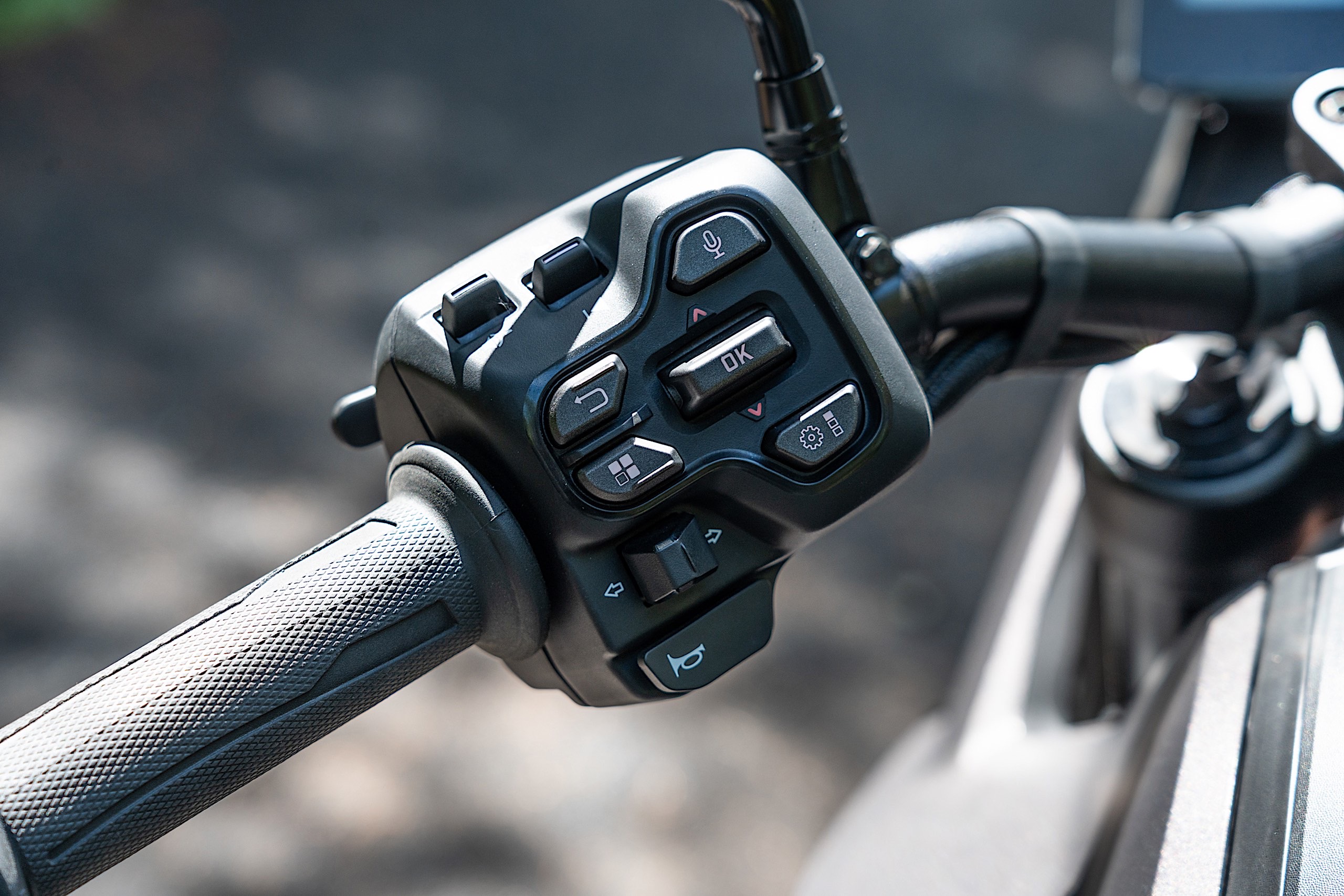
The motorcycle also features a bevy of controls on the left grip, starting with standard fare like headlight flasher, horn and turn signals. But there’s also a rocker switch for changing drive modes and navigating through menus, a button that cycles through various views on the display, and a back button in case you dig a little deeper in a menu than you meant.
There’s even a full series of media controls. There’s a button to toggle the voice assistant on your phone, buttons for adjusting the volume of media playback and even buttons to skip forward and backward in your current playlist.
Personally, I’m the kind of rider who likes to listen to the wind, my thoughts and the ominous sounds approaching SUVs driven by morons browsing TikTok. But if you have a riding playlist that you like to spin, you’ll have full control here.
Ride time
Tim Stevens for Engadget
I don’t often fit well on dual-sport machines. I stand six feet tall, but do it on disproportionately short legs. That usually leaves me tottering on tiptoes whenever riding an off-road-minded motorcycle. I cringed when the Origin rolled off a truck and into my life for the evaluation period, but I was pleasantly surprised to find I could straddle it with no problem.
A 34-inch seat height enables me to stand flat-footed without having to break out platform boots, and on the go, I found the Origin’s ergonomics to fit me just about perfectly. The pegs are wide and grippy, so standing up on them is no problem, and while I’d probably prefer it if the bar stood a fraction of an inch taller, it was close to perfect whether sitting on or standing over the saddle.That saddle is a little on the narrow side compared to your average street motorcycle, but wider than those found on many dual-sport machines, striking a good balance between narrowness for standing and comfort for sitting.
About the only complaint I had was wind buffeting. I generally prefer riding bikes without fairings, but somehow the wind coming off that big, wide display caused some awful turbulence on my helmet when seated in my usual riding position. The $175 optional windshield would be, for me, well worth it.
And what’s it like to ride? This thing is a blast. At 47 horsepower and 53 pound-feet of torque, it’s far from the quickest electric motorcycle on the market, but it has plenty enough twist to beat everything on four wheels at any light, or scrabble up a steep incline.
Tim Stevens for Engadget
Even more impressive is the traction control system of the Origin. It’s easy to be a little over-eager when accelerating on an EV, thanks to their instant torque, but the Origin always ensured I neither did an unintentional burnout nor tipped over backwards. It simply managed grip and power to ensure that I accelerated smoothly away, whether I was on asphalt or gravel.The bike has adjustable levels for ABS and traction control, and yes, you can turn them off if you want.
Overall, the Origin was also easy to ride. Those knobby tires do make for a loose feeling on asphalt, the bike moving around a bit thanks to the extra tread, but it’s a worthy tradeoff if you’ll find yourself hitting the dirt on a semi-regular basis.
What you probably won’t find yourself doing is going on long rides in the Origin, sadly. Though Can-Am says you can do up to 90 miles on a charge in the city, even when riding gently on rural roads using the most economical mode, I struggled to get 60 miles. Ridden more aggressively (which is to say, normally), I burned through a charge in less than 45 miles.
That’s the bad news. The good news? There’s an onboard level two charger on the Origin. L2 charging on a car usually means overnight, but since the Origin’s pack is so small, it’ll go from empty to full in under 90 minutes, and you’ll be stopped for less than an hour if you only need a partial charge.
Wrap-up
The relatively quick onboard charging of the Origin does open the door to some longer rides if you can time your meals and charging stops appropriately. And, if you’re doing lower-speed off-road riding, you could realistically go for hours and hours on a charge. Still, this sadly isn’t a long-distance high-speed cruiser.
But it’s rare for a dual-sport machine that’s comfortable enough for you to want to be in the saddle on the highway for that long anyway. For short blasts up the trail or high-speed sprints home after a long day in the office, the Origin is a real treat, and a stylish one at that
This article originally appeared on Engadget at https://www.engadget.com/transportation/evs/can-am-origin-electric-motorcycle-review-good-for-a-fun-time-not-a-long-time-160000545.html?src=rss
Spotify’s Free Music Streaming Tier Gets A Major Upgrade, Is It Still Worth Paying?

Spotify is upgrading its services— just after finally adding lossless streaming for Premium users earlier this month, thankfully without a price bump, they’re also removing a key shackle from Spotify’s free tier. Now, Spotify’s free users can also listen to playlists and albums in their intended order, and pick-and-choose individual songs
Firefox 143.0 released
Version
143.0 of the Firefox browser has been released. Changes include the
ability to pin tabs by dragging them to the edge, previews in the camera
permissions dialog, improved fingerprinting protection, and (optional)
automatic deletion of files downloaded in private browsing mode.
143.0 of the Firefox browser has been released. Changes include the
ability to pin tabs by dragging them to the edge, previews in the camera
permissions dialog, improved fingerprinting protection, and (optional)
automatic deletion of files downloaded in private browsing mode.
AI’s Insatiable Storage Demand Sparks HDD Shortage And SSDs Could Be Next

We’re seeing a similar plot line with AI demand compared to the crypto craze that enraptured the market a few years ago. First, GPUs became scarce and in high demand, with high prices not far behind. Next, even CPUs entered the fray, and now it’s happening to storage media. Due to the large amount of data required by AI workloads, storage
New Official Sonic Racing Crossworlds Ad Goes After Mario Kart World Like It’s The 1990s

Plus: Xenoblade gets mentioned in an unexpected place, Palworldwill leave early access next year, more games come to Game Pass, and MindsEye’s lead actor talks about the flop
The post New Official <i>Sonic Racing Crossworlds</i> Ad Goes After <i>Mario Kart World</i> Like It’s The 1990s appeared first on Kotaku.
YouTube just announced a bunch of AI tools for creators
YouTube held an event today aimed at creators and announced all kinds of new tools, many of which include AI in one way or another. Let’s get into some of the more interesting drops.
There’s an AI tool that can automatically edit raw footage into a “compelling first draft.” It’ll create a video complete with “music, transitions and voiceover.” It’s being tested right now and should roll out in the coming weeks.
The platform is also launching software that will automatically create voiceovers in English and Hindi. It’ll be available on the YouTube Create app and when making Shorts. It’s launching later in the year. Additionally, there’s software coming that turns the dialogue from videos into “catchy soundtracks” for Shorts.
YouTube is also expanding Veo 3 integration in Shorts, so users can “easily turn any idea into high quality videos with sound, all from a text prompt.” It could already make short videos, but now it can add sound and the video quality should be better. The platform also promises “better prompt matching” and new tools that can animate characters or stylize Shorts in other ways.
YouTube Studio is adding a “conversational AI partner” to help users get insight on traffic analytics and that type of thing. That’s rolling out right now.
The event wasn’t just for AI. There’s a new collaboration feature that lets creators team up with up to four other people to make a video. This will increase discoverability by showing the footage to all audiences. It’ll be available globally in the next couple of weeks. The platform is also finally introducing A/B testing for titles, allowing up to three variants.
This article originally appeared on Engadget at https://www.engadget.com/ai/youtube-just-announced-a-bunch-of-ai-tools-for-creators-153341885.html?src=rss
MBAs Cost More and Are Less Profitable as ROI Falls
Getting an MBA in the US has gotten a little more expensive and a little less profitable, according to a Bloomberg analysis of salary and tuition data. From the report: This year’s update of Bloomberg’s Business School ROI Calculator, based on surveys of more than 9,500 students and alumni, projects a typical return on investment of 12.3% a year for the decade after graduation. That’s down from 13.3% last year. The S&P 500 index, by comparison, returned 14.6% over the decade ending Aug. 31.
The main reason for the decline: This year’s respondents reported 6.2% better pre-MBA salaries than last year’s, while projected postdegree earnings increased only 1.7%. In other words, the MBA pay edge — the compensation boost graduates get for the degree — shrank. In the broader US workforce, the average high-skilled worker’s earnings rose 4.7% in the year ended July 31, Federal Reserve data show.
Other factors didn’t help: The increase in pre-MBA salaries meant students were forgoing more income during their studies. Tuition and other expenses increased 2.4%, some of that financed with bigger loans at higher rates. In all, the typical total investment to get an MBA in the US rose 6.8%, to almost $300,000.


Read more of this story at Slashdot.
Following teen suicide, OpenAI explores automatic underage user restrictions
OpenAI is developing a system designed to automatically identify teen users and restrict their usage of ChatGPT. In a blog post published Tuesday, the company said the new experience would come with age-appropriate policies, including a block of graphic sexual content. “In cases of acute distress,” the system will also have the capability to contact law enforcement to ensure user safety. In scenarios where ChatGPT can’t definitively estimate the age of a user, it will default them to the new gated experience. OpenAI will provide a way for adult users to verify their age and unlock ChatGPT’s full capabilities. The company did not state when it plans to deploy the new systems.
The announcement follows the death of 16-year-old Adam Raine, the first teen believed to have committed suicide after ChatGPT allegedly helped him plan his death. In the immediate aftermath of the suicide, OpenAI promised to release controls designed to give parents and guardians more say over their teen’s usage of ChatGPT. On Tuesday, the company reiterated that those controls would arrive before the end of the month, and said they would include an additional feature that would give parents the ability to set hours where their child could not use ChatGPT.
Separately, OpenAI published a letter from CEO Sam Altman detailing the company’s thinking on the issue. “We prioritize safety ahead of privacy and freedom for teens; this is a new and powerful technology, and we believe minors need significant protection,” Altman said. “We realize that these principles are in conflict and not everyone will agree with how we are resolving that conflict. These are difficult decisions, but after talking with experts, this is what we think is best and want to be transparent in our intentions.”
This article originally appeared on Engadget at https://www.engadget.com/ai/following-teen-suicide-openai-explores-automatic-underage-user-restrictions-151948711.html?src=rss
Overwatch 2 Fans Mourn The Persona 5 Skins They Didn’t Get

Growing accusations of favoritism color every new Overwatch 2 collaboration and season
The post <em>Overwatch 2</em> Fans Mourn The <em>Persona 5</em> Skins They Didn’t Get appeared first on Kotaku.