Linux systems provide a variety of system services (process management, login, syslog, cron, etc.) and network services (remote login, email, printers, web hosting, data storage, file transfer, DNS, DHCP, and more).
Technically, a service is a daemon — a process or group of processes running in the background, waiting to respond to client requests.
Modern Linux distributions use systemd as the default system and service manager. With the systemctl command, you can easily list, start, stop, restart, enable, or disable services.
A new Stanford-led study finds that switching permanently to standard time could prevent 300,000 strokes and reduce obesity in 2.6 million Americans by better aligning circadian rhythms with natural light. Researchers argue that the twice-yearly clock changes are the worst option for public health, while permanent daylight saving time would offer two-thirds of the benefits. From a report: “We found that staying in standard time or staying in daylight saving time is definitely better than switching twice a year,” senior researcher Jamie Zeitzer said in a news release. He’s a professor of psychiatry and behavioral sciences at Stanford University in California. For the study, researchers estimated how different national time policies might affect American’s circadian rhythms — the body’s innate clock that regulates many physiological processes. The human circadian cycle isn’t exactly 24 hours, researchers noted. It’s about 12 minutes longer for most people, and it can be changed based on a person’s exposure to light.
“When you get light in the morning, it speeds up the circadian cycle. When you get light in the evening, it slows things down,” Zeitzer said. “You generally need more morning light and less evening light to keep well synchronized to a 24-hour day.” An out-of-sync circadian cycle has been linked with many different poor health outcomes, researchers said. “The more light exposure you get at the wrong times, the weaker the circadian clock,” Zeitzer said. “All of these things that are downstream — for example, your immune system, your energy — don’t match up quite as well.” Most people would experience the least circadian burden under permanent standard time, which prioritizes morning light, researchers found.
The research team then linked its analysis of circadian rhythms to county-level data from the U.S. Centers for Disease Control and Prevention (CDC) to see how each time policy might affect people’s health. Their models showed that permanent standard time would reduce obesity nationwide by 0.78% and stroke by 0.09%. Those seemingly small percentage changes, when played out across the national population, would mean 2.6 million fewer people with obesity and 300,000 fewer cases of stroke. Permanent daylight savings time would result in a 0.51% drop in obesity — around 1.7 million people — and a 0.04% reduction in strokes, or 220,000 cases. Either move would help American health. “You have people who are passionate on both sides of this, and they have very different arguments,” Zeitzer said. The findings have been published in the Proceedings of the National Academy of Sciences.
A patch making it to a TIP Git branch this week adds Linux kernel support for detecting the FreeBSD Bhyve hypervisor, which will become important with today’s growing server CPU counts…
China’s internet regulator has told the country’s biggest technology companies to stop buying all of Nvidia’s artificial intelligence chips and terminate their existing orders, as Beijing steps up efforts to boost its homegrown semiconductor industry and compete with the US. From a report: The Cyberspace Administration of China (CAC) informed companies including ByteDance and Alibaba this week to terminate their testing and orders of the RTX Pro 6000D, Nvidia’s tailor-made product for the country introduced two months ago, according to three people with knowledge of the matter.
Several companies had indicated they would order tens of thousands of the RTX Pro 6000D, and had started testing and verification work with Nvidia’s server suppliers before telling them to stop the work after receiving the CAC order, said the people.
Mike Blumenkrantz of Valve’s Linux graphics team is the one who has been driving the development forward on Mesa’s Zink OpenGL-on-Vulkan driver. While traditionally focused on getting OpenGL games running over Zink, recently he has taken to optimizing Zink for workstation graphics…
“Phys.org is reporting on a study published in Nature Physics involving ICN2 at the UAB campus, Xi’an Jiaotong University (Xi’an) and Stony Brook University (New York), showing for the first time that ordinary ice is a flexoelectric material — meaning it can generate electricity when subjected to mechanical deformation,” writes longtime Slashdot reader fahrbot-bot. From the report: “We discovered that ice generates electric charge in response to mechanical stress at all temperatures. In addition, we identified a thin ‘ferroelectric’ layer at the surface at temperatures below -113C (160K),” explains Dr. Xin Wen, a member of the ICN2 Oxide Nanophysics Group and one of the study’s lead researchers. “This means that the ice surface can develop a natural electric polarization, which can be reversed when an external electric field is applied — similar to how the poles of a magnet can be flipped. The surface ferroelectricity is a cool discovery in its own right, as it means that ice may have not just one way to generate electricity, but two: ferroelectricity at very low temperatures, and flexoelectricity at higher temperatures all the way to 0 C.” This property places ice on a par with electroceramic materials such as titanium dioxide, which are currently used in advanced technologies like sensors and capacitors.
The BeOS-inspired Haiku open-source operating system project published a new blog post to outline some of their latest development activity. One of the areas they have been focusing on in the performance department has been for addressing much slower git status performance compared to Linux…
Overnight the AMD ROCm 7.0 release tags began appearing within the public Git repositories. Now AMD ROCm 7.0 is officially released as a very significant step forward for AMD’s open-source GPU compute stack for better competing against NVIDIA’s CUDA ecosystem…
IBASE Technology has introduced the IBR500, a 3.5-inch single board computer built around MediaTek Genio processors. The compact design is aimed at embedded and edge applications that prioritize low power consumption and efficient use of space. The board integrates the MediaTek Genio 700 (MT8390) at up to 2.2 GHz or the Genio 510 (MT8370) at […]
These are several videos of 2024 Kendama World Cup U9 champion Naru Nishimoto demonstrating his very impressive skills with the toy. Naru was the youngest entrant in the competition and still took home the gold. And I can see why. If I had this level of hand-eye coordination I might not have just slapped myself in the nuts trying to high-five a former coworker. “What were you celebrating?” Oh I just got fired.
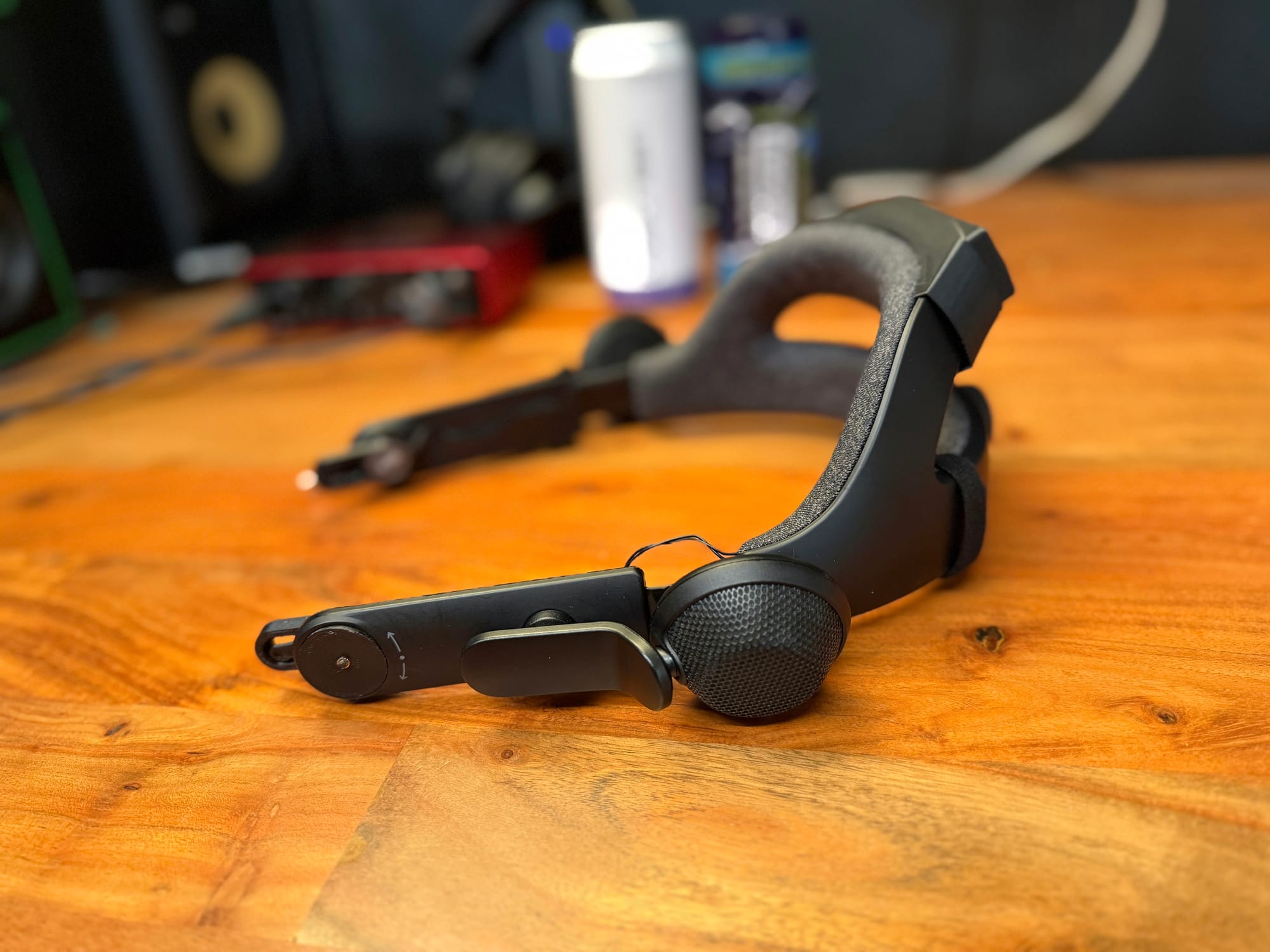
Project Beyondex is a mod kit from Fluid that will let you affix your Valve Index’s strap and speakers to a Bigscreen Beyond or Beyond 2.
Valve Index is now well over six years old, and its displays and form factor are inarguably outdated given its price. Its audio, on the other hand, remains in a class of its own, matched only by the discontinued HP Reverb G2, which Valve provided Index’s drivers for. While Bigscreen sells an official Audio Strap, it just doesn’t hold up to the Valve Index speakers.
Like many VR enthusiasts, the team behind the Quest spatial computing app Fluid wished that they had a PC headset with the pancake optics, micro-OLED displays, and comfort of Bigscreen’s Beyond headsets but with the speakers of Valve Index. So they built a kit to make that happen, which they call Project Beyondex.
Of course, this is not exactly a cheap option. Valve doesn’t sell the Index strap separately, so you’ll need the $500 headset, if you don’t own it already. And while it’s on your Beyond, you won’t really be able to use your Index. But the Fluid team thinks the result is worth it.
“It’s our favorite way to experience PC VR that we have experienced so far in our careers as VR devs”, they promise.
Project Beyondex on Bigscreen Beyond
To install Project Beyondex, you start by detaching the strap from your Valve Index. You then attach it upside-down to the Beyond headset using Project Beyondex’s 3D printed side adapters, which Fluid was able to design thanks to Bigscreen releasing the CAD files for its Audio Strap connector last year, using a single M6 screw on each side. The upside-down approach turns what used to be rear cradle support into top support, suitable for using on Beyond without a top strap.
The key electronic components of the kit are a custom DAC, based on the open-source project Picoamp, and a tiny uninterruptible power supply (UPS) with a lithium-ion battery, all housed in a plastic enclosure that clips on to the back of the strap. The DAC passes the audio from the Beyond to the Index’s speakers, via thin wires you tuck under the strap which connect to pogo pins in the side adapters, and the UPS is needed because to play very loud sounds, the Valve Index drivers draw more power than Beyond provides via its USB-C port.
Fluid says this quirk was discovered by Matt Gaines from MMI Modular, who provided “tons of tips and advice” for Project Beyondex.
The “only tricky part” of the installation, Fluid says, is tucking the thin audio cables on each side.
Project Beyondex
You can preorder the ready-to-use Project Beyondex mod kit for $109, and Fluid expects to start shipping before November.
Alternatively, Fluid will sell you everything except for the 3D printed brackets and enclosures for $89, and provide the STL files so you can print those yourself. Note that this means you’ll have to solder the wiring yourself.
Project Beyondex orders are currently limited to the US, UK, Canada, and Japan, but Fluid encourages interested enthusiasts from outside these four countries to contact them if they’re interested.
Fluid is also working on making the entire schematics for Project Beyondex freely available, including the PCB for the DAC+UPS module, so that hardware hackers can DIY the entire thing themselves.
Of course, we’re aware that this is not the Valve headset news many of you are hoping to see this week. Over the past four years Valve has repeatedlyconfirmed that it’s working on a new headset, strongly hinting that it will have a focus on wireless streaming from your PC. In this time, many references to a Valve headset called “Deckard” have been found in the code of SteamVR, and “Roy” controller models were discovered late last year.
Two weeks ago Valve applied for a trademark on the term ‘Steam Frame’, and both SteamVR datamining and Valve leakers suggest this could be the product name for Deckard. This has led many VR enthusiasts to wonder if Valve might repeat the same launch tactic it did for Index, where, just as Mark Zuckerberg opened preorders for Rift S and Oculus Quest, Valve’s embargo for first impressions expired, and it opened preorders the next day.
We’ll keep a close eye on Bellevue in the coming days to see if that in fact does happen. But if it doesn’t, and perhaps even if it does, Project Beyondex might be the ideal PC VR experience.
OpenAI is rolling out stricter safety measures for ChatGPT after lawsuits linked the chatbot to multiple suicides. “ChatGPT will now attempt to guess a user’s age, and in some cases might require users to share an ID in order to verify that they are at least 18 years old,” reports 404 Media. “We know this is a privacy compromise for adults but believe it is a worthy tradeoff,” the company said in its announcement. “I don’t expect that everyone will agree with these tradeoffs, but given the conflict it is important to explain our decisionmaking,” OpenAI CEO Sam Altman said on X. From the report: OpenAI introduced parental controls to ChatGPT earlier in September, but has now introduced new, more strict and invasive security measures. In addition to attempting to guess or verify a user’s age, ChatGPT will now also apply different rules to teens who are using the chatbot. “For example, ChatGPT will be trained not to do the above-mentioned flirtatious talk if asked, or engage in discussions about suicide of self-harm even in a creative writing setting,” the announcement said. “And, if an under-18 user is having suicidal ideation, we will attempt to contact the users’ parents and if unable, will contact the authorities in case of imminent harm.”
OpenAI’s post explains that it is struggling to manage an inherent problem with large language models that 404 Media has tracked for several years. ChatGPT used to be a far more restricted chatbot that would refuse to engage users on a wide variety of issues the company deemed dangerous or inappropriate. Competition from other models, especially locally hosted and so-called “uncensored” models, and a political shift to the right which sees many forms of content moderation as censorship, has caused OpenAI to loosen those restrictions.
“We want users to be able to use our tools in the way that they want, within very broad bounds of safety,” Open AI said in its announcement. The position it seemed to have landed on given these recent stories about teen suicide, is that it wants to “‘Treat our adult users like adults’ is how we talk about this internally, extending freedom as far as possible without causing harm or undermining anyone else’s freedom.”
Microsoft will invest $30 billion in the U.K. through 2028 to expand AI infrastructure and operations, including building the country’s largest supercomputer with 23,000 GPUs in partnership with Nscale. CNBC reports: On a call with reporters on Tuesday, Microsoft President Brad Smith said his stance on the U.K. has warmed over the years. He previously criticized the country over its attempt in 2023 to block the tech giant’s $69 billion acquisition of video game developer Activision-Blizzard. The deal was cleared by the U.K.s competition regulator later that year.
“I haven’t always been optimistic every single day about the business climate in the U.K.,” Smith said. However, he added, “I am very encouraged by the steps that the government has taken over the last few years.” “Just a few years ago, this kind of investment would have been inconceivable because of the regulatory climate then and because there just wasn’t the need or demand for this kind of large AI investment,” Smith said. Microsoft’s announcement comes as President Donald Trump embarks on a state visit to Britain where he’s expected to sign a new deal with U.K. Prime Minister Keir Starmer “to unlock investment and collaboration in AI, Quantum, and Nuclear technologies,” the government said in a statement late Tuesday.
A problem with the main engine on Northrop Grumman’s Cygnus XL spacecraft will keep it from delivering 11,000 pounds of supplies and experiments to the International Space Station as scheduled on Wednesday.
In a statement released Tuesday afternoon, NASA said ground teams are evaluating backup plans that might still allow the Cygnus spacecraft to reach the space station, just not on schedule. The problem arose early Tuesday when the spacecraft’s main engine shut down earlier than expected during two burns to boost the ship’s orbit for its rendezvous with the ISS, according to NASA.
Officials didn’t release any other details about the engine problem, but all other systems on the Cygnus XL spacecraft are performing as designed, NASA said. The agency said a new arrival date and time at the space station is “under review.”
BrianFagioli shares a report from NERDS.xyz: The Fedora Project has announced Fedora Linux 43 Beta, giving users and developers the opportunity to test the distribution ahead of its final release. This beta introduces improvements across installation, system tools, and programming languages while continuing Fedora’s pattern of cleaning out older components. The beta can be downloaded in Workstation, KDE Plasma, Server, IoT, and Cloud editions. Spins and Labs are also available, though Mate and i3 are not provided in some builds. Existing systems can be upgraded with DNF system-upgrade. Fedora CoreOS will follow one week later through its “next” stream. The beta brings enhancements to its Anaconda WebUI, moves to Python 3.14, and supports Wayland-only GNOME, among many other changes. A full list of improvements and system enhancements can be found here.
The official release should be available in late October or early November.
Mastercard, American Express, Coinbase, and PayPal sign up at launchGoogle has given the go-ahead to a plan that lets AI agents make purchases on your behalf and, on Tuesday, released its Agent Payments Protocol (AP2) to make it happen. The system comes with touted safeguards that are intended to prevent thieves from draining bank accounts.…
An anonymous reader quotes a report from the Associated Press: The Taliban leader banned fibre optic internet in an Afghan province to “prevent immorality,” a spokesman for the administration said Tuesday. It’s the first time a ban of this kind has been imposed since the Taliban seized power in August 2021, and leaves government offices, the private sector, public institutions, and homes in northern Balkh province without Wi-Fi internet. Mobile internet remains functional, however.
Haji Attaullah Zaid, a provincial government spokesman, said there was no longer cable internet access in Balkh by order of a “complete ban” from the leader Hibatullah Akhundzada. “This measure was taken to prevent immorality, and an alternative will be built within the country for necessities,” Zaid told The Associated Press. He gave no further information, including why Balkh was chosen for the ban or if the shutdown would spread to other provinces.
Gig economy platform Fiverr is laying off 250 employees as it pivots to being an “AI-first company,” CEO Micha Kaufman shared in an essay on X. The move affects around 30 percent of the company’s staff, The Register writes, and it’s not uncommon among tech companies in 2025. Duolingo announced similar plans to become “AI-first” in April.
Kaufman describes this process as returning to “startup mode” and writes that his ultimate goal is to turn Fiverr into “an AI-first company that’s leaner, faster, with a modern AI-focused tech infrastructure, a smaller team, each with substantially greater productivity, and far fewer management layers.” Part of the justification Kaufman offers for why Fiverr doesn’t “need as many people to operate the existing business” is that the company has already integrated AI into its customer support and fraud detection programs.
The first sign that Fiverr might justify layoffs with AI came when Kaufman was interviewed by CBS News in May 2025 about the danger the technology posed to employees. Kaufman specifically advised employees to “automate 100 percent” of what they do with AI, while also claiming that wouldn’t make them replaceable because they were still capable of “non-linear thinking” and “judgement calls.” That advice doesn’t seem like it was ultimately helpful for Fiverr’s own employees.
The company’s cuts affect fewer people than a larger firm like Workday, who announced plans to eliminate 1,750 roles in February 2025. Regardless of the size of the company or its level of investment in AI, though, layoffs have the same effect: More work has to be done by fewer people.
This article originally appeared on Engadget at https://www.engadget.com/ai/fiverr-is-laying-off-250-employees-to-become-an-ai-first-company-215730063.html?src=rss