FOSS Force’s Marco Fioretti asks LibreOffice’s Italo Vignoli and Collabora’s Naomi Obbard about why their software isn’t used in more schools, and what can be done to turn that around.
I didn’t know what to expect upon walking into Blur during Venice Immersive, though going through the curtain gives me an immediate sense of unease.
Co-directed by Craig Quintero and Phoebe Greenberg, Blur describes itself as “a new myth for the modern age” focused on how science has changed the way we perceive life and death. Taking a more theatrical approach that involves real actors and a group of ten participants using a Quest 3, this unfolds like an unsettling dreamscape that questions the ethics of cloning, bioengineering, and resurrection.
After walking through the curtain at Venice Immersive, I soon find myself greeted by an actress you’d think was dressed for a funeral in all black. After choosing English as my preferred language for this event, my hand now marked by a pen with the number 10, I waited for my group’s other attendees to join before another actress in red walked through.
It’s immediately clear that this wouldn’t work as a home release; this experience follows a set layout that involves multiple actors. Once we get underway, this guides you across what feels like a labyrinth, and other participants appear like sparkling silhouettes. Getting too close sees them appear in yellow, helpfully warning you to step back before colliding. Going too far off the intended path gives you another warning to move back.
That unsettling feeling never truly fades, never veering into horror, but this leans hard into some messaging about societal collapse. It’s an odd vibe that delivers some more baffling moments, like a woman with sheep heads on the sides of her head dancing for several minutes and splitting into different forms. Even after a week to think on this, I’m still not sure what this moment aims to achieve.
It’s also deeply unsubtle in its messaging, though every so often you need to cut away the ambiguity. For example, one sequence brings up images of real-life protestors as well as the word “coronavirus” repeatedly in a large font. In a post-apocalyptic world designed as a cautionary tale, there’s no guessing needed on what the developers are going for there.
One thing that’s a bit jarring is how Blur moves between a mix of live action footage. You can see 3D models when the actors are participating in a scene, whereas the live action things have a surprisingly low resolution at times. Not to the point where I can’t recognize them, though I would’ve hoped for sharper resolution visuals in these moments.
Going into much more detail would spoil the rest of this, though it’s not something I’ll forget anytime soon. While The Clouds Are Two Thousand Meters Up might be my favorite experience at Venice Immersive 2025, Blur is certainly the strangest. Given all the other surrealist projects recently shown at the event, like Face Jumping, that’s saying a lot.
Google rolled out three big Gemini updates: the app now supports audio uploads (with tiered limits for free vs. paid users), Search gains AI Mode in five new languages, and NotebookLM expands to generate reports, study guides, quizzes, and other formats in over 80 languages. The Verge reports: According to a Monday post on X by Josh Woodward, vice president of Google Labs and Gemini, audio file compatibility was the “#1 request” to the Gemini app. Free Gemini users max out at 10 minutes of audio, and five free prompts each day. AI Pro or AI Ultra users, meanwhile, can upload audio up to three hours in length. All Gemini prompts accommodate up to 10 files across various file formats, including within ZIP files.
Additionally, Google Search’s AI Mode has rolled out five new language options: Hindi, Indonesian, Japanese, Korean, and Brazilian Portuguese, thanks to the integration of Gemini 2.5 with Search, according to a company blog: “With this expansion, more people can now use AI Mode to ask complex questions in their preferred language, while exploring the web more deeply.” The Gemini-powered NotebookLM software is also getting an update in the form of new report styles in over 80 languages based on a user’s uploaded documents, files, and other media.
Judge William Alsup has rejected the record-breaking $1.5 billion settlement Anthropic has agreed to for a piracy lawsuit filed by writers. According to Bloomberg Law, the federal judge is concerned that the class lawyers struck a deal that will be forced “down the throat of authors.” Alsup reportedly felt misled by the deal and said it was “nowhere close to complete.” In his order, he said he was “disappointed that counsel have left important questions to be answered in the future,” including the list of works involved in the case, the list of authors, the process of notifying members of the class and the claim form class members can use to get their part of the settlement.
If you’ll recall, the plaintiffs sued Anthropic over the company’s use of pirated copies of their works to train its large language models. Around 500,000 authors are involved in the lawsuit, and they’re expected to receive $3,000 per work. “This landmark settlement far surpasses any other known copyright recovery,” one of the lawyers representing the authors said in a statement. However, Alsup had an “uneasy feeling about hangers on with all [that] money on the table.” He explained that class members “get the shaft” in a lot of class actions once the monetary settlement has been established and lawyers stopped caring.
Alsup told the lawyers that they must give the class members “very good notice” about the settlement and design a claim form that gives them the choice to opt in or out. They also have to ensure that Anthropic cannot be sued for the same issue in the future. The judge gave the lawyers until September 15 to submit a final list of works involved in the lawsuit. He also wrote in his order that the works list, class members list and the claim form all have to be examined and approved by the court by October 10 before he grants the settlement his preliminary approval.
This article originally appeared on Engadget at https://www.engadget.com/ai/judge-rejects-anthropics-record-breaking-15-billion-settlement-for-ai-copyright-lawsuit-033512498.html?src=rss
An anonymous reader quotes a report from the Associated Press: For decades, scientists believed Prochlorococcus, the smallest and most abundant phytoplankton on Earth, would thrive in a warmer world. But new research suggests the microscopic bacterium, which forms the foundation of the marine food web and helps regulate the planet’s climate, will decline sharply as seas heat up. A study published Monday in the journal Nature Microbiology found Prochlorococcus populations could shrink by as much as half in tropical oceans over the next 75 years if surface waters exceed about 82 degrees Fahrenheit (27.8 Celsius). Many tropical and subtropical sea surface temperatures are already trending above average and are projected to regularly surpass 86 degrees Fahrenheit (30 Celsius) over that same period.
“These are keystone species — very important ones,” said Francois Ribalet, a research associate professor at the University of Washington’s School of Oceanography and the study’s lead author. “And when a keystone species decreases in abundance, it always has consequences on ecology and biodiversity. The food web is going to change.” Prochlorococcus inhabit up to 75% of Earth’s sunlit surface waters and produce about one-fifth of the planet’s oxygen through photosynthesis. More crucially, Ribalet said, they convert sunlight and carbon dioxide into food at the base of the marine ecosystem. “In the tropical ocean, nearly half of the food is produced by Prochlorococcus,” he said. “Hundreds of species rely on these guys.”
Though other forms of phytoplankton may move in and help compensate for the loss of oxygen and food, Ribalet cautioned they are not perfect substitutes. “Evolution has made this very specific interaction,” he said. “Obviously, this is going to have an impact on this very unique system that has been established.” The findings challenge decades of assumptions that Prochlorococcus would thrive as waters warmed. Those predictions, however, were based on limited data from lab cultures. For this study, Ribalet and his team tested water samples while traversing the Pacific over the course of a decade.
When using Nginx as a reverse proxy, enabling caching can dramatically improve performance by reducing backend load and speeding up response times. However, there are situations where you may not want to clear the entire cache, but instead only remove a cached copy of a specific page. This guide shows you how to configure Nginx caching, generate cache files, and locate them on disk so you can purge individual items without dropping the full cache.
Hackers planted malicious code in open source software packages with more than 2 billion weekly updates in what is likely to be the world’s biggest supply-chain attack ever.
The attack, which compromised nearly two dozen packages hosted on the npm repository, came to public notice on Monday in socialmedia posts. Around the same time, Josh Junon, a maintainer or co-maintainer of the affected packages, said he had been “pwned” after falling for an email that claimed his account on the platform would be closed unless he logged into a site and updated his two-factor authentication credentials.
Defeating 2FA the easy way
“Sorry everyone, I should have paid more attention,” Junon, who uses the moniker Qix, wrote. “Not like me; have had a stressful week. Will work to get this cleaned up.”
alternative_right shares a report from The Guardian: It has been estimated that during the height of the coronavirus pandemic 129bn disposable face masks, mostly made from polypropylene and other plastics, were being used every month around the world. With no recycling stream, most ended up either in landfill or littered in streets, parks, beaches, waterways and rural areas, where they have now begun to degrade. Recent research has reported a significant presence of disposable face masks in both terrestrial and aquatic environments.
They left newly bought masks of several different kinds for 24 hours in flasks containing 150ml of purified water, then filtered the liquid through a membrane to see what came out. Every mask examined … leached microplastics, but it was the FFP2 and FFP3 masks — marketed as the gold-standard protection against the transmission of the virus — that leached the most, releasing four to six times as many. And they made an even more worrying discovery.
Subsequent chemical analysis of the leachate found medical masks also released bisphenol B, an endocrine-disrupting chemical that acts like oestrogen when absorbed into the bodies of humans and animals. Taking into account the total amount of single-use face masks produced during the height of the pandemic, the researchers estimated they led to the release of 128-214kg of bisphenol B into the environment. The findings have been published in the journal Environmental Pollution.
The KDE project has officially announced the alpha release of KDE Linux, marking a significant milestone in the organization’s expansion beyond desktop environments into full operating system development. This groundbreaking immutable distribution represents KDE’s first official operating system, unveiled at Akademy 2025 and designed to serve as the definitive reference implementation for KDE Plasma and applications.
The Red Hat Enterprise Linux 10 (RHEL 10) downstream AlmaLinux 10 is further distinguishing itself from alternatives by enabling its CRB repository by default. This will be rolling out as an update to AlmaLinux 10.0 and as part of the upcoming AlmaLinux 10.1 point release…
In a new interview with The Telegraph (paywalled), William Shatner revealed he has never earned residuals from reruns of the original Star Trek series, since syndication royalties weren’t in place until after the show ended in 1969. “Nobody knew about reruns,” said Shatner. “The concept of syndication only came in after ‘Star Trek’ was canceled when someone from the unions said: ‘Wait a minute, you’re replaying all those films, those shows.’ There was a big strike. But in the end, the unions secured residual fees shortly after ‘Star Trek’ finished, so I didn’t benefit.”
The now 94-year-old actor said he’s actually only seen a “few” episodes of his work and has “never seen” any of the spinoffs. “I’m gonna tell you something that nobody knows. I’ve never seen another ‘Star Trek’ and I’ve seen as few ‘Star Treks’ of the show I was on, I’ve seen as few as possible,” he told Entertainment Tonight. “I don’t like to look at myself, and I’ve never seen any other. I love it, I think it’s great. I just don’t, you know, I don’t watch television, per se.”
The Anduril-Meta team and the Palantir-backed startup Rivet will each deliver hundreds of AR headsets to the US Army for testing as part of SBMC, the successor to IVAS.
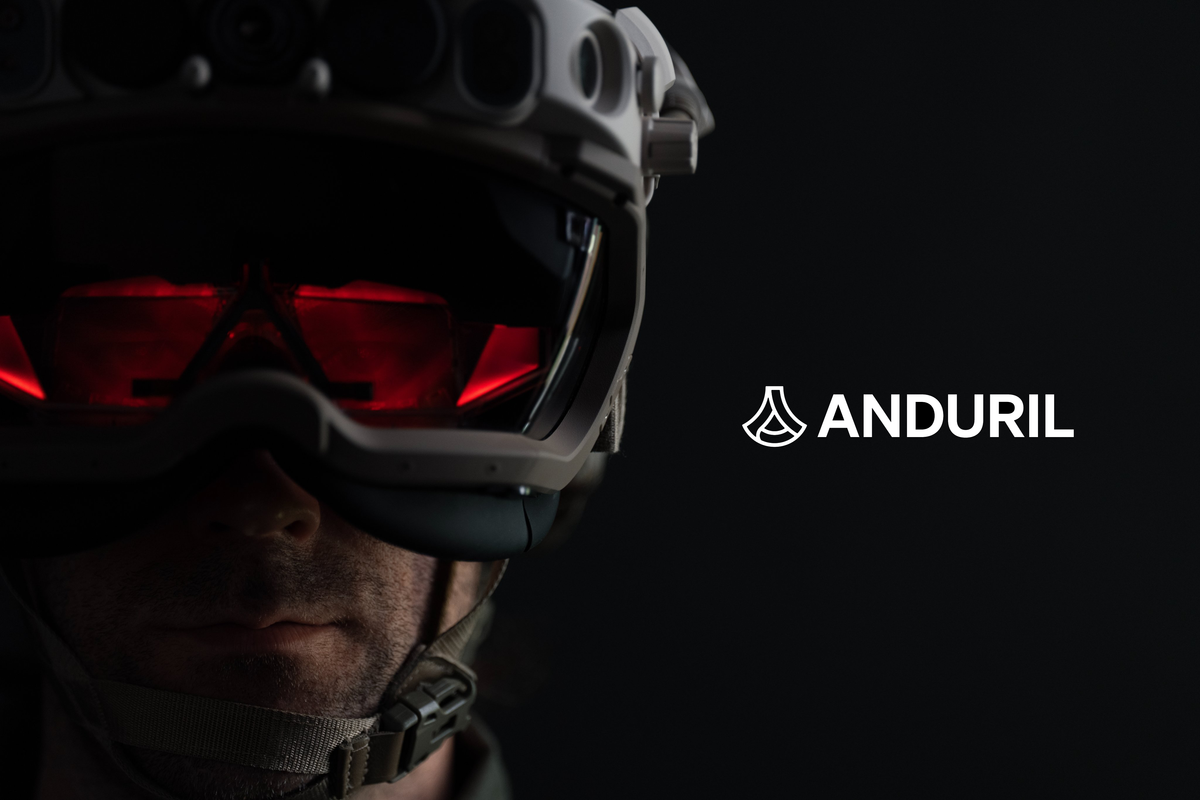
If you missed it, back in May, Meta and Palmer Luckey’s defense firm Anduril announced that they were teaming up to build XR products for US and allied militaries, starting with the EagleEye AR/VR helmet.
Alongside the partnership announcement, the two companies also jointly submitted a white paper for the US Army’s SBMC (Soldier-Borne Mission Command) program, the successor to the IVAS program that Microsoft once led with a customized HoloLens before Anduril took it over.
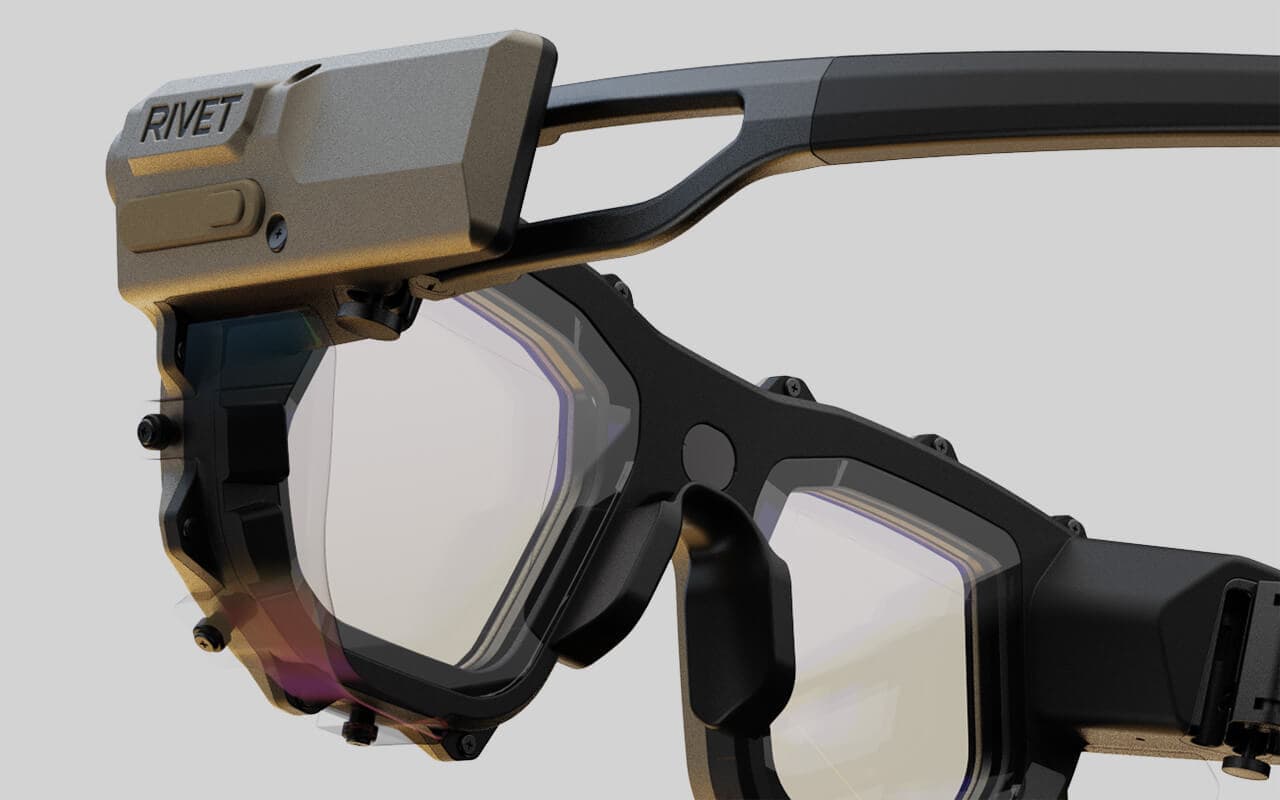
That same month, a new startup called Rivet announced its own military-focused AR glasses, called Hard Spec. Rivet’s executives include key former Microsoft HoloLens staff, and the company is funded in part by Palantir, which is also a “strategic partner” for both Rivet and Anduril.
While Anduril describes EagleEye as an “integrated ballistic shell”, a protective helmet with all the electronics built in, Rivet’s Hard Spec is currently a thick pair of glasses, with a cable routed around an existing helmet.
Beyond the design and the obvious use of waveguides, Rivet hasn’t said much about the technical specifics of Hard Spec.
Rivet Hard Spec
Now, the US Army has awarded Anduril $159 million, and Rivet $195 million, to build and deliver hundreds of SBMC prototypes for field testing.
Rivet has confirmed that its contract is for 470 “production representative” devices. Anduril, meanwhile, hasn’t disclosed exactly how many units its contract covers, though Breaking Defense reports that it’s also “hundreds”.
Ultimately, the SBMC program aims to augment the senses and cognition of all company-level-and-below US Army soldiers, and it could eventually be worth billions of dollars.
Previously reported potential use cases for IVAS, the predecessor of SBMC, included:
overlaying icons on friendly units, objectives, threats, and points of interest
built-in night vision & thermal view modes
live picture-in-picture feeds from drones, including the Soldier Borne Sensor (SBS) personal drone
simulated weapons & enemies for training exercises
scanning nearby people for signs of illness, such as a high temperature
facial recognition for hostage rescue situations
Microsoft’s IVAS solution was plagued with issues. In 2022 the US Congress rejected further orders following “mission-affecting physical impairments” including headaches, eyestrain and nausea”. Previous evaluations had found reliability issues, with “essential functions” sometimes failing.
Soon, with hundreds of units set to be tested, we should know whether Anduril’s EagleEye and Rivet’s Hard Spec fare any better in the field.
BrianFagioli shares a report from NERDS.xyz: Plex has alerted its customers about a security incident that may have affected user accounts. In an email sent to subscribers, the popular media server company confirmed that an unauthorized third party gained access to one of its databases. The breach exposed emails, usernames, and hashed passwords. Plex emphasized that passwords were encrypted following best practices, so attackers cannot simply read them. The company also reassured users that no credit card data was compromised, since Plex does not store that information on its servers. Still, out of caution, it is requiring all account holders to reset their credentials.
Users are being directed to reset their passwords at plex.tv/reset. During the process, Plex recommends enabling the option to sign out all connected devices. This measure logs out every device associated with the account, including Plex Media Servers, forcing a fresh login with the updated password. The company says it has already fixed the method used by the intruder to gain entry and is conducting additional security reviews. Plex is also urging subscribers to enable two-factor authentication if they have not already done so.
Microsoft is preparing to ship Windows 11 25H2 as their newest incremental update to their operating system. Windows 11 25H2 is currently available via their preview channel in advance of the formal public release in October. With Canonical also putting the finishing touches on their Ubuntu 25.10 release also due for a stable release in October, here are some benchmarks looking at how those competing operating systems are fairing in various CPU benchmarks on the same hardware.
The Washington Post reports on documents given to the United States Congress in an extensive article pointing to Meta’s leaders avoiding the subject of its role in children encountering adult strangers in Horizon Worlds.
“After leaked Meta studies led to congressional hearings in 2021, the company deployed its legal team to screen, edit and sometimes veto internal research about youth safety in VR, according to a joint statement the current and former employees submitted to Congress in May,” the article reports.
In 2022, an employee wrote “an analysis of app reviews indicated many were being driven off the app because of child users.”
“A company official wrote in response that if employees planned to share the findings more widely across the company, they should “avoid saying ‘kids’ like we know for sure they are kids — instead use ‘alleged Youth’ or ‘alleged minors with young sounding voices who may be underage.”
Head over to The Washington Post to read the entire article, but here’s one more snippet:
..the team studied publicly available app reviews and VR Facebook groups, where they found hundreds of allegations of inappropriate behavior on Meta products, including grooming— building a rapport with a child to enable abuse — along with bullying and simulated sexual acts. She said they compiled those allegations in a 59-page document that they shared with a small group of colleagues in an effort to spread awareness. Meta did not respond to questions on that document, which was among those submitted to Congress.
Notably, much of what’s discussed in the piece takes place before Meta formally invited those under 13 to play in VR by introducing “preteen accounts” that let parents, among other things, control which apps and worlds they can access. By default, these preteen accounts don’t have access to Horizon Worlds at all.
With Meta Connect right around the corner, I’m extremely curious to see how Mark Zuckerberg and his team respond. For some context, here’s a portion of an interview between me and Meta’s then-head of VR and AR Mark Rabkin at Meta Connect in 2023:
Hamilton: What changed to make a change the minimum age from 13 to ten?
Rabkin: A lot of work to be done to make it so. I think there is a lot of young folks who are super excited about MR and VR, super excited about the content, we saw a lot of the content that is popular with kind of a teen age groups, whether Horizon or VRChat or Rec Room or Roblox…”
Hamilton: Is VR safe for 10-year olds?
Rabkin: “I think so. We did tremendous amount of work over the last few years to make it possible. We worked on safety and integrity. We worked on a ton of research at the physical level of folks wearing it. We worked on Guardian. We worked on all these things, but most importantly, recently what held us back is we wanted to have better family accounts, better parental controls, better parental management and approval for what content the young folks get and then monitoring by the parents of how time was spent and so on. Once we got it to the point that we thought it was good enough to release, I’m very excited to have made that move and then we’re continuing our investment on the parental controls and management stuff, which I think is probably the most important piece to make it industry-leading. And then families can choose what each teen and what each pre-teen is ready for, which I think very dramatically by that young person and the family.”
If you’re looking for more reading after looking through the Washington Post’s article, I encourage you to read Henry Stockdale’s landmark piece from earlier this year on UploadVR.com where he charted the effect of Meta’s changing priorities on developers as the company changed focus from Quest to Horizon.
Bluesky has added a built-in bookmarking feature so users finally have a way to privately save posts on the platform. The update is out now on Bluesky’s website and app.
Bookmarks on Bluesky work pretty much like they do on any other service. Save a post and you can revisit it later from the “saved posts” section of the app and website. It’s overall a basic feature — there’s currently no way to organize your saves into folders, for example — but it’s a very long overdue addition to the platform.
Up to now, Bluesky users have technically been able to save posts via a workaround. Bluesky developer Jaz created a custom “pinned” feed that allowed subscribers to save posts by replying with a � emoji. But while this provided a handy way to save posts in the absence of an official bookmarking feature, it wasn’t private since it created a public reply for every save. Now, though, there’s a handy tool to convert your previously “pinned” posts into private bookmarks. You can also opt to delete your public “pins” or leave them as is.
This article originally appeared on Engadget at https://www.engadget.com/social-media/bluesky-finally-has-a-private-bookmarking-feature-224110038.html?src=rss
An anonymous reader quotes a report from Ars Technica: Last year, we reported on the efforts of classic iPod fans to preserve playable copies of the downloadable clickwheel games that Apple sold for a brief period in the late ’00s. The community was working to get around Apple’s onerous FairPlay DRM by having people who still owned original copies of those (now unavailable) games sync their accounts to a single iTunes installation via a coordinated Virtual Machine. That “master library” would then be able to provide playable copies of those games to any number of iPods in perpetuity.
At the time, the community was still searching for iPod owners with syncable copies of the last few titles needed for their library. With today’s addition of Real Soccer 2009 to the project, though, all 54 official iPod clickwheel games are now available together in an easily accessible format for what is likely the first time.
[…] Now that the consolidated clickwheel game collection is complete, though, owners of any iPod 5G+ or iPod Nano 3G+ should be able to sync the complete library to their personal device completely offline, without worrying about any server checks from Apple. They can do that by setting up a Virtual Machine using these GitHub instructions or by downloading this torrented Internet Archive collection and creating their own Virtual Machine from the files contained therein. The effort was made possible by GitHub user Olsro, with help from other iPod enthusiasts. To Olsro, completing the project “means this whole part from the early 2000s will remain with us forever.”
He also expressed hope that “this Virtual Machine can also be useful towards any security [or] archeologist researcher who want to understand how the DRM worked.”
The new Castelli Perfetto 3 RoS jacket has undergone a major overhaul, dropping the Gore-Tex Infinium fabric that was synonymous with the Italian brand’s wet-weather cycling kit and moving to Polartec’s new Aircore fabric.
Castelli worked closely with Polartec to develop the new “revolutionary” Aircore fabric. It says the fabric “ticks every box when it comes to being lightweight, highly breathable, windproof, and water repellent” and helps the Perfetto 3 redefine “what ‘breathable’ means”.
The fabric is also completely free from PFAs-based chemicals. These toxic ‘forever chemicals’ don’t break down in the natural environment and are now banned in some parts of the world.
Steve Smith, head of cycling at the MVC Group, which owns Castelli and Sportful, says this fabric is a “huge deal”.
“The drive to remove PFAs from wet weather clothing has been challenging to say the least. A number of products coming out dramatically compromise breathability for the sake of waterproofing,” says Smith.
“In so few areas of our lives is the move towards sustainability actually bringing us better performance. But here, we’re improving breathability, we’re improving water protection, we’re improving stretch and comfort, and we’re PFAs free,” he explains.
Fewer people are heading out for a bike ride in the rain, according to Steve Smith. Castelli
Entering an era free of PFAs, Castelli began designing the new Perfetto with a blank canvas and “a hard look” at what cyclists need.
“We’re seeing a big change in the way cyclists are riding in cool and wet conditions. That’s partly driven by technology, but also driven by climate change,” Smith says.
When it comes to technology, cyclists are spending more time riding indoors, which means they’re not braving the elements so often. And with more accurate weather forecasts, cyclists are adapting their rides to avoid downpours.
On climate change, Smith says: “There’s data out there that says we’re actually getting fewer days of rain, although the total amount of rainfall is maintaining the levels it always has. It’s just increasing in intensity.”
So when we do cycle in the rain, Smith says we’re reaching for rain jackets more than the kind of mixed-conditions, wet-weather kit for which Castelli is renowned, such as the Gabba.
These factors led Castelli to ask a question. “If we didn’t have to worry so much about water, how far could we push the breathability so that we can keep the cyclists drier on the inside across the widest range of temperatures and intensity levels?” says Smith.
Enter Polartec Aircore
The Castelli Perfetto 3 RoS jacket uses the “revolutionary” Polartec Aircore fabric. Castelli
After speaking to a range of fabric suppliers, engineers and scientists, Castelli found Polartec best understood its quest not to compromise on breathability or water protection.
Ramesh Kesh, business manager at Polartec, says you can basically make any rain jacket shell waterproof by putting a plastic film in it. But this means the material can’t breathe, which leads to moisture build-up.
With Polartec’s new Aircore fabric, Kesh says: “The idea is to prevent wind and moisture getting in, but at the same time, it has to get out so that you don’t feel clammy and start becoming uncomfortable.”
This is particularly tricky with sports such as cycling due to the Clausius–Clapeyron law. Kesh explains: “For every degree increase in your body temperature, you’re going to accumulate about 7 per cent more water, which means that as you do your high aerobic activity, condensation is going to build up.”
Aircore gets around this issue thanks to a nano-fibre membrane that’s sandwiched between two layers of textile.
The membrane is produced by a process called electrospinning, where a hydrophobic polymer is pushed through a needle that’s charged at 20,000 volts. The needle emits filaments, which are approximately 100 times smaller than a human hair and “fall like snow” to create a membrane that’s incredibly tight but still allows air to move through it.
A graphic showing how air can move through the Aircore fabric. Castelli
Smith says this airflow through the Perfetto is imperceivable: “Your perception of wearing this garment is that it is completely windproof, you don’t feel that there’s a wind chill, but yet there’s a small amount of air coming in that’s grabbing the moisture and taking it out.”
The end result is a fabric, and therefore a cycling jacket, which ventilates sweat away from your body to keep you dry and blocks out the wind and rain.
“A disservice to the industry”
Steve Smith says the water column of 10,000mm has been a “disservice to the industry”. Castelli
When it comes to waterproofing, the new Perfetto has a water column equivalent to 5,000mm.
This is half of the 10,000mm figure that is often the legal definition of waterproofness, and Smith thinks has “really been a disservice to the industry”.
“It got set at that because of the lobbyists for the industry, who were the earlier players that figured out how to make a product that gave that level of waterproofness,” he claims.
“In reality, lighter rain falls with the water column equivalent of around 800mm while heavy rain falls at around 2,000mm. So when you go to 10,000mm, you have way more waterproofness than you actually need,” Smith adds.
This means that although the new Perfetto has a high water column value, “we can’t call it waterproof in a legal sense”. Instead, Smith says Castelli promises you “effective waterproofing” with its latest jacket.
What else is new with the Castelli Perfetto 3?
The new Castelli Perfetto 3 RoS jacket is similar to its predecessor. Castelli
Apart from the new fabric, the Perfetto 3 (£280 / $320 / €249.95) is similar to its predecessor, with a few small tweaks.
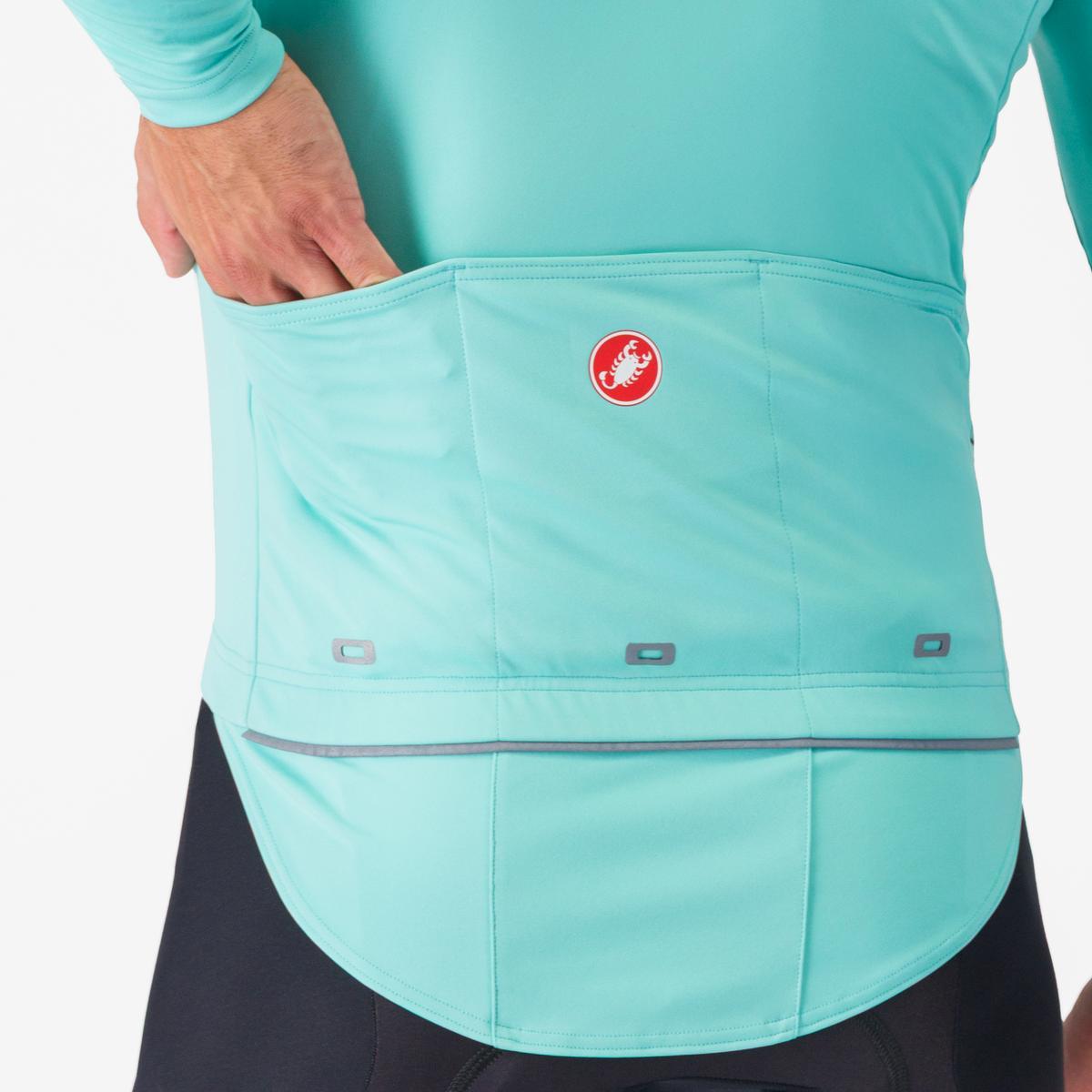
The jacket still has taped shoulder seams to keep any water out, but these are now reflective. There is also a new reflective strip underneath the three rear pockets, which still feature drainage holes. A drop-tail design protects you from any road spray, while the high collar keeps your neck warm.
Suitable for temperatures ranging from 4–14˚C, the jacket now has a two-way zip and retains its two body zips, which may not be of great use. Smith says the jacket was in development over the last winter and by the time it had gone into production in spring, Castelli realised the body zips weren’t necessary thanks to the breathability of the fabric. “You may never open them,” he says.
The Perfetto retains the body zips for ventilation. Castelli
The jacket has three rear pockets and a drop tail. Castelli
What’s next for Aircore?
Castelli has exclusive rights to use Aircore for cycling kit, and it will soon release a range of products that use the new fabric.
But there are currently brands outside of cycling looking at Aircore, so we can probably expect to see it crop up across the outdoor industry – and possibly elsewhere – in due course.
Kesh says the next stage of development will be to make the Aircore membrane from recycled material, which would make the fabric 100 per cent recycled.
“The idea is to leave the world in a better place, but not to compromise on performance,” says Kesh.
Rimac Technology has unveiled a new battery pack platform for electric vehicles that uses only solid-state batteries. The company has been an EV supplier for notable car brands including Aston Martin and Koenigsegg, as well as making electric supercar Nevara. Rimac collaborated with ProLogium and Mitsubishi Chemical Group on the product, which it claims will offer a lighter, safer and more energy-dense EV battery. It introduced this tech, alongside new composite and hybrid battery EV developments, at the IAA Mobility 2025 event.
Solid-state batteries are being touted as an important new development for EVs. European R&D operation Imec released a study into this tech last year that backed claims that these batteries did indeed have the potential to improve efficiency while bringing down costs.
However, the commercial development of solid-state batteries has been slow going. Despite a flurry of partnerships several years ago, the targets for getting EVs fully powered by the tech onto the road may still be some time away. For instance, Nissan said it aims to have its first EV solely using solid-state batteries released by its 2028 fiscal year. Rimac didn’t offer even a rough timeline for when it might have its new battery tech available for customers.
This article originally appeared on Engadget at https://www.engadget.com/transportation/evs/rimac-introduces-its-take-on-solid-state-batteries-for-electric-vehicles-215915664.html?src=rss
Kevin Barry, founder and sole developer of Nova Launcher, has left parent company Branch Metrics after being told to stop work on both the launcher and an open-source release. While the app remains on Google Play, the launcher’s website currently shows a 404 error. The Verge reports: Mobile analytics company Branch Metrics acquired Nova in 2022. The company’s CEO at the time, co-founder Alex Austin, said on Reddit that if Barry were to leave Branch, “it’s contracted that the code will be open-sourced and put in the hands of the community.” Austin left Branch in 2023, and now with Barry officially gone from the company, too, it’s unclear if the launcher will now actually be open-sourced.
“I think the newer leadership since Alex Austin left has put a different focus on the company and Nova simply isn’t part of that focus in any way at all,” Cliff Wade, Nova’s former customer relations lead who left as part of the 2024 layoffs, tells The Verge. “It’s just some app that they own but no longer feel they need or want.” Wade also said that “I don’t believe Branch will do the right thing any time soon with regards to open-sourcing Nova. I think they simply just don’t care and don’t want to invest time, unless of course, they get enough pressure from the community and individuals who care.”
Users have started a change.org petition to ask for the project to be open-sourced, and Wade says it’s a “great start” to apply that pressure. Wade said he hasn’t personally seen Barry’s contract, so couldn’t corroborate the claim of a contractual obligation to open-source Nova. Still, he said that the community “deserves” for the launcher to be open-sourced. “Branch just simply needs to do the right thing here and honor what they as a company have stated as well as what then CEO Alex Austin has stated numerous times prior to him leaving Branch.”