Bending Spoons Buys Video Platform Vimeo for $1.38 Billion

Bending Spoons has entered a definitive agreement with Vimeo to purchase the video platform for $1.38 billion. From a report: Per the agreement, Bending Spoons will acquire Vimeo in an all-cash transaction and take Vimeo (VMEO), a public company, private. Vimeo shareholders will receive $7.85 per share in cash when the transaction closes.

[…] Vimeo, once a significant player in the streaming video space, has lost massive ground to other platforms, including YouTube, in recent years. Rather than fight a losing battle in the creator space, Vimeo has catered more toward business and enterprise users lately.


Read more of this story at Slashdot.

Lyft launches autonomous fleet with May Mobility in Atlanta

Lyft and May Mobility have teamed up to launch a fleet of autonomous vehicles in Atlanta. It’s a pilot program, so it’s currently only available to Lyft riders in the area of midtown Atlanta. The companies promise a “measured, safety-first approach” with this rollout.

The fleet consists of hybrid-electric Toyota Sienna Autono-MaaS vehicles equipped with May Mobility’s self-driving technology. Lyft and May Mobility announced this partnership last year, but Atlanta is the first city to get a fleet of self-driving vehicles.

Atlanta, we’re here! Our autonomous vehicle pilot program with @Lyft is now live in Midtown. Find us in the Lyft app! https://t.co/dUqF95q93r pic.twitter.com/TFfDg23D8Y

— May Mobility (@May_Mobility) September 10, 2025

The rides will be fully autonomous, but each vehicle will feature a human just in case something goes wrong. These standby operators are trained to take the wheel if needed. The companies haven’t announced a timeframe for when these standby operators will no longer be required.

Customers will have access to temperature controls, which is nice. However, hailing one of these cars is something of a crap shoot. You have to be in the service area, use the app and hope for the best. Lyft and May Mobility say they will increase the number of available vehicles and expand service hours in the “months ahead.”

This is May Mobility’s second launch in Georgia, as it operates a fleet of driverless vehicles in the Atlanta suburb of Peachtree Corners. Lyft’s primary rival Uber has also been making serious moves in this space. The company has entered into a partnership with Lucid to create a massive fleet of 20,000 autonomous vehicles. It also has plans to launch self-driving pilot programs throughout the globe.

This article originally appeared on Engadget at https://www.engadget.com/transportation/lyft-launches-autonomous-fleet-with-may-mobility-in-atlanta-184942285.html?src=rss

These Two New Features Cement Google’s NotebookLM As One of My Favorite Study Apps

While AI tools are incredibly divisive, and I remain highly skeptical of them in general (especially as someone who makes a living writing for the internet), I have to give props to Google’s NotebookLM, which is the rare AI tool I’ve found that meets my standards for being both ethical and useful.

This large language model pulls only from the content you put into it, making it a great way to organize your notes, pull out key ideas, and increase your productivity. And now a new update allows you to use it to create flashcards and quizzes, making it a perfect study companion—and it’s still free.

What NotebookLM can do

If you’re unfamiliar with NotebookLM’s capabilities, here’s a quick rundown: You start by uploading your materials to “notebooks,” which you can think of as your single source of truth on a given topic. (An SSOT is a repository where you keep all the information, resources, and materials related to whatever it is you’re doing.) You can upload local files, files from your Google Drive, links to websites or YouTube videos, or plain old copied-and-pasted text. This is particularly useful for students, as you can input links to articles mentioned in your study materials, upload PDFs from your teacher, or even add digital copies of your textbook, putting all your approved study materials in one place.

You can then ask the chatbot questions about the material, ask it to create an audio “podcast” of people discussing the content (which you can then interact with), and more. I most often use it when I’m working on a large project: I input all the interviews I’ve done, all the research material I have, and any other related elements, then ask it to help me find quotes or develop an outline. It’s also great for summarizing and organizing my notes and class materials when I’m preparing for a grad school exam.

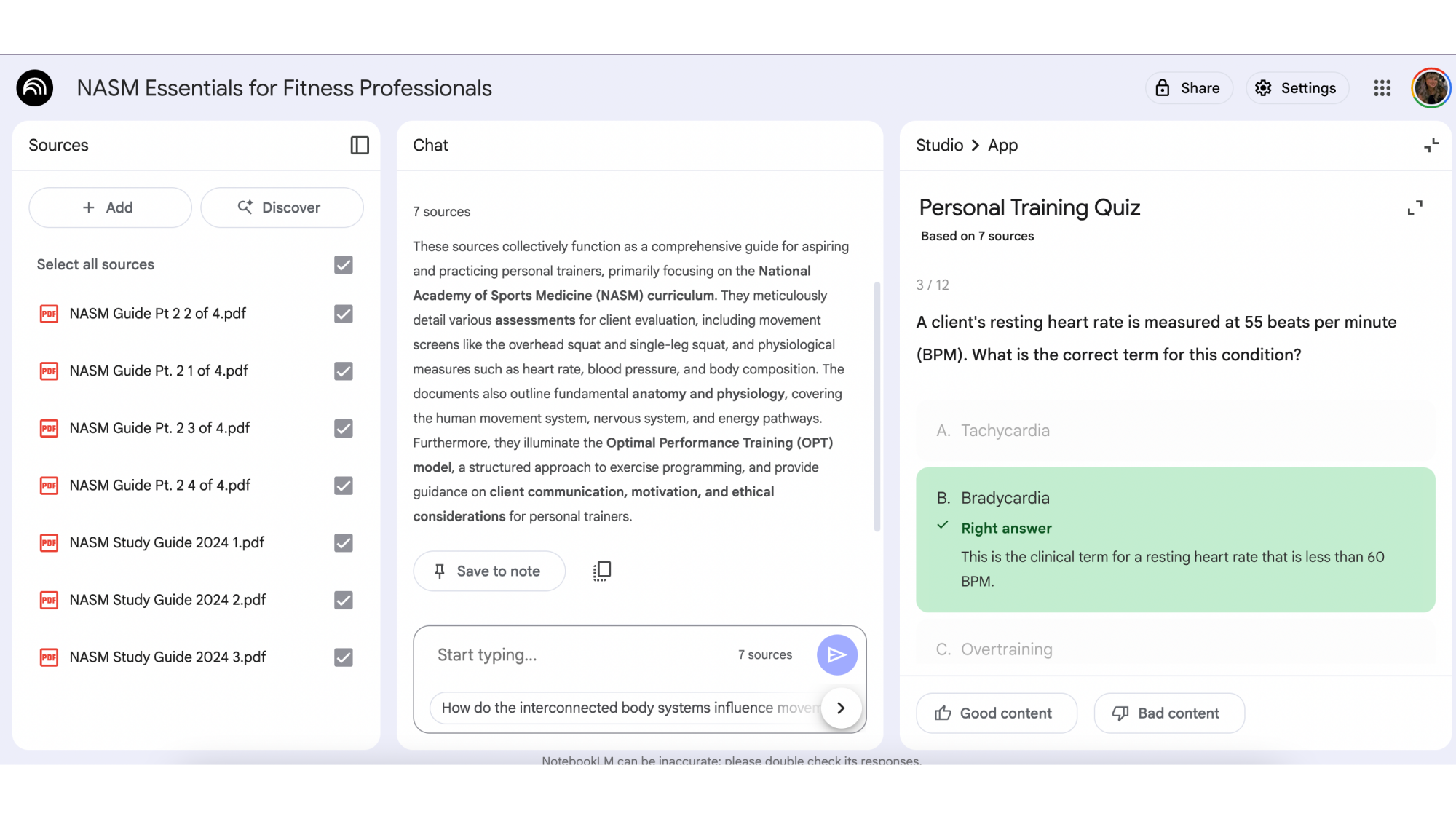
And with the latest update, you have more options: Along the side menu, you’ll see buttons for Flashcards and Quizzes alongside Mind maps and Audio overview.

Testing NotebookLM’s new features

To test these new capabilities, I chose from my collection of notebooks one filled with materials for a certification exam I’ve been studying for.

Instant quizzes

NotebookLM previously allowed you to ask it to create quizzes, but it would just generate practice quizzes in plain text with an answer key at the end. The new Quizzes feature is a lot more involved.

NotebookLM quiz

Credit: Google/Lindsey Ellefson

The quiz it generated from seven PDFs of material was extremely detailed and easy to use. It asked a question, gave me four options, and, after I clicked one, told me if it was right or wrong, and included an explanation for why the right answer was correct. All of the information was pulled directly from my own materials, so I didn’t have to worry about checking the sourcing.

Effortless flashcards

There are a ton of flashcard apps out there and I’ve reviewed plenty, but I never stuck with any of them because creating flashcards is invariably tedious—or expensive. In contrast, the flashcards NotebookLM generates were easy to use and, again, pulled right from my materials.

There isn’t much to say about them—they’re flashcards; you just flip them back and forth to reveal questions and answers—but notably, and unlike other flashcard apps, NotebookLM doesn’t have a way to indicate whether you got a card’s answer right or wrong. Some other apps will ask you to indicate how you did so they know how often to show you that card again, in line with the Leitner method of flashcard review. That doesn’t mean this approach to flashcards is terrible, however, as it adds some additional worthwhile features. For instance, once you flip a card by clicking on it to reveal the answer, NotebookLM adds an Explain button. Click it to get more context on the answer, or to see exactly where from your uploaded materials the card was generated.

NotebookLM is one of my favorite study apps

I’ve written about all kinds of learning techniques and studying apps, and used most of them myself, whether for work, grad school, or my own personal development. I am squeamish about most AI tools not only because they can be inaccurate, but because they provide so many shortcuts that it’s harder to learn and retain information. NotebookLM, meanwhile, makes it easy to study using proven methods, and as it only pulls information from resources you provide (and therefor presumably trust), you’ll be able to trust its output.

The addition of the quizzes and flashcards make it an even more powerful and useful study tool than it already was, and that’s saying a lot. I’m going to use both of them to prepare for my next exam exam.

‘No Tax on Tips’ apparently also applies to your favorite streamer

Streamers, YouTubers and other content creators are eligible for the new “No Tax on Tips” policy in the One Big Beautiful Bill Act President Donald Trump signed into law on July 4, 2024. “Digital Content Creators” are included in a preliminary list of occupations that are eligible for the new tax deduction on tips the US Treasury Department released last week. That means a podcaster could receive the same tax relief as a waiter or bartender.

Under that guidance, the “Bits” received during a Twitch stream or the “Super Thanks” a YouTuber receives for a great upload could go untaxed when next year’s tax season rolls around. As The Hollywood Reporter notes, though, there are limits to how much of that tipped income will be deducted — up to $25,000 per year and it’s phased out for single filers who make more than $150,000 per year — and language that suggests not every tipping scenario content creators face might apply.

According to the Treasury, tips won’t qualify for the deduction “if they are received in the course of certain specified trades or businesses,” which includes “the fields of health, performing arts, and athletics.” Does that mean this is a much narrower carve out for content creators than it appears? Possibly, but these classifications will need to be finalized before anyone will be able to say for sure. Ultimately, content creators have multiple possible sources of income: direct subscriptions, ad revenue, paid partnerships, direct sales and digital tips. How much a new tax deduction changes their calculus will vary.

Making tips tax deductible was one of several campaign promises Trump made leading up to his reelection in November 2024. The idea was eventually folded into the One Big Beautiful Bill, which is perhaps better known for the catastrophic cuts it made to social welfare and clean energy spending. As it turns out, the bill might also reshape the creator economy, too.

This article originally appeared on Engadget at https://www.engadget.com/entertainment/youtube/no-tax-on-tips-apparently-also-applies-to-your-favorite-streamer-182932748.html?src=rss

iPhones 17 and the Sugar Water Trap

Analyst Ben Thompson, commenting on Apple’s outlook following the launch of the iPhone 17 lineup: Apple, to be fair, isn’t selling the same sugar water year-after-year in a zero sum war with other sugar water companies. Their sugar water is getting better, and I think this year’s seasonal concoction is particularly tasty. What is inescapable, however, is that while the company does still make new products — I definitely plan on getting new AirPod Pro 3s! — the company has, in the pursuit of easy profits, constrained the space in which it innovates.

That didn’t matter for a long time: smartphones were the center of innovation, and Apple was consequently the center of the tech universe. Now, however, Apple is increasingly on the periphery, and I think that, more than anything, is what bums people out: no, Apple may not be a sugar water purveyor, but they are farther than they have been in years from changing the world.


Read more of this story at Slashdot.

Reddit, Yahoo, Medium and more are adopting a new licensing standard to get compensated for AI scraping

With web publishers in crisis, a new open standard lets them set the ground rules for AI scrapers. (Or, at least it will try.) The new Really Simple Licensing (RSL) standard creates terms that participants expect AI companies to abide by. Although enforcement is an open question, it can’t hurt that some heavy hitters back it. Among others, the list includes Reddit, Yahoo (Engadget’s parent company), Medium and People Inc.

RSL adds licensing terms to the robots.txt protocol, the simple file that provides instructions for web crawlers. Supported licensing options include free, attribution, subscription, pay-per-crawl and pay-per-inference. (The latter means AI companies only pay publishers when the content is used to generate a response.)

Launching alongside the standard is a new managing nonprofit, the RSL Collective. It views itself as an equivalent of nonprofits like ASCAP and BMI, which manage music industry royalties. The new group says its standard can “establish fair market prices and strengthen negotiation leverage for all publishers.”

Participating brands include plenty of internet old-schoolers. Reddit, People Inc., Yahoo, Internet Brands, Ziff Davis, wikiHow, O’Reilly Media, Medium, The Daily Beast, Miso.AI, Raptive, Ranker and Evolve Media are all on board. Former Ask.com CEO Doug Leeds and RSS co-creator Eckart Walther lead the group.

“The RSL Standard gives publishers and platforms a clear, scalable way to set licensing terms in the AI era,” Reddit CEO Steve Huffman wrote in a press release. “The RSL Collective offers a path to do it together. Reddit supports both as important steps toward protecting the open web and the communities that make it thrive.” (It’s worth noting that Reddit has licensing deals with OpenAI and Google.)

It’s unclear whether AI companies will honor the standard. After all, they’ve been known to simply ignore robots.txt instructions. But the group believes its terms will be legally enforceable.

In an interview with Ars Technica, Leeds pointed to Anthropic’s recent $1.5 billion settlement, suggesting “there’s real money at stake” for AI companies that don’t train “legitimately.” (However, that settlement is up in the air after a judge rejected it.) Leeds told The Verge that the standard’s collective nature could also help spread legal costs, making challenges to violations more feasible.

As for technical enforcement, the RSL standard can’t block bots on its own. For that, the group is partnering with the cloud company Fastly, which can act as a sort of gatekeeper. (Perhaps Cloudflare, which recently launched a pay-per-crawl system, could eventually play a part, too.) Leeds said Fastly could serve as “the bouncer at the door to the club.”

Leeds suggested to Ars that there are incentives for AI companies, too. Financially, it could be simpler for them than inking individual licensing deals. It could prevent a problem in AI content: using multiple sources for an answer to avoid using too much from any one. If content is legally licensed, the AI app can simply use the best source, which provides the user with a higher-quality answer and minimizes the risk of hallucinations.

He also referenced complaints from AI companies that there’s no effective means of licensing web-wide content. “We have listened to them, and what we’ve heard them say is… we need a new protocol,” Leeds told Ars Technica. “With the RSL standard, AI firms get a “scalable way to get all the content” they want, while setting an incentive that they’ll only have to pay for the best content that their models actually reference. If they’re using it, they pay for it, and if they’re not using it, they don’t pay for it.”

This article originally appeared on Engadget at https://www.engadget.com/ai/reddit-yahoo-medium-and-more-are-adopting-a-new-licensing-standard-to-get-compensated-for-ai-scraping-180946671.html?src=rss

Developers joke about “coding like cavemen” as AI service suffers major outage

On Wednesday afternoon, Anthropic experienced a brief but complete service outage that took down its AI infrastructure, leaving developers unable to access Claude.ai, the API, Claude Code, or the management console for around half an hour. The outage affected all three of Anthropic’s main services simultaneously, with the company posting at 12:28 pm Eastern that “APIs, Console, and Claude.ai are down. Services will be restored as soon as possible.” As of press time, the services appear to be restored.

The disruption, though lasting only about 30 minutes, quickly took the top spot on tech link-sharing site Hacker News for a short time and inspired immediate reactions from developers who have become increasingly reliant on AI coding tools for their daily work. “Everyone will just have to learn how to do it like we did in the old days, and blindly copy and paste from Stack Overflow,” joked one Hacker News commenter. Another user recalled a joke from a previous AI outage: “Nooooo I’m going to have to use my brain again and write 100% of my code like a caveman from December 2024.”

The most recent outage came at an inopportune time, affecting developers across the US who have integrated Claude into their workflows. One Hacker News user observed: “It’s like every other day, the moment US working hours start, AI (in my case I mostly use Anthropic, others may be better) starts dying or at least getting intermittent errors. In EU working hours there’s rarely any outages.” Another user also noted this pattern, saying that “early morning here in the UK everything is fine, as soon as most of the US is up and at it, then it slowly turns to treacle.”

Read full article

Comments

Grammarly’s AI writing assistance tools now work in five new languages

Since its debut in 2009, Grammarly has only been available in one language: English. Sure, you could switch between dialects, including Canadian and Indian English, but if you wrote in any other language, you were out of luck. That’s changing today with Grammarly rolling out beta support for five additional languages: French, German, Italian, Portuguese and Spanish.

The update is available to all Grammarly customers — whether you live in a country that speaks the language you want to write in or not — with support for the platform’s signature features included. As you write in any one of the new languages, you’ll see Grammarly highlight spelling and grammatical errors, as well offer suggestions for how you might rewrite certain paragraphs to refine their tone, style and flow. Additionally, with any of the six primary languages Grammarly now supports, the app offers in-line translation, with the ability to convert your text into 19 different languages.    

“The new features are Grammarly’s first step toward more comprehensive multilingual writing assistance,” said Grammarly. “In the coming year, the company plans to launch more advanced clarity suggestions in the supported languages, similar to what it offers in English.”

If you want to start writing in French, German, Italian, Portuguese or Spanish, you don’t need to tweak any settings in Grammarly. Provided you’re using the Windows or Mac app or Chrome extension, you can simply start writing in one of the new languages. In addition to being available to Pro, Enterprise and Education customers, free users can also take advantage of the expanded support — though with some limitations.

This article originally appeared on Engadget at https://www.engadget.com/grammarlys-ai-writing-assistance-tools-now-work-in-five-new-languages-180432231.html?src=rss

Growth Collides With Rising Seas in Charleston

Charleston’s planned $1.3 billion sea wall will protect the city’s historic downtown peninsula while leaving lower-income neighborhoods like Rosemont exposed to rising waters. The eight-mile barrier, with Charleston contributing $455 million, excludes historically Black communities already experiencing regular flooding.

Meanwhile, developers have received approval for thousands of new homes in flood-prone areas, including Long Savannah’s 4,500 units and Cainhoy’s 9,000-home development on filled wetlands. Charleston’s sea level rose 13 inches over the past century and faces another four-foot rise by 2100. Climate Central projects 8,000 residents and 4,700 homes will face annual flooding risk by 2050. The Bridge Pointe neighborhood already underwent FEMA buyouts after successive floods, while coastal South Carolina zip codes report among the nation’s highest insurance non-renewal rates.


Read more of this story at Slashdot.

AI Darwin Awards Launch To Celebrate Spectacularly Bad Deployments

An anonymous reader shares a report: The Darwin Awards are being extended to include examples of misadventures involving overzealous applications of AI. Nominations are open for the 2025 AI Darwin Awards and the list of contenders is growing, fueled by a tech world weary of AI and evangelists eager to shove it somewhere inappropriate.

There’s the Taco Bell drive-thru incident, where the chain catastrophically overestimated AI’s ability to understand customer orders. Or the Replit moment, where a spot of vibe coding nuked a production database, despite instructions from the user not to fiddle with code without permission. Then there’s the woeful security surrounding an AI chatbot used to screen applicants at McDonald’s, where feeding in a password of 123456 gave access to the details of 64 million job applicants.


Read more of this story at Slashdot.

Protect Arctic From ‘Dangerous’ Climate Engineering, Scientists Warn

Dozens of polar scientists have warned that geoengineering schemes to manipulate the Arctic and Antarctic are dangerous, impractical, and risk distracting from the urgent need to cut fossil fuel emissions. The BBC reports: These polar “geoengineering” techniques aim to cool the planet in unconventional ways, such as artificially thickening sea-ice or releasing tiny, reflective particles into the atmosphere. They have gained attention as potential future tools to combat global warming, alongside cutting carbon emissions. But more than 40 researchers say they could bring “severe environmental damage” and urged countries to simply focus on reaching net zero, the only established way to limit global warming.

The scientists behind the new assessment, published in the journal Frontiers in Science, reviewed the evidence for five of the most widely discussed polar geoengineering ideas. All fail to meet basic criteria for their feasibility and potential environmental risks, they say. One such suggestion is releasing tiny, reflective particles called aerosols high into the atmosphere to cool the planet. This often attracts attention among online conspiracy theorists, who falsely claim that condensation trails in the sky — water vapour created from aircraft jet engines — is evidence of sinister large-scale geoengineering today. But many scientists have more legitimate concerns, including disruption to weather patterns around the world.

With those potential knock-on effects, that also raises the question of who decides to use it — especially in the Arctic and Antarctic, where governance is not straightforward. If a country were to deploy geoengineering against the wishes of others, it could “increase geopolitical tensions in polar regions,” according to Dr Valerie Masson-Delmotte, senior scientist at the Universite Paris Saclay in France. Another fear is that while some of the ideas may be theoretically possible, the enormous costs and time to scale-up mean they are extremely unlikely to make a difference, according to the review. […]

A more fundamental concern is that these types of projects could create the illusion of an alternative to cutting humanity’s emissions of planet-warming gases. “If they are promoted… then they are a distraction because to some people they will be a solution to the climate crisis that doesn’t require decarbonising,” said Prof Siegert. “Of course that would not be true and that’s why we think they can be potentially damaging.” Even supporters of geoengineering research agree that it is, at best, a supplement to net zero, not a substitution.


Read more of this story at Slashdot.

Witnesses Tell Congress of UFO Sightings

A U.S. congressional hearing today on Unidentified Anomalous Phenomena (UAPs) featured testimony from military veterans and witnesses describing encounters with mysterious craft, including glowing red squares, tic-tac-shaped objects emerging from the ocean, and videos of missiles striking unidentified orbs. While NASA maintains there’s no evidence of extraterrestrial life, lawmakers stressed the need for transparency, whistleblower protections, and further investigation.

There were four witnesses at today’s hearing:
Jeffrey Nuccetelli: U.S. Air Force veteran and self-described UAP witness who investigated the reported “red square” sighting above Vandenberg Air Force Base.
George Knapp: Award-winning journalist and chief reporter at KLAS-TV, known for his decades of UFO coverage and multiple Peabody Awards.
Alexandro Wiggins: Navy veteran of 23 years who reported witnessing a “Tic Tac” UAP aboard the USS Jackson in 2023 and noted his father’s work at Area 51.
Dylan Borland: Air Force veteran and UAP witness with little public information or media exposure available.

“The public senses that it’s real and the people in authority dismiss them,” said Knapp, arguing that the public can handle the truth. One of the clips he showed lawmakers was of a drone operator tracking a glowing orb off the coast of Yemen before a missile struck the object. “That’s a Hellfire missile smacking into that UFO and just bouncing right off,” he said. “What the hell is that?” Knapp said the clip is not unique, claiming multiple video servers with similar UAP footage are being kept from Congress. Borland testified: “This craft interfered with my telephone, did not have any sound and the material it was made of appeared fluid or dynamic.”


Read more of this story at Slashdot.

Beer Drinkers Are Mosquito Magnets, According To a Festival Study

alternative_right shares a report from Phys.org: Some people are simply mosquito magnets while others emerge relatively unscathed. But why is this so? One explanation, according to scientists from the Netherlands, is beer. To find out why the blood-sucking critters prefer some people over others, a research team led by Felix Hol of Radboud University Nijmegen took thousands of female Anopheles mosquitoes to Lowlands, an annual music festival held in the Netherlands.

Researchers set up a pop-up lab in connected shipping containers in 2023, and around 500 volunteers took part. First, they filled out a questionnaire about their hygiene, diet and behavior at the festival. Then, to see how attractive they are to mosquitoes, they placed their arm into a custom-designed cage filled with the pesky insects. The cage had tiny holes so the mosquitoes could smell the person’s arm but couldn’t bite them. A video camera recorded how many insects landed on a volunteer’s arm compared to a sugar feeder on the other side of the cage. By comparing the video footage and questionnaire answers, researchers saw some clear results emerge.

Participants who drank beer were 1.35 times more attractive to mosquitoes than those who didn’t. The tiny vampires were also more likely to target people who had slept with someone the previous night. The study also revealed that recent showering and sunscreen make people less attractive to the buzzing menace. “We found that mosquitoes are drawn to those who avoid sunscreen, drink beer, and share their bed,” the researchers wrote in a paper uploaded to the bioRxiv preprint server. “They simply have a taste for the hedonists among us.”


Read more of this story at Slashdot.

Amazon Might Be Developing Its Own Smart Glasses to Compete With Meta

We may earn a commission from links on this page.

Amazon might be developing its own augmented reality smart glasses to compete with Meta, according to Amazon insiders who worked on the project. Codenamed “Jayhawk,” the smart specs will reportedly feature a camera, microphones, speakers, and a full-color display in one eye, all packed in a sleek frame. If the rumors, as reported by The Information, turn out to be true, Amazon’s smart glasses will hit the market in late 2026 or early 2027.

The goal, presumably, is to not cede the entire smart glasses market to industry leader Meta and newcomers like Google (we’ll pretend Google Glass never happened). Whether Amazon can compete on that field remains to be seen, but the company’s last stab at tech glasses, the audio-and-Alexa-focused Echo Frames line of smart glasses, didn’t exactly set the world on fire when they were released back in 2019, despite being generally regarded as adequate (though uninspiring).

Amazon drivers may get their own AR smart glasses, too

Amazon is also reportedly developing smart glasses specifically for its delivery drivers. These will feature the same technology as the consumer devices in a sturdier package, and give drivers turn-by-turn navigation on a small embedded screen. According to a report from Reuters in late 2024, the delivery driver glasses are designed to provide extremely precise, location-based directions, in order to “shave valuable seconds off each delivery by providing left or right directions off elevators and around obstacles such as gates or aggressive dogs.”

It’s hard to avoid considering the nightmarish possibilities of an employer being able to literally look through the eyes of its workers—imagine your boss yelling at you through your eyeballs. Smart glasses could easily track eye movements, pauses, or even monitor employees’ emotions through facial expressions and voice analysis. Whether Amazon, a company sued for enforcing a schedule so strict that drivers were forced to urinate in bottles, would use the technology in these, or other exploitative ways, remains to be seen.

Microsoft And LG Want To Ride Shotgun For In-Car Xbox Cloud Gaming

Microsoft And LG Want To Ride Shotgun For In-Car Xbox Cloud Gaming
Microsoft’s Xbox gaming division launched its “This is an Xbox” campaign late last year, in an effort to reinforce the notion that all its games are playable on a variety of devices, thanks to the cloud. In its latest move, the company wants to cater to gamers wherever they happen to be, by offering cloud gaming services in a select set of

NASA’s Perseverance rover finds potential signs of ancient life on Mars

NASA just announced that its Perseverance rover recently found some promising signs of ancient life on Mars. The rover obtained a sample of rock formed billions of years ago from sediment and there are biomarkers indicating the potential presence of microbes once upon a time.

Basically, the rocks contain minerals that typically form as a result of a chemical reaction between mud and organic matter. That doesn’t necessarily mean that Mars once had life, as the minerals can form due to nonbiological processors. However, it’s certainly one of the best pieces of evidence we have to point toward our neighbor planet once housing life of some kind.

“On Earth, reactions like these, which combine organic matter and chemical compounds in mud to form new minerals like vivianite and greigite, are often driven by the activity of microbes,” said Stony Brook University planetary scientist Joel Hurowitz, who led the study published in the journal Nature. “The microbes are consuming the organic matter in these settings and producing these new minerals as a byproduct of their metabolism.”

Hurowitz does caution that this is just a potential biosignature and not actual proof of ancient life. Many scientists believe, however, that Mars wasn’t always quite as inhospitable as it is today.

The planet likely held plenty of water in its distant past. Researchers suggest that the area in which Persevere found these samples was once a river valley that led to a lake, though this was more than 3.5 billion years ago.

The samples were collected last year, but researchers needed time for analysis. Perseverance has been roaming around the Martian surface since 2021. The six-wheeled rover has been collecting rock samples and regolith, using its onboard instruments for this analysis. This is also just the beginning of the research required here.

“Ultimately, follow-on research will provide us with a suite of testable hypotheses for how to determine whether biology is responsible for the generation of these features,” Hurowitz added.

This article originally appeared on Engadget at https://www.engadget.com/science/space/nasas-perseverance-rover-finds-potential-signs-of-ancient-life-on-mars-173457976.html?src=rss