
Embracer’s Bluff might be a sly reference to the company’s past and the hated video game publisher that tried to own everything
The post <i>Borderlands 4</i> Seems To Include A Direct Jab At Gearbox’s Former Owner Embracer appeared first on Kotaku.

Embracer’s Bluff might be a sly reference to the company’s past and the hated video game publisher that tried to own everything
The post <i>Borderlands 4</i> Seems To Include A Direct Jab At Gearbox’s Former Owner Embracer appeared first on Kotaku.
The F-Droid project has some
advice for free-software projects on how to deal with takedown
requests.
As part of our legal resilience research, we spoke with a range of
legal experts, software freedom advocates, and maintainers of
mature FOSS infrastructure to understand how others manage these
moments. In this article, we share what we learned, and how F-Droid
is incorporating these lessons into its own approach.
Did you know you can customize Google to filter out garbage? Take these steps for better search results, including adding Lifehacker as a preferred source for tech news.
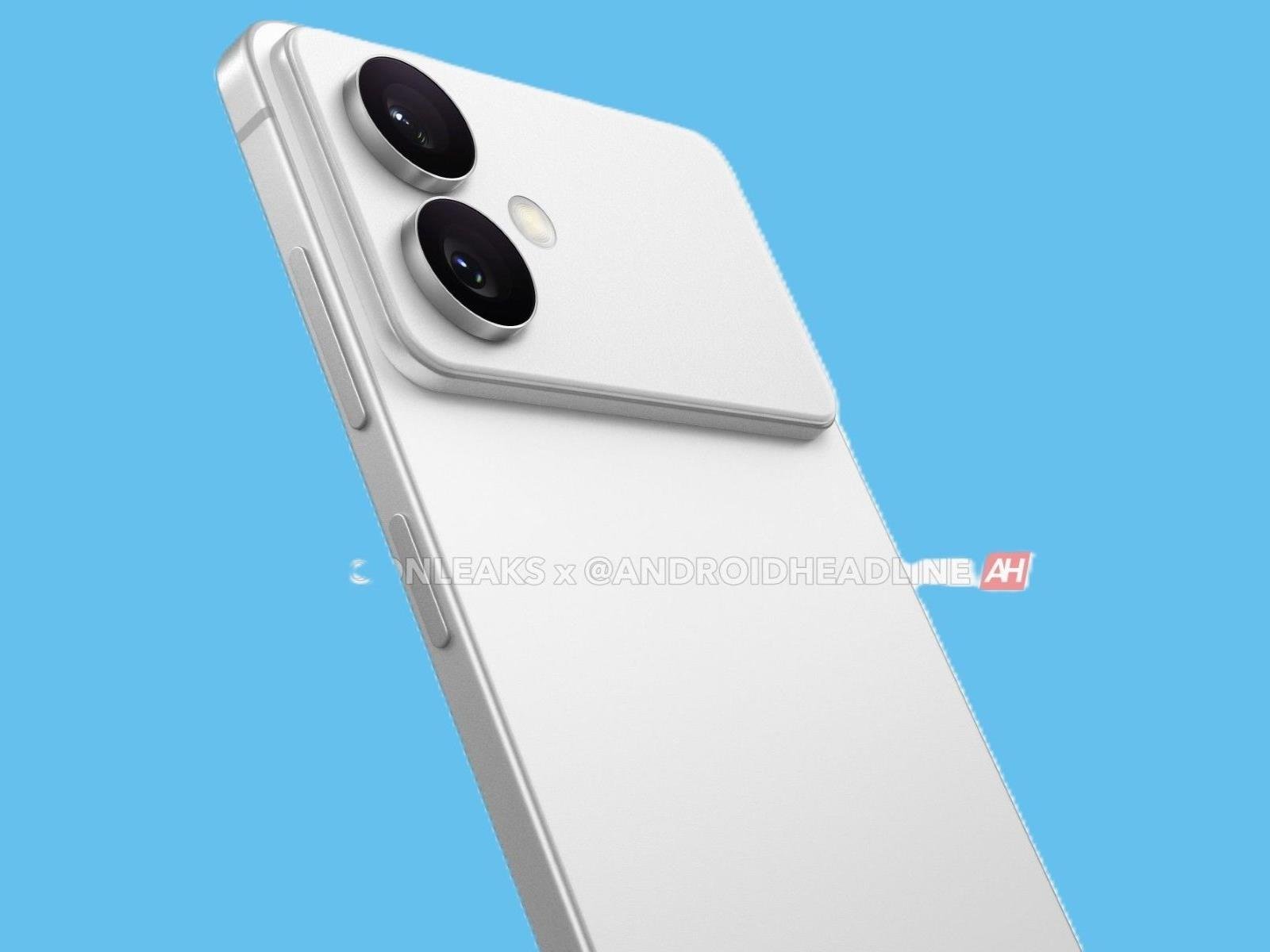
Apple hasn’t said anything official about plans to introduce a foldable iPhone, but there’s little doubt that one is on the way. The rumors have been accumulating for years, and both Bloomberg’s Mark Gurman and industry analyst Ming-Chi Kuo—two of the most reliable Apple tipsters in the business—say the device will launch in 2026.
Now, and with perhaps less than a year until the arrival of the foldable iPhone, Apple has dropped the iPhone Air. It wouldn’t be a huge surprise if the iPhone Fold looked more or less like like two iPhone Airs with a hinge in the middle, which means the thinnest iPhone ever might be giving us clues about Apple’s foldable future.
Thinness is an absolute must with a foldable phone: No one wants two regular-sized handsets stuck together in their pocket or bag. This isn’t so much of an issue when a foldable is opened, but when it’s closed, any excess bulk is much more noticeable—so foldable phone makers are trying to minimize the problem, literally.
The Honor Magic V5 foldable is a mere 4.2 mm (0.17 inches) front to back when opened, while the Samsung Galaxy Z Fold 7 has exactly the same thickness. The iPhone Air is officially 5.64 mm (0.22 inches) thick, excluding the camera bump, which beats the 7.95 mm (0.31 inches) thickness of the regular iPhone 17 by a significant margin.
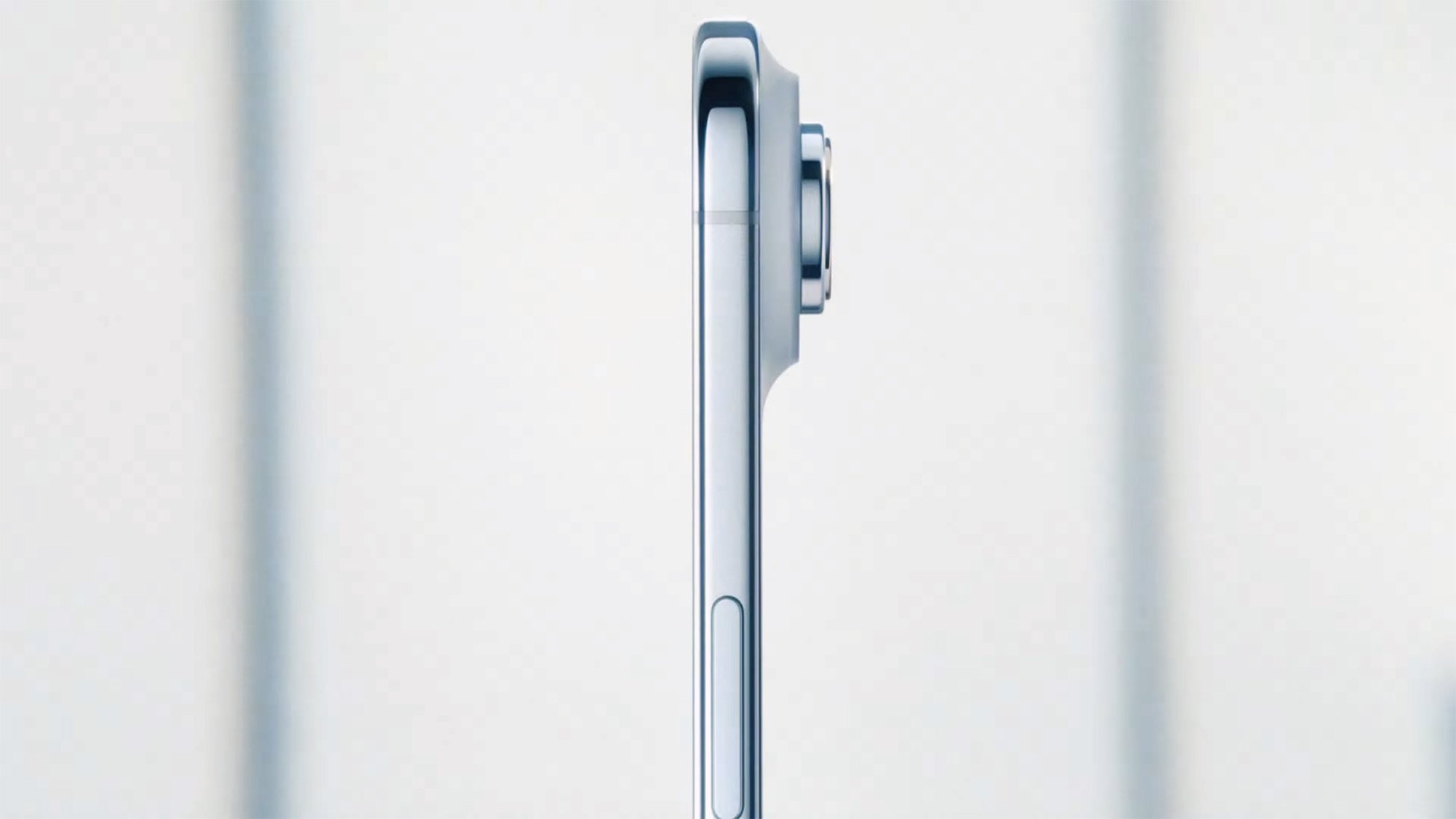
While the foldable iPhone will probably have to go even thinner, Apple is clearly heading in the right direction. Meanwhile, it’s also tackling another crucial characteristic of foldable phones: Durability. The extra moving parts and the additional screens involved with a folding smartphone mean that it has to withstand knocks and scrapes, and obviously have a hinge mechanism that lasts.
The iPhone Air is unique among the 2025 models in having the brand new Ceramic Shield 2 material (a kind of glass-ceramic hybrid) on the front of the phone, and the older Ceramic Shield material on the back. It’s a fully protected handset. While the Pro and Pro Max models have dropped titanium, the iPhone Air sticks with it for extra durability, to the point that it’s actually the most durable iPhone ever—so expect similar from the iPhone Fold.
Apple’s September 2025 launch event went into detail about how the internals of the iPhone Air had been redesigned from scratch to make as much room as possible for the battery. Most of the other components have been shifted up to the top of the chassis, which is one of the reasons why there’s only a single rear camera on the iPhone Air.
The physical SIM card slot has been completely dropped in a bid to give the phone as much battery capacity as possible despite its slim size, and foldable phones present a similar challenge; the batteries in these devices have to provide power to a tablet-sized display when they’re fully opened up.
Apple is likely to use a few similar engineering innovations when it comes to designing the iPhone Fold. There’s going to be double the internal space available compared to a standard handset of the same thickness, but there are also a lot of components to fit in, including the hinge mechanism.
When it comes to the grand unveiling of the foldable iPhone, I wouldn’t be at all surprised to see another X-ray video showing its internals, and how Apple has made the most efficient use of the space possible. The iPhone Air required a new approach to fit the restraints of the form factor, and so will the iPhone Fold.
Lifehacker rounded up the most prominent rumors round the iPhone Fold back in December, and there has been plenty more online chatter around the device in the months since. This speculation goes back a long way, pretty to when Samsung first started releasing foldables in 2019, but it seems the wait might be coming to an end.
Gurman has again gone on the record to say that we’ll get a foldable iPhone in 2026, followed by an all-glass, curved 20th anniversary iPhone in 2027. He predicts this will be a book-style foldable rather than a flip phone, and it[ll apparently have two rear cameras, one selfie camera on the main screen, and another selfie on the outer cover display. It’ll apparently be available in black and white.
This Tweet is currently unavailable. It might be loading or has been removed.
Gurman has also said that Apple is working hard to minimize the crease on the iPhone Fold, and make the hinge more durable than it is on competing models. Analyst Ming-Chi Kuo, meanwhile, has reiterated that the foldable will use a Touch ID sensor built into the power button, iPad-style (the iPhone Fold is effectively a mini iPad, after all).
As for pricing, it’s probably a good idea to start saving now: Supply chain sources are pointing towards a starting price of $2,100-$2,500, which is a little higher than the $1,999.99 starting price of the Galaxy Z Fold 7.
All of this above remains very much in the realm of rumor for the time being, and nothing is certain until Tim Cook appears on a livestream and tells us the iPhone Fold is real—but I think the iPhone Air has given us our most substantial look into the future yet.

Please, my kleptomaniac son has been stranded in Ancient Egypt since 2013
The post Someone Save <em>Sly Cooper</em> Because Sucker Punch Clearly Isn’t Going To appeared first on Kotaku.

Did you know you can customize Google to filter out garbage? Take these steps for better search results, including adding Lifehacker as a preferred source for tech news.
In addition to a new chip and upgraded cameras announced at Apple’s “Awe Dropping” event earlier this week, the iPhone 17 lineup comes with a “groundbreaking” security feature designed to protect your device against hackers.
The upgrade, which Apple is calling Memory Integrity Enforcement (MIE), targets spyware tools like Pegasus, a surveillance software that can extract data from compromised mobile devices running iOS or Android. By reducing an attacker’s ability to exploit memory corruption vulnerabilities on Apple devices, MIE is intended to disrupt the surveillance industry and make “mercenary spyware” far more expensive to develop and maintain.
According to the announcement from Apple’s Security Research team, Memory Integrity Enforcement is “the industry’s first ever, comprehensive, always-on memory-safety protection covering key attack surfaces” with protection for the kernel and more than 70 userland processes.
The feature is built on the Enhanced Memory Tagging Extension (EMTE) specification released in 2022, which finds and reports memory corruption bugs in real time. It also includes mitigation for Spectre V1, a speculative-execution vulnerability, with minimal impact on performance (“virtually zero CPU cost,” according to Apple).
Memory Integrity Enforcement protects users by default and is supported by the new A19 and A19 Pro chips found in the iPhone 17 lineup and the iPhone Air. Apple is also implementing memory safety upgrades for older hardware that doesn’t support memory tagging.
As The Verge notes, this update from Apple is akin to memory integrity security features for Windows 11 and MTE found on Google’s Pixel 8 series and later.
Snapchat has been accused by a Danish research organisation of leaving an “overwhelming number” of drug dealers to openly operate on Snapchat, making it easy for children to buy substances including cocaine, opioids and MDMA. The Guardian: The social media platform has said it proactively uses technology to filter out profiles selling drugs. However, research by Digitalt Ansvar (Digital Accountability), a Danish research organisation that promotes responsible digital development, has found evidence of a failure to moderate drug-related language in usernames. It also accused Snapchat of failing to respond adequately to reports of profiles openly selling drugs.
Researchers used profiles of 13-year-olds and found a multitude of people selling drugs on Snapchat under usernames featuring keywords such as “coke,” “weed” and “molly.” When researchers reported 40 of these profiles to Snapchat, the company removed only 10 of them. The other 30 reports were rejected, they said.


Read more of this story at Slashdot.

David Zaslav previews the coming customer squeeze
The post Warner Bros. Boss Promises Investors The HBO Password Crackdown And Price Hikes Are Coming appeared first on Kotaku.
Part of teaching young people AI literacy skills is teaching them to critically think about AI, and to design AI applications that address problems they care about. How to do this was the focus of our June research seminar.

Our June research seminar was delivered by Netta Iivari, Professor in Information Systems at the University of Oulu’s INTERACT Research Unit.
The INTERACT research group focuses on understanding and supporting participatory design, user-centered design, user-driven innovation, and human interaction with technology in everyday life contexts. From this perspective, “users” aren’t considered as passive consumers, but as valuable co-creators and content producers. This calls for different approaches that place emphasis on empowerment and inclusion in designing, shaping, and co-creating information technology in everyday life.
As part of this work, Netta introduced the idea of ‘transformative agency’ — empowering children to believe they can solve problems they care about — and its application in secondary computing education. She showed examples of how to foster young people’s transformative agency within computing, specifically focusing on transdisciplinary approaches to learning about AI and inviting young people to critically analyse and design their futures with AI tools in it.
Netta began by giving an overview of two of the INTERACT Research Unit’s projects:
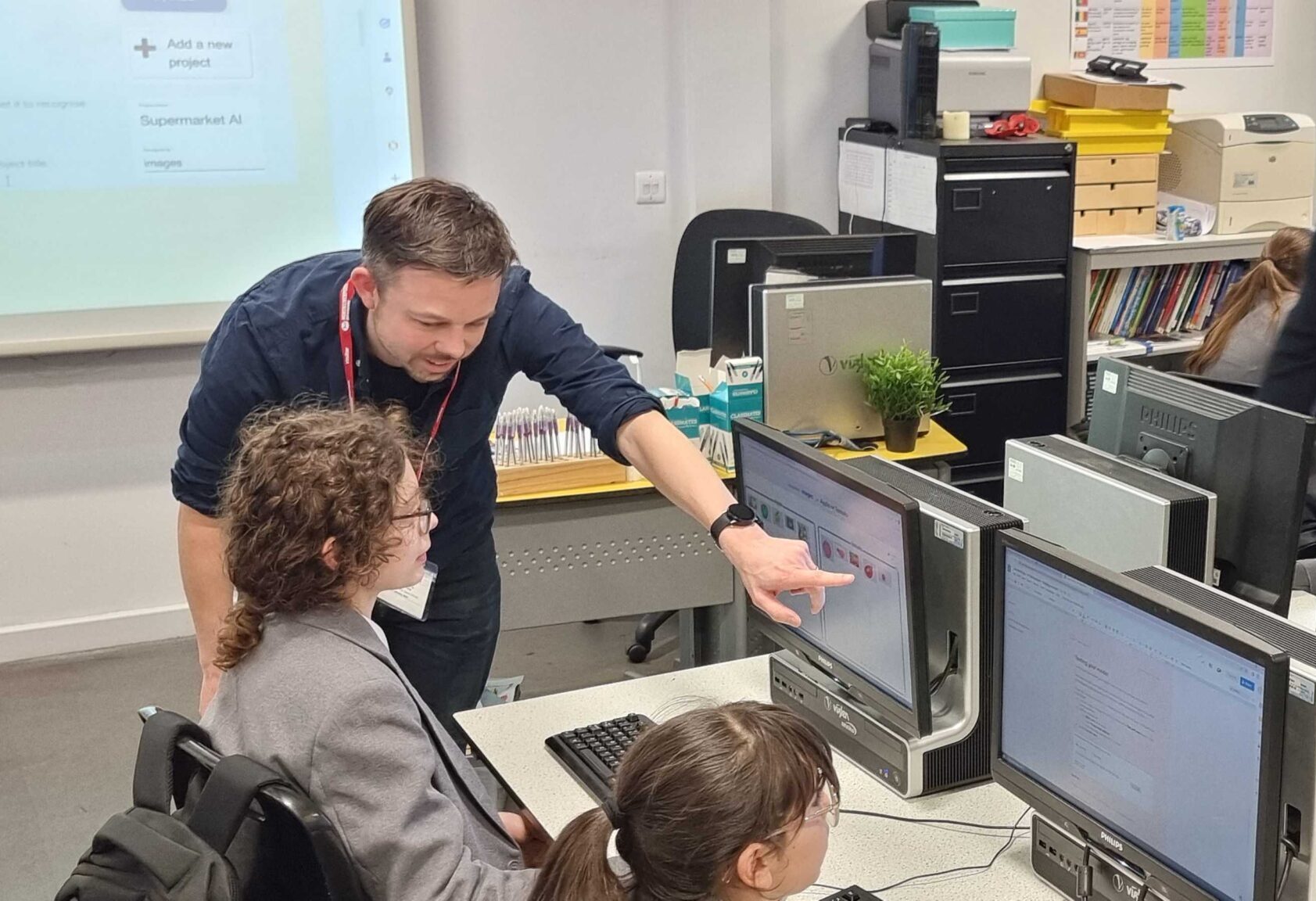
Netta explained that these projects give young people an opportunity to begin to address the problems they care about, even though they may be very complex problems. From this problem-solving perspective, children are introduced (or ‘sensitised’) to emerging technologies as tools for social good.
She then went on to outline the key pedagogical approaches that underpin these projects:
The projects follow 3 design phases and include a range of plugged and unplugged activities, as shown in Figure 1.
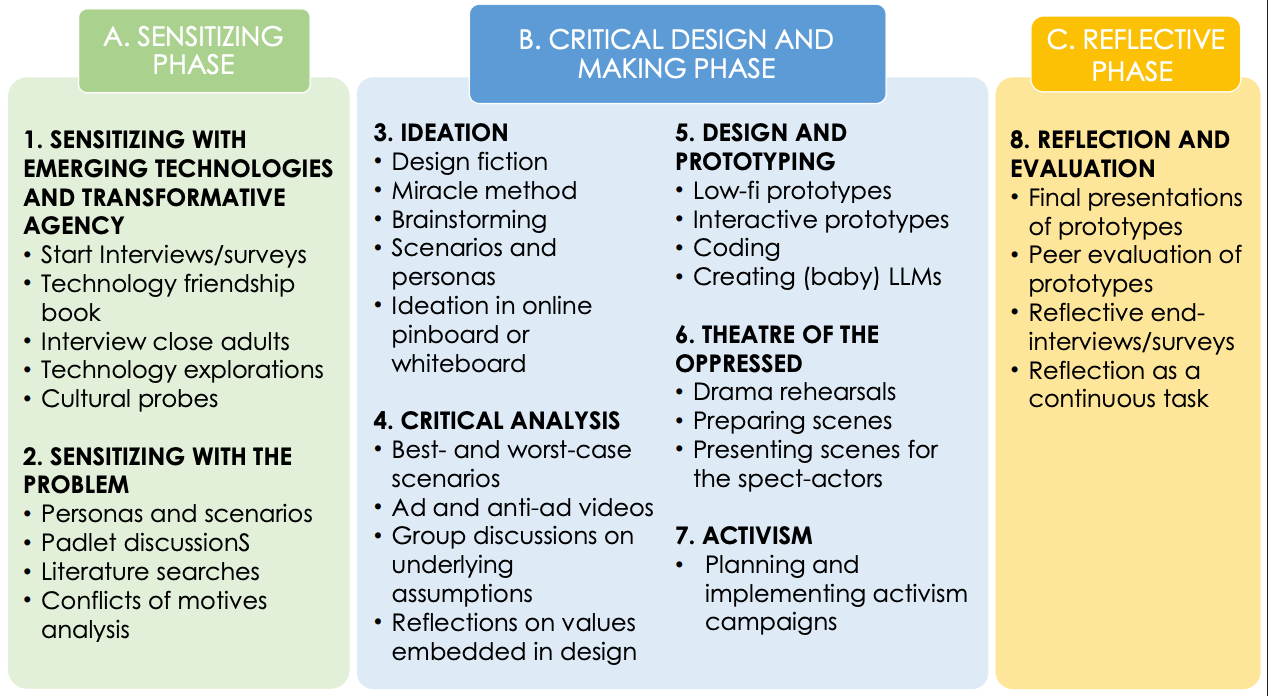
Netta then described in more detail some of the activities that have been used to address these different project phases and the design process involved. For example, to explore what are the problems that children really care about, they are asked to imagine ‘carrying a stone in your pocket for one week, as if it was a magic tool. Where could it be used in your everyday life? What problems could it solve? What problems would you like it to solve and how?’
Young people are then introduced to a range of novel technologies, for example, VR headsets, robots, and emulators of AI-driven social media platforms, such as “Somekone”, developed as part of the Generative AI project at the University of Eastern Finland. They deconstruct and reconstruct generative AI tools by prompting large language model chatbots such as ChatGPT, Gemini, Claude, etc. and exploring bias in their outputs. They perform small-scale algorithmic auditing and create mini language models (with Google Colab), using the text in Alice in Wonderland to train their models, and then open datasets (books as text files from Project Gutenberg). In exploring the responses generated, they experience the potential and the limitations of such tools and gain an important understanding of the human activity involved in the development of AI technologies.

Once they have had this ‘sensitising‘ exposure to a range of tools, they then work in groups on a project that makes use of AI to solve the societal problem they have chosen. These problems could encompass a range of topics, such as racism, animal rights, the impact of AI, war, mental health, bullying. The young people are prompted to think about how large language models can be used to solve the problem, or parts of the problem. But importantly, they are also asked to consider the different motives and perspectives of the multiple stakeholders involved in the problem and its solution and whether their model ideas will create new problems when deployed.
They follow the 3 project phases shown in Figure 1 to design and make a range of digital (robots, apps, videos) and non-digital artefacts to solve their problem. Netta emphasised that although it could take 10 weeks or more to implement all the suggested activities, it is also possible to pick and choose individual tasks from the 3 phases to suit available curriculum timescales.
Other project tasks involve:

These projects situate learning about data-driven technologies in real-world contexts and promote a transdisciplinary approach, teaching and learning about AI from a problem-solving perspective.
This perspective conveys important messages to young people — that they do have agency and can take action in the face of many of the world’s problems, that they can and should be active, critical users of the new technologies that surround them, and that these technologies can be used to change the world for good.
Netta ended the seminar by asking viewers to consider how they could foster transformative agency in the young people they teach and whether or not they consider it to be important in computing education.
Resources relating to the projects can be found at interact.oulu.fi.
In our current seminar series, we’re exploring teaching about AI and data science. Join us at our next seminar on Tuesday 14 October from 17:00 to 18:30 GMT to hear Viktoriya Olari talk about data-related concepts and practices for AI education in K–12.
To sign up and take part, click the button below. We’ll then send you information about joining. We hope to see you there.
The schedule of our upcoming seminars is online. You can catch up on past seminars on our previous seminars page.
The post Promoting young people’s agency in the age of AI appeared first on Raspberry Pi Foundation.
It’s the season of FOSS fruitfulness as juicy goodness falls from the branchThe Northern hemisphere is moving into autumn and FOSS vendors are falling over themselves in their efforts to get new versions out for the season.…

Save 40% on the Amazon Fire TV Stick 4K for a limited time.
The post Amazon Fire TV Stick 4K Streams Xbox Games for a Steal, No Pricey Console Needed appeared first on Kotaku.
Cycling memorabilia hunters will be devastated to hear they’ve missed a roaring bargain, with Bradley Wiggins’ 2000 Sydney Olympics bike, raced at the Madison event, selling for only £515 on eBay.
However, it will be of some comfort to hear it went to someone with a direct connection to the bike.
The bike in question is a Terry Dolan track machine in size 62cm to suit the lofty 6ft 3in Wiggins.
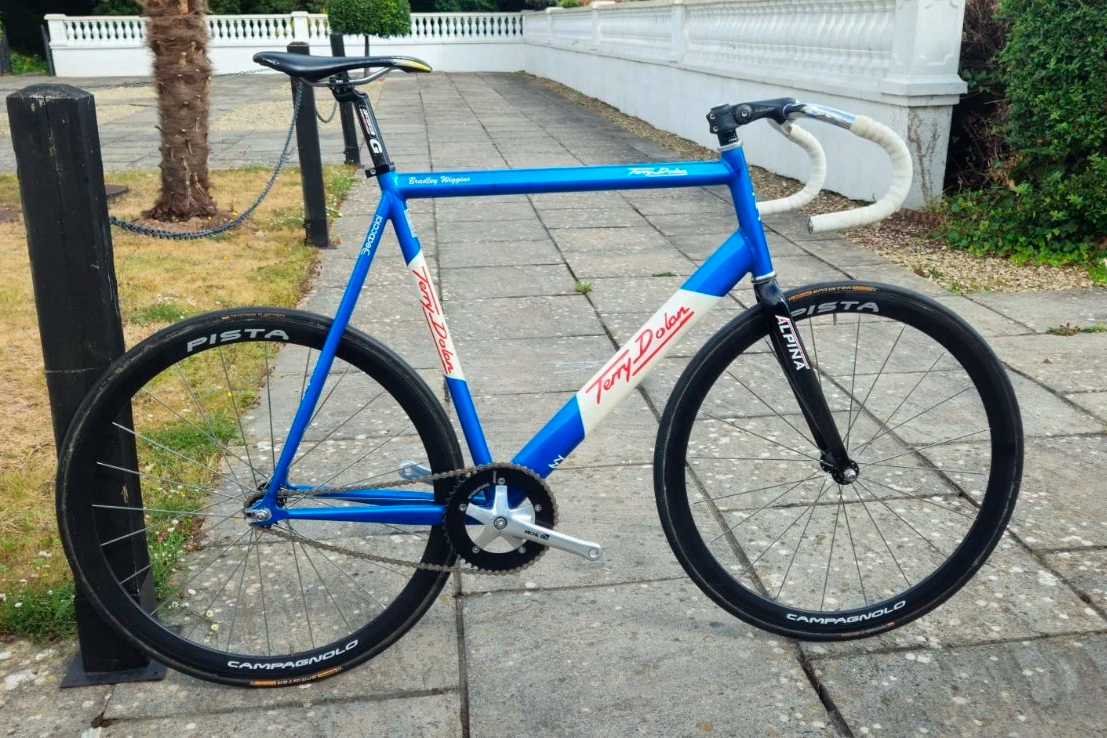
Speaking to BikeRadar, the seller said the bike was originally passed down through a family in Torquay, with the legend being that it had once been raced by a young Wiggins.
Dolan frames were a common sight beneath British Cycling riders in the late 1990s and early 2000s. Although better known for his time aboard Pinarello bikes at Team Sky, Wiggins – and his contemporary, Mark Cavendish – was still riding Dolan bikes at least as late as 2007 at Six Day events.
This bike is likely a much earlier model, however – but exactly how old?

We spoke to Stephen Dolan – CEO of Dolan Bikes and son of the eponymous Terry – who confirmed the bike was “Brad’s spare bike from the Sydney Olympics in 2000”.
“We supplied custom-built aluminium frames to both Brad and Rob Hayles to ride in the Madison event at the Olympics, where they finished 4th,” he added.
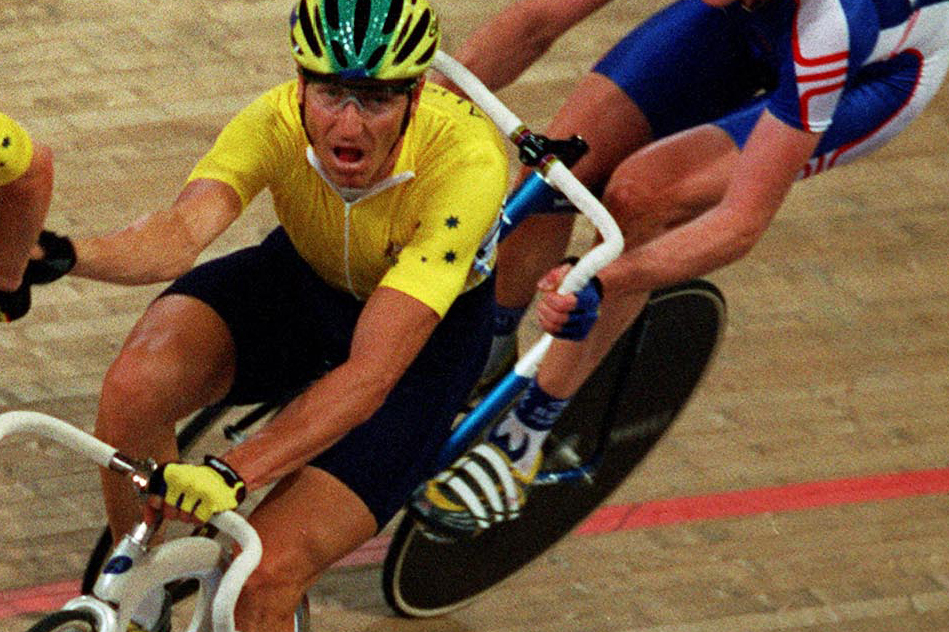
Indeed, a search of the Getty Images library unearthed a photo of the young Wiggins riding the bike at the gold-medal event. The race – the first time the Madison was contested at the Olympics – was won by Australia’s Scott McGrory and Brett Aitken.
The frame is typical of the time, constructed using chunky 7003 Dedacciai alloy tubing. It’s paired with an Alpina fork and Campagnolo headset. The alloy Campagnolo Pista wheels and finishing kit look to be later additions.
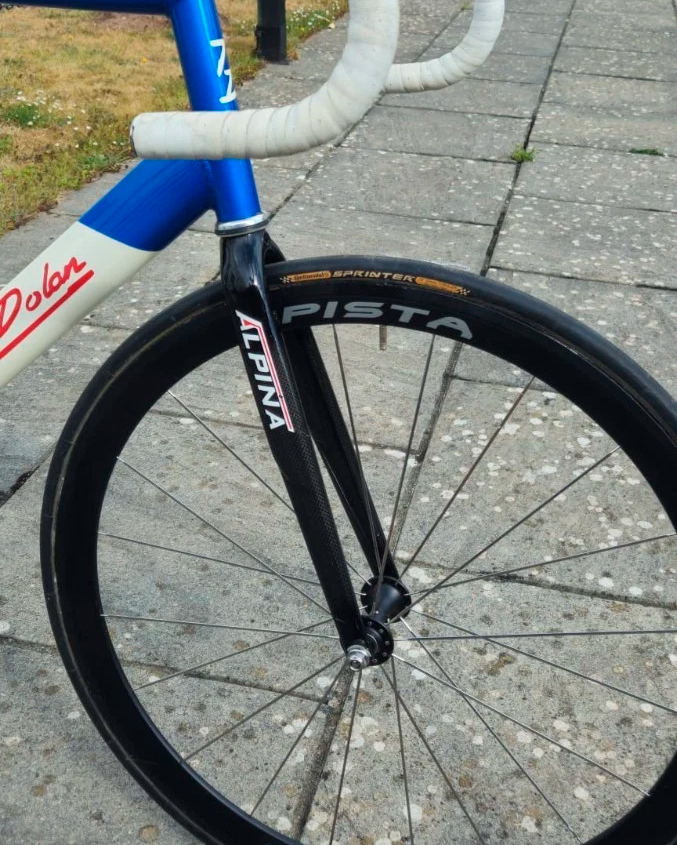
Described by the seller as having only cosmetic marks, the bike still looks resplendent in a handsome shade of blue, with cream panels bearing the Dolan name.
After confirming the frame’s provenance, Dolan decided to buy it back for himself: “I have Rob Hayles’ frame here, so I bought it to match the bikes up.”
Dolan intends to source the original parts and will renovate the bike for display at the brand’s showroom in Burscough, Lancashire.
This humble frame will be in good company, sitting along bikes from “Bradley Wiggins, Mark Cavendish, Chris Hoy, David Millar and Chris Boardman also currently on display.”
We may earn a commission from links on this page. Deal pricing and availability subject to change after time of publication.
Did you know you can customize Google to filter out garbage? Take these steps for better search results, including adding Lifehacker as a preferred source for tech news.
Mobile gaming has come a long way from endless swipes on Fruit Ninja. With today’s games offering open worlds, complex combat systems, and even the option to stream full console titles, the weak link is usually the controls. Touch screens get frustrating fast. That’s where a snap-on controller makes all the difference, and the Razer Kishi Ultra is one of the more serious options out there. At $89.99 on Woot (for the next three weeks or until it sells out), it’s a notable deal compared to Amazon’s $132 listing (down from $149.99), and even undercuts the lowest price it has ever hit ($99.99), according to price-trackers. Prime members get free standard shipping, while others will need to pay $6, though shipping isn’t available to Alaska, Hawaii, or P.O. boxes.
The Kishi Ultra feels less like a mobile add-on and more like a split Xbox controller. It’s bigger than most competitors, with proper grips and full-sized controls that make longer sessions less of a hand-cramp gamble. The triggers use Hall Effect sensors, so they’re smoother and more precise than the typical mushy plastic triggers you’d find elsewhere, and the mechanical face buttons click in with satisfying feedback. There’s also a proper 8-way D-pad for fighting games or retro titles, plus a couple of extra bumper buttons you can map however you like. Razer even added its signature Chroma RGB lighting around the edges if you want a little flair. And unlike other handheld controllers, this one doesn’t just fit phones; it can stretch wide enough to hold an iPad Mini, which makes it feel more versatile.
That said, you’ll need a USB-C device to use it, so anything older than an iPhone 15 is out. The upside is that the same port lets you double this as a wired PC controller, which extends its usefulness beyond mobile. Also, on iOS, cloud streaming support can be a little clunky with services like Xbox Game Pass, and there’s no virtual gamepad option, but for Android users or those who stream via Razer’s own Remote Play service, it works well, notes this PCMag review.
The United States has emerged as the largest investor in commercial spyware—a global industry that has enabled the covert surveillance of journalists, human rights defenders, politicians, diplomats, and others, posing grave threats to human rights and national security.
In 2024, 20 new US-based spyware investors were identified, bringing the total number of American backers of this technology to 31. This growth has largely outpaced other major investing countries such as Israel, Italy, and the United Kingdom, according to a new report published today by the Atlantic Council.
The study surveyed 561 entities across 46 countries between 1992 and 2024, identifying 34 new investors. This brings the total to 128, up from 94 in the dataset published last year.


Hollow Knight: Silksong once again raises the debate about whether it’s OK not to be able to finish a game
The post The Debate Over <i>Silksong</i> Points To A Growing Divide In The World Of Gaming appeared first on Kotaku.

NordVPN keeps you anonymous and bypasses geo-blocks.
The post NordVPN Is Free for 20 Months, But Here’s the Condition You Need to Meet appeared first on Kotaku.
Europe, the bloc with 24 official languages and 287 spoken in total, won’t get Apple’s Live Translation with AirPods feature for now. “Live Translation with AirPods is not available if you are in the EU and your Apple Account Country or Region is also in the EU,” the company said on its iOS feature availability page. No reason was given, but it may have to do with the EU’s strict rules around artificial intelligence and how it impacts privacy.
If that’s the case, Apple may be waiting for the EU to approve or examine the feature before implementing it in the region. The AI Act is most strictly applied to “high-risk use cases” involving the potential for discrimination or violation of users’ privacy. To that end, the EU may want to ensure that date stored when using the app is kept securely and locally in the bloc.
Apple’s phrasing about availability seems to indicate that it will work for North American and other users visiting the bloc and possibly vice-versa. Only users with an Apple Europe account who are also in Europe won’t be able to access the feature.
Live Translation lets users with AirPods communicate naturally with speakers of other languages. If the other party also has AirPods, the conversation is translated and heard by both people. If you’re speaking with someone without AirPods, speech is translated onto your phone where it can be either be read or heard by the other party.
Live Translation was first introduced at WWDC as part of iOS 26 and unveiled as a key feature for the AirPods Pro 3 during Apple’s “Awe Dropping” event on Tuesday. It will work on iPhone 15 and later devices running Apple Intelligence, and be available with the AirPods Pro 3, AirPods Pro 2 and AirPods 4 once iOS 26 arrives on September 15.
Right now, Live Translation supports real-time translation between English, French, German, Portuguese (Brazil), and Spanish. However, Apple plans to add Italian, Japanese, Korean, and Chinese (simplified) support later in 2025.
This article originally appeared on Engadget at https://www.engadget.com/mobile/live-translation-with-airpods-wont-come-to-eu-based-apple-users-125410519.html?src=rss