
Samba 4.23 is out today as the newest version of this SMB protocol re-implementation for file and print services interoperability with the Microsoft Windows world…
Monthly Archives: September 2025
Linux 6.17 Fix Lands To Address Regression With “Serious Breakage” In Hibernation
This week’s round of power management fixes for the in-development Linux 6.17 kernel are on the more notable side with fixes for both AMD and Intel P-State drivers plus addressing a system hibernation issue that could lead to “serious breakage” and stems from a Linux 6.16 regression…
Fwupd 2.0.16 Released With New Search Feature, Fixes For FreeBSD Firmware Updates
It was just two days ago that Fwupd 2.0.15 released with new hardware support and other improvements. That has already been replaced by Fwupd 2.0.16…
Scientists Link Hundreds of Severe Heat Waves To Fossil Fuel Producers’ Pollution
A new study published in Nature links more than 200 severe heat waves directly to greenhouse gas pollution from major fossil fuel producers like ExxonMobil, Chevron, and BP. Researchers found that up to a quarter of these heat waves would have been virtually impossible without emissions from oil, coal, and cement companies. NPR reports: The new study, published Wednesday in the journal Nature, found that 213 heat waves were substantially more likely and intense because of the activity of major fossil fuel producers, also called carbon majors. They include oil, coal and cement companies, as well as some countries. The scientists found as much as a quarter of the heat waves would be “virtually impossible” without the climate pollution from major fossil fuel producers. Some individual fossil fuel companies, such as ExxonMobil, Chevron and BP, had emissions high enough to cause some of the more extreme heat waves, the research found.
For the new study, the scientists looked at something called the disaster database, a global list of disasters maintained by university researchers, to identify heat waves “with significant casualties, economic losses and calls for international assistance. The scientists then used historical reconstructions and statistical models to see how human-caused global warming made each heat wave more likely and more intense. Then, to examine the link to major fossil fuel producers, the researchers relied on the Carbon Majors Database to understand the emissions of major oil, gas, coal and cement producers.
“We ran a climate model to reconstruct the historical period, and then we ran it again but without the emissions of a specific carbon major, thus deducing its contribution to global warming,” Yann Quilcaille, climate scientist at ETH Zurich and lead author of the study, says in an email. While some of the contributions to heat waves came from larger well-known fossil fuel companies, the study found that some smaller, lesser-known fossil fuel companies are producing enough greenhouse gas emissions to cause heat waves too, Quilcaille says.


Read more of this story at Slashdot.
How To Add, Delete, And Grant Sudo Privileges To Users In RHEL, AlmaLinux And Rocky Linux
Learn how to add, delete, and grant sudo privileges to users in Red Hat Enterprise Linux (RHEL), AlmaLinux and Rocky Linux.
ASF Retires Indigenous Imagery–But Keeps ‘Apache’ Name for Now
Stuck between a rock and a hard place, ASF ditches the feather, but keeps the Apache name: not enough for the left, too ‘woke’ for the right? Welcome to modern America…
The post ASF Retires Indigenous Imagery–But Keeps ‘Apache’ Name for Now appeared first on FOSS Force.
Gravitational Waves Finally Prove Stephen Hawking’s Black Hole Theorem
Physicists have confirmed Stephen Hawking’s 1971 black hole area theorem with near-absolute certainty, thanks to gravitational waves from an exceptionally loud black hole collision detected by upgraded LIGO instruments. New Scientist reports: Hawking proposed his black hole area theorem in 1971, which states that when two black holes merge, the resulting black hole’s event horizon — the boundary beyond which not even light can escape the clutches of a black hole — cannot have an area smaller than the sum of the two original black holes. The theorem echoes the second law of thermodynamics, which states that the entropy, or disorder within an object, never decreases.
Black hole mergers warp the fabric of the universe, producing tiny fluctuations in space-time known as gravitational waves, which cross the universe at the speed of light. Five gravitational wave observatories on Earth hunt for waves 10,000 times smaller than the nucleus of an atom. They include the two US-based detectors of the Laser Interferometer Gravitational-Wave Observatory (LIGO) plus the Virgo detector in Italy, KAGRA in Japan and GEO600 in Germany, operated by an international collaboration known as LIGO-Virgo-KAGRA (LVK).
The recent collision, named GW250114, was almost identical to the one that created the first gravitational waves ever observed in 2015. Both involved black holes with masses between 30 and 40 times the mass of our sun and took place about 1.3 billion light years away. This time, the upgraded LIGO detectors had three times the sensitivity they had in 2015, so they were able to capture waves emanating from the collision in unprecedented detail. This allowed researchers to verify Hawking’s theorem by calculating that the area of the event horizon was indeed larger after the merger. The findings have been published in the journal Physical Review Letters.


Read more of this story at Slashdot.
openSUSE to Disable Bcachefs File System Support in Tumbleweed with Linux 6.17
In some controversial news, openSUSE announced that it plans to disable support for the Bcachefs file system in openSUSE Tumbleweed with the next major kernel update, Linux 6.17, due out in late September or early October 2025.
Microsoft and OpenAI announce the ‘next phase’ of their partnership
Microsoft and OpenAI have issued a joint statement to say that they have signed a non-binding memorandum of understanding for the “next phase” of their partnership. The companies are still finalizing the terms of agreement and haven’t shared the details of what their future would look like exactly. But according to The New York Times, the deal includes hows the parties share technology and and the revenue from those technologies. The new agreement also reportedly modifies the clause in the original, which states that Microsoft cannot access OpenAI’s most powerful technology if its board decides that it has reached human-like artificial general intelligence or AGI.
In addition to the new deal, The Times says OpenAI is giving an equity stake worth at least $100 billion to its nonprofit arm that will continue to oversee and control the organization. As the publication notes, a change in the company’s agreement paves the way for OpenAI to transition into a public benefit corporation, a type of corporation that’s meant to make a positive impact on society, and for an eventual IPO. OpenAI had to reach an acceptable agreement with Microsoft first, including how much equity it’s getting in the AI firm’s for-profit arm. Microsoft had invested over $13 billion into OpenAI and is entitled to 49 percent of its future profits.
Reports about OpenAI moving away from its complicated non-profit structure started coming out last year. After Christmas in 2024, it officially announced its plan to transform itself into a public benefit corporation with ordinary shares of stock. “It will enable us to raise the necessary capital with conventional terms like others in this space,” it said at the time. In May, however, OpenAI announced that it was no longer going to remove the control of its for-profit arm from its non-profit board. “OpenAI was founded as a nonprofit, and is today overseen and controlled by that nonprofit. Going forward, it will continue to be overseen and controlled by that nonprofit,” it said.
This article originally appeared on Engadget at https://www.engadget.com/ai/microsoft-and-openai-announce-the-next-phase-of-their-partnership-035247037.html?src=rss
AI Use At Large Companies Is In Decline, Census Bureau Says
An anonymous reader quotes a report from Gizmodo: [D]espite the AI industry’s attempts to make itself seem omnipresent, a new report this week shows that adoption at large U.S. companies has declined. The report comes from the Census Bureau and shows that the rate of AI adoption by large companies — that is, firms with over 250 employees — has been declining slightly in recent weeks. The report is based on a biweekly survey, dubbed Business Trends and Outlook (or BTOS), of some 1.2 million U.S. firms. The survey, which asks businesses about their use of AI tools, such as machine learning and agents, found that — between June and now — the rate of adoption had declined from 14 to 12 percent. Futurism notes that this is the largest drop-off in the adoption rate since the survey first began in 2023, although the survey also showed a slight increase in AI use among smaller companies.
The moderate drop off comes after the rate of adoption had climbed precipitously over the last few years. When the survey first began, in September of 2023, the AI adoption rate hovered around 3.7 percent (PDF), while the adoption rate in December 2024 was around 5.7 percent. In the second quarter of this year, the rate also rose significantly, climbing from 7.4 percent to 9.2. The new drop-off in reported usage comes not long after another study, this one published by MIT, found that a vast majority of corporate AI pilot programs had failed to produce any material benefit to the companies involved.


Read more of this story at Slashdot.
The Apache Software Foundation Unveils New Oak Leaf Logo
The Apache Software Foundation (ASF) unveils a refreshed visual identity with an oak leaf logo, highlighting growth, trust, and sustainability.
Windows Developers Can Now Publish Apps To Microsoft’s Store Without Fees
Microsoft has eliminated the one-time fee for publishing apps on its Windows Store. According to The Verge, “Individual developers in nearly 200 countries can now sign up to publish apps on the Microsoft Store with just a personal Microsoft account, and no more one-time fees.” From the report: Microsoft started cutting its $19 one-time fee to publish apps to its Windows store in June in certain markets, and it’s now essentially removing this fee for all developers worldwide. Apple still charges an annual $99 fee to developers, and Google charges a one-time registration fee of $25.
“Developers will no longer need a credit card to get started, removing a key point of friction that has affected many creators around the world,” explains Chetna Das, senior product manager at Microsoft. “By eliminating these one-time fees, Microsoft is creating a more inclusive and accessible platform that empowers more developers to innovate, share and thrive on the Windows ecosystem.” […]
The Microsoft Store is now used by more than 250 million monthly active users, according to Microsoft. Microsoft is now encouraging more developers to make use of the store, where they can publish a variety of Win32, UWP, PWA, .NET, MAUI, or Electron apps. Developers can even use their own in-app commerce system to keep 100 percent of their revenues on non-gaming apps.


Read more of this story at Slashdot.
Linux Lite 7.6: Plenty for Windows Refugees, But Too Dumbed Down for Comfort
While it’s very commendable that Linux Lite is going after a particular user – people who might be unhappy with Windows 11 – treating these new users like digital imbeciles leaves a lot to be desired.
Meta Overhauls Quest’s TV App To Be A Hub For Streaming Content
Meta overhauled Quest’s TV app as a hub for streaming content, both flatscreen and immersive, and removed all user-uploaded videos.
Originally known as Oculus TV, then Meta Quest TV, and now simply TV, the app previously fully focused on 180° and 360° content, including user-uploaded videos.

Earlier this year, Meta emailed all creators with videos on the platform to inform them that their videos would soon be unavailable, and would be deleted on September 22. The company recommended migrating them to YouTube in advance of the deadline.
Now, the TV app has been completely revamped.
While it still shows select professionally produced 180° and 360° video content, such as Red Bull’s Touching the Sky and The Faceless Lady, it now focuses just as much on flatscreen streaming content from Amazon Prime Video and Comcast’s Peacock.
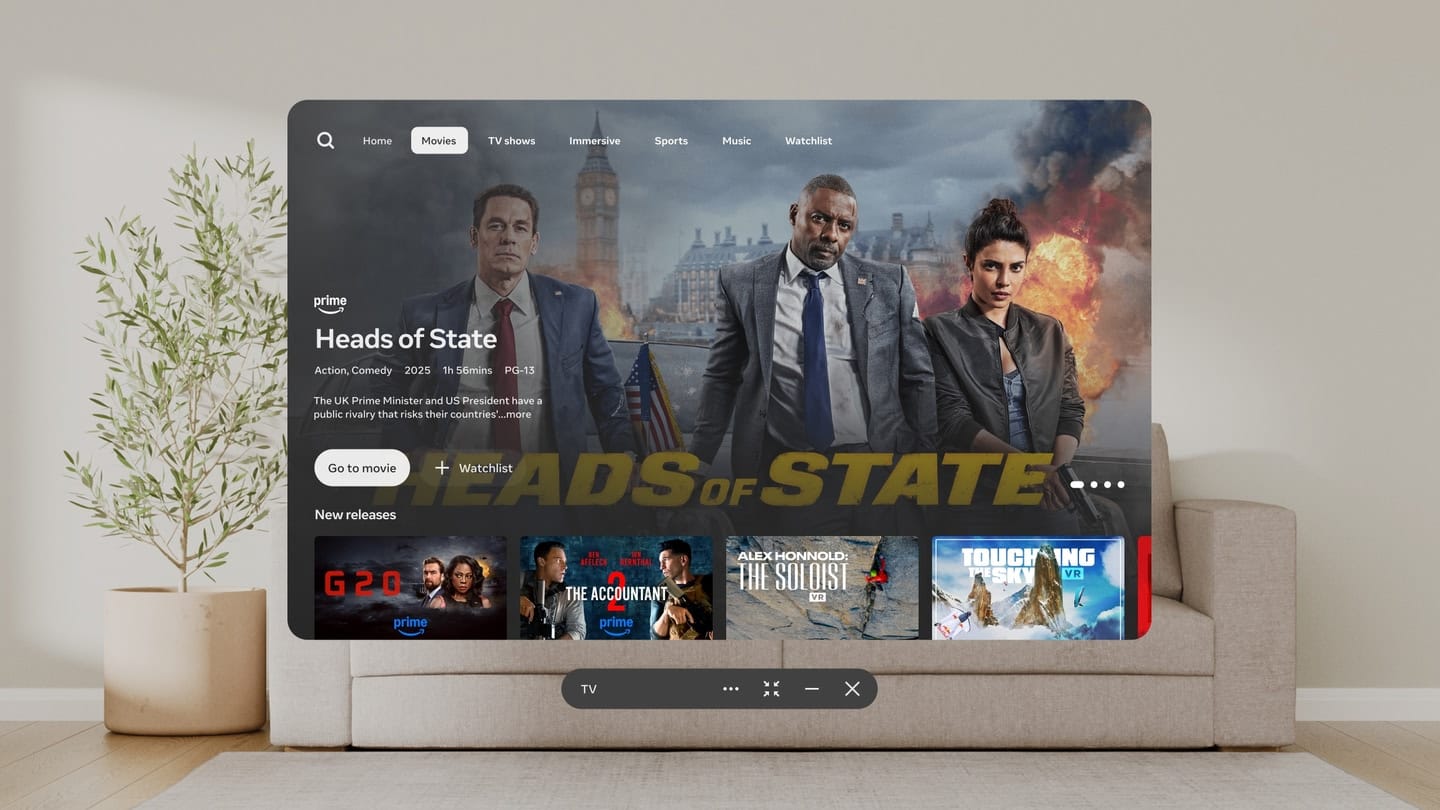
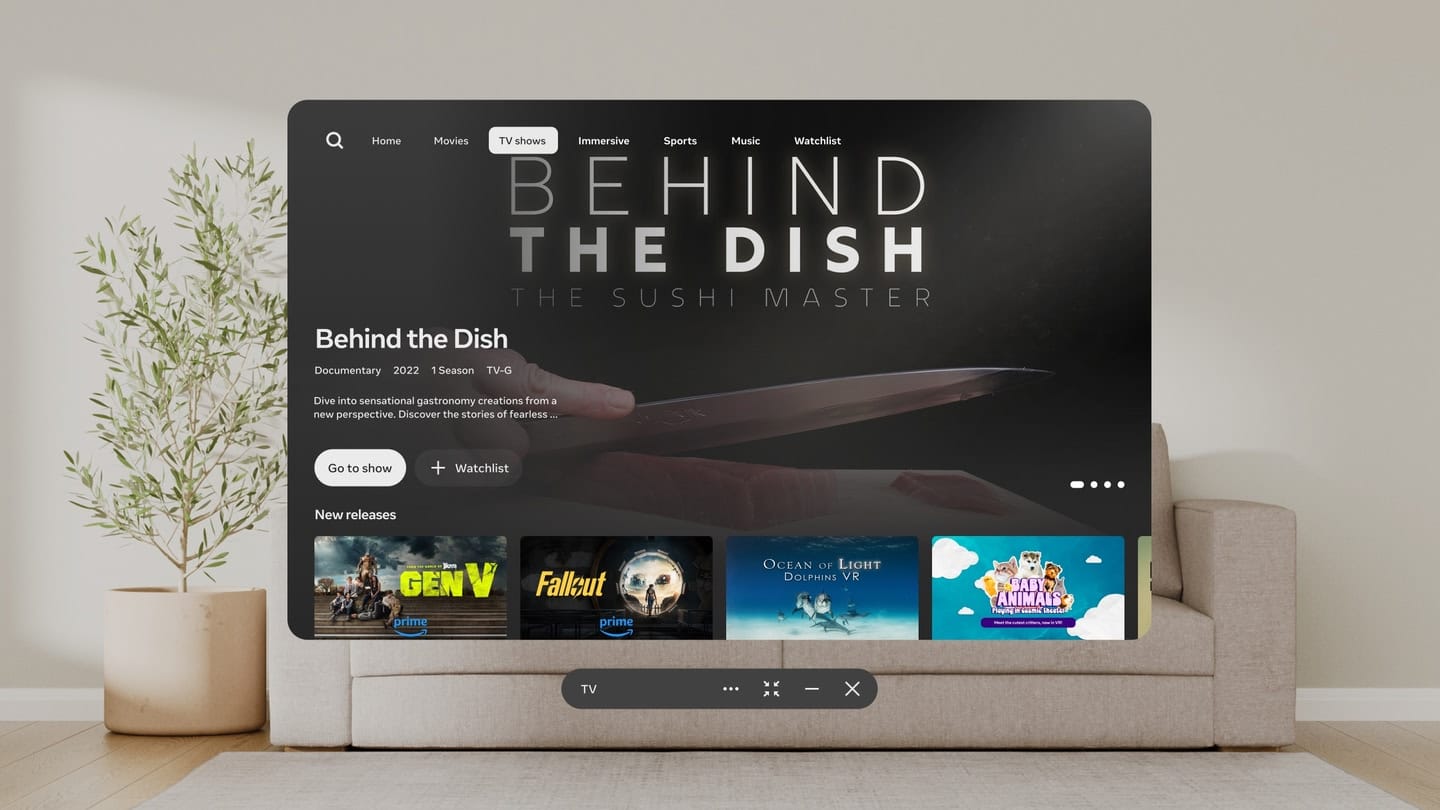
It features a sleek new design with seven tabs: Home, Movies, TV Shows, Immersive, Sports, Music, and Watchlist:
- The Movies and TV Shows tabs are populated by content from Prime Video and Peacock. None of this content plays within the TV app, to be clear. It simply acts as a hub collating recommended content, and clicking on any will bring you to said content in the Prime Video and Peacock apps.
- The Immersive tab features a combination of links to Horizon Worlds concerts and in-app 180° and 360° content from partners like TARGO, Red Bull, Tested, and SNL.
- The Sports tab is populated by livestreams and sports movies and documentaries from Prime Video and Peacock. As with Movies and TV Shows, these are links to the content that will open in the app for the platform.
- The Music tab is a combination of links to currently-running Horizon Worlds concerts, in-app 180° and 360° recordings of past concerts, and links to Amazon Music content.
- The Watchlist tab, as you might expect, shows content that you’ve added to your watchlist.
0:00
/1:16
Footage by UploadVR of the new Horizon OS TV app.
While the app has 180° and 360° tags to mark immersive content, it doesn’t distinguish between 2D and 3D.
Meta “Courting” Disney & A24 To Make Immersive Video For Horizon OS
Meta is “courting” Disney and A24 to produce immersive video for Horizon OS, offering “millions of dollars”, The Wall Street Journal reports.
 UploadVRDavid Heaney
Last year, Meta and James Cameron announced an exclusive multi-year partnership to help bring significantly more 3D video content to Quest headsets, and earlier this year The Wall Street Journal reported that Meta was “courting” Hollywood firms including Disney and A24, offering “millions of dollars” to provide “episodic and stand-alone immersive video based on well-known intellectual property”. The Horizon OS TV app overhaul may be laying the foundations for browsing this future content.
Meta Connect 2025 takes place next week, and it’s possible the company will have more to share on its TV app strategy then.
‘No Tax On Tips’ Includes Digital Creators, Too
“President Trump’s One Big Beautiful Bill Act may have quietly changed the economics of the creator economy,” reports the Hollywood Reporter. The Treasury Department has ruled this past week that digital creators, including podcasters, influencers, and streamers, qualify for the U.S. “no tax on tips” policy, allowing them to deduct tipped income up to $25,000. From the report: The change could cause digital creators to rethink how they seek income. Platforms like TikTok, YouTube, Twitch and Snapchat all offer a variety of ways for creators to generate income, be it a share of advertising revenue or creator funding programs, or options to launch subscription tiers for their channels or profiles. But they also give creators the option to turn on tips or gifts. If revenue from user tips or gifts is eligible, while recurring subscription revenue is not, it could shift how streamers, podcasters or influencers ask their followers to support them.
To be sure, there are limitations: The tax deduction is capped at $25,000 per year, and it begins to phase out at $150,000 in income for single filers and $300,000 for married joint filers. The act also provides that tips do not qualify for the deduction if they are received “in the course of certain specified trades or businesses — including the fields of health, performing arts, and athletics,” Treasury says, further limiting the deduction opportunity for some in entertainment-adjacent lines of work.
But by making influencers, Twitch streamers and podcasters eligible, the administration has nonetheless changed the incentive structure for digital creators, and the ramifications could be felt across the creator economy in the name of tax efficiency (Don’t be surprised if users are asked to like, subscribe, and tip). Platforms may also develop more ways to more prominently feature tips and gifts, pushing creators to add more opportunities for that income. But the inclusion of digital creators is also a recognition of how the power dynamics have shifted in media.


Read more of this story at Slashdot.
Bcachefs Outlines Plans For Shipping As A DKMS Out-Of-Tree Kernel Module
With Linus Torvalds having recently marked Bcachefs as being “externally maintained” following ongoing disagreement over the generally accepted Linux kernel development practices, the plans were laid out today for shipping Bcachefs as an out-of-tree DKMS module…
OpenAI and Oracle Ink Historic $300 Billion Cloud Computing Deal
Amid yesterday’s news of Oracle’s soaring stock, which propelled founder Larry Ellison to the top of the world’s richest list, the Wall Street Journal reported that the cloud giant and OpenAI have struck one of the largest cloud contracts ever signed. Under the deal, OpenAI will purchase $300 billion worth of compute power from Oracle over roughly five years, with purchases beginning in 2027.
“This move away from Microsoft was timed with OpenAI’s involvement with the Stargate Project, in which OpenAI, SoftBank, and Oracle have committed to invest $500 billion into domestic data center projects over the next four years,” notes TechCrunch.
OpenAI also recently signed a cloud deal with Google. “The deal … underscores the fact that the two are willing to overlook heavy competition between them to meet the massive computing demands,” wrote analyst in Reuter’s report.


Read more of this story at Slashdot.
Namibia’s Onguza launches Bliksem gravel bike, which you can customise to your heart’s content
The Namibian bicycle company Onguza has launched its new Bliksem gravel bike, which you can customise to your heart’s content, specifying everything from cable routing to frame graphics.
Former professional cyclist Dan Craven set up Onguza in 2021 in his home country of Namibia, and it released its first bike in 2022, the Gravel Model 1.
Now, after three years of development, Onguza says the Bliksem is introducing a new way for you to design and order handmade steel bicycles.
“The business model we’ve always aimed for”

Onguza’s factory is in-house, making it “uniquely able to offer truly customisable, handmade framesets at a price much closer to mass-produced brands”.
As with the Gravel Model 1, Onguza’s frames have standardised geometry, but beyond that you can customise almost everything on the Bliksem gravel bike.
“This is the business model we’ve always aimed for, and finally we’re in a place to bring it to life,” says Onguza.
“The customer can select which of three different cable routing options they want installed on their frame, extra bottle and luggage bosses add-ons, all before your choice of paints and special graphics go on,” the brand says.
There are 18 frame colours and 10 graphics colours to choose from, inspired by Namibia’s landscape and culture.
A fast and responsive gravel bike

Taking its name from the Afrikaans word for ‘lightning’, Onguza says the Bliksem is its most responsive, fast gravel bike.
The steel gravel bike is said to have a “subtly aggressive geometry”, which avoids going too low on the stack figures for “all-round great riding capabilities”.
It also has clearance for 50mm gravel tyres, which is said to suit “high-paced training and racing, while keeping the adventure fun on brutal terrain”.
This reflects how gravel tyre widths have grown. When Onguza launched the Gravel Model 1, it had clearance for 700x42c gravel tyres. Craven told BikeRadar this was because it was the most popular width he saw while riding in the UK, Girona and elsewhere. Fast forward three years, and brands and riders are running wider tyres.


Elsewhere, the Bliksem has a T47 bottom bracket shell, which means Onguza can offer three cable-routing options, while using the same chassis.
The frames are hand-mitred and fillet brazed with Columbus Life and Zone tubes, and feature stainless flat mount bosses for durability.
How much does the Onguza Bliksem cost?

Onguza says the Bliksem frameset pricing starts at £2,390 / $3,032 / €2,890. The price includes shipping, duties and taxes.
The US price excludes state sales taxes. “With current international duties and shipping challenges, we believe this is a necessary step to ensure bikes arrive with no hassle,” says Onguza.
Onguza has also updated its website with a frameset-building feature. Once you place an order, you will receive an estimate of the final cost, along with an image of your selected paint choices and a confirmation of your chosen specification.
“[W]e believe more people should have access to the truly special experience of riding a customized, hand-made bike, so for us, we see this new model as our future,” says Onguza.
We can expect to see more models from Onguza in the future, including a gravel adventure bike and two road bikes.
VMware To Lose 35 Percent of Workloads In Three Years
By 2028, Gartner research VP Julia Palmer predicts that VMware will lose 35% of its current workloads as Broadcom’s licensing changes and rising costs push customers toward competitors like Nutanix and public clouds. The Register reports: On Wednesday at the analyst firm’s Symposium event in Australia, Palmer pointed out that the Broadcom business unit recently tweaked its licensing program so that hyperscalers can no longer sell VMware subscriptions to users of their hosted VMware services. Customers must instead buy direct from Broadcom and use license portability entitlements for any VMware infrastructure they host in hyperscale clouds. Palmer said that decision shows VMware does not consider hyperscalers strategic partners, and she thinks the feeling is mutual. Hyperscalers nevertheless welcome customers who use them to run VMware workloads “because they know over time they will convert you to ‘proper cloud’.”
Which is one reason she expects VMware will lose so many workloads: Hyperscalers will use their engagements with VMware customers to extol the virtue of public clouds. Palmer thinks VMware customers should heed that pitch. “We are all addicted to hypervisors, and that needs to change,” Palmer said, not least because Broadcom’s acquisition of VMware shows how lock-in to a virtualization platform can be costly. But she counseled against planning to move all workloads off VMware, as no rival vendor offers a superior platform and a full migration will take three or more years. Palmer instead advised assessing which applications are ripe for modernization and re-platforming, and shifting those — a job that can take up to a year.


Read more of this story at Slashdot.
Video Games Weekly: It’s weird that esports is segregated by gender
Welcome to Video Games Weekly on Engadget. Expect a new story every Monday or Tuesday (Or, I dunno, Thursday), broken into two parts. The first is a space for short essays and ramblings about video game trends and related topics from me, Jess Conditt, a reporter who’s covered the industry for more than 13 years. The second contains the video game stories from the past week that you need to know about, including some headlines from outside of Engadget.
Please enjoy — and I’ll see you next week.
Earlier this week, FlyQuest top laner Bwipo (Gabriël Rau) was suspended for one series of the League of Legends LTA playoffs after saying some wild stuff during a livestream about women and their ability to play esports. Here’s a sampling of what he said:
-
“I think there’s just not enough support for female pro players… women’s anatomy and their monthly cycles are just extremely different from males, and there’s no proper support system for women to go through what they’re going through.”
-
“Even men just tilt out of their fucking minds when they’re playing League of Legends. So, when a woman is on the wrong part of the month and playing competitively, there is a time of the month where you should not be fucking playing competitive games as a woman, in my opinion.”
OK, Bwipo. His comments received an appropriate amount of ridicule from fellow players, casters and fans, and FlyQuest benched him during a pivotal moment in the race to Worlds. He has apologized and pledged to “reflect, listen, and do better.”
So, here we are yet again. It’s 2025 and it must be stated: Men are not biologically better at video games than women. Women, femmes and nonbinary people are not physiologically less interested in or skilled at competitive gaming than a player who lives as a dude. Gender on its own has no bearing on how quickly a person can click a mouse, scan a screen or strategize in high-intensity situations, and lines of code react the same no matter how an individual player identifies.
That said, I find myself agreeing with Bwipo’s initial statement, “There’s just not enough support for female pro players.” I understand, in a backward kind of way, the logical leaps he then tried to make in order to explain a situation that doesn’t make any sense — namely, the absence of non-guy players in mainstream, professional esports. His conclusion may have been laughably misguided, but the core conundrum still stands.
The professional esports scene is segregated by gender and dominated by men. There are no hard and fast rules barring women or gender nonconforming people from competing at a professional level in any major league, but there are vanishingly few women, femmes or non-male-presenting players participating in mainstream esports tournaments, and this tends to be the baseline. There are separate leagues and competitions established specifically for women and gender nonconforming players, and while I find these events to be extremely exciting, they’re siloed and receive far less financial, marketing and back-end support than mainstream tournaments. Women’s esports leagues exist in a bubble that, for some strange reason, seems to be modeled on the gender segregation practices of traditional sports, with matching gaps in pay, respect and opportunity.
A handful of women players have broken through on the main stage over the years, including Potter (Christine Chi, CS:GO), Karma (Jaime Bickford, Rocket League), Hafu (Rumay Wang, WoW, Hearthstone) and Scarlett (Sasha Hostyn, StarCraft II). Still, the earnings gap between men and women in esports is cavernous: According to Esports Earnings, the top male player on record is N0tail (Johan Sundstein, Dota 2), with $7,184,163 in prize money to his name. The top female player on that list is Scarlett, with $472,111 in total earnings. There are 619 male players ahead of her, and the totals don’t factor in the lucrative sponsorship deals available to elite gamers.
I have to say it again. Esports, an industry built around people playing video games really well, is segregated by gender. Isn’t that insane?
The natural question is, why? It’s not because only men are good at video games, since we’ve established that’s a steaming pile of horseshit. Nor is it because, as Bwipo suggested, some women menstruate. But the actual reason is just as clear.
It’s sexism. The gender makeup of the mainstream esports scene is the result of everyday, bog standard, garden variety, run of the mill misogyny. In the world of esports, it’s sponsored by Red Bull, drenched in LEDs and proudly hosted by your favorite streamer. At our current stage, when a veteran LoL player is openly trying to bring back the hysteria diagnosis rather than looking at the realities of a system that provides him privilege, I think we have to say it plainly. Put the pivotal issue on the table so we can look at how ugly, regressive and nasty it is. Only then can we start to change it.
There is a dearth of women, femmes and nonbinary people in mainstream esports because of the sexism that permeates society at large.
I understand why someone like Bwipo — or other players, coaches, presenters, managers, team owners, league organizers or game makers at the highest levels of esports — wouldn’t want to acknowledge this fact or how much power it holds over the entire scene. I get that some would rather twist themselves into knots trying to blame women for their own exclusion, instead of tackling an uncomfortable social issue that runs far deeper than just the gaming industry. I understand it, but I think it’s cowardly. Ostrich behavior.
So, let’s look at it. If misogyny in esports is the problem, I think a solution has to lie in the talent pipeline. During the scouting stages, when school-age players of all genders are streaming and climbing ranks from their bedrooms, boys naturally receive things from the community that girls don’t, like enthusiastic support, a welcoming attitude, respect, and, eventually, enough belief in their skills to risk investment. I’m not suggesting toxicity isn’t a thing for everyone, but these positive aspects are also built into the experience for many young men playing games. Young women have to earn these responses, generally by overperforming compared to their peers, and while being belittled, sexualized, threatened with violence, hyperanalyzed and othered, for years on end. It’s exhausting. It silently pushes some women out of video games and esports.
It’s also malleable. Sexism spawns from an embarrassing and irrational way of thinking, but people change their minds all the time. A simple but widespread shift in perception — oh right, it’s weird that esports is segregated by gender — can make an enormous impact especially on these early stages of esports play. How we think alters how we behave, how we speak and what we allow in social spaces. It really can be that simple, at least as a starting point.
I think about this each time I turn on a pro match, which is currently every day with LoL Worlds qualification tournaments in full swing (hi, FlyQuest). The esports gender disparity is face-smackingly obvious, especially in concert with the godlike presentation that existing players tend to receive: hype trailers with uber-masculine motifs, walk-out rituals, emotional behind-the-scenes documentaries and epic promotional spots depicting teams as otherwordly superheroes. Of course, most esports players are literal teenagers, which tends to make these macho presentations more adorable than anything — but the fact remains that male esports pros, even teenage ones, are taken extremely seriously as athletes (athletes!) and can find support for their goals at every level. I’d love to see this encouragement, faith and excitement extended to young women and nonbinary players as well.
The mental shift is the first step. As demonstrated by Bwipo’s offhand comments, it seems plenty of people in the esports scene are still in the early stages of critical thinking when it comes to gender and opportunity, so we’re starting with the basics. Remind yourself that men are not inherently skilled at playing video games and women aren’t naturally bad, and think about how ridiculous those suggestions sound in the first place. Remember that sexism is an artificial barrier limiting opportunities for everyone in esports. Next time you see an ad with a bunch of dude esports players surrounded by ladies in cosplay, take a second to notice how odd that is. Hear how many times the casters say “gentlemen,” “sir,” “boys” and other gendered terms during games, and recognize how daunting this space is for players who don’t fit those descriptions. Get comfortable with the idea that some humans can play video games really, really, really well, and this fact is completely divorced from how they look or identify. It’s easy to do because it’s true.
Additional reading and viewing
-
Are Trans People too Visible? (in esports) by Team Liquid senior managing editor Austin
The news
007 First Light lands in March
IO Interactive’s James Bond game, 007 First Light, is heading to PlayStation 5, Xbox Series X/S, Switch 2, Steam and the Epic Games Store on March 27, starting at $70. Engadget UK Bureau Chief Mat Smith got his hands on the preview at Gamescom earlier this month and he found it to be spectacular in the very literal sense.
There’s more Stardew Valley coming to Stardew Valley
What a lovely little surprise. Stardew Valley creator ConcernedApe (Eric Barone) announced another numbered update is on its way, adding significant bits of new content to the game more than nine years after its Steam debut. Update 1.7 will hit Stardew Valley at an unspecified time in the near future and Barone clarified that it won’t impact the release timeline for his next game, Haunted Chocolatier. Barone had the following to say about the whole thing:
“Haunted Chocolatier will be released at some point. And sure, the reality of my life is that I have a very popular 1st game that I still want to take care of, which means that my 2nd game might take a little longer. It is what it is. I didn’t have to make a 1.7 update for Stardew Valley, but the game is still so popular (in fact, still growing), that it’s hard to just stop improving it when there are still things that can be improved. But I hope the approach I am taking for Stardew Valley 1.7 will help keep Haunted Chocolatier on track.
“About the Stardew Valley team: they are awesome, all very talented, hard-working, and contribute unique things to the development process. We are a very small group, and I like it that way. Also, I am still working completely solo on Haunted Chocolatier without any plans to change that for the time being.”
Yooka-Replaylee will be here in October
Playtonic’s bright and shiny remaster of Yooka-Laylee will come to PS5, PC, Switch 2 and Xbox Series X/S on October 9. For the Switch 2 version, Playtonic has opted to release the full game on an actual cartridge, rather than relying on game-key card downloads, which is a heartwarming throwback to the way things were. Digital versions of the game cost $30, while the physical edition is $50.
Diablo developers vote to unionize
More than 450 developers with Blizzard Entertainment’s Diablo team have voted to form a union with the backing of the Communications Workers of America. The CWA is also overseeing the ZeniMax QA union, and is backing recent organization efforts by the Overwatch 2 crew and Blizzard’s Story and Franchise Development group. (Am I the only person who wants that to be Story and Song development? Probably.) The CWA says more than 3,500 Microsoft employees have organized under its banner.
Diablo producer Kelly Yeo is an organizing committee member of the latest Blizzard union and she said in a statement that multiple rounds of sweeping layoffs at Microsoft prompted the organization efforts.
“With every subsequent round of mass layoffs, I’ve witnessed the dread in my coworkers grow stronger because it feels like no amount of hard work is enough to protect us,” Yeo said. “This is just the first step for us joining a movement spreading across an industry that is tired of living in fear.”
Layoffs at Crystal Dynamics and Firaxis
It feels like nowadays, for every unionization story, there are at least two tales of layoffs. This was sadly true in recent weeks, with news of mass firings at Tomb Raider studio Crystal Dynamics and Civilization team Firaxis. An unknown number of people were fired from Crystal Dynamics and it’s unclear if the cuts were tied to the recent cancellation of The Initiative, which Crystal Dynamics was helping reboot. The Initiative was canceled as part of Microsoft’s huge cuts to its gaming segment in July (which followed similarly large losses the year before, and so on). Crystal Dynamics is still owned by Embracer Group and is working on a new Tomb Raider installment.
After unleashing Civilization VII on the masses in February, Firaxis has also laid off an undisclosed number of developers in the name of studio restructuring. Firaxis is owned by 2K, which recently canceled a remake of the original BioShock and sent Cloud Chamber’s new BioShock title back to an even-deeper circle of development hell. Meanwhile, Take-Two Interactive, the company that controls all of this, is reporting healthy financials and expectations to grow in the second half of 2025. Grand Theft Auto VI is on its way, after all.
Ju-DAS, Ju-da’as / Ju-DAS, Ju-da’as
I swear, if the release trailer for Ghost Story Games’ Judas doesn’t include the Lady Gaga song, I will riot by myself.
Following all of that weird BioShock news out of 2K, Ken Levine decided to remind everyone that his game Judas is still in development and even has key art. His post on the PlayStation Blog outlines some of the relationship mechanics in Judas, relating them partly to the Nemesis system from Middle Earth: Shadow of Mordor, which has me all kinds of excited. And, yeah, the new picture looks cool, too.
Ghost Story Games
The Silksong corner
The day of its release, Hollow Knight: Silksong singlehandedly crashed multiple game storefronts including Steam, the Nintendo eShop and the Xbox Store. The marketplaces recovered, but players haven’t — the bulk of the post-launch discourse has focused on whether the game is too hard, a suggestion that I find baffling as someone who does not enjoy punishing metroidvanias like Silksong. With this brand of game, I was under the impression that if it’s beatable, it’s not too hard. It’s mechanically precise, tricky, twitchy and super-duper challenging — isn’t that exactly what you masochists want?
Then again, Team Cherry’s first update for the game includes a “slight difficulty reduction in early game bosses” including Moorwing and Sister Splinter, so what do I know?
There’s a Nintendo Direct on Friday
Watch it here at 9AM ET.
Catch the end of the Flame Fatales speedrunning event
The Flame Fatales speedrunning event, which features women and femmes playing a bunch of awesome games very quickly, is underway and runs through Sunday, September 14. Check it out here!
Recent Engadget reviews and previews
Additional additional reading
Have a tip for Jessica? You can reach her by email, Bluesky or send a message to @jesscon.96 to chat confidentially on Signal.
This article originally appeared on Engadget at https://www.engadget.com/gaming/video-games-weekly-its-weird-that-esports-is-segregated-by-gender-223518454.html?src=rss