Microsoft Edge will stop begging you for attention (in Europe, at least)

Good news to anyone living in the European Economic Area (EEA): Microsoft is toning down its “pick me” energy in order to further comply with the Digital Markets Act. The company has announced updates that notably include Microsoft Edge no longer begging to be your default browser. However, if you open the AI-powered browser, the guilt trip will return for the time being. This change should already be available, rolling in with an Edge update released on Thursday, May 29. 

On top of that, you should no longer get pestered by other apps to reinstall Microsoft Edge if you choose to remove it altogether. The only exception are progressive web apps (PWAs) that have Microsoft Edge tech. This update is still coming to some apps, and should roll out to Windows 10 and 11 this month.

You can also separate yourself even further from the tech giant and uninstall the Microsoft Store on your device. Any apps you already downloaded will continue to update. The new option should come “later this year” on Windows 10 and 11 devices. 

This article originally appeared on Engadget at https://www.engadget.com/big-tech/microsoft-edge-will-stop-begging-you-for-attention-in-europe-at-least-130038477.html?src=rss

These Wired, Open-Back Sennheiser Headphones Are Nearly Half Off Right Now

We may earn a commission from links on this page. Deal pricing and availability subject to change after time of publication.

If you’ve been holding out for a good deal on wired headphones, the Sennheiser HD 660S2 is currently sitting at $349.99 on Woot, down from its original $679.95. That’s a serious cut for a set of headphones that usually don’t dip below the $400 mark elsewhere—for reference, they’re $415.90 on Amazon right now. Plus, Prime members get free standard shipping (non-Prime buyers pay $6 for delivery), and it comes with a two-year Sennheiser manufacturer warranty. That said, Woot doesn’t ship this item to Alaska, Hawaii, or P.O. boxes.

Thanks to the open-back build of the HD 660S2, you get a wide, natural soundstage that makes instruments and vocals feel more spacious. And with 300 ohms of impedance, they do their best work when paired with a good amp or DAC, delivering deep bass without being muddy; even at louder volumes, the sound stays clean and detailed. Comfort is handled well too—the velour ear pads are soft, and the headband has precise notches for a snug, repeatable fit. Long sessions are fine for most, though you might notice some fatigue after several hours, depending on how sensitive you are.

You do have a couple of small trade-offs. There’s some audio leakage, as with any open-back design, so they’re not ideal for shared spaces. Also, while they include two cables (one with a quarter-inch connector and one with a 4.4mm balanced plug), both are just under six feet—fine for casual setups, but maybe a bit short for studio rigs or larger rooms, notes this PCMag review. Still, for those who want clear, balanced sound without artificial tuning and don’t mind being tethered to a wire, the HD 660S2 offers a lot of value at this price. For more options, here are our picks for best over-ear headphones.

VR Developer Direct Delves Into Three Upcoming Games Next Week

A VR Developer Direct is happening next week, promising deep dives for Roboquest VR and two other games.

Created by the team behind the VR Games Showcase, the upcoming VR Developer Direct is taking a different approach by offering more in-depth looks into three upcoming games from three different studios. That includes Roboquest VR from Flat2VR Studios, while the remaining titles will be announced “in the coming days.”

Promising a mix of AAA games and new IP alongside Flat2VR’s work, this upcoming presentation features “new looks at gameplay, behind-the-scenes assets, and new details on each project” with a mix of in-person and online interviews. An expected runtime hasn’t been confirmed at this time.

It’s the latest addition to the traditional showcase season for games publishers, which is now fully underway. Our own UploadVR Summer Showcase is on July 11, while some potential highlights include today’s State of Unreal 2025 presentation at 6.30am PT. Meta is confirmed as a Summer Game Fest partner on June 6, while the IO Interactive Showcase later that day promises Hitman news.

The VR Developer Direct airs at 9am PT on June 10 via YouTube and TikTok Live.

VMware Drops the Lowest Tier of Its Partner Program, Except In Europe

An anonymous reader quotes a report from The Register: Broadcom’s VMware business unit has dropped the lowest tier of its channel program, a move one analyst told The Register will benefit its rivals. The virtualization pioneer currently operates a four-tier channel program spanning Pinnacle, Premier, Select, and Registered partners. On Sunday the business unit announced the retirement of the Registered tier. A blog post written by Brian Moats, Broadcom’s Senior Vice President for Global Commercial Sales and Partners, states VMware made the decision because “the vast majority of customer impact and business momentum comes from partners operating within the top three tiers.”

Laura Falko, Broadcom’s Head of Global Partner Programs, Marketing & Experience, told The Register “The vast majority of these [Registered] partners are inactive and lack the capabilities to support customers through VMware’s evolving private cloud journey. That’s why the Registered tier is being retired to ensure every active partner meets a higher standard of technical, sales, and service readiness.” Falko told us VMware will give Registered partners 60 days’ notice before deauthorization and then “work proactively with affected customers to transition them to qualified partners in the new ecosystem, ensuring continuity and support throughout the change.”

VMware has also introduced new requirements for partners in its remaining tiers. The virtualization giant will require Pinnacle and Premier partners to maintain dedicated sales and technical resources, and to “execute joint business plans with VMware to ensure alignment and delivery with mutual results.” The Broadcom business unit is also “beginning the process of transitioning partners who no longer meet the minimum program requirements or have not demonstrated consistent engagement,” suggesting even Pinnacle, Premier, and Select partners are not safe. The Register asked VMware to define “consistent engagement” and Falko told us it includes “regular deal activity,” ongoing participation in joint sales activities, staying up to date with training, and “sustained, proactive commitment to a partner’s VMware customer base.” The changes will only apply in its Americas, and Asia-Pacific and Japan regions. Broadcom didn’t explain why Europe was excluded.

The Register notes that trade associations in Europe have criticized Broadcom’s changes at VMware and urged the European Commission to investigate the company.


Read more of this story at Slashdot.

These new carbon aero wheels are inspired by a rock god

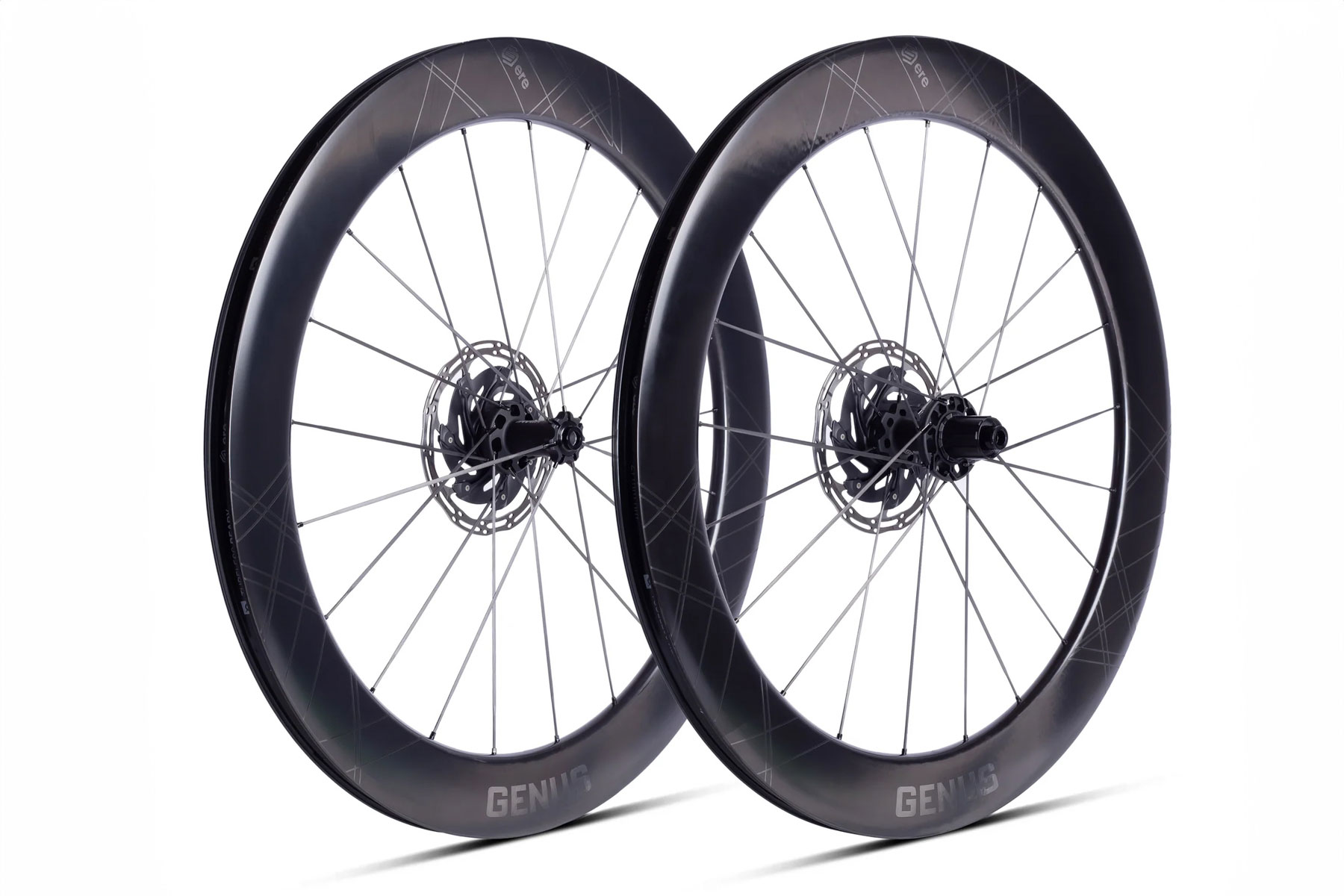
Dutch wheel builder Ere Research has introduced a new line of carbon race wheels called the Genus II, inspired by legendary rock guitarist Eddie Van Halen.

Their classic aero-shape rims come in three sizes, with a hooked tubeless-ready profile that’s optimised for road tyres between 26 and 36c.

They have a 2:1 spoke ratio for balance, lightweight Sapim spokes and an alternative carbon spoke option. Weights range from a feathery 1,188g for the 30mm rim and carbon spokes to 1,599g for the 65mm-deep rim with steel spokes.

They certainly look set to be solid rivals to the latest road bike wheels from all the major players.

Ere Research Genus II
I want to ‘Jump’ on a set of the Genus II wheels soon. Warren Rossiter / OurMedia

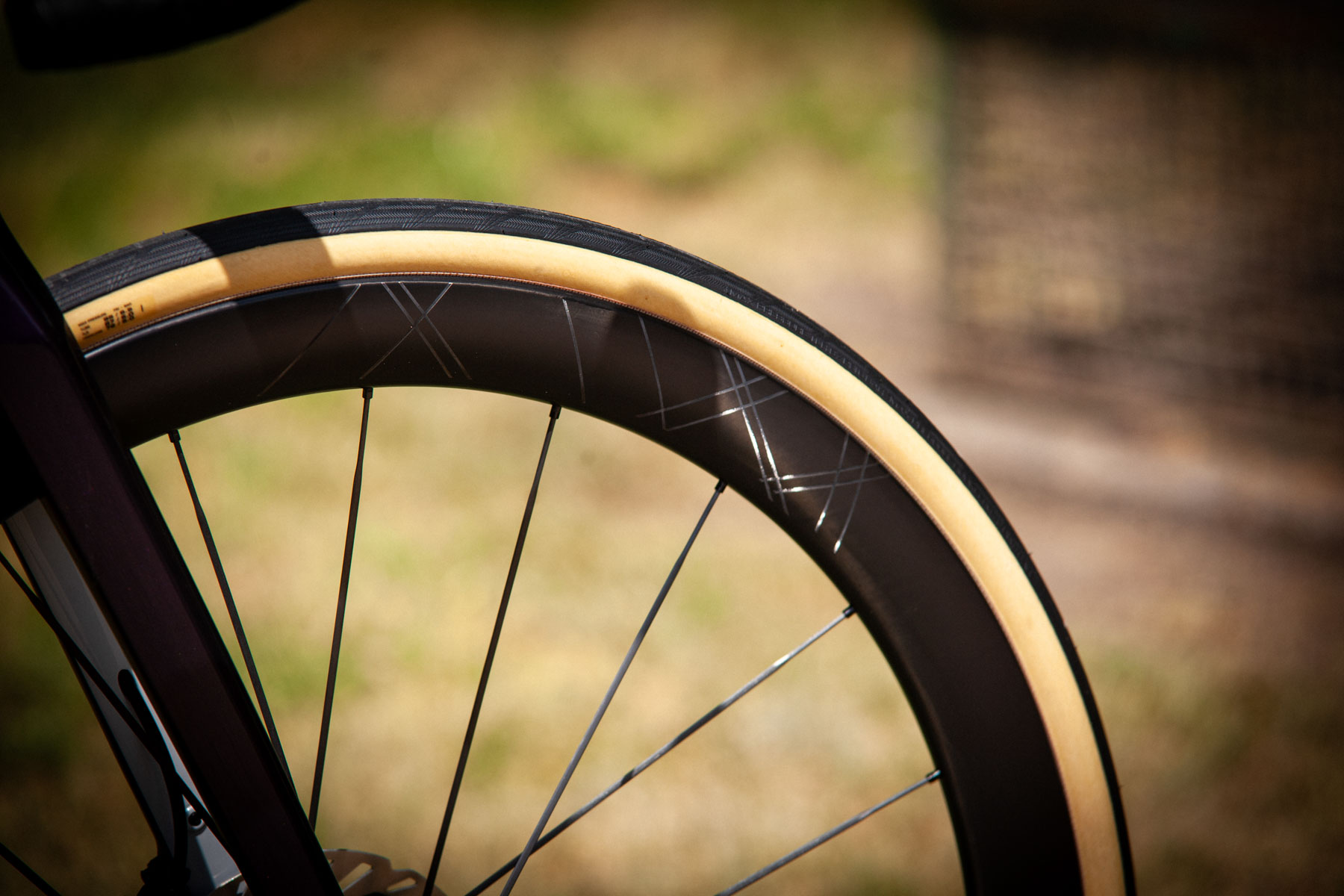
What sets the Genus II wheels apart and piqued my interest is the rims are adorned with a laser-etched pattern that will be familiar to rock fans worldwide.

The criss-cross pattern of lines is inspired by Netherlands-born guitar hero Eddie Van Halen and his legendary Frankenstrat guitar.

It’s not only the rims that pay homage to Van Halen. Ere Research’s lightweight straight-pull hub design is called the ‘Panama’, named after Van Halen’s 1984 top 20 US Billboard chart hit.

Genus II hubs
The hubs are named after one of Van Halen’s most famous songs. Warren Rossiter / OurMedia

The Genus II wheels are available in 30, 45 and 65mm depths, priced at £1,499 for carbon spokes and £1,399 for steel. I’d go so far as to say these classy carbon hoops look ideal for ‘solo’ getaways (sorry, I’ll get my coat).

Ere Research Genus II CL65
The rims are laser-etched with a design inspired by Eddie Van Halen’s iconic guitar. ere research

How to watch Black Voices in Gaming at Summer Game Fest 2025

Black Voices in Gaming will be at Summer Game Fest 2025, with its showcase taking place on June 9 at 12PM Eastern time. You’ll be able to stream it live online on The Game Awards YouTube channel. The non-profit organization focuses on putting a spotlight on titles created by Black game developers and on curating culturally relevant games centered on the lived experiences of Black, Indigenous and other People of Color (BIPOC). On X, the team said you can expect “world premieres, dope interviews, and bold voices pushing the culture forward” during the event. It didn’t list out the games it’s going to feature, but you can peek at the kind of titles the organization champions on its website.

Guess who’s back? Back again! It’s almost that time! The Black Voices in Gaming Showcase returns June 9th at 9AM PT, streaming during @summergamefest weekend!

Get ready for world premieres, dope interviews, and bold voices pushing the culture forward. Don’t miss it!#BViG… pic.twitter.com/p84nLSt4Cl

— Black Voices in Gaming (@BVIGaming) June 2, 2025

Summer Game Fest kicks off on June 6 with its opening livestream, followed by the indie-focused showcase Day of the Devs. On June 7, you can watch a showcase for time-sucking cozy games called Wholesome Direct, as well as the Women-led Games Showcase that will feature 39 titles from women-led and majority women development teams. That will be followed by the Latin American Games Showcase for titles created by Latin American developers and the Green Games Showcase for games that make direct contributions to green initiatives. On June 8, there will be showcase dedicated to Xbox games, featuring reveals and updates from across Xbox Game Studios, Bethesda and Activision Blizzard. In addition, Death Stranding 2 will premiere at the event on the evening of June 8. 

This article originally appeared on Engadget at https://www.engadget.com/gaming/how-to-watch-black-voices-in-gaming-at-summer-game-fest-2025-125906747.html?src=rss

I’m a Professional Cake Decorator and I Never Bake Without Cake Strips

We may earn a commission from links on this page.

Putting together a cake might seem straightforward, but it’s so much harder than it looks. Making the “bones” of the cake sturdy is just as important as making the outside look good, and having layers that are domed or topsy-turvy can mess up your cake from the jump. I’ve been a professional cake decorator for 14 years and there’s one tool that makes cake baking so much easier that I no longer bake without them: cake strips. 

One thing that used to drive me crazy in commercial kitchens and bakeries is food waste. Some waste is to be expected, but it can become rather extreme. Working as a cake decorator, I would chop off pounds of domed cake tops a day to make flat cake layers. As you might guess, if the layers aren’t flat, the cake won’t be straight. Those tops went straight into the trash.

Cake strips ensure your cakes rise and cook evenly. They reduce irregular humps in your cakes, which means you don’t have to cut anything off and waste it. At roughly five dollars each and with (potentially) years of use, cake strips can save you money and put more cake in your belly. 

Why cakes dome on top

If you’ve ever baked cake, muffins, or even cookies, you’ve witnessed the phenomenon of a domed center and browned, short edges. This is to be expected. The batter or dough on the edges, directly in contact with the metal cake pan, heats up and cooks first. With cake, these areas cook and solidify before the leavening agent reaches its maximum potential—thus, shorter edges. The center of the cake takes longer to heat up and so the baking powder or baking soda has a chance to fully activate, rising fully. There’s nothing wrong with this most of the time—muffins get beautiful cracks and pointy tops, and cookies get soft, chewy centers. Cakes, however, with a tall domed top and shorter edges, can complicate things.

Cake strips make better cakes

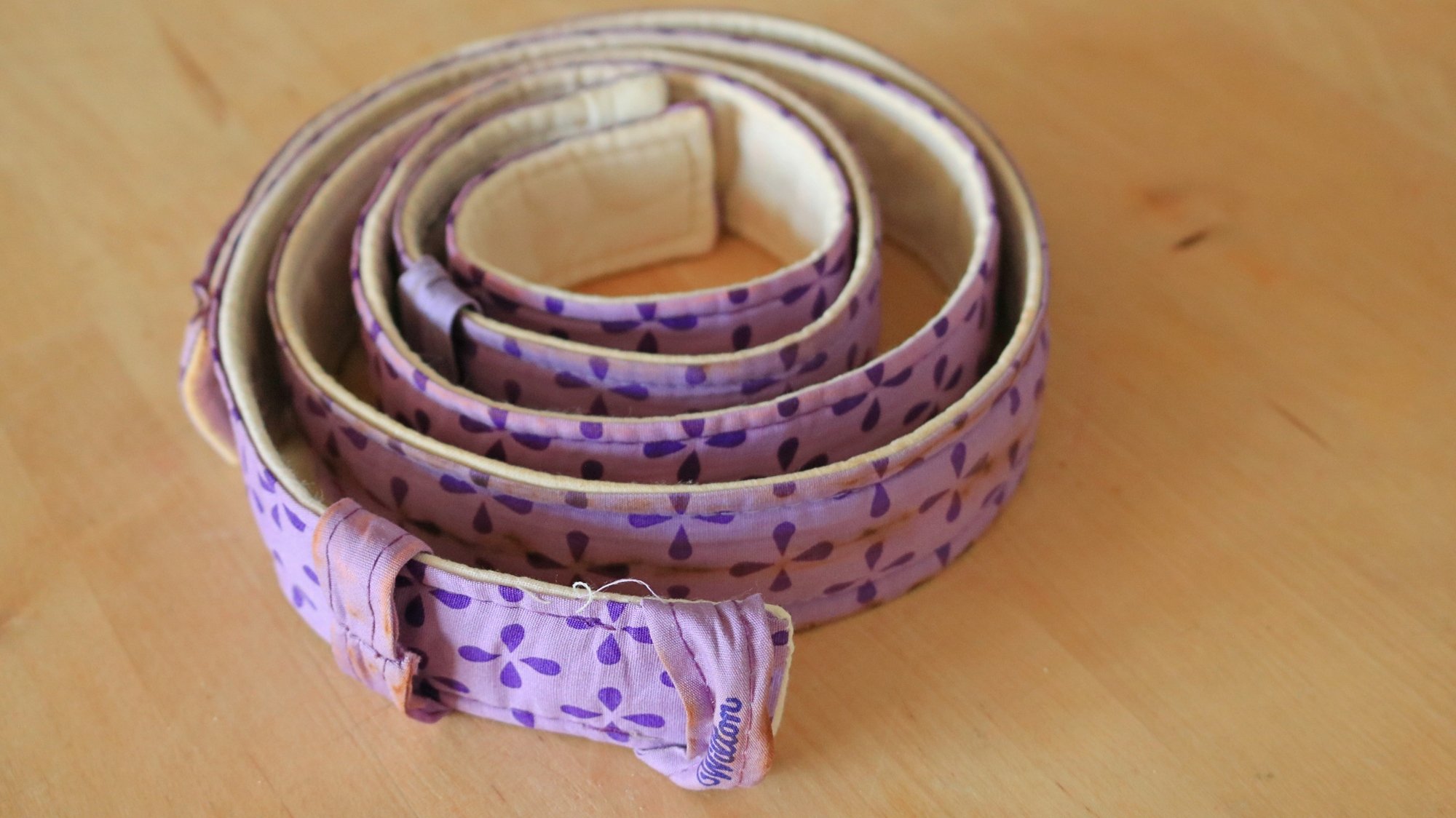
Cake strips wrapped in a circle on a wooden counter top.

Credit: Allie Chanthorn Reinmann

Cake strips are genius in their simplicity. They’re long pieces of sturdy cotton fabric—sometimes they’ll be shiny with a metallic fabric—and they’re multiple layers thick. On one end there are two small cotton loops. You use cake strips by soaking them in water and then wrapping them around the outside of round cake pans, securing one end into the cotton loops on the other end, like a belt. This damp cotton strip essentially insulates the edges of the cake pan so they don’t cook as fast, giving the leavening agent plenty of time to fully activate. The cake batter bakes evenly, cooking in the center at the same rate as the outside edges and resulting in a flat cake. 

How to use cake strips

I usually drop my cake strips into a bowl of water in the sink and let them soak while I’m preparing the cake batter. Once everything is in the pan and the oven is preheated, I’ll wring out the cake strips (they should be wet but not dripping everywhere) and wrap the cake pans. I take a moment to ensure the strip is pushed all the way up toward the top of the rim. If the cotton touches the oven racks under the pan then you can get a little toasty spot on the cotton. (Light browning over time is to be expected, but rest assured, these cake strips are perfectly safe to use inside of gas or electric ovens.)

I buy these Wilton brand cake strips for about $5 each (they sometimes come in a two-pack for $10). Wilton is a cake brand I’ve used for years and I find them to make consistently reliable products. Most cake strips are built for nine-inch cakes, but there are no rules against piggy-backing your cake strips. I link two strips together to cover 12-inch cake rounds all the time. 

While cake strips aren’t efficient for large-scale cake operations—wrapping hundreds of cake pans would be too much of a time-suck—they’re excellent for home use or small independent bakery situations. Yes, I’ve replaced working in production bakeries for writing food hacks for you fine folks, but I do make wedding cakes and celebration cakes on a low-production scale. I can honestly say that there’s not one cake that goes in my oven without a cake strip around it. 

Tuesday Telescope: A time-lapse from orbit reveals treasures below

I did not expect to feature NASA astronaut Nichole Ayers in the Tuesday Telescope so soon, but a recent photo she shared is just sublime. (In case you missed it, we wrote about her photo of lightning from space about a month ago.)

This week Ayers has a time-lapse sequence she captured from the Cupola as the International Space Station soared near Central and South America.

“Soooooo much going on in this picture,” Ayers wrote on the social media site X. “You can see Nicaragua, Costa Rica, and Panama, with South America off in the distance.”

Read full article

Comments

The FDA rolls out its own AI to speed up clinical reviews and scientific evaluations

The FDA has launched the generative AI tool, Elsa, agency-wide to help its employees with everything from clinical reviews to investigations. Sure, we’re living in a time of widespread disinformation and pushbacks against science, but why not rush things through with AI?

Elsa — yes, weirdly like the snow queen from Frozen — completed a “very successful pilot program with FDA’s scientific reviewers.” According to the FDA, the AI tool can help with reading, writing and summarizing everything from adverse events to assessments. Elsa can also do label comparisons and generate code. It’s already being used to speed up clinical protocol reviews and scientific evaluations, along with finding “high-priority inspection targets.”

Elsa should be a secure platform, the FDA states. It’s not clear how exactly the agency trained Elsa, but the FDA claims it’s not through “data submitted by regulated industry.” The information exists in Amazon Web Services’ GovCloud that, again, should keep all information internal.

The FDA calls Elsa the first step in its AI journey. “Today marks the dawn of the AI era at the FDA with the release of Elsa, AI is no longer a distant promise but a dynamic force enhancing and optimizing the performance and potential of every employee,” said FDA Chief AI Officer Jeremy Walsh. “As we learn how employees are using the tool, our development team will be able to add capabilities and grow with the needs of employees and the agency.”

This article originally appeared on Engadget at https://www.engadget.com/ai/the-fda-rolls-out-its-own-ai-to-speed-up-clinical-reviews-and-scientific-evaluations-120052323.html?src=rss

Meta and Yandex are de-anonymizing Android users’ web browsing identifiers

Tracking code that Meta and Russia-based Yandex embed into millions of websites is de-anonymizing visitors by abusing legitimate Internet protocols, causing Chrome and other browsers to surreptitiously send unique identifiers to native apps installed on a device, researchers have discovered. Google says it’s investigating the abuse, which allows Meta and Yandex to convert ephemeral web identifiers into persistent mobile app user identities.

The covert tracking—implemented in the Meta Pixel and Yandex Metrica trackers—allows Meta and Yandex to bypass core security and privacy protections provided by both the Android operating system and browsers that run on it. Android sandboxing, for instance, isolates processes to prevent them from interacting with the OS and any other app installed on the device, cutting off access to sensitive data or privileged system resources. Defenses such as state partitioning and storage partitioning, which are built into all major browsers, store site cookies and other data associated with a website in containers that are unique to every top-level website domain to ensure they’re off-limits for every other site.

A blatant violation

“One of the fundamental security principles that exists in the web, as well as the mobile system, is called sandboxing,” Narseo Vallina-Rodriguez, one of the researchers behind the discovery, said in an interview. “You run everything in a sandbox, and there is no interaction within different elements running on it. What this attack vector allows is to break the sandbox that exists between the mobile context and the web context. The channel that exists allowed the Android system to communicate what happens in the browser with the identity running in the mobile app.”

Read full article

Comments

I Used AI-Powered Calorie Counting Apps, and They Were Even Worse Than I Expected

The promise is seductive: Snap a photo of your meal, and artificial intelligence will instantly tell you exactly how many calories you’re consuming. No more tedious manual logging, no more guessing at portion sizes, no more human error. Apps like Cal AI, Lose It!, and MyFitnessPal’s new photo features claim to revolutionize calorie tracking by letting your smartphone’s camera do the heavy lifting.

But as someone with a long, complicated history with calorie counting—and admittedly, a somewhat cursed expertise in it—I can tell you that counting calories with a photo is exactly as stupid as it sounds.

How AI-powered calorie counting is supposed to work

Calorie counting apps promise to solve what developers claim is the biggest problem with calorie tracking: human error. The pitch is compelling—why spend time searching databases and measuring portions when your phone can instantly analyze your plate?

Apps like Cal AI or SnapCalorie AI use visual cues like color, texture, and relative size to make educated guesses about what you’re eating and how much of it there is.

They claim that AI methods can solve the pesky problem of human accuracy in calorie estimation—which, to be fair, is easy to get wrong. Cal AI markets itself as one of the more sophisticated options in this space, so I decided to see for myself. The app was free for the first three days, then $29.99/year.

The setup process is straightforward: Download the app, create an account, input basic demographic information, and set your goals. Here’s where I encountered my first red flag. The app cheerfully informed me that “losing 10 lbs is a realistic target”—except that losing 10 pounds would actually push me into underweight BMI territory. This kind of blanket statement reveals a concerning lack of nuance about individual health needs.

Cal AI’s photo logging process follows these steps:

  1. Take a clear photo of your food, ideally against a plain background.

  2. Make sure all ingredients are visible and well-lit.

  3. Include a reference object (like a coin or your hand) for scale.

  4. Upload the image and wait for AI analysis.

  5. Review and correct the app’s identifications and portion estimates.

  6. Save the entry to your daily log.

The app provides detailed tips for getting better results: Use natural lighting, avoid shadows, keep the camera parallel to the plate, and ensure no ingredients are hidden. These guidelines sound reasonable in theory, but they hint at the fundamental challenge these apps face—the complexity of real-world eating.

The reality is wildly disappointing

I started my testing with something simple: a Pink Lady apple weighing 222 grams. Surely this would be an easy win for the AI—apples are among the most photographed foods on earth, with a distinctive shape and color that should be instantly recognizable.

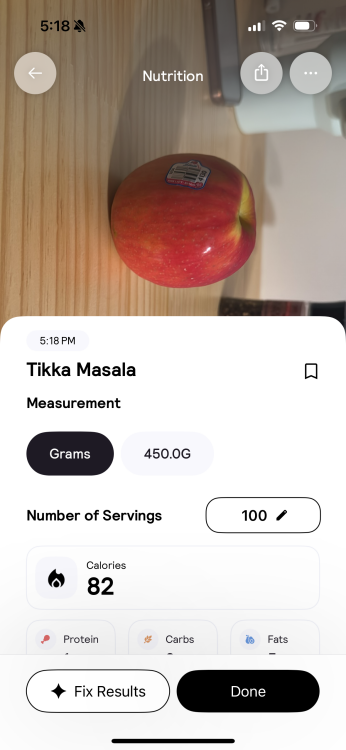
Cal AI confidently identified my apple as tikka masala.

Cal AI identifying an apple as tikka masala.
Gorgeous tikka masala, yes?
Credit: Meredith Dietz

I gave it another chance, this time photographing the apple alongside its barcode and sitting on a kitchen scale displaying its exact weight. The app did recognize it as an apple this time, but estimated it at 80 calories when the actual count should have been closer to 120. That’s a 33% underestimation—not exactly the precision you’d want if you’re trying to track intake accurately.

The real test came with a more complex meal: my current meal-prepped lunch of fried tofu, onions, cucumbers, tomatoes, feta cheese, and chickpeas, all generously dressed with an oil-based homemade vinaigrette. This is the kind of mixed dish that presumably showcases AI’s advantage over manual logging—no need to search for individual ingredients or estimate their quantities.

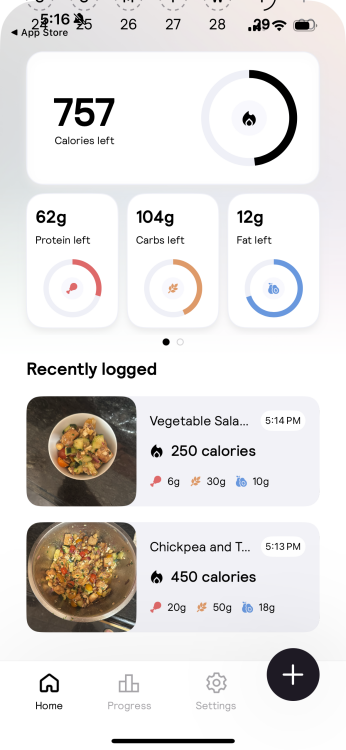
The results were a masterclass in algorithmic overconfidence. The app identified the golden-brown fried tofu as croutons, which I had to manually correct. It did a reasonably good job recognizing the vegetables and feta, but completely whiffed on the oil content. Despite the salad being visibly glistening with dressing, the app estimated the entire dish at 450 calories.

This estimate was laughably low. A single can of chickpeas contains about 400 calories, and my portion included roughly that amount plus significant quantities of feta cheese and several tablespoons of olive-oil-based dressing. A realistic calorie count for this meal would have been closer to 800 to 900 calories.

The app’s portion estimation proved even more problematic than its ingredient identification. When I photographed a smaller serving—less than a quarter of the original salad—Cal AI estimated it at 250 calories. According to the app’s own logic, less than 25% of the meal somehow contained more than 55% of its calories. The math simply doesn’t work.

Cal AI display
Cal AI was way, way off.
Credit: Meredith Dietz

This highlights a fundamental limitation of photo-based calorie counting: Cameras capture two-dimensional images of three-dimensional objects. Without consistent reference points or sophisticated depth analysis, estimating volume from photos remains largely guesswork. Even humans struggle with this task, which is why nutrition professionals typically recommend weighing foods for accuracy.

To get a fuller picture of the AI calorie counting landscape, I also tested two other popular apps: SnapCalorie and Calorie Mama.

SnapCalorie: better numbers, same problems

SnapCalorie did immediately assuage some skepticism by suggesting a much more reasonable daily calorie target of 1,900 calories, compared to Cal AI’s problematic weight loss messaging. However, this accuracy comes at a steep price—$79.99 per year after just a one-week free trial, making it the most expensive option I tested.

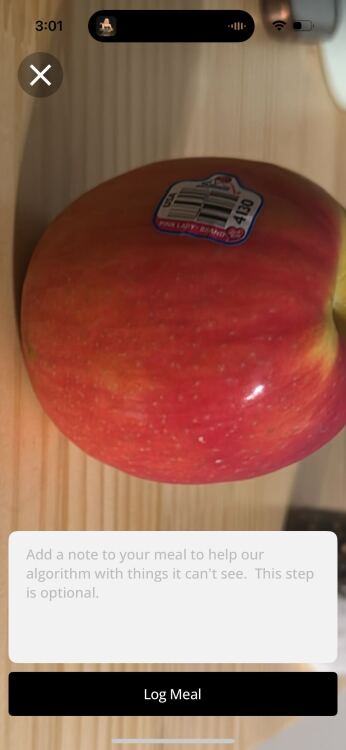
The app does offer one interesting feature: an “add note” function that lets you provide additional context about ingredients the camera can’t see. In theory, this addresses one of the fundamental limitations of photo-based tracking.

SnapCalorie analyzing an apple.
SnapCalorie has a useful “add note” feature and more accurate results.
Credit: Meredith Dietz

When I tested SnapCalorie with the same Pink Lady apple, it performed much better than Cal AI, estimating 115 calories. But the Greek salad test revealed familiar problems. SnapCalorie’s initial estimate was an absurdly low 257 calories. When I photographed a smaller portion—the same sub-quarter serving that had stumped Cal AI—SnapCalorie estimated 184 calories. The math still didn’t work; this smaller portion should have been roughly 25% of the larger serving, not 70%.

Determined to give the app a fair shot, I used the note feature to manually specify “full container of tofu, feta, chickpeas and olive oil.” With this human intervention, SnapCalorie bumped its estimate to 761 calories—much more reasonable and accurate, though still on the low side.

But this raises the obvious question: If I need to manually input detailed ingredient information to get accurate results, what exactly is the photo accomplishing? I’m essentially doing the work of traditional calorie counting while going through the motions of taking pictures.

Calorie Mama: when AI doesn’t even try

Calorie Mama provided the most frustrating and laughable experience of the three apps. The interface feels rudimentary, and the AI’s performance is so poor that the app essentially abandons the premise of automated photo analysis.

After uploading a photo, Calorie Mama requires you to manually confirm not just the food items but also their portion sizes. This defeats the entire purpose of photo-based logging—you’re doing all the work that manual entry would require anyway.

When I uploaded my Greek salad photo, Calorie Mama identified it simply as “tofu”—ignoring the vegetables, feta cheese, chickpeas, and dressing entirely. The app then asked me to manually adjust the portion size and seemed to consider the logging complete, as if a complex mixed dish contained nothing but plain tofu.

This wasn’t just inaccurate; it was useless. At least Cal AI and SnapCalorie attempted to recognize multiple ingredients, even if their calorie estimates were off. Calorie Mama appeared to give up on the core challenge entirely, relegating the AI to little more than a gimmicky photo storage system.

AI-powered calorie counting wasted my time

The promise of AI-powered calorie counting is efficiency—snap and go, no manual entry required. But my experience revealed a different reality. I spent considerable time correcting ingredient identifications, adjusting portion sizes, and second-guessing the app’s estimates. In many cases, I would have been faster using traditional manual logging with a food scale and database search.

This creates a frustrating conundrum: If you don’t scrutinize the AI’s results, you’ll get wildly inaccurate data. But if you do verify every entry, you lose the time-saving benefit that justified using the technology in the first place. It’s the worst of both worlds—the effort of manual tracking combined with the uncertainty of automated guessing.

Perhaps most concerning is what happens when users don’t have the background to recognize inaccurate estimates. My years of calorie counting experience—problematic as that history may be—gave me the knowledge to spot when Cal AI’s numbers were off. But what about users who trust the technology?

Systematic underestimation of calories could be particularly harmful for people trying to lose weight, as it might lead them to believe they’re eating less than they actually are. Conversely, overestimation could cause unnecessary restriction or anxiety around food. Either way, inaccurate data undermines the entire purpose of tracking.

The fundamental issue with AI calorie counting apps isn’t just technical—it’s philosophical. These tools emerge from and reinforce the idea that precise calorie tracking is both necessary and beneficial for health. But research suggests that obsessive calorie counting may do more harm than good for many people.

Intuitive eating, which focuses on internal hunger and satiety cues rather than external metrics, has shown promise as a more sustainable and psychologically healthy approach to nutrition. This framework emphasizes developing a healthy relationship with food based on how it makes you feel rather than hitting specific numerical targets.

For most people, understanding general principles of balanced nutrition—eating plenty of vegetables, choosing whole grains over refined ones, including adequate protein—provides better long-term outcomes than meticulous calorie tracking.

The bottom line

AI-powered calorie counting apps promise to solve human error in dietary tracking, but they introduce new forms of inaccuracy while maintaining many of the old problems. If your goal is simply to get a rough estimate of how many calories are in generic foods, these apps might provide some value. But for anyone seeking precision in their intake tracking, traditional methods combined with food scales remain more reliable.

More importantly, I’d question whether precise calorie counting serves your health goals at all. For many people, developing a more intuitive relationship with food—one based on satisfaction, energy levels, and overall well-being rather than numerical targets—leads to better physical and mental health. Maybe the old-fashioned approach of listening to our bodies works better than any algorithm.


Top 5 Zwift Videos: New Splits Feature, Zwift Review, and Winning Races

As one of the community’s most popular feature requests, the splits feature unveiled in a recent update was a very welcome addition to Zwift. In this week’s top video, learn all about the new feature from Shane Miller!

We’ve also decided to feature an in-depth review of Zwift, a guide to winning Zwift races, a long-term review of the Zwift Ride, and one Zwifter’s first time trial experience.

Zwift Splits: New In-Game Lap Tracking Tool!

Learn all about Zwift’s new splits/lap feature in Shane’s latest video.

Should You Try Zwift in 2025? My Honest Review!

Over the last 9 months, Chad Rides has been riding on Zwift. Now he’s ready to share his honest review on whether it actually lives up to the hype.

This is How to Win Zwift Races… a Lot!

Markus Harford has been walking away with incredible wins and podium finishes throughout the After Party ZRacing series. In this video, Markus shares why he has been able to do this and how you can train yourself to race in a similar fashion.

Zwift Ride Frame Long-Term Review: The Smartest Indoor Bike Setup

After over 6 months of riding with the Zwift Ride, Lake District Cyclist shares his thoughts and provides a long-term review of the smart bike.

I Tried My First Zwift Time Trial and It Was Insane!

Road to A tries his first-ever time trial on Zwift. Watch as he shares his experience and learnings from the race.

Got a Great Zwift Video?

Share the link below and we may feature it in an upcoming post!

The Morning After: What to expect at Summer Game Fest 2025

It’s time to game. Kicking off June 6, with Summer Game Fest Live, SGF 2025 runs through to June 9, with the likes of Xbox Games Showcase and even Death Stranding 2 live game premiere likely to make headlines. There is a bunch of others in store, including Day of the Devs. Devolver Direct and Wholesome Direct are peppering the schedule.

For Xbox, games in the pipeline include the new Fable, Perfect Dark, Gears of War: E-Day, Everwild, State of Decay 3, Clockwork Revolution, Hideo Kojima’s OD and Contraband.

What about Nintendo (although it’s a bit busy) and Sony? Traditionally, both have their own presentations, but there is no word yet on either. Ubisoft usually does a thing too, but nothing’s on the docket.

The most recent headline-makers include a glimpse at The Witcher 4, courtesy of Unreal, and a closer look at IO Interactive’s 007 First Light, a James Bond game from the studio responsible for the incredible Hitman series. Hopefully, there are further surprises. Maybe a Silksong release date? Gosh, I can be silly.

— Mat Smith

Get Engadget’s newsletter delivered direct to your inbox. Subscribe right here!

The news you might have missed

I still don’t miss E3

How SGF gave games media a better kind of trade event

Summer Games Fest kicks off at the end of the week. We’re sending a small team of editors to watch, play and interview their way through all the biggest reveals and experiences. While it doesn’t yet have the iconic weight of E3 — which is all but dead — SGF is a crucial lightning rod for most of the gaming industry. Jessica Conditt lays out why she prefers the new form of the gaming trade show — and how she might have cursed the whole thing with her witchy powers.

Continue reading.

28 Years Later used 20 iPhones at the same time

The film used three iPhone rigs.

TMA
Sony

Director Danny Boyle has discussed the use of iPhones for 28 Years Later in an interview with IGN. The movies used three special rigs for the iPhone sequences: one for eight cameras, which one person can carry, another with ten and another with 20.

“I never say this, but there is an incredible shot in the second half [of the film] where we use the 20-rig camera, and you’ll know it when you see it,” Boyle told IGN. He described the 20-iPhone rig as “basically a poor man’s bullet time.”

Continue reading.

Stranger Things 5 finally has a release date

Spread across three volumes.

TMA
Netflix

While I thought they’d keep the Stranger Things train rolling until Bobby Milly Brown morphed into Winona Ryder, this is the end. Netflix has finally revealed the release date for the show’s fifth and final season: November 26. Volume one has four episodes, followed a month later by three episodes for volume two on Christmas Day (December 25) and the final episode on New Year’s Eve (December 31).

Continue reading.

This article originally appeared on Engadget at https://www.engadget.com/general/the-morning-after-engadget-newsletter-111341868.html?src=rss

ByoWave Modular Proteus Controller Kit Support Lands In Linux 6.16

Valve engineer Pierre-Loup A. Griffais contributed ByoWave Proteus controller support to the Linux kernel. ByoWave Proteus are some modular controller designs that can be adapted based upon the needs of the gamer and even what title you may be playing at the moment. The triggers and buttons are all repositionable for a very customized controller experience. The only downside is the modular gaming controller kit retails for $299 USD, but at least now works off the mainline Linux kernel…