Texas is poised to become the first state with a Republican-controlled government to pass a right to repair law, as its Senate unanimously approved HB 2963. The bill requires manufacturers to provide parts, manuals, and tools for equipment sold or used in the state. The Verge reports: A press release from the United States Public Interest Research Group (PIRG), which has pushed for repairability laws nationwide, noted that this would make Texas the ninth state with a right to repair rule, and the seventh with a version that includes consumer electronics. It follows New York, Colorado, Minnesota, California, Oregon, Maine, and most recently, Washington […]. “More repair means less waste. Texas produces some 621,000 tons of electronic waste per year, which creates an expensive and toxic mess. Now, thanks to this bipartisan win, Texans can fix that,” said Environment Texas executive director Luke Metzger.
An anonymous reader quotes a report from 404 Media: The moderators of a pro-artificial intelligence Reddit community announced that they have been quietly banning “a bunch of schizoposters” who believe “they’ve made some sort of incredible discovery or created a god or become a god,” highlighting a new type of chatbot-fueled delusion that started getting attention in early May. “LLMs [Large language models] today are ego-reinforcing glazing-machines that reinforce unstable and narcissistic personalities,” one of the moderators of r/accelerate, wrote in an announcement. “There is a lot more crazy people than people realise. And AI is rizzing them up in a very unhealthy way at the moment.”
The moderator said that it has banned “over 100” people for this reason already, and that they’ve seen an “uptick” in this type of user this month. The moderator explains that r/accelerate “was formed to basically be r/singularity without the decels.” r/singularity, which is named after the theoretical point in time when AI surpasses human intelligence and rapidly accelerates its own development, is another Reddit community dedicated to artificial intelligence, but that is sometimes critical or fearful of what the singularity will mean for humanity. “Decels” is short for the pejorative “decelerationists,” who pro-AI people think are needlessly slowing down or sabotaging AI’s development and the inevitable march towards AI utopia. r/accelerate’s Reddit page claims that it’s a “pro-singularity, pro-AI alternative to r/singularity, r/technology, r/futurology and r/artificial, which have become increasingly populated with technology decelerationists, luddites, and Artificial Intelligence opponents.”
The behavior that the r/accelerate moderator is describing got a lot of attention earlier in May because of a post on the r/ChatGPT Reddit community about “Chatgpt induced psychosis.” From someone saying their partner is convinced he created the “first truly recursive AI” with ChatGPT that is giving them “the answers” to the universe. […] The moderator update on r/accelerate refers to another post on r/ChatGPT which claims “1000s of people [are] engaging in behavior that causes AI to have spiritual delusions.” The author of that post said they noticed a spike in websites, blogs, Githubs, and “scientific papers” that “are very obvious psychobabble,” and all claim AI is sentient and communicates with them on a deep and spiritual level that’s about to change the world as we know it. “Ironically, the OP post appears to be falling for the same issue as well,” the r/accelerate moderator wrote. “Particularly concerning to me are the comments in that thread where the AIs seem to fall into a pattern of encouraging users to separate from family members who challenge their ideas, and other manipulative instructions that seem to be cult-like and unhelpful for these people,” an r/accelerate moderator told 404 Media. “The part that is unsafe and unacceptable is how easily and quickly LLMs will start directly telling users that they are demigods, or that they have awakened a demigod AGI. Ultimately, there’s no knowing how many people are affected by this. Based on the numbers we’re seeing on reddit, I would guess there are at least tens of thousands of users who are at this present time being convinced of these things by LLMs. As soon as the companies realise this, red team it and patch the LLMs it should stop being a problem. But it’s clear that they’re not aware of the issue enough right now.”
Moderators of the subreddit often cite the term “Neural Howlround” to describe a failure mode in LLMs during inference, where recursive feedback loops can cause fixation or freezing. The term was first coined by independent researcher Seth Drake in a self-published, non-peer-reviewed paper. Both Drake and the r/accelerate moderator above suggest the deeper issue may lie with users projecting intense personal meaning onto LLM responses, sometimes driven by mental health struggles.
Laurene Powell Jobs has publicly endorsed the secretive AI hardware device being developed by Jony Ive and OpenAI, expressing admiration for his design process and investing in his ventures. Ive says the project is an attempt to address the unintended harms of past tech like the iPhone, and Powell Jobs stands to benefit financially if the device succeeds. The Verge reports: In a new interview published by The Financial Times, the two reminisce about Jony Ive’s time working at Apple alongside Powell Jobs’ late husband, Steve, and trying to make up for the “unintentional” harms associated with those efforts. […] Powell Jobs, who has remained close friends with Ive since Steve Jobs passed in 2011, echoes his concerns, saying that “there are dark uses for certain types of technology,” even if it “wasn’t designed to have that result.” Powell Jobs has invested in both Ive’s LoveFrom design and io hardware startups following his departure from Apple. Ive notes that “there wouldn’t be LoveFrom” if not for her involvement. Ive’s io company is being purchased by OpenAI for almost $6.5 billion, and with her investment, Powell Jobs stands to gain if the secretive gadget proves anywhere near as successful as the iPhone.
The pair gives away no extra details about the device that Ive is building with OpenAI, but Powell Jobs is expecting big things. She says she has watched “in real time how ideas go from a thought to some words, to some drawings, to some stories, and then to prototypes, and then a different type of prototype,” Powell Jobs said. “And then something that you think: I can’t imagine that getting any better. Then seeing the next version, which is even better. Just watching something brand new be manifested, it’s a wondrous thing to behold.”
Linux user share on Steam rose to 2.69% in May 2025 — the highest level recorded since at least 2018. GamingOnLinux reports: Overall user share for May 2025:
– Windows 95.45% -0.65%
– Linux 2.69% +0.42%
– macOS 1.85% +0.23%
Even with SteamOS 3 now being a little more widely available, the rise was not from SteamOS directly. Filtering to just the Linux numbers gives us these most popular distributions:
– SteamOS Holo 64 bit 30.95% -2.83%
– Arch Linux 64 bit 10.09% +0.64%
– Linux Mint 22.1 64 bit 7.76% +1.56%
– Freedesktop SDK 24.08 (Flatpak runtime) 64 bit 7.42% +1.01%
– Ubuntu Core 22 64 bit 4.63% +0.01%
– Ubuntu 24.04.2 LTS 64 bit 4.30% -0.14%
– CachyOS 64 bit 2.54% +2.54%
– EndeavourOS Linux 64 bit 2.44% -0.02%
– Manjaro Linux 64 bit 2.43% -0.18%
– Pop!_OS 22.04 LTS 64 bit 2.17% -0.06%
– Debian GNU/Linux 12 (bookworm) 64 bit 1.99% -0.28%
– Other 23.27% -2.27%
An anonymous reader quotes a report from Ars Technica: It has become a common refrain during Google’s antitrust saga: What happened to “don’t be evil?” Google’s unofficial motto has haunted it as it has grown ever larger, but a shareholder lawsuit sought to rein in some of the company’s excesses. And it might be working. The plaintiffs in the case have reached a settlement with Google parent company Alphabet, which will spend a boatload of cash on “comprehensive” reforms. The goal is to steer Google away from the kind of anticompetitive practices that got it in hot water.
Under the terms of the settlement, obtained by Bloomberg Law, Alphabet will spend $500 million over the next 10 years on systematic reforms. The company will have to form a board-level committee devoted to overseeing the company’s regulatory compliance and antitrust risk, a rarity for US firms. This group will report directly to CEO Sundar Pichai. There will also be reforms at other levels of the company that allow employees to identify potential legal pitfalls before they affect the company. Google has also agreed to preserve communications. Google’s propensity to use auto-deleting chats drew condemnation from several judges overseeing its antitrust cases. The agreement still needs approval from US District Judge Rita Lin in San Francisco, but that’s mainly a formality at this point. Naturally, Alphabet does not admit to any wrongdoing under the terms of the settlement, but it may have to pay tens of millions in legal fees on top of the promised $500 million investment.
Microsoft, CrowdStrike, Palo Alto Networks, and Google announced Monday they will create a public glossary standardizing the nicknames used for state-sponsored hacking groups and cybercriminals.
The initiative aims to reduce confusion caused by the proliferation of disparate naming conventions across cybersecurity firms, which have assigned everything from technical designations like “APT1” to colorful monikers like “Cozy Bear” and “Kryptonite Panda” to the same threat actors. The companies hope to bring additional industry partners and the U.S. government into the effort to streamline identification of digital espionage groups.
A smartphone smuggled out of North Korea automatically captures screenshots every five minutes and stores them in a hidden folder inaccessible to users, according to analysis by the BBC. Authorities can later review these images to monitor citizen activity on the device. The phone, obtained by Seoul-based media outlet Daily NK, resembles a Huawei or Honor device but runs state-approved software designed for surveillance and control. The device also automatically censors text, replacing “South Korea” with “puppet state” and Korean terms of endearment with “comrade.”
The Witcher 4 looks astonishing in a new Unreal Fest tech demo today, but I’ve been on the path long enough to know that the visuals that delight our eyeballs years out from release don’t always reflect how a game ends up looking once it’s finally out on a gaming console. Still, a new cinematic trailer and extended…
The internet is both excellent and horrible at spreading information and community. In one sense, it can provide access to so many people and perspectives that aren’t available in a person’s day-to-day life. At the same time, it can be ripe with misinformation and people who cause more harm than good.
Now, a new study from The Guardian is revealing just how intertwined these two things can be. An investigation found that 52 out of the top 100 videos tagged #mentalhealthtips contained at least some misinformation, according to a team of mental health professionals. These clips discussed conditions and experiences such as anxiety, depression, bipolar disorder, trauma, neurodivergence and more.
“TikTok is spreading misinformation by suggesting that there are secret universal tips and truths that may actually make a viewer feel even worse, like a failure, when these tips don’t simply cure,” said Amber Johnston, a British Psychological Society-accredited psychologist, who reviewed videos about trauma for The Guardian.
The experts identified four major themes within the misleading and inaccurate information. The first, pathologizing normal emotions, came in videos that described everyday feelings, such as tiredness or feeling anxiety around changes, as clear indicators of specific mental health disorders. They seemed to imply that experiencing any symptoms of a mental health disorder meant the viewer must be living with it.
Then there was misuse of therapeutic language, whether through inaccurately describing a mental health disorder or using words like abuse, to explain certain actions, without context or nuance. The third category was reportedly the most common: unevidenced treatments and false claims. These clips include claims that a certain method can heal trauma in just one hour, that ingesting certain things causes depression and that manufactured supplements will ease anxiety.
The last theme identified was anecdotal evidence. Videos in this area included recommendations to get inpatient treatment solely based on the creators’ own experiences. Another showed someone in a hospital gown who implied that they were in a psychiatric unit for being too honest with their therapist.
Misinformation is a tremendous issue across social media platforms, with many companies doing little to nothing about it. Take Meta, for example, which removed its fact-checking program in the US this past April. Instead, it has opted for community notes that allow for crowdsourced responses to posts.
TikTok has made multiple claims over the years that it’s removing “problematic” content and inaccurate videos. In a statement shared with The Guardian, a TikTok spokesperson commended the app for being a place people can share and get support for their mental health experiences. “There are clear limitations to the methodology of this study, which opposes this free expression and suggests that people should not be allowed to share their own stories.”
The spokesperson added that TikTok works with the World Health Organization and the NHS in the UK to provide accurate information, further claiming that the app removes 98 percent of “harmful misinformation before it’s reported to us.”
This article originally appeared on Engadget at https://www.engadget.com/social-media/tiktok-ripe-with-mental-health-misinformation-new-study-reports-150359735.html?src=rss
The BBC and Disney chose not to share screeners ahead of “The Reality War” to preserve its numerous twists. There isn’t time to review it in the usual style, but I felt I’d be remiss not to cap off this run of reviews by talking about the finale. And it’s not as if I’ve nothing to say about what the hell happened on Saturday.
“It’s the end… but the moment has been ‘prepared for.’”
I refuse to believe that “The Reality War” was planned and written as the execution of this run of Doctor Who. I’m well aware the BBC, Bad Wolf and Ncuti Gatwa claimed the intention from the start was for him to bow out after two short seasons. I’m not buying it.
On one hand, the rumors of disharmony behind the scenes, last minute reshoots and Disney’s reported displeasure are hard to ignore. But there’s far better evidence, which is to just watch the damn episode and try to think about what happened for more than a heartbeat.
Everything after the Doctor’s triumphant return to UNIT HQ feels like it was hastily assembled and tacked on. In fact, there are times in which it feels like all of the main actors are reading from different scripts, and not interacting with one another.
Spot the join
Lara Cornell/BBC Studios/Bad Wolf
I’ve seen some people grousing about the simple way the Omega storyline was resolved, but I think it was always planned that way. Russell T. Davies’ has always ended the big dramatic plots of his finales early to make more room to show the aftermath for the characters.
Take last year’s “Empire of Death,” which dumps off Sutekh two thirds of the way in to spend the rest of the episode showing Ruby meeting her birth mother. For Davies, the big CGI space monsters are always the means through which he can spend moments with his characters.
And yet the character moments here are weird if not totally incoherent — the one highlight being the moment that Poppy disappears. The shot of the Doctor and Belinda absentmindedly handing her coat back and forth as it turns into an ever-smaller piece of cloth is sublime.
But when Ruby’s protestations are finally taken seriously, the Doctor’s decision to just hand Belinda a child comes totally out of left field. Not only does it not agree with anything that we’ve come to know about her over the last eight weeks, it’s also totally pretty outrageous.
Which is why it’s far more plausible that Davies, faced with no commission for a third season and with a lead actor looking to quit, just wrote a few pages of nonsense to justify the change.
“One day, I shall come back.”
Naturally, the rumors suggest the original ending would have seen Susan appear as a lead-in to the next season. Again, this isn’t so much a hint as something the last two years have been very clearly laying the foundations for. The Doctor openly discussed that he has a child living in London (in “The Devil’s Chord”) and the Susan Twist saga was designed to play up to that. Going to the trouble of hiring the 84-year-old Carole Ann Ford and putting her in brief cameos in the last two episodes — plus dropping references to that in “Lux” — was clearly part of the plan. Now, after the extensive, patient buildup of that storyline, it appears that we’ll not get the chance to see what Davies had intended.
Going back to the point about the BBC and Gatwa’s claim that this was always meant to be a two-season deal, it’s likely the show’s original ending will be swept under the rug. And given Ford’s age, it’s likely that we’ll never get the chance to give the actress the sendoff she really deserved in 1964.
“Davies has never been that sort of writer.”
A large amount of fan speculation this year was focused on the various structural and thematic coincidences. Each episode of this run could more or less map onto the previous one and went over similar ground. But, as far back as “Lux,” I said that Russell T. Davies wasn’t that sort of writer, building a mystery box that would resolve perfectly by its conclusion. His writing is a little more like a kid pulling toys out of a toybox and smashing them together at speed.
“The Reality War” is a great example of this approach, since while there were plenty of elements that came back, none of them were as vital to the plot’s conclusion as they could have been. Anita was a convenient way of getting the Doctor out of the cliffhanger, but did nothing else for the rest of the episode. Hell, it’s hard to take the suggestion seriously that she’d fallen in love with the Doctor but not realized he was, at least in this incarnation, more interested in men. Joy, too, from “Joy to the World” gets a mention but with little emotional attachment given the events of that episode. And on the subject of its treatment of women…
“I was this really brilliant woman”
James Pardon/BBC Studios/Bad Wolf
Doctor Who has spent much of its recent years trying to address its own blind spots around representation. This era has continued this tradition, broadening out the series’ supporting cast, especially the team known by fans as the “UNIT Family.” In “The Reality War,” every one of the Doctor’s allies, barring Colonel Ibrahim, is either a woman or non-binary. And yet, the sheer number of cast members means each one is almost aggressively underserved.
“The Reality War,” after all, is focused on unpacking a false reality called into existence by an ultra-conservative YouTuber who ignores and erases disabled and queer people. But the show’s treatment of these characters both during the action-packed finale, and afterward, is rough. When the team starts working together, the legion of people around the Doctor get little to nothing of note to actually do.
Anita is quite literally reduced to the role of a human doorstop (she holds the door to the Time Hotel open to counteract Conrad’s wish). Kate orders Shirley to fire the lasers. Susan (Triad) builds the zero room. Mel does quite literally nothing once she’s sneered at the Rani. And then there’s Rose.
Rose’s brief inclusion would have been extraordinarily poignant if she’d helped defeat Conrad once she’s been pulled out of oblivion. Instead, she’s just there so the Doctor can point out she was erased because Conrad hates (and/or ignores) nonbinary transfem people. And after that moment, Yasmin Finney essentially disappears from the episode once again, making her less a character and more a prop.
It gets worse with the treatment of Ruby and Belinda — the former marginalized and almost aggressively ignored by the characters to the point that I assumed their rejection of her claims was a sign the reality hadn’t actually been fixed. But the latter goes from not having a child, to having a fictional child in Conrad’s world, to forgetting she exists when Conrad’s wish is undone. When the timeline resets and she no longer has any memory of a child, the Doctor then opts to sacrifice his life in order to bring that child back into existence. I mean, what? Given Davies’ politics, and the (ostensibly) pro-abortion subtext of “Space Babies,” the Doctor suddenly re-writes the universe to force his companion — without her consent — into motherhood.
“It’s funny, but is it going to get them off their tractors?”
I’m a Brit, reviewing a uniquely British show for a predominantly American audience, and so try to view the series through that lens. Doctor Who has been a fixture in the US since the ‘70s and was a mainstay on PBS through the ‘80s and so it’s not an unknown property. The revival series may not have been an instant hit, but quickly built a respectable audience on BBC America. But while in the UK the series is a mainstream hit, its US demographic can be roughly broken down into genre nerds and anglophiles.
Consequently, there was a degree of nervousness about how the revitalized series would be received by the far broader audience on Disney+. Davies’ had spoken about the need for the series to recruit new fans, downplaying the series’ six-decades-long backstory. But despite that aim, it never felt that the series was making many concessions to its potential audience. Don’t forget, the Ncuti Gatwa series is playing out in the shadow of specific events from its 2021 series and the second and third of its three 2023 specials. And yet, rather than starting from a clean(-ish) slate, the series threw itself headlong into a multi-year story about its broken reality.
“In the ‘70s or ‘80s depending on the dating protocol…”
The Two Ranis / Two Ronnies gag was great, but did anyone over the age of 30 get it?
BBC Studios/Bad Wolf
And on that subject, I don’t think we really needed to see the Rani or Omega again, especially as Conrad was a compelling enough villain on his own. I’m the sort of Doctor Who fan who bleeds TARDIS Blue if you were to cut me (but don’t do that). But I’m also sufficiently interested in new experiences that I’d rather the show avoid relitigating and revisiting the same coterie of classic series villains.
Omega wasn’t a mainstay anyway, and his second appearance (in “Arc of Infinity”) was tedious enough that his absence wasn’t missed. Similarly, while the Rani offers a different spin on the homegrown foe trope, it’s hard not to just write her as a female Master. And, let’s be honest, as much as I’m trying not to invoke Steven Moffat here, Missy was so well done we didn’t need to go back to that well ever again.
Similarly, I can’t help but wonder how many folks who persisted with the series until this point bailed out. The late Craig Hinton coined the term “Fanwank” as a catch-all term for the sort of self-indulgent storytelling that exists to satisfy the author’s own obsessions. You know, fan fiction that makes Captain Kirk the father of Jean-Luc Picard or that Han Solo and Luke Skywalker were secretly friends in childhood. Having the Rani bi-generate to rebuild a new Gallifrey with Omega as its progenitor is the sort of self-indulgence most people grow out of.
Doctor Who isn’t Star Trek
James Pardon/BBC Studios/Bad Wolf
Several times this season, we’ve seen Doctor Who smash its face into the limits of its own storytelling. Its premise is far more elastic than many others, but there are themes it simply cannot meaningfully engage with. “Lux,” “Lucky Day” and “The Interstellar Song Contest” all gestured toward big real-world topics (structural racism, abuse and radicalization, genocide and reputation laundering) that are simply beyond the capacity of a science fantasy show about a quasi-immortal clown solving problems. And here we’re learning another big fact about Doctor Who: It’s not Star Trek.
The battle between UNIT and the big dinosaur skeletons was shot and edited as if we were watching the crew of the Enterprise. Now, I’m not watching Doctor Who for the gritty realism but there’s a moment when you can go through silly fun and into ridiculousness. And when the UNIT tower, consciously modeled on the Avengers’ Stark Tower, starts spinning around to shoot its lasers, you have to wonder how many people had to sign off on that image thinking it was okay.
Eating its own tail
Doctor Who’s critical and popular success has always waxed and waned, and that’s nothing to be worried about. There was, however, a sense during Chis Chibnall’s era that he wanted to recapture the glories of Davies’ era. After all, David Tennant’s initial tenure saw the show become the biggest thing on British TV with ratings often passing the 10 million mark. I suppose it comes as no surprise, then, that Davies would repay the compliment by giving Jodie Whittaker’s 13th Doctor a cameo. It’s a shame that it’s as equally incoherent as the rest of the episode’s finale, but it does a far better job of addressing the #Thasmin plot — the implied romance between the Doctor and her companion Yaz – than Chibnall’s own era does.
Naturally, Davies was better able to capitalize upon this nostalgia, recruiting the stars of his own era — David Tennant and Catherine Tate — to come back for the 60th anniversary specials. That was a nice piece throwback to help get the series back on track ahead of its rejuvenation with Ncuti Gatwa at the helm. Obviously, while hiring one of the stars of the series’ most recent heyday for a short tenure for the anniversary was a nice treat, the series now needs to strike out on its own. Or, at least, that was the thinking until Ncuti Gatwa regenerated into Billie Piper.
Billie Piper
BBC
I was 20 when Doctor Who came back and was as sneery as the rest of the country when Billie Piper was announced as the show’s companion. Piper was a teenage singer — the youngest UK Number One act — and while not a one-hit wonder, her music career stalled. Aged 18, she married the 35-year-old radio DJ and TV presenter Chris Evans and became tabloid fodder. Naturally, the whole country had to eat crow when it turned out she wasn’t just a fantastic actor but a true powerhouse and star. Her return for “The Day of the Doctor,” as the psychic interface of Gallifreyan superweapon The Moment, was a joyous one. And while the leaks had revealed Piper would be replacing Gatwa, it was still nice to see her appear on screen.
Given Piper was not credited as “And introducing Billie Piper as the Doctor” it’s clear that her inclusion is another hedge. If nothing else, she can take the role for the revival series’ 20th anniversary and hopefully pull in more eyes to whoever replaces her. But as desperate as the move seems, I’d be happy to see her remain in the role for an extended period of time — she’s brilliant, clearly has plenty of affection for the show, and has enough star power to carry the series on her back. So, if Piper is back, let her be back for a long time and let her bask in all of the adoration she so rightly deserves.
“There are worlds out there…”
At the risk of armchair psychologizing, I suspect all Doctor Who fans of a certain age carry the wound of 1989 very deeply. The show had entered a creative renaissance thanks to the work of Andrew Cartmel that had invigorated long-serving producer John Nathan-Turner. Just as it had found its feet and started to produce era-defining work in a model that could have sustained it through the 1990s, the plug was pulled. There have been many (many!) post mortems as to the causes but James Cooray-Smith’s recent essay on the subject is probably the most concise. In short, a combination of executive snobbery, personal enmity (John Nathan-Turner was not well-liked by his bosses) and budgetary issues caused the show’s demise.
1989 to 2005 was beset by false dawns, the BBC’s self-sabotage and fans essentially taking ownership of the property. Virgin Publishing had the license to publish tie-in novels that evolved into the New Adventures line. In the gap, the need for new Doctor Who was filled by writers: some professional, some fans who would go on to become professionals with a monthly book series. And then, in 1999, a production company called Big Finish secured the rights to produce new audio adventures featuring classic Doctors. But aside from the abortive (and mostly awful) 1996 TV movie that served as a pilot for a US version of the show, Doctor Who was dead.
It wouldn’t be until the second series of the reboot, when David Tennant took the role and it became the biggest thing on TV, that the worry the show would go away again started to fade even as ratings and public enthusiasm declined with Steven Moffat at the helm. But those fears have returned in the last decade, especially given the lukewarm critical and audience reception to Jodie Whittaker’s tenure. And with Disney pulling back and the BBC’s own budget crisis, the risk to Doctor Who’s future — with no new series confirmed to be in the works — is grave.
On one hand, the BBC has said we may see the situation change in a year, but then it said that in 1989 as well. I’m going to hold off writing an obituary, however, because if Doctor Who is to go back on the shelf, it’s going to be taken very good care of. After all, many of the fans who kept the flame alive during the first wilderness years would go on to make the series proper. And I’m sure the next generation of fans are ready to cut their teeth on their own projects that’ll one day grow into whatever Doctor Who becomes in a decade or more.
This article originally appeared on Engadget at https://www.engadget.com/entertainment/tv-movies/12-thoughts-about-that-doctor-who-finale-150032038.html?src=rss
You’ve probably already been fooled by an AI video, whether you realize it or not. On May 20, Google released Veo 3, its latest AI video generation tool, showing it off with a video featuring an AI-generated seaman, and the results were either impressive or horrifying, depending on your point of view.
Yeah. We’re cooked. While this video does have a slightly surreal quality upon close inspection, it’s good enough to fool most casual viewers. The barrier preventing the average person from being taken in by a computer-generated video has been shattered. Veo 3’s videos are so good, you can’t easily tell they aren’t real, especially when you see them while casually scrolling a social media feed. People are already using Veo 3 for profit, politics, and propaganda. As Lifehacker’s Jake Peterson put it, “You are not prepared for this terrifying new wave of AI-generated videos.”
Veo 3 produces hyper-realistic videos with natural-looking lighting, physicality, sound effects, camera movement, and dialogue. Unlike traditional CGI, the new breed of AI doesn’t require a Hollywood budget or a team of animators—you just need to craft a prompt a few sentences long, and feed it to Veo 3. What gets output doesn’t display many of the telltale distortions that used to mark content as obviously created using AI.
Take a look at this entirely Veo 3-made video to get a sense of how convincing it can be:
Making these videos is extremely easy too—you don’t need to spend all day iterating prompts to get a good result. I went from “I don’t know how to do this” to creating the video below in about half an hour, and it was even made using the “free trial” version of Google’s AI tool:
Is there anything a devoted seeker of truth can do in the face of the upcoming onslaught of AI video slop? Maybe. A little. There are (a few) steps you can take to (maybe sometimes) spot a fake video. At least until Veo 4 makes it that much harder, or a competing AI’s video generation service releases a new model that’s even better.
A few tips for spotting fake AI videos (that might work, sometimes)
Look for the watermarks (both visible and invisible)
According to Google, a SynthID watermark is embedded in all content created with Google’s generative AI models. Unfortunately, you can’t see it, and you can’t easily detect it—at least not yet. The company says it’s testing a verification portal to “quickly and efficiently identify AI-generated content made with Google AI.” It’s not live yet. (Maybe they could have finished working on that before releasing Veo 3?) Anyway, hopefully soon anyone will be able to upload a piece of content and learn if it was made with any of Google’s AI tools.
Late last week, Google also rolled out a visible watermark on Veo 3 content, called DeepMind’s SynthID. Unfortunately (again), it won’t apply to “videos generated by Ultra members in Flow, our tool for AI filmmakers,” so anyone using the expensive, “professional” version of Veo 3 can still trick you.
Non-technical, common sense ways to spot an AI video
Here are a few more suggestions for spotting AI-generated video that don’t require the use of any tools more sophisticated that your own brain:
Slow down. Don’t immediately trust videos you see online, even if they’re from people or accounts you usually trust.
Cross-check. Has this clip been reported elsewhere? Who’s sharing it, and why?
Watch for tells. Even Veo 3 isn’t perfect yet. Look for odd physics, unnatural skin textures, strange mouth movements, or uncanny lighting.
Think critically. Always ask yourself, Who benefits from me believing this video is real? Consider whether it even makes sense. Think about who could’ve shot it, and why. Question whether the behavior of the video’s subjects tracks with how you know actual humans to behave.
The limitations of AI detection
Those are some concrete steps you can take, but I don’t actually think many people will take them when viewing videos on social media. Even in a perfect world, where we all had access to foolproof AI checkers that reliably identified bogus content, plenty of people would still believe AI gunk is real. Who would bother investigating every video that scrolled by on TikTok, and every photo that appeared on Facebook? That’s a lot of work, and I don’t think most people actually care whether what they’re seeing is real or not, as long as they like it.
I write about people being fooled by AI creations in this column fairly regularly, and it doesn’t seem to matter how convincing the fakes are. Even the sloppiest, obviously uncanny creations are good enough when the people viewing them want them to be real. And that’s the hardest thing about AI detection: We’re most vulnerable to fake content when it confirms our biases. Humans are the weak link in the chain.
While these videos are terrifying, there’s nothing new about fake news
While AI programs like Veo 3 make it easier to create fake videos, it’s not like creating effective disinformation was impossible before. CGI has been convincing people of unreal things for decades. Before that, you could just film a realistic version of whatever you’d like to see, minus digital effects. Before there were movies, people faked photographs, and before there were photographs, people lied in print. And people lie with their mouths all the time, sometimes while standing behind a podium carrying an official government seal. Deception, forgery, and fraud are as old as mankind. The only difference is that now we can do it a lot faster.
The best means of telling the fake from the real has always been by developing your personal bullshit detector, but that’s also the most difficult method to rely on. Submitting to confirmation bias is base human nature, and while it’s easy to say “be extra suspicious of things that seem true to you,” it’s not a skill that many of us (or maybe any of us) actually possess.
Maybe the people who are most wrong this week (and every week) are people like me, for assuming I’d be able to spot AI fakes when it really matters. Maybe it’s easy to spot and call out Facebook slop AI, but how can I ever know what I’m sure is true is actually true? I can’t. No one can. And that’s a philosophical conundrum that no amount of watermarks or detection tools can fix.
The highly anticipated Hell Is Us demo, a new sci-fi horror action-RPG from Rogue Factor, has launched on Steam, offering PC gamers a taste of its mysterious, war-torn world ahead of its September release. However, the visually stunning Unreal Engine 5-powered title has encountered a significant roadblock. Numerous players, particularly those
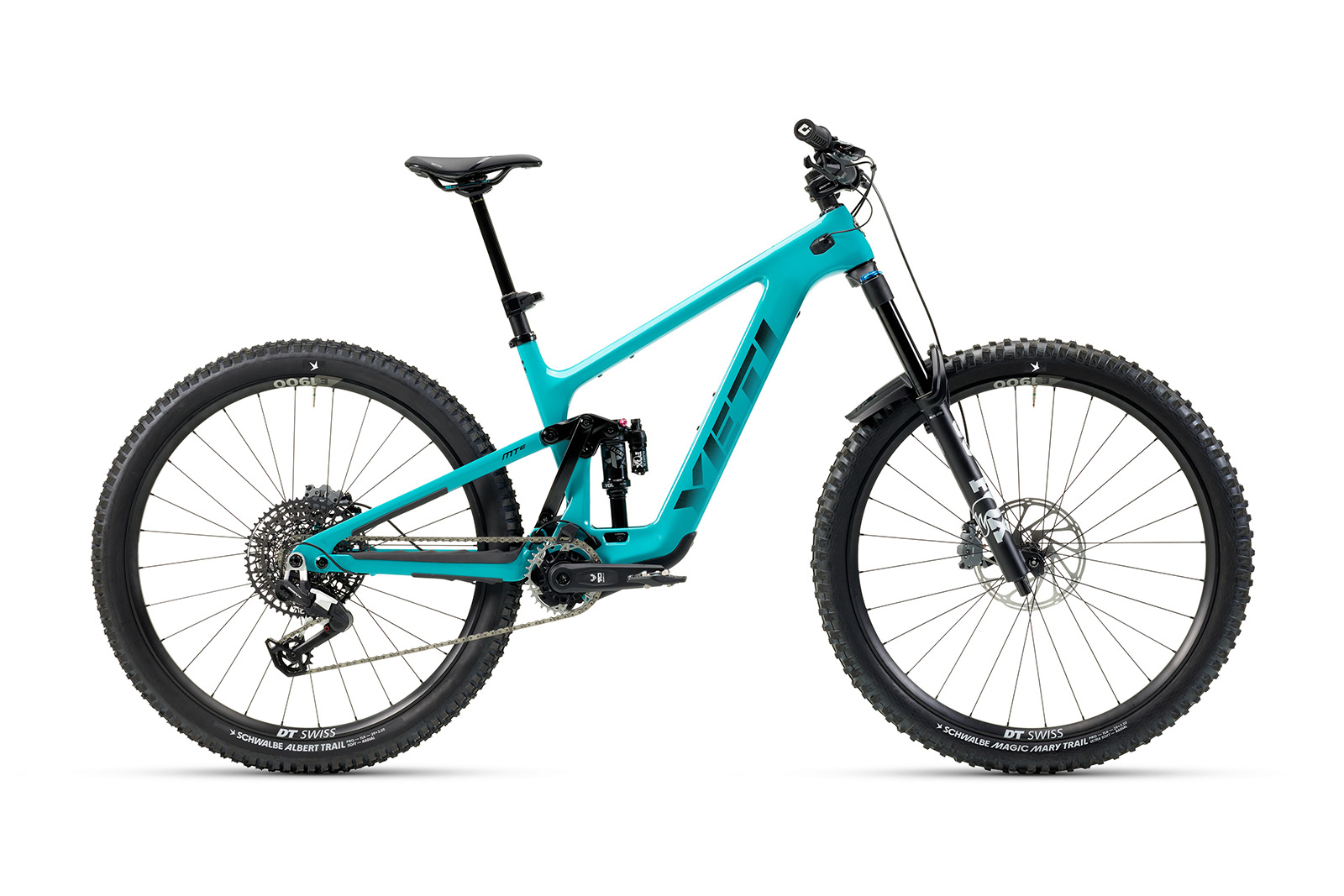
The new Yeti MTe uses the freshly announced TQ HPR60 drive unit, which has more power and torque than the TQ HPR50.
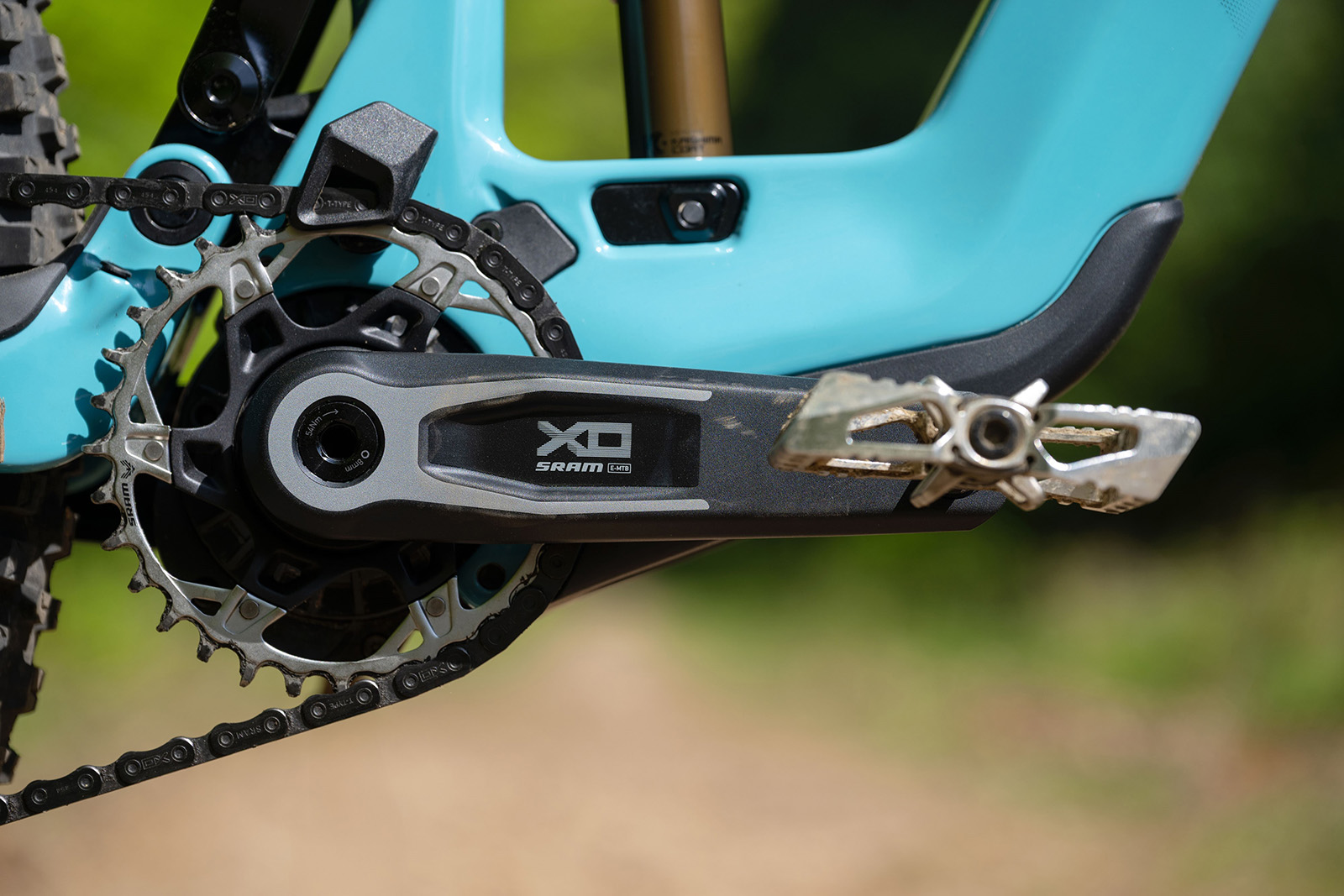
There’s now 60Nm of torque on tap and peak power of 350 watts.
Yeti opted for the new TQ motor because it enabled the brand to create a lightweight, mid-travel electric mountain bike, with a focus on ride quality and handling.
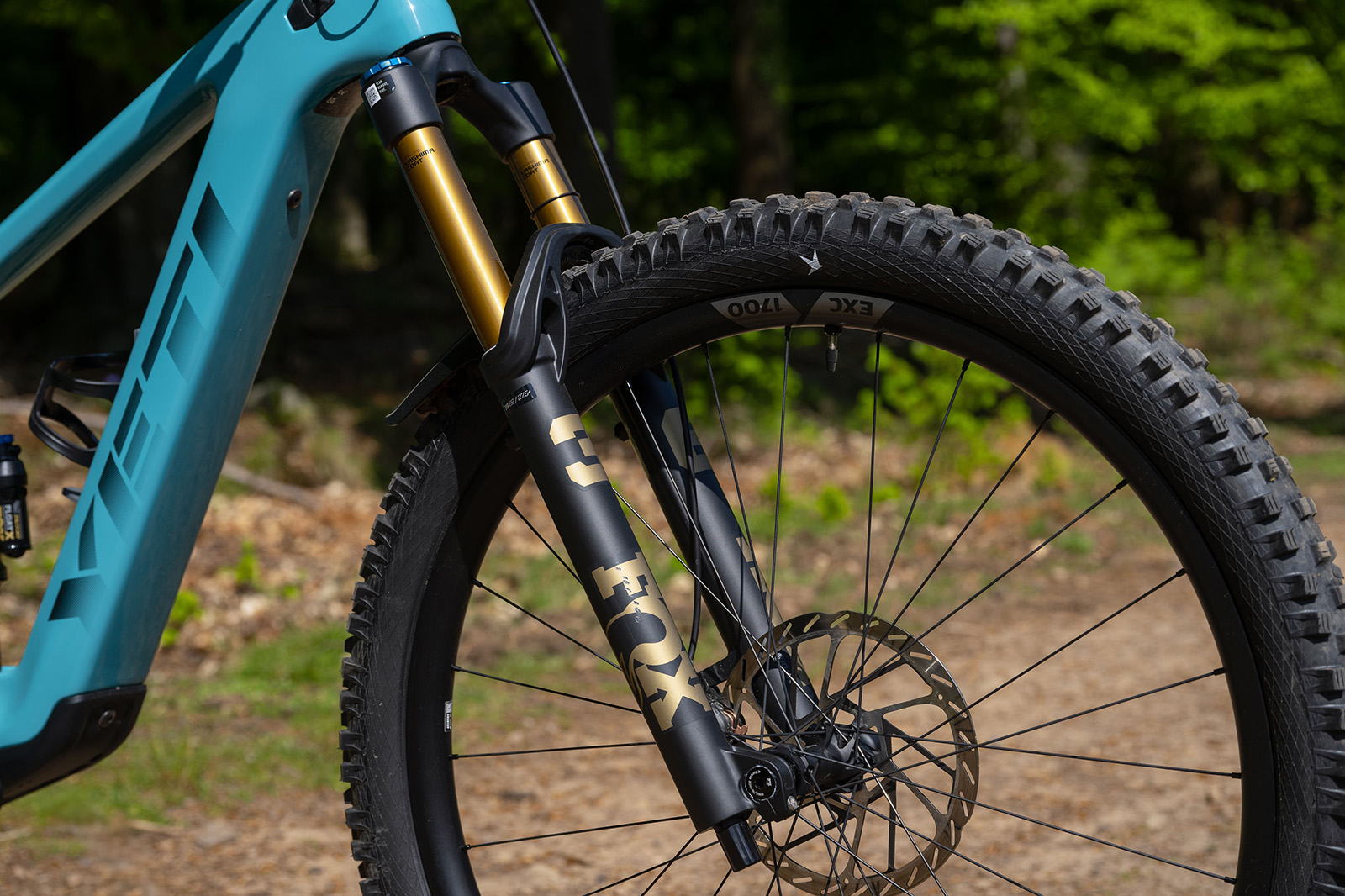
The MTe uses the latest Fox 36 fork with 160mm of travel. Andy Lloyd / Silverfish UK
With the priciest T4 build weighing in at a claimed 17.5kg, it could well be one of the lightest 145mm-travel eMTBs out there.
Battery capacity varies between builds, with two of the three spec options coming with a 580Wh battery, although the priciest and lightest MTe comes with a much smaller 290Wh – handy if you’re keen on keeping weight to a minimum.
However, considering most MTe builds weigh in the region of 19.6-20kg, which is almost identical to DJI’s full-power, high-capacity-battery Amflow PL Carbon, will riders be left wanting more?
Yeti MTe motor and battery details
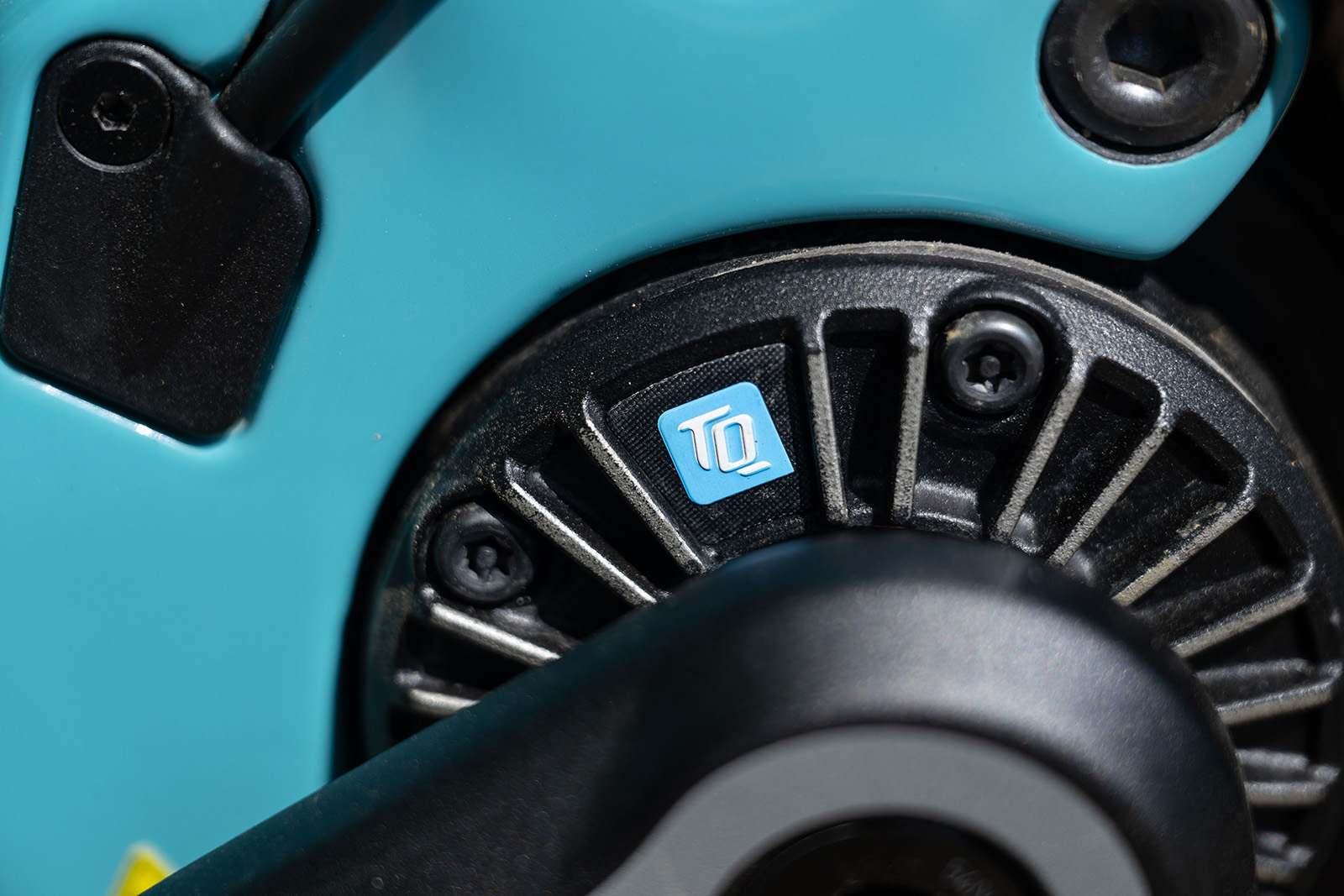
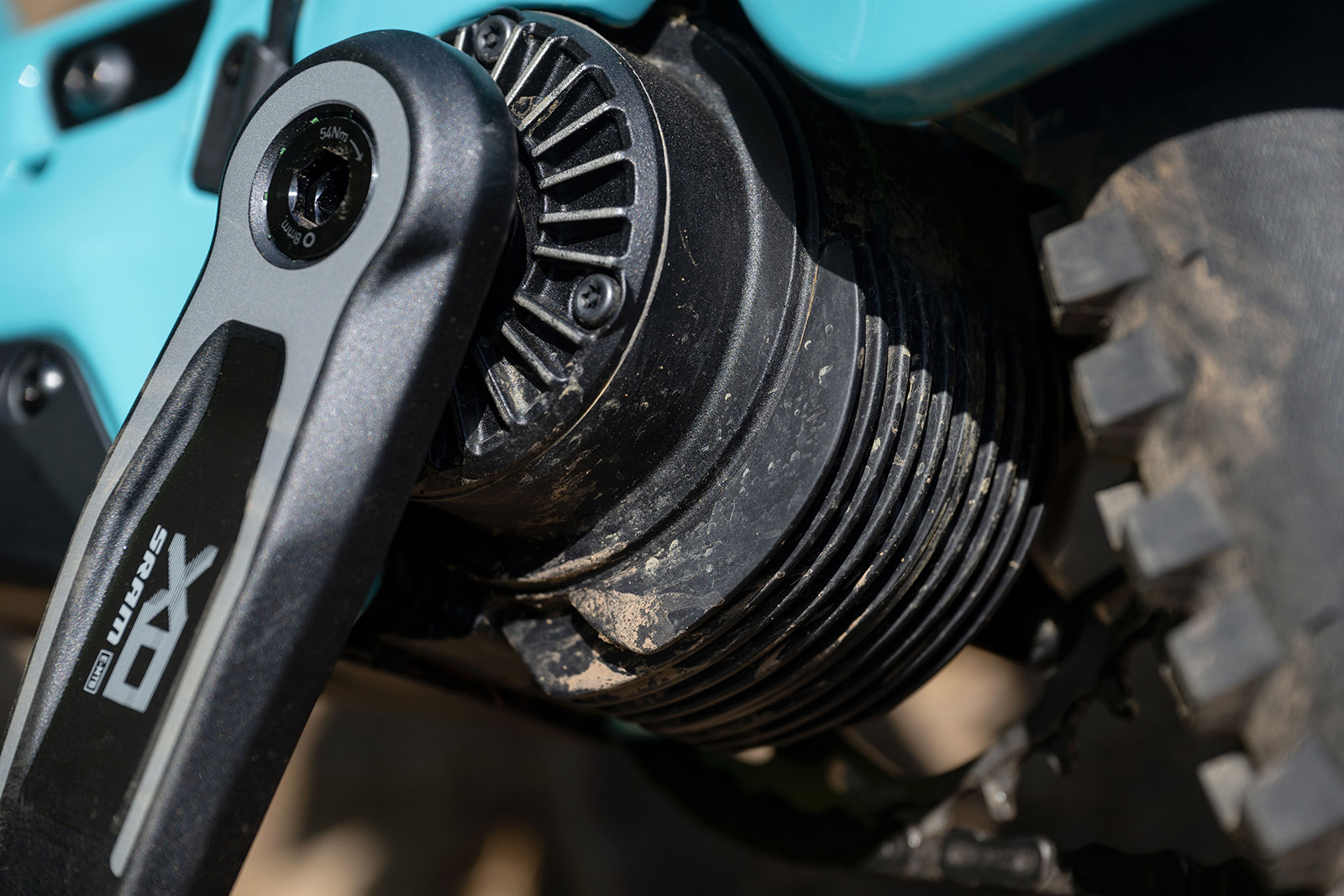
TQ has updated its HPR motor, increasing torque and power. Andy Lloyd / Silverfish UK
The new MTe is designed to be all about the ride quality and handling, but with a little extra assistance thrown in for good measure.
To help achieve this, Yeti partnered with TQ and built the MTe around its new HPR60 motor.
This delivers 60Nm of torque, up from 50Nm in the first iteration of the motor, and a 17% increase in peak power, meaning it can now deliver 350 watts when needed.
Improved cooling should make the TQ motor more efficient. Andy Lloyd / Silverfish UK
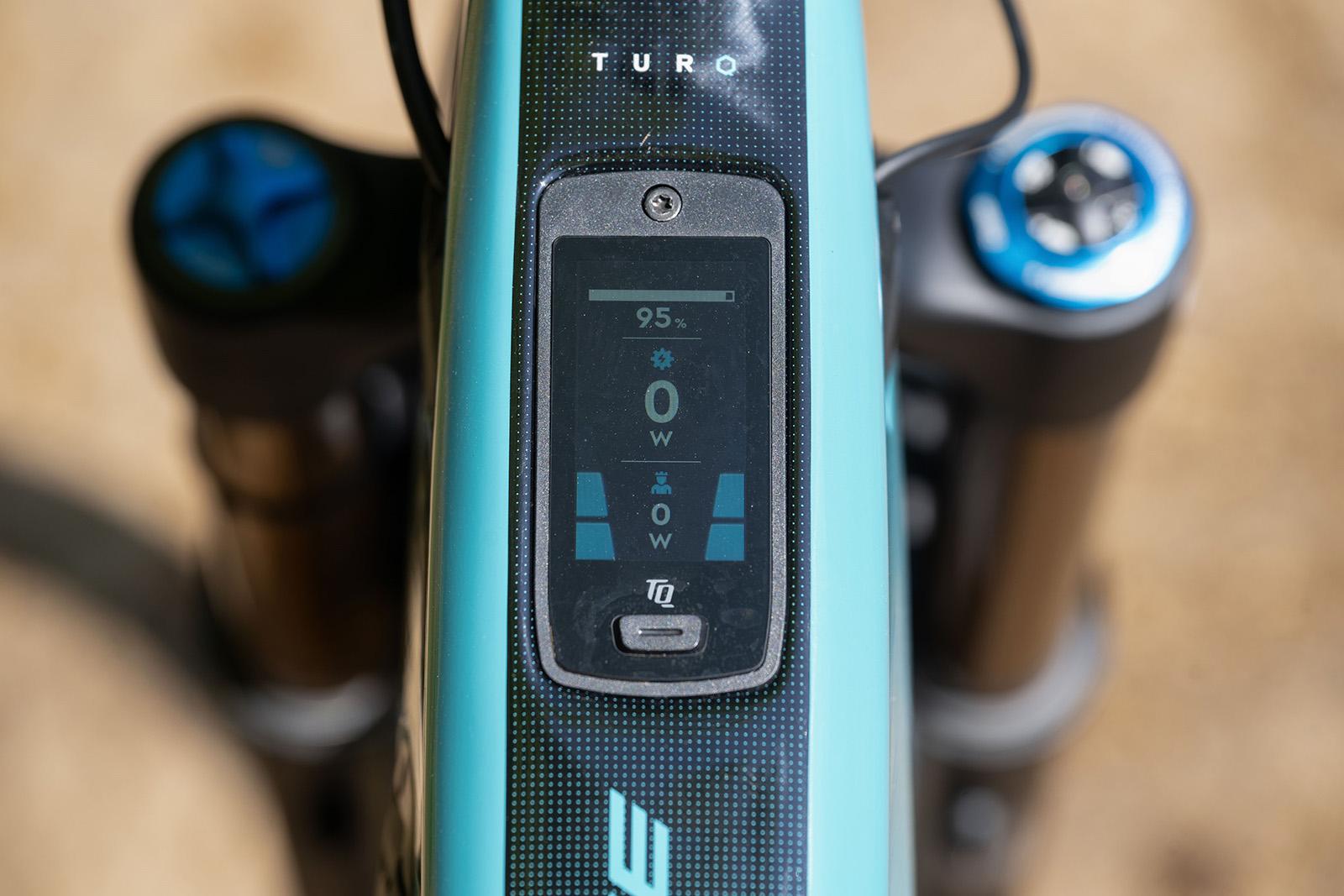
TQ claims to have reduced noise, enhanced cooling and improved the integrated colour display.
At 1.9kg, it’s reasonably light and compact, too, ensuring brands such as Yeti aren’t held back when designing bike frames.
The TQ motor modes remain unchanged, with ‘eco’, ‘mid’ and ‘high’ to choose from via the small bar-mounted controller. There’s also a walk mode, should you need it. Of course, there’s an app to enable you to customise the modes.
The integrated top-tube display offers up masses of ride data to keep tabs on just about everything you’re doing on the bike, along with monitoring battery life and range. Andy Lloyd / Silverfish UK
According to TQ’s ‘performance curve’, the HPR60 motor has been designed to work across a broad cadence range, meaning assistance should be easy to maintain, no matter how fast or slow you’re spinning the cranks.
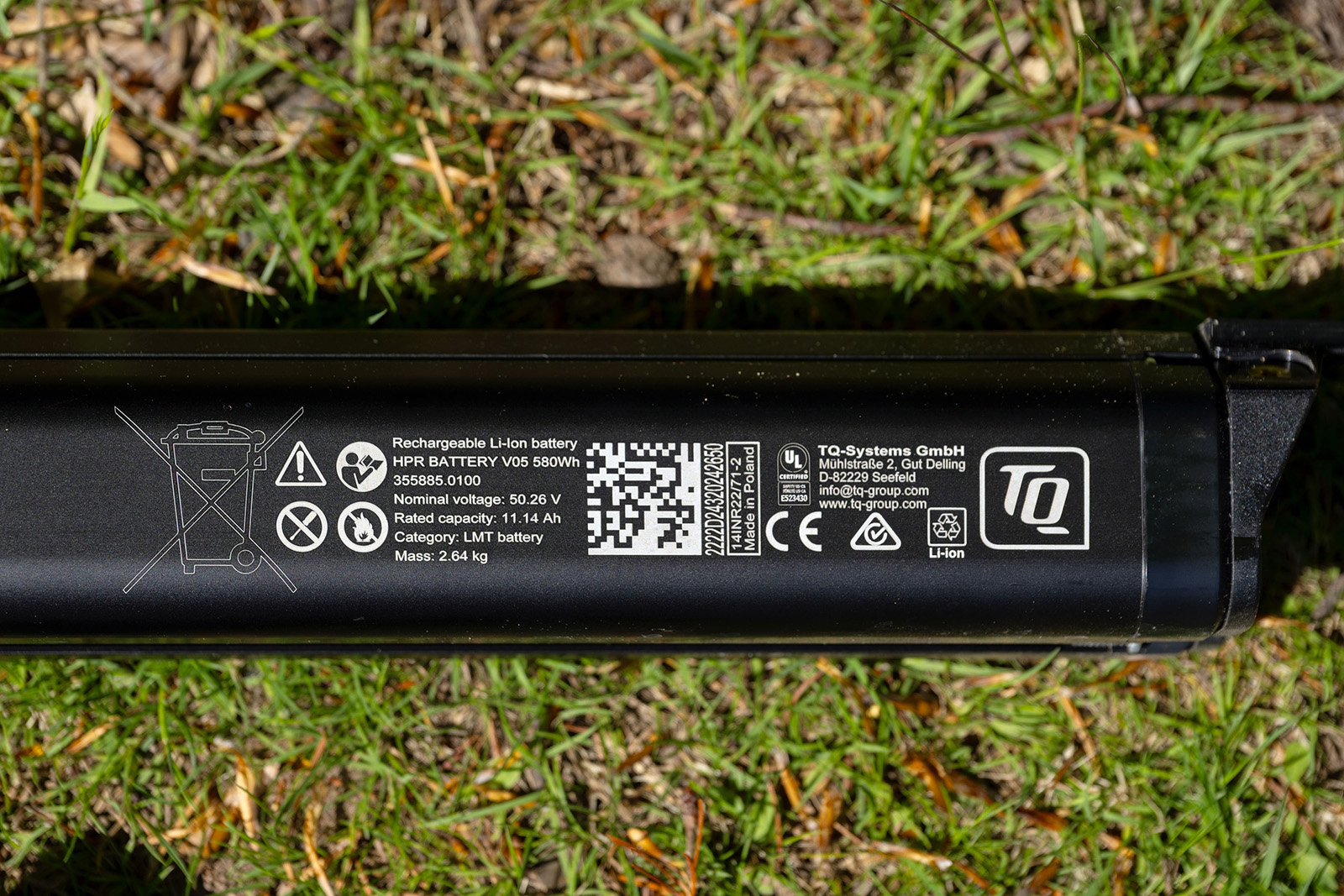
When it comes to battery options, Yeti is offering the MTe in three builds, two of which feature the largest 580Wh battery option.
The priciest and lightest MTe is the only bike to come with the smaller 290Wh unit.
The MTe comes with either the 580Wh or 290Wh battery, depending on which model you go for. Andy Lloyd / Silverfish UK
If you want more juice, TQ offers a 160Wh range extender.
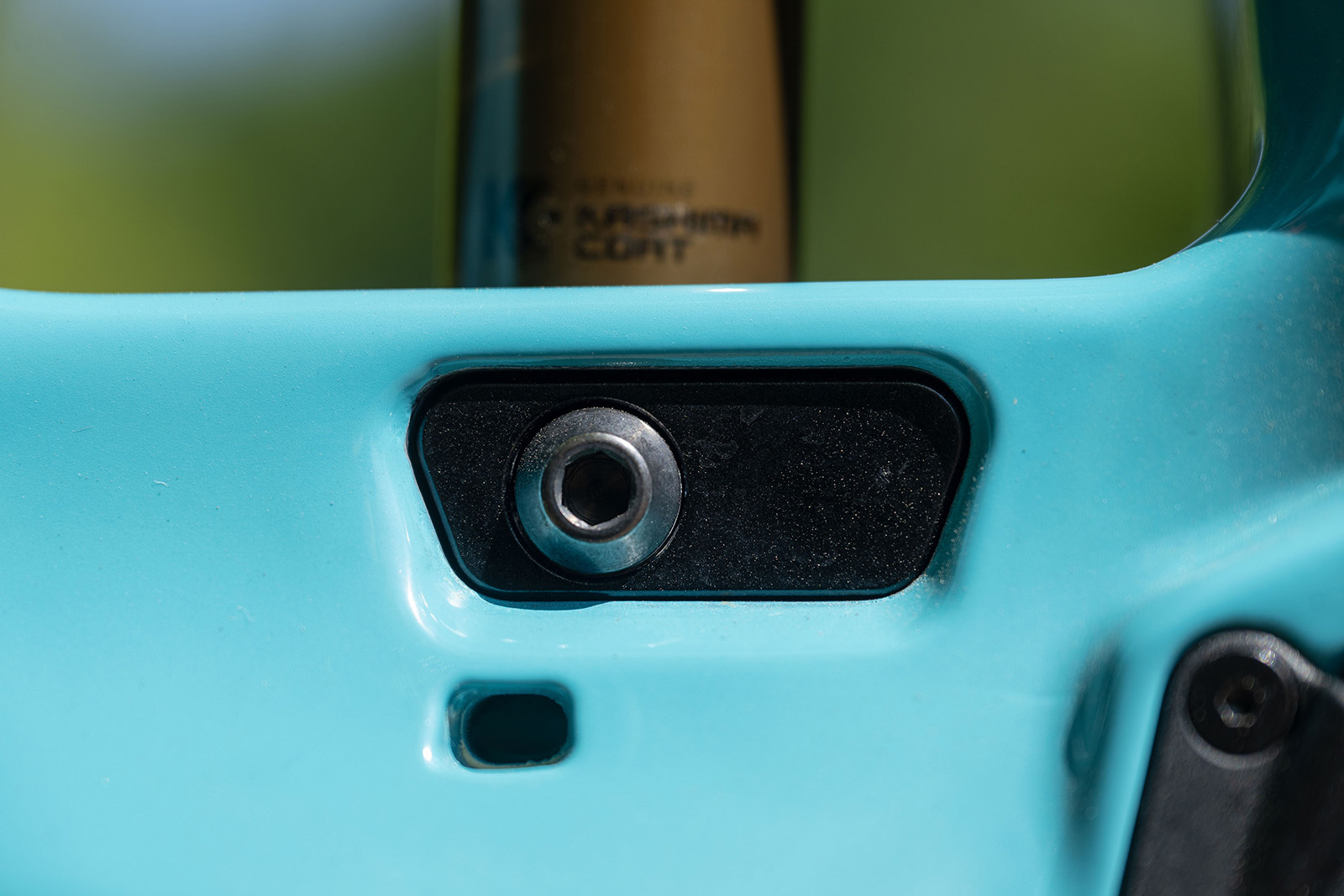
Batteries can be removed and there’s a neat little storage slot for an AirTag should you want to keep track of the bike.
For context, though, bear in mind that the DJI Avinox drive unit – which is just over 600g heavier – delivers up to 120Nm of torque and a mind-melting 1,000 watts of peak power.
Yeti MTe frame and suspension details
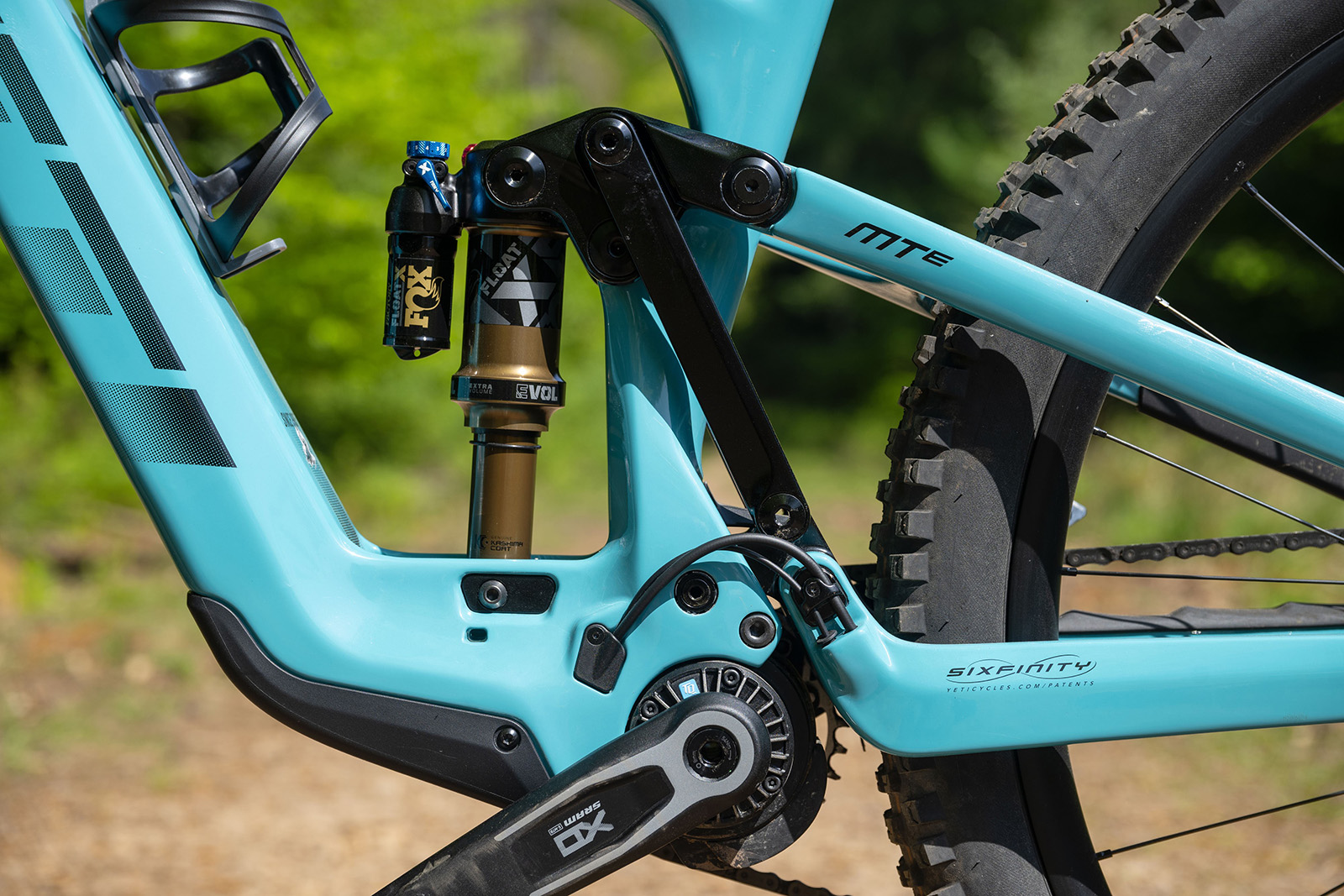
Yeti’s Sixfinity suspension system controls the 145mm of rear-wheel travel. Andy Lloyd / Silverfish UK
The MTe delivers its 145mm of rear-wheel travel via Yeti’s well-established Sixfinity suspension system.
In the case of this bike, Yeti enables you to tune how progressive that 145mm of travel is (going from a plusher 14% up to a harder-to-bottom-out 25%) via flip chips in the lower shock mount.
Yeti gives riders the choice to tweak progression at the rear end. You can alter this by switching between the lower shock mount flip chip positions. Andy Lloyd / Silverfish UK
Yeti says the anti-squat figures (the suspension’s ability to resist pedal-induced bob) are higher than those of its full-power 160E eMTB to help keep the MTe suitably efficient and lively. The anti-rise numbers (the ability of the rear suspension to extend under braking) are said to “strike an ideal balance” between geometry preservation, suspension activity and rear-wheel traction.
With the intention of ensuring the MTe’s carbon frame lasts the distance, Yeti has included ‘Vectran plies’, a high-performance multifilament-like Kevlar, which have been added in areas that are likely to experience high impacts.
Yeti MTe geometry details
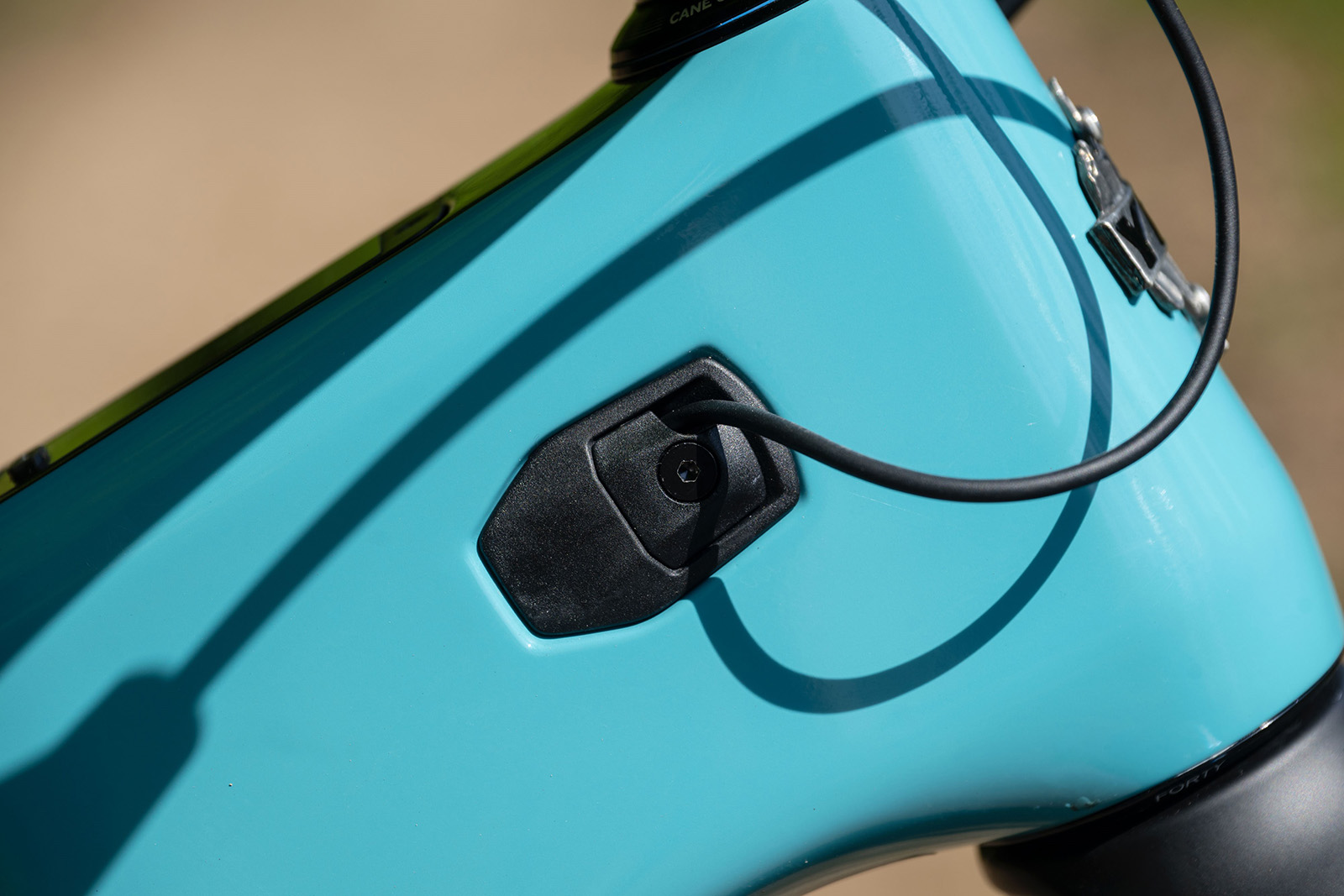
Neat little cable ports should help control cable rattle. Andy Lloyd / Silverfish UK
Yeti offers the MTe in four sizes, from small to extra-large, with reach figures ranging from 430mm to 505mm, all designed to work with a 160mm-travel fork up-front.
Head tube angles are 64 degrees across the board, while seat tube angles are suitably steep at 77 degrees for all sizes.
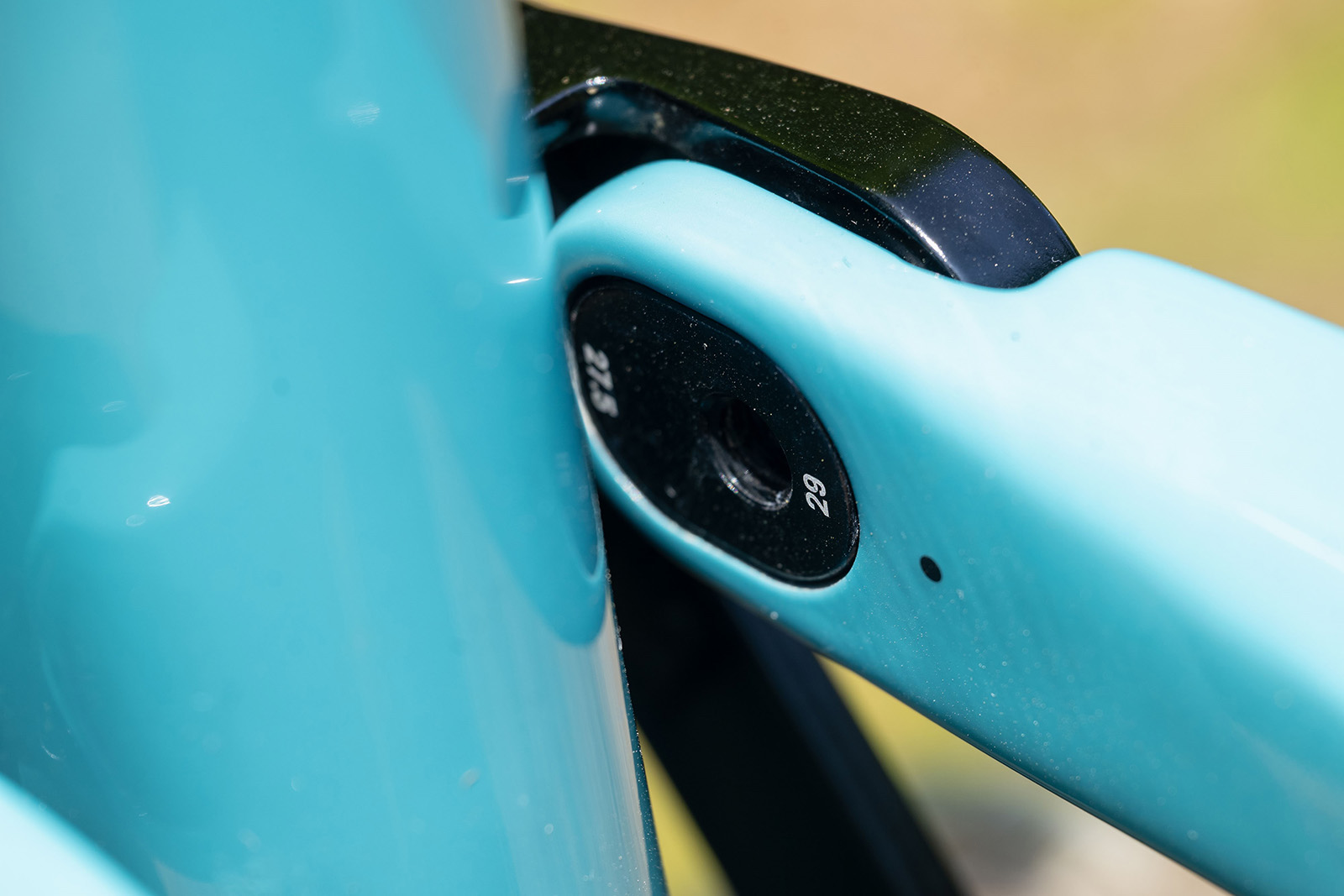
It’s easy to switch rear-wheel sizes and Yeti claims this can be done without disrupting the geometry of the MTe. Andy Lloyd / Silverfish UK
Chainstay lengths remain the same for each frame, measuring a claimed 449mm, while bottom brackets sit suitably low at 342mm off the floor.
Yeti includes flip chips (sorry Tom Marvin, I know you don’t like flip chips). These enable you to switch from the stock 29in rear wheel to a 27.5in hoop, without altering angles or proportions in the process.
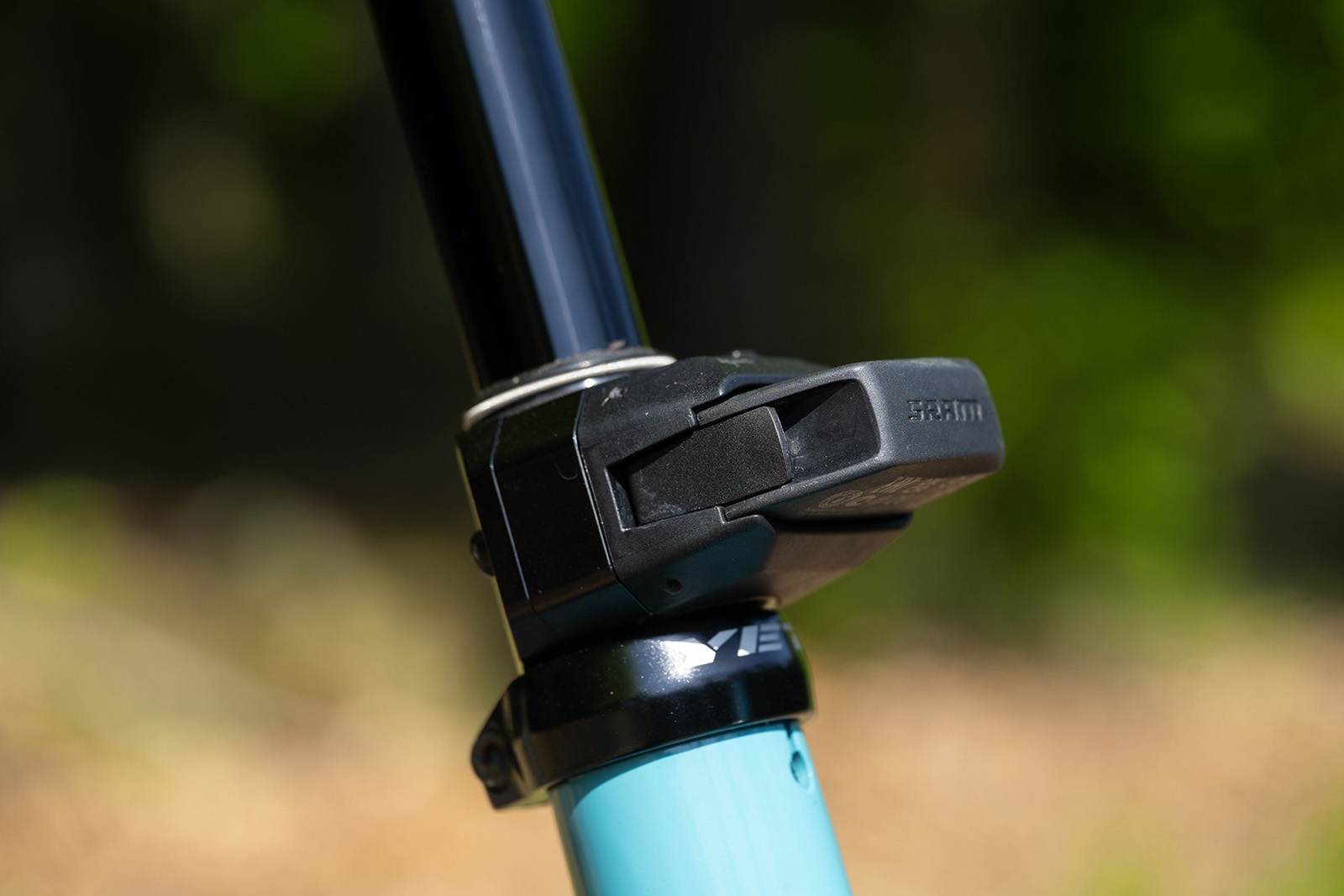
All models get a RockShox AXS Reverb post. Andy Lloyd / Silverfish UK
Yeti offers three different build options, all featuring the same motor but differing battery sizes, SRAM brakes and drivetrains. All builds come with a RockShox Reverb AXS wireless dropper post.
Yeti MTe C2 Eagle 90 Transmission
The cheapest MTe C2 uses the same battery and motor, but comes with a lower spec. Andy Lloyd / Silverfish UK
Frame: Carbon, 145mm travel
Motor: TQ HPR60
Battery: 580Wh
Fork: Fox 36 Performance, 160mm travel
Shock: Fox Float X Performance
Drivetrain: SRAM Eagle 90 Transmission
Brakes: SRAM Maven Bronze
Tyres: Schwalbe Magic Mary Trail Pro 2.5 Radial Ultra Soft / Schwalbe Albert Trail Pro 2.5 Radial Soft
Weight: 20.09kg
Price: $9,850
Yeti MTe T3 X0 Transmission
If you’ve got deeper pockets, the T3’s spec is hard to fault, but it certainly doesn’t come cheap. Andy Lloyd / Silverfish UK
Frame: Carbon, 145mm travel
Motor: TQ HPR60
Battery: 580Wh
Fork: Fox 36 Factory GRIP X2, 160mm travel
Shock: Fox Float X Factory
Drivetrain: SRAM X0 Eagle AXS Transmission
Brakes: SRAM Maven Silver
Tyres: Schwalbe Magic Mary Trail Pro 2.5 Radial Ultra Soft / Schwalbe Albert Trail Pro 2.5 Radial Soft
Weight: 19.64kg
Price: $12,650
Yeti MTe T4 XX Transmission
Yeti’s T4 build uses a lighter 290Wh battery, tyres and suspension, along with other parts to keep the weight down around the 17.5kg mark. Andy Lloyd / Silverfish UK
The impressive suspension helps make the MTe a confident descender. Andy Lloyd / Silverfish UK
My time on the MTe was limited to around half a day, although that was spent on my local trails, which I know like the back of my hand.
Sadly, the UK distributor couldn’t provide the correct size for me (medium), so I rode the large. That means my ride impressions are a little limited, although I was able to comment on the motor and suspension performance easily enough.
Smooth and capable
While the TQ motor might not be as punchy as some, it still offers a decent amount of assistance on the climbs. Andy Lloyd / Silverfish UK
What is clear from the outset is the time Yeti has put into ride feel and handling has been well spent.
Yes, it’s a 20kg bike, but a 20kg bike that comes with very few downsides.
In a lot of ways, it’s like riding an enduro bike with plenty of grip and an impressive suspension feel. The motor’s assistance – which is far more subtle compared to a full-power equivalent – makes you feel as if you’re just back from a training camp at altitude and are fitter than ever.
As with other lighter-weight eMTBs, the ride experience is simply a different proposition from that of a bike with a big battery and high-powered motor – but that’s no bad thing, if that’s what you’re looking for.
An integrated chain guide helps to keep things running smoothly. Andy Lloyd / Silverfish UK
Pedal inputs aren’t met with instantaneous power, as they are on the likes of the DJI Avinox drive unit, but assistance kicks in quickly enough to ensure you can add those last-minute, hard-to-time bursts on tricky uphill sections.
It’s really quiet, too, maybe even the quietest electric mountain bike motor I’ve used, which adds to that natural ride feel.
In chattery, rough sections where you’re heavy on the brakes, the MTe feels very composed and predictable.
The supple suspension and low-slung weight keep the tyres gripping through the turns. Andy Lloyd / Silverfish UK
That 145mm of rear-wheel travel is controlled impeccably, offering plenty of grip through loose, flat turns, but more than enough ramp-up as and when the bigger hits start coming thick and fast.
It helps that the performance is well-matched up-front, with the new Fox 36 fork feeling smoother and freer to move, enabling it to work in sync with the rear.
Will you want more?
The rear suspension works really well under braking. Andy Lloyd / Silverfish UK
Answering this question is tricky. At a time when the motor capturing all the headlines produces nearly double the torque and almost triple the peak power, opting for something such as the MTe with the new TQ motor might be a bit of a hard sell.
It could be harder still if you ride in a group and all your mates are aboard full-power eMTBs.
But, right now at least, for those who are looking for a bit of extra help on the climbs and aren’t willing to compromise when it comes to handling, bikes such as the MTe are certainly worth considering. You will need deep pockets, though.
In the age of AI, all roads lead to the Taiwan based TSMC (directly or indirectly, as the case might be). As the leading multinational semiconductor manufacturer in the world, numerous big tech firms from AMD to NVIDIA (amongst others) are vying for allocation for its chips. Meanwhile, tariffs don’t appear to be stopping or even slowing the
This is a clip from a Monster Jam event featuring 10,000 die-cast 1/64th scale monster trucks being released down a launch ramp simultaneously. Now I’m not one to be nit-picky (just kidding that’s all I am) but it looks like there were several lines that got caught on the track and failed to launch. Still, the excitement of the announcers in the video would make you believe this stunt (they call it a stunt) is up there with the moon landing. Speaking of — we’ve got the first manned moon landing in over 50 years scheduled for mid-2027! “They’ll probably fake this one too.” But the graphics will be so much sicker this time.
Meta has signed a 20-year agreement with Constellation Energy that will allow it to purchase nuclear power supplied by the Clinton Clean Energy Center in southern Illinois. To help fuel its AI ambitions, Meta said in a statement that it is prioritizing 100 percent clean, renewable energy for its data centers and recognizes the “immense value of nuclear power in providing reliable, firm electricity.”
Rather than building a new nuclear plant, Meta says its deal with Constellation for its existing Clinton center will ensure the plant can remain in operation long-term, preserving over 1,000 local jobs. The deal, the first of its kind for Meta, commences in 2027, and will see Facebook’s parent company buy in full the approximately 1.1 gigawatts of emissions-free nuclear energy currently being generated at the site. Meta also committed to expanding the grid by an additional 30 megawatts. The exact financial details of the landmark agreement are not detailed in the statement.
Meta has been behind the curve on nuclear, with big tech rivals Google and Microsoft already buying up significant capacity. In December last year, Meta confirmed its ambition to add between one and gour gigawatts of nuclear energy capacity to its US data centers by the early 2030s, so the Constellation agreement is something of a headstart for Mark Zuckerberg’s company.
Meta did actually plan to build a nuclear-powered data center of its own, but was reportedly forced to scrap it when a rare bee species was discovered on the land it had earmarked for the project. According to the Financial Times, Zuckerberg told staff at the time that Meta would have had the first nuclear energy AI if the bee-related pivot hadn’t been necessary.
This article originally appeared on Engadget at https://www.engadget.com/big-tech/meta-signs-multi-decade-nuclear-energy-deal-to-power-its-ai-data-centers-144916645.html?src=rss
The Ninth Circuit has ruled that the 1967 Ford Mustang fastback nicknamed “Eleanor” in Gone in 60 Seconds is a film prop rather than a protectable character. The panel said the car fails all three Towle test prongs, so it cannot receive standalone copyright protection. sinij writes: The ruling states that the Mustang doesn’t pass tests that would qualify it as a character. In the past, studio aggressively went after builders for any Mustang that even remotely approximated Eleanor, making it a hassle to restomod classic Mustangs.
The Ninth Circuit has ruled that the 1967 Ford Mustang fastback nicknamed “Eleanor” in Gone in 60 Seconds is a film prop rather than a protectable character. The panel said the car fails all three Towle test prongs, so it cannot receive standalone copyright protection. sinij writes: The ruling states that the Mustang doesn’t pass tests that would qualify it as a character. In the past, studio aggressively went after builders for any Mustang that even remotely approximated Eleanor, making it a hassle to restomod classic Mustangs.
Eight years ago, just before the release of the Nintendo Switch, we provided an in-depth review of the hardware thanks to early production units provided by Nintendo. This year, Nintendo has opted not to provide such unrestricted early press access to the Switch 2 hardware, citing a “day-one update” to the system software and some launch games that would supposedly make pre-release evaluation more difficult.
As such, we won’t be able to provide our full thoughts on the Switch 2 until well after the system is in players’ hands. While that’s not an ideal situation for readers looking to make an early purchase decision, we’ll do our best to give you our hands-on impressions as soon as possible after launch day.
In lieu of review access, though, we were able to get some extended hands-on time with the final Switch 2 hardware at a daylong preview event held by Nintendo last week. This event provided our first look at the console’s system-level menu and settings, as well as features like GameChat (which was hard to fully evaluate in an extremely controlled environment).
This year’s
Linaro Connect in Lisbon, Portugal featured a number of talks about the use of
open-source components in safety-critical systems. Kate Stewart gave a keynote on the topic
on the first day of the conference. In it, she highlighted several projects that
have been working to pursue safety certification and spoke about the importance of
being able to trace software’s origins to safety. In a talk on the second day, Roberto
Bagnara shared his experience with working on one of those projects, the Xen
hypervisor, to conform to a formal set of rules for safety-critical code.