
Raspberry Pi Imager 1.9.4, an easy-to-use SD card preparation tool by Raspberry Pi, lands as the first official 1.9.x release, bringing a refined UI, more translations, bug fixes, and updated dependencies across platforms.
Monthly Archives: June 2025
How to buy the Nintendo Switch 2
The Nintendo Switch 2 will be available to buy in the US starting tomorrow, June 5. It’s been a long time coming, and if you’re one of the lucky ones who managed to secure a pre-order, you’re likely hoping yours will arrive on launch day. For everyone else, the hunt for the Switch 2 continues. Pre-orders opened at the end of April, but since then, there have been basically no online restocks. That could change in the near future with launch day right around the corner, and some retailers have been gearing up to sell consoles on June 5 to customers in stores. If you’re still looking to get Nintendo’s latest console, here’s all the latest information on how to buy the Switch 2 and where you can get one.
Where to buy the Nintendo Switch 2
GameStop and Best Buy have midnight launch events planned, and both retailers have said they will have limited in-store stock available on June 5.
Walmart will have consoles for purchase online at midnight on June 5, and in stores the same day. Select super-centers in the Pacific, Mountain, Hawaii and Alaska regions of the US will be open at midnight for in-store purchases.
While Target hasn’t announced midnight launch events, it has said it will have the console available for purchase in stores on launch day. The retailer will restock online inventory beginning early morning of June 6, while supplies last of course.
Costco will have the a Mario Kart World bundle that includes a 12-month Switch Online membership on sale on June 5, according to its website. However, it’s unclear if the big-box store will have consoles to purchase in store on launch day. And remember, you must have a Costco membership to shop there.
As of now, Amazon is the only retailer that doesn’t have some form of a Nintendo Switch 2 listing on its website. The company also did not take any pre-orders for the Switch 2 when the window opened at other retailers.
Where to buy Switch 2:
Where to buy Switch 2 + Mario Kart World bundle:
Where to buy Nintendo Switch 2 games and accessories
Nintendo has a bunch of new, first-party accessories for the Switch 2, most of which will be available on June 5 along with the console. Same thing goes for games including Mario Kart World and the Switch 2 edition of The Legend of Zelda: Tears of the Kingdom, while another big Switch 2 title, Donkey Kong Bananza, won’t be available until mid-July. Still, you can pre-order games that will not be out on launch day now, so that you’ll get them as soon as they actually become available.
Mario Kart World
Donkey Kong Bananza
Additional Switch 2 games
Samsung microSD Express Card (256GB) for Nintendo Switch 2
Joy-Con 2 bundle
Switch 2 Pro Controller
Switch 2 Camera
Hori Nintendo Switch 2 Piranha Plant Camera
Joy-Con 2 Charging Grip
Joy-Con 2 Wheels (set of 2)
Switch 2 All-in-One Carrying Case
Switch 2 Carrying Case and Screen Protector
This article originally appeared on Engadget at https://www.engadget.com/gaming/nintendo/how-to-buy-the-nintendo-switch-2-120039147.html?src=rss
Everything I’m Seeding in June
We may earn a commission from links on this page.
June is a cusp month in gardening: All the seedlings you’ve nurtured all spring, from tomatoes to onions, have finally left the nest and are going into the ground. After you breathe the sigh of relief at the end of May to simply enjoy the landscape for a moment, it is time to pick up the seed box again. All the mid-summer vegetables need to be seeded, and in some cases, you can luck out and direct sow outside. But as weird as it may seem, it’s also time to start thinking about seeding starts for fall. All the while, there’s still plenty to be direct sown outside, from summer cucurbits to annual flowers.
Direct seeding outside
Last week, I direct sowed this year’s first succession of pickling cucumbers at the base of a brand new, very aspirational trellis. It’s part of an attempt to be more daring about direct sowing outside, rather than growing starts inside and planting them out. There are risks, of course, to this tactic. The seeds might not germinate, or they might get taken out as mere seedlings by slugs or any other animal. I’ve aggressively overseeded and have given the cucumbers two weeks to show themselves, or I’m off to the garden center for starts. At this point in the summer, I feel like you can go either way for cucumbers: direct seeding or planting starts. Direct seeding requires a little more trust and a little more patience—but less work.
One seeding experiment that rarely fails is the planting of bean seeds. Whether planting bush or pole beans, beans are fast and easy to germinate, and they prefer to grow in place. Overseed them (I plant about 30% more than advised in case I have loss to local wildlife), and provide sturdy trellises. My white climbing beans (pictured above) have already started to show themselves, ten days after planting. Corn seeds are also best sown in place, and should go in by early June.
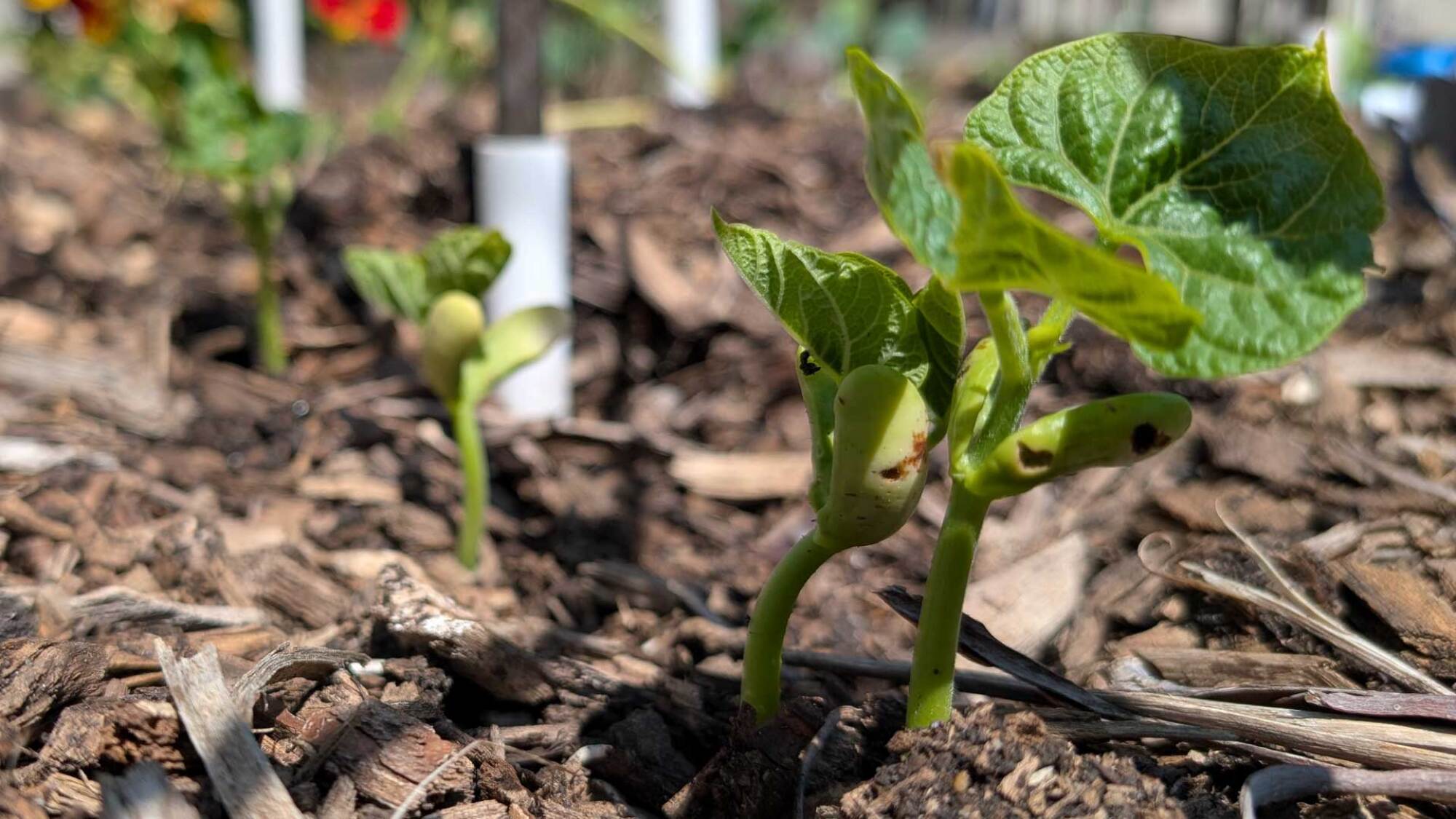
beans emerging from the soil
Credit: Amanda Blum
Credit: Amanda Blum
An in-between method I’d decided on this year is to plant some seeds in trays, but the trays will remain outside. This takes advantage of the heat of the sun, but means I can control the seedlings. Particularly for pumpkins, this method made a lot of sense for me. Because they’re in trays, I know which varieties have germinated, I can ensure that only sturdy seedlings go into the ground, and go precisely where I want them. Planted about a week ago, about half the tray is up. This method has been so rewarding, I will likely use it on squash, melons, basil, herbs, and plants I can’t seem to find in the nursery right now (like napa cabbage).
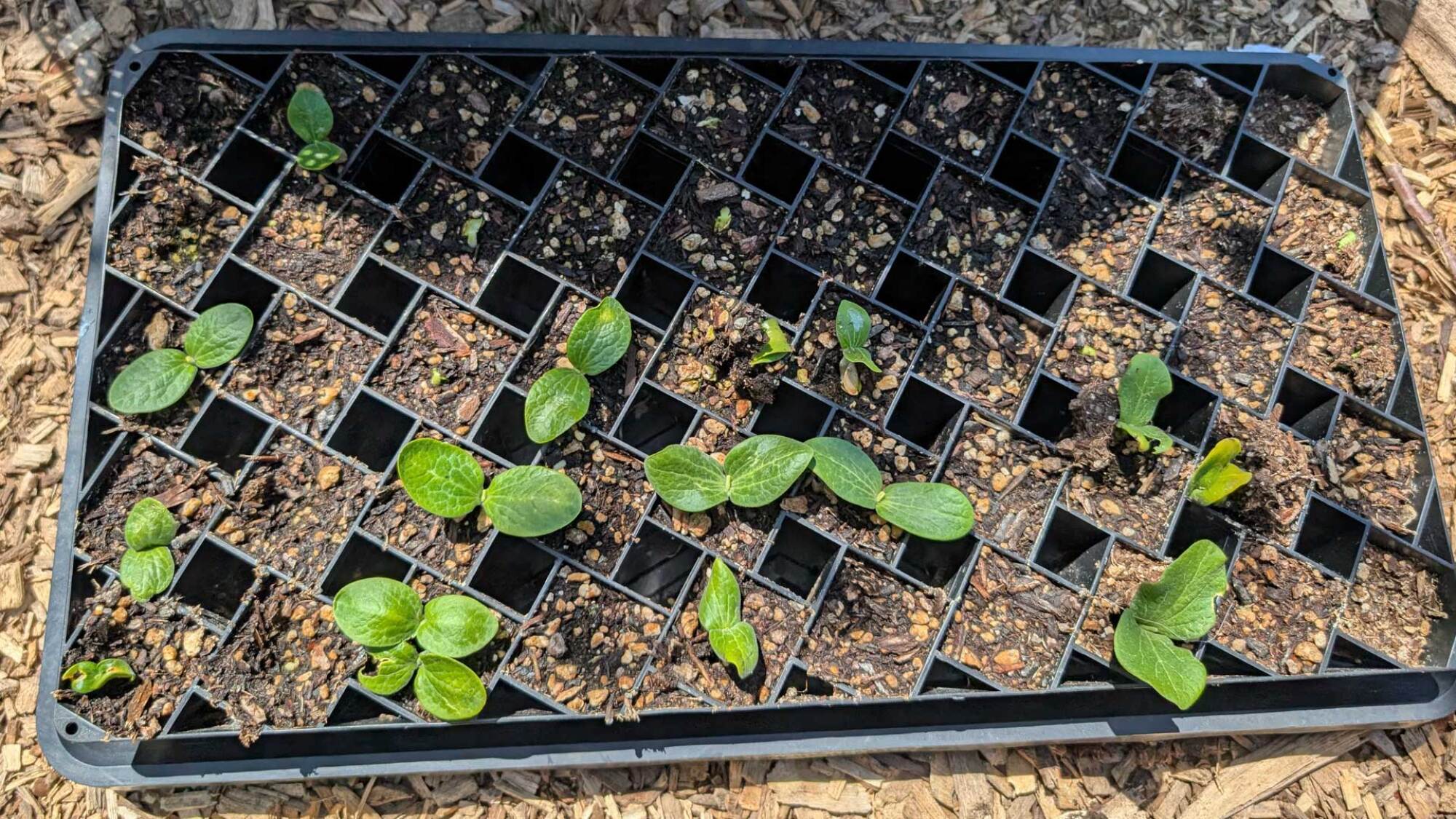
pumpkin seeds growing in a tray
Credit: Amanda Blum
Credit: Amanda Blum
A challenge this time of year is to remember that if you don’t succession-plant lettuce, beets, radishes, and scallions, you won’t have them all summer to harvest.
Annual flower seeding

nasturiums growing
Credit: Amanda Blum
Credit: Amanda Blum
Sunflower seeds went into the ground this week, in rows according to height, with mammoth varieties in the back that will grow twenty feet in the air, and shorter five-foot teddy bear varieties in front. Creating a sunflower wall is an easy way to create a border in the garden, and even if you don’t plant sunflowers this year, the ones you planted last year will pop back up where the flowers or birds dropped seeds. You can also start planting zinnias outside now. Remember that zinnias come in heights ranging from a foot to four feet. Mix and match them for a greater impact, and consider the zinnia mixes from Renee’s Gardens. They always have spectacular mixes by color and size that I enjoy. You can still seed nasturtiums, and should, throughout your garden. They act as an aphid trap.

sunflowers self seeding
Credit: Amanda Blum
Credit: Amanda Blum
Consider getting cosmos into the soil now, they’ll grow to five or six feet and grow bushy, with delicate flowers that fill the late summer season. Ammi, a carrot flower that makes a good filler flower for gardens, can be sown now, as can amaranthus.
Start your perennials for next year

coneflower growing
Credit: Amanda Blum
Credit: Amanda Blum
Once the summer starts are cleared from my growing room, I think about the perennials that I have space for. These are expensive starts to buy at the garden center, so they’re always worth nurturing at home. Agastache, also known as hummingbird mint, can be found in a wide swath of colors from Etsy growers. I haven’t found as many colors from commercial seed houses, and you could grow an actual rainbow of starts. Echinacea, one of my favorite July bloomers, now comes in so many electric colors and beautiful shapes, and will return each year. Starting seeds now means you’ll have a well-developed four-inch start by the end of summer to go into the ground. Consider perennial salvia (there is an annual salvia, too). Yarrow is no longer confined to the yellow and whites you’ve seen everywhere: Summer berry yarrow comes in sweeping reds and pinks. Columbines make delightful summer blooms, like upside-down bells. You can start them now. Lastly, consider giving delphinium, a notoriously tricky seed to germinate, a try. Having this perennial spike come up each year in the garden is always worthwhile.
Start to think about fall
You shouldn’t need to start fall starts until early July, but you should prepare lists and get your seeds now. It’s a great time to do so, because seeds are on sale everywhere. I receive sale notices daily from every seed house I subscribe to, so check in with the seed houses closest to you and grab what you’ll need.
AI Startups Revolutionize Coding Industry, Leading To Sky-High Valuations
Code generation startups are attracting extraordinary investor interest two years after ChatGPT’s launch, with companies like Cursor raising $900 million at a $10 billion valuation despite operating with negative gross margins. OpenAI is reportedly in talks to acquire Windsurf, maker of the Codeium coding tool, for $3 billion, while the startup generates $50 million in annualized revenue from a product launched just seven months ago.
These “vibe coding” platforms allow users to write software using plain English commands, attempting to fundamentally change how code gets written. Cursor went from zero to $100 million in recurring revenue in under two years with just 60 employees, though both major startups spend more money than they generate, Reuters reports, citing investor sources familiar with their operations.
The surge comes as major technology giants report significant portions of their code now being AI-generated — Google claims over 30% while Microsoft reports 20-30%. Meanwhile, entry-level programming positions have declined 24% as companies increasingly rely on AI tools to handle basic coding tasks previously assigned to junior developers.


Read more of this story at Slashdot.
Campagnolo unveils Super Record 13 – the world’s lightest electronic disc brake groupset
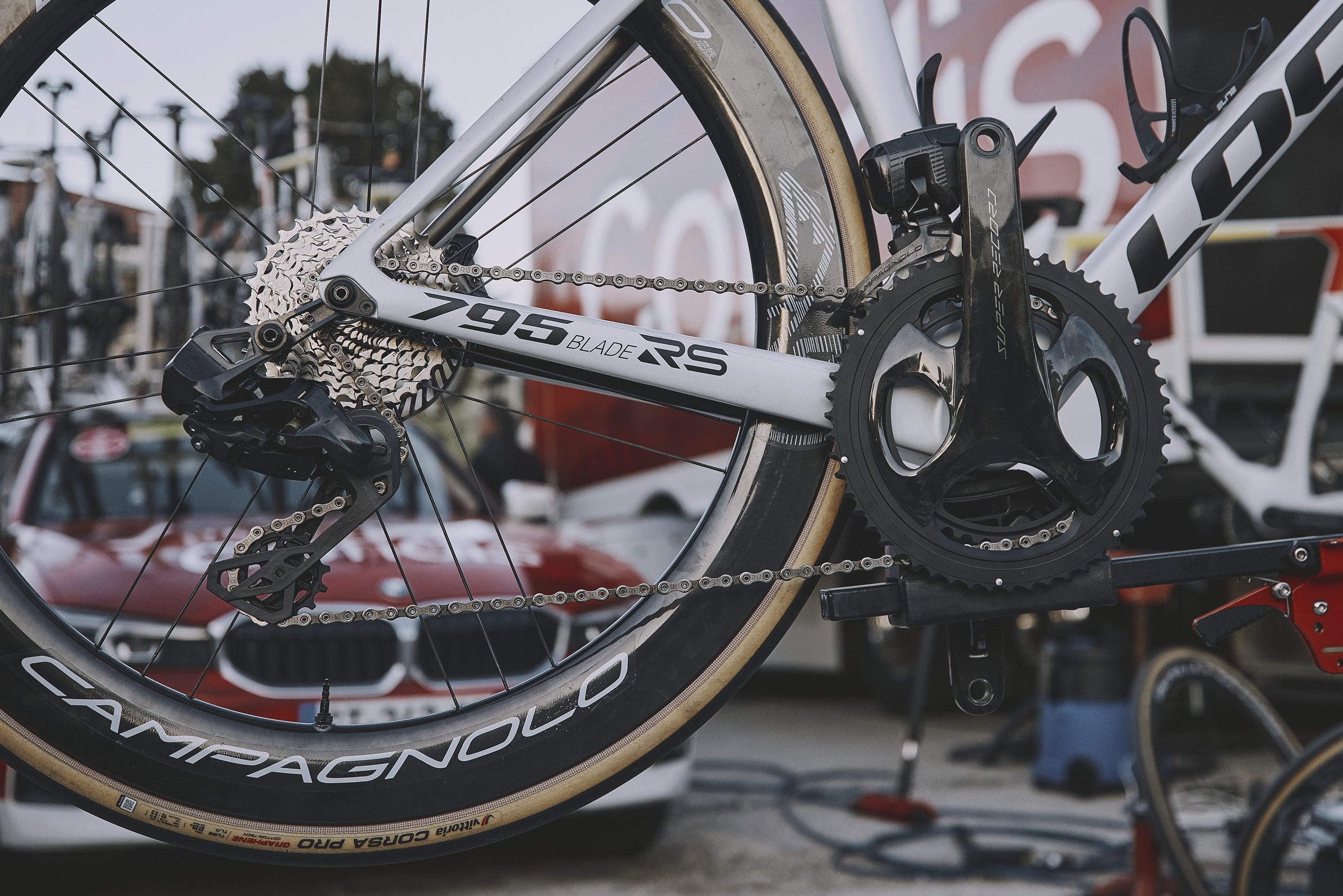
Campagnolo has announced the release of Super Record 13, the world’s first 2x 13-speed wireless electronic road bike groupset.
Although the groupset takes its name from the number of sprockets available on its cassettes, Campagnolo says Super Record 13 is about “more than one extra sprocket”.
As the leaks suggested, Campagnolo’s iconic ‘thumb shifter’ makes its return with Super Record 13, but the Italian brand says almost every part of the new groupset has been updated or refined, with the aim of creating a new “benchmark” for the cycling industry.
At 2,435g, Super Record 13 is claimed to be the lightest electronic road bike groupset with disc brakes, undercutting SRAM Red AXS by roughly 60g.
Shifting is also said to be faster, smoother and quieter than before, with the broadest range of stock gearing options of any road bike groupset and overhauled ergonomics.
Super Record 13 marks a “new chapter” for Campagnolo and a “redefinition” of its brand identity.
It is, the brand says, the first stage of a “complete line of products designed to cover the various market segments”, including 1x and 2x 13-speed groupsets for road, time trial and gravel bikes.
Bucking trends, the price of a complete Super Record 13 groupset is – at £3,900 / $4,750 / €4,300 – cheaper than Campagolo’s previous flagship groupset, Super Record Wireless (£4,499 / €5,200).
- Read more: I tested new Campagnolo Super Record 13, and Shimano and SRAM should be worried – here’s why
Not just 2x 13-speed for road
After a number of years when it seemed as if Campagnolo’s influence on cycling was waning, the historic Italian brand has come out swinging with an announcement that puts it decisively on the front foot.
Although the launch primarily encompasses a 2x 13-speed wireless electronic grouspet for road bikes, Campagnolo says there’s plenty more to come from this new Super Record product family, starting from September 2025, including:
- 1x 13-speed road groupset, with a clutch-equipped rear derailleur
- 1x 13-speed time trial groupset, with a clutch-equipped rear derailleur and aero bar-end shifters
- 2x 13-speed endurance road / gravel groupset, with a clutch-equipped rear derailleur
- 1x 13-speed ‘Super Record X’ gravel groupset with a gravel-specific, clutch-equipped rear derailleur and a 48t cassette
In total, Campagnolo says the complete Super Record 13 platform will cover five applications (the four above plus 2x 13-speed for road) with three separate rear derailleurs and other dedicated components.

The only thing missing, then, is something more accessible – to compete with the likes of Shimano Ultegra Di2 and SRAM Force AXS, for example.
After all, despite the drop in price compared to Super Record Wireless, Super Record 13’s price tag means it will – like Shimano Dura-Ace Di2 and SRAM Red AXS – remain out of reach for many riders.
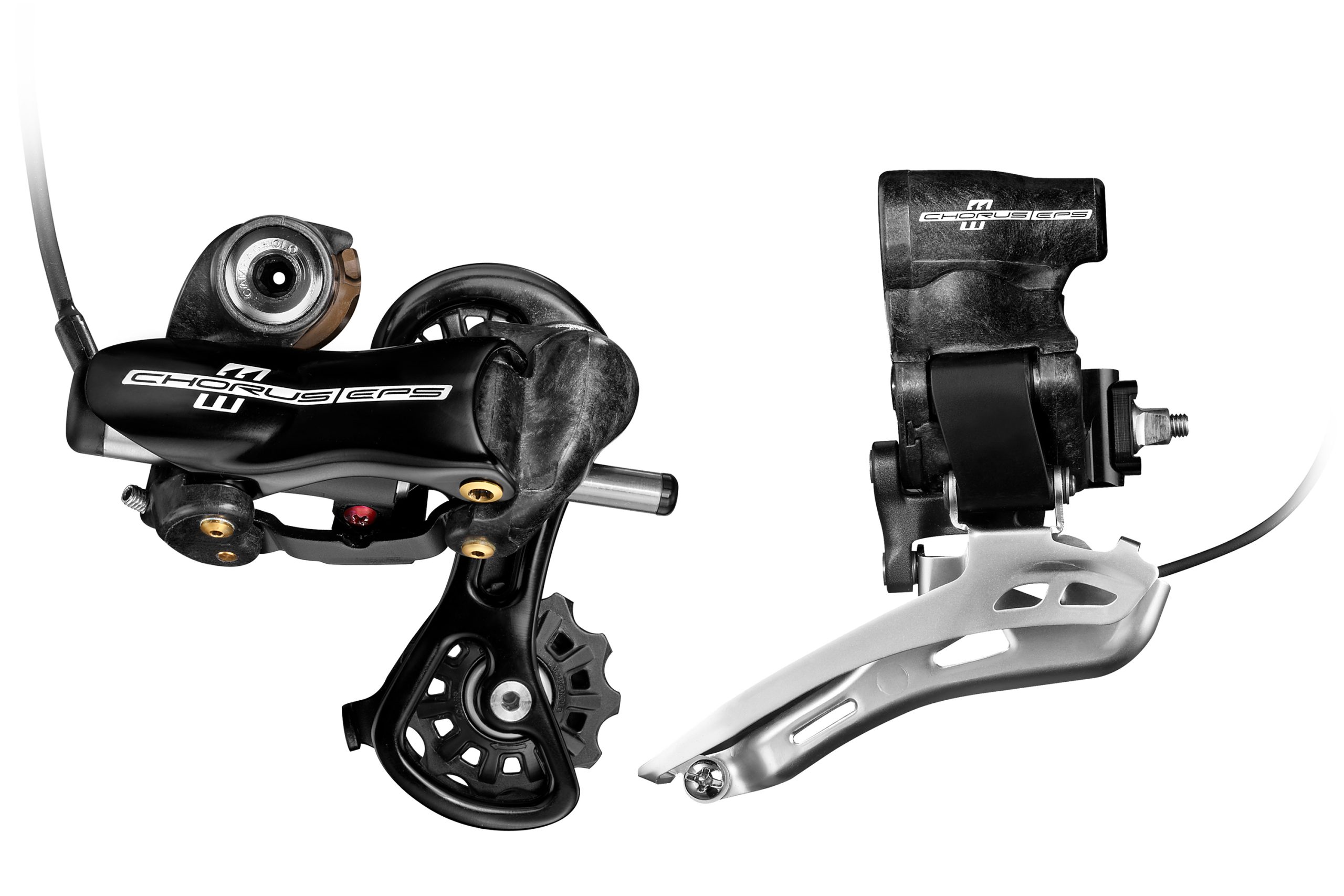
Recent reports have suggested the Italian brand may be set to retire its iconic Record groupsets, but perhaps we could see a Chorus 13 wireless groupset at some point instead.
When asked about this, Campagnolo’s group head of product and marketing, Federico Gardin, didn’t reveal any specific plans for cheaper groupsets, but stressed the brand is aware it needs to offer products hitting a range of price points, and is listening to market feedback.
Ultimately, Gardin says Campagnolo knows “it’s important to have a product you can find in shops”, and it has been working hard with bike brands to ensure this and any future groupsets make their way onto bikes in shops at competitive prices.
Faster shifting with more options

As well as aesthetic overhauls to both derailleurs, Campagnolo claims significant improvements to shifting performance.
Super Record 13 is claimed to offer “the fastest shifting on the market”, for example, while being 25 per cent more compact.
Shifting from the top to the bottom of the cassette, for example, is claimed to take only 1.9 seconds, compared to 3.6 seconds with 12-speed Super Record Wireless.
Going the other way (from bottom to top) is claimed to be similarly swift, at only 2.1 seconds on Super Record 13, compared to 3.3 seconds with 12-speed Super Record Wireless.
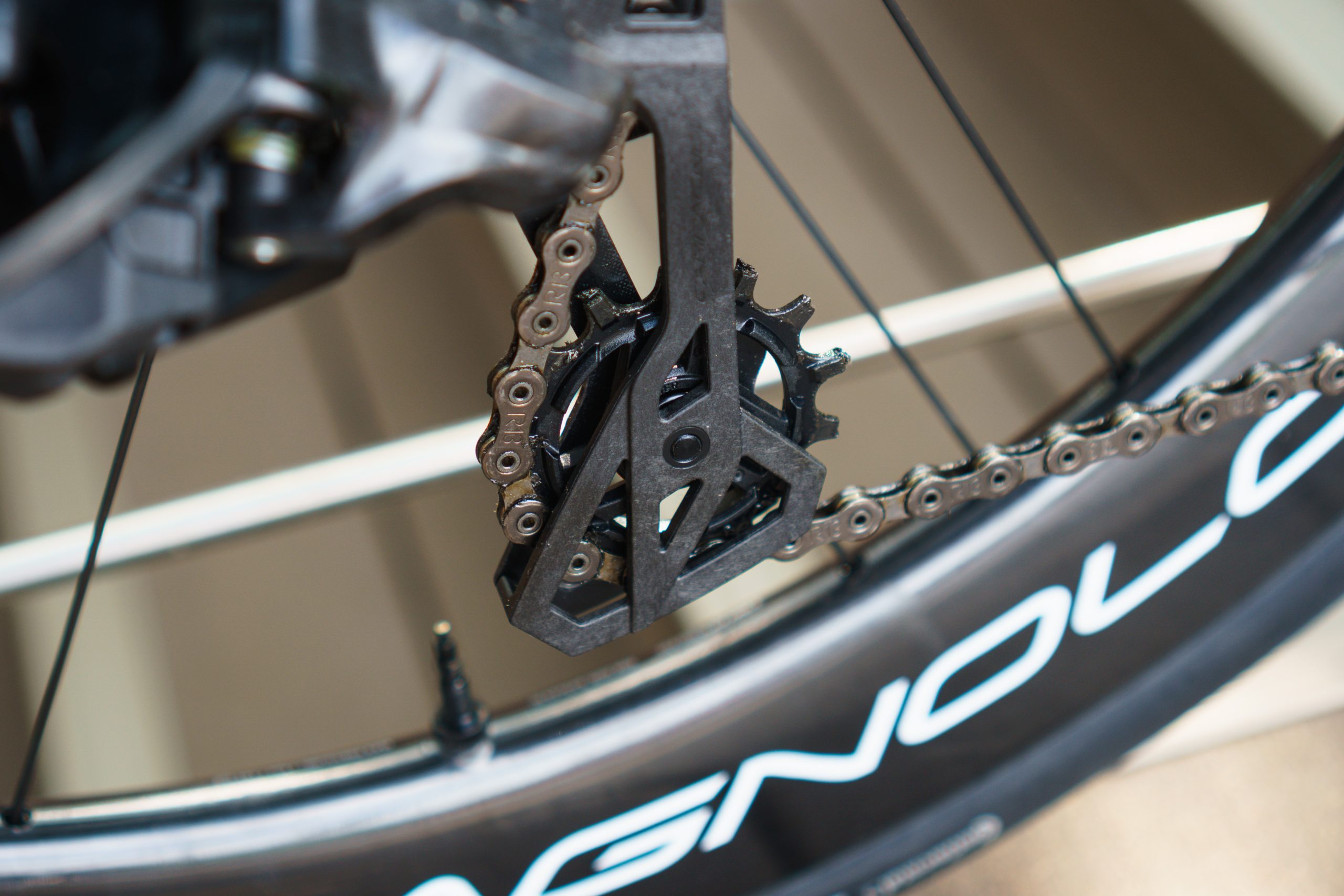
Campagnolo says this improvement comes as a result of the tighter spacing and updated sprocket tooth profiles.
Larger, 14t pulley wheels with updated tooth profiles are also said to reduce drivetrain friction while improving shifting accuracy and chain retention.
Both the chain and cassette are treated to a new ‘black chrome’ finish, which is claimed to reduce drivetrain noise and improve durability.
The rear derailleur is compatible with UDH frames via a direct mount hanger, as well as traditional frames via a standard derailleur hanger.

There are seven chainring combinations, from 45/29 to 55/39t, and four cassette options, from 10-29 to 11-36t. Campagnolo says “all chainring and cassette combinations are possible”, and that the same front derailleur can be used with all chainring combinations.
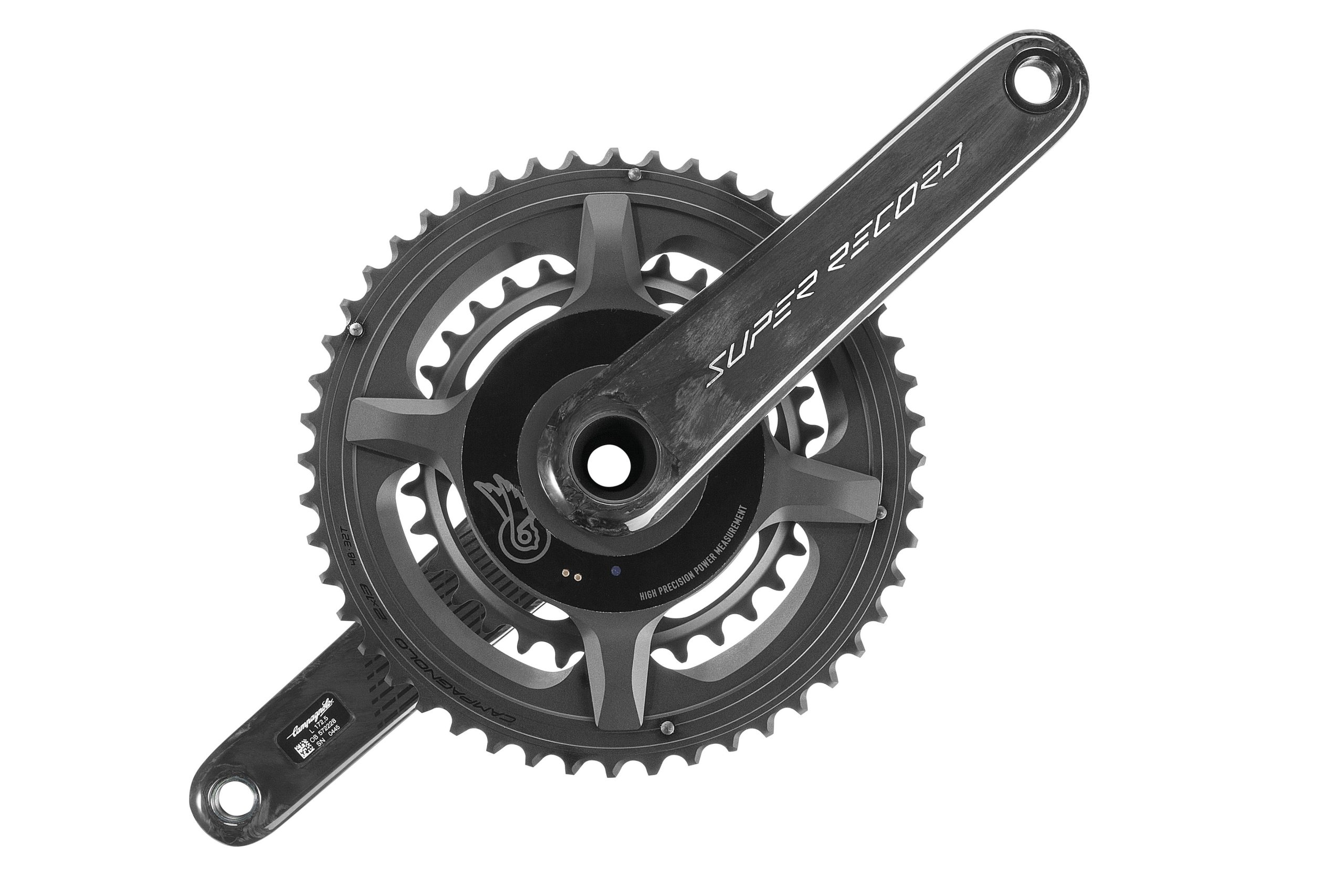
The carbon cranks are largely unchanged versus the previous-generation cranksets, although Campagnolo notes the retaining clip has been moved to the non-driveside bottom bracket cup (from the driveside) to simplify installation.
There are four crank-length options, from 165 to 175mm. Campagnolo says it is aware of the current pro trend for short cranks and that it’s open to introducing more options if it considers there is sufficient demand.
| Chainrings | Cassettes | Crank lengths |
|---|---|---|
| 45/29t | 10-29t | 165mm |
| 48/32t | 10-33t | 170mm |
| 50/34t | 11-32t | 172.5mm |
| 52/36t | 11-36t | 175mm |
| 53/39t | ||
| 54/39t | ||
| 55/39t |
Campagnolo doesn’t claim any specific improvements to front shifting speed, but it says the front derailleur has been “completely redesigned”, shedding 10g, with a new carbon outer cage and “new engineering” that “guarantees” smoother shifts while shifting under power.
The shape of the front derailleur has been redesigned to improve rear tyre clearance, and it also gets a new, simplified battery with a single LED light to indicate battery life and “system status”.

The claimed battery life is the same as before (750km of range per charge, front and rear) and it can be charged on or off the bike with a magnetic charging cable.
Campagnolo says the new battery is backwards-compatible with 12-speed Super Record Wireless and Super Record Wireless S front derailleurs running the latest firmware.
Return of the thumb shifter

It’s fair to say that ditching its iconic thumb shifter (with the launch of Super Record Wireless) was a fairly divisive move for Campagnolo.
It showed the brand was willing to explore alternative ergonomics for the electronic age, but also came as a disappointment to many existing fans – many of whom felt Campagnolo was abandoning one of its key differentiators compared to Shimano Di2 or SRAM AXS.
With Super Record 13, though, Campagnolo is bringing the thumb shifter back in a redesigned form to make it easier to reach from the drops.

This, plus the addition of a third, customisable ‘Smart Button’ on each shifter (located on the inside, just above the pivot point of the brake lever), offers a more traditional Campagnolo feel, while also giving riders more options to customise how they use the shifters.
Each Smart Button can, for example, be set to shift up or down at the front or rear derailleur, as a toggle button for the front derailleur (similar to Shimano’s ‘Front Shift Next’ function, which shifts up or down depending on which chainring you’re using), or as a control button for compatible bike computers.
All of this is done via the MyCampy app, which is available for iOS and Android smart devices.
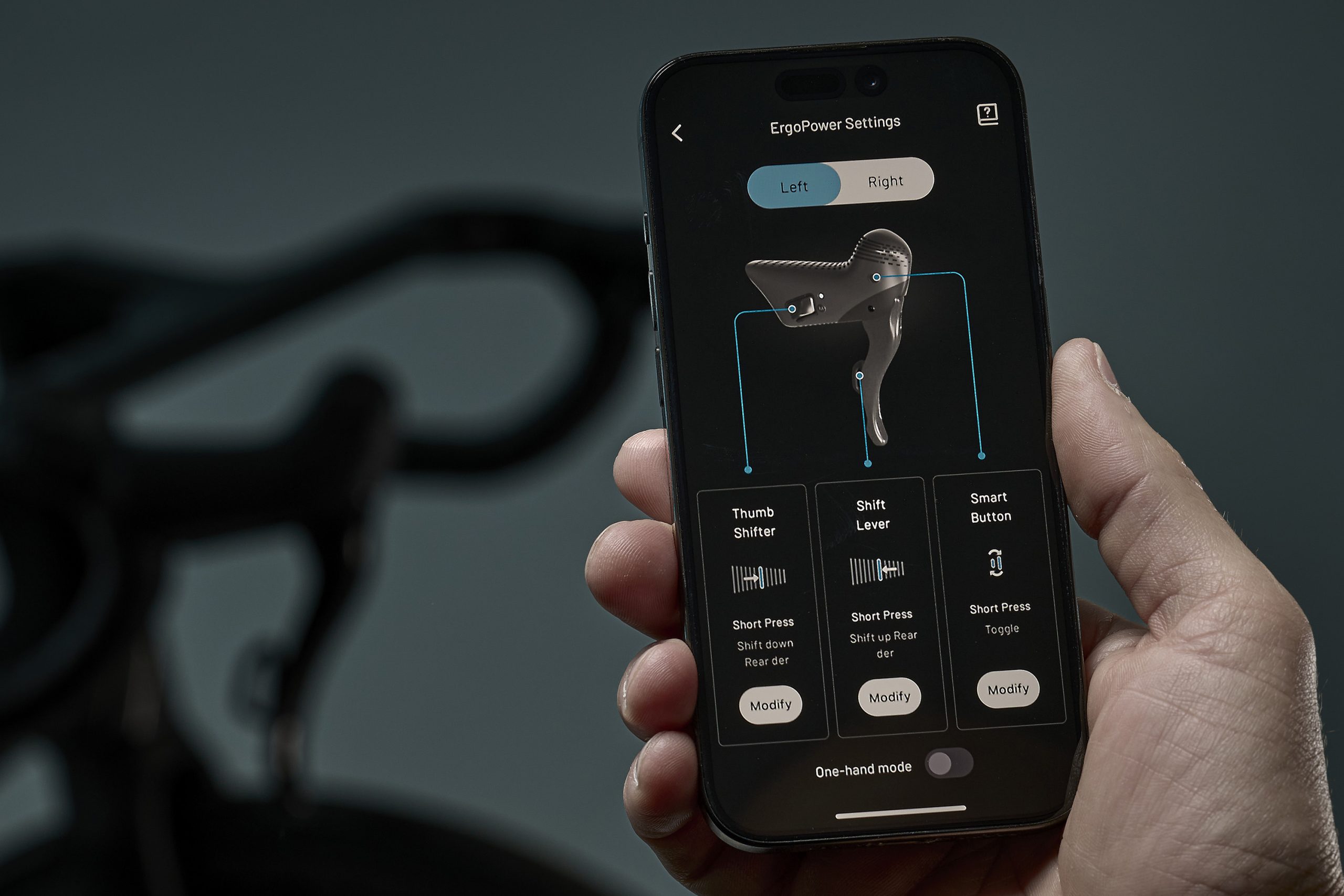
Beyond buttons, Campagnolo has also refined the shape of the Ergopower shifters. The new shifter bodies are slightly longer and more svelte than before, with a flatter top designed to spread the weight more evenly across the palms of your hands.
The shape of the carbon brake levers has also been refined, with a repositioned pivot point to aid braking from the hoods. Campagnolo says the lever is now less likely to interfere with your fingers during braking too.
The shifters have also been designed with the pro trend for angled-in hoods in mind, up to the UCI’s limit of 10 degrees.

In terms of brakes, Campagnolo says it has updated the calipers for easier bleeding and added titanium hardware to save a few grams.
It’s also launching sintered brake pads for better durability in wet weather, although groupsets will ship with organic pads as stock.
More than an extra sprocket

Super Record 13 beats Shimano and SRAM to the punch, bringing the first 2x 13-speed wireless electronic road bike groupset to the market.
While some might question the need for yet more sprockets and ever finer gear ratios, Campagnolo says that “being able to manage your effort maximizes performance” and that “finding the right cadence makes the difference between an effective and satisfying action and a tiring and disappointing experience”.
Happily, the new groupset doesn’t necessitate a new freehub standard – meaning Super Record 13 will work with existing wheels that feature, or are compatible with, the brand’s N3W freehub.
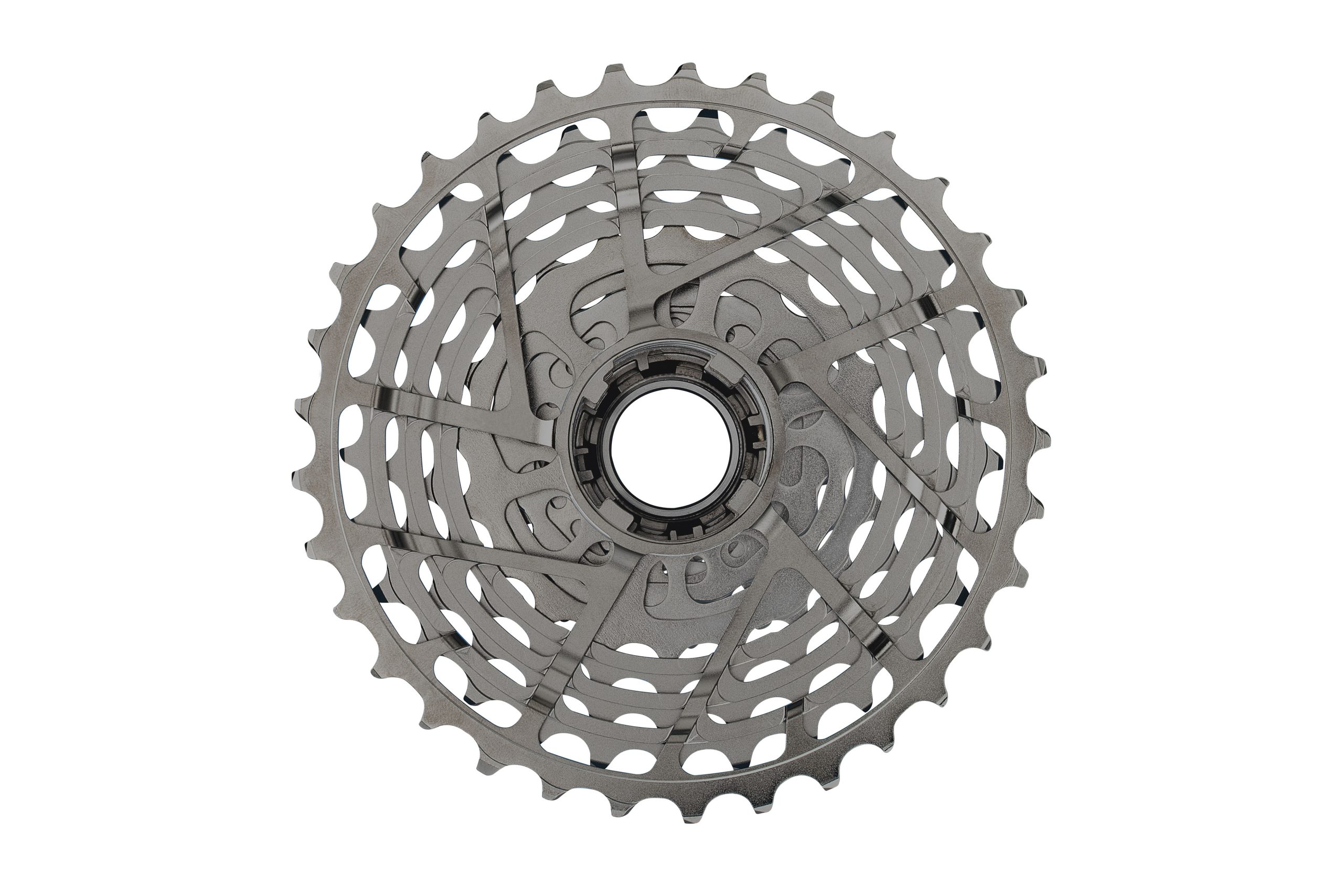
Campagnolo says this was possible thanks to experience gained from its Ekar 1x 13-speed gravel groupsets – where, compared to 12-speed, it reduced the thickness of and distance between each sprocket, and developed a narrower 13-speed chain.
Campagnolo says that while Ekar cassettes and chains share the same spacing dimensions, the tooth profiles on Super Record 13 cassettes are different. They are cross-compatible, although Campagnolo recommends staying within the same family of components for the best performance.
Campagnolo Super Record 13 pricing, specifications and availability
Campagnolo hasn’t provided a detailed breakdown of individual component weights or prices, but here’s how it stacks up against its predecessor and the competition:
| | Campagnolo Super Record 13 | Campagnolo Super Record Wireless (12-speed) | Shimano Dura-Ace Di2 R9200 | SRAM Red AXS |
|---|---|---|---|---|
| Price (w/o power meter) | £3,900 / $4,750 / €4,300 | £4,499 / $5,399 / €5,200 | £3,600 / $4,300 / €3,460 | £4,090 / $4,090 / €4,135 |
| Weight | 2,435g (claimed, w/o power meter) | 2,518g (claimed, w/o power meter) | 2,514g (actual, with power meter) | 2,548g (actual, with power meter) |
Campagnolo says Super Record 13 will also be available with the brand’s HPPM power meter included for £4,950 / $5,899 / €5,399, saving around £900 / $1,000 / €1,000 compared to buying them separately.
It’s also worth bearing in mind Shimano’s current Dura-Ace groupset launched back in 2021, and with the effects of inflation, tariffs and economic uncertainty hitting the bike industry hard in recent years, we wouldn’t be surprised to see Shimano’s next flagship groupset cost more than R9200 (when it eventually arrives).
Campagnolo says Super Record 13 is “uniquely Italian in design” and that 80 per cent of the groupset is “proudly made in Europe”.
The Italian brand said it was able to bring the cost down, compared to 12-speed Super Record Wireless, “without cutting corners” by investing in automation and through “optimising component design”.
The new shifters, for example, are said to be made from 36 individual components, compared to 74 for the previous ones.
The brand says the groupset will be available, both on and off bikes, from launch, so if you’ve been waiting for a 2x 13-speed wireless electronic road bike groupset and have a few grand burning a hole in your pocket… today’s your lucky day.
All About Pride On 2025 on Zwift
Zwift has announced a series of Pride events for June, including colorful Pride Ons, new unlocks, and a series of races! Why all the special events? The Pride On FAQ says, “When we say we’re on a mission to make more people more active more often—we mean it! We want to work towards making Watopia, and all of Zwift, more inclusive.”

Daily Schedule
Here is the schedule of Pride On events during the month of June:
- Mondays: Pride On Rides
- Tuesdays: Pride On Rides
- Wednesdays: Rainbow Races
- Thursdays: Throwback Thursday Rides & Runs
- Fridays: Pride On Rides
- Saturdays: LGBTQ Zwifters Club Rides and Runs
- Sundays: LGBTQ Zwifters Club Rides and Runs

See the Pride On events schedule at zwift.com/events/tag/prideon
Social Rides and Runs
Zwift hosts Pride On events throughout the year, but they will be especially prominent on the calendar during the month of June, with Pride On Rides and Runs scheduled throughout the week.
Most rides are open-paced and 45 minutes long, while runs are open-paced and 30 minutes long. Events will rotate between several different routes throughout the month.
Note that Thursday and weekend events are a bit different than the other days – see below for details…
Throwback Thursdays
The Thursday Pride On Rides and Runs are “Throwback Thursday” rides which will unlock past Pride On kits:
- Week 1 (June 5): 2021 Ride kit, 2019 Run kit
- Week 2 (June 12): 2022 Ride kit, 2020 Run kit
- Week 3 (June 19): 2023 Ride kit, 2021 Run kit
- Week 4 (June 26): 2024 Ride kit, 2022 Run kit
Weekend LGBTQ Zwifters Club Rides

The weekend Pride On rides are hosted by the LGBTQ Zwifters Club, with experienced leaders pacing the 60-minute events at 1.6-1.8 W/kg.
Rainbow Races
This year, for the first time, Zwift is hosting special crit-style Pride Month races each Wednesday. Dubbed “Rainbow Races”, they happen in five time slots each week:
- Wednesday 12:30am UTC/Tuesday 8:30pm ET Tuesday/5:30pm PT
- Wednesday 6:30am UTC/2:30am ET/ Tuesday 11:30pm PT
- Wednesday 10:45am UTC/6:45am ET/3:45am PT
- Wednesday 1:30pm UTC/9:30am ET/6:30am PT
- Wednesday 6:50pm UTC/2:50pm ET/11:50am PT
Races will be held on the following routes:
- Week 1 (June 4): Downtown Dolphin (19.7km, 170m)
- Week 2 (June 11): Neokyo Crit Course (20.2km, 99m)
- Week 1 (June 18): Downtown Dolphin (19.7km, 170m)
- Week 2 (June 25): Neokyo Crit Course (20.2km, 99m)
Kit and Wheel Unlocks
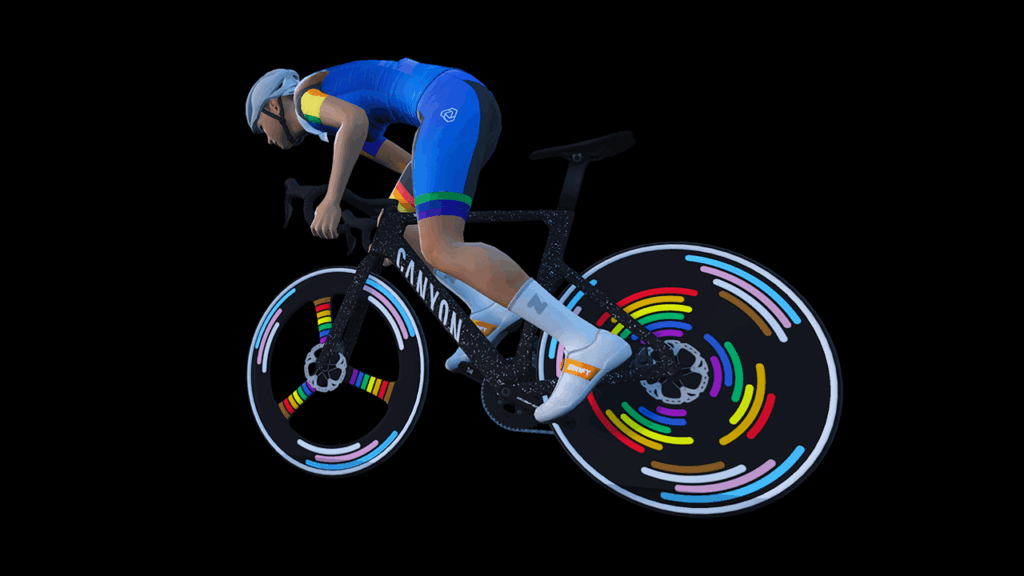
Every Pride On event unlocks something – a kit, the new 2025 Pride On Wheels, or both. To be precise:
- Pride On Rides and Weekend LGBTQ Zwifters Club unlock the LGBTQ Zwifters club kit and Pride On Wheels
- Throwback Thursday rides unlock a different kit each week and Pride On Wheels
- Rainbow Races unlock only the Pride On Wheels




Wondering how the new Pride On Wheels perform? They’re not particularly fast, although they look fun. They turn in the same test performance as the 2025 Big Spin prize wheels (named the Zwift Groovy Time Trial wheels). See their performance details on our wheel charts page.
WHIP Muxer Merged To FFmpeg For Sub-Second Latency Streaming
A big project was merged into FFmpeg overnight in providing a WHIP muxer for sub-second latency streaming…
Samsung teases a Galaxy Z Fold Ultra
Samsung has published a blog post teasing the “next chapter of Ultra,” and it included an animation of a phone that clearly has the form factor of the Galaxy Z Fold. The phone’s silhouette folds out to show a device as big as a small tablet and then folds in again into the size of a phone. Samsung’s post was vague and didn’t give out specific details about the device, but it sounds like the company is cooking up a new product that has the capabilities of its Ultra range in the body of a Galaxy Z Fold.
You can use voice controls on the phone while it’s folded to ask its AI assistant to text your family or friends and to find a restaurant you can eat at, Samsung said. You can finish unsent work emails, browse online, game or capture photos while the phone is in its folded state. Unfolded, it becomes an immersive entertainment hub or a workspace. Samsung said its Galaxy AI features will be designed specifically for the foldable form.
It’s been rumored for a while now that the company is launching a tri-fold phone this year. The animation in the teaser didn’t show a tri-fold form factor, so unless this is a redirection by Samsung, it’s likely another device altogether. If it is indeed an Ultra version of the Galaxy Z Fold, we can only wait and see if Samsung will sell the ordinary Z Folds at a lower price or if it will add several hundred to its pricing for the Ultra variant.
This article originally appeared on Engadget at https://www.engadget.com/mobile/smartphones/samsung-teases-a-galaxy-z-fold-ultra-140020512.html?src=rss
2 certificate authorities booted from the good graces of Chrome
Google says its Chrome browser will stop trusting certificates from two certificate authorities after “patterns of concerning behavior observed over the past year” diminished trust in their reliability.
The two organizations, Taiwan-based Chunghwa Telecom and Budapest-based Netlock, are among the hundreds of certificate authorities trusted by Chrome and most other browsers to provide digital certificates that encrypt traffic and certify the authenticity of sites. With the ability to mint cryptographic credentials that cause address bars to display a padlock, assuring the trustworthiness of a site, these certificate authorities wield significant control over the security of the web.
Inherent risk
“Over the past several months and years, we have observed a pattern of compliance failures, unmet improvement commitments, and the absence of tangible, measurable progress in response to publicly disclosed incident reports,” members of the Chrome security team wrote Tuesday. “When these factors are considered in aggregate and considered against the inherent risk each publicly-trusted CA poses to the internet, continued public trust is no longer justified.”
5 Reasons Why Your Company Needs a Password Manager
In today’s digital workplace, the number of accounts and services a company relies on is constantly growing — and so is the risk of password-related breaches. Whether you run a startup or a large enterprise, securing your credentials should be a top priority. That’s why more and more businesses are turning to dedicated password managers.
Here are five compelling reasons why your company should implement a password manager today:
The post 5 Reasons Why Your Company Needs a Password Manager appeared first on Linux Today.
New CXL RAS Features Upstreamed For Linux 6.16
Linux kernel developers continue building out the support around the Compute Express Link (CXL) specification for benefiting modern high performance servers. With the in-development Linux 6.16 kernel there are more CXL features now in place…
23andMe Founder Aims To Restart Auction With Major Corporate Backing
Anne Wojcicki has asked a U.S. judge to reopen the auction for 23andMe, claiming she has backing from a $400+ billion Fortune 500 company. Reuters reports: South San Francisco, California-based 23andMe filed for bankruptcy in March, seeking to sell its business at auction after a decline in consumer demand and a 2023 data breach that exposed sensitive genetic and personal information of millions of customers. Last month, Regeneron Pharmaceuticals agreed to buy the firm for $256 million, topping a $146 million bid from Wojcicki and TTAM Research Institute, which was founded by Wojcicki and describes itself as a California non-profit public benefit corporation.
In a filing dated May 31, Wojcicki claimed that 23andMe’s debtors had attempted to tilt the sales process away from TTAM and in favor of Regeneron. TTAM and Wojcicki said in the filing that 23andMe’s financial and legal advisers unfairly capped their maximum bid at $250 million due to misplaced concerns about TTAM’s “financial wherewithal.” The plaintiffs said the auction was prematurely concluded before they had the opportunity to submit a bid that would have exceeded $280 million.
The company’s debtors said the auction results came after an extensive and careful consideration by a four-member special committee of independent directors, according to the filing. According to another filing, 23andMe is seeking court approval to let Wojcicki and Regeneron submit final proposals by June 12. 23andMe is also seeking a $10 million breakup fee for Regeneron if Wojcicki’s bid is ultimately accepted.


Read more of this story at Slashdot.
TikTok “ClickFix” Videos Are Spreading Malware — And Now Targeting Linux
A new social engineering tactic known as “ClickFix” is gaining momentum on TikTok, where seemingly harmless tech tip videos are being used to lure users into downloading malware. These short clips pretend to offer simple fixes for browser issues or system errors, but in reality, they redirect viewers to download malicious files that install infostealers. Even more concerning is that attackers are now starting to experiment with this technique on Linux systems as well — a development covered in detail here: Hackers now testing ClickFix attacks on Linux systems.
The post TikTok “ClickFix” Videos Are Spreading Malware — And Now Targeting Linux appeared first on Linux Today.
DietPi released a new version 9.13
DietPi is a lightweight Debian based Linux distribution for SBCs and server systems, with the option to install desktop environments, too. It ships as minimal image but allows to install complete and ready-to-use software stacks with a set of console based shell dialogs and scripts.
The source code is hosted on GitHub: https://github.com/MichaIng/DietPi
The main website can be found at: https://dietpi.com/
Wikipedia: https://de.wikipedia.org/wiki/DietPi
The project released the new version DietPi v9.13 on May 25th, 2025.
The highlights of this version are:
- DietPi default passwords: Default password ‘dietpi’ must not be used any more for security reasons and has to be changed
- Orange Pi 3B: Added support for the PWM fan
- Radxa ZERO 3: Upgrade to Linux 6.1 based vendor kernel
- Virtual Machines: Future VM images will use initramfs-tools instead of tiny-initramfs
- DietPi-Config: Simplified keyboard layout dialog
- Gitea: Now enabled also for RISC-V systems
- Google AIY, Mycroft AI: Removed deprecated software packages
- Fixes for ASUS Tinker Board 2, Orange Pi 3B v1.1, Orange Pi Zero 3/2W, DietPi-Imager, DietPi-Display, RPi.GPIO, fish, Home Assistant, Redis
The full release notes can be found at: https://dietpi.com/docs/releases/v9_13/
The post DietPi released a new version 9.13 appeared first on Linux Today.
LXD 6.4 Lands with UI Enhancements, Smarter Shutdown Logic
LXD 6.4 system container manager introduces new CLI options, updated UI features, and better shutdowns, clusters, and storage handling.
The post LXD 6.4 Lands with UI Enhancements, Smarter Shutdown Logic appeared first on Linux Today.
SMT Proves Very Advantageous For AMD Ryzen AI MAX Strix Halo Performance
While Intel opted against implementing Hyper Threading for their latest Arrow Lake and Lunar Lake processors, Simultaneous Multi-Threading (SMT) still proves very effective on the AMD side. Even though the top-end AMD Ryzen AI MAX “Strix Halo” SoCs provide 16 Zen 5 cores, the presence of SMT for 32 threads still proves worthwhile from both a performance and power efficiency perspective. Here is an on/off comparison for SMT with the flagship AMD Ryzen AI MAX+ PRO 395 within the HP ZBook Ultra G1a.
James Webb Space Telescope Discovers the Earliest Galaxy Ever Seen
The James Webb Space Telescope has discovered the most distant galaxy ever observed, named MoM z14. NASA estimates it existed just 280 million years after the Big Bang. Space.com reports: Prior to the discovery of MoM z14, the galaxy holding the title of earliest and distant was JADES-GS-z14-0, which existed just 300 million years after the Big Bang, or around 13.5 billion years ago. This previous record galaxy has a redshift of z =14.32, while MoM z14 has a redshift of z = 14.44. There is a wider context to the observation of MoM z14 than the fact that it has broken the record for earliest known galaxy by 20 million years, though, as [explained team member and Yale University professor of Astronomy and Physics Pieter van Dokkum].
The researchers were able to determine that MoM z14 is around 50 times smaller than the Milky Way. The team also measured emission lines from the galaxy, indicating the presence of elements like nitrogen and carbon. “The emission lines are unusual; it indicates that the galaxy is very young, with a rapidly increasing rate of forming new stars,” van Dokkum said. “There are also indications that there is not much neutral hydrogen gas surrounding the galaxy, which would be surprising: the very early universe is expected to be filled with neutral hydrogen. “That needs even better spectra and more galaxies, to investigate more fully.”
The presence of carbon and nitrogen in MoM z14 indicates that there are earlier galaxies to be discovered than this 13.52 billion-year-old example. That is because the very earliest galaxies in the universe and their stars were filled with the simplest elements in the cosmos, hydrogen and helium. Later galaxies would be populated by these heavier elements, which astronomers somewhat confusingly call “metal,” as their stars forged them and then dispersed them in supernova explosions.
The research has been published on arXiv.


Read more of this story at Slashdot.
Why kids still need to learn to code in the age of AI
Today we’re publishing a position paper setting out five arguments for why we think that kids still need to learn to code in the age of artificial intelligence.

Just like every wave of technological innovation that has come before, the advances in artificial intelligence (AI) are raising profound questions about the future of human work. History teaches us that technology has the potential to both automate and augment human effort, destroying some jobs and creating new ones. The only thing we know for sure is that it is impossible to predict the precise nature and pace of the changes that are coming.
One of the fastest-moving applications of generative AI technologies are the systems that can generate code. What started as the coding equivalent of autocomplete has quickly progressed to tools that can generate increasingly complex code from natural language prompts.
This has given birth to the notion of “vibe-coding” and led some commentators to predict the end of the software development industry as we know it. It shouldn’t be a surprise then that there is a vigorous debate about whether kids still need to learn to code.
In the position paper we put forward five arguments for why we think the answer is an unequivocal yes.
We need humans who are skilled programmers
First, we argue that even in a world where AI can generate code, we need skilled human programmers who can think critically, solve problems, and make ethical decisions. The large language models that underpin these tools are probabilistic systems designed to provide statistically acceptable outputs and, as any skilled software engineer will tell you, simply writing more code faster isn’t necessarily a good thing.
Learning to code is an essential part of learning to program
Learning to code is the most effective way we know for a young person to develop the mental models and fluency to become a skilled human programmer. The hard cognitive work of reading, modifying, writing, explaining, and testing code is precisely how young people develop a deep understanding of programming and computational thinking.
Learning to code will open up even more opportunities in the age of AI
While there’s no doubt that AI is going to reshape the labour market, the evidence from history suggests that it will increase the reach of programming and computational approaches across the economy and into new domains, creating demand for humans who are skilled programmers. We also argue that coding is no longer just for software engineers, it’s becoming a core skill that enables people to work effectively and think critically in a world shaped by intelligent machines. From healthcare to agriculture, we are already seeing demand for people who can combine programming with domain-specific skills and craft knowledge.
Coding is a literacy that helps young people have agency in a digital world
Alongside the arguments for coding as a route to opening up economic opportunities, we argue that coding and programming gives young people a way to express themselves, to learn, and to make sense of the world.
And perhaps most importantly, that learning to code is about power. Providing young people with a solid grounding in computational literacy, developed through coding, helps ensure that they have agency. Without it, they risk being manipulated by systems they don’t understand. As Rushkoff said: “Program, or be programmed”.
The kids who learn to code will shape the future
Finally, we argue that the power to create with technology is already concentrated in too small and homogenous a group of people. We need to open up the opportunity to learn to code to all young people because it will help us mobilise the full potential of human talent, will lead to more inclusive and effective digital solutions to the big global challenges we face, and will help ensure that everyone can share in the societal and economic benefits of technological progress.
The work we need to do
We end the paper with a call to action for all of us working in education. We need to challenge the false narrative that AI is removing the need for kids to learn to code, and redouble our efforts to ensure that all young people are equipped to take advantage of the opportunities in a world where AI is ubiquitous.
You can read the full paper here:
The cartoon image for this blog was created using ChatGPT-4o, which was prompted to produce a “whimsical cartoon that expresses some of the key ideas in the position paper”. It took several iterations.
The post Why kids still need to learn to code in the age of AI appeared first on Raspberry Pi Foundation.
Ubuntu Touch OTA-9 Released with VoLTE and Waydroid Improvements
The UBports Foundation released Ubuntu Touch OTA-9 today as the ninth stable update to their Ubuntu Touch mobile operating system based on Ubuntu 20.04 LTS (Focal Fossa) for supported Linux devices.
‘Deliberate Attack’ Deletes Shopping App’s AWS and GitHub Resources
The CEO of Indian grocery ordering app KiranaPro has claimed an attacker deleted its GitHub and AWS resources in a targeted and deliberate attack and vowed to name the perpetrator. From a report: KiranaPro lets users shop at “Kiranas,” the Indian equivalent of convenience stores, which mostly stock basic foodstuffs. Users of the app place an order, which KiranaPro sends to nearby Kiranas who bid to win the sale. The winner arranges delivery of the goods. The elapsed time from ordering to delivery seldom tops 20 minutes.
KiranaPro CEO Deepak Ravindran claims the app “powers the livelihoods of thousands of Kirana store owners” and handles 2,000-plus orders each day. Ravindran also claims the app was destroyed by someone who holds a grudge. “Our startup @Kirana_Pro was deliberately hacked — entire GitHub repo & AWS data wiped. Logs suggest malicious insider action,” he wrote on June 3rd. The attack happened last week, and the app has been inoperable since.


Read more of this story at Slashdot.