Tesla CEO Elon Musk’s big government adventure appears to be at an end. As promised in April, Musk has returned his attention to his car company, which is facing serious headwinds. In the first quarter of the year, Tesla sold tens of thousands fewer electric vehicles than it did the year before, despite a rise in worldwide EV sales. Data from April looked even worse, with substantial sales declines in Europe and China. May’s numbers don’t look much better.
Although Tesla only publishes its global production and sales numbers—and only at the end of each quarter—some countries provide monthly new car registration information, making it possible to track sales on a national level. And according to Germany’s KBA, in May, Tesla sales fell by just over 36 percent year over year, even as overall EV registrations increased by 45 percent. At least that’s a few hundred more cars than it managed in April.
Similar trends were seen in the UK and Italy. In the UK, Tesla sales decreased by 45 percent, even as overall EV sales increased by 28 percent. In Italy, EV sales increased by almost 41 percent, but Tesla’s deliveries dropped by 20 percent.
Samsung is teasing its next-gen Galaxy Z Fold smartphone and all signs indicate a new ‘Ultra’ variant coming too. This sneak peek suggests that the Ultra will be a more premium edition of the popular book-style foldable, promising consumers “an Ultra-experience that goes beyond” larger screens, enhanced camera systems, and superior connectivity.
AI video generation is a rapidly developing field, with the likes of Google’s Veo and OpenAI’s Sora constantly out-doing each other. We are approaching the time when it might be difficult to discern some AI generated video content from reality. But all those gains are limited to the top-tier paid services. To get access to Google’s flagship Veo 3 model (which can now generate dialogue), you need to fork over $250 a month. Until now, no one has really tried to make free AI video generation a thing, given just how resource intensive it is. But now, Microsoft’s stepping up to the plate.
Of all things, the Bing app is integrating a free video creator, that while limited, generates short videos for free using OpenAI’s Sora model. But is it worth your time? And how does it compare to Gemini’s Veo 2, which requires Google’s $20/month AI Pro subscription?
How Bing’s free AI videos work
Microsoft is rolling out its Video Creator feature first on the Bing iPhone and Android apps, with web and desktop versions to follow soon. It’s completely free to use, but is quite limited.
The feature is built on OpenAI’s Sora text-to-video platform that’s still in public beta, and is normally part of the $20/month ChatGPT Plus subscription. In Sora, you are able to edit and adjust videos after creation, but there’s no such option in Bing Video Creator.
Bing Video Creator also limits you to 5 second videos at 480p resolution, and only in a portrait 9:16 aspect ratio (landscape aspect ratios are coming soon).
Because the platform is free, it revolves around Fast Generation credits. When you first start using Video Creator, you’re handed 10 such credits, which you can spend to generate videos in just a couple of seconds. After you run out, you’ll have to wait a couple of hours for each video you generate (the app will send you a notification when a video is ready). Unfortunately, there’s no direct way to buy more credits, but you can redeem 100 Microsoft Rewards Points for future quick generations.
How to generate free short AI videos using Bing Video Creator
To get started with Bing Video Creator, first download the Bing app on your smartphone, then tap the Menu button from the right edge of the toolbar. Here, choose the Video Creator feature.
Credit: Khamosh Pathak
You’ll see a text box where you can enter your prompt, alongside a Settings icon for changing your aspect ratio, the duration of the video, and generation speed. Microsoft will flesh out those first two options in the future, but for now, you can set your generation speed to Standard to avoid spending a fast generation credit. When you’re ready, click create to start generating your video.
Once it’s done, your video will be saved in a gallery, and you’ll have 90 days to share or download it.
How does Bing’s free AI video generator compare to the paid options?
As I mentioned above, completely free AI video tools are mostly unheard of, or are supremely limited. Canva offers 5 video generations for free, but then requires an upgrade to Canva Pro. Runway does have a free plan that offers 125 credits, but in my testing, I found that I couldn’t use it to generate videos—only images.
I generated three videos using Bing’s free video generator and was happy with the output of one of them. My prompt of a bride in a wedding dress resulted in a video of a bride twirling her body in front of a mirror, but not her head. Eerie.
Next, I asked it to generate a video of someone removing a carrot cake from an oven (not at all related to my sugar fast), and it just couldn’t nail the motion of the person moving a physical object with their hand.
It did well in one task though: a video of a freshly brewed cup of coffee, with people in the background.
Canva’s output was equally jarring. There’s a nice moment with a camera flash, but the hands are like putty, and the facial expressions are really far off.
Google’s Veo 2 did much better. It showed a bride smiling away in her new white dress. The view was too cropped in for my liking, but at least there’s no dislocated elbows or necks.
As it stands, the video quality of paid AI video generators is still quite a bit better, and free options are akin to the early days of DALL-E, where AI couldn’t really nail down fingers and hands.
If you want to generate a short video to share on your company’s page, or just as a gag, sure, go ahead, try it out. For anything else, it might be best to try Google’s Veo, which is currently the best AI video generator out there, at least based on the testing conducted by my colleague, David Nield.
On an average day, you might unlock or look at your phone dozens of times, which makes the lock screen a hot property for advertising. Ad tech company Glance has been taking advantage of that for years with its ad-laden lock screen experiences, but it’s going further in the age of AI. Samsung and Glance have teamed up to deliver a new “AI shopping” experience that uses a selfie to create custom fashion ads. This feature is rolling out to numerous Samsung phones in the next month.
Glance has been around for a while—its non-AI lock screen experience has been bundled on various phones from Samsung, Motorola, and others. Before the AI era, Glance lured people in with promises of pretty pictures and news alerts, which came with a side of ads and tracking. The new Glance AI feature has all that, but it adds an unsettling face-stealing layer to the experience.
The AI-infused Glance will arrive on Samsung phones as both a standalone app and a fully integrated lock screen. Thankfully, this is a fully opt-in experience. If you never open or set up Glance, you can keep using the normal lock screen on your phone.
Epic Games has revealed more about the upcoming Switch 2 port of its popular battle royale game, Fortnite. The new version of Fortnite will support mouse controls, a higher framerate, and more on the new Nintendo hardware. It seems like a significant improvement over the janky version currently playable on the OG…
Being a fan of Apple TV+’s Severance requires patience. Hopefully the wait until season three is released won’t be as interminable as the three-year drought between seasons one and two, but you never know, so we gotta just hang in there.
There’s nothing quite like Severance. The seriesuses thehead-spinning sci-fi premise of people having brain surgery to deal with their damn jobs to explore identity, corporate control, and the nature of humanity itself, while maintaining an unsettling vibe and managing to be darkly hilarious. That said, these five shows blend mind-bending concepts, workplace satire, and existential dread, and may just help you scratch that Severance itch while you wait for season 3 to drop.
Mr. Robot (2015-2019)
Mr. Robot follows the story of Elliot Alderson, a young cyber security expert with mental health problems who goes rogue to try to take down the mega corporation he works for. Like the re-integrated characters in Severance, Elliot isn’t always sure where reality ends and his delusions begin. Viewers aren’t, either. The two shows share thematic ground—a bleak view of late capitalism, the last embers of humanity being ground out by forces beyond anyone’s control—but Mr. Robot lacks the coldly removed vibe of Severance. It’s all told from the point-of-view of the main character, so it’s more intense and personal. You can stream Mr. Robot onTubi.
Dark (2017 to 2020)
On the surface, German sci-fi drama Dark resembles Netflix’s Stranger Things more than Apple TV’s Severance—it’s partly about a group of teenagers who discover a weird lab on the outskirts of their town where something supernatural seems to be going on. But Dark is smart and interesting throughout its three seasons instead of falling off after season one. Like Severance, Dark features complex characters and an intricate plot where the fantastic element at its center is really a way to explore themes of loss, time, memory, and identity. And I really appreciate any show that doesn’t insult its viewers’ intelligence by over-explaining everything. You can stream Dark on Netflix.
The Prisoner (1967-1968)
If you’re the type who likes to explore the source of the thing you love, you have to watch The Prisoner. The title character is a British secret agent being held in a surreal prison for reasons he doesn’t understand. It’s hard to overstate how innovative and ahead of its time this show was when it aired in the late 1960s: It’s basically the blueprint for every mind-fuck TV show that followed, from Lost to the X-Files to Severance. While The Prisoner is obviously dated, there’s a charm to the old-school cheesiness. It’s a low-budget James Bond with sci-fi elements and serious ambitions—how could you not love it? You can stream The Prisoner onPrime, Tubi, Sling, and Plex.
Silo (2023-present)
Apple TV+’s other ambitious, original science fiction show tells the story of a civilization that has lived in a huge underground silo for so many generations, they’re not even sure why they’re down there anymore; they only know that returning to the surface means death. Or does it? The way Silo’s corrupt government tightly controls information has definite similarities to Lumon Industries’ petty authoritarianism. While Silo is, overall, a less nuanced show than Severance (it’s closer to exciting, YA fiction storytelling than Severance’s carefully plotted puzzle of a plot), if you need a sci-fi series fix, check out Silo.You can find Silo on Apple TV.
The Kingdom (1994)
Filmmaker/provocateur Lars Von Trier’s The Kingdom is the only TV series I know of that balances comedy and surrealism as well as Severance. While The Kingdom‘s characters work in a Danish hospital built on a cursed burial ground instead of an evil cult’s corporate office, both shows feature a powerful institution corrupting its employees, and both are, on some level, absurdist, darkly hilarious workplace comedies. Severance has a weird cult, a brain operation, and a goat room; The Kingdom has patient-led seances, a ghostly ambulance, and a monster baby. You can stream The Kingdom on Mubi.
Quantum Threshold from Vaki Games uses a wheelchair as both a means of locomotion and a weapon.
This game’s unique premise stands out right from the start. You quickly realize that you’re not playing the typical run-and-gun FPS-style hero here, but instead will need to learn how to navigate in this world via a motorized and weaponized wheelchair that might even make Professor X a little jealous.
One of the standout features of Quantum Threshold is its ever-changing battlefield. Each new run feels fresh thanks to the game’s roguelike elements that ensure every session yields new loot, challenges, and enemies. This all comes together nicely to blend the game’s sense of chaos and need for strategy into a compelling loop that made me want to grind harder with each new cycle.
0:00
/0:14
Your progress isn’t lost upon death but instead, Quantum Threshold places you back inside a hub-world where your hard-earned Hate Corp credits can be spent on upgrades to your weapons and chair. Then you can test your newly updated firepower on the practice range, allowing for better accuracy and longer runs over time.
Combat in Quantum Threshold quickly becomes intense as you make your way across this post-apocalyptic landscape. Wheeling around enemies and dispatching them with various weapons and cool chair upgrades shows that this wheelchair isn’t just a mobility aid. It’s an extension of you, and your ticket to continued survival. The game’s locomotion design forces players to confront and adapt to limitations they might not feel completely comfortable with at first.
0:00
/0:28
When I started playing, I found myself getting frustrated that I had to control the wheelchair with a single arm while also trying to hold a weapon in my dominant hand. After 40 years of building up traditional FPS muscle memory, it was difficult for me to disconnect from that and realize I was going to have to approach this game differently. Not being able to quickly strafe or slide tightly around corners with precision was something I had to rewire my brain into realizing I could no longer do. These actions wouldn’t even be possible to pull off while seated in a wheelchair in the real world, so why would it be any different here?
The more I spent time in this game and thought about it, the more I realized those limitations I’m feeling reflect real challenges that many with mobility impairments might face every day. I was experiencing something like their experience, even for a short time in a VR game like this, and this created a newfound appreciation for Vaki Games’ thoughtful design. Now I’m seeing the need for more wheelchair ramps almost everywhere I look.
0:00
/0:59
Visually, Quantum Threshold’s cel-shaded graphics look great on Quest 3 and 3S, and the game presents a good sense of depth and scale. It’s mesmerizing seeing a huge hunter-killer drone hovering overhead, scanning the ground with its laser beams, looking like something out of James Cameron’s Terminator movies with 8-bit style pixelated explosions popping off all around me.
However, as we’ve seen with other titles released on Quest 3, it seems as if Vaki Games elected to make compromises that somewhat limit the potential visual polish and performance Quantum Threshold could have achieved. That is, if it had been solely designed and optimized for the Quest 3, and not held back by compatibility with the now aging, but still market-saturated, Quest 2.
One complete loop – 8 minutes of gameplay.
In a storefront crowded with many typical first-person shooter style experiences one would expect, Quantum Threshold stands out by bringing a fresh take on the shooter genre while shining a light on accessibility through high-stakes and action-packed VR roguelike FPS gameplay. The subtle way in which Vaki has integrated the accessibility angle has me seeing this as more than just a game now.
This title has shown me a nuanced take on some of the real-world challenges faced by many. Quantum Threshold’s approach, which turns seated VR into a VR wheelchair that’s used as a vehicle of destruction, is not just a clever game mechanic. It also shows how VR developers can bridge worlds by overcoming limitations in the most imaginative ways possible.
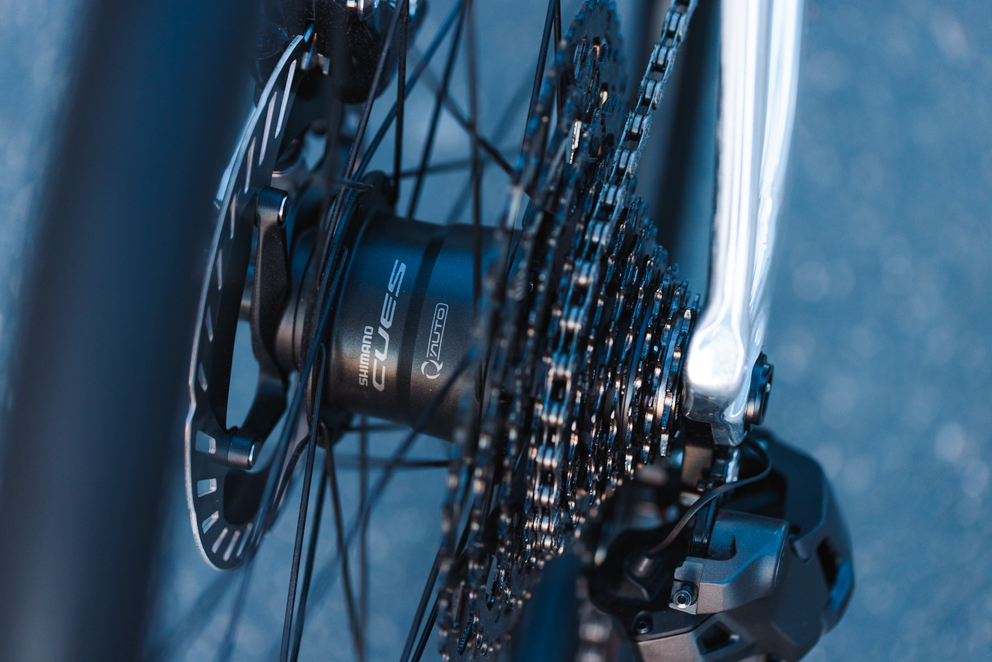
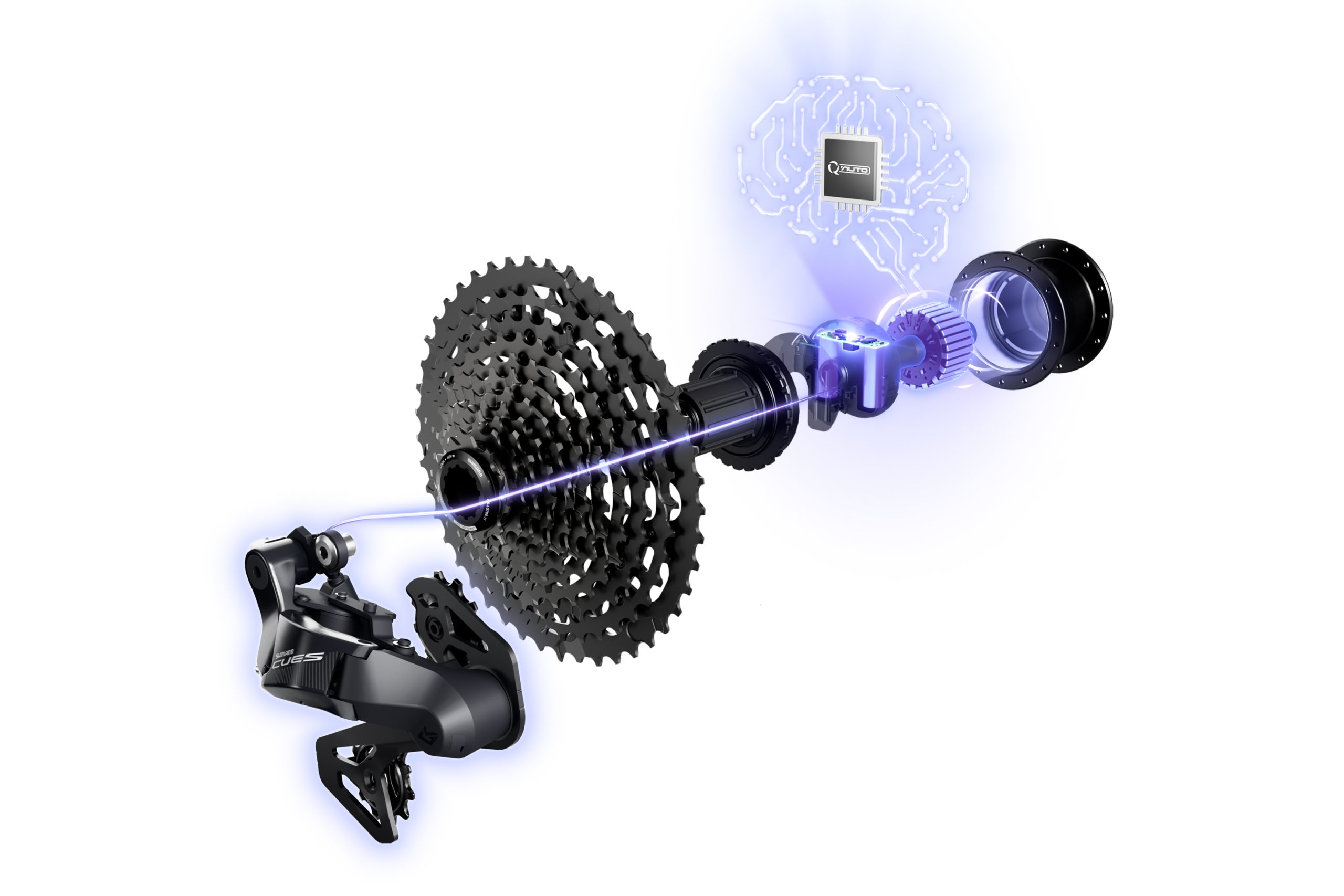
Shimano Q’Auto is a new automatic-shifting system powered by a dynamo incorporated into a new rear hub that integrates with the brand’s Cues derailleurs.
Crucially, compared to existing Shimano Di2 drivetrains, the system does away with a central battery, running from a self-charging Li-ion capacitor that can store power for over a year.
As well as powering the system, the hub can control gear shifts automatically, using “over 6,500” pre-set algorithms in response to your pedalling input, speed and gradient.
The system is accompanied by a wireless shifting switch, which offers the ability to override gear selections. In turn, the Q’Auto system learns these choices, effectively customising the drivetrain to your riding.
Shimano says Q’Auto is designed for “urban, trekking and gravel” bikes, but that the system is also compatible with the brand’s complete range of Di2 shifters.
This opens the enticing possibility that Q’Auto could be rolled out to other disciplines in the future.
Machine-learning gears
The Q’Auto hub is the big news here, but it’s focused currently around Shimano’s Cues offering. Shimano
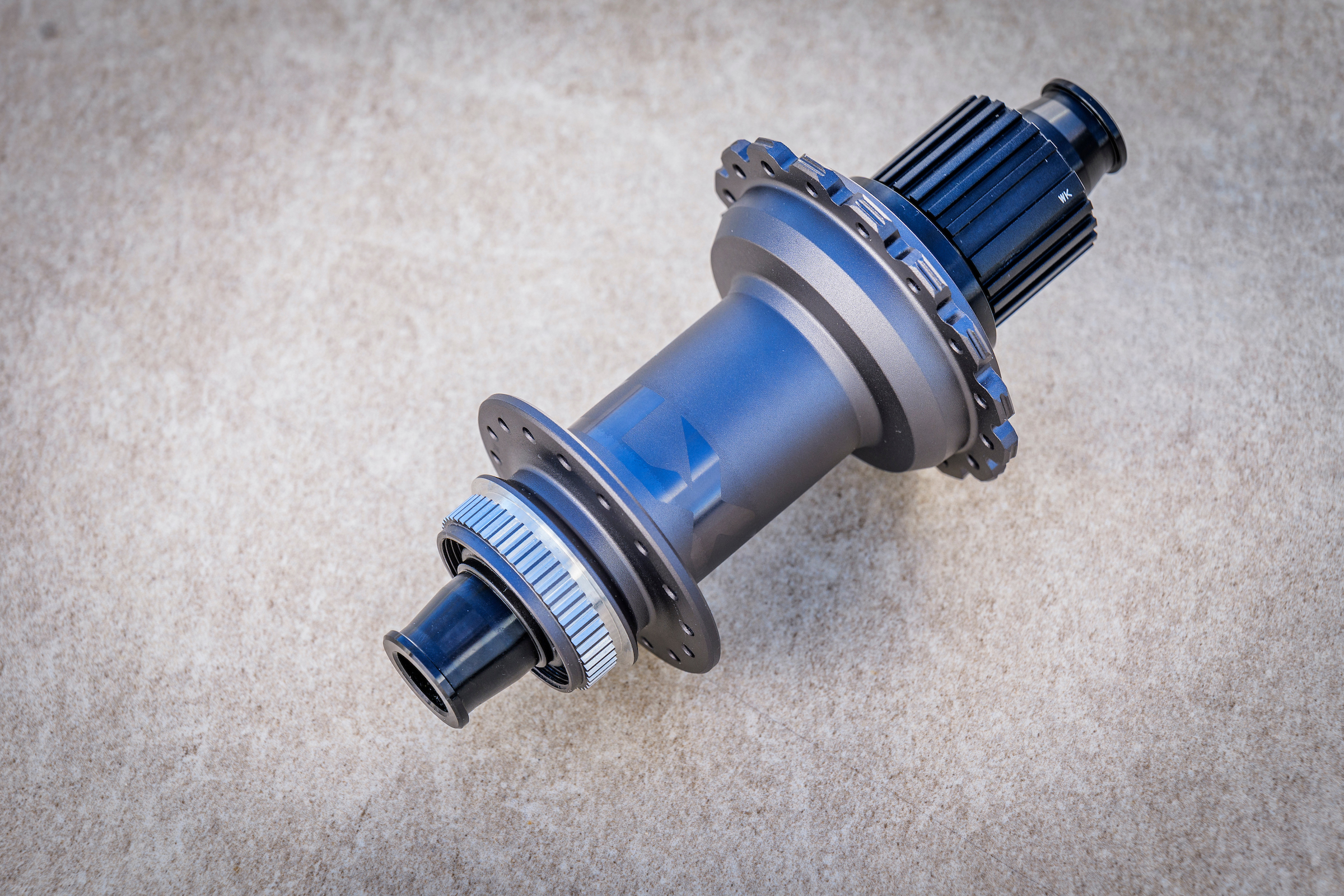
Q’Auto’s centrepiece is undoubtedly the FH-U6060 rear freehub. This pairs speed, cadence and gradient sensors with an internally housed dynamo.
The dynamo removes the need for a separate battery to be housed in the frame to power the Shimano Cues RD-U8050 rear derailleur. Instead, the small onboard lithium-ion capacitor is connected directly to the derailleur.
Shimano claims this can hold charge for up to a year, removing the need to manually recharge the derailleur.
On top of the hub and Cues Di2 derailleur (exploded above), the system includes a satellite shifter for the handlebar. Shimano
A dedicated wireless shift switch (SW-EN605-R), which is powered by two CR1632 coin batteries, can also be used to control the system. This enables you to override the default automatic gear selection to a preferred gear.
You can also use the switch to toggle between manual and automatic shifting modes, and can customise its functions through Shimano’s E-TUBE Project app.
Shimano claims the brains of the system, which are housed inside the hub, learn from these manual inputs, producing an automatic drivetrain better matched to your riding style.
Shimano Q’Auto compatibility
The system is pitched towards urban bikes… Shimano
While intended primarily for trekking, urban and electric bikes, the use of a standard 142x12mm thru axle and standard HG freehub body offers the tantalising prospect of combining the system with Shimano’s more performance-oriented road electronic groupsets.
There’s no word on the possibility of swapping to a Microspline freehub body for use with the brand’s other electronic gravel or MTB drivetrains.
That said, Shimano says the hub and rear derailleur are compatible with the brand’s pre-existing wireless Di2 switches and shifters – a further indication that we could see the system rolled out to 105, Ultegra and Dura-Ace Di2 levels on the road, GRX Di2 on gravel, or XTR Di2 for MTB in the future.
It’s worth remembering that the brand’s road groupsets are all currently 2x, and Shimano hasn’t confirmed yet whether the system could be adapted to accommodate a front derailleur.
…and gravel bikes. Shimano
At launch, the system is designed with long and short cage versions of the Cues RD-U8050 rear derailleur, which are compatible with the brand’s LinkGlide cassettes (used commonly on ebikes and some non-assisted bikes).
The 11-speed 11-50t and 11-45t cassettes, plus the 10-speed 11-48t cassette, require the use of the RD-U8050-SGS long cage derailleur, while the 10-speed 11-43t cassette uses the RD-U8050-GS short cage version.
As a result, the system is set to be seen on new urban and entry-level gravel bikes, while it will also be possible to upgrade an existing bike with the drivetrain.
Prices for the new system, as well as expected price ranges for fully built bikes, are still to be confirmed.
Haven’t we seen this before?
In 2017, we spotted this patent that describes much of what has been launched today. Shimano
Shimano’s self-powered Q’Auto system might feel like a bold leap forward, but the idea has been brewing for more than a decade.
Although the original design never made it to production, it clearly laid the groundwork for what we’re seeing today.
The patent described how the lower pulley would contain the dynamo, with rectifying and power-limiting circuits living on the pulley cage. Shimano
That patent described not only the dynamo-equipped pulley, but an entire ecosystem where derailleurs, computers and accessories could be powered from a shared energy source. At the time, it was a tantalising vision of a self-sufficient electronic bike.
Fast-forward to 2025 and Q’Auto realises much of that ambition – albeit in a more practical form.
The core principle, however, remains the same: eliminate reliance on a central battery, reduce rider maintenance and open the door to smarter, more integrated bike tech.
It has taken seven years, but Shimano has finally launched the long-awaited, wireless version of its top-flight XTR groupset, M9200.
It’ll come as no surprise that the drivetrain is wireless – cables no longer pull the derailleur across the cassette, instead Shimano’s own wireless protocol connects the shifter and derailleur, while a battery and motor push and pull the unit’s parallelogram over the cassette.
Shimano says market demands and performance benefits drove the removal of the gear cable.
It has taken time to get to this point, although the brand points to its other Di2 drivetrains that are prevalent in the eMTB market, as well as its durable Di2 LinkGlide 11-speed drivetrain releases over the past few years as proof that its engineers have been far from idle.
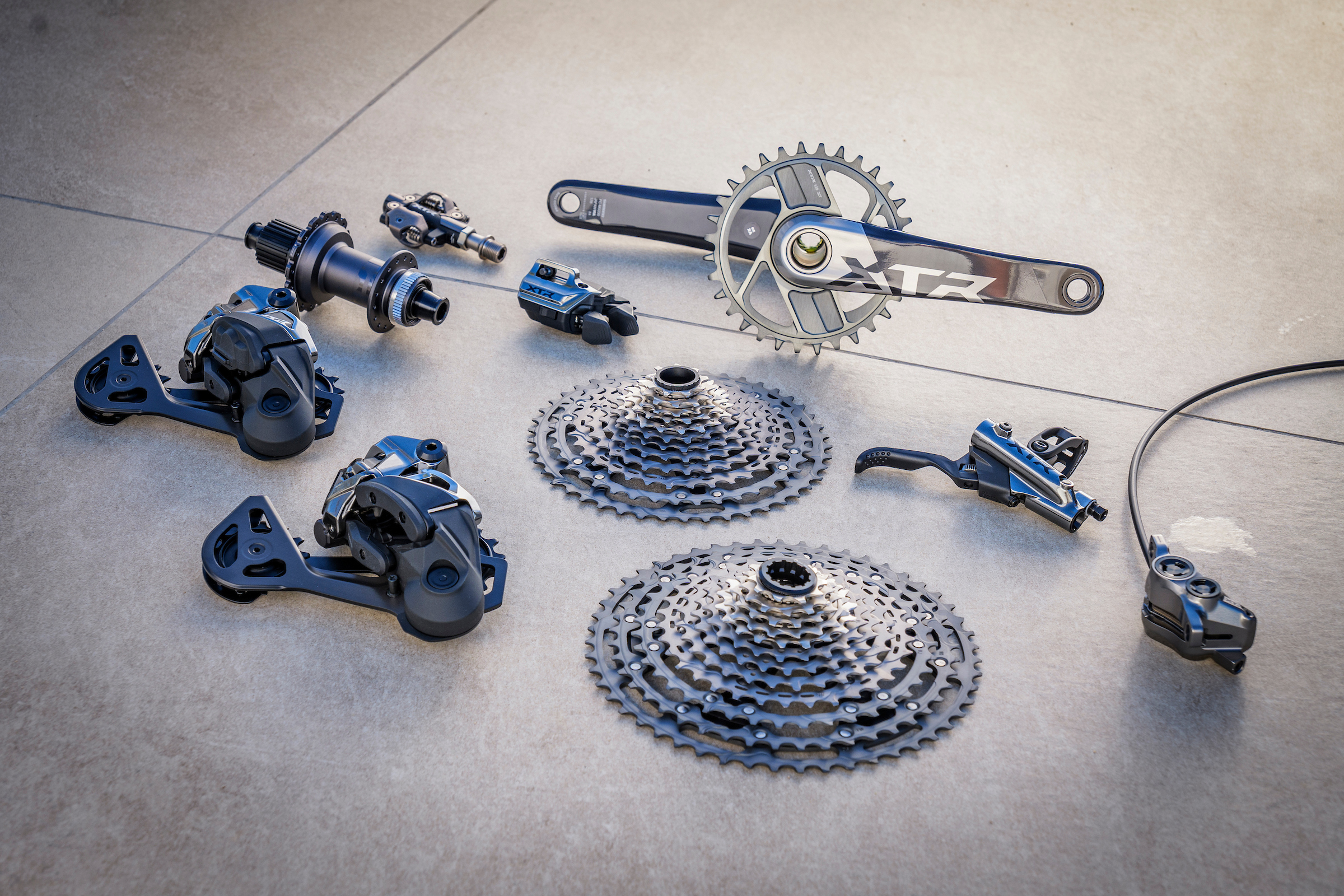
The new Shimano groupset in all its glory. Dan Milner / Shimano
Lessons have been learnt from these drivetrains, while they’ve also taken up development resources.
In addition to the new gears, which come in a duo of flavours for XC and trail or enduro riders, there are new brakes and wheels, too.
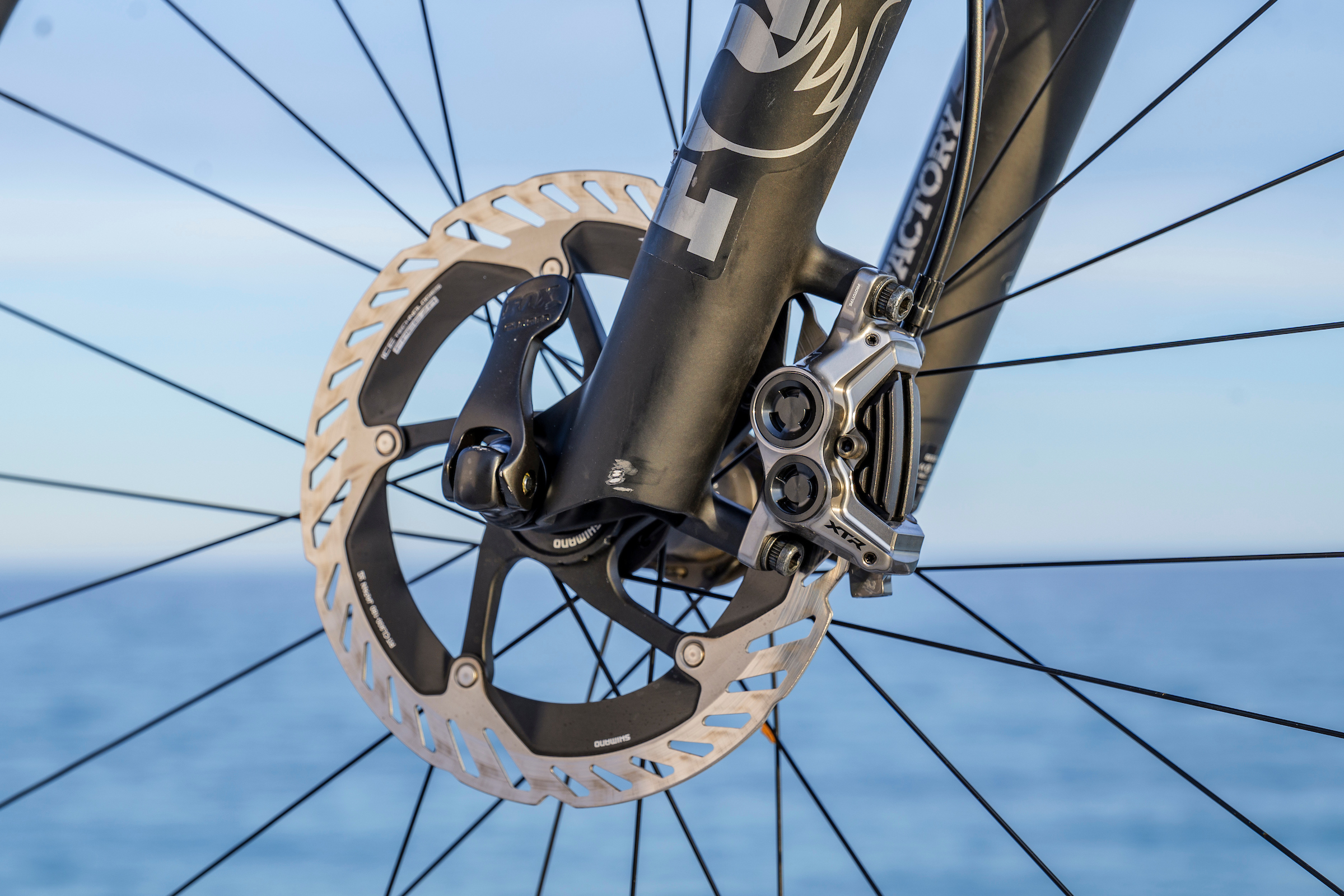
The lighter-weight XC brakes are on the surface almost identical to the previous XC brakes, but the new trail or enduro brakes have completely revised levers and calipers.
Both contain a new mineral oil, said to boost performance across a range of temperatures, killing off the wandering bite point issue that has dogged Shimano brakes in recent years.
Carbon rims, as well as a quick pick-up rear hub, feature on the new wheelsets. Again, XC, trail and enduro riders are catered for.
The business end of the new groupset – the derailleur, cassette and chain. Dan Milner / Shimano
Both pairs of rims are wide, with the enduro version just a little wider and sporting a broad rim wall to ward off punctures.
It is worth noting that there are no updates to either chains or rotors.
Fortunately, there are options for backward compatibility in the groupset – cranksets and chainrings, chains and cassettes of old will still work with the new groupset.
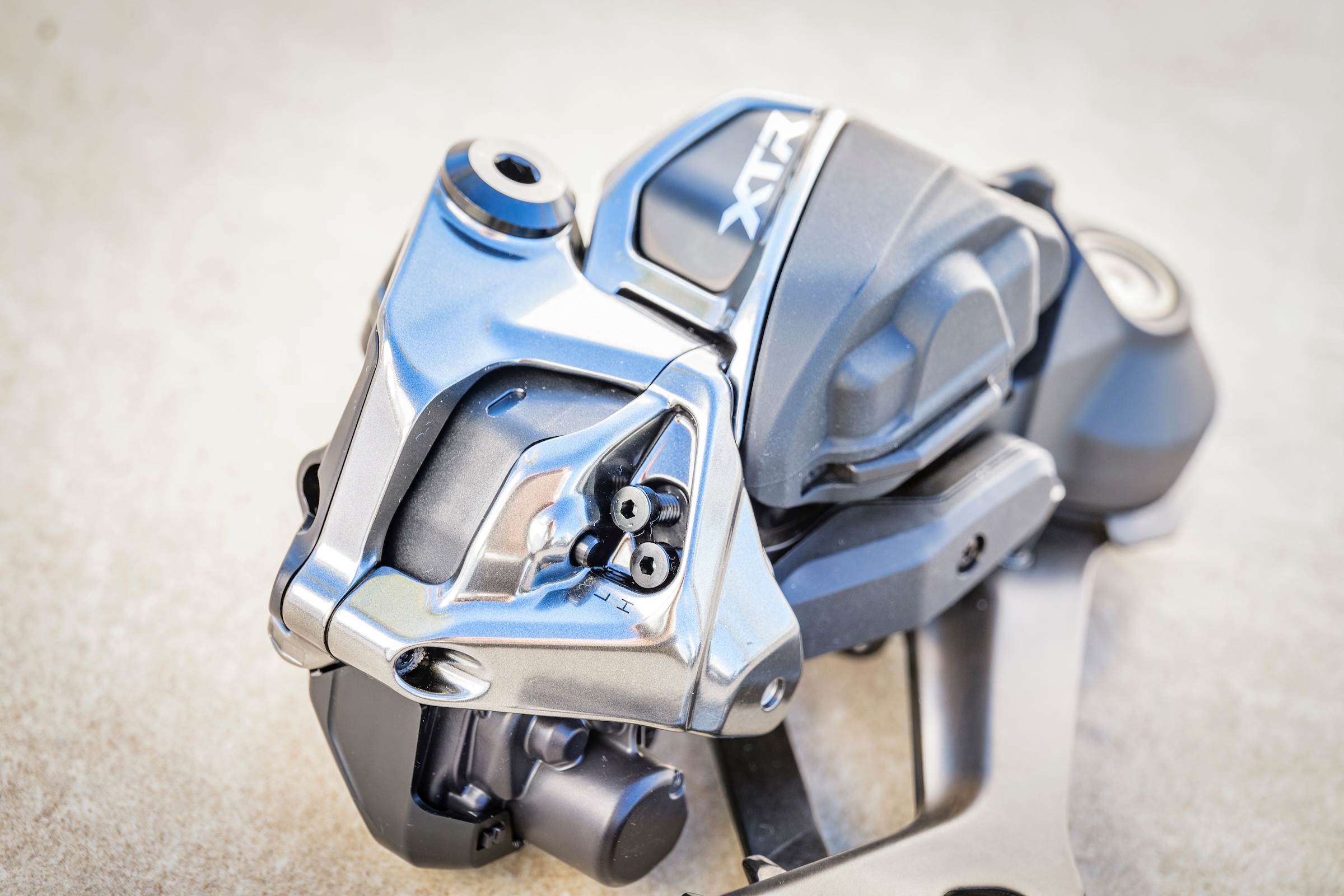
The new XTR derailleur connects to the frame traditionally, via a derailleur hanger, and features low and high adjustments and a b-tension screw to set the distance between the top jockey wheel and the cassette.
The unit is designed to be as low-profile as possible, with skid plates and forms designed to slide past impacts, rather than hang up on them. This ‘Shadow ES’ form is intended to minimise the number of impacts the derailleur encounters.
Should an impact occur, the Automatic Impact Recovery mechanism brings the derailleur back to its required position, without the rider being required to shift up or down to reset the system.
The main knuckle, from which the cage hangs, is built around a dual spring, rather than the spring and clutch of old. This means there’s no adjustability there, nor a clutch on-off switch to make wheel removal easier.
Shimano claims this system gives more consistent tension on the cage, so chain retention is better, it’s less likely to suffer from chain slap and should encourage improved chain wrap on the cassette teeth.
Shimano XTR derailleur details
Shimano’s new derailleurs rely on high/low adjustments and the b-tension screw. Dan Milner / Shimano
The battery has a capacity that’s said to give a range of 340km. This is reportedly 40% more than competitors, thanks to a mechanically more efficient system, and a communication protocol with the shifter that needs fewer messages to be relaid back and forth.
Lights indicate the battery level on the derailleur.
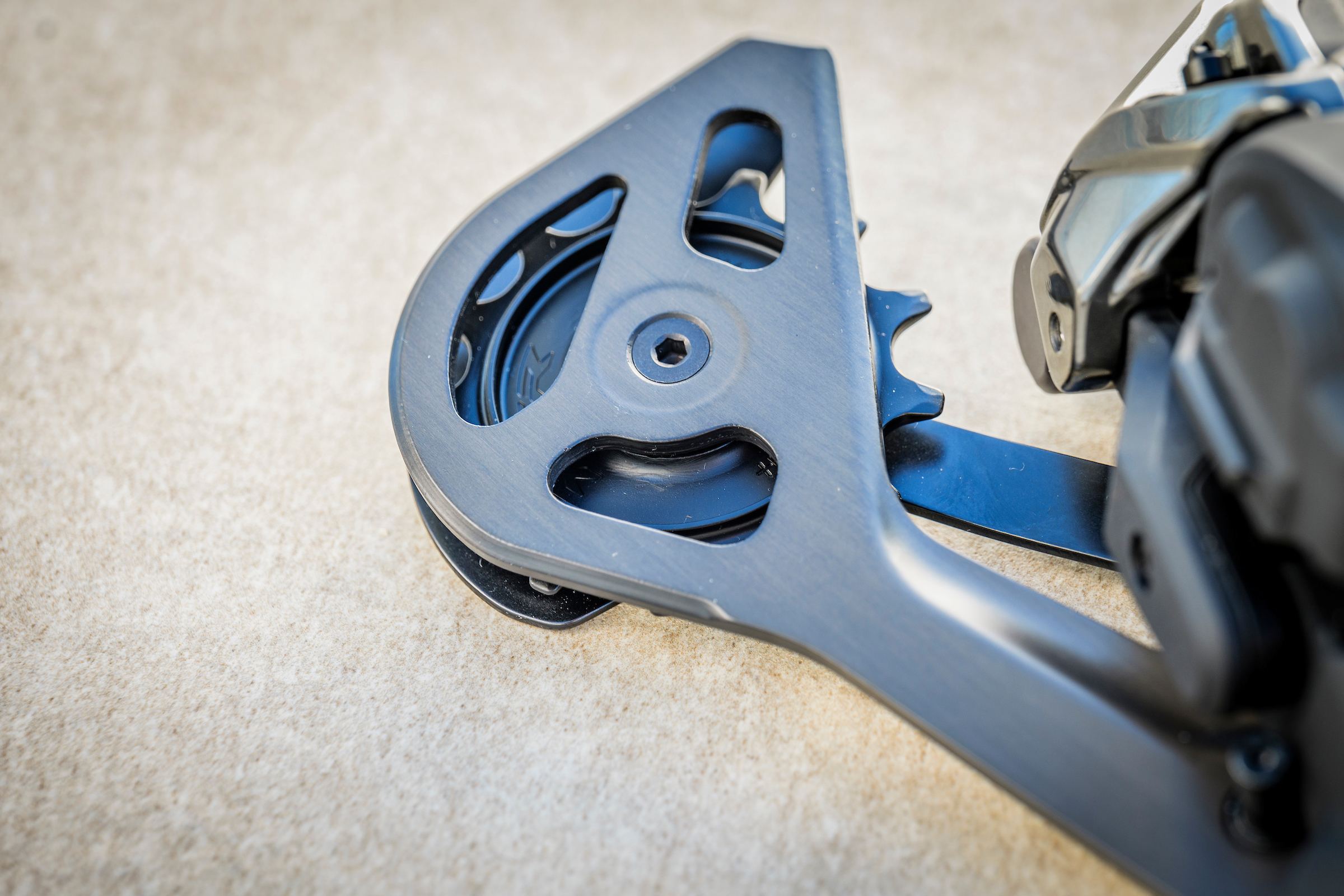
The carbon cage features 13t jockey wheels. They’re solid, which the Shimano engineers explained reduces their flex.
This, in turn, means better shifting performance, which also improves efficiency, according to Shimano.
A carbon cage and solid jockey wheels sit in the lower portion of the derailleur. Dan Milner / Shimano
While larger jockey wheels are increasingly popular, because they’re mechanically more efficient, Shimano wasn’t able to measure any notable improvements in efficiency, and so believes the stiffer jockey wheels offer the best performance.
Shimano XTR derailleur options
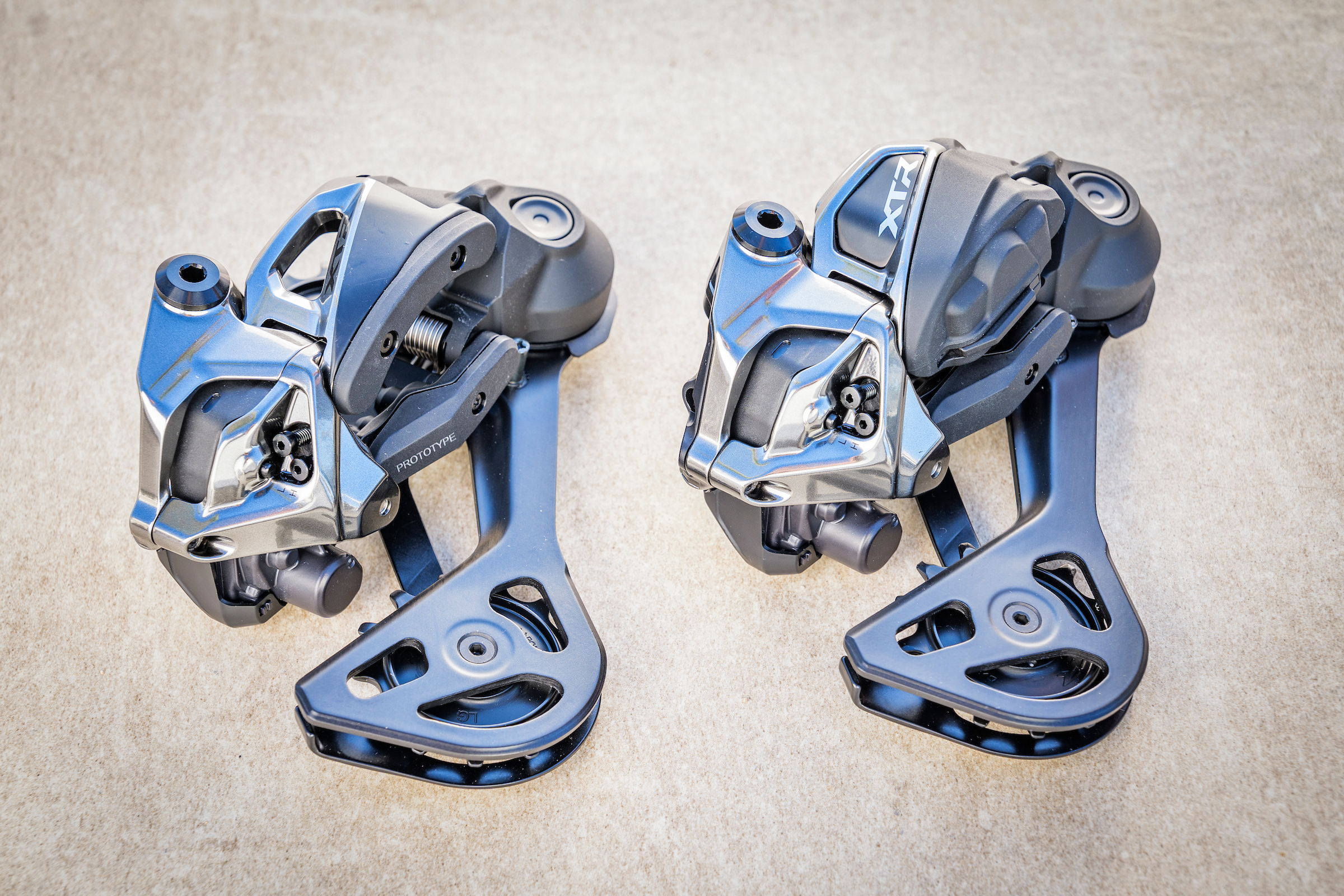
The two derailleurs – one for eMTBs (left) and one for non-assisted bikes (right). Dan Milner / Shimano
Shimano is offering two families – one for mountain bikes and one for electric mountain bikes, with the former utilising an onboard battery, while the latter is built to draw power from the eMTB’s main battery.
Each family will have two options – long and mid cages for the standard derailleur, and 11- and 12-speed options for the eMTB version.
The long, SGS derailleur is built for the 10-51t cassette. The mid, SG derailleur is built for the new 9-45t cassette.
In an update to the current Di2 MTB and eMTB-specific derailleurs, both Free Shift and Auto Shift will be available on the 12-speed setup – features previously reserved for 11-speed drivetrains.
Free Shift enables gears to be changed while you’re not pedalling, by independently rotating the chainring, via the Shimano EP8 motor. This enables you to pre-select a gear for an upcoming trail feature.
Auto Shift uses speed and torque sensors to shift gears automatically, without rider inputs at the shifter, to keep the pedal cadence within an optimal range.
Shimano XTR shifter
Shimano’s new XTR shifter. Dan Milner / Shimano
SW-M9250R: £184.99 / $205
Since Shimano released its Di2 drivetrains, its shifters have always mimicked ‘traditional’ cable shifters, with shift buttons in similar positions and offering a similar ‘click’ feel.
This is no different with the latest-generation shifter.
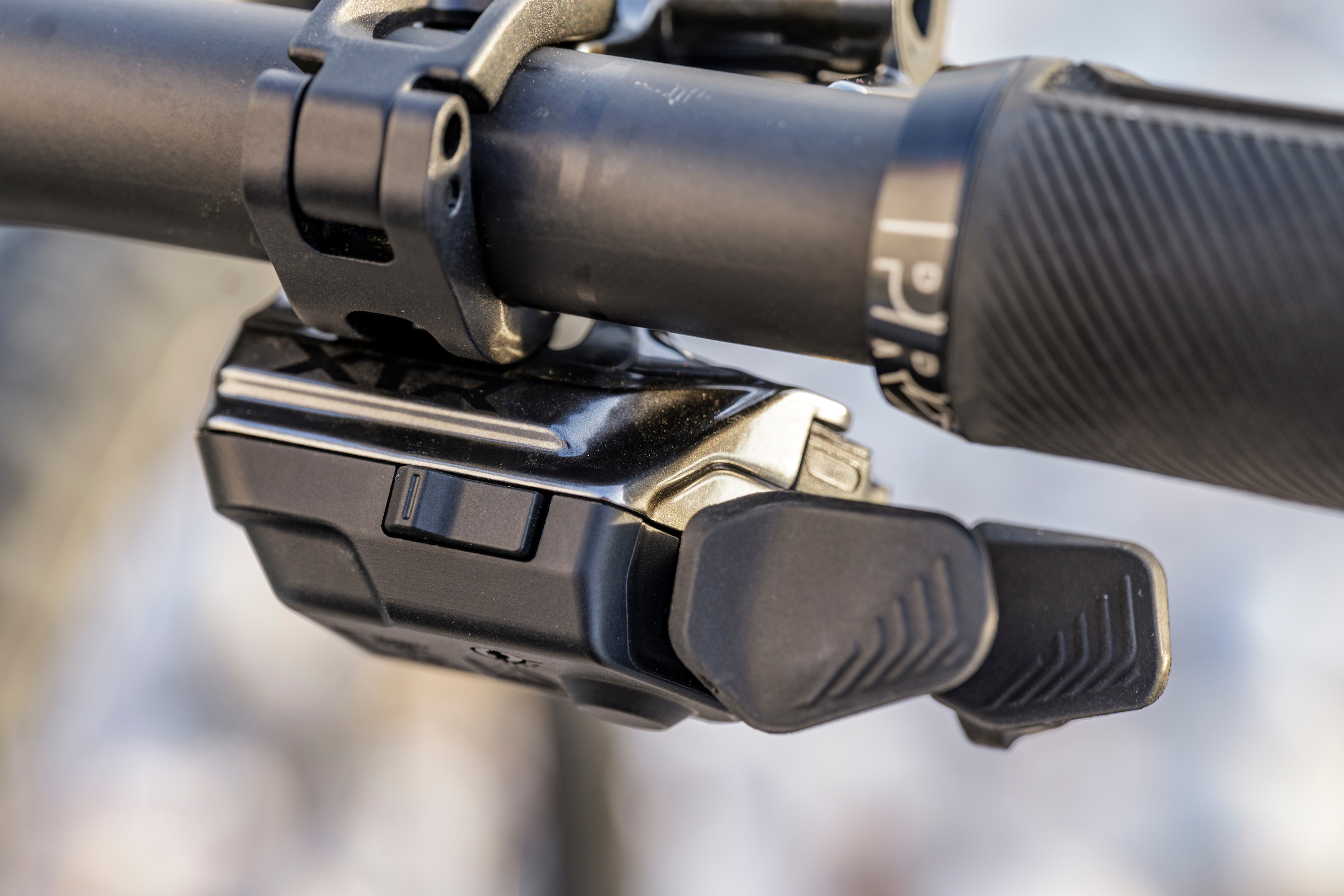
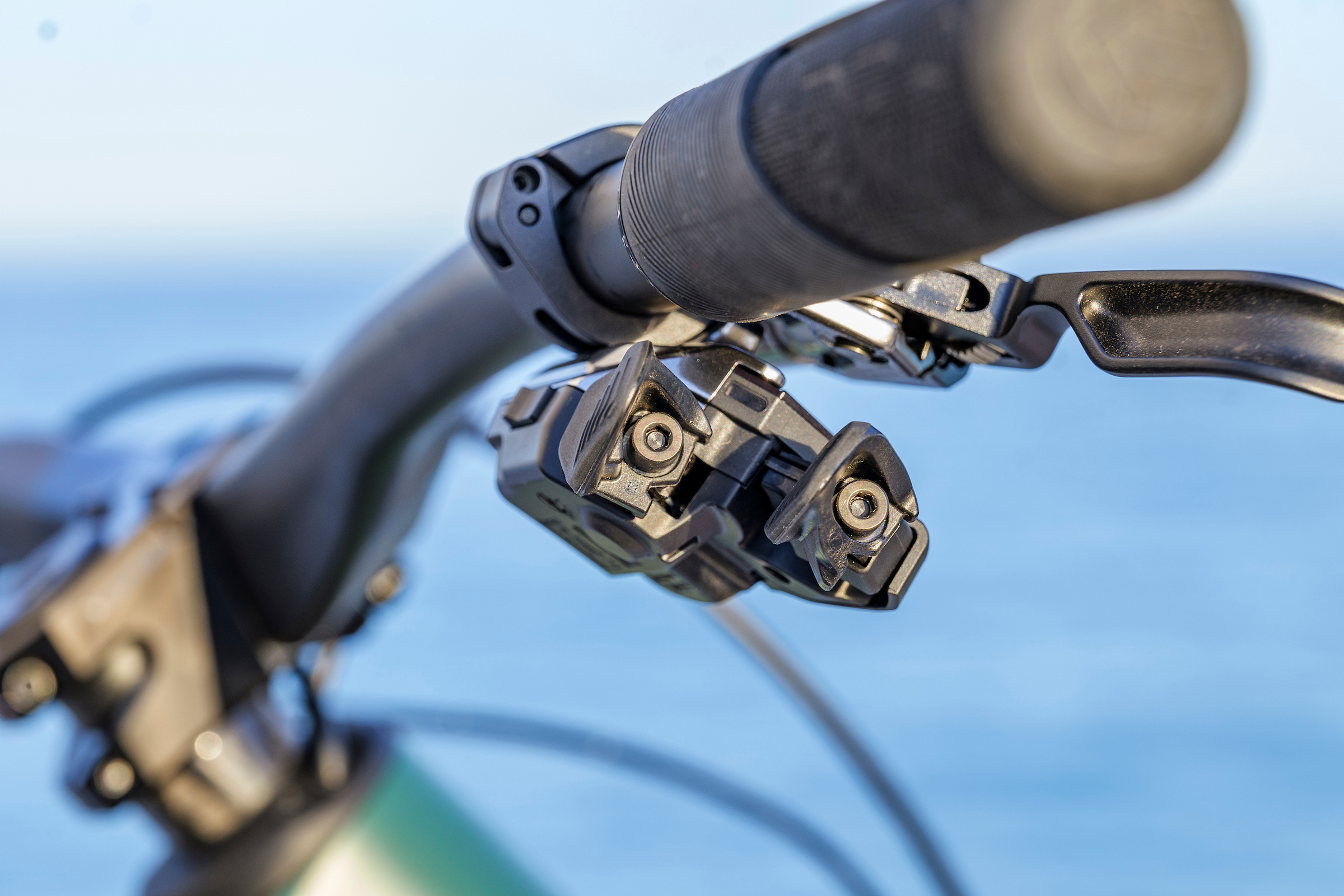
However, it is now a sleeker design, with a body that sits closely under the bar and now features a pair of four-way adjustable shift buttons.
The paddles are mounted on a ball joint, so their angle can be fully adjusted, and the larger and smaller paddles can be swapped front to back, too.
Four-way adjustability for the paddles is achieved through hex-key bolts. Dan Milner / Shimano
There’s the option for a single or push-through double click – a screw on the base of the shifter body enables or prevents this second click, depending on your preference.
As you’d now expect, the shifter can provide multi-shifts. Hold down the shift paddle and the derailleur will shift multiple sprockets at a time, with an in-app definition of how many shifts are provided.
A third button is provided on the shifter.
A long hold will enable you to trim the derailleur while riding and a short press can be used to control a variety of options.
These include those from third-party brands – Garmin and Magicshine are the two that stood out to us.
While Shimano says the function of that button is up to third parties, and wouldn’t comment on what that might be, road cyclists have been able to control their data screens on Garmin computers for years, and we would imagine a light-power toggle function might be offered by Magicshine.
Shimano XTR cassettes
The two cassette options: 10-51t and 9-45t. Dan Milner / Shimano
CS-M9200-12; $465 / £399.99
The Japanese drivetrain giant is releasing the groupset with two cassette options.
There’s Shimano’s long-standing 10-51t ratio cassette and a new 9-45t option.
They both get a new coating that’s said to reduce wear.
The 9-45t option is 70g lighter in weight. While this might offer up advantages for XC riders, we feel this, in conjunction with the short-cage rear derailleur, could be a good option for enduro riders looking to boost ground clearance – it does so by 23mm.
This 9-45t cassette still fits on Shimano’s Microspline freehub body, but requires a new tool in order to fit it, because the existing lockring has a diameter that is too large to work.
The new 9-45t cassette requires a new tool, but still sits on a Microspline freehub. Dan Milner / Shimano
Shimano acknowledges that the 9t sprocket is less efficient in terms of drivetrain efficiency, but it’s good to see this option for all riders, in our opinion.
Shifting performance should be similar to existing cassettes, thanks to the use of Hyperglide+ tooth profiling found on current-generation cassettes.
The existing LinkGlide cassette will be used for 11-speed builds.
Shimano XTR cranks
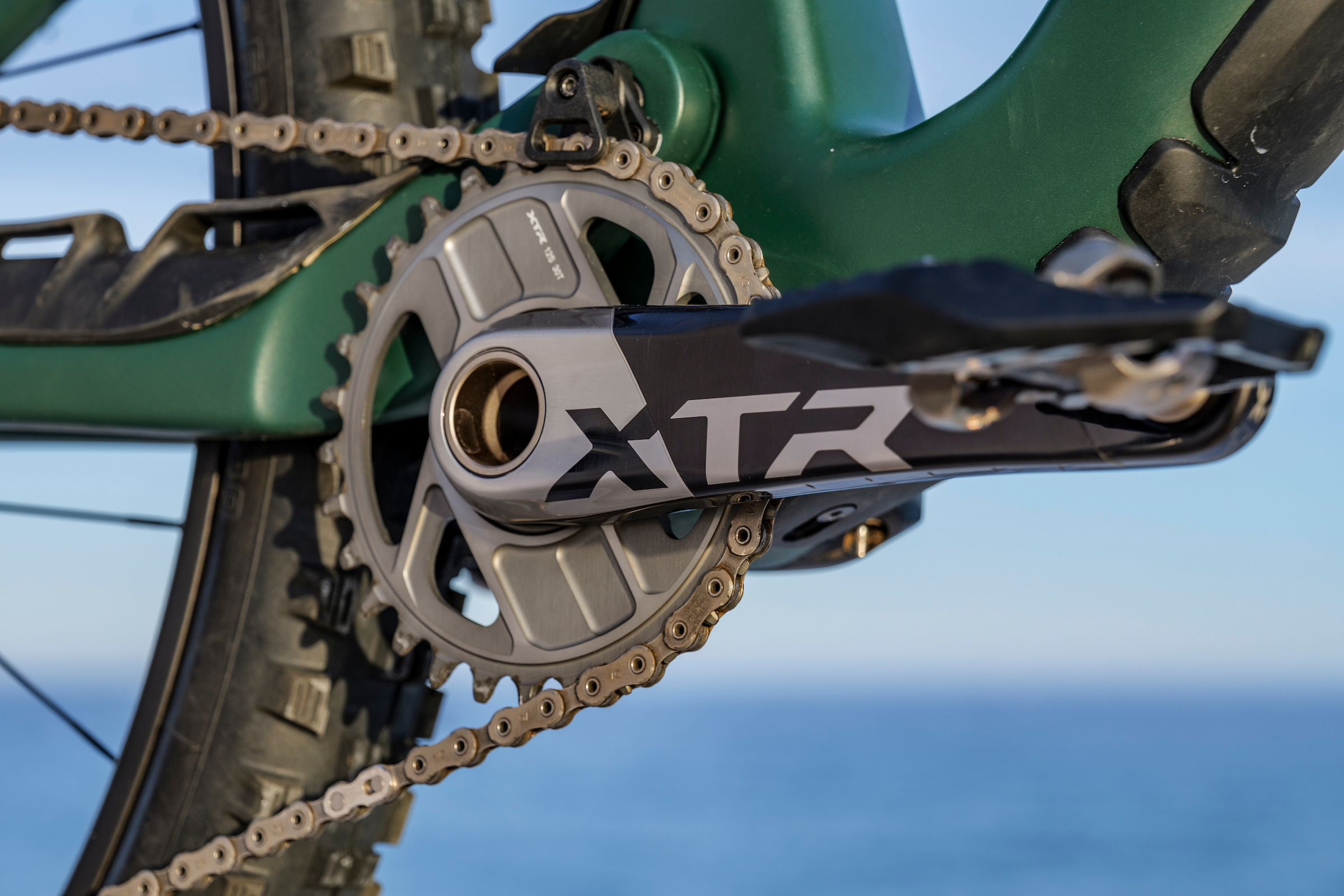
The brand new XTR crank is a real looker. Dan Milner / Shimano
FC-M9220 (trail and enduro): £379.98 / $415 (inc ring)
FC-M9200 (XC): £379.98 / $415 (inc ring)
FC-M9220 (trail and enduro): £249.99 / $280 (exc ring)
FC-M9200 (XC): £249.99 / $280 (exc ring)
SM-CRM96 chainring: £129.99 / $135
The jewels in the crown, in our eyes, are the new crank and chainring options.
Shimano has stuck with its tried-and-tested HollowTech II alloy construction.
Although it’s identical in appearance, there will be a thicker, more durable trail and enduro option, and a lighter-weight XC crank, with the XC crank offering a slightly narrower Q-factor.
The cranks will be available in a broad range of lengths, from 160mm to 175mm.
Solid blocks in the chainring add strength and stiffness. Dan Milner / Shimano
The trail and enduro crank will have a Q-factor of 176mm, while the XC crank will be 168mm, both built around a 55mm chainline.
Sadly, there’s no power meter option with XTR, so if you need to know how many watts you’re pushing, you’ll need to rely on third-party hardware.
The chainrings have a new look, too.
The closed portion of the rings’ splines is there to offer increased impact protection at the 3 and 9 o’clock crank position that is more likely to experience chaining impacts.
28-36t options will be offered, in two-tooth increments.
Shimano XTR brakes
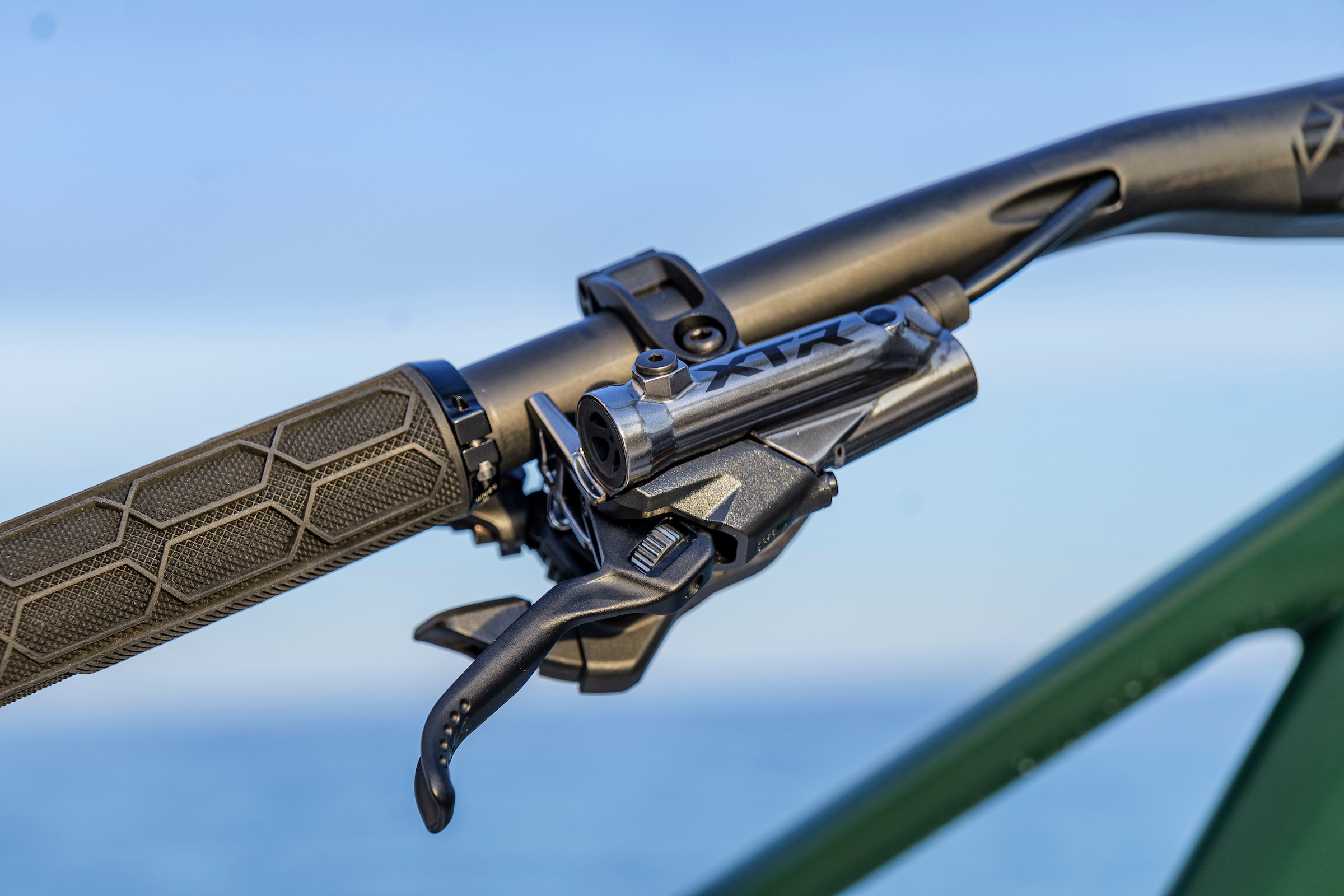
The new trail and enduro lever sits closer to parallel to the bar and contains new internal architecture. Dan Milner / Shimano
BR-M9220 (trail and enduro): £229.99 / $295
BR-M9200 (XC): £249.99 / $260
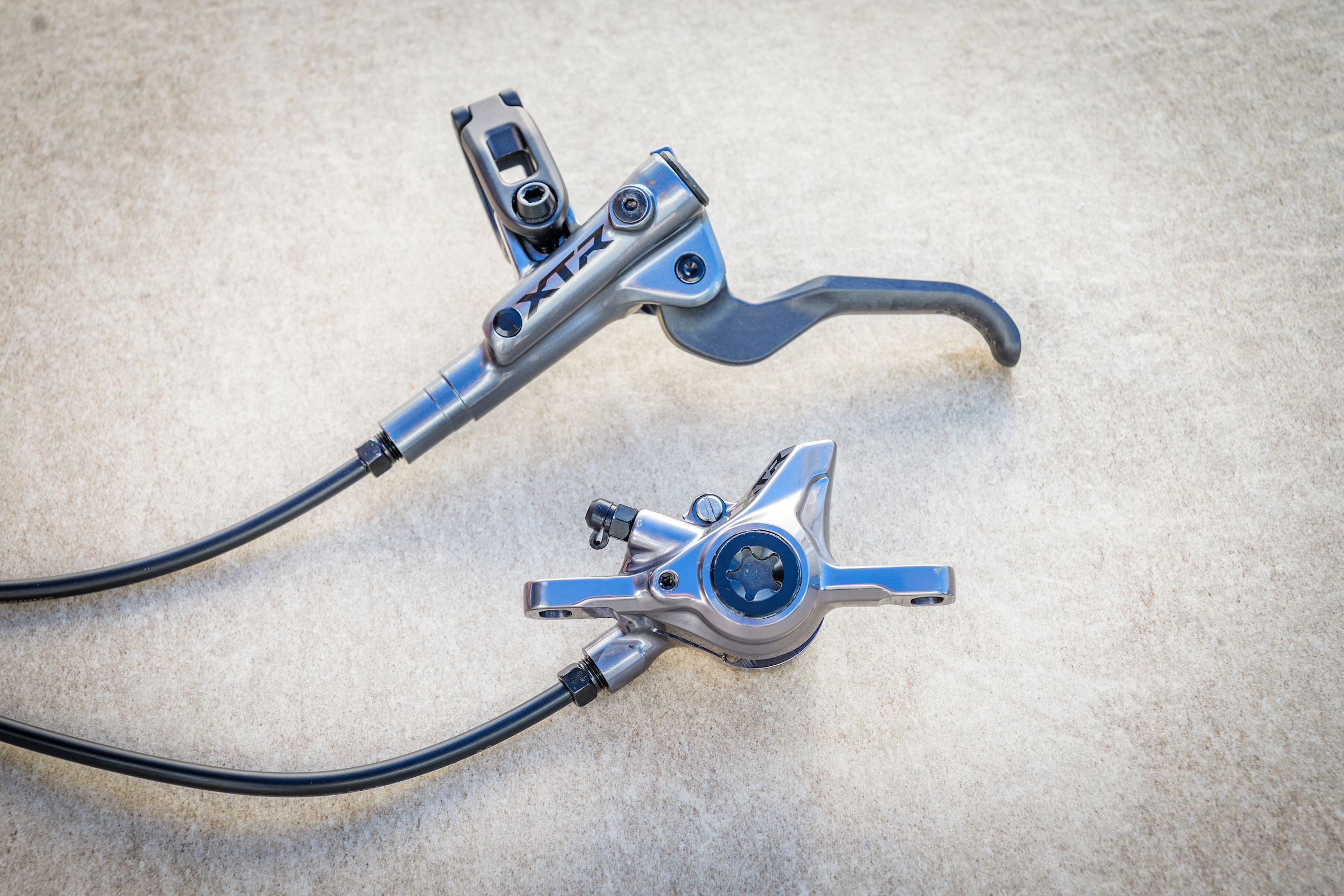
As we’ve seen in previous iterations of Shimano’s groupsets, there will be two versions of the XTR brakes – trail and XC.
Shimano acknowledges the issues it has faced with wandering bite points and says it has fixed the problems with this generation.
The main issue, it says, was the mineral fluids, and so there’s a new type in use here.
Shimano XTR XC brakes
XC riders receive refreshed brakes, although on the outside, they’re pretty similar to the outgoing version. Dan Milner / Shimano
The XC brakes look nigh-on identical to the previous-generation XC brakes, with a svelte lever and a two-piston caliper.
Inside, though, new seals are designed to work with Shimano’s new low-viscosity mineral fluid, which is said to be much more stable at a range of temperatures.
Sadly, the new mineral oil is not backward-compatible, nor can you use your current bottle of mineral fluid to top up the brakes, because this would damage the new seals.
A magnesium master cylinder and carbon lever blade help keep weight low.
Shimano XTR trail and enduro brakes
The new four-piston calipers have redesigned pads to reduce rattling. Dan Milner / Shimano
The lever end of the trail brakes is much more obviously new, with a completely revised architecture.
The hose exits the lever body much closer to the bar, enabling cleaner-looking through-headset routed hosing.
The lever holds a larger reservoir of fluid, adding consistency, and the fluid is now pulled through the system, rather than pushed, by the master piston.
Shimano has subtly changed the brake lever blade to improve ergonomics.
The pivot has been moved closer to the bar to give a more natural-feeling lever travel through its stroke, while the lever is tilted 5 degrees upwards from the pivot, to better match your finger’s position over it when in use.
At the caliper end, the brake pad has grown in size, offering increased surface contact with the rotor.
The pads still feature their wings, to help dissipate heat, but the additional size is also said to reduce pad rattle.
This is further aided by an ovalised hole for the retaining pin to go through.
Shimano XTR wheels
The carbon rims are wide and designed to be puncture-resistant. Dan Milner / Shimano
WH-M9220 (trail and enduro): £1,249.98 / $1,550
WH-M9200 (XC): £1,699.98 / $2,170
Two sets of wheels will be offered – an XC pair and a set for enduro and trail riding. Both will feature carbon rims.
The enduro and trail wheels feature a hookless rim with a 30mm internal width, and a broad rim wall to ward off punctures. It’s held onto the hubs by 28 spokes – relatively few for a wheel of this type.
The hub has been built to reduce drag, while there’s a 3.5-degree engagement angle.
The new rear hub has a very low engagement angle. Dan Milner / Shimano
The XC wheels have a marginally narrower rim, at 29.6mm internally, and are built with 24 titanium spokes onto a low-drag, high-engagement hub.
Hubs will also be available to purchase.
Shimano XTR finishing touches
Shimano is also offering new pedals. Most noteworthy are the trail pedals, with an improved platform to offer more support to your shoes.
The XC-focused pedals will have two axle options – one offering a 3mm narrower stance.
An upgrade kit, consisting of a derailleur, shifter, and associated chargers and battery, will also be offered.
PD-M9200 (XC pedals): £159.99 / $TBC
PD-M9220 (trail and enduro pedals): £179.99 / $TBC
Paranormal horror game Phasmophobiais being adapted into a movie by Blumhouse Productions and Atomic Monster, in partnership with the games developer Kinetic Games. Blumhouse is a major player in the horror genre, having produced the Purge and Paranormal Activity franchises as well as Get Out, The Invisible Man and many more. Atomic Monster produced all the films in The Conjuring universe since 2016’s The Conjuring Two.
First released on PCs in 2020, Phasmophobiaquickly became a pandemic-era hit, with YouTubers and streamers racking up millions of views playing the multiplayer survival game. The game follows one to four players as they work to complete a contract requiring them to identify the type of ghost haunting a specific site.
Blumhouse Productions announced the Phasmophobia adaptation at its first-ever “Business of Fear” event in Hollywood, where founder and CEO Jason Blum and Atomic Monster founder and CEO James Wan spoke about the business of horror movies. No distributor or release date has been announced yet.
This article originally appeared on Engadget at https://www.engadget.com/entertainment/tv-movies/phasmophobia-is-getting-the-hollywood-treatment-155654171.html?src=rss
One of the more unique Nightlord fights you’ll encounter is Gnoster, Wisdom of Night, during the Sentient Pest mission. The first phase of this boss is a dual fight, which then turns into a single-target encounter halfway through.
As gaming in general has boomed in popularity over the last several decades, so has the focus on mobile gaming. With improving technology on the hardware and software side, this paradigm is even more enjoyable for users to partake in now. Case in point, Fortnite, one of the most popular games on the planet, also has a Fortnite Mobile version
OpenAI is expanding ChatGPT’s enterprise capabilities with new integrations that connect the chatbot directly to business cloud services and productivity tools. The Microsoft-backed startup announced connectors for Dropbox, Box, SharePoint, OneDrive and Google Drive that allow ChatGPT to search across users’ organizational documents and files to answer questions, such as helping analysts build investment theses from company slide decks.
The update includes meeting recording and transcription features that generate timestamped notes and suggest action items, competing directly with similar offerings from ClickUp, Zoom, and Notion. OpenAI also introduced beta connectors for HubSpot, Linear, and select Microsoft and Google tools for deep research reports, plus Model Context Protocol support for Pro, Team, and Enterprise users.
Elden Ring Nightreign can pose an immense challenge, even for seasoned veterans of the Soulslike genre. So, you’ll want to be sure you’ve got all of the resources you can possibly find to increase your chances of survival. Chief among these is healing flasks, which may stand between you and a fatal blow. If you’re…
Apple is reportedly on the cusp of leading the way in mobile chipset manufacturing and processing power, with rumors suggesting that the future iPhone 18 Pro models will be powered by a groundbreaking A20 chip. This new silicon, expected to debut in the iPhone 18 Pro, iPhone 18 Pro Max, and potentially the all-new iPhone 18 Fold, promises
Here’s another game to play on that shiny, new Switch 2 console. Hello Games just announced that it’s releasing a free update for No Man’s Sky to launch alongside Nintendo’s new device. It includes many features that the original Switch version lacked, like 4K texture support.
The update also finally brings full multiplayer to this version of the game, along with cross-play and cross-save. In other words, players can save the game on the Switch 2 and pick it up on another device. Spoiler alert: No Man’s Sky is on just about every platform imaginable.
The developer promises DLSS and DLR support, a better UI, touch controls and a resolution boost for both handheld and TV modes. Hello Games says this update took a full year to make, after receiving development kits around 12 months ago.
The Switch 2 version will also include the latest big update for the game, called Beacons. This brings a town management mechanic to the title, with plenty of new homesteads to discover. Players can design their own hangout locations within these towns, like bars or fishing ponds. Beacons is available on all platforms.
No Man’s Sky isn’t the only game getting a software refresh for the Switch 2. The console launches alongside several Switch 2 editions that feature graphical overhauls, like both recent mainline Zelda titles.
This article originally appeared on Engadget at https://www.engadget.com/gaming/nintendo/no-mans-skys-free-switch-2-update-adds-full-multiplayer-and-4k-support-153124323.html?src=rss
Many of us have been waiting for the day when we could download Ryan Coogler’s exceptional horror flick Sinners so it can scare us in the comfort of our own homes. To celebrate the release of Sinners on digital retailers, Fandango released a deleted scene from the film that adds a bit more emotional weight to the…
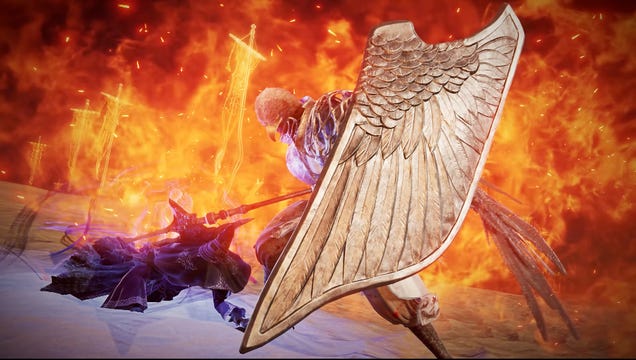
If you like to tank attacks from enemies, there’s one class in Elden Ring Nightreign that’s perfect for you: Guardian. This big bird is decked out with armor and a shield for the ultimate protection. The Guardian is fantastic at both crowd control and diverting attention away from his teammates to be one of the best…
Major Hollywood studios are extensively using AI tools while avoiding public disclosure, according to industry sources interviewed by New York Magazine. Nearly 100 AI studios now operate in Hollywood with every major studio reportedly experimenting with generative AI despite legal uncertainties surrounding copyright training data, the report said.
Lionsgate has partnered with AI company Runway to create a customized model trained on the studio’s film archive, with executives planning to generate entire movie trailers from scripts before shooting begins. The collaboration allows the studio to potentially reduce production costs from $100 million to $50 million for certain projects.
Widespread usage of the new technology is often happening through unofficial channels. Workers are reporting pressure to use AI tools without formal studio approval, then “launder” the AI-generated content through human artists to obscure its origins.
Sonic Racing Crossworlds is the next mainline installment in Sega’s popular kart racing franchise. The Mario Kart-like racing game is set to launch later this year and will include the roster of characters you’d expect, like Sonic himself, Tails, Dr. Robotnik, and uh…SpongeBob SquarePants? Wait a minute.