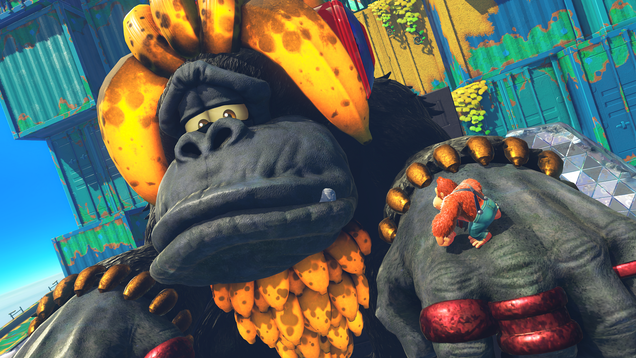
The Virtual Expo 2025 Can’t Match The Real Thing

We recently attended Japan’s Expo 2025, weighing up how this World’s Fair compares with its virtual counterpart.

Expo 2025 is a World’s Fair of old, dragged into the present. For those less familiar, World’s Fairs have existed since the late-19th century for both countries and powerhouses of the private sector to showcase national pride and progress on the global stage. It’s part soft-power politics and part science and tech fair, a concept that means you’ll have Astro Boy exploring iPCS cells and the future of healthcare, star-shaped mascots singing about America, the Land of the Free (and AI), and a Monster Hunter XR showcase in the same location.

The historic impact of these events can’t be overstated. The Eiffel Tower was created for France’s 1889 World Expo, while other fairs saw the public debut of both the Ferris Wheel and the mobile phone. In summary, these events are snapshots of the world as it exists at the time, as well as what it could be in the future. Expo 2025 won the rights to host its event in 2018, and thus was fully realized and begun construction in the depths of the COVID-19 pandemic and the metaverse craze.

Even pre-pandemic, Japan proposed its Expo 2025 would explore the theme of ‘Designing Future Society for Our Lives’. How could we create a sustainable society of the future where humanity can rethink its current way of life while still retaining its potential to thrive? The event places front and center in promotional material that this is the ‘laboratory for a future society’, a testing ground all about saving, empowering and connecting people.

If you’re crafting a major showcase under these parameters in the lockdown depths of 2020, why wouldn’t you propose a Virtual Expo for your event? In the physical world, everyone is invited to Osaka, Japan, to see Expo 2025 for themselves. For those unable to make the trip, this would be the first such event accessible worldwide virtually, allowing countries and corporations to showcase themselves on a global stage from the comfort of their own home.

Looking at how many Japanese events still embrace virtual communities, it’s not even like the concept of a virtual event is a remnant of the past or out-of-step with the attempts of other organizations in the country. Online communication and events didn’t disappear with the lockdowns – we still use Zoom, and Tokyo Game Show continues to support its virtual rendition even as its in-person event returned to full capacity.

The difference is, people are now actively seeking in-person connection and fun, rather than remaining stuck behind a screen. If Virtual Expo: Yumeshima Islands in the Sky (named after the Yumeshima artificial island the event is hosted on in Osaka) is to succeed in this environment, it needs to bring a unique experience simply not possible elsewhere, even at the show itself.

The Virtual Expo is supported on phones, PC and VR devices, and admittedly delivers a strong first impression when I jumped in a few days before my planned visit. Far more than your average VRChat world, the Virtual Expo is a dedicated free application that offers enough content to feel like a full game, rather than a secondary experience. After logging into your Expo account you enter a full avatar creator that, though admittedly limited to a few set facial styles, costumes, hairstyles, plus hair and skin colors, still gives players ample ability for self-expression.

You’re then dropped into the application’s hub world where you can meet the charming and adorable Soramin, before being released to explore the expo. Refreshingly, this is far from a static hub, and events take place virtually at the same rate as the real thing. If there’s a National Day inside the real Expo 2025, it’s also that day virtually, filled with virtual flags. As a World Expo with the expectation players of all cultures and languages will join, there’s even an in-built translator for voice and text chat for multiple languages so you can talk and meet strangers and friends inside the event.

On paper and when first booting the app, it feels like a real but distinctly virtual event, filled with endless things to do and pavilions to explore. Until you dig closer.

There’s a sense of contractual obligation with the event, a clear example of many countries being forced to participate while soon realizing the Virtual side of the expo was far from a priority. Each virtual island hosts a selection of pavilions and virtual experiences that players are encouraged to physically walk between and explore at their leisure. The Soramin and the event’s mascot, Myaku Myaku, are often enjoying their own cute activities in the open spaces that help these places feel alive. Some will even give you emotes for communicating with other players or new costumes.

These islands recreate the floor plan of the expo on a 1:1 scale that’s surprisingly helpful if you jump from the virtual to the physical Expo (the real event is not the most intuitive to navigate, to the point I still found new pavilions even in the latter stages of a 10-hour day). It was useful creating a mental map by wandering the virtual expo, only to see it aid my exploration when I visited Osaka later that week.
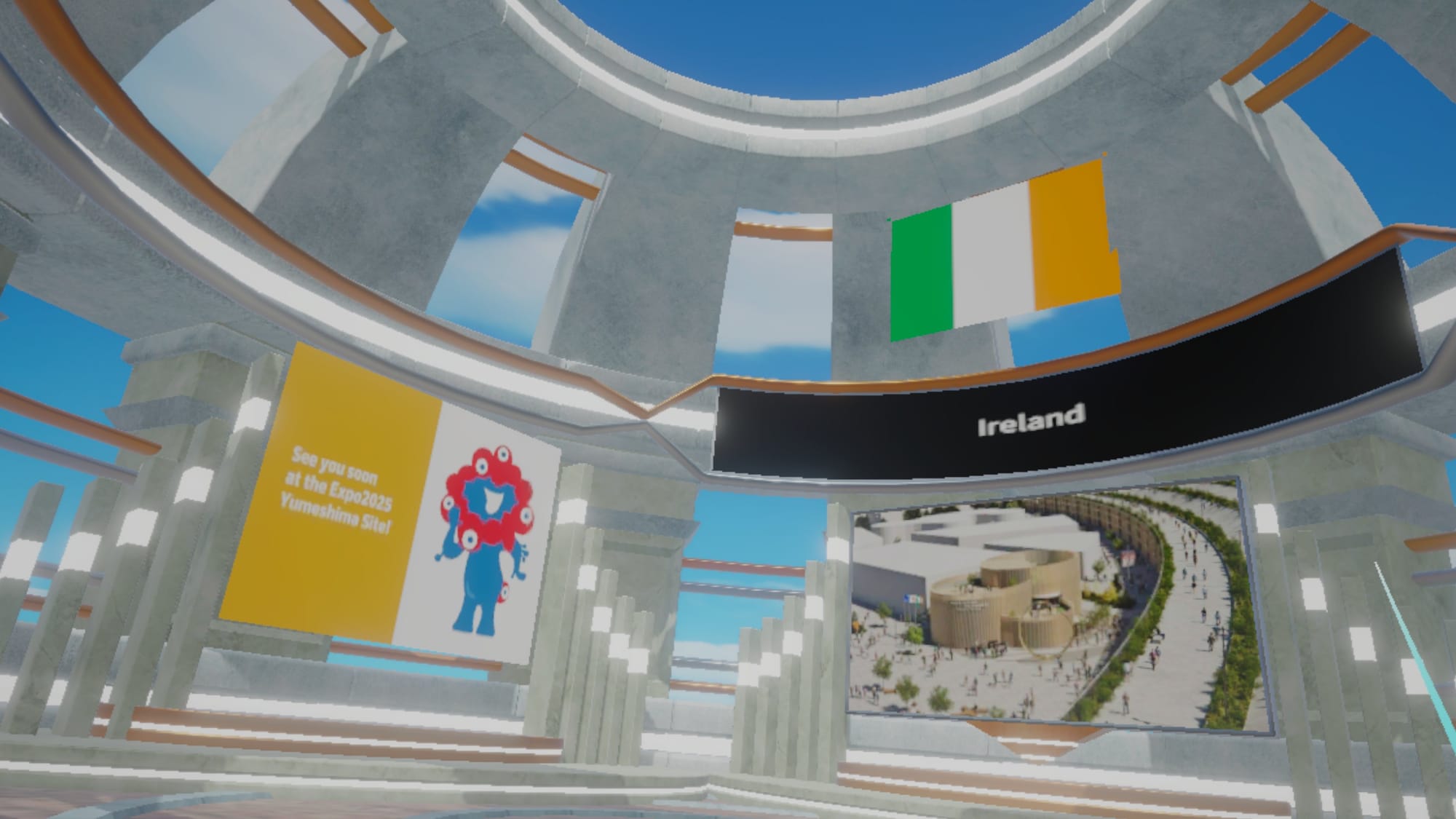
The virtual pavilions themselves, however, are a mixed bag. Many are non-existent, simply forcing players into long load times only to find an empty room with a blurry stock image of an artist’s render of the pavilion with a text description for what the real Expo 2025 offers. With flashy exteriors replicating the real thing to make each of these buildings look enticing, these copy-paste template pavilions are all-too common. From a sample of roughly 40 virtual pavilions, over 50% followed this exact formula, similar to going to a party only to watch the door get locked in front of you just as you’re about to approach.

Some countries did attempt to create something. Mozambique had a walkthrough where they had speakers discussing parts of their culture and prowess as a developing nation alongside some stunning photos of the people, and you even got a free costume to wear around the pavilion as you left. Even these showcase another drawback, relying on YouTube videos that barely function in order to portray anything that can’t be rendered via simplistic 3D models or text boxes.

There are a few pavilions that embrace the virtual nature of this experience to deliver something thematically similar to their real-world equivalent that embraces the new medium. Amidst the private and national pavilions available at Expo 2025 are six Signature Pavilions, constructed under the supervision of artists and professors from across Japan to challenge the event’s theme and embrace their craft.
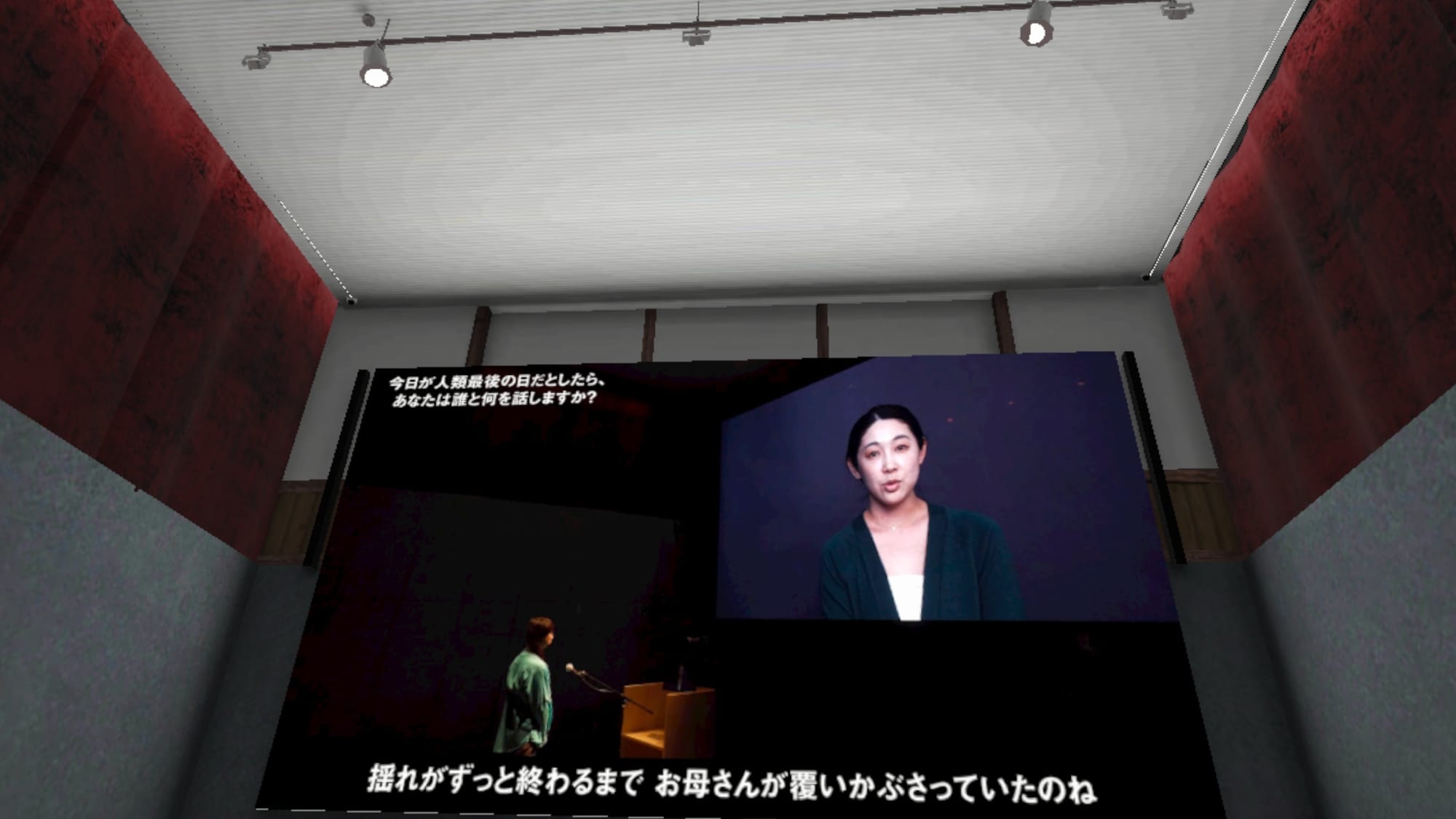
Each is promising on paper: professor and roboticist Ishiguro Hiroshi explored the future of life itself, while artist Ochiai Yoichi questioned the humanity of digital technology with an experimental showcase that would scan attendees and create high-quality duplicates to meet and converse with, a question of how to identify and retain humanity in an AI and digital future.

For the latter, without the ability to scan attendees, this core aspect of the pavilion is impossible to recreate in VR. Rather than give up on the idea entirely though, a disorienting experience is crafted instead that captures the intent of causing visitors to spiral and question their self and status in a virtual space. It’s a little terrifying for its chaotic structure, but somehow it works.

Pavilions like this, or the Panasonic pavilion that turns the drawings of kids to life to capture the spark of human creativity, show a path these pavilions could have taken to make these virtual experiences meaningful and distinct. Instead, Virtual Expo is an empty space of broken dreams, without even the promised gaggle of attendees you could speak with in order to experience it with others.

One benefit is the ability to virtually watch special talk sessions occurring at the real-world Expo – in aid of the theme and national days, guests are occasionally invited to discuss sustainability and topics of social consciousness, from rebuilding communities after earthquakes to water sustainability. You can watch them here, though even these are YouTube livestreams you could more easily watch without the application.

It’s a nice idea that people unable to visit Osaka can experience the event virtually, with the motivation to meet people and customize an avatar while doing so. But it hardly creates an experience of visiting a World’s Fair when all you get in many cases are empty rooms or YouTube videos. Yet after visiting the Expo itself I’d go further, and argue that this Virtual Expo is a showcase of the fundamental flaws at the heart of the maximalist view of the metaverse. Even if this app delivered the best possible virtual rendition of the Expo, it misses the point: it’s impossible to craft the spontaneity of human connection and discovery virtually, at least for now. And that’s ok.

It was a warm-yet-cloudy Thursday when I visited Expo 2025, and I had methodically researched my trip ahead of the event out of excitement and a desire to get the most out of my day. As silly as it may sound, the idea of a World’s Fair was exciting for me, a chance to try new things, and there were pavilions I’d been recommended and seen in guidebooks I thought I simply must visit. I made some reservations for entry in advance for some pavilions, while others I simply planned to make bookings on the day or line up to visit. France had classic art, Poland had Chopin, and there was a taiko matsuri only there on the day I visited! I was excited!

That plan was discarded almost immediately, bar those few reservations, and my day was improved by embracing whatever came my way. If anything, the most joy came where I least expected it. As I waited for my first reservation with the knowledge there was no time to check anything meaningful before my time slot, I stumbled upon the Malaysia pavilion. On a small raised platform at the entrance of the pavilion were dancers engaged in traditional Malay dance. It was mesmerizing.

I’m not one to profess expert knowledge on this topic, but the smooth movements and playful interactions between the male and female dancers were a joy to watch, skipping from heel to toe with precision and grace. Toward the end of their routine, they ran into the crowd, pulling me and many other attendees of all nationalities onto the stage to join them. For five minutes, we learned the basics, and attempted to mimic their movements as we joined in their dance. By the end, everyone was cheering, and people across languages and cultures were hugging and applauding one another for the opportunity we just had to dance with each other as strangers united.

A virtual expo, even in its ideal form, is limited to whatever a developer intends and can script into the programming. You could still have a fun conversation or meet new people virtually, but there’s a degree of control over what you can and can’t do or say. It changes even how you approach the event, viewing pavilions not as a chance to learn but as a checklist and objective to complete (the Virtual Expo encourages this with a promised reward for seeing them all). Only by attending the real thing were my eyes opened to countries I knew little about before visiting, and I had experiences I never would otherwise.
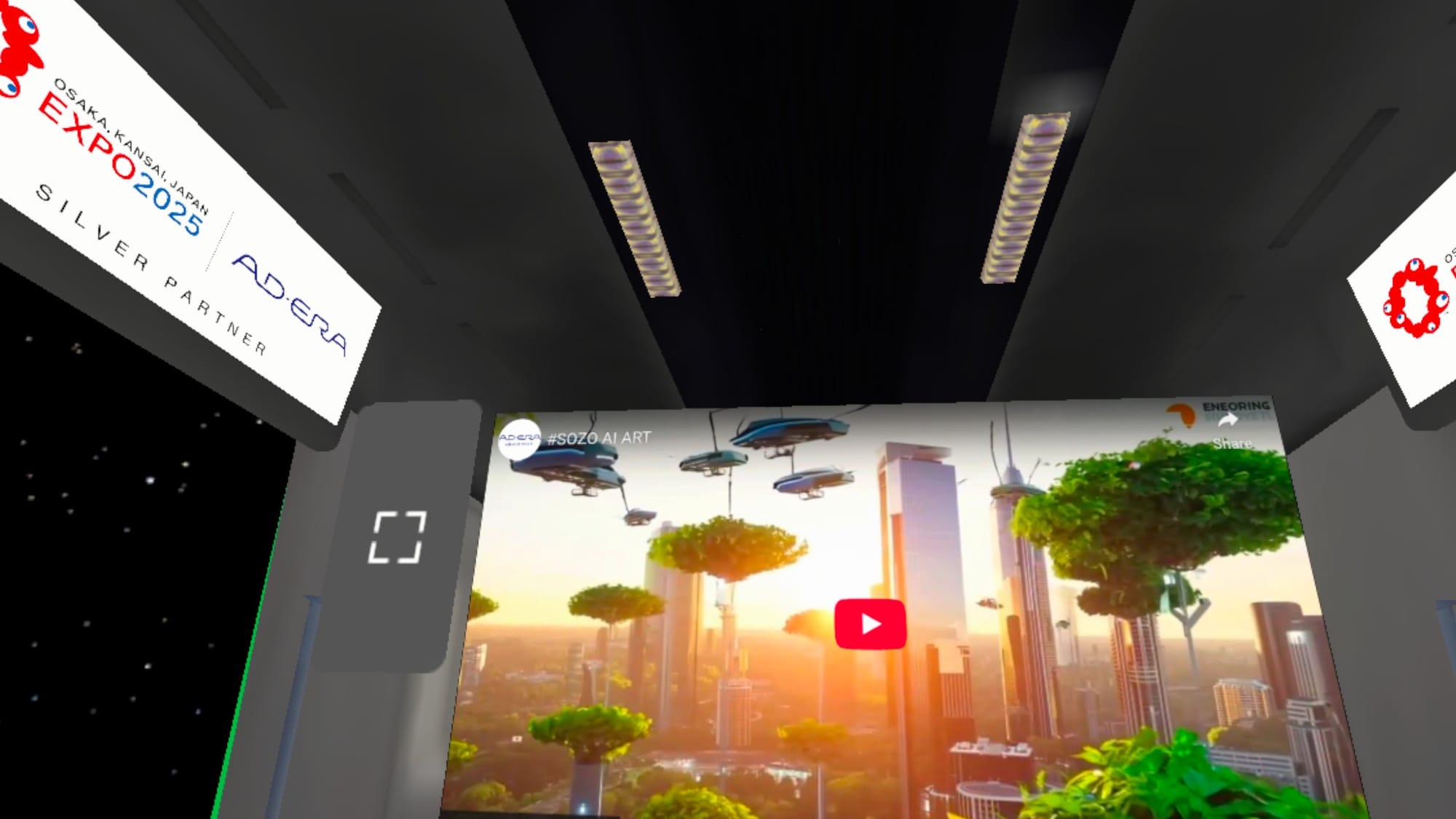
At Expo 2025 I ate African curry with authentic ingredients and I got talking to a stranger in line for one pavilion where we shared stories of our lives. In the Virtual Expo I rode a fake train in space pushing AI and got requests to mint NFTs.

I like VR and the potential for experiences that go beyond what is possible in other mediums, but it can never replace what makes us human and the joy of even minor interactions spawned by coincidence. Technology can enhance our lives, but whether it’s AI chatbots replacing friendships or a virtual hangout over a physical meetup, to be human means spontaneity that can’t be scripted into code.

Is there a platform that can one day capture that sense of spontaneity in human connection one finds walking down the street and smiling at another human? And the touch on my fingertips when I’m being dragged into a dance lesson with everyone else? Perhaps, but not right now. Perhaps never, if we continue down this particular path we call the metaverse in its current form.

The Virtual Expo can’t match the joy of the real thing, for it is the joy and strife that can’t be planned. If you happen to find yourself in Osaka before October, visit Expo 2025 and embrace the idea of learning about the world beyond your own with strangers. Perhaps you can give the Yumeshima Island in the Sky a miss.

Resilience Spacecraft Likely Crashed Into the Moon, Ispace Confirms

Japan-based Ispace confirmed its Resilience lander likely crashed during its second failed attempt at a lunar landing, after a sensor malfunction prevented proper deceleration. Despite the setback, the company remains committed to future missions, with funding secured for a third attempt using a new lander, Apex 1.0, scheduled for 2027. “Until then, Ispace has its work cut out for it,” reports CNN. “[Ispace CEO and founder Takeshi Hakamada] said during the news briefing he will need to work to regain the trust of investors, and the company will need to deeply investigate what went wrong on the Resilience mission to ensure similar issues don’t plague Apex 1.0.”

The company has ambitious “plans to eventually build a city on the lunar surface that would house a thousand people and welcome thousands more for tourist visits,” notes ABC News. “If ispace is going to establish a colony on the moon, it will need to identify an ample supply of ice or water, which it will convert into fuel for a future lunar fueling station. The ability to produce fuel on the moon will enable the company to transport people back and forth between the Earth and the moon.”


Read more of this story at Slashdot.

Proxy Services Feast On Ukraine’s IP Address Exodus

An anonymous reader quotes a report from KrebsOnSecurity: Ukraine has seen nearly one-fifth of its Internet space come under Russian control or sold to Internet address brokers since February 2022, a new study finds. The analysis indicates large chunks of Ukrainian Internet address space are now in the hands of shadowy proxy and anonymity services that are nested at some of America’s largest Internet service providers (ISPs). The findings come in a report that examines how the Russian invasion has affected Ukraine’s domestic supply of Internet Protocol Version 4 (IPv4) addresses. Researchers at Kentik, a company that measures the performance of Internet networks, found that while a majority of ISPs in Ukraine haven’t changed their infrastructure much since the war began in 2022, others have resorted to selling swathes of their valuable IPv4 address space just to keep the lights on.

For example, Ukraine’s incumbent ISP Ukrtelecom is now routing just 29 percent of the IPv4 address ranges that the company controlled at the start of the war, Kentik found. Although much of that former IP space remains dormant, Ukrtelecom told Kentik’s Doug Madory they were forced to sell many of their address blocks “to secure financial stability and continue delivering essential services.” “Leasing out a portion of our IPv4 resources allowed us to mitigate some of the extraordinary challenges we have been facing since the full-scale invasion began,” Ukrtelecom told Madory.

Madory found much of the IPv4 space previously allocated to Ukrtelecom is now scattered to more than 100 providers globally, particularly at three large American ISPs — Amazon (AS16509), AT&T (AS7018), and Cogent (AS174). Another Ukrainian Internet provider — LVS (AS43310) — in 2022 was routing approximately 6,000 IPv4 addresses across the nation. Kentik learned that by November 2022, much of that address space had been parceled out to over a dozen different locations, with the bulk of it being announced at AT&T. Ditto for the Ukrainian ISP TVCOM, which currently routes nearly 15,000 fewer IPv4 addresses than it did at the start of the war. Madory said most of those addresses have been scattered to 37 other networks outside of Eastern Europe, including Amazon, AT&T, and Microsoft.


Read more of this story at Slashdot.

Intel: New Products Must Deliver 50% Gross Profit To Get the Green Light

Intel has implemented a strict new policy requiring all new projects to demonstrate at least a 50% gross margin to move forward. CEO Lip-Bu Tan explained Intel’s new risk-averse policy as “something that we probably should have had before,” later clarifying that the number is a figure the company is aspiring toward internally. Tom’s Hardware reports: Tan is reportedly “laser focused on the fact that we need to get our gross margins back up above 50%.” To accomplish this, Tan is also said to be investigating and potentially cancelling or changing unprofitable deals with other companies. Intel’s margins have slipped to new lows for the company in recent months. MacroTrends reports Intel’s trailing 12 months gross margin for Q1 2025 was as low as 31.67%. Intel’s gross margins had hovered around the 60% mark for the ten years leading up to the COVID-19 pandemic, falling beneath 50% in Q2 2022 and continuing to steadily fall ever since.

Holthaus predicts a “tug-of-war” to ensue within Intel in the coming months as engineers and executives reckon with being forced between a rock and a hard place. “We need to be building products that… fit the right competitive landscape and requirements of our customers, but also have the right cost structure in place. It really requires us to do both.” […] Tan is also quoted as wanting to turn Intel into an “engineering-focused company” again under his leadership. To reach this, Tan has committed to investing in recruiting and retaining top talent; “I believe Intel has lost some of this talent over the years; I want to create a culture of innovation empowerment.” Maintaining a culture of empowering innovation and top talent seems, on its face, at odds with layoffs and a lock on projects not projected to gross 50% margins, but Tan seemingly has Intel investors on his side in these pursuits.


Read more of this story at Slashdot.

Senate response to White House budget for NASA: Keep SLS, nix science

Negotiations over the US federal budget for fiscal year 2026 are in the beginning stages, but when it comes to space, the fault lines are already solidifying in the Senate.

The Trump White House released its budget request last Friday, and this included detailed information about its plans for NASA. On Thursday, just days later, the US Senate shot back with its own budget priorities for the space agency.

The US budget process is complicated and somewhat broken in recent years, as Congress has failed to pass a budget on time. So, we are probably at least several months away from seeing a final fiscal year 2026 budget from Congress. But we got our first glimpse of the Senate’s thinking when the chair of the Committee on Commerce, Science, and Transportation, Sen. Ted Cruz (R-Texas) released his “legislative directives” for NASA on Thursday

Read full article

Comments

Consumer Group Accuses Shein of Manipulating Shoppers With ‘Dark Patterns’

An anonymous reader quotes a report from CBC: A consumer organization filed a complaint with the European Commission on Thursday against online fast-fashion retailer Shein over its use of “dark patterns,” which are tactics designed to make people buy more on its app and website. Pop-ups urging customers not to leave the app or risk losing promotions, countdown timers that create time pressure to complete a purchase and the infinite scroll on its app are among the methods Shein uses that could be considered “aggressive commercial practices,” wrote BEUC, a pan-European consumer group, in a report.

The BEUC also detailed Shein’s use of frequent notifications, with one phone receiving 12 notifications from the app in a single day. “For fast fashion you need to have volume, you need to have mass consumption, and these dark patterns are designed to stimulate mass consumption,” said Agustin Reyna, director general of BEUC, in an interview. “For us, to be satisfactory they need to get rid of these dark patterns, but the question is whether they will have enough incentive to do so, knowing the potential impact it can have on the volume of purchases.” […]

The BEUC also targeted the online discount platform Temu, a Shein rival, in a previous complaint. Both platforms have surged in popularity in Europe, partly helped by apps that encourage shoppers to engage with games and stand to win discounts and free products. […] The BEUC noted that dark patterns are widely used by mass-market clothing retailers and called on the consumer protection network to include other retailers in its investigation. It said 25 of its member organizations in 21 countries, including France, Germany and Spain, joined in the grievance filed with the commission and with the European consumer protection network. Temu and Shein have their own issues in the United States. Following the recent closure of the de minimis loophole, use of the two Chinese platforms have slowed significantly. “Temu’s U.S. daily active users (DAUs) dropped 52% in May versus March, before Trump’s tariffs were announced, while those at rival Shein were down 25%,” reports CNBC, citing data from market intelligence firm Sensor Tower.

“The declines were also reflected in both platforms’ Apple App Store rankings. Temu averaged a rank of 132 in May 2025, down from an average top 3 ranking a year ago, while Shein averaged a rank of 60 last month versus a top 10 ranking the year prior, the data showed.”


Read more of this story at Slashdot.

Anthropic Co-founder on Cutting Access To Windsurf: ‘It Would Be Odd For Us To Sell Claude To OpenAI’

Anthropic cut AI coding assistant Windsurf’s direct access to its Claude models after media reported that rival OpenAI plans to acquire the startup for $3 billion. Anthropic co-founder Jared Kaplan told TechCrunch that “it would be odd for us to be selling Claude to OpenAI,” explaining the decision to cut access to Claude 3.5 Sonnet and Claude 3.7 Sonnet models.


Read more of this story at Slashdot.

Etsy co-founder’s new startup is making what really looks like a mixed reality magnifying glass

Virtual and augmented reality are still pretty new frontiers with a lot of potentially cool ideas yet to be developed. The latest product in the mixed reality space could be coming from a startup called Dopple Works. Lowpass reported that the secrecy-shrouded business from Etsy co-founder and former CEO Robert Kalin is working on a new device called Loop.

Dopple Works has submitted an application to the Federal Communications Commission. Many of the details are not publicly available, but that filing indicates that Loop is battery-powered and will use both WiFi and Bluetooth networks. Lowpass also unearthed a patent application that dubs Loop a “dedicated hand-held spatial computing device.” The application comes with images that show a camera, speaker and tracking sensor that could capture details on an environment, along with a screen for viewing the mixed reality content.

At this stage, there’s not enough information available to speculate on what Loop’s purpose will be. But the photos from the government filings do spark some entertaining mental images of a future where people wandering about doing their best Sherlock Holmes imitations with mixed reality magnifying glasses. 

This article originally appeared on Engadget at https://www.engadget.com/ar-vr/etsy-co-founders-new-startup-is-making-what-really-looks-like-a-mixed-reality-magnifying-glass-224247515.html?src=rss

Stablecoin Issuer Circle Soars 168% In IPO Debut

Circle Internet Group surged 168% in its NYSE debut, raising nearly $1.1 billion after pricing its IPO at $31 and opening at $69. “At one point, shares traded as high as $103.75,” notes CNBC. From the report: The New York-based company priced its IPO late Wednesday far above this week’s expected range of $27 to $28, and an initial range last week of between $24 and $26, valuing the company at some $6.8 billion before trading began. Trading volume by the end of the session was about 46 million, far exceeding the number of freely floating shares available for trading.

Circle joins Coinbase, Mara Holdings and Riot Platforms as one of the few pure-play crypto companies to list in the U.S. This marks the company’s second attempt at going public. A prior merger with a special purpose acquisition company collapsed in late 2022 amid regulatory challenges. “To realize our vision, we needed to forge relationships with governments, we needed to work with policymakers … because if you want this to work for mainstream, it’s got to work in mainstream society and you need to have those rules of the road,” CEO Jeremy Allaire told CNBC’s “Money Movers” on Thursday. “We’ve been one of the most licensed, regulated, compliant, transparent companies in the entire history of this industry, and that’s served us well.”


Read more of this story at Slashdot.

[$] Zero-copy for FUSE

In a combined storage and filesystem session at the 2025 Linux Storage,
Filesystem, Memory Management, and BPF Summit (LSFMM+BPF), Keith Busch led
a discussion about zero-copy operations for the Filesystem
in Userspace
(FUSE) subsystem. The session was proposed
by his colleague, David Wei, who could not make it to the summit, so Busch
filled in, though he noted that “I do not really know FUSE so
well
“. The idea is to eliminate data copies in the data path to and
from the FUSE server in user space.

Out-of-warranty Switch 2 repairs are a lot more expensive than the original console’s

The Nintendo Switch 2 comes with a one-year limited warranty that covers the cost of repairing unexpected defects, but any damage that falls outside that coverage will cost you. Avoiding that could be key, because based on Nintendo’s customer repair portal, paying to fix a Switch 2 is noticeably more expensive than repairing an older Switch.

Now, prices could vary depending on how your Switch 2 or its accessories are damaged. Just looking at repairing water damage specifically, though, here’s how prices break down:

  • Console: $179

  • Dock: $66

  • Camera: $30

  • AC Adapter: $18

  • Pro Controller: $48

For comparison, fixing up a water-damaged Switch OLED costs $139, $40 less than it costs to fix a Switch 2. The original Switch dock and the original Pro Controller both costs $30 to repair, $33 and $18 cheaper, respectively. The only real outlier from the general trend of Switch 2 hardware costing more to service is the Joy-Con 2 controllers. Whether the stick feels loose or the magnets won’t attach, Nintendo is apparently willing to fix a Joy-Con 2 controller for free.

Maybe the hardware changes the company made to improve the performance of the sticks also made them easier to repair. Or maybe free repairs is some sort of quiet make-good for the well-documented stick-drift issues that plagued the original Joy-Con controllers. Either way, it’s a small bright spot in what otherwise seems like a potentially pricey repair process.

This article originally appeared on Engadget at https://www.engadget.com/gaming/nintendo/out-of-warranty-switch-2-repairs-are-a-lot-more-expensive-than-the-original-consoles-215448447.html?src=rss

Apple Notes Expected To Gain Markdown Support

According to 9to5Mac, “Apple is working on supporting the ability to export notes in Markdown from Apple notes, which is something third-party apps have supported for years.” Apple enthusiast and co-creator of the Markdown markup language, John Gruber, is not a fan. From a blog post: Some people find this surprising, but I personally don’t want to use a Markdown notes app. I created Markdown two decades ago and have used it ever since for one thing and one thing only: writing for the web at Daring Fireball. My original description of what it is still stands: “Markdown is a text-to-HTML conversion tool for web writers.” Perhaps an even better description of Markdown is Matthew Butterick’s, from the documentation for Pollen: “Markdown is a simplified notation system for HTML.”

The other great use case for Markdown is in a context where you either need or just want to be saving to a plain text file or database field. That’s not what Apple Notes is or should be. I can see why many technically-minded people want to use Markdown “everywhere.” It’s quite gratifying that Markdown has not only become so popular, but after 21 years, seemingly continues to grow in popularity, to the point now where there clearly are a lot of people who seemingly enjoy writing in Markdown more than even I do. But I think it would be a huge mistake for Apple to make Apple Notes a “Markdown editor,” even as an option. It’s trivial to create malformed Markdown syntax; it shouldn’t be possible to have a malformed note in Apple Notes. I craft posts for Daring Fireball; I dash off notes in Apple Notes. […]

But Markdown export from Notes? That sounds awesome. Frankly, perhaps the biggest problem with Apple Notes is that its export functionality is rather crude — PDF and, of all formats, Pages. Exporting and/or copying the selected text as Markdown would be pretty cool. Very curious to see how they handle images though, if this rumor is true.


Read more of this story at Slashdot.