Apple‘s next big UI overhaul, reportedly called “Liquid Glass,” is ready for its big reveal. According to Bloomberg‘s Mark Gurman, the upcoming interface redesign will feature “sheen and see-through visuals of a glassy surface.” More specifically, Apple’s new design language will have “transparency and shine effects” in its toolbars, in-app interfaces and controls.
It may sound like a superficial makeover, but it’s rare that Apple makes such a major change to its UI. The last big change for iPhones came from iOS 7 when Apple ditched its iconic skeumorphism design in favor of a more simplified design we have today.
However, Gurman reported that Apple could be getting Liquid Glass ready for the eventual 20th anniversary of the iPhone next year. According to Gurman, the upcoming 20th anniversary release of the iPhone will have “curved glass sides around the entire phone, even at the edges.” On top of that, this special iPhone will have “extraordinarily slim bezels and no cutout section in the screen” to better match the upcoming redesign.
It’s not the first time we’re hearing about Apple’s rumored redesign, which was expected to draw inspiration from the Apple Vision Pro. With this Liquid Glass design, Apple could unify the look of its interfaces across all of its devices and make it less of a dramatic visual shift when switching between your Vision Pro and iPhone. This big visual change is expected to align across the board with iOS 26, macOS, watchOS, iPadOS, and tvOS. We’re expecting to see Apple’s Liquid Glass debut during WWDC 2025 which will kick off on June 9, 1PM ET/10AM PT.
This article originally appeared on Engadget at https://www.engadget.com/big-tech/apple-will-reportedly-demo-its-liquid-glass-interface-redesign-with-see-through-visuals-at-wwdc-165823089.html?src=rss
The New York Times reports:
California State University announced this year that it was making ChatGPT available to more than 460,000 students across its 23 campuses to help prepare them for “California’s future A.I.-driven economy.” Cal State said the effort would help make the school “the nation’s first and largest A.I.-empowered university system…” Some faculty members have already built custom chatbots for their students by uploading course materials like their lecture notes, slides, videos and quizzes into ChatGPT.
And other U.S. campuses including the University of Maryland are also “working to make A.I. tools part of students’ everyday experiences,” according to the article. It’s all part of an OpenAI initiative “to overhaul college education — by embedding its artificial intelligence tools in every facet of campus life.”
The Times calls it “a national experiment on millions of students.”
If the company’s strategy succeeds, universities would give students A.I. assistants to help guide and tutor them from orientation day through graduation. Professors would provide customized A.I. study bots for each class. Career services would offer recruiter chatbots for students to practice job interviews. And undergrads could turn on a chatbot’s voice mode to be quizzed aloud ahead of a test. OpenAI dubs its sales pitch “A.I.-native universities…” To spread chatbots on campuses, OpenAI is selling premium A.I. services to universities for faculty and student use. It is also running marketing campaigns aimed at getting students who have never used chatbots to try ChatGPT…
OpenAI’s campus marketing effort comes as unemployment has increased among recent college graduates — particularly in fields like software engineering, where A.I. is now automating some tasks previously done by humans. In hopes of boosting students’ career prospects, some universities are racing to provide A.I. tools and training…
[Leah Belsky, OpenAI’s vice president of education] said a new “memory” feature, which retains and can refer to previous interactions with a user, would help ChatGPT tailor its responses to students over time and make the A.I. “more valuable as you grow and learn.” Privacy experts warn that this kind of tracking feature raises concerns about long-term tech company surveillance. In the same way that many students today convert their school-issued Gmail accounts into personal accounts when they graduate, Ms. Belsky envisions graduating students bringing their A.I. chatbots into their workplaces and using them for life.
“It would be their gateway to learning — and career life thereafter,” Ms. Belsky said.
It’s no longer a hypothetical question, writes the Washington Post. “In recent years, scientists have devised powerful genetic tools that may be able to eradicate mosquitoes and other pests once and for all.”
But along with the ability to fight malaria, dengue, West Nile virus and other serious diseases, “the development of this technology also raises a profound ethical question: When, if ever, is it okay to intentionally drive a species out of existence…?”
When so many wildlife conservationists are trying to save plants and animals from disappearing, the mosquito is one of the few creatures that people argue is actually worthy of extinction. Forget about tigers or bears; it’s the tiny mosquito that is the deadliest animal on Earth. The human misery caused by malaria is undeniable. Nearly 600,000 people died of the disease in 2023, according to the World Health Organization, with the majority of cases in Africa… But recently, the Hastings Center for Bioethics, a research institute in New York, and Arizona State University brought together a group of bioethicists to discuss the potential pitfalls of intentionally trying to drive a species to extinction. In a policy paper published in the journal Science last month, the group concluded that “deliberate full extinction might occasionally be acceptable, but only extremely rarely…”
It’s unclear how important malaria-carrying mosquitoes are to broader ecosystems. Little research has been done to figure out whether frogs or other animals that eat the insects would be able to find their meals elsewhere. Scientists are hotly debating whether a broader “insect apocalypse” is underway in many parts of the world, which may imperil other creatures that depend on them for food and pollination… Instead, the authors said, geneticists should be able to use gene editing, vaccines and other tools to target not the mosquito itself, but the single-celled Plasmodium parasite that is responsible for malaria. That invisible microorganism — which a mosquito transfers from its saliva to a person’s blood when it bites — is the real culprit.
A nonprofit research consortium called Target Malaria has genetically modified mosquitoes in their labs (which get core funding from the Gates Foundation and from Open Philanthropy, backed by Facebook co-founder Dustin Moskovitz and his wife). ), and hopes to deploy them in the wild within five years…
The Associated Press reports that on Friday, U.K. High Court justice Victoria Sharp and fellow judge Jeremy Johnson ruled on the possibility of false information being submitted to the court. Concerns had been raised by lower-court judges about “suspected use by lawyers of generative AI tools to produce written legal arguments or witness statements which are not then checked.”
In a ruling written by Sharp, the judges said that in a 90 million pound ($120 million) lawsuit over an alleged breach of a financing agreement involving the Qatar National Bank, a lawyer cited 18 cases that did not exist. The client in the case, Hamad Al-Haroun, apologized for unintentionally misleading the court with false information produced by publicly available AI tools, and said he was responsible, rather than his solicitor Abid Hussain. But Sharp said it was “extraordinary that the lawyer was relying on the client for the accuracy of their legal research, rather than the other way around.”
In the other incident, a lawyer cited five fake cases in a tenant’s housing claim against the London Borough of Haringey. Barrister Sarah Forey denied using AI, but Sharp said she had “not provided to the court a coherent explanation for what happened.” The judges referred the lawyers in both cases to their professional regulators, but did not take more serious action.
Sharp said providing false material as if it were genuine could be considered contempt of court or, in the “most egregious cases,” perverting the course of justice, which carries a maximum sentence of life in prison.
The Switch 2 has a very long way to go before it can become a contender for Nintendo’s best-selling game console of all time (an honor that currently belongs to the Nintendo DS, followed by the original Switch family), but it’s off to a hot start. How hot, exactly? Reportedly, the Switch 2 has outsold every other console—Nintendo or otherwise—in
Notable with the staging area updates for the in-development Linux 6.16 kernel is word that the GPIB driver code may be ready to leave the staging area in the next kernel cycle (Linux v6.17) in then being promoted to the main driver area in signifying the maturity of the code and being cleaned up to meet kernel coding standards. The GPIB drivers are for the General Purpose Interface Bus that was introduced back in 1972…
Ask me what I’m reading at any given moment and I’ll probably rattle off at least three titles, not to mention comics and the occasional textbook I may also be chipping away at in the background. Reading multiple books simultaneously might sound chaotic (at least, people always tell me it is), but there is a degree of organization to it all: each book in my pile of current reads is in a different format. I’ll have one physical, paper book, an ebook and an audiobook in progress at a time, so I always have something on hand to read no matter where I am.
While I used to carry around a dedicated ereader, I’ve shifted more toward using my phone for the job these days, especially since getting a foldable. Consequently, I’ve tried out a bunch of different apps for reading and logging my books. These are the ones I like most.
Libro.fm
Audiobooks have really grown on me over the last few years, almost entirely replacing podcasts as the thing I’ll throw on when I’m cleaning, taking a walk or going for a long drive. While I tried to make do at first by only borrowing audiobooks from the library, I quickly found that the extremely limited selection from my library system coupled with really long wait times just wouldn’t cut it if I wanted to stay up on new releases. After researching all the options, I settled on Libro.fm, an audiobook platform that shares a portion of profits (about half, according to a 2022 interview) with independent bookstores. And even better, you get to pick which bookstore to support with your purchases.
I wasn’t expecting to find my favorite local bookstore — a tiny shop in a small town in New York’s Hudson Valley — on Libro.fm, so I was pleasantly surprised when it turned up in the search. With that, and the fact that all audiobooks from Libro.fm are Digital Rights Management (DRM) free, so you can actually download the files and do with them as you please, I was sold. You have a few options for buying audiobooks through Libro.fm: you can subscribe for $15 per month, which gives you one audiobook credit and a 30 percent discount on all purchases; you can buy credit bundles to save on purchases without a subscription; and you can purchase individual titles at their full, non-member price. There are also plenty of free books to choose from.
Bookshop.org app
The moment I found out that Bookshop.org had launched ebooks and an app to read them on, I made the site my sole destination for buying digital books and haven’t looked back. Just like Libro.fm, Bookshop.org lets you choose a local bookseller to support with your purchases. It’s been doing this for physical book sales for the last five years — and according to its tally has raised over $38 million for independent bookstores in that time — but until now, there hasn’t been a similar option for ebooks. The new app is a no-frills ereader app where you can browse the Bookshop.org catalog to save titles to your wishlist (purchases have to be made on the site) and read all the ebooks you’ve bought. There are some things I’d love to see it gain in the future, like comics and the option to display pages side by side for reading book-style on a foldable, but it’s a great start as it is, especially if your primary concern is supporting small businesses.
Right now Bookshop.org’s ebook service doesn’t sync with any of the mainstream ereader devices, so you’re locked into reading on Android, iOS or a web browser, but the company said it’s working on Kobo integration and we could see that happen before the end of this year.
Libby
Libby, aka the library app, is my app of choice for older, less in-demand ebooks and audiobooks, or for when I don’t have anything particular in mind and just want to browse the catalog to see what jumps out at me. It lets you link multiple library cards, meaning you potentially have a huge pool to pull from, and since you’re borrowing books rather than buying them, it’s entirely free. Libby also connects with Kindle, and you can have your titles automatically sent to your ereader. Some Kobo devices support OverDrive (the distributor behind Libby) too.
While using an app may not be quite as satisfying as perusing the stacks IRL, I really like Libby’s tag system, which lets you organize your borrowed books and To Be Read titles in whatever way works best for you. You can have a dedicated TBR tag, or create several different tags to group things by genre, mood, etc. Libby is also a great place to find magazines.
Moon+ Reader (Android only)
Moon+ Reader is the best app I’ve used yet for instances where I have the actual file for a book or document. It supports a ton of different file types — including ePUB, PDF, AZW3, MOBI and many more — and allows you to highlight and annotate text, in addition to offering auto scroll and text-to-speech so the text can be read aloud to you. It’s really customizable, too. You can choose things like font, font color, background, margin width, line spacing and more for each document, and save the final build as a theme so you can use it again later. Designwise, the app feels almost like a relic of a bygone digital era, organizing all of your books in a skeuomorphic virtual bookshelf, and I love it. There are a few style options for the bookshelf too, or you can turn off the bookshelf and just see your books in a standard grid.
There’s both a free and paid version of the Moon+ Reader, and this is a situation where getting the paid version (Moon+ Reader Pro) is actually worth it. It’s a one-time purchase of $10, and going that route will get rid of ads and open up more customization options. In addition to importing your own files into the app, Moon+ Reader has Project Gutenberg integrated so you can directly access that library of over 75,000 free books.
The Storygraph
Naturally, I need a way to keep up with all the reading I’m doing, and that’s where The StoryGraph comes in. The StoryGraph is a data-focused app for keeping track of everything you’re currently reading, everything you’ve read and the ever-growing list of titles you want to read. It even allows you to mark books as “did not finish.” I love that I can have five in-progress books logged at a time, and can even update each entry to note how far along I am, which is nice for those I’m dragging my feet on completing.
When you leave a review, you have the option to be really detailed about it, going beyond a star rating and a blurb. Reviewers can indicate whether the book would appeal to readers who like a particular mood, with over a dozen options. You rate the pace and answer basic questions about the plot and characters, like whether there’s character development or if the characters are even likeable. There’s also the option to add content warnings.
Where The StoryGraph really shines, though, is in the stats. There are tons of actual graphs built into the experience to show you a comprehensive breakdown of your reading habits, from the genres, moods and pacing you prefer, to how much fiction you’ve read versus nonfiction. You can set challenges for yourself, like a yearly reading goal, and you’ll be shown a Reading Wrap-up at the end of the year. It’ll tell you how long it takes you to finish a book on average, and compare your reading stats to previous years.
There is a mild social component to the app, but it’s tucked away in its own tab and not shoved in your face, which I appreciate as someone who tends to shy away from those things. If you want, though, you can participate in or create readalongs, start buddy reads and book clubs (and even write out a code of conduct for the latter) or just see what other people with similar interests to yours are reading. The StoryGraph team also really seems to take users’ feedback into consideration, and is constantly adding new things to the app and tweaking existing ones to improve the experience, which is always nice to see.
This article originally appeared on Engadget at https://www.engadget.com/entertainment/the-best-apps-for-reading-tracking-and-listening-to-books-120047705.html?src=rss
Last year’s Pentagon report reviewing UFO reports “left out the truth behind some of the foundational myths about UFOs,” reports the Wall Street Journal.
“The Pentagon itself sometimes deliberately fanned the flames, in what amounted to the U.S. government targeting its own citizens with disinformation.”
The congressionally ordered probe took investigators back to the 1980s, when an Air Force colonel visited a bar near Area 51, a top-secret site in the Nevada desert. He gave the owner photos of what might be flying saucers. The photos went up on the walls, and into the local lore went the idea that the U.S. military was secretly testing recovered alien technology. But the colonel was on a mission — of disinformation. The photos were doctored, the now-retired officer confessed to the Pentagon investigators in 2023. The whole exercise was a ruse to protect what was really going on at Area 51: The Air Force was using the site to develop top-secret stealth fighters, viewed as a critical edge against the Soviet Union. Military leaders were worried that the programs might get exposed if locals somehow glimpsed a test flight of, say, the F-117 stealth fighter, an aircraft that truly did look out of this world. Better that they believe it came from Andromeda.
That’s not the only example. The Journal spoke to Robert Salas, now 84, who in 1967 was a 26-year-old Air Force captain “sitting in a walk-in closet-sized bunker, manning the controls of 10 nuclear missiles in Montana.” Suddenly all 10 missiles were disabled after reports of “a glowing reddish-orange oval was hovering over the front gate… The next morning a helicopter was waiting to take Salas back to base. Once there he was ordered: Never discuss the incident.”
58 years later, the Journal reports….
The barriers of concrete and steel surrounding America’s nuclear missiles were thick enough to give them a chance if hit first by a Soviet strike. But scientists at the time feared the intense storm of electromagnetic waves generated by a nuclear detonation might render the hardware needed to launch a counterstrike unusable. To test this vulnerability, the Air Force developed an exotic electromagnetic generator that simulated this pulse of disruptive energy without the need to detonate a nuclear weapon… But any public leak of the tests at the time would have allowed Russia to know that America’s nuclear arsenal could be disabled in a first strike. The witnesses were kept in the dark. To this day Salas believes he was party to an intergalactic intervention to stop nuclear war which the government has tried to hide.
“We were never briefed on the activities that were going on, the Air Force shut us out of any information,” Salas tells the Journal.
But it’s not just secrecy. Some military men were told directly that they were working on alien technology, according to Pentagon investigator Sean Kirkpatrick:
A former Air Force officer was visibly terrified when he told Kirkpatrick’s investigators that he had been briefed on a secret alien project decades earlier, and was warned that if he ever repeated the secret he could be jailed or executed. The claim would be repeated to investigators by other men who had never spoken of the matter, even with their spouses.
It turned out the witnesses had been victims of a bizarre hazing ritual. For decades, certain new commanders of the Air Force’s most classified programs, as part of their induction briefings, would be handed a piece of paper with a photo of what looked like a flying saucer. The craft was described as an antigravity maneuvering vehicle. The officers were told that the program they were joining, dubbed Yankee Blue, was part of an effort to reverse-engineer the technology on the craft. They were told never to mention it again. Many never learned it was fake. Kirkpatrick found the practice had begun decades before, and appeared to continue still… Investigators are still trying to determine why officers had misled subordinates, whether as some type of loyalty test, a more deliberate attempt to deceive or something else. After that 2023 discovery, Kirkpatrick’s deputy briefed President Joe Biden’s director of national intelligence, Avril Haines, who was stunned… “We are talking about hundreds and hundreds of people. These men signed NDAs. They thought it was real.”
The article also notes that rep9rts of Unidentified Aerial Phenomenon “skyrocketed” after May of 2023 — but that “Many pilot accounts of floating orbs were actually reflections of the sun from Starlink satellites, investigators found.”
For years, gray market services known as “bulletproof” hosts have been a key tool for cybercriminals looking to anonymously maintain web infrastructure with no questions asked. But as global law enforcement scrambles to crack down on digital threats, they have developed strategies for getting customer information from these hosts and have increasingly targeted the people behind the services with indictments. At the cybercrime-focused conference Sleuthcon in in Arlington, Virginia on Friday, researcher Thibault Seret outlined how this shift has pushed both bulletproof hosting companies and criminal customers toward an alternative approach.
Rather than relying on web hosts to find ways of operating outside law enforcement’s reach, some service providers have turned to offering purpose-built VPNs and other proxy services as a way of rotating and masking customer IP addresses and offering infrastructure that either intentionally doesn’t log traffic or mixes traffic from many sources together. And while the technology isn’t new, Seret and other researchers emphasized to WIRED that the transition to using proxies among cybercrminals over the last couple of years is significant.
“The issue is, you cannot technically distinguish which traffic in a node is bad and which traffic is good,” Seret, a researcher at the threat intelligence firm Team Cymru, told WIRED ahead of his talk. “That’s the magic of a proxy service—you cannot tell who’s who. It’s good in terms of internet freedom, but it’s super, super tough to analyze what’s happening and identify bad activity.”
The GNOME 49 Alpha release isn’t expected until the end of June but for facilitating additional testing and a number of prominent changes this cycle, a number of GNOME packages have begun releasing “GNOME 49 Alpha 0” tags as part of plans to issue multiple alpha releases this cycle. Notable for GNOME 49 are plans moving forward for disabling X11 session support by default with that code then likely to be removed entirely with GNOME 50 for a Wayland-only desktop…
This week in marking Phoronix.com turning 21 years old there was a Phoronix Premium special for those wanting to enjoy the site ad-free, multi-page articles on a single page, and other benefits. That special deal is ending at end of day Monday (9 June) as your last chance to hop on this special…
The Linux Mint project published its newest monthly status report to outline various interesting development activities around this Linux desktop distribution project building off Ubuntu and Debian bases…
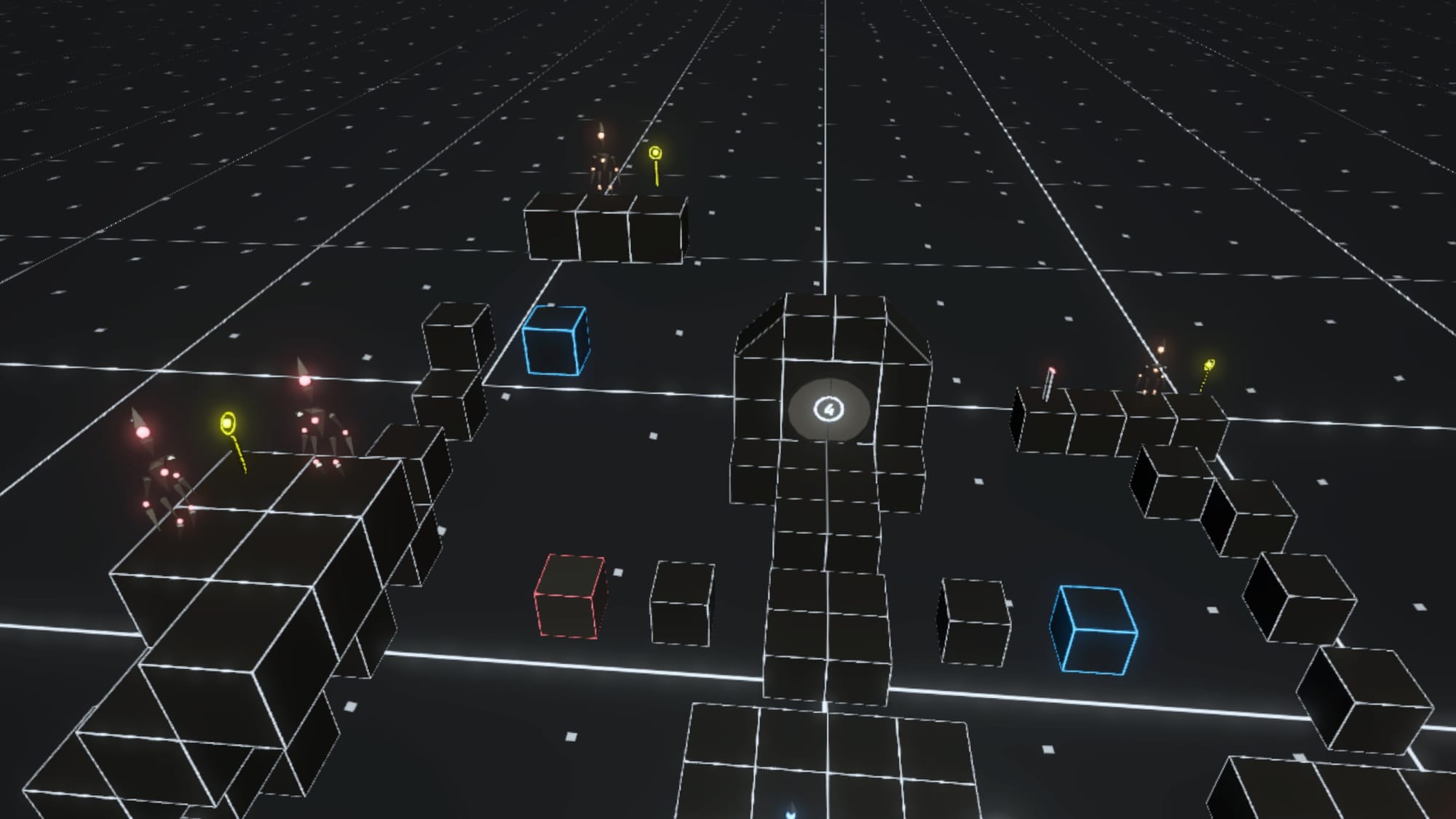
Neon Cipher is a brisk, brain-teasing puzzle platformer that blends first-person immersion with third-person platforming.
Your journey begins after being dropped into a series of fraught cyberspace mazes full of robotic sentries and geometric obstacles to fight, evade, and escape. You control an avatar in the game space and manipulate the environment and its enemies using hands-on controls from a first-person perspective.
It’s a stylish and ultra-minimalist mashup of the VR classic Moss, and ancient PlayStation relics like Intelligent Qube and Echochrome.
The Facts
What is it?: A geometric puzzle-platformer played via first and third-person controls. Platforms: PC VR, Meta Quest (Reviewed on Quest 3S) Release Date: Out now Developer: eXomorph Games Price: $19.99
The plot of Neon Cipher is light, and what’s here isn’t groundbreaking, but it sets the tone and establishes the game world. You play as a hacker who’s been recruited by the mysterious Captain S. Ren, a member of a digital rebellion. The goal is to hack into XE_Corp’s digital archive to retrieve… something. I can’t really recall, because the plot is so sparse that it’s simply not very memorable. On the flipside, it’s not distracting, either.
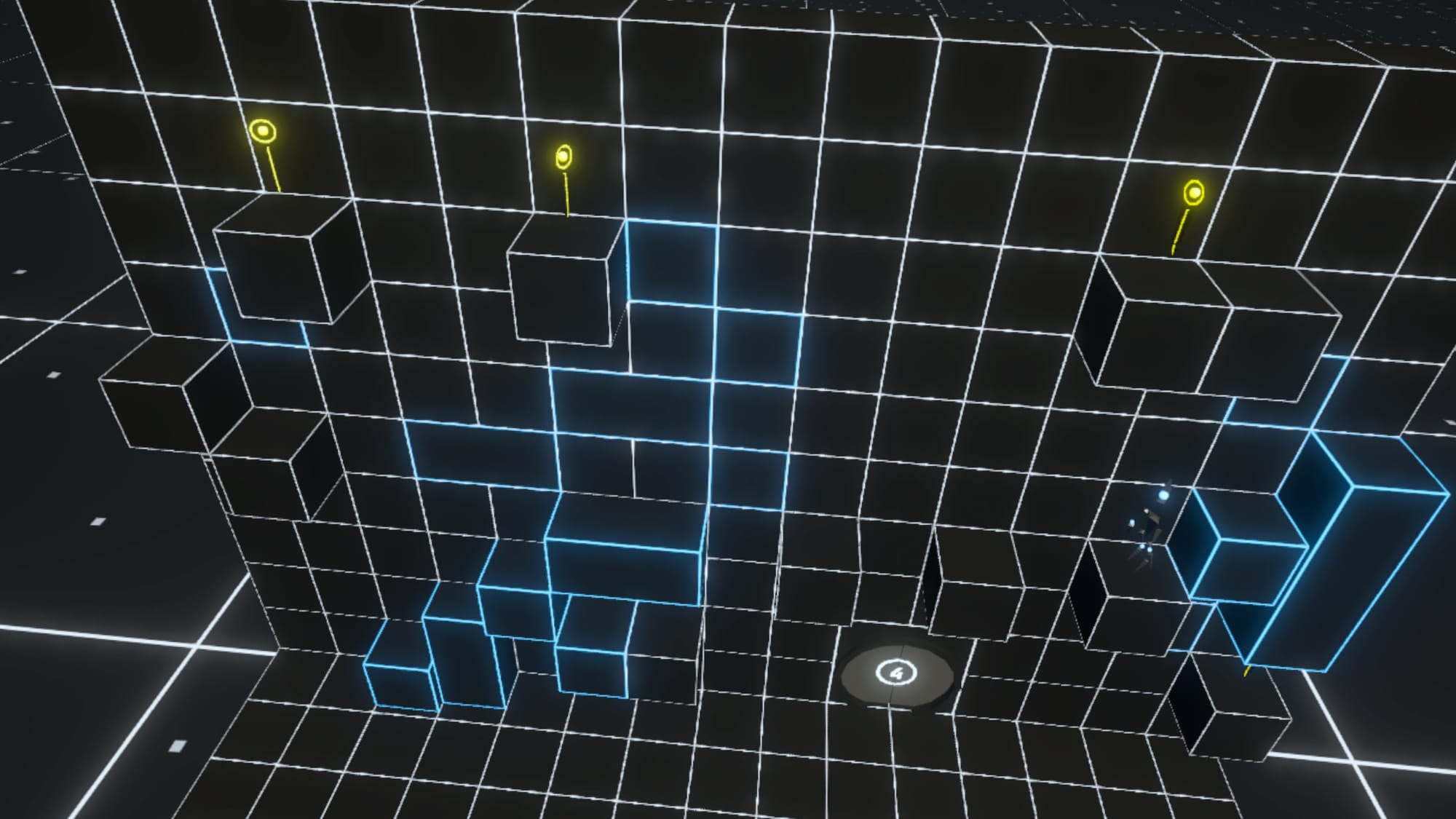
More important are the game’s mechanics, which are simple and effective. Across fifty brief puzzle stages, the player must navigate their in-game avatar through the many three-dimensional geometric mazes to obtain a set number of keys scattered throughout the environment. The avatar is controlled via the game controller’s analog sticks and buttons in a traditional third-person fashion.
The acquisition of the keys is not a straightforward proposition. Often, they are placed in awkward locations which must be navigated to with pinpoint accurate platforming and by manipulating platforms and objects in the environment. You do this with the game controller by physically reaching out, grabbing hold of the platform or object, and dragging it where we want it to go.
0:00
/1:48
Gameplay captured by UploadVR on Quest 3S
The manipulable objects are rendered in the monochrome game space in shades of blue and red. We can pull or push blue platforms out of niches in a wall, for instance, to create a makeshift stairway or carry our avatar here and there. Reaching out and grabbing hold of these platforms can be done with either hand, and the process feels intuitive and effortless.
Automated moving red platforms and other objects can be activated by hand switches or by placing weighted blocks placed on pressure switches.
While both mechanics work well enough, they can occasionally feel too obvious. For example, most of the blue movable platforms simply run on a predetermined track. We can slide a block left or right or up or down, but not wherever we like. This limitation keeps the player from just grabbing a block, placing our avatar onto it, and zipping them around the game world freely. Still, the fact that each block has a sort of predestined path means that the solution to every puzzle is simply sliding some blocks this way and then that. In this way, the platforming puzzles don’t always feel like puzzles, more like a series of tasks to complete.
The game’s puzzles naturally become more complicated as the game progresses, with later stages being absolutely packed with red and blue interactable puzzle objects and plenty of enemies to stun, dodge, and attack. But Neon Cipher could be a bit more challenging, and I wouldn’t complain.
Neon Cipher’s controls are tight, and the platforming is satisfying and consistent. We don’t suffer inscrutable physics or slog through frustrating perspectives. There’s no traditional camera to control, we simply view the world in first person and move ourselves physically to gain a better view. There are also no odd distances to judge, or extraneous confusing elements, and there’s no fall damage.
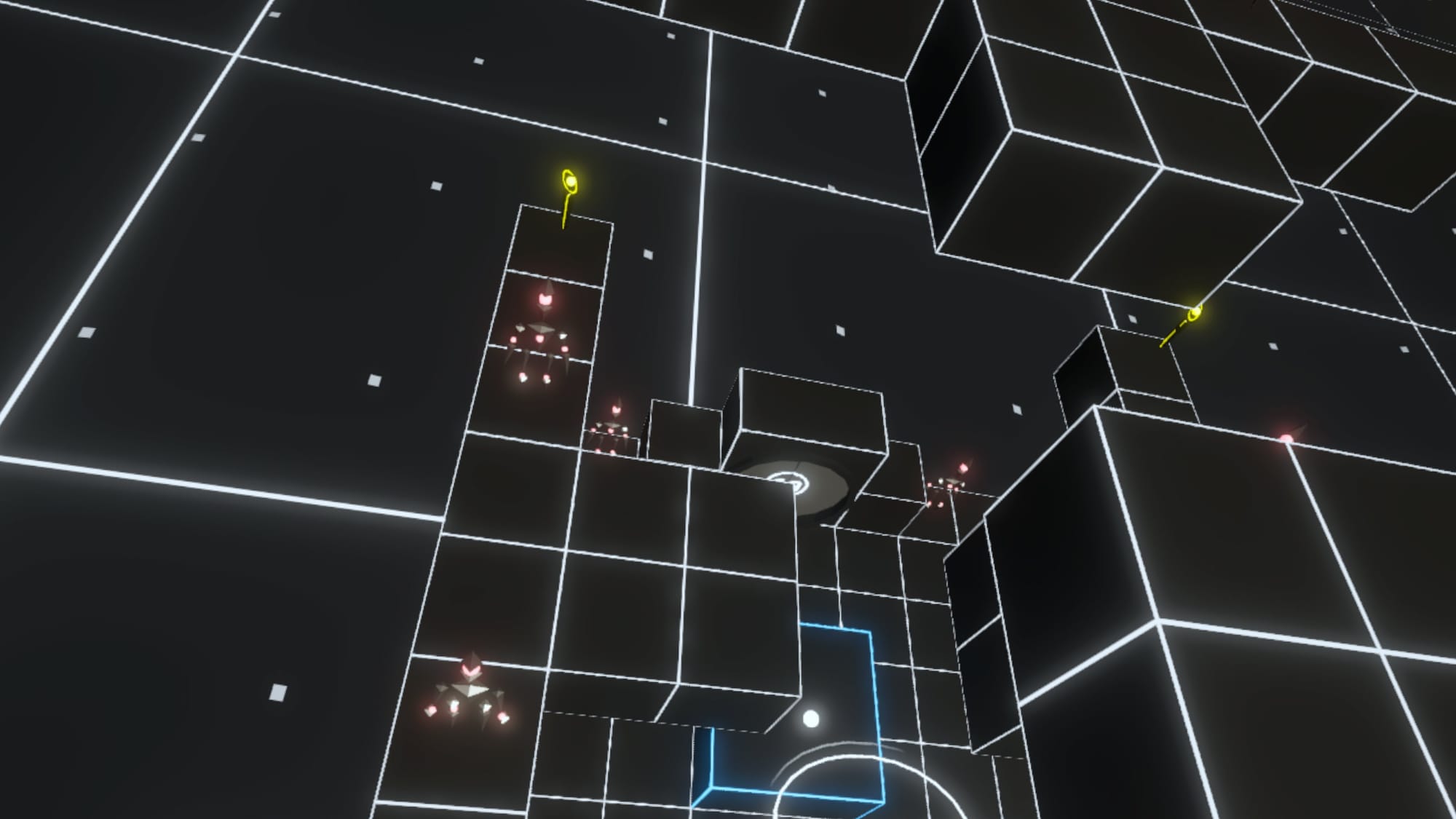
Once we’ve worked our avatar through the maze and collected all the necessary keys, the stage door opens, allowing our avatar to escape the stage and move on to the next. But this is easier said than done; the keys are guarded by enemies. These enemy bots attempt to destroy the player character via melee or ranged attacks, which must be avoided or countered.
We have a few methods of counterattack available to us. The first is a simple melee attack. By pressing the A button, our little electric avatar can deliver a weak punch. Punch an enemy a few times, and it’ll dissolve permanently. We can also physically reach out with the VR controller and grab the enemy bots with a press of the trigger. This temporarily stun-locks the enemy behind a vector force field, allowing our avatar in the game world to either circumvent or attack the enemy freely. Lastly, it’s possible to use the environment’s movable objects to squish the enemy bots.
0:00
/2:17
Gameplay captured by UploadVR on Quest 3S
While these actions can be reasonably described as “combat,” you should not expect complexity or sophistication. Our bot has one move that’s slow and ineffective. Though the ability to reach out and stun our enemies with the controllers before delivering a couple of melee attacks sounds dynamic and interesting, the reality is that combat is far from engaging.
More often than not, clearing a stage devolves simply into wiggling around a bit, avoiding the enemy’s ranged attacks, and scampering away with a key. It’s just not very exciting, and this becomes even more obvious when we realize that defeating all the bots on a stage is not a requirement for progression. If we can evade the enemies and grab all the keys, the door opens, and we still win.
But I’m nitpicking, just a bit. What’s here is fine, I only wish the puzzles were a bit tougher on the brain, and the combat a bit more demanding of the reflexes.
Playing Neon Cipher almost becomes meditative at times. Despite the potential stress of failure and the lightly taxing mental exertion, the game’s ethereal environment and moody ambient soundtrack sneakily lulls you into a state of calm. After 20 or 40 minutes of playing, I feel more focused, somehow.
0:00
/1:22
Gameplay captured by UploadVR on Quest 3S
Comfort
Neon Cipher uses the controller’s analog stick for moving the avatar in the game space, and the headset for first-person camera work. There is no real movement requirement, and the game can be played sitting or standing.
Beyond the main campaign of fifty puzzles, Neon Cipher also includes a fairly comprehensive level creator. Custom mazes are built using pre-made blocks and objects, which can be placed anywhere in the 3D space. While there is currently no way to upload custom maps, the developer hopes to implement this in future updates, or that maps can be shared manually via the studio’s Discord server.
Neon Cipher Review – Final Verdict
Neon Cipher began life as a school project developed across a three-month period. Upon graduation, eXomorph Games’ studio head, Jon Bogert, expanded the game to its current form for this release, and it’s an enjoyable debut from a new developer. It may not be as lush or expansive as similar third-person/first-person puzzle platformers such as Moss, but it’s a fun albeit simplified example of the genre’s more interesting ideas.
UploadVR uses a 5-Star rating system for our game reviews – you can read a breakdown of each star rating in our review guidelines.
An anonymous reader shared this report from The New York Times:
Russian counterintelligence agents are analyzing data from the popular Chinese messaging and social media app WeChat to monitor people who might be in contact with Chinese spies, according to a Russian intelligence document obtained by The New York Times. The disclosure highlights the rising level of concern about Chinese influence in Russia as the two countries deepen their relationship. As Russia has become isolated from the West over its war in Ukraine, it has become increasingly reliant on Chinese money, companies and technology. But it has also faced what the document describes as increased Chinese espionage efforts.
The document indicates that the Russian domestic security agency, known as the F.S.B., pulls purloined data into an analytical tool known as “Skopishche” (a Russian word for a mob of people). Information from WeChat is among the data being analyzed, according to the document… One Western intelligence agency told The Times that the information in the document was consistent with what it knew about “Russian penetration of Chinese communications….” By design, [WeChat] does not use end-to-end encryption to protect user data. That is because the Chinese government exercises strict control over the app and relies on its weak security to monitor and censor speech. Foreign intelligence agencies can exploit that weakness, too…
WeChat was briefly banned in Russia in 2017, but access was restored after Tencent took steps to comply with laws requiring foreign digital platforms above a certain size to register as “organizers of information dissemination.” The Times confirmed that WeChat is currently licensed by the government to operate in Russia. That license would require Tencent to store user data on Russian servers and to provide access to security agencies upon request.
An anonymous reader shared this report from SFGate about a lawsuit alleging a “warrantless drone surveillance program” that’s “trampling residents’ right to privacy”:
Sonoma County has been accused of deploying hundreds of drone flights over residents in a “runaway spying operation”… according to a lawsuit filed Wednesday by the American Civil Liberties Union. The North Bay county of Sonoma initially started the 6-year-old drone program to track illegal cannabis cultivation, but the lawsuit alleges that officials have since turned it into a widespread program to catch unrelated code violations at residential properties and levy millions of dollars in fines. The program has captured 5,600 images during more than 700 flights, the lawsuit said…
Matt Cagle, a senior staff attorney with the ACLU Foundation of Northern California, said in a Wednesday news release that the county “has hidden these unlawful searches from the people they have spied on, the community, and the media….” The lawsuit says the county employees used the drones to spy on private homes without first receiving a warrant, including photographing private areas like hot tubs and outdoor baths, and through curtainless windows.
One plaintiff “said the county secretly used the drone program to photograph her Sonoma County horse stable and issue code violations,” according to the article.
She only discovered the use of the drones after a county employee mentioned they had photos of her property, according to the lawsuit. She then filed a public records request for the images, which left her “stunned” after seeing that the county employees were monitoring her private property including photographing her outdoor bathtub and shower, the lawsuit said.
The engineer behind much of the Mac’s early graphical user interfaces, QuickDraw, MacPaint, Hypercard and much more, William D. “Bill” Atkinson, died on June 5 of complications from pancreatic cancer…
Atkinson, who built a post-Apple career as a noted nature photographer, worked at Apple from 1978 to 1990. Among his lasting contributions to Apple’s computers were the invention of the menubar, the selection lasso, the “marching ants” item selection animation, and the discovery of a midpoint circle algorithm that enabled the rapid drawing of circles on-screen.
He was Apple Employee No. 51, recruited by Steve Jobs. Atkinson was one of the 30 team members to develop the first Macintosh, but also was principle designer of the Lisa’s graphical user interface (GUI), a novelty in computers at the time. He was fascinated by the concept of dithering, by which computers using dots could create nearly photographic images similar to the way newspapers printed photos. He is also credited (alongside Jobs) for the invention of RoundRects, the rounded rectangles still used in Apple’s system messages, application windows, and other graphical elements on Apple products.
Hypercard was Atkinson’s main claim to fame. He built the a hypermedia approach to building applications that he once described as a “software erector set.” The Hypercard technology debuted in 1987, and greatly opened up Macintosh software development.
In 2012 some video clips of Atkinson appeared in some rediscovered archival footage. (Original Macintosh team developer Andy Hertzfeld uploaded “snippets from interviews with members of the original Macintosh design team, recorded in October 1983 for projected TV commercials that were never used.”)
Blogger John Gruber calls Atkinson “One of the great heroes in not just Apple history, but computer history.”
If you want to cheer yourself up, go to Andy Hertzfeld’s Folklore.org site and (re-)read all the entries about Atkinson. Here’s just one, with Steve Jobs inspiring Atkinson to invent the roundrect. Here’s another (surely near and dear to my friend Brent Simmons’s heart) with this kicker of a closing line: “I’m not sure how the managers reacted to that, but I do know that after a couple more weeks, they stopped asking Bill to fill out the form, and he gladly complied.”
Some of his code and algorithms are among the most efficient and elegant ever devised. The original Macintosh team was chock full of geniuses, but Atkinson might have been the most essential to making the impossible possible under the extraordinary technical limitations of that hardware… In addition to his low-level contributions like QuickDraw, Atkinson was also the creator of MacPaint (which to this day stands as the model for bitmap image editorsâ — âPhotoshop, I would argue, was conceptually derived directly from MacPaint) and HyperCard (“inspired by a mind-expanding LSD journey in 1985”), the influence of which cannot be overstated.
I say this with no hyperbole: Bill Atkinson may well have been the best computer programmer who ever lived. Without question, he’s on the short list. What a man, what a mind, what gifts to the world he left us.
All of the kernel build system “Kbuild” updates were merged today for the nearly-over Linux 6.16 merge window that is expected to conclude tomorrow with the Linux 6.16-rc1 release. Notable with the Kbuild pull is the introduction of the EXPORT_SYMBOL_GPL_FOR_MODULES helper…