Rethinking Fairness in Cycling Esports: A Closer Look at Categorization

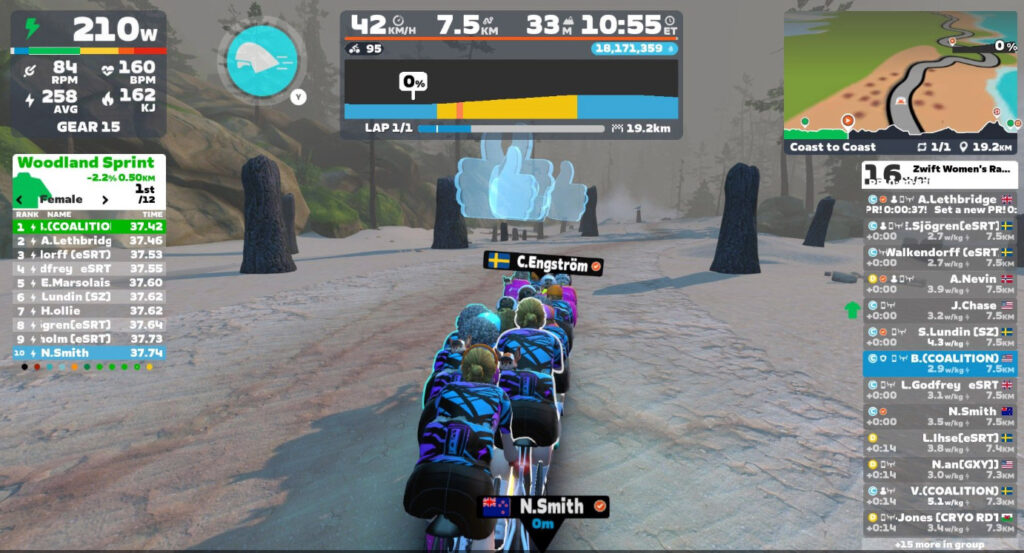
In May 2025, the FemmeCycle Collab (FCC) partnered with Zwift to launch a four-week women’s race series that grouped participants by age. There were five age brackets, with racers under 30 placed in one group and those over 60 in another. While this categorization was welcomed by some, many others remained skeptical. Interestingly, a portion of the feedback questioned the fairness of using age as a basis for categorization. These women referenced the previous Zwift model, which categorized racers using performance metrics like zFTP (~40 min power max) and zMAP (4-6 min power output), as a fairer system.

This feedback, particularly the reactions to this Zwift Insider article, got my wheels turning. Why do we, as women racers, consider a model based on medium- and long-term watts-per-kilogram (w/kg) output “fair”? And does this perception align with how athletes are categorized in outdoor cycling or other sports?

Let’s examine how categorization works in professional cycling, amateur events, and other sports to gain a better understanding of what might be applicable in the esports context.

“Real” Outdoor Professional Bike Racing

In professional cycling, which is often (perhaps unfairly) compared to community-level esports racing, categorization is rarely rigid. Instead, there are varied points systems that reward different elements: overall finishing position, stage wins, sprint points, mountain points, and even subjective recognitions like “most combative rider” or “best young rider.”

Although racers in mountain bike, gravel, or road events aren’t explicitly categorized in novel ways, these formats are largely self-selecting. Riders choose races that suit their strengths, whether that’s climbing, sprinting, or endurance.

Outdoor Amateur Cycling
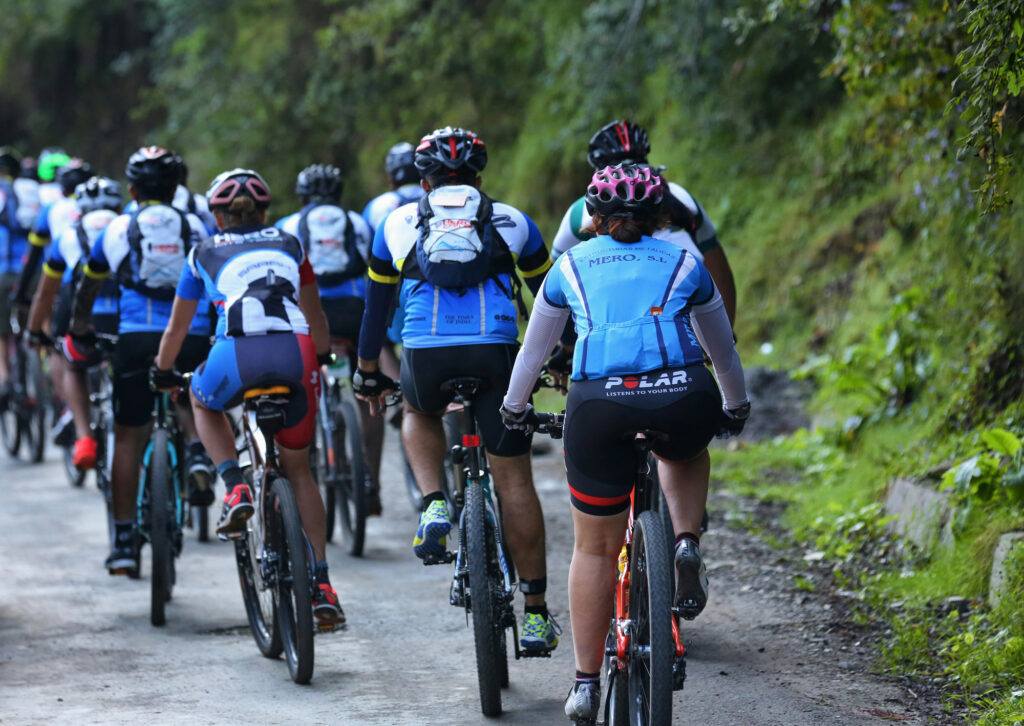
At the amateur level, race formats and categorization vary globally. In the USA, criterium races dominate, while in the UK, time trials are more common. Again, there’s a self-selecting dynamic: riders choose the races that align with their abilities and preferences.

Some events include special categories, such as the “Clydesdale” class in mountain races for heavier riders, which reflects an effort to tailor competition based on rider phenotype.  However, most outdoor amateur racing disciplines employ a categorization system that starts everyone at the bottom, with progression based on both experience and performance. This has practical justifications (e.g., bike handling skills at high speeds).

Other Sports

As a former rower in high school and college, I saw firsthand how diverse categorization can be. Rowing classifications vary by boat type (single, double, quad, or eight), rowing style (sweep or scull), weight class (lightweight or heavyweight), and even team composition (men’s, women’s, or mixed). Events are further divided by age group and skill level.

Track and field provides another strong model for categorization by athlete type. You have sprinters, distance runners, hurdlers – all with distinct strengths and race types. Athletes specialize early and select events that match their capabilities. In contrast, community-level esports cycling allows anyone to enter any race, regardless of phenotype. This can lead to mismatches and a feeling of disconnection between racer and race.

Why shouldn’t esports racing be just as versatile? We already have points races and climbing races. Why not a climbing event organized by weight class? Or a mixed-ability team time trial where the team’s result is based on the finish time of the lowest-ranked member?

So, What Makes a Race Feel “Good” or “Fair”?
A healthy pen size is important—it keeps things competitive and engaging. But beyond that, what truly matters is the sense that every racer belongs and that their unique strengths contribute to the dynamic of the race. If everyone has a superpower, why not create races using categorization systems that allow athletes to showcase theirs? 

There are multiple platforms launching in 2025 which will allow race organizers to showcase the performance in race fields, including ECRO and Lead Out.  These services could make community-level racing more exciting on every platform for both racers and spectators.  Now is the time to explore what racers want, so the right tools can be built.

Share Your Thoughts

I’d love to hear from others in the community – what kinds of racer categorizations feel fair to you? What formats have made you feel seen and valued as a racer?

Let’s keep the conversation going and explore how we can build more inclusive, creative, and exciting race experiences together.

AI’s Adoption and Growth Truly is ‘Unprecedented’

“If the adoption of AI feels different from any tech revolution you may have experienced before — mobile, social, cloud computing — it actually is,” writes TechCrunch. They cite a new 340-page report from venture capitalist Mary Meeker that details how AI adoption has outpaced any other tech in human history — and uses the word “unprecedented” on 51 pages:

ChatGPT reaching 800 million users in 17 months: unprecedented. The number of companies and the rate at which so many others are hitting high annual recurring revenue rates: also unprecedented. The speed at which costs of usage are dropping: unprecedented. While the costs of training a model (also unprecedented) is up to $1 billion, inference costs — for example, those paying to use the tech — has already dropped 99% over two years, when calculating cost per 1 million tokens, she writes, citing research from Stanford. The pace at which competitors are matching each other’s features, at a fraction of the cost, including open source options, particularly Chinese models: unprecedented…

Meanwhile, chips from Google, like its TPU (tensor processing unit), and Amazon’s Trainium, are being developed at scale for their clouds — that’s moving quickly, too. “These aren’t side projects — they’re foundational bets,” she writes.
“The one area where AI hasn’t outpaced every other tech revolution is in financial returns…” the article points out.

“[T]he jury is still out over which of the current crop of companies will become long-term, profitable, next-generation tech giants.”


Read more of this story at Slashdot.

Warplanes Pacific & Border Bots Are June’s Horizon+ Monthly Games On Quest

Warplanes: Battles over Pacific and Border Bots VR are the Meta Horizon+ monthly redeemable games for June 2025 on Quest.

What Is Meta Horizon+?

The Meta Horizon+ subscription lets you redeem two pre-selected games each month, alongside a rotating selection of titles in its Games Catalog. It was previously called Meta Quest+ until its rebranding in May 2025.

Redeeming these monthly games ensures continued access while your subscription remains active. Should you cancel your membership, previously redeemed games become accessible again if you resubscribe.

Horizon+ is available on Quest 2, Quest Pro, Quest 3, and Quest 3S.

Now available on Quest, this follows last month’s selection of multiplayer FPS Breachers and Kill It With Fire VR. This also marks the first new month where the subscription service has been called Meta Horizon+, following a recent rebranding from its previous name Meta Quest+.

Available now for subscribers until June 30, 2025, here’s what you can download.


Warplanes: Battles over Pacific

The second entry in Home Net Games’ dogfighter trilogy, Warplanes: Battles over Pacific sees you leading the charge during World War II as you fight the Japanese Empire using one of 15 available aircraft. This includes a single player campaign, a PvP multiplayer mode, and co-op missions you can play with friends.


Border Bots VR

Border Bots VR is a comedic sci-fi puzzle sim where you play as a human border control agent inspecting robots from Paw Print Games and vTime Ltd. When it launched last year, we considered it to be a “thoroughly entertaining adventure” that mixes Job Simulator with Papers, Please, awarding 4/5 stars in our review.

Review: Border Bots VR Presents A Charming Security Sim
Border Bots VR is a thoroughly enjoyable security sim that mixes Job Simulator with Papers, Please. Our full review.
UploadVRHenry Stockdale


Horizon+ Games Catalog

Horizon+ also offers a games catalog of Quest titles that any subscribers can play. Here’s the full Games Catalog library as of June 2, 2025:

  • Angry Birds VR: Isle of Pigs
  • Asgard’s Wrath 2
  • BAM
  • Broken Edge
  • Cook-Out
  • Cosmonious High
  • Cubism
  • Deisim
  • Demeo
  • Dungeons of Eternity
  • Elven Assassin
  • Espire 2: Stealth Operatives
  • Garden of the Sea
  • Guardians Frontline
  • Home Sports
  • In Death: Unchained
  • Medieval Dynasty New Settlement
  • Mini Motor Racing X
  • Onward
  • Premium Bowling
  • Puzzling Places
  • Red Matter
  • Shattered
  • Swarm
  • Sweet Surrender
  • Synth Riders
  • Tetris Effect: Connected
  • The Climb 2
  • Thief Simulator VR: Greenview Street
  • Titans Clinic
  • Walkabout Mini Golf

Meta Horizon+ costs $8 per month or $60 annually.

QuestCraft 6.0 Brings Major Performance Improvement & Pico Support

QuestCraft 6.0 adds performance improvements to the unofficial Minecraft VR port, Pico support, and more.

Now live following an announcement last week, QuestCraft 6.0 is the latest major update to the ongoing project. This notably adds support for ByteDance’s Pico Neo 3 Link, Pico 4 and Pico 4 Ultra headsets, expanded mod support and performance improvements. Multi-account support, a demo mode if you don’t own Microsoft Java Edition, and a log viewer were also introduced.

0:00

/1:16

The full QuestCraft 6.0 patch notes can be seen on GitHub, and playing this requires sideloading onto your Pico and Quest headsets. For Quest, our sideloading guide has the full details. Just be aware that several players are reporting issues with logging into the game following the 6.0 update.

This follows last year’s major QuestCraft 5.0 update, which made the unofficial project compatible with Quest 3. Notably, that aimed to boost the framerate from 45fps to 120fps on Meta’s latest generation of headsets, though performance was reportedly poor. Mod compatibility and resource utilization were also improved alongside Quest 1 support, though only Quest 2 onwards is supported with 6.0.

Currently, modding is the only way you can play Minecraft in VR and while QuestCraft is designed for standalone headsets, PC players can use the Vivecraft mod. Official support was previously available with Minecraft: Bedrock Edition for PC VR and PlayStation VR, though Microsoft removed that last month following previous announcements last year.

Minecraft No Longer Officially Supports VR
Minecraft Bedrock has now removed its official support for PC VR and PlayStation VR, as announced last year.
UploadVRDavid Heaney

As a reminder, QuestCraft doesn’t directly distribute Minecraft and this wrapper allows you to play on standalone hardware. Accessing QuestCraft requires a legitimate copy of Minecraft’s Java & Bedrock Edition on PC and a Microsoft account.

QuestCraft 6.0 is available now through SideQuest and GitHub.

BBC to broadcast Women’s Tour of Britain 2025 live – here’s how to watch it

BBC Sport will broadcast the 2025 Lloyd’s Tour of Britain live as part of its Women’s Summer of Sport. 

The four-day race begins on 5 June and will be aired live on BBC iPlayer, the BBC Sport website and app. 

The broadcast will likely come as good news to cycling fans. The sport is becoming harder to watch, with the price hike of TNT Sports and the Tour de France set to disappear from ITV after this year’s edition of the race. 

The broadcast also signals a change of fortune for the Women’s Tour of Britain, after it was rescued by British Cycling last year after being cancelled in 2023 because of funding issues. 

The 2025 Women’s Tour of Britain will see 19 teams compete, a record number for the stage race. 

Among the riders set to take part are the UK’s Lizzie Deignan, a previous race winner and world champion, European champion Lorena Wiebes and double Olympic gold medallist Kristen Faulkner. 

“The Tour of Britain Women will be another great moment for women’s sport this summer and we’re delighted to bring this event to fans across the UK through our popular digital platforms,” said Alex Kay-Jelski, director of BBC Sport. 

“The BBC has a strong track record of backing women’s sport. Not just the victories, but the stories, the grit and the passion behind them. And as the UK’s most-used sports broadcaster, we’re proud to shine a spotlight on this race and its great cyclists.”

The BBC Sport’s Women’s Summer of Sport coverage will also include the Women’s Euros, Women’s Rugby World Cup, alongside the World Athletics Championships, Wimbledon and more. 

To enhance the Women’s Tour of Britain further, British Cycling has launched a new Lloyds Tour of Britain TikTok account, and there will be more race content available on the race’s YouTube channel. 

The event will also be available across Warner Bros. Discovery+ with a digital-only live stream, in addition to daily highlights on the TNT channels and digital, as well as the TNT red button. 


How else can I watch the 2025 Women’s Tour of Britain 2025 outside the UK?

A Virtual Private Network (VPN) is software that enables you to change your device’s IP address, making it appear as though you’re accessing the internet from another country.

As long as you adhere to your broadcaster’s terms and conditions, a VPN enables you to unblock your usual streaming services, no matter your location. Additionally, a VPN can improve playback speeds and significantly enhance your overall internet security.

There are many VPN options available, but we recommend NordVPN as the best choice. It offers strong streaming capabilities, robust security features, and excellent value for money.

*At BikeRadar (published by Our Media Limited), we review VPN services to help you access online content and services securely while you’re on the go. This includes activities such as streaming your favourite TV shows, live web content or using apps from different countries (provided it’s okay with the service provider’s terms and conditions). It’s important to note: BikeRadar does not endorse or support the use of VPN services for illegal or malicious activities, such as accessing paid-for pirated content. Please ensure you enjoy online content responsibly.


2025 Lloyds Tour of Britain stages 

  • Stage one: Thursday 5 June, Dalby Forest to Redcar
  • Stage two: Friday 6 June, Hartlepool to Saltburn-by-the-Sea
  • Stage three: Saturday 7 June, The Scottish Borders Stage, Kelso to Kelso
  • Stage four: Sunday 8 June, The Glasgow Stage

2025 Lloyds Tour of Britain teams

  • UCI Women’s WorldTeams: AG Insurance – Soudal Team (Belgium); Canyon//SRAM zondacrypto (Germany); CERATIZIT Pro Cycling Team (Germany); FDJ – SUEZ (France); Lidl-Trek (USA); Liv AlUla Jayco (Australia); Movistar Team (Spain); Team Picnic PostNL (Netherlands); Team SD Worx Protime (Netherlands); Team Visma | Lease a Bike (Netherlands); UAE Team ADQ (UAE); Uno-X Mobility (Norway)
  • UCI Women’s ProTeams: EF Education – Oatly (USA);
  • UCI Continental Teams: CJ O’Shea Racing (Great Britain); DAS – Hutchinson (Great Britain); Handsling Alba Development Road Team (Great Britain); Hess Cycling Team (Great Britain); Smurfit Westrock Cycling Team (Great Britain)

With victory at Unbound, Pas Racing is cementing its place as gravel’s super team to beat

Karolina Migoń is on a hot streak. 

The 29-year-old from Poland won the Traka 360 this spring. Then she traveled to the United States and won Gravel Locos. A week later, she was the sole survivor of a three-woman breakaway as she crossed the line to win Unbound Gravel. 

Migoń wears the black and gold kit of Pas Racing, the gravel team made up of riders sponsored by boutique clothing brand Pas Normal Studios. Migoń’s results are well-earned and impressive, but another layer to the story is the rise of one of gravel’s most dominant teams. 

In addition to Migoń’s win at the Traka, Pas took the win in the men’s Traka race under the power of Tobias Kongstad. Last year at Unbound, Pas rider Chad Haga placed second behind Lachlan Morton. 

Pas Racing is a loose confederation of riders. They call themselves a team, but the riders’ only common sponsor is Pas Normal. For instance, Migoń races on a Rose bike, while Kongstad rides a Specialized. 

Cecily Decker finishes second at Unbound 2025
Cecily Decker finished second behind Karolina Migoń at Unbound. Unbound

“We are pushing each other,” Migoń said of her teammates. “We are learning from each other, and we have a big support. So staying at the Pas house, it’s really nice. I can help with anyone. Everyone’s really chill, really helpful. I think that’s why our team is so strong.”

Pas’ dominance naturally leads to questions wondering whether road racing team tactics have made their way into gravel racing. In Sunday’s Unbound race, Migoń was in the breakaway with Pas teammate Cecily Decker. The two could have used their advantage against their third break companion, Lauren Stephens, but Migoń said they didn’t use any team tactics.

Pas Racing rider at the Traka gravel race in Girona
Pas Racing is on a winning streak, having also dominated at the Traka in Girona. Traka

“Not really, to be fair,” Migoń said. “I would never say that we were pushing any more than Lauren because we were two on one team. We didn’t try to leave Lauren at any point.”

Stephens was the first to fall off the back of the trio, and then Decker cracked as well. Migoń rode much of the final 50 miles on her own, and finished nine minutes ahead of second-place Decker. 

Pas Racing gravel team
Pas Racing was established as a gravel team in 2024. Traka

For her part, Decker was visibly wrecked and shaken at the finish. She said she messed up her first feed and got dehydrated. She then drank her fluids fast after the second aid, but she was still thirsty for the rest of the race – proof that even the race leaders struggle at the infamous Unbound. 

Migoń and Pas Racing don’t appear to be slowing down anytime soon. 

“I think right now I just believe in myself,” Migoń said.


Read more from Unbound 2025:


‘Hubble Tension’ and the Nobel Prize Winner Who Wants to Replace Cosmology’s Standard Model

Adam Riess won a Nobel Prize in Physics for helping discover that the universe’s acceleration is expanding, remembers The Atlantic. But then theorists “proposed the existence of dark energy: a faint, repulsive force that pervades all of empty space… the final piece to what has since come to be called the ‘standard model of cosmology.'”
Riess thinks instead we should just replace the standard model:

When I visited Riess, back in January, he mentioned he was looking forward to a data release from the Dark Energy Spectroscopic Instrument, a new observatory on Kitt Peak, in Arizona’s portion of the Sonoran Desert. DESI has 5,000 robotically controlled optic fibers. Every 20 minutes, each of them locks onto a different galaxy in the deep sky. This process is scheduled to continue for a total of five years, until millions of galaxies have been observed, enough to map cosmic expansion across time… DESI’s first release, last year, gave some preliminary hints that dark energy was stronger in the early universe, and that its power then began to fade ever so slightly. On March 19, the team followed up with the larger set of data that Riess was awaiting. It was based on three years of observations, and the signal that it gave was stronger: Dark energy appeared to lose its kick several billion years ago.

This finding is not settled science, not even close. But if it holds up, a “wholesale revision” of the standard model would be required [says Colin Hill, a cosmologist at Columbia University. “The textbooks that I use in my class would need to be rewritten.” And not only the textbooks — the idea that our universe will end in heat death has escaped the dull, technical world of academic textbooks. It has become one of our dominant secular eschatologies, and perhaps the best-known end-times story for the cosmos. And yet it could be badly wrong. If dark energy weakens all the way to zero, the universe may, at some point, stop expanding. It could come to rest in some static configuration of galaxies. Life, especially intelligent life, could go on for a much longer time than previously expected.

If dark energy continues to fade, as the DESI results suggest is happening, it may indeed go all the way to zero, and then turn negative. Instead of repelling galaxies, a negative dark energy would bring them together into a hot, dense singularity, much like the one that existed during the Big Bang. This could perhaps be part of some larger eternal cycle of creation and re-creation. Or maybe not. The point is that the deep future of the universe is wide open…
“Many new observations will come, not just from DESI, but also from the new Vera Rubin Observatory in the Atacama Desert, and other new telescopes in space. On data-release days for years to come, the standard model’s champions and detractors will be feverishly refreshing their inboxes…” And Riess tells The Atlantic he’s disappointed when complacent theorists just tell him “Yeah, that’s a really hard problem.”
He adds, “Sometimes, I feel like I am providing clues and killing time while we wait for the next Einstein to come along.”


Read more of this story at Slashdot.

New Moderate Linux Flaw Allows Password Hash Theft Via Core Dumps in Ubuntu, RHEL, Fedora

An anonymous reader shared this report from The Hacker News:

Two information disclosure flaws have been identified in apport and systemd-coredump, the core dump handlers in Ubuntu, Red Hat Enterprise Linux, and Fedora, according to the Qualys Threat Research Unit (TRU).

Tracked as CVE-2025-5054 and CVE-2025-4598, both vulnerabilities are race condition bugs that could enable a local attacker to obtain access to access sensitive information. Tools like Apport and systemd-coredump are designed to handle crash reporting and core dumps in Linux systems. “These race conditions allow a local attacker to exploit a SUID program and gain read access to the resulting core dump,” Saeed Abbasi, manager of product at Qualys TRU, said…
Red Hat said CVE-2025-4598 has been rated Moderate in severity owing to the high complexity in pulling an exploit for the vulnerability, noting that the attacker has to first win the race condition and be in possession of an unprivileged local account… Qualys has also developed proof-of-concept code for both vulnerabilities, demonstrating how a local attacker can exploit the coredump of a crashed unix_chkpwd process, which is used to verify the validity of a user’s password, to obtain password hashes from the /etc/shadow file.
Advisories were also issued by Gentoo, Amazon Linux, and Debian, the article points out. (Though “It’s worth noting that Debian systems aren’t susceptible to CVE-2025-4598 by default, since they don’t include any core dump handler unless the systemd-coredump package is manually installed.”)

Canonical software security engineer Octavio Galland explains the issue on Canonical’s blog. “If a local attacker manages to induce a crash in a privileged process and quickly replaces it with another one with the same process ID that resides inside a mount and pid namespace, apport will attempt to forward the core dump (which might contain sensitive information belonging to the original, privileged process) into the namespace… In order to successfully carry out the exploit, an attacker must have permissions to create user, mount and pid namespaces with full capabilities.”

Canonical’s security team has released updates for the apport package for all affected Ubuntu releases… We recommend you upgrade all packages… The unattended-upgrades feature is enabled by default for Ubuntu 16.04 LTS onwards. This service:

– Applies new security updates every 24 hours automatically.
– If you have this enabled, the patches above will be automatically applied within 24 hours of being available.


Read more of this story at Slashdot.

‘Doctor Who’ Regenerates in Surprise Season Finale. But Will the Show Return?

“The Doctor is dead. Long live the Doctor!” writes Space.com. (Spoilers ahead…)

“The era of Ncuti Gatwa’s Fifteenth Doctor came to a surprise end on Saturday night, as the Time Lord regenerated at the end of “Doctor Who” season 2 finale… [T]he Doctor gradually realises that not everything is back to normal. Poppy, his daughter with Belinda Chandra in the “Wish World” fantasy, has been erased from history, so the Time Lord decides to sacrifice himself by firing a ton of regeneration energy into the time Vortex to “jolt it one degree” — and hopefully bring her back. It goes without saying that his madcap scheme saves Poppy, as we learn that, in this rewritten timeline, the little girl was always the reason Belinda had been desperate to get back home. But arguably the biggest talking point of the episode — and, indeed, the season — is saved until last, as the Doctor regenerates into a very familiar face…

Hint: They played the Doctor’s companion, Rose Tyler, “alongside Christopher Eccleston’s Ninth Doctor and David Tennant’s Tenth Doctor during the phenomenally successful first two seasons of the show’s 2005 reboot.”
Showrunner Russell T Davies called it “an honour and a hoot” to welcome back Billie Piper to the TARDIS, “but quite how and why and who is a story yet to be told. After 62 years, the Doctor’s adventures are only just beginning!”
Although the show’s post-regeneration credits have traditionally featured the line “And introducing [insert name] as the Doctor”, here it simply says “And introducing Billie Piper”. The omission of “as the Doctor” is unlikely to be accidental, suggesting that Davies is playing a very elaborate game with “Who” fandom…

Another mystery! The BBC and Disney+ are yet to confirm if and when “Doctor Who” will return for a third season of its current iteration.

“There’s no decision until after season two…” Davies told Radio Times in April (as spotted by the Independent). “That’s when the decision is — and the decision won’t even be made by the people we work with at Disney Plus, it’ll be made by someone in a big office somewhere. So literally nothing happening, no decision.”

“For a new series to be ready for 2026, production would need to get under way relatively soon,” writes the BBC. “So at the moment a new series or a special starring Billie Piper before 2027 looks unlikely.” The Guardian adds:

Concerns have been raised about falling viewing figures, which have struggled to rally since Russell T Davies’ return in 2023. Two episodes during this series, which aired in May, got less than 3 million viewers — the lowest since the modern era began airing in 2005.

The Independent has this statement from Piper:

“It’s no secret how much I love this show, and I have always said I would love to return to the Whoniverse as I have some of my best memories there, so to be given the opportunity to step back on that Tardis one more time was just something I couldn’t refuse, but who, how, why and when, you’ll just have to wait and see.”


Read more of this story at Slashdot.

How to watch the Green Games Showcase at Summer Game Fest 2025

This year’s Summer Game Fest will feature a new showcase for games that highlight environmental causes and make direct contributions to real-world sustainability efforts. The Green Games Showcase, led by the not-for-profit PlanetPlay, will be held on Saturday, June 7 at 4:00PM ET (1:00PM PT) and streamed live on YouTube.

PlanetPlay says the event will be “a celebration of game studios that have raised over $100,000 for certified environmental projects around the world.” Those projects so far include Abundant Village, a regenerative garden project in South Africa; the carbon forestry project WithOneSeed in Timor-Leste; The Hongera Clean Cookstove project in Kenya; and The Teeny Tiny Truth, which aims to reduce microplastics in New Zealand’s fresh water systems.

The Green Games Showcase is one of several streams that are set to take place between Summer Game Fest Live on Friday and the Xbox Games Showcase on Sunday. Be sure to also check out Day of the Devs, Devolver Direct, Wholesome Direct, the Women-Led Games Showcase, the Latin American Game Showcase and the Southeast Asian Games Showcase. It’ll all wrap up with a Death Stranding 2: On the Beach premiere event, where you can get an early look at the game ahead of its release on June 26.

This article originally appeared on Engadget at https://www.engadget.com/gaming/how-to-watch-the-green-games-showcase-at-summer-game-fest-2025-000057640.html?src=rss

Six More Humans Successfully Carried to the Edge of Space by Blue Origin

An anonymous reader shared this report from Space.com:

Three world travelers, two Space Camp alums and an aerospace executive whose last name aptly matched their shared adventure traveled into space and back Saturday, becoming the latest six people to fly with Blue Origin, the spaceflight company founded by billionaire Jeff Bezos.

Mark Rocket joined Jaime Alemán, Jesse Williams, Paul Jeris, Gretchen Green and Amy Medina Jorge on board the RSS First Step — Blue Origin’s first of two human-rated New Shepard capsules — for a trip above the Kármán Line, the 62-mile-high (100-kilometer) internationally recognized boundary between Earth and space…

Mark Rocket became the first New Zealander to reach space on the mission. His connection to aerospace goes beyond his apt name and today’s flight; he’s currently the CEO of Kea Aerospace and previously helped lead Rocket Lab, a competing space launch company to Blue Origin that sends most of its rockets up from New Zealand. Alemán, Williams and Jeris each traveled the world extensively before briefly leaving the planet today. An attorney from Panama, Alemán is now the first person to have visited all 193 countries recognized by the United Nations, traveled to the North and South Poles, and now, have been into space. For Williams, an entrepreneur from Canada, Saturday’s flight continued his record of achieving high altitudes; he has summitted Mt. Everest and five of the other six other highest mountains across the globe.
“For about three minutes, the six NS-32 crewmates experienced weightlessness,” the article points out, “and had an astronaut’s-eye view of the planet…”
On social media Blue Origin notes it’s their 12th human spaceflight, “and the 32nd flight of the New Shepard program.”


Read more of this story at Slashdot.

Amid Turmoil, Stack Overflow Asks About AI, Salary, Remote Work in 15th Annual Developer Survey

Stack Overflow remains in the midst of big changes to counter an AI-fueled drop in engagement. So “We’re wondering what kind of online communities Stack Overflow users continue to support in the age of AI,” writes their senior analyst, “and whether AI is becoming a closer companion than ever before.”

For their 15th year of their annual reader survey, this means “we’re not just collecting data; we’re reflecting on the last year of questions, answers, hallucinations, job changes, tech stacks, memory allocations, models, systems and agents — together…”

Is it an AI agent revolution yet? Are you building or utilizing AI agents? We want to know how these intelligent assistants are changing your daily workflow and if developers are really using them as much as these keynote speeches assume. We’re asking if you are using these tools and where humans are still needed for common developer tasks.
Career shifts: We’re keen to understand if you’ve considered a career change or transitioned roles and if AI is impacting your approach to learning or using existing tools. Did we make up the difference in salaries globally for tech workers…?

They’re also re-visiting “a key finding from recent surveys highlighted a significant statistic: 80% of developers reported being unhappy or complacent in their jobs.”
This raised questions about changing office (and return-to-office) culture and the pressures of the industry, along with whether there were any insights into what could help developers feel more satisfied at work. Prior research confirmed that flexibility at work used to contribute more than salary to job satisfaction, but 2024’s results show us that remote work is not more impactful than salary when it comes to overall satisfaction… [For some positions job satisfaction stayed consistent regardless of salary, though it increased with salary for other positions. And embedded developers said their happiness increased when they worked with top-quality hardware, while desktop developers cited “contributing to open source” and engineering managers were happier when “driving strategy”.]

In 2024, our data showed that many developers experienced a pay cut in various roles and programming specialties. In an industry often seen as highly lucrative, this was a notable shift of around 7% lower salaries across the top ten reporting countries for the same roles. This year, we’re interested in whether this trend has continued, reversed, or stabilized. Salary dynamics is an indicator for job satisfaction in recent surveys of Stack Overflow users and understanding trends for these roles can perhaps improve the process for finding the most useful factors contributing to role satisfaction outside of salary.
And of course they’re asking about AI — while noting last year’s survey uncovered this paradox. “While AI usage is growing (70% in 2023 vs. 76% in 2024 planning to or currently using AI tools), developer sentiment isn’t necessarily following suit, as 77% in of all respondents in 2023 are favorable or very favorable of AI tools for development compared to 72% of all respondents in 2024.”

Concerns about accuracy and misinformation were prevalent among some key groups. More developers learning to code are using or are interested in using AI tools than professional developers (84% vs. 77%)… Developers with 10 — 19 years experience were most likely (84%) to name “increase in productivity” as a benefit of AI tools, higher than developers with less experience (<80%)…

Is it an AI agent revolution yet? Are you building or utilizing AI agents? We want to know how these intelligent assistants are changing your daily workflow and if developers are really using them as much as these keynote speeches assume. We’re asking if you are using these tools and where humans are still needed for common developer tasks.


Read more of this story at Slashdot.