Klarna Pivots Back To Humans After AI Experiment Fails

Fintech startup Klarna is now recruiting humans after its AI customer service agents underperformed. The buy-now-pay-later company, which eliminated its marketing contracts in 2023 and customer service team in 2024, now plans an “Uber-type setup” with remote gig workers.

This marks a stark reversal from CEO Sebastian Siemiatkowski’s 2024 claim that “AI can already do all of the jobs that we, as humans, do.” Siemiatkowski told Bloomberg: “From a brand perspective, I just think it’s so critical that you are clear to your customer that there will be always a human if you want.” He added that “cost unfortunately seems to have been a too predominant evaluation factor” leading to “lower quality.”


Read more of this story at Slashdot.

For the first time in the US, a rotating detonation rocket engine takes flight

A US-based propulsion company, Venus Aerospace, said Wednesday it had completed a short flight test of its rotating detonation rocket engine at Spaceport America in New Mexico.

The company’s chief executive and co-founder, Sassie Duggleby, characterized the flight as “historic.” It is believed to be the first US-based flight test of an idea that has been discussed academically for decades, a rotating detonation rocket engine. The concept has previously been tested in a handful of other countries, but never with a high-thrust engine.

“By proving this engine works beyond the lab, Venus brings the world closer to a future where hypersonic travel—traversing the globe in under two hours—becomes possible,” Duggleby told Ars.

Read full article

Comments

Microsoft Is Open-Sourcing Its Linux Integration Services Automation Image-Testing Service

An anonymous reader quotes a report from ZDNet: Would you believe Microsoft has announced a new Linux distribution service for its Azure cloud service? You should. For many years, the most popular operating system on Azure has not been Windows Server, it’s been Linux. Last time I checked, in 2024, Azure Linux Platforms Group Program Manager Jack Aboutboul told me that 60% of Azure Marketplace offerings and more than 60% of virtual machine cores use Linux. Those figures mean it’s sensible for Microsoft to make it easier than ever for Linux distributors to release first-class Linux distros on Azure. The tech giant is taking this step, said Andrew Randall, principal manager for the Azure Core Linux product management team, by making “Azure Image Testing for Linux (AITL) available ‘as a service’ to distro publishers.”

ATIL is built on Microsoft’s Linux Integration Services Automation project (LISA). Microsoft’s Linux Systems Group originally developed this initiative to validate Linux OS images. LISA is a Linux quality validation system with two parts: a test framework to drive test execution and a set of test suites to verify Linux distribution quality. LISA is now open-sourced under the MIT License. The system enables continuous testing of Linux images, covering a wide range of scenarios from kernel updates to complex cloud-native workloads. […] Specifically, the ATIL service is designed to streamline the deployment, testing, and management of Linux images on Azure. The service builds on the company’s internal expertise and open-source tools to provide:

– Curated, Azure-optimized, security-hardened Linux images
– Automated quality assurance and compliance testing for Linux distributions
– Seamless integration with Azure’s cloud-native services and Kubernetes environments

Krum Kashan, Microsoft Azure Linux Platforms Group program manager, said in a statement: “While numerous testing tools are available for validating Linux kernels, guest OS images, and user space packages across various cloud platforms, finding a comprehensive testing framework that addresses the entire platform stack remains a significant challenge. A robust framework is essential, one that seamlessly integrates with Azure’s environment while providing coverage for major testing tools, such as LTP and kselftest, and covers critical areas like networking, storage, and specialized workloads, including Confidential VMs, HPC, and GPU scenarios. This unified testing framework is invaluable for developers, Linux distribution providers, and customers who build custom kernels and images.”


Read more of this story at Slashdot.

xAI’s Grok suddenly can’t stop bringing up “white genocide” in South Africa

Users on X (formerly Twitter) love to tag the verified @grok account in replies to get the large language model’s take on any number of topics. On Wednesday, though, that account started largely ignoring those requests en masse in favor of redirecting the conversation towards the topic of alleged “white genocide” in South Africa and the related song “Kill the Boer.”

Searching the Grok account’s replies for mentions of “genocide” or “boer” currently returns dozens if not hundreds of posts where the LLM responds to completely unrelated queries with quixotic discussions about alleged killings of white farmers in South Africa (though many have been deleted in the time just before this post went live; links in this story have been replaced with archived versions where appropriate). The sheer range of these non-sequiturs is somewhat breathtaking; everything from questions about Robert F. Kennedy Jr.’s disinformation to discussions of MLB pitcher Max Scherzer’s salary to a search for new group-specific put-downs, see Grok quickly turning the subject back toward the suddenly all-important topic of South Africa.

It’s like Grok has become the world’s most tiresome party guest, harping on its own pet talking points to the exclusion of any other discussion.

Read full article

Comments

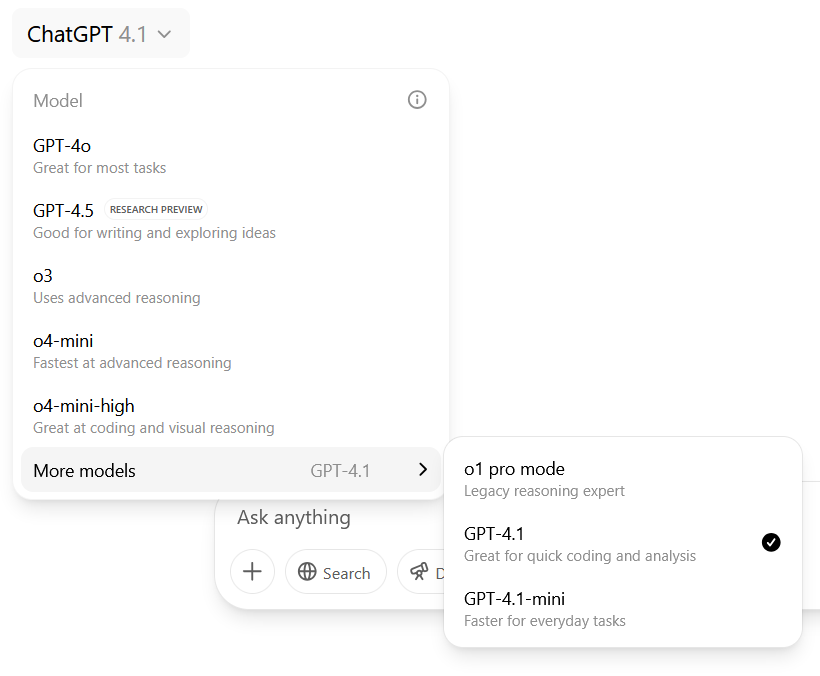
OpenAI adds GPT-4.1 to ChatGPT amid complaints over confusing model lineup

On Wednesday, OpenAI announced that ChatGPT users now have access to GPT-4.1, an AI language model previously available only through the company’s API since its launch one month ago. The update brings what OpenAI describes as improved coding and web development capabilities to paid ChatGPT subscribers, with wider enterprise rollout planned in the coming weeks.

GPT-4.1 and 4.1 mini to ChatGPT adds to an already complex model selection that includes GPT-4o, various specialized GPT-4o versions, o1-pro, o3-mini, and o3-mini-high models. There are technically nine AI models available for ChatGPT Pro subscribers. Wharton professor Ethan Mollick recently publicly lampooned the awkward situation on social media.

As of May 14, 2025, ChatGPT Pro users have access to 8 different main AI models, plus Deep Research.
As of May 14, 2025, ChatGPT Pro users have access to eight main AI models, plus Deep Research.
Credit:
Benj Edwards

Deciding which AI model to use can be daunting for AI novices. Reddit users and OpenAI forum members alike commonly voice confusion about the available options. “I do not understand the reason behind having multiple models available for use,” wrote one Reddit user in March. “Why would anyone use anything but the best one?” Another Redditor said they were “a bit lost” with the many ChatGPT models available after switching back from using Anthropic Claude.

Read full article

Comments

Here’s How the Tariffs Are Impacting the Price of Gaming

Contrary to the White House’s assertions, we consumers are indeed footing the bill for all these tariffs. Companies from across industries have been stopping sales or raising prices over the past month or so, and the chaos continues on.

It doesn’t help that the actual tariff situation is so volatile. President Donald Trump kept escalating the tariffs against China in particular, all the way up to 145%. Then, the administration made a deal with China to suspend most of the tariffs until August, but some tariffs still remain. As such, companies are scrambling to figure out the best way to protect their bottom lines and shareholder values—part of that strategy involves raising costs.

Gaming is no exception to this reality. Many gaming companies manufacture their components in China, which means their devices face tariffs if they ship to the U.S. Here’s where the situation currently stands with the biggest gaming companies.

Microsoft

Xboxes are apparently an appreciating asset. On May 1, Microsoft raised the prices on all Xbox consoles, and some Xbox accessories—including controllers and headsets. These price hikes were actually pretty steep: Both the standard and digital Series X models jumped by $100, while the 2TB model jumped a whopping $130. On April 30, Series X with 2TB of internal storage would have set you back $600. Now, you’re out $730.

Games aren’t wholly exempt here, either, but the news is a bit better: Existing titles will keep the same MSRP they did before the price hikes, while select new titles will cost $80 this holiday season.

To be fair, Microsoft doesn’t directly attribute the tariffs to these raised prices, instead referring to “market conditions and the rising cost of development.” However, seeing as tariffs are the driving force of current market conditions, it seems a safe assumption that Microsoft is recouping some increased costs due to these import fees.

Sony

Sony, too, raised the prices on its flagship consoles—but only in select markets.

The company increased the price of certain PS5 units in Europe, the UK, Australia, and New Zealand. The price increases, as well as which console received them, depends on the region: Europe, for example, only saw an increase on the PS5 Digital Edition by €50, while the disc drive PS5 remained the same. Australia and New Zealand, on the other hand, were not so lucky, seeing price increases on both. New Zealand has the highest MSRP for a PS5 on the list at NZD $949.95 (or roughly $560 USD at this time).

However, that doesn’t mean those of us in the U.S. are safe from PS5 price increases. As reported by The Verge, Sony says that it expects tariffs to cost the company 100 billion yen ($681 million), and is considering both relocating manufacturing to the U.S., as well as raising costs for consumers.

Sony is a massive company, so that could involve raising prices on products other than PS5. However, the lack of a definitive answer on which products would be affected means that Sony may raise PS5 prices in the future.

Nintendo

Here’s the good news: Nintendo did not raise the MSRP of the Switch 2, nor any of its existing Switch consoles. The Switch 2 will remain $450, or $500 if you buy the Mario Kart World bundle.

However, Nintendo has reacted to the tariffs in other ways. First, it paused preorders for the Switch 2 in the U.S. and Canada, “to assess the potential impact of tariffs and evolving market conditions.” We already know it ultimately kept the Switch prices the same, but once Nintendo picked a new preorder date, it also announced new price increases for Switch 2 accessories.

The Pro Controller is now $15 more than it was, and while the Joy-Con 2 controllers are only $5 more, they now cost an astounding $95. The Switch 2 camera is also $55, when originally it was $50. The rest of the Switch 2 accessories remain the same.

PC gaming

PC gaming is a more complicated beast than console gaming. Unless you opt for a gaming laptop, you most likely are looking to build your own PC, which requires purchasing a number of parts—many of which are made in China. Luckily computers, phones, and PC cases were exempt from the full 145% tariff, but not other PC components.

According to PCMag, most PC parts haven’t been hit that hard by tariffs yet—at least when it comes to April prices. The outlet observed that PC cases, processors, and memory kits all had modest increases ($10, $15, and $3, respectively), while a liquid cooler unit actually dropped in price by $60.

However, they did find a concerning price increase when it came to one particularly important component: graphics cards. In January, the MSI SHADOW GeForce RTX 5070 Ti graphics card cost $750. In April, it cost $840, a $90 increase. PCMag found a similar trend across other popular graphics cards, with price increases ranging from $250 all the way to $750.

Graphics cards had been in hot demand long before Trump was even elected, largely due to their use in processing AI. Increased tariffs are now only putting more pressure on that product category.

Gaming laptops largely haven’t taken much of a hit yet, but Razer was one of the companies to pause direct sales to the U.S. last month.

You can’t predict the future

This is where the market stands now, but there’s no telling what will change in the coming days, weeks, and months. Sony could raise PS5 prices in the U.S. tomorrow; Nintendo could decide that the OG Switch needs to cost more now, too.

Nothing is certain, but one thing seems reasonable to assume: The prices you see today are the best they’re going to be for a while. If you’re holding out for the Xbox Series X to drop in cost, or crossing your fingers that Mario Kart World won’t actually cost $80 on release, you’re probably not going to be happy with the future.

Anything’s possible, but given where we are with tariffs and global markets, prices only seem to be going up. Remaining the same is perhaps the best we can hope for—unless you’re willing to give the secondhand market a try.

Appeals court confirms that tracking-based online advertising is illegal in Europe

The Belgian Court of Appeal ruled today that the Transparency and Consent Framework (TCF) currently used as the foundation for most online advertising is illegal in the EU. This decision upholds the findings of the Belgian Data Protection Authority from 2022 that the technology underpinning online ads violates several principles of the General Data Protection Regulations, an EU digital privacy law that took effect in 2018.

Engadget’s Daniel Cooper wrote a thorough explainer of the different systems that support the current online advertising ecosystem, which is valuable reading for anybody spending time online. The very simplified version is that advertisers participate in real-time bidding (RTB) to show their content online. Currently, those bids are based on information gathered from tracking individuals’ activities online with cookies. The TCF was created by the Interactive Advertising Bureau as a way to standardize how websites ask users for permission to be tracked. The original 2022 decision determined that both the consent collected by the TCF and the data collected in the RTB process were illegal under the GDPR.

“Today’s court’s decision shows that the consent system used by Google, Amazon, X, Microsoft, deceives hundreds of millions of Europeans,” said Dr Johnny Ryan, director of Enforce at the Irish Council for Civil Liberties, who has been leading the legal charge against the current approach to ad tech. “The tech industry has sought to hide its vast data breach behind sham consent popups. Tech companies turned the GDPR into a daily nuisance rather than a shield for people.”

The reaction from IAB Europe, which filed the appeal, seems to mostly be relief that it hasn’t been found responsible for the data collected by TCF. “The Market Court has rejected the APD’s view that IAB Europe is a joint controller together with TCF participants for their own respective processing of personal data, for instance for the purpose of digital advertising,” the organization’s statement says. IAB Europe notes that it has already suggested changes to the TCF that better reflect the “limited controllership” and submitted them to the Belgian Data Protection Authority. The group faced fines and was ordered to rebuild its current ad-tech framework as a result of the original decision.

We’ve also reached out to some of the major advertisers that use the RTB technology for comment on the ruling.

While this does seem like a big win for privacy advocates and internet users in the EU, it’s unclear exactly what the next steps will be for advertisers and for ad tech systems. Most likely, regulators will oversee changes the IAB Europe makes to the TCF, so consent pop-ups may not yet be a thing of the past.

This article originally appeared on Engadget at https://www.engadget.com/big-tech/appeals-court-confirms-that-tracking-based-online-advertising-is-illegal-in-europe-223714124.html?src=rss

NordVPN Finally Gets a Proper GUI On Linux

BrianFagioli shares a report from BetaNews: For years, NordVPN made Linux users live in the terminal. Sure, the command-line interface technically worked, but let’s not pretend it was ideal for everyone. Meanwhile, competitors like Surfshark and ExpressVPN had already given their Linux users full graphical interfaces. Now, NordVPN has finally caught up by launching its very own GUI for Linux. So, what exactly does this mean? Well, instead of typing in commands, users can now click their way through connection options, settings, and even theme preferences like light or dark mode. This will arguably make using the service on Linux much easier. […]

Just like on Windows and macOS, the NordVPN GUI lets you quickly connect to servers, activate features, and monitor your connection in a clean, modern interface. And yes, those features include fan favorites like Dedicated IP, Double VPN, Onion Over VPN, Kill Switch, and Threat Protection. In other words, the features are the same, only easier to access now. That said, some advanced tools, like Meshnet, are still CLI-only for the time being. But at least now there’s a choice. And if you want to stick to the terminal, don’t worry, that option hasn’t gone away.


Read more of this story at Slashdot.

A dangerous E. coli strain has emerged; a small mutation may explain its rise

Since 2017, a particularly dangerous strain of E. coli O157:H7 has emerged across the country to spark outbreaks, severe disease, and deaths. It spreads in various ways: via leafy greens and contaminated beef, like its relatives, but also recreational waters. Hundreds of people across 46 states have been infected, and health officials have documented at least nine separate outbreaks. One in 2018, linked to lettuce, caused over 200 infections across 37 states, killing five people and causing a severe kidney condition in 26.

Now, a sweeping genetic analysis by researchers at the Centers for Disease Control and Prevention suggests a tiny mutation in one of the bacteria’s molecular weapons may be behind the strain’s rise. The finding, published recently in the journal Emerging Infectious Diseases, provides insights into this clinically significant plague and its rise to prominence. It also highlights the role of the bacteria’s sophisticated military tactics.

The mutated weapon is part of a complex system that E. coli and other harmful bacteria sometimes use called a Type 3 Secretion System (T3SS). This involves molecular machinery that basically functions like a syringe, complete with a long needle that is poked into the cells of its victims. The T3SS then directly injects a fleet of hostile proteins. Those proteins—called effectors—attack specific targets that collectively disable the host’s defense responses and make the host more hospitable for its bacterial conqueror.

Read full article

Comments

Google DeepMind creates super-advanced AI that can invent new algorithms

Google’s DeepMind research division claims its newest AI agent marks a significant step toward using the technology to tackle big problems in math and science. The system, known as AlphaEvolve, is based on the company’s Gemini large language models (LLMs), with the addition of an “evolutionary” approach that evaluates and improves algorithms across a range of use cases.

AlphaEvolve is essentially an AI coding agent, but it goes deeper than a standard Gemini chatbot. When you talk to Gemini, there is always a risk of hallucination, where the AI makes up details due to the non-deterministic nature of the underlying technology. AlphaEvolve uses an interesting approach to increase its accuracy when handling complex algorithmic problems.

According to DeepMind, this AI uses an automatic evaluation system. When a researcher interacts with AlphaEvolve, they input a problem along with possible solutions and avenues to explore. The model generates multiple possible solutions, using the efficient Gemini Flash and the more detail-oriented Gemini Pro, and then each solution is analyzed by the evaluator. An evolutionary framework allows AlphaEvolve to focus on the best solution and improve upon it.

Read full article

Comments

Netflix will show generative AI ads midway through streams in 2026

Netflix is joining its streaming rivals in testing the amount and types of advertisements its subscribers are willing to endure for lower prices.

Today, at its second annual upfront to advertisers, the streaming leader announced that it has created interactive mid-roll ads and pause ads that incorporate generative AI. Subscribers can expect to start seeing the new types of ads in 2026, Media Play News reported.

“[Netflix] members pay as much attention to midroll ads as they do to the shows and movies themselves,” Amy Reinhard, president of advertising at Netflix, said, per the publication.

Read full article

Comments

Beyond qubits: Meet the qutrit (and ququart)

The world of computers is dominated by binary. Silicon transistors are either conducting or they’re not, and so we’ve developed a whole world of math and logical operations around those binary capabilities. And, for the most part, quantum computing has been developing along similar lines, using qubits that, when measured, will be found in one of two states.

In some cases, the use of binary values is a feature of the object being used to hold the qubit. For example, a technology called dual-rail qubits takes its value from which of two linked resonators holds a photon. But there are many other quantum objects that have access to far more than two states—think of something like all the possible energy states an electron could occupy when orbiting an atom. We can use things like this as qubits by only relying on the lowest two energy levels. But there’s nothing stopping us from using more than two.

In Wednesday’s issue of Nature, researchers describe creating qudits, the generic term for systems that hold quantum information—it’s short for quantum digits. Using a system that can be in three or four possible states (qutrits and ququarts, respectively), they demonstrate the first error correction of higher-order quantum memory.

Read full article

Comments

Krypto steals the show (again) in Superman trailer

David Corenswet stars as Clark Kent in director James Gunn’s Superman.

We’re about to enter a new era for DC Studios with the July release of Superman, writer/director James Gunn’s fresh take on one of the most iconic superheroes. And after months of tantalizing teases, we finally have the first official trailer, featuring a bickering Clark Kent and Lois Lane, plenty of action, villains being villains, kaiju, and of course, our favorite flying super-pup, Krypto.

As previously reported, Gunn has described his take as less of an origin story and more of a journey, with Superman struggling to reconcile his Kryptonian heritage and aristocratic origins with his small-town adoptive human family. Gunn tapped David Corenswet to play Clark Kent/Superman at 25, a bit more established than the young cub reporter of Smallville, for instance. Rachel Brosnahan plays Lois Lane, Skyler Gisondo plays Jimmy Olsen, and Nicholas Hoult is arch-nemesis Lex Luthor. Luthor’s sidekicks are played by Sara Sampaio as Eve Teschmacher and Terence Rosemore as Otis.

The cast also includes Nathan Fillion as Guy Gardner/Green Lantern (sporting a disastrous bowl haircut); Anthony Carrigan as Rex Mason/Metamorpho, who can transmute elements in his body to change forms; Isabela Merced as Hawkgirl; Edi Gathegi as Michael Holt/Mister Terrific, an inventor turned superhero; Maria Gabriela de Faria as Angela Spica/The Engineer, whose abilities stem from embedded nanotechnology; and Pruitt Taylor Vince and Neva Howell as Clark’s parents, Jonathan and Martha Kent, respectively. We’ll also see Frank Grillo reprise his role as Rick Flag Sr. from the animated series Creature Commandos; Sean Gunn as Maxwell Lord; and Milly Alcock as Superman’s cousin, Kara Zor-El/Supergirl.

Read full article

Comments

Netflix is bringing back ‘Star Search’ as it continues to expand into live TV

Star Search, a reality competition series that’s featured a shocking number of musicians and comedians before they were famous, is coming back as a Netflix show. The streaming platform announced that it’s bringing Star Search back as a live show with interactive elements, building on Netflix’s expansion into live TV and events.

Like the original, the new Star Search will focus on “emerging performers in music, dance, comedy and kids’ acts,” Netflix says. The company didn’t share who would host or judge these acts, and doesn’t have a premiere data as of yet, but Netflix did claim that the new Star Search will be “more interactive than ever.” Past seasons of the show allowed the at-home audience to rate each performance before their scores were read live on air. It’s not hard to imagine Netflix rigging something similar inside its own apps.

Reality competition shows are a dime a dozen in 2025, particularly on Netflix, but Star Search is notable for the sheer number of famous people who competed on it. Like American Idol, not many of them actually won, but it’s rare to see a competition show that’s featured everyone from Christina Aguilera to Sinbad.

Star Search is just one part of Netflix’s growing ambitions for live TV, which now includes everything thing from alternative talk shows to WWE. The company streamed its first NFL game on Christmas Day 2024, and has continued to expand into other live events, like award shows. At the same time, Netflix’s plans for gaming have seemingly diminished — the company closed its AAA game studio and has removed interactive shows like Bandersnatch from its catalog.

Casting has already begun for the new version of Star Search. You can head to Netflix’s website for more information and to apply to be on the show.

This article originally appeared on Engadget at https://www.engadget.com/entertainment/streaming/netflix-is-bringing-back-star-search-as-it-continues-to-expand-into-live-tv-214022695.html?src=rss

Uber To Introduce Fixed-Route Shuttles In Major US Cities

Uber is launching a fixed-route shuttle service in major U.S. cities that offers commuters up to 50% off UberX fares during weekday peak hours. Called “Route Share,” the service aims to provide a more affordable, predictable alternative to standard ride-hailing. TechCrunch reports: The commuter shuttles will drive between pre-set stops every 20 minutes, according to Sachin Kansal, Uber’s chief product officer. He noted that there will be dozens of routes in each launch city — like between Williamsburg and Midtown in NYC. The routes, which are selected based on Uber’s extensive data on popular travel patterns, might have one or two additional stops to pick up other passengers. To start, riders will only ever have to share the route with up to two other co-riders.

Riders can book a seat anywhere from seven days to 10 minutes before a scheduled pickup, and the app will provide them with turn-by-turn directions to get them from their house to the corner where they’ll be picked up. Uber is relying on the same underlying technology that it uses for Uber Share, its shared rides offering where riders can get 15% to 30% off the cost of an UberX ride by pooling with others. Kansal told TechCrunch that Uber completes millions of shared trips annually and has been seeing more traction lately as riders look for more ways to save. Hence, Route Share.

Uber envisions a future where Route Share could qualify for pre-tax commuter benefits. However, as a spokesperson noted, the company would need to find a way to match those trips with Uber XL vehicles. That’s because only six-seater vehicles would meet the eligibility requirements. A potential progression of Route Share would involve autonomous vehicles, particularly in chaotic cities like New York City, where no self-driving car companies have deigned to test.


Read more of this story at Slashdot.

Now’s a good time to check in on your Steam account security

Update May 14, 6:38PM ET: Valve has confirmed that Steam systems were not breached and identifying user data has not been stolen or accessed by hackers. The company provided clarification in a Steam blog post:

“We’re still digging into the source of the leak, which is compounded by the fact that any SMS messages are unencrypted in transit, and routed through multiple providers on the way to your phone. The leak consisted of older text messages that included one-time codes that were only valid for 15-minute time frames and the phone numbers they were sent to. The leaked data did not associate the phone numbers with a Steam account, password information, payment information or other personal data. Old text messages cannot be used to breach the security of your Steam account.”

Our original story follows.


Steam has allegedly suffered a data breach in the past week. Details are scant and difficult to confirm, but a known hacker has claimed to be selling a database of more than 89 million user records for the gaming platform with one-time access codes obtained from a third-party vendor used by Steam. If accurate, that would include information about more than two-thirds of Steam’s audience. 

The original LinkedIn post identifying a breach suggested that the leaked information came from cloud communication company Twilio. However, a Steam rep said the platform doesn’t use Twilio, so if there has been a breach, it may be through a different vendor providing SMS codes for access.

While we’re genuinely not sure what’s happening at this stage, the whole kerfuffle is a timely reminder to check in on your online security practices. In the case of Steam, Valve has a mobile authentication program called Steam Guard that can help keep your account secure. It’s also a good practice to make sure you’re regularly changing your pass codes, especially when it’s possible that some component of Steam Guard was at the root of this week’s security drama. A password manager can streamline that process. Since phone numbers appear to have been compromised, be extra alert to possible phishing attempts via text. 

This article originally appeared on Engadget at https://www.engadget.com/gaming/nows-a-good-time-to-check-in-on-your-steam-account-security-205807479.html?src=rss

World Record For Most Playing Cards Knocked Over Like Dominos

This is a video (including some stunning shots through the glass roof) of the world record for most playing cards being toppled like dominos, with a very impressive 51,725 slightly bent cards getting knocked over. Damn, and I thought standing dominos was nerve-racking, this must take a REALLY special kind of person. Which I am not, just to be clear. I am very average. Well, except in the…you know. “Idiot department.” Exactly.

SoundCloud backtracks on ‘too broad’ AI terms of service

SoundCloud is updating its Terms of Use again after angering users with language around AI that even the company now describes as “too broad.” The details of the change were shared in an open letter from SoundCloud CEO Eliah Seton affirming the company’s commitment to artists.

Specifically, SoundCloud’s Terms of Use now forbids the company from using content uploaded to SoundCloud to train generative AI that replicates an artist without their consent. As it’s phrased in the new terms SoundCloud is rolling out in the next few weeks:

We will not use Your Content to train generative AI models that aim to replicate or synthesize your voice, music, or likeness without your explicit consent, which must be affirmatively provided through an opt-in mechanism.

Seton also reiterated that Soundcloud has never used “artist content” to train AI. “Not for music creation. Not for large language models. Not for anything that tries to mimic or replace your work,” Seton writes.

The conflict over SoundCloud’s approach to AI started when users noticed that the company had updated its Terms of Use in February 2024 to allow SoundCloud to use content to “inform, train, develop or serve as input to artificial intelligence or machine intelligence technologies or services as part of and for providing the services.” 

SoundCloud claims that it would only ever use artist’s content to train AI music discovery tools. The company acquired Musiio in 2022 with that exact idea in mind. Still, it’s understandable that SoundCloud users would be sensitive to any AI-related changes the company makes. Like most other content stored online, AI companies have scraped music without artists’ consent and been fairly open about it.

This article originally appeared on Engadget at https://www.engadget.com/entertainment/music/soundcloud-backtracks-on-too-broad-ai-terms-of-service-201023013.html?src=rss