The third season of Star Trek: Strange New Worldsfinally drops on July 17. It’s been around two years since the Paramount+ exclusive was last on the air. It’s a two-episode premiere, so that’s something.
We’ve already gotten a juicy trailer for the upcoming season and Paramount+ just unveiled a cool poster to advertise the release date. It shows all of the main characters wandering through, well, a strange new world.
For the uninitiated, Star Trek: Strange New Worldsfollows Captain Christopher Pike and the crew of the USS Enterprise. This is the very same Enterprise that will one day be captained by James Kirk. It’s a prequel, so there are new actors playing franchise legends like Spock, Uhura and Nurse Chapel.
Of course, as the show gets closer to the events of The Original Series, more familiar characters have been popping up. Kirk has been all over the place and the same goes for Scotty. We’ve even gotten Sybok, Spock’s half-brother who will one day lead the crew on a search to find God in the critically-reviled Star Trek V: The Final Frontier.
It’s a neat show, with a mystery-of-the-week format that recalls classic Trek. Season two ended on a cliffhanger, so it’ll be interesting to see how that shakes out. Season three of Strange New Worlds looks to include a visit to the 1960s version of Star Trek, complete with period-accurate costumes and sets, and a murder-mystery set in the Holodeck (or something similar.)
This article originally appeared on Engadget at https://www.engadget.com/entertainment/tv-movies/star-trek-strange-new-worlds-returns-on-july-17-162935572.html?src=rss
Back in February, Elon Musk skewered the Treasury Department for lacking “basic controls” to stop payments to terrorist organizations, boasting at the Oval Office that “any company” has those controls.
Fast-forward three months, and now Musk’s social media platform X is suspected of taking payments from sanctioned terrorists and providing premium features that make it easier to raise funds and spread propaganda—including through X’s chatbot, Grok. Groups seemingly benefiting from X include Houthi rebels, Hezbollah, and Hamas, as well as groups from Syria, Kuwait, and Iran. Some accounts have amassed hundreds of thousands of followers, paying to boost their reach while X apparently looks the other way.
In a report released Thursday, the Tech Transparency Project (TTP) flagged popular accounts likely linked to US-sanctioned terrorists. Some of the accounts bear “ID verified” badges, suggesting that X may be going against its own policies that ban sanctioned terrorists from benefiting from its platform.
Toyota is on a tear unveiling new EVs for the American market, announcing a new model for the third day in a row. After debuting the bZ SUV and the C-HR crossover, Toyota is adding the bZ Woodland SUV to the lineup, yet another fully electric vehicle built on the company’s e-TNGA platform. This more rugged version of the bZ is aimed at adventurous drivers, akin to the Subaru Outback, with marketing images depicting the electric SUV over rocky terrain.
The bZ Woodland will feature all-wheel drive as a standard option and boasts 375 combined horsepower from its dual-motor setup. At 260 miles of estimated range, this model has the lowest range of the three new electric models announced so far. Like the other models, it comes equipped with the North American Charging Standard (NACS) outlet as standard and supports DC fast charging, which can take it from 10 percent to 80 percent charge in around 30 minutes.
While the two models share “bZ” in the name, the bZ Woodland is not just a different trim of the bZ. The body of the Woodland is 6 inches longer and about 1 inch higher in the back. This gives it more than 30 cubic feet of rear cargo space.
Toyota has designed the bZ Woodland to be off-road and all-terrain friendly with details like 8.3-inch ground clearance, standard roof rails, a Panoramic View Monitor with Multi-Terrain Monitor and a 3,500-pound towing capacity. All-terrain tires are also available as an option when buying the Woodland. The AWD SUV also has the Toyota X-Mode system, which modulates the power delivered to each motor to improve grip when off-road.
Toyota expects the bZ Woodland to arrive in early 2026. Pricing has not yet been announced.
This article originally appeared on Engadget at https://www.engadget.com/transportation/evs/toyota-announces-the-bz-woodland-a-rugged-all-terrain-electric-suv-161925373.html?src=rss
The ad-supported tier of Netflix is going to get way worse, starting some time in 2026. That’s when the streaming giant is promising to implement AI-generated ads and pause ad formats in the middle of watching shows and movies, according to a new report by Media Play News. It’s a privilege for which users will be…
This is a video of ‘Caress’ by artistic duo Pfeifer & Kreutzer, a piece of kinetic art featuring two windshield wipers repeatedly brushing a piece of faux fur. Is it relaxing to watch? Yes. But would I want it in my house? Absolutely, except with the fur replaced with moss green shag carpet. My rumpus room has a certain vibe, you know? “And what would that be?” No clue, but my girlfriend hates it.
Star Wars: Andor, one of the best shows of the year, wrapped up its second and final season earlier this week. And while the series featured some Easter eggs and familiar faces, it didn’t include any main cast characters from the Original Trilogy. However, there were talks at one time about possibly including Leia…
China has been installing renewable energy at a spectacular rate, and it now has more renewable capacity than the next 13 countries combined and four times that of its closest competitor, the US. So far, though, that hasn’t been enough to offset the rise of fossil fuel use in that country. But a new analysis by the NGO Carbon Brief suggests that things may be changing, as China’s emissions have now dropped over the past year, showing a 1 percent decline compared to the previous March. The decline is largely being led by the power sector, where growth in renewables has surged above rising demand.
This isn’t the first time that China’s emissions have gone down over the course of a year, but in all previous cases the cause was primarily economic—driven by things like the COVID pandemic or the 2008 housing crisis. The shift was driven largely by the country’s energy sector, which saw a 2 percent decline in emissions over the past year.
China’s emissions have shown a slight decline over the last year, despite economic growth and rising demand for electricity.
Credit: Carbon Brief
Carbon Brief put the report together using data from several official government sources, including the National Bureau of Statistics of China, the National Energy Administration of China, and the China Electricity Council. Projections for future growth come from the China Wind Energy Association and the China Photovoltaic Industry Association.
To say I’m familiar with Sony’s 1000X line of headphones would be an understatement. I’ve tested every pair thus far, except the OG: the MDR-1000X. With each successive model, the company managed to add new features, develop better technology and expand the sonic capabilities of its flagship headphones. And with each new release, Sony kept its spot atop our best wireless headphones list.
This time around, Sony made us wait longer than usual. The first three sets of 1000X headphones each arrived a year apart. Then it was two years between the WH-1000XM3 and WH-1000XM4, perhaps delayed in part by the COVID pandemic, and then nearly two more before the redesigned WH-1000XM5 debuted. We’re three years out from that last model and today Sony is finally revealing the follow-up: the WH-1000XM6 ($450).
The extended interval is understandable once you consider the number of updates Sony has included to overhaul its pride and joy. There’s a new processor, more microphones, improved active noise cancellation (ANC), refined design and a retuned sound platform. Those changes join the long list of features Sony has amassed on the 1000X line over the years, a number of which automatically adapt when enabled, and many that provide great convenience in daily use. Other companies may have surpassed Sony in audio quality (at least until now), but none of the competition offers a collection of tools that even comes close to the WH-1000XM6.
Design updates
At first glance, the WH-1000XM6 might not look much different from the M5, but there are some notable tweaks that improve comfort and storage. First, there’s a wider, asymmetrical headband that makes these headphones even easier to wear for long periods of time. The previous model was already lightweight, and that continues here. Together with the new headband, it provides a comfy fit that beats every other wireless headphone.
Next, Sony returned to its folding design that older 1000X models used to have. With recent models, the company opted to just let the ear cups rotate before the headphones went in the case. They still do that, but they also fold in for easier storage. Due to this change, the company designed a smaller case, and instead of a zipper, Sony chose a magnetic closure.
One complaint I have about the design is how the ear cups rotate. When you take the WH-1000XM6 off, the cups rotate inside up to lay flat. To me, it should be the opposite, with the ear pads flipping down, because that’s how you’re going to put them in the case. This is a change from the M5, where the ear cups turn in what I’d consider the correct way, which makes this switch an even more confounding choice for this new model.
Sony mostly kept the controls on the WH-1000XM6 the same, save for a couple of small revisions. First, the company still uses a mix of physical buttons and touch panels on the outside of each ear cup. With the former, the only two options there are power (which doubles as Bluetooth pairing) and the noise control button that cycles through ANC, ambient sound and off.
That power button was redesigned so it’s now larger, round and concave. This makes it easier to find by touch and differentiates it from the noise control button. What’s more, Sony has added the ability for users to mute/unmute the microphones on the M6 during calls by double pressing the noise control button. This is handy when you don’t want to reach for your phone or keyboard during a voice or video chat.
Improved sound quality
Billy Steele for Engadget
The 1000X line has never been a slouch when it comes to sound quality, and Sony has made strides to continually improve audio performance over the years. With the WH-1000XM6, the company made changes in three areas to further boost the sound profile. First, Sony developed new drivers for the M6, which it says deliver “richer details and clearer vocals.” That’s due to what the company describes as smoother, extended high frequency reproduction created by perforations in the driver’s voice coil. And there’s better overall balance in the sound too, thanks to a more rigid dome for these components.
The company also enlisted mastering engineers from three recording studios to help tune the sound profile of the 1000XM6. They all contributed various quotes praising the audio quality of these headphones, but the general goal here was to deliver results that were closer to the artist’s intention. That includes more immersive sound and finer details. To further aid this, Sony also added 360 Spatial Sound upmixing for stereo content on the M6. Essentially, this feature can turn regular content into spatial audio. It’s something similar to what Bose does on its QuietComfort Ultra headphones, and it’s separate from both 360 Reality Audio support and DSEE Extreme compression upscaling.
On Sleep Token’s Even In Arcadia, the WH-1000XM6 provides boomy bass when tracks call for it, like the loud, crunchy guitars and thundering drums in “Look To Windward.” Throughout the album, treble and mid-range cut through cleanly, providing ample separation so you can hear all of the elements clearly. And that’s no easy feat, given the genre-bending production the band employs. Plus, the big, soaring, loud parts of these songs seem to completely surround you with sound.
The recently remastered The Musings of Miles by Miles Davis exhibits a different side of the M6. Here, the textures of the instruments are what stand out, where you can hear the subtle nuances of the trumpet, piano, bass and drums. I’m not sure there would be much more clarity if you time-traveled back to Rudy Van Gelder’s home studio in 1955. The audio is pristine here. There’s a similar vibe given to Billy Strings & Bryan Sutton’s Live At The Legion, where the two bluegrass virtuosos lend only two acoustic guitars and their voices to the show. Listening to this album with the M6, I might as well be sitting between them.
New chip, more mics and a dash of AI
Billy Steele for Engadget
Inside the WH-1000XM6, the star of the show is the new QN3 processor. Sony says it’s seven times faster than the QN1 used in the M5, a chip that first debuted on the WH-1000XM3 in 2018. Given that’s the main power behind noise cancellation, it was definitely time for an update.
With the QN3, Sony was able to add four additional microphones for its ANC setup, bringing the total on the 1000XM6 to 12. More mics means the company can more effectively detect and block noise. Alongside the new hardware,, Sony upgraded the Auto NC Optimizer on the M5 to what it now calls the Adaptive NC Optimizer on the M6. This technology accounts for changes in fit and air pressure, automatically adapting the ANC coverage as needed. What’s more, the company says the M6 can block more mid-to-high-range frequencies than the M5, putting all of that power to good use.
There’s a noticeable improvement in ANC performance on the M6 — it’s not just marketing hype. I can easily tell the headphones are blocking more background noise than their predecessor, which isn’t always the case across 1000X generations. Particularly with human voices, this model does a better job of reducing the sound of chatty neighbors in the office than much of the competition. Even though it doesn’t entirely silence them, this still constitutes an upgrade in performance. The company has been giving Bose a run for its money for a while now, and the M6 further cements the fact the noise-cancelling arms race is closer than ever.
Like it did on the M5, Sony employs AI-based noise reduction on the M6 to reduce background noise during calls. The company says it trained its model on 500 million voice samples so the system can properly extract the user’s voice. What’s more, Sony now utilizes two additional microphones for voice performance (with a smidge more AI on them) that are better positioned for speech pickup.
In practice, call performance is a mixed bag. First, the M6 does an excellent job of blocking background noise. It rendered a loud fan completely silent during one of my tests. However, that processing impacts overall clarity, so you won’t sound nearly as good as you do in quieter locations. Plus, the results in noiseless conditions aren’t pristine, but it’s good enough to get the job done for most call scenarios.
Sony brought back the convenient automation features that have made its flagship headphones the best option for years. Adaptive Sound Control can automatically adjust settings based on activity or location, like when you arrive at the office or when you’re out for a walk. Ambient sound still has pleasant, natural quality and is helpful to have on during calls. Speak-to-Chat continues to reduce the volume and activates that transparency mode when it detects your voice, though it’s still far too easily duped by coughs and when you clear your throat. You can also use head gestures to accept (nod) or reject calls (shake). There’s plenty more, but suffice it to say Sony is still ahead of the pack for the sheer volume of features it packs into its 1000X headphones.
Battery life
Billy Steele for Engadget
One of the few things that’s unchanged on the WH-1000XM6 is battery life. Just like the M5, this model offers up to 30 hours of use with ANC on or up to 40 hours with it off. The quick charge function is also the same: three minutes gives you three hours. I had no problem hitting these stated figures during my tests, which were primarily conducted with ANC on as well as Sony’s DSEE Extreme audio upscaling enabled. I would occasionally switch to transparency mode for calls, but 80 percent of the time I was in noise-blocking mode. After 25 hours of use, I still have 50 percent left in the tank.
There is one item Sony tweaked when it comes to battery and charging performance. On the M6, you’ll be able to listen to music while the headphones are charging. This functionality wasn’t available previously, and it’s sure to provide some added convenience in a pinch — like when you’re waiting for your flight in a raucous airport terminal.
The competition
Whether it’s Bose, Bowers & Wilkins or Sennheiser, there are a number of companies that inch closer to Sony’s crown with each product cycle. I’m convinced Sony has surpassed Bose in terms of pure noise-cancelling performance, but the QuietComfort Ultra headphones are still plenty good and can regularly be found for less than their $449 suggested retail price. I don’t care for the design of Sennheiser’s Momentum Wireless 4, but the headphones have nearly double the battery life of the M6 with plenty of audio and ANC performance to boot. And they do so for less money than the WH-1000XM6.
This leads me to the Bowers & Wilkins Px7 S3. The company’s Px7 S2e had been my pick for best sounding headphones for a while, and were only recently bested by Noble Audio’s pricey FoKus Apollo ($649). The S3 edition supposedly offers improvements to sound and ANC performance, but I haven’t tested them yet and there’s no clear indication how much they’ll cost or when they’ll arrive. Still, if you’re not in a hurry, the Px7 S3 may be worth waiting on as they should be slightly more affordable than the M6 and Bowers & Wilkins has a strong track record for sound quality.
Wrap-up
With the WH-1000XM6, the three-year-long wait was well worth it. The company has made significant gains in both sound quality and noise-canceling performance, thanks in part to a powerful new chip. Subtle, but impactful design tweaks increase comfort, while spatial audio upmixing further expands the sonic abilities of the 1000X line. The only real downside is the price continues to go up: the M6 is $50 more than the M5 was at launch. When you combine their performance with Sony’s ever-growing list of features, the 1000XM6 are the best headphones you can buy right now.
This article originally appeared on Engadget at https://www.engadget.com/audio/headphones/sony-wh-1000xm6-review-the-best-headphones-just-keep-on-getting-better-160058170.html?src=rss
Today is Global Accessibility Awareness Day (GAAD), and, as in years past, many tech companies are marking the occasion with the announcement of new assistive features for their ecosystems. Apple got things rolling on Tuesday, and now Google is joining in on the parade. To start, the company has made TalkBack, Android’s built-in screen reader, more useful. With the help of one of Google’s Gemini models, TalkBack can now answer questions about images displayed on your phone, even they don’t have any alt text describing them.
“That means the next time a friend texts you a photo of their new guitar, you can get a description and ask follow-up questions about the make and color, or even what else is in the image,” explains Google. The fact Gemini can see and understand the image is thanks to the multi-modal capabilities Google built into the model. Additionally, the Q&A functionality works across the entire screen. So, for example, say you’re doing some online shopping, you can first ask your phone to describe the color of the piece of clothing you’re interested in and then ask if it’s on sale.
Separately, Google is rolling out a new version of its Expressive Captions. First announced at the end of last year, the feature generates subtitles that attempt to capture the emotion of what’s being said. For instance, if you’re video chatting with some friends and one of them groans after you make a lame joke, your phone will not only subtitle what they said but it will also include “[groaning]” in the transcription. With the new version of Expressive Captions, the resulting subtitles will reflect when someone drags out the sound of their words. That means the next time you’re watching a live soccer match and the announcer yells “goallllllll,” their excitement will be properly transcribed. Plus, there will be more labels now for sounds like when someone is clearing their throat.
The new version of Expressive Captions is rolling out to English-speaking users in the US, UK, Canada and Australia running Android 15 and above on their phones.
This article originally appeared on Engadget at https://www.engadget.com/mobile/smartphones/androids-screen-reader-can-now-answer-questions-about-images-160032185.html?src=rss
Accessibility features built into devices and apps are essential for making tech easier to use. Apple recently announced a suite of new and expanded accessibility updates—like Accessibility Reader and improved Braille support—coming to its devices later this year. TikTok is now rolling out a handful of new features to make its platform and content more accessible for everyone. Here’s what’s coming.
AI-powered alt text
TikTok already has an alternative text feature that allows creators to manually add alt text—a brief description that can be accessed by screen readers—to photo posts when uploading or even after content has been published. (This can be found under More options > Add alternative text.) The platform is now testing an AI feature that will automatically describe content aloud if creators don’t include alt text, improving usability for those who are blind or low vision.
Increased color contrast
TikTok users can now enable a high-contrast mode, which increases the foreground color of text, icons, and other app elements. Color contrast ups the distinction between text and objects on a page and their background, improving readability. This joins the existing text size feature, which allows users to increase or decrease the size of text in the TikTok app specifically (independent of device settings). Both features can be turned on or off under Accessibility > Appearance.
Bold text
TikTok will now match device-level bold text settings, so all text in the app will appear bold if that display feature has been enabled. Bold text can be turned on or off under Settings > Display & Brightness on iOS or Settings > Accessibility > Display size and text > Bold text on Android.
Other accessibility settings already available on TikTok include toggles to remove photosensitive videos, add auto-generated captions to content, and animate thumbnails, as well as dark mode and compatibility with device-level screen readers.
Following a series of leaks, Sony’s much anticipated WH-1000XM6 wireless headphones have officially arrived. The new model has to follow the WH-1000XM5 that was among the best-sounding we’ve ever tested. To that end, Sony has updated them in nearly every way, from sound to noise cancellation to call quality.
The WH-1000XM6 has largely the same design as the previous model, but there are subtle tweaks. The case is smaller and now has a magnetic lock, while the headphones have a new asymmetric headband that’s wider than the one on the XM5 for increased comfort. The power and mute buttons were also redesigned for improved usability.
Sony was able to make some major updates in the noise cancellation (ANC) thanks to the new QN3 chip that’s seven times faster than the QN1 from the XM5. It now carries 12 ANC microphones instead of eight to better detect surrounding noise and uses adaptive ANC optimization rather than auto optimization before. The latter allows the XM6 headphones to push noise levels down across a wider range of frequencies.
Sony
On the sound quality side, Sony worked with “world-renowned mastering engineers” to tune audio for improved realism and deeper bass. New driver units supposedly allow for “richer details, clearer vocals [and] improved balance thanks to more rigid dome,” along with smoother and more extended high frequency reproduction via a new voice coil design. And a new feature can upmix regular stereo to spatial audio using Sony’s 360 Spatial Sound technology for a surround sound effect with any music or audio.
Finally, Sony improved call quality with updated noise reduction that uses “AI beamforming” and six mics instead of four as before. Battery life is the same at 30 hours with ANC on and 40 hours with it disabled, and you can still get up to three hours of life with just three minutes of charging.
All of this new tech comes at a price, as the WH-1000XM6 costs $450, a price that’s $50 higher than the XM5 was at launch. Still, if it lives up to Sony’s claims and follows the footsteps of other WH-1000 models, it’s bound to be among the best wireless ANC headphones you can get at any price.
This article originally appeared on Engadget at https://www.engadget.com/audio/headphones/sonys-flagship-wh-1000xm6-headphones-arrive-with-updated-sound-and-more-robust-anc-160005817.html?src=rss
Google has overtaken IBM to become the leader in generative AI-related patents and also leads in the emerging area of agentic AI, according to data from IFI Claims. Axios: In the patents-for-agents U.S. rankings, Google and Nvidia top the list, followed by IBM, Intel and Microsoft, according to an analysis released Thursday.
Globally, Google and Nvidia also led the agentic patents list, but three Chinese universities also make the top 10, highlighting China’s place as the chief U.S. rival in the field. In global rankings for generative AI, Google was also the leader — but six of the top 10 global spots were held by Chinese companies or universities. Microsoft was No. 3, with Nvidia and IBM also in the top 10.
Beat Saber is celebrating its 7th anniversary with Danger, a free new track that’s out now.
Available on all platforms, Beat Saber is bringing back Teminite and Boom Kitty for a new song to celebrate seven years since its original launch. That’s free for all existing owners and follows the two artists previously collaborating on “The Master” on OST 7 that arrived last year. Danger can be found in the ‘Extras’ library with an anniversary-themed environment, Arc and Chain notes, plus the Variable Note Jump Speed. Here’s how it looks.
0:00
/0:45
Danger comes two weeks after the anniversary of Beat Saber’s early access launch, which arrived on Steam on May 1, 2018. A PSVR release arrived later that year, and the full release followed in 2019 as Beat Saber became a launch game for Quest 1. It’s seen a continuous stream of updates ever since with a PlayStation VR2 port, new features like 120Hz support on Quest 3, and more music.
That includes the surprise drop of Kendrick Lamar’s Not Like Us back in February, the famous diss track released last May during Lamar’s heavily publicized feud with Canadian rapper Drake. Other recent additions include December’s Metallica DLC pack with 17 songs from the iconic heavy metal band, such as One and Master of Puppets.
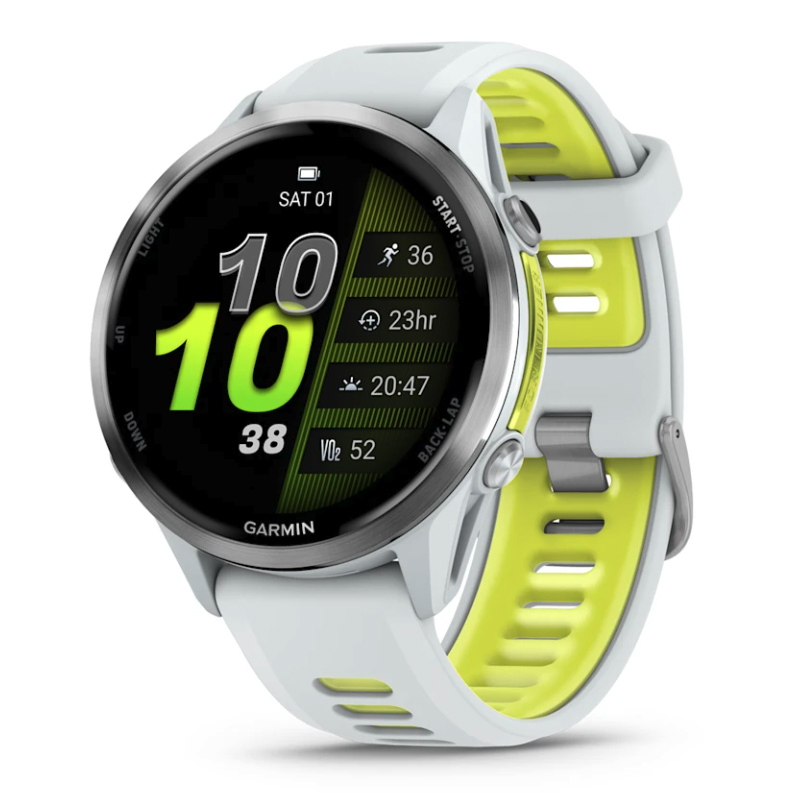
Garmin has released the new Forerunner 570 and Forerunner 970 smartwatches for athletes who are “out there chasing goals and passionate about their data”.
Focused primarily on running and triathlon, the new smartwatches come with a host of new features, including Garmin’s brightest-ever display, a built-in speaker and microphone, and more health and wellness features.
“Created for every athlete who is out there chasing goals and passionate about their data, the Forerunner 570 and Forerunner 970 include innovative training tools, recovery metrics and connected features to help them perform at their best,” says Garmin’s Susan Lyman.
Garmin has also announced the new HRM 600 heart-rate monitor, which features a rechargeable battery and is said to give athletes new performance data and ways to improve their training.
The Forerunner 570 has Garmin’s brightest-ever smartwatch display. Garmin
Described as an ‘advanced training tool’, the Garmin Forerunner 570 features the brand’s brightest smartwatch display to date.
The touchscreen display and five-button design are said to allow for fast, all-weather access to its training tools, health stats and notifications.
The watch includes free triathlon training plans, which will adapt daily to provide personalised workouts based on your performance, recovery and health metrics.
You can also create custom step-by-step multisport workouts in the Garmin Connect app and send them to the Forerunner 570.
If you’re running a course loaded for a race, the watch can suggest trimming data to the finish line if you forget to hit stop.
Costing £459.99, the watch also has a built-in speaker and microphone, so you can make or take calls when the watch is paired with a compatible smartphone. The microphone also means you can control the watch with voice commands, or dictate text messages.
With an eye on health and wellness, the watch will also provide you with an evening report. This includes a reminder of what sleep is needed, plus your workout for the following day, weather forecasts and events.
The watch can also track your skin temperature. Garmin says this can be related to recent activity, sleep environment and potential illness. It can also be used to provide female athletes with improved period prediction and past ovulation estimates.
Garmin Forerunner 970
The 970 has a built-in torch. Garmin
The Garmin Forerunner 970 has the same new features as the 570, but with some exclusive extras.
The watch has the same bright screen, but it features Garmin’s scratch-resistant sapphire lens technology. It also has a titanium bezel to “withstand the harshest of environments”.
A built-in LED torch can be controlled from the watch’s display.
The extra training features will be of most interest to runners. They include a running tolerance tool, which helps you better understand the impact a run has on your body, plus a running economy feature when used in tandem with the new Garmin HRM 600 heart-rate monitor.
The £629.99 watch can also detect signs of atrial fibrillation, an irregular heart rhythm.
Garmin HRM 600 heart-rate monitor
The HRM 600 is rechargeable. Garmin
Garmin says its new HRM 600 heart-rate monitor provides accurate heart-rate readings, while tracking heart-rate variability, and it will send that information to compatible Garmin smartwatches, cycling computers or apps.
The heart-rate monitor also has new features, including ‘expanded running dynamics’.
When used with the Forerunner 970, the new step speed loss feature will tell runners how much they slow down when their foot hits the ground.
For team sports where a smartwatch can’t be worn, the heart-rate monitor will also record activity data such as heart rate and distance, which you can then view in the Garmin Connect app.
Possibly of more interest to cyclists, the £149.99 HRM 600 can be recharged, with a single charge lasting up to two months.
The heart-rate monitor’s strap comes in two new sizes (XS-S and M-XL) to fit a range of body types.
The HRM 600, and Forerunner 570 and 970 will be available to order from 21 May.
The Ray-Ban Meta glasses are getting an upgrade to better help the blind and low vision community. The AI assistant will now provide “detailed responses” regarding what’s in front of users. Meta says it’ll kick in “when people ask about their environment.” To get started, users just have to opt-in via the Device Settings section in the Meta AI app.
The company shared a video of the tool in action in which a blind user asked Meta AI to describe a grassy area in a park. It quickly hopped into action and correctly pointed out a path, trees and a body of water in the distance. The AI assistant was also shown describing the contents of a kitchen.
I could see this being a fun add-on even for those without any visual impairment. In any event, it begins rolling out to all users in the US and Canada in the coming weeks. Meta plans on expanding to additional markets in the near future.
It’s Global Accessibility Awareness Day (GAAD), so that’s not the only accessibility-minded tool that Meta announced today. There’s the nifty Call a Volunteer, a tool that automatically connects blind or low vision people to a “network of sighted volunteers in real-time” to help complete everyday tasks. The volunteers come from the Be My Eyes foundation and the platform launches later this month in 18 countries.
The company recently announced a more refined system for live captions in all of its extended reality products, like the Quest line of VR headsets. This converts spoken words into text in real-time, so users can “read content as it’s being delivered.” The feature is already available for Quest headsets and within Meta Horizon Worlds.
This article originally appeared on Engadget at https://www.engadget.com/ai/metas-smart-glasses-will-soon-provide-detailed-information-regarding-visual-stimuli-153046605.html?src=rss
Folks who are starting to build out their smart home security systems could do a lot worse than going with Nest’s cameras. The Google brand offers an accessible entry point into home security (especially if you already have a Google account for Gmail, YouTube or the company’s other services). As such, the Google Nest Security Cam (Wired) is our pick for the best security camera for smart home newbies. That model is currently on sale for $70, which is $30 off and a record-low price.
The camera is a cinch to set up and get working the way you want it to. You can manage it through the Google Home app, which is smartly designed, clean and easy to navigate. The app takes you through the setup process with step-by-step directions, and the plain language helps make it a breeze to do things like customizing routines. The camera supports features like location-based triggers on both Android and iPhone — you can set things up so that you’re only notified of a detected incident when you’re away from home.
Along with viewing your camera feed in the Home app, you can also access it from a Nest Hub, Google TV or Streamer. You should get a decent look at whatever’s going on as the camera captures 1080p HD video with what we felt were accurate colors. Infrared images captured at night are smooth as well.
The Nest Cam has a fairly sleek, modern design featuring two half-orbs, one acting as the base (which can be wall-mounted) and another as the camera module. The arm that connects the two allows for a 90-degree range of vertical movement and full 360-degree horizontal rotation. That’s especially useful as the camera has a 135-degree field of view, which is decent enough but not exactly the widest among home security cameras.
Google gates some of the Nest Cam’s more useful features behind subscriptions. If you opt out, you’ll only get access to three hours of the most recent event history. That might not be long enough, especially if you’re away on a trip and something notable happens that your camera picks up.
With an $8-per-month Nest Aware subscription, you can access the past 30 days of recorded activity. Upgrade further to the $15 per month Nest Aware Plus plan and you can call up 90 days of recorded activity and store up to 10 days of round-the-clock recordings. A subscription isn’t required for the people, animal and people detection features, or customizing alerts for any of those.
This article originally appeared on Engadget at https://www.engadget.com/deals/the-best-security-camera-for-smart-home-newbies-is-on-sale-for-a-record-low-price-152534663.html?src=rss
Play For Dream MR, the high-end Android standalone headset, is getting Guy Godin’s app Virtual Desktop next week.
Originally founded in China as YVR in 2020, the headset company renamed itself to Play For Dream and reincorporated in Singapore alongside launching its third headset, called Play For Dream MR, which it started shipping this year.
Play For Dream MR is a high-end standalone headset running the company’s own fork of Android, with the kind of specs you might have expected from a Meta Quest Pro 2. Priced at $2000, it features Qualcomm’s Snapdragon XR2+ Gen 2 chipset, 4K micro-OLED displays, eye tracking with automatic IPD adjustment, and comes with tracked controllers. It has a 1-hour battery, built into the back of the strap, and thus Play For Dream recommends pairing it with an external battery pack.
Play For Dream MR already has a free built-in PC VR wireless streaming tool, just like Quest, Pico, and HTC standalone headsets do. But when I briefly tested it recently I found the quality and reliability lacking.
That’s why Virtual Desktop’s coming arrival on Play For Dream MR is so significant for the headset. Guy Godin’s $20 app is the gold standard for wirelessly streaming from your PC to a standalone headset, whether it be your flatscreen monitors or immersive VR.
Even on Quest, where Meta’s built-in Air Link and Valve’s Steam Link work relatively well and are available for free, many PC gamers purchase Virtual Desktop for a superior experience.
Virtual Desktop supports streaming multiple PC monitors, and even spawning virtual extra monitors, with industry-leading sharpness and latency. For VR streaming, it supports the latest AV1 codec as well as HEVC and H.264, with a range of features like passthrough cutouts and on-device upscaling and motion extrapolation.
The app’s arrival on Play For Dream MR could make the headset a viable high-end option for wireless PC VR, with significantly higher resolution than Quest 3, support for eye tracking, and OLED’s signature infinite contrast with rich colors and true blacks.
We plan to bring you extended impressions of Play For Dream MR soon, and perhaps a review later this year.
Of Lies and Rain is a post-apocalyptic sci-fi VR shooter where you fight to save humanity, and a free demo is out now on Quest and Steam.
Two years after launching ARK and ADE, Castello Inc. is gearing up for its next game with Of Lies and Rain, which is described as a story-driven FPS in a dark sci-fi world. Crossing between the real and digital realms, you’re tasked with saving humanity from the brink of extinction following a 20-year war against a rogue AI, A.D.E., as both sides fight for survival.
Of Lies and Rain is heading for early access first, though the Steam FAQ states all the core content – the full storyline, plus all game areas and mechanics – will be included. Castello’s main focus will be on bug fixing and optimizing performance for a more stable experience, and the game will remain in early access “for approximately 6 to 12 months.”
Regarding platform differences, Castello informed Gamertag VR that the Quest 2 version features no dynamic lights or shadows, 1K textures and reduced particle effects, whereas Quest 3 features “some” dynamic lights and 2K textures. The PC VR and PS VR2 versions both feature dynamic lighting, dynamic shadows, 4K textures, full particle effects, and post-processing effects.
As for the first level demo on Steam and Quest, I jumped into the Quest 3 version earlier today and came away impressed. The beginning reminds of Uncharted 2’s perilous opening as I climb the derailed train hanging off a cliff edge, and the oppressive atmosphere is immediately evident. From the AI’s flying vehicles to smaller creatures hiding out in the vents, you never feel at ease.
0:00
/0:24
Quest 3 demo footage captured by UploadVR
Most items are interactable from scattered bottles to a full chalkboard, which is nice to mess around with, though moments like using a hammer to break a door and grab the other side’s handle shows good VR-first design. I’m relieved to see HUD elements are minimal too, while data centers let you unlock upgrades in exchange for GPUs. I can’t upgrade my abilities too far yet, but your options include health boosts, increased fire rate and more bullets.
You’ll eventually unlock two new tools, a gravity gun and your gun. Weapons pleasingly use manual reloading for both the ammo and sliding back your pistol before you can fire, though I’ll need more time to effectively judge combat. Elsewhere, the gravity gun can be used for jumping over gaps, and you simply need to point in the direction you wish to go.
This can lead to some intense motion, which Castello warns about in the Horizon Store’s comfort rating. Even for a more active VR user like me, playing on minimal comfort settings left me nauseous after 30 minutes. Reassuringly, the demo has a good range of comfort options that help, like vignettes and snap turning. You can even switch the camera turning off entirely for extra immersion, which is a welcome sight. Left-handed settings, seated play and other options are also included.
I’m not completely sold on the story so far; the amnesiac protagonist is a convenient approach for introducing basic gameplay mechanics, but it’s a tired trope that’s been done to death. I’m enjoying the strong environmental storytelling, which effectively conveys a sense of dread. Thorough exploration is well encouraged too, whether that’s searching through lockers or finding GPUs (more on that shortly) hidden in boxes.
Of Lies and Rain isn’t what I’d call a horror game, not really, though there’s certainly elements of that in this world. Minor story spoilers ahead in the next paragraph, please skip to the next screenshot if you’d prefer to avoid these.
Arguably the most memorable moment came as I found a former human settlement. Between graffitied conversations on the walls reminiscent of Left 4 Dead to scattered items, seeing my stomach sank as I uncovered its horrifying fate. Discovering dried but bloodied human remains before uncovering a cannibal’s abattoir had me reeling as I realized what exactly happened here.
We’ve not yet tried the PC VR version, so I can’t offer a direct comparison right now, and we’re aiming to take a look at that soon. Still, I’m impressed by the visual fidelity so far on Quest 3, and Castello’s done well bringing this ruined, sometimes gruesome world to life. I’m curious to see what the full game will offer, and I’ll return for more when that happens.
Of Lies and Rain is “coming soon” on Quest, while Steam lists a 2025 release window. Castello also plans to release the demo on PlayStation VR2.
One of the most popular VR drumming rhythm games is released today for PlayStation VR 2, and there are some important differences compared to the Quest version.